U.S. Pat. No. 11,574,214
SEQUENTIAL DECISION ANALYSIS TECHNIQUES FOR E-SPORTS
AssigneeAT&T Intellectual Property I, L.P.
Issue DateMarch 31, 2020
Illustrative Figure
Abstract
Aspects of the subject disclosure may include, for example, training a decision scoring model for an e-sport based on historical data for the e-sport. In various embodiments, the decision scoring model may be trained based on the historical data and on metadata associated with the e-sport. Some embodiments can include identifying a plurality of candidate in-game decision sequences based on decision parameters for a gameplay decision of an ongoing gaming session and a gaming session history for the ongoing gaming session. Various embodiments can include applying the decision scoring model to rank the plurality of candidate in-game decision sequences. Other embodiments are disclosed.
Description
DETAILED DESCRIPTION The subject disclosure describes, among other things, illustrative embodiments for evaluating gameplay decisions in e-sports gameplay sessions. According to techniques described herein, the effects of present-time choices upon the nature of gameplay decisions that may be expected to arise in the future are taken into account. Some embodiments can include training a decision scoring model for an e-sport based on historical data for the e-sport. In various such embodiments, the decision scoring model may be trained based on the historical data and on metadata associated with the e-sport. Some embodiments can include identifying a plurality of candidate in-game decision sequences based on decision parameters for a gameplay decision of an ongoing gaming session and a gaming session history for the ongoing gaming session. Various embodiments can include applying the decision scoring model to rank the plurality of candidate in-game decision sequences. Other embodiments are described in the subject disclosure. One or more aspects of the subject disclosure include an apparatus comprising a processing system including a processor and a memory that stores executable instructions that, when executed by the processing system, facilitate performance of operations. The operations can include training a decision scoring model for an e-sport based on historical data for the e-sport, determining decision parameters for a gameplay decision of an ongoing gaming session of the e-sport, identifying a plurality of candidate in-game decision sequences based on the decision parameters and a gaming session history for the ongoing gaming session, and applying the decision scoring model to rank the plurality of candidate in-game decision sequences. One or more aspects of the subject disclosure include a non-transitory machine-readable medium, comprising executable instructions that, when executed by a processing system including a processor, facilitate performance of operations. The operations can include training a decision scoring model for an ...
DETAILED DESCRIPTION
The subject disclosure describes, among other things, illustrative embodiments for evaluating gameplay decisions in e-sports gameplay sessions. According to techniques described herein, the effects of present-time choices upon the nature of gameplay decisions that may be expected to arise in the future are taken into account. Some embodiments can include training a decision scoring model for an e-sport based on historical data for the e-sport. In various such embodiments, the decision scoring model may be trained based on the historical data and on metadata associated with the e-sport. Some embodiments can include identifying a plurality of candidate in-game decision sequences based on decision parameters for a gameplay decision of an ongoing gaming session and a gaming session history for the ongoing gaming session. Various embodiments can include applying the decision scoring model to rank the plurality of candidate in-game decision sequences. Other embodiments are described in the subject disclosure.
One or more aspects of the subject disclosure include an apparatus comprising a processing system including a processor and a memory that stores executable instructions that, when executed by the processing system, facilitate performance of operations. The operations can include training a decision scoring model for an e-sport based on historical data for the e-sport, determining decision parameters for a gameplay decision of an ongoing gaming session of the e-sport, identifying a plurality of candidate in-game decision sequences based on the decision parameters and a gaming session history for the ongoing gaming session, and applying the decision scoring model to rank the plurality of candidate in-game decision sequences.
One or more aspects of the subject disclosure include a non-transitory machine-readable medium, comprising executable instructions that, when executed by a processing system including a processor, facilitate performance of operations. The operations can include training a decision scoring model for an e-sport based on historical data for the e-sport, determining decision parameters for a gameplay decision of an ongoing gaming session of the e-sport, identifying a plurality of candidate in-game decision sequences based on the decision parameters and a gaming session history for the ongoing gaming session, and applying the decision scoring model to rank the plurality of candidate in-game decision sequences.
One or more aspects of the subject disclosure include a method. The method can include training a decision scoring model for an e-sport based on historical data for the e-sport, determining decision parameters for a gameplay decision of an ongoing gaming session of the e-sport, identifying a plurality of candidate in-game decision sequences based on the decision parameters and a gaming session history for the ongoing gaming session, and applying the decision scoring model to rank the plurality of candidate in-game decision sequences.
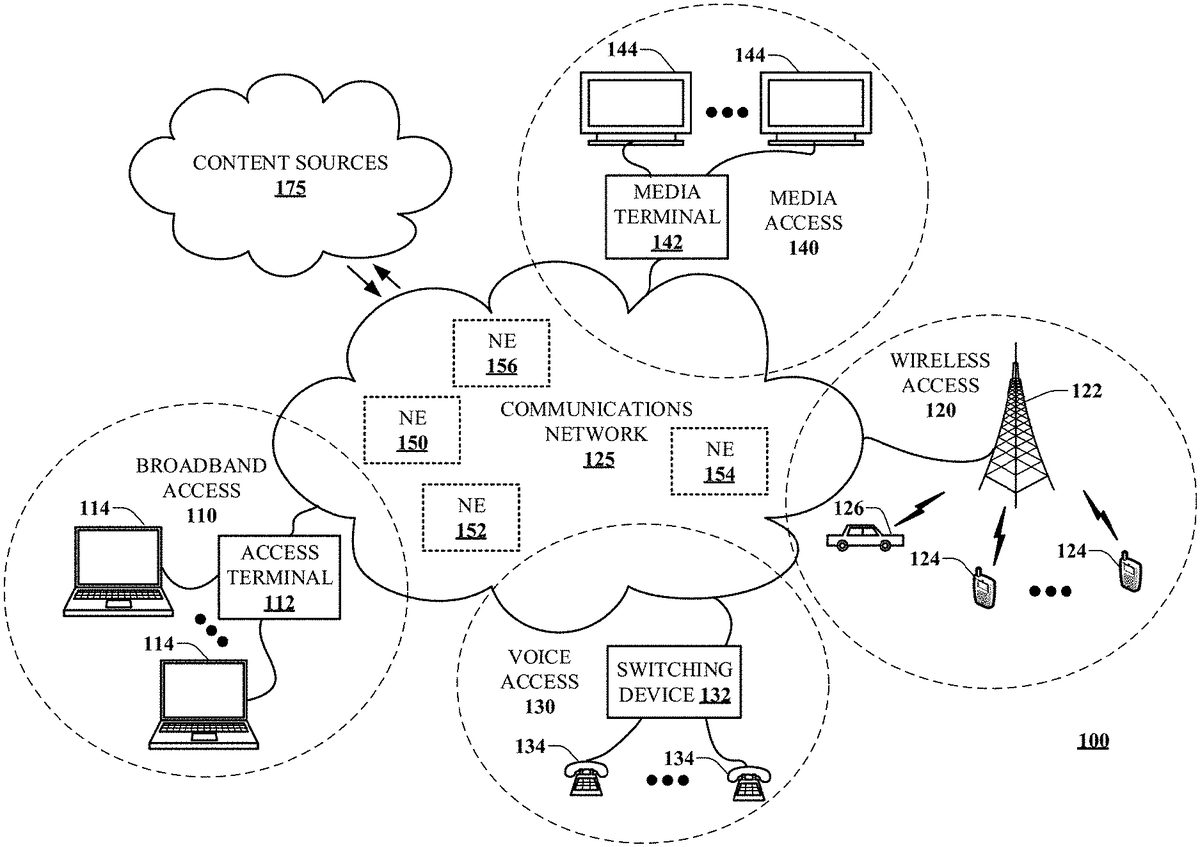
Referring now toFIG.1, a block diagram is shown illustrating an example, non-limiting embodiment of a system100in accordance with various aspects described herein. For example, system100can facilitate in whole or in part training a decision scoring model for an e-sport based on historical data for the e-sport, determining decision parameters for a gameplay decision of an ongoing gaming session of the e-sport, identifying a plurality of candidate in-game decision sequences based on the decision parameters and a gaming session history for the ongoing gaming session, and applying the decision scoring model to rank the plurality of candidate in-game decision sequences. In particular, a communications network125is presented for providing broadband access110to a plurality of data terminals114via access terminal112, wireless access120to a plurality of mobile devices124and vehicle126via base station or access point122, voice access130to a plurality of telephony devices134, via switching device132and/or media access140to a plurality of audio/video display devices144via media terminal142. In addition, communication network125is coupled to one or more content sources175of audio, video, graphics, text and/or other media. While broadband access110, wireless access120, voice access130and media access140are shown separately, one or more of these forms of access can be combined to provide multiple access services to a single client device (e.g., mobile devices124can receive media content via media terminal142, data terminal114can be provided voice access via switching device132, and so on).
The communications network125includes a plurality of network elements (NE)150,152,154,156, etc. for facilitating the broadband access110, wireless access120, voice access130, media access140and/or the distribution of content from content sources175. The communications network125can include a circuit switched or packet switched network, a voice over Internet protocol (VoIP) network, Internet protocol (IP) network, a cable network, a passive or active optical network, a 4G, 5G, or higher generation wireless access network, WIMAX network, UltraWideband network, personal area network or other wireless access network, a broadcast satellite network and/or other communications network.
In various embodiments, the access terminal112can include a digital subscriber line access multiplexer (DSLAM), cable modem termination system (CMTS), optical line terminal (OLT) and/or other access terminal. The data terminals114can include personal computers, laptop computers, netbook computers, tablets or other computing devices along with digital subscriber line (DSL) modems, data over coax service interface specification (DOCSIS) modems or other cable modems, a wireless modem such as a 4G, 5G, or higher generation modem, an optical modem and/or other access devices.
In various embodiments, the base station or access point122can include a 4G, 5G, or higher generation base station, an access point that operates via an 802.11 standard such as 802.11n, 802.11ac or other wireless access terminal. The mobile devices124can include mobile phones, e-readers, tablets, phablets, wireless modems, and/or other mobile computing devices.
In various embodiments, the switching device132can include a private branch exchange or central office switch, a media services gateway, VoIP gateway or other gateway device and/or other switching device. The telephony devices134can include traditional telephones (with or without a terminal adapter), VoIP telephones and/or other telephony devices.
In various embodiments, the media terminal142can include a cable head-end or other TV head-end, a satellite receiver, gateway or other media terminal142. The display devices144can include televisions with or without a set top box, personal computers and/or other display devices.
In various embodiments, the content sources175include broadcast television and radio sources, video on demand platforms and streaming video and audio services platforms, one or more content data networks, data servers, web servers and other content servers, and/or other sources of media.
In various embodiments, the communications network125can include wired, optical and/or wireless links and the network elements150,152,154,156, etc. can include service switching points, signal transfer points, service control points, network gateways, media distribution hubs, servers, firewalls, routers, edge devices, switches and other network nodes for routing and controlling communications traffic over wired, optical and wireless links as part of the Internet and other public networks as well as one or more private networks, for managing subscriber access, for billing and network management and for supporting other network functions.
FIG.2is a block diagram illustrating a non-limiting example of an operating environment200that may be representative of various embodiments. In operating environment200, a plurality of players202-1to202-N compete in an e-sport by participating in a gaming session of the e-sport. According to some embodiments, teams may be formed from some or all of players202-1to202-N, and those teams may compete against each other during the gaming session. In the example depicted inFIG.2, a team203is formed, featuring players202-1,202-2, and202-3as members. In various embodiments, participants in the gaming session may compete against each both individually and as teams. In some other embodiments, participants in the gaming session may compete as individuals only. In still other embodiments, some participants in the gaming session may compete as individuals only, while other participants may compete as members of teams, in addition to or in lieu of competing individually. The embodiments are not limited in this context.
202-1to202-N participate in the gaming session using respective e-sport client devices204-1to204-N. Each of e-sport client devices204-1to204-N may comprise respective processing circuitry to run an e-sport client application that enables participation in the gaming session of the e-sport. Any or all of e-sport client devices204-1to204-N may comprise additional components facilitating participation in the gaming session. For example, in various embodiments, any or all of e-sport client devices204-1to204-N can additionally include one or more input devices to receive player input during the gaming session, one or more display devices to display visual effects during the gaming session, and/or one or more audio devices to generate audio effects during the gaming session. The embodiments are not limited to this example.
In some embodiments, an e-sport coordinator240can coordinate the e-sport gaming session. As reflected inFIG.2, in various embodiments, e-sport coordinator240can comprise an e-sport coordinator application running on an e-sport server230. During the e-sport gaming session, e-sport coordinator240can communicate, via a communication network205, with e-sport client applications running on e-sport client devices204-1to204-N. In a given embodiment, for any given one of e-sport client devices204-1to204-N, connectivity to e-sport coordinator240via communication network205can constitute wired connectivity, wireless connectivity, or a combination of both.
Participants in the e-sport gaming session in operating environment200may be faced with various types of gameplay decisions at various points in time over the course of the session. In the case of many e-sports, a rapid pace of play may afford participants little time to consider their options when handling such gameplay decisions. As a result, it may be difficult for participants, as well as commentators and spectators, to assess the extent to which participants' decision-making has aided or hindered their efforts to win. This difficulty may be compounded by the fact that different available options for a present decision may give rise to different future gameplay decisions.
FIG.3is a block diagram illustrating a non-limiting example of a decision analysis scheme300that may be implemented in some embodiments in order to provide e-sports participants and observers with improved insight into gameplay decisions. According to decision analysis scheme300, a decision scoring model is used to evaluate the available options for gameplay decisions, while a decision simulator is used to identify future gameplay decisions that may arise from selection of such options. The decision scoring model may generally accept inputs comprising lists of options for gameplay decisions of the e-sport, evaluate the options in such lists, and rank the options in order of preference, based on the evaluations. Optionally, the decision scoring model may determine preference scores for the options.
The decision scoring model can be trained using historical data for the relevant e-sport. The historical data can include statistics generally characterizing results of past gaming sessions of the e-sport. These statistics can include statistics aggregated at the player level, statistics aggregated at the team level, or both. Examples of such statistics can include, without limitation, win/loss records, gold/experience point accrual totals/rates, and kill counts/rates. The historical data can also include player histories generally characterizing aspects of the performance of given players in past gaming sessions. Such player histories can include statistics such as those discussed above, broken down in terms of heroes/roles played (attack/support/defend), time (evolution of skill level), past teams, a combination of these, and/or other factors. The historical data can additionally include game information associated with the e-sport in question. Such game information can comprise, for example, update logs from developers of the e-sport, and can describe changes that have occurred over time with respect to maps, game mechanics, and/or heroes/characters of the e-sport.
Optionally, the decision scoring model can be trained using metadata associated with the e-sport. Such metadata can include game timeline information describing timings of events, such as fights, kills, and item buys, that occur during gaming sessions of the e-sport. Such metadata can additionally/alternatively include player positioning timeline information describing the positions of players in gaming sessions of the e-sport, continuously or at discrete points in time. Such metadata can additionally/alternatively include map information describing various aspects, such as size, topography, barriers, and/or player line of sight, of maps associated with gaming sessions of the e-sport. Optionally, metadata extraction model(s) may be used to obtain some or all of such metadata by analyzing video and/or audio feeds of gaming sessions of the e-sport.
In some embodiments, the historical data (and optionally, metadata) used to train the decision scoring model may be restricted to a subset of gaming sessions (e.g., only gaming sessions featuring given teams as participants) and/or particular time period(s) (e.g., only gaming sessions within the preceding two years). In some embodiments, differential weighting may be applied across time and/or player segments in conjunction with training the decision scoring model. In some embodiments, missing parts of the feature space may be inferred using mathematical smoothing techniques such as interpolation or imputation.
When used to evaluate options for gameplay decisions during an ongoing e-sport gaming session, the decision scoring model may accept inputs including a game history for the ongoing gaming session, a decision type characterizing the gameplay decision, and a list of options to be considered for the gameplay decision. The game history may comprise information generally describing results/aspects of the ongoing gaming session through a time t generally corresponding to the present. Examples of decision types can include, without limitation, hero pick/ban decisions, item purchase decisions, gold expenditure decisions, in-game team formation decisions, and attack/defend decisions.
During an initial iteration, the decision scoring model may be used to rank/score the available options for the gameplay decision under consideration. A check may then be performed to determine whether a termination condition has been satisfied. In some embodiments, the termination condition may require decision scoring at a number of time points that are pre-supplied instead of being generated by the decision simulator. In some embodiments, the termination condition may impose a lower bound on decision scores, such that the evaluation process continues until a threshold score is exceeded. In some embodiments, the termination condition may impose an upper bound on the lengths of decision sequences to be considered using the decision scoring model.
If the termination condition has not been satisfied following a given iteration, a subsequent iteration or “loop” may be initiated. During the subsequent iteration/loop, the decision simulator may be provided with feedback regarding the results returned by the decision scoring model during the preceding iteration/loop. Based on such feedback, the decision simulator may predict future gaming decisions, and available options for such future gaming decisions, that may arise as a result of various possible choices associated with gaming decisions at earlier points in time. The decision simulator may output a list of decision sequences, which may then be accepted as input, evaluated, and ranked/scored using the decision scoring model.
FIG.4is a block diagram illustrating a non-limiting example of an operating environment400that may be representative of various embodiments. In operating environment400, an e-sport analyzer420generally performs decision analysis in accordance with decision analysis scheme300ofFIG.3. As shown inFIG.4, e-sport analyzer420comprises a decision evaluator422, a decision simulator424, and a metadata extractor426. Decision evaluator422generally analyzes/evaluates gameplay decisions of an e-sport using the decision scoring model of decision analysis scheme300. Decision simulator424generally performs operations corresponding to those of the decision simulator of decision analysis scheme300. Metadata extractor426generally extracts metadata427from video feed(s)416and/or audio feed(s)417using metadata extraction model(s) such as may optionally be used in conjunction with decision analysis scheme300.
An e-sport reporter410communicates with e-sport coordinator240to obtain various types of information associated with e-sport gaming sessions coordinated by e-sport coordinator240. Such information can include any or all of historical data412, metadata414, video feed(s)416, audio feed(s)417, and session information418. Historical data412can include statistics generally characterizing results of past gaming sessions of the e-sport, and generally corresponds to the historical data used to train the decision scoring model of decision analysis scheme300ofFIG.3. Metadata414(and/or metadata427) can include game timeline information describing timings of events, such as fights, kills, and item buys, that occur during gaming sessions of the e-sport, player positioning timeline information describing the positions of players in gaming sessions of the e-sport, and/or map information describing various aspects, such as size, topography, barriers, and/or player line of sight, of maps associated with gaming sessions of the e-sport. Video feed(s)416and audio feed(s)417generally comprise video/audio feeds of gaming sessions of the e-sport. Session information418generally comprises information describing aspects of an ongoing gaming session of the e-sport. Session information418can include a gaming session history for the ongoing gaming session, which may serve as input to the decision scoring model of decision analysis scheme300.
E-sport analyzer420may train the decision scoring model based on historical data412, metadata414, and/or metadata427. E-sport analyzer420may then use the decision scoring model to evaluate gameplay decisions during the ongoing gaming session. In conjunction with evaluating such gameplay decisions during the ongoing gaming session, e-sport analyzer420may identify candidate decision sequences429based on decision parameters428and the gaming session history for the ongoing gaming session, and may apply the decision scoring model to rank candidate decision sequences429. Decision parameters428may generally comprise information characterizing a gameplay decision of the ongoing gaming session. Decision parameters428can include information identifying a decision type characterizing the gameplay decision, information indicating a timing of the gameplay decision, and a list of options to be considered for the gameplay decision.
FIG.5depicts an illustrative embodiment of a method500in accordance with various aspects described herein. According to some embodiments, method500may be representative of the implementation of decision analysis scheme300ofFIG.3in operating environment400ofFIG.4. As shown inFIG.5, historical data for an e-sport may be identified at502. For example, in operating environment400ofFIG.4, e-sport analyzer420may identify historical data412provided by e-sport reporter410. At504, metadata for the e-sport may be identified. For example, in operating environment400ofFIG.4, e-sport analyzer420may identify metadata414provided by e-sport reporter410and/or metadata427provided by metadata extractor426.
At506, a decision scoring model for the e-sport may be trained using the historical data identified at502and the metadata identified at504. For example, in operating environment400ofFIG.4, e-sport analyzer420may train a decision scoring model for an e-sport using historical data412, metadata414, and/or metadata427. At508, decision parameters may be determined for a gameplay decision of an ongoing gaming session of an e-sport. For example, in operating environment400ofFIG.4, e-sport analyzer420may determine decision parameters428.
At510, a plurality of candidate in-game decision sequences may be identified based on the decision parameters determined at508and a gaming session history for the ongoing gaming session. For example, in operating environment400ofFIG.4, e-sport analyzer420may identify candidate decision sequences429based on decision parameters428and a gaming session history comprised among session information418. At512, the decision scoring model may be applied to rank the plurality of candidate in-game decision sequences identified at510. For example, in operating environment400ofFIG.4, e-sport analyzer420may apply a decision scoring model to rank candidate decision sequences429. The embodiments are not limited to these examples.
While for purposes of simplicity of explanation, the respective processes are shown and described as a series of blocks inFIG.5, it is to be understood and appreciated that the claimed subject matter is not limited by the order of the blocks, as some blocks may occur in different orders and/or concurrently with other blocks from what is depicted and described herein. Moreover, not all illustrated blocks may be required to implement the methods described herein.
Referring now toFIG.6, a block diagram is shown illustrating an example, non-limiting embodiment of a virtualized communication network600in accordance with various aspects described herein. In particular a virtualized communication network is presented that can be used to implement some or all of the subsystems and functions of system100, the subsystems and functions of decision analysis scheme300, and the operations of method500presented inFIGS.1,3, and5. For example, virtualized communication network600can facilitate in whole or in part training a decision scoring model for an e-sport based on historical data for the e-sport, determining decision parameters for a gameplay decision of an ongoing gaming session of the e-sport, identifying a plurality of candidate in-game decision sequences based on the decision parameters and a gaming session history for the ongoing gaming session, and applying the decision scoring model to rank the plurality of candidate in-game decision sequences.
In particular, a cloud networking architecture is shown that leverages cloud technologies and supports rapid innovation and scalability via a transport layer650, a virtualized network function cloud625and/or one or more cloud computing environments675. In various embodiments, this cloud networking architecture is an open architecture that leverages application programming interfaces (APIs); reduces complexity from services and operations; supports more nimble business models; and rapidly and seamlessly scales to meet evolving customer requirements including traffic growth, diversity of traffic types, and diversity of performance and reliability expectations.
In contrast to traditional network elements—which are typically integrated to perform a single function, the virtualized communication network employs virtual network elements (VNEs)630,632,634, etc. that perform some or all of the functions of network elements150,152,154,156, etc. For example, the network architecture can provide a substrate of networking capability, often called Network Function Virtualization Infrastructure (NFVI) or simply infrastructure that is capable of being directed with software and Software Defined Networking (SDN) protocols to perform a broad variety of network functions and services. This infrastructure can include several types of substrates. The most typical type of substrate being servers that support Network Function Virtualization (NFV), followed by packet forwarding capabilities based on generic computing resources, with specialized network technologies brought to bear when general purpose processors or general purpose integrated circuit devices offered by merchants (referred to herein as merchant silicon) are not appropriate. In this case, communication services can be implemented as cloud-centric workloads.
As an example, a traditional network element150(shown inFIG.1), such as an edge router can be implemented via a VNE630composed of NFV software modules, merchant silicon, and associated controllers. The software can be written so that increasing workload consumes incremental resources from a common resource pool, and moreover so that it's elastic: so the resources are only consumed when needed. In a similar fashion, other network elements such as other routers, switches, edge caches, and middle-boxes are instantiated from the common resource pool. Such sharing of infrastructure across a broad set of uses makes planning and growing infrastructure easier to manage.
In an embodiment, the transport layer650includes fiber, cable, wired and/or wireless transport elements, network elements and interfaces to provide broadband access110, wireless access120, voice access130, media access140and/or access to content sources175for distribution of content to any or all of the access technologies. In particular, in some cases a network element needs to be positioned at a specific place, and this allows for less sharing of common infrastructure. Other times, the network elements have specific physical layer adapters that cannot be abstracted or virtualized, and might require special DSP code and analog front-ends (AFEs) that do not lend themselves to implementation as VNEs630,632or634. These network elements can be included in transport layer650.
The virtualized network function cloud625interfaces with the transport layer650to provide the VNEs630,632,634, etc. to provide specific NFVs. In particular, the virtualized network function cloud625leverages cloud operations, applications, and architectures to support networking workloads. The virtualized network elements630,632and634can employ network function software that provides either a one-for-one mapping of traditional network element function or alternately some combination of network functions designed for cloud computing. For example, VNEs630,632and634can include route reflectors, domain name system (DNS) servers, and dynamic host configuration protocol (DHCP) servers, system architecture evolution (SAE) and/or mobility management entity (MME) gateways, broadband network gateways, IP edge routers for IP-VPN, Ethernet and other services, load balancers, distributers and other network elements. Because these elements don't typically need to forward large amounts of traffic, their workload can be distributed across a number of servers—each of which adds a portion of the capability, and overall which creates an elastic function with higher availability than its former monolithic version. These virtual network elements630,632,634, etc. can be instantiated and managed using an orchestration approach similar to those used in cloud compute services.
The cloud computing environments675can interface with the virtualized network function cloud625via APIs that expose functional capabilities of the VNEs630,632,634, etc. to provide the flexible and expanded capabilities to the virtualized network function cloud625. In particular, network workloads may have applications distributed across the virtualized network function cloud625and cloud computing environment675and in the commercial cloud, or might simply orchestrate workloads supported entirely in NFV infrastructure from these third party locations.
Turning now toFIG.7, there is illustrated a block diagram of a computing environment700in accordance with various aspects described herein. In order to provide additional context for various embodiments of the embodiments described herein,FIG.7and the following discussion are intended to provide a brief, general description of a suitable computing environment700in which the various embodiments of the subject disclosure can be implemented. In particular, computing environment700can be used in the implementation of network elements150,152,154,156, access terminal112, base station or access point122, switching device132, media terminal142, and/or VNEs630,632,634, etc. Each of these devices can be implemented via computer-executable instructions that can run on one or more computers, and/or in combination with other program modules and/or as a combination of hardware and software. For example, computing environment700can facilitate in whole or in part training a decision scoring model for an e-sport based on historical data for the e-sport, determining decision parameters for a gameplay decision of an ongoing gaming session of the e-sport, identifying a plurality of candidate in-game decision sequences based on the decision parameters and a gaming session history for the ongoing gaming session, and applying the decision scoring model to rank the plurality of candidate in-game decision sequences.
Generally, program modules comprise routines, programs, components, data structures, etc., that perform particular tasks or implement particular abstract data types. Moreover, those skilled in the art will appreciate that the methods can be practiced with other computer system configurations, comprising single-processor or multiprocessor computer systems, minicomputers, mainframe computers, as well as personal computers, hand-held computing devices, microprocessor-based or programmable consumer electronics, and the like, each of which can be operatively coupled to one or more associated devices.
As used herein, a processing circuit includes one or more processors as well as other application specific circuits such as an application specific integrated circuit, digital logic circuit, state machine, programmable gate array or other circuit that processes input signals or data and that produces output signals or data in response thereto. It should be noted that while any functions and features described herein in association with the operation of a processor could likewise be performed by a processing circuit.
The illustrated embodiments of the embodiments herein can be also practiced in distributed computing environments where certain tasks are performed by remote processing devices that are linked through a communications network. In a distributed computing environment, program modules can be located in both local and remote memory storage devices.
Computing devices typically comprise a variety of media, which can comprise computer-readable storage media and/or communications media, which two terms are used herein differently from one another as follows. Computer-readable storage media can be any available storage media that can be accessed by the computer and comprises both volatile and nonvolatile media, removable and non-removable media. By way of example, and not limitation, computer-readable storage media can be implemented in connection with any method or technology for storage of information such as computer-readable instructions, program modules, structured data or unstructured data.
Computer-readable storage media can comprise, but are not limited to, random access memory (RAM), read only memory (ROM), electrically erasable programmable read only memory (EEPROM), flash memory or other memory technology, compact disk read only memory (CD-ROM), digital versatile disk (DVD) or other optical disk storage, magnetic cassettes, magnetic tape, magnetic disk storage or other magnetic storage devices or other tangible and/or non-transitory media which can be used to store desired information. In this regard, the terms “tangible” or “non-transitory” herein as applied to storage, memory or computer-readable media, are to be understood to exclude only propagating transitory signals per se as modifiers and do not relinquish rights to all standard storage, memory or computer-readable media that are not only propagating transitory signals per se.
Computer-readable storage media can be accessed by one or more local or remote computing devices, e.g., via access requests, queries or other data retrieval protocols, for a variety of operations with respect to the information stored by the medium.
Communications media typically embody computer-readable instructions, data structures, program modules or other structured or unstructured data in a data signal such as a modulated data signal, e.g., a carrier wave or other transport mechanism, and comprises any information delivery or transport media. The term “modulated data signal” or signals refers to a signal that has one or more of its characteristics set or changed in such a manner as to encode information in one or more signals. By way of example, and not limitation, communication media comprise wired media, such as a wired network or direct-wired connection, and wireless media such as acoustic, RF, infrared and other wireless media.
With reference again toFIG.7, the example environment can comprise a computer702, the computer702comprising a processing unit704, a system memory706and a system bus708. The system bus708couples system components including, but not limited to, the system memory706to the processing unit704. The processing unit704can be any of various commercially available processors. Dual microprocessors and other multiprocessor architectures can also be employed as the processing unit704.
The system bus708can be any of several types of bus structure that can further interconnect to a memory bus (with or without a memory controller), a peripheral bus, and a local bus using any of a variety of commercially available bus architectures. The system memory706comprises ROM710and RAM712. A basic input/output system (BIOS) can be stored in a non-volatile memory such as ROM, erasable programmable read only memory (EPROM), EEPROM, which BIOS contains the basic routines that help to transfer information between elements within the computer702, such as during startup. The RAM712can also comprise a high-speed RAM such as static RAM for caching data.
The computer702further comprises an internal hard disk drive (HDD)714(e.g., EIDE, SATA), which internal HDD714can also be configured for external use in a suitable chassis (not shown), a magnetic floppy disk drive (FDD)716, (e.g., to read from or write to a removable diskette718) and an optical disk drive720, (e.g., reading a CD-ROM disk722or, to read from or write to other high capacity optical media such as the DVD). The HDD714, magnetic FDD716and optical disk drive720can be connected to the system bus708by a hard disk drive interface724, a magnetic disk drive interface726and an optical drive interface728, respectively. The hard disk drive interface724for external drive implementations comprises at least one or both of Universal Serial Bus (USB) and Institute of Electrical and Electronics Engineers (IEEE) 1394 interface technologies. Other external drive connection technologies are within contemplation of the embodiments described herein.
The drives and their associated computer-readable storage media provide nonvolatile storage of data, data structures, computer-executable instructions, and so forth. For the computer702, the drives and storage media accommodate the storage of any data in a suitable digital format. Although the description of computer-readable storage media above refers to a hard disk drive (HDD), a removable magnetic diskette, and a removable optical media such as a CD or DVD, it should be appreciated by those skilled in the art that other types of storage media which are readable by a computer, such as zip drives, magnetic cassettes, flash memory cards, cartridges, and the like, can also be used in the example operating environment, and further, that any such storage media can contain computer-executable instructions for performing the methods described herein.
A number of program modules can be stored in the drives and RAM712, comprising an operating system730, one or more application programs732, other program modules734and program data736. All or portions of the operating system, applications, modules, and/or data can also be cached in the RAM712. The systems and methods described herein can be implemented utilizing various commercially available operating systems or combinations of operating systems.
A user can enter commands and information into the computer702through one or more wired/wireless input devices, e.g., a keyboard738and a pointing device, such as a mouse740. Other input devices (not shown) can comprise a microphone, an infrared (IR) remote control, a joystick, a game pad, a stylus pen, touch screen or the like. These and other input devices are often connected to the processing unit704through an input device interface742that can be coupled to the system bus708, but can be connected by other interfaces, such as a parallel port, an IEEE 1394 serial port, a game port, a universal serial bus (USB) port, an IR interface, etc.
A monitor744or other type of display device can be also connected to the system bus708via an interface, such as a video adapter746. It will also be appreciated that in alternative embodiments, a monitor744can also be any display device (e.g., another computer having a display, a smart phone, a tablet computer, etc.) for receiving display information associated with computer702via any communication means, including via the Internet and cloud-based networks. In addition to the monitor744, a computer typically comprises other peripheral output devices (not shown), such as speakers, printers, etc.
The computer702can operate in a networked environment using logical connections via wired and/or wireless communications to one or more remote computers, such as a remote computer(s)748. The remote computer(s)748can be a workstation, a server computer, a router, a personal computer, portable computer, microprocessor-based entertainment appliance, a peer device or other common network node, and typically comprises many or all of the elements described relative to the computer702, although, for purposes of brevity, only a remote memory/storage device750is illustrated. The logical connections depicted comprise wired/wireless connectivity to a local area network (LAN)752and/or larger networks, e.g., a wide area network (WAN)754. Such LAN and WAN networking environments are commonplace in offices and companies, and facilitate enterprise-wide computer networks, such as intranets, all of which can connect to a global communications network, e.g., the Internet.
When used in a LAN networking environment, the computer702can be connected to the LAN752through a wired and/or wireless communication network interface or adapter756. The adapter756can facilitate wired or wireless communication to the LAN752, which can also comprise a wireless AP disposed thereon for communicating with the adapter756.
When used in a WAN networking environment, the computer702can comprise a modem758or can be connected to a communications server on the WAN754or has other means for establishing communications over the WAN754, such as by way of the Internet. The modem758, which can be internal or external and a wired or wireless device, can be connected to the system bus708via the input device interface742. In a networked environment, program modules depicted relative to the computer702or portions thereof, can be stored in the remote memory/storage device750. It will be appreciated that the network connections shown are example and other means of establishing a communications link between the computers can be used.
The computer702can be operable to communicate with any wireless devices or entities operatively disposed in wireless communication, e.g., a printer, scanner, desktop and/or portable computer, portable data assistant, communications satellite, any piece of equipment or location associated with a wirelessly detectable tag (e.g., a kiosk, news stand, restroom), and telephone. This can comprise Wireless Fidelity (Wi-Fi) and BLUETOOTH® wireless technologies. Thus, the communication can be a predefined structure as with a conventional network or simply an ad hoc communication between at least two devices.
Wi-Fi can allow connection to the Internet from a couch at home, a bed in a hotel room or a conference room at work, without wires. Wi-Fi is a wireless technology similar to that used in a cell phone that enables such devices, e.g., computers, to send and receive data indoors and out; anywhere within the range of a base station. Wi-Fi networks use radio technologies called IEEE 802.11 (a, b, g, n, ac, ag, etc.) to provide secure, reliable, fast wireless connectivity. A Wi-Fi network can be used to connect computers to each other, to the Internet, and to wired networks (which can use IEEE 802.3 or Ethernet). Wi-Fi networks operate in the unlicensed 2.4 and 5 GHz radio bands for example or with products that contain both bands (dual band), so the networks can provide real-world performance similar to the basic 10BaseT wired Ethernet networks used in many offices.
Turning now toFIG.8, an embodiment800of a mobile network platform810is shown that is an example of network elements150,152,154,156, and/or VNEs530,532,534, etc. For example, platform810can facilitate in whole or in part training a decision scoring model for an e-sport based on historical data for the e-sport, determining decision parameters for a gameplay decision of an ongoing gaming session of the e-sport, identifying a plurality of candidate in-game decision sequences based on the decision parameters and a gaming session history for the ongoing gaming session, and applying the decision scoring model to rank the plurality of candidate in-game decision sequences. In one or more embodiments, the mobile network platform810can generate and receive signals transmitted and received by base stations or access points such as base station or access point122. Generally, mobile network platform810can comprise components, e.g., nodes, gateways, interfaces, servers, or disparate platforms, that facilitate both packet-switched (PS) (e.g., internet protocol (IP), frame relay, asynchronous transfer mode (ATM)) and circuit-switched (CS) traffic (e.g., voice and data), as well as control generation for networked wireless telecommunication. As a non-limiting example, mobile network platform810can be included in telecommunications carrier networks, and can be considered carrier-side components as discussed elsewhere herein. Mobile network platform810comprises CS gateway node(s)812which can interface CS traffic received from legacy networks like telephony network(s)840(e.g., public switched telephone network (PSTN), or public land mobile network (PLMN)) or a signaling system #7 (SS7) network860. CS gateway node(s)812can authorize and authenticate traffic (e.g., voice) arising from such networks. Additionally, CS gateway node(s)812can access mobility, or roaming, data generated through SS7 network860; for instance, mobility data stored in a visited location register (VLR), which can reside in memory830. Moreover, CS gateway node(s)812interfaces CS-based traffic and signaling and PS gateway node(s)818. As an example, in a 3GPP UMTS network, CS gateway node(s)812can be realized at least in part in gateway GPRS support node(s) (GGSN). It should be appreciated that functionality and specific operation of CS gateway node(s)812, PS gateway node(s)818, and serving node(s)816, is provided and dictated by radio technology(ies) utilized by mobile network platform810for telecommunication over a radio access network820with other devices, such as a radiotelephone875.
In addition to receiving and processing CS-switched traffic and signaling, PS gateway node(s)818can authorize and authenticate PS-based data sessions with served mobile devices. Data sessions can comprise traffic, or content(s), exchanged with networks external to the mobile network platform810, like wide area network(s) (WANs)850, enterprise network(s)870, and service network(s)880, which can be embodied in local area network(s) (LANs), can also be interfaced with mobile network platform810through PS gateway node(s)818. It is to be noted that WANs850and enterprise network(s)870can embody, at least in part, a service network(s) like IP multimedia subsystem (IMS). Based on radio technology layer(s) available in technology resource(s) or radio access network820, PS gateway node(s)818can generate packet data protocol contexts when a data session is established; other data structures that facilitate routing of packetized data also can be generated. To that end, in an aspect, PS gateway node(s)818can comprise a tunnel interface (e.g., tunnel termination gateway (TTG) in 3GPP UMTS network(s) (not shown)) which can facilitate packetized communication with disparate wireless network(s), such as Wi-Fi networks.
In embodiment800, mobile network platform810also comprises serving node(s)816that, based upon available radio technology layer(s) within technology resource(s) in the radio access network820, convey the various packetized flows of data streams received through PS gateway node(s)818. It is to be noted that for technology resource(s) that rely primarily on CS communication, server node(s) can deliver traffic without reliance on PS gateway node(s)818; for example, server node(s) can embody at least in part a mobile switching center. As an example, in a 3GPP UMTS network, serving node(s)816can be embodied in serving GPRS support node(s) (SGSN).
For radio technologies that exploit packetized communication, server(s)814in mobile network platform810can execute numerous applications that can generate multiple disparate packetized data streams or flows, and manage (e.g., schedule, queue, format . . . ) such flows. Such application(s) can comprise add-on features to standard services (for example, provisioning, billing, customer support . . . ) provided by mobile network platform810. Data streams (e.g., content(s) that are part of a voice call or data session) can be conveyed to PS gateway node(s)818for authorization/authentication and initiation of a data session, and to serving node(s)816for communication thereafter. In addition to application server, server(s)814can comprise utility server(s), a utility server can comprise a provisioning server, an operations and maintenance server, a security server that can implement at least in part a certificate authority and firewalls as well as other security mechanisms, and the like. In an aspect, security server(s) secure communication served through mobile network platform810to ensure network's operation and data integrity in addition to authorization and authentication procedures that CS gateway node(s)812and PS gateway node(s)818can enact. Moreover, provisioning server(s) can provision services from external network(s) like networks operated by a disparate service provider; for instance, WAN850or Global Positioning System (GPS) network(s) (not shown). Provisioning server(s) can also provision coverage through networks associated to mobile network platform810(e.g., deployed and operated by the same service provider), such as the distributed antennas networks shown inFIG.1(s)that enhance wireless service coverage by providing more network coverage.
It is to be noted that server(s)814can comprise one or more processors configured to confer at least in part the functionality of mobile network platform810. To that end, the one or more processor can execute code instructions stored in memory830, for example. It is should be appreciated that server(s)814can comprise a content manager, which operates in substantially the same manner as described hereinbefore.
In example embodiment800, memory830can store information related to operation of mobile network platform810. Other operational information can comprise provisioning information of mobile devices served through mobile network platform810, subscriber databases; application intelligence, pricing schemes, e.g., promotional rates, flat-rate programs, couponing campaigns; technical specification(s) consistent with telecommunication protocols for operation of disparate radio, or wireless, technology layers; and so forth. Memory830can also store information from at least one of telephony network(s)840, WAN850, SS7 network860, or enterprise network(s)870. In an aspect, memory830can be, for example, accessed as part of a data store component or as a remotely connected memory store.
In order to provide a context for the various aspects of the disclosed subject matter,FIG.8, and the following discussion, are intended to provide a brief, general description of a suitable environment in which the various aspects of the disclosed subject matter can be implemented. While the subject matter has been described above in the general context of computer-executable instructions of a computer program that runs on a computer and/or computers, those skilled in the art will recognize that the disclosed subject matter also can be implemented in combination with other program modules. Generally, program modules comprise routines, programs, components, data structures, etc. that perform particular tasks and/or implement particular abstract data types.
Turning now toFIG.9, an illustrative embodiment of a communication device900is shown. The communication device900can serve as an illustrative embodiment of devices such as data terminals114, mobile devices124, vehicle126, display devices144or other client devices for communication via either communications network125. For example, computing device900can facilitate in whole or in part training a decision scoring model for an e-sport based on historical data for the e-sport, determining decision parameters for a gameplay decision of an ongoing gaming session of the e-sport, identifying a plurality of candidate in-game decision sequences based on the decision parameters and a gaming session history for the ongoing gaming session, and applying the decision scoring model to rank the plurality of candidate in-game decision sequences.
The communication device900can comprise a wireline and/or wireless transceiver902(herein transceiver902), a user interface (UI)904, a power supply914, a location receiver916, a motion sensor918, an orientation sensor920, and a controller906for managing operations thereof. The transceiver902can support short-range or long-range wireless access technologies such as Bluetooth®, ZigBee®, WiFi, DECT, or cellular communication technologies, just to mention a few (Bluetooth® and ZigBee® are trademarks registered by the Bluetooth® Special Interest Group and the ZigBee® Alliance, respectively). Cellular technologies can include, for example, CDMA-1X, UMTS/HSDPA, GSM/GPRS, TDMA/EDGE, EV/DO, WiMAX, SDR, LTE, as well as other next generation wireless communication technologies as they arise. The transceiver902can also be adapted to support circuit-switched wireline access technologies (such as PSTN), packet-switched wireline access technologies (such as TCP/IP, VoIP, etc.), and combinations thereof.
The UI904can include a depressible or touch-sensitive keypad908with a navigation mechanism such as a roller ball, a joystick, a mouse, or a navigation disk for manipulating operations of the communication device900. The keypad908can be an integral part of a housing assembly of the communication device900or an independent device operably coupled thereto by a tethered wireline interface (such as a USB cable) or a wireless interface supporting for example Bluetooth®. The keypad908can represent a numeric keypad commonly used by phones, and/or a QWERTY keypad with alphanumeric keys. The UI904can further include a display910such as monochrome or color LCD (Liquid Crystal Display), OLED (Organic Light Emitting Diode) or other suitable display technology for conveying images to an end user of the communication device900. In an embodiment where the display910is touch-sensitive, a portion or all of the keypad908can be presented by way of the display910with navigation features.
The display910can use touch screen technology to also serve as a user interface for detecting user input. As a touch screen display, the communication device900can be adapted to present a user interface having graphical user interface (GUI) elements that can be selected by a user with a touch of a finger. The display910can be equipped with capacitive, resistive or other forms of sensing technology to detect how much surface area of a user's finger has been placed on a portion of the touch screen display. This sensing information can be used to control the manipulation of the GUI elements or other functions of the user interface. The display910can be an integral part of the housing assembly of the communication device900or an independent device communicatively coupled thereto by a tethered wireline interface (such as a cable) or a wireless interface.
The UI904can also include an audio system912that utilizes audio technology for conveying low volume audio (such as audio heard in proximity of a human ear) and high volume audio (such as speakerphone for hands free operation). The audio system912can further include a microphone for receiving audible signals of an end user. The audio system912can also be used for voice recognition applications. The UI904can further include an image sensor913such as a charged coupled device (CCD) camera for capturing still or moving images.
The power supply914can utilize common power management technologies such as replaceable and rechargeable batteries, supply regulation technologies, and/or charging system technologies for supplying energy to the components of the communication device900to facilitate long-range or short-range portable communications. Alternatively, or in combination, the charging system can utilize external power sources such as DC power supplied over a physical interface such as a USB port or other suitable tethering technologies.
The location receiver916can utilize location technology such as a global positioning system (GPS) receiver capable of assisted GPS for identifying a location of the communication device900based on signals generated by a constellation of GPS satellites, which can be used for facilitating location services such as navigation. The motion sensor918can utilize motion sensing technology such as an accelerometer, a gyroscope, or other suitable motion sensing technology to detect motion of the communication device900in three-dimensional space. The orientation sensor920can utilize orientation sensing technology such as a magnetometer to detect the orientation of the communication device900(north, south, west, and east, as well as combined orientations in degrees, minutes, or other suitable orientation metrics).
The communication device900can use the transceiver902to also determine a proximity to a cellular, WiFi, Bluetooth®, or other wireless access points by sensing techniques such as utilizing a received signal strength indicator (RSSI) and/or signal time of arrival (TOA) or time of flight (TOF) measurements. The controller906can utilize computing technologies such as a microprocessor, a digital signal processor (DSP), programmable gate arrays, application specific integrated circuits, and/or a video processor with associated storage memory such as Flash, ROM, RAM, SRAM, DRAM or other storage technologies for executing computer instructions, controlling, and processing data supplied by the aforementioned components of the communication device900.
Other components not shown inFIG.9can be used in one or more embodiments of the subject disclosure. For instance, the communication device900can include a slot for adding or removing an identity module such as a Subscriber Identity Module (SIM) card or Universal Integrated Circuit Card (UICC). SIM or UICC cards can be used for identifying subscriber services, executing programs, storing subscriber data, and so on.
The terms “first,” “second,” “third,” and so forth, as used in the claims, unless otherwise clear by context, is for clarity only and doesn't otherwise indicate or imply any order in time. For instance, “a first determination,” “a second determination,” and “a third determination,” does not indicate or imply that the first determination is to be made before the second determination, or vice versa, etc.
In the subject specification, terms such as “store,” “storage,” “data store,” data storage,” “database,” and substantially any other information storage component relevant to operation and functionality of a component, refer to “memory components,” or entities embodied in a “memory” or components comprising the memory. It will be appreciated that the memory components described herein can be either volatile memory or nonvolatile memory, or can comprise both volatile and nonvolatile memory, by way of illustration, and not limitation, volatile memory, non-volatile memory, disk storage, and memory storage. Further, nonvolatile memory can be included in read only memory (ROM), programmable ROM (PROM), electrically programmable ROM (EPROM), electrically erasable ROM (EEPROM), or flash memory. Volatile memory can comprise random access memory (RAM), which acts as external cache memory. By way of illustration and not limitation, RAM is available in many forms such as synchronous RAM (SRAM), dynamic RAM (DRAM), synchronous DRAM (SDRAM), double data rate SDRAM (DDR SDRAM), enhanced SDRAM (ESDRAM), Synchlink DRAM (SLDRAM), and direct Rambus RAM (DRRAM). Additionally, the disclosed memory components of systems or methods herein are intended to comprise, without being limited to comprising, these and any other suitable types of memory.
Moreover, it will be noted that the disclosed subject matter can be practiced with other computer system configurations, comprising single-processor or multiprocessor computer systems, mini-computing devices, mainframe computers, as well as personal computers, hand-held computing devices (e.g., PDA, phone, smartphone, watch, tablet computers, netbook computers, etc.), microprocessor-based or programmable consumer or industrial electronics, and the like. The illustrated aspects can also be practiced in distributed computing environments where tasks are performed by remote processing devices that are linked through a communications network; however, some if not all aspects of the subject disclosure can be practiced on stand-alone computers. In a distributed computing environment, program modules can be located in both local and remote memory storage devices.
In one or more embodiments, information regarding use of services can be generated including services being accessed, media consumption history, user preferences, and so forth. This information can be obtained by various methods including user input, detecting types of communications (e.g., video content vs. audio content), analysis of content streams, sampling, and so forth. The generating, obtaining and/or monitoring of this information can be responsive to an authorization provided by the user. In one or more embodiments, an analysis of data can be subject to authorization from user(s) associated with the data, such as an opt-in, an opt-out, acknowledgement requirements, notifications, selective authorization based on types of data, and so forth.
Some of the embodiments described herein can also employ artificial intelligence (AI) to facilitate automating one or more features described herein. The embodiments (e.g., in connection with automatically identifying acquired cell sites that provide a maximum value/benefit after addition to an existing communication network) can employ various AI-based schemes for carrying out various embodiments thereof. Moreover, the classifier can be employed to determine a ranking or priority of each cell site of the acquired network. A classifier is a function that maps an input attribute vector, x=(x1, x2, x3, x4, . . . , xn), to a confidence that the input belongs to a class, that is, f(x)=confidence (class). Such classification can employ a probabilistic and/or statistical-based analysis (e.g., factoring into the analysis utilities and costs) to determine or infer an action that a user desires to be automatically performed. A support vector machine (SVM) is an example of a classifier that can be employed. The SVM operates by finding a hypersurface in the space of possible inputs, which the hypersurface attempts to split the triggering criteria from the non-triggering events. Intuitively, this makes the classification correct for testing data that is near, but not identical to training data. Other directed and undirected model classification approaches can also be employed; e.g., naïve Bayes, Bayesian networks, decision trees, neural networks, fuzzy logic models, and probabilistic classification models. Classification as used herein also is inclusive of statistical regression that is utilized to develop models of priority.
As will be readily appreciated, one or more of the embodiments can employ classifiers that are explicitly trained (e.g., via a generic training data) as well as implicitly trained (e.g., via observing UE behavior, operator preferences, historical information, receiving extrinsic information). For example, SVMs can be configured via a learning or training phase within a classifier constructor and feature selection module. Thus, the classifier(s) can be used to automatically learn and perform a number of functions, including but not limited to determining according to predetermined criteria which of the acquired cell sites will benefit a maximum number of subscribers and/or which of the acquired cell sites will add minimum value to the existing communication network coverage, etc.
As used in some contexts in this application, in some embodiments, the terms “component,” “system” and the like are intended to refer to, or comprise, a computer-related entity or an entity related to an operational apparatus with one or more specific functionalities, wherein the entity can be either hardware, a combination of hardware and software, software, or software in execution. As an example, a component may be, but is not limited to being, a process running on a processor, a processor, an object, an executable, a thread of execution, computer-executable instructions, a program, and/or a computer. By way of illustration and not limitation, both an application running on a server and the server can be a component. One or more components may reside within a process and/or thread of execution and a component may be localized on one computer and/or distributed between two or more computers. In addition, these components can execute from various computer readable media having various data structures stored thereon. The components may communicate via local and/or remote processes such as in accordance with a signal having one or more data packets (e.g., data from one component interacting with another component in a local system, distributed system, and/or across a network such as the Internet with other systems via the signal). As another example, a component can be an apparatus with specific functionality provided by mechanical parts operated by electric or electronic circuitry, which is operated by a software or firmware application executed by a processor, wherein the processor can be internal or external to the apparatus and executes at least a part of the software or firmware application. As yet another example, a component can be an apparatus that provides specific functionality through electronic components without mechanical parts, the electronic components can comprise a processor therein to execute software or firmware that confers at least in part the functionality of the electronic components. While various components have been illustrated as separate components, it will be appreciated that multiple components can be implemented as a single component, or a single component can be implemented as multiple components, without departing from example embodiments.
Further, the various embodiments can be implemented as a method, apparatus or article of manufacture using standard programming and/or engineering techniques to produce software, firmware, hardware or any combination thereof to control a computer to implement the disclosed subject matter. The term “article of manufacture” as used herein is intended to encompass a computer program accessible from any computer-readable device or computer-readable storage/communications media. For example, computer readable storage media can include, but are not limited to, magnetic storage devices (e.g., hard disk, floppy disk, magnetic strips), optical disks (e.g., compact disk (CD), digital versatile disk (DVD)), smart cards, and flash memory devices (e.g., card, stick, key drive). Of course, those skilled in the art will recognize many modifications can be made to this configuration without departing from the scope or spirit of the various embodiments.
In addition, the words “example” and “exemplary” are used herein to mean serving as an instance or illustration. Any embodiment or design described herein as “example” or “exemplary” is not necessarily to be construed as preferred or advantageous over other embodiments or designs. Rather, use of the word example or exemplary is intended to present concepts in a concrete fashion. As used in this application, the term “or” is intended to mean an inclusive “or” rather than an exclusive “or”. That is, unless specified otherwise or clear from context, “X employs A or B” is intended to mean any of the natural inclusive permutations. That is, if X employs A; X employs B; or X employs both A and B, then “X employs A or B” is satisfied under any of the foregoing instances. In addition, the articles “a” and “an” as used in this application and the appended claims should generally be construed to mean “one or more” unless specified otherwise or clear from context to be directed to a singular form.
Moreover, terms such as “user equipment,” “mobile station,” “mobile,” subscriber station,” “access terminal,” “terminal,” “handset,” “mobile device” (and/or terms representing similar terminology) can refer to a wireless device utilized by a subscriber or user of a wireless communication service to receive or convey data, control, voice, video, sound, gaming or substantially any data-stream or signaling-stream. The foregoing terms are utilized interchangeably herein and with reference to the related drawings.
Furthermore, the terms “user,” “subscriber,” “customer,” “consumer” and the like are employed interchangeably throughout, unless context warrants particular distinctions among the terms. It should be appreciated that such terms can refer to human entities or automated components supported through artificial intelligence (e.g., a capacity to make inference based, at least, on complex mathematical formalisms), which can provide simulated vision, sound recognition and so forth.
As employed herein, the term “processor” can refer to substantially any computing processing unit or device comprising, but not limited to comprising, single-core processors; single-processors with software multithread execution capability; multi-core processors; multi-core processors with software multithread execution capability; multi-core processors with hardware multithread technology; parallel platforms; and parallel platforms with distributed shared memory. Additionally, a processor can refer to an integrated circuit, an application specific integrated circuit (ASIC), a digital signal processor (DSP), a field programmable gate array (FPGA), a programmable logic controller (PLC), a complex programmable logic device (CPLD), a discrete gate or transistor logic, discrete hardware components or any combination thereof designed to perform the functions described herein. Processors can exploit nano-scale architectures such as, but not limited to, molecular and quantum-dot based transistors, switches and gates, in order to optimize space usage or enhance performance of user equipment. A processor can also be implemented as a combination of computing processing units.
As used herein, terms such as “data storage,” data storage,” “database,” and substantially any other information storage component relevant to operation and functionality of a component, refer to “memory components,” or entities embodied in a “memory” or components comprising the memory. It will be appreciated that the memory components or computer-readable storage media, described herein can be either volatile memory or nonvolatile memory or can include both volatile and nonvolatile memory.
What has been described above includes mere examples of various embodiments. It is, of course, not possible to describe every conceivable combination of components or methodologies for purposes of describing these examples, but one of ordinary skill in the art can recognize that many further combinations and permutations of the present embodiments are possible. Accordingly, the embodiments disclosed and/or claimed herein are intended to embrace all such alterations, modifications and variations that fall within the spirit and scope of the appended claims. Furthermore, to the extent that the term “includes” is used in either the detailed description or the claims, such term is intended to be inclusive in a manner similar to the term “comprising” as “comprising” is interpreted when employed as a transitional word in a claim.
In addition, a flow diagram may include a “start” and/or “continue” indication. The “start” and “continue” indications reflect that the steps presented can optionally be incorporated in or otherwise used in conjunction with other routines. In this context, “start” indicates the beginning of the first step presented and may be preceded by other activities not specifically shown. Further, the “continue” indication reflects that the steps presented may be performed multiple times and/or may be succeeded by other activities not specifically shown. Further, while a flow diagram indicates a particular ordering of steps, other orderings are likewise possible provided that the principles of causality are maintained.
As may also be used herein, the term(s) “operably coupled to”, “coupled to”, and/or “coupling” includes direct coupling between items and/or indirect coupling between items via one or more intervening items. Such items and intervening items include, but are not limited to, junctions, communication paths, components, circuit elements, circuits, functional blocks, and/or devices. As an example of indirect coupling, a signal conveyed from a first item to a second item may be modified by one or more intervening items by modifying the form, nature or format of information in a signal, while one or more elements of the information in the signal are nevertheless conveyed in a manner than can be recognized by the second item. In a further example of indirect coupling, an action in a first item can cause a reaction on the second item, as a result of actions and/or reactions in one or more intervening items.
Although specific embodiments have been illustrated and described herein, it should be appreciated that any arrangement which achieves the same or similar purpose may be substituted for the embodiments described or shown by the subject disclosure. The subject disclosure is intended to cover any and all adaptations or variations of various embodiments. Combinations of the above embodiments, and other embodiments not specifically described herein, can be used in the subject disclosure. For instance, one or more features from one or more embodiments can be combined with one or more features of one or more other embodiments. In one or more embodiments, features that are positively recited can also be negatively recited and excluded from the embodiment with or without replacement by another structural and/or functional feature. The steps or functions described with respect to the embodiments of the subject disclosure can be performed in any order. The steps or functions described with respect to the embodiments of the subject disclosure can be performed alone or in combination with other steps or functions of the subject disclosure, as well as from other embodiments or from other steps that have not been described in the subject disclosure. Further, more than or less than all of the features described with respect to an embodiment can also be utilized.
Claims
- A device, comprising: a processing system including a processor;and a memory that stores executable instructions that, when executed by the processing system, facilitate performance of operations, the operations comprising: assembling historical data for an electronic sport (e-sport), wherein the historical data is obtained over a network from an e-sport coordinator executing on a server device, and wherein the e-sport coordinator is communicatively coupled with a plurality of e-sport client devices associated with a plurality of participants in an ongoing gaming session of the e-sport;training a decision scoring model for the e-sport using the historical data for the e-sport;determining decision parameters for a gameplay decision of a particular participant of the plurality of participants in the ongoing gaming session of the e-sport;based on the decision parameters and a gaming session history for the ongoing gaming session, identifying a plurality of candidate in-game decision sequences;and applying the decision scoring model to rank the plurality of candidate in-game decision sequences, resulting in ranked candidate in-game decision sequences;and causing the ranked candidate in-game decision sequences to be outputted over the network, wherein outputting of the ranked candidate in-game decision sequences enables the particular participant to assess an extent to which decision-making by the particular participant has aided or hindered efforts by the particular participant to win in the ongoing gaming session of the e-sport.
- The device of claim 1, wherein the applying the decision scoring model to rank the plurality of candidate in-game decision sequences includes determining a respective aggregate score for each candidate in-game decision sequence of the plurality of candidate in-game decision sequences.
- The device of claim 2, wherein the respective aggregate score for each candidate in-game decision sequence of the plurality of candidate in-game decision sequences is determined based on respective scores for a plurality of decisions within that candidate in-game decision sequence.
- The device of claim 1, wherein the historical data for the e-sport includes one or both of: aggregated player-level statistics associated with one or more prior gaming sessions of the e-sport;and aggregated team-level statistics associated with one or more prior gaming sessions of the e-sport.
- The device of claim 1, wherein the operations further comprise training the decision scoring model for the e-sport using the historical data for the e-sport and metadata associated with the e-sport.
- The device of claim 5, wherein the operations further comprise using a metadata extraction model to obtain at least a portion of the metadata associated with the e-sport by analyzing one or more video feeds, one or more audio feeds, or a combination of both.
- The device of claim 1, wherein the identifying the plurality of candidate in-game decision sequences includes simulating one or more in-game scenarios based on an assumed decision.
- The device of claim 1, wherein each candidate in-game decision sequence of the plurality of candidate in-game decision sequences comprises a potential sequence of decisions occurring subsequent to a same point in time.
- A non-transitory machine-readable medium, comprising executable instructions that, when executed by a processing system including a processor, facilitate performance of operations, the operations comprising: identifying historical data for an electronic sport (e-sport) and metadata for the e-sport wherein the historical data is obtained over a network from an e-sport coordinator executing on a server device, and wherein the e-sport coordinator is communicatively coupled with a plurality of e-sport client devices associated with a plurality of participants in an ongoing gaming session of the e-sport;training a decision scoring model for the e-sport based on the historical data for the e-sport and the metadata for the e-sport;determining decision parameters for a gameplay decision of a particular participant of the plurality of participants in the ongoing gaming session of the e-sport;based on the decision parameters and a gaming session history for the ongoing gaming session, identifying a plurality of candidate in-game decision sequences;and applying the decision scoring model to rank the plurality of candidate in-game decision sequences, resulting in ranked candidate in-game decision sequences;outputting the ranked candidate in-game decision sequences over the network, wherein the outputting the ranked candidate in-game decision sequences enables the particular participant to assess an extent to which decision-making by the particular participant has aided or hindered efforts by the particular participant to win in the ongoing gaming session of the e-sport.
- The non-transitory machine-readable medium of claim 9, wherein the operations further comprise extracting at least a portion of the metadata for the e-sport from a video feed.
- The non-transitory machine-readable medium of claim 9, wherein the operations further comprise extracting at least a portion of the metadata associated with the e-sport from an audio feed.
- The non-transitory machine-readable medium of claim 9, wherein the applying the decision scoring model to rank the plurality of candidate in-game decision sequences includes determining a respective aggregate score for each candidate in-game decision sequence of the plurality of candidate in-game decision sequences.
- The non-transitory machine-readable medium of claim 12, wherein the respective aggregate score for each candidate in-game decision sequence of the plurality of candidate in-game decision sequences is determined based on respective scores for a plurality of decisions within that candidate in-game decision sequence.
- The non-transitory machine-readable medium of claim 9, wherein the historical data for the e-sport includes aggregated player-level statistics associated with one or more prior gaming sessions of the e-sport.
- The non-transitory machine-readable medium of claim 9, wherein the historical data for the e-sport includes aggregated team-level statistics associated with one or more prior gaming sessions of the e-sport.
- A method, comprising: assembling, by a processing system including a processor, historical data for an electronic sport (e-sport), wherein the historical data is obtained over a network from an e-sport coordinator, and wherein the e-sport coordinator is communicatively coupled with a plurality of e-sport client devices associated with a plurality of participants in an ongoing gaming session of the e-sport;obtaining, by the processing system, metadata for the e-sport;training, by the processing system, a decision scoring model for the e-sport based on the historical data for the e-sport and the metadata for the e-sport;determining, by the processing system, decision parameters for a gameplay decision of a particular participant of the plurality of participants in the ongoing gaming session of the e-sport;based on the decision parameters and a gaming session history for the ongoing gaming session, identifying, by the processing system, a plurality of candidate in-game decision sequences;applying, by the processing system, the decision scoring model to rank the plurality of candidate in-game decision sequences, resulting in ranked candidate in-game decision sequences;and outputting the ranked candidate in-game decision sequences over the network, wherein the outputting the ranked candidate in-game decision sequences enables the particular participant to assess an extent to which decision-making by the particular participant has aided or hindered efforts by the particular participant to win in the ongoing gaming session of the e-sport.
- The method of claim 16, further comprising extracting, by the processing system, at least a portion of the metadata for the e-sport from a video feed.
- The method of claim 16, further comprising extracting, by the processing system, at least a portion of the metadata for the e-sport from an audio feed.
- The method of claim 16, wherein the applying the decision scoring model to rank the plurality of candidate in-game decision sequences includes determining a respective aggregate score for each candidate in-game decision sequence of the plurality of candidate in-game decision sequences.
- The method of claim 19, wherein the respective aggregate score for each candidate in-game decision sequence of the plurality of candidate in-game decision sequences is determined based on respective scores for a plurality of decisions within that candidate in-game decision sequence.
Disclaimer: Data collected from the USPTO and may be malformed, incomplete, and/or otherwise inaccurate.