U.S. Pat. No. 11,571,629
SYSTEM AND SOFTWARE FOR CHALLENGE-BASED MATCHMAKING
AssigneeIndividual
Issue DateAugust 6, 2020
Illustrative Figure
Abstract
The present invention is directed to systems, methods, and computer-readable instructions for managing a challenge-based matchmaking session comprising a plurality of sequential video game matches between two or more players pursuant to rules set by a host. Players participating in the session may submit challenges (e.g., performance ratings, monetary value, etc.), and the players are sorted into a ranked queue based on their respective challenges. The ranked queue is preferably re-sorted in response to challenge submissions, revisions, or withdrawals. For each match of the matchmaking session, at least two players are selected from the ranked queue and a match is initialized between the players. At the end of each match, one player is designated as a winner and the other designated as a loser, and portions of the challenge received from each losing player is allocated for distribution (e.g., transfer, deposit, etc.) to an account corresponding to each winning player.
Description
DETAILED DESCRIPTION OF THE INVENTION Referring toFIG.1, an embodiment of a system for challenge-based matchmaking is shown as system100. As shown inFIG.1, system100includes data network110, server120, host device130, and player devices140,150,160, and170. In operation according to embodiments herein, system100may be used to administer and track challenge-based competition events. Player devices140,150,160, and170of embodiments may each be communicatively coupled with host device130via network110. Host device130is preferably communicatively coupled with server120via network110, and in some embodiments, player devices140,150,160, and170may also be communicatively coupled with server120via network110. Additionally, player devices140,150,160, and170may be communicatively coupled with each other via network110to facilitate operations discussed below (e.g., gameplay, messaging, spectating, etc.). According to embodiments, data network110includes one or more communication networks for facilitating communication among server120, host device130, and player devices140,150,160, and170. Network110may include wired networks, wireless networks, public networks (e.g., the Internet), private networks (e.g., local area networks (LANs), wide area networks (WANs), etc.), cellular broadband networks (e.g. LTE, CDMA200, EDGE, 5G wireless, etc.), Wi-Fi networks, other network infrastructures and topologies suitable for operations discussed herein, or combinations thereof. As depicted inFIG.2A, server120of embodiments includes processor202, network interface204, and memory206. In some embodiments, server120may be a game-specific server or may correspond to a gaming platform associated with an online platform (e.g., XboxLive®, Playstation Network®, Steam™, etc.). For example, server120may be a platform server and support matchmaking sessions for a variety of games. In another example, server120may correspond to a specific game publisher or development studio and, thus, support matchmaking sessions of a particular game. Additionally or alternatively, server120may be a private server corresponding to host device130that is capable of supporting one or more games. Processor202may include a single processor, or multiple processors, each of which may include a single processing core, multiple processing cores, or combinations thereof. In operation according to embodiments, processor202may be configured to ...
DETAILED DESCRIPTION OF THE INVENTION
Referring toFIG.1, an embodiment of a system for challenge-based matchmaking is shown as system100. As shown inFIG.1, system100includes data network110, server120, host device130, and player devices140,150,160, and170. In operation according to embodiments herein, system100may be used to administer and track challenge-based competition events. Player devices140,150,160, and170of embodiments may each be communicatively coupled with host device130via network110. Host device130is preferably communicatively coupled with server120via network110, and in some embodiments, player devices140,150,160, and170may also be communicatively coupled with server120via network110. Additionally, player devices140,150,160, and170may be communicatively coupled with each other via network110to facilitate operations discussed below (e.g., gameplay, messaging, spectating, etc.).
According to embodiments, data network110includes one or more communication networks for facilitating communication among server120, host device130, and player devices140,150,160, and170. Network110may include wired networks, wireless networks, public networks (e.g., the Internet), private networks (e.g., local area networks (LANs), wide area networks (WANs), etc.), cellular broadband networks (e.g. LTE, CDMA200, EDGE, 5G wireless, etc.), Wi-Fi networks, other network infrastructures and topologies suitable for operations discussed herein, or combinations thereof.
As depicted inFIG.2A, server120of embodiments includes processor202, network interface204, and memory206. In some embodiments, server120may be a game-specific server or may correspond to a gaming platform associated with an online platform (e.g., XboxLive®, Playstation Network®, Steam™, etc.). For example, server120may be a platform server and support matchmaking sessions for a variety of games. In another example, server120may correspond to a specific game publisher or development studio and, thus, support matchmaking sessions of a particular game. Additionally or alternatively, server120may be a private server corresponding to host device130that is capable of supporting one or more games.
Processor202may include a single processor, or multiple processors, each of which may include a single processing core, multiple processing cores, or combinations thereof. In operation according to embodiments, processor202may be configured to perform operations for challenge-based matchmaking, as described below. Network interface204is preferably adapted to facilitate communication between server120and network110and may include, for example, a Bluetooth transceiver, cellular transceiver (e.g., 3G, 4G, 5G, etc.), Wi-Fi transceiver, or combinations thereof. Memory206of embodiments may include random access memory (RAM) devices, read-only memory (ROM devices), flash memory devices, hard disk drives (HDD), solid state drives (SSDs), other memory devices configured to store information in a persistent or non-persistent state, or combinations thereof. In operation according to embodiments, memory206may store instructions208, host data210, player data212, game data214, and session data216. Instructions208, when executed by processor202, preferably cause processor202to perform the operations for challenge-based matchmaking, as described below.
Host data210of embodiments may include registration and rule information corresponding to data stored by host device130(e.g., host data230) used to facilitate challenge-based matchmaking, as described below. For example, a user corresponding to host device130may have a registered account with server120, and host data210may include information associated with the account (e.g., rules associated with one or more matchmaking sessions, user name, password, historical matchmaking information, performance rating corresponding to the user associated with host device130, amount of money available to the account, etc.) for matchmaking operations. According to embodiments, host data210may be received via communications between server120and host device130over network110.
Game data214of embodiments may include data and executables associated with one or more video games corresponding to one or more challenge-based matchmaking sessions managed and administered according to concepts discussed herein. For example, game data214may include software configured to initialize a Street Fighter™ match between two player devices (e.g., two of player devices140,150,160, or170) over network110comprising multiple rounds pursuant to rules set by host data210. In some embodiments, session data216may include information corresponding to a challenge-based matchmaking session such as, for example, challenges received from one or more players (e.g., players corresponding to one or more of player devices140,150,160, and170) and set aside for allocation. In another example, session data216may include a sorted queue of ranked players participating in a challenge-based matchmaking session, a listing of players who have joined the matchmaking session but have not submitted challenges (e.g., as spectators in a lobby corresponding to the session, waiting for the ranked queue to be unfrozen to accept challenge submissions, etc.), other session-related information consistent with operations discussed herein, or combinations thereof.
Additionally, memory206may store player data212corresponding player data stored on player devices140,150,160, and170(e.g., player data250corresponding to player devices140,150,160, and170, as discussed below). Exemplary player data212may include account-related information, such as, a user name associated with the player, a performance rating corresponding to the player, an amount of money available to the player's account, and information about the events that the user has administered or participated in. In operation, embodiments of server120may use player data212to facilitate challenge-based matchmaking, as described below. In some embodiments, the described functionality of server120may be implemented on a single server. In alternative embodiments, the functionality of server120may be implemented across multiple servers. For example, a first server may be configured to store and process player data (e.g., corresponding to player data212and/or session data216) associated with challenge-based matchmaking for two or more players (e.g., corresponding to one or more players corresponding to player devices140,150,160, and170), and a second server may be configured to store and process video game data (e.g., corresponding to game data214) corresponding to video game matches between the players.
An exemplary representation of host device130is depicted inFIG.2B. Host device130preferably includes processor222, network interface224, memory226, input devices232and233, and display234. For example, host device130may include a mobile phone, personal computer, gaming console, or similar device with a network interface adapted to facilitate communication with server120and player devices140,150,160, and170via network110on behalf of a user. In some embodiments, host device130may be used to administer and manage a challenge-based matchmaking session. Additionally or alternatively, the user may participate as a player in a challenge-based matchmaking session via host device130in accordance with concepts discussed herein.
Processor222may include a single processor, or multiple processors, each of which may include a single processing core, multiple processing cores, or combinations thereof. In operation according to embodiments, processor222may be configured to perform the functions of host device130as described herein (e.g., initiating a challenge-based matchmaking session, setting rules for the same, etc.). Network interface224is preferably adapted to facilitate communication between host device130and network110and may include, for example, a Bluetooth transceiver, cellular transceiver (e.g., 3G, 4G, 5G, etc.), Wi-Fi transceiver, or combinations thereof. Display234of embodiments may include a peripheral and/or incorporated monitor, television, touch-screen, or similar device suitable for operations discussed herein. According to embodiments, input devices232and233may be configured to provide input to the UI of the display and/or a video game. For example, input devices232and233may include a peripheral and/or embedded touch-screen corresponding to display234, mouse and/or keyboard, a video game controller, other like control mechanisms, or combinations thereof. It is noted that two input devices (e.g., input devices232and233) are depicted for purposes of illustration, rather than by way of limitation, and, in other embodiments of host device130, more or less than two input devices may be available.
In some embodiments, host device130may include location interface225. For example, location interface225may include a multi-channel satellite antenna, a processor, and a stable clock. Host device130of embodiments may be communicatively coupled to a global positioning satellite system via location interface225, which may in turn provide host device130's geolocation information to processor222. Time and location information corresponding to host device130may be transmitted to server120and/or one or more player devices (e.g., one or more of player devices140,150,160, and170) to facilitate challenge-based matchmaking. For example, host device130's location may be communicated to player devices140,150,160, and170to identify locations offering off-line, challenge-based competitions administered in accordance with concepts discussed herein.
Memory226of embodiments may include RAM devices, ROM devices, flash memory devices, other memory devices configured to store information in a persistent or non-persistent state and suitable for operations described herein, or combinations thereof. In operation according to embodiments, memory226may store instructions228, host interface229, and host data230. According to embodiments, instructions228, when executed by processor222, may cause processor222to perform functions in accordance with the matchmaking operations, as described below. For example, a subset of the instructions stored in memory226may correspond to operations associated with host interface229. In another example, instructions228may include instruction for executing a particular game corresponding to a challenge-based matchmaking session on host device130. Additionally, instructions228, when executed by processor222, may allow host device130to send and/or receive text, audio, and/or video communications to/from player devices140,150,160, and170.
Host interface229preferably includes one or more graphic user interfaces (GUIs) executing on processor222and presented via display234. According to embodiments, the GUIs of host interface229may include fields and/or selectable elements corresponding to input devices232and233for receiving information from the user corresponding to host device130. Host interface229may be configured for a corresponding user to register, log into, manage, and withdraw from their account (e.g., corresponding to an account stored among host data210of server120); to create, administer and complete one or multiple competitions; and to view information stored in their account. In some embodiments, the user may manually control the timing (e.g., start, end, etc.) of individual matches within a matchmaking session or the session as a whole (e.g., designating a final match of the session, removing players from the session queue, etc.). Additionally, the GUIs of host interface229may display information corresponding to a challenge-based matchmaking session to facilitate management thereof. For example, a GUI of host interface229may present a summary listing of the number of players in the sorted queue, the respective challenges received from players in the sorted queue, the players participating in an ongoing match of the session, the players in the sorted queue that will be selected for an upcoming match of the session, or combinations thereof.
In some embodiments, host interface229and instructions228corresponding thereto may be integrated within the operating system of host device130or a video game executing on host device130. Additionally or alternatively, host interface229and corresponding instructions228may be implemented on host device130as standalone software from the operating system or executing video game. In some embodiments, host interface229may also include a player interface (e.g., corresponding to player interface249, as described below) configured to allow the user of host device130to participate in a challenge-based matchmaking session in accordance with concepts discussed herein. For example, host interface229may be used to facilitate registration, with server120, of a player who does not have a corresponding player device (e.g., corresponding one of player device140,150,160or170). In such embodiments, memory226may include player data corresponding to registration of a player using a player interface or host interface229(e.g., corresponding to player data250discussed below).
According to embodiments, host data230may include account information corresponding to host data210stored by server120. In some embodiments, host data210may include information corresponding to one or more video games, account information for online video game platforms, or other like information used to execute a video game. Additionally, host data230may include rules corresponding to a matchmaking session. For example, host data230may include gameplay-specific rules that impose one or more limitations on players (e.g., banning specific characters, maps, third-party assistance tools; setting the duration or structure of each match, setting the occurrence and duration of time periods for accepting challenges, setting a predetermined number of matches for the matchmaking session, etc.). In another example, host data230may include rules regarding the types and scope of challenges on which matchmaking will be based (e.g., performance rating value, monetary value, number of prior matches played, win/loss ratio, or combinations thereof) and the minimum performance rating or monetary value and/or threshold prior match history or win/loss ratio to be included a challenge. Additionally, the rules may set specific intervals between matches in a session, the cutoff time prior to the beginning of a match in which the ranked player queue is locked from sorting and/or new or revised challenges, or other controls consistent with operations discussed herein.
In some embodiments, host data230may include a sorted queue of ranked players participating in a challenge-based matchmaking session. The sorted queue of host data230may correspond to a sorted queue stored as session data216by server120. Additionally, host data230may include a listing of players who have not submitted challenges but are joined to the matchmaking session (e.g., as spectators, waiting for the ranked queue to be unfrozen to accept challenge submissions, etc.). It is noted that host device130is depicted as a singular device for purposes of illustration, rather than by way of limitation, and, in other embodiments of system100, host device130may correspond to a plurality of host devices, each associated with one or more challenge-based matchmaking sessions. For example, a second host device may cooperate with a first host device to administer a matchmaking session (e.g., initializing individual matches of a session, locking ranked queue from new and/or revised challenges, etc.).
An exemplary representation of player device140is depicted inFIG.2C. It is noted that although embodiments described below in relation toFIG.2Cmay refer to player device140, it should be appreciated that the concepts herein may likewise apply to a plurality of players device (e.g., player devices150,160,170, and more). Player device140of embodiments may include processor242, network interface244, memory246, one or more input devices252and253, and display254. For example, player device140may include a mobile phone, personal computer, a video game console, or similar device adapted for operations described herein (e.g., participate in challenge-based matchmaking, execute video games associated with a matchmaking session, etc.) on behalf of a player.
Processor242may include a single processor, or multiple processors, each of which may include a single processing core, multiple processing cores, or combinations thereof. In operation according to embodiments, processor242may be configured to perform the functions of user device player device140as described herein (e.g., submit challenges, player interfaces, etc.). Network interface244is preferably adapted to facilitate communication between player device140and network110and may include, for example, a Bluetooth transceiver, cellular transceiver (e.g., 3G, 4G, 5G, etc.), Wi-Fi transceiver, or combinations thereof. Display254may include a peripheral and/or incorporated monitor, a television, an embedded touch-screen, or similar device suitable for operations discussed herein. Input devices252and253of embodiments may be configured to provide input to a GUI of the display and/or a video game. For example, input devices252and253may include a peripheral and/or embedded touch-screen corresponding to display254, a mouse and/or keyboard, a video game controller, other like control mechanisms, or combinations thereof. It is noted that two input devices (e.g., input devices252and253) are depicted for purposes of illustration, rather than by way of limitation, and, in other embodiments of player device140, more or less than two input devices may be available.
In some embodiments, player device140may include location interface245. For example, location interface245may include a multi-channel satellite antenna, a processor, and a stable clock. Player device140of embodiments may be communicatively coupled to a global positioning satellite system via location interface245, which may in turn provide player device140's geolocation information to processor242. Time and location information corresponding to player device140may be transmitted to server120and/or host device130to facilitate challenge-based matchmaking. For example, player device140's location may be used by the corresponding player to identify nearby locations offering off-line, challenge-based competitions administered in accordance with concepts discussed herein. In another example, player device140's location information may be utilized by server120and/or host device130in online matchmaking as weights for sorting matchmaking queues (discussed below) to diversify match competitors based on location.
Memory246of embodiments may include RAM devices, ROM devices, flash memory devices, other memory devices configured to store information in a persistent or non-persistent state and suitable for operations described herein, or combinations thereof. In operation according to embodiments, memory246may store instructions248and player data250. Instructions248, when executed by processor242, preferably cause processor242to perform operations in accordance with the concepts described herein. For example, a subset of the instructions stored in memory246may correspond to operations associated with player interface249. In another example, instructions248may include instructions for executing a particular game corresponding to a challenge-based matchmaking session on player device140. Additionally, instructions248may include instructions configured to allow player device140to send and/or receive text, audio, and/or video communications to/from host device130and/or player devices150,160, and170.
Player data250preferably includes account information corresponding to player data210stored by server120. In some embodiments, player data250may include information corresponding to one or more video games, account information for online video game platforms, or other like information used to execute a video game. Exemplary player data250corresponding to the player may include a performance rating associated with the player, an amount of money available to the player's account, and information about the events that the player has participated in (e.g., number of games played, win/loss ratio, etc.).
In some embodiments, memory246also stores data associated with player interface249. Player interface249of embodiments and instructions248corresponding thereto may be integrated within the operating system of player device140or a video game executing on player device140. Additionally or alternatively, player interface249and corresponding instructions248may be implemented on player device140as standalone software from the operating system or executing video game. In alternative embodiments, player device140and memory246may not include instructions and data corresponding to player interface249, and host device130may be configured to provide a player with matchmaking controls consistent with concepts discussed herein.
Player interface249of embodiments may include one or more GUIs executing on processor242and presented via display254. The GUIs of player interface249are preferably configured to allow a player (e.g., corresponding to a user of one or more of player devices140,150,160and170) to register, log into, manage, and withdraw from their account (e.g., corresponding to an account stored among player data212of server120); find and join a challenge-based matchmaking session as a participant or spectator; submit or revise challenges to enter a queue for a session; leave the queue and/or matchmaking session; communicate with other players (e.g., corresponding to one or more of player devices140,150, and160) and/or the session host (e.g., corresponding to host device130); other operations consistent with concepts discussed herein; or combinations thereof. Embodiments of player interface249may include one or more fields and/or selectable controls (e.g., buttons, drop-down menus, touch-selectors, etc.) corresponding to input devices252and253and configured for receiving information from the player corresponding to player device140. In additional embodiments, player interface249may be configured to provide session-related information to the player. For example, a GUI of player interface249may display the sorted queue of ranked players corresponding to a matchmaking session. In another example, player interface249may present a summary of a player's (e.g., corresponding to player device140) current outstanding challenge(s) and a listing of other players in the sorted queue for a matchmaking session and the players' respective challenges.
In operation according to embodiments, a challenge-based matchmaking system according toFIG.1may initialize a challenge-based matchmaking session. The matchmaking session is preferably initialized pursuant to rules specified by host device130. In some embodiments, server120automatically performs operations for facilitating the matchmaking session, as discussed herein (e.g., receiving challenges from player devices140,150,160, and170; sorting players based on received challenges; validating received challenges; initializing individual matches between players; partitioning received challenges for competing players; etc.), pursuant to rules specified by host device130. Alternatively, host device130may perform operations for facilitating the matchmaking session, and server120supports the operations of host device130by storing game data214, session data216, host data210, and/or player data212and facilitating session-related communication traffic between host device130and player devices140,150,160, and170.
According to embodiments, a user (e.g., host) may create a matchmaking session via host device130and specify rules (e.g., corresponding to host data230) setting forth session parameters, such as, the particular game to be played, the types of challenges used by the session (e.g., thresholds and/or increments for rating values, monetary values, win/loss ratios, etc.), time periods for receiving new and/or revised challenges, number of matches to be played, and whether the session will be public (e.g., accessible to any player corresponding to player devices140,150,160, and170) or private (e.g., accessible by invitation, passcode, etc.). The host preferably uses host interface229to manage the matchmaking session by, for example, opening and closing session queue(s) for entry, declaring a winning player for one or more matches of the session, locking the session queue(s) from receiving challenges prior to and/or during a match of the session, specifying rules corresponding to the matchmaking session, other operations consistent with concepts discussed herein, or combinations thereof. According to embodiments, rules and controls (e.g., corresponding to host data230) specified by host device130are communicated to server120via network110as session control information132.
In response to receiving session control information132, server120of embodiments may store session rules specified by host device130as session data216and administer one or more matchmaking sessions pursuant to the specified rules. In operation according to embodiments, server120may establish one or more queues corresponding to a matchmaking session in session data216. The session queue(s) are preferably configured to allow a plurality of players corresponding to player devices140,150,160, and170to join the queue(s) and submit challenges to participate in the matchmaking session. Additionally, server120may be configured to distinguish between the host and the players via respective accounts corresponding to the same that are stored as host data210and player data212in memory206. For example, the host (e.g., a user corresponding to host device130) and one or more players (e.g., players corresponding to one or more of player devices140,150,160, and170) have each have separate accounts with server120that includes information, such as, username, password, performance ratings, amount of available money, prior session histories, etc.
In operation according to embodiments, one or more of player devices140,150,160, and170may submit (e.g., transmit) challenges142,152,162, and172, respectively, to host device130and/or server120via network110. The plurality of players joined to the matchmaking session may be classified into ranked (e.g., those who have submitted challenges) and unranked players (e.g., those who have not submitted challenges). For example, four players corresponding to player devices140,150,160, and170may each separately join the matchmaking session as participating players. In another example, two players corresponding to player devices140and150may join the matchmaking session as a team, occupying one spot in the queue. The ranked players are preferably organized in a ranked queue that may be re-sorted in response to newly submitted, revised, or withdrawn challenges. For example, server120may create a ranked session queue that includes players who have submitted challenges and an unranked queue that includes players who have not submitted challenges. In another example, a single queue may be created with unranked players (e.g., those who have not submitted challenges) sorted at the bottom of the queue.
In response to receiving challenges142,152,162, and172from player devices140,150,160, and170, server120of embodiments may sort the queues of ranked players according to rules specified by host data210. The queues administered by server120may be re-sorted in response to new challenges received from unranked players, revised challenges received from ranked players, one or more ranked players leaving the ranked queue and/or session (e.g., challenge withdrawal). The re-sort timing is preferably set by rules specified by host device130and stored as session data216. According to embodiments, the queues may be locked within a predetermined amount of time prior to the start of a match of the session. The time at which the ranked queue is locked may be set, for example, by rules specified by host device and stored in host data210. Additionally or alternatively, the queue may be locked in response to a control signal received from host device130via session control information132. Ranked queue(s) of embodiments may be unlocked and sorting resumed, for example, once a particular match has commenced, after the completion of a particular match, or in response to a control signal via session control information132from host device130.
After the sorted queue of ranked players has been locked, server120may select top-ranked players within the queue as challengers for a match of the matchmaking session. For example, if a particular game consists of a head-to-head match between two players, server120may select and remove two top-ranked players from the queue as challengers. In another example, for a game consisting of a free-for-all match between four players, server120may select and remove four top-ranked players from the queue as challengers. Server120preferably validates that the challenge corresponding to each challenger pursuant to rules set by host device130and according to concepts discussed herein. For example, server120may confirm that a rating value included in the challenge received from the player corresponding to player device140does not exceed the player's performance rating, as stored in an account associated with the player in player data212. If a player's challenge is invalid, the player may be removed from the match and a replacement challenger selected from the ranked queue. Additionally or alternatively, host device130may select and validate the challengers for each match and communicate the same to server120via session control information132. The validated challenges received from the designated challengers are preferably set aside in session data216for the duration of a particular match and/or the duration of the session in accordance with concepts discussed herein.
After challengers are selected for a particular match, server120may initialize a match by transmitting match control information122to the player devices corresponding to the players who have been designated as challenges for the particular match. Match control information122preferably includes gameplay and session rules specified by host device130and stored in host data210. Additionally or alternatively, the match may be initialized in response to a control signal received from host device130via session control information132.
In response to match control information122, a match may be initialized between the designated challengers (e.g., a first match). In some embodiments, the game of the matchmaking session may execute on one or more player devices (e.g., corresponding to player devices140,150,160, and/or170) and/or host device130. For example, player devices140and150may each have a running instance of a particular video game, and the match control information122allows the respective video game instances to link together in an online video game match. Alternatively, the match may be conducted on a standalone video game system executing the video game corresponding to the session. For example, the players corresponding to player devices140and150may play a separate, offline match on a standalone video arcade system. According to embodiments, host device130may be configured to spectate or observe the progress of the match via host interface229. Additionally, one or more player devices may be configured to spectate or observe the progress of the match via player interface249.
Upon completion of the match, a winning and losing player may be designated. For example, in a head-to-head match between two players corresponding to player devices140and150, a first player may be designated the winner and a second player may be designated the loser. In another example involving two teams of three players, a first team of three players may be designated as winners, and a second team of three players may be designated as losers. The winning and losing players may be designated by host device130and/or by server120. With the winning and losing player designated, server120, pursuant to rules specified by host device130or under the manual control of host device130, may automatically partition and allocate portions of the set-aside challenge corresponding to the losing player in accordance with concepts discussed herein. For example, a set-aside first portion of the losing player's challenge may be allocated to the winning player's account in player data212(e.g., performance rating, amount available to the account, etc.), a set-aside second portion of the losing player's challenge may be allocated to a collective repository in session data216designated for later allocation (e.g., champion of the session, as discussed below), a set-aside third portion of the losing player's challenge may be allocated to a host account in host data210associated with the host corresponding to host device130(e.g., mitigate against rating inflation, management costs, etc.), a set-aside fourth portion of the losing player's challenge may be allocated to an account corresponding to a business entity associated with server120(e.g., mitigate against rating inflation, maintenance costs, etc.).
According to embodiments, the winner of the match may be designated as a player in a directly subsequent match of the session (e.g., a second match) and an additional player may be selected from the sorted queue of ranked players as a challenger in the directly subsequent match. The queue is preferably resorted during the prior match or after the prior match has been completed. For example, players within the ranked queue may have revised or withdrawn challenges, previously unranked players may have submitted new challenges, or the losing player of the prior match has submitted a renewed challenge. The second match may be initialized and completed pursuant to concepts discussed above. Additionally, one or more subsequent matches may be initialized and completed pursuant to concepts discussed above.
According to embodiments, progressive matches of the session may be initialized and completed until a final match of the session. The final match of the session may be manually designated by host device130, or the final match may be specified by rules set by the host device130. Upon completion of the final match, server120and/or host device130may designate a champion for the session and a losing player of the final match. In operation according to embodiments, server120, automatically pursuant to rules specified by host device130or under the manual control of host device130, may allocate portions of the set-aside challenge corresponding to the losing player of the final match in accordance with concepts discussed herein. For example, any set-aside challenge received from champion may be returned to the player, and the set-aside challenge received from the losing player may be partitioned and allocated in accordance with concepts discussed above. Additionally, server120may allocate previously set-aside challenge portions from losing players of prior matches of the session for distribution (e.g., transfer, deposit, etc.) to the champion of the session.
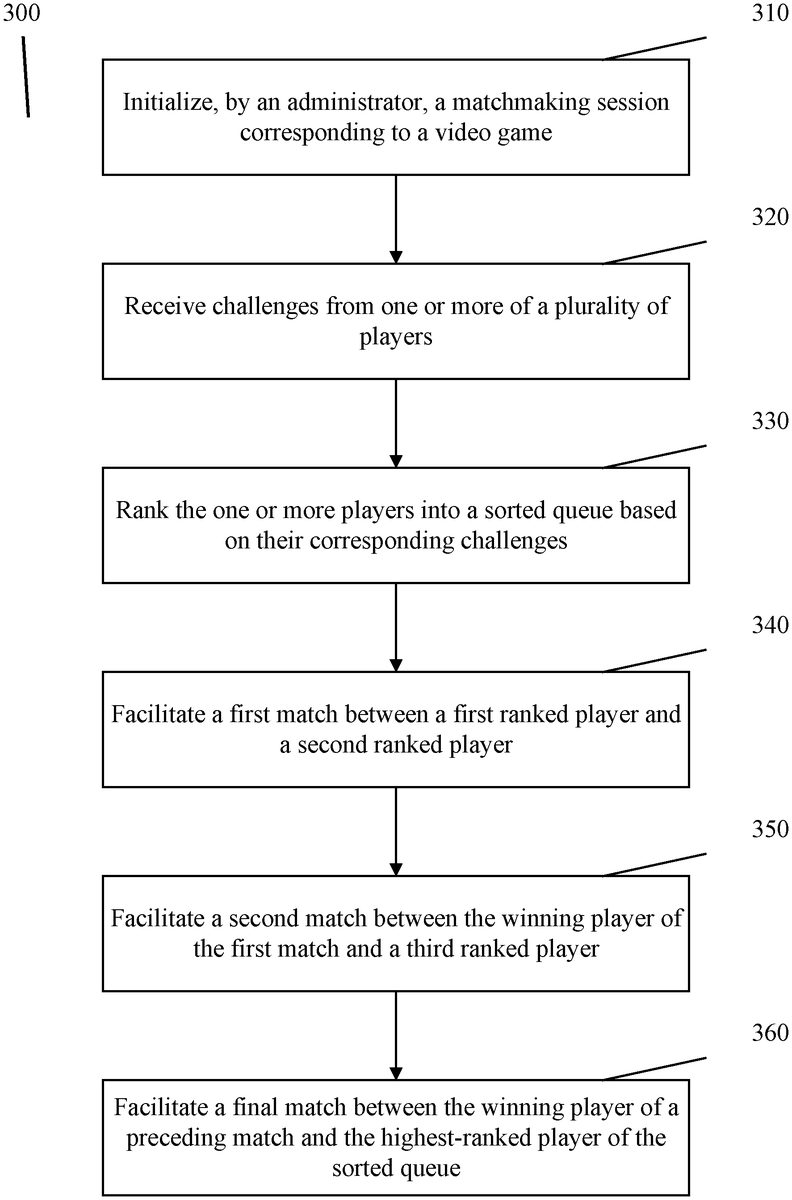
Referring toFIG.3, a flow diagram of an exemplary method for administering a challenge-based matchmaking session is depicted. In an embodiment, method300may be performed by a server (e.g., corresponding server120ofFIG.1). Although embodiments are described below with respect to a single, challenge-based matchmaking session involving a single host device (e.g., corresponding to host device130ofFIG.1), and one or more player devices (e.g., corresponding to one or more of player devices140,150,160and170ofFIG.1), it should be appreciated that the concepts herein may likewise apply to a plurality of host devices, a plurality of servers, and a plurality of player devices involved in more than one matchmaking session.
At step310, initialize, by an administrator, a matchmaking session corresponding to a video game. The matchmaking session is preferably initialized pursuant to rules specified by a host device (e.g., corresponding to host device130ofFIG.1). The session may be initialized by either the host device or a server (e.g., corresponding to server120ofFIG.1) at the request of the host device. According to embodiments, initializing the matchmaking session may include establishing a queue for a plurality of players to join and submit challenges. Preferably, each player joining the queue has a corresponding account registered with the server in accordance with concepts discussed herein. Some players may join the queue via a GUI on a corresponding player device (e.g., corresponding to one or more of player devices140,150,160,170), while other players may utilize a player GUI on the host device. In some embodiments, players may join the queue without submitting a challenge. For example, one or more players (e.g., one or more players corresponding to one or more of player devices140,150,160,170) may join the session queue as spectators.
At step320, receive challenges from one or more of a plurality of players. According to embodiments, players from whom challenges are received may be classified separately from players who join the matchmaking session without submitting a challenge. For example, the session queue may include a primary, ranked queue including players who have submitted challenges and a secondary, unranked queue including players who have not submitted challenges. For example, two, separate queues may be used for the matchmaking session, one for ranked player and the other for unranked players. In another example, a sub-queue within the primary queue may be used to group together players who have not submitted challenges. According to embodiments, challenges may be received from a plurality of players for a predetermined period of time in accordance with session rules established by the host (e.g., corresponding to one or more rules of host data210and/or230ofFIGS.2A and/or2B). For example, initial challenges may be accepted from players for one hour before the queue is locked for the start of a match. In another example, the queue may be locked two minutes before the start of a match and unlocked again for challenge submissions after the match begins or after the match ends.
At step330, rank the one or more players into a sorted queue. Players are preferably ordered in the sorted queue based on their submitted challenge, and players with equivalent challenges are ordered by secondary metrics, such as, timing of challenge, number of matches played for the video game of the matchmaking session or other games in same genre, win/loss ratio of prior games, etc. For example, two players submitting challenges with equivalent performance rating values may be sorted based on whoever's challenge was submitted earlier. In another example, two players submitting challenges with equivalent monetary values may be sorted based on whoever had more prior matches played. The ranked player queue is preferably re-sorted in response to new challenges received from unranked players, revised challenges received from ranked players, one or more ranked players leave the queue. The re-sort timing may be set by rules specified by the host device. According to embodiments, the ranked queue may be locked from re-sorting after a predetermined period of time or under the control of the host device.
At step340, facilitate a first match between a first ranked player and a second ranked player. Accordingly to some embodiments, the top two players in the sorted queue of ranked players are removed from the queue and the remaining players in the queue are shifted to fill the vacancy. Although the first and second ranked players may each correspond to an individual player, in some embodiments, the first and second ranked players in the sorted session queue may correspond to a team of two or more players. At the conclusion of the first match, a winning player and a losing player are preferably designated, and the winning player may be automatically included in a subsequent match of the matchmaking session.
According to embodiments, challenges received from and corresponding to the first and second ranked players may be removed from the players' accounts (e.g., corresponding to ofFIG.1) and set aside until the completion of the first match. For example, rating values included in the first and second ranked players' challenges may be deducted from their respective performance ratings (e.g., performance ratings corresponding to one or more of player data212and/or250ofFIGS.2A and/or2C). In another example, monetary values included in the first and second ranked players' challenges may be deducted from their respective accounts. In some embodiments, the received challenges corresponding to the first and second players are validated. For example, if the rating value included in the challenge received from the second player exceeds the second player's performance rating, the challenge is invalid. As such, the second player may be replaced in the first match with the top-ranked player in the sorted queue. In another example, if the monetary value included in the challenge received from the first player exceeds the amount of money available to the first player's account (e.g., corresponding to one or more of player data212and/or250ofFIGS.2A and/or2C), the challenge is invalid and the first player may be replaced in the first match with the top-ranked player in the sorted queue.
The set-aside challenges corresponding to the first and second ranked players are preferably partitioned for allocation during the matchmaking session. For example, a first portion of the set-aside challenge corresponding to the losing player may be allocated for the winning player, a second portion of the set-aside challenge may be allocated for a player that defeats the current lead player, a third portion may be allocated for the winning player of the final match, a fourth portion may be allocated to the host for administering the matchmaking session, and a fifth portion may be allocated to the server. Allocating a portion of the challenge to non-players (e.g., host device130and/or server120) may serve to mitigate against inflation of performance ratings. In another example, a portion of the challenge may be allocated to the host or the server to cover administrative costs for managing the matchmaking session.
In some embodiments, players may submit new challenges or revise their prior challenges during the first match. Additionally or alternatively, new or revised challenges may be accepted only for a predetermined period of time (e.g., seconds, minutes, hours, etc.) after the conclusion of the first match. For example, a one-minute window may be provided after the first match to accepted challenges from players already sorted in the session queue, players that are not sorted in the session queue, or from the losing player of the first match. The predetermined period of time preferably corresponds to one or more rules set by the host device. Additionally or alternatively, the host device may transmit instructions to the server and/or player devices to close receipt of challenges in advance of a subsequent match of the session or the termination of the session.
According to embodiments, at the conclusion of the first match, the server or the host device may allocate a set-aside first portion of the losing player's challenge to the winning player's account and a set-aside second portion of the losing player's challenge may be allocated to a collective repository (e.g., corresponding to information in session data213ofFIG.2A) designated for later allocation. For example, the set-aside second portion may be allocated to a player who defeats the winning player of the first match of the session, the winner of a final match of the session, or both. In some embodiments, a set-aside third portion of the losing player's challenge may be allocated to a host account (e.g., corresponding to host data210and/or230ofFIGS.2A and/or2B) corresponding to the host administering the matchmaking session. Additionally or alternatively, a set-aside fourth portion of the losing player's challenge may be allocated to an account corresponding to the server facilitating the matchmaking session to maintain the infrastructure of the challenge-based matchmaking system (e.g., to mitigate against rating inflation, for maintenance costs, etc.). In some embodiments, the winning player's set aside challenge may be similarly allocated and distributed in accordance with concepts discussed herein.
At step350, facilitate a second match between the winning player of the first match and a third ranked player. Accordingly to embodiments, the third player corresponds to the top-ranked player in the sorted queue of ranked players. The third player is preferably removed from the queue, and the remaining players in the queue are shifted to fill the vacancy. Moreover, the ranked queue of embodiments may re-sorted based on new and/or revised challenges received from players. For example, the third player may be the losing player from the first match who has resubmitted a challenge sufficient for ranking ahead of other players in the queue. In another example, the third player may not have participated in the first match nor submitted a challenge prior to the first match.
A video game match is preferably initialized between the winning player from the first match and the third player pursuant to rules set by via the host device (e.g., duration, gameplay settings, etc.). At the conclusion of the second match, a winning player and a losing player are preferably designated, and the winning player of the second match may be automatically included in a subsequent match of the matchmaking session. In some embodiments, challenges received from and corresponding to the third player may be removed from the third player's account (e.g., corresponding to ofFIG.1) and set aside until the completion of the second match (e.g., stored in a repository corresponding to information in session data213ofFIG.2A). For example, if the third player is the losing player of the second match, a set-aside first portion of the third player's challenge may be allocated to the winning player, a set-aside second portion may be allocated to one or more winners of subsequent session matches, a set-aside third portion may be allocated to a host account, a set-aside forth portion allocated to the system infrastructure, or combinations thereof. In another example, if the losing player of the second match is the winning player from the first match, portions of the challenge previously set aside are allocated to the challenge received and set aside during the first match is allocated in accordance with concepts discussed herein.
At step360, facilitate a final match between the winning player of a preceding match and the highest-ranked player of the sorted queue. Preferably, there are one or more intervening matches in the session between the second match and the final match; however, in some embodiments, the proceeding match to the final match may be the second match. According to embodiments, the highest-ranked player of the sorted queue may be removed from the queue and designated the final challenger. Moreover, prior to the start of the final match, the ranked queue of embodiments may re-sorted based on new and/or revised challenges received from one or more players. The final match between the winning player of the preceding match and the final challenger is preferably initialized pursuant to rules specified by via the host device.
After the final match of the session, any set-aside challenge received from the winning player of the final match is returned to the player. For example, if the challenge received from the winning player of the final match was previously set aside during a prior match within the session, the set-aside challenge (e.g., rating value, monetary value, etc.) is returned to the player's account (e.g., corresponding to player data250). In another example, if the winning player of the final match is the final challenger, the challenge received from the final challenger is returned to the player. According to embodiments, the challenge received from the losing player of the final match may be partitioned consistent with concepts discussed above.
Although the present invention and its advantages have been described in detail, it should be understood that various changes, substitutions and alterations can be made herein without departing from the spirit and scope of the invention as defined by the appended claims. Moreover, the scope of the present application is not intended to be limited to the particular embodiments of the process, machine, manufacture, composition of matter, means, methods and steps described in the specification. As one of ordinary skill in the art will readily appreciate from the disclosure of the present invention, processes, machines, manufacture, compositions of matter, means, methods, or steps, presently existing or later to be developed that perform substantially the same function or achieve substantially the same result as the corresponding embodiments described herein may be utilized according to the present invention. Accordingly, the appended claims are intended to include within their scope such processes, machines, manufacture, compositions of matter, means, methods, or steps.
Moreover, the scope of the present application is not intended to be limited to the particular embodiments of the process, machine, manufacture, composition of matter, means, methods and steps described in the specification.
Claims
- A system comprising: an electronic data store configured to facilitate session-related communication traffic corresponding to at least one video game and a plurality of players;at least one processor communicatively coupled to the electronic data store and configured to execute computer-executable instructions to perform operations;at least one memory which may store computer-executable instructions and player data comprising: initialize, by a host device or a server, a matchmaking session corresponding to a video game, wherein the matchmaking session includes the plurality of players and a plurality of matches corresponding to the video game, wherein the stored player data includes an account corresponding to each of the plurality of players;during a predetermined time period, opening one or more session queues to receive challenges corresponding to a performance rating or a monetary value or both from one or more of the plurality of players;rank the one or more of the plurality of players based on their corresponding challenges, wherein the one or more of the plurality of players who submitted challenges are classified as ranked players and players of the plurality of players who did not submit a challenge are classified as unranked players, and wherein ranking includes organizing the ranked players in a sorted queue, and wherein players are further ranked by one or more secondary metrics comprising timing of challenge submission, number of matches played for the video game, or win/loss ratio of prior games;after the predetermined time period, transmit computer-executable instructions to the server to close the one or more session queues, locking the one or more session queues from receiving challenges corresponding to the performance rating or the monetary value or both to facilitate a first match between a first ranked player and a second ranked player of the sorted queue of ranked players, wherein the first match results in a winning player and a losing player, and wherein facilitating the first match includes communicatively coupling devices associated with the first ranked player and the second ranked player, communicating rules and controls via a network as session control information for a session between a device of the first ranked player and a device of the second ranked player, and partitioning a first challenge corresponding to the performance rating or the monetary value or both received from the losing player of the first match and allocating at least a portion of the first challenge to the winning player of the first match;subsequent to the first match, the host device transmits computer-executable instructions to the server to facilitate a second match between the winning player of the first match and a third ranked player of the sorted queue of ranked players, wherein the second match results in a winning player and a losing player, and wherein facilitating the second match includes communicatively coupling devices associated with the winning player of the first match and the third ranked player, communicating the rules and controls via the network as session control information for a session between a device of the winning player of the first match and a device of the third ranked player, and partitioning a second challenge corresponding to the performance rating or the monetary value or both received from the losing player of the second match and allocating at least a portion of the second challenge to the winning player of the second match, wherein at least the portion of the second challenge includes a portion of the first challenge allocated to the winning player of the first match when the winning player of the second match is the third ranked player;and the host device transmits computer-executable instructions to the server to facilitate a final match between the winning player of a preceding match and a highest-ranked player of sorted queue of ranked players, wherein the final match results in a champion player and a losing player, and wherein facilitating the final match includes communicatively coupling devices associated with the winning player of the preceding match and the highest ranked player, communicating the rules and controls via the network as session control information, for a session between a device of the winning player of the preceding match and a device of the highest-ranked player, and partitioning a final challenge corresponding to the performance rating or the monetary value or both received from the losing player of the final match and allocating at least a portion of one or more preceding challenges to a winning player of the final match, wherein at least the portion of the final challenge includes a portion of the one or more preceding challenges allocated to the winning player of the one or more preceding match when the winning player of the final match is the highest-ranked player.
- The system of claim 1, wherein the operations further comprise: validating each challenge received from the ranked players;and prior to facilitating a match of the matchmaking session, re-ranking the one or more of the ranked players based on their validated challenges, wherein re-ranking includes re-classifying one or more of the ranked players with invalid challenges as unranked players.
- The system of claim 2, where the account corresponding to each of the plurality of players includes information indicating the performance rating of the corresponding player, wherein the challenge corresponding to each ranked player includes a rating value, and wherein validating each received challenge includes verifying that the rating value of the challenge corresponding each ranked player does not exceed the performance rating corresponding to the ranked player.
- The system of claim 2, where the account corresponding to each of the plurality of players includes information indicating the monetary value available to the account of the corresponding player, wherein the challenge corresponding to each ranked player includes the monetary value, and wherein validating each received challenge includes verifying that the monetary value of the challenge corresponding to each ranked player does not exceed the monetary value available to the corresponding ranked player's account.
- The system of claim 1, wherein the operations further comprise: prior to facilitating the second match of the matchmaking session, receiving a rematch challenge from the losing player of the first match;and prior to facilitating the second match of the matchmaking session, re-ranking the one or more players based on their revised challenges.
- The system of claim 1, wherein the operations further comprise: receiving a challenge from at least one of the unranked players;reclassifying the at least one of the unranked players submitting a challenge as a ranked player;and prior to facilitating a match of the matchmaking session, re-ranking the ranked players based on the received challenges corresponding to the ranked player.
- The system of claim 1, wherein the account corresponding to each of the plurality of players includes a performance rating, wherein the challenge corresponding to each ranked player includes a rating value, wherein partitioning the challenge received from the losing player of the first match for allocation includes: decreasing the performance rating corresponding to the losing player of the first match is by the rating value associated with the challenge corresponding to the losing player, increasing the performance rating associated with the winning player of the first match by a first portion of the rating value associated with the challenge corresponding to the losing player of the first match, and reserving a second portion of the rating value associated with the challenge corresponding to the losing player of the first match for the champion player of the final match.
- The system of claim 1, wherein the account corresponding to each player of the plurality of players includes information indicating the monetary value available to the account, wherein the challenge corresponding to each ranked player includes at least a portion of the monetary value available to the account, and wherein partitioning the challenge received from the losing player of the first match for allocation includes: decreasing the monetary value available to the account corresponding to the losing player of the first match by the monetary value associated with the challenge corresponding to the losing player of the first match, increasing the monetary value available to the account corresponding to the winning player of the first match by a first portion of the monetary value associated with the challenge corresponding to the losing player of the first match, reserving a second portion of the monetary value associated with the challenge corresponding to the losing player of the first match for the champion player of the final match, and reserving a third portion of the monetary value associated with the challenge corresponding to the losing player of the first match for an administrator.
- The system of claim 1, wherein the sorted queue of ranked players is organized in a descending order based on the challenges corresponding to each ranked player.
- The system of claim 9, wherein ranked players with equal corresponding challenges are sorted in descending order based on the predetermined time period that the challenges were received.
- A method comprising: initializing a matchmaking session corresponding to a video game, wherein the matchmaking session includes a plurality of players and a plurality of matches corresponding to the video game, wherein each of the plurality of players has a corresponding account;during a predetermined time period, opening one or more session queues to receive challenges corresponding to a performance rating or a monetary value or both from one or more of the plurality of players;ranking the one or more of the plurality of players based on their corresponding challenges, wherein the one or more of the plurality of players who submitted challenges are classified as ranked players and players of the plurality of players who did not submit a challenge are classified as unranked players, and wherein ranking includes organizing the ranked players in a sorted queue, and wherein players are further ranked by one or more secondary metrics comprising timing of challenge submission, number of matches played for the video game, or win/loss ratio of prior games;after the predetermined time period, transmitting computer-executable instructions to a server to close the one or more session queues, locking the one or more session queues from receiving challenges corresponding to the performance rating or the monetary value or both to facilitate a first match between a first ranked player and a second ranked player of the sorted queue of ranked players, wherein the first match results in a winning player and a losing player, and wherein facilitating the first match includes communicatively coupling devices associated with the first ranked player and the second ranked player, communicating rules and controls via a network as session control information for a session between a device of the first ranked player and a device of the second ranked player, and partitioning a first challenge corresponding to the performance rating or the monetary value or both received from the losing player of the first match and allocating at least a portion of the first challenge to the winning player of the first match;subsequent to the first match, transmitting, by a host device, computer-executable instructions to the server to facilitate a second match between the winning player of the first match and a third ranked player of the sorted queue of ranked players, wherein the second match results in a winning player and a losing player, and wherein facilitating the second match includes communicatively coupling devices associated with the winning player of the first match and the third ranked player, communicating the rules and controls via the network as session control information for a session between a device of the winning player of the first match and a device of the third ranked player, and partitioning a second challenge corresponding to the performance rating or the monetary value or both received from the losing player of the second match and allocating at least a portion of the second challenge to the winning player of the second match, wherein at least the portion of the second challenge includes a portion of the first challenge allocated to the winning player of the first match when the winning player of the second match is the thirdranked player;and transmitting, by the host device, computer-executable instructions to the server to facilitate a final match between the winning player of a preceding match and a highest-ranked player of sorted queue of ranked players, wherein the final match results in a champion player and a losing player, and wherein facilitating the final match includes communicatively coupling devices associated with the winning player of the preceding match and the highest ranked player, communicating the rules and controls via the network as session control information, for a session between a device of the winning player of the preceding match and a device of the highest-ranked player, and partitioning a final challenge corresponding to the performance rating or the monetary value or both received from the losing player of the final match and allocating at least a portion of one or more preceding challenges to a winning player of the final match, wherein at least the portion of the final challenge includes a portion of the one or more preceding challenges allocated to the winning player of the one or more preceding match when the winning player of the final match is the highest-ranked player.
- The method of claim 11, wherein the method further comprises: validating each challenge received from the ranked players;and prior to facilitating a match of the matchmaking session, re-ranking the one or more of the ranked players based on their validated challenges, wherein re-ranking includes re-classifying one or more of the ranked players with invalid challenges as unranked players.
- The method of claim 12, where the account corresponding to each of the plurality of players includes information indicating the performance rating of the corresponding player, wherein the challenge corresponding to each ranked player includes a rating value, and wherein validating each received challenge includes verifying that the rating value of the challenge corresponding each ranked player does not exceed the performance rating corresponding to the ranked player.
- The method of claim 11, wherein the account corresponding to each of the plurality of players includes a performance rating, wherein the challenge corresponding to each ranked player includes a rating value, wherein partitioning the challenge received from the losing player of the first match for allocation includes: decreasing the performance rating corresponding to the losing player of the first match is by the rating value associated with the challenge corresponding to the losing player, increasing the performance rating associated with the winning player of the first match by a first portion of the rating value associated with the challenge corresponding to the losing player of the first match, and reserving a second portion of the rating value associated with the challenge corresponding to the losing player of the first match for the champion player of the final match.
- The method of claim 11, wherein the account corresponding to each player of the plurality of players includes information indicating the monetary value available to the account, wherein the challenge corresponding to each ranked player includes at least a portion of the monetary value available to the account, and wherein partitioning the challenge received from the losing player of the first match for allocation includes: decreasing the monetary value available to the account corresponding to the losing player of the first match by the monetary value associated with the challenge corresponding to the losing player of the first match, increasing the monetary value available to the account corresponding to the winning player of the first match by a first portion of the monetary value associated with the challenge corresponding to the losing player of the first match, reserving a second portion of the monetary value associated with the challenge corresponding to the losing player of the first match for the champion player of the final match, and reserving a third portion of the monetary value associated with the challenge corresponding to the losing player of the first match for an administrator.
- One or more non-transitory computer-readable media comprising instructions that when executed by a computer system cause the computing system to: initialize, by a host device or a server, a matchmaking session corresponding to a video game, wherein the matchmaking session includes a plurality of players and a plurality of matches corresponding to the video game, wherein a stored player data includes an account corresponding to each of the plurality of players;during a predetermined time period, opening one or more session queues to receive challenges corresponding to a performance rating or a monetary value or both from one or more of the plurality of players;rank the one or more of the plurality of players based on their corresponding challenges, wherein the one or more of the plurality of players who submitted challenges are classified as ranked players and players of the plurality of players who did not submit a challenge are classified as unranked players, and wherein ranking includes organizing the ranked players in a sorted queue, and wherein players are further ranked by one or more secondary metrics comprising timing of challenge submission, number of matches played for the video game, or win/loss ratio of prior games;after the predetermined time period, transmit computer-executable instructions to the server to close the one or more session queues, locking the one or more session queues from receiving challenges corresponding to the performance rating or the monetary value or both to facilitate a first match between a first ranked player and a second ranked player of the sorted queue of ranked players, wherein the first match results in a winning player and a losing player, and wherein facilitating the first match includes communicatively coupling devices associated with the first ranked player and the second ranked player, communicating rules and controls via a network as session control information for a session between a device of the first ranked player and a device of the second ranked player, and partitioning a first challenge corresponding to the performance rating or the monetary value or both received from the losing player of the first match and allocating at least a portion of the first challenge to the winning player of the first match;subsequent to the first match, the host device transmits computer-executable instructions to the server to facilitate a second match between the winning player of the first match and a third ranked player of the sorted queue of ranked players, wherein the second match results in a winning player and a losing player, and wherein facilitating the second match includes communicatively coupling devices associated with the winning player of the first match and the third ranked player, communicating the rules and controls via the network as session control information for a session between a device of the winning player of the first match and a device of the third ranked player, and partitioning a second challenge corresponding to the performance rating or the monetary value or both received from the losing player of the second match and allocating at least a portion of the second challenge to the winning player of the second match, wherein at least the portion of the second challenge includes a portion of the first challenge allocated to the winning player of the first match when the winning player of the second match is the third ranked player;and the host device transmits computer-executable instructions to the server to facilitate a final match between the winning player of a preceding match and a highest-ranked player of sorted queue of ranked players, wherein the final match results in a champion player and a losing player, and wherein facilitating the final match includes communicatively coupling devices associated with the winning player of the preceding match and the highest ranked player, communicating the rules and controls via the network as session control information, for a session between a device of the winning player of the preceding match and a device of the highest-ranked player, and partitioning a final challenge corresponding to the performance rating or the monetary value or both received from the losing player of the final match and allocating at least a portion of one or more preceding challenges to a winning player of the final match, wherein at least the portion of the final challenge includes a portion of the one or more preceding challenges allocated to the winning player of the one or more preceding match when the winning player of the final match is the highest-ranked player.
- The one or more non-transitory computer-readable media of claim 16, wherein the non-transitory computer-readable media further comprise instructions that when executed by a computer system cause the computing system to: validate each challenge received from the ranked players;and prior to facilitating a match of the matchmaking session, re-rank the one or more of the ranked players based on their validated challenges, wherein re-ranking includes re-classifying one or more of the ranked players with invalid challenges as unranked players.
- The one or more non-transitory computer-readable media of claim 17, where the account corresponding to each of the plurality of players includes information indicating the performance rating of the corresponding player, wherein the challenge corresponding to each ranked player includes a rating value, and wherein validating each received challenge includes verifying that the rating value of the challenge corresponding each ranked player does not exceed the performance rating corresponding to the ranked player.
- The one or more non-transitory computer-readable media of claim 16, wherein the account corresponding to each of the plurality of players includes a performance rating, wherein the challenge corresponding to each ranked player includes a rating value, wherein partitioning the challenge received from the losing player of the first match for allocation includes: decreasing the performance rating corresponding to the losing player of the first match is by the rating value associated with the challenge corresponding to the losing player, increasing the performance rating associated with the winning player of the first match by a first portion of the rating value associated with the challenge corresponding to the losing player of the first match, and reserving a second portion of the rating value associated with the challenge corresponding to the losing player of the first match for the champion player of the final match.
- The one or more non-transitory computer-readable media of claim 16, wherein the account corresponding to each player of the plurality of players includes information indicating the monetary value available to the account, wherein the challenge corresponding to each ranked player includes at least a portion of the monetary value available to the account, and wherein partitioning the challenge received from the losing player of the first match for allocation includes: decreasing the monetary value available to the account corresponding to the losing player of the first match by the monetary value associated with the challenge corresponding to the losing player of the first match, increasing the monetary value available to the account corresponding to the winning player of the first match by a first portion of the monetary value associated with the challenge corresponding to the losing player of the first match, reserving a second portion of the monetary value associated with the challenge corresponding to the losing player of the first match for the champion player of the final match, and reserving a third portion of the monetary value associated with the challenge corresponding to the losing player of the first match for an administrator.
Disclaimer: Data collected from the USPTO and may be malformed, incomplete, and/or otherwise inaccurate.