U.S. Pat. No. 11,547,946
GROUP ELECTRONIC GAME OR POLL USING BEVERAGE SENSORS
AssigneeGlitchbit LLC
Issue DateOctober 11, 2020
Illustrative Figure
Abstract
A system includes a beverage sensor to distinguish one or more beverage states and to communicate the distinguished one or more beverage states to a processor as gameplay control inputs to the game.
Description
DETAILED DESCRIPTION Businesses that serve drinks and which have video games available for patrons typically make significantly more from beverage service than from the video games. One way in which such a business may enhance profitability is to require a player to insert into an arcade machine a beverage, rather than money, so that the player may continue playing for as long as the player has a non-empty beverage container. To this end, the present disclosure describes arcade game machines and associated methods that incorporate one or more beverage receptacles, each having an associated beverage sensor, into an arcade game machine as a control input to a video game controller. In various examples, a receptacle/sensor can act not only as a coin or token to grant access to a game but further as a control input to control vital game functions. Consequently, the systems and methods described herein not only enhance customer experience by providing a fun electronic diversion, they also enhance business sales by encouraging beverage purchases and providing data about customer consumption to business proprietors. Different examples of systems described herein may comprise an integrated beverage receptacle, beverage sensor, and video game. More specifically, the video game may receive a signal from the beverage sensor indicating the state of the beverage receptacle as empty or non-empty. Additionally, examples may distinguish between non-empty states where the beverage receptacle contains, i.e. receives, a non-empty beverage container, and an empty beverage container. Accordingly, an example may enable game play in response to a user depositing, e.g. a bottle of beer, in a beverage in the beverage receptacle, and it may disable game play when the beer bottle is empty. Alternatively, or additionally, examples may temporarily disable game play until a game controller receives a signal from a beverage sensor that a ...
DETAILED DESCRIPTION
Businesses that serve drinks and which have video games available for patrons typically make significantly more from beverage service than from the video games. One way in which such a business may enhance profitability is to require a player to insert into an arcade machine a beverage, rather than money, so that the player may continue playing for as long as the player has a non-empty beverage container. To this end, the present disclosure describes arcade game machines and associated methods that incorporate one or more beverage receptacles, each having an associated beverage sensor, into an arcade game machine as a control input to a video game controller. In various examples, a receptacle/sensor can act not only as a coin or token to grant access to a game but further as a control input to control vital game functions. Consequently, the systems and methods described herein not only enhance customer experience by providing a fun electronic diversion, they also enhance business sales by encouraging beverage purchases and providing data about customer consumption to business proprietors.
Different examples of systems described herein may comprise an integrated beverage receptacle, beverage sensor, and video game. More specifically, the video game may receive a signal from the beverage sensor indicating the state of the beverage receptacle as empty or non-empty. Additionally, examples may distinguish between non-empty states where the beverage receptacle contains, i.e. receives, a non-empty beverage container, and an empty beverage container. Accordingly, an example may enable game play in response to a user depositing, e.g. a bottle of beer, in a beverage in the beverage receptacle, and it may disable game play when the beer bottle is empty. Alternatively, or additionally, examples may temporarily disable game play until a game controller receives a signal from a beverage sensor that a non-empty beverage container has been removed and then replaced, suggesting that the player has taken a drink. As used herein, the term “sensored beverage receptacle” means a beverage receptacle having at least one sensor associated therewith, which sensor may be affixed to or integrated as part of the receptacle or may merely be matched with the receptacle such that there is a one-to-one correspondence between sensors and receptacles in systems having multiple of each.
As used herein, the term “player,” as in “game player,” refers to a human participant of a video game, while the term “character” refers to a graphical game element responsive to player inputs to a video game controller. Thus a character may correspond to a player in that the player's input controls to a gaming console control the character, and the character may be enabled or disabled according to methods described herein. In one example, a character may be disabled when the corresponding beverage receptacle is empty or when the beverage receptacle contains an empty beverage container. Accordingly, in order for a player to play the game, the player must acquire a non-empty beverage container. Some examples may additionally enable and disable a character in response to events occurring the game, e.g., completion or non-completion of a game objective or other required task. Furthermore, such examples may require the player to remove and replace a non-empty beverage container belonging to the player in order to re-enable a character corresponding to the player, or otherwise to proceed with a game.
The term “video game controller,” as used herein, may include a variety of different devices. In general, a video game controller is any device that enables, disables, or effects game play. For example, a video game may be enabled when a state of one component of the controller causes another component(s) to accept user input and communicate the input to a computer to effect game play, e.g. by moving graphical game pieces. Conversely, a video game may be disabled when a state of one component of the controller causes another component(s) to reject user input or otherwise not communicate it. Notwithstanding the foregoing description, while components for enabling and disabling a video game may in some sense be said to be part of, or a component of, a video game controller, the present disclosure distinguishes between a video game controller and the components that produce signals for enabling and disabling game play. Accordingly, the beverage receptacle and beverage sensor are considered herein to be distinct from the video game controller.
The beverage receptacle may use weight, pressure, switch, strain gauge, proximity, Hall effect, barcode, temperature, sonar or optical sensors to determine the brand, value or source of an inserted beverage. These sensors can be installed directly on or close to the beverage receptacle to make their respective measurements or determinations.
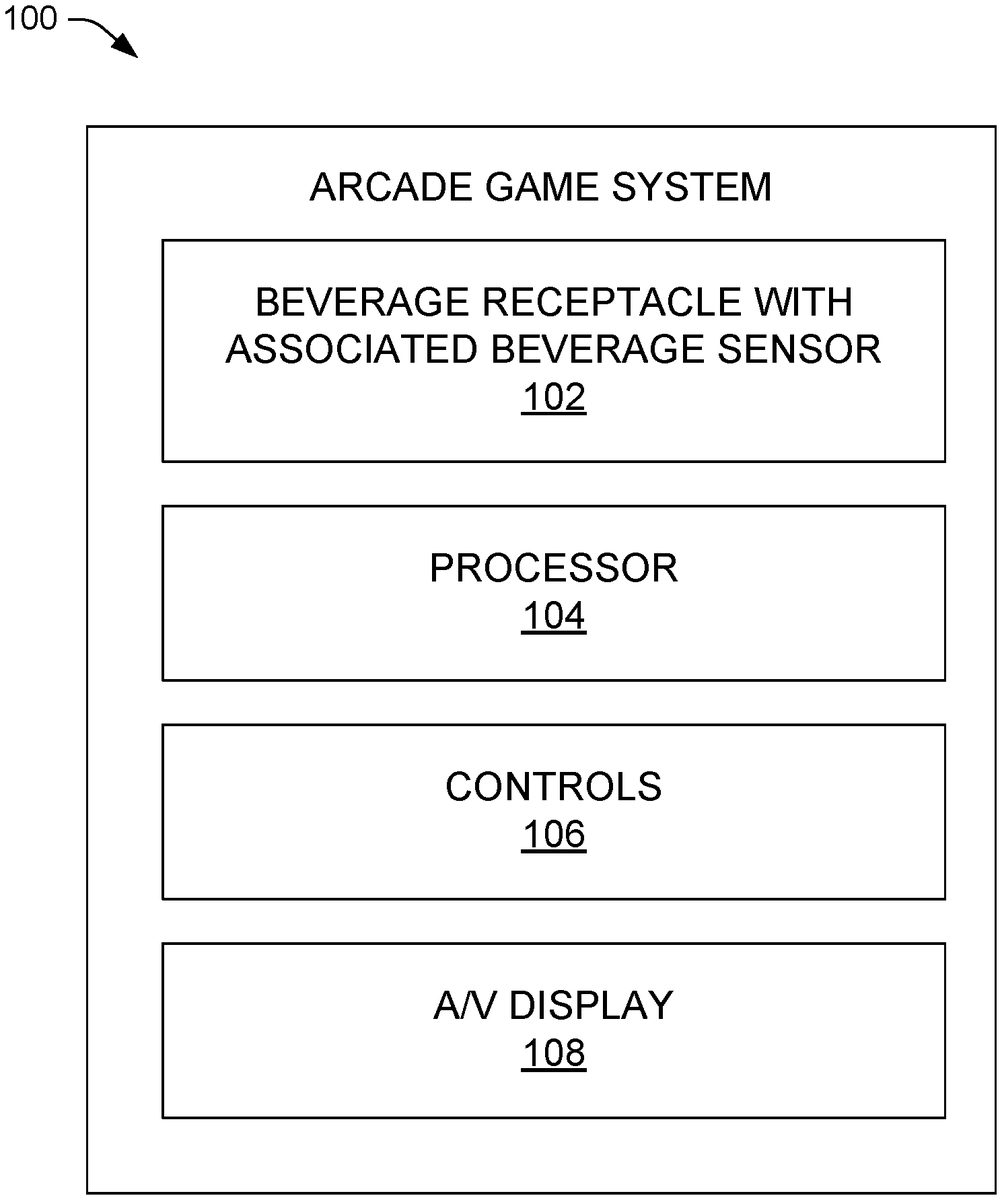
FIG.1is a system diagram showing the core components of an example arcade game system100. System100can include a beverage receptacle having associated therewith an associated beverage sensor102. Beverage sensor102can detect and report, via at least one output, the presence of a non-empty beverage container. In some examples, beverage sensor102can further discriminate between various levels of beverage container fullness or emptiness (i.e., levels of consumption of the beverage) and/or can detect or measure various other beverage properties, such as beverage type (e.g., water vs. soft drink vs. alcoholic beverage), container type (e.g., glass vs. bottle vs. can), beverage origin (e.g., purchased on the premises vs. brought from outside the premises), beverage price or value, or beverage age since serving (e.g., by measuring temperature or level of carbonation evanescence). The various beverage properties may be measured or detected with an appropriate sensor or detector or may be inferred based on measurements of related properties.
System100can further include at least one processor or CPU104that acts as a video game controller to accept control inputs, including from sensor102and controls106, and produce outputs, e.g., game graphics, sound effects, and music, to at least one visual or audiovisual display108, such as a color display monitor.
FIG.2is a three-quarters perspective view of the exterior of an example arcade game machine200with a number of integrated sensored beverage receptacles220, whileFIG.4provides a front perspective view of machine200. In the illustrated example, machine200has six such receptacles220. Arcade machine200has a cabinet having a base or housing body204, topped by a control panel208, a bezel206, and a marquee212. Bezel214can secure and aesthetically frame display monitor214. In some examples, marquee212can house a static sign, which in some examples can be backlit, to indicate, e.g., the name of the game offered by machine200and its maker or origin. In other examples, marquee212can house a dynamic display, e.g., a color display screen, that can display different names of different games depending, e.g., on a selectable or rotating set of offerings. The cabinet can be powered, for example, via a standard A/C wall plug (not shown).
Control panel208can include a number of controllers that can provide inputs to the video game, e.g., joysticks, buttons, trackballs, keyboards, microphones, guns, steering wheels, throttle levers, pilot yokes, etc. In some examples the system200may also provide one or more pedals as controls. Control panel208can also include a number of sensored beverage receptacles220. In some examples, control panel208is substantially level so that beverages may be placed on it without sliding off. In the illustrated example, control panel208is connected to housing204by hinge222at its back edge so that it can be lifted to expose the underside of controls and beverage sensors for maintenance and diagnostic purposes. A locking mechanism210(e.g., a key lock) can secure panel208limiting underside access to restricted personnel.
Control panel208can be visually divided into individual player stations216by, for example, station dividing lines218and/or arrows (not shown inFIGS.2and4, but see606inFIG.6) pointing outward to the intended positions of the various players. The stations can be color-coded and/or be given any type of distinctive design to reduce the confusion between players of their respective controls and beverages.FIG.3shows an example station216having a beverage receptacle220, button308, and a joystick made of knob302, stem304, and cover plate306. In addition to any controls associated with any one station, machine200may also incorporate common controls, e.g., a start button224.
FIGS.5A-5Hillustrate various game states that may arise as a result of sensed inputs from the one or more beverage sensors and/or be controlled by the sensored beverage receptacles220embedded in control panel208. Initial state500inFIG.5Ashows screen214displaying a directive to “insert drinks” and may be accompanied, for example, by a demonstrative animation. As shown by first player activation state510inFIG.5B, a non-empty beer bottle502inserted into receptacle220, and thereby sensed by the game via a beverage sensor, activates the game for the corresponding player, as indicated on screen214by a change to corresponding character504, which can include a change in brightness, contrast, intensity, or color of character504, and/or an animation change in character504or a sound effect cue that may appear to emanate from character504. Following the “check-in” of this player, after a certain time or in response to an input, the game may begin, or in some examples, the game may wait for additional players to join the game before beginning gameplay. Full game state520inFIG.5Cshows that all players that can be accommodated by game (i.e., in the illustrated example, all six players) have joined by insertion of non-empty beverage containers, causing all on-screen characters to become illuminated or otherwise indicated as active, and causing screen214to issue a new directive to press start button224to begin the game.
Gameplay can involve any number of arcade-style games of various genres, e.g., racing, puzzle, platform, side-scroller, shoot-'em-up, etc. Games can be cooperative between players, or competitive, or both, as when players are divided into teams. As an example, players can control on-screen characters that can, for example, match in color, pattern, or in some other way to a designation provided by the design of respective stations on control panel208. For example, joystick302can be used to navigate characters and one or more buttons308can be used to cause characters to jump, shoot projectiles, or perform other actions. Gameplay state530shown inFIG.5Dillustrates one example game on screen214, a team volleyball game, in which characters536are manipulated to prevent a ball538from falling on a home side of a net540and to cause it to fall on opponents' side. At the instant illustrated, ball538is falling onto the right side of the court, causing the players associated with the right-side characters to lose the game. As shown by game completion state540inFIG.5E, screen214prompts the losing players to “drink.” Compliant player state550inFIG.5Fshows that one player has removed beer bottle506from its receptacle in that player's station, causing the game to remove the corresponding prompt character from screen214.
The game can be programmed to sense that a sip has been taken (e.g., that the liquid in the beverage container506is reduced in weight, level, etc.), and to persist in requiring a player to drink until such beverage amount reduction is sensed. Alternatively, in some examples, the game may be programmed to consider that mere removal and replacement of container506suffices to qualify as the required “drink” instructed by the game. In any case, once all “loser” players have complied, the game may resume or a new, possibly different game may begin.
FIG.5Gillustrates the start of a new game state560, another cooperative/competitive game. As shown, the game can be programmed to disregard temporary removal of one or more beverages from the receptacles to allow players to drink between games or mid-game without penalty. However, as shown by no-player state570inFIG.5H, the game may also be programmed to pause, and eventually to terminate (e.g., after a countdown), a game when it appears that all players have run out of beverage or abandoned the game by virtue of insufficient beverage being sensed in a threshold number of beverage receptacles. The illustrated example shows all beverages having been removed from their receptacles, but for some games that require multiple players, the game may be programmed to pause and/or terminate when an insufficient number of players are active, or have been inactive for long enough time. For example, the game may be programmed such that removal of a beverage from a receptacle for 10 seconds without returning a non-empty beverage container to the receptacle triggers deactivation of player control for that player, while absence of a non-empty beverage container from the receptacle for one minute triggers a “check-out” of the player, and an absence of a quorum of active players for 30 seconds terminates the game.
FIG.6is a top-view diagram of arcade game system200showing an example relative placement of game controls302,308and beverage receptacles220in control panel208. Arrows606on the control panel208point to recommended player placement around the machine200and help associate each player with his or her controls302,308. From this view, receptacle drain holes602(as illustrated, three per receptacle) and receptacle attachment points604(as illustrated, two per receptacle, spaced closely together) at the bottoms of each receptacle202are visible. The drain holes602permit spilled liquid to drain from receptacles220, while the attachment points604permit the receptacles to be mounted other than by a lip or rim of a receptacle resting directly against panel208, which attachment could prevent or distort a measurement by an associated beverage sensor.
FIG.7is a front perspective illustration of arcade game system200during maintenance. Locking mechanism210can be unlocked to permit the raise of the control panel208on its hinge. A hanging connector208(e.g., chain, wire, or string) affixed at one end to the front of the underside of the panel208can be attached to an attachment point704(e.g., hook, eyelet, or screw head) at the top of the cabinet to secure panel208in an open position. Game controls (e.g., joysticks and buttons) can be based on pressure switches of the type commonly found in arcade controls, which provide the benefits of simplicity, reliability and ruggedness. For example, pressure switches can survive even full liquid immersion. As illustrated, joystick underside706can provide access to the four pressure switches belonging to each joystick, while control button undersides710and start button underside712can provide access to the single pressure switch each button.
Although the arrangement of components on the underside of panel208is illustrated inFIG.7, the connections between them are omitted for clarity. Each of the control elements706,708,710,712can be connected (e.g., by conductive wires) to one of one or more controllers on printed circuit boards (PCBs)714that can accept analog signal inputs and can provide, e.g., digital signal outputs to processor716via, e.g., a USB connection. Signal conditioning circuitry (e.g., filters and/or amplifiers) (not shown) can be placed in the signal paths between the control elements706,708,710,712and the PCBs714to which they are respectively connected to provide cleaner or larger-amplitude signals to the PCBs714prior to digitization. As an example, a SparkFun Load Cell Amplifier can serve as an intermediary between a load cell1204of beverage sensor708and the PCB714to which it is connected.
Processor716can include a microprocessor to process game inputs and run game functions. Processor716can be, for example, a Mini-ITX PC, such as a Mac Mini manufactured by Apple Inc., which has a form factor of only 7.7 inches square by 1.4 inches tall, and provides the requisite USB inputs and HDMI audiovisual outputs. Processor716can store game data and programming, including graphics, sounds effects, music, level designs, and game logic, in one or more non-transitory memories and can thus control a game given inputs from game controls and provide suitable outputs to a visual or audiovisual display via, e.g., an HDMI connector. Processor716can also provide operational electric power (e.g., at 5 volts) to PCBs714via, e.g., the USB connection between them.
In some examples, the two PCBs714can include a first PCB that communicates inputs from the buttons710and joysticks706to processor716and a second PCB that communicates inputs from players' beverage sensors708to processor716. As examples, the PCB that handles button, joystick, or other control device inputs can be an Ultimarc I-PAC, while the PCB that handles beverage sensor inputs can be an Arduino Uno or a Sparkfun Redboard. Each PCB714can be housed in a polymer cover or box to protect the electronic components from liquids that may spill over the arcade's control panel208.
FIG.7shows that system200can also have a gutter system900that includes, in the illustrated example, two gutters718arranged underneath the rows of beverage receptacles220/708. Each gutter718can flow into a containment reservoir720which can be sized large enough (e.g., to hold one or several gallons) such that it can hold a large volume of beverage fluid that may be spilled into receptacles220, which fluid drains through holes602into gutters718and finally into reservoir720. In some examples, reservoir720itself may be provided with a hose or pipe (not shown) to drain out of system220into, e.g., a floor drain (not shown) or sewer line connection (not shown). In other examples, however, such additional drainage may not be convenient, and thus, reservoir720can be sized large enough to all fluid that may be spilled in the course of an activity period until it can evaporate.FIG.8provides an overhead view of gutters718and reservoir720within cabinet body204.FIGS.9A and9Bprovide, respectively, a front perspective view and a side perspective view of the example gutter system900. Alternatively or in addition to the illustrated gutters, hoses or pipes (not shown) can direct liquid from receptacles220to reservoir720or to an external drain.
As shown in the cutaway view of reservoir720inFIG.10, reservoir720for collecting leaked fluid can be outfitted with one or more sponges1002, which can be antimicrobial sponges capable of arresting the growth of odor-causing bacteria as may be produced, for example, by the decomposition of hops in spilled beer. Sponges1002can thus absorb spilled fluid and prevent the development of bad odors until such time as spilled fluid has evaporated and the sponges1002again become dry. As shown, sponges1002can be arranged as a stack. The outer surface of arcade machine200, and particularly its control panel208, can be coated in a water resistant paint or shell, e.g., a vinyl wrap, which can be printed with an industrial inkjet printer, cut to shape, and adhered to the arcade machine200with a spray adhesive. On the inside of the cabinet204, where any wood may be exposed, the cabinet204may be coated with latex or a latex-based coating to prevent the wood from soaking by spilled beverage. The aforementioned PCB covers, gutters718and paint/coatings/covers together render the arcade200highly resistant to the effects of spilled liquid.
Also shown inFIG.8is a battery or uninterruptible power supply (UPS)802capable of powering the components of arcade system200, including processor716and AV display214. UPS802can also be communicatively connected to processor716to provide information regarding power status. Upon loss of external electrical power, as may result from a premises proprietor switching off the premises power, UPS802can signal processor716to begin a shutdown phase, which can include providing a message on display214signaling to players that any game in progress will soon terminate. After a game termination countdown, for example, processor716can safely enter and complete its shutdown sequence prior to the depletion of UPS power. When power is returned, battery802sends messages to display214and processor716that can power-up these devices and start up the arcade system200.
FIG.9Badditionally illustrates how beverage receptacles220can be mounted to the underside of panel208via mounting brackets, such that they are held up from underneath rather than resting down from above. The holes in panel into which receptacles220fit can be made to be a tolerance diameter larger than the outer diameter of the receptacle cups, such that the receptacles do not rest vertically down upon or lean laterally up against panel208, as any such contact may distort measurements made by associated beverage sensors that collect force (e.g., weight) readings to ascertain beverage presence and/or beverage level.
With reference toFIG.11A, each station216may include a variety of game controls (e.g., joystick302,304,306and/or one or more buttons308) and may also include at least one sensored beverage receptacle220capable of holding a beverage container (e.g., soda can1102). With reference toFIG.11B, beverage receptacle220may comprise an ordinary cup holder254. Beverage receptacle220may be so dimensioned as to permit a player to deposit a variety of typical beverages into receptacle220such as, without limitation, a beer bottle1106, a water bottle (not shown), a soda bottle (not shown), a soda can (1102), and/or a drinking glass1104such as beer or water glass.
Each beverage receptacle has associated with it one or more beverage sensors. Beverage sensors may comprise a variety of sensors, including load cells and optical cells. Suitable load cells may be selected from, for example, strain gauges such as shear beam strain gauges, S-beam strain gauges, compression load cells, and piezoelectric load cells. A wide variety of load cells, many not explicitly enumerated here, could be used as beverage sensors.
FIG.12Ashows an exploded view of components of an example sensored beverage receptacle1200. The illustrated sensored beverage receptacle1200includes, in addition to cup receptacle220, a bar load cell1204that uses strain gauges to detect beverage weight. Receptacle220can be attached to one end of bar load cell1204using, for example, threaded bolts1206, washers1208and nuts1210. The bolts1206can be fitted through receptacle attachment points604, which are labeled, but not visible, inFIG.12A, on the underside of receptacle cup254. In some examples, the components can be adhered together using an epoxy or other adhesive, obviating the need for holes drilled through receptacle cup254, as well as for bolts1206and nuts1210. Washers can adjust mounting space and also serve as a buffer to protect bar load cell1204, which can be fragile. Mounting bracket1212can be bolted or adhered by its bottom to an opposite end of bar load cell1204, while the top of mounting bracket1212can be bolted or adhered to the underside of control panel208(not shown inFIG.12A, but seeFIG.9B). In this manner, receptacle220can be prevented from directly contacting panel208, and thus receptacle220, and by extension any beverage placed therein, can be mechanically isolated from the rest of arcade game system200except through load cell1204.
Bar load cell1204can have four strain gauges connected in a Wheatstone bridge formation. The strain gauges can be bonded to the load cell1204, positioned, for example, at the middle top and bottom of the load cell1204, i.e., at position1216and the corresponding underside of load cell1204, such that two strain gauges are in compression at the same time two are in tension when load cell deforms around shaped hole1214due to the weight of a beverage. Bar load cell1204is laid out in a “Z” formation so that when torque is applied to the bar, the four strain gauges on the cell measure the bending distortion. Two of the gauges measure compression and the other two measure tension caused by a player's drink (bottle, glass, can, etc.) being placed inside cup holder254.
A millivolt-scale output voltage signal produced in response to the applied force can be amplified and/or otherwise conditioned, modulated, inverted, or converted from analog to digital prior to being provided to a video game controller. In one example, the load cell signal produced by bar load cell1204is provided to an amplifier (not shown) and then to a PCB714for digitization prior to being fed to processor716. Small changes in resistance measured from the strain gauges act as an input device for each player to system200. System200therefore permits players to use their drinks to enter a game, provide feedback to the game, affect gameplay, and exit the game. At any time during a game, players' drinks might be measured, therefore the scale formed by sensor1200can constantly act as an input in the game in the same manner as a button or joystick. In addition to being used during gameplay, the incorporation of drink sensors into an arcade eliminates the need for more traditional payment methods like coins, bills, payment cards, stored-value cards or reprogrammable magnetic stripe cards.
Measurements using strain gauges may be improved by stiffening the base, or bottom, of the beverage receptacle220. Accordingly, sensored beverage receptacle1200can include a rigid base plate1202made from a suitably stiff material such as aluminum or steel. Inclusion of base plate1202may be especially advantageous when the beverage receptacle220is fabricated from pliable materials such as some thin polyolefin plastics. In such examples, a base plate1202is affixed to the beverage receptacle220. In other examples (not illustrated), the base of the beverage receptacle220is sufficiently stiff for making measurements with strain gauges without modification. According to such examples, the base plate is regarded to be unitary with the beverage receptacle220and forms its base. Accordingly, all examples that include strain gauges also include base plates regardless of whether the base plate is affixed to or unitary with the beverage receptacle220, regardless of the material from which the base plate is constructed, and regardless of whether it is constructed from the same or different material as the beverage receptacle220.
As illustrated inFIGS.12B-12E, a variety of other beverage sensors may be used in addition to or as an alternative to the load cell arrangement illustrated inFIG.12Aand described above. In the beverage sensor1250of cross-sectionFIG.12B, a sensor comprising a plurality of vertically offset optical beam break cells is integrated into receptacle220. More generally, a beverage sensor can include any number of optical cells each having an emitter1252and a receiver1254. Suitable optical cells may situate the emitter and receiver either side-by-side, thus sensing reflection (reflection mode), or, as shown inFIG.12B, at 180° (transmission mode). In either configuration, the cell can be adapted to sense an occupied state when an optical beam is broken or attenuated above a threshold, which can be a predetermined or an adaptively determined threshold and an unoccupied (empty) state when the beam is unbroken or not attenuated above the threshold. When the optical cells are arranged, as shown, as a plurality of vertically offset optical beam break cells, the combination of output signals is able to determine a level1256of beverage, to within the resolution provided by the number of cells, greater resolution being achievable by increasing the number of cells and adjusting their offsets accordingly.
Suitable optical cells may operate in the visible spectrum, or instead may operate in the near infrared spectrum. The output signal of an optical cell may require amplification and/or conditioning. Similar to the case with load cells, while it may be said herein that a controller receives a signal from a beverage sensor, the signal may not necessarily be received by processor716directly but rather may be communicated to the controller716after being amplified and possibly otherwise conditioned, modulated, inverted, or converted from analog to digital.
The cross-section ofFIG.12Bshows a beverage sensor1260comprising a combined emitter/receiver optical cell1262integrated at the bottom of receptacle220, to operate in reflection mode and thereby to detect a level1256of a beverage inserted into receptacle220. Beverage sensors1250,1262function better with beverage containers that are more transparent and may not function at all with opaque or reflective containers such as metal cans. Those business establishments that serve beverages only in clear glass containers may benefit most from the sensors1250and1260illustrated inFIGS.12B and12C.
The cross-section ofFIG.12Dillustrates a beverage sensor1270in which an acoustic emitter/receiver pair is mounted and positioned above corresponding receptacle220so as to detect beverage level1256using echo ranging through which emitted acoustic signals are reflected from the surface of the liquid beverage. Sensor1270may be more effective with wider-mouth glasses and less effective with cans and bottles. However, some example systems may provide a side-loaded beverage receptacle which may have the advantage of enhanced precision positioning of downward-facing sensor emitters vis-à-vis beverage container openings, permitting sensor1270to function well with various types of beverage containers. Instead of or in addition to an ultrasonic sensor, sensor1272may be, in some examples, a temperature sensor (e.g., an infrared temperature sensor) to sense the temperature of a beverage so as to accept only beverages within certain temperature ranges and thereby reject beverages that are, for example, approximately room temperature, which have presumptively been brought in from outside the business premises rather than sold or otherwise provided by the business. In some examples, an optical beam sensor as illustrated inFIG.12Cmay also be placed above the beverage as shown inFIG.12Dto detect beverage level1256.
The cross-section ofFIG.12Eshows beverage sensor1280in which a vibration sensor1282is integrated into receptacle220to estimate beverage level through the measurement of vibrational energy. A vibrational force is provided to receptacle and beverage220and a vibrational response is measured, e.g., by a MEMS accelerometer in sensor1282. The vibrational force can be provided by a vibrator integrated into unit1282or by a separate vibrator. Based on the damping of the response with respect to the force applied, an estimate of mass, and therefore of beverage amount, can be output by sensor1280.
Although not illustrated, acoustic sensing modalities may also be used for detecting the presence or absence of a container, and the liquid level of the container, based upon the container's properties as a Helmholtz resonator. Also not illustrated, the beverage sensor can incorporate an optical scanner or barcode reader to determine the brand, type, origin, or price of a receptacle-inserted beverage by, for example, scanning a barcode or viewing a container label, and comparing the received input to a database.
Examples may combine load cells and other beverage sensing modalities such as optical cells or scanners into a single beverage sensor unit, for instance, to compensate for shortcomings in one or more of the modalities. For example, combined-sensor units may be used to redundantly detect the presence or absence of non-empty beverage container, thereby providing further assurance of accuracy. A load cell can be especially appropriate for determining that a suitable container is present, while an optical cell can be especially suitable for determining the liquid level of the container.
In some examples, the beverage sensor may be as simple as a switch. However, a the binary output of a switch (weight/no weight) cannot readily be used to measure beverage levels, to distinguish an empty beverage container from a non-empty beverage container, or to distinguish a beverage container from a non-beverage container (e.g., a mobile phone). As such, a switch is not useful to prevent a player from “cheating” by attempting to check-in to a game without having purchased a beverage.
Processor716can validate (i.e., judge the legitimacy of) a beverage container and make estimates of the emptiness or non-emptiness of a valid container based on inputs from the one or more beverage sensors, e.g., weight inputs delivered from bar sensors1204, and by comparing received weight inputs against predetermined thresholds or weight ranges stored in memory of processor716. For example, a full 20-oz. beer glass of the size typically used for service of draft beverages at bars weighs approximately 800 grams, whereas a full beer bottle (where the bottle is made of glass) weighs approximately 575 grams. Thus, any full beverage inserted into a receptacle220of the arcade200that is determined to weigh more than approximately 600 grams but less than approximately 800 grams can be deemed to be a beverage served in a glass. Likewise, when system200is programmed to understand that no valid drink will be more than about 800 grams in weight, 800 grams can serve as an upper-limit threshold, and any higher weight sensed by a beverage sensor will fail to register as a check-in to play a game.
Full beverage cans and plastic bottles in various sizes can weigh much less than full glasses or glass bottles, but even so can have fairly uniform weights, both when full and when empty. Going under the presumption that a deposited beverage will be a fresh one from which a significant amount of liquid has not already been consumed (e.g., not more than a sip or two), the system200may determine that the weight of a deposited beverage falls within one of a variety of predefined ranges corresponding to a variety of anticipated container types and may thus classify the deposited beverage as being, e.g., full 12-oz. soda can or a full 20-oz. plastic soda bottle, and thereby permit check-in, or, conversely, as being, e.g., an empty 12-oz. soda can or an empty 20-oz. plastic soda bottle, and thereby deny check-in or continued play.
As another example, given than an empty beer bottle is approximately 225 grams, if a beverage sensor reports a weight of 225 grams, processor716may determine that the deposited object is most likely an empty bottle or a foreign object and thereby system200may decline to “check-in” the player or let the player continue to play. Under any refusal condition as determined by processor716, a warning may be delivered to a player via AV screen214alerting the player of the need to purchase a new drink if the player desires to join or continue gameplay.
The programming for arcade system200can be customized for the restaurant or bar establishment in which the system200is installed. For example, some bars do not serve beverages in cans at all, while others serve beverages only in glasses and do not serve bottles. In such instances, the system200can be informed with such information by setting customization settings, allowing system200to make more accurate or more certain estimates of beverage levels or determinations of beverage legitimacy, e.g., by eliminating a variety of possibilities from among the various pre-programmed identifier ranges as discussed above. System200can similarly be programmed, again via customization parameter settings, to know the weight or weight range of a standard glass or set of glasses if the establishment serves all its beverages in only one or a few standardized glasses.
Processor716can be connected to the Internet or other computer network wired (e.g., through Ethernet) or wirelessly (e.g., over a WiFi connection or cellular modem connected by USB to the processor716) and can thereby report collected usage data, e.g., to a central server, by e-mail, FTP, SCP, HTTP, or another protocol. Such usage data can be analyzed by business proprietors, in some instances after being merged with or mapped to sales receipt data, to understand customer preferences and behavior and thereby to inform business decisions, such as what brands of beverages to stock, when to sell certain beverages at discount, what operating hours to keep, and whether to install additional arcade machines of the type described herein.
In summary, this disclosure provides a device comprising a beverage receptacle adapted to hold a beverage container in an upright orientation; a beverage sensor operatively coupled to the beverage receptacle and adapted to distinguishably respond to states of the beverage receptacle including empty, non-empty but containing an empty beverage container, and non-empty and containing a non-empty beverage container; and an output of the beverage sensor adapted to electronically communicate responses of the beverage sensor to an input of a video game controller. The device can further comprise a rigid base plate disposed at a bottom of the beverage receptacle. The beverage sensor can comprise a load cell operatively affixed to the base plate and adapted to sense vertically applied forces incident upon the beverage receptacle.
The base plate can be unitary with the beverage receptacle, or the base plate can be a separate structure affixed to the bottom of the beverage receptacle. The load cell can, for example, be selected from one or more of a shear beam strain gauge, an S-beam strain gauge, a compression load cell, or a piezoelectric load cell. The video game controller can be adapted to enable and disable a character of the video game in response to input from the beverage sensor. The video game controller can be adapted to disable the character of the video game when the beverage receptacle is empty and/or when a beverage container received by the beverage receptacle is empty. As an example, the video game controller can be adapted to disable the character of the video game when the beverage receptacle receives between 8 ounces and 0 ounces of vertically applied force.
Additionally or alternatively to the beverage sensor comprising a load cell, the beverage sensor can comprise an optical beam break cell or a plurality of vertically offset optical beam break cells. Additionally or alternatively, the beverage sensor can comprise a Helmholtz resonator volume sensing device.
The video game controller can be adapted to temporarily disable the character of the video game while the video game controller is receiving a signal from the beverage sensor indicating that the beverage receptacle is receiving a non-empty beverage container. The character can remain disabled until the video game controller receives a first signal from the beverage sensor indicating that the beverage receptacle is empty, followed by a second signal from the beverage sensor indicating that the beverage receptacle is receiving a non-empty beverage container.
The video game controller can be adapted to disable the character of the video game when the beverage sensor indicates that no beverage container is present in the beverage receptacle, or when the beverage sensor indicates that an empty beverage container is present in the beverage receptacle. The video game controller can be adapted to enable the character of the video game when the beverage sensor indicates that a non-empty beverage container is present in the beverage receptacle. The video game controller can be adapted to temporarily disable the character of the video game while the video game controller is receiving a signal from the beverage sensor indicating that the beverage receptacle is receiving a non-empty beverage container.
The video game controller can be further adapted maintain the character in a disabled state until the video game controller receives a first signal from the beverage sensor indicating that the beverage receptacle is empty, followed by a second signal from the beverage sensor indicating that the beverage receptacle is receiving a non-empty beverage container.
FIGS.13A-Gillustrate, using a sequence of diagrams, an example method of use of a system such as arcade200including various prompts delivered to user by the system via display214at various times and various player actions responsive to those prompts or vice-versa.FIG.13Ashows the check-in process whereby processor716generates a prompt sent to display214over AV link1306(e.g., HDMI cable) and a player can thereby be prompted to insert a drink. Responsive to the prompt, the player can insert a drink, e.g., soda can1102, into beverage receptacle220having an associated beverage sensor, e.g., bar load cell1204. A signal from the sensor corresponding to a beverage property, e.g., a measured weight, can be transmitted to processor716, e.g., through the intermediary of PCB714over analog transmission wires1302and USB connection1304.
FIG.13Bis representative of the fact that the deposit of a non-empty bottle1106, can1102, or cup1104into sensored beverage receptacle can serve as an entry to the game by enabling control of a character536, in similar fashion to the way that the deposit of a coin (e.g., quarter) or token activates gameplay in a traditional arcade machine.
Now checked-in through the deposit of valid beverage container,FIG.13Cillustrates that the player can manipulate the character536using other control inputs, such as joystick302/304/306and button308. Joystick302/304/306may be connected to PCB714via, e.g., four analog connections1308(one of each of four pressure switches associated with joystick302/304/306) while button308(having only one pressure switch associated therewith) may be connected to PCB714via only a single analog connection1310. As before, PCB may digitize inputs and deliver control signals to processor716via connection1304, e.g., a USB connection. As an example of character control, moving joystick302/304/306left and right can move character536left and right, respectively, on screen214. The game begins inFIG.13D(“Level 1”), during which the container1102used to check in can be required to remain, at least for a substantial portion of the gameplay time, in receptacle220. For example, a removal of a beverage container for a predetermined timeout limit (e.g., 10 straight seconds) may be indicative that the player has left the game and may deactivate the player's movement. As another example, removal of the beverage for a predetermined fraction of gameplay time (e.g., more than 10% of elapsed gameplay time) may similarly trigger a deactivation, which deactivation may be permanent for the duration of the game, level, or round, or may be only temporary until the beverage container or a fresh beverage has been replaced into sensored receptacle220. During gameplay, the player can move corresponding character536around on screen214to compete until the player is prompted to take a sip, as shown inFIG.13E.
As shown inFIG.13F, upon such a prompt, the player can be required to at least remove and replace container1102from receptacle220, and, in some examples, may be required to reduce the weight of the container by an amount falling within a predetermined range corresponding to, e.g., a single sip (e.g., between 5 and 20 grams, the average sip size being approximately 12 grams). Having completed the required sip (or motion of a sip if an actual sip is not required), the game can resume, as shown inFIG.13G(beginning “Level 2”).
In accordance with the above, a method1400of gameplay using a video game machine with an integrated beverage sensor is illustrated inFIG.14. The method can begin with a check-in process by accepting a non-empty beverage container into a receptacle associated with a beverage sensor to activate1402electronic gameplay control. The beverage can be validated through one or more sensed or measured beverage parameters, such as weight, level, barcode, or temperature based on beverage sensor input, to prevent invalid check-in. The method can continue with instructing1404a participant to consume beverage as part of gameplay, e.g., upon losing a game or level. One or more beverage states (e.g., beverage weight, beverage temperature, beverage volume, beverage level) can be detected1406with a beverage sensor, and the detected beverage state(s) can be communicated1408to a video game controller (e.g., processor716). Electronic gameplay control can be disabled1410based on detected beverage state indicating absence of valid beverage, and in some examples can be re-enabled based on detected beverage state indicating presence of a valid beverage again.
In some examples, player controls are not used to control an onscreen character, but instead are used to play an arcade game in some other fashion (e.g., first-person-perspective racing games and shooting games) or to provide other competitive inputs (e.g., selecting among multiple choice quiz or estimation questions). In such examples, however, the operation of the game and the methods described above need not be otherwise different than as described above.
In addition to obviating the need for coins and tokens to activate gameplay, the systems and methods described herein may also obviate the need for scorekeeping within a game as a means of incentivizing competitive gameplay. This is because the “shame of losing game”—i.e., of drinking upon a loss—may eliminate the need for a high score in incentivizing or motivating players. Thus, in some examples, no score is kept throughout the game, as a traditional tally of points or otherwise. In other examples, even if no traditional point tally is kept, statistics as to the number of times each player was caused to take a sip, and/or the amount of beverage consumed by the various players over the course of gameplay or other statistics, may be compiled and reported at the end of gameplay or periodically throughout gameplay (e.g., at the end of various levels or rounds and/or as a persistent on-screen display). In some instances, players can be called upon to register guesses (through game inputs) as to who among them had to drink the most, or who most recently took the biggest gulp, for example. In some examples, the more that a player has consumed over the course of a game, the more that player is rewarded, e.g., with ability upgrades to characters, which may compensate for reduced gameplay performance that may be owed to the physiological effects of consuming alcohol.
Some example systems, such as system1500illustrated inFIG.15, can operate without a single arcade cabinet but instead can use beverage sensors1502of the types described herein mounted to tabletops1504, counters1506, bars1508, and/or shelves in a distributed fashion throughout the premises of a business establishment. The sensors can be wired or wirelessly connected to a central processor, which can be a mobile computing device, such as tablet computer1510, or can together form a distributed network of processors, in either case capable of supplying inputs to games that would not necessarily involve an arcade machine. For example, a business establishment such as a bar can use system1500to administer a bar trivia game (a “pub quiz”) consisting of various rounds wherein participants can be required to purchase, and check-in using the above-described methods, a non-empty beverage1516to join the game, and/or non-winning participants are called upon to take sips of their respective drinks at various points throughout the game.
In some distributed system examples, beverage sensors can include or be connected to a miniaturized computer system (e.g., a Raspberry Pi or ASUS Tinker) to process beverage measurements and transmit measurements or analyzed data derived therefrom. The miniaturized computer system may transmit the measurements or data over a wireless protocol such as Bluetooth or WiFi.
Participants' personal mobile computing devices (e.g., smartphones1512or tablets1514) can be used to provide electronic player inputs to such a game, and in some examples, the participant personal mobile computing devices1512,1514can be required to be paired with participants' respective beverage sensors1502so as to match players' responses or other gameplay inputs entered through, e.g., a mobile app or a web app to each player's corresponding beverage state as measured by players' respective beverage sensors1502. Participant mobile devices1512,1514can be paired to beverage sensors1502by the mobile devices' sensing a proximity signal emitted by the beverage sensors1502, by the mobile devices1512,1514using a camera or other imaging sensor to visually sense a distinctive marker (e.g., a barcode or a QR code) on or associated with the beverage sensor, or by the participants' manually inputting a station ID into a mobile app or web app. In some examples, players' responses or game inputs may be delivered verbally or by paper or other methods and entered via a computing device1510used by a game host or scorekeeper.
With a similar setup, the beverage sensors described herein can further be used as voting mechanisms for communal participatory activities, e.g., to select the winner of an in-establishment competition (e.g., karaoke contest, poetry slam, dance competition) or to gauge support in the establishment for one sporting team or another during a sport match. The voting can be based on number of sips taken in a defined time period or on total volume (or weight) of beverage consumed. Additionally or alternatively, participants' personal mobile devices, linked to their respective beverage sensors, can execute arcade games or other types of games for individual play by participants, wherein the gameplay or results can be linked between participants in a business establishment, permitting for a distributed version of the arcade system200without requiring a cabinet or large AV monitor.
Accordingly, the present disclosure describes a system comprising a game server to transmit game content to, and receive game information from, a plurality of wireless mobile devices; a plurality of beverage receptacles each adapted to hold a beverage container in an upright orientation; and a plurality of beverage sensors each associated with one of the beverage receptacles, each of the beverage sensors to distinguish beverage states and to electronically communicate distinguished beverage states to the game server; wherein game content transmitted by the game server to a target wireless mobile device is based on a beverage state distinguished by one of the beverage sensors corresponding to the target wireless mobile device.
What have been described above are examples of the present invention. It is, of course, not possible to describe every conceivable combination of components or methodologies for purposes of describing the present invention, but one of ordinary skill in the art will recognize that many further combinations and permutations of the present invention are possible. Accordingly, the present invention is intended to embrace all such alterations, modifications and variations that fall within the spirit and scope of the appended claims.
Claims
- A game or poll system installed in an establishment, the system comprising: a plurality of beverage sensors installed in one or more countertops or tabletops of the establishment, each of the plurality of beverage sensors being coupled, wired or wirelessly, to either a respective computer processor or to a central computer processor, the processors or processor being configured to execute a game or poll having one or more participants.
- The system of claim 1, further comprising at least one game input by which a participant can provide inputs to the game or poll.
- The system of claim 2, wherein each of the beverage sensors is wirelessly coupled to a smart phone or tablet computer having a touchscreen, and wherein the inputs are provided via the touchscreen.
- The system of claim 3, wherein the one or more processors are configured to disable the control inputs of the participant of the system based on the beverage sensor indicating the absence of a beverage container or the presence of an empty beverage container.
- The system of claim 3, wherein the game is a bar trivia game or pub quiz, and wherein the inputs provided via the touchscreen are answers to trivia questions.
- The system of claim 2, wherein the one or more processors are configured to disable the control inputs of the participant of the system based on the beverage sensor indicating the absence of a beverage container or the presence of an empty beverage container.
- The system of claim 1, wherein the game is a bar trivia game or pub quiz.
- The system of claim 1, configured to select a winner of a poll or contest based on a number of sips taken in a defined time period or on a total volume or weight of beverage consumed as measured by the beverage sensors.
- A game or poll system comprising: a game server configured to transmit game or poll content to, and receive game or poll information from, a plurality of wireless mobile devices;a plurality of beverage receptacles each adapted to hold a beverage container in an upright orientation;and a plurality of beverage sensors each associated with one of the beverage receptacles, each of the beverage sensors to distinguish beverage states and to electronically communicate distinguished beverage states to the game server, wherein game or poll content transmitted by the game server to a target wireless mobile device of the plurality of wireless mobile devices is based on a beverage state distinguished by one of the beverage sensors corresponding to the target wireless mobile device.
- The system of claim 9, wherein the beverage receptables and beverage sensors are installed in one or more countertops or tabletops of a business establishment.
- The system of claim 9, configured to administer a bar trivia game or pub quiz in part by receiving game response inputs from participants via the wireless mobile devices, the game response inputs corresponding to answers to questions.
- The system of claim 9, configured to administer a poll or contest in part by receiving beverage consumption inputs from participants via the beverage sensors, the game server being configured to select a winner of a poll or contest based on a number of sips taken in a defined time period or on a total volume or weight of beverage consumed as measured by the beverage sensors.
- The system of claim 9, wherein the wireless mobile devices are participant personal mobile computing devices that are paired with respective ones of the beverage sensors so as to match participant gameplay inputs, entered through a mobile app or a web app installed on or accessed from the participant personal mobile computing devices, to respective corresponding beverage states as measured by the respective ones of the beverage sensors.
- The system of claim 13, wherein each of the participant mobile computing devices is paired to a respective one of the beverage sensors by the respective participant mobile computing device sensing a proximity signal emitted by the respective one of the beverage sensors.
- The system of claim 13, wherein each of the participant mobile computing devices is paired to a respective one of the beverage sensors by the respective participant mobile computing device using a camera or other imaging sensor to visually sense a distinctive marker on or associated with the respective one of the beverage sensors.
- The system of claim 13, wherein each of the participant mobile computing devices is paired to a respective one of the beverage sensors by a respective participant manually inputting a station ID into a mobile app or web app accessed via the respective participant mobile computer device.
- The system of claim 9, wherein each of the wireless mobile devices is configured to execute a game for individual play by a respective participant, the system being configured to deactivate control inputs of the participant to the game based on a respective beverage sensor indicating the absence of a beverage container or the presence of an empty beverage container.
- A method of conducting a poll or administering a game, the method comprising: a server receiving game or poll information from a plurality of a beverage sensors each configured to measure and report a respective beverage state;and the server computing a game or poll winner based at least in part on the reported beverage states.
- The method of claim 18, further comprising: the server transmitting poll or game content to a plurality of wireless mobile devices, each of the plurality of wireless mobile devices being associated with a respective one of the beverage sensors;and the server receiving game or poll information from the plurality of wireless mobile devices, the computed game or poll winner being further based on the received game or poll information.
- The method of claim 19, further comprising deactivating a control input to a target one of the wireless mobile devices based on the associated beverage sensor indicating the absence of a beverage container or the presence of an empty beverage container.
Disclaimer: Data collected from the USPTO and may be malformed, incomplete, and/or otherwise inaccurate.