U.S. Pat. No. 11,532,200
METHOD OF GAMING, A GAMING SYSTEM AND A GAME CONTROLLER
AssigneeARISTOCRAT TECHNOLOGIES AUSTRALIA PTY LIMITED
Issue DateJuly 24, 2020
Illustrative Figure
Abstract
A gaming machine having a display to display symbols at a plurality of display positions and a plurality of prize identifiers. The gaming machine also includes a game controller to cause a display to display a plurality of symbols at the display positions and visually moves a number of a plurality of prize identifiers at a first speed. If a trigger condition occurs with the displayed symbols, the game controller selects a prize identifier of the prize identifiers to be upgraded while visually moving the selected prize identifier being upgraded at a second speed onto the display. The game controller completes the upgrading on the display while the selected prize identifier is being displayed.
Description
DETAILED DESCRIPTION Referring to the drawings, there is shown an embodiment of a gaming machine having a display to display symbols at a plurality of display positions and to display a plurality of prize identifiers. The gaming machine also includes a game controller to cause a display of a plurality of symbols at the display positions and visually moves a number of a plurality of prize identifiers at a first speed. If a trigger condition occurs with the displayed symbols, the game controller selects a prize identifier to be upgraded while visually moving the selected prize identifier being upgraded at a second speed on the display. The game controller completes the upgrading of the display while the selected prize identifier is being displayed. General Construction of Gaming System The gaming system can take a number of different forms. In a first form, a standalone gaming machine is provided wherein all or most components required for implementing the game are present in a player operable gaming machine. In a second form, a distributed architecture is provided wherein some of the components required for implementing the game are present in a player operable gaming machine and some of the components required for implementing the game are located remotely relative to the gaming machine. For example, a “thick client” architecture may be used wherein part of the game is executed on a player operable gaming machine and part of the game is executed remotely, such as by a gaming server; or a “thin client” architecture may be used wherein most of the game is executed remotely such as by a gaming server and a player operable gaming machine is used only to display audible and/or visible gaming information to the player and receive gaming inputs from the player. However, it will be understood ...
DETAILED DESCRIPTION
Referring to the drawings, there is shown an embodiment of a gaming machine having a display to display symbols at a plurality of display positions and to display a plurality of prize identifiers. The gaming machine also includes a game controller to cause a display of a plurality of symbols at the display positions and visually moves a number of a plurality of prize identifiers at a first speed. If a trigger condition occurs with the displayed symbols, the game controller selects a prize identifier to be upgraded while visually moving the selected prize identifier being upgraded at a second speed on the display. The game controller completes the upgrading of the display while the selected prize identifier is being displayed.
General Construction of Gaming System
The gaming system can take a number of different forms. In a first form, a standalone gaming machine is provided wherein all or most components required for implementing the game are present in a player operable gaming machine.
In a second form, a distributed architecture is provided wherein some of the components required for implementing the game are present in a player operable gaming machine and some of the components required for implementing the game are located remotely relative to the gaming machine. For example, a “thick client” architecture may be used wherein part of the game is executed on a player operable gaming machine and part of the game is executed remotely, such as by a gaming server; or a “thin client” architecture may be used wherein most of the game is executed remotely such as by a gaming server and a player operable gaming machine is used only to display audible and/or visible gaming information to the player and receive gaming inputs from the player.
However, it will be understood that other arrangements are envisaged. For example, architecture may be provided wherein a gaming machine is networked to a gaming server and the respective functions of the gaming machine and the gaming server are selectively modifiable. For example, the gaming system may operate in standalone gaming machine mode, “thick client” mode or “thin client” mode depending on the game being played, operating conditions, and so on. Other variations will be apparent to persons skilled in the art.
Referring toFIG.1, the gaming system1has several core components. At the broadest level, the core components are a player interface50and a game controller60. The player interface50enables manual interaction between a player and gaming system1, and for this purpose includes input/output components required for the player to enter instructions to play a game and observe game outcomes.
Components of the player interface may vary from embodiment to embodiment but will typically include a credit mechanism52to enable a player to input credits. For example, in some embodiments, credit mechanism52may include a credit input mechanism52.1to receive a physical item representing a monetary value for establishing a credit balance. The credit balance may be increasable and decreasable based on wagering activities. Based on the established credit balance, the gaming system1initiates a game. In some embodiments, the credit mechanism52also includes a payout mechanism52.2to cause a payout associated with the credit balance. The player interface may also include one or more displays54, a game play mechanism56including one or more input devices that enable a player to input game play instructions (e.g. to place a wager), and one or more speakers58. In some embodiments, each of the displays54includes a plurality of display positions. In other embodiments, each of the displays54includes a plurality of display areas. Each of the display areas includes a plurality of display positions. In the embodiment shown, the display54also includes a credit meter54.1. In some embodiments, credit meter54.1displays credits available, credits bet, and/or credits won.
Game controller60is in data communication with player interface50and typically includes a processor62that processes game play instructions in accordance with game play rules and outputs game play outcomes to the display(s)54. Typically, the game play rules are stored as program code in a memory64but can also be hardwired. In some embodiments, the memory64may also store data indicative of a plurality of symbols, pay tables, images, and other information to be used in games. Herein the term “processor” is used to refer generically to any device that can process game play instructions in accordance with game play rules and may include: a microprocessor, microcontroller, programmable logic device or other computational device, a general purpose computer (e.g. a PC) or a server. That is, a processor may be provided by any suitable logic circuitry for receiving inputs, processing them in accordance with instructions stored in memory and generating outputs (for example on the display). Such processors are sometimes also referred to as central processing units (CPUs). Most processors are general purpose units, however, it is also known to provide a specific purpose processor using an application specific integrated circuit (ASIC) or a field programmable gate array (FPGA).
Referring toFIG.2, a gaming system in the form of a standalone gaming machine10includes a console12having a display14on which are displayed representations of a game16that can be played by a player. Mid-trim20of the gaming machine10houses a bank of buttons22for enabling a player to interact with the gaming machine, in particular during game play. The mid-trim20also houses a credit input mechanism24(similar to credit input mechanism52.1ofFIG.1) which in this example includes a coin input chute24A and a bill collector24B. Other credit input mechanisms may also be employed, for example, a card reader for reading a smart card, debit card or credit card. Other gaming machines may be configured to accept a ticket such that the credit input mechanism24may have a ticket reader (not shown) for reading tickets having a value and crediting the player based on the face value of the ticket. A player marketing module (not shown) having a reading device may also be provided for the purpose of reading a player tracking device, for example as part of a loyalty program. The player tracking device may be in the form of a card, flash drive or any other portable storage medium capable of being read by the reading device. In some embodiments, the player marketing module may provide an additional credit mechanism, either by transferring credits to the gaming machine from credits stored on the player tracking device or by transferring credits from a player account in data communication with the player marketing module.
As shown inFIG.2, a top box26may carry artwork28, including for example pay tables and details of bonus awards and other information or images relating to the game. Further artwork and/or information may be provided on a front panel29of the console12. Gaming machine10also includes a payout mechanism in the form of a coin tray30that is mounted beneath front panel29for dispensing cash payouts from gaming machine10. Another form of a payout mechanism may include an embedded printer to print out a payout ticket associated with the credit balance that may be redeemed at a cage (not shown).
Display14shown inFIG.2is in the form of a liquid crystal display. Alternatively, display14may be a light emitting diode display, plasma screen, and/or any other suitable video display unit. Top box26may also include a display, for example a video display unit, which may be of the same type as display14, or of a different type.
FIG.3shows a block diagram of operative components of a typical gaming machine which may be the same as or different to the gaming machine ofFIG.2.
As shown inFIG.3, a gaming machine100includes a game controller101having a processor102mounted on a circuit board. Instructions and data to control operation of processor102are stored in a memory103, which is in data communication with the processor102. Typically, gaming machine100will include both volatile and non-volatile memory and more than one of each type of memory, with such memories being collectively represented by the memory103.
Gaming machine100has hardware meters104for purposes including ensuring regulatory compliance and monitoring player credit, and an input/output (I/O) interface105for communicating with peripheral devices of the gaming machine100. Input/output (I/O) interface105and/or the peripheral devices may be intelligent devices with their own memory for storing associated instructions and data for use with the input/output interface or the peripheral devices. A random number generator module113generates random numbers for use by processor102. Persons skilled in the art will appreciate that the reference to random numbers includes pseudo-random numbers.
In the example shown inFIG.3, a player interface120includes peripheral devices that communicate with game controller101including one or more displays106, a touch screen and/or buttons107(which provide a game play mechanism), a card and/or ticket reader108, a printer109, a bill acceptor and/or coin input mechanism110and a coin output mechanism111. Additional hardware may be included as part of the gaming machine100, or hardware may be omitted as required for the specific implementation. For example, while buttons or touch screens are typically used in gaming machines to allow a player to place a wager and initiate a play of a game, any input device that enables the player to input game play instructions may be used. For example, in some gaming machines a mechanical handle is used to initiate a play of the game. Persons skilled in the art will also appreciate that a touch screen can be used to emulate other input devices, for example, a touch screen can display virtual buttons which a player can “press” by touching the screen where they are displayed.
In addition, gaming machine100may include a communications interface, for example a network card112. Network card may, for example, send status information, accounting information or other information to a bonus controller, central controller, server or database and receive data or commands from the bonus controller, central controller, server or database. In embodiments employing a player marketing module, communications over a network may be via player marketing module—i.e. the player marketing module may be in data communication with one or more of the above devices and communicate with it on behalf of the gaming machine.
Referring now toFIG.4, the main components of an exemplary memory103include RAM103A, EPROM103B and a mass storage device103C. RAM103A typically temporarily holds program files for execution by processor102and related data. EPROM103B may be a boot ROM device and/or may contain some system or game related code. Mass storage device103C is typically used to store game programs, the integrity of which may be verified and/or authenticated by the processor102using protected code from EPROM103B or elsewhere.
It is also possible for the operative components of gaming machine100to be distributed, for example, input/output devices106,107,108,109,110,111may be provided remotely from the game controller101.
FIG.5shows a gaming system200in accordance with an alternative embodiment. Gaming system200includes a network201, which for example may be an Ethernet network. Gaming machines202, shown arranged in three banks203of two gaming machines202inFIG.5are connected to network201. Gaming machines202provide a player operable interface and may be the same as the gaming machines10,100shown inFIGS.2and3, or may have simplified functionality depending on the requirements for implementing game play. While banks203of two gaming machines are illustrated inFIG.5, banks of one, three or more gaming machines are also envisaged.
One or more displays204may also be connected to network201. For example, displays204may be associated with one or more banks203of gaming machines. Displays204may be used to display representations associated with game play on gaming machines202, and/or used to display other representations, for example promotional or informational material.
In a thick client embodiment, a game server205implements part of the game played by a player using a gaming machine202and the gaming machine202implements part of the game. With this embodiment, as both the game server and the gaming device implement part of the game, they collectively provide a game controller. A database management server206may manage storage of game programs and associated data for downloading or access by gaming machines202in a database206A. Typically, if the gaming system enables players to participate in a jackpot game, a jackpot server207will be provided to perform accounting functions for the Jackpot game. A loyalty program server212may also be provided.
In a thin client embodiment, game server205implements most or all of the game played by a player using a gaming machine202and the gaming machine202essentially provides only the player interface. With this embodiment, game server205provides the game controller. The gaming machine will receive player instructions, pass these to the game server which will process them and return game play outcomes to the gaming machine for display. In a thin client embodiment, the gaming machines could be computer terminals, e.g. PCs running software that provides a player interface operable using standard computer input and output components. Other client/server configurations are possible, and further details of a client/server architecture can be found in WO 2006/052213 and PCT/SE2006/000559, the disclosures of which are incorporated herein by reference.
Servers are also typically provided to assist in the administration of the gaming network200, including for example a gaming floor management server208, and a licensing server209to monitor the use of licenses relating to particular games. An administrator terminal210is provided to allow an administrator to run network201and the devices connected to the network.
Gaming system200may communicate with other gaming systems, other local networks, for example a corporate network, and/or a wide area network such as the Internet, for example through a firewall211.
Persons skilled in the art will appreciate that in accordance with known techniques, functionality at the server side of the network may be distributed over a plurality of different computers. For example, elements may be run as a single “engine” on one server or a separate server may be provided. For example, game server205could run a random number generator engine. Alternatively, a separate random number generator server could be provided. Further, persons skilled in the art will appreciate that a plurality of game servers could be provided to run different games or a single game server may run a plurality of different games as required by the terminals.
Further Detail of Gaming System
When credit input mechanism52.1(ofFIG.1) has received a physical item representing a monetary value, a credit balance is established. The player may then operate the game play mechanism56(ofFIG.1) to specify one or more of a plurality of wagers for the base game and to initiate a play of the base game. In an exemplary embodiment, at least certain of the wagers that the player can make entitles the player to win a chance to play a feature game, for example, when a trigger condition occurs. In some embodiments, when the credit input mechanism52.1(ofFIG.1) has received a physical item representing a monetary value for establishing a credit balance, at least a portion of the received physical item may initiate a play of the base game directly.
Referring toFIG.6, a gaming machine600(similar to the gaming machine10ofFIG.2) includes a game controller60. Game controller60includes a processor62and a memory64. Memory64includes a symbol memory module64.1that stores data of a plurality of symbols, a meter memory module64.2that stores meter data of gaming machine600, and a program code memory64.3that stores program code to implement a number of modules to be executed by processor62. In the embodiment, memory64also includes a game rules memory module64.4that stores a plurality of game rules. Game controller60also includes a segment data module64.5that stores a plurality of prize identifiers to be associated with respective prize segments.
Persons skilled in the art will appreciate that some or all of the components of the game controller60could be alternatively implemented. For example, in some embodiments, the game controller60and its components are implemented in the form of a dedicated circuit, or an individual application-specific-integrated-circuit (ASIC). In other embodiments, game controller60and its components is implemented as an individual ASIC. In other embodiments, some or all of the game controller components may be individually or collectively implemented as software modules, controllers, and/or circuitries.
In the embodiment, game controller60includes a display controller621which is configured to control display54, a random number generator (RNG)622configured to generate a random number, and a timer/counter623configured to time and/or count an amount of time and/or a number of games that a base game has been played, for example, without a win, an upgrade, and/or a trigger event. The timer/counter623may also count a number of free spins in a feature game. Game controller60also includes a meter controller624configured to generate meter data, for example, for display or storage based on game play, and/or to read meter data from the meter memory64.2.
In the embodiment shown, the processor62includes a segment populating controller625athat communicates with the display controller621, the RNG622, the timer/counter623, and/or the meter controller624. In some embodiments, the segment populating controller625apopulates a plurality of vertical segments of a vertical feature wheel with a plurality of jackpot prizes. For example, the segment populating controller625apopulates the vertical segments with a plurality of prize identifiers, for example, in the form of a plurality of numbers identifying a number of free games, a plurality of progressive jackpot prizes, mini jackpot prizes, minor jackpot prizes, major jackpot prizes, and grand jackpot prizes. In other embodiments, the segment populating controller625apopulates a plurality of horizontal segments of a vertical feature wheel with the plurality of jackpot prizes.
In the embodiment shown, the processor62includes a direction controller625bthat controls directional movements of the vertical segments. For example, the direction controller625bmay control the vertical segments to laterally move from left to right. In other embodiments, the direction controller625bmay control the vertical segments to laterally move from right to left. In yet other embodiments, the direction controller625bmay control the horizontal segments to move down from top to bottom. In still other embodiments, the direction controller625bmay control the horizontal segments to move up from bottom to top. Thus, for example, when the direction controller625blaterally moves a vertical segment that is not presently displayed, or an invisible vertical segment, into the display54, the display controller621controls the display54to animate the invisible vertical segment laterally moving into the display54, for example, from a left edge of the display54into the display54, while laterally moving a previously displayed vertical segment near a right edge of the display54out of the display54. For another example, when the direction controller625bvertically moves a horizontal segment that is not presently displayed, or an invisible horizontal segment, into the display54, the display controller621controls the display54to animate the invisible horizontal segment vertically moving into the display54, for example, from a bottom edge of the display54up into the display54, while vertically moving a previously displayed horizontal segment near a top edge of the display54out of the display54.
In the embodiment shown, the processor62includes a speed controller625cthat controls speeds at which the vertical or horizontal segments are moved. For example, the speed controller625ccontrols the directional movements of the vertical segments to move laterally at a first speed during an idle time, at a second speed during play of a base game before a trigger event occurs in the base game, a third speed during play of a base game when a trigger event occurs in the base game and when a segment selected to be upgraded is not yet displayed on the display54, and a fourth speed during play of a base game when a trigger event occurs in the base game and when a segment selected to be upgraded is being displayed on the display54. The speed controller625cdetermines speeds at which the segments are moved based on a number of factors. Exemplary factors include a number of segments to be displayed on display54, a total number of segments, an amount of upgrade to a segment, and the second speed, the third speed, and the fourth speed. In some embodiments, the first speed is a slow speed that allows a player to visually see the prize identifiers to be won in a feature game while the player is playing a base game.
In embodiments where the segments are vertical and moving left to right, the second speed during play of a base game before a trigger event occurs in the base game may be equal to the first speed. For another example, in embodiments where the segments are vertical and moving left to right, the third speed during play of a base game when a trigger event occurs in the base game and when a segment selected to be upgraded is not yet displayed on the display54may depend on whether the invisible vertical segment has moved out of the right edge of the display54, or whether the invisible vertical segment is about to move into the left edge of the display54. For another example, in embodiments where the segments are vertical and moving left to right, the third speed during play of a base game when a trigger event occurs in the base game and when a segment selected to be upgraded is not yet displayed on the display54may be slower for a large amount of upgrade than that for a small amount of upgrade, thus allowing more time for the display54to display the large amount of upgrade.
In some embodiments, the speed controller625calso controls speeds at which an upgrade is displayed. For example, in embodiments where the segments are vertical and moving left to right, and when the speed controller625ckeeps the third speed constant, the speed controller625ccontrols a display speed of an upgrade of a prize identifier. For example, if the display54displays ten segments moving with a third speed at 2 segments per second, and an upgrade of 12500 credits on a segment with a prize identifier of 50000 credits, the speed controller625calso controls to display an upgrade of 12500 credits in 5 seconds, which results in a display speed of 2500 credits per second.
Referring back toFIG.6, the processor62includes a symbol selecting controller625dto select symbols from the symbol data64.1for display on the display54. The display controller621then causes the display54to display the selected symbols at a plurality of display positions. The displayed symbol thus form an outcome from the symbols displayed at the display positions.
FIG.7Aillustrates an exemplary base game700displayed on a display702(similar to display54). The display702has a first display area704, and a second display area706. The first display area704includes a plurality of display positions708. In the embodiment shown, the display positions708form a 3×5 array (3 rows and 5 columns). In the embodiment, the columns are spinning reels709a,709b,709c,709d,709espinning vertically and come to stop to display the symbols selected by the symbol selecting controller625d. The displayed symbols form an outcome of the base game700. When the outcome includes a combination of predetermined symbols, an award is provided. A feature game may be triggered by a conventional trigger event, including a particular symbol outcome in the base game700.
The second display area706displays a spinning wheel710formed from a plurality of vertical segments712. As shown, the second display area706includes 11 vertical segments712. Each of the vertical segments712carries a prize identifier714. Only a portion of the spinning wheel710is displayed in the second display area706. As such, although the prize identifiers714are shown to carry an amount of credits in numerical forms, the vertical segments712that are to be moved into the second display area706may have prize identifiers714in non-numeral forms, such as, for example, mini jackpot prizes, minor jackpot prizes, major jackpot prizes, grand jackpot prizes, diamonds, and other graphical symbols, described hereinafter. In the embodiment shown, the direction controller625bcontinuously laterally moves the vertical segments712from a left edge716of the second display area706to a right edge718of the second display area706. As a vertical segment712moves into the second display area706from the left edge716, a displayed vertical segment712moves out of the second display area706from the right edge718. The lateral movement continues until a trigger event occurs, discussed hereinafter.
Referring back toFIG.6, the processor62includes a trigger controller625ethat detects an occurrence of a trigger event. For example, the trigger controller625edetects a trigger event based on the displayed symbols. In some embodiments, when the displayed symbols include one or more of a plurality of predetermined symbols, the trigger controller625edetects a trigger event. For example, when the displayed symbols include a predetermined winning combination, the trigger controller625emay also consider a trigger event has occurred. In other embodiments, other trigger events may be detected by the trigger controller625e. For example, after the timer/counter623has determined a player has played a base game for a predetermined amount of time without any winning of the base game, a trigger event may be detected by the trigger controller625e. For another example, the meter controller624may determine that a predetermined amount of credits have been wagered, for example, via ante bets, another trigger event may be detected by the trigger controller625e.
Referring back toFIG.6, the processor62also includes a segment selecting controller625fto select a group of segments of the plurality of vertical segments to be upgradable, prior to or during play of the base game700. In some embodiments, there are 20 segments and 3 of the segments may be selected to be upgradable segments. In other embodiments, the segment data64.5may specify 5 groups of 4 selectable segments, and the segment selecting controller625fmay select one of the 5 groups of selectable segments, thus allowing one or more segments of the four selectable segments of the selected group be upgraded. For example, the segment data64.5may specify a group of four jackpot prizes to be upgradable. The segment selecting controller625fmay also select a segment of the selected group of segments to be upgraded.
Referring back toFIG.6, the processor62also includes an upgrade controller625gto determine an amount of upgrade on a segment selected by the segment selecting controller625f. The amount of upgrade on a selected vertical segment may also be determined by a predetermined multiple of an amount of credits wagered in the base game700. For example, if a multiplier of 7 is used and the wager is 50 credits, then 350 credits is added to the prize identifier in the selected segment.
The upgrade controller625galso determines if the selected segment is currently displayed on the second display area706. If the upgrade controller625gdetermines that the selected segment is not currently displayed on the second display area706, the speed controller625cincreases the speed at which the segments are displayed such that the selected segment is displayed as entering the second display area706from the left edge716. If the upgrade controller625gdetermines that the selected segment is currently displayed on the second display area706, the speed controller625cdetermines a display speed, for example, an increment of number of credits per display frame, or per time unit, at which the amount of upgrade is visually shown to a player before the selected segment moves out of the second display area706from the right edge718. For example, in some embodiments, when upgrading from 2000 credits to 2500 credits on a vertical segment, the speed controller625cdetermines a number of credits at a time and thus the display speed, such that the 2000-credit segment incrementally changes to a 2500-credit segment by the determined number of credits at the determined speed. That is, the display controller621may control the display54to visually display an increment of credits by the determined number of credits at the speed, viewable by a player. In other embodiments, when upgrading from 2000 credits to 2500 credits on a vertical segment, the speed controller625cdetermines a speed such that the 2000-credit segment changes to a 2500-credit segment instantaneously.
FIG.7Billustrates a second exemplary base game720. In the second exemplary base game720, the spinning reels709a,709b,709c,709d,709estop to display an outcome in which spinning reels709d,709edisplay a plurality of predetermined symbols in the form of five “Spin-It-Grand” symbols722. The trigger controller625edetermines that a trigger event has occurred based on the five displayed “Spin-It-Grand” symbols722.
When a trigger event occurs based on a plurality of predetermined symbols as detected by the trigger controller625e, the segment selecting controller625frandomly selects a segment of the plurality of vertical segments712to be upgraded. In some embodiments, as discussed above, the segment selecting controller625frandomly selects a segment of a selected group of vertical segments to be upgraded.
In this embodiment, the segment selecting controller625fselects a segment carrying a prize identifier of 50000 credits is to be upgraded. However, the upgrade controller625gdetermines that the selected segment carrying the prize identifier of 50000 credits is not displayed in the second display area706. As such, the speed controller625cmoves to assume the third speed such that the vertical segments712move faster so as to display the previously hidden segment carrying the prize identifier of 50000 credits entering the second display area706. For example, in some embodiments, prize identifiers move at a first speed during general game play, until a trigger event occurs. The prize identifiers also move at the first speed in a continuous fashion so that at all times whilst the gaming machined10(ofFIG.1) is powered on, the prize identifiers are moving across the display54(ofFIG.1), regardless or independently of any game play which may or may not be occurring at the same time, which in turn has an effect of attracting players to the gaming machine10. Once at the gaming machine10, players can visually see all possible prize identifiers that may win from the prize feature, and furthermore all the possible prize combination results that may be won.
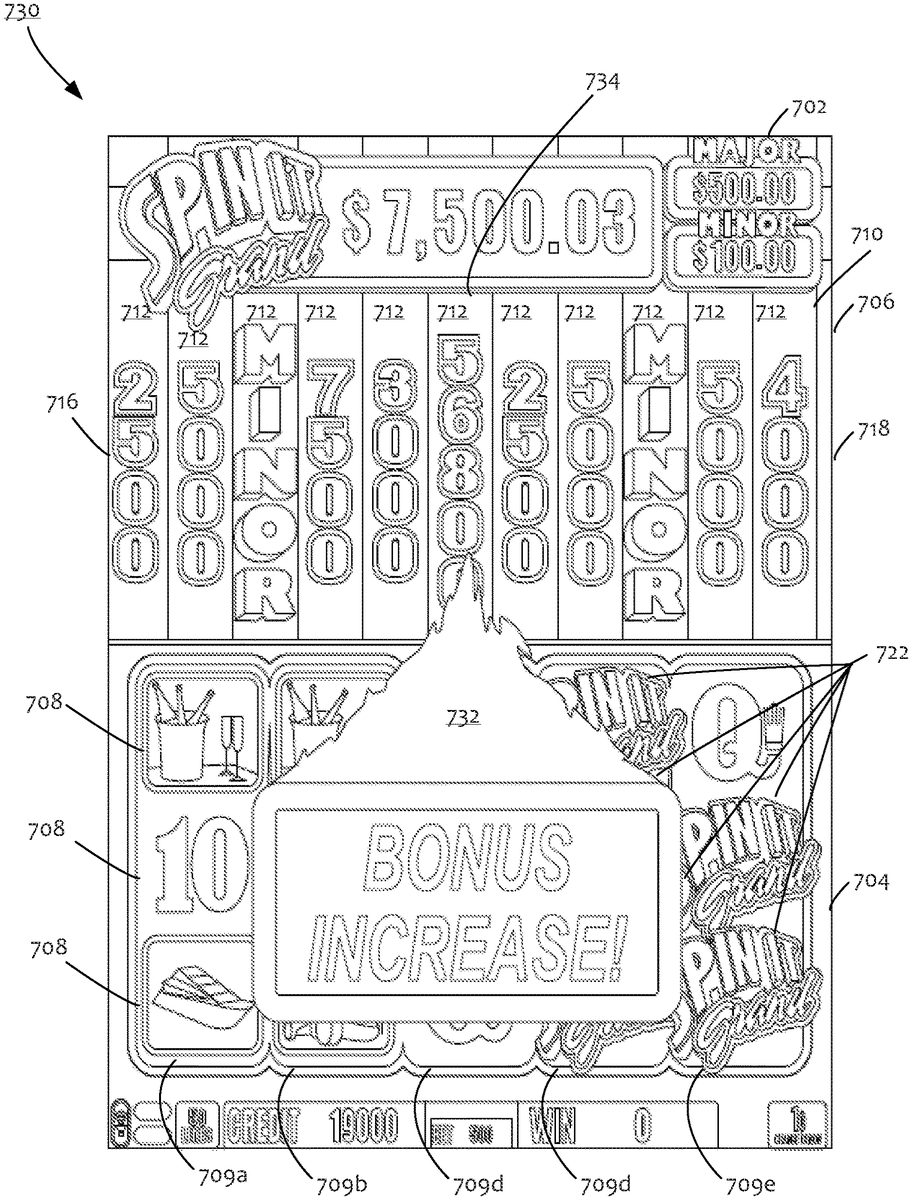
FIG.7Cillustrates an animation of a prize identifier upgrade730based on an occurrence of the five displayed “Spin-It-Grand” symbols722upgrading a selected segment734carrying the prize identifier of 50000 credits. Specifically, when the trigger controller625edetects five “Spin-It-Grand” symbols722are displayed, the display controller621animates on display702an upgrade flame732with text “BONUS INCREASE” indicating that an upgrade is initiated. In some embodiments, the upgrade flame732originates from the first display area704igniting the selected segment734having a prize identifier of 50000 credits. In some embodiments, igniting a selected segment may also be accompanied by an additional animation of a respective prize identifier. For example, upgrading a minor jackpot prize identifier that is animated as an ice block may also include an animation of melting of the ice block revealing a major jackpot prize identifier, while igniting the corresponding segment.
In the embodiment shown, the upgrade controller625gdetermines the amount of upgrade to be 12500 credits. Thus, the upgrade controller625galso determines an upgrade speed for the change in value of the selected segment734to assume an upgrade from 50000 credits to 62500 credits before the selected segment734moves out of the second display area706.FIG.7Dillustrates a continuation of the animation of the prize identifier upgrade730ofFIG.7C. As shown inFIG.7D, the selected segment734has assumed an upgrade of only 6800 credits toward the 12500-credit upgrade, as segment734moves laterally across the second display area706.FIG.7Dillustrates a completion of the animation of the 12500-credit upgrade730. As shown inFIG.7E, the selected segment734has now completed the upgrade of 12500 credits before the selected segment734moves out of the second display area706, while continuing to move the vertical segments712laterally across the second display area706. The upgraded segment734will then be used as one of the vertical segments712to be awardable to the player during play of a feature game.
FIG.8illustrates a flow chart of an exemplary upgrade process800. When a gaming machine is idle, at block802, the speed controller625cdetermines a first speed at which a plurality of vertical segments (like vertical segments712ofFIG.7A) are moved, and, at block804, the display controller621causes the second display area706to display the vertical segments moving laterally at the determined speed.
When the meter controller624determines that a credit has been established, for example, when the credit input mechanism52.1(ofFIG.1) has received a physical item representing a monetary value, as determined at block806, the symbol selecting controller625dselects a plurality of symbols from the symbol data memory module64.1for display at the first display area704, for example, at the display positions708at block810. The trigger controller625ethen determines if the displayed symbols include a predetermined number of predetermined or upgrade symbols at block812. If the trigger controller625edetermines that the displayed symbols do not include any predetermined or upgrade symbols at block812, the upgrade process800proceeds to block830. However, if the trigger controller625edetermines that the displayed symbols include one or more predetermined or upgrade symbols at block812, the upgrade process800proceeds to select a segment to upgrade via the segment selecting controller625f, as discussed above, at block814.
The upgrade process800at block816animates an upgrade flame with text “BONUS INCREASE” indicative that an upgrade is initiated, via the display controller621, and at block818determines an amount of upgrade to be applied to the selected segment. At block820, the upgrade process800determines if the selected segment is being displayed in the second display area706, via upgrade controller625g. If the upgrade process800determines that the selected segment is not being displayed in the second display area706, the speed controller625cincreases the speed as determined in block822, in block824, such that the selected segment is displayed in second display area706. If the upgrade process800determines that the selected segment is being displayed in the second display area706, at block820, the upgrade controller625gdetermines an upgrade speed for the selected segment to assume, at block826, and the selected segment is displayed and being upgraded at block828.
At block830, the upgrade process800determines if the displayed symbols displayed at block810include any winning combination of symbols. If upgrade process800determines that the displayed symbols include a winning combination of symbols, the meter controller624increments the credit meter54.1(ofFIG.1). If the upgrade process800determines that the displayed symbols do not include a winning combination of symbols, the trigger controller625edetermines if the displayed symbols include any feature trigger condition at block834. If the upgrade process800determines the displayed symbols do not include any feature trigger condition, the upgrade process800determines if there are more games to be played, at block838. If the upgrade process800determines that there are more games to be played, the upgrade process800returns to block808. If the upgrade process800determines that there is no more game to be played, the upgrade process800ends, at block840. If the trigger controller625edetermines that the displayed symbols include a feature trigger condition at block834, the upgrade process800proceeds to initiate a feature game at block836.
Referring back toFIG.6, feature game controller625imanages a feature game based on an occurrence of a trigger event as detected by the trigger controller625e. The feature game controller625iinitiates a feature game when a predetermined condition or a trigger event occurs, and uses the prize identifiers714(including any upgraded prize identifiers) of the spinning wheel710to award a player winning a feature game. An award controller625hcontrols an award in accord with plays in the base game and in the feature game.
FIG.9Aillustrates an exemplary feature game900. When the feature game controller625i(based on trigger controller625e) initiates the feature game900, the feature game controller625ireplaces the spinning reels709a,709b,709c,709d,709eof the base game700(ofFIG.7A) with a plurality of tubes952,954,956,958,960,962,964,966,968,970. The tubes952,954,956,958,960,962,964,966,968,970are initially empty. The feature game900continues to include the spinning wheel710that further includes a plurality of vertical segments712having respective prize identifiers714moving laterally at a feature speed set by speed controller625c(ofFIG.6). In some embodiments, the feature speed is generally higher than the first speed of the base game700(ofFIG.7A). In some embodiments, the feature game900is a plurality of games of filling the empty tubes. For example, each of the tubes952,954,956,958,960,962,964,966,968,970has a respective reel strip that has a predetermined feature symbol918. In some embodiments, each of the tubes952,954,956,958,960,962,964,966,968,970has only one predetermined feature symbol918. In an exemplary feature game900that includes a series of three spins or tube fillings, if no predetermined feature symbol918is spun up, a spin is spent. However, if a predetermined feature symbol918is spun up at an exemplary tube, the predetermined feature symbol918is held at the exemplary tube for a subsequent spin, and the series of spins is reset back to three.
When a player actuates the game play mechanism56to play the feature game900, the speed controller625cinitially increases the feature speed to accelerate the lateral movements of the vertical segments712, and controllably slows down the lateral movements to a complete stop. While the vertical segments712are moving laterally across the second display area706, the symbol selecting controller625drandomly selects a plurality of symbols to fill the empty tubes952,954,956,958,960,962,964,966,968,970. In the embodiment shown, the empty tubes952,954,956,958,960,962,964,966,968,970have a “Spin-It-Grand” background. In other embodiments, the empty tubes empty tubes952,954,956,958,960,962,964,966,968,970may have different backgrounds, or no background at all.
FIG.9Billustrates an exemplary outcome910of the feature game900ofFIG.9A. The outcome910shows that tubes952,954,956,960,962,964,968,970, are filled with respective predetermined feature symbols918. Tubes958and966are darkened because no symbols filled (moved into) tubes958,966. During the feature game900, the tubes952,954,956,958,960,962,964,966,968,970are spun, and only tubes952,954,956,960,962,964,968,970have spun up the predetermined feature symbols918. As shown, the predetermined feature symbols918are flaming dollar signs with respective flaming backgrounds920.
FIG.9Cillustrates a completion930of the feature game900ofFIG.9B. That is, a series of spins has been completed. The completion930shows that the vertical segments712align with the tubes952,954,956,958,960,962,964,966,968,970. The award controller625hthen awards a feature prize based on the prize identifiers that aligned with tubes952,954,956,960,962,964,968,970. The completion930also shows the feature prize in a pop-up feature prize window940.
FIG.10illustrates a flow chart of an exemplary feature game1000. The feature game1000begins with determining a first feature speed at which the spinning wheel710of vertical segments712with prize identifiers714are moved at block1002. Generally, the first feature speed is higher than the first speed of the base game700. The display controller621causes the second display area706to laterally move the vertical segments at the first feature speed, at block1004. At block1006, the feature controller625i(ofFIG.6) causes the first display area704to display the plurality of empty tubes952,954,956,958,960,962,964,966,968,970. Thus, with a denomination972of10, the award controller awards a total of 44,000 credits, or $440, and $100 for a MINOR jackpot prize974of $100, thus resulting in a total award of $540. In other words, from left to right5000($50)+2500 ($25)+MINOR ($100)+3500 ($35)+25000 ($250)+2500 ($25)+3500 ($35)+2000 ($20)=$540.
When a player actuates the game play mechanism56as determined at block1008, the feature game1000proceeds to select symbols, at block1010, to fill the empty tubes952,954,956,958,960,962,964,966,968,970via the symbol selecting controller625d. Although not shown, in some embodiments, the feature controller625irandomly selects which of the tubes952,954,956,958,960,962,964,966,968,970to fill. At block1014, the feature controller625ifills the selected tubes952,954,956,960,962,964,968,970with the selected symbols. The trigger controller625ethen determines whether the filled tubes include predetermined symbols at block1016. In some embodiments, only tubes952,954,956,960,962,964,968,970are filled with predetermined symbols918.
When the trigger controller625edetermines that the filled tubes include predetermined symbols at block1016, the speed controller625caccelerates the lateral movements of the vertical segments712at block1017. At block108, the speed controller625ceffectively slows down the spinning wheel to align the vertical segments712with the tubes952,954,956,958,960,962,964,966,968,970. At block1020, the award controller625hthen awards the player with the prize identifiers714that are aligned with the filled tubes952,954,956,960,962,964,968,970.
Further aspects of the method will be apparent from the above description of the system. It will be appreciated that at least part of the method will be implemented electronically, for example, digitally by a processor executing program code such as in the above description of a game controller. In this respect, in the above description certain steps are described as being carried out by a processor of a gaming system, it will be appreciated that such steps will often require a number of sub-steps to be carried out for the steps to be implemented electronically, for example due to hardware or programming limitations. For example, to carry out a step such as evaluating, determining or selecting, a processor may need to compute several values and compare those values.
As indicated above, the method may be embodied in program code. The program code could be supplied in a number of ways, for example on a tangible computer readable storage medium, such as a disc or a memory device, e.g. an EEPROM, (for example, that could replace part of memory103) or as a data signal (for example, by transmitting it from a server). Further different parts of the program code can be executed by different devices, for example in a client server relationship. Persons skilled in the art will appreciate that program code provides a series of instructions executable by the processor.
It will be understood to persons skilled in the art of the invention that many modifications may be made without departing from the spirit and scope of the invention. In particular, it will be apparent that certain features of embodiments of the invention can be employed to form further embodiments.
It is to be understood that, if any prior art is referred to herein, such reference does not constitute an admission that the prior art forms a part of the common general knowledge in the art in any country.
In the claims which follow and in the preceding description of the invention, except where the context requires otherwise due to express language or necessary implication, the word “comprise” or variations such as “comprises” or “comprising” is used in an inclusive sense, i.e. to specify the presence of the stated features but not to preclude the presence or addition of further features in various embodiments of the invention.
Claims
- A gaming device comprising: a display device;and a controller comprising a processor and a memory, the memory storing instructions, which when executed by the processor, cause the processor to, at least: control the display device to display a plurality of symbol display positions;control the display device to display a plurality of vertical segments, wherein at least a subset of the plurality of vertical segments display a number;control the display device to display a plurality of symbols in the plurality of symbol display positions;control the display device to display the plurality of vertical segments moving laterally across the display device;and in response to a trigger condition being generated by a random number generator, control the display device to visually present a numerical upgrade of a first vertical segment by displaying the number of the first vertical segment increasing from an initial value, through one or more intermediate values, and to a final value;control the display device to show the first vertical segment moving laterally across the display device at a first speed;control the display device to show the numerical upgrade of the first vertical segment while laterally moving the first vertical segment across the display device at a second speed different from the first speed;and select the second speed such that the numerical upgrade of the first vertical segment from the initial value to the final value completes before the first vertical segment moves out of the display device.
- The gaming device of claim 1, wherein executing the instructions further causes the processor to control the display device to display a second vertical segment of the plurality of vertical segments being selected based on an output of the random number generator and determine an award amount corresponding to the number displayed by the selected vertical segment.
- The gaming device of claim 1, wherein executing the instructions further causes the processor to control the display device to display the number of the first vertical segment being numerically increased from the initial value to the final value visually in increments that result in the one or more intermediate values being displayed by the first vertical segment.
- The gaming device of claim 1, wherein executing the instructions further causes the processor to control the display device to display the plurality of vertical segments at a position above a position where the plurality of symbol display positions are displayed on the display device.
- The gaming device of claim 4, wherein executing the instructions further causes the processor to control the display device to display a plurality of reels spinning vertically, each reel of the plurality of reels corresponding to a column of a matrix in which the plurality of symbols display positions are arranged.
- The gaming device of claim 1, further comprising: a credit input device operable to receive a physical item representing a monetary value to establish a credit balance;and a payout mechanism to cause a payout associated with the credit balance.
- A method in a gaming device comprising: controlling a display device of the gaming device to display a plurality of symbol display positions;controlling the display device of the gaming device to display a plurality of vertical segments, wherein at least a subset of the plurality of vertical segments display a number;controlling the display device of the gaming device to display a plurality of symbols in the plurality of symbol display positions;controlling the display device of the gaming device to display the plurality of vertical segments moving laterally across the display device;in response to a trigger condition being generated by a random number generator, control the display device to visually present a numerical upgrade of a first vertical segment by displaying the number of the first vertical segment being numerically increased from an initial value to a final value;and adjusting a speed of the vertical segments laterally moving across the display device and/or a speed of presenting the numerical upgrade of the first vertical segment such that the numerical upgrade completes during a period in which the first vertical segment is displayed on the display device.
- The method of claim 7, further comprising controlling the display device to display a second vertical segment of the plurality of vertical segments being selected based on an output of the random number generator and determine an award amount corresponding to the number displayed by the selected vertical segment.
- The method of claim 7, further comprising controlling the display device to display the number of the first vertical segment being numerically increased from the initial value to the final value visually in increments that result in a plurality of intermediate values being displayed by the first vertical segment.
- The method of claim 7, further comprising controlling the display device to display the plurality of vertical segments at a position above a position where the plurality of symbol display positions are displayed on the display device.
- The method of claim 10, further comprising controlling the display device to display a plurality of reels spinning vertically, each reel of the plurality of reels corresponding to a column of a matrix in which the plurality of symbols display positions are arranged.
- One or more non-transitory computer-readable storage media comprising instructions, which when executed by at least one processor cause the at least one processor to, at least: control a display device to display a plurality of symbol display positions;control the display device to display a plurality of vertical segments, wherein at least a subset of the plurality of vertical segments display a number;control the display device to display a plurality of symbols in the plurality of symbol display positions;control the display device to display the plurality of vertical segments moving laterally across the display device;and in response to a trigger condition being generated by a random number generator, determine an update speed based on a display position of a first vertical segment;and control the display device to visually present a numerical upgrade of the first vertical segment by displaying the number of the first vertical segment being numerically increased from an initial value to a final value per the determined update speed.
- The one or more non-transitory computer-readable storage media of claim 12, wherein the instructions further cause the at least one processor to control the display device to display a second vertical segment of the plurality of vertical segments being selected based on an output of the random number generator and determine an award amount corresponding to the number displayed by the selected vertical segment.
- The one or more non-transitory computer-readable storage media of claim 12, wherein the instructions further cause the at least one processor to control the display device to visually present the numerical upgrade of the first vertical segment while laterally moving the first vertical segment across the display device.
- The one or more non-transitory computer-readable storage media of claim 14, wherein the instructions further cause the at least one processor to control the display device to display the number of the first vertical segment being numerically increased from an initial value to a final value visually in increments that result in a plurality of intermediate values being displayed by the first vertical segment.
- The one or more non-transitory computer-readable storage media of claim 14, wherein the instructions further cause the at least one processor to control the display device to: display the plurality of vertical segments at a position above a position where the plurality of symbol display positions are displayed on the display device;and display a plurality of reels spinning vertically, each reel of the plurality of reels corresponding to a column of a matrix in which the plurality of symbols display positions are arranged.
- The method of claim 7, wherein adjusting the speed of the vertical segments laterally moving across the display device and/or the speed of presenting the numerical upgrade of the first vertical segment comprises decreasing the speed of the vertical segments laterally moving across the display device.
- The method of claim 7, wherein adjusting the speed of the vertical segments laterally moving across the display device and/or the speed of presenting the numerical upgrade of the first vertical segment comprises increasing the speed of presenting the numerical upgrade.
Disclaimer: Data collected from the USPTO and may be malformed, incomplete, and/or otherwise inaccurate.