U.S. Pat. No. 11,532,172
ENHANCED TRAINING OF MACHINE LEARNING SYSTEMS BASED ON AUTOMATICALLY GENERATED REALISTIC GAMEPLAY INFORMATION
AssigneeElectronic Arts Inc.
Issue DateJuly 10, 2020
Illustrative Figure
Abstract
Systems and methods for enhanced training of machine learning systems based on automatically generated visually realistic gameplay. An example method includes obtaining electronic game data that includes rendered images and associated annotation information, the annotation information identifying features included in the rendered images to be learned, and the electronic game data being generated by a video game associated with a particular sport. Machine learning models are trained based on the obtained electronic game data, with training including causing the machine learning models to output annotation information based on associated input of a rendered image. Real-world gameplay data is obtained, with the real-world gameplay data being images of real-world gameplay of the particular sport. The obtained real-world gameplay data is analyzed based on the trained machine learning models. Analyzing includes extracting features from the real-world gameplay data using the machine learning models.
Description
DETAILED DESCRIPTION This specification describes schemes for improved generation of training data using video game systems or other computer graphic-based systems. Additionally, this specification describes utilizing the training data to train machine learning models which are able to analyze real-world images or video. For example, a sports video game may be utilized to generate training data, and a system implementing trained machine learning models may analyze real-world images or video of a same sport. While this specification describes utilization of a hockey video game, it should be understood that hockey is merely an illustrative example of a sport. Video games for different sports may instead be utilized and the techniques described herein will enable real-world images or video of these different sports to be similarly analyzed. Additionally, techniques described herein may be applied to video games or other computer graphic-based systems that are not related to sports. For example, realistic role playing games set in a city may be utilized to analyze real-world footage of a city. Due to advances in computer graphics, images of gameplay generated by example modern video games may advantageously form the basis of training data usable to train one or more machine learning models. As will be described, the machine learning models may learn different aspects or features of the gameplay. For example, a machine learning model may learn to identify differing video game characters, and their locations in a video game environment, as illustrated in images generated by a video game. In the example of a sports video game, the machine learning model may learn to recognize different characters, or types of characters (e.g., goalie, forward, and so on), along with the character's locations in a sports stadium (e.g., ice hockey rink). As another example, specific portions of the video game characters may be ...
DETAILED DESCRIPTION
This specification describes schemes for improved generation of training data using video game systems or other computer graphic-based systems. Additionally, this specification describes utilizing the training data to train machine learning models which are able to analyze real-world images or video. For example, a sports video game may be utilized to generate training data, and a system implementing trained machine learning models may analyze real-world images or video of a same sport. While this specification describes utilization of a hockey video game, it should be understood that hockey is merely an illustrative example of a sport. Video games for different sports may instead be utilized and the techniques described herein will enable real-world images or video of these different sports to be similarly analyzed. Additionally, techniques described herein may be applied to video games or other computer graphic-based systems that are not related to sports. For example, realistic role playing games set in a city may be utilized to analyze real-world footage of a city.
Due to advances in computer graphics, images of gameplay generated by example modern video games may advantageously form the basis of training data usable to train one or more machine learning models. As will be described, the machine learning models may learn different aspects or features of the gameplay. For example, a machine learning model may learn to identify differing video game characters, and their locations in a video game environment, as illustrated in images generated by a video game. In the example of a sports video game, the machine learning model may learn to recognize different characters, or types of characters (e.g., goalie, forward, and so on), along with the character's locations in a sports stadium (e.g., ice hockey rink). As another example, specific portions of the video game characters may be learned (e.g., arms, legs, and so on). These portions may represent an underlying skeletal model of the video game character. As another example, a machine learning model may learn to identify features of different video game environments. For example, the features may include elements of a sports stadium. As will be described, these features may be recognized in images of real-world sports stadiums and may be utilized, at least, to determine locations within the sports stadiums of real-world players.
To efficiently generate the images of video game gameplay, a script, or other software, may automatically control a video game such that images of differing types of gameplay may be generated. For example, a script may cause a hockey video game to be automatically played, such that images of the gameplay may be obtained. As another example, particular video games may enable modes of automatic gameplay. For instance, with respect to a sports game a mode may enable two teams to play a match against each other with each team being automatically controlled. Images of the video game gameplay may be extracted from the video game periodically, for example every frame, every half a second, and so on. Additionally, images of the video game gameplay may be extracted according to one or more triggers. Example triggers may include a particular video game character being present, a particular action being performed, and so on. In this way, multitudes of video game images may be automatically generated for utilization in training machine learning models.
Training data, such as the above-described video game images, generally requires labels or annotations of specific features included in the training data. Machine learning models may utilize these labels or annotations to learn to identify the features. For example, images generated by a hockey video game may illustrate features such as, players, ice, elements associated with the ice (e.g., markings on the ice, such as faceoff spots), hockey nets, crowds, scoreboards, and so on. Advantageously, when rendering images of gameplay, video games will have information describing the features included in the rendered images. (e.g., state information, reference information, parameter information, and so on). For example, when rendering an image of a hockey stadium, a hockey video game will have information indicating the players being included in the image, specific portions of each player, locations of a crowd, scoreboard, and so on. The hockey video game may thus provide label or annotation information as being associated with a rendered video game image. Optionally, video games may include custom code or software that causes the video games to generate the label or annotation information.
As will be described in more detail below, label or annotation information for a video game image may include a textual description of a feature included in the video game image, or may include an annotation image generated based on the video game image. A textual description may include an identification of a type of video game character. For example, with respect to hockey a type of video game character may include a goalie, a referee, or a forward or defensive player. In this way, machine learning models may be trained to identify these distinct types of players. An annotation image may be an image associated with the video game image that clearly illustrates specific features of the video game image. For example, an annotation image may include each hockey player as being a particular color (e.g., white), while the remaining portions of the annotation image are different colors. In this way, the annotation image can clearly illustrate locations of the hockey players. As another example, a label image may include portions of a hockey player being distinct colors. For example, a hockey player's stick may be a first color (e.g., red), while the player's arms, legs, head, skates, and so on, are different colors. In this way, the annotation image can clearly illustrate the portions of a hockey player that are to be learned by the machine learning models.
Based on the above-described training data (e.g., video game images and label or annotation information), machine learning models may be trained by a system described herein (e.g., the gameplay learning system100). Example machine learning models may include neural networks (e.g., convolutional neural networks, recurrent neural networks, and so on), support vector machines, and so on. Optionally, multiple machine learning models may be trained, with each machine learning model being utilized to extract respective features (e.g., a subset of total features being learned). Additionally, one or more machine learning models may utilize information extracted via other machine learning models. For example, a first machine learning model may be trained to identify a particular player. Once identified, a second machine learning model may be trained to identify portions of the particular player (e.g., hockey stick, arms, legs, and so on).
Subsequent to training, the system can obtain real-world images or video, for example images or video of sports being played, and extract information based on the machine learning models. For example, the system can obtain an image of a real-world hockey game, and extract pose information associated with each player included in the image. Pose information may include information indicating portions of a player, such as a location of the players hockey stick, arms, legs, helmet, skates, and so on. As will be described, this pose information may be related to a skeletal model comprising bones and joints which is utilized in video games. The system can track this player across multiple images to identify movement of the player. This pose information may be utilized to improve how video game characters move about a hockey rink. As another example, the system can determine three-dimensional locations of each player in the real-world environment. For example, the system can tag each player's two-dimensional location as illustrated in a real-world image. The system can then determine camera information associated with the real-world image, such as a perspective of a camera that captured the image (e.g., a location of a television camera). Based on this camera information, and information associated with the hockey rink, the system can determine a three-dimensional location on the hockey rink for reach player. This location information can inform how players realistically move about a hockey rink. Additionally, via analyzing images or video of a real-world game, the system can identify how cameras capturing the images or video track the real-world game. In this way, artificial intelligence for in-game cameras that track action of a video-game may be improved or made to appear more realistic.
In order to facilitate an understanding of the systems and methods discussed herein, a number of terms are described below. The terms described below, as well as other terms used herein, should be construed broadly to include the provided definitions, the ordinary and customary meaning of the terms, and/or any other implied meaning for the respective terms.
As used herein, a video game is an electronic game that executes on a user device, such as a dedicated console system (e.g., XBOX®, PLAYSTATION®), a laptop or desktop computer, a tablet, smart phone, and so on. Example video games may include sports games (for example, football games, hockey games, basketball games, racing games, and the like), and so on. The electronic game may be utilized to generate (e.g., render) images or video that are to be used as training data. Additionally, the electronic game may utilize state information to generate label or annotation information associated with the training data. State information may include player information, information associated with objects rendered in a video game image, camera information, score information, and so on. The electronic game may include custom code or software that causes generation of the label or annotation information. As another example, the electronic game may provide state information, or a portion thereof, to an outside system to generate label or annotation information.
As used herein, training data includes information usable to train machine learning systems or models. Training data may include images or video, optionally along with label or annotation information describing features of included in the images or video.
As used herein, label or annotation information (hereinafter referred to as annotation information) may include information usable by a machine learning model to identify a particular feature of an image. For example, annotation information may include a classification for each pixel of an image included in the training data. An example classification may include whether the pixel corresponds to part of a player, to a feature of a video game environment, and so on. Annotation information may further include a designation or textual description of a particular feature. For example, the training data can include images of different players of a hockey game. Each player may be associated with a designation indicating a role or type of the player.
As used herein, machine learning models include supervised or unsupervised machine learning techniques. Example machine learning models can include neural networks (e.g., convolutional neural networks or recurrent neural networks), or other deep learning techniques. The neural networks, for example recurrent neural networks, may utilize long short-term memory (LSTM) and/or gated recurrent units as storage. In this way, frames of video can be utilized by the neural networks and time-series information may be learned.
As used herein in reference to user interactions with data displayed by a computing system, “user input” is a broad term that refers to any type of input provided by a user that is intended to be received and/or stored by a system, to cause an update to data that is displayed by the system, and/or to cause an update to the way that data is displayed by the system. Non-limiting examples of such user input include keyboard inputs, mouse inputs, digital pen inputs, voice inputs, finger touch inputs (e.g., via touch sensitive display), gesture inputs (e.g., hand movements, finger movements, arm movements, movements of any other appendage, and/or body movements), and/or the like. Additionally, user inputs to the system may include inputs via tools and/or other objects manipulated by the user. For example, the user may move an object, such as a tool, stylus, or wand, to provide inputs. Further, user inputs may include motion, position, rotation, angle, alignment, orientation, configuration (e.g., fist, hand flat, one finger extended, etc.), and/or the like. For example, user inputs may comprise a position, orientation, and/or motion of a hand and/or a 3D mouse.
As used herein, a data store can refer to any computer readable storage medium and/or device (or collection of data storage mediums and/or devices). Examples of data stores include, but are not limited to, optical disks (e.g., CD-ROM, DVD-ROM, etc.), magnetic disks (e.g., hard disks, floppy disks, etc.), memory circuits (e.g., solid state drives, random-access memory (RAM), etc.), and/or the like. Another example of a data store is a hosted storage environment that includes a collection of physical data storage devices that may be remotely accessible and may be rapidly provisioned as needed (commonly referred to as “cloud” storage).
As used herein, a database can refer to any data structure (and/or combinations of multiple data structures) for storing and/or organizing data, including, but not limited to, relational databases (e.g., Oracle databases, mySQL databases, and so on), non-relational databases (e.g., NoSQL databases, and so on), in-memory databases, spreadsheets, as comma separated values (CSV) files, eXtendible markup language (XML) files, TeXT (TXT) files, flat files, spreadsheet files, and/or any other widely used or proprietary format for data storage. Databases are typically stored in one or more data stores. Accordingly, each database referred to herein (e.g., in the description herein and/or the figures of the present application) is to be understood as being stored in one or more data stores.
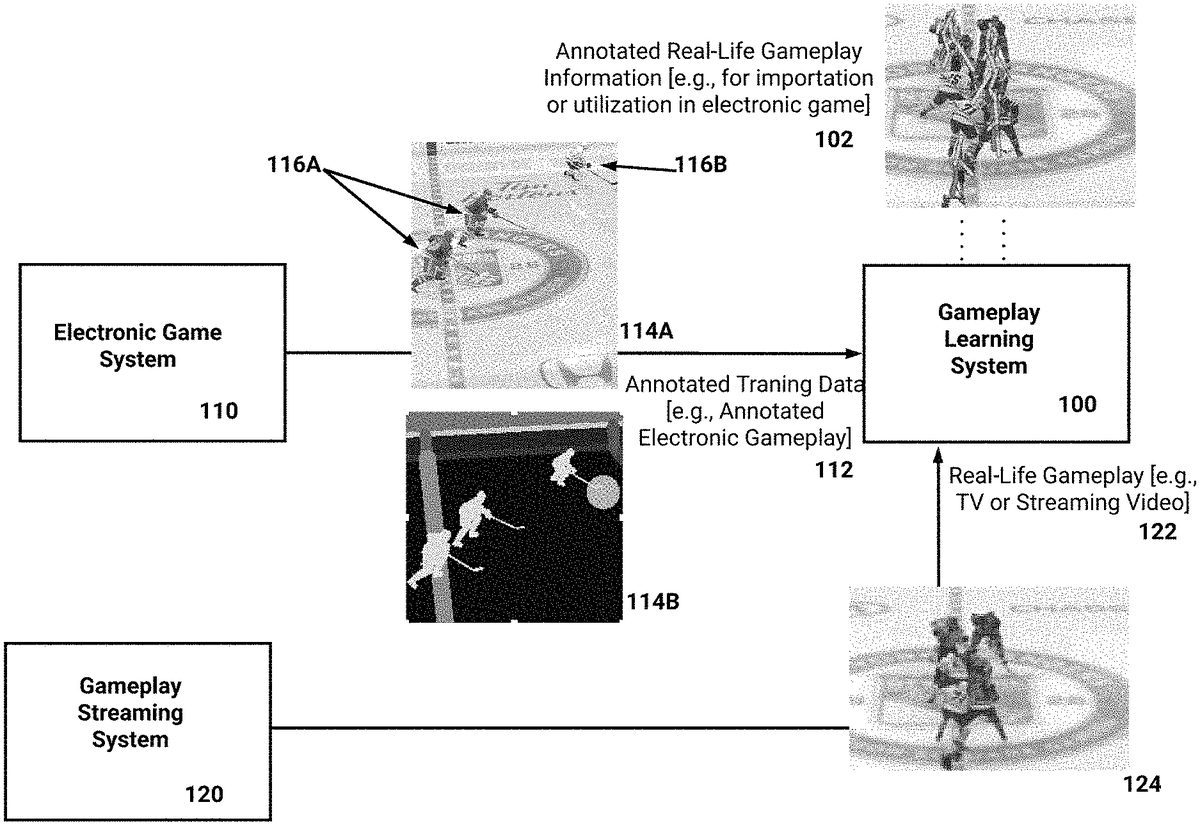
FIG.1illustrates a block diagram of a gameplay learning system100in communication with other systems. As illustrated, the other systems include an electronic game system110and a gameplay streaming system120. The gameplay learning system100may be a system of one or more computers, one or more virtual machines executing on a system of one or more computers, and so on. The electronic game system110may, as described above, be a dedicated game console or other user device. Optionally, the gameplay learning system100may implement the electronic game system110. For example, the gameplay learning system100may emulate the electronic game system110. The gameplay streaming system120may be a system that receives television broadcasts, such as broadcasts from a sports network, and/or may receive streaming broadcasts over a network (e.g., the internet).
As described above, the gameplay learning system100can train machine learning models using annotated training data112. For example, the annotated training data112can include images generated by the electronic game system110along with annotation information associated with features to be learned. To generate the annotated training data112, the electronic game system110can execute (e.g., run) a particular video game, such as a sports video game, and store images of rendered gameplay. While the electronic game system110is singly illustrated inFIG.1, it should be understood that multitudes of electronic game systems110may be utilized to generate training data112. Optionally, the electronic game system110may be a system of one or more computers, and may execute a multitude (e.g., emulate) a multitude of instances of the same video game. For example, the electronic game system110may form, or otherwise be associated with, cloud computing components. In this example, the system110may execute each instance of a video game in a respective virtual machine assigned particular components. Example computing components may include a particular amount of memory, processing power (e.g., one or more virtual central processing units), and so on.
The electronic game system110can periodically store rendered images of gameplay. As an example, the electronic game system110can store images after a threshold quantity of time (e.g., after every 0.0167 seconds, 0.0333 seconds, 0.5 seconds, and so on). These images may therefore represent a cross-section of video game gameplay. Optionally, when rendering video game gameplay, the electronic game system110can ensure that user interface elements are not rendered. For example, the system110can remove menus or other video game specific user interface elements that may normally be presented to an end-user. In this way, the rendered images can adhere closely to images obtained from real-world gameplay.
The electronic game system110may execute software, such as a script (e.g., a Python script), that instructs the electronic game system110to store rendered images. The script may periodically (e.g., based on time as described above) instruct (e.g., trigger) the electronic game system110to store one or more frames rendered by the system110. As the video game renders gameplay for presentation, the software may therefore periodically cause storing of rendered images. For example, the system110may execute the software in a separate process than processes associated with the video game. In this example, as the video game generates display data, the software may cause the storing of particular rendered images.
Optionally, the software may be a part of a video game, for example the video game may be placed into a development or debug mode which responds to instructions to store rendered images. As another example, the video game may be customized to include the software. Optionally, the gameplay learning system100may execute the software, for example in a separate process than processes associated with the video game, and the software may provide instructions to the video game.
In addition to storing video game images according to time, images may be stored based on satisfaction of particular triggers. For example, the electronic game system110may store images while a particular action is being performed. As an example with respect to a hockey video game, the system110may store images of hockey players taking shots on a hockey net. As another example, the system110may store images of players making particular types of turns, or skating in a particular way. As another example, the system110may store images that include both right handed and left handed characters. In this example, the system110can ensure that training data112includes video game hockey players who hold their sticks in opposite hands. Additionally, the system110may cause hockey players to be evenly split between right and left handed, or may cause hockey players to either all be right handed or left handed.
Optionally, the gameplay learning system100may generate information indicating annotated training data112that it is lacking. For example, the system100can determine it has less than a threshold quantity of a type of image, or that accuracy of its machine learning models with respect to this type of image is less than a threshold. The generated information may specify, for example, that the system100needs images of hockey players skating vertically up an ice hockey rink while a camera is pointing at a back of the hockey players. These images may be required to fill out the training data112, such that the machine learning models can effectively learn player animations. The electronic game system110can therefore trigger images of video game gameplay based on this generated information.
Optionally, the electronic game system110may render particular images that remove additional elements besides user interface features. As an example, the electronic game system110may render video game characters, while not rendering remaining elements of a scene. With respect to the example of a hockey video game, the electronic game system110may render hockey players while removing remaining elements (e.g., ice, hockey net, crowd, and so on). The rendered hockey players may be placed on a transparent background, or on a background of a uniform color which may be ignored by machine learning models (e.g., a green screen). These rendered images can enable the machine learning models to better learn outlines and features of players. Similarly, a hockey rink may be solely rendered, such that machine learning models may learn features of the hockey rink.
As described above, images of particular video game characters may be rendered and provided as training data112. For some example machine learning models, such as convolutional neural networks, the models may be scale dependent. That is, scale associated with features to be learned may impact an effectiveness of a trained model. Thus, when providing the images of particular video game characters, the system110or100may adjust a scale of the particular video game characters. However, to learn detail of these video game characters it may be beneficial for the machine learning models to have access to high resolution and/or large versions of the characters. Thus, the training data112may include the particular video game characters rendered at different scales. Additionally, the different scales may be beneficial as real-world gameplay (e.g., a broadcast of a hockey game) may include images captured by television cameras at different zoom levels. Thus, the real-world hockey players may appear differently sized within the images. Additionally, the real-world gameplay images may include differently sized hockey players based on their position on a skating rink. Players closer to the camera will appear larger than players farther from the camera. While these variations in player size may be captured in video game images, for example due to differing locations of the video game characters, the training data112may still benefit from the explicit addition of differently scaled (e.g., sized) video game characters. Thus, the system110or100may obtain an image of a particular video game character, and may generate different sizes of the video game character. This adjustment of scale can therefore serve to increase an effectiveness of machine learning models.
The electronic game system110, or the gameplay learning system100, may adjust one or more characteristics of the rendered video game gameplay images. The adjustments may serve to make the video game images appear closer to real-world counterparts (e.g., when similarly adjusted). As an example, the adjustments may remove details that can confuse machine learning models, or that are otherwise not necessary for the machine learning models to learn. For example, the resolution of the images may be reduced. As another example, one or more computer vision processing techniques may be applied to the images. Example computer vision processing techniques may include applying an edge detection scheme (e.g., a Canny edge detector) to better highlight distinctions between gameplay elements (e.g., distinction between characters and background elements). Another example technique may include applying blur to the image. As will be described, images of real-world gameplay122may be similarly blurred to reduce a distinction between video game images and real-world gameplay122images. Other example computer vision processing techniques may include adjusting rendered lighting of rendered images. For example, and with respect to the example of a hockey video game, lights may be rendered as reflecting off of an ice hockey rink. These lights may be adjusted to make them appear more diffuse.
As illustrated, the annotated training data112includes an example rendered gameplay image114A generated by the electronic game system110. The image114A is of three hockey players traversing an ice hockey rink. Additionally, two of the hockey players116A are on a same team, while a third hockey player116B is on a different team. Thus, the image114A may be utilized to learn included features such as outlines of players, particular team outfits, features of the ice hockey rink (e.g., center line, faceoff spot), and so on.
In addition the rendered gameplay image114A, annotation information114B is illustrated as being provided to the gameplay learning system100. In the example ofFIG.1, the annotation information114B is an annotation image generated from the gameplay image114A. This annotation information114B may cause a particular machine learning model (e.g., a particular neural network) to identify outlines of specific features. For example, different features of the image114A may be represented in the annotation information114B as being a distinct color. The colors may optionally be different shades of gray as illustrated. The different features, as illustrated in the example ofFIG.1, can include different video game characters with each video game character assigned a same team optionally being a same color. Optionally, video game characters of different types may be represented as different colors in the annotation information114B. For example, a goalie may be a first color and other players may be a second color. The different features can further include an indication of the center line, a neutral zone faceoff spot, a wall of the ice hockey rink, the ice of the ice hockey rink, and so on.
While the annotation information114B inFIG.1is illustrated as being outlines of specific features, it should be understood that annotation information may represent identify different features. For example, portions of each hockey player may be distinct colors. In this example, each hockey player's helmet may be a first color, while each hockey player's torso, arms, legs, skates, hockey stick, and so on, may be other colors. Optionally, each hockey player's helmet may be a distinct color than the hockey player's face. In this way, the machine learning models may learn to differentiate between different portions of each character (e.g., the character's helmet and face).
The gameplay learning system100can ingest this annotated training data112and train one or more machine learning models. As described above, the machine learning models may include neural networks such as convolutional or recurrent neural networks. Optionally, different machine learning models may learn different features included in the annotated training data112. For example, a first neural network may be trained to identify outlines of specific features. In this way, the first neural network can learn to extract a portion of an image corresponding to a video game character. A second neural network may be trained to identify portions of a video game character, such as their heard, torso, arms, legs, and so on. Optionally, the first neural network may provide information to the second neural network. For example, the first neural network may extract video game characters for the second neural network to then extract or identify respective portions of the video game characters.
Without being constrained by theory, the gameplay learning system100may train example neural networks via backpropagation. For example, a neural network may be trained to output the annotation information114B based on rendered image114A. Through use of multitudes of rendered images and corresponding annotation information, connections between neurons of the neural network may be adjusted. An example neural network, for example a convolutional neural network, may be formed from distinct layers connected to each other. An example layer may include a convolutional layer comprising locally connected neurons. An additional example layer may include a pooling layer, which may represent non-linear down sampling. An example of non-linear down sampling can include a max pooling layer, which can partition an input image into a set of non-overlapping rectangles and, for each sub-region, output a maximum. Another example layer may include a fully connected layer, for example a layer in which neurons are fully connected. This layer may enable high-level reasoning in the neural network. Furthermore, a loss layer may be included that specifies how training penalizes deviation between predicted information (e.g., based on an input and the output produced by the neural network) and true annotated information (e.g., annotation information114B).
Another example neural network may include a recurrent neural network. This example neural network may be utilized to extract animation information from subsequent rendered images. For example, rendered images of a particular video game character performing an animation be stored. The recurrent neural network may utilize long short-term memory units as a form of storage or memory. For example, a long short-term memory unit may comprise a cell, an input gate, an output gate, and a forget gate. The cell may be utilized to remember particular values, while the gates may represent a neuron. This example neural network may improve animation detection, and reduce existence of jitter through remembering the sequence of rendered images that form an animation. Additionally, when ingesting real-world gameplay images (e.g., from a broadcast of a real-world sports game), this example neural network may be utilized to better track a specific player.
As illustrated inFIG.1, the gameplay learning system100can obtain real-world gameplay122from the gameplay streaming system120. As described above, the real-world gameplay122may be broadcast video obtained via television or streaming services. The gameplay learning system100can ingest the real-world gameplay122, and using trained machine learning models, can extract particular features or information from the real-world gameplay122.
An example real-world gameplay image124is illustrated as being received by the gameplay learning system100. The gameplay learning system100can provide this image124to the trained machine learning models, and obtain annotated real-world gameplay information102. For example, a first machine learning model may extract outlines of real-world players included in the gameplay image124. Subsequently, a second machine learning model may determine portions of each real-world player. These machine learning models may therefore adjust the received gameplay image124to indicate the determined portions of each real-world player. As illustrated, the annotated real-world gameplay information102includes each real-world player with lines representing a skeletal model utilized in the video game. The skeletal model may include arms, legs, skates, hockey stick, and so on. The information102may therefore represent the pose of each real-world player. This pose information may inform realistic movement of video game characters, and using the gameplay learning system100, may be automatically extracted from real-world gameplay122.
Similar to the above description of the rendered image114A, the gameplay learning system100may adjust the real-world gameplay image124prior to analysis by the machine learning models. For example, the system100can adjust a resolution or scale of the image124. As another example, the system100can apply an edge detection scheme (e.g., a Canny edge detector), and so on. As will be described in more detail below inFIGS.2A-2F, the system may further extract camera information from the image124. For example, a real-world location of a camera capturing the image124in a sports stadium may be determined. This camera information can be utilized to learn behaviors of camera operators (e.g., how action is tracked). Additionally, the camera information can be utilized to adjust a perspective of the rendered gameplay image124, such that the perspective represents a virtual camera looking directly onto the ice. As will be described, this perspective may be utilized to better extract each real-world player from the image124, to learn specific features of real-world ice stadiums (e.g., logos on the walls or ice), and so on. These learned specific features may then cause updating of the machine learning models, thus increasing their accuracy. An example image adjusted to look down on the ice is illustrated inFIG.2E.
Optionally, and with respect to extracted pose information, the annotated real-world gameplay information102may be imported or utilized in the video game. For example, the information102is illustrated as including a skeletal model for each real-world player. Similarly, the video game may have video game characters that utilize a skeletal model comprising bones and joints. Since the machine learning models were trained on video game annotated training data112, the skeletal models represented in the information102may be applied to video game characters. For example, a video game character may be adjusted according to a sequence of skeletal models extracted from real-world gameplay122. In this way, information describing adjustment of a skeletal model may be provided to end-users of the video game (e.g., as downloadable content). The information may represent a particular sequence of movements performed by a real-world player, such as a game winning shot or celebration. Thus, the video game may accurately recreate this sequence of movements in a realistic fashion. Additionally, since this information may be automatically extracted from real-world gameplay122, end-users can rapidly receive the information for utilization in the video game. In this way, an efficiency of importing notable animations and movements of characters can be increased.
Extracting and Utilizing Camera Parameters
FIG.2Aillustrates a block diagram of an example gameplay learning system100in communication with an electronic game system110. As described above inFIG.1, the gameplay learning system100may receive rendered images of video game gameplay along with annotation information. The gameplay learning system100may then utilize the received information to train one or more machine learning models.
The gameplay learning system100includes a gameplay learning engine210that receives video game images or video and annotation information112from a video game230executing on the electronic game system110, and trains machine learning models. As described above, machine learning models may include neural networks, such as convolutional or recurrent neural networks, and the system may update weightings associated with neurons during the training. Additionally, the system may prune or otherwise optimize trained neural networks according to various pruning schemes (e.g., optimal brain damage, greedy criteria-based pruning with fine-tuning by backpropagation, and so on). Additionally, different machine learning models may be trained to extract or identify different features. For example, and as described above, a first neural network may be trained to extract outlines of video game characters. A second neural network may then be trained to identify portions of each video game character, such as by reference to a skeletal model comprising bones and joints.
In addition to training machine learning models to identify particular features, the gameplay learning engine210can utilize camera information232associated with the video game230to transform received two-dimensional rendered images (e.g., included in the video game images or video and annotation information112) to three-dimensional information. As will be described below, the camera information232can enable deeper insights into real-world gameplay. For example, the machine learning models can utilize the camera information to learn three-dimensional positional information associated with each element included in a rendered image. In this way, the machine learning models can be trained to essentially visualize the three-dimensional video game environment. As an example, having access to three-dimensional information can improve detection of video game pose information. As described above, pose information can include an orientation of different portions of a video game character, such as an orientation of a skeletal model comprising bones and joints. When analyzing real-world gameplay images, the gameplay learning system100can similarly relate the two-dimensional images to a three-dimensional version of a sports stadium. For example, the gameplay learning system100can determine a three-dimensional position of each real-world player with respect to the sports stadium. Thus, each real-world player's movement within the sports stadium can be monitored. This monitoring may be utilized to improve, for example, artificial intelligence of video game characters. The monitoring may also be utilized to improve how cameras in the video game, whose views are rendered and presented to end-users, track movement of players and focus on specific actions of the players. As an example, placement of cameras in a video game sports stadium (e.g., a perspective of the camera), rotation of the cameras, zoom utilized by the cameras, and so on, may all be improved through monitoring of the real-world cameras.
To enable translation between features included in two-dimensional video game images (e.g., included in the video game images or video and annotation information112) and their corresponding three-dimensional locations, the gameplay learning system100can utilize camera information232associated with the video game. Camera information232can include any information indicative of camera parameters of an in-game camera. Since views from the in-game cameras are presented to end-users, the camera parameters enable translation between the video game images (e.g., included in the video game images or video and annotation information112) and a three-dimension video game environment. Example camera parameters can include zoom being applied, orientation of the camera within the video game environment (e.g., location of the camera), a rotation being applied, and so on. Based on the camera information232, and geometrical information associated with the video game environment, the gameplay learning system100can determine three-dimensional locations of each feature included in the received video game images (e.g., included in the video game images or video and annotation information112).
To determine geometrical information, the gameplay learning engine210can be trained to identify specific fixed features of the video game environment. With respect to the example of a hockey video game, the engine210can be trained to identify fixed features including faceoff spots, faceoff circles, hockey nets, and so on. Since these features will be existent in real-world hockey games, they can similarly be extracted from real-world gameplay images. As illustrated inFIG.2A, example annotation information234is included (e.g., an annotation image). The example annotation information234identifies fixed features of a hockey rink as being respective colors. For example, a faceoff circle is indicated as being a first color, and a faceoff spot is indicated as being a second color. Utilizing multitudes of video game images that include these fixed features, and corresponding annotation information, the gameplay learning system100can train machine learning models to accurately identify locations of any fixed features included in either video game images or real-world gameplay images.
The specific fixed features can serve as key points of a known environment. For example, and with respect to hockey, the dimensions of a hockey rink can be obtained. Since the system100has access to the camera parameters utilized by the video game, the system can determine three-dimensional locations of any point within the hockey rink. That is, the system has access to camera parameters, two-dimensional locations of fixed features within a video game image, and can solve a perspective-n-point problem to determine the corresponding three-dimensional locations. In this way, two-dimensional images (e.g., video game images, real-world gameplay images) may be related to three-dimensional geometric information.
FIG.2Billustrates an example video game image242analyzed via machine learning models. As described above, the gameplay learning system100can train machine learning models to identify particular features. Example features may include fixed-features of a video game environment, such as faceoff circles, faceoff spots, and so on. As illustrated, the gameplay learning system100has analyzed video game image242, and annotated the video game image242to identify fixed features (e.g., faceoff spot244).
Based on these identified fixed features, the gameplay learning system100can additionally determine three-dimensional locations of each video game character (e.g., character246) within a video game environment (e.g., a hockey rink). For example, the system100can utilize camera information232associated with the video game230to determine camera parameters (e.g., orientation, rotation, zoom). Additionally, the system100can obtain geometrical information associated with the video game environment. Therefore, the system100can determine a perspective associated with an in-game camera that captured the video game image242. Based on this perspective and the geometrical information, the system100can determine each player's orientation with respect to the fixed features (e.g., faceoff spot244).
Thus, the gameplay learning system100can generate an example image248associated with the features of image242. The example image248includes a ‘top-down’ overview of the features included in image242. For example, the example image248indicates a position of each video game character along with a representation of the ice hockey rink proximate to the video game characters. The gameplay learning system100may optionally utilize this information to train additional machine learning models. For example, and as will be described in more detail below with respect toFIG.2C, the gameplay learning system100may analyze real-world gameplay images and generate a similar ‘top-down’ overview. This top-down overview advantageously summarizes the positions of each real-world player in a real-world environment (e.g., a hockey rink). The gameplay learning system100can utilize this positional information to identify how real-world players maneuver about the real-world environment. Additionally, the positional information can inform starting positions of players, complex team strategies and arrangements during particular actions, and so on. The information may thus inform improvements to artificial intelligence.
FIG.2Cillustrates a block diagram of an example gameplay learning system100in communication with a gameplay streaming system120. As described above, with respect toFIG.1, the gameplay learning system100can obtain images or video of real-world gameplay and generate annotated gameplay information102. As described inFIG.2A, the gameplay learning system100can generate annotated gameplay information102based on trained machine learning models. As will be described below, the gameplay learning system100can analyze received real-world gameplay122, for example two-dimensional images, and translate the real-world gameplay122to three-dimensional environments. In this way, the gameplay learning system100can determine three-dimensional locations of each real-world player. Additionally, the system100can identify information describing movement of real-world cameras. Optionally, and as will be described, the gameplay learning system100can update the trained machine learning models based on the determined three-dimensional information—thus improving accuracy of the machine learning models.
The gameplay learning system100includes a gameplay annotation engine220that can obtain real-world gameplay images or video122, and generate annotated gameplay information102. As illustrated, the gameplay learning system100has obtained a real-world gameplay image222of a hockey game, and has utilized machine learning models to identify fixed features on the gameplay image222. As described above, with respect toFIG.2A, example fixed features can include faceoff spots, faceoff circles, lines on the hockey rink, hockey nets, and so on. As will be described, the machine learning models can be updated based on real-world gameplay images to include unique fixed features of specific hockey rinks. For example, a logo printed on the ice of a specific ice hockey rink may be utilized as a fixed feature. Optionally the logo may be imported into a hockey video game to increase an accuracy of the video game's version of the ice hockey rink.
Based on the identified fixed features of the image222, the gameplay learning system100can relate the fixed features to known key points of an environment. In the example of hockey, the fixed features can be related to key points, such as faceoff spots and/or faceoff circles.
FIG.2Dillustrates an example image252with fixed features identified via trained machine learning models, and with the fixed features related to key points of a hockey stadium (e.g., key points254A-254D, representing faceoff circles). Particular key points may be selected for utilization in translating the two-dimensional example image252to three-dimensional information. For example, faceoff circles may be considered more reliable (e.g., these points may be more reliably detected) than faceoff spots. Additionally, center lines may be considered less reliable than the aforementioned faceoff circles and spots. Thus, a ranking of the identified key points may be utilized to select a threshold number of key points that will be relied upon to determine three-dimensional information. In the example ofFIG.2Dthe faceoff circles254A-254D may therefore be selected over center line255as key points.
Upon selection of the key points, the gameplay learning system100can obtain geometrical information associated with the real-world environment. For example with respect to hockey, the gameplay learning system100can obtain three-dimensional locations of the faceoff circles254A-254D in a hockey rink (e.g., the hockey rink may be standardized, or the system100can obtain geometric information of a specific hockey rink). Thus, the gameplay learning system100can access two dimensional coordinates in an image with corresponding three-dimensional locations.
Optionally, to solve the above-described perspective-n-point problem, the gameplay learning system100may utilize location information of a real-world camera that obtained image252. For example, the gameplay learning system100may have information identifying three-dimensional locations of all cameras utilized to broadcast sports games. This information may be obtained from, for example, video game230which may have this information defined. In this embodiment, the gameplay learning system100can obtain identifications of three-dimensional locations of each real-world camera. The system100can then select the camera that provides a best match of three-dimensional projections of the key points as included in the image252. For example, based on a perspective of the image252, the system100can determine a camera most likely to have captured the image252. Thus, the gameplay learning system100can determine an orientation camera parameter. Therefore, the system100can solve for the remaining camera parameters, such as zoom and rotation. For example, and with respect to a perspective-n-point problem, the gameplay learning system100may perform matrix multiplication to solve for the unknown zoom and rotation variables.
Optionally, if the gameplay learning system100does not have location information of the real-world camera, the system100can back calculate camera information based on one or more images of the real-world gameplay. For example, an image of a center ice faceoff perspective may be utilized as a starting point. Based on this perspective, the gameplay learning system100can solve for the camera parameters. To ensure proper determination of the camera parameters, the system100can optionally identify an image that is not zoomed in (e.g., an image with a greatest coverage of a sports stadium). This image may then be utilized to determine the remaining camera parameters (e.g., location, rotation) based on the identified key points.
FIG.2Dillustrates four key points being utilized (e.g., faceoff spots254A-254B). For some example images, less key points may be able to be extracted. As an example, real-world players may be blocking faceoff spots, or an image may be zoomed in such that only one or two fixed features are visible. In this case of two identified fixed features, and a known camera location, the gameplay learning system100can determine zoom. In the case of one identified fixed feature, and a known camera location, the gameplay learning system100can determine rotation. Thus, if one identified fixed feature is included in an image, the gameplay learning system100can utilize a zoom camera parameter value from a prior image frame (e.g., the most recent image frame).
Camera distortion may additionally be evident in particular images. For example, a real-world camera may utilize a wide-angle lens which may introduce distortion at the edges of an image. As another example, particular lenses may have natural distortion at the edges (e.g., barrel distortion). In these examples, the gameplay learning system100may correct for this distortion at the edges (e.g., based on the Brown-Conrady model). However, optionally the distortion may be retained. Since the distortion may be small, and may be relatively linear such that it will impact everything presented in the image, the relative positions of features included in the image may be relatively preserved (e.g., locations of real-world players).
Based on the above-described information, the gameplay learning system100can therefore determine the camera parameters of a camera which captured the image252. Thus, three-dimensional locations of all points within the image252may be determined. As described above, the gameplay learning system100can therefore obtain three-dimensional locations of each real-world player and monitor their movement throughout a sports game. Additionally, based on monitoring movement of a camera, the system100can store information describing how a real-world camera operator controls the camera. For example, the system100may store camera parameters for each obtained image. Since these camera parameters indicate orientation, rotation, and zoom, the system100can generate information describing progression of the camera during the game. For example, and with respect to the example of hockey, the system100can further identify movement of a hockey puck during a game. Based on correlating the movement of the puck to the progression of the camera, the system100can generate information usable to improve realism of camera tracking in the video game230.
In addition to correlating camera movements to movement of a puck, the system100can determine how particular types of action in a real-world environment (e.g., hockey rink) is monitored by a camera. For example, if two real-world players are vying for control of a puck, the camera information may be monitored. As the real-world players converge on an end of the hockey rink, the camera information may be monitored. This camera information may therefore be classified based on what it is depicting. The gameplay learning system100may additionally classify camera movements according to a detected style. As an example, the system100can classify camera movements according to how abruptly they move, or how close they zoom in on players, and so on. These different detected styles may be utilized to improve the functioning of video game cameras.
FIGS.2E-2Fillustrate example images generated based on determined camera parameters. As described above, with respect toFIGS.2C-2D, camera parameters may be determined for each real-world gameplay image. These camera parameters can enable three-dimensional information to be determined for the two-dimensional real-world gameplay images.
FIG.2Eillustrates a real-world gameplay image262adjusted in perspective via the gameplay learning system100. As described above, the system100can determine camera parameters for image262, such that three-dimensional information can be extracted. Using the determined three-dimensional information for image262, the system100has generated an example image264with an adjusted perspective. As illustrated, the adjusted perspective represents a virtual camera being pointed directly down on the real-world players. This adjusted perspective causes the faceoff circle266to become an actual circle in the image264. Similarly, logos included on the ice (e.g., logo268) is also circular.
Thus, the gameplay learning system100can utilize this image264to learn specific fixed features that are unique to an environment. For example, the system100can learn ice hockey stadium specific ice surface elements, such as the logo268and graphical representation of the faceoff circle266. This learned information may be utilized to improve an accuracy of a video game. Furthermore, through knowledge of these learned unique fixed features, the machine learning models of the gameplay learning system100can distinguish between these features and other features. For example, particular logos may confuse machine learning models as being faceoff spots. Based on the automatically learned fixed features, the gameplay learning system100can learn better distinguish between the particular logos and faceoff spots.
As another example, the gameplay learning system100can utilize the image264to more accurately detect real-world player contours. That is, the real-world players may be more accurately separately from an ice surface. To separate real-world players from an ice surface, the gameplay learning system100may subtract the image264from an empty-ice surface. For example, the system100may obtain images of the ice without players (e.g., prior to a start of the game), and may adjust a perspective of these images as in image264. In this way, the players may be removed from the ice surface and machine learning models trained to detect outlines of players (e.g., as described above), may more accurately extract these players.
As another example, the gameplay learning system100can utilize the image264to accurately detect a moving object (e.g., a hockey puck). For example, the gameplay learning system100can store a representation of the ice surface in the adjusted perspective. Based on subtracting the ice surface from obtained real-world gameplay images, the system100may better identify a moving puck.
As another example, camera parameters may be adjusted to increase their accuracy based on the image264. The adjusted perspective of the image264causes real-world vertical lines to appear vertically in the image264. For example, vertical line269A in obtained real-world gameplay image262appears as a vertical line269B in the adjusted image264. If the gameplay learning system100generates the adjusted image264, and line269B is not vertical (e.g., within a threshold angle of vertically upwards), the system100can adjust the camera parameters until line269B appears vertical. Since the camera parameters inform the translation between a two-dimensional image and three-dimensional information, such as three-dimensional locations of each player, correct camera parameters can improve usefulness of information generated by the system100. As described above, distortion in real-world gameplay images may cause features at the edges of an image to be distorted. If a line therefore does not appear vertically, it may also represent distortion. However, this distortion will not appear uniform along the length of the vertical line (e.g., portions closer to the extremities of an image will be more distorted). Therefore, the gameplay learning system100can determine whether the distortion is causing a line to not appear vertically in an adjusted image, or whether the camera parameters are incorrect. With respect to distortion, the system100can correct the distortion as described above.
FIG.2Fillustrates three-dimensional positions of players as illustrated in an obtained real-world gameplay image274. As described above, the gameplay learning system100can determine three-dimensional positions of each player. For example, the system100can analyze a two-dimensional real-world gameplay image272, and determine locations within a real-world environment on which each player is positioned. As illustrated, real-world gameplay image272is illustrated as including indications of each player's position on the ice (e.g., the circles below each player, such as circle275). As described above, each player's position in a two-dimensional image may be determined via machine learning models trained to extract positional information.
Based on each player's two-dimensional position within the gameplay image272, the gameplay learning system100can translate the position to a three-dimensional position in the hockey rink illustrated in portion276of image272. The gameplay learning system100can then include a representation of each player's position (e.g., circle278may correspond to circle275).
Optionally, image272may be presented on a user device, and may be respond to user input. Users viewing image272may select a particular player's position on either the two-dimensional image274or portion276, and view the corresponding position on either image274or portion276. Additionally, an entire real-world game may be presented. For example, positions of each player may be monitored over the course of a game and presented to a user. In this way, the user can view real-time positional information of each player. As described above, this monitored positional information may be utilized to improve artificial intelligence of a video game. As an example, the artificial intelligence may be made more realistic via actual positions taken by real-world players.
Example Process Flows
FIG.3illustrates a flowchart of an example process300for generating training data. For convenience, the process300will be described as being performed by a system of one or more computers (e.g., a dedicated video game console, a computer system emulating a video game console, and so on as described above inFIG.1).
At block302the system obtains video game images generated by a video game. As described above, the system can store images generated by a video game periodically during gameplay. For example, the video game may be operated by one or more users. As another example, the video game may be automatically operated such that video game characters within the video game are automatically controlled.
Optionally, and as described inFIG.1, the system can adjust the obtained video games. For example, the system can reduce a resolution of the images. As another example, the system can apply blur to the video game images. As another example, the system can apply different computer vision techniques, such as an edge detection scheme as described above.
At block304, the system accesses metadata or state information maintained by the video game. As the video game generates video game images, the video game can access its already maintained state information. As described above, the state information can include values and information associated with all variables utilized by the video game, all positions and identifications of everything presented to a user, and any associated metadata, such as camera information, and so on. This state information can be utilized to generate annotation information for the video game images.
At block306, the system generates annotation information for an obtained video game image. The system can execute a script, or other custom software or code, to utilize the state information to generate annotation information for each obtained video game. The annotation information can be specific to features that are to be learned. As described above, annotation information may include an annotation image that adjusts the obtained video game image to indicate features that are to be learned. The system may optionally generate a plurality of annotation images. For example, a first annotation image may identify a contour of each video game character. The first annotation image may therefore assign each pixel classified as a same feature to be a same color. As an example, each player may be assigned a same color, while other features (e.g., hockey net, faceoff circle, crowd) may be assigned different colors. Additionally, the first annotation image may assign each character to be a color based on a type of the character (e.g., a goalie may be a different color than a referee, and so on). A type of character may further include whether the character is on an away or home team.
As another example, a second annotation image may be utilized to identify portions of each character. Optionally, the second annotation image may be generated for each character included in the video game image. That is, a close-up or zoomed in version of the character may be determined. Each close-up character may have its own annotation image. Using the state information, the system can identify portions of each illustrated character that correspond to a bone or joint of a skeletal model. These portions may be assigned a different color (e.g., an arm may be first a color, while a leg may be a second). Optionally, a third annotation image may identify a centroid or hip of each player. Other example annotation images may be generated, for example to identify fixed features, and so on.
At block308, the system provides obtained video game images and annotation information to an outside system. The system can provide the generated information to the outside system to train machine learning models, for example as described above. Optionally, the outside system may request particular training data. For example, the outside system can identify that it lacks particular types of training data, such as particular animations of characters, and so on. The system can respond to this request by generated appropriate training data and providing it to the outside system.
At block310, the system optionally receives information for importation into the video game. As will be described below inFIG.4, the outside system may extract information from real-world gameplay. For example, the extracted information may include animation information for a real-world player. The system can receive this extracted information and utilize it in the video game. As an example, the system can cause a video game character to be animated according to the extracted information.
FIG.4illustrates a flowchart of an example process400for analyzing real-world gameplay based on trained machine learning models. For convenience, the process400will be described as being performed by a system of one or more computers (e.g., the gameplay learning system100).
At block402, the system receives electronic gameplay and annotation information. As described inFIG.1, the system can obtain images or video generated by a video game. These images can be provided to the system along with annotation information associated with features of the images to be learned. As an example, annotation information may include an annotation image generated from a video game image that highlights characters, fixed features, and so on. Each pixel of the annotation image may correspond to a particular feature to be learned, such as a particular classification that corresponds to each pixel.
For example, an image generated by a video game may include characters of a sports game (e.g., hockey players, referees), fixed features of an environment in which the characters are included, and so on. In the annotation image, pixels corresponding to characters may be a first color while pixels corresponding to fixed features may be different colors. As another example, pixels corresponding to characters of a same type (e.g., a goalie, a referee, a player), or on a same team, may be a same color, while pixels corresponding to characters of different types may be different colors. Similarly, pixels corresponding to same fixed features may be a same color (e.g., a faceoff circle may be a same color).
As another example, pixels corresponding different portions of a player may be colored differently in the annotation image. For example, players in a video game may be generated based on a skeletal model comprising bones connected by joints. The annotation image may therefore illustrate the differing portions of the players. As will be described in more detail below, the system learn to identify a skeletal model on real-world players.
At block404, the system trains machine learning models. The system trains one or more machine learning models, such as neural networks, based on the received electronic gameplay (e.g., video game images) and annotation information. For example, the system can train a machine learning model to identify players included in video game images. The machine learning model may identify a portion of each video game image that includes a player. The machine learning model may also learn to highlight a contour of a player.
As another example, the system can train a machine learning model to determine a pose of each player included in a video game image. As will be described in more detail below, a machine learning model may identify a centroid of a player, or a location of a player's hips. This identified centroid or hip may form a basis of a skeletal model that forms the player. A same, or different, machine learning model may then identify one or more of arms, torso, legs, skates, head, hockey stick, and so on, based on the identified centroid or hip. These identified portions of a player can correspond to the bones and joints of a skeletal model. Therefore, the system can determine a pose for each player illustrated in a video game image.
As described inFIG.1, the system may adjust obtained video game images prior to training machine learning models. For example, the system can apply blur to the video game images. As another example, the system can reduce a resolution or other quality characteristic of the image. Adjust the obtained video game images may increase a processing speed associated with the training. Additionally, the adjusted video game images may remove elements that distract the machine learning models from being properly trained. That is, the adjustment may remove details not relevant to the machine learning models goals of identifying players, identifying pose information, identifying specific features of an environment, and so on. Since, as described above, the system will obtain real-world gameplay images or video and analyze them using the machine learning models, the adjusted images may better correspond to the real-world gameplay images.
At block406, the system receives videos of real-world gameplay. As described above, the system can obtain broadcasts of sports games via television broadcasts or streaming over a network.
At block408, the system analyzes the real-world gameplay based on the trained machine learning models. As will be described below, the system can analyze images obtained from the videos (e.g., image frames) and extract features for utilization or importation in video games. For example, the system can generated images adjusted according to the machine learning models. These images can identify, highlight, and so on, specific features included in the obtained images. The system can then extract features from the adjusted images, and utilize the features to update the machine learning models, determine pose information, determine camera information, and so on as described herein. As an example described in more detail below, the system can adjust real-world gameplay image412A based on one or more machine learning models. The adjusted image412B can identify or highlight a particular feature (e.g., a location of a player's hips or centroid as described above). The system can then utilize this feature to extract information, such as a pose412C of the player.
At block410, the system provides obtained images of real-world gameplay to the trained machine learning models, which generate annotated output (e.g., adjusted versions of the obtained images). Examples of such output are described above, with respect toFIGS.1-2F, and may include extraction of particular players, pose information for each player, identification of fixed features (e.g., faceoff circles, faceoff spots, center lines, and so on) included in the images, and so on. Additionally, three-dimensional information for the images may be determined. For example, three-dimensional positions of each player may be determined.
As another example, information describing camera movements may be determined. As described above, these camera movements may be correlated with real-world gameplay action. For example, the system can determine how camera operators track a moving puck, how particular types of action (e.g., hockey fights, faceoffs, shots on goal, and so on) are monitored. With respect to camera movements, the system may cause presentation of an interactive user interface to a user that provides detailed information regarding these camera movements. For example, a top-down view of the real-world gameplay may be presented (e.g., as illustrated inFIG.2F). The system may then present a location of a camera that captured each image of the gameplay. Additionally, the system may present a vector extending from the camera that indicates a field of view, and thus a perspective, of the camera. In this way, the system can replay the real-world gameplay while graphically depicting how the camera was utilized. A user may interact with the user interface to see actual images or video at different points in the replayed gameplay.
As described above, pose information may be determined for each player. For example, the system can determine portions of each player and correlate these portions to a skeletal model utilized to form animations and movements of video game characters. As described above,FIG.4illustrates an example of an image portion412A of a real-world player extracted from the real-world gameplay received in block406. As described above, the system can utilize machine learning models to identify individual players in a real-world game play image. For example, the machine learning models may extract a contour of a real-world player. Optionally, the system may utilize the contour to determine a polygon surrounding the real-world player (e.g., a rectangle as illustrated in image412A). As another example, the machine learning models may extract a polygon surrounding a real-world player (e.g., a rectangle). Thus, the image portion412A includes a close-up (e.g., zoomed) representation of the real-world player. This close-up representation can allow the system to utilize the machine learning models to better determine a pose for the real-world player. As described above with respect toFIG.3, the system can train the machine learning models to extract pose through training data comprising multitudes of close-up images. Thus, the machine learning models can focus on the specific player being examined without extraneous noise introduced via other players or from fixed features of the environment.
As illustrated, the system has determined a pose412C for the real-world player included in image portion412A. To determine the pose412C, the system can determine portions of the real-world player that correspond to bones and/or joints of a skeletal model. As an example, the system can identify a centroid, or hip, of the real-world player. Image portion412B represents the system having identified a centroid or hip of the player. For example, image portion412B may be the image412A adjusted according to machine learning models. The image portion412B may therefore represent an output generated by the system using the machine learning models based on input image412A. This intermediate step can be utilized to anchor the real-world player to the skeletal model illustrated in pose412C. For example, the system can be trained to extract pose information based on an image of a player and a corresponding centroid or hip location. Thus, the system can determine an extension of each portion of the real-world player based on this identified centroid or hip of the real-world player.
The determined portions of the real-world player can then be applied to a skeletal model as illustrated in pose412C. As an example, the system can be trained to identify portions of video game characters based on annotation information that identifies each portion differently (e.g., each portion may be a separate color, as described above). Thus, when analyzing the real-world player, the system can generate output information that similarly identifies each portion (e.g., as a different color). The system can determine one or more lines through each portion that connect to the identified centroid or hip. For example, and as illustrated in pose412C, the system has determined a line forming the player's torso and has determined a line forming the players upper leg and lower leg (e.g., connected at the knee joint). The system has already determined a line representing the real-world player's hockey stick. In this way, the system has extracted pose information for this player.
The system can optionally monitor this real-world player as the real-world player maneuvers about the real-world environment. For example, the system can track movement of the player in images obtained of the real-world gameplay. To track movement, the system can utilize frame-to-frame tracking to monitor each player's movements between images. Without being constrained by theory, the system track players through estimating measures of motion of the player. For example, the system can determine directions of travel, and then analyze a next obtained image and locate each real-world player based on these estimated measures. Optionally, the system can determine each player's three-dimensional location within the real-world environment. The system can then identify a vector describing each player's three-dimensional motion. Thus, a time sequence of each real-world player may be obtained. The system can utilize machine learning models, such as neural networks that utilize long short-term memory for storage, to determine more complex animation information associated with the real-world player.
At block414, the system can optionally cause a portion of the processed real-world gameplay to be imported into a video game. For example, with respect to the extracted pose information of a real-world player the system can provide the pose information to the video game. Since the pose information is correlated to a skeletal model (e.g., as illustrated in pose412C), the video game can apply movement of the skeletal model to its own in game video game characters. With respect to the determined animation extracted from a time sequence, the video game can therefore recreate the real-world player's movements within the real-world gameplay.
In addition, the system may update the trained machine learning models based on the real-world gameplay. For example, the system can identify real-world fixed features, such as logos presented on the ice of an ice hockey rink. The system can store information identifying the logos, and may optionally cause importation into the video game of the logos. As another example, the system can update machine learning models to identify more natural and varied pose information real-world players.
As another example, and as described above with respect toFIGS.2A-2F, the system can translate two-dimensional gameplay images into three-dimensional information. This three-dimensional information can be utilized to improve the functioning of the machine learning models, such as improvements to accuracy. For example, to translate a two-dimensional image the system can determine camera parameters associated with a real-world camera which captured the two-dimensional image. While the video game may have access to real-world locations of cameras (e.g., television cameras), the system can identify new locations of cameras based on the real-world gameplay. If, for example, broadcasts of hockey games start using unmanned aerial vehicles (UAVs) to capture hockey games, then based on the techniques described herein the system can determine their flight paths. For example, the system can identify fixed features of the ice hockey rink that are included in the drone-captured images. Utilizing these fixed features as ground control points, and geometrical information of the ice hockey rink, the system can determine a location above the fixed features from which the UAV captured an image. For example, the system can perform a photogrammetric process. In this way, the system can update the machine learning models based on this newly identified camera information. The system may then enable similar in-game camera views to be utilized in the video game.
Example Hardware Configuration of Computing System
FIG.5illustrates an embodiment of a hardware configuration for a computing system500(e.g., the gameplay learning system100ofFIG.1). Other variations of the computing system500may be substituted for the examples explicitly presented herein, such as removing or adding components to the computing system500. The computing system500may include a computer, a server, a smart phone, a tablet, a personal computer, a desktop, a laptop, a smart television, and the like.
As shown, the computing system500includes a processing unit502that interacts with other components of the computing system500and also components external to the computing system500. A game media reader22may be included that can communicate with game media. Game media reader22may be an optical disc reader capable of reading optical discs, such as CD-ROM or DVDs, or any other type of reader that can receive and read data from game media. In some embodiments, the game media reader22may be optional or omitted. For example, game content or applications may be accessed over a network via the network I/O38rendering the game media reader22and/or the game media optional.
The computing system500may include a separate graphics processor24. In some cases, the graphics processor24may be built into the processing unit502, such as with an APU. In some such cases, the graphics processor24may share Random Access Memory (RAM) with the processing unit502. Alternatively, or in addition, the computing system500may include a discrete graphics processor24that is separate from the processing unit502. In some such cases, the graphics processor24may have separate RAM from the processing unit502. Further, in some cases, the graphics processor24may work in conjunction with one or more additional graphics processors and/or with an embedded or non-discrete graphics processing unit, which may be embedded into a motherboard and which is sometimes referred to as an on-board graphics chip or device.
The computing system500also includes various components for enabling input/output, such as an I/O32, a user interface I/O34, a display I/O36, and a network I/O38. As previously described, the input/output components may, in some cases, including touch-enabled devices. The I/O32interacts with storage element303and, through a device42, removable storage media44in order to provide storage for the computing system500. The storage element303can store a database that includes the failure signatures, clusters, families, and groups of families. Processing unit502can communicate through I/O32to store data, such as game state data and any shared data files. In addition to storage503and removable storage media44, the computing system500is also shown including ROM (Read-Only Memory)46and RAM48. RAM48may be used for data that is accessed frequently, such as when a game is being played, or for all data that is accessed by the processing unit502and/or the graphics processor24.
User I/O34is used to send and receive commands between processing unit502and user devices, such as game controllers. In some embodiments, the user I/O34can include touchscreen inputs. As previously described, the touchscreen can be a capacitive touchscreen, a resistive touchscreen, or other type of touchscreen technology that is configured to receive user input through tactile inputs from the user. Display I/O36provides input/output functions that are used to display images from the game being played. Network I/O38is used for input/output functions for a network. Network I/O38may be used during execution of a game, such as when a game is being played online or being accessed online.
Display output signals may be produced by the display I/O36and can include signals for displaying visual content produced by the computing system500on a display device, such as graphics, user interfaces, video, and/or other visual content. The computing system500may comprise one or more integrated displays configured to receive display output signals produced by the display I/O36, which may be output for display to a user. According to some embodiments, display output signals produced by the display I/O36may also be output to one or more display devices external to the computing system500.
The computing system500can also include other features that may be used with a game, such as a clock50, flash memory52, and other components. An audio/video player56might also be used to play a video sequence, such as a movie. It should be understood that other components may be provided in the computing system500and that a person skilled in the art will appreciate other variations of the computing system500.
Program code can be stored in ROM46, RAM48, or storage503(which might comprise hard disk, other magnetic storage, optical storage, solid state drives, and/or other non-volatile storage, or a combination or variation of these). At least part of the program code can be stored in ROM that is programmable (ROM, PROM, EPROM, EEPROM, and so forth), in storage503, and/or on removable media such as game media12(which can be a CD-ROM, cartridge, memory chip or the like, or obtained over a network or other electronic channel as needed). In general, program code can be found embodied in a tangible non-transitory signal-bearing medium.
Random access memory (RAM)48(and possibly other storage) is usable to store variables and other game and processor data as needed. RAM is used and holds data that is generated during the play of the game and portions thereof might also be reserved for frame buffers, game state and/or other data needed or usable for interpreting user input and generating game displays. Generally, RAM48is volatile storage and data stored within RAM48may be lost when the computing system500is turned off or loses power.
As computing system500reads game media12and provides a game, information may be read from game media12and stored in a memory device, such as RAM48. Additionally, data from storage503, ROM46, servers accessed via a network (not shown), or removable storage media46may be read and loaded into RAM48. Although data is described as being found in RAM48, it will be understood that data does not have to be stored in RAM48and may be stored in other memory accessible to processing unit502or distributed among several media, such as game media12and storage503.
It is to be understood that not necessarily all objects or advantages may be achieved in accordance with any particular embodiment described herein. Thus, for example, those skilled in the art will recognize that certain embodiments may be configured to operate in a manner that achieves, increases, or optimizes one advantage or group of advantages as taught herein without necessarily achieving other objects or advantages as may be taught or suggested herein.
All of the processes described herein may be embodied in, and fully automated via, software code modules executed by a computing system that includes one or more computers or processors. The code modules may be stored in any type of non-transitory computer-readable medium or other computer storage device. Some or all the methods may be embodied in specialized computer hardware.
Many other variations than those described herein will be apparent from this disclosure. For example, depending on the embodiment, certain acts, events, or functions of any of the algorithms described herein can be performed in a different sequence, can be added, merged, or left out altogether (for example, not all described acts or events are necessary for the practice of the algorithms). Moreover, in certain embodiments, acts or events can be performed concurrently, for example, through multi-threaded processing, interrupt processing, or multiple processors or processor cores or on other parallel architectures, rather than sequentially. In addition, different tasks or processes can be performed by different machines and/or computing systems that can function together.
The various illustrative logical blocks and modules described in connection with the embodiments disclosed herein can be implemented or performed by a machine, such as a processing unit or processor, a digital signal processor (DSP), an application specific integrated circuit (ASIC), a field programmable gate array (FPGA) or other programmable logic device, discrete gate or transistor logic, discrete hardware components, or any combination thereof designed to perform the functions described herein. A processor can be a microprocessor, but in the alternative, the processor can be a controller, microcontroller, or state machine, combinations of the same, or the like. A processor can include electrical circuitry configured to process computer-executable instructions. In another embodiment, a processor includes an FPGA or other programmable device that performs logic operations without processing computer-executable instructions. A processor can also be implemented as a combination of computing devices, for example, a combination of a DSP and a microprocessor, a plurality of microprocessors, one or more microprocessors in conjunction with a DSP core, or any other such configuration. Although described herein primarily with respect to digital technology, a processor may also include primarily analog components. A computing environment can include any type of computer system, including, but not limited to, a computer system based on a microprocessor, a mainframe computer, a digital signal processor, a portable computing device, a device controller, or a computational engine within an appliance, to name a few.
Conditional language such as, among others, “can,” “could,” “might” or “may,” unless specifically stated otherwise, are otherwise understood within the context as used in general to convey that certain embodiments include, while other embodiments do not include, certain features, elements and/or steps. Thus, such conditional language is not generally intended to imply that features, elements and/or steps are in any way required for one or more embodiments or that one or more embodiments necessarily include logic for deciding, with or without user input or prompting, whether these features, elements and/or steps are included or are to be performed in any particular embodiment.
Disjunctive language such as the phrase “at least one of X, Y, or Z,” unless specifically stated otherwise, is otherwise understood with the context as used in general to present that an item, term, and the like, may be either X, Y, or Z, or any combination thereof (for example, X, Y, and/or Z). Thus, such disjunctive language is not generally intended to, and should not, imply that certain embodiments require at least one of X, at least one of Y, or at least one of Z to each be present.
Any process descriptions, elements or blocks in the flow diagrams described herein and/or depicted in the attached figures should be understood as potentially representing modules, segments, or portions of code which include one or more executable instructions for implementing specific logical functions or elements in the process. Alternate implementations are included within the scope of the embodiments described herein in which elements or functions may be deleted, executed out of order from that shown, or discussed, including substantially concurrently or in reverse order, depending on the functionality involved as would be understood by those skilled in the art.
Unless otherwise explicitly stated, articles such as “a” or “an” should generally be interpreted to include one or more described items. Accordingly, phrases such as “a device configured to” are intended to include one or more recited devices. Such one or more recited devices can also be collectively configured to carry out the stated recitations. For example, “a processor configured to carry out recitations A, B and C” can include a first processor configured to carry out recitation A working in conjunction with a second processor configured to carry out recitations B and C.
It should be emphasized that many variations and modifications may be made to the above-described embodiments, the elements of which are to be understood as being among other acceptable examples. All such modifications and variations are intended to be included herein within the scope of this disclosure.
Claims
- A computer-implemented method comprising: by a system of one or more computers, obtaining electronic game data comprising a plurality of rendered images and associated annotation information, the annotation information labeling a plurality of features included in the rendered images which are to be learned, and the electronic game data being generated by an electronic game associated with a sport;training, based on the obtained electronic game data, one or more machine learning models, wherein the training causes the one or more machine learning models to output a portion of the annotation information based on associated input of a rendered image of the plurality of rendered images;and labeling at least a subset of the plurality of features which are included in obtained real-world gameplay data via application of the one or more machine learning models, the real-world gameplay data comprising a plurality of images of real-world gameplay which are associated with the sport.
- The computer-implemented method of claim 1, wherein the one or more machine learning models comprise one or more neural networks, and wherein each neural network is trained to identify one or more of the plurality of features.
- The computer-implemented method of claim 1, wherein the annotation information comprises one or more label images for each obtained rendered image, and wherein an individual label image of the one or more label images is configured to adjust portions of the rendered image which are associated with at least one of the plurality of features.
- The computer-implemented method of claim 3, wherein a particular label image of the one or more label images comprises pixels which are assigned respective colors of a plurality of colors, and wherein the colors correspond to particular features of the plurality of features.
- The computer-implemented method of claim 1, wherein labeling a plurality of features included in the obtained real-world gameplay data comprises: adjusting the obtained images of real-world gameplay data based on application of the one or more machine learning models;and extracting the features from the adjusted images.
- The computer-implemented method of claim 5, wherein adjusting a first image comprises highlighting a portion of the particular obtained image, and wherein one or more features of the plurality of features are extracted based on the highlighted portion.
- The computer-implemented method of claim 1, wherein labeling the features included in the obtained real-world gameplay data comprises: extracting, via a first machine learning model of the one or more machine learning models, a contour of a real-world player included in a particular image;identifying, via a second machine learning model of the one or more machine learning models, portions of the real-world player that correspond to portions of a skeletal model utilized in the electronic game, the second machine learning model being trained to extract skeletal models of respective electronic game characters;and based on the identified portions, determining pose information associated with the real-world player.
- The computer-implemented method of claim 7, further comprising: generating, based on the pose information for the successive images, animation information for importation into the electronic game, the animation information causing the electronic game to adjust a skeletal model of an electronic game character according to the animation information.
- The computer-implemented method of claim 1, wherein labeling the features included in the obtained real-world gameplay data comprises: extracting, via a first machine learning model of the one or more machine learning models, one or more fixed features of a real-world environment represented in a particular image;determining camera parameters associated with a real-world camera that obtained the particular image;and based on the camera parameters, determining three-dimensional locations of real-world players included in the particular image.
- The computer-implemented method of claim 1, wherein obtaining the electronic game data comprises: obtaining the plurality of rendered images generated by the electronic game;accessing state information associated with the electronic game;and generating the annotation information for the rendered images based on the state information.
- The computer-implemented method of claim 10, wherein generating a particular portion of the annotation information for a particular rendered image comprises: identifying, for the particular rendered image, a portion of the state information which informs generation of one or more features of the plurality of features included in the particular rendered image;and generating, based on the portion of the state information, a label image that classifies image pixels of the particular rendered image as corresponding to an individual feature of the one or more features.
- The computer-implemented method of claim 1, further comprising: identifying a deficiency with respect to the electronic game data associated with one or more features of the plurality of features;causing generation of electronic game data associated with the one or more features;and updating at least one of the one or more machine learning models based on the generated electronic game data.
- Non-transitory computer storage media storing instructions that when executed by a system of one or more computers, cause the one or more computers to perform operations comprising: obtaining electronic game data comprising a plurality of rendered images and associated annotation information, the annotation information labeling a plurality features included in the rendered images to be learned, and the electronic game data being generated by an electronic game associated with a sport;training, based on the obtained electronic game data, one or more machine learning models, wherein the training comprises causing the one or more machine learning models to output a portion of the annotation information based on associated input of a rendered image of the plurality of rendered images;and labeling at least a subset of the features which are included in obtained real-world gameplay data via application of the one or more machine learning models, the real-world gameplay data comprising a plurality of images of real-world gameplay which are associated with the sport.
- The computer storage media of claim 13, wherein the annotation information comprises one or more label images for each obtained rendered image, and wherein an individual label image of the one or more label images adjusts portions of the rendered image which are associated with a feature of the plurality of features.
- The computer storage media of claim 13, wherein labeling the features included in the obtained real-world gameplay data comprises: adjusting the obtained images of real-world gameplay based on application of the one or more machine learning models;and extracting the features from the adjusted images.
- The computer storage media of claim 13, wherein labeling the features included in the obtained real-world gameplay data comprises: extracting, via a first machine learning model of the one or more machine learning models, a contour of a real-world player included in a particular image of the plurality of rendered images;identifying, via a second machine learning model of the one or more machine learning models, portions of the real-world player that correspond to portions of a skeletal model utilized in the electronic game, the second machine learning model being trained to extract skeletal models of respective electronic game characters;and based on the identified portions, determining pose information associated with the real-world player.
- The computer storage media of claim 13, wherein labeling the features included in the obtained real-world gameplay data comprises: extracting, via a first machine learning model of the one or more machine learning models, one or more fixed features of a real-world environment represented in a particular image;determining camera parameters associated with a real-world camera that obtained the particular image;and based on the camera parameters, determining three-dimensional locations of real-world players included in the particular image.
- The computer storage media of claim 13, wherein obtaining electronic game data comprises: obtaining the plurality of rendered images generated by the electronic game;accessing state information associated with the electronic game;and generating annotation information for the rendered images based on the state information.
- A system comprising one or more computers and computer storage media storing instructions that when executed by the one or more computers, cause the one or more computers to perform operations comprising: obtaining electronic game data comprising a plurality of rendered images and associated annotation information, the annotation information labeling a plurality of features included in the rendered images to be learned, and the electronic game data being generated by an electronic game associated with a sport;training, based on the obtained electronic game data, one or more machine learning models, wherein the training comprises causing the one or more machine learning models to output a portion of the annotation information based on associated input of a rendered image of the plurality of rendered images;and labeling at least a subset of the features which are included in obtained real-world gameplay data via application of the one or more machine learning models, the real-world gameplay data comprising a plurality of images of real-world gameplay which are associated with the sport.
- The system of claim 19, wherein labeling the features included in the obtained real-world gameplay data comprises: determining pose information associated with a real-world player represented in at least one image included in the real-world gameplay data, and/or determining information informing a three-dimensional location of the real-world player represented in the at least one image.
Disclaimer: Data collected from the USPTO and may be malformed, incomplete, and/or otherwise inaccurate.