U.S. Pat. No. 11,524,245
METHODS AND SYSTEMS FOR IMPROVING SPECTATOR ENGAGEMENT IN A VIDEO GAME
AssigneeSony Interactive Entertainment Inc.
Issue DateJune 19, 2020
Illustrative Figure
Abstract
Methods and systems for improving engagement metrics of a spectator include identifying a group of spectators watching game play of a video game and generating an aggregate group profile for the group. Engagement metrics for the group are analyzed to identify engagement level of the group toward the game play of the player. One or more suggestions are provided to adjust game play of the video game so as to improve engagement level of the group toward the game play of the video game.
Description
DETAILED DESCRIPTION Although the following detailed description contains many specific details for the purposes of illustration, anyone of ordinary skill in the art will appreciate that many variations and alterations to the following details are within the scope of the present disclosure. Accordingly, the aspects of the present disclosure described below are set forth without any loss of generality to, and without imposing limitations upon, the claims that follow this description. Generally speaking, the various implementations of the present disclosure describe systems and methods for implementing machine learning algorithm to generate prediction models (i.e., AI models generated using machine learning logic within a prediction engine) for different video games selected for game play by players. The prediction models are trained using interactions provided by the respective group of spectators and inputs provided by the players during game play. The prediction models are then used to determine the engagement level of the spectators in the group and correlate the engagement level to changes occurring in the game play, so that appropriate suggestions may be provided to the respective players or to the respective game engine to adjust game play of the video games to improve engagement level of the spectators in the respective groups. Each prediction model is specific for a video game of a player and is trained with the changes in the engagement metrics detected from the group of spectators that are watching or have selected the video game for watching the game play of the player. The changes in the engagement metrics may be due to changes in the constitution of the group. The group of spectators may change dynamically over time as some of the existing spectators may leave the group and new spectators join the group. Consequently, the engagement metrics of the group may also change ...
DETAILED DESCRIPTION
Although the following detailed description contains many specific details for the purposes of illustration, anyone of ordinary skill in the art will appreciate that many variations and alterations to the following details are within the scope of the present disclosure. Accordingly, the aspects of the present disclosure described below are set forth without any loss of generality to, and without imposing limitations upon, the claims that follow this description.
Generally speaking, the various implementations of the present disclosure describe systems and methods for implementing machine learning algorithm to generate prediction models (i.e., AI models generated using machine learning logic within a prediction engine) for different video games selected for game play by players. The prediction models are trained using interactions provided by the respective group of spectators and inputs provided by the players during game play. The prediction models are then used to determine the engagement level of the spectators in the group and correlate the engagement level to changes occurring in the game play, so that appropriate suggestions may be provided to the respective players or to the respective game engine to adjust game play of the video games to improve engagement level of the spectators in the respective groups. Each prediction model is specific for a video game of a player and is trained with the changes in the engagement metrics detected from the group of spectators that are watching or have selected the video game for watching the game play of the player. The changes in the engagement metrics may be due to changes in the constitution of the group. The group of spectators may change dynamically over time as some of the existing spectators may leave the group and new spectators join the group. Consequently, the engagement metrics of the group may also change dynamically to reflect the changing composition of the group and the prediction model evolves to correlate with the changes detected in the group. Based on the information from the prediction model generated for the game play of the player of the video game, the prediction engine may provide suggestions to adjust game play of the video game. The suggestions may be requests directed toward the player to perform certain types of actions or certain sequence of actions, or signals to the game engine to adjust content (e.g., inject additional content) into the video game or render alongside the video game. The suggestions are specific to the spectator group and specific to the video game, and are provided to enhance the engagement level of the spectators. Enhancing the engagement level of the spectators in the group may lead to improved popularity of the player of the video game, which can lead to improved revenue for the player. It can also enhance the marketability of the video game.
With the general understanding of the inventive embodiments, example details of the various implementations will now be described with reference to the various drawings.
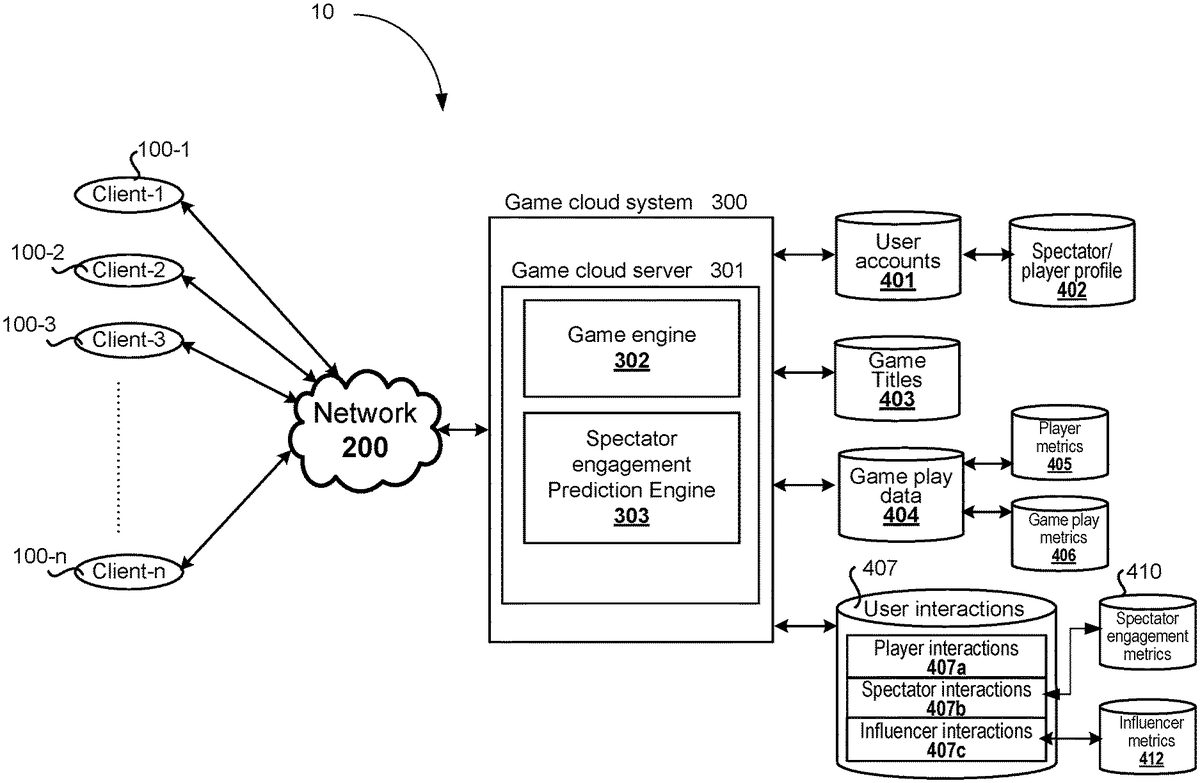
FIG.1provides an overview of a system10that includes a game cloud system300used for providing suggestions to improve engagement metrics of a group of spectators that have selected to watch game play of a video game of a player, in accordance with one implementation. A plurality of client devices100(100-1,100-2,100-3, . . .100-n) are used by different users (e.g., players, spectators, influencers (a user who shares game play of a player with commentary provided by the user) to access the game cloud system (GCS)300hosting a variety of games, and other interactive application systems hosting social media applications, content provider applications, etc., over a network200, such as the Internet. The client devices100may be accessing the GCS300from a single geolocation or from a plurality of geolocations. For example, a player from a first geolocation may select a video game for game play and a group of spectators from the first geolocation may access the video game to watch the game play of the player. In an alternate example, the player may play the video game at the game cloud system300by accessing the video game from the first geolocation and the group of spectators from different geolocations may access the video game to view the game play by the player. The client devices100can be any type of client computing device having a processor, memory, having LAN, wired, wireless or 5G communication capabilities, and being portable or not portable. For example, the client devices can be smartphones, mobile devices, tablet computers, desktop computers, personal computers, wearable devices, or hybrids or other digital devices that include monitors or touch screens with a portable form factor.
The client devices100having 5G communication capabilities may include mobile devices or any other computing devices that are capable of connecting to 5G networks. In one implementation, the 5G networks are digital cellular networks, where the service areas are divided into a plurality of “cells” (i.e., small geographical areas). Analog data generated at the mobile devices are digitized and transmitted as radio waves to a local antenna within a cell using frequency channels that can be reused in geographically separated cells. The local antenna is connected to Internet and telephone network by a high bandwidth optical fiber or other similar wireless communication. The 5G networks are capable of transmitting data at higher data rates as they use higher frequency radio waves for communication and, as a result, provide lower network latency.
The client devices100may run an operating system and include network interfaces that provide access to various game applications or interactive applications (apps) available on the game cloud servers in the GCS300over the network200or could be thin clients with network interface to communicate with the game cloud servers (or simply referred to as “servers”)301, which provide the computation functions. Players may access the GCS300using a user account and select a video game available at the GCS300for game play, wherein the game play is controlled by the player using control options provided in the client device100associated with the player or using controllers that are communicatively connected to the client device100of the player. The user account of the player may be verified against user profile data maintained in a user account datastore401and against a game titles datastore403to ensure that the player is eligible to access and play the video game, prior to providing access to the video game. It is to be noted that although the various embodiments are described in relation to a video game, the embodiments can be extended to include any other interactive applications.
In some implementations, an instance of the video game may be executed remotely on one or more servers301disposed in one geolocation or distributed in a plurality of geolocations of the GCS300and game play related data from the executing instance of the video game streamed to the various client devices100over the network200. In other implementations, the video games may be executed locally at the client devices100and metadata from the executing video game may be transmitted over the network200to the game cloud server(s)301of the GCS300for affecting the game state. Game play data collected from the player's game play session for the video game is used to create a prediction model (i.e., an artificial intelligence (AI) model). The prediction model is trained using interactions provided by the spectators and the game inputs provided by the player. The interactions provided by the spectators may be used to provide suggestions to the player or to a game engine to adjust game play of the video game to improve the engagement level of the spectators. In addition to the suggestions, the prediction model may identify and provide details of select ones of the engagement metrics of the group of spectators, details related to aggregate group profile, additional content related to or unrelated to the video game, etc. The suggestions and details related to the engagement metrics may be provided in a dash board format with a plurality of tabs. Each tab may provide either one or more suggestions or details of the engagement metrics. For example, a tab may provide a sequence of moves the player has to follow next, or a type of move to perform, or a map detailing the changes in the engagement level of the group based on the moves performed by the player, etc.
The game cloud system (GCS)300may include a network of back-end servers301that are distributed across different geolocations and are configured to execute instances of one or more video game applications and/or other interactive applications that are available at the back-end server301. Each back-end server301may be a game cloud server or cloud application server that is configured to execute one or more instances of the one or more video games/interactive applications. For purpose of simplicity, reference will be made to a game cloud server (or simply a “game server” or “server”)301executing an instance of a video game application, although the implementations disclosed herein can be extended to executing any other interactive applications. In addition to providing resources to execute the video game, the game server301may include a prediction engine303that is configured to analyze user profiles of a group of spectators that have accessed or are accessing the video game to watch game play of a player, generate an aggregate group profile for the group of spectators, analyze the aggregate group profile to determine engagement level of the group of spectators, and provide suggestions to improve the engagement level of the group of spectators. The suggestions may identify actions for the player to perform during game play, or may identify additional content for rendering either as overlay or alongside game scene of the video game. The actions may be to adjust game play of the video game. The additional content may be sponsored content, or additional details related to engagement metrics or game event or the player or other interesting content or any other content.
The game server301may be any type of server computing device available in the GCS300, including, but not limited to, a stand-alone server, a server that is part of a server farm or data center, etc. Further, the game server301may manage one or more virtual machines supporting a game processor that executes an instance of a video game for the player, on a host.
The video game executed by the game server301may be a single player game or a multi-player game. In some implementations, the video game may be a massive multiplayer online (MMO) game that allows a plurality of players from across different geolocations to access and play the video game. The game play of one of the players of the MMO game may be accessed by other users, such as spectators, or influencers. The influencers may share the video of the game play of the player, in real-time, and include commentaries related to the progression of the video game. The game server301may include a multi-player distributed game engine that is communicatively connected to game logic of the video game. Generally speaking, a game engine is a software layer that serves as a foundation for a game, such as MMO game, and provides a framework that is used to develop the video game. The game engine abstracts the details of doing common related tasks (i.e., game engine tasks) required for every game, while the video game developers provide the game logic that provides the details of how the video game is to be played. The game engine framework includes a plurality of reusable components for processing several functional portions (i.e., core features) for the video game that bring the video game to life. The basic core features that are processed by the game engine may include physics (e.g., collision detection, collision response, trajectory, movement of object based on gravity, friction, etc.), graphics, audio, artificial intelligence, scripting, animation, networking, streaming, optimization, memory management, threading, localization support, and much more. The reusable components include process engines that are used to process the core features identified for the video game.
During game play of a video game, a game engine302manages the game logic of the video game, collects and transmits one or more players inputs received from one or more client devices100, to the game logic. The game engine302further manages the allocation and synchronization of the functional portions of the game engine302to process game data generated by the game logic, in an optimal manner, and generates frames of game data that is transmitted back to the client devices100for rendering. A variety of game engines302are currently available to provide different core functionalities and an appropriate game engine may be selected based on the functionalities specified for executing the video game. Interactions provided by spectators while game scene of the video game is being rendered at the respective client devices, and attributes of the spectators captured during the rendering of the game scene of the video game are also collected by a prediction engine303from the different sensors and input devices associated with the client devices100of the spectators and used to provide suggestions to the player to adjust their inputs to the video game or instructions to the game engine302to adjust content being rendered on the client devices100of the spectators. Some of the attributes of the spectators in the group that may be captured by the one or more sensors and/or input devices may include specific emotions expressed by the spectators while watching the game play of the player, a number of spectators that expressed similar emotions, comments provided by the spectators, number of spectators that provided each type of comment, interactions with different applications when the streaming data of the video game is being rendered, amount of time spent interacting with the different applications, attention of the spectators focused on or away from the display screen rendering the streaming data of the game play, or any combinations thereof.
The game server301receives a request from a player for playing a video game executing on the game server301and validates the request. As part of validation, the game logic retrieves the profile of the player from a user account datastore401and a list of game titles of video games that the user is authorized to access for game play from game titles datastore403, and validates the identity of the player and determines if the player is authorized to play the video game. Upon successful validation, the game server301retrieves an instance of the video game and executes the instance. The instance of the game may be executed on a single game server (or simply referred to hereonwards as “server”)301or on a plurality of servers, based on how the game logic is configured. A distributed game engine302on the server301, in association with the game logic of the video game, manages the intricacies of game play of the video game based on the inputs provided by the player.
The game logic receives the inputs provided at the respective client device100, by the player, during a game play session, analyzes the inputs, updates a game state of the video game based on the inputs, manages saved data of the player playing the video game, and generates game play data that is processed by the distributed game engine302prior to being streamed to the client devices100of the player and of the one or more spectators that have signed in to watch the game play session of the player. The player inputs to the video game are stored in user interactions datastore407as player interactions407a. The saved data of the player and the game play data of the video game are also stored in game play datastore404. The game inputs provided by the player during game play correspond to the activities performed by the player in the video game, and the inputs along with the activities are stored as part of telemetry data within the game play datastore404. The telemetry data provides characteristics of each activity that a player attempted, the player accomplished, the player failed, etc., and player attributes of the player. The player attributes may be updated to the player profile stored in the spectator/player profile datastore402. The spectator/player profile datastore402may be maintained separately or may be part of the user accounts datastore401.
The game state of the video game identifies overall state of the video game at a particular point and is influenced by intricacies of the game play of the player. If the video game is a MMO game, then inputs from a plurality of players are used to influence the overall game state of the video game. The saved data of the player includes any game customization provided by the player for the video game.
In addition to the inputs from the player, the game logic may receive requests in the form of suggestions, from a spectator experience prediction engine (or simply referred to herein onwards as “prediction engine”)303to adjust content or inputs to affect game play of the video game, based on interactions received from the spectators. The interactions from the spectators may be stored in the user interaction datastore407as spectator interactions407b. Information included in the spectators interactions may be used to generate spectator engagement metrics for the group of spectators that have selected the game play of the player for watching. The prediction engine303aggregates the interactions provided by the spectators in the group, analyzes the interactions, and, may interact with the game logic to provide suggestions to adjust game play or include content for rendering with game scene, in order to improve the spectators engagement. The suggestions provided in the requests may be based on the preferences of the spectators or game state of the video game, and may identify type of actions, sequence of actions preferred by the spectators, next move to make during game play, or content to include within or outside the game scenes of the video game. These suggestions may be provided to the player to adjust game inputs during game play, and such adjustments to the game inputs cause adjustments to the game state. In some implementations, the suggested adjustments may request the player to follow a different path in the game, use specific type of tools, perform specific type of moves, etc. The prediction engine303may also provide suggestions to the game logic to adjust game content, based on analysis of interactions received from the spectators. The adjustment to game content may be in the form of injecting content (e.g., non-player characters or entities, etc.,) into the video game during game play or content for rendering alongside game scenes of the game play of the video game.
The prediction engine303may also receive interactions from influencers. Similar to the spectators, the influencers may provide interactions to improve engagement level of the spectators or improve game play of the video game. The prediction engine303may analyze the influencers' interactions and provide suggestions, such as specific moves or specific types of moves to make during game play, specific content to inject into the gaming environment or to include for rendering alongside a game scene of the video game during game play. The interactions of the influencers may be stored in the user interaction datastore407as influencer interactions407c. Information from the influencers interactions may be used to generate influencer metrics.
The game play data of the video game stored in game play datastore404may be used to identify player metrics and game play metrics of the video game. The player metrics may be stored in player metrics datastore405and the game play metrics may be stored in game play metrics datastore406. Alternatively, the player metrics datastore405and game play metrics datastore406may be part of the game play datastore404.
Based on the suggestions or requests from the prediction engine303and based on the current game state of the video game, the game logic may identify and include content for rendering alongside or as overlay on the game scene of the video game, or inject content, non-player entities or non-player characters into the gaming environment of the player. The injection of the content or non-player characters or entities may be to provide additional challenges to the player, which can make the game play of the video game more interesting, which can cause an increase in the engagement level of the spectators. The player may follow the suggested moves or provide the suggested inputs during game play to affect the game state of the video game. Similarly, the game logic may include the suggested content, during game play, to improve the engagement level of the spectators.
In some alternate implementations, the prediction engine303may provide suggestions to the game logic to enable a player to inject a user into the gaming environment of the video game and allow the user to play alongside or against the player, or follow the player as the player navigates through various game scenes of the video game. In these implementations, the game logic may be configured to provide a user interface with a list of users for player selection and an injection option, which when selected by the player would cause the game logic to inject the selected user into the gaming environment during current game play. The selected user may be injected into a current game scene of the game play or in any other game scene following the current game scene. The list of users may include social contacts of the player, or users with whom the player has previously played the current video game or any other video game, or may be spectators that have or have not provided interactions, or may be an influencer. Allowing a user to follow the player within the gaming environment would provide an immersion experience for the user, which can enhance the interest of the user and, in the process, improve the engagement level of the user and hence the group of spectators watching the game play of the player. In this implementation, a ghost form of the user or an avatar or an icon or a game object of the user may be injected into the video game. In order for the injected user to participate in the game play of the video game, the user may have to be authorized to play the video game or at least have a limited access to the video game to enable the user to participate in the game play of the video game, wherein the limited access may be in terms of limited time or limited portion of the video game. The user participation may be enabled by providing a control interface with interactive controls through which the user may be able to provide interactions during game play.
Content provided for rendering alongside or as overlay may include promotional content (i.e., sponsored content) or additional content that is specific to the group of spectators, and may be customized in accordance to the aggregate group profile of the spectators.
The game logic processes the inputs from the player and generates game data that is then processed by the distributed game engine302prior to streaming the game data to the client device100of the player and the group of spectators, for rendering. The group of spectators may change dynamically over time due to one or more spectators leaving the group and/or one or more new spectators joining the group. The prediction engine303monitors the spectators in the group and when a change is detected in the group due to movement of spectators into or out of the group, the prediction engine updates the aggregate group profile to reflect the current composition of the spectators in the group. In accordance to the changes detected in the composition of the group, the suggestions provided by the prediction engine may also change to correspond with the changes to the spectators detected in the group.
FIG.2illustrates the dynamic changes that can occur in the group of spectators over time, in one implementation. A player has accessed a user account on a game cloud system300to select a game for game play. Upon authenticating the player using the user profile maintained at a game server301, the game cloud system300provides a user interface110with a list of games that the player is authorized to access for game play. Player selection of game23for game play at the user interface110causes an instance of game23to be executed on the game server301of the game cloud system300. The player provides inputs to affect game state of the game and game data representing a current game state of the game is streamed to a client device100of player for rendering on a display screen112. In one implementation, the game data may be rendered on a monitor112-athat is associated with the client device100. In an alternate implementation, the game data may be projected on a display surface or on an external screen112-bthat is communicatively connected to the client device100.
A group of spectators GS1114-1access the game cloud system300to view the game play of player at time t1. The group114-1of spectators may, at time t1, include spectators S1-Sm3. A prediction engine303available in the game server301identifies the spectators in the group114-1and extracts spectator profile of each spectator included in the group114-1from the user accounts datastore401, or more specifically from spectator/player profile datastore402within the user accounts datastore401. The prediction engine303then aggregates the spectator profiles of all the spectators in the group114-1to generate an aggregate group profile AGP1for the group114-1. The generated aggregate group profile AGP1is associated with group of spectators114-1. At time t2, the spectator group GS1is shown to have changed (i.e., shrunk significantly from114-1) with some spectators having left the group GS1114-1. The group GS2114-2(spectator group at time t2) may be a subset of spectators from the group114-1, or may include some spectators from group114-1and some new spectators that have joined the group. Consequently, the aggregate group profile AGP2generated for group114-2may be similar to AGP1(if spectators of GS2are a sub-set of GS1) or may be different. At time t3, the spectator group GS3114-3may have evolved from spectator group114-2. Spectator group GS3114-3may include a sub-set of spectators from spectator group114-2and/or some new spectators. The prediction engine303keeps track of the changes in the spectator group and updates the aggregate group profile to reflect the changes within the group. The changes in the aggregate group profile may result in changes to the suggestions provided to the player or game logic, as preferences of the spectators in the group may have changed. The changes to the preferences may be related to different types of action, different sequence of actions, different paths to follow during game play, different speed of game play, etc. For instance, the spectators in group114-1may prefer the player to perform certain types of actions, such as use specific type of tool to fight, perform more jumps, follow a specific path, etc., during game play, while spectators in group114-3may prefer the player to use a different type of tool, follow a different path, etc. As a result, the aggregate group profile generated for the different spectator groups identifies the changes in the spectators' preferences.
FIG.3illustrates the different modules of the prediction engine303used to generate the aggregate group profile of the group of spectators and to provide suggestions to the player or signals to the game logic of the video game to adjust the game play or game content of the video game, or provide additional content to the group of spectators to keep the spectators interest in the video game, in one implementation. Some of the modules in the prediction engine303include a spectator group generator engine305, an engagement metrics analyzer315and a feedback engine325. The spectator group generator engine305is used to identify a group of spectators that have come together to watch game play of the video game by the player, and to generate an aggregate group profile (AGP) for the group. The spectator profile of each of the spectators in the group is retrieved from the spectator/player profile datastore402maintained within the user accounts datastore401to generate the aggregate group profile. The spectators that have come together may be co-located with the player or may be remotely located from the player and may be accessing the game play of the player by accessing the game play instance of the player executing at the game cloud system300. Each of the spectators may be accessing the game play using their own client devices100and the game data is streamed to their client devices100for rendering. Details of generating the aggregate group profile using the spectator group generator engine305will be discussed with reference toFIG.4.
The engagement metrics analyzer315is used to analyze interactions provided by the spectators at their respective client devices during game play of the game by the player and to determine engagement metrics of the group of spectators in relation to the game play of the player. The engagement metrics include details that are used to gauge the engagement level of the spectators in the group. Changes detected in the group of spectators result in corresponding changes in the engagement metrics. For example, a first set of spectators may prefer certain types of moves, certain sequence of moves, or a first path to follow, etc., during game play while a second set of spectators may prefer different types of moves, different sequence of moves, different paths to follow during game play. Details of analyzing the interactions of the spectators using the engagement metrics analyzer315will be discussed with reference toFIG.5.
The feedback engine325is configured to take into consideration the engagement metrics of the group of spectators and provide suggestions to improve engagement level of the spectators in the group. As the group of spectators changes over time, the engagement metrics of the group change correspondingly. Changes in the group of spectators evolve gradually and not drastically. As a result, the suggestions provided by the feedback engine325, based on current group of spectators, may be improvements from the suggestions provided for prior group of spectators. If, however, the change is drastic, then the spectator group generator engine305generates an aggregate group profile for the changed group, and the feedback engine325provides suggestions to the changed group based on the spectator composition of the changed group and these suggestions may be different from the suggestions provided to the prior group. To provide the suggestions, engagement metrics for the group are identified and extracted. The engagement metrics for the group are then provided as inputs to the classifiers (not shown) of the machine learning algorithm326. The classifiers use the engagement metrics to generate an artificial model (AI) model (not shown). The AI model is trained, using the machine learning algorithm, by harvesting the changes in the engagement metrics of the group. For instance, the AI model is trained by progressively updating the nodes using interactions of the spectators and the game play of the player of the video game. The updates to the nodes may be in the form of weights assigned to the various engagement metrics and/or player inputs. The machine learning algorithm uses reinforced learning to strengthen (i.e., train) the AI model using the spectators interactions and player inputs collected during the game play session. The updates to the AI model are used to adjust the outputs to achieve the objective of improving the engagement metrics of the spectator group. The output are used by a recommendation engine327to generate suggestions to the player or to the game logic to either adjust the game play or provide additional content for the spectators. Details of the feedback engine325will be discussed with reference toFIG.6.
FIG.4illustrates a simplified block diagram of the spectator group generator engine305included in the prediction engine303, in one implementation. The spectator group generator engine305may include one or more sub-modules, such as a spectator identification engine306, a spectator profile extractor engine307, a group profiling engine308, to name a few. Of course, there may be fewer or additional sub-modules and the spectator profile extractor engine307is not restricted to the aforementioned sub-modules. A spectator identification engine306within the spectator group generator engine305identifies spectators that have accessed game play of a player. The spectators may be co-located or remotely located from the player and are identified from the user account datastore401. The spectators are identified using their user identifier and/or other biometric identifiers used to access the game cloud system300. Each user of the game cloud system300is associated with corresponding profile data, which may be maintained in the user account datastore401or separately in a spectator/player profile datastore402that is part of the user account datastore401. The spectator profile may include details, such as demographic information, age, biometric data, religion, height, weight, geo location, preferences for content (including game content and other content), etc.
A spectator profile extractor engine307is used to extract the profile information of each spectator accessing the game play of the player, from the spectator/player profile datastore402. In addition to extracting the spectator profile information, the spectator profile extractor engine307may also collect spectators interactions407bprovided during game play of the player, from the user interactions datastore407. The spectators interactions407bmay be captured by one or more image capturing devices, one or more input devices, and/or one or more sensors associated with the client devices100of the spectators. The spectators interactions407bmay be used to update the spectator engagement metrics410.
A group profiling engine308is then used to aggregate the spectator profiles of the spectators in the group, to generate an aggregate group profile. In one implementation, depending on the profile of the spectators, the group profiling engine308may group the spectators into one or more spectator groups. For example, if the number of spectators that are watching the game play of the player is too big and the spectators are distributed across various geolocations or span different age groups, it may be beneficial to group the spectators in accordance to the geo locations or age groups, so that appropriate suggestions may be identified and provided to the player or the game logic to improve the engagement metrics of the respective groups. Alternatively, if the number of spectators that are watching the game play of the player is small, then it may be beneficial to generate a single group. Thus, depending on the number of spectators and the spectator profiles, the group profiling engine308may define one or more groups and generate an aggregate group profile for each group generated. The aggregate group profile includes profile information of the group and the interactions of the spectators captured during game play of the player. The aggregate group profile generated for the one or more groups of spectators are then forwarded as inputs to an engagement metrics analyzer315for processing.
FIG.5illustrates various modules of an engagement metrics analyzer315used to identify engagement metrics of the group of spectators, in one implementation. The engagement metrics analyzer315receives the aggregate group profile of the group(s) of spectators and analyzes the information contained within the aggregate group profile to identify the engagement metrics of the group of spectators. The spectators interactions captured at the respective client devices may include inputs provided by the spectators including interactions with other applications (e.g., social media applications, other interactive applications), interactions with other spectators and/or users (i.e., non-spectators) during game play of the video game. The interactions may be comments, messages, chats, emails, etc., exchanged between the spectators and between the spectators and the player, or actions performed by the spectators during game play of the player.
The interactions with other interactive applications may be indicative of the spectators' interest or distraction from the game play of the player. For instance, some of the interactions indicating the spectators interest in the game play of the video game of the player may include interactions promoting the video game, comments about the game play of the player to other users of social media applications, email applications, or message/chat applications, or comments related to specific moves or types of moves performed by the player, etc. Interactions indicative of the disinterest of the spectators may include interactions with other users via social media applications, email applications, chat/messaging applications, etc., to provide comments, messages, etc., not related to the video game or the game play of the player. In addition to the aforementioned interactions, the interactions indicative of the disinterest of the spectators may also include expressions (e.g., bored, not focused, etc.), movement of the spectators (e.g., spectator's face turning away from the display screen of the client device, spectator moving away from the display screen of the client device rendering the game play of the player, eyes of the spectator focused away from the display screen, etc.,) captured using the image capturing devices, sensors associated with client devices of the spectators, etc., during game play of the video game. The engagement metrics including the various interactions of the spectators can be used to determine the spectators interest in the game play of the player.
An emotion/expression detection engine316is configured to extract the expressions of the spectators during the game play of the video game of the player. The expressions of the spectators can be evaluated to determine if the spectators are showing interest in the game play of the player or are getting bored.
Similarly, a spectator activity analyzer318is configured to extract information related to the interactions of the spectators during game play of the player from the engagement metrics provided by the spectator group generator engine305. As noted before, the interactions may include movement of the spectators captured by the various sensors and image capturing devices and/or inputs provided using input devices while the game play of the video game is being rendered at their respective client devices. If a spectator's face or eyes or body is detected to be moving away from the display screen associated with the client device of the spectator, then such movement may be used to indicate the user's distraction or disinterest in the game play of the player. The inputs may be related to game related or non-game related interactions exchanged between the spectators and between the spectators and the player.
A context identifier engine317of the engagement metrics analyzer315is configured to extract the context of the spectators' interactions generated while the game play is being rendered on the respective client devices. The context identifier engine317may be used to determine if the interactions are related or unrelated to the game play of the player.
A spectator preference engine319of the engagement metrics analyzer315is configured to extract the preferences of the spectators in the group. The preferences of the spectators may be obtained from the aggregate group profile and may be related to majority or all of the spectators in the group. The preferences may be related to the type of game, the type of game moves, the sequence of game moves, specific paths/direction to follow, type of tools to use, etc., preferred by the majority or all of the spectators in the group. The various modules of the engagement metrics analyzer315is configured to extract the various attributes of the spectators that are relevant to gauge the engagement level of the spectators in the group, from the engagement metrics. The engagement level attributes of the group of spectators are provided as inputs to the feedback engine325.
FIG.6illustrates an example feedback engine325that is used to provide recommendations to the game logic or to the player of the video game, in one implementation. The feedback engine325includes a machine learning algorithm326with a plurality of classifiers326athat are used to generate a machine learning model (i.e., artificial intelligence (AI) model)326bwith the engagement level attributes of the group of spectators and the game play data generated in response to the inputs from the player. Each classifier326ais predefined to identify and classify specific attributes of the group of spectators to achieve one or more objectives defined for improving the engagement metrics of the spectators. The AI model326bincludes a plurality of nodes and edges defined between consecutive pair of nodes. The engagement metrics provided by the engagement metrics analyzer315and the game play data resulting from the player's inputs are used for defining the nodes of the AI model326b. Edges between any two consecutive nodes define the relationship between the engagement metrics/game play data defined in the respective nodes. The classifiers are used to tune the AI model326bbased on the ongoing players inputs and the engagement metrics resulting from the players inputs to determine how to improve the game play of the video game to influence the engagement metrics, and the correlation is provided in the output from the AI model326b. The output of the AI model326bis forwarded to a recommendation engine327.
The prediction engine303used to generate and train the AI model may be provided in software, hardware, firmware, or any combination thereof. The prediction engine303is configured to use the player inputs and the spectators' engagement metrics during the game play session of the player and provide suggestions for improving the engagement metrics of the group of spectators. The AI model generated by the prediction engine assists in identifying appropriate suggestions to either the player or the game logic for improving the engagement level of the spectators.
A recommendation engine327within the feedback engine325is configured to examine the output of the AI model, identify the suggestions that need to be made, the targeted recipients of the suggestions, and provide recommendations to the targeted recipients in order to improve engagement metrics of the spectators watching the game play of the video game of the player. For example, the recommendations may be directed toward including promotional content or statistical content or graphical map content, or injecting additional characters or entities in certain game scene of the video game, based on game state of the video game. The targeted recipient may be a user or non-user entity. For example, the non-user entity may be the game server or the game logic or the content provider. The user may be the player or the influencer. Appropriate signals may be provided to the game server to generate or retrieve the content for inclusion with the game play data streamed to the client devices of the spectators, players, or to inject characters into the gaming environment, during game play of the player. Alternatively, appropriate instructions may be provided to the player to perform certain actions, certain sequence of actions, certain types of actions, etc., during game play.
The recommendation engine327includes a plurality of sub-modules for identifying and forwarding recommendations to appropriate recipients, so that game play or content rendered at the client device of the spectators, players may be adjusted. Some of the sub-modules within the recommendation engine327include a content provider recommendation engine328, a content adjustment engine329, game play adjustment engine330and engagement map generation engine331. The various sub-modules will be described in detail with reference toFIGS.7-9.
FIG.7illustrates the details of the content provider recommendation engine328of the feedback engine325used to provide recommendations to the player and/or an influencer. For example, the content provider recommendation engine328provides instructions to the player to adjust content or interactions during the game play. The content provider recommendation engine328may also provide instructions to an influencer to select video stream corresponding to game play of the player for streaming to client devices of spectators. As mentioned previously, an influencer may be a user who has a group of spectators following what the influencer is watching. The group of spectators may be provided a video of game play of the player shared by the influencer with comments related to the game play of the player provided by the influencer. The number of spectators following the video shared by the influencer may be based on the popularity and/or expertise level of the influencer, and/or availability of the video feed of the game play of the player. For example, the only video feed of the game play of the player may be the one provided by the influencer. In an alternate example, the video feed of the game play shared by the influencer may include expert comments on the strategy adapted by the player, a unique sequence of actions performed by the player, etc., or funny or in-depth comments related to the game play or the player, provided by the influencer.
A content switching engine328aof the content provider recommendation engine328is configured to provide instructions to the player to switch content, in order to improve the engagement metrics of the spectators in the group. The instructions to switch may be provided as suggestion by the feedback engine325based on the output of the AI model326b. The instructions to switch content may be suggested to the player, based on the engagement level of the spectators observed by the engagement metrics analyzer315. For instance, during game play of the video game, the progression in the game may be slow or not exciting, or there may not be sufficient activities or challenges occurring in the game to make the game play exciting for the spectators. As a result, the spectators may begin to exhibit boredom or may switch their attention to other interactive applications. In order to improve the engagement level of the spectators and to keep them engaged in the game play of the player, the content switching engine328amay suggest to the player to switch to a different content, such as a different game. The different game may be suggested based on the preferences of the spectators, player's accessibility to the different game, expertise level of the player for the different game, game genre of the different game, contextual similarity of the different game to the video game the player is to switch from, and/or other criteria. The switching to suggested different game may result in the player continuing to keep the attention of the group of spectators (i.e., improving the engagement metrics of the group of spectators).
An action switching engine328bof the content provider recommendation engine328may identify a recommendation that is directed toward a player. The action switching engine328bis configured to use the output from the AI model to provide recommendations to switch the interactions provided by the player during game play. The recommendation to switch may identify the specific actions or specific type of actions or specific sequence of actions for the player to switch to from the current type of interactions the player is performing. The output from the AI model is used to identify the specific recommendation based on the AI model training using the interactions provided by the player during game play, the activities attempted/accomplished from the interactions, engagement level of the spectators responsive to the interactions, preferences of the spectators, etc. For example, the player may use a certain type of tool to accomplish certain task or overcome a challenge or certain action against an enemy, and the spectators may desire the player to use a different type of tool to perform the task.
A video feed recommendation engine328cof the content provider recommendation engine328may identify a recommendation that is directed toward an influencer. The video feed recommendation engine328cis configured to use the output to identify video feeds that can be recommended to the influencer. In one implementation, the group of spectators may be following the video feed of the game play of the player shared by the influencer instead of the spectators following the game play of the player. In such implementations, responsive to detecting a low engagement level of the spectators and based on the output of the AI model, the video feed recommendation engine328cmay recommend one or more video feeds for the influencer to share in order to improve the engagement level of the spectators. These video feeds may be identified based on the spectators preferences, influencer's preference, popularity of the video feed, etc. The video feeds may be identified from different game play sessions of the video game of the player or from game play sessions of the video game played by other players. The influencer may share the recommended video feeds with the group of spectators to keep the group of spectators engaged in the content shared by the influencer, so as to improve the engagement level of the spectators.
FIG.8illustrates an example content adjustment engine329of the recommendation engine327used for recommending different content to be included with the game play data streamed to the group of spectators, in order to improve the engagement level of the spectators. A content recommendation engine329amay be used to identify content that may be included for rendering alongside or as overlay over the game play data. The content may be additional content related to the video game, such as statistics of the player or statistics of other players currently playing or that have previously played the video game, or details of certain features of the game scene, or details related to difficulty level of the game, or details related to popularity of the video game, or details of the game scene being rendered. Alternatively, the content may be related to other video games that are in the same genre as the video game that is currently being played by the player or video games that are popular with other players that are within similar demographics of the player. The content recommendation engine329amay also be used to identify and provide promotional content for rendering alongside the game scene of the video game. The promotional content may be obtained from a content provider, such as an advertiser, content generator, etc.
The content adjustment engine329may also be used to inject some content into the gaming environment, in one implementation. A sponsor content engine329bof the content adjustment engine329may be used to identify and inject additional content, such as promotional content, into the gaming environment of the video game, during game play by the player. The promotional content may be identified based on the content included in the gaming environment, or based on attributes of the spectators, for example. The attributes of the spectators may be categorized in accordance to the demographics, age, geo location, preferences of the spectators at different times of day, activities of the spectators prior to following the video game, etc., and the group of spectators may be clustered in accordance to these categories. The recommendations of the promotional content to the group of spectators may be customized based on such clustering and the recommended promotional content included within the game scene of the video game, for example.
It is to be noted that the attributes of the spectators may dynamically change due to dynamic nature of the group or due to preferences of the spectators at different times of day. The attributes related clustering, therefore, will take into account the dynamic nature of the attributes of the spectators so that appropriate content can be recommended to different cluster of spectators within the group. The recommendations of the sponsored content may be customized based on the attributes of the spectators, such as geolocations of the spectators, presence or absence of other users in the vicinity of the spectators, time of day, sponsored content preferences of the spectators, interactions of the spectators with other interactive applications or games, etc. A sponsor customizer engine332may be used to identify the various attributes of the spectators within the group, the clustering of the spectators in the group, the preferences of the spectators toward the sponsored content, etc., and customize the sponsored content for each cluster identified within the group of spectators following the game play of the player.
In some implementations, the sponsor customizer engine332may be used to promote an influencer sharing the game play of the player that the influencer is watching and commenting on. The video feed generated and shared by the influencer, in one implementation, may include a video of the influencer watching and commenting on the game play of the player. In such implementations, the influencer may wear wearable marker elements that can be used to customize the sponsored content. The marker elements worn by the influencer may be detected and be replaced with sponsored content. The sponsored content can dynamically change based on the changes in the content of the game play or may be temporal based, for example. The sponsored content may be used as a monetizing or promotional vehicle to compensate/promote the influencer, and the monetary compensation or promotion may depend on the popularity of the influencer, popularity of the player, or popularity of the video game played by the player.
A marker detection engine332amay be used to identify the marker elements worn by the influencer from images of the influencer captured in the video feed of the influencer captured by the one or more sensors or image capturing devices and shared with the group of spectators. The identified marker elements are replaced with the sponsored content selected for the spectator group. In some implementations, the sponsored content may be customized based on the clustering of the spectators within the group. A marker customization engine332bmay be used to identify the sponsored content that correlate with the attributes of the spectators associated with each cluster in the group. For example, for a cluster of spectators that are from a specific geolocation, the sponsored content may be geolocation based content (e.g., Japanese content for spectators accessing the video feed shared by the influencer, from Japan). In an alternate example, the sponsored content may be identified based on age group of each cluster of spectators. The customized sponsored content is then included with the game play data for rendering at the client devices of the spectators of the respective cluster. The sponsored content (i.e., promotional data) may be included with game play data streamed to the spectators and not to the player or influencer, so as to not distract the player during game play or the influencer commenting on the game play that the influencer is substantially live-streaming to the spectators. In alternate implementations, the sponsored content may be included with game play data for rendering on the client devices of the player or influencer.
In some implementations, the content that may be included for rendering may be statistical data related to game play of the player or of other players. A statistics injector engine329cmay be used to identify one or more features of the video game or the game play of the video game or attribute of the player of the video game, and provide statistical data associated with the identified features. For example, the features may relate to a game level or difficulty of game level or expertise of the player, and the statistical data may be related to number of times a particular activity/challenge at the game level was attempted, accomplished, time taken to complete the activity/challenge at the level, etc. The statistics injector engine329cmay interact with game play datastore404to retrieve the intricacies of game play of the video game of the player and/or other players and use the game play intricacies of the player, other players to dynamically generate the statistical data. The statistics injector engine329cmay then communicate with the game server301or the game logic to dynamically adjust the game play data to include the generated statistical data during appropriate times of game play so as to render alongside or as overlay on the game scene of the video game or to inject within the gaming environment.
FIG.9illustrates an example game play adjustment engine330that may be used to provide content within the gaming environment of the player based on the output from the AI model326b, in one implementation. The feedback engine325may recommend content for including within the gaming environment of the player so as to improve engagement metrics of the group of spectators watching the game play of the player. In one implementation, the content that may be injected into the gaming environment may include non-player characters/entities, or avatar of users, who may be spectators or other players/users. The game play adjustment engine330of the feedback engine325is configured to interact with the game logic of the video game to determine the game state of the game play of the player, and identify characters or entities to inject within the gaming environment during game play of the player. A character injection engine330aof the game play adjustment engine330is configured to identify the appropriate non-playing characters or entities to inject into the gaming environment. The non-playing characters or entities may be chosen so that the characters or entities are contextually relevant to the game scene into which they are to be injected. The non-playing characteristics may be injected to provide sufficient challenges to the player to make the game play interesting to the spectators. For instance, the character injection engine330amay use the output of the AI model to determine that the game play of the player is progressing at a slower pace and does not include sufficient challenges for the player to make the game play more interesting, leading to decrease in the engagement level of the spectator group. In order to infuse sufficient excitement in the game play to the player and to the spectators watching the game play of the player, the character injection engine330ain association with the game logic may identify and inject non-playing characters or entities into the gaming environment. The characters/entities may be static or may be moving. When moving characters are being injected into the game play, a size or a shape or speed of the moving characters may be chosen to provide sufficient challenges to the player at the level at which the player is currently playing.
In addition to injecting non-player entities/characters, the game play adjustment engine330may also inject one or more other users into the gaming environment. A player injection engine330bof the game play adjustment engine330may be used to inject the one or more other users. The other users may be selected from social contact of the player or may be another player that has already played the video game or another player with whom the player has played another multi-player game, or may be a spectator that is watching the game play of the player, or an influencer that may be streaming the game play of the player. An avatar, an icon, or a ghost form of the other user may be injected into the gaming environment of the player so as to allow the other user to participate in the game play of the player (i.e., play with or against the player) or to follow the player within the gaming environment. In order to allow the other user to participate in the game play (either play with or against, or follow) of the player, the player injection engine330b, in association with the game logic of the video game, may be configured to send a request to the selected other user to join in the game play of the player. The request may include a link for the other user to access the game play session of the player and may also include an interface with controls to enable the other user to participate in the game play of the player. The player's and the other user's interactions in the video game may be used to affect the game state of the video game. Injecting the other user into the gaming environment and enabling the other user to participate in the game play of the video game of the player enhances the interest of the other user as well as the interest of the group of spectators watching the user's participation in the game play of the player.
In addition to character and player injection into the gaming environment, the game play adjustment engine330may also provide option for the spectators in the group to participate in some ways with the game play of the player, in some implementation. A spectator voting system330cof the game play adjustment engine330may be used to provide spectators with an ability to vote on some events or activities or challenges within the game play of the player. For instance, based on the output of the AI model, the spectator voting system330cmay be configured to identify an event, or a task, or an activity or a challenge or any other random element within the current game play of the player and provide an interactive voting interface to enable the spectators to respond to a query or to vote on one or more options related to the identified event, task, activity, challenge or the random element. For example, the query or voting option may include what may happen next in the game play of the player—i.e., will the player successfully complete the task or activity or challenge that the player is attempting, number of attempts it would take the player to complete the task or activity or challenge, or what event or challenge or activity will occur next, or which path the player will attempt next, etc. The spectator voting system330cmay also provide incentives to the spectators to participate in the voting. Additionally or Alternatively, the spectators may be provided with additional incentives for correctly responding to the query included in the voting interface.
In some implementations, the reputation of a spectator may be taken into consideration when providing incentives. In alternate implementation, the spectator may themself provide incentives to improve weight of their vote. For example, one of the options that may be provided by the spectator voting system330cmay be a vote to influence the activities of the player that the spectator would like to see in the game play. In this example, the option may allow the spectator to provide incentives to the player so that the spectator's vote may be considered favorably for influencing the activities of the player. Additionally or Alternatively, the behavior and/or the reputation of the spectator may be considered along with the incentives provided by the spectator when the vote of the spectator is evaluated by the spectator voting system330c. The behavior and/or the reputation of the spectator and the incentives provided by the spectator may be weighted differently when evaluating the vote of the spectator for influencing the player to perform certain activities during game play. For example, a first spectator who has exhibited good behavior and provided lower incentive to the player may be weighted higher than a second spectator who has exhibited bad behavior and provided higher incentive than the first spectator. The spectator is shown to exhibit good behavior, for example, when the spectator posts encouraging or positive comments, writes good reviews of the player, entertains other spectators' comments in a positive manner, etc. Similarly, a spectator is shown to exhibit bad behavior, for example, when the spectator posts mean or derogatory remarks/comments, constantly provides bad reviews or critics the player, exhibits bullying characteristics like harassing other spectators with mean posts, etc. In the above example, the good behavior of the first spectator is weighted higher than the incentives provided by the spectator. As can be seen, the spectator voting system330ctakes into consideration the attributes of the spectator as well as the incentives provided by the spectator when evaluating the votes of the spectator. The incentives may be financial incentives, game related incentives (e.g., improving a spectator's ranking/reputation, incrementing points that may be used for ranking the spectator, etc.). The results of the evaluation of the votes collected from a plurality of spectators may be provided at some future time and may depend on how long the voting option is made available or how many spectators votes is collected. The voting interface and the results of the voting may be provided alongside the game play of the player that is being streamed to the spectators' client devices for rendering. The voting interface and the incentives provided by or to the spectators via the spectator voting system330cprovides ways to ensure that the spectators linger longer to watch the game play of the player in order to determine how their vote was evaluated.
In one implementation, in addition to the content being rendered alongside game play or injected into the gaming environment of the video game to keep the spectators engaged, the prediction engine303may be configured to provide information related to one or more engagement metrics, player metrics to keep the player informed of the status of the player, engagement level of the group of spectators, and/or suggestions for performing certain actions during game play of the player. The suggestions or recommendations may be in the form of instructions to the player to adjust interactions within the game play, or to adjust game content during game play. The suggestions to the player may be provided by the content provider recommendation engine328, or content adjustment engine329, and/or the game logic of the video game and can be rendered as pull-down or pop-up tabs in a dashboard menu (or simply referred to hereonward as “dashboard”), during game play of the video game of the player. The one or more engagement metrics may be identified from the output of the AI model.
In one implementation, the one or more engagement metrics of the group may be provided as an interactive map (i.e., graphical representation) generated by an engagement map generation engine331. The engagement map generation engine331may engage an analytics or a graphic application to plot the engagement level of the spectators observed over time the spectators are signed in to watch the game play of the player. The engagement map provides a visual representation of the engagement level of the spectators that can be quickly absorbed by the player while the player is engaged in the game play. The dashboard is an interactive dashboard and include one or more pop-up/pull down tabs with each tab providing the various game play metrics, engagement metrics, etc. The pop-up/pull down tabs ensure that relevant data is available to the player to access without unnecessarily cluttering the display screen of the client device of the player on which the game play data is being rendered. The different tabs in the dashboard provide useful information that can be used by the player to improve engagement metrics of the spectators.
FIG.10illustrates an example pop-up dashboard1000that may be provided to keep the player informed on various metrics, in one implementation. The dashboard1000is an interactive dashboard and includes a plurality of tabs,1001-1004, for example, with each tab providing details related to adjusting content, adjusting interactions, aggregate group profile of the spectator group, and visual representation of the engagement metrics of the spectator group, etc. The number of tabs and details of each tab of the dashboard1000is provided as an example and should not be considered restrictive. Fewer or additional tabs may be provided in the dashboard1000depending on the amount of information that is to be provided to the player.
In one implementation, the interactive dashboard may be integrated with a game application programming interface (API) defined for the video game. The game API is configured to control access to and/or use of different interactive interfaces, including input devices, and manage device bandwidth, other device loadouts, etc. The game API may also be configured to manage access to the tabs or links, especially links that directs a user (i.e., player, spectator, etc.,) to a website for accessing details related to the player, spectator, or game moves. The website may be hosted within the game cloud server that is executing the video game or is hosted on another server and is accessible to the video game. In one implementation, the interactive dashboard1000may be provided as an on-screen overlay. The on-screen overlay may be presented in a portion of the display screen of the client devices of the player and/or the spectators of the group of spectators. The display screen of the client devices may be divided into a plurality of zones and a specific portion of the display screen may be identified for overlaying the interactive dashboard1000. The specific portion for overlaying the interactive dashboard1000may be identified by game logic of the video game based on activities occurring in the video game. The activities occurring in the video game are dynamic in nature based on the game inputs provided by the player during game play. As a result, the portion of the screen where the activities of the game play are rendering may dynamically change. The specific portion of the display screen where the interactive dashboard1000is presented may be determined by game logic of the video game so as to ensure that the overlay does not interrupt the game play of the player or obstruct viewing the game play of the video game of the player. In some implementations, the specific portion of the display screen of the client devices for rendering the interactive dashboard1000may be determined based on rendering preferences specified by the player/spectators. The rendering preferences may be in addition to or in place of the specifics provided by the game logic.
The suggested content tab1001may identify content that was recommended by the content provider recommendation engine328or content adjustment engine329for the player to choose to include with the game play of the video game.FIG.10Aillustrates some of the options1001a-1001cthat the player can select to include with the game play, in one implementation. The sponsored content option1001aallows the player to select one or more of a plurality of sponsored content for rendering alongside the game play of the game for the spectators. The sponsored contents that are provided as options in the sponsored content option1001amay be based on the content of the video game, the popularity of the player, the popularity of the video game, relevancy of the sponsored content, etc. The switch content option1001ballows the player to switch content selected for rendering with the game play. The switch content option1001bmay identify additional content, such as game statistics of the video game including player statistics of the player or of different players, interesting tips or information related to the different levels, challenges, activities, etc., interesting information related to the player, etc., different content that is recommended for the player based on the player's attributes and/or preferences, and the player is provided with option to switch from the existing content provided with the game play to the recommended content. The switch game option1001callows the player to switch interactions from the video game to a different video game or interactive application. The video game and/or interactive application included in the switch game option1001care identified by matching the preferences of the player and accessibility of the games/application to the player for interacting.
The suggested next move tab1002may identify a specific move or a specific sequence of moves that the player can select to perform. The specific move or specific sequence of moves or specific path to follow is provided by the action switching engine328b. For instance, when the spectators prefer the player to perform specific types of moves or specific sequence of moves, the player is provided with suggestions identifying the preferred moves of the spectators.FIG.10Billustrates an example of the suggested moves provided by the suggested next move tab1002for the player to perform. The suggested next move tab1002may include a type of move or sequence of moves.FIG.10Billustrates the suggested sequence of moves for the player to follow, which includes following specific path(s) (i.e., path B followed by path C), specific sequence of moves to follow on the specific paths (e.g., moves 1-3 on path B and move 4 on path C). Based on the suggested next move, the player may select to switch their interaction to the suggested moves or sequence of moves.
The aggregate group profile tab1003may identify one or more attributes of the group of spectators identified from the aggregate group profile. The attributes may include demographics, age, geolocation, content preference, interaction preference, etc. The player can select the aggregate group profile tab1003to determine the attributes of the spectator group. Based on the attributes, the player may elect to adjust their content or interactions to enhance the engagement metrics of the spectators.
The engagement metrics tab1004may provide a visual graphical view of the engagement metrics of the spectator group following the game play of the player. A sample engagement metrics graph1004agenerated with the engagement metrics of the spectator group is shown inFIG.10C. The graph identifies the engagement level of the spectators over time as the spectators are engaged in watching the game play of the player. The engagement level of the spectators varies over time, as represented by reference points a1-a9, based on the type of moves or sequence of moves followed by the player. For example, when the player performs a first move, the engagement level of the players may be at ‘a1’. When the player continues to perform moves that the spectators enjoy watching, the engagement level of the spectators begins to increase, as represented by reference point ‘a2’. When the player begins to make mistakes or is unable to complete a task due to select of wrong type or sequence of moves, the spectator engagement level begins to fall, as represented by reference point ‘a3’. When the player begins to recover by performing certain type of moves, the engagement level of the player begins to climb up, as represented by reference point ‘a4’. After reaching the engagement level represented by reference point ‘a4’, the player begins to perform moves that are not preferred by the spectators. These moves may also cause the player to not make much progress in the game. As the player fails to progress, the game play becomes less interesting for the spectators, resulting the engagement level of the spectator group to fall, as represented by reference points ‘a5’ and ‘a6’. At this stage, the player may select the suggested next move tab1002to see if there is a set of suggested moves to help the player to progress in the game. These moves may be the ones suggested by the action switching engine328b. The moves suggested by the suggested next move tab1002may be moves that were suggested by an expert player who may be spectating the game play of the player or may be provided by a game logic based on the current game state and the experience/capability of the player. As the player performs the suggested moves, the game play of the player as well as the engagement level of the spectators begins to improve, as shown by reference point ‘a7’ and ‘a8’. When the player continues to play, the engagement level may start to drop significantly, as shown by reference point ‘a9’, based on the inputs from the player. Consequently, the output of the AI model326bmay suggest next moves provided by the suggested next move tab1002that corresponds to switch out of the game or to suggest providing additional content to keep the spectators engaged or suggested other moves to improve progression in the game play and hence the engagement level of the spectators.
The various embodiments described herein provide ways to detect the engagement metrics of the spectators that have selected the game play of the video game of the player to follow, and provide suggestions to assist the player to improve engagement metrics of the spectators. Improving the spectators engagement may result in improved interest in the video game, which can translate to improved revenue for the game developer or game distributor, or content sponsor. It may also assist the player to improve their monetary revenue, if the game provides such benefits, or improve their status or popularity or expertise level within the gaming world. Other benefits may become apparent to one skilled in the art after reviewing the various embodiments.
FIG.11illustrates a flow chart of operations for improving the engagement level of a group of spectators engaged in watching game play of a player, in one implementation. The method begins at operation1110with the identification of a group of spectators watching a game play of a video game of a player. The group of spectators may be accessing the game play of the player from same geolocation as the player or may be accessing the game play from different geolocations. In response to identifying a group of spectators, a prediction engine executing on a game cloud server generates an aggregate group profile of the group, as illustrated in operation1120. The aggregate group profile may be generated using the profile of the spectators forming the group. In addition to the profile, the aggregate group profile of the spectator group may also include engagement metrics of the group of spectators. The engagement metrics of the group may be obtained by gathering interactions of each of the spectators in the group from sensors and input devices associated with the respective client devices of the spectators. The interactions may include movements of the spectators and/or inputs provided by the spectators during game play of the player. The inputs may be related or not related to game play of the video game and may include comments, messages, emails, chats, or interactions at different interactive applications other than the video game.
The engagement metrics of the group of spectators is analyzed, as illustrated in operation1130. The analysis is done to identify engagement level of the spectators toward the game play of the video game. The various interactions captured by the one or more sensors and/or input devices at the respective client devices of the spectators and considered for generating the engagement metrics of the group, are analyzed to determine if the spectators are focused in the game play or are distracted. In some implementations, the spectators interactions may be contextual in nature or expressive in nature. Contextual interactions may be provided via input devices and expressive interactions may be captured by one or more sensors and/or image capturing devices. For example, contextual interactions may include comments/chats/messages related to the video game, related to game play of the video game, related to game play of the player, etc. Expressive interactions may include expressions on the spectators faces, or images of the spectators (e.g., eyes, face, body, etc.). These interactions are analyzed to determine the interest or disinterest of the spectators. For example, the spectators constant interactions with other applications, such as social media applications, email applications, chat/messaging applications, etc., providing comments, messages, etc., not related to the video game or the game play of the player may indicate disinterest. Whereas interactions with social media applications, email applications, chat/messaging applications, etc., providing comments related to the video game, game play of the player, etc., may indicate interest in the game play of the player. Similarly, certain expressions (e.g., happy, focused, etc.,) or spectators movement causing the spectator's focus toward the display screen of the respective client device rendering game play of the player would indicate interest, while certain other expressions (e.g., bored, not focused, etc.,) or spectators movements causing the spectator's focus away from the display screen of the client devices rendering game play, would indicate disinterest. The information included in the engagement metrics of the group can be used to determine the engagement level of the group of spectators.
Based on the analysis, a prediction engine executing on the game cloud server may generate a AI model with engagement metrics of the spectators and game inputs of the player as nodes. The AI model is trained with ongoing game inputs from the player and changes in the engagement metrics of the group. The group of spectators may be dynamic in nature as some spectators may choose to leave the group after watching the game play of the player for some time, while some other spectators may join the group. The changes in the spectators in the group would cause a corresponding change in the engagement metrics of the group. The prediction engine monitors the constitution of the group and adjusts the engagement metrics of the group accordingly. Output from the AI model is used to provide suggestions for adjusting the game play of the video game, so as to improve engagement level of the group of spectators, as illustrated in operation1140. The output may be used to provide suggestions to achieve the objective of improving the engagement level of the group of spectators. The training of the AI model to provide corresponding output for use in suggesting adjustment to the game play may continue as long as the game play session is active.
FIG.12illustrates components of an example game cloud server301that can be used to perform aspects of the various embodiments of the present disclosure. For example,FIG.12illustrates an exemplary server system with hardware components suitable for training an AI model that is capable of performing various functionalities in relation to a video game and/or game plays of the video game, in accordance with one embodiment of the present disclosure. The block diagram of the server system includes a server301that can incorporate or can be a personal computer, a server computer, gaming console, mobile device, or other digital device, each of which is suitable for practicing an embodiment of the invention. Alternatively, the functionalities of the server301could be implemented in a physical server or on a virtual machine or a container server. Server301includes a central processing unit (CPU)1202for running software applications and optionally an operating system. CPU1202may be comprised of one or more homogeneous or heterogeneous processing cores.
In accordance with various embodiments, CPU1202is one or more general-purpose microprocessors having one or more processing cores. Further embodiments can be implemented using one or more CPUs with microprocessor architectures specifically adapted for highly parallel and computationally intensive applications, such as media and interactive entertainment applications, of applications configured for deep learning, content classification, and user classifications. For example, CPU1202may be configured to include the machine learning algorithm326(also referred to herein as AI engine or deep learning engine) that is configured to support and/or perform learning operations with regards to providing various functionalities (e.g., predicting, suggesting) in relation to a video game and/or game plays of the video game. The deep learning engine326may include classifiers326athat are configured for building and/or training an AI model326busing inputs and interactions provided during game play of a video game. The AI model326bis configured to provide suggestions for improving engagement metrics of a group of spectators of the video game and/or game plays of the video game. Further, the CPU1202includes an analyzer1240that is configured for analyzing the inputs and interactions and providing the results of the analysis for generating and training the AI model326b. The trained AI model326bprovides an output in response to a particular set of players' inputs, spectators interactions, wherein the output is dependent on the predefined functionality of the trained AI model326b. The trained AI model326bmay be used to determine the optimal suggestions to the player and/or the game logic for improving the engagement metrics of the spectators in order to meet the engagement criteria defined for the video game. The analyzer1240is configured to perform various functionalities in relation to the video game and/or game plays of the video game, including analyzing the output from the trained AI model326bfor a given input (e.g., controller input, game state data, success criteria), and provide a suggestion.
Memory1204stores applications and data for use by the CPU1202. Storage1206provides non-volatile storage and other computer readable media for applications and data and may include fixed disk drives, removable disk drives, flash memory devices, and CD-ROM, DVD-ROM, Blu-ray, HD-DVD, or other optical storage devices, as well as signal transmission and storage media. User input devices1208communicate players inputs and spectator interactions from one or more players, spectators to server301. Examples of user input devices1208may include keyboards, mice, joysticks, touch pads, touch screens, still or video recorders/cameras, game controllers1255, and/or microphones. Network interface1214allows server301to communicate with other computer systems via an electronic communications network, and may include wired or wireless communication over local area networks and wide area networks such as the internet. An audio processor1212is adapted to generate analog or digital audio output from instructions and/or data provided by the CPU1202, memory1204, and/or storage1206. The components of server301, including CPU1202, memory1204, data storage1206, user input devices1208, network interface1214, and audio processor1212are connected via one or more data buses1222.
A graphics subsystem1213is further connected with data bus1222and other components of the server301. The graphics subsystem1213includes a graphics processing unit (GPU)1216and graphics memory1218. Graphics memory1218includes a display memory (e.g., a frame buffer) used for storing pixel data for each pixel of an output image. Graphics memory1218can be integrated in the same device as GPU1216, connected as a separate device with GPU1216, and/or implemented within memory1204. Pixel data can be provided to graphics memory1218directly from the CPU1202. Alternatively, CPU1202provides the GPU1216with data and/or instructions defining the desired output images, from which the GPU1216generates the pixel data of one or more output images. The data and/or instructions defining the desired output images can be stored in memory1204and/or graphics memory1218. In an embodiment, the GPU1216includes 3D rendering capabilities for generating pixel data for output images from instructions and data defining the geometry, lighting, shading, texturing, motion, and/or camera parameters for a scene. The GPU1216can further include one or more programmable execution units capable of executing shader programs. In one embodiment, GPU1216may be implemented within AI engine to provide additional processing power, such as for the AI or deep learning functionality.
The graphics subsystem1213periodically outputs pixel data for an image from graphics memory1218to be displayed on display screen (display device associated with a client device)112, or to be projected by projection system (not shown). Display device112can be any device capable of displaying visual information in response to a signal from the server301, including CRT, LCD, plasma, and OLED displays. Server301can provide the display device112with an analog or digital signal, for example.
It should be understood that the various embodiments defined herein may be combined or assembled into specific implementations using the various features disclosed herein. Thus, the examples provided are just some possible examples, without limitation to the various implementations that are possible by combining the various elements to define many more implementations. In some examples, some implementations may include fewer elements, without departing from the spirit of the disclosed or equivalent implementations.
Embodiments of the present disclosure may be practiced with various computer system configurations including hand-held devices, microprocessor systems, microprocessor-based or programmable consumer electronics, minicomputers, mainframe computers and the like. Embodiments of the present disclosure can also be practiced in distributed computing environments where tasks are performed by remote processing devices that are linked through a wire-based or wireless network.
With the above embodiments in mind, it should be understood that embodiments of the present disclosure can employ various computer-implemented operations involving data stored in computer systems. These operations are those requiring physical manipulation of physical quantities. Any of the operations described herein that form part of embodiments of the present disclosure are useful machine operations. Embodiments of the disclosure also relate to a device or an apparatus for performing these operations. The apparatus can be specially constructed for the required purpose, or the apparatus can be a general-purpose computer selectively activated or configured by a computer program stored in the computer. In particular, various general-purpose machines can be used with computer programs written in accordance with the teachings herein, or it may be more convenient to construct a more specialized apparatus to perform the required operations.
The disclosure can also be embodied as computer readable code on a computer readable medium. The computer readable medium is any data storage device that can store data, which can be thereafter be read by a computer system. Examples of the computer readable medium include hard drives, network attached storage (NAS), read-only memory, random-access memory, CD-ROMs, CD-Rs, CD-RWs, magnetic tapes and other optical and non-optical data storage devices. The computer readable medium can include computer readable tangible medium distributed over a network-coupled computer system so that the computer readable code is stored and executed in a distributed fashion.
Although the method operations were described in a specific order, it should be understood that other housekeeping operations may be performed in between operations, or operations may be adjusted so that they occur at slightly different times, or may be distributed in a system which allows the occurrence of the processing operations at various intervals associated with the processing, as long as the processing of the overlay operations are performed in the desired way.
Although the foregoing disclosure has been described in some detail for purposes of clarity of understanding, it will be apparent that certain changes and modifications can be practiced within the scope of the appended claims. Accordingly, the present embodiments are to be considered as illustrative and not restrictive, and embodiments of the present disclosure is not to be limited to the details given herein, but may be modified within the scope and equivalents of the appended claims.
Claims
- A method, comprising: identifying a group of spectators that are watching game play of a video game, the video game generating streaming data based on input provided by a player, the streaming data from the game play being transmitted to a plurality of client devices associated with the group of spectators for rendering;generating an aggregate group profile of the group of spectators watching the game play of the video game, the aggregate group profile capturing engagement metrics of the spectators in the group of spectators;analyzing the engagement metrics of the spectators in the group, the analyzing performed to identify engagement level of the group of spectators toward the game play of the video game;and providing suggestion to adjust game play of the video game so as to improve engagement level of the group of spectators toward the game play of the player of the video game, the suggestion provided in response to detecting waning interest of the group of spectators toward the game play of the player, wherein operations of the method are performed by a processor of a game cloud server.
- The method of claim 1, wherein composition of the group of spectators changes dynamically over time, and the aggregate group profile is dynamically adjusted to correspond with changes detected in the composition of the group of spectators, and wherein the spectators forming the group are co-located or remotely located from the player and accessing the game play of the player.
- The method of claim 1, wherein the suggestion is directed to the player and is dynamically adjusted based on changes detected in the aggregate group profile of the group, the changes detected in the aggregate group profile correspond with changes detected in composition of spectators forming the group of spectators.
- The method of claim 1, wherein the aggregate group profile is generated from spectator profile of each spectator in the group of spectators.
- The method of claim 4, wherein the spectator profile includes one or more attributes of each spectator related to the game play of the video game, the one or more attributes of each spectator is determined from information captured using one or more sensors or from interactions provided at the respective client devices, wherein the one or more sensors are associated with the respective client devices of the spectators used to access the streaming data of the video game.
- The method of claim 1, wherein the aggregate group profile is used to identify preferences of the group of spectators relating to a type of game play of the video game.
- The method of claim 1, wherein analyzing of the engagement metrics is performed by building a model using machine learning logic, the model being dynamically trained from inputs from the player and interactions related to the game play of the video game received from the one or more spectators from the group of spectators.
- The method of claim 1, wherein the suggestion is provided as an interactive dashboard.
- The method of claim 8, wherein the interactive dashboard includes tabs or links to access one or more profile attributes of the aggregate group profile of the group of spectators, or suggested move for the player, wherein the profile attributes include one or more of demographics of the group, or game actions preferences of the group, or game type preferences of the group, or geolocation of the spectators in the group, or engagement level of the group.
- The method of claim 8, wherein the interactive dashboard is integrated within a game application programming interface (API), the interactive dashboard includes tabs or links to access one or more profile attributes of the aggregate group profile of the group of spectators and suggested move for the player, the game API configured to manage access to the tabs or links included in the interactive dashboard.
- The method of claim 8, wherein the interactive dashboard is provided as a screen overlay, and wherein the screen overlay is rendered in a specific zone defined on a display screen of the client device of the player, where in the specific zone is determined by game logic of the video game so as to not interrupt with game play of the player.
- The method of claim 1, wherein the suggestion is provided to the player and includes a request to perform certain actions or follow a specific sequence of actions during game play of the video game, the suggestion being provided based on interactions from one or more spectators in the group.
- The method of claim 1, wherein the suggestion is provided to the player and includes a request to switch from the video game to a different video game, the request received from a prediction engine executing the machine learning logic on the game cloud server, the different video game identified based on the aggregate group profile of the group of spectators currently following game play of the video game.
- The method of claim 1, wherein providing suggestions further includes, responsively sending a signal to a game logic of the video game to dynamically inject one or more non-player entities into gaming environment of the video game during game play, the one or more non-player entities selected to provide additional challenges for the player, the additional challenges provided to improve the engagement level of the group.
- The method of claim 1, wherein providing suggestions further includes, responsively providing additional content with streaming data of the video game, the additional content being associated with one or more frames of the streaming data of the video game, the one or more frames identified based on context of the streaming data, the additional content selected to be contextually relevant or related to a game scene rendered in the one or more frames.
- The method of claim 15, wherein the additional content is provided as content overlay.
- The method of claim 15, wherein the additional content is one of a sponsored content, or statistics related to game play of the video game collected over a period of time from various game play sessions of the player or plurality of other players, or information related to the video game, or information related to spectators in the group, or information related to the player, and wherein the additional content is rendered on a specific zone defined on a display screen of the client devices associated with the group of spectators.
- The method of claim 17, wherein the sponsored content is customized based on demographics of the group of spectators watching the game play of the video game.
- The method of claim 1, wherein providing suggestions includes, sending a signal to a game logic of the video game to dynamically inject additional content within gaming environment of the video game, wherein the additional content is associated with one or more frames of the streaming data so as to render during rendering of the one or more frames during the game play.
- The method of claim 1, wherein providing suggestions further includes, identifying a feature of game play or an event of the video game and providing a voting system interface for the group of spectators to enable voting on an aspect of the feature or the event identified in the video game.
- A system for improving engagement metrics of a group of spectators watching game play of a video game of a player, comprising: a server configured to execute an instance of the video game and to generate frames of data for transmitting to one or more client devices;an encoder configured to receive the frames of data of the video game and encode the frames of data for transmission, in accordance to specifications of a communication channel established between the server and respective ones of the client devices associated with the group of spectators and the player, the encoded frames of data transmitted to the client devices for rendering;and a prediction engine executing on the server and configured to, generate an aggregate group profile of the group of spectators watching the game play of the video game, the aggregate group profile capturing engagement metrics of the spectators in the group;analyze the engagement metrics of the spectators in the group using machine learning logic of the prediction engine, wherein analyzing of the engagement metrics used to identify engagement level of the group toward the game play of the video game;and provide suggestion to adjust game play of the video game so as to improve engagement level of the group of spectators toward the game play of the player of the video game, the suggestion provided in response to detecting waning interest of the group of spectators toward the game play of the player.
- The system of claim 21, wherein the prediction engine is configured to receive information captured using one or more sensors or one or more input devices associated with the client devices of the spectators, the information used in identifying one or more attributes of the spectators related to game play of the player, the one or more attributes of the spectators used to define engagement metrics of the group, wherein the engagement metrics is used for generating the aggregate group profile.
- The system of claim 21, wherein the prediction engine is configured to analyze the engagement metrics and build a model using machine learning logic, the model being dynamically trained with inputs from the player and interactions related to the game play of the video game received from one or more spectators of the group of spectators, output from the model used to provide suggestions.
- The system of claim 21, wherein the prediction engine is configured to provide suggestions to the player, the suggestions directing the player to perform certain actions or follow a specific sequence of actions during game play of the video game.
- The system of claim 21, wherein the prediction engine is configured to provide suggestions to the player, the suggestions directing the player to switch from the video game to a different video game, the different video game identified based on the aggregate group profile of the group of spectators currently following game play of the video game.
- The system of claim 21, wherein the prediction engine is configured to send a signal to a game logic of the video game to dynamically inject one or more non-player entities into gaming environment of the video game during game play, the signal being sent in response to detecting the engagement level of the group of spectators toward the game play is diminishing, the one or more non-player entities selected to provide additional challenges for the player, so as to improve the engagement level of the group.
- The system of claim 21, wherein the prediction engine is configured to identify and provide additional content for inclusion with streaming data of the video game, in response to detecting the engagement level of the group of spectators toward the game play is diminishing, the additional content associated with one or more frames of the streaming data of the video game so as to be rendered when rendering the one or more frames of the streaming data, the additional content selected to be contextually related to a game scene rendered in the one or more frames.
- A method, comprising: identifying a group of spectators that are watching game play of a video game, the video game generating streaming data based on input provided by a player, the streaming data from the game play transmitted to client devices associated with the group of spectators for rendering;generating an aggregate group profile of the group of spectators watching the game play of the video game, the aggregate group profile capturing engagement metrics of the spectators in the group of spectators;analyzing the engagement metrics of the spectators in the group by building a model using machine learning logic, the analyzing performed to identify engagement level of the group toward the game play of the video game;and providing suggestion to adjust game play of the video game so as to improve engagement level of the group toward the game play of the video game, the suggestion provided in response to detecting waning interest of the group of spectators toward the game play of the player, wherein operations of the method are performed by a processor of a game cloud server.
- The method of claim 28, wherein the model is dynamically trained from inputs of the player and interactions related to the game play of the video game received from the one or more spectators from the group of spectators.
Disclaimer: Data collected from the USPTO and may be malformed, incomplete, and/or otherwise inaccurate.