U.S. Pat. No. 11,510,042
GAME CONTROLLER FOR MOBILE DEVICE
AssigneeDEXIN CORPORATION
Issue DateNovember 18, 2021
Illustrative Figure
Abstract
A game controller for a mobile device is provided. The game controller includes a control module, a first audio module, and a second audio module. The mobile device includes a first wireless communication module. The first audio module is wirelessly connected to an audio device. The second audio module is electrically connected to the mobile device, so as to control the mobile device to be wirelessly connected to the audio device. A pairing between the audio device and the first audio module and a pairing between the audio device and the first wireless communication module of the mobile device are performed before the audio device is used. The control module generates a control command according to a category of audio information of the mobile device, so as to output the audio information to the audio device through the first audio module or the second audio module.
Description
DETAILED DESCRIPTION OF THE EXEMPLARY EMBODIMENTS The present disclosure is more particularly described in the following examples that are intended as illustrative only since numerous modifications and variations therein will be apparent to those skilled in the art. Like numbers in the drawings indicate like components throughout the views. As used in the description herein and throughout the claims that follow, unless the context clearly dictates otherwise, the meaning of “a”, “an”, and “the” includes plural reference, and the meaning of “in” includes “in” and “on”. Titles or subtitles can be used herein for the convenience of a reader, which shall have no influence on the scope of the present disclosure. The terms used herein generally have their ordinary meanings in the art. In the case of conflict, the present document, including any definitions given herein, will prevail. The same thing can be expressed in more than one way. Alternative language and synonyms can be used for any term(s) discussed herein, and no special significance is to be placed upon whether a term is elaborated or discussed herein. A recital of one or more synonyms does not exclude the use of other synonyms. The use of examples anywhere in this specification including examples of any terms is illustrative only, and in no way limits the scope and meaning of the present disclosure or of any exemplified term. Likewise, the present disclosure is not limited to various embodiments given herein. Numbering terms such as “first”, “second” or “third” can be used to describe various components, signals or the like, which are for distinguishing one component/signal from another one only, and are not intended to, nor should be construed to impose any substantive limitations on the components, signals or the like. Embodiments Referring toFIG. 1, a first embodiment of the present disclosure ...
DETAILED DESCRIPTION OF THE EXEMPLARY EMBODIMENTS
The present disclosure is more particularly described in the following examples that are intended as illustrative only since numerous modifications and variations therein will be apparent to those skilled in the art. Like numbers in the drawings indicate like components throughout the views. As used in the description herein and throughout the claims that follow, unless the context clearly dictates otherwise, the meaning of “a”, “an”, and “the” includes plural reference, and the meaning of “in” includes “in” and “on”. Titles or subtitles can be used herein for the convenience of a reader, which shall have no influence on the scope of the present disclosure.
The terms used herein generally have their ordinary meanings in the art. In the case of conflict, the present document, including any definitions given herein, will prevail. The same thing can be expressed in more than one way. Alternative language and synonyms can be used for any term(s) discussed herein, and no special significance is to be placed upon whether a term is elaborated or discussed herein. A recital of one or more synonyms does not exclude the use of other synonyms. The use of examples anywhere in this specification including examples of any terms is illustrative only, and in no way limits the scope and meaning of the present disclosure or of any exemplified term. Likewise, the present disclosure is not limited to various embodiments given herein. Numbering terms such as “first”, “second” or “third” can be used to describe various components, signals or the like, which are for distinguishing one component/signal from another one only, and are not intended to, nor should be construed to impose any substantive limitations on the components, signals or the like.
Embodiments
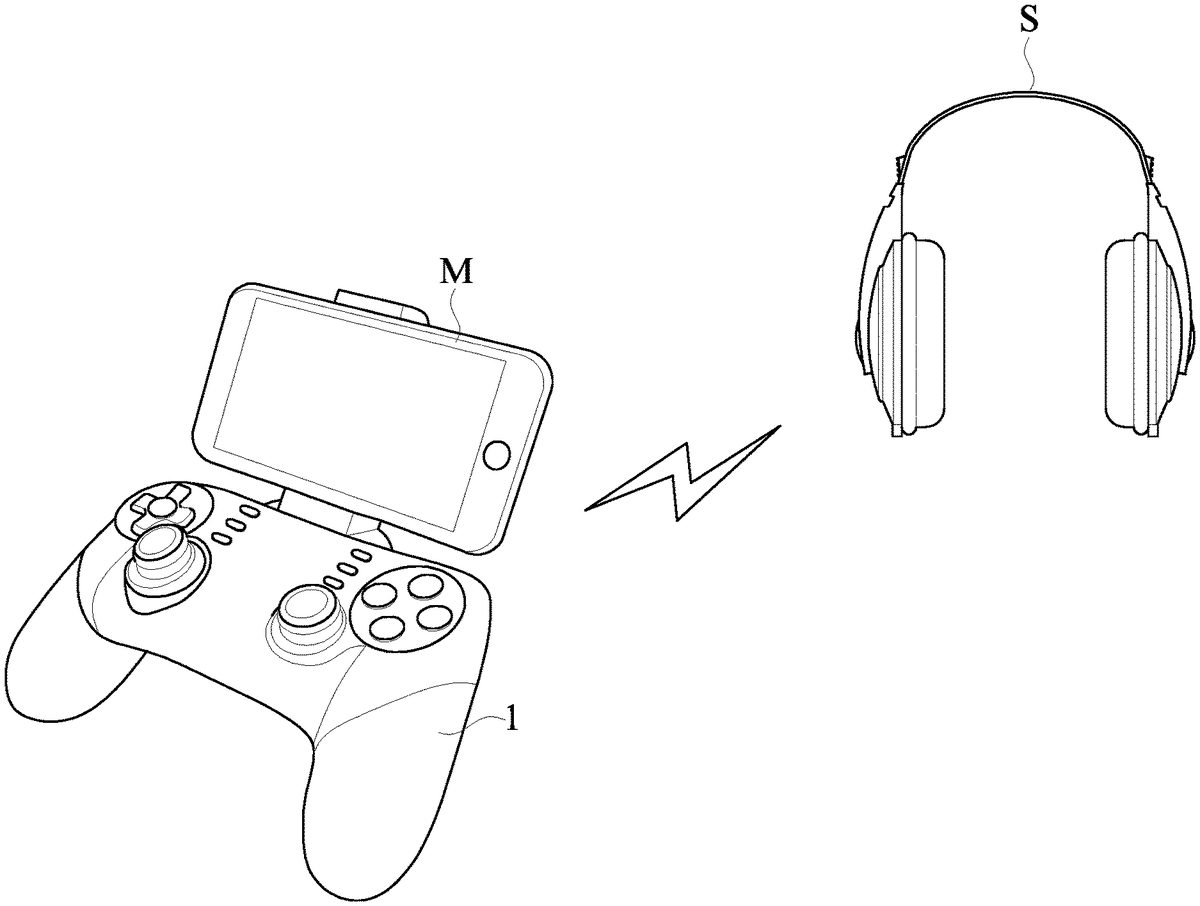
Referring toFIG. 1, a first embodiment of the present disclosure provides a game controller1for a mobile device M, which includes a control module11, a first audio module12, and a second audio module13.
In the present embodiment, the mobile device M can be a smart phone, a tablet, etc., but the present disclosure is not limited thereto. In addition, the mobile device M at least includes a first wireless communication module M1, and the first wireless communication module M1can include, for example but limited to, a WI-FI® transceiver, a BLUETOOTH® transceiver, a 2.4 GHz wireless transceiver, a ZIGBEE® transceiver, a LoRa transceiver, a Sigfox transceiver, or an NB-IoT transceiver. In one particular embodiment, the first wireless communication module M1of the mobile device M includes the BLUETOOTH® transceiver.
Referring toFIG. 2toFIG. 4,FIG. 2toFIG. 4are each a schematic view of a game controller being used in cooperation with a mobile device and an audio device according to embodiments of the present disclosure. The game controller1can include at least one first gamepad, and the game controller1is connected to the mobile device M through the first gamepad. In other embodiments, the game controller1can further include a second gamepad, and the mobile device M is connected between the first gamepad and the second gamepad. A configuration of internal components of the game controller1can be adjusted according to a structure of the first gamepad and a structure of the second gamepad, but the present disclosure is not limited thereto. In addition, at least one battery module can be disposed in the game controller1. The battery module can be charged through the mobile device M that is connected thereto, or through an external power source. Moreover, the battery module can also be connected to the game controller1in a pluggable manner, such that power supply to the game controller1can be maintained by changing the battery module, but the present disclosure is not limited thereto.
Furthermore, the game controller1can be connected to the mobile device M through a LIGHTNING® connector, a Type-A universal serial bus (Type-A USB) connector, a Type-C USB connector, or a micro USB connector, so as to control an operation thereof.
The control module11is disposed in the game controller1, and the control module11is electrically connected to the mobile device M. In the present embodiment, the control module11can be a central processing unit (CPU), an application-specific integrated circuit (ASIC), or a microprocessor.
The first audio module12is disposed in the game controller1, and the first audio module12is correspondingly and electrically connected to the mobile device M and the control module11. The first audio module12can further include a first wireless communication unit121. The first wireless communication unit121can include, for example but not limited to, a WI-FI® transceiver, a BLUETOOTH® transceiver, a 2.4 GHz wireless transceiver, a ZIGBEE® transceiver, a LoRa transceiver, a Sigfox transceiver, or an NB-IoT transceiver. In one particular embodiment, the first audio module12includes the 2.4 GHz wireless transceiver. More specifically, when the game controller1is connected to the mobile device M, the first wireless communication unit121of the first audio module12is wirelessly connected to a corresponding one of at least one audio device S, and audio information of the mobile device M can be transmitted to the corresponding one of the audio device S through the first wireless communication unit121of the first audio module12.
The second audio module13is disposed in the game controller1, and the second audio module13is correspondingly and electrically connected to the mobile device M and the control module11. More specifically, the second audio module13is electrically connected to the first wireless communication M1of the mobile device M, so as to control the mobile device M to transmit the audio information to the corresponding one of the audio device S through the first wireless communication module M1.
In the present embodiment, the audio device S includes a second wireless communication module S1that corresponds to the first wireless communication module M1of the mobile device M, and a second wireless communication unit S2that corresponds to the first wireless communication unit121of the first audio module12. In one particular embodiment, the second wireless communication module S1can include the 2.4 GHz wireless transceiver, and the second wireless communication unit S2can include the BLUETOOTH® transceiver. In the present embodiment, the audio device S can be a headset, a speaker, a smart speaker, an in-vehicle information system, etc. In one particular embodiment, the audio device S is a wireless headset.
In should be noted that, a pairing between the audio device S and the game controller1and a pairing between the audio device S and the mobile device M are performed before the audio device S is used. That is, the second wireless communication module S1and the second wireless communication unit S2of the audio device S are respectively paired with the first wireless communication module M1of the mobile device M and the first wireless communication unit121of the first audio module12before the audio device S is used, so that the audio information can be transmitted smoothly and an audio latency can be improved. The pairing process described above is a conventional technique, and will not be described in detail herein.
Furthermore, through the control of the control module11, the first audio module12or the second audio module13can be electrically connected to the mobile device M. That is to say, the control module11can define a use mode and generate a control command according to a category of the audio information of the mobile device M, so as to enable the first audio module12or the second audio module13to be electrically connected to the mobile device M. In addition, the control module11controls the audio information to be transmitted from the first wireless communication unit121of the first audio module12and the first wireless communication module M1of the mobile device M respectively to the second wireless communication module S1and the second wireless communication unit S2of the audio device S.
For example, in the present embodiment, when a user plays a game, watches a video, or listens to music, the control module11defines such a condition as a first use mode and transmits a first control command to the first audio module12, so as to enable the first audio module12to be electrically connected to the mobile device M. Then, the first audio module12controls the mobile device M to transmit audio information of the game, the video, or the music through the first wireless communication unit121and the second wireless communication unit S2.
In another aspect, in the present embodiment, when the user makes a phone call or makes a voice call through a communication software, the control module11defines such a condition as a second use mode and transmits a second control command to the second audio module13, so as to enable the second audio module13to be electrically connected to the mobile device M. Then, the second audio module13controls the mobile device M to transmit audio information of the phone call or the voice call using the communication software through the first wireless communication module M1and the second wireless communication module S1.
Furthermore, when an operation of the user switches from the first use mode to the second use mode or from the second use mode to the first use mode, the control module11defines such a condition as a third use mode and transmits a third control command to the first audio module12and the second audio module13. According to this use mode, the audio information is transmitted to the audio device S correspondingly through the first audio module12and the second audio module13. That is to say, when the operation of the user switches from playing the game, watching the video, or listening to the music to making the phone call or making the voice call through the communication software, the control module11transmits the third control command to the first audio module12and the second audio module13, so as to enable the second audio module13to be electrically connected to the mobile device M. Then, the second audio module13controls the mobile device M to transmit the audio information of the phone call or the voice call using the communication software through the first wireless communication module M1and the second wireless communication module S1. When the operation of the user switches from making the phone call or making the voice call through the communication software to playing the game, watching the video, or listening to the music, the control module11transmits the third control command to the first audio module12and the second audio module13, so as to enable the first audio module12to be electrically connected to the mobile device M. Then, the first audio module12controls the mobile device M to transmit the audio information of the game, the video, or the music through the first wireless communication unit121and the second wireless communication unit S2.
It should be noted that, in the third use mode, after the control module11transmits the third control command to the first audio module12and the second audio module13, the control module11can control the first audio module12to be continuously and electrically connected to the mobile device M. Therefore, both the audio information of the game, the video, or the music, and the audio information of the phone call or the voice call through the communication software are transmitted through the first wireless communication unit121of the first audio module12and the second wireless communication unit S2according to the third control command.
Furthermore, the game controller1can include a human-computer interaction module that is correspondingly and electrically connected to the control module11, the first audio module12, and the second audio module13. The human-computer interaction module can generate a human-computer interaction instruction according to the third control command of the control module11, and the human-computer interaction module receives a fourth control command input by the user according to the human-computer interaction instruction, so as to control the transmission of the audio information to the audio device S through the first audio module12or the second audio module13. That is to say, according to practical requirements, the user can control the first audio module12or the second audio module13to output the audio information to the audio device S through the human-computer interaction module.
The aforementioned human-computer interaction module can be software, firmware, hardware, or a combination of other software, firmware, and hardware that can achieve the functions described above.
However, the aforementioned examples describe only one of the embodiments of the present disclosure, and the present disclosure is not intended to be limited thereto.
Beneficial Effects of the Embodiments
In conclusion, in the game controller for the mobile device provided by the present disclosure, by virtue of “the pairing between the audio device S and the first audio module12and the pairing between the audio device S and the first wireless communication module M1of the mobile device M being performed before the audio device S is used” and “the control module11being configured to generate the control command according to the category of the audio information of the mobile device M, so as to output the audio information to the audio device S through the first audio module12or the second audio module13,” switching between different audio information outputs can be done in a more timely manner and the audio latency can be improved, thereby improving a user experience.
The foregoing description of the exemplary embodiments of the disclosure has been presented only for the purposes of illustration and description and is not intended to be exhaustive or to limit the disclosure to the precise forms disclosed. Many modifications and variations are possible in light of the above teaching.
The embodiments were chosen and described in order to explain the principles of the disclosure and their practical application so as to enable others skilled in the art to utilize the disclosure and various embodiments and with various modifications as are suited to the particular use contemplated. Alternative embodiments will become apparent to those skilled in the art to which the present disclosure pertains without departing from its spirit and scope.
Claims
- A game controller for a mobile device, wherein the mobile device includes a first wireless communication module, the game controller comprising: a control module electrically connected to the mobile device;a first audio module electrically connected to the mobile device and the control module, wherein the first audio module is wirelessly connected to an audio device;and a second audio module electrically connected to the mobile device and the control module, so as to control the mobile device to be wirelessly connected to the audio device;wherein a pairing between the audio device and the first audio module and a pairing between the audio device and the first wireless communication module of the mobile device are performed before the audio device is used;wherein the control module is configured to generate a control command according to a category of audio information of the mobile device, so as to output the audio information to the audio device through the first audio module or the second audio module.
- The game controller according to claim 1, wherein the control module is configured to generate a first control command according to a first audio information of the mobile device, so as to control the first audio module to output the first audio information to the audio device through the first audio module.
- The game controller according to claim 2, wherein the first audio information is audio information of a game, a video, or music.
- The game controller according to claim 2, wherein, according to a second audio information of the mobile device, the control module is configured to generate a second control command for controlling the second audio module, such that the second audio module controls the mobile device to output the second audio information to the audio device through the first wireless communication module of the mobile device.
- The game controller according to claim 4, wherein the second audio information is audio information of a phone call or a voice call made through a communication software.
- The game controller according to claim 4, wherein the control module is configured to generate a third control command according to a third audio information of the mobile device, so as to control the first audio module and the second audio module to transmit the third audio information to the audio device respectively through the first audio module and the first wireless communication module of the mobile device;wherein the third audio information includes the first audio information and the second audio information.
- The game controller according to claim 6, wherein the third control command is generated when the mobile device switches from outputting the first audio information to outputting the second audio information, or when the mobile device switches from outputting the second audio information to outputting the first audio information.
- The game controller according to claim 6, wherein, after the control module generates the third control command to control the first audio module and the second audio module, the first audio module outputs the third audio information to the audio device according to the third control command.
- The game controller according to claim 6, further comprising: a human-computer interaction module correspondingly and electrically connected to the control module, the first audio module, and the second audio module;wherein the human-computer interaction module is configured to generate a human-computer interaction instruction according to the third control command, and the human-computer interaction module receives a fourth control command that is input by a user according to the human-computer interaction instruction, so as to control the third audio information to be transmitted to the audio device through the first audio module or the second audio module.
- The game controller according to claim 1, wherein the audio device is a wireless headphone, and the wireless headphone includes two transceivers respectively corresponding to the first wireless communication module of the mobile device and the first audio module.
- The game controller according to claim 1, wherein the first audio module includes a 2.4 GHz wireless transceiver.
- The game controller according to claim 1, wherein the first wireless communication module of the mobile device includes a BLUETOOTH® transceiver.
- The game controller according to claim 1, wherein the first audio module includes a 2.4 GHz wireless transceiver, and the first wireless communication module of the mobile device includes a BLUETOOTH® transceiver.
Disclaimer: Data collected from the USPTO and may be malformed, incomplete, and/or otherwise inaccurate.