U.S. Pat. No. 11,504,630
Massively-Multiplayer-Online-Game Avatar Customization for non-Game Media
Issue DateMarch 17, 2020
Illustrative Figure
Abstract
The present invention describes methods to customize massively-multiplayer-online-game (MMOG) Avatars beyond what can be displayed during general game-play. General game play refers to when a user is in a game with control of their Avatar. One knowledgeable in the art would understand that MMOGs are limited by their game engines to the complexity of Avatars that may be displayed to a user during general game-play, while maintaining acceptable frame rates. Furthermore one knowledgeable in the art would understand that Avatar complexity may further be limited due to the target machine the MMOG is designed to run on. The current invention describes methods to produce a custom Avatar image for non-game use, wherein the custom Avatar has higher resolution and greater choices than are available in-game.
Description
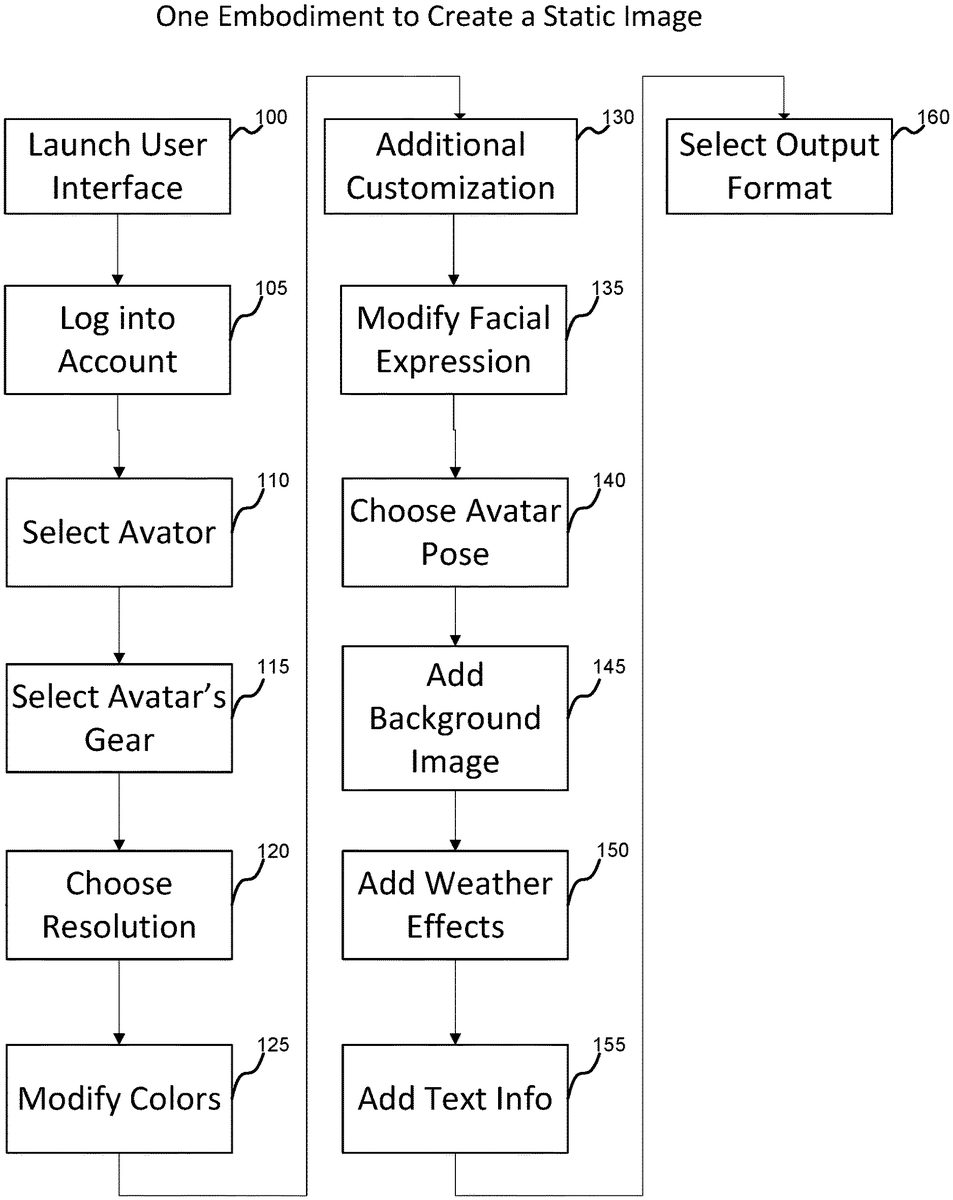
STATIC IMAGE For creating a customized Static image, the user starts by launching the user interface100on a computer. Virtually all of the MMOGs on the market require that the user logs in105to access his/her account. Often, accounts will have more than one character, with each character being represented by a different avatar. The user interface presents the available avatars110. The user further customizes the look of the Avatar by selecting from the gear available to the character115. The user may select the appropriate output resolution for the new Static image120. Customizations to colors related to the Avatar may also be available125. Color customizations may include options to change hair color, skin color, weapons and other gear. These customizations are not restricted to solid colors. Patterns and other types of textures may be available. An example would be adding a camouflage texture to a weapon. Some additional Avatar customizations may include such things as tattoos, hair style and jewelry130. The facial expressions for the Avatar may be changed135. Facial expressions may include sad, happy, and determined. The pose for the Avatar may be specified140. A background image may be specified for the static image145. Typically, this image would be either from the game or representative of it. The background image may be further customized with weather effects150. These may include such things as snow, rain, or dust storms. Textual information may be specified for the static image155. This may include such things as the Avatar's name, its servers' name and the Avatar's level in the game. When all of the settings have been specified to the User's satisfaction, the static image's file format and storage location may be specified and the static image generated160. 3D Figure For creating a customized 3D Figure, the user starts by launching the user interface200on a ...
STATIC IMAGE
For creating a customized Static image, the user starts by launching the user interface100on a computer. Virtually all of the MMOGs on the market require that the user logs in105to access his/her account. Often, accounts will have more than one character, with each character being represented by a different avatar. The user interface presents the available avatars110. The user further customizes the look of the Avatar by selecting from the gear available to the character115. The user may select the appropriate output resolution for the new Static image120.
Customizations to colors related to the Avatar may also be available125. Color customizations may include options to change hair color, skin color, weapons and other gear. These customizations are not restricted to solid colors. Patterns and other types of textures may be available. An example would be adding a camouflage texture to a weapon. Some additional Avatar customizations may include such things as tattoos, hair style and jewelry130.
The facial expressions for the Avatar may be changed135. Facial expressions may include sad, happy, and determined. The pose for the Avatar may be specified140. A background image may be specified for the static image145. Typically, this image would be either from the game or representative of it. The background image may be further customized with weather effects150. These may include such things as snow, rain, or dust storms. Textual information may be specified for the static image155. This may include such things as the Avatar's name, its servers' name and the Avatar's level in the game. When all of the settings have been specified to the User's satisfaction, the static image's file format and storage location may be specified and the static image generated160.
3D Figure
For creating a customized 3D Figure, the user starts by launching the user interface200on a computer. Generally, the user must log in205to access his/her account. Often, accounts will have more than one character, with each character being represented by a different avatar. The user interface presents the available avatars210. The user further customizes the look of the Avatar by selecting from the gear available to the character215. The user may select the appropriate output resolution for the new 3DFIG. 220. For 3D models, different types of output devices may be optimized for different levels of detail. This is similar to the resolution that would be specified in a static image.
Depending on the use for which the 3D Figure is being created, there may be different color options. A simple 3D filament based printer may only support a single color. A higher end printer may support thousands of colors within a certain color range. A subset of available colors may be specified to best match the capabilities of the 3D output Device225.
Customizations to colors related to the Avatar may also be available230. Color customizations may include options to change hair color, skin color, weapons and other gear. These customizations are not restricted to solid colors. Patterns and other types of textures may be available. An example would be adding a camouflage texture to a weapon. Any customizations may be restricted to the selected color subset225.
The facial expressions for the Avatar may be specified or changed235. Facial expressions may include sad, happy, and determined. The pose for the Avatar may be specified240. A 3D figure that is to be rendered on a 3D printer may include a base so that the final model can stand on its own. Different size and shapes of bases may be selected. In some cases, a base choice is more functional than decorative, while others tend more to the decorative. The selection is left to the preference of the user245. The base may be further customized with text250.
When all of the customizations are complete, the file for the 3D figure may be generated.
Non-Static Image
For creating a customized non-static, the user starts by launching the user interface300on a computer. Generally, the user must log in305to access his/her account. Often, accounts will have more than one character, with each character being represented by a different avatar. The user interface presents the available avatars310. The user further customizes the look of the Avatar by selecting from the gear available to the character315. The user may select the appropriate output resolution for the new non-static image320.
Since this is for a non-static image, a duration needs to be specified325. The duration depends on the use for the non-static image. A lenticular print tends to use very few frames while video clips can use many.
Customizations to colors related to the Avatar may also be available330. Color customizations may include options to change hair color, skin color, weapons and other gear. These customizations are not restricted to solid colors. Patterns and other types of textures may be available. An example would be adding a camouflage texture to a weapon.
Additional Customizations may be available and may be specified335. For a non-static image, this may include such features as colors that change over time. A feature such as this would allow for a background to “glow” or even have a glint of light appear on a sword. Similar to static image, facial expressions may be specified340. Unlike the static images, an expression may be animated, such as the Avatar winking or smirking.
A background image may be specified345. The background may be animated, such as snow falling on the scene. The Avatar's gestures may also be specified355. Gestures may include, but are certainly not limited to, raising a weapon, waving, and even dancing. Text information may be added as well360. Like other effects, the text is not limited to being static and may have animation effects. Finally, the output format may be specified and the file saved365.
Claims
- An Avatar customization system comprising a computer program configured to: a. run on a client computing device connected to a host computing device, b. display a user-interface for a massively-multiplayer-online-game on the client computing, device, and c. access software and digital artwork on the host computing device, wherein said user-interface is configured to allow a user to customize an avatar for non-game use images comprising access to: a. avatar models with a higher polygon count than available in-game, b. avatar textures optimized for a higher resolution than available in-game, c. avatar color palettes greater than available in-game.
- The Avatar customization system of claim 1 further comprising: access to more fixed assets on the Host than available in-game.
- The Avatar customization system of claim 1 further comprising: access to more Avatar expressions on the Host than available in-game.
- The Avatar customization system of claim 1 further comprising: access to procedurally generated non-specific environmental effects software on the Host to modify an Avatar image.
- The Avatar customization system of claim 1 further comprising: access to software on the host to save a 3D custom Avatar file suitable for 3D printing.
- The Avatar customization system of claim 1 further comprising: access to software on the host to limit a background image created from in-game locations, to in-game locations that an avatar has visited in-game.
- The Avatar customization system of claim 1 further comprising: access to software on the host to create a non-static image.
- The Avatar customization system of claim 1 further comprising: access to software on the host to select an avatar gesture not available in-game.
- The Avatar customization system of claim 1 further comprising: access to software on the host to select weather effects.
- The Avatar customization system of claim 1 further comprising: software on the host configured to limit the color choices of the avatar's gear to a subset of all available colors.
- The Avatar customization system of claim 1 further comprising: access to software on the host configured to add additional avatar information to a non-game image or 3D print file.
- The Avatar customization system of claim 1 further comprising: access to software on the host configured to modify the avatar with user-uploaded artwork.
- Avatar customization system of claim 1 further comprising: access to software on the host to create anon-static image in a format suitable for Lenticular printing.
Disclaimer: Data collected from the USPTO and may be malformed, incomplete, and/or otherwise inaccurate.