U.S. Pat. No. 11,497,987
INPUT DEVICE, GAME CONTROLLER, AND INFORMATION PROCESSING APPARATUS
AssigneeNintendo Co., Ltd.
Issue DateAugust 25, 2020
Illustrative Figure
Abstract
An example of a controller includes a housing including an opening, and an operation member, a part of which is exposed through the opening. The operation member includes a key top exposed through the opening and operated by a user, a shaft portion extending downward from the key top, and a protruding portion protruding from the shaft portion. Further, in the housing, a pedestal with which the protruding portion of the operation member comes into contact when the operation member is tilted is provided. The tilt of the operation member is limited by the protruding portion coming into contact with the pedestal.
Description
DETAILED DESCRIPTION OF NON-LIMITING EXAMPLE EMBODIMENTS With reference to the drawings, a game controller1(an example of an input device) according to an exemplary embodiment is described below. The game controller1according to the exemplary embodiment is connected to a game apparatus (not shown) in a wireless or wired manner and used to perform an operation in a game performed in the game apparatus. It should be noted that the game apparatus to which the game controller1is connected may be a mobile game apparatus or may be a stationary game apparatus. Further, the game controller1may be connected not only to a game apparatus but also to an information processing apparatus such as a smartphone, a tablet terminal, or a personal computer and used to perform an operation in a game performed using the information processing apparatus. FIG. 1is examples of external views of the game controller1. (a) ofFIG. 1is a front view of the game controller1. (b) ofFIG. 1is a left side view of the game controller1. (c) ofFIG. 1is a right side view of the game controller1. (d) ofFIG. 1is a top view of the game controller1. (e) ofFIG. 1is a bottom view of the game controller1. (f) ofFIG. 1is a rear view of the game controller1. An xyz coordinate system inFIG. 1is a coordinate system based on the game controller1. The xyz coordinate system defines a direction perpendicular to a front surface of the game controller1(e.g., the direction in which buttons2are pressed) as a z-axis direction, defines a left-right direction of the game controller1(e.g., the direction in which an A-button2and a Y-button2are connected together) as an x-axis direction, and defines an up-down direction of the game controller1(e.g., the direction in which a B-button2and an X-button2are connected together) as a y-axis direction. As shown inFIG. 1, the game controller1includes a first ...
DETAILED DESCRIPTION OF NON-LIMITING EXAMPLE EMBODIMENTS
With reference to the drawings, a game controller1(an example of an input device) according to an exemplary embodiment is described below. The game controller1according to the exemplary embodiment is connected to a game apparatus (not shown) in a wireless or wired manner and used to perform an operation in a game performed in the game apparatus. It should be noted that the game apparatus to which the game controller1is connected may be a mobile game apparatus or may be a stationary game apparatus. Further, the game controller1may be connected not only to a game apparatus but also to an information processing apparatus such as a smartphone, a tablet terminal, or a personal computer and used to perform an operation in a game performed using the information processing apparatus.
FIG. 1is examples of external views of the game controller1. (a) ofFIG. 1is a front view of the game controller1. (b) ofFIG. 1is a left side view of the game controller1. (c) ofFIG. 1is a right side view of the game controller1. (d) ofFIG. 1is a top view of the game controller1. (e) ofFIG. 1is a bottom view of the game controller1. (f) ofFIG. 1is a rear view of the game controller1. An xyz coordinate system inFIG. 1is a coordinate system based on the game controller1. The xyz coordinate system defines a direction perpendicular to a front surface of the game controller1(e.g., the direction in which buttons2are pressed) as a z-axis direction, defines a left-right direction of the game controller1(e.g., the direction in which an A-button2and a Y-button2are connected together) as an x-axis direction, and defines an up-down direction of the game controller1(e.g., the direction in which a B-button2and an X-button2are connected together) as a y-axis direction.
As shown inFIG. 1, the game controller1includes a first housing10on the front surface side of the game controller1and a second housing20on a back surface side of the game controller1. The first housing10and the second housing20are connected together, thereby forming a housing of the game controller1. The first housing10and the second housing20may be formed of, for example, an ABS resin, a polycarbonate ABS resin, an acrylic ABS resin, or the like, or may be formed of a polymer alloy including at least two of these three materials. Further, the game controller1includes a left grip portion8aand a right grip portion8b.
Further, as shown inFIG. 1, in a right region of the front surface of the game controller1, four buttons (an A-button, a B-button, an X-button, and a Y-button)2are provided. Further, to the left side of the four buttons2, four buttons (a “+” button, a “—” button, a home button, and a capture button)3are provided. Further, in the right region of the front surface of the game controller1and obliquely below and to the left of the Y-button2, a right analog stick4bis provided.
Further, in a left region of the front surface of the game controller1and to the left side of the “—” button3, a left analog stick4ais placed. Further, in the left region of the front surface of the game controller1and obliquely below and to the right of the left analog stick4a, a directional pad5is placed.
Further, as shown in (d) ofFIG. 1, on an upper surface of the game controller1, an L-button6a, a ZL-button7a, an R-button6b, and a ZR-button7bare provided. Specifically, the L-button6ais provided in a left end portion on the upper surface of the game controller1. The ZL-button7ais provided on the game controller1back surface side (further in a positive z-axis direction) of the L-button6a. Further, the R-button6bis provided in a right end portion on the upper surface of the game controller1. The ZR-button7bis provided on the game controller1back surface side (further in the positive z-axis direction) of the R-button6b.
The four buttons2are buttons that can be pressed in a depth direction (the positive z-axis direction) in (a) ofFIG. 1, and are buttons used for a game operation. Further, the four buttons3are buttons that can be pressed in the positive z-axis direction. Further, the directional pad5is a device for indicating up, down, left, and right directions.
Further, the left analog stick4aand the right analog stick4bare devices for indicating directions and are each configured such that a key top of the analog stick to be operated by the finger of a user can be tilted in any directions (at any angles in up, down, left, right, and oblique directions). The left analog stick4aand the right analog stick4bmay be configured to be pressed in the positive z-axis direction. It should be noted that hereinafter, the left analog stick4aand the right analog stick4bwill occasionally be collectively referred to as an “analog stick4”. The analog stick4outputs a signal including information regarding the direction in which the analog stick4is tilted, and information regarding the angle of the tilt. The game apparatus can execute game processing based on this signal. The details of the analog stick4will be described later.
FIG. 2is a diagram showing the state where the user holds the game controller1with both hands. As shown inFIG. 2, when the user holds the grip portion8awith their left hand and holds the grip portion8bwith their right hand, the user can operate the left analog stick4aand the directional pad5with the thumb of the left hand. Further, the user can operate two of the buttons3(the “−” button and the capture button) with the thumb of the left hand. Further, the user can operate the L-button6aand the ZL-button7awith the index finger (or the middle finger) of the left hand. Further, the user can operate the four buttons2(the A-button, the B-button, the X-button, and the Y-button), the right analog stick4b, and two of the buttons3(the “+” button and the home button) with the thumb of the right hand. Further, the user can operate the R-button6band the ZR-button7bwith the index finger (or the middle finger) of the right hand. It should be noted thatFIG. 2shows the typical manner of holding the game controller1. The game controller1may be held in a different manner depending on the user.
FIG. 3is an exploded perspective view of the game controller1. As shown inFIG. 3, within the game controller1(within the housing formed of the first housing10and the second housing20), various members are accommodated.
Specifically, within the game controller1, a substrate30, a left analog stick main body part43a, a pedestal42a, and a left operation member41aare accommodated. Further, within the game controller1, a right analog stick main body part43b, a pedestal42b, and a right operation member41bare accommodated. It should be noted that although various parts are also accommodated within the game controller1in addition to these, only portions related to the analog stick4will be described below.
The left analog stick4ais formed of the left analog stick main body part43a, the pedestal42a, and the left operation member41a. Further, the right analog stick4bis formed of the right analog stick main body part43b, the pedestal42b, and the right operation member41b. It should be noted that hereinafter, the left analog stick main body part43aand the right analog stick main body part43bwill occasionally be collectively referred to as an “analog stick main body part43”. Further, the pedestal42aand the pedestal42bwill occasionally be collectively referred to as a “pedestal42” (an example of a contact target portion). Similarly, the left operation member41aand the right operation member41bwill occasionally be collectively referred to as an “operation member41”.
The analog stick main body part43is fixed onto the substrate30. The analog stick main body part43includes a stick shaft431(seeFIG. 10). Although the details will be described later, the stick shaft431of the analog stick main body part43is inserted into a shaft insertion opening415provided in the operation member41, thereby fixing the operation member41to the analog stick main body part43. Then, a key top of the operation member41is exposed through an opening portion11(a left opening portion11aor a right opening portion11b) provided in the first housing10.
The operation member41is tilted by the user, thereby inputting a direction. Although the details will be described later, the tilt angle of the operation member41is limited by the pedestal42.
(Details of Operation Member41of Analog Stick4)
Next, the details of the operation member41of the analog stick4are described.FIG. 4is examples of external views of the operation member41of the analog stick4. (a) ofFIG. 4is a front view of the operation member41(a diagram in which only the operation member41is viewed from the front surface of the game controller1when the operation member41is fixed to the game controller1). (b) ofFIG. 4is a left side view of the operation member41. (c) ofFIG. 4is a right side view of the operation member41. (d) ofFIG. 4is a top view of the operation member41. (e) ofFIG. 4is a bottom view of the operation member41. (f) ofFIG. 4is a rear view of the operation member41. It should be noted that an x-axis, a y-axis, and z-axis inFIG. 4correspond to the x-axis, the y-axis, and the z-axis, respectively, inFIG. 1.
FIG. 5Ais a front surface side perspective view of the operation member41.FIG. 5Bis a back surface side perspective view of the operation member41. Further,FIG. 6is a cross-sectional view along a line A-A in (a) ofFIG. 4.
As shown inFIG. 4, the operation member41includes a key top411, a shaft portion412, and a protruding portion413. The key top411is exposed through the opening portion11of the first housing10and is a portion to be operated (touched) by the user. The shape of the key top411is a circular shape when the game controller1is viewed from the front surface.
The shaft portion412extends downward from the key top411(in the direction in which the buttons2of the game controller1are pressed; the positive z-axis direction). When the operation member41is provided in the game controller1, the shaft portion412extends in the direction from the key top411toward the inside of the housing of the game controller1. The shaft portion412has, for example, a columnar shape, and the radius of a bottom surface of the shaft portion412is L1. When the operation member41is fixed to the analog stick main body part43provided on the substrate30, the shaft portion412penetrates through the opening portion11of the first housing10and exposes the key top411to the outside of the housing.
The protruding portion413is formed into an umbrella shape and formed such that the further downward (the positive z-axis direction) in the shaft portion412, the wider. Specifically, the protruding portion413protrudes downward from the shaft portion412and in a direction away from the center of the shaft portion412(the x-axis direction and the y-axis direction, i.e., a direction perpendicular to the direction in which the buttons2are pressed). More specifically, as shown in (e) ofFIG. 4, the protruding portion413has a shape obtained by cutting about half to two-thirds of a hollow ball. The side surface of the protruding portion413is arcuate when viewed from a direction parallel to the xy plane. As shown in (f) ofFIG. 4, a lower end portion (extremity) of the protruding portion413is circular when the operation member41is viewed from the back surface. Further, the extremity of the protruding portion413may have a round shape. As shown in (d) ofFIG. 4, the distance from the center of the shaft portion412to the extremity of the protruding portion413(i.e., the radius of the circle of the extremity of the protruding portion413) is L3 (>L1).
Further, as shown in (f) ofFIGS. 4, 5B, and 6, inside the protruding portion413, a plurality of ribs414are provided. The ribs414are provided along the inside of the protruding portion413toward the extremity of the protruding portion413, thereby preventing the protruding portion413from deforming when the operation member41is operated. It should be noted that the ribs414may be provided so as to extend to the extremity of the protruding portion413.
Further, inside the protruding portion413, a shaft insertion opening415is provided. Into the shaft insertion opening415, the stick shaft431of the analog stick main body part43(seeFIG. 10) is inserted. Consequently, the operation member41is fixed to the analog stick main body part43.
The key top411is formed of a different material from those of the first housing10and the second housing20and formed of a material having a higher coefficient of friction than the first housing10and the second housing20so that the key top411is less likely to slip when the user operates the key top411. Further, the shaft portion412and the protruding portion413(also the ribs414and the shaft insertion opening415) may be formed of polypropylene. Further, the shaft portion412and the protruding portion413may be formed of the same material as those of the first housing10and the second housing20. The key top411, the shaft portion412, and the protruding portion413(also the ribs414and the shaft insertion opening415) may be integrally molded by two-color molding. It should be noted that the key top411may be formed of the same material as that of the first housing10. Further, the shaft portion412and the protruding portion413may be formed of different materials.
(Details of Pedestal42of Analog Stick4)
FIG. 7is examples of external views of the pedestal42of the analog stick4. (a) ofFIG. 7is a front view of the pedestal42. (b) ofFIG. 7is a left side view of the pedestal42. (c) ofFIG. 7is a right side view of the pedestal42. (d) ofFIG. 7is a top view of the pedestal42. (e) ofFIG. 7is a bottom view of the pedestal42. (f) ofFIG. 7is a rear view of the pedestal42. It should be noted that a z-axis inFIG. 7coincides with the z-axis inFIG. 1.
FIG. 8Ais a perspective view of the pedestal42when viewed from the back surface side.FIG. 8Bis a perspective view of the pedestal42when viewed from the upper surface side. Further,FIG. 9is a cross-sectional view along a line A-A in (a) ofFIG. 7.
The pedestal42(an example of a contact target portion) is a member that comes into contact with the protruding portion413when the operation member41is tilted. As shown in (d) ofFIG. 7, the pedestal42is a ring-shaped member. The pedestal42includes a contact surface421, an inner wall422, and an outer wall423. Further, the pedestal42includes two screw holes424. The pedestal42is molded by integral molding. Screws are inserted into the screw holes424, and the pedestal42is screwed, thereby fixing the pedestal42to the first housing10. The pedestal42is fixed in the housing such that the contact surface421is directed to the front surface side of the game controller1(i.e., the normal vector of the contact surface421is directed in a negative z-axis direction of the game controller1). As shown inFIG. 3, the pedestal42is disposed further on the front surface side of the game controller1than the substrate30and the analog stick main body part43, and the ring-shaped pedestal42is disposed so as to surround the analog stick main body part43.
As shown inFIG. 9, the contact surface421is a flat surface parallel to the xy plane. The outer wall423is a surface that extends upward (in the negative z-axis direction) from the contact surface421and for example, is perpendicular to the contact surface421. Further, at least a surface inside the inner wall422(a surface that comes into contact with the contact surface421) is formed, for example, so as to extend upward (in the negative z-axis direction) and toward the center (inside) of the pedestal42from the contact surface421and have an angle greater than the 90 degrees with respect to the contact surface421.
The pedestal42may be formed of a material having higher sliding properties (a lower coefficient of friction) than the first housing10and the second housing20. Further, the pedestal42may be formed of a material having higher sliding properties than the protruding portion413of the operation member41. For example, the pedestal42may be formed of a POM (polyacetal) resin, a PA (nylon/polyamide) resin, a PBT resin, or the like. It should be noted that the pedestal42may be formed of any material. For example, the pedestal42may be formed of the same material as that of the protruding portion413, or may be formed of the same material as those of the first housing10and the second housing20.
(Limitation on Tilt of Operation Member41by Pedestal42)
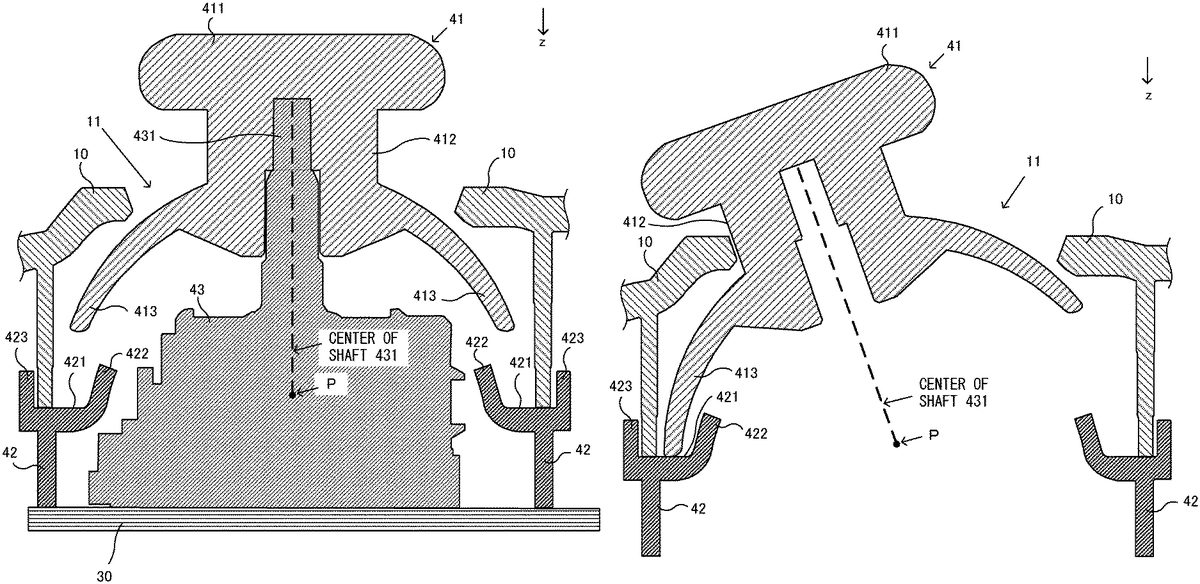
FIG. 10is a diagram showing an example of an end surface of the game controller1when cut in the center of the analog stick4in a case where the operation member41is not tilted. It should be noted thatFIG. 10conceptually shows a portion related to the limitation on the tilt of the operation member41by the pedestal42, and does not show a portion unrelated to the limitation on the tilt of the operation member41. Further, a down direction inFIG. 10coincides with the z-axis directions inFIGS. 1, 4, and the like.
As shown inFIG. 10, the stick shaft431of the analog stick main body part43is inserted into the shaft insertion opening415of the operation member41, and the operation member41is fixed to the analog stick main body part43. The key top411of the operation member41is exposed through the opening portion11of the first housing10.
The stick shaft431of the analog stick main body part43is configured to be tilted with a point P as a fulcrum. It should be noted that inFIG. 10, a dashed line in the up-down direction passing through the point P indicates the center of the stick shaft431of the analog stick main body part43. The center of the shaft431coincides with the center of the shaft portion412of the operation member41. For example, when a force is applied to the key top411of the operation member41in the left-right direction inFIG. 10by the user, the stick shaft431of the analog stick main body part43is tilted in the left-right direction. Further, when a force is applied to the key top411of the operation member41in a direction perpendicular to the plane of the paper ofFIG. 10, the stick shaft431of the analog stick main body part43is tilted in the direction perpendicular to the plane of the paper ofFIG. 10.
FIG. 11is a diagram showing an example of the state where the operation member41is tilted in the left direction from the state ofFIG. 10.FIG. 12is a diagram showing an example of the state where the operation member41is tilted in the right direction from the state ofFIG. 10. It should be noted that inFIGS. 11 and 12, for description, the analog stick main body part43is omitted except for the point P and the center of the stick shaft431.
As shown inFIG. 11, when a force is applied to the key top411of the operation member41in the left direction, the operation member41is tilted to the left side and moves in a peripheral direction on the left side of the opening portion11. Then, within the housing10, the extremity of the protruding portion413comes into contact with the contact surface421of the pedestal42. Thus, the operation member41is not tilted any more in the left direction. That is, the extremity of the protruding portion413comes into contact with the pedestal42, thereby limiting the tilt in the left direction of the operation member41. At this time, the shaft portion412of the operation member41does not come into contact with the first housing10.
Further, as shown inFIG. 12, when a force is applied to the key top411of the operation member41in the right direction, the operation member41is tilted to the right side and moves in the peripheral direction on the right side of the opening portion11. Then, within the housing10, the extremity of the protruding portion413comes into contact with the contact surface421of the pedestal42. Thus, the operation member41is not tilted any more in the right direction. That is, the extremity of the protruding portion413comes into contact with the pedestal42, thereby limiting the tilt in the right direction of the operation member41. At this time, the shaft portion412of the operation member41does not come into contact with the first housing10.
The same applies to a case where a force is applied to the key top411in any other direction. That is, when a force is applied to the key top411in any direction, the operation member41is tilted in the direction of the force, and the extremity of the protruding portion413comes into contact with the contact surface421of the pedestal42. Consequently, the tilt of the operation member41(the movement in the peripheral direction of the opening portion11) is limited. Even when the operation member41is tilted in any direction, the shaft portion412of the operation member41does not come into contact with the first housing10. Thus, the user can obtain a non-conventional operational feeling. Further, the protruding portion413and the pedestal42come into contact with each other within the first housing10. Thus, a sound associated with the contact is unlikely to leak to outside.
When the tilt of the stick shaft431of the analog stick main body part43is not limited by another member, the stick shaft431itself of the analog stick main body part43can be tilted to an angle greater than an angle shown inFIGS. 11 and 12. When the tilt of the stick shaft431of the analog stick main body part43is not limited by another member, the tilt of the stick shaft431of the analog stick main body part43can be tilted in any direction and at any angle up to a predetermined angle (e.g., 20 degrees, 30 degrees, or 45 degrees) with the state shown inFIG. 10as a tilt angle of “0 degrees”. However, when the analog stick main body part43is accommodated in the housing of the game controller1, then as described above, the angle at which the operation member41is tilted is limited by the protruding portion413and the pedestal42.
It should be noted that also when the tilt of the operation member41is limited by the protruding portion413and the pedestal42, the shaft portion412of the operation member41and the first housing10may come into contact with each other. In this case, when the operation member41is tilted, the protruding portion413and the pedestal42may come into contact with each other before the shaft portion412and the first housing10come into contact with each other. That is, the operation member41is tilted, and the protruding portion413and the pedestal42come into contact with each other, and a force is further applied to elastically deform the protruding portion413or the pedestal42, whereby the shaft portion412of the operation member41and the first housing10may come into contact with each other. Further, when the operation member41is tilted, the protruding portion413and the pedestal42may come into contact with each other, and simultaneously, the shaft portion412and the first housing10may come into contact with each other.
Further, on the contact surface421of the pedestal42, a sheet (e.g., a nylon sheet, a fluorine sheet, or the like) having higher sliding properties than the pedestal42and the protruding portion413may be provided. A sheet having high sliding properties is provided on the contact surface421, whereby it is possible to reduce resistance that occurs between the protruding portion413and the contact surface421. Further, the protruding portion413may be formed of a material having higher sliding properties than the pedestal42. That is, a material having high sliding properties may be used for at least a portion where the protruding portion413and the pedestal42come into contact with each other.
Further, on the contact surface421of the pedestal42, a sheet-like cushioning material for absorbing shock may be provided. The cushioning material may be a material having higher shock absorption than the material of the pedestal42, and may be formed of a foamed resin such as foamed polyurethane, foamed polyethylene, or the like. The cushioning material is provided on the contact surface421, whereby it is possible to reduce sound generated when the protruding portion413comes into contact with the contact surface421. Further, the cushioning material may be provided at the extremity of the protruding portion413, or the entirety of the protruding portion413may be formed of the cushioning material. That is, the cushioning material may be provided in at least a portion where the protruding portion413and the pedestal42come into contact with each other.
The material of the protruding portion412of the operation member41, the material of the pedestal42, the presence or absence of a sheet on the contact surface421of the pedestal42, and the material of a sheet may be optionally combined. For example, when a material having higher sliding properties than the protruding portion413is selected as the material of the pedestal42, a sheet may not be provided, or a sheet having high cushioning properties may be provided. Further, when the same material as that of the protruding portion413is selected as the material of the pedestal42, a sheet having higher sliding properties than the pedestal42, a sheet having high cushioning properties, or a sheet having these properties may be provided on the contact surface421.
Further, the contact surface421of the pedestal42and/or the extremity of the protruding portion413may be formed of a metal. In this case, when the extremity of the protruding portion413comes into contact with the contact surface421, a metallic sound is generated. Consequently, the user can generate a relatively large operation sound by operating the analog stick4and transmit the operation sound also to outside the first housing10. In this manner, it is possible to configure the game controller1more preferable for a user who likes an operation sound.
Here, it is also possible that the shaft portion412of the operation member41and the first housing10are brought into contact with each other, thereby limiting the tilt of the operation member41. A description is given below of the difference between a configuration for limiting the tilt of the operation member41by the contact between the shaft portion412of the operation member41and the first housing10, and a configuration for limiting the tilt of the operation member41by the contact between the protruding portion413and the pedestal42as in the exemplary embodiment.
FIG. 13is a diagram showing an example of the state where contact points move when the tilt of the operation member41is limited by the contact between the shaft portion412of the operation member41and the first housing10.FIG. 13shows parts of the shaft portion412of the operation member41and the first housing10when viewed from the front surface of the game controller1. The depth direction of the plane of the paper ofFIG. 13coincides with the z-axis inFIG. 1.
FIG. 14is a diagram showing an example of the state where the shaft portion412of the operation member41and the first housing10come into contact with each other in a configuration in which the pedestal42is not provided. InFIG. 14, the operation member41before being tilted is indicated by a solid line, and the operation member41when the operation member41is tilted and the shaft portion412is in contact with the first housing10is indicated by a dashed line.
As shown inFIG. 13, before the operation member41is tilted, the center of the shaft portion412of the operation member41is located at the center of the circular opening portion11of the first housing10. As shown inFIGS. 13 and 14, the radius of the shaft portion412of the operation member41is L1, and the radius of the opening portion11of the first housing10is L2 (>L1).
As shown inFIG. 13, for example, the operation member41is tilted in the up direction, the shaft portion412of the operation member41and the first housing10come into contact with each other. At this time, a contact point on the shaft portion412side is a point CPa, and a contact point on the first housing10side is a point CPh.
When the operation member41is operated so as to draw a circle (i.e., when the input direction of the analog stick4is changed with the shaft portion412remaining in contact with the first housing10), then as shown inFIG. 13, the contact point CPa moves in the direction of an arrow inFIG. 13on the circumference of the shaft portion412. Further, the contact point CPh moves in the direction of an arrow inFIG. 13along the periphery of the opening portion11. The shaft portion412of the operation member41does not rotate about the shaft portion412. Thus, the distance at which the contact point CPa moves is shorter than the distance at which the contact point CPh moves. Thus, when the operation member41is operated so as to draw a circular arc (when the input direction of the analog stick4is changed from the up direction to the right direction with the shaft portion412remaining in contact with the first housing10), the shaft portion412moves from the position in the upper diagram to the position in the lower diagram inFIG. 13while sliding on the periphery of the opening portion11of the first housing10.
That is, there is a difference (hereinafter, “DF1”) between the length of a portion of the shaft portion412that comes into contact with the first housing10(the perimeter of the shaft portion412) and the length of a portion of the first housing10that comes into contact with the shaft portion412(the perimeter of the opening portion11). Specifically, the difference DF1 is 2π×(L2−L1). When a circle is drawn while the shaft portion412is in contact with the first housing10, the shaft portion412slides by the difference DF1.
Thus, when the operation member41is operated so as to draw a circle, there is a possibility that resistance occurs in a direction opposite to the operation direction by the friction between the shaft portion412and the first housing10and influences the operability.
In response to this, in the exemplary embodiment, the tilt of the operation member41is limited by the contact between the protruding portion413of the operation member41and the pedestal42.
FIG. 15is a diagram showing an example of the trajectory of a contact point when the tilt of the operation member41is limited by the contact between the protruding portion413of the operation member41and the pedestal42.FIG. 15shows a view of the pedestal42of the operation member41from the front surface of the game controller1. The depth direction of the plane of the paper inFIG. 15coincides with the z-axis inFIG. 1.
FIG. 16is a diagram showing an example of the state where the protruding portion413of the operation member41and the pedestal42come into contact with each other. InFIG. 16, the operation member41before being tilted is indicated by a solid line, and the operation member41when the operation member41is tilted and the protruding portion413is in contact with the pedestal42is indicated by a dashed line.
As shown inFIG. 16, a contact point on the protruding portion413side when the extremity of the protruding portion413of the operation member41and the pedestal42are in contact with each other is a point CPa, and a contact point on the pedestal42side is a point CPb. When the operation member41is operated so as to draw a circle (i.e., when the input direction of the analog stick4is changed with the protruding portion413remaining in contact with the pedestal42), then as shown inFIG. 15, the contact point CPb of the pedestal42moves so as to draw a circle. InFIG. 15, a dashed line indicates the trajectory of the contact point CPb.
As shown inFIG. 16, the distance between the contact point CPa (the extremity of the protruding portion413) and the center of the stick shaft431when the operation member41is not tilted (i.e., the radius of the circle of the extremity of the protruding portion413) is L3. When the operation member41is tilted in the right direction, the extremity of the protruding portion413moves and comes into contact with the pedestal42. At this time, the distance between the center of the stick shaft431and the contact point CPb of the pedestal42is L4. Here, the distance L3 and the distance L4 are approximately equal to each other. That is, the length of the circumference of the circle of the extremity (the contact point CPa) of the protruding portion413is approximately equal to the length of the circumference of the circle of the trajectory of the contact point CPb of the pedestal42shown inFIG. 15. That is, when the operation member41is operated so as to draw a circle (i.e., when the input direction of the analog stick4is changed with the extremity of the protruding portion413remaining in contact with the pedestal42), the distance at which the contact point CPa at the extremity of the protruding portion413moves and the distance at which the contact point CPb of the pedestal42shown inFIG. 15moves are approximately equal to each other.
That is, the difference (hereinafter, “DF2”) between the length of a portion of the protruding portion413that comes into contact with the pedestal42(the perimeter of the extremity of the protruding portion413) and the length of a portion of the pedestal42that comes into contact with the protruding portion413(the perimeter of the contact surface421of the pedestal42) is smaller than the difference DF1. When the operation member41is operated so as to draw a circle while the protruding portion413is in contact with the pedestal42, the extremity of the protruding portion413slides by the difference DF2, but the difference DF2 is approximately “0”.
Thus, when the operation member41is operated so as to draw a circle, the extremity of the protruding portion413rolls without sliding on the contact surface421of the pedestal42. Thus, when the operation member41is operated so as to draw a circle, it is possible to suppress resistance when the operation is performed.
Further, the extremity of the protruding portion413is formed into a round shape. Thus, when the extremity of the protruding portion413comes into contact with the contact surface421of the pedestal42, a force is dispersed. It should be noted that the extremity of the protruding portion413may be formed into a planar shape, and the extremity of the protruding portion413and the contact surface421may be configured to come into planar contact with each other.
Further, in the pedestal42, the inner wall422and the outer wall423extending upward (in the negative z-axis direction) above the contact surface421are provided. Thus, it is possible to prevent a position shift between the operation member41and the pedestal42.
Further, the inner wall422of the pedestal42is formed so as to extend upward and toward the center of the shaft portion412. Thus, it is possible to secure the path on which the protruding portion413moves when the operation member41is tilted. Even when the operation member41is tilted, it is possible to prevent the protruding portion413from hitting the inner wall422. Further, even when an error in manufacturing or assembling occurs, it is possible to sufficiently secure the path on which the protruding portion413moves.
It should be noted that the difference DF2 does not necessarily need to be “0”. That is, there may be some difference between the length of the portion of the protruding portion413that comes into contact with the pedestal42(the perimeter of the extremity of the protruding portion413) and the length of the portion of the pedestal42that comes into contact with the protruding portion413(the perimeter of the contact surface421of the pedestal42). Also in this case, the difference DF2 is smaller than the difference DF1.
It should be noted that a ring member may be provided in the periphery of the opening portion11of the first housing10.FIG. 17is a diagram showing an example of a partially enlarged view when a ring member12is provided in the opening portion11of the first housing10. As shown inFIG. 17, the ring member12is provided so as to cover the periphery of the opening portion11. The ring member12may be formed of a material having higher sliding properties than the first housing10(e.g., a POM resin, a PA (nylon/polyamide) resin, a PBT resin, or the like). The ring member12may be formed as a component different from the first housing10and bonded to the first housing10, or may be formed with the first housing10by integral molding. Further, the ring member12may be formed in a color different from that of the first housing10.
FIG. 18is a diagram showing an example of an end surface of the game controller1when cut in the center of the analog stick4in the configuration in which the ring member12is provided in the periphery of the opening portion11of the first housing10. As shown inFIG. 18, when the operation member41is tilted in the right direction, the pedestal42limits the tilt of the operation member41. In this case, the shaft portion412of the operation member41does not come into contact with the ring member12. The same applies to a case where the operation member41is tilted in any direction.
As described above, when the ring member12having high sliding properties is provided in the periphery of the opening portion11of the first housing, and even if the shaft portion412and the ring member12come into contact with each other, it is possible to make resistance that occurs between the shaft portion412and the ring member12when the operation member41is operated so as to draw a circle, relatively small.
As described above, the game controller1according to the exemplary embodiment includes the housing including the opening portion11, and the operation member41. The operation member41includes the key top411to be operated by the user, the shaft portion412extending downward from the key top, and the protruding portion413protruding from the shaft portion412. Within the housing (the first housing10and the second housing), the pedestal42is provided that comes into contact with the protruding portion413when the operation member41is tilted. Thus, it is possible to limit the tilt of the operation member41by the pedestal42and the protruding portion413. That is, by the protruding portion413and the pedestal42, it is possible to limit the movement of the operation member41in the peripheral direction of the opening portion11. Further, when the pedestal42is formed of a material having high sliding properties, it is possible to suppress resistance that occurs between the pedestal42and the extremity of the protruding portion413.
Further, the perimeter of the extremity of the protruding portion413and the perimeter of the portion of the contact surface421of the pedestal42that comes into contact with the extremity of the protruding portion413are approximately equal to each other. Thus, when the operation member41is operated so as to draw a circle, the protruding portion413rolls without sliding on the contact surface421of the pedestal42. Consequently, it is possible to make the operability excellent.
Further, when the ring member12is provided in the periphery of the opening portion11of the first housing10, the shaft portion412comes into contact with the ring member12, and does not come into direct contact with the shaft portion412and the first housing10. The ring member12is formed of a material having higher sliding properties than the first housing10. Thus, it is possible to reduce resistance force to be generated by the shaft portion412and the ring member12coming into contact with each other, as compared with resistance force to be generated by the shaft portion412and the first housing10coming into contact with each other.
(Variations)
While the exemplary embodiment has been described above, various variations may be made in another exemplary embodiment.
For example, in the above exemplary embodiment, the pedestal42is a ring-shaped member, and the contact surface421is a flat surface. In another exemplary embodiment, the contact surface421may have recesses and protrusions. For example, the contact surface421may include recessed portions or protruding portions in four directions, namely up, down, left, and right directions, or eight directions, namely up, down, left, right, and oblique directions.
FIG. 19is a diagram showing an example of the contact surface421when recessed portions are formed on the contact surface421of the pedestal42.FIG. 19shows the contact surface421of the pedestal42. As shown inFIG. 19, in four directions, namely up, down, left, and right directions, and four oblique directions on the ring-shaped contact surface421, recessed portions425(425ato425h) may be formed. The recessed portions425are portions formed into recessed shapes in the depth direction of the plane of the paper inFIG. 19, and for example, may be formed into arcuate shapes. The contact surface421between two of the recessed portions425may be formed into a flat surface, or may be formed into a protruding shape. When such a pedestal42is used, it is possible to guide the inputs of the eight directions. For example, when the user inputs the up direction, the extremity of the protruding portion413of the operation member41is fitted to the recessed portion425a, thereby facilitating the input of the up direction.
It should be noted that the recesses and protrusions shown inFIG. 19may be provided in the protruding portion413. That is, a configuration may be employed in which the recesses and protrusions are provided at the extremity of the protruding portion413, thereby guiding the inputs of predetermined directions (four directions, namely up, down, left, and right directions, and four oblique directions, or other directions).
Further, in the above exemplary embodiment, the opening portion11of the first housing10has a circular shape. Alternatively, in another exemplary embodiment, the shape of the opening portion11may be an ellipse, or may be a polygon (e.g., an octagon). Also in this case, as described above, a configuration is employed in which the tilt of the operation member41is limited by the protruding portion413of the operation member41and the pedestal42coming into contact with each other, so that the shaft portion412of the operation member41does not come into contact with, or is less likely to come into contact with, the periphery of the opening portion of the first housing10.
Further, the shapes of the key top411, the shaft portion412, and the protruding portion413of the operation member41, the pedestal42, and the like described above are merely examples, and these components may have other shapes. For example, in the above exemplary embodiment, the pedestal42is formed into a ring shape of which a center portion has a hole. Alternatively, in another exemplary embodiment, the pedestal42may be a circular plate. Further, the protruding portion413of the operation member41may have not only the umbrella shape described above but also another shape. For example, the protruding portion413may be so shaped as to extend in the horizontal direction of the shaft portion412(a direction away from the center of the shaft portion412) and extend bending sharply downward in the middle. Then, when the operation member41is tilted, the protruding portion413may come into contact with the pedestal42, and the tilt of the operation member41may be limited by this contact.
Further, in the above exemplary embodiment, the pedestal42is formed as a member separate from the housing. In another exemplary embodiment, a pedestal may be formed as a part of the housing.FIG. 20is a diagram showing an example of the configuration of another exemplary embodiment.
FIG. 20conceptually shows an example of an end surface of a game controller when cut in the center of the analog stick4in a case where the pedestal42is formed as a part of the first housing10. As shown inFIG. 20, the first housing10and the pedestal42are formed in a unified manner That is, the first housing10includes the contact surface421that, when the operation member41is tilted, comes into contact with the protruding portion413of the operation member41within the first housing10. Further, the pedestal42as a part of the first housing10includes the inner wall422and the outer wall423. The tilt of the operation member41is limited by the pedestal42as a part of the first housing10. Further, in the periphery of the opening portion11of the first housing10, the ring member12shown inFIG. 18may be provided.
Further, in the above exemplary embodiment, in the first housing10, the opening portion11is provided, and the analog stick4is formed of the operation member41of which a part is exposed through the opening portion11, the pedestal42, and the analog stick main body part43. In another exemplary embodiment, a part of the analog stick4may be formed as a part of the housing. That is, the analog stick4may be formed of a housing member exposed to outside, the operation member41, the pedestal42, and the analog stick main body part43. Then, an opening may be provided in a housing of a controller main body forming the external shape of a controller, and the housing member as a part of the analog stick4and the operation member41may be exposed through this opening.
Further, in the above exemplary embodiment, the tilt of the operation member41is limited by the extremity of the protruding portion413of the operation member41coming into contact with the pedestal42provided below the protruding portion413(in the z-axis direction). In another exemplary embodiment, the tilt of the operation member may be limited by another portion of the protruding portion413coming into contact with the pedestal. For example, when the operation member is tilted, the side surface of the protruding portion of the operation member may come into contact with the pedestal, and the tilt of the operation member may be limited by this contact.
Further, in the above exemplary embodiment, using the analog stick main body part43that can be tilted in any direction, the tilt of the analog stick4is limited by the operation member41and the pedestal42. In another exemplary embodiment, such limitation may be applied to a slide pad slidable in the horizontal direction (a direction parallel to the surface of the housing).
Further, the above analog stick4may be applied to an information processing apparatus including an input device. That is, in an information processing apparatus unified with an input device, the input device may include the analog stick4. For example, a mobile game apparatus may include the above analog stick4. Further, a smartphone, a tablet terminal, or a personal computer may include the above analog stick4.
While the exemplary embodiment has been described, the above description is merely illustrative, and the exemplary embodiment may be improved and modified in various manners.
While certain example systems, methods, devices and apparatuses have been described herein, it is to be understood that the appended claims are not to be limited to the systems, methods, devices and apparatuses disclosed, but on the contrary, are intended to cover various modifications and equivalent arrangements included within the spirit and scope of the appended claims.
Claims
- An input device comprising a housing including an opening and an operation member that is movable in a peripheral direction relative to the opening, the operation member including: a key top positioned outside of the housing to be operable by a user;a shaft portion extending through the opening from the key top;and a protruding portion protruding from the shaft portion, the input device further comprising a contact target portion positioned within the housing, wherein the contact target portion is configured to limit movement of the operation member, when the operation member moves in the peripheral direction and a side of the protruding portion that is in the peripheral direction of movement of the operation member contacts a side of the contact target portion that is in the peripheral direction of movement of the operation member, and wherein the contact target portion and the protruding portion are structured such that a side of the protruding portion that is opposite to the peripheral direction of movement of the operation member does not limit movement of the operation member, when the operation member moves in the peripheral direction.
- The input device according to claim 1, wherein the protruding portion protrudes in a direction away from a center of the shaft portion and downward.
- The input device according to claim 1, wherein when the operation member moves in the peripheral direction of the opening, an extremity of the protruding portion comes into contact with the contact target portion.
- The input device according to claim 3, wherein the extremity of the protruding portion has a round shape.
- The input device according to claim 1, wherein the contact target portion is formed of a material having a lower coefficient of friction than at least a peripheral portion of the opening in the housing.
- The input device according to claim 1, wherein when the operation member moves in the peripheral direction of the opening, the protruding portion comes into contact with the contact target portion without the shaft portion coming into contact with the housing.
- The input device according to claim 1, wherein when the operation member moves in the peripheral direction of the opening, the protruding portion comes into contact with the contact target portion before the shaft portion comes into contact with the housing.
- The input device according to claim 1, wherein the contact target portion includes a contact surface with which the protruding portion comes into contact, and a wall portion extending upward from the contact surface.
- The input device according to claim 8, wherein the wall portion is in an end portion, on a center side of the shaft portion, of the contact surface.
- The input device according to claim 1, wherein when the operation member moves in any peripheral direction of the opening, the protruding portion comes into contact with the contact target portion.
- The input device according to claim 10, wherein a portion of the protruding portion that comes into contact with the contact target portion has a circular shape, and a portion of the contact target portion that comes into contact with the protruding portion has a circular shape.
- The input device according to claim 1, further comprising a cushioning material in a portion where the protruding portion and the contact target portion come into contact with each other.
- The input device according to claim 1, wherein a difference between a length of a portion of the protruding portion that comes into contact with the contact target portion and a length of a portion of the contact target portion that comes into contact with the protruding portion is smaller than a difference between a perimeter of the shaft portion and a perimeter of the opening.
- The input device of claim 1, wherein the key top and the protruding portion are positioned at opposite ends of the shaft portion.
- The input device of claim 1, wherein the key top has a greater diameter than the shaft portion.
- The input device of claim 1, wherein the key top extends radially outward from the shaft portion.
- A game controller comprising a housing including an opening, and an operation member that is movable in a peripheral direction relative to the opening, the operation member including: a key top exposed positioned outside of the housing to be operable by a user;a shaft portion extending through the opening from the key top;and a protruding portion protruding from the shaft portion, the game controller further comprising a contact target portion positioned within the housing, wherein the contact target portion is configured to limit movement of the operation member, when the operation member moves in the peripheral direction and a side of the protruding portion that is in the peripheral direction of movement of the operation member contacts a side of the contact target portion that is in the peripheral direction of movement of the operation member, and wherein the contact target portion and the protruding portion are structured such that a side of the protruding portion that is opposite to the peripheral direction of movement of the operation member does not limit movement of the operation member, when the operation member moves in the peripheral direction.
- The game controller of claim 17, wherein the key top and the protruding portion are positioned at opposite ends of the shaft portion.
- The game controller of claim 17, wherein the key top has a greater diameter than the shaft portion.
- The game controller of claim 17, wherein the key top extends radially outward from the shaft portion.
- An information processing apparatus including an input device, the input device comprising a housing including an opening, and an operation member that is movable in a peripheral direction relative to the opening, the operation member including: a key top positioned outside of the housing to be operable by a user;a shaft portion extending through the opening from the key top;and a protruding portion protruding from the shaft portion, the input device further comprising a contact target portion positioned within the housing, wherein the contact target portion is configured to limit movement of the operation member, when the operation member moves in the peripheral direction and a side of the protruding portion that is in the peripheral direction of movement of the operation member contacts a side of the contact target portion that is in the peripheral direction of movement of the operation member, and wherein the contact target portion and the protruding portion are structured such that a side of the protruding portion that is opposite to the peripheral direction of movement of the operation member does not limit movement of the operation member, when the operation member moves in the peripheral direction.
- The information processing apparatus of claim 21, wherein the key top and the protruding portion are positioned at opposite ends of the shaft portion.
- The information processing apparatus of claim 21, wherein the key top has a greater diameter than the shaft portion.
- The information processing apparatus of claim 21, wherein the key top extends radially outward from the shaft portion.
- An input device comprising a housing including an opening and an operation member that is movable in a peripheral direction relative to the opening, the operation member including: a key top positioned outside of the housing to be operable by a user;a shaft portion extending through the opening from the key top;a protruding portion protruding from the shaft portion;and a stick main body part and a stick shaft extending from the stick main body part, the stick shaft being connected to the shaft portion, the input device further comprising a contact target portion positioned within the housing, wherein the contact target portion is configured to limit movement of the operation member, when the operation member moves in the peripheral direction and a side of the protruding portion that is in the peripheral direction of movement of the operation member contacts a side of the contact target portion that is in the peripheral direction of movement of the operation member.
- A game controller comprising a housing including an opening, and an operation member that is movable in a peripheral direction relative to the opening, the operation member including: a key top exposed positioned outside of the housing to be operable by a user;a shaft portion extending through the opening from the key top;a protruding portion protruding from the shaft portion;and a stick main body part and a stick shaft extending from the stick main body part, the stick shaft being connected to the shaft portion, the game controller further comprising a contact target portion positioned within the housing, wherein the contact target portion is configured to limit movement of the operation member, when the operation member moves in the peripheral direction and a side of the protruding portion that is in the peripheral direction of movement of the operation member contacts a side of the contact target portion that is in the peripheral direction of movement of the operation member.
- An information processing apparatus including an input device, the input device comprising a housing including an opening, and an operation member that is movable in a peripheral direction relative to the opening, the operation member including: a key top positioned outside of the housing to be operable by a user;a shaft portion extending through the opening from the key top;a protruding portion protruding from the shaft portion;and a stick main body part and a stick shaft extending from the stick main body part, the stick shaft being connected to the shaft portion, the input device further comprising a contact target portion positioned within the housing, wherein the contact target portion is configured to limit movement of the operation member, when the operation member moves in the peripheral direction and a side of the protruding portion that is in the peripheral direction of movement of the operation member contacts a side of the contact target portion that is in the peripheral direction of movement of the operation member.
Disclaimer: Data collected from the USPTO and may be malformed, incomplete, and/or otherwise inaccurate.