U.S. Pat. No. 11,471,770
GAME PROGRAM, GAME SERVER, GAME SYSTEM, AND GAME DEVICE
AssigneeCYGAMES, INC.
Issue DateJanuary 22, 2021
Illustrative Figure
Abstract
A game server 30 includes: a processing unit 38 that deletes an item obtained by a user and increases the value of a parameter on the basis of an experience value of the deleted item when a condition preset by the user is satisfied; an item box 35 that stores the item obtained by the user when the condition is not satisfied; and a present box 36 that stores the item obtained by the user when the condition is not satisfied and the number of items stored in the item box 35 has reached an upper-limit value.
Description
DESCRIPTION OF EMBODIMENTS An embodiment according to an aspect of the present invention will be described below on the basis of the drawings. The embodiment of the present invention is intended to facilitate the understanding of the present invention, and should not be construed to limit the present invention. The present invention may be modified or improved without departing from the spirit thereof, and the present invention encompasses equivalents thereof. Note that the same reference signs signify the same constituent elements, and repeated descriptions thereof will be omitted. First, an overview of this embodiment will be described. In a game according to this embodiment, goals referred to as quests are set, and a user obtains items in the process of accomplishing the quests. For example, a quest is constituted of a scenario and a battle. Various methods can be set as methods of obtaining items, such as gacha and purchasing using an in-game currency, as well as accomplishing a quest. Items generally refer to virtual objects having the effect of enriching the game. Items may be classified into a plurality of types from the viewpoint of the roles thereof in the game. For example, items may be classified into roles such as weapons and summons. A weapon is, for example, a virtual object having an offensive or defensive effect in a battle. A summon is, for example, a virtual object having an effect of enhancing the offensive power or defensive power of a weapon. Each item has various parameters set therefor. Examples of such parameters include a parameter quantitatively indicating the offensive power, a parameter quantitatively indicating the defensive power, a parameter quantitatively indicating an experience value, and a parameter indicating bonus points. The experience value is a parameter quantitatively indicating the degree of the intensity of an effect (e.g., ...
DESCRIPTION OF EMBODIMENTS
An embodiment according to an aspect of the present invention will be described below on the basis of the drawings. The embodiment of the present invention is intended to facilitate the understanding of the present invention, and should not be construed to limit the present invention. The present invention may be modified or improved without departing from the spirit thereof, and the present invention encompasses equivalents thereof. Note that the same reference signs signify the same constituent elements, and repeated descriptions thereof will be omitted.
First, an overview of this embodiment will be described. In a game according to this embodiment, goals referred to as quests are set, and a user obtains items in the process of accomplishing the quests. For example, a quest is constituted of a scenario and a battle. Various methods can be set as methods of obtaining items, such as gacha and purchasing using an in-game currency, as well as accomplishing a quest. Items generally refer to virtual objects having the effect of enriching the game. Items may be classified into a plurality of types from the viewpoint of the roles thereof in the game. For example, items may be classified into roles such as weapons and summons. A weapon is, for example, a virtual object having an offensive or defensive effect in a battle. A summon is, for example, a virtual object having an effect of enhancing the offensive power or defensive power of a weapon. Each item has various parameters set therefor. Examples of such parameters include a parameter quantitatively indicating the offensive power, a parameter quantitatively indicating the defensive power, a parameter quantitatively indicating an experience value, and a parameter indicating bonus points. The experience value is a parameter quantitatively indicating the degree of the intensity of an effect (e.g., the offensive power or defensive power) in the game, and the value thereof increases through growth. Growth refers to, for example, the accomplishment of certain goals by the user. An example of a certain goal is the accomplishment of a quest, and the content of the goal may be set in accordance with the kind of game. It may be allowable to combine a plurality of items of the same type into a single new item. In this case, the sum of the individual experience values of the plurality of items before combining may be used as the experience value of the new item obtained by combining the plurality of items. An example of combining is processing for deleting an item owned by the user and enhancing another item instead. The user can select an item to be enhanced and an item to be combined and perform combining processing. Another example of combining is processing for deleting two or more items owned by the user and allowing the user to obtain another item. Also in this case, the sum of the experience values of the individual items may be used.
In this embodiment, a game server has a present box and an item box as storage areas for storing items obtained by the user. The user can set a condition for automatically deleting an item obtained and converting that item into a parameter. For convenience of description, this condition will be referred to as an automatic conversion condition. When the automatic conversion condition is not satisfied, an item obtained by the user is stored either in the present box or in the item box. Meanwhile, when the automatic conversion condition is satisfied, an item obtained by the user is not stored either in the present box or in the item box but is automatically deleted, and the value of a second parameter is increased on the basis of the value of a first parameter of that deleted item. For convenience of description, this processing will be referred to as automatic conversion processing. Here, the first parameter is a parameter associated with an obtained item for the purpose of game processing, and for example, the first parameter is a parameter quantitatively indicating an experience value. The second parameter is a parameter used for the purpose of giving a predetermined item to the user through the automatic conversion processing. The value of the second parameter is increased on the basis of the value of the first parameter of the item deleted through the automatic conversion processing. As an example, the amount of increase in the second parameter may be equal to the value of the first parameter of the item deleted through the automatic conversion processing. As another example, for the second parameter, the cumulative value of the individual first parameters of a plurality of items automatically deleted through the automatic conversion processing may be counted. The initial value of the second parameter may be, for example, zero. As an example, in the case where the experience value of a single item automatically deleted through the automatic conversion processing is 500 points, processing for increasing the value of the second parameter by 500 points may be executed. As another example, in the case where the experience value of each of two items automatically deleted through the automatic conversion processing is 500 points, processing for increasing the value of the second parameter by 1000 points may be executed.
As the automatic conversion processing is repeated in the manner described above, the value of the second parameter exceeds a predefined threshold at a certain point in time. When the value of the second parameter exceeds the threshold, processing for assigning a predetermined item to the item box of the user is performed. The predetermined item may be, for example, an item with which the first parameter is associated, and the value of the first parameter associated with the predetermined item may be equal to the threshold. For example, in the case where 30,000 points is set as the threshold, processing for assigning an item for which an experience value of 30,000 points is set to the item box of the user as the predetermined item may be performed when the value of the second parameter exceeds 30,000 points.
Note that the user may be allowed to preset the predetermined item that is assigned to the user through the automatic conversion processing, and the threshold may be associated with the preset item. Then, the item associated with the threshold (the item set by the user as the item to be assigned to the user) may be assigned to the user as the predetermined item when the value of the second parameter exceeds the threshold. The value of a parameter indicating the owned number of instances of the predetermined item obtained by the user may be displayed in association with the predetermined item. For example, in the case where the user obtains one unit of the predetermined item, the value of the parameter indicating the owned number is increased by one. In the case where the user consumes one unit of the predetermined item through combining or the like, the value of the parameter indicating the owned number is decreased by one. When the second parameter exceeds the threshold, processing for increasing the parameter indicating the owned number by one is performed. With this configuration, it becomes possible for the user to readily confirm the owned number of instances of the predetermined item obtained by the user when the second parameter exceeds the threshold.
When the predetermined item is assigned to the user as a result of the value of the second parameter exceeding the threshold, a value corresponding to the threshold is subtracted from the value of the second parameter. Then, when the user obtains an item satisfying the automatic conversion condition, the automatic conversion processing is executed for that item, whereby the value of the second parameter is increased. The automatic conversion processing is repeated in this manner, and when the value of the second parameter exceeds the threshold again at a certain point in time, processing for assigning the predetermined item to the item box of the user is performed again. With the configuration described above, the user can repeat the automatic conversion processing, which serves to further alleviate the burden on the user concerning the disposal of items.
The automatic conversion processing according to this embodiment eliminates the need for the work of selecting an item and selecting a disposal method after the item is moved from the present box to the item box each time for the purpose of disposing of an unnecessary item among items obtained by the user, which serves to alleviate the burden on the user. Furthermore, it becomes possible to keep a record of obtaining an item in the form of an increase in the value of the second parameter by increasing the value of the second parameter on the basis of the value of the first parameter of an item deleted through the automatic conversion processing. This is useful in a game in which an item box for which an upper limit is set to the number of items that can be stored is used.
Next, the hardware configuration of a game system10according to this embodiment will be described with reference toFIG. 1. The game system10includes a game client20that receives the provision of an online game service and a game server30that provides the online game service. The game client20is a communication terminal of a user who plays the game. Examples of such a communication terminal include a multi-functional mobile phone called a smartphone, a tablet, a personal digital assistant, a personal computer, and a television receiver equipped with a communication function. Meanwhile, the game server30is managed, for example, by a company that provides a social networking service.
The game client20includes a processor21, a storage device22, a communication module23, an operation unit24, a display unit25, and an acoustic processing unit26as hardware resources thereof. The storage device22is a computer-readable recording medium, such as a semiconductor memory (e.g., a volatile memory or a non-volatile memory) or a disk medium (e.g., an optical recording medium or a magneto-optical recording medium). The storage device22has recorded therein a computer program27for causing the processor21to execute game processing at the game client20. The computer program27is, for example, a game program that can be downloaded from the game server30via a network40. The communication module23is a communication circuit for sending and receiving data relating to game processing to and from the game server30via the network40, which is wireless or wired. The operation unit24accepts the input of operations concerning game processing by the user. The operation unit24is, for example, operation keys or a touchscreen. The display unit25is an image processing circuit and a display device that display a game screen. Such a display device may be provided with, for example, a touchscreen that can also function as the operation unit24. The acoustic processing unit26is an acoustic signal processing circuit and a speaker that output sound effects, background music, etc. in the game.
The game server30is a computer system including a processor31, a storage device32, and a communication module33as hardware resources thereof. The hardware configurations of the processor31, the storage device32, and the communication module33of the game server30are the same as the hardware configurations of the processor21, the storage device22, and the communication module23, respectively, of the game client20. The storage device32has recorded therein a computer program34for causing the processor31to execute game processing at the game server30. The computer program34is a game program programmed for the game processing at the game server30.
Note that the game server30need not necessarily be configured of a single computer system, and may be configured of a plurality of computer systems deployed in a distributed manner over the network40. Furthermore, although a single game client20is connected to the game server30in the example shown for convenience of explanation, a plurality of game clients20may be connected to the game server30.
Next, the functions of the game system10according to this embodiment will be described with reference toFIG. 2.
The functions of a processing unit28and a communication unit29are realized through cooperation between the hardware resources and the computer program27of the game client20. The processing unit28executes game processing at the game client20. Examples of the game processing at the game client20include processing for accepting an input operation by the user from the operation unit24, processing for requesting game processing associated with the input operation by the user to the game server30, as well as processing for displaying a game screen on the display unit25and outputting a sound effect from the acoustic processing unit26on the basis of a game processing result received from the game server30. The communication unit29controls the transmission of a game processing request and the reception of a game processing result, exchanged between the game client20and the game server30. The communication unit29also performs processing for transmitting the automatic conversion condition preset by the user to the game server30via the network40.
The functions of an item box35, a present box36, a registration unit37, a processing unit38, and a communication unit39are realized through cooperation between the hardware resources and the computer program34of the game server30. The item box35is a first storage area, for which an upper-limit value of the number of items that can be stored is set. The present box36is a second storage area, which is different from the item box35. A limit as to the number of items that can be stored in the present box36need not be set, or such a limit to the number may be set. The item box35and the present box36are allocated on a per-user basis. The item box35and the present box36are partial storage areas (e.g., logical volumes) of the storage device32. Among items stored in the item box35or the present box36, there may be items for which storage periods are defined, and there may also be items for which storage periods are not defined. An item for which a storage period is defined is automatically deleted from the item box35or the present box36after the elapse of the storage period. An example of an item for which a storage period is defined is a free item that can be obtained by accomplishing a quest. An example of an item for which a storage period is not defined is a paid item that is purchased by using a virtual currency in the game.
Note, however, that when an item for which a storage period is defined is moved from the present box36to the item box35, the storage period of that item may be changed to be unlimited. Also note that it may be allowed to combine a plurality of items of the same type stored in the item box35into a single new item. In this case, for example, the sum of the individual experience values of the plurality of items before combining may be used as the experience value of the new item obtained by combining.
The registration unit37registers, on a per-user basis, the automatic conversion condition preset by the user. The processing unit38executes game processing at the game server30. Examples of the game processing at the game server30include the execution of processing in response to a game processing request from the game client20and the transmission of a game processing result to the game client20. In addition, the game processing at the game server30also includes the automatic conversion processing described earlier. The communication unit39controls the transmission of a game processing request and the reception of a game processing result, exchanged between the game client20and the game server30.
Next, the setting of an automatic conversion condition will be described with reference toFIGS. 3 to 5.
The user is allowed to selectively set whether to enable or disable the function of the automatic conversion processing.
In the case where the function of the automatic conversion processing is enabled, the user is allowed to input the setting of an automatic conversion condition. As the automatic conversion condition, for example, one or more or all of the following may be used: (i) the number of items stored in the item box35exceeds a preset number; (ii) the kind of an item obtained by the user coincides with a preset kind; and (iii) the rarity of an item obtained by the user coincides with a preset rarity. In the case where a plurality of conditions are set as the automatic conversion condition, the automatic conversion processing is executed when all the conditions are satisfied.
FIG. 3shows an example screen for setting the number of items as an automatic conversion condition. In this example, a weapon obtained by the user (the 201st and subsequent weapons obtained by the user in this example) is subjected to the automatic conversion processing when the number of weapons stored in the item box35is greater than or equal to 200. Furthermore, a summon obtained by the user (the 151st and subsequent summons obtained by the user in this example) is subjected to the automatic conversion processing when the number of summons stored in the item box35is greater than or equal to 150.
FIG. 4shows an example screen for setting the kind of an item as an automatic conversion condition. In this example, weapon B is selected from among three kinds of weapons A, B, and C, and the automatic conversion processing is executed for weapon B. Furthermore, summon Z is selected from among three kinds of summons X, Y, and Z, and the automatic conversion processing is executed for summon Z. Note that either one of a weapon and a summon or both a weapon and a summon may be selected as an item or items for which the automatic conversion processing is executed.
FIG. 5shows an example screen for setting the rarity of an item as an automatic conversion condition. The rarity quantitatively indicates the degree of rarity. In this example, weapons having rarity lower than or equal to normal-rare are subjected to the automatic conversion processing. Furthermore, summons having rarity lower than or equal to super-rare are subjected to the automatic conversion processing. Note that normal-rare refers to rarity falling within a range of normal degrees. Super-rare indicates rarity higher than normal-rare. There is no need to set the degrees of rarity in a stepwise fashion, and for example, rarity may be set quantitatively in terms of numerical values. Furthermore, a setting may be made such that the automatic conversion processing is not executed for items having high rarity.
The communication unit29of the game client20sends information indicating whether the function of the automatic conversion processing is enabled or disabled to the game server30. The registration unit37of the game server30registers, on a per-user basis, whether the function of the automatic conversion processing is enabled or disabled on the basis of the information received from the communication unit29of the game client20. In the case where the function of the automatic conversion processing is set to be enabled, the communication unit29of the game client20sends information concerning the automatic conversion condition (e.g., information input via the setting screens inFIGS. 3 to 5) to the game server30. The registration unit37of the game server30registers the information concerning the automatic conversion condition on a per-user basis on the basis of the information received from the communication unit29of the game client20.
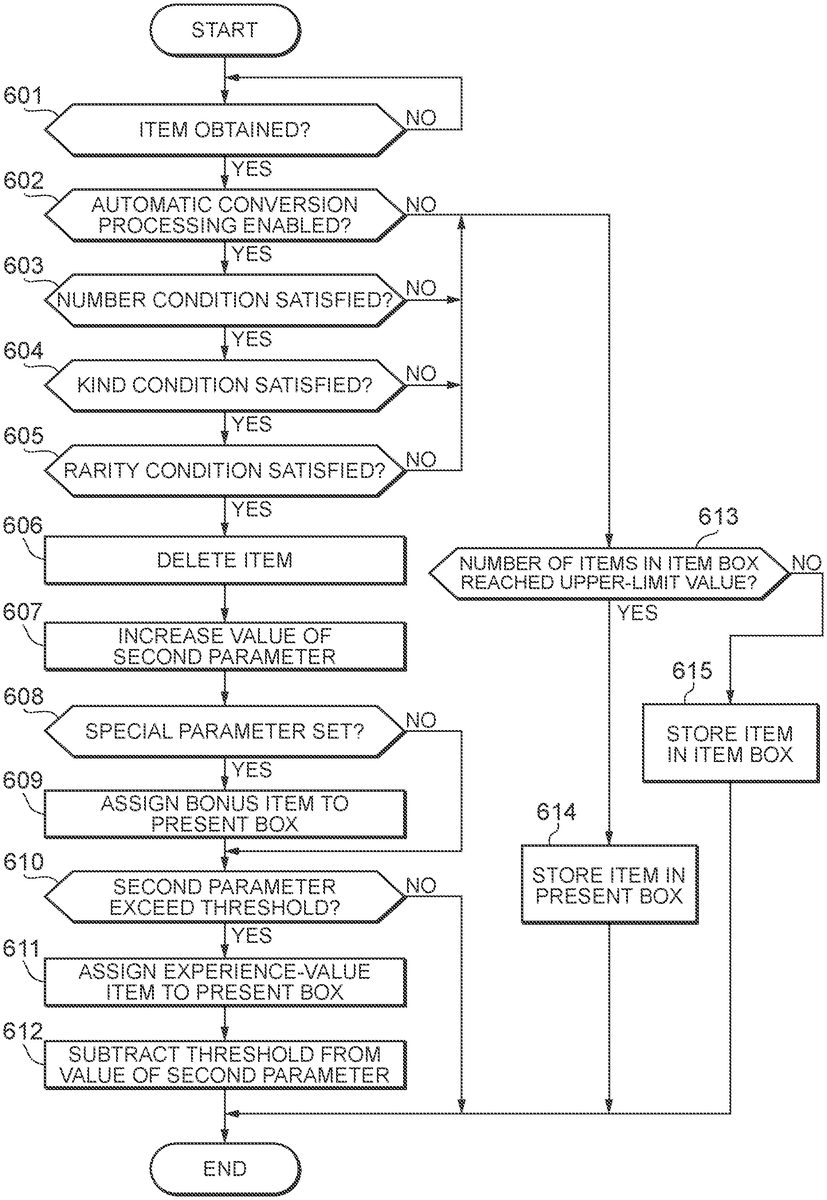
Next, the automatic conversion processing according to this embodiment will be described with reference toFIG. 6. Here, the case where all of (i) to (iii) described earlier are selected as the automatic conversion condition will be considered as an example.
In step601, the processing unit38of the game server30determines whether or not the user has obtained an item.
In step602, the processing unit38of the game server30determines whether or not the function of the automatic conversion processing is set to be enabled.
In step603, the processing unit38of the game server30determines whether or not the number of items stored in the item box35exceeds a preset number.
In step604, the processing unit38of the game server30determines whether or not the kind of the item obtained by the user coincides with a preset kind.
In step605, the processing unit38of the game server30determines whether or not the rarity of the item obtained by the user coincides with a preset rarity.
In step606, the processing unit38of the game server30deletes the item obtained by the user.
In step607, the processing unit38of the game server30increases the value of the second parameter on the basis of the value of the first parameter of the deleted item.
In step608, the processing unit38of the game server30determines whether or not a special parameter is set for the item satisfying the automatic conversion condition. An example of the special parameter is a parameter indicating bonus points. Here, bonus refers to a privilege in the game, which is assigned, for example, when the user accomplishes a certain goal. The special parameter may also be referred to as a third parameter.
In step609, the processing unit38of the game server30assigns an item corresponding to the value of the special parameter to the item box35or the present box36. The item corresponding to the value of the special parameter may be referred to, for example, as a bonus item. The bonus item is thus stored in the item box35or the present box36.
In step610, the processing unit38of the game server30determines whether or not the value of the second parameter exceeds a threshold.
In step611, the processing unit38of the game server30assigns a predetermined item to the item box35. The predetermined item may be referred to, for example, as an experience-value item. The experience-value item is thus stored in the item box35.
In step612, the processing unit38of the game server30subtracts the threshold from the value of the second parameter. This makes it possible to carry over the value remaining after subtracting the threshold from the value of the second parameter for the purpose of the next assignment of the predetermined item. An arbitrary method may be used as the method of carry-over processing.
In step613, the processing unit38of the game server30determines whether or not the number of items stored in the item box35has reached an upper-limit value.
In step614, the processing unit38of the game server30stores the item obtained by the user in the present box36.
In step615, the processing unit38of the game server30stores the item obtained by the user in the item box35.
Note that the embodiment of the present invention is not limited to an online game but may be applied, for example, to a standalone game device.
FIG. 7is an illustration showing the hardware configuration of a game device50according to this embodiment. The game device50includes a processor51, a storage device52, an operation unit53, a display unit54, and an acoustic processing unit55as hardware resources thereof. The storage device52has recorded therein a computer program56for causing the processor51to execute game processing at the game device50. The computer program56is a game program programmed for the game processing at the game device50. As shown inFIG. 8, the functions of an item box57, a present box58, a registration unit59, and a processing unit60are realized through cooperation between the hardware resources and the computer program56of the game device50. The functions of the item box57, the present box58, the registration unit59, and the processing unit60of the game device50are the same as the functions of the item box35, the present box36, the registration unit37, and the processing unit38of the game server30.
In the embodiment described above, each of the functions of the game client20(the processing unit28and the communication unit29), each of the functions of the game server30(the item box35, the present box36, the registration unit37, the processing unit38, and the communication unit39), and each of the functions of the game device50(the item box57, the present box58, the registration unit59, and the processing unit60) need not necessarily be realized through cooperation between a hardware resource and a computer program, and may be realized, for example, by using a special hardware resource (e.g., an application-specific integrated circuit (ASIC) or a field-programmable gate array (FPGA)).
REFERENCE SIGNS LIST
10Game system20Game client21Processor22Storage device23Communication module24Operation unit25Display unit26Acoustic processing unit27Computer program28Processing unit29Communication unit30Game server31Processor32Storage device33Communication module34Computer program35Item box36Present box37Registration unit38Processing unit39Communication unit40Network50Game device51Processor52Storage device53Operation unit54Display unit55Acoustic processing unit56Computer program57Item box58Present box59Registration unit60Processing unit
Claims
- A game program that causes a computer system to execute: a step of performing an electronic game by a user on the computer system;a step of determining, during the electronic game and when the user has obtained a virtual item, whether or not the virtual item satisfies a condition preset by the user;a step of deleting, during the electronic game, the virtual item obtained by the user and increasing the value of a second parameter on the basis of the value of a first parameter of the deleted virtual item when the condition is satisfied;a step of storing, during the electronic game, the virtual item obtained by the user in a first storage area of the computer system when the condition is not satisfied, the first storage area having set therefor an upper-limit value as to the number of instances of the virtual item that can be stored therein;a step of storing, during the electronic game, the virtual item obtained by the user in a second storage area of the computer system when the condition is not satisfied and the number of instances of the virtual item stored in the first storage area has reached the upper-limit value;and a step of storing, during the electronic game, a predetermined virtual item in the first storage area when the value of the second parameter exceeds a threshold.
- A game program according to claim 1, wherein the game program further causes the computer system to execute: a step of carrying over the value remaining after subtracting the threshold from the value of the second parameter for the purpose of the next assignment of the predetermined virtual item upon storing the predetermined virtual item in the first storage area.
- A game program according to claim 1, wherein the condition includes a condition that the number of instances of the virtual item stored in the first storage area exceeds a preset number.
- A game program according to claim 1, wherein the condition includes a condition that the kind of the virtual item obtained by the user coincides with a preset kind.
- A game program according to claim 1, wherein the condition includes a condition that the rarity of the virtual item obtained by the user coincides with a preset rarity.
- A game program according to claim 1, wherein the first parameter is an experience value of the virtual item.
- A game program according to claim 1, wherein the predetermined virtual item is a virtual item with which the first parameter is associated.
- A game program according to claim 7, wherein the value of the first parameter associated with the predetermined virtual item is equal to the threshold.
- A game program according to claim 1, wherein the game program further causes the execution of a step of storing, in the case where a third parameter is associated with the virtual item satisfying the condition, a virtual item corresponding to the value of the third parameter in the first storage area or the second storage area.
- A game server comprising: a processing unit that is configured to: perform an electronic game by a user, determine, during the electronic game and when a user has obtained a virtual item, whether or not the virtual item satisfies a condition preset by the user, and delete, during the electronic game, the virtual item obtained by the user, and increase, during the electronic game, the value of a second parameter on the basis of the value of a first parameter of the deleted virtual item when the condition is satisfied;a first storage area, where the virtual item obtained by the user is stored when the condition is not satisfied, the first storage area having set therefor an upper-limit value as to the number of instances of the virtual item that can be stored therein;and a second storage area, where the virtual item obtained by the user is stored when the condition is not satisfied and the number of instances of the virtual item stored in the first storage area has reached the upper-limit value, wherein the processing unit stores a predetermined virtual item in the first storage area when the value of the second parameter exceeds a threshold.
- A game system comprising a game server and a game client, the game client including: a communication unit that sends a condition preset by a user to the game server via a network, the game server including: a processing unit that is configured to: perform an electronic game by the user, determine, during the electronic game and when the user has obtained a virtual item, whether or not the virtual item satisfies the condition preset by the user, and delete, during the electronic game, the virtual item obtained by the user and increases the value of a second parameter on the basis of the value of a first parameter of the deleted virtual item when the condition is satisfied;a first storage area, where the virtual item obtained by the user is stored when the condition is not satisfied, the first storage area having set therefor an upper-limit value as to the number of instances of the virtual item that can be stored therein;and a second storage area, where the virtual item obtained by the user is stored when the condition is not satisfied and the number of instances of the virtual item stored in the first storage area has reached the upper-limit value, wherein the processing unit stores a predetermined virtual item in the first storage area when the value of the second parameter exceeds a threshold.
- A game device comprising: a processing unit that is configured to: perform an electronic game by a user, determine, during the electronic game and when the user has obtained a virtual item, whether or not the virtual item satisfies a condition preset by the user, and that delete, during the electronic game, the virtual item obtained by the user and increase, during the electronic game, the value of a second parameter on the basis of the value of a first parameter of the deleted virtual item when the condition is satisfied;a first storage area, where the virtual item obtained by the user is stored when the condition is not satisfied, the first storage area having set therefor an upper-limit value as to the number of instances of the virtual item that can be stored therein;and a second storage area, where the virtual item obtained by the user is stored when the condition is not satisfied and the number of instances of the virtual item stored in the first storage area has reached the upper-limit value, wherein the processing unit stores a predetermined virtual item in the first storage area when the value of the second parameter exceeds a threshold.
Disclaimer: Data collected from the USPTO and may be malformed, incomplete, and/or otherwise inaccurate.