U.S. Pat. No. 11,465,056
GAME MEDIATION COMPONENT FOR ENRICHING MULTIPLAYER GAMING SESSIONS
AssigneeBunch Live Inc
Issue DateApril 8, 2020
Illustrative Figure
Abstract
Users play electronic games on their client devices, such as smartphones, laptop computers, game consoles, or the like. A game mediation component supplements the electronic games by providing additional functionality for group gameplay, such as communication among the players participating in the gameplay group, emphasizing key moments in the gameplay, saving and sharing of portions of the group gameplay, etc. Events related to gameplay, such as environmental events or in-game events, cause the game mediation component to take an action to supplement the gameplay, such as modifying an overlay user interface to provide additional gameplay data while efficiently using screen real estate, sending messages to other players in the group gameplay, and saving and sharing portions of gameplay session.
Description
DETAILED DESCRIPTION FIG. 1is a high-level block diagram illustrating an environment100in which game mediation takes place, according to one embodiment.FIG. 1illustrates two clients110A and110B, a game mediator server130, a game server140, a game client111, and an app store server150connected by a network120. Only two clients110, one game mediator server130, one game client111, one game server140, and one app store server150are shown inFIG. 1in order to simplify and clarify the description. Embodiments of the computing environment100can have many clients110, game clients111, game mediator servers130, game servers140, and app store servers150connected to the network120. Likewise, the functions performed by the various entities ofFIG. 1may differ in different embodiments. FIG. 1uses like reference numerals to identify like elements. A letter after a reference numeral, such as “110A,” indicates that the text refers specifically to the element having that particular reference numeral. A reference numeral in the text without a following letter, such as “110,” refers to any or all of the elements in the figures bearing that reference numeral. For example, “110” in the text refers to reference numerals “110A” and/or “110B” in the figures. A client device110(or for brevity, simply “client”) is an electronic device used by a user to perform functions such as communication with other clients, executing software applications for various purposes, and consuming electronic content such as content hosted by web servers on the network120. For example, the client may be a smart phone, a tablet computer, a notebook or laptop computer, a desktop computer, or any other computing system on which users may play, and/or interact with, electronic games. The client110includes a display on which the user may view content such as electronic games. In addition, the client110provides a user interface (UI), such as physical and/or on-screen buttons, which the user may interact with to perform various functions ...
DETAILED DESCRIPTION
FIG. 1is a high-level block diagram illustrating an environment100in which game mediation takes place, according to one embodiment.FIG. 1illustrates two clients110A and110B, a game mediator server130, a game server140, a game client111, and an app store server150connected by a network120. Only two clients110, one game mediator server130, one game client111, one game server140, and one app store server150are shown inFIG. 1in order to simplify and clarify the description. Embodiments of the computing environment100can have many clients110, game clients111, game mediator servers130, game servers140, and app store servers150connected to the network120. Likewise, the functions performed by the various entities ofFIG. 1may differ in different embodiments.
FIG. 1uses like reference numerals to identify like elements. A letter after a reference numeral, such as “110A,” indicates that the text refers specifically to the element having that particular reference numeral. A reference numeral in the text without a following letter, such as “110,” refers to any or all of the elements in the figures bearing that reference numeral. For example, “110” in the text refers to reference numerals “110A” and/or “110B” in the figures.
A client device110(or for brevity, simply “client”) is an electronic device used by a user to perform functions such as communication with other clients, executing software applications for various purposes, and consuming electronic content such as content hosted by web servers on the network120. For example, the client may be a smart phone, a tablet computer, a notebook or laptop computer, a desktop computer, or any other computing system on which users may play, and/or interact with, electronic games. The client110includes a display on which the user may view content such as electronic games. In addition, the client110provides a user interface (UI), such as physical and/or on-screen buttons, which the user may interact with to perform various functions with the client.
In one embodiment, the client110includes a game mediator112and an electronic game114, the game mediator112facilitating the creation of multiplayer gaming sessions with the electronic game114or other electronic games. Depending upon the embodiment, the game mediator112and/or game114may be integrated into the operating system, or implemented as an application or other software executing on the client110. In some embodiments, the game114is part of the game mediator112, rather than an independent software item. In other embodiments, the game114is distributed among a plurality of locations, for example, in part on the client110as an independent software item, and in part on the game server140.
In some embodiments, the game mediator112and the electronic game114need not be installed and/or run on the same client110. Rather, in some embodiments the game114may be played on a separate game client device111(e.g., a dedicated gaming console, such as NINTENDO SWITCH or the XBOX ONE X, or SONY PLAYSTATION 4, or a general purpose computer such as a laptop or desktop computer running a commercial operating system such as MICROSOFT WINDOWS or APPLE MAC OS). In such embodiments, the game114may have or make use of a game mediator library115, as described in more detail below, or the game client111may have a game mediator112. The game mediator library115and/or the game mediator112provide the game client device111to be part of the game mediation infrastructure. The client device110may then be used in conjunction with the game client device111, with its game mediator112serving as an independent means of interacting with the game session established via the game mediation infrastructure, such as by chatting with other game session participants, specifying portions of game sessions to be saved and shared, displaying video of other participants, or the like.
The game mediator112is a software module, such as an executable application, that runs on the client110(or game client111) and mediates multiplayer gameplay. The game mediator112interacts with one or more games such as the game114, as well as the game mediator server130. The “game mediation infrastructure” used to enable game sessions includes at least the game mediator112and/or the game mediator library115, and in some embodiments also includes the game mediator server130and/or at least one other game mediator112on at least one other client110. Depending upon the embodiment, the game mediation infrastructure controls various aspects of a group gameplay session, such as providing a “lobby” user interface for establishing and/or configuring the gameplay session, and/or providing enriched gameplay via an “overlay” portion of the lobby user interface during gameplay of the game. In one embodiment, a gameplay session may be launched via a UI of the game mediator112, such as the lobby, using a “deep link” (a link, such as a Uniform Resource Locator (URL), to a resource such as a game, and that additionally specifies a more specific context within the resource, such as a particular stage or state of the game). In an embodiment, the game mediator112A runs on a first client110A and interacts with a second client110B, such as with a game mediator112B upon the second client110B, to enable client110B to participate in the gameplay session launched by client110A. In other embodiments, more than one client110may be interacted with by the client110A to enable participation in the gameplay session launched by client110A, e.g., up to as many as the game being played supports.
The “lobby” is a user interface that provides an environment for communication among clients110associated with a gameplay session. The lobby allows clients110to communicate before, during, and/or after gameplay sessions, such as by using live video feeds, screen capture feeds, and/or voice. In an embodiment, the lobby has functionality allowing at least one client110to configure gameplay settings of the game that is to be launched. In an embodiment, the lobby is executed at least in part upon the game mediator server130. The lobby may further include various information about the gameplay session, such as usernames or rankings of clients110for the game, as well as a level of the game or other information pertaining to the gameplay session. For example, in some embodiments the lobby includes a chatroom in which client110A exchanges text messages with client110B. Alternatively or additionally, as another example, in some embodiments the lobby enables a video call (using live video feeds) with which users of clients110see and hear each other.
In some embodiments, one or more of the games114accesses a game mediator library115. The game mediator library115contains executable code that integrates with the rest of the game mediation infrastructure (e.g., the game mediator112and the game mediator server130) to facilitate the playing of multiplayer games. The game mediator library115may be a subset of the functionality provided by the game mediator112itself, so that software that incorporates the game mediator library115(such as games114) can perform a subset of the actions of the game mediator112, even without the game mediator112being installed. The game mediator library115may be wholly or partially statically linked into the game114itself, or the game mediator library may be stored externally to the game and accessed by dynamic linking. In some embodiments, the game mediator library115is included within the game mediator112, so that if the game mediator is installed, the game mediator library is installed, as well. The game mediator112and the game mediator library115may both be referred to as being part of a game mediation infrastructure that encompasses both the game mediator112and the game mediator library115on the client devices, as well as the game mediator server140. The game mediator library115may be (though need not be) created by the same organization that creates the game mediator112and/or the logic of the game mediator server130. The game114itself may be created by any organization, such as an independent third-party game developer different from the organization creating the game mediator112and/or other components of the game mediation infrastructure. In some embodiments, game mediator libraries115are not employed, and instead the game mediators112themselves provide all the required functionality.
FIG. 2illustrates a simplified example of the lobby user interface before a particular electronic game has been selected for gameplay, according to one embodiment. In the example ofFIG. 2, the lobby includes video panes210, a settings button220, a games button230, an invite button240, and a joined icon250. The lobby may provide a user interface such as a page or screen of the game mediator112, which runs upon client110, which in the example ofFIGS. 2-3is a mobile device. Each video pane240is associated with a client110joined to the lobby. For example, if clients110A and110B are joined to a lobby, there is a video pane210A for client110A and a video pane210B for client110B, as inFIG. 3. If additional clients110are joined to the lobby, additional panes may be added, which may involve modifying the boundaries of existing panes to accommodate the additional panes on the display. In an embodiment, additional panes are not added if a pane threshold is reached or surpassed. For example, the pane threshold may be a number of panes, or a pane size. Each video pane210presents a live video feed from the associated client110, including both graphical and audio content. The live video feed may be, for example, from a camera of the client110, e.g., displaying an image of the user of the client (or of whatever is in the field of view of the camera), from the content of the screen of the client (e.g., feed of screen capture), or the like. In an embodiment, the client110can disable the presentation of graphical and/or audio content of the client's110live video feed, for example, using the option buttons230. In an embodiment, the client110can change the camera used to generate the live video feed, such as switching from a front-facing camera to a rear-facing camera of the client110.
The settings buttons220control settings of the game mediator112. For example, in some embodiments, upon selection of a setting button220by the client110, the game mediator112loads a settings page. At the settings page, one or more settings may be adjusted using the client110, such as enabling or disabling the transmission of audio and/or graphical content by the client110, changing the camera used to generate the live video feed, muting one or more incoming live video feeds from other clients110joined to the lobby, and so on.
The games buttons230control game selection in the game mediator112. For example, upon selection of the games button230by the user of the client110, the game mediator112loads a games page listing the games available for play. At the games page, a game may be selected using the client110. For example, the games page may include a list of available games, including for each listed game a game title, a game icon or image, a game summary, and/or an on-screen button to select the game. For example, a listed game may have title “Fortnite™,” an image of a game character, and a summary “compete in a battle royale.” In an embodiment, the games page further allows the client110to select a portion of the game they wish to play, such as a track where they wish to race within a car racing game, or a location upon a map where a user character should be placed upon loading.
Upon selection of a game by the client110, the game mediator112configures the lobby to attain a look and feel of the selected game based on one or more features of the game. The lobby may be configured to display graphical and/or textual elements of the game, such as a logo, a color scheme, one or more images from the game, and so on. For example, if “Fortnite™” is selected, an image from the game of a game character may be displayed with the “Fortnite™” logo overlaid (e.g., as game logo320inFIG. 3). Other aspects of the lobby, such as video panes210, may adjust to accommodate the configuration, as seen inFIG. 3, which illustrates a simplified example of a lobby according to a second embodiment.
FIG. 3illustrates a different state of the lobby, e.g. after a game has been selected.FIG. 3includes a game image310, a game logo320, option buttons330, a video pane340, and a launch button350. The game image310is an image from game A, such as a game character holding a sword in a game landscape. The game logo320is the stylized title of the game, such as how it may appear in-game at a title screen. The option buttons330allow one or more settings to be adjusted, such as the transmission of audio and/or graphical content as part of a live video feed.
The video pane340is a video pane similar to video pane210, though possibly of different dimensions. In an embodiment, each client110joined to the lobby is associated with a video pane that displays the associated client's110live video feed. In an embodiment, there are as many video panes as there are allowed players for the game, and if there are fewer clients110joined to the lobby than there are allowed players for the game, unused video panes include an icon, such as a “+” icon, which the client110may select to access an invitation page as detailed below. The launch button350prompts the game mediator112to launch a gameplay session, e.g., to initiate execution of the gameplay session.
Returning toFIG. 2, the invite button240controls invitation of clients110to the lobby, according to one embodiment. For example, upon selection of the invite button240by the client, the game mediator112loads an invitation page enabling a user of the client110to send invitations to join the lobby to other clients110. For example, the invitation page may include a list of invitation techniques, including for each listed technique a technique title and a technique icon. For example, an iMessage™ listed technique may include the title “iMessage™” and an iMessage™ icon. The invitation page may also include a list of clients110to whom an invitation may be sent, each listed client110including, for example, a name. Upon selection of one or more clients110for invitation and selection of one or more invitation techniques, the game mediator112generates an invitation message and configures the selected invitation techniques such that the invitation message may be sent. For example, if the invitation technique is a text message and the invitee is a client110associated with the name “Justin,” the game mediator112generates a textual invitation message, opens a text message application upon the client110, addresses the text to the invitee, and displays the invitation message in a message portion of the text message application. The client110may then send the invitation to the invitee using a button of the text message application.
The joined icon250indicates a number of clients110joined to the lobby. In the example ofFIG. 2, there are two clients110joined to the lobby, hence the joined icon250indicates “2.” In other embodiments, other icons may be present, as well as other buttons, graphical, and/or audio content. For example, the lobby may be configured to display a text string for each client110in the lobby indicating a name associated with the client110. In an embodiment the lobby may include a list of other clients110that are playing games or are preparing to play games, which the client110may select to join another client's110lobby and/or gameplay session.
In an embodiment, the lobby may be configured to allow the client110to initiate live streams of gameplay, using, for example, a livestream product such as Facebook Live™ YouTube™, or Twitch™. A live stream of gameplay involves sending a video of gameplay as seen on the screen of a client110playing in the gameplay session to a client110not playing in the gameplay session. Furthermore, clients110joined to the lobby or who select the lobby may choose to view the live stream, rather than participate in the gameplay session. For example, if a game allows a maximum of four players and a fifth client110joints the lobby, the fifth client110may choose to livestream the gameplay session despite being unable to play.
In an embodiment, a first client110may invite one or more additional clients110to a gameplay session using the game mediator112via the game mediator server130(e.g., using the invite button240in the embodiment ofFIG. 2). Upon receipt of an invitation, the game mediator112of each additional client prompts a user of the additional client110to either accept or reject the invitation. If the invitation is accepted, the game mediator server130may further interact with each accepting client110to enable participation in the gameplay session. Furthermore, if the invitation is accepted, the respective client110is added to the lobby, for example, gaining the ability to participate in the chatroom or other communications functionality.
Returning toFIG. 1, the electronic game114interacts with the game mediator112to provide gameplay sessions to users of clients110. The game114may be a dedicated software application built natively to run on the operating system of the client110, code (e.g., HTML 5 code) running within a game playing engine, such as (in some embodiments) the game mediator112, a game built with a framework such as React Native™, or the like. A gameplay session involves one or more users interacting with respective clients110to play a set of instances of the game114in coordination with each other. In multiplayer gameplay sessions, multiple clients110participate in a single gameplay session, interactively playing the same game. In single player gameplay sessions, one client110participates in a single gameplay session. In some embodiments, the game114runs on the game mediator server130, and is accessed using the client110, which provides an interface to play the game114. For example, the game114executes upon the game mediator server130, which sends the results of the execution of the game114to the clients110. The clients110interact with the results of the execution that are received from the game mediator server130and send the interactions to the game mediator server130, which impact the execution of the game114. The gameplay session may progress in this back and forth manner.
There may be different types of games, and the game mediator112and/or game mediator server130may support different types of games differently. One embodiment includes instant games and downloadable games. In such an embodiment, instant games can be played without downloading additional software. For example, the instant game may be at least partially integrated into the game mediator112such that the client110can launch a game without prior installation of additional software. If the client110launches a gameplay session using the game mediator112for an instant game, the game mediator112does not check whether the client110has the game installed. In contrast, downloadable games require the downloading of the game by the client110before a gameplay session can be launched. If the client110launches a gameplay session using the game mediator112for a downloadable game, the game mediator112may check if the client110has the game installed.
The game mediator server130interacts with the clients110to support the operation of the game mediator112. The game mediator server130configures the lobby launched by the game mediator112according to specifics of the game114launched in conjunction with the lobby. For example, the lobby may be configured to show which players are prepared to play a particular game, allow a user to invite other players or to initiate a live stream of game play, and to allow a user to enable configuration of gameplay settings specific to the game114(such as selecting a character to use, or arena in which to play).
Upon receiving a command to launch a gameplay session, the game mediator112alerts the game mediator server130, which checks each client110involved in the gameplay session, e.g., by querying its game mediator112. If a certain client110involved in the gameplay session does not have the game114installed, the game mediator server130sends a deep link to the client110, e.g., a deep link corresponding to an application store such as Apple App Store™ or Google Play Store™. The deep link then initiates installation of the game on the certain client110without exiting the game mediator112. Alternatively, the deep link is sent to each client110involved in the gameplay session regardless of whether the client110has the game installed or not. If the game is not installed, the deep link facilitates the installation of the game without the user leaving the lobby. The deep link may be a uniform resource locator (URL). In an embodiment, the deep link directs the client110to open an application vendor (e.g., an application store) to a page where the game may be downloaded, for example, in a web view of the game mediator112. For example, the deep link includes an identifier associated with the page of the application vendor that is used by the client110to navigate to the page. In another embodiment, the deep link facilitates checking whether the game114includes a game mediator library115. If client110and/or game mediator server130, facilitated by the deep link, determines the game has the library115, it transfers functionality to the game; for example, it may transfer voice and/or video stream controls to the game. Such a transfer allows the user to control various aspects of voice and/or video during gameplay without having to return to the lobby. In other embodiments, other functionality may be transferred to the game, such as livestream functionality, game invitation functionality, and so on. In such embodiments, one or more graphical elements, such as on-screen buttons with which a client110may interact to control functionality passed to the game, may be overlaid upon the game as it is displayed in the course of the gameplay session. (The graphical user interface elements overlaid upon the game by the game mediator112or the game mediator library115are hereinafter referred to as the “overlay”.) Furthermore, launching the game itself may involve the use of a deep link to access the game directly from the game mediator112.
Furthermore, in some embodiments the game mediator server130checks the state of the lobby and, depending upon the number of clients110participating in the lobby, suggests to the client110who invited the others that more clients110could be invited. In an embodiment, the game mediator server130hosts the lobby. In an embodiment, when the game mediator server130configures the lobby according to the specifics of the game114, the game114specifies the number of players required to play the game, to which the lobby adapts. For example, the lobby adapts to not launch a gameplay session until the required number of players are in the lobby. In an embodiment, if the minimum number of players are not present in the lobby to launch a gameplay session, the lobby prompts the players to invite others. Furthermore, the lobby may be configured to display as many video panes as the game allows.
In some embodiments, lobbies may be private or public. In an embodiment, the player who created the gameplay session sets the lobby as private or public. A public lobby is discoverable by users who wish to join a game. A private lobby is accessible only via invitation. Furthermore, the lobby may be configured to allow players who join the lobby to elect to participate in the gameplay session as spectators. Spectators watch gameplay but do not themselves play. If a game has reached its maximum number of players, additional players may only participate as spectators.
The game mediator server130proceeds to launch the game after receiving notifications that each client110that was sent a deep link installed the game and receiving a notification that the client110that commanded launching the gameplay session declined to invite more clients110. In an embodiment, the game is hosted on the game server140, and the game mediator server130sends the game server140parameters associated with the gameplay session, such as a session identifier, as well as parameters associated with each client110, such as client identifiers. In other embodiments, parameters associated with the gameplay session are sent to one or more other destinations to coordinate game play.
The game mediator112uses the client110functionality to enhance gameplay. The game mediator112may enable actions within the game mediator112, such as in the lobby, to affect gameplay, or may enable actions within the game to affect the lobby. The game mediator112has access to the functionality of the client110, further detailed inFIG. 4below. Games such as the game114may use the functionality of the client110via the game mediator112by way of the game mediator library115. For example, games may access video content of the clients110using the live video streams of the clients110in the lobby participating in the gameplay session.
The game mediator112may enhance gameplay using the audio content of live video streams of the clients110in the lobby participating in the gameplay session. Game events may be associated with audio cues, which the game mediator112detects and communicates to the game114via the game mediator library115. Game events are associated with audio cues on a subscription basis. For example, in a charades game, each word in a set of candidate words is subscribed to a different audio cue which the game mediator112is set to detect depending upon which word is being guessed. If the word is “car.” for example, the game mediator112listens for the word “car” and informs the charades game that it has been spoken. In an embodiment, the game mediator112also informs the game114which client110produced the audio cue. The audio content may also be used for voice recognition. For example, if multiple players are speaking, and one says the correct keyword, the correct player is awarded a point.
In some embodiments, the graphical content of live video streams of the clients110in the lobby participating in the gameplay session may be used for gesture recognition to enrich gameplay, i.e., detecting (or subscribing to and then being notified by the game mediator112of) certain gestures, such as smiles, and awarding points to appropriately gesturing users within a game114responsive to detection of those gestures. As another example, if a particular client110participating in a gameplay session chooses to overlay a graphic of a wolf's face upon its video pane in the lobby, its character within the game114could likewise gain a wolf façade.
In an embodiment, the game mediator server130uses external live streaming, rather than the content of live video streams within the lobby, to enhance gameplay. For example, in a pictorial guessing game, the livestream (such as on Facebook Live™ or Twitch™) may be used for players, i.e. viewers of the livestream, to guess what the picture is. The game114subscribes to the game mediator112to listen for certain keywords, and upon detection of those keywords, awards points appropriately to the participant who guessed correctly by saying the keyword, similar to the use of audio content of the live video streams of the clients110in the lobby.
In some embodiments, the game mediation infrastructure provides enriched gameplay functionality by enabling game events to affect the lobby. This is discussed in more detail below with respect toFIGS. 5 and 6.
In some embodiments, the game114is hosted by the game server140, which runs the gameplay session. Each game114interacts with the game that is run on the game server140to generate the game experience on the clients110. For example, if a user playing a game114on a client110performs an action within the game114, the action is communicated to the game server140, which handles that action and applies it to the corresponding game session, populating that action and its effects to any other clients110/game mediators112that are participating in that session. Upon occurrence of events associated with enriched gameplay functionality (such as an in-game interaction with a certain game character), the game server140notifies the game mediator server130of the event and the client110that triggered the event. In an embodiment, the game mediator server130tracks the game session and identifies events with enriched gameplay functionality.
The network120enables communications among the clients110, the game mediator server130, and the game server140, and can comprise the Internet as well as mobile telephone networks. In one embodiment, the network120uses standard communications technologies and/or protocols. The data exchanged over the network120can be represented using technologies and/or formats including the hypertext markup language (HTML), the extensible markup language (XML), etc. In addition, all or some of links can be encrypted using conventional encryption technologies such as secure sockets layer (SSL), transport layer security (TLS), virtual private networks (VPNs), Internet Protocol security (IPsec), etc. The entities can use custom and/or dedicated data communications technologies instead of, or in addition to, the ones described above.
FIG. 4is a high-level block diagram of the software stack upon which the game mediation infrastructure operates, in one embodiment. At a first or bottom layer reside software components that drive low level functionality including hardware functionality, including WebRTC402, Voice/Video404, Livestream406, GPS408, Accelerometer410, Touch412, and Wifi/Bluetooth414. At a second layer resides software that drives a host application420, such as an operating system. At a third layer resides the game mediator library115(or its equivalent within the game mediator112). At a fourth or top layer resides a game440(e.g., a game114ofFIG. 1).
The WebRTC402component enables web browsers to communicate in real time. The Voice/Video404component enables use of audio and/or video capabilities of the client device110. The Livestream406component allows for communication of video in real time. The GPS408component provides location information of the client device110. The Accelerometer410component provides acceleration information of the client device110. The Touch412component enables touch input to the client device110. The Wifi/Bluetooth414component enables Wifi and/or Bluetooth functionality to the client device110.
The host application420manages operation of the client110and its software and hardware components. The game mediator library115(in embodiments in which it is employed) provides a software framework used by the game mediator112and/or the game440(e.g., game114ofFIG. 1), allowing for the interactivity needed to enable mediated and/or enriched gameplay sessions. In some embodiments, the game mediator112and game440are managed by the host application420. For example, the host application420allocates memory for both the game mediator112and the game440.
In the above description, some actions are performed by the game mediators112. In embodiments making game mediator libraries115available for inclusion within the games114themselves, some of these actions may instead be performed by the game mediator libraries115included within the games. In some embodiments, whether a given action is performed by the game mediator112or the game mediator library115varies. For example, in some embodiments the game mediator library115can perform functionality discussed above as being performed by the game mediator112, possibly in more lightweight form. For example, the game mediator library115could show a user interface for establishing a multiplayer gaming session and inviting participants within the game114itself, rather than using a separate user interface of the game mediator112for that purpose.
FIG. 5illustrates interactions between the various components ofFIG. 1when modifying the state of the lobby or taking other actions based on game-related events, according to some embodiments.
Initially, the user501is playing505the electronic game114. Subsequently, as the user is playing505, an event happens and is detected by a game mediation component (the game mediator112, or the game mediator library115, if any) or by the logic of the electronic game114itself, leading to the game mediation component taking an action. Events leading to taking actions (such as modification of the state of lobby) may be either “environmental” events to which the game mediation component has access, such as aural, visual, or movement inputs from sensors of the client device, or “in-game” events defined by the internal logic of the game itself. The game mediator112can detect environmental events through, for example, obtaining information about the state of the client device sensors from the operating system of the client device. The electronic game114—either directly, or through its incorporated game mediator library115, if any—can also detect environmental events, but can also detect the in-game events with its own internal logic. The environmental events that can be detected include, but are not limited to, events derived from client device sensors, such as microphone sensor data (from which semantic events such as yelling or clapping may be inferred), movement sensor data such as acceleration and rotation (from which semantic events such as dancing or hopping may be inferred), touchscreen sensor data (from which semantic events such as gestures, interactions with the lobby user interface, and the like may be inferred). The in-game events are events of significance within the game itself, and (depending on the game) could include occurrences such as (within the game) a player being attacked, a player being defeated, a player wining, the current game objective being completed. Other examples of in-game events include situations occurring between players within the game, such as the in-game character of one player coming within the field of view of the in-game character of the other player. For example, in a first-person shooter game, a first player's character might be looking in a certain direction and emerge from behind a wall, resulting in a second player's character being within the field of view of the first player and hence able to be attacked by the first player.
Upon detection510of an environmental event by the game mediator512, or detection530an in-game (or environmental) event by the electronic114game, the event is raised. In some embodiments, the event is raised through an asynchronous event-handling interface defined by the game mediation infrastructure and called by the game114; in other embodiments, the event is raised by the game114directly calling an appropriate function of the game mediator library115(e.g., a function to emphasize a video feed of a particular player, in response to that player's character being defeated in the game).
In response to the detection510,530of the event, an action is taken by the game mediation infrastructure (that is, the game mediator112, the game mediator library115(if any), and/or the game mediator server130). In different embodiments, the actions include modification of a state of the lobby, such as the appearance or functionality of its overlay user interface that is superimposed upon the game display during gameplay, or interaction with the electronic game or a group gameplay session. Such interaction can include the communication amongst players in the group gameplay, the modification of the gameplay group (e.g., the invitation of another player to participate), and the ability to save and share portions of the gameplay for later viewing. These actions are now discussed in additional detail.
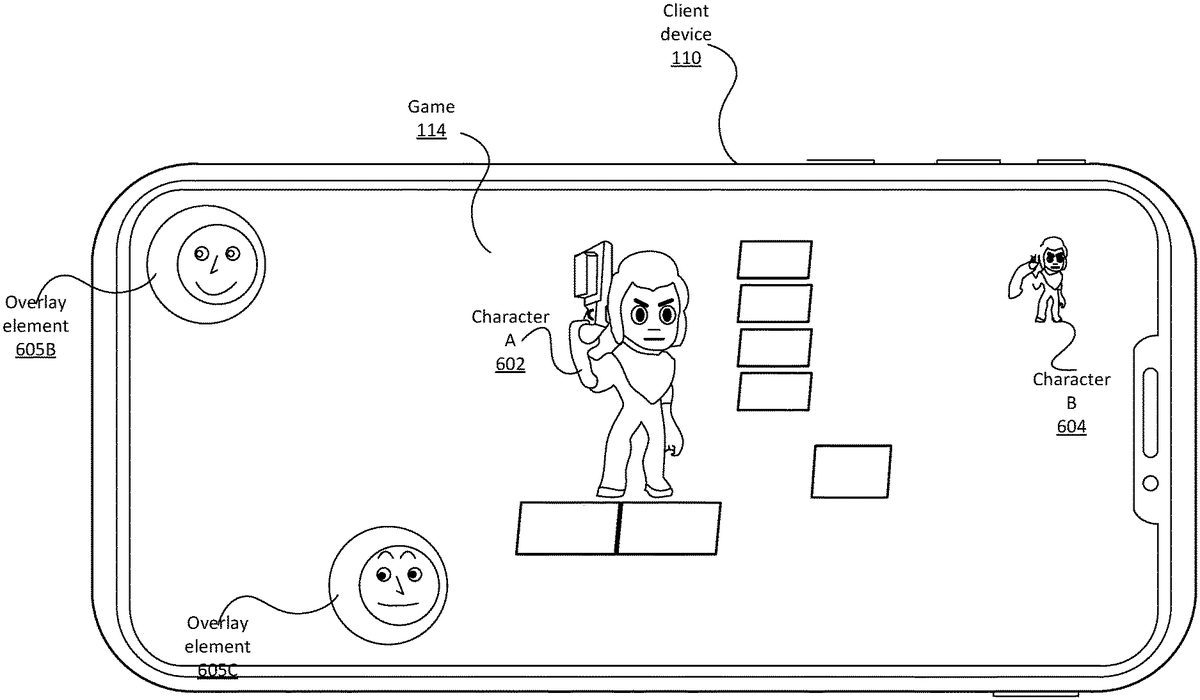
One type of action is modification of the state of the lobby, such as its overlay user interface.FIG. 6illustrates visuals of a game114being displayed on the screen of a client device110during gameplay, according to one embodiment. Specifically,FIG. 6illustrates a simplified representation of a shooting game. The game114is displaying the character602for the player of the game, and also a second character604for another player, indicating that the characters are nearby within the game. In the example ofFIG. 6, the lobby's overlay user interface contains two elements: a video feed605B for the player corresponding to the character604, and a video feed605C for another player also playing the game with them. The video feeds allows players to see the real-time image and reaction of other players as the game is being played. Because the video feeds605at least partially obscure the display of the game114, the player can move the overlay elements, e.g., by pressing and dragging on them to move them to a less relevant portion of the screen. In some embodiments, in order to minimize the amount of screen space used by the overlay, the game mediation component (the game mediator112or game mediator library115) displays video feeds for only a subset of the other players playing the game, and this may be adjusted in response to events so as to prioritize display of players who are more immediately relevant in the game as defined by the events. For example, if character602moves out from behind a wall and character604comes within its field of view within the game, the game114upon detecting this in-game event could request the game mediation component to prioritize the video feed for the player corresponding to the character604so that the first player can watch in real time the player who he can now attack, e.g., displacing a video feed for a different player who is currently of less relevance to the first player. The relevance of another player for this purpose can also be defined by environmental events, such as whether that player is yelling, moving vigorously or otherwise significantly (e.g., over some threshold degree of a movement metric), or otherwise behaving in a manner indicating excitement. As another example, instead of entirely hiding or showing video fees, the action could be to change their opacity depending upon a current relevance of their associated players, with less relevant players having video feeds with less opacity, or to change their sizes, with less relevant players having video feeds occupying less space. In some embodiments, other environmental events, such as the player pressing one of the video feeds605, trigger display of a more complete overlay interface with additional controls, such as those for volume adjustment, for sending an invitation to an additional player to join the gameplay, opening the game mediator112(if installed), or the like.
Another type of action taken in response to an event is communication with other players in the group gameplay. Environmental events indicating a desire to communicate with another player, such as a user pressing on the video feed of another player, or an explicit selection of a message user interface element within the overlay user interface, can lead to the sending of messages such as images, emoticons/emojis, or the like. The messages can be displayed within the overlay user interface (e.g., visually associated with a video feed for the player that sent the message).
Still another type of action taken in response to an event deals with the designation, saving (e.g., as a video of gameplay actions occurring on the screen of one of the client devices110), and/or sharing of portions of the gameplay. Environmental events may designate the portion of gameplay to be saved, such as explicit pressing of a “record” button within the overlay user interface. Environmental events may also be implicit, such as events indicating an unusual level of user engagement on the part of one or more of the users in the group gameplay, such as significant movement, yelling, or the like; these events may be used to indicate the beginning of portions of the gameplay to save, and a lack of such events may be used to indicate the end of the current portion to save. In-game events can also be used to indicate the portion of gameplay to save. For example, the logic of the game might detect that a new high score or some other notable accomplishment has been achieved, or is likely to be achieved soon, and cause the game mediation component to start to record gameplay at that point.
The game mediation component may also facilitate sharing saved portions of gameplay with others. For example, the game mediator112may make the saved portions available within its lobby user interface (e.g., a “Your greatest moments” collection associated with the various electronic games available to be played within the lobby), or may use the APIs of third-party social networking systems such as Facebook™ or Twitter™ to publish the saved gameplay, assuming that the player has configured the game mediation infrastructure to have knowledge of the player's credentials on those systems.
OTHER CONSIDERATIONS
The present invention has been described in particular detail with respect to one possible embodiment. Those of skill in the art will appreciate that the invention may be practiced in other embodiments. First, the particular naming of the components and variables, capitalization of terms, the attributes, data structures, or any other programming or structural aspect is not mandatory or significant, and the mechanisms that implement the invention or its features may have different names, formats, or protocols. Also, the particular division of functionality between the various system components described herein is merely for purposes of example, and is not mandatory; functions performed by a single system component may instead be performed by multiple components, and functions performed by multiple components may instead performed by a single component.
Some portions of above description present the features of the present invention in terms of algorithms and symbolic representations of operations on information. These algorithmic descriptions and representations are the means used by those skilled in the data processing arts to most effectively convey the substance of their work to others skilled in the art. These operations, while described functionally or logically, are understood to be implemented by computer programs. Furthermore, it has also proven convenient at times, to refer to these arrangements of operations as modules or by functional names, without loss of generality. As used herein, the term “module” refers to computer program logic utilized to provide the specified functionality. Thus, a module can be implemented in hardware, firmware, and/or software.
Unless specifically stated otherwise as apparent from the above discussion, it is appreciated that throughout the description, discussions utilizing terms such as “determining” or “displaying” or the like, refer to the action and processes of a computer system, or similar electronic computing device, that manipulates and transforms data represented as physical (electronic) quantities within the computer system memories or registers or other such information storage, transmission or display devices.
Certain aspects of the present invention include process steps and instructions described herein in the form of an algorithm. It should be noted that the process steps and instructions of the present invention could be embodied in software, firmware or hardware, and when embodied in software, could be downloaded to reside on and be operated from different platforms used by real time network operating systems.
The present invention also relates to an apparatus for performing the operations herein. This apparatus may be specially constructed for the required purposes, or it may comprise a general-purpose computer selectively activated or reconfigured by a computer program stored on a computer readable medium that can be accessed by the computer. Such a computer program may be stored in a non-transitory computer readable storage medium, such as, but is not limited to, any type of disk including floppy disks, optical disks, CD-ROMs, magnetic-optical disks, read-only memories (ROMs), random access memories (RAMs), EPROMs, EEPROMs, magnetic or optical cards, application specific integrated circuits (ASICs), or any type of computer-readable storage medium suitable for storing electronic instructions, and each coupled to a computer system bus. Furthermore, the computers referred to in the specification may include a single processor or may be architectures employing multiple processor designs for increased computing capability.
The algorithms and operations presented herein are not inherently related to any particular computer or other apparatus. Various general-purpose systems may also be used with programs in accordance with the teachings herein, or it may prove convenient to construct more specialized apparatus to perform the required method steps. The required structure for a variety of these systems will be apparent to those of skill in the art, along with equivalent variations. In addition, the present invention is not described with reference to any particular programming language. It is appreciated that a variety of programming languages may be used to implement the teachings of the present invention as described herein, and any references to specific languages are provided for invention of enablement and best mode of the present invention.
The present invention is well suited to a wide variety of computer network systems over numerous topologies. Within this field, the configuration and management of large networks comprise storage devices and computers that are communicatively coupled to dissimilar computers and storage devices over a network, such as the Internet.
Finally, it should be noted that the language used in the specification has been principally selected for readability and instructional purposes, and may not have been selected to delineate or circumscribe the inventive subject matter. Accordingly, the disclosure of the present invention is intended to be illustrative, but not limiting, of the scope of the invention, which is set forth in the following claims.
Claims
- A computer-implemented method for providing enhanced capabilities for group gameplay sessions of electronic games being played on client devices, the computer-implemented method comprising: creating an overlay user interface superimposed upon a display of an electronic game being played in a group gameplay session, the overlay user interface comprising video feeds of players in a session of the electronic game;monitoring occurrences of environmental events on a client device on which the electronic game is being played, the environmental events being external to the electronic game;identifying an occurrence of one of the monitored environmental events;and responsive to the identification, modifying, within the overlay user interface, a visual opacity of a video feed of one of the players in the session associated with the occurrence.
- The computer-implemented method of claim 1, wherein the creating, monitoring, identifying, and modifying are performed by a game mediator executing in a process separate from a process in which the electronic game is executing.
- The computer-implemented method of claim 1, wherein the creating, monitoring, identifying, and modifying are performed by a game mediator library linked into the electronic game.
- The computer-implemented method of claim 3, wherein the electronic game additionally uses the game mediator library to perform at least one action responsive to the electronic game identifying an occurrence of at least one gameplay event internal to the electronic game.
- The computer-implemented method of claim 4, wherein the gameplay event comprises at least one of: a player in the group gameplay session being attacked, the player being defeated, the player achieving an objective, or a current level of the electronic game being completed.
- The computer-implemented method of claim 1, wherein the overlay user interface includes video of a plurality of players in the group gameplay session.
- The computer-implemented method of claim 6, further comprising responsive to the identification of the occurrence of the event, visually emphasizing a video feed of one of the plurality of players.
- The computer-implemented method of claim 7, wherein the gameplay event comprises an in-game character of the one of the plurality of players coming within a field of view of a character of another one of the plurality of players.
- The computer-implemented method of claim 1, wherein the environmental event comprises at least one of: a player clapping, or a player moving vigorously.
- The computer-implemented method of claim 1, further comprising saving a clip of gameplay from the group gameplay session.
- The computer-implemented method of claim 10, further comprising: displaying the saved clip within a lobby user interface;and responsive to selection of the displayed saved clip, playing the saved clip.
- The computer-implemented method of claim 1, further comprising posting a clip of gameplay from the group gameplay session to a third-party social networking system.
- A non-transitory computer-readable storage medium storing instructions that when executed by a processor perform actions comprising: creating an overlay user interface superimposed upon a display of an electronic game being played in a group gameplay session, the overlay user interface comprising video feeds of players in a session of the electronic game;monitoring occurrences of environmental events on a client device on which the electronic game is being played, the environmental events being external to the electronic game;identifying an occurrence of one of the monitored environmental events;and responsive to the identification, modifying, within the overlay user interface, a visual opacity of a video feed of one of the players in the session associated with the occurrence.
- The non-transitory computer-readable storage medium of claim 13, wherein the creating, monitoring, identifying, and modifying are performed by a game mediator executing in a process separate from a process in which the electronic game is executing.
- The non-transitory computer-readable storage medium of claim 13, wherein the creating, monitoring, identifying, and modifying are performed by a game mediator library linked into the electronic game.
- The non-transitory computer-readable storage medium of claim 15, wherein the electronic game additionally uses the game mediator library to perform at least one action responsive to the electronic game identifying an occurrence of at least one gameplay event internal to the electronic game.
- The non-transitory computer-readable storage medium of claim 16, wherein the gameplay event comprises at least one of: a player in the group gameplay session being attacked, the player being defeated, the player achieving an objective, or a current level of the electronic game being completed.
- The non-transitory computer-readable storage medium of claim 13, wherein the overlay user interface includes video of a plurality of players in the group gameplay session.
- The non-transitory computer-readable storage medium of claim 18, the actions further comprising responsive to the identification of the occurrence of the event, visually emphasizing one of the plurality of players.
- The non-transitory computer-readable storage medium of claim 13, the actions further comprising responsive to the identification of the occurrence of the event, modifying a visual opacity of the overlay user interface.
Disclaimer: Data collected from the USPTO and may be malformed, incomplete, and/or otherwise inaccurate.