U.S. Pat. No. 11,458,398
TRAMPOLINE VIDEO GAME
Issue DateMay 18, 2021
Illustrative Figure
Abstract
A trampoline video game has a trampoline having a bed suspended across a trampoline frame. The bed has a bed center, bed middle, and bed periphery. A beam emitter is configured for operation by a first player to emit a beam. A player one target includes a sensor and a camera. The player one target is connected to a wide area network. A processor is electrically connected to the camera. The processor is configured to generate a geometric model from an image or a video of the first player. A second player terminal is configured as a wireless device with a touchscreen. The second player terminal is configured to connect to the wide area network. A first player avatar is generated on the touchscreen. The first player avatar is generated from the geometric model. Players are given incentives for jumping in the bed middle.
Description
The following call out list of elements can be a useful guide in referencing the elements of the drawings.20Trampoline21Trampoline Legs22Spring Cover23Bed Periphery24Bed Middle25Player1, First Player26Beam Emitter27Frame28Bed Center29Enclosure30Player One Target31Sensor32Camera33Processor34First Transceiver35Wireless Signal36Second Transceiver37Router138Wide Area Network39Router240Player2Terminal41Wireless Device42Touchscreen43Wireless Transceiver51Player1Avatar52Player1Hit Point Indicator53Player2Hit Point Indicator54Projectile Hit Box55Projectile First Position56Projectile Second Position57Projectile Third Position58Projectile Path60Coordinate Definition61X Axis62Y Axis63Z Axis64Hit Box X-Coordinate Centroid65Hit Box Y-Coordinate Centroid66Hit Box Z Coordinate Centroid67Reticle68Projectile69Ammunition Bar70Application71Speaker72starting hit point indicator73first player decay indicator74second player decay indicator75first player damage indicator76second player damage indicator77first player hit point bar78second player hit point bar DETAILED DESCRIPTION OF THE PREFERRED EMBODIMENT As seen inFIG. 1, the present invention is played on a trampoline20which has a frame27supporting a trampoline bed. The frame27is connected to and supported by trampoline legs21. The trampoline bed has a bed center28, a bed middle24, and a bed periphery23. The spring cover22covers the springs around the periphery of the frame27. A safety enclosure29connects to the frame27. The first player25has a beam emitter26that can shoot a beam that can be received at a first player target30. The first player target30has a sensor31, a camera32, and a processor33. The processor33is connected to a first transceiver34. The camera32he pointed at the trampoline bed center28and can determine the location of the first player25. When the first player is jumping on the bed center28, the bed middle24, or the bed periphery23, the processor provides a status of the first player. The processor communicates wirelessly from a first transceiver34. The first transceiver34send a wireless signal35to a second transceiver36that connects to a first router37. The first router37then connects to a wide area network38and through the wide area network communicates with a second router39. The second router39communicates with a wireless transceiver means43on a second player terminal40. The second player terminal40is a wireless device41that has a touchscreen42. The touchscreen displays a field having coordinate ...
The following call out list of elements can be a useful guide in referencing the elements of the drawings.20Trampoline21Trampoline Legs22Spring Cover23Bed Periphery24Bed Middle25Player1, First Player26Beam Emitter27Frame28Bed Center29Enclosure30Player One Target31Sensor32Camera33Processor34First Transceiver35Wireless Signal36Second Transceiver37Router138Wide Area Network39Router240Player2Terminal41Wireless Device42Touchscreen43Wireless Transceiver51Player1Avatar52Player1Hit Point Indicator53Player2Hit Point Indicator54Projectile Hit Box55Projectile First Position56Projectile Second Position57Projectile Third Position58Projectile Path60Coordinate Definition61X Axis62Y Axis63Z Axis64Hit Box X-Coordinate Centroid65Hit Box Y-Coordinate Centroid66Hit Box Z Coordinate Centroid67Reticle68Projectile69Ammunition Bar70Application71Speaker72starting hit point indicator73first player decay indicator74second player decay indicator75first player damage indicator76second player damage indicator77first player hit point bar78second player hit point bar
DETAILED DESCRIPTION OF THE PREFERRED EMBODIMENT
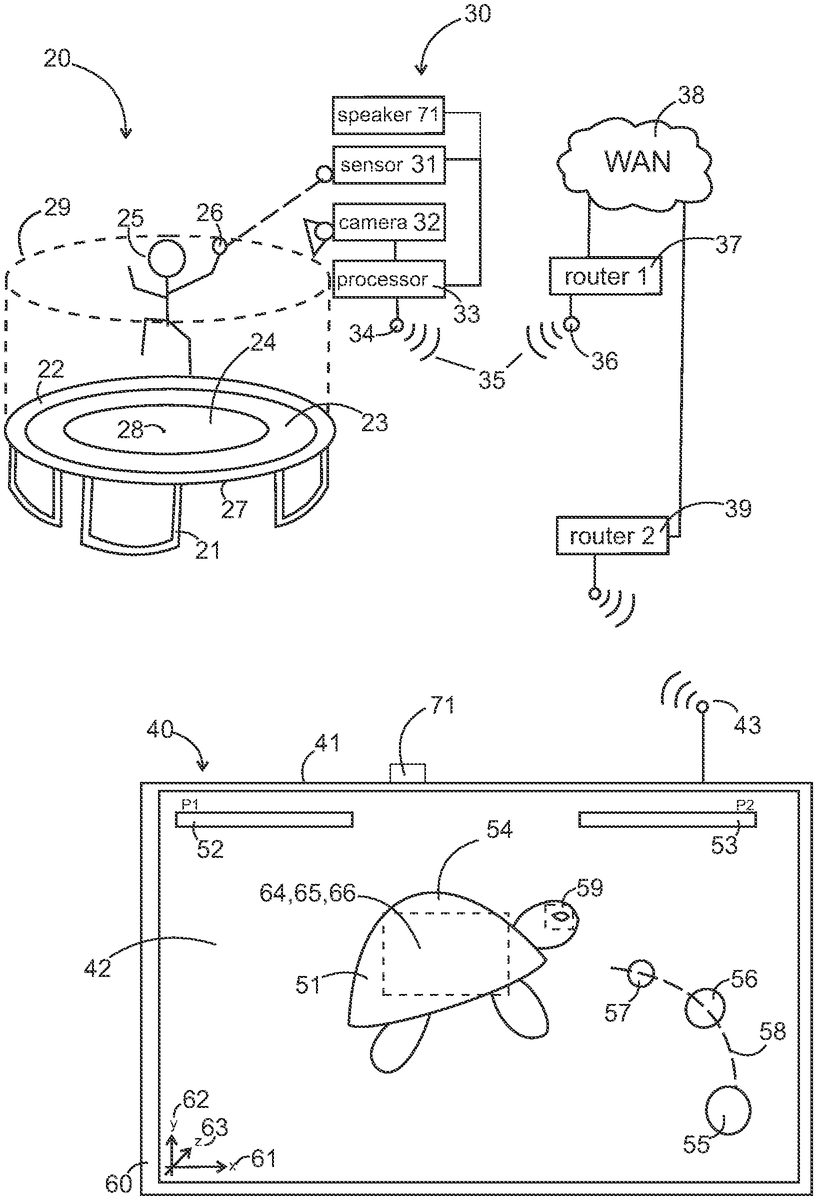
As seen inFIG. 1, the present invention is played on a trampoline20which has a frame27supporting a trampoline bed. The frame27is connected to and supported by trampoline legs21. The trampoline bed has a bed center28, a bed middle24, and a bed periphery23. The spring cover22covers the springs around the periphery of the frame27. A safety enclosure29connects to the frame27.
The first player25has a beam emitter26that can shoot a beam that can be received at a first player target30. The first player target30has a sensor31, a camera32, and a processor33. The processor33is connected to a first transceiver34. The camera32he pointed at the trampoline bed center28and can determine the location of the first player25. When the first player is jumping on the bed center28, the bed middle24, or the bed periphery23, the processor provides a status of the first player.
The processor communicates wirelessly from a first transceiver34. The first transceiver34send a wireless signal35to a second transceiver36that connects to a first router37. The first router37then connects to a wide area network38and through the wide area network communicates with a second router39. The second router39communicates with a wireless transceiver means43on a second player terminal40.
The second player terminal40is a wireless device41that has a touchscreen42. The touchscreen displays a field having coordinate definition60on a coordinate space. The coordinate definition defines metes and bounds of the coordinate space to define a virtual play area. The coordinate definition includes an X axis61, a Y axis62, and a Z axis63. The processor33translates the camera image taken from the camera32and outputs first player data so that the second player terminal40can generate a first player avatar51.
The first player avatar51, shown as a turtle, can be targeted by the second player that can send a projectile at the first player avatar51. The projectile can have a projectile path58so that the projectile moves from a projectile first position55, to a projectile second position56, to a projectile third position57. The projectile has a projectile path to create that can connect with the projectile hit box54.
The hit box54registers a hit on the first player avatar51that represents the first player25, when the hit box54is hit by a projectile. The first player can have a first player hit point indicator52and the second player can have a second player hit point indicator53.
The first player25can use the beam emitter26to target the sensor31of the first player target50. The second player can use the touchscreen42to target the player one avatar51by launching a projectile at a player one avatar51hit box54. The projectile hit box54may have a hit box x-coordinate centroid64, a hit box y-coordinate centroid65, and a hit box Z coordinate centroid66. The player one avatar51may have a tap hit box59that intermittently activates to allow the second player to tap on the touchscreen42to hit the player one avatar51. The tap attack may have a status change, or debuff, or directly decrease the number of hit points on the player one hit point indicator52. The projectile hit box54may also have an intermittent activation which can be dependent upon the coordinate definition60.
The first player25jumps on the bed middle24and the player one avatar51can move in a jumping motion as well. If the first player25is jumping in the bed middle24, the hit box54or the tap hit box59can be minimized or intermittently deactivated, based upon the first player jumping skill.
The number of hit points deducted can also be proportional to and depend upon the location of the first player jumping. For example, the first player can jump in the bed middle24, or on the bed periphery23. The bed middle24can shield the trampoline player, also called the first player or player one. The shield effect of the bed middle24can be such that a successful tap attack may decrease a single hit point, and a successful projectile attack may decrease two hit points. If the shield effect is removed such as if the user jumps in the bed periphery area23, then the hit point deduction for the first player would increase, such as by doubling for example.
The bed middle24has a bed center28which is the geographical and geometric center of the trampoline bed. The bed center28can be marked with an alignment code such as a QR code or other code that can determine an alignment of the camera32. As noted in the prior art, multiple cameras can be used for improving the position determination and stance of the first player.
The first player25can change between a variety of different stances or poses, such as curling up in a ball, which could be translated to a tortoise like player one avatar51as retracting into its shell to eliminate the tap hit box59. The first player25could also jump vertically, or twist to change the direction of the player one avatar51. If the first player25is facing to the left, the avatar can be drawn as facing to the left, and if the first player25is facing to the right, the avatar can be drawn as facing to the right. If the first player turns from the left to the right, then the avatar can be animated as turning from the left to the right.
Each of the different players' stances in combination with the location of the bed jumping can affect the stance of the avatar. For example, the avatar may have a blocking stance that is activated by a first player assuming a blocking stance such as by folded arms. The camera32is preferably stereoscopic so that the location, distance and motion of player one can be more precisely determined, however it is also possible to operate the game based on a single camera. The bed periphery23preferably has a color contrast with the bed middle24, and a machine-readable indicator acting as an alignment indicator such as a QR code could be placed on the bed center28. The spring cover22can also be used for alignment of the camera field of vision so that the motion of the first player25can be accurately translated to motion of the player one avatar51.
The stance of a player can be determined by the stereoscopic camera system that converts player video to a geometric model, which is then used for building and animating the player one avatar51. A variety of different mathematical models can be used for implementing the avatar conversion. For example, as previously described in the reference KR20180112656A, Interactive Trampoline Play System And Control Method For The Same by inventor Jiho Kim, published Oct. 12, 2018 the disclosure atFIGS. 1-2describe a stereoscopic video camera method for generating avatar representations of trampoline participants.
Additionally, as seen inFIG. 2, a user can hold a beam emitter26that is formed in the shape of a toroid disc. The beam emitter26has a beam emitter handle45with a beam emitter handle opening46. As the first player shoots at the first player target in a physical space, the second player uses a touch screen to show at an avatar of the first player in virtual space. Thus, a key feature of the present invention is to bridge the physical play of the first player with the virtual play of the second player. The first player target represents the second player avatar, and the first player avatar represents the first player. As the users do not see each other, the users can be anonymous to each other. A first player can be a physical player with a trampoline can play with a second player that can be a virtual player, and additional players can be added as physical players or virtual players in a group game.
Additionally, as seen inFIG. 3, the player one avatar51can be a pterodactyl having a placement on the touchscreen. The touchscreen may further display an ammunition bar69to allow counting of ammunition usage consumed by the second player when launching projectiles toward the player one avatar51. The projectiles68can be launched by the second player using the touchscreen graphical interface. The second player may also see a crosshairs or reticle67that marks where a projectile path begins, or terminates. The projectile68can be launched toward the first player avatar51according to the position of the reticle67. The hit point bar can be a tug-of-war combined bar that combines the player one hit point indicator52with the player two hit point indicator53on a single bar so that when the first player scores a hit against the second player, the first player wins points and the second player loses points. Conversely, when the second player scores a hit against the first player, the second player wins points and the first player loses points in a zero sum tug-of-war display.
As seen inFIG. 5, the processor is configured with a hit point system that provides certain incentives for improved play. The first player25has an incentive to jump in the bed middle24instead of the bed periphery23. When the first player25jumps in the bed middle, the first player25has more hit points. A player begins with a set number of hit points, such as 100 hit points, and the hit points decay when the player suffers a hit, or when the player jumps to the bed periphery23. The player may be automatically eliminated if the player leaves the trampoline bed altogether. If the player transitions from the bed middle24to the bed periphery23, the player hit points may decay to 50 hit points for example until the player transitions back to the bed middle24. Each hit could be worth 10 hit points.
The first player25can dodge the attacks by performing a pose for example. Particular poses or arm positions can correspond to avatar movement that allows dodging an attack by the second player. The first player25must pose over the bed middle24to be allowed the dodge.
As an alternative to the second player playing from a sedentary position, the second player could also be a trampoline player rather than a touchscreen player. The second player if a trampoline player can also have a set number of hit points such as 100 hit points. The second player can also suffer a decay of hit points if the second player jumps to the bed periphery23. The bed middle24should be visible in the camera to identify that the second player is jumping over the bed middle24.
The hit point decay for jumping away from the bed middle24can be adjusted. If one of the players is equal to or below 50 hit points, and the hit point decay is set for 50 hit points, that player is eliminated because the hit point decay brings the player to zero or negative points. The hit point decay is preferably proportional to the size of the bed middle24.
Instead of accruing instantaneously, the hit point decay can accrue over time such as by 10 hit points per bounce for example. Thus, if a player is in the bed middle24and then bounces on the bed periphery23, the player has a hit point decay can decrease the player's hit point by 10 so that the player only has 90 hit points. If the player bounces four more times, the player's hit points decrease down to 50. The player can recover the decayed hit points by jumping on the bed middle which can lead to a hit point recovery. For example, the player can have a hit point recovery of 10 for every bounce in the bed middle24.
Players can be given incentives for jumping in the bed middle and disincentives for jumping away from the bed middle. The hit point decay and hit point recovery provides an improved game dynamic that rewards bounce stability and trampoline control. The hit points can have regeneration such as five hit points per two bounces for example. Regenerated hit points are different than recovered hit points because recovered hit points are only applicable to the hit points that are decayed from jumping away from the bed middle24. Regenerated hit points can lengthen the game to allow longer gameplay. Regenerated hit points are hit points that are restored due to damage scored by the opposing player. To control the height of user bounces, the regenerated hit points can be awarded for bounces within a certain time with a time minimum and a time maximum. Thus, the user bounces being within a certain frequency on the bed middle24can trigger the regeneration. Preferably, the processor is configured to allow hit point regeneration only when the user is bouncing within a certain frequency on the bed middle24. The bed middle24is preferably indicated by a round circle that is seen by the camera and partially covered by the user whenever a player lands on the circle. These hit points being added or subtracted are visually displayed on the hit point bar, which can be numerical display augmented or graphical only.
A variety of different bounce sensors such as vibration sensors can be implemented for detecting a bounce. The bounce sensors can be used in conjunction with the video sensors to provide more accurate bounce detection. The bounce sensor can be mechanically coupled to the bounce mat such as by being connected to the frame or springs so as to detect vibration from the bounce mat. The bounce sensor can also be coupled directly to the bounce mat.
Preferably, a speaker71can notify the user with an audible sound effect when the user is gaining or losing it points due to recovery and decay, or damage and regeneration. For example, the decay and damage can have low tones and the recovery and regeneration can have high tones. The speaker can also provide a single tone for a given number of hit points changed, such as one tone for every five hit points for example. Speakers71can be mounted in the wireless device41or the player one target30, or the beam emitter26for example.
The wireless device41or the player one target30may have a processor33. The processor33preferably includes a graphic processing unit for driving a touchscreen42. The touchscreen may have a player one hitpoint indicator52and a player two hitpoint indicator. A starting hit point indicator72can be displayed to show the starting hit points of the first and second player. A first player decay indicator73and a second player decay indicator74can indicate decay due to bounding outside of the trampoline middle at the bed center28. The first player decay indicator73is between the first player damage indicator75and the first player hit point indicator52. The second player damage indicator76is between the starting hit point indicator72and the second player decay indicator. The first player hit point bar77drops and progresses to the left while the second player hit point bar78drops and progresses to the right.
Because the damage indicator is closer to the starting hit point indicator, the damage indicator is displayed as a bar which shows the amount of hit points lost due to damage. The decay indicator is preferably shown in a bar next to the damage indicator to show the amount of decayed hit points that can be recovered by returning to the bed middle. Jumping on the bed center28which can be marked as a point or a dot on the jump mat can optionally regenerate hit points at a slower rate than recovery of decayed hit points.
Claims
- A trampoline video game comprising: a. a trampoline having a bed suspended across a trampoline frame, wherein the bed has a bed center, a bed middle, and a bed periphery;b. a beam emitter configured for operation by a first player, wherein the beam emitter is configured to emit a beam;c. a player one target, wherein the player one target includes a sensor and a camera, wherein the camera is mounted so that it has a view of the bed center, the bed middle and the bed periphery, wherein the player one target is connected to a wide area network;d. a processor, electrically connected to the camera, wherein the processor is configured to generate a geometric model from an image or a video of the first player;e. a second player terminal configured as a wireless device with a touchscreen, wherein the second player terminal is configured to connect to the wide area network;f. a first player avatar generated on the touchscreen, wherein the first player avatar is generated from the geometric model;and g. a hitbox defined on the first player avatar, wherein the touchscreen is configured to score hits on the first player avatar during play.
- The trampoline video game of claim 1, further including a first player hit point bar.
- The trampoline video game of claim 1, further including a second player hit point bar.
- The trampoline video game of claim 1, further including a coordinate space having a coordinate definition on the wireless device and displayed on the touchscreen, wherein the coordinate definition includes an X axis, a Y axis, and a Z-axis.
- The trampoline video game of claim 1, further including a projectile defined on the coordinate space, wherein the hit box is defined in the coordinate definition, wherein the hit box has a hit box X coordinate centroid, a hit box Y coordinate centroid, and a hit box Z coordinate centroid.
- The trampoline video game of claim 1, wherein the processor is configured to provide a first player starting hit point amount which is a first player's hit points when starting the game, wherein the first player loses hit points when the second player scores a hit on the first player.
- The trampoline video game of claim 6, wherein the processor is configured to decay the first players hit points if the first player bounces away from the bed middle to the bed periphery by a hit point decay measured in units of hit points per bounce.
- The trampoline video game of claim 7, wherein the processor is configured to have a first player hit point recovery that recovers the hit points decayed which is also measured in units of hit points per bounce.
- The trampoline video game of claim 6, wherein the processor is configured to have regenerated hit points restored from damage scored by the second player when the first player bounces on the bed middle.
- The trampoline video game of claim 1, further including a first player hit point bar;a second player hit point bar;a coordinate space having a coordinate definition on the wireless device and displayed on the touchscreen, wherein the coordinate definition includes an X axis, a Y axis, and the Z-axis;and further including a projectile defined on the coordinate space, wherein the hit box is defined in the coordinate definition, wherein the hit box has a hit box X coordinate centroid, a hit box Y coordinate centroid, and a hit box Z coordinate centroid.
- The trampoline video game of claim 10, wherein the processor is configured to provide a first player starting hit point amount which is a first player's hit points when starting the game, wherein the first player loses hit points when the second player scores a hit on the first player.
- The trampoline video game of claim 11, wherein the processor is configured to decay the first players hit points if the first player bounces away from the bed middle to the bed periphery by a hit point decay measured in units of hit points per bounce.
- The trampoline video game of claim 12, wherein the processor is configured to have a first player hit point recovery that recovers the hit points decayed which is also measured in units of hit points per bounce.
- The trampoline video game of claim 13, wherein the processor is configured to have regenerated hit points restored from damage scored by the second player when the first player bounces on the bed middle.
- The trampoline video game of claim 10, further including a bounce sensor mechanically coupled to the bounce mat to detect vibration from a user bounce.
- The trampoline video game of claim 10, wherein the player one target is mounted on a trampoline pole above the bed middle, wherein the camera is downwardly facing at an angle, wherein the bed middle is defined as a circular region on the trampoline, wherein the bed periphery is defined as a ring shaped region around the bed middle.
- The trampoline video game of claim 10, further including a first player damage indicator and a first player decay indicator on the first player hit point bar, and further including a second player damage indicator and a second player decay indicator on the second player hit point bar.
- The trampoline video game of claim 17, wherein the first player decay indicator increases when the first player jumps away from the bed middle.
- The trampoline video game of claim 17, wherein the first player can regenerate hit points by jumping on the bed middle.
Disclaimer: Data collected from the USPTO and may be malformed, incomplete, and/or otherwise inaccurate.