Illustrative Figure
Abstract
An example game controller includes a spherical housing, a vibrator, an inertia sensor, an operation device, and a transmitter. The vibrator is inside the spherical housing and configured to generate a vibration to vibrate the spherical housing. The inertia sensor is at a position inside the spherical housing such that a distance from a center of the spherical housing to the inertial sensor is shorter than a distance from the center of the spherical housing to the vibrator. The operation section has an operation surface. The operation surface is capable of being depressed and is at the spherical housing on an opposite side from the vibrator with respect to the center of the spherical housing. The transmitter configured to transmit, to outside, information regarding an operation on the operation section and information output from the inertia sensor.
Description
DETAILED DESCRIPTION OF NON-LIMITING EXAMPLE EMBODIMENTS [1. Game System in which Spherical Controller is Used] Before describing a spherical controller according to an exemplary embodiment, a game system in which the spherical controller is used will be described first. An example of a game system1according to the exemplary embodiment includes a main body apparatus (an information processing apparatus; which functions as a game apparatus main body in the exemplary embodiment)2, a left controller3, and a right controller4. Each of the left controller3and the right controller4is attachable to and detachable from the main body apparatus2. That is, the game system1can be used as a unified apparatus obtained by attaching each of the left controller3and the right controller4to the main body apparatus2. Further, in the game system1, the main body apparatus2, the left controller3, and the right controller4can also be used as separate bodies (seeFIG. 2). Hereinafter, first, the hardware configuration of the game system1according to the exemplary embodiment is described, and then, the control of the game system1according to the exemplary embodiment is described. FIG. 1is a diagram showing an example of the state where the left controller3and the right controller4are attached to the main body apparatus2. As shown inFIG. 1, each of the left controller3and the right controller4is attached to and unified with the main body apparatus2. The main body apparatus2is an apparatus for performing various processes (e.g., game processing) in the game system1. The main body apparatus2includes a display12. Each of the left controller3and the right controller4is an apparatus including operation sections with which a user provides inputs. FIG. 2is a diagram showing an example of the state where each of the left controller3and the right controller4is detached from the main body apparatus2. As shown inFIGS. 1 and 2, the left controller3and the right controller4are attachable to and detachable ...
DETAILED DESCRIPTION OF NON-LIMITING EXAMPLE EMBODIMENTS
[1. Game System in which Spherical Controller is Used]
Before describing a spherical controller according to an exemplary embodiment, a game system in which the spherical controller is used will be described first. An example of a game system1according to the exemplary embodiment includes a main body apparatus (an information processing apparatus; which functions as a game apparatus main body in the exemplary embodiment)2, a left controller3, and a right controller4. Each of the left controller3and the right controller4is attachable to and detachable from the main body apparatus2. That is, the game system1can be used as a unified apparatus obtained by attaching each of the left controller3and the right controller4to the main body apparatus2. Further, in the game system1, the main body apparatus2, the left controller3, and the right controller4can also be used as separate bodies (seeFIG. 2). Hereinafter, first, the hardware configuration of the game system1according to the exemplary embodiment is described, and then, the control of the game system1according to the exemplary embodiment is described.
FIG. 1is a diagram showing an example of the state where the left controller3and the right controller4are attached to the main body apparatus2. As shown inFIG. 1, each of the left controller3and the right controller4is attached to and unified with the main body apparatus2. The main body apparatus2is an apparatus for performing various processes (e.g., game processing) in the game system1. The main body apparatus2includes a display12. Each of the left controller3and the right controller4is an apparatus including operation sections with which a user provides inputs.
FIG. 2is a diagram showing an example of the state where each of the left controller3and the right controller4is detached from the main body apparatus2. As shown inFIGS. 1 and 2, the left controller3and the right controller4are attachable to and detachable from the main body apparatus2. It should be noted that hereinafter, the left controller3and the right controller4will occasionally be referred to collectively as a “controller”.
FIG. 3is six orthogonal views showing an example of the main body apparatus2. As shown inFIG. 3, the main body apparatus2includes an approximately plate-shaped housing11. In the exemplary embodiment, a main surface (in other words, a surface on a front side, i.e., a surface on which the display12is provided) of the housing11has a generally rectangular shape.
It should be noted that the shape and the size of the housing11are optional. As an example, the housing11may be of a portable size. Further, the main body apparatus2alone or the unified apparatus obtained by attaching the left controller3and the right controller4to the main body apparatus2may function as a mobile apparatus. The main body apparatus2or the unified apparatus may function as a handheld apparatus or a portable apparatus.
As shown inFIG. 3, the main body apparatus2includes the display12, which is provided on the main surface of the housing11. The display12displays an image generated by the main body apparatus2. In the exemplary embodiment, the display12is a liquid crystal display device (LCD). The display12, however, may be a display device of any type.
Further, the main body apparatus2includes a touch panel13on a screen of the display12. In the exemplary embodiment, the touch panel13is of a type that allows a multi-touch input (e.g., a capacitive type). The touch panel13, however, may be of any type. For example, the touch panel13may be of a type that allows a single-touch input (e.g., a resistive type).
The main body apparatus2includes speakers (i.e., speakers88shown inFIG. 6) within the housing11. As shown inFIG. 3, speaker holes11aand11bare formed on the main surface of the housing11. Then, sounds output from the speakers88are output through the speaker holes11aand11b.
Further, the main body apparatus2includes a left terminal17, which is a terminal for the main body apparatus2to perform wired communication with the left controller3, and a right terminal21, which is a terminal for the main body apparatus2to perform wired communication with the right controller4.
As shown inFIG. 3, the main body apparatus2includes a slot23. The slot23is provided on an upper side surface of the housing11. The slot23is so shaped as to allow a predetermined type of storage medium to be attached to the slot23. The predetermined type of storage medium is, for example, a dedicated storage medium (e.g., a dedicated memory card) for the game system1and an information processing apparatus of the same type as the game system1. The predetermined type of storage medium is used to store, for example, data (e.g., saved data of an application or the like) used by the main body apparatus2and/or a program (e.g., a program for an application or the like) executed by the main body apparatus2. Further, the main body apparatus2includes a power button28.
The main body apparatus2includes a lower terminal27. The lower terminal27is a terminal for the main body apparatus2to communicate with a cradle. In the exemplary embodiment, the lower terminal27is a USB connector (more specifically, a female connector). Further, when the unified apparatus or the main body apparatus2alone is mounted on the cradle, the game system1can display on a stationary monitor an image generated by and output from the main body apparatus2. Further, in the exemplary embodiment, the cradle has the function of charging the unified apparatus or the main body apparatus2alone mounted on the cradle. Further, the cradle has the function of a hub device (specifically, a USB hub).
FIG. 4is six orthogonal views showing an example of the left controller3. As shown inFIG. 4, the left controller3includes a housing31. In the exemplary embodiment, the housing31has a vertically long shape, i.e., is shaped to be long in an up-down direction (i.e., a y-axis direction shown inFIGS. 1 and 4). In the state where the left controller3is detached from the main body apparatus2, the left controller3can also be held in the orientation in which the left controller3is vertically long. The housing31has such a shape and a size that when held in the orientation in which the housing31is vertically long, the housing31can be held with one hand, particularly the left hand. Further, the left controller3can also be held in the orientation in which the left controller3is horizontally long. When held in the orientation in which the left controller3is horizontally long, the left controller3may be held with both hands.
The left controller3includes an analog stick32. As shown inFIG. 4, the analog stick32is provided on a main surface of the housing31. The analog stick32can be used as a direction input section with which a direction can be input. The user tilts the analog stick32and thereby can input a direction corresponding to the direction of the tilt (and input a magnitude corresponding to the angle of the tilt). It should be noted that the left controller3may include a directional pad, a slide stick that allows a slide input, or the like as the direction input section, instead of the analog stick. Further, in the exemplary embodiment, it is possible to provide an input by pressing the analog stick32.
The left controller3includes various operation buttons. The left controller3includes four operation buttons33to36(specifically, a right direction button33, a down direction button34, an up direction button35, and a left direction button36) on the main surface of the housing31. Further, the left controller3includes a record button37and a “−” (minus) button47. The left controller3includes a first L-button38and a ZL-button39in an upper left portion of a side surface of the housing31. Further, the left controller3includes a second L-button43and a second R-button44, on the side surface of the housing31on which the left controller3is attached to the main body apparatus2. These operation buttons are used to give instructions depending on various programs (e.g., an OS program and an application program) executed by the main body apparatus2.
Further, the left controller3includes a terminal42for the left controller3to perform wired communication with the main body apparatus2.
FIG. 5is six orthogonal views showing an example of the right controller4. As shown inFIG. 5, the right controller4includes a housing51. In the exemplary embodiment, the housing51has a vertically long shape, i.e., is shaped to be long in the up-down direction. In the state where the right controller4is detached from the main body apparatus2, the right controller4can also be held in the orientation in which the right controller4is vertically long. The housing51has such a shape and a size that when held in the orientation in which the housing51is vertically long, the housing51can be held with one hand, particularly the right hand. Further, the right controller4can also be held in the orientation in which the right controller4is horizontally long. When held in the orientation in which the right controller4is horizontally long, the right controller4may be held with both hands.
Similarly to the left controller3, the right controller4includes an analog stick52as a direction input section. In the exemplary embodiment, the analog stick52has the same configuration as that of the analog stick32of the left controller3. Further, the right controller4may include a directional pad, a slide stick that allows a slide input, or the like, instead of the analog stick. Further, similarly to the left controller3, the right controller4includes four operation buttons53to56(specifically, an A-button53, a B-button54, an X-button55, and a Y-button56) on a main surface of the housing51. Further, the right controller4includes a “+” (plus) button57and a home button58. Further, the right controller4includes a first R-button60and a ZR-button61in an upper right portion of a side surface of the housing51. Further, similarly to the left controller3, the right controller4includes a second L-button65and a second R-button66.
Further, a window portion68is provided on a lower side surface of the housing51. Although the details will be described later, the right controller4includes an infrared image capturing section123and an infrared light-emitting section124, which are placed within the housing51. The infrared image capturing section123captures a portion around the right controller4through the window portion68such that a down direction of the right controller4(a negative y-axis direction shown inFIG. 5) is the image capturing direction. The infrared light-emitting section124emits infrared light through the window portion68to an image capturing target to be captured by the infrared image capturing section123such that a predetermined range about the down direction of the right controller4(the negative y-axis direction shown inFIG. 5) is the emission range. The window portion68is used to protect a lens of a camera of the infrared image capturing section123, a light emitter of the infrared light-emitting section124, and the like and composed of a material (e.g., a transparent material) that transmits light of a wavelength sensed by the camera and light emitted from the light emitter. It should be noted that the window portion68may be a hole formed in the housing51. It should be noted that in the exemplary embodiment, the infrared image capturing section123itself includes a filter member for inhibiting the transmission of light of a wavelength other than light sensed by the camera (infrared light in the exemplary embodiment). In another exemplary embodiment, the window portion68may have the function of a filter.
Further, although the details will be described later, the right controller4includes an NFC communication section122. The NFC communication section122performs short-range wireless communication based on the NFC (Near Field Communication) standard. The NFC communication section122includes an antenna122a, which is used for short-range wireless communication, and a circuit (e.g., an NFC chip) for generating a signal (a radio wave) to be sent from the antenna122a. It should be noted that the NFC communication section122may perform short-range wireless communication through any proximity communication (or contactless communication), instead of performing short-range wireless communication based on the NFC standard. Here, the NFC standard can be used for proximity communication (contactless communication), and “may perform short-range wireless communication through any proximity communication (or contactless communication)” is intended to mean that short-range wireless communication may be performed through other proximity communication except for proximity communication based on the NFC standard.
Further, the right controller4includes a terminal64for the right controller4to perform wired communication with the main body apparatus2.
FIG. 6is a block diagram showing an example of the internal configuration of the main body apparatus2. The main body apparatus2includes components81to91,97, and98shown inFIG. 6in addition to the components shown inFIG. 3. Some of the components81to91,97, and98may be mounted as electronic components on an electronic circuit board and accommodated in the housing11.
The main body apparatus2includes a processor81. The processor81is an information processing section for executing various types of information processing to be executed by the main body apparatus2. For example, the processor81may be composed only of a CPU (Central Processing Unit), or may be composed of a SoC (System-on-a-chip) having a plurality of functions such as a CPU function and a GPU (Graphics Processing Unit) function. The processor81executes an information processing program (e.g., a game program) stored in a storage section (specifically, an internal storage medium such as a flash memory84, an external storage medium attached to the slot23, or the like), thereby performing the various types of information processing.
The main body apparatus2includes a flash memory84and a DRAM (Dynamic Random Access Memory)85as examples of internal storage media built into the main body apparatus2. The flash memory84and the DRAM85are connected to the processor81. The flash memory84is a memory mainly used to store various data (or programs) to be saved in the main body apparatus2. The DRAM85is a memory used to temporarily store various data used for information processing.
The main body apparatus2includes a slot interface (hereinafter abbreviated as “I/F”)91. The slot I/F91is connected to the processor81. The slot I/F91is connected to the slot23, and in accordance with an instruction from the processor81, reads and writes data from and to the predetermined type of storage medium (e.g., a dedicated memory card) attached to the slot23.
The processor81appropriately reads and writes data from and to the flash memory84, the DRAM85, and each of the above storage media, thereby performing the above information processing.
The main body apparatus2includes a network communication section82. The network communication section82is connected to the processor81. The network communication section82communicates (specifically, through wireless communication) with an external apparatus via a network. In the exemplary embodiment, as a first communication form, the network communication section82connects to a wireless LAN and communicates with an external apparatus, using a method compliant with the Wi-Fi standard. Further, as a second communication form, the network communication section82wirelessly communicates with another main body apparatus2of the same type, using a predetermined communication method (e.g., communication based on a unique protocol or infrared light communication). It should be noted that the wireless communication in the above second communication form achieves the function of enabling so-called “local communication” in which the main body apparatus2can wirelessly communicate with another main body apparatus2placed in a closed local network area, and the plurality of main body apparatuses2directly communicate with each other to transmit and receive data.
The main body apparatus2includes a controller communication section83. The controller communication section83is connected to the processor81. The controller communication section83wirelessly communicates with the left controller3and/or the right controller4. The communication method between the main body apparatus2and the left controller3and the right controller4is optional. In the exemplary embodiment, the controller communication section83performs communication compliant with the Bluetooth (registered trademark) standard with the left controller3and with the right controller4.
The processor81is connected to the left terminal17, the right terminal21, and the lower terminal27. When performing wired communication with the left controller3, the processor81transmits data to the left controller3via the left terminal17and also receives operation data from the left controller3via the left terminal17. Further, when performing wired communication with the right controller4, the processor81transmits data to the right controller4via the right terminal21and also receives operation data from the right controller4via the right terminal21. Further, when communicating with the cradle, the processor81transmits data to the cradle via the lower terminal27. As described above, in the exemplary embodiment, the main body apparatus2can perform both wired communication and wireless communication with each of the left controller3and the right controller4. Further, when the unified apparatus obtained by attaching the left controller3and the right controller4to the main body apparatus2or the main body apparatus2alone is attached to the cradle, the main body apparatus2can output data (e.g., image data or sound data) to the stationary monitor or the like via the cradle.
Here, the main body apparatus2can communicate with a plurality of left controllers3simultaneously (in other words, in parallel). Further, the main body apparatus2can communicate with a plurality of right controllers4simultaneously (in other words, in parallel). Thus, a plurality of users can simultaneously provide inputs to the main body apparatus2, each using a set of the left controller3and the right controller4. As an example, a first user can provide an input to the main body apparatus2using a first set of the left controller3and the right controller4, and simultaneously, a second user can provide an input to the main body apparatus2using a second set of the left controller3and the right controller4.
The main body apparatus2includes a touch panel controller86, which is a circuit for controlling the touch panel13. The touch panel controller86is connected between the touch panel13and the processor81. Based on a signal from the touch panel13, the touch panel controller86generates, for example, data indicating the position where a touch input is provided. Then, the touch panel controller86outputs the data to the processor81.
Further, the display12is connected to the processor81. The processor81displays a generated image (e.g., an image generated by executing the above information processing) and/or an externally acquired image on the display12.
The main body apparatus2includes a codec circuit87and speakers (specifically, a left speaker and a right speaker)88. The codec circuit87is connected to the speakers88and a sound input/output terminal25and also connected to the processor81. The codec circuit87is a circuit for controlling the input and output of sound data to and from the speakers88and the sound input/output terminal25.
Further, the main body apparatus2includes an acceleration sensor89. In the exemplary embodiment, the acceleration sensor89detects the magnitudes of accelerations along predetermined three axial (e.g., xyz axes shown inFIG. 1) directions. It should be noted that the acceleration sensor89may detect an acceleration along one axial direction or accelerations along two axial directions.
Further, the main body apparatus2includes an angular velocity sensor90. In the exemplary embodiment, the angular velocity sensor90detects angular velocities about predetermined three axes (e.g., the xyz axes shown inFIG. 1). It should be noted that the angular velocity sensor90may detect an angular velocity about one axis or angular velocities about two axes.
The acceleration sensor89and the angular velocity sensor90are connected to the processor81, and the detection results of the acceleration sensor89and the angular velocity sensor90are output to the processor81. Based on the detection results of the acceleration sensor89and the angular velocity sensor90, the processor81can calculate information regarding the motion and/or the orientation of the main body apparatus2.
The main body apparatus2includes a power control section97and a battery98. The power control section97is connected to the battery98and the processor81. Further, although not shown inFIG. 6, the power control section97is connected to components of the main body apparatus2(specifically, components that receive power supplied from the battery98, the left terminal17, and the right terminal21). Based on a command from the processor81, the power control section97controls the supply of power from the battery98to the above components.
Further, the battery98is connected to the lower terminal27. When an external charging device (e.g., the cradle) is connected to the lower terminal27, and power is supplied to the main body apparatus2via the lower terminal27, the battery98is charged with the supplied power.
FIG. 7is a block diagram showing examples of the internal configurations of the main body apparatus2, the left controller3, and the right controller4. It should be noted that the details of the internal configuration of the main body apparatus2are shown inFIG. 6and therefore are omitted inFIG. 7.
The left controller3includes a communication control section101, which communicates with the main body apparatus2. As shown inFIG. 7, the communication control section101is connected to components including the terminal42. In the exemplary embodiment, the communication control section101can communicate with the main body apparatus2through both wired communication via the terminal42and wireless communication not via the terminal42. The communication control section101controls the method for communication performed by the left controller3with the main body apparatus2. That is, when the left controller3is attached to the main body apparatus2, the communication control section101communicates with the main body apparatus2via the terminal42. Further, when the left controller3is detached from the main body apparatus2, the communication control section101wirelessly communicates with the main body apparatus2(specifically, the controller communication section83). The wireless communication between the communication control section101and the controller communication section83is performed in accordance with the Bluetooth (registered trademark) standard, for example.
Further, the left controller3includes a memory102such as a flash memory. The communication control section101includes, for example, a microcomputer (or a microprocessor) and executes firmware stored in the memory102, thereby performing various processes.
The left controller3includes buttons103(specifically, the buttons33to39,43,44, and47). Further, the left controller3includes the analog stick (“stick” inFIG. 7)32. Each of the buttons103and the analog stick32outputs information regarding an operation performed on itself to the communication control section101repeatedly at appropriate timing.
The left controller3includes inertial sensors. Specifically, the left controller3includes an acceleration sensor104. Further, the left controller3includes an angular velocity sensor105. In the exemplary embodiment, the acceleration sensor104detects the magnitudes of accelerations along predetermined three axial (e.g., xyz axes shown inFIG. 4) directions. It should be noted that the acceleration sensor104may detect an acceleration along one axial direction or accelerations along two axial directions. In the exemplary embodiment, the angular velocity sensor105detects angular velocities about predetermined three axes (e.g., the xyz axes shown inFIG. 4). It should be noted that the angular velocity sensor105may detect an angular velocity about one axis or angular velocities about two axes. Each of the acceleration sensor104and the angular velocity sensor105is connected to the communication control section101. Then, the detection results of the acceleration sensor104and the angular velocity sensor105are output to the communication control section101repeatedly at appropriate timing.
The communication control section101acquires information regarding an input (specifically, information regarding an operation or the detection result of the sensor) from each of input sections (specifically, the buttons103, the analog stick32, and the sensors104and105). The communication control section101transmits operation data including the acquired information (or information obtained by performing predetermined processing on the acquired information) to the main body apparatus2. It should be noted that the operation data is transmitted repeatedly, once every predetermined time. It should be noted that the interval at which the information regarding an input is transmitted from each of the input sections to the main body apparatus2may or may not be the same.
The above operation data is transmitted to the main body apparatus2, whereby the main body apparatus2can obtain inputs provided to the left controller3. That is, the main body apparatus2can determine operations on the buttons103and the analog stick32based on the operation data. Further, the main body apparatus2can calculate information regarding the motion and/or the orientation of the left controller3based on the operation data (specifically, the detection results of the acceleration sensor104and the angular velocity sensor105).
The left controller3includes a vibrator107for giving notification to the user by a vibration. In the exemplary embodiment, the vibrator107is controlled by a command from the main body apparatus2. That is, if receiving the above command from the main body apparatus2, the communication control section101drives the vibrator107in accordance with the received command. Here, the left controller3includes a codec section106. If receiving the above command, the communication control section101outputs a control signal corresponding to the command to the codec section106. The codec section106generates a driving signal for driving the vibrator107from the control signal from the communication control section101and outputs the driving signal to the vibrator107. Consequently, the vibrator107operates.
More specifically, the vibrator107is a linear vibration motor. Unlike a regular motor that rotationally moves, the linear vibration motor is driven in a predetermined direction in accordance with an input voltage and therefore can be vibrated at an amplitude and a frequency corresponding to the waveform of the input voltage. In the exemplary embodiment, a vibration control signal transmitted from the main body apparatus2to the left controller3may be a digital signal representing the frequency and the amplitude every unit of time. In another exemplary embodiment, the main body apparatus2may transmit information indicating the waveform itself. The transmission of only the amplitude and the frequency, however, enables a reduction in the amount of communication data. Additionally, to further reduce the amount of data, only the differences between the numerical values of the amplitude and the frequency at that time and the previous values may be transmitted, instead of the numerical values. In this case, the codec section106converts a digital signal indicating the values of the amplitude and the frequency acquired from the communication control section101into the waveform of an analog voltage and inputs a voltage in accordance with the resulting waveform, thereby driving the vibrator107. Thus, the main body apparatus2changes the amplitude and the frequency to be transmitted every unit of time and thereby can control the amplitude and the frequency at which the vibrator107is to be vibrated at that time. It should be noted that not only a single amplitude and a single frequency, but also two or more amplitudes and two or more frequencies may be transmitted from the main body apparatus2to the left controller3. In this case, the codec section106combines waveforms indicated by the plurality of received amplitudes and frequencies and thereby can generate the waveform of a voltage for controlling the vibrator107.
The left controller3includes a power supply section108. In the exemplary embodiment, the power supply section108includes a battery and a power control circuit. Although not shown inFIG. 7, the power control circuit is connected to the battery and also connected to components of the left controller3(specifically, components that receive power supplied from the battery).
As shown inFIG. 7, the right controller4includes a communication control section111, which communicates with the main body apparatus2. Further, the right controller4includes a memory112, which is connected to the communication control section111. The communication control section111is connected to components including the terminal64. The communication control section111and the memory112have functions similar to those of the communication control section101and the memory102, respectively, of the left controller3. Thus, the communication control section111can communicate with the main body apparatus2through both wired communication via the terminal64and wireless communication not via the terminal64(specifically, communication compliant with the Bluetooth (registered trademark) standard). The communication control section111controls the method for communication performed by the right controller4with the main body apparatus2.
The right controller4includes input sections similar to the input sections of the left controller3. Specifically, the right controller4includes buttons113, the analog stick52, and inertial sensors (an acceleration sensor114and an angular velocity sensor115). These input sections have functions similar to those of the input sections of the left controller3and operate similarly to the input sections of the left controller3.
Further, the right controller4includes a vibrator117and a codec section116. The vibrator117and the codec section116operate similarly to the vibrator107and the codec section106, respectively, of the left controller3. That is, in accordance with a command from the main body apparatus2, the communication control section111causes the vibrator117to operate, using the codec section116.
The right controller4includes the NFC communication section122, which performs short-range wireless communication based on the NFC standard. The NFC communication section122has the function of a so-called NFC reader/writer. Here, the term “short-range wireless communication” as used herein includes a communication method where a radio wave from an apparatus (here, the right controller4) develops an electromotive force (e.g., by electromagnetic induction) in another device (here, a device near the antenna122a). The other device can operate by the developed electromotive force, and may or may not have a power supply. When the right controller4(the antenna122a) and a communication target come close to each other (typically, the distance between the right controller4and the communication target becomes dozen centimeters or less), the NFC communication section122becomes able to communicate with the communication target. The communication target is any apparatus capable of performing short-range wireless communication with the NFC communication section122and is, for example, an NFC tag or a storage medium having the function of an NFC tag. Alternatively, the communication target may be another apparatus having an NFC card emulation function.
Further, the right controller4includes the infrared image capturing section123. The infrared image capturing section123includes an infrared camera for capturing a portion around the right controller4. As an example, the main body apparatus2and/or the right controller4calculate information of a captured image (e.g., information related to the luminance of a plurality of blocks into which at least the entirety of a partial area of a captured image is divided or the like), and based on the calculated information, determine a change in the portion around the right controller4. Further, the infrared image capturing section123may capture an image using ambient light, but in the exemplary embodiment, includes the infrared light-emitting section124, which emits infrared light. The infrared light-emitting section124emits infrared light, for example, in synchronization with the timing when the infrared camera captures an image. Then, the infrared light emitted from the infrared light-emitting section124is reflected by an image capturing target, and the infrared camera receives the reflected infrared light, thereby acquiring an image of the infrared light. This enables the infrared image capturing section123to obtain a clearer infrared light image. It should be noted that the infrared image capturing section123and the infrared light-emitting section124may be provided as different devices in the right controller4, or may be provided as a single device in the same package in the right controller4. Further, in the exemplary embodiment, the infrared image capturing section123including an infrared camera is used. In another exemplary embodiment, a visible light camera (a camera using a visible light image sensor) may be used as image capturing means, instead of the infrared camera.
The right controller4includes a processing section121. The processing section121is connected to the communication control section111. Further, the processing section121is connected to the NFC communication section122, the infrared image capturing section123, and the infrared light-emitting section124. In accordance with a command from the main body apparatus2, the processing section121performs the process of managing the NFC communication section122. For example, in accordance with a command from the main body apparatus2, the processing section121controls the operation of the NFC communication section122. Further, the processing section121controls the start of the NFC communication section122or controls the operations (specifically, reading, writing, and the like) of the NFC communication section122performed on a communication target (e.g., an NFC tag). Further, the processing section121receives, from the main body apparatus2, information to be transmitted to the communication target via the communication control section111and passes the information to the NFC communication section122. Further, the processing section121acquires, from the NFC communication section122, information received from the communication target and transmits the information to the main body apparatus2via the communication control section111.
Further, the processing section121includes a CPU, a memory, and the like. Based on a predetermined program (e.g., an application program for performing image processing and various calculations) stored in a storage device (e.g., a non-volatile memory or the like) (not shown) included in the right controller4, and in accordance with a command from the main body apparatus2, the processing section121performs the process of managing the infrared image capturing section123. For example, the processing section121causes the infrared image capturing section123to perform an image capturing operation. Further, the processing section121acquires and/or calculates information based on an image capturing result (information of a captured image, information calculated from this information, or the like) and transmits the information to the main body apparatus2via the communication control section111. Further, in accordance with a command from the main body apparatus2, the processing section121performs the process of managing the infrared light-emitting section124. For example, in accordance with a command from the main body apparatus2, the processing section121controls the light emission of the infrared light-emitting section124. It should be noted that a memory used by the processing section121to perform processing may be provided in the processing section121or may be the memory112.
The right controller4includes a power supply section118. The power supply section118has a function similar to that of the power supply section108of the left controller3and operates similarly to the power supply section108.
[2. Spherical Controller]
Next, a spherical controller according to the exemplary embodiment will be described. In the exemplary embodiment, the spherical controller may be used as a controller device for giving instructions to the main body apparatus2, instead of the controllers3and4, or together with the controllers3and/or4. The details of the spherical controller will now be described.
FIG. 8andFIG. 9are perspective views showing an example of the spherical controller.FIG. 8is a perspective view of a spherical controller200as seen from the upper front direction, andFIG. 9is a perspective view of the spherical controller200as seen from the lower rear direction. As shown inFIG. 8andFIG. 9, the spherical controller200includes a spherical controller main body201and a strap portion202. For example, the user uses the spherical controller200while holding the controller main body201with the strap portion202wound around the arm.
In the following description regarding the spherical controller200(specifically, the controller main body201), the up-down direction, the left-right direction and the front-rear direction are defined as follows. That is, the direction from the center of the spherical controller main body201toward a joystick212(i.e., the z-axis negative direction shown inFIG. 8) is defined as the front direction, and the opposite direction thereto (i.e., the z-axis positive direction shown inFIG. 8) as the rear direction. As seen from the front-rear direction, the direction from the center of the controller main body201toward the center of an operation surface213(i.e., the y-axis positive direction shown inFIG. 8) is defined as the upper direction, and the opposite direction thereto (i.e., the y-axis negative direction shown inFIG. 8) as the lower direction. Moreover, the direction from the center of the controller main body201toward the right edge of the controller main body201as seen from the front side (i.e., the x-axis positive direction shown inFIG. 8) is defined as the right direction, and the opposite direction thereto (i.e., the x-axis negative direction shown inFIG. 8) as the left direction. Note that the up-down direction, the left-right direction and the front-rear direction are orthogonal to each other.
[2-1. External Configuration of Controller Main Body]
FIG. 10shows six orthogonal views showing an example of the controller main body. InFIG. 10, (a) is a front view, (b) a right side view, (c) a left side view, (d) a plan view, (e) a bottom view, and (f) a back view.
As shown inFIG. 10, the controller main body201has a spherical shape. Herein, “spherical shape” means a shape that generally appears to be a sphere from outside. A spherical shape may be a perfectly spherical shape, or may be a perfectly spherical shape except it has cutout portions and/or protruding portions. A spherical shape may also be a shape a part of which is not spherical. A spherical shape may be a perfectly spherical shape except it is slightly distorted.
(Housing)
As shown inFIG. 10, the controller main body201has a spherical housing211. In the exemplary embodiment, the controller main body201(in other words, the housing211) is sized so that it can be held in one hand by the user (seeFIG. 12). The diameter of the housing211is set in the range of 4 cm to 10 cm, for example.
FIG. 11is a diagram showing an example of the housing211. In the exemplary embodiment, the surface of the housing211is a substantially spherical surface except for holes or cutouts therein to be described below. Note that in other embodiments, the housing211may have a spherical surface with protruding portions or depressed portions. Such portions may be provided for design purposes, for example.
In the present specification, “substantially (in a certain state)” means to include both cases where the certain state is achieved in a strict sense and cases where the certain state is generally achieved. For example, “substantially spherical (surface)” means to include embodiments where the surface is spherical in a strict sense and embodiments where the surface is not strictly spherical but is generally spherical.
In the exemplary embodiment, the housing211has a spherical shape with cutouts and holes therein. The housing211is provided with holes for the purpose of providing operation sections (e.g., the joystick212and a reboot button214to be described later) on the housing211and attaching other components (e.g., the strap portion202) to the housing211, the details of which will be described later.
Specifically, in the exemplary embodiment, the front end portion of the housing211is a flat surface (see (b) to (e) ofFIG. 10). Hereinafter, the flat surface of the front end portion of the housing211will be referred to as the “front end surface”. It can be said that the housing211has a shape obtained by cutting off the front end portion of the spherical shape by truncating the spherical shape along a plane that includes the front end surface. As shown inFIG. 11, an opening211ais provided in the front end surface of the housing211. The joystick212is provided so as to be exposed through the opening211a, the details of which will be described later. While the opening211ahas a circular shape in the exemplary embodiment, the opening211amay have any other shape in other embodiments. For example, the shape of the opening211amay be a polygonal shape (specifically, a triangular shape, a quadrilateral shape, a pentagonal shape, etc.), an elliptical shape or a star shape.
As shown inFIG. 11, in the exemplary embodiment, the housing211includes an upper housing part221, a middle housing part222, and a lower housing part223. The upper housing part221and the lower housing part223are each a hemispherical shape. The middle housing part222is a portion that includes the front end surface and where the opening211ais provided. These three housing parts221to223are connected together to form the spherical housing211.
As shown inFIG. 11, the upper housing part221has a hemispherical shape. The lower housing part223also has a hemispherical shape as does the upper housing part221. It can be said that the upper housing part221and the lower housing part223are each a hemispherical housing. Herein, “hemispherical shape” means a shape that generally appears to be a hemisphere from outside. A hemispherical shape may be a perfectly hemispherical shape, or may be a perfectly hemispherical shape except it has cutout portions and/or protruding portions. A hemispherical shape may also be a shape a part of which is not spherical. A hemispherical shape may be one half of a perfectly spherical shape except it is slightly distorted.
The middle housing part222has a ring (or “annular”) shape as shown inFIG. 11andFIG. 19to be discussed later. The middle housing part222is provided between the upper housing part221and the lower housing part223. In the exemplary embodiment, the middle housing part222has a spherical zone shape (i.e., a band-shaped piece of a sphere that is defined between two parallel planes running through the sphere).
Thus, in the exemplary embodiment, the housing211is composed of three housing parts. Note that in other embodiments, there is no limitation on the number of housing parts of the housing211, and it may be two or four or more. Alternatively, the entire housing211may be integral.
(Regarding External Appearance of Housing)
As shown inFIG. 11, in the exemplary embodiment, two housing parts are connected together to form a seam on the surface of the housing211. That is, the upper housing part221and the middle housing part222form a seam therebetween, and the middle housing part222and the lower housing part223form a seam therebetween. Herein, the seam includes line portions (e.g., the lines L1and L2shown inFIG. 11) that appear to be straight when the spherical controller200is seen from the direction from the center of an operation surface252cof the joystick212(seeFIG. 13) toward the center of the housing211(i.e., the direction from the front side toward the rear side; see (a) ofFIG. 10). Note that it can be said that the seam is the boundary between a first hemispherical portion (e.g., the upper housing part221) and a second hemispherical portion (e.g., the middle housing part222and the lower housing part223) included in the housing211.
Herein, since the controller main body201is a sphere, it may be difficult for the user to recognize the orientation of the controller main body201based only on the outer shape of the controller main body201. In the exemplary embodiment, with the line portions described above, it is easier for the user to recognize the orientation of the controller main body201. For example, in the exemplary embodiment, the user can recognize that the direction in which the line portions described above extend is the left-right direction of the controller main body201.
In the exemplary embodiment, the joystick212is provided so as to be located on the extensions of the line portions as the spherical controller200is seen from the direction from the joystick212toward the center of the housing211(i.e., the direction from the front side toward the rear side) (see (a) ofFIG. 10). Thus, the user can judge the orientation of the joystick212based on the direction of the line portions. For example, in the exemplary embodiment, the user can recognize that the direction along the line portions is the direction of left-right inputs on the joystick212.
In the exemplary embodiment, the line portions of the seam are formed on opposite sides of the joystick212(see (a) ofFIG. 10). Then, the joystick212and the line portions can be presented to the user in an easy-to-see manner, and the relationship between the joystick212and the line portions is made easier to understand. For example, the user can recognize the relationship between the joystick212and the line portions whether the joystick212is seen from one side (e.g., the left side) or from the other side (e.g., the right side).
As described above, in the exemplary embodiment, the housing211includes the first housing part (i.e., the upper housing part221), the second housing part (i.e., the lower housing part223), and a spherical zone-shaped third housing part (i.e., the middle housing part222) provided between the first housing part and the second housing part. Herein, since the third housing part is spherical zone-shaped, the third housing part has a band-shaped portion that extends along a spherical zone that is defined between two parallel planes running through the housing211(seeFIG. 11). The band-shaped portion provides a similar effect to that of the line portions of the seam. That is, in the exemplary embodiment, the band-shaped portion makes it easier for the user to recognize the orientation of the controller main body201. For example, in the exemplary embodiment, the user can recognize that the direction in which the band-shaped portion extends is the left-right direction of the controller main body201.
In the exemplary embodiment, the joystick212is provided on the third housing part (see (a) ofFIG. 10). That is the joystick212is provided on the extension of the band-shaped portion as the spherical controller200is seen from the direction from the joystick212toward the center of the housing211(i.e., the direction from the front side toward the rear side) (see (a) ofFIG. 10). Then, the user can judge the orientation of the joystick212based on the direction in which the band-shaped portion extends. For example, in the exemplary embodiment, the user can recognize that the direction in which the band-shaped portion extends is the direction of left-right inputs on the joystick212.
In the exemplary embodiment, the band-shaped portion is provided on both sides of the joystick212(see (a) ofFIG. 10). Then, the joystick212and the band-shaped portion can be presented to the user in an easy-to-see manner, and the relationship between the joystick212and the band-shaped portion is made easier to understand. For example, the user can visually recognize the relationship between the joystick212and the band-shaped portion whether the joystick212is seen from one side (e.g., the left side) or from the other side (e.g., the right side).
In the exemplary embodiment, the housing211includes a hemispherical first housing part (i.e., the upper housing part221) and a hemispherical second housing part (i.e., the lower housing part223). Thus, the user can recognize the orientation of the controller main body201based on the positional relationship between the two hemispherical housing parts. For example, in the exemplary embodiment, the user can recognize that one side where one housing part is provided is the upper side of the controller main body201, and the other side where the other housing part is provided is the lower side of the controller main body201.
In the exemplary embodiment, the hemispherical upper housing part221and the hemispherical lower housing part223have different colors. Specifically, the surface of the upper housing part221is red (the color of red is represented by dots inFIG. 11), and the surface of the lower housing part223is white. Note that in other embodiments, the upper housing part221and the lower housing part223may have different patterns from each other, or may have both different colors and different patterns from each other. Thus, as the upper housing part221and the lower housing part223are different from each other in terms of at least one of color and pattern, the user can recognize, in an easy-to-understand manner, the upper and lower sides of the spherical controller200.
(Joystick)
The controller main body201includes the joystick212, which is an example of a direction input section (see (a) to (e) ofFIG. 10). In the exemplary embodiment, the joystick212includes a shaft portion that can be tilted in any direction by the user (i.e., a shaft portion252shown inFIG. 19to be discussed later). In the exemplary embodiment, the joystick212is a type of a joystick such that the shaft portion is capable of being depressed in addition to being tilted, the details of which will be described later. Note that in other embodiments, the joystick212may be another type of an input device (see “[3. Variations]” to be described later).
In the exemplary embodiment, the joystick212is provided in the front end portion of the housing211. As shown inFIG. 10, the joystick212is provided so that a portion (specifically, the shaft portion) of the joystick212is exposed through the opening211aof the housing211. The position of the joystick212is at the center of the spherical controller main body201with respect to the up-down direction and the left-right direction (see (a) ofFIG. 10).
In the exemplary embodiment, the joystick212is provided so that the shaft portion thereof is arranged along a straight line (specifically, the straight line L4shown inFIG. 13to be discussed later) that passes through the center of the housing211and is parallel to the front-rear direction. In the exemplary embodiment, the joystick212is provided so that the axis of the shaft portion thereof is parallel to the front-rear direction. Note that in the exemplary embodiment, the front-rear direction of the spherical controller200is defined to be the direction from the center of the housing211toward the center of the tip surface of the shaft portion (i.e., the front side surface of a tip portion252bshown inFIG. 21to be discussed later).
Note that in the present specification, a straight line passing through a certain component, such as the “straight line that passes through the center of the housing211”, for example, may be used in the description of the spherical controller200. Similarly, in the exemplary embodiment, a plane (e.g., a plane P1shown inFIG. 13) or a region (e.g., a region R shown inFIG. 27) associated with a certain component may be used in the description. Herein, a straight line, a plane and a region as described above are those that are defined virtually for the sake of discussion, and do not need to be components that actually exist (in other words, that the spherical controller200is provided with).
In the exemplary embodiment, a portion of the joystick212(more specifically, a portion of the shaft portion) protrudes from the plane of the front end portion of the housing211(see (b) and (c) ofFIG. 10). Therefore, the user can easily perform the operation of tilting the shaft portion. Note that in other embodiments, the joystick212may not protrude from the plane but may be exposed through the opening211a.
As described above, in the exemplary embodiment, the spherical controller200includes the spherical housing211with the opening211ain the surface thereof, and the joystick212that includes the shaft portion252that can be tilted and is at least partially exposed through the opening211a. Then, the user can use a game controller having a spherical outer shape to perform a direction input operation of tilting the shaft portion. That is, in the exemplary embodiment, it is possible to perform subtler operations using a game controller having a spherical outer shape.
(Operation Surface)
As shown in (d) ofFIG. 10, the operation surface213is provided in the upper end portion of the housing211. The position of the operation surface213is at the center of the spherical controller main body201with respect to the left-right direction and the front-rear direction (see (d) ofFIG. 10). In the exemplary embodiment, the operation surface213(in other words, the outer circumference of the operation surface213) has a circular shape on the spherical surface of the housing211. Note however that in other embodiments, there is no limitation on the shape of the operation surface213, and the shape may be a quadrilateral shape or a triangular shape, etc., for example. The operation surface213is configured so that it is capable of being depressed from above, the details of which will be described later.
In the exemplary embodiment, the operation surface213is integral with the surface of the housing211. The operation surface213is a part of an operation section (or an “operation button”) that is capable of being depressed. Note however that since the operation surface213is integral with the rest of the housing211other than the operation surface213, it can be said to be a part of the housing211. Note that in the exemplary embodiment, the operation surface213can be deformed by being depressed, the details of which will be described later. An input is made on the operation section having the operation surface213by depressing the operation surface213.
(Regarding Arrangement of Joystick and Operation Surface)
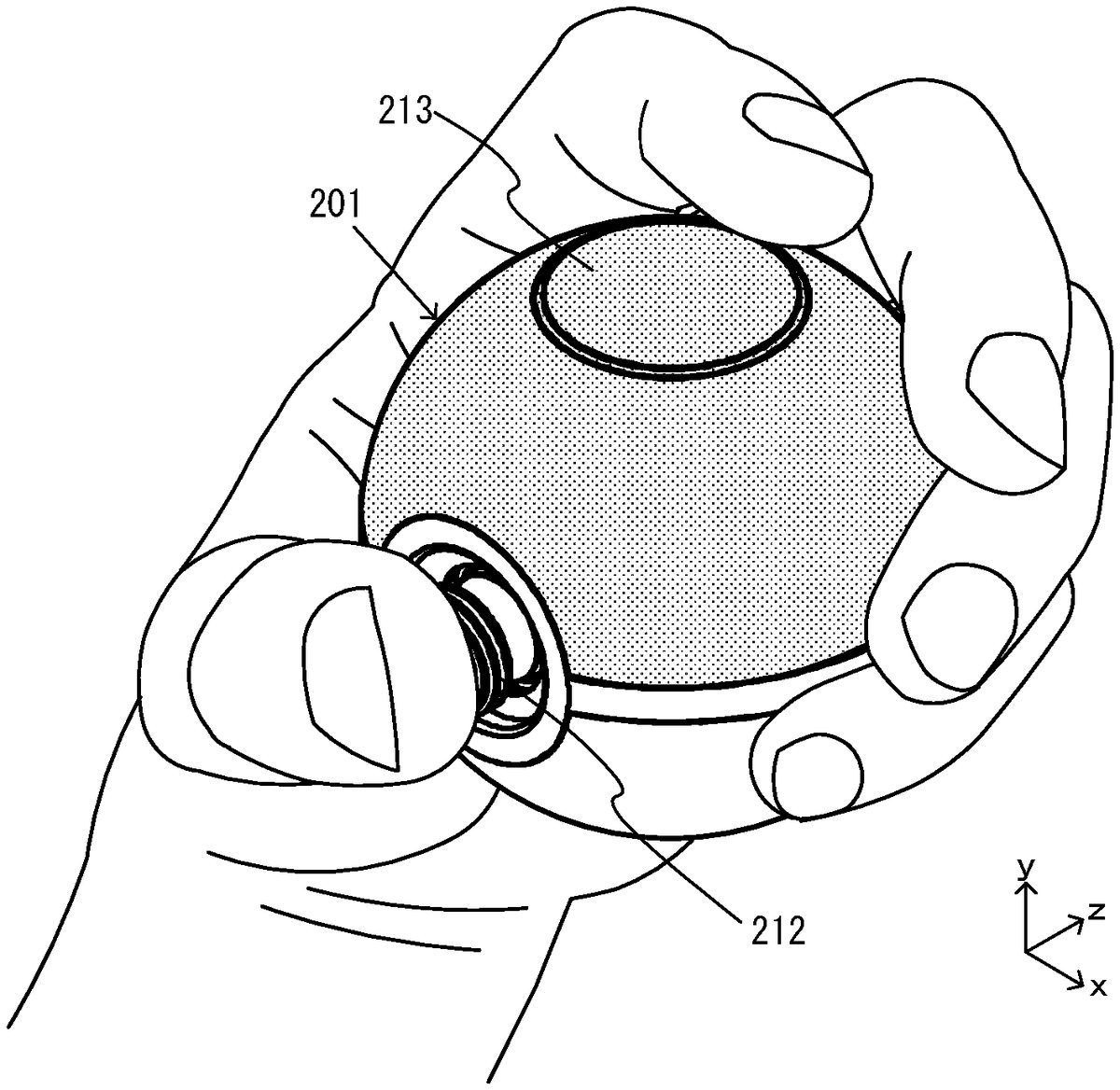
Referring toFIG. 12andFIG. 13, the positional relationship between the joystick212and the operation surface213will now be described.FIG. 12is a diagram showing an example of how the controller main body is held by the user. As shown inFIG. 12, the user, while holding the controller main body201in one hand, is allowed to operate the joystick212with the thumb and operate the operation surface213with the index finger. Note thatFIG. 12shows an example where the controller main body201is held in the left hand of the user. Note however that also when the controller main body201is held in the right hand by the user, the user is similarly allowed to operate the joystick212with the thumb of the right hand and operate the operation surface213with the index finger of the right hand.
As described above, in the exemplary embodiment, the operation surface213is provided that is capable of being depressed. Then, the user can use the game controller having a spherical outer shape both to make a direction input using the joystick and to depress the operation surface213. Thus, it is possible to perform various operations using the game controller having a spherical outer shape.
FIG. 13is a diagram showing an example of the positional relationship between the joystick and the operation surface. As shown inFIG. 13, in the exemplary embodiment, the operation surface213is provided at a position where the straight line L3passing through the center C of the housing211and the operation surface213substantially orthogonally crosses the straight line L4passing through the center C and the joystick212.
According to the description above, the user can easily operate the joystick212and the operation surface213with two fingers (e.g., the thumb and the index finger) of one hand. Specifically, in the exemplary embodiment, the user is allowed to hold the controller main body201so that the thumb for operating the joystick212and the index finger for operating the operation surface213can both easily be bent toward the center C of the housing211(seeFIG. 12). Therefore, since the user can easily apply force on the joystick212and the operation surface213, the user can easily operate the joystick212and the operation surface213.
The “straight line passing through the operation surface213” is the straight line L3that passes through the center of the operation surface213(seeFIG. 13). The “straight line passing through the joystick212” is the straight line L4that passes through the center of the operation surface252cof the joystick212. Note that the operation surface252cis a surface on the front side (in other words, the tip side) of the shaft portion (more specifically, the tip portion252b) of the joystick212, the details of which will be described later.
Note that it can also be said that the operation surface213is provided at such a position that the operation surface213crosses the orthogonal straight line that passes through the center C of the housing211and that is substantially orthogonal to the straight line L4that passes through the center C and the joystick212. Thus, the operation surface213may be provided not only at such a position that the center of the operation surface213is aligned with the orthogonal straight line in a strict sense, but may also be provided so that the orthogonal straight line crosses the operation surface213at any position of the operation surface213, for example. Also in such a case, the user can easily operate the joystick212and the operation surface213.
In the exemplary embodiment, it can be said that the operation surface213is provided at such a position that the direction from the center C of the housing211toward the operation surface213substantially coincides with the “up input direction” (in other words, provided at a position through which the straight line extending from the center C of the housing211in the up input direction passes). Herein, the “up input direction” is the direction in which the shaft portion of the joystick212is tilted in order to give an up instruction (seeFIG. 13). More specifically, the “up input direction” is the direction in which the shaft portion of the joystick212is tilted in order to give an up instruction in a state where no operation is being performed on the joystick212. That is, in the exemplary embodiment, the “up input direction” is a direction that is perpendicular to the direction from the center of the operation surface252cof the joystick212toward the center C of the housing211. Note that in a game application in which operations are performed by using the spherical controller200, for example, an instruction to move up an object (e.g., a game character or a cursor) displayed on the screen can be said to be an “up instruction”. Specifically, in the exemplary embodiment, the “up input direction” is the up direction described above. Note that the “down input direction”, the “left input direction” and the “right input direction” are defined in a similar manner to the “up input direction”.
According to the description above, the operation surface213is provided in the direction in which the joystick212is tilted to make an up direction. Thus, the operation surface213can be arranged at such a position that the operation surface213can be operated with the index finger in a case where the joystick212is operated with the thumb. That is, it is possible to improve the operability of the joystick212and the operation surface213.
FIG. 14is a diagram showing an example of the positional relationship between the joystick and the operation surface. As shown inFIG. 14, it can also be said that the operation surface213is provided on the side of the up input direction relative to the joystick212(i.e., above the dotted line shown inFIG. 14) in the exemplary embodiment. In other embodiments, the operation surface213may be provided at a position that is not the upper end of the controller main body201as in the exemplary embodiment but that is on the side of the “up input direction” relative to the joystick. Then, in a case where the joystick212is operated with the thumb, the user can easily operate the operation surface213with a finger other than the thumb (e.g., the index finger or the middle finger). Therefore, as the operation surface213is provided on the side of the up input direction relative to the joystick, it is possible to improve the operability of the joystick212and the operation surface213.
In the exemplary embodiment, the operation surface213is capable of being depressed in a direction that is substantially opposite to the up input direction (i.e., the down direction). That is, in the exemplary embodiment, the direction in which the shaft portion is tilted in order to given an up instruction using the joystick212is substantially opposite to the direction in which the operation surface213is depressed. Thus, it is possible to realize a configuration such that the operation surface213can be depressed easily.
Note that the “direction substantially opposite to the up input direction” does not need to be the “direction substantially opposite to the up input direction” in a strict sense, but means to include a direction that generally coincides with the “direction substantially opposite to the up input direction”. Note that in the exemplary embodiment, in response to being depressed, the operation surface213is deformed while moving downward as a whole, the details of which will be described later. A key top235to be described later pivots in response to the operation surface213being depressed. Thus, even in an embodiment where the operation surface213and/or the key top235does not move in the “direction opposite to the up input direction” in a strict sense, it can be said that the operation surface213“is capable of being depressed in a direction that is substantially opposite to the up input direction”.
As shown inFIG. 13, in the exemplary embodiment, at least a portion (the front half in the exemplary embodiment) of the operation surface213is located on the side of the joystick212relative to the plane P1that includes the center C of the housing211and that is perpendicular to the direction from the joystick212toward the center C of the housing211(specifically, the direction from the center of the operation surface252cof the joystick212toward the center C of the housing211). Then, the operation surface213can be arranged at such a position that the operation surface213can be easily operated with the index finger in a case where the joystick212is operated with the thumb, and it is therefore possible to improve the operability of the joystick212and the operation surface213. Note that in other embodiments, the operation surface213may be provided at any position on the side of the joystick212relative to the plane P1. In other embodiments, the operation surface213may be provided at a position that is on the opposite side from the joystick212relative to the plane P1.
In the exemplary embodiment, the joystick212is provided between the upper housing part221and the lower housing part223(i.e., in the middle housing part222) on the surface of the housing211, and the operation surface213is provided near the zenith of the upper housing part221(in other words, near the center of the surface of the upper housing part). In other words, the joystick212is positioned at the boundary (e.g., the middle housing part222) between the first hemispherical portion (e.g., the upper housing part221) and the second hemispherical portion (e.g., the lower housing part223) of the spherical housing211, and the operation surface213is provided at the zenith, which is the apex of the first hemispherical portion. According to the description above, it is possible to realize an arrangement such that the joystick212and the operation surface213can be operated easily with the thumb and the index finger as described above. Note that the “zenith” of a hemisphere refers to a point where a vertical line extended from the center of the hemisphere (i.e., the center of a sphere which the hemisphere is a part of) crosses the spherical surface of the hemisphere when the hemisphere is placed on a horizontal surface with the bottom surface facing down (note however that “zenith” may be referred to simply as “apex”).
Herein, the “boundary between the first hemispherical portion and the second hemispherical portion” in the exemplary embodiment refers to a component (e.g., the middle housing part222) provided between the first hemispherical portion (e.g., the upper housing part221) and the second hemispherical portion (e.g., the lower housing part223). Thus, the boundary between the first hemispherical portion and the second hemispherical portion may be a section having a certain area. Note however that the boundary is not limited to a component provided between two hemispherical portions. For example, in other embodiments, the boundary may be a seam between the two hemispherical portions, or a line on the housing211(e.g., a line drawn on the housing).
Note that there is no limitation on the position of the operation surface213, and in other embodiments, the operation surface213may be provided at any other position on the upper portion of the housing211(i.e., the upper housing part221) or may be provided on the lower portion of the housing211(i.e., the lower housing part223).
As shown inFIG. 11, an indication211bindicating the position of the operation surface213is provided on the housing211in the exemplary embodiment. In the exemplary embodiment, the indication211bindicates the position corresponding to the outer circumference of the operation surface213. Specifically, the indication211bis provided around the boundary between the housing211and the operation surface213. Note that the indication211bmay be provided on the housing211or on the operation surface213. According to the exemplary embodiment, the indication211ballows the user to recognize a region of the housing211to be the operation surface213(i.e., a region that can be depressed).
In the exemplary embodiment, the indication211bis a line of groove (in other words, depression) formed on the surface of the housing211. Note however that the indication211bmay be any indication with which the user can identify the position of the operation surface213. Note that in other embodiments, the indication211bmay be a projection (or a depression) provided at the center of the operation surface213, for example. Thus, by forming a projection and/or a depression on the surface of the housing211as the indication, the user can tactilely know the position of the operation surface213. Note that in other embodiments, the indication211bmay indicate the region of the operation surface213by using a color that is different from the color of the region of the housing211other than the operation surface213. Note however that in other embodiments, the indication211bmay be drawn with a paint on the surface of the housing211. In this way, as in the exemplary embodiment, the indication211ballows the user to recognize the region of the housing211to be the operation surface213(i.e., the region that can be depressed).
(Strap Hole)
As shown in (f) ofFIG. 10, a strap hole211cto which the strap portion202is attached is provided in the rear end portion of the housing211. The position of the strap hole211cis at the center of the spherical controller main body201with respect to the up-down direction and the left-right direction (see (f) ofFIG. 10). The strap portion202is attached to the controller main body201by passing the strap chord of the strap portion202through the strap hole211c, the details of which will be described later. Note that in other embodiments, there is no limitation on the position of the strap hole211c, and the strap hole211cmay be provided at any position on the rear side of the housing211or may be provided in the lower end portion of the housing211, for example.
(Reboot Button)
The controller main body201includes the reboot button214. The reboot button214is a button for giving an instruction to reboot the spherical controller200, the details of which will be described later.
As shown in (c) and (f) ofFIG. 10, the reboot button214is provided at a position that is on the left side of the rear end of the housing211. The position in the up-down direction of the reboot button214is at the center of the spherical controller main body201. The position in the front-rear direction of the reboot button214is on the rear side relative to the center of the spherical controller main body201. Note that in other embodiments, there is no limitation on the position of the reboot button214, and the reboot button214may be provided at any position on the rear side of the housing211, for example.
(Cover Portion)
As shown in (f) ofFIG. 10, a cover portion215is provided under the strap hole211cof the housing211. The cover portion215can be opened/closed relative to the portion of the controller main body201other than the cover portion215, the details of which will be described later. A recessed surface (i.e., a recessed surface245dshown inFIG. 20) is provided on the inside of the cover portion215, the details of which will be described later. The cover portion215is provided so as to cover the recessed surface when the cover portion215is in the closed position. On the other hand, when the cover portion215is in the open position, the recessed surface is exposed to the outside of the controller main body201. As shown in (b), (c) and (e) ofFIG. 10, the surface of the cover portion215is a spherical surface forming a part of the spherical surface of the spherical controller main body201. Therefore, it can also be said that the cover portion215is a part of the housing211.
[2-2. Internal Configuration of Controller Main Body]
Next, an internal configuration of the controller main body201will be described. In the exemplary embodiment, the controller main body201is composed of an upper unit including the upper housing part221described above, a middle unit including the middle housing part222described above, and lower unit including the lower housing part223described above (seeFIG. 24andFIG. 25to be discussed later). The internal configuration will now be described for each unit.
[2-2-1. Upper Unit]
FIG. 15andFIG. 16are exploded perspective views of an example of an upper unit.FIG. 15is an exploded perspective view as the upper unit is seen from the upper front side, andFIG. 16is an exploded perspective view as the upper unit is seen from the lower rear side.FIG. 17is a cross-sectional view of an example of an upper unit.FIG. 17is a cross-sectional view showing a cross section that passes through the center of the controller main body201and is perpendicular to the left-right direction.
(Upper Housing Part)
As shown inFIG. 15andFIG. 16, an upper unit230includes the upper housing part221. As described above, the upper housing part221has a hemispherical shape. Note that as shown inFIG. 16, the upper housing part221is open on the lower side thereof, and does not have a surface that corresponds to the bottom surface of the hemisphere. Therefore, it can also be said that the upper housing part221has a hemispherical surface shape. It can also be said that the upper housing part221has a shape of a spherical cap (i.e., a side surface portion of a solid obtained by cutting a sphere along a plane (i.e., a spherical segment)).
As shown inFIG. 15andFIG. 16, in the exemplary embodiment, the upper housing part221has a hemispherical shape with a front end portion thereof cut off. Specifically, the upper housing part221has a hemispherical shape with a front end portion thereof cut off along a plane that is perpendicular to the front-rear direction. The upper housing part221has an edge221athat is the circumference of the bottom surface of the hemisphere, and an edge221bthat is produced by cutting off the front end portion of the hemispherical surface along the plane described above. The edge221bdefines a shape that appears to be semicircular as the upper housing part221is seen from the front side. Note that the shape of the cutout of the upper housing part221is a shape corresponding to the shape of the front end surface described above of the middle housing part222(specifically, a shape that substantially coincides with the upper edge of the front end surface), and specifically the shape is semicircular. Note however that there is no limitation on the shape of the cutout, and the shape may be any shape other than semicircular in other embodiments.
As shown inFIG. 16andFIG. 17, the upper housing part221has an outer surface portion231and an inner wall portion232. The outer surface portion231is a component that forms the outer surface of the upper housing part221. That is, the outer surface portion231has a hemispherical shape as does the upper housing part221. In the exemplary embodiment, the outer surface portion231is integral with the operation surface213. As does the upper housing part221, the outer surface portion231has a shape obtained by cutting off a front end portion of the hemispherical surface.
In the exemplary embodiment, the outer surface portion231is made of a material that is relatively soft (specifically, softer than the inner wall portion232or softer than the middle housing part222). Specifically, the material of the outer surface portion231in the exemplary embodiment is an elastomer. The operation surface213that is integral with the outer surface portion231is also made of the same material as the outer surface portion231. Note that in the exemplary embodiment, an outer surface portion272forming the surface of the lower housing part223is also made of an elastic material as is the outer surface portion231, the details of which will be described later. Thus, in the exemplary embodiment, at least a portion of the surface of the housing211is made of an elastic material, making it easier for the user to hold the housing211. This also improves the feel when the user holds the housing211. This also makes it easier to absorb a shock on the controller main body201, and it is possible to reduce the influence of the shock reaching the components inside of the housing211.
As shown inFIG. 16andFIG. 17, the inner wall portion232is a component that forms the inner wall of the upper housing part221. The inner wall portion232has a hemispherical shape as does the upper housing part221. More specifically, as does the upper housing part221, the inner wall portion232has a shape obtained by cutting off a front end portion of the hemispherical surface. In the exemplary embodiment, the inner wall portion232is made of a material that is harder than the outer surface portion231. For example, the material of the inner wall portion232is a resin that is harder than the elastomer of the outer surface portion231. The inner wall portion232is connected to the inner side of the outer surface portion231(seeFIG. 17). The inner wall portion232is attached to the inner side of the outer surface portion231via an adhesive or thermal fusion, for example. Note that the inner wall portion232is sized so that the outer surface of the inner wall portion232coincides with the inner surface of the outer surface portion231.
Herein, the inner wall portion232has a hole therein provided in the upper end portion of the hemispherical surface. Specifically, the inner wall portion232has a hole therein provided so as to correspond to the operation surface213. The hole in the inner wall portion232has a circular shape of substantially the same size as the circular operation surface213. Of the inner surface of the outer surface portion231and the operation surface213, the region other than the reverse side of the operation surface213is attached to the inner wall portion232, and the region on the reverse side of the operation surface213is not attached to the inner wall portion232. Therefore, since the outer surface portion231is reinforced by the inner wall portion232, the outer surface portion231does not deform significantly even when some force is applied thereto. On the other hand, the operation surface213is not reinforced by the inner wall portion232, and deforms when some force is applied thereto. For example, the operation surface213deforms by being depressed from above, and moves downward. Thus, in the exemplary embodiment, the outer surface portion231and the operation surface213are integral together and the region of the operation surface213can be depressed.
In the exemplary embodiment, the inner wall portion232is black. In the exemplary embodiment, a light-emitting section (i.e., a light-emitting section248shown inFIG. 19) is provided inside the housing211, and light is emitted through the opening211aof the housing211to the outside of the housing211, the details of which will be described later. Therefore, in the exemplary embodiment, the inner wall portion232is made of a black material so as to prevent light from the light-emitting section from passing through the inner wall portion232as much as possible.
As shown inFIG. 16, the inner wall portion232is provided with a bearing portion231a. The bearing portion231ahas a groove into which a rotation shaft235bof the key top235to be described later can be inserted.
As shown inFIG. 16andFIG. 17, the upper housing part221includes a shock absorber233. The shock absorber233is provided on a portion of the inner surface of the inner wall portion232with which the rotation shaft of the key top to be described later comes into contact, the details of which will be described later.
(Key Top)
As shown inFIG. 15toFIG. 17, the upper unit230includes the key top235. The key top235is an example of a movable portion that can move in response to the operation surface213being depressed. In the exemplary embodiment, the key top235pivots in response to the operation surface213being depressed, the details of which will be described later. Therefore, it can also be said that the key top235is an example of a pivot portion that pivots in response to the operation surface213being depressed.
As shown inFIG. 15andFIG. 17, the key top235includes a disc portion235ahaving a disc shape, and the rotation shaft235b. In the exemplary embodiment, the rotation shaft235bis provided on the front side of the disc portion235a. The key top235is provided so that it can pivot about the rotation shaft235b, the details of which will be described later. As shown inFIG. 16andFIG. 17, a protruding portion235cis provided on the lower side of the disc portion235a.
(Key Rubber)
As shown inFIG. 15, the upper unit230includes a key rubber236. The key rubber236is made of an elastic material such as a rubber, for example. The key rubber236deforms as the key top235(specifically, the protruding portion235c) moves downward, the details of which will be described later.
As shown inFIG. 15andFIG. 17, the key rubber236includes a disc portion236ahaving a disc shape. As shown inFIG. 15andFIG. 17, the key rubber236includes a cylindrical portion236bhaving a cylindrical shape provided on the upper side of the disc portion236a. The cylindrical portion236bis provided so as to extend upward from the vicinity of the center of the disc portion236a. The cylindrical portion236bis provided for the purpose of deforming the key rubber236in response to the movement of the key top235, the details of which will be described later.
As shown inFIG. 16andFIG. 17, the key rubber236includes an annular portion236cprotruding downward from the outer circumference portion of the disc portion236a. The key rubber236also includes a protruding portion236dprotruding downward from the vicinity of the center of the disc portion236a. As shown inFIG. 17, with no force applied to the key rubber236, the annular portion236cprotrudes below the protruding portion236d.
(Sub-Substrate)
As shown inFIG. 15andFIG. 16, the upper unit230includes a sub-substrate237. In the exemplary embodiment, the sub-substrate237is a plate-shaped substrate. Note however that the sub-substrate237may be a flexible print circuit board that can be bent. The sub-substrate237is provided with a contact237awhich the key rubber236comes into contact with when the operation surface213is operated, and a detection circuit for detecting the contact of the key rubber236with the contact237a, the details of which will be described later. Note that there is no limitation on the specific configuration of the contact237a. For example, the contact237amay include a movable contact that moves in response to the downward movement of the key rubber236, and a fixed contact which the movable contact comes into contact with when the movable contact moves. While a component including a movable contact and a fixed contact is referred to as a contact in the present specification, such a component can also be called a switch. As shown inFIG. 17, the sub-substrate237is also provided with an antenna291. In the exemplary embodiment, the antenna291is provided on the front side of the sub-substrate237.
(Sub-Substrate Holding Portion)
As shown inFIG. 15andFIG. 16, the upper unit230includes a sub-substrate holding portion238for holding the sub-substrate237. The sub-substrate holding portion238includes a flat upper surface to which the sub-substrate237is attached. The sub-substrate holding portion238also includes a protruding portion238aprotruding from the upper surface. The protruding portion238ais provided at the front end of the upper surface of the sub-substrate holding portion238.
(Arrangement of Components)
As shown inFIG. 15andFIG. 16, the components included in the upper unit230are arranged in the following order from top to bottom: the upper housing part221, the key top235, the key rubber236, the sub-substrate237and the sub-substrate holding portion238. In the exemplary embodiment, the components included in the upper unit230are secured by screws239(three screws239in the exemplary embodiment). Specifically, screw holes that are open on the lower side are provided on the inner surface of the inner wall portion232of the upper housing part221. The sub-substrate237and the sub-substrate holding portion238are provided with holes at positions corresponding to the screw holes. As shown inFIG. 15andFIG. 16, the screws239are screwed into the screw holes of the upper housing part221through the holes of the sub-substrate237and the holes of the sub-substrate holding portion238, thereby securing together the upper housing part221, the sub-substrate237and the sub-substrate holding portion238.
The key top235is held by being sandwiched between the upper housing part221and the sub-substrate237. Specifically, as shown inFIG. 17, the rotation shaft235bof the key top235is sandwiched between the upper housing part221and the protruding portion238aof the sub-substrate holding portion238. Thus, the rotation shaft235bis secured with respect to the up-down direction. The key top235is provided in such an orientation that the rotation shaft235bis parallel to the left-right direction. The rotation shaft235bis inserted into the groove of the bearing portion231a. The rotation shaft235bis secured with respect to the left-right direction by this groove. Thus, the key top235is held so that the key top235can pivot about the rotation shaft235bwith respect to the upper housing part221.
Note that in the exemplary embodiment, the shock absorber233is provided on a portion of the inner surface of the upper housing part221where the rotation shaft235bcomes into contact. Therefore, the rotation shaft235bsandwiched between the upper housing part221and the sub-substrate237is held while pressing and deforming the shock absorber233. Thus, it is possible to reduce the rattling of the rotation shaft235b.
As shown inFIG. 17, the key top235is provided on the inner side of the upper housing part221. The upper surface of the disc portion235aof the key top235is in contact with the reverse side of the operation surface213, which is continuous with the outer surface portion231of the upper housing part221.
As shown inFIG. 15, the key rubber236is attached under the key top235. The key rubber236is provided between the key top235and the sub-substrate237. Specifically, the protruding portion235cof the key top235is inserted into the cylindrical portion236bof the key rubber236(seeFIG. 17). Thus, the key top235and the key rubber236are connected together. Therefore, when the key top235moves, the cylindrical portion236bmoves integrally with the key top235, deforming the key rubber236. As shown inFIG. 17, the key rubber236is provided so that the annular portion236cis in contact with the sub-substrate237with the protruding portion235cinserted in the cylindrical portion236b. Note that the protruding portion236dis arranged at a position opposing the contact237aof the sub-substrate237.
Herein, while the operation surface213is not being operated (e.g., the state shown inFIG. 17), the key rubber236is kept in its original shape (i.e., un-deformed shape). That is, in this state, the annular portion236cis in contact with the sub-substrate237, and the protruding portion236dis not in contact with the contact237aof the sub-substrate237.
FIG. 18is a cross-sectional view of an example of the upper unit with the operation surface213depressed. As shown inFIG. 18, when the operation surface213is depressed, the operation surface213deforms and moves downward (see the arrow shown inFIG. 18). In response to the downward movement of the operation surface213, the key top235pivots about the rotation shaft235b, and the disc portion235amoves downward. In response to the downward movement of the disc portion235a, the key rubber236deforms, and the protruding portion236dmoves downward. As a result, the protruding portion236dcomes into contact with the contact237aof the sub-substrate237. The detection circuit of the sub-substrate237detects the contact of the protruding portion236dwith the contact237a. Thus, the spherical controller200can detect an operation performed on the operation surface213.
Note that when there is no longer a depressing operation on the operation surface213, the key rubber236returns to its original shape by its own elasticity. Thus, the protruding portion236dand the contact237aare no longer in contact with each other.
As described above, in the exemplary embodiment, the spherical controller200includes a movable portion (i.e., the key top235), a detection section (i.e., a detection circuit provided on the sub-substrate237). The movable portion can pivot about a rotation shaft (specifically, the rotation shaft235bparallel to the left-right direction) that is substantially perpendicular to the straight line that connects together the center of the housing211and the operation surface213, and pivots in response to the operation surface213being depressed. The detection section detects the operation on the operation surface213in response to the pivot of the movable portion. Therefore, according to the exemplary embodiment, no matter which part of the operation surface213is depressed, the movable portion pivots in one direction, and the detection section detects the operation based on the pivot of the movable portion. Thus, the detection section can easily detect the operation no matter which part of the operation surface213is depressed. Therefore, according to the exemplary embodiment, it is possible to reduce the possibility that the operation on the operation surface213is not detected.
In the exemplary embodiment, the rotation shaft235bof the key top235is provided on the front side of the disc portion235a(seeFIG. 17). In other words, the rotation shaft235bis provided on the front side relative to the center of the operation surface213. Therefore, it can be said that the rotation shaft235bis provided at such a position that the distance from the joystick212to the rotation shaft235bis shorter than the distance from the joystick212to the operation surface213.
By providing the rotation shaft235bat such a position, the rear side of the key top235moves farther than the front side thereof when the operation surface213is depressed. Therefore, it is easier for the user to depress a rear position of the operation surface213because the distance by which the operation surface213is depressed is greater, than to depress a front position thereof. On the other hand, assuming a case where the user operates the joystick212with the thumb and the operation surface213with the index finger (seeFIG. 12), it is believed that it is more likely that the user depresses a rear side, than a front side, relative to the center of the operation surface213. Therefore, according to the exemplary embodiment, it is made easier for the user to depress a position (i.e., a rear position) of the operation surface213that the user is more likely to operate, thus improving the operability of the depressing operation.
As described above, in the exemplary embodiment, the rotation shaft235bof the key top235is provided parallel to the left-right direction. In other embodiments, the orientation of the rotation shaft235bis not limited to the left-right direction, but may be any other orientation. For example, in other embodiments, the rotation shaft235bmay be provided to be parallel to the front-rear direction. Then, the rotation shaft235bmay be provided on the left side relative to the center of the operation surface213or may be provided on the right side relative to the center of the operation surface213. For example, when it is assumed that the spherical controller200is to be held and operated by the left hand, the rotation shaft235bmay be provided on the left side relative to the center of the operation surface213so as to make it easier for the user to depress the right side of the operation surface213. For example, when it is assumed that the spherical controller200is to be held and operated by the right hand, the rotation shaft235bmay be provided on the right side relative to the center of the operation surface213so as to make it easier for the user to depress the left side of the operation surface213.
Note that there is no limitation on the configuration for detecting the operation surface213being depressed, and it is not limited to that of the exemplary embodiment. For example, in other embodiments, the key top and the key rubber may be integral together by an elastic material, for example. In other embodiments, the spherical controller200may include no key top and no key rubber, in which case the contact237aof the sub-substrate237may be provided at such a position that the operation surface213depressed directly comes into contact with the contact237a. In other embodiments, the spherical controller200may include a movable portion that can move in parallel to the up-down direction, instead of a movable portion that can pivot (i.e., the key top235and the key rubber236).
[2-2-2. Middle Unit]
FIG. 19andFIG. 20are exploded perspective views of an example of a middle unit.FIG. 19is an exploded perspective view of the middle unit as seen from the upper front side, andFIG. 20is an exploded perspective view of the middle unit as seen from the upper rear side.FIG. 21is a cross-sectional view of the example of the middle unit.FIG. 21is a cross-sectional view showing a cross section that passes through the center of the controller main body201and is perpendicular to the left-right direction.
(Middle Housing Part)
As shown inFIG. 19toFIG. 21, a middle unit240includes the middle housing part222. The middle housing part222has a ring shape with a portion at the rear end thereof cut off. Specifically, the middle housing part222includes a front surface portion241, a left band-shaped portion242and a right band-shaped portion243.
The front surface portion241is provided in the front end portion of the middle housing part222. The front surface portion241includes a flat surface portion on the front side. The front side surface of the front surface portion241is the front end surface (i.e., the flat surface of the front end portion of the housing211). The opening211adescribed above is provided in the front end surface of the front surface portion241. Therefore, it can be said that the front surface portion241is an annular portion surrounding the opening211a. In the exemplary embodiment, the front end surface has a circular shape. Note however that in other embodiments, there is no limitation on the shape of the front end surface, and it may be a quadrilateral shape, for example.
As shown inFIG. 20, the front surface portion241includes an attachment portion241a, on the upper side of the front end surface, that extends toward the inside of the housing211. The attachment portion241ais provided with a hole for receiving therethrough a screw for securing the main substrate support portion to be described later on the middle housing part222.
The two band-shaped portions242and243are provided so as to extend from the left and right ends of the front surface portion241. That is, the left band-shaped portion242is band-shaped and is provided so as to extend from the left end of the front surface portion241. In other words, the left band-shaped portion242extends from the front surface portion241to the left input direction of the joystick212. The right band-shaped portion243is band-shaped and is provided so as to extend from the right end of the front surface portion241. In other words, the right band-shaped portion243extends from the front surface portion241to the right input direction of the joystick212. The band-shaped portions242and243each form a part of the spherical surface of the spherical housing211. Specifically, the band-shaped portions242and243are provided along the spherical zone defined by two planes perpendicular to the up-down direction running through the housing211(i.e., a band-shaped portion of a spherical surface that is defined between two parallel planes running through the spherical surface). Note that “the band-shaped portions provided along the spherical zone” means to include embodiments where the surfaces of the band-shaped portions coincide with the spherical zone and embodiments where the surfaces of the band-shaped portions do not coincide with the spherical zone in a strict sense. For example, in other embodiments, the surfaces of the band-shaped portions may not be spherical surfaces but may be curved surfaces similar to those of the side surface of a cylinder.
In the exemplary embodiment, the rear end of the left band-shaped portion242is not continuous with the rear end of the right band-shaped portion243. The space defined between the rear end of the left band-shaped portion242and the rear end of the right band-shaped portion243becomes the strap hole211cdescribed above (FIG. 10), the details of which will be described later. Holes for receiving therethrough screws for securing the main substrate support portion to be described later on the middle housing part222are provided in the band-shaped portions242and243near the rear end thereof (seeFIG. 19andFIG. 20).
As shown inFIG. 19andFIG. 20, the right band-shaped portion243includes a tab-receiving portion243a. Although not shown in the figure, the left band-shaped portion242includes a tab-receiving portion similar to the tab-receiving portion243aof the right band-shaped portion243. When the middle housing part222and the lower housing part223are connected together, the tab of the lower housing part223(i.e., a tab273eshown inFIG. 23) engages with the tab-receiving portion, the details of which will be described later. Note that while the tab-receiving portion is provided on the front side relative to the center of the controller main body201in the exemplary embodiment, there is no limitation on the position of the tab-receiving portion.
As shown inFIG. 19, the right band-shaped portion243includes a tab243b. The tab243bis provided so as to extend upward from the right band-shaped portion243and further extend toward the inside of the housing211. The left band-shaped portion242includes a tab similar to the tab243bof the right band-shaped portion243. The tab engages with a hole (i.e., a hole257cshown inFIG. 31) provided in a lightguide254, the details of which will be described later.
As shown inFIG. 20, a hole242ais provided in the left band-shaped portion242. In the exemplary embodiment, the hole242ais provided on the rear side relative to the center of the controller main body201. The hole242ais provided for exposing the reboot button214described above to the outside of the housing211.
In the exemplary embodiment, the middle housing part222is made of a material that is harder than the outer surface portion231of the upper housing part221(and the lower housing part223). For example, the material of the middle housing part222is a resin that is harder than the outer surface portion231(herein, an elastomer). Therefore, in the exemplary embodiment, the housing211includes a first portion (i.e., the middle housing part222) that is provided surrounding the joystick212, and a second portion (i.e., the upper housing part221and the lower housing part223) that is provided surrounding the first portion and whose surface is made of a material that is softer than the surface of the first portion. Then, a portion of the housing211that is around the joystick212(i.e., the first portion) is made of a hard material. Therefore, when the user is operating the joystick212, for example, it is possible to reduce the possibility that this portion is scratched or worn out by the finger of the user and/or the joystick212, for example.
The middle housing part222is made of a black material, for example, as is the inner wall portion232of the upper housing part221, so that light from the light-emitting section is prevented from passing through the middle housing part222as much as possible.
(Main Substrate Holding Portion)
As shown inFIG. 19andFIG. 20, the middle unit240includes a main substrate holding portion245. The main substrate holding portion245holds some components included in the middle unit240(e.g., a rechargeable battery244, a main substrate246, etc.).
As shown inFIG. 19andFIG. 21, the main substrate holding portion245includes a frame portion245ato which the rechargeable battery244is attached. The frame portion245ais shaped so that the rechargeable battery244can be accommodated inside the frame portion245a. Specifically, in the exemplary embodiment, the frame portion245aincludes four walls to be in contact with the side surfaces of the rechargeable battery244having a rectangular parallelepiped shape.
As shown inFIG. 19andFIG. 21, the main substrate holding portion245includes a stick attachment portion245bto which the joystick212is attached. The stick attachment portion245bis provided on the front side of the frame portion245a. The front side surface of the stick attachment portion245bis a flat surface perpendicular to the front-rear direction. A screw hole that is open on the front side is provided in the front side flat surface of the stick attachment portion245b. The screw hole is for attaching the joystick212to the main substrate holding portion245.
A screw hole that is open on the upper side is provided between the frame portion245aand the stick attachment portion245b(seeFIG. 19). The screw hole is for securing together the main substrate holding portion245and the middle housing part222.
As shown inFIG. 20, the main substrate holding portion245includes a strap attachment shaft245cto which the strap portion202is attached. The strap attachment shaft245cis provided on the rear side of the frame portion245a. The strap attachment shaft245chas a tubular shape extending in the up-down direction. The hole provided at the center of the strap attachment shaft245cis for receiving therethrough a screw for securing together the main substrate holding portion245and the upper housing part221, the details of which will be described later. As described above, the strap portion202can be attached to the controller main body201by passing the strap chord of the strap portion202around the strap attachment shaft245c.
Note that on the rear side of the frame portion245a, screw holes that are open on the upper side are provided on the opposite (left and right) sides of the strap attachment shaft245c(seeFIG. 20). The screw holes are for securing together the main substrate holding portion245and the middle housing part222.
As shown inFIG. 20andFIG. 21, the main substrate holding portion245has the recessed surface245d. The recessed surface245dis provided on the rear side of the frame portion245aand on the lower side of the strap attachment shaft245c. In the exemplary embodiment, the recessed surface245dis provided so as to be substantially perpendicular to the front-rear direction. The recessed surface245dis provided with a hole through which the charging terminal provided on the main substrate246is exposed to the outside of the recessed surface245d(seeFIG. 29), the details of which will be described later. The recessed surface245dis also provided with a hole for receiving therethrough a screw for securing together the main substrate holding portion245and the lower housing part223(seeFIG. 26). Moreover, the recessed surface245dis provided with an attachment hole (i.e., a hole245fshown inFIG. 29) for the attachment of the cover portion215described above (seeFIG. 10).
As shown inFIG. 20, the main substrate holding portion245includes a detection circuit attachment portion245eto which a button detection section258to be described later is attached. The detection circuit attachment portion245eis provided at a position on the outer surface of the frame portion245athat corresponds to the hole242aof the middle housing part222. The detection circuit attachment portion245eis provided at the rear left corner on the outer surface of the frame portion245a.
As shown inFIG. 19andFIG. 20, the main substrate holding portion245is secured on the middle housing part222. The main substrate holding portion245is provided at such a position that the main substrate holding portion245is surrounded by the annular middle housing part222. In the exemplary embodiment, the main substrate holding portion245and the middle housing part222are secured together by screws261(three screws261in the exemplary embodiment). As described above, three screw holes that are open on the upper side are provided in the main substrate holding portion245. The middle housing part222is provided with holes at positions corresponding to the screw holes. As shown inFIG. 19andFIG. 20, the middle housing part222and the main substrate holding portion245are secured together by screwing the screws261into the screw holes of the main substrate holding portion245through the holes of the middle housing part222.
(Rechargeable Battery)
As shown inFIG. 19toFIG. 21, the middle unit240includes the rechargeable battery244. The rechargeable battery244supplies power to the electronic components of the spherical controller200. The rechargeable battery244is electrically connected to the main substrate246to be described later. The rechargeable battery244is provided in the frame portion245aof the main substrate holding portion245. The rechargeable battery244is secured on the frame portion245aby a double-side tape, an adhesive, or the like, for example.
(Main Substrate)
As shown inFIG. 19toFIG. 21, the middle unit240includes the main substrate246. In the exemplary embodiment, the main substrate246is a plate-shaped substrate. Note however that the main substrate246may be a flexible print circuit board that can be bent.
An acceleration sensor247is provided on the main substrate246(seeFIG. 19). The acceleration sensor247is an example of an inertia sensor and senses movement and rotation about three axis directions (specifically, the up-down direction, the left-right direction and the front-rear direction). In other embodiments, a gyrosensor may be provided as an example of an inertia sensor. The acceleration sensor247is provided in the vicinity of the center of the upper surface of the main substrate246so that the acceleration sensor247is arranged in the vicinity of the center of the controller main body201(seeFIG. 19andFIG. 21), the details of which will be described later.
A light-emitting section for emitting light is provided on the main substrate246. In the exemplary embodiment, the spherical controller200includes two light-emitting sections248aand248b(seeFIG. 19). Specifically, the left light-emitting section248ais provided near the left end of the upper surface of the main substrate246, and the other, right light-emitting section248bis provided near the end of the upper surface of the main substrate246. Note that in the present specification, the left light-emitting section248aand the right light-emitting section248bmay be referred to collectively as “the light-emitting section248”. In the exemplary embodiment, the light-emitting sections248are each provided on the outer side of the joystick212with respect to the left-right direction. That is, the light-emitting sections248are provided at such positions that they do not overlap the joystick212as seen from the front-rear direction.
A charging terminal249is provided on the main substrate246(seeFIG. 20). The charging terminal249is a terminal for receiving power supply for charging the rechargeable battery244from outside the spherical controller200. In the exemplary embodiment, the charging terminal249is provided at the rear end of the lower surface of the main substrate246. The charging terminal249is provided so that the rear end of the charging terminal249protrudes from the rear end of the main substrate246.
Although not shown in the figures, a control section (in other words, a processor) for controlling the operation of the spherical controller200is provided on the main substrate246. Holes for receiving therethrough screws for securing the main substrate246on the main substrate holding portion245are provided in the main substrate246(seeFIG. 19andFIG. 20).
As shown inFIG. 19toFIG. 21, the main substrate246is provided on the lower side of the main substrate holding portion245. In the exemplary embodiment, the main substrate246and the main substrate holding portion245are secured together by screws262(three screws262in the exemplary embodiment). Specifically, screw holes that are open on the lower side are provided on the lower side of the main substrate holding portion245. As described above, holes are provided in the main substrate246at positions corresponding to the screw holes. As shown inFIG. 19toFIG. 21, the screws262are screwed into the screw holes of the main substrate holding portion245through the holes of the main substrate246, thereby securing together the main substrate246and the main substrate holding portion245.
As shown inFIG. 21, with the main substrate246secured on the main substrate holding portion245, the charging terminal249is exposed through the hole in the recessed surface245dof the main substrate holding portion245. As shown inFIG. 21, the rear end of the charging terminal249is provided so as not to protrude past the recessed surface245d(i.e., on the front side relative to the recessed surface245d).
(Joystick)
As shown inFIG. 19andFIG. 20, the middle unit240includes the joystick212described above. The joystick212includes a base portion251and the shaft portion252. The base portion251has a rectangular parallelepiped shape, and the shaft portion252is provided on the front side of the base portion251. As shown inFIG. 21, the shaft portion252includes a rod-shaped portion252aand the tip portion252b. Specifically, the rod-shaped portion252ahas a rod-like shape extending in the front-rear direction, and is connected to the base portion251on the rear end. The tip portion252bhas a disc shape and is provided on the front end of the rod-shaped portion252a. The front side surface of the tip portion252bis the operation surface of the joystick212(i.e., the operation surface252cshown inFIG. 13). Note that while the shaft portion252is not operated, the tip portion252bis arranged so that the operation surface is substantially perpendicular to the front-rear direction. The shaft portion252is provided so that the shaft portion252can be tilted with respect to the base portion251in response to a tilt operation by the user. The shaft portion252is provided so that the shaft portion252can move in response to the push-in operation by the user. Note that the configuration of the joystick212may be similar to those of conventional analog stick units.
As shown inFIG. 19toFIG. 21, the joystick212is provided on the front side of the main substrate holding portion245. Specifically, the joystick212is attached to the stick attachment portion245bof the main substrate holding portion245. In the exemplary embodiment, the joystick212and the main substrate holding portion245are secured together by screws263(two screws263in the exemplary embodiment). As described above, screw holes that are open on the front side are provided in the stick attachment portion245b. Holes are provided in the base portion251of the joystick212at positions corresponding to the screw holes. As shown in FIG.19andFIG. 20, the screws263are screwed into the screw holes of the stick attachment portion245bthrough the holes of the base portion251, thereby securing together the joystick212and the main substrate holding portion245.
In the exemplary embodiment, the joystick212is attached in such an orientation that the rear surface of the base portion251opposes the stick attachment portion245b. Therefore, the joystick212is provided so that the shaft portion252(specifically, the axial direction of the shaft portion252or the operation surface of the tip portion252b) is facing in the front direction as shown inFIG. 19. The joystick212is provided so that the rod-shaped portion252ais substantially parallel to the front-rear direction while the shaft portion252is not being operated (seeFIG. 21).
As described above, the shaft portion252of the joystick212is provided so as to be oriented substantially toward the center of the housing211while the shaft portion252is not being operated. Then, it is easy for the user to apply force on the joystick212, making it easier for the user to operate the joystick212. Moreover, in the exemplary embodiment, the shaft portion252of the joystick212is capable of being depressed along the axial direction of the shaft portion252. Therefore, in the exemplary embodiment, it is made easy to perform the operation of depressing the shaft portion252, in addition to the direction input operation. That is, it is possible to improve the operability of the joystick212.
(Lightguide, Etc.)
As shown inFIG. 19toFIG. 21, the middle unit240includes a reflective portion253, the lightguide254and a diffusion sheet255. These members253to255are for guiding light emitted from the light-emitting section248to output the light through the opening211aof the housing211.
The lightguide254is made of a transparent material, and functions as a lightguide that receives light emitted from the light-emitting section248on the light-receiving surface to output the light having passed through the inside of the lightguide254from the light-exiting surface. Specifically, the lightguide254includes a plate-shaped surrounding portion256with a hole provided at the center. The surrounding portion256is provided surrounding the joystick212. In the exemplary embodiment, the front surface of the surrounding portion256functions as the light-exiting surface. The lightguide254includes two extended portions257. The left extended portion257ais provided so as to extend from the left end of the surrounding portion256, and the other right extended portion257bis provided so as to extend from the right end of the surrounding portion256. Note that in the present specification, the left extended portion257aand the right extended portion257bmay be referred to collectively as “the extended portion257”. The tips of the extended portions257extended from the surrounding portion256each function as a light-receiving surface. Note that the lightguide254will be described in detail in “[2-3. Configuration related to light emission]” below.
The reflective portion253has an annular shape, and is made of a white material. The reflective portion253is provided on the rear side of the surrounding portion256of the lightguide254(in other words, the reverse side of the light-exiting surface) so as to reflect light output from the reverse side of the light-exiting surface so that more light is output from the light-exiting surface, the details of which will be described later. In the exemplary embodiment, the reflective portion253is made of a microcell polymer sheet, and functions also as a shock absorber.
The diffusion sheet255is made of a translucent sheet material, and has a property of diffusing light that passes through the diffusion sheet255. Note that the diffusion sheet255is a thin sheet, and the diffusion sheet255is not shown in the cross-sectional view ofFIG. 21. The diffusion sheet255diffuses light output from the light-exiting surface of the lightguide254to output the diffused light forward. In the exemplary embodiment, the diffusion sheet255has an annular shape. The diffusion sheet255is provided surrounding the hole provided in the light-exiting surface of the lightguide254.
As shown inFIG. 19toFIG. 21, the reflective portion253, the lightguide254and the diffusion sheet255are provided on the front side of the base portion251of the joystick212. Specifically, the reflective portion253is provided in front of the base portion251, the surrounding portion256of the lightguide254is provided in front of the reflective portion253, and the diffusion sheet255is provided in front of the surrounding portion256. As shown inFIG. 21, the reflective portion253, the surrounding portion256and the diffusion sheet255is secured sandwiched between the base portion251and the front surface portion241of the middle housing part222. Therefore, the reflective portion253and the surrounding portion256are in contact with each other, and the surrounding portion256and the diffusion sheet255are in contact with each other.
The reflective portion253, the surrounding portion256and the diffusion sheet255are each arranged so that the shaft portion252passes through the hole provided therein. Thus, the reflective portion253, the surrounding portion256and the diffusion sheet255are provided surrounding the shaft portion252. In the exemplary embodiment, the diffusion sheet255provided surrounding the shaft portion252(and the surrounding portion256and the reflective portion253rearward thereof) is visually recognizable through the opening211a, as the controller main body201is seen from the front side, the details of which will be described later.
Note that in the exemplary embodiment, the surrounding portion256(this similarly applies also to the reflective portion253and the diffusion sheet255) is provided extending along the entire circumference of the joystick212. Herein, in other embodiments, the surrounding portion256does not need to be provided so as to completely surround the entire circumference of the joystick212. For example, in other embodiments, the surrounding portion256(this similarly applies also to the reflective portion253and the diffusion sheet255) may have an annular shape with a portion thereof cut off.
FIG. 22is a perspective view showing an example of a positional relationship between the middle housing part, the lightguide and the main substrate. Note thatFIG. 22does not show a part of the middle housing part for the purpose of making it easier to see the positional relationship between these components. As shown inFIG. 22, the light-receiving surface at the tip of the right extended portion257bof the lightguide254is provided in the vicinity of (specifically, directly above) the right light-emitting section248bprovided on the main substrate246. Similarly, the light-receiving surface at the tip of the left extended portion257aof the lightguide254is provided in the vicinity of (specifically, directly above) the left light-emitting section248aprovided on the main substrate246.
As shown inFIG. 22, a hole257dis provided in the right extended portion257b. With the lightguide254attached to the middle housing part222, the tab243bprovided on the right band-shaped portion243of the middle housing part222engages with the hole257d. As with the right extended portion257b, a hole (the hole257cshown inFIG. 31to be discussed later) is provided also in the left extended portion257a. With the lightguide254attached to the middle housing part222, the tab provided on the left band-shaped portion242of the middle housing part222engages with the hole. Thus, the lightguide254is provided so that tabs engage with the holes of the respective extended portions257. With the tabs engaging with the holes, the lightguide254can be secured firmly.
(Reboot Button)
As shown inFIG. 20, the middle unit240includes the reboot button214described above. The reboot button214is made of an elastic material such as a rubber, for example, and can deform in response to the operation surface thereof being depressed. The reboot button214is provided so that the operation surface thereof is exposed through the hole242aof the middle housing part222(see (f) ofFIG. 10). Note that in the exemplary embodiment, the reboot button214is provided so that the operation surface thereof is recessed from the surface of the middle housing part222.
The middle unit240includes the button detection section258for detecting a depressing operation on the reboot button214. Although not shown in the figures, the button detection section258is provided with a contact for detecting an operation on the reboot button214, and a detection circuit for detecting the reboot button214coming into contact with the contact. The button detection section258is attached to the detection circuit attachment portion245eof the main substrate holding portion245.
The button detection section258is provided on the inner side of the reboot button214. Specifically, the button detection section258is arranged so that the contact is located on the reverse side from the operation surface of the reboot button214. Therefore, when the reboot button214deforms in response to a depressing operation on the reboot button214, a portion of the reboot button214comes into contact with the contact of the button detection section258. The detection circuit of the button detection section258detects the reboot button214coming into contact with the contact. Although not shown in the figures, the detection circuit of the button detection section258is electrically connected to the main substrate246.
(Cover Portion)
As shown inFIG. 19toFIG. 21, the middle unit240includes the cover portion215described above. In the exemplary embodiment, as is the outer surface portion of the upper housing part221and the lower housing part223, the cover portion215is made of a material (e.g., an elastomer similar to that of the outer surface portion) that is softer than the middle housing part222.
As shown inFIG. 19andFIG. 20, the cover portion215includes a surface which forms a part of a spherical shape, and a rod-shaped portion259provided on the reverse side of the surface. When the cover portion215is attached to the main substrate holding portion245, the rod-shaped portion259is inserted into the attachment hole (i.e., the hole245fshown inFIG. 29) provided in the recessed surface245dof the main substrate holding portion245. Note that the tip portion of the rod-shaped portion259is slightly thicker than the other portion other than the tip portion. Therefore, the rod-shaped portion259having been inserted in the attachment hole does not come off the attachment hole with a force that is not so strong. The cover portion215is attached so as to cover the recessed surface245dwith the rod-shaped portion259inserted in the attachment hole.
[2-2-3. Lower Unit]
FIG. 23is an exploded perspective view of an example of a lower unit.FIG. 23is an exploded perspective view of a lower unit270as seen from the upper front side.
(Lower Housing Part)
As shown inFIG. 23, the lower unit270includes the lower housing part223. As described above, the lower housing part223has a hemispherical shape as does the upper housing part221. As shown inFIG. 23, the lower housing part223is open on the upper side and does not have a surface that corresponds to the bottom surface of the hemisphere. Therefore, it can also be said that the lower housing part223has a hemispherical surface shape. It can also be said that the lower housing part223has a spherical cap shape as does the upper housing part221.
As shown inFIG. 23, in the exemplary embodiment, the lower housing part223has a hemispherical shape with a front end portion thereof cut off. Specifically, the lower housing part223has a hemispherical shape with a front end portion thereof cut off along a plane that is perpendicular to the front-rear direction. That is, the lower housing part223has an edge223athat is the circumference of the bottom surface of the hemisphere, and an edge223bthat is produced by cutting off the front end portion of the hemispherical surface along the plane described above. The edge223bdefines a shape that appears to be semicircular as the lower housing part223is seen from the front side. Note that the shape of the cutout of the lower housing part223is a shape corresponding to the shape of the front end surface described above of the middle housing part222(specifically, a shape that substantially coincides with the lower edge of the front end surface), and specifically the shape is semicircular. Note however that there is no limitation on the shape of the cutout, and the shape may be any shape other than semicircular in other embodiments.
The lower housing part223has a hemispherical shape with a rear end portion thereof cut off as well as a front end portion thereof. Therefore, the lower housing part223has an edge223cthat is produced by cutting off the rear end portion. The shape of the cutout of the rear end portion substantially coincides with the shape of the surface of the cover portion215. That is, the cover portion215is provided so as to cover the cutout portion of the rear end of the lower housing part223.
As shown inFIG. 23, the lower housing part223includes the outer surface portion272and an inner wall portion273, as does the upper housing part221. The outer surface portion272is a component that forms the outer surface of the lower housing part223. The inner wall portion273is a component that forms the inner wall of the lower housing part223. The outer surface portion272and the inner wall portion273each have a hemispherical shape similar to the lower housing part223, and each have a hemispherical shape with a front end portion thereof and a rear end portion thereof cut off as does the lower housing part223. The inner wall portion273is connected to the inner side of the outer surface portion272. For example, the inner wall portion273is attached to the inner side of the outer surface portion272via an adhesive. Note that the inner wall portion273is sized so that the outer surface of the inner wall portion273coincides with the inner surface of the outer surface portion272.
The outer surface portion272of the lower housing part223is made of an elastic material that is softer than the middle housing part222and the inner wall portion273(e.g., an elastomer) as is the outer surface portion231of the upper housing part221. The inner wall portion273of the lower housing part223is made of a material that is harder than the outer surface portion272(e.g., a resin) as is the inner wall portion232of the upper housing part221.
As is the inner wall portion232of the upper housing part221, the inner wall portion273is made of a black material, for example, so as to prevent light from the light-emitting section248from passing through the inner wall portion273as much as possible.
As shown inFIG. 23, the inner wall portion273is provided with ribs273a. The ribs273aare provided so as to protrude relative to the inner wall of the spherical surface of the lower housing part223. Note that the ribs273aare provided so as not to come into contact with a vibrating section271(in other words, so as to avoid the position of the vibrating section271). Note that there is no limitation on the position and the number of the ribs273a. With the provision of the ribs273a, the mechanical strength (in other words, rigidity) of the lower housing part223can be improved.
Note that in the exemplary embodiment, the number of ribs provided on the inner wall of the upper housing part221is smaller than the number of ribs provided on the inner wall of the lower housing part223(this means to include embodiments where there are no ribs on the inner wall of the upper housing part221). For the upper housing part221, the sub-substrate237and the sub-substrate holding portion238may be secured on the upper housing part221, thereby improving the mechanical strength of the upper housing part221. That is, in the exemplary embodiment, by providing fewer ribs on the upper housing part221than on the lower housing part223, more components can be accommodated therein, and the components accommodated therein (i.e., the sub-substrate237and the sub-substrate holding portion238) can be secured on the upper housing part221, thereby improving the mechanical strength.
As shown inFIG. 23, vibrating section attachment portions273bare provided on the inner wall portion273. Note that whileFIG. 23only shows two vibrating section attachment portions273b, four vibrating section attachment portions273bare provided on the inner wall portion273. The vibrating section attachment portions273beach have a screw hole that is open on the upper side. The screw hole is a screw hole for attaching the vibrating section271to be described later to the lower housing part223.
As shown inFIG. 23, a housing attachment portion273cis provided on the inner wall portion273. The housing attachment portion273cincludes two screw holes running therethrough in the front-rear direction. The screw holes are screw holes for attaching the lower housing part223(in other words, the lower unit270) to the main substrate holding portion245(in other words, the middle unit240).
As shown inFIG. 23, projecting tabs273dare provided on the inner wall portion273. The projecting tabs273dare provided so as to protrude upward relative to the edge223aof the lower housing part223. In the exemplary embodiment, the projecting tabs273dare provided, one on a rear right portion and another one on a rear left portion of the edge of the lower housing part223. When the middle housing part222and the lower housing part223are connected together, the projecting tabs273dengage with the middle housing part222, the details of which will be described later.
As shown inFIG. 23, the tab273eis provided on the inner wall portion273. The tab273eis provided so as not to protrude relative to the edge223aof the lower housing part223. The tab273eis provided on a front right portion of the lower housing part223. Although not shown in the figures, a tab similar to the tab273eis provided also on a front left portion of the lower housing part223. When the middle housing part222and the lower housing part223are connected together, the tab273eengages with the tab-receiving portion243aof the middle housing part222(seeFIG. 19), the details of which will be described later.
(Vibrating Section)
As shown inFIG. 23, the lower unit270includes the vibrating section271. The vibrating section271is a vibrator for generating a vibration to vibrate the housing211. Note that although not shown in the figures, the vibrating section271is electrically connected to the main substrate246(more specifically, the control section provided on the main substrate246).
In the exemplary embodiment, the vibrating section271is a voice coil motor. That is, the vibrating section271can generate a vibration in response to a signal input thereto, and can also generate a sound in response to the signal. For example, when a signal of a frequency in the audible range is input to the vibrating section271, the vibrating section271generates a sound (i.e., audible sound) as well as a vibration. For example, when a sound signal representing a voice (or a sound) of a character appearing in the game, the vibrating section271outputs the voice (or the sound) of the character. When a signal of a frequency outside the audible range is input to the vibrating section271, the vibrating section271generates a vibration. Note that a signal input to the vibrating section271can be said to be a signal representing the wavelength of the vibration to be generated from the vibrating section271, and can be said to be a sound signal representing the wavelength of the sound to be output from the vibrating section271. The signal input to the vibrating section271may be a vibration signal intended to cause the vibrating section271to generate a vibration of an intended waveform, or may be a sound signal intended to cause the vibrating section271to output an intended sound. As described above, since the vibrating section271can output a vibration and a sound in the exemplary embodiment, it is possible to output a vibration and a sound from the spherical controller200, and to simplify the internal configuration of the controller main body201.
As shown inFIG. 23, the vibrating section271has a cylindrical outer shape. Since a cylindrical vibrating section is arranged in the spherical housing211in the exemplary embodiment, it is possible to efficiently use the space inside the housing211. Generally, as the vibrating section271is larger, it is possible to generate a stronger vibration, and it is therefore easier to arrange a vibrating section capable of generating a strong vibration according to the exemplary embodiment.
In the exemplary embodiment, the vibrating section271includes protruding portions271aprotruding from the side surface of the cylindrical vibrating section271. In the exemplary embodiment, the four protruding portions271aare provided on the upper end of the side surface of the vibrating section271. The protruding portions271aeach protrude in a direction perpendicular to the up-down direction from the side surface of the vibrating section271. The protruding portions271aeach include a hole therein for receiving therethrough a screw for securing the vibrating section271on the lower housing part223(seeFIG. 23).
As shown inFIG. 23, the vibrating section271is attached to the inner side of the lower housing part223. In the exemplary embodiment, the vibrating section271and the lower housing part223are secured together via screws274(four screws274in the exemplary embodiment). As described above, four screw holes that are open on the upper side are provided in the vibrating section attachment portions273bof the lower housing part223. The protruding portions271aof the vibrating section271have holes therein at positions corresponding to the screw holes. As shown inFIG. 23, the screws274are screwed into the screw holes of the lower housing part223through the holes of the vibrating section271, thereby securing together the vibrating section271and the lower housing part223. In the exemplary embodiment, the vibrating section271is provided in an orientation such that the central axis of the cylinder (in other words, the central axis of the vibrating section271) is substantially parallel to the up-down direction. In the exemplary embodiment, the vibrating section271is provided in an orientation such that the vibrating direction thereof is substantially parallel to the up-down direction.
In the exemplary embodiment, the vibrating section271is in contact with the lower housing part223only via the protruding portions271awhich are screwed to the lower housing part223. That is, the bottom surface and the side surface of the cylindrical vibrating section271are not in contact with the lower housing part223. By limiting the portions where the vibrating section271is in contact with the lower housing part223, it is possible to reduce variations (i.e., variations between individual products) of the vibration property when the vibration from the vibrating section271is transmitted to the lower housing part223.
In the exemplary embodiment, the four connecting portions (i.e., the four protruding portions271a) between the vibrating section271and the lower housing part223are arranged substantially in symmetry with respect to the front-rear direction and the left-right direction. That is, the four connecting portions are arranged substantially in symmetry with respect to the axis that passes through the center of the four connecting portions and is parallel to the left-right direction. The four connecting portions are arranged substantially in symmetry with respect to the axis that passes through the center of the four connecting portions and is parallel to the front-rear direction. Then, the vibration from the vibrating section271can be transmitted to the housing211in a well-balanced manner.
[2-2-4. Connection Between Units]
The controller main body201is obtained by connecting together the upper unit230, the middle unit240and the lower unit270described above.
FIG. 24is an exploded perspective view of an example of the upper unit230and an example of the middle unit240. As shown inFIG. 24, the upper unit230and the middle unit240are secured together by screws281(three screws281in the exemplary embodiment). Specifically, three screw holes that are open on the lower side are provided on the inner surface of the upper housing part221(specifically, the inner wall portion232) of the upper unit230(seeFIG. 16). Three holes are provided in the main substrate holding portion245of the middle unit240at positions corresponding to the three screw holes (seeFIG. 19). Specifically, one hole is provided on the left side of the frame portion245aand one hole is provided on the right side thereof, and another hole is provided in the strap attachment shaft245c(seeFIG. 19). As shown inFIG. 24, the screws281are screwed to into the screw holes of the upper housing part221through the holes of the main substrate holding portion245, thereby securing together the upper unit230and the middle unit240.
Note that when the upper unit230and the middle unit240are connected together, the edge221aof the upper housing part221is in contact with the band-shaped portions242and243of the middle housing part222, and the edge221bof the upper housing part221is in contact with the upper edge of the front surface portion241of the middle housing part222. Thus, the upper housing part221and the middle housing part222are connected together so that there is substantially no gap therebetween. Note however that since the rear end of the left band-shaped portion242and the rear end of the right band-shaped portion243of the middle housing part222are not continuous with each other, the rear end portion of the upper housing part221is not in contact with the middle housing part222.
FIG. 25andFIG. 26are exploded perspective views showing an example of the controller main body201.FIG. 25is a perspective view showing an upper-middle unit290that includes the upper unit230and the middle unit240connected together, and the lower unit270, as seen from the lower front side. On the other hand,FIG. 26shows the upper-middle unit290as seen from the lower front side, and the lower unit270as seen from the upper front side.
As shown inFIG. 25andFIG. 26, the lower unit270is further connected to the upper-middle unit290that includes the upper unit230and the middle unit240connected together. In the exemplary embodiment, the lower unit270is connected to the upper-middle unit290via tabs and screws.
As described above, four tabs (i.e., the two projecting tabs273dand the two tabs273e) are provided on the lower housing part223. These tabs engage with the middle housing part222. Specifically, the projecting tabs273dengage with the inner side of the band-shaped portions242and243of the middle housing part222. The tab273eengages with the tab-receiving portion243aof the middle housing part222(seeFIG. 19). Thus, the lower housing part223and the middle housing part222are secured together.
As shown inFIG. 26, the upper-middle unit290and the lower unit270are secured together by screws282. Specifically, the housing attachment portion273cof the lower unit has two screw holes running therethrough in the front-rear direction. The recessed surface245dof the main substrate holding portion245included in the upper-middle unit290has two holes at positions corresponding to the two screw holes. As shown inFIG. 26, the screws282are screwed into the screw holes of the lower housing part223through the holes of the recessed surface245d, thereby securing together the upper-middle unit290and the lower unit270.
Note that in the exemplary embodiment, when the upper-middle unit290and the lower unit270are connected together, the edge223aof the lower housing part223is in contact with the band-shaped portions242and243of the middle housing part222, and the edge223bof the lower housing part223is in contact with the lower edge of the front surface portion241of the middle housing part222(seeFIG. 25). Thus, the lower housing part223and the middle housing part222are connected together with substantially no gap therebetween. Note however that since the rear end of the left band-shaped portion242and the rear end of the right band-shaped portion243of the middle housing part222are not continuous with each other, the rear end portion of the lower housing part223is not in contact with the middle housing part222. In the exemplary embodiment, the rear end of the left band-shaped portion242and the rear end of the right band-shaped portion243of the middle housing part222, the upper housing part221and the lower housing part223together provide a hole at the rear end of the housing211. This hole serves as the strap hole211cdescribed above (seeFIG. 10).
While the exemplary embodiment is directed to a case where the components of the controller main body201are connected together via screws, tabs, etc., there is no limitation on the method for connecting the components together. There is no limitation on the positions and the number of screws used for connecting (in other words, securing) the components together.
[2-2-5. Internal Arrangement]
(Regarding Arrangement of Antenna)
FIG. 27is a cross-sectional view of an example of a controller main body.FIG. 27is a cross-sectional view showing a cross section that passes through the center of the controller main body201and is perpendicular to the left-right direction. As described above, the antenna291is provided on the sub-substrate237. In the exemplary embodiment, the antenna291is arranged above the center C of the housing211and on the front side relative to the center C (seeFIG. 27).
As shown inFIG. 27, in the exemplary embodiment, the position of the antenna291is between the center C of the housing211and the operation surface213. More specifically, the position of the antenna291with respect to the direction (i.e., up-down direction) parallel to the straight line (i.e., the straight line L3shown inFIG. 13) that passes through the center C of the housing211and the operation surface213is between the position of the center C of the housing211with respect to the direction (i.e., the y-axis coordinate of the center C) and the position of the operation surface213with respect to the direction (i.e., the y-axis coordinate of the operation surface213). In other words, in the exemplary embodiment, the antenna291is provided on the “up input direction” side relative to the center C of the housing211, and the operation surface213is provided on the “up input direction” side relative to the antenna291. When the antenna291is arranged at such a position as described above, the finger operating the operation surface213is unlikely to interfere with the communication by the antenna291, improving the communication ability of the spherical controller200using the antenna291.
In the exemplary embodiment, the spherical controller200includes an electronic substrate (i.e., the sub-substrate237) that carries thereon the contact237afor detecting a depressing operation on the operation surface213and the antenna291. By using a common substrate for the contact237aand the antenna291, it is possible to more efficiently arrange components in the housing211and to reduce the weight and the space of the spherical controller200. According to the description above, the antenna291can be arranged below the operation surface213with some distance from the operation surface213. Therefore, the finger operating the operation surface213is unlikely to interfere with the communication by the antenna291, improving the communication ability of the spherical controller200using the antenna291.
In the exemplary embodiment, the operation surface213is provided on the hemispherical upper housing part221, and the antenna291is provided inside the upper housing part221(in other words, the first hemispherical portion). Thus, in the exemplary embodiment, the antenna291is provided in the housing part where the operation surface213is provided. Then, the antenna291can be arranged on the same side in the spherical housing211as the operation surface213. Thus, the finger operating the operation surface213is unlikely to interfere with the communication by the antenna291, improving the communication ability of the spherical controller200using the antenna291.
In the exemplary embodiment, the operation surface213is provided in the upper end portion of the housing211, the joystick212is provided in the front end portion of the housing211, and the antenna291is provided on the front side of and above the center C of the housing211(seeFIG. 27). In other words, the antenna291is provided on the side of the joystick212relative to a plane (i.e., the plane P1shown inFIG. 13) that contains the center C of the housing211and that is perpendicular to a straight line (i.e., the straight line L4shown inFIG. 13) that passes through the center C and the opening211a. That is, the antenna291is provided on the same side (specifically, the front side) of the joystick212with respect to the plane. Note that “the antenna291provided on the front side” means to include embodiments where at least a portion of the antenna291is on the front side.
Herein, assuming that the joystick212is operated with the thumb and the operation surface213is operated with the index finger, no finger is placed between the joystick212and the operation surface213on the surface of the housing211as shown inFIG. 12. Therefore, by arranging the antenna291on the same side as the joystick212as described above, the antenna291can be arranged at a position where the finger is unlikely to be placed. Thus, fingers holding the spherical controller200are unlikely to interfere with the communication by the antenna291, improving the communication ability using the antenna291.
In the exemplary embodiment, the antenna291is provided so that at least a portion of the antenna291is inside a fan-shaped region having a fan shape (i.e., the region R delimited by a one-dot-chain line inFIG. 27) of the circular region along a cross section that passes through the operation surface213, the opening211aand the center C of the housing211, wherein the fan shape is defined by a radius extending between the operation surface213and the center C and another radius extending between the opening211aand the center C, and the fan shape has a central angle that is a minor angle. Thus, when at least a portion of the antenna291is arranged in this region, fingers holding the spherical controller200are unlikely to interfere with the communication by the antenna291, improving the communication ability using the antenna291.
Note that in the exemplary embodiment, the joystick212and the operation surface213are arranged so that the central angle of the fan shape is 90°. In other words, the joystick212and the operation surface213are arranged so that the straight line that passes through the joystick212(in other words, the opening211a) and the center C of the housing211is orthogonal to the straight line that passes through the operation surface213and the center C. In other embodiments, the central angle of the fan shape does not need to be 90°. Even if the central angle of the fan shape is not 90°, the antenna291can be arranged so that at least a portion of the antenna291is included in the fan-shaped region. Then, as in the exemplary embodiment, fingers holding the spherical controller200are unlikely to interfere with the communication by the antenna291.
(Regarding Configuration of Operation Surface)
As described above, in the exemplary embodiment, the spherical controller200includes an operation section having the operation surface213that is integral with the surface of the housing211. Then, since it is possible to eliminate the gap between the operation surface213and the rest of the housing211other than the operation surface213, the shape of the controller main body201as seen from outside can be made closer to a sphere. Thus, it is possible to improve the feel of holding the controller main body201. It is also possible to reduce the possibility that the operation surface213is operated inadvertently because something gets caught on the operation surface213.
Note that “the operation surface is integral with the surface of the housing” means to include embodiments where there is a groove (i.e., the indication211b) between the operation surface and the surface of the housing, as in the exemplary embodiment. Note that there is no limitation on the depth and the width of the groove. Moreover, “the operation surface is integral with the surface of the housing” means that at least a portion of the operation surface is integral with the surface of the housing. For example, while the entire circumference of the operation surface213is formed continuously on the surface of the housing211in the exemplary embodiment, only a portion of the circumference of the operation surface213may be formed continuously on the surface of the housing211in other embodiments. Therefore, when there is a cutout between a portion of the circumference of the operation surface213and the surface of the housing211so that they are not continuous, and the other portion of the circumference of the operation surface213and the surface of the housing211are integral together (in other words, continuous with each other), for example, it can be said that the “operation surface is integral with the surface of the housing”.
As described above, in the exemplary embodiment, the operation surface213and the surface of the housing211(i.e., the outer surface portion231) are made of an elastic material. The housing211also includes the inner wall portion232that is provided on the inner side of the surface made of an elastic material and that is harder than the elastic material. According to the description above, the operation surface213that is integral with the surface of the housing211is capable of being depressed. According to the description above, with the provision of the inner wall portion, it is possible to prevent a portion of the housing211other than the operation surface213from deforming significantly when the user holds the housing211with a normal force. Note that in the exemplary embodiment, the surface of the upper housing part221and the lower housing part223is made of an elastic material. Note however that in other embodiments, only a portion of the surface of the housing211that is around the operation surface213may be made of an elastic material.
In the exemplary embodiment, the operation section including the operation surface213includes a movable portion (specifically, the key top235). The spherical controller200also includes a detection section (specifically, a detection circuit322). The movable portion is covered by the housing211and the operation surface213, and can move in response to the operation surface213being depressed. The detection section detects an operation performed on the operation surface213in response to the movement of the movable portion. According to the description above, the spherical controller200can detect, with a simple configuration, the operation surface being depressed.
In the exemplary embodiment, the operation surface213has a surface which forms a part of a spherical shape. Specifically, the operation surface213has a surface which forms a part of a spherical shape whose radius is substantially equal to the radius of the housing211. Therefore, in the exemplary embodiment, the housing211and the operation surface213together form one spherical surface. Note that it can be said that the operation surface213is provided along the surface of the housing211. According to the exemplary embodiment, the shape of the controller main body201as seen from outside can be made closer to a sphere. Note that the operation surface213may be (a) such that the housing211and the operation surface213are integral with each other as in the exemplary embodiment, or (b) such that the housing and the operation surface are separate from each other as opposed to the exemplary embodiment. For example, even when the operation surface separate from the housing defines the spherical surface of the same sphere as the surface of the housing, the shape of the controller main body201as seen from outside can be made closer to a sphere as in the exemplary embodiment.
Note that in other embodiments, the operation surface213may be provided so as to protrude relative to the surface of the housing211. Then, the position of the operation surface can be made easier to see for the user. Note that even in such a case, it can be said that the controller main body201as a whole is spherical.
In other embodiments, the operation surface213may be separate from the housing211. For example, the operation surface may be a part of an operation button that is separate from the housing211. Specifically, the housing211may be provided with a button hole different from the opening211aso that the operation surface (in other words, the operation button) is exposed through the button hole. Then, the position of the operation button can be made easier to see for the user. Note that in such a case, the operation surface may be provided along the housing211, may be provided so as to protrude relative to the housing211, or may be provided so as to be depressed relative to the housing211.
In the exemplary embodiment, the area of the operation surface213is larger than the area of the operation surface252cof the joystick212. Then, it is made easier for the user to push the operation surface213. Note that in other embodiments, there is no limitation on the size and shape of the operation surface213, and it may be smaller than the operation surface252cof the joystick212.
(Regarding Arrangement of Joystick)
FIG. 28is a diagram schematically showing the vicinity of a front end portion of an example of a spherical controller. Note thatFIG. 28is a diagram showing the vicinity of the front end portion of the spherical controller200as seen from the left-right direction, schematically showing the relationship between the joystick212and the housing211and the opening211a. InFIG. 28, the shaft portion252shown by a solid line represents the shaft portion252while not being operated, and the shaft portion252shown by a dotted line represents the shaft portion252while being tilted to the limit.
As shown inFIG. 28, the housing211includes a spherical surface211dand a front end surface211e. The spherical surface211dis provided at a position at a predetermined distance (referred to as the “radial distance”) from the center of the housing211. The front end surface211eis an opening surface having the opening211a. The joystick212protrudes through the opening211atoward the outside of the housing211.
The front end surface211eis provided at a distance from the center of the housing211that is shorter than the radial distance described above. In other words, the front end surface211eis provided at a position depressed relative to the reference spherical surface (in other words, at a position that is on the inner side of the reference spherical surface). Herein, the reference spherical surface is a spherical surface of a spherical region whose center is at the center of the housing211and whose radius is equal to the radial distance described above (a one-dot-chain line shown inFIG. 28). That is, the spherical surface211dof the housing211is provided along the reference spherical surface, and the front end surface211eis provided so as to be depressed relative to the reference spherical surface.
According to the description above, the portion where the joystick212is provided (i.e., the front end surface211e) can be provided at a position that is closer to the center of the housing211than the spherical surface211dof the housing211. Then, it is possible to suppress the amount of protrusion of the joystick212relative to the reference spherical surface, and it is possible to make it easier for the user to operate the joystick212.
As shown inFIG. 28, in the exemplary embodiment, the tip portion252bof the joystick212is provided at a position that overlaps the reference spherical surface. In other words, the tip portion252bis provided at such a position that the distance from the center of the housing211is equal to the radial distance. Then, the operation surface252cof the joystick212is provided at a position along the reference spherical surface (more specifically, at a position slightly on the outer side of the reference spherical surface).
According to the description above, although there is some variation based on the thickness of the tip portion252b(e.g., 3 mm to 10 mm), the finger operating the joystick212is located substantially at the spherical surface. Therefore, the user can hold the spherical controller200, feeling as if the finger operating the joystick212were placed on the spherical surface, making it even easier for the user to operate the joystick212.
As shown inFIG. 28, in the exemplary embodiment, the tip portion252bis located at a position that overlaps the reference spherical surface whether the joystick212is being operated or not. In other words, the tip portion252bis provided at such a position that the distance from the center of the housing211is equal to the radial distance whether the joystick212is being operated or not. Note that in the exemplary embodiment, irrespective of the tilt angle of the shaft portion252within the movable range, the tip portion252bis located at a position that overlaps the reference spherical surface. Then, irrespective of the tilted state of the shaft portion252, the user can operate the joystick212, feeling as if the finger operating the joystick212were placed on the spherical surface. Thus, it is possible to further improve the feel of operating the joystick212.
(Regarding Arrangement of Acceleration Sensor)
As shown inFIG. 27, in the exemplary embodiment, the spherical controller200includes an inertia sensor (e.g., the acceleration sensor247) provided in the vicinity of the center of the housing211. Then, the inertia sensor can sense under equal conditions for the three axial directions, i.e., the up-down direction, the left-right direction and the front-rear direction. Thus, it is possible to improve the sensing accuracy of the inertia sensor.
(Regarding Arrangement of Rechargeable Battery)
As shown inFIG. 27, in the exemplary embodiment, the rechargeable battery244is provided inside the housing211, specifically, at such a position that the distance from the center C of the housing211to the rechargeable battery244is shorter than the distance from the center of the housing211to the vibrating section271. Thus, the rechargeable battery244is provided in the vicinity of the center of the housing211. Therefore, it is possible to reduce the transmission of the shock from outside the controller main body201to the rechargeable battery244, thereby safely protecting the rechargeable battery244.
Note that in the exemplary embodiment, the main substrate holding portion245includes holes for receiving therethrough screws for connecting the main substrate holding portion245to the middle housing part222(seeFIG. 19). Herein, these holes are provided on the outside of the frame portion245aaccommodating the rechargeable battery244. Therefore, in the exemplary embodiment, it is possible to further reduce the transmission of the shock from outside the controller main body201to the rechargeable battery244.
(Regarding Arrangement of Vibrating Section)
In the exemplary embodiment, the spherical controller200includes the following components.
the spherical housing211.
the vibrating section271provided inside the housing211for generating a vibration to vibrate the housing211.
the inertia sensor (specifically, the acceleration sensor247) provided inside the housing211at a position that is closer to the center of the spherical housing than the vibrating section.
the operation section having the operation surface213that is capable of being depressed and is provided at a position on the housing211on the opposite side from the vibrating section271with respect to the center C of the housing211(specifically, on the opposite side from the vibrating section271in the housing211with respect to a plane (i.e., the xz plane) that includes the center C and is perpendicular to the straight line passing through the center C of the housing211and the vibrating section271).
a transmission section (a communication section323to be described later) for transmitting, to outside, information regarding an operation on the operation section and information output from the inertia sensor.
Note that the “position on the opposite side from the vibrating section271with respect to the center C of the housing211” means a position on the opposite side from the vibrating section271with respect to a plane (i.e., the xz plane) that includes the center of the housing211and is perpendicular to a straight line passing through the center of the vibrating section271and the center of the housing211.
Note that in the above description, “(the inertia sensor) provided at a position that is closer to the center of the spherical housing than the vibrating section” means that it is provided at such a position that the distance from the center C of the housing211to the inertia sensor is shorter than the distance from the center C to the vibrating section271, and more specifically, it means that the distance from the lower end of the inertia sensor to the center C of the housing211is shorter than the distance from the upper end of the vibrating section271to the center C of the housing211.
With the configuration above, by arranging the inertia sensor in the vicinity of the center of the housing211, it is possible to improve the sensing accuracy of the inertia sensor as described above. By arranging the inertia sensor away from the vibrating section271, the inertia sensor is unlikely to be influenced by the vibrations from the vibrating section271. Thus, it is possible to improve the sensing accuracy of the inertia sensor. By arranging the operation section and the vibrating section271on the opposite side from each other with respect to the center of the housing211, it is possible to make it more difficult for the vibrations of the vibrating section271to be transmitted to the operation section. Thus, operations on the operation section are less likely to be influenced by the vibrations, and it is possible to improve the operability of the operation section.
In the exemplary embodiment, the “operation section” is a member including a movable portion (specifically, the key top235) that is capable of moving in response to the operation surface213being depressed. That is, in the exemplary embodiment, the “operation section” is an input device including the movable portion. Note however that the “operation section” may be any input device. For example, in other embodiments, the operation section may be an analog stick similar to the joystick212, a cross-shaped key, or a button that can be depressed.
In the exemplary embodiment, the spherical controller200includes, as the operation section, a first input device including the key top235, and a second input device (specifically, the joystick212) in addition to the first input device. In other embodiments, the spherical controller200may include the first input device but not the second input device. For example, in other embodiments, an opening (i.e., an opening similar to the opening211a) may be provided at the position of the operation surface213in the exemplary embodiment, and the joystick212may be provided as the operation section so as to be exposed through the opening. Then, the spherical controller200does not need to include the operation surface213and the key top235.
When the spherical controller200includes the first input device as the operation section, and the second input device, the first input device and the second input device may be input devices of the same type or may be input devices of different types as in the exemplary embodiment. For example, in other embodiments, the spherical controller200may include, on the housing211, the operation surface213described above, and a second operation surface at a position different from the operation surface213. Then, the spherical controller200may include, as the operation section, a first input device including the key top235, and a second input device (i.e., an input device including a key top that is capable of moving in response to the second operation surface being depressed) of the same type as the first input device.
In the exemplary embodiment, “transmit to outside” is to transmit to the main body apparatus2, but it may be to transmit to any apparatus (see “[3. Variations]” to be described later).
As shown inFIG. 27, the vibrating section271is provided between the center C of the housing211and the lower end B. The vibrating section271is arranged below the center C of the housing211. In the exemplary embodiment, the vibrating section271is heavier than components (specifically, the key top235, the key rubber236, the sub-substrate237, the sub-substrate holding portion238, the rechargeable battery244and the joystick212) arranged above the center C of the housing211. The vibrating section271may be heavier than the sum of the weights of the components.
According to the description above, in the exemplary embodiment, the center of gravity position of the spherical controller200(specifically, the controller main body201) is located between the center C of the housing211and the lower end B of the surface of the housing211. Note that in the exemplary embodiment, it can be said that the lower end B of the housing211is the floor contact portion of the surface of the housing211. Note that the “center of gravity position being located between the center C and the lower end B” means that the position of the center of gravity with respect to the direction (i.e., the up-down direction) of the straight line that connects between the center C and the lower end B lies between the position of the center C with respect to this direction and the position of the lower end B with respect to this direction. That is, the center of gravity position does not need to be located on a line segment that connects between the center C and the lower end B. Therefore, in other embodiments, the lower end B of the housing211does not always need to be the floor contact portion, but a position shifted from the lower end B may be the floor contact portion.
According to the description above, when the spherical controller main body201is placed on a horizontal surface with no external force applied thereto, the controller main body201sits in an attitude such that the lower end B is in contact with the horizontal surface. In other words, when placed on a horizontal surface with no external force applied thereto, the controller main body201sits in an attitude such that the down input direction (i.e., the opposite direction to the “up input direction” described above) substantially coincides with the direction of gravity. When the user places the controller main body201on a horizontal surface in an attitude such that a position of the housing211that is different from the lower end B is in contact with the horizontal surface, the controller main body201automatically (in other words, naturally) turns into an attitude such that the floor contact portion (i.e., the lower end B) is in contact with the horizontal surface.
Since the controller main body201is spherical, it may become difficult for the user to recognize the up-down orientation based only on the outer shape of the controller main body201. In contrast, according to the exemplary embodiment, the user can check the up-down orientation by placing the controller main body201on a horizontal surface, and the up-down orientation of the spherical controller200can be made easy-to-understand for the user.
Note that in the exemplary embodiment, it is possible to adjust the center of gravity position of the spherical controller200by using the vibrating section271, which is heavier than the components. Specifically, by providing the vibrating section271between the center of the housing211and the floor contact portion, the center of gravity position can be arranged below the center. Thus, in the exemplary embodiment, the center of gravity position of the spherical controller200can be set without using a weight, and it is therefore possible to simplify the configuration of the spherical controller200.
Note that in the exemplary embodiment, it can be said that the center of gravity position of the controller main body201is located on the side of the vibrating section271with respect to the center C of the housing211. That is, the center of gravity position of the controller main body201is located on the side of the vibrating section271relative to a plane (i.e., the xz plane) that includes the center C and is perpendicular to the straight line (i.e., a straight line extending in the up-down direction) passing through the center C of the housing211and the center of the vibrating section271. In other embodiments, the center of gravity position of the controller main body201does not need to be on a line segment that connects together the center C of the housing211and the lower end B, and may be at any position that is on the side of the vibrating section271relative to the plane. Also in this case, as in the exemplary embodiment, the user can check the up-down orientation by placing the controller main body201on a horizontal surface.
In the exemplary embodiment, the floor contact portion is at a position on the housing211different from the position where the joystick212is provided, and is a position that is on the opposite side from the operation surface213with respect to the center of the housing211. Herein, the “position on the opposite side from the operation surface213with respect to the center of the housing211” means a position that is opposite from the operation surface213with respect to a plane (i.e., the xz plane) that includes the center of the housing211and is perpendicular to a straight line passing through the center of the operation surface213and the center of the housing211. Note that it can also be said that the vibrating section271is provided on an extension of the straight line that extends from the operation surface213to the center of the housing211.
According to the description above, when the controller main body201is placed on a horizontal surface with no external force applied thereto, the controller main body201sits in an attitude such that the operation surface213faces up. Then, it is easy for the user to recognize the position of the operation surface213when the controller main body201is placed on a horizontal surface. According to the description above, the possibility that the operation surface213comes into contact with the horizontal surface is reduced. Therefore, it is possible to reduce the possibility that the operation surface213inadvertently hits the horizontal surface, resulting in the operation surface213being operated without the user intending to do so. When the controller main body201is placed on a horizontal surface with no external force applied thereto, the controller main body201sits in an attitude such that the operation surface213can be operated, thereby making it easy to operate the operation surface213.
In the exemplary embodiment, the vibrating section271is provided at a position on the inner wall of the housing211that opposes the reverse side of the floor contact portion (seeFIG. 27). Then, the center of gravity position of the controller main body201can be brought closer to the floor contact portion, and the controller main body201is more likely to be stable while being in contact with the floor contact portion when the controller main body201is placed on a horizontal surface with no external force applied thereto.
In the exemplary embodiment, the spherical controller200includes the rechargeable battery244provided inside the housing211, and the charging terminal249that is provided at a position different from the floor contact portion and is electrically connected to the rechargeable battery244. Then, when the controller main body201is placed on a horizontal surface with no external force applied thereto, the charging terminal249does not face down, making it easy for the user to find the charging terminal249and connect a charger, etc., to the charging terminal249. Thus, in the exemplary embodiment, it is possible to make it easy for the user to charge the spherical controller200, and improve the usability of the spherical controller200.
In the exemplary embodiment, the charging terminal249is at a position recessed from the surface of the housing211(i.e., the recessed surface245d). Thus, it is possible to reduce the possibility that the charging terminal249comes into contact with the floor on which the controller main body201is placed. For example, even when the controller main body201placed on the floor rolls over, the possibility that the charging terminal249comes into contact with the floor is reduced.
In the exemplary embodiment, the housing211includes the vibrating section attachment portions273bon the reverse side of the housing211, and the vibrating section271is secured directly on the vibrating section attachment portions273b(seeFIG. 23). Thus, since the vibrating section271is secured directly on the housing211(specifically, the lower housing part223), the vibration from the vibrating section271can be efficiently transmitted to the housing211. When the controller main body201is placed on a horizontal surface, the vibration from the vibrating section271can be easily transmitted also to the horizontal surface via the housing211.
In the exemplary embodiment, there is an interval between the vibrating section271and the sensor electronic substrate (i.e., the main substrate246) that carries thereon the acceleration sensor247(seeFIG. 27). That is, the vibrating section271is not in direct contact with the substrate that carries thereon the acceleration sensor247. Then, the acceleration sensor247is unlikely to be influenced by the vibration from the vibrating section271. Thus, it is possible to reduce the possibility that the acceleration sensor247detects the vibration and fails to accurately detect the acceleration of the controller main body201.
In the exemplary embodiment, the vibrating section271is secured directly on the housing211(specifically, the lower housing part223), and the main substrate holding portion245that holds the sensor electronic substrate (i.e., the main substrate246) that carries thereon the acceleration sensor247is secured directly on the housing211(specifically, the middle housing part222and the lower housing part223). Therefore, the vibrating section271is connected indirectly, but not directly, to the substrate that carries thereon the acceleration sensor247. Thus, the acceleration sensor247is unlikely to be influenced by the vibration from the vibrating section271, and it is possible to reduce the possibility that the acceleration sensor247fails to accurately detect the acceleration of the controller main body201.
(Regarding Configuration on Rear Side of Housing)
FIG. 29is a back view of an example of a controller main body with the cover portion215removed. As shown inFIG. 29, the recessed surface245ddescribed above is provided inside the cover portion215. Note that although not shown inFIG. 29, the cover portion215is attached to the recessed surface245dby inserting the rod-shaped portion259described above into the hole245fprovided in the recessed surface245d. Note that as shown inFIG. 29, a notch222ais provided at a position adjacent to the cover portion215of the middle housing part222. The notch222ais provided for the purpose of making it easy for the user to hook a finger or a fingernail of the user on the cover portion215when removing the cover portion215from the position where it is covering the recessed surface245d.
As shown inFIG. 29, the recessed surface245dis provided with the charging terminal249. That is, the charging terminal249is provided so as to be exposed through a hole of the recessed surface245d. The recessed surface245dis also provided with holes245gused for screwing together the upper-middle unit290(specifically, the main substrate holding portion245having the recessed surface245d) and the lower unit270(specifically, the lower housing part223).
As described above, in the exemplary embodiment, the spherical controller200includes the recessed surface245dprovided at a position recessed from a first surface of a housing part which forms a part of a spherical shape (specifically, the surface of the lower housing part223). The recessed surface245dis formed with the holes245gfor receiving therethrough screws for securing together the lower housing part223having the first surface and the recessed surface245d(seeFIG. 29). The spherical controller200also includes the cover portion215that covers the recessed surface245dand has a second surface which forms a part of a spherical shape.
As described above, in the exemplary embodiment, screw holes for connecting together the upper-middle unit290and the lower unit270are covered by the cover portion215. Then, the controller main body201can be configured with no screw holes on the surface thereof. Therefore, according to the exemplary embodiment, the shape of the controller main body201as seen from outside can be made closer to a sphere.
As shown inFIG. 29, the strap hole211cto which a strap can be attached is at the rear end of the housing211. That is, the strap hole211cis at a position on a straight line that is extended from the center of the housing211in the opposite direction from the direction from the center of the housing211toward the center of the operation surface252cof the joystick212. Then, a strap can be attached at a position that is unlikely to interfere with operations on the joystick212. Thus, it is possible to improve the operability of the spherical controller200.
In the exemplary embodiment, the operation surface of the reboot button214shown inFIG. 29is recessed from the surface of the housing211. Then, it is possible to reduce the possibility that the reboot button214is operated inadvertently. Note that in other embodiments, the operation surface of the reboot button214may be provided along the surface of the housing211or may be provided so as to protrude relative to the surface of the housing211.
[2-3. Configuration Related to Light Emission]
Next, the configuration of the controller main body201related to light emission will be described.FIG. 30is a diagram showing an example of how the controller main body emits light. As shown inFIG. 30, in the exemplary embodiment, the joystick212(specifically, the shaft portion252) is provided so as to be exposed through the opening211aof the housing211, and the diffusion sheet255provided surrounding the joystick212(and the surrounding portion256and the reflective portion253on the rear side thereof) is provided so that it is visually recognizable from outside the housing211. When light is emitted from the light-emitting section248inside the housing211, light having passed through the inside of the lightguide254described above is output from the light-exiting surface of the lightguide254. Thus, as shown inFIG. 30, the surrounding portion around the joystick212appears lit. Note that inFIG. 30, the light emission from the surrounding portion around the joystick212is represented by hatching. The light emission of the controller main body201will now be described in detail focusing on the configuration of the lightguide254.
FIG. 31is a perspective view showing an example of the lightguide.FIG. 32shows six orthogonal views showing an example of the lightguide. Herein, in the present specification, the lightguide254will be described as a plurality of parts for the purpose of discussion, and cross sections that are boundaries between these parts are drawn in dotted lines inFIG. 31andFIG. 32. Note that in the exemplary embodiment, the lightguide254is an integral member and is not divided into these parts. Note however that in other embodiments, the lightguide254may be composed of these separate parts.
As described above, the lightguide254includes the surrounding portion256, the left extended portion257aand the right extended portion257b. As shown inFIG. 31, the surrounding portion256has a quadrilateral plate shape. The left extended portion257ais provided so as to extend from the left side surface of the surrounding portion256, and the right extended portion257bis provided so as to extend from the right side surface of the surrounding portion256. Note that in the exemplary embodiment, the third cross section S3is the cross section to be the boundary between the surrounding portion256and the left extended portion257a.
In the exemplary embodiment, a flat plate-shaped portion of the lightguide254that is provided perpendicular to the front-rear direction is defined as the surrounding portion256, and a portion thereof that extends curved rearward from the flat plate-shaped portion is defined as the extended portion257(seeFIG. 31). Note however that in other embodiments, the surrounding portion256does not need to be composed only of the flat plate-shaped portion, and it does not need to be flat plate-shaped as a whole.
Note that in the exemplary embodiment, the lightguide254is formed in left-right symmetry. Therefore, the configuration of the right extended portion257bis equal to the left extended portion257aexcept that it is left-right inverted. Therefore, the left extended portion257awill be described below in detail, and the right extended portion257bwill not be described in detail.
[2-3-1. Extended Portion]
As shown inFIG. 31andFIG. 32, the left extended portion257ahas an arm-like shape. Note that the “extended portion having an arm-like shape” means that the extended portion is narrower than the surrounding portion256at least in a predetermined direction. Specifically, in the exemplary embodiment, the left extended portion257aextends while becoming narrower in the up-down direction than the surrounding portion256. The width of the extended portion257in the up-down direction gradually decreases over a portion thereof as the extended portion257extends from the surrounding portion256(in other words, away from the surrounding portion256). Therefore, it can also be said that the extended portion257is an arm portion provided on the surrounding portion256. In the exemplary embodiment, since the left extended portion257ahas an arm-like shape, the left extended portion257ais unlikely to interfere with other components to be arranged inside the housing211. Note that in other embodiments, the left extended portion257adoes not need to become narrower as it extends away from the surrounding portion256. For example, the left extended portion257amay have a constant cross-sectional area in a direction perpendicular to the direction in which it extends from the surrounding portion256.
As shown inFIG. 31and (d) ofFIG. 32, the left extended portion257aextends from the surrounding portion256and is then curved toward the inner side of the housing211. Thus, a light-receiving surface306can be arranged on the inner side of the housing211relative to the surrounding portion256. Note that while the entirety of the left extended portion257ais curved toward the inner side of the housing211in the exemplary embodiment, only a portion of the left extended portion257amay be curved toward the inner side of the housing211in other embodiments. That is, the left extended portion257aincludes a portion that extends from the surrounding portion256and is curved toward the inner side of the housing211.
Note that in the exemplary embodiment, the left extended portion257aincludes a portion that extends from the surrounding portion256and is curved toward the inner side of the housing211, and has an arm-like shape. Note however that in other embodiments, the left extended portion257amay have an arm-like shape that does not include the curved portion, or may be a shape that is not an arm-like shape and includes the curved portion. There is no limitation on the shape of the left extended portion257a, and it may not be an arm-like shape and not include the curved portion in other embodiments.
As shown inFIG. 22, the left extended portion257ais provided so as to extend toward the left light-emitting section248a. Specifically, in the exemplary embodiment, the tip portion of the left extended portion257aextends to the vicinity of the left light-emitting section248a(more specifically, the vicinity above the left light-emitting section248a). Therefore, the light-receiving surface306provided at the tip portion is arranged in the vicinity of the left light-emitting section248a. Thus, it is easy to arrange the light-receiving surface306at such a position that light from the left light-emitting section248acan be received efficiently.
As shown inFIG. 31, the left extended portion257aincludes a first lightguide portion301, a second lightguide302and a third lightguide303. The first lightguide portion301is a portion of the left extended portion257afrom the light-receiving surface306shown inFIG. 32to the first cross section S1. The second lightguide portion302is a portion of the left extended portion257afrom the first cross section S1to the second cross section S2. The third lightguide portion303is a portion of the left extended portion257afrom the second cross section S2to the third cross section S3.
The first cross section S1is a cross section that is substantially perpendicular to the light-receiving surface306and that includes a position (the position p shown inFIG. 31) at which the normal direction to the outer surface on the upper side of the left extended portion257ais the upward direction. Note that in the exemplary embodiment, the light-receiving surface306is provided substantially parallel to the up-down direction. The second cross section S2is a cross section in the left extended portion257athat is between the first cross section S1and the third cross section S3and that is substantially perpendicular to the light-receiving surface306.
The first lightguide portion301includes the light-receiving surface306facing down (seeFIG. 32). Note that in the present specification, the orientation of a surface refers to the normal direction to the surface. In the exemplary embodiment, the light-receiving surface306is provided at a position opposing the left light-emitting section248aprovided on the main substrate246(seeFIG. 22). Specifically, the light-receiving surface306is provided above the left light-emitting section248awith an interval from the left light-emitting section248a.
In the exemplary embodiment, the left extended portion257aincludes a protruding portion304. As shown inFIG. 31andFIG. 32, the protruding portion304protrudes relative to the light-receiving surface306from the side (herein, the right side) of the light-receiving surface306. Herein, the amount by which the protruding portion304protrudes is greater than the amount by which the left light-emitting section248aprotrudes. That is, the length by which the protruding portion304protrudes from the light-receiving surface306is longer than the length by which the left light-emitting section248aprotrudes from the main substrate246. Note that the protruding portion304may or may not be in contact with the main substrate246.
Therefore, in the exemplary embodiment, if the lightguide254moves inside the housing211so that the light-receiving surface306moves toward the left light-emitting section248a, the protruding portion304comes into contact with the main substrate246, preventing the light-receiving surface306from coming into contact with the left light-emitting section248a. That is, in the exemplary embodiment, if the light-receiving surface306is moved in the direction toward the left light-emitting section248a, the protruding portion304serves as a contact portion that comes into contact with the main substrate246before the light-receiving surface306comes into contact with the left light-emitting section248a. Thus, even when the lightguide254is shifted inside the housing211for some reason, it is possible to reduce the possibility that the lightguide254damages the light-emitting section248by coming into contact with the light-emitting section248.
As shown inFIG. 31andFIG. 32, the first lightguide portion301has a curved rod-like shape. Specifically, the first lightguide portion301extends from the light-receiving surface306upward while being bent forward. In other words, the first lightguide portion301has a shape that is curved toward the forward direction while extending upward from the light-receiving surface306. Therefore, an inner wall surface307of the upper side surface of the side surfaces of the first lightguide portion301(i.e., the surfaces that connect together the light-receiving surface306and the first cross section S1) faces forward and downward (seeFIG. 33to be discussed later). Note that the cross-sectional area of the first lightguide portion301(specifically, the cross-sectional area along a cross section of the first lightguide portion301that is parallel to the normal direction to the side surface; in other words, the cross-sectional area along a cross section that is perpendicular to the direction extending from the light-receiving surface306to the first cross section S1) is substantially constant. This cross section has substantially the same quadrilateral shape as the light-receiving surface306.
As shown inFIG. 31andFIG. 32, the second lightguide portion302has a curved rod-like shape. Specifically, the second lightguide portion302extends from the first cross section S1forward while being bent slightly downward. In other words, the second lightguide portion302has a shape that is curved downward while extending forward from the first cross section S1. Therefore, an inner wall surface308of the upper side surface of the side surfaces of the second lightguide portion302(i.e., the surfaces that connect together the first cross section S1and the second cross section S2) faces downward and rearward (seeFIG. 33to be discussed later). Note that the cross-sectional area of the second lightguide portion302(specifically, the cross-sectional area along a cross section of the second lightguide portion302that is parallel to the normal direction to the side surface; in other words, the cross-sectional area along a cross section that is perpendicular to the direction extending from the first cross section S1to the second cross section S2) is substantially constant. This cross section has substantially the same quadrilateral shape as the light-receiving surface306.
As shown inFIG. 31andFIG. 32, the third lightguide portion303has such a shape that the width thereof in the up-down direction gradually increases in the forward direction. It can be said that the third lightguide portion303has a plate shape that is wider on the front side. The third lightguide portion303is curved to the right in the forward direction.
The hole257cis in the third lightguide portion303. The hole257cis a hole passing through the plate-shaped third lightguide portion303in the left-right direction (it can also be said to be the front-rear direction). As shown inFIG. 31, in the exemplary embodiment, the shape of the hole257cis pointed on the rear side.
FIG. 33is a diagram schematically showing an example of how light passes through the left extended portion. Note that in the present specification, “to schematically show” means to show the size and shape of an component or components of interest and the positional relationship between components in a different manner from other figures for the purpose of making the component or components of interest (e.g., the left extended portion inFIG. 33) more conspicuous. Note that while the left extended portion257ais curved to the right whose extending forward from the light-receiving surface306in the exemplary embodiment, the description ofFIG. 33neglects the bending of light with respect to the left-right direction (in other words, assuming that the left extended portion257ais not curved in the left-right direction) for the purpose of discussing how light travels in the up-down direction and the front-rear direction.
As shown inFIG. 33, light emitted from the left light-emitting section248aenters the inside of the first lightguide portion301of the left extended portion257avia the light-receiving surface306(see the arrow shown inFIG. 33). Note that while directions of travel of light are denoted by dotted arrows inFIG. 33, the direction of travel of light through the left extended portion257ais not uniform, and there are light components that travel in directions different from those denoted by the dotted arrows shown inFIG. 33.
Light having been received via the light-receiving surface306travels generally upward through the first lightguide portion301. Herein, on the inner wall surface307on the upper side of the first lightguide portion301, the normal direction (see the arrow shown inFIG. 33) faces forward and downward (more specifically, the normal direction faces more downward at higher positions). Therefore, when light is reflected at the inner wall surface307, the direction of travel changes toward the front side (in other words, the direction becomes closer to the forward direction) (see the dotted arrows shown inFIG. 33). Note that since the first lightguide portion301is curved by 90° (in other words, the light-receiving surface306and the first cross section S1are substantially perpendicular to each other), most of the light having been received via the light-receiving surface306of the first lightguide portion301is reflected at a position on the inner wall surface307to change its direction of travel. As described above, light having been received via the light-receiving surface306travels through the first lightguide portion301while changing its direction of travel generally from the upward direction to the forward direction. Then, light in the first lightguide portion301enters the second lightguide portion302through the first cross section S1.
In the second lightguide portion302, light having entered through the first cross section S1travels generally in the forward direction. Herein, on the inner wall surface308on the upper side of the second lightguide portion302, the normal direction faces downward and rearward (see the arrow shown inFIG. 33). Therefore, when light is reflected at the inner wall surface308, the direction of travel changes toward the lower side (in other words, the direction becomes closer to the downward direction) (see the dotted arrows shown inFIG. 33). Thus, in the second lightguide portion302, light having entered through the first cross section S1travels generally in the forward direction, and a portion of the light is reflected at the inner wall surface308to change its direction of travel downward and travel through the second lightguide portion302. Then, light in the second lightguide portion302enters the third lightguide portion303through the second cross section S2.
In the third lightguide portion303, since the width in the up-down direction is increased, light is output from the third cross section S3that is longer in the up-down direction than the second cross section S2. Herein, the hole257cis provided in the third lightguide portion303. Therefore, light reflected at the inner wall surface that is the circumference of the hole257cchanges its direction of travel toward the upper side or the lower side of the hole257c(see the dotted arrows shown inFIG. 33). Light traveling through the third lightguide portion303is divided into portions that pass through the upper side of the hole257cand portions that pass through the lower side of the hole257c, entering the surrounding portion256through the third cross section S3. Note that whileFIG. 33shows dotted arrows that are oriented perpendicular to the third cross section S3, the direction of travel of light passing through the third cross section S3is not limited to the direction of these arrows.
Herein, when light travels through a curved lightguide, as with the left extended portion257a, the amount of light traveling through the outer portion of the curved lightguide is larger than the amount of light traveling through the inner portion thereof. Therefore, if the second lightguide portion302is configured so that the inner wall surface308on the upper side does not face rearward (i.e., so that it faces directly downward or forward), the amount of light traveling through the upper portion of the third lightguide portion303will be large and the amount of light traveling through the lower portion thereof will be small. As a result, a large amount of light will enter the surrounding portion256from the upper portion of the third cross section S3while only a small amount of light will enter the surrounding portion256from the lower portion of the third cross section S3. Then, at the light-exiting surface of the surrounding portion256, the amount of light emission from the upper portion and that from the lower portion will differ. As a result, only the upper portion of the light-exiting surface will possibly be lit strongly, thereby failing to uniformly light the light-exiting surface.
In contrast, in the exemplary embodiment, the inner wall surface308on the upper side of the second lightguide portion302is configured to face downward and rearward. Then, it is possible to increase the amount of light traveling through the lower portion of the third lightguide portion303, thereby increasing the amount of light to be output from the lower portion of the light-exiting surface of the surrounding portion256.
Note that when the inner wall surface308on the upper side of the second lightguide portion302faces downward and rearward, the amount of light traveling through the lower portion of the third lightguide portion303may increase, thereby relatively reducing the amount of light traveling through the upper portion. In view of this, in the exemplary embodiment, the hole257cis provided in the third lightguide portion303. Thus, light reflected at the inner wall surface on the upper side of the hole257cin the third lightguide portion303changes its direction of travel toward the upper side, and it is therefore possible to ensure sufficient light traveling through the upper portion of the third lightguide portion303. Therefore, in the exemplary embodiment, light can be made to uniformly enter the surrounding portion256through the upper portion and from the lower portion of the third cross section S3, making it possible to uniformly light the light-exiting surface.
[2-3-2. Surrounding Portion]
As shown inFIG. 31andFIG. 32, the surrounding portion256is formed with a hole256arunning through the surrounding portion256in the front-rear direction. In the exemplary embodiment, a region of the surface (i.e., the front side surface) of the surrounding portion256that is surrounding the hole256ais visually recognizable from outside the controller main body201, and this region serves as the light-exiting surface.
FIG. 34is a diagram showing an example of the reverse surface of the surrounding portion256. As shown inFIG. 34, cutouts (specifically, slits309) are on the reverse surface (i.e., the surface on the rear side) of the surrounding portion256. In the exemplary embodiment, the slits309are in the annular region within a predetermined distance from the hole256a. Specifically, the slits309are linear grooves extending in the up-down direction. The slits309are provided for the purpose of increasing the amount of light to be output from the light-exiting surface, the details of which will be described later.
FIG. 35is a cross-sectional view schematically showing an example of the cross section of the surrounding portion. Note thatFIG. 35is a cross-sectional view showing a portion of a cross section perpendicular to the up-down direction. As shown inFIG. 35, light having entered the surrounding portion256through the third cross section S3is output from a light-exiting surface256b. Specifically, a portion of light having entered the surrounding portion256through the third cross section S3that travels forward is output, as it is (i.e., without being reflected), through the light-exiting surface256b(see the dotted arrow A shown inFIG. 35). On the other hand, a portion of light having entered the surrounding portion256through the third cross section S3that travels rearward is reflected at a reverse surface256c. Herein, in the exemplary embodiment, the slits309(slits309aand309binFIG. 34andFIG. 35) are on the reverse surface256c. Therefore, a portion of light having entered the surrounding portion256through the third cross section S3that travels rearward is reflected by the slits309so that it is likely to be reflected forward (see dotted arrows B and C shown inFIG. 35). Therefore, with the provision of the slits309, it is possible to increase the amount of light to be output from the light-exiting surface256b.
As described above, in the exemplary embodiment, with the surrounding portion256, light having been received via the light-receiving surface and guided through the extended portion257is reflected by the reverse surface256cof the light-exiting surface256btoward the light-exiting surface256b. That is, it can be said that on the reverse side of the light-exiting surface256bof the surrounding portion256, the surrounding portion256has a reflection surface for reflecting light that has been received via the light-receiving surface and guided through the extended portion257toward the light-exiting surface256b. Owing to this reflection surface, it is possible with the spherical controller200to increase the amount of light to be output from the light-exiting surface. Note that in other embodiments, there is no need to provide cutouts on the reflection surface. Even when cutouts are not provided, the reflection surface has the function of reflecting light toward the light-exiting surface256b.
In the exemplary embodiment, one or more cutouts (specifically, the slits309) are provided on the reflection surface. Thus, it is possible to increase the amount of light to be reflected by the reflection surface and output from the light-exiting surface256b. Note that while the linear slits309are provided as the cutouts in the exemplary embodiment, there is no limitation on the shape and the number of cutouts. For example, in other embodiments, the cutout may be a dot-shaped cutout (specifically, as hemispherical cutout having a semicircular cross section), and there may be a plurality of dot-shaped cutouts on the reflection surface.
Note that in the exemplary embodiment, since the extended portions257aand257bare provided on opposite (left and right) sides of the surrounding portion256, light enters the surrounding portion256from opposite (left and right) sides and is output from the light-exiting surface256b.
Herein, the slits309are provided to extend in a direction that crosses the direction of travel (herein, the left-right direction) of light having been received via the light-receiving surface and guided through the extended portion257to the surrounding portion256. Specifically, the extended portion257extends from a predetermined portion (i.e., the left and right end portions) on the outer side surface of the surrounding portion256, and the slits309are provided to extend in a direction that has a component of the direction (i.e., the up-down direction) that is perpendicular to the direction from the center of the surrounding portion256toward the predetermined portion. Then, light from the extended portion257can be efficiently reflected by the slits309, and it is therefore possible to increase the amount of light to be output from the light-exiting surface256b.
Note that while the slits309are provided to extend substantially parallel to the direction (specifically, the up-down direction) parallel to the side surface of the surrounding portion256in the exemplary embodiment, the slits309in other embodiments may be provided to extend in any direction crossing a straight line (i.e., a straight line extending in the left-right direction) that is perpendicular to the side surface of the surrounding portion256. In other words, the slits309may be provided to extend in any direction that has a component of the up-down direction. For example, the slits309may be provided to extend in a diagonally upward direction. Then, as in the exemplary embodiment, it is possible to increase the amount of light to be output from the light-exiting surface256b.
In the exemplary embodiment, as shown inFIG. 34andFIG. 35, the interval between the slits309aprovided in the outer region of the light-exiting surface is wider than the interval between the slits309bprovided in the inner region thereof. Note that the outer region is a region of the light-exiting surface that is near the extended portion (more accurately, the closer one of the extended portions257aand257bprovided on the left and right of the surrounding portion256), and specifically is a region within a predetermined distance from the extended portion. In the exemplary embodiment, since the extended portions are provided on opposite (left and right) sides of the surrounding portion256, regions of the surface of the surrounding portion256near the left and right edges are the outer regions. The inner region is a region of the light-exiting surface that is sandwiched between the two (left and right) outer regions.
Therefore, in the exemplary embodiment, in the inner region away from the extended portions257aand257bon the left and right of the surrounding portion256, the density of the slits309is higher than that in the outer region near one of the extended portions257aand257b. Herein, since light beams from the extended portions less easily reach the inner region as compared with the outer region, if the inner region and the outer region have the same density of the slits309, more light will be output from the outer region than from the inner region. As a result, the amount of light output will differ between the outer region and the inner region, and it will be difficult to uniformly light the light-exiting surface. In contrast, in the exemplary embodiment, the density of the slits309bin the inner region is higher than the density of the slits309ain the outer region, thereby increasing the amount of light to be reflected by the slits309band output from the light-exiting surface256b(see arrows C shown inFIG. 35), relative to the amount of light to be reflected by the slits309aand output from the light-exiting surface256b(see arrows B shown inFIG. 35). Then, the amount of light to be output from the outer region and the amount of light to be output from the inner region can be made close to each other, thereby making it easier to uniformly light the light-exiting surface.
As described above, in the exemplary embodiment, the reflection surface includes a first region where the cutouts are with a first interval therebetween (specifically, a region where the slits309bare provided) and a second region where the cutouts are with a second interval therebetween that is smaller than the first interval (specifically, a region where the slits309aare provided). Thus, the amount of light to be output from the light-exiting surface can be adjusted for each region. Moreover, in the exemplary embodiment, the distance from the second region to the extended portion257is shorter than the distance from the first region to the extended portion257. Thus, the spherical controller200is more likely to be able to uniformly light the light-exiting surface.
Note that in the exemplary embodiment, the density of cutouts in the surrounding portion256is set in two levels for the first region and for the second region. Herein, in other embodiments, the density of cutouts in the surrounding portion256may be set in three or more levels. In other embodiments, the slits may be provided so that the density changes gradually. Note that in embodiments where the density is set in three or more levels, the first region is one of three or more regions having different densities, and the second region is another one of the three or more regions. In embodiments where the density changes gradually, the first region is a position (in other words, region) where the density is at a certain level, and the second region is a position where the density is at a lower level. That is, “the reflection surface including the first region and the second region” means to include embodiments where the density is set in three or more levels, and embodiments where the density changes gradually.
Although not shown inFIG. 35, in the exemplary embodiment, a white reflective portion253is provided on the reverse surface (in other words, the surface that faces toward the inner side of the housing211) of the surrounding portion256(seeFIG. 19). Therefore, with the white reflective portion253, it is possible to reduce the amount of light that passes from the reverse surface of the surrounding portion256to the rear side of the surrounding portion256and the amount of light that is absorbed by the reflective portion253. As a result, it is possible to increase the amount of light to be output from the light-exiting surface256b.
FIG. 36is a diagram showing an example of an arrangement of light-emitting elements in a light-emitting section. In the exemplary embodiment, as shown inFIG. 36, the left light-emitting section248aincludes three light-emitting elements (e.g., LEDs)311to313. The light-emitting elements311to313emit different colors of light. Specifically, the light-emitting element311emits red light, the light-emitting element312emits green light, and the light-emitting element313emits blue light. The light beams from the light-emitting elements311to313of the left light-emitting section248aeach travel through the lightguide254via the light-receiving surface306to be output from the light-exiting surface256b. Then, since the colors of light from the light-emitting elements311to313are mixed together and output from the light-exiting surface256b, color-mixed light is output from the light-exiting surface256b. Thus, the spherical controller200can emit various colors of light.
In the exemplary embodiment, the left light-emitting section248ais provided so that the light-emitting elements311to313are arranged next to each other in the longitudinal direction of the light-receiving surface306(seeFIG. 36). Herein, the longitudinal direction of the light-receiving surface is one of the directions of the two sides of the quadrilateral-shaped light-receiving surface that is closer to the left-right direction of the controller main body201. Note that while the longitudinal direction of the light-receiving surface does not coincide with the left-right direction of the controller main body201in the exemplary embodiment, the longitudinal direction of the light-receiving surface may coincide with the left-right direction of the controller main body201in other embodiments.
Herein, in the exemplary embodiment, the left extended portion257aof the lightguide254has a curved shape as seen from the longitudinal direction of the light-receiving surface306(seeFIG. 35). Therefore, if the light-emitting elements311to313are arranged next to each other in the width direction of the light-receiving surface306(i.e., the direction perpendicular to the longitudinal direction of the light-receiving surface306), different colors of light from the light-emitting elements311to313are likely to be received by the light-receiving surface306from different positions with respect to the width direction of the light-receiving surface306. Then, the different colors of light will be likely to travel through different paths with respect to the up-down direction in the second lightguide portion302and the third lightguide portion303, and will not be sufficiently mixed together through the left extended portion257a. As a result, different colors of light may be output from the upper portion and from the lower portion of the third cross section S3, and light beams output from the upper portion and the lower portion of the light-exiting surface256bof the surrounding portion256may appear in different colors.
In contrast, in the exemplary embodiment, the light-emitting elements311to313are arranged next to each other in the longitudinal direction of the light-receiving surface306. That is, the light-emitting elements311to313are arranged at substantially the same position with respect to the width direction of the light-receiving surface306, and different colors of light from the light-emitting elements311to313are likely to travel through the same path with respect to the up-down direction in the second lightguide portion302and the third lightguide portion303. As a result, it is possible to reduce the possibility that light beams output from the upper portion and the lower portion of the light-exiting surface256bof the surrounding portion256appear in different colors.
Note that while the arrangement of the light-emitting elements311to313of the left light-emitting section248ahas been described above with reference toFIG. 36, the arrangement of light-emitting elements of the right light-emitting section248bis similar to the left light-emitting section248a. That is, the right light-emitting section248bincludes three light-emitting elements that emit red light, green light and blue light, and the three light-emitting elements are arranged next to each other in the longitudinal direction of the light-receiving surface of the right extended portion257b. Therefore, it is possible to reduce the possibility that light beams from the right light-emitting section248bthat are output from the upper portion and the lower portion of the light-exiting surface256bappear in different colors.
[2-3-3. Configuration Related to Light Emission]
As described above, in the exemplary embodiment, the spherical controller200includes the following components.
the housing211with the opening211a.
the operation section at least a portion of which is exposed through the opening211a(specifically, the joystick212).
the light-emitting section248provided inside the housing211for emitting light.
the lightguide254including a light-receiving surface (e.g., the light-receiving surface306) for receiving light generated from the light-emitting section248, and a light-exiting surface (i.e., the light-exiting surface256b) for outputting light having been received via the light-receiving surface to the outside of the housing211.
Herein, the lightguide includes the surrounding portion256that has a light-exiting surface and is provided so as to surround the circumference of the operation section, and the extended portion257that is provided to extend from the surrounding portion256and has a light-receiving surface at the tip portion thereof (more specifically, an end portion that is opposite from the side where it is continuous with the surrounding portion256).
With the configuration above, as the lightguide254includes the extended portion257, it is possible to arrange the light-receiving surface at a position different from the light-exiting surface. Thus, it is possible to improve the degree of freedom regarding the arrangement of the light-emitting section248. For example, it is possible to arrange the light-emitting section at a position away from the operation section.
Note that “(the surrounding portion) provided so as to surround the circumference of the operation section” means to include embodiments where the surrounding portion with a cutout is provided around the operation section, as well as embodiments where the surrounding portion completely surrounds the entire circumference of the operation section. Moreover, “(the surrounding portion) provided so as to surround the circumference of the operation section” does not mean to define the interval between the surrounding portion and the operation section, but means to include both embodiments where the surrounding portion and the operation section are in contact with each other and embodiments where the surrounding portion and the operation section are not in contact with each other.
While the extended portion257includes a curved portion (e.g., the first lightguide portion301and the second lightguide portion302) in the exemplary embodiment, the extended portion257may include a bent portion. That is, the extended portion257may include at least one of a curved portion and a bent portion. Then, the light-receiving surface can be arranged at a position different from the light-exiting surface, and it is possible to improve the degree of freedom regarding the arrangement of the light-emitting section.
In the exemplary embodiment, the light-receiving surface faces toward a direction (i.e., the downward direction) that is different from the direction opposite to the direction toward which the light-exiting surface faces (i.e., the forward direction) (seeFIG. 32). In other words, the light-receiving surface faces toward a direction that is not parallel to the direction toward which the light-exiting surface faces. It can also be said that the light-receiving surface is oriented so that the plane extending along the light-receiving surface crosses the plane extending along the light-exiting surface. It can also be said that the light-receiving surface is oriented so that the angle formed between the normal direction to the light-receiving surface (i.e., the downward direction) and the normal direction to the light-exiting surface (i.e., the forward direction) is other than 180 degrees. Specifically, in the exemplary embodiment, the light-exiting surface is provided substantially perpendicular to the light-receiving surface. That is, in the exemplary embodiment, the light-exiting surface faces toward the forward direction whereas the light-receiving surface faces toward the downward direction. Note that in other embodiments, the light-receiving surface does not need to be provided substantially perpendicular to the light-exiting surface. For example, in other embodiments, the normal direction to the light-receiving surface may be in an orientation at 45°, or in an orientation at 120°, with respect to the normal direction to the light-exiting surface.
According to the description above, it is possible to improve the degree of freedom in the arrangement of the light-emitting section248. For example, when light is emitted in the forward direction as in the exemplary embodiment, the light-emitting section248can be arranged so as to emit light in the upward direction.
In the exemplary embodiment, the spherical controller200includes an electronic substrate (i.e., the main substrate246) that carries thereon the light-emitting section248, and the electronic substrate is oriented inside the housing211in a different direction (i.e., the upward direction) from the direction of the light-exiting surface (seeFIG. 19). Specifically, in the exemplary embodiment, the electronic substrate is provided substantially perpendicular to the light-exiting surface. Thus, when the light-emitting section248is provided on the electronic substrate, it is possible, with the lightguide, to improve the degree of freedom in the arrangement of the electronic substrate. In the exemplary embodiment, the electronic substrate may be oriented in the up-down direction while the light-exiting surface is oriented in the forward direction.
In the exemplary embodiment, the extended portion257extends from the outer circumference (specifically, the left and right side surfaces) of the surrounding portion256in a direction toward the outer side of the outer circumference and toward the inner side of the housing211(seeFIG. 19andFIG. 31). In other words, the extended portion257extends from the outer circumference of the surrounding portion256toward the outer side of the outer circumference and toward the inner side of the housing211. Then, components different from the light-emitting section248can be arranged on the reverse side of the surrounding portion256(in other words, the reverse side of the light-exiting surface). In the exemplary embodiment, the base portion251of the joystick212is provided on the reverse side of the surrounding portion256. Thus, according to the exemplary embodiment, it is possible to further improve the degree of freedom in the arrangement of components in the housing211.
In the exemplary embodiment, the extended portion257includes the portions (a) to (c) as follows.
(a) the first lightguide portion (e.g., the first lightguide portion301) extending from the light-receiving surface to the cross section of the extended portion (e.g., the first cross section S1) that is perpendicular to the orientation of the light-receiving surface.
(b) the second lightguide portion (e.g., the second lightguide portion302) that is continuous with the first lightguide portion.
(c) the third lightguide portion (e.g., the third lightguide portion303) whose first end is continuous with the second lightguide portion and whose second end is continuous with the surrounding portion, wherein the width of the third lightguide portion in the direction (i.e., the up-down direction) parallel to the orientation of the light-receiving surface gradually increases from the first end toward the second end.
On the wall surface (i.e., the wall surface on the upper side) that is on the opposite side from the orientation of the light-receiving surface, the second lightguide portion has a wall surface (e.g., the inner wall surface308shown inFIG. 33) whose interior angle with respect to the cross section is less than 90°.
With the configuration above, it is possible, with the wall surface of the second lightguide portion, to change the direction of travel of light toward the same side as the orientation of the light-receiving surface. Thus, light entering the surrounding portion from the third lightguide portion can be made more uniform with respect to the direction parallel to the orientation of the light-receiving surface.
In the exemplary embodiment, the extended portion257has a hole (e.g., the hole257c) that is capable of changing the path of light having been received via the light-receiving surface. With this hole, it is possible to adjust the path of light entering the surrounding portion256from the extended portion257. Moreover, in the exemplary embodiment, the hole includes a lightguide portion (e.g., the third lightguide portion303) of the extended portion257whose width in the direction perpendicular to the light-receiving surface gradually increases toward the surrounding portion256. Then, light traveling through the lightguide portion can be divided by the hole into a light component that passes through one side of the hole and another light component that passes through the other side of the hole. As a result, light entering the surrounding portion from the third lightguide portion can be made more uniform.
Note that in the exemplary embodiment, the hole (e.g., the hole257c) in the lightguide portion has a shape of which an end portion further away from the surrounding portion256is tapered toward the tip thereof (seeFIG. 33). Then, it is possible to reduce the possibility that light reflected at the wall surface of the hole travels toward the light-receiving surface. As a result, it is possible to increase the amount of light to be output from the light-exiting surface.
In the exemplary embodiment, the housing211includes an engagement portion (e.g., the tab243bshown inFIG. 19) that engages with the hole (e.g., the hole257c) in the lightguide portion. Thus, with the hole, light entering the surrounding portion from the third lightguide portion can be made more uniform, and it is possible to reduce the possibility that the position of the lightguide254is misaligned with the housing211.
In the exemplary embodiment, as the light-emitting section248, the spherical controller200includes a first light-emitting section (i.e., the left light-emitting section248a) and a second light-emitting section (i.e., the right light-emitting section248b) provided at a position different from the first light-emitting section. As the extended portion257, the lightguide254includes a first extended portion (i.e., the left extended portion257a) and a second extended portion (i.e., the right extended portion257b). The first extended portion is provided so as to extend from the surrounding portion256, and a first light-receiving surface (i.e., the light-receiving surface306) is provided at a position opposing the first light-emitting section. The second extended portion is provided so as to extend from the surrounding portion256, and a second light-receiving surface is provided at a position opposing the second light-emitting section (seeFIG. 22). Thus, in the exemplary embodiment, extended portions are provided corresponding respectively to the two light-emitting sections, and light beams from the two extended portions can be output from one light-exiting surface, thereby increasing the amount of light to be output from the light-exiting surface.
In the exemplary embodiment, the first extended portion is provided to extend from one side in a predetermined direction (specifically, the left side) of the surrounding portion256, and the second extended portion is provided to extend from the other side in the predetermined direction (specifically, the right side) of the surrounding portion256. Then, it is possible to reduce the possibility that light output from the light-exiting surface becomes non-uniform.
In the exemplary embodiment, the first extended portion and the second extended portion are provided with the operation section (i.e., the joystick212) sandwiched therebetween (seeFIG. 19). That is, the first extended portion and the second extended portion are provided so that the operation section is located between the first extended portion and the second extended portion. Then, the extended portions and the operation section can be efficiently arranged inside the housing211. For example, in the exemplary embodiment, the extended portion257may be located so as not to interfere with other components while avoiding the joystick212.
In the exemplary embodiment, the spherical controller200includes a diffusion portion (specifically, a diffusion sheet) provided on the light-exiting surface so as to overlap at least a portion of the light-exiting surface for diffusing light output from the light-exiting surface. Thus, light output from the light-exiting surface can be made more uniform. For example, in the exemplary embodiment, portions of the slits309provided on the reverse side of the light-exiting surface may possibly appear brighter than other portions other than the slits309, but it is possible, with the diffusion portion, to reduce such a possibility.
In the exemplary embodiment, the light-emitting section248includes a first light-emitting element for generating light of a first color, and a second light-emitting element for generating light of a second color different from the first color. The lightguide254outputs light through the light-exiting surface, wherein the light is obtained by mixing together the light of the first color and the light of the second color that have been received via light-receiving surfaces. Therefore, with the spherical controller200, it is possible to increase the variety of colors of light to be output from the light-exiting surface. Note that while the light-emitting section248includes three light-emitting elements in the exemplary embodiment, the light-emitting section248may include any number (two or more) of light-emitting elements or may include only one light-emitting element in other embodiments.
In the exemplary embodiment, the extended portion257includes a portion that is curved (or bent) as seen from a predetermined direction (i.e., the longitudinal direction of the light-receiving surface). Then, the first light-emitting element and the second light-emitting element are arranged next to each other in the predetermined direction. Thus, it is possible to reduce the possibility that the color of the light output from the light-exiting surface appears to vary depending on the position on the light-exiting surface.
[2-4. Configuration of Strap Portion]
Next, referring toFIG. 8andFIG. 9, the strap portion202will be described. As shown inFIG. 8andFIG. 9, the strap portion202includes a strap chord401. The strap chord401is a rope-like or belt-like chord member formed in a loop. The strap chord401is used by the user whose wrist is passed through the strap portion202when holding the controller main body201.
In the exemplary embodiment, the strap portion202is fixedly attached to the controller main body201. A strap attachment shaft (i.e., the strap attachment shaft245cofFIG. 20) is provided inside the controller main body201, the details of which will be described later. As shown in (f) ofFIG. 10, the strap hole211cis provided on the surface of the housing211of the controller main body201. The strap chord401is provided so as to extend from the strap hole211cto the outside of the housing211with the strap chord401passed around the strap attachment shaft. Therefore, in the exemplary embodiment, the strap portion202can be fixedly attached to the controller main body201. According to the exemplary embodiment, the strap portion202can be attached firmly to the controller main body201.
Note that in other embodiments, the spherical controller200may be configured so that the strap portion can be attached to and detached from the spherical controller200. For example, in other embodiments, the strap chord may be attached to the strap attachment shaft so that it can be detached therefrom.
As shown inFIG. 8andFIG. 9, the strap portion202includes an adjustment portion403. The adjustment portion403is a member for adjusting the size of the loop of the strap chord401. Specifically, two holes are provided running through the adjustment portion403, and the strap chord401is passed through the holes. By pressing the portion of the strap chord401that is in the hole of the adjustment portion403, the strap chord401is fixed relative to the adjustment portion403. Thus, a portion of the strap chord401that is on the opposite side, with respect to the adjustment portion403, from the side where the strap chord401is attached to the controller main body201forms a loop. The user holds the controller main body201with the user's wrist passed through the loop when using the spherical controller200.
Herein, in the exemplary embodiment, the adjustment portion403includes an adjustment button403a(seeFIG. 9). Although there is no limitation on the specific mechanism of the adjustment portion403, in the exemplary embodiment, the adjustment portion403presses a portion of the strap chord401that is in the hole while the adjustment button403ais not being depressed, and the adjustment portion403does not press the strap chord401while the adjustment button403ais being depressed. Therefore, while the adjustment button403ais being depressed, the user can easily move the adjustment portion403relative to the strap chord401, and while the adjustment button403ais not being depressed, the adjustment portion403is fixed relative the strap chord401(in other words, it is less easily moved).
Thus, the user can adjust the size of the loop formed by the strap chord401. For example, the user adjusts the size of the loop of the strap chord401using the adjustment portion403so that the strap portion202does not come off the wrist of the user's hand holding the controller main body201.
As shown inFIG. 8andFIG. 9, the strap portion202includes a finger hook portion404. The finger hook portion404has a ring shape with a cutout. The finger hook portion404is attached to the strap chord401. Specifically, the finger hook portion404is provided between a portion of the strap chord401that is attached to the controller main body201and a portion thereof that is attached to the adjustment portion403. Note that the finger hook portion404is movable between these two portions.
The user passes one finger (e.g., the middle finger or the ring finger) of the user's hand holding the controller main body201through the finger hook portion404. Then, even when the user inadvertently lets go of the controller main body201, the finger hook portion404is on the finger and it is possible to reduce the possibility that the controller main body201comes off the hand.
[2-5. Electrical Configuration]
FIG. 37is a block diagram showing electrical connections of the spherical controller200. As shown inFIG. 37, the spherical controller200includes a control section321. The control section321is provided on the main substrate246. The control section321includes a processor and a memory for storing data. In the exemplary embodiment, the control section321controls the communication process with the main body apparatus2, and controls the power supply to the various electrical components shown inFIG. 37. Note that the memory may store data used in the control operations, or may store data used in an application (e.g., a game application) using the spherical controller200to be executed on the main body apparatus2.
The control section321is electrically connected to the input means included in the spherical controller200. In the exemplary embodiment, as input means, the spherical controller200includes the joystick212, the detection circuit322, the acceleration sensor247and the button detection section258. The detection circuit322is a detection circuit for detecting the key rubber236coming into contact with the contact237awhen the operation surface213described above is operated. The control section321obtains, from each input means, information (in other words, data) regarding operations performed on the input means.
The control section321is electrically connected to the communication section323. The communication section323includes the antenna291, and wirelessly communicates with the main body apparatus2. That is, the control section321transmits information (in other words, data) to the main body apparatus2using the communication section323(in other words, via the communication section323), and receives information (in other words, data) from the main body apparatus2using the communication section323. For example, the control section321transmits information obtained from the joystick212, the detection circuit322and the acceleration sensor247to the main body apparatus2via the communication section323. Note that in the exemplary embodiment, the communication section323(and/or the control section321) functions as a transmission section for transmitting information regarding the operation performed on the joystick212to the main body apparatus2. The communication section323(and/or the control section321) also functions as a transmission section for transmitting information regarding the operation performed on the operation surface213to the main body apparatus2. The communication section323(and/or the control section321) functions as a transmission section for transmitting information output from the acceleration sensor247to the main body apparatus2. In the exemplary embodiment, the communication section323performs communication compliant with the Bluetooth (registered trademark) standard with the main body apparatus2.
Note that in other embodiments, the communication section323may perform wired communication with the main body apparatus2, instead of wireless communication. The communication section323may have both functions of performing wireless communication and performing wired communication with the main body apparatus2.
The control section321is electrically connected to output means included in the spherical controller200. In the exemplary embodiment, as output means, the spherical controller200includes the vibrating section271and the light-emitting section248. The control section321controls the operation of the output means. For example, the control section321may refer to the information obtained from the input means and control the operation of the output means in accordance with the operation performed on the input means. For example, the control section321may vibrate the vibrating section271or light the light-emitting section248in response to the operation surface213being depressed. For example, the control section321may control the operation of the output means based on information received from the main body apparatus2via the communication section323. That is, the control section321may vibrate the vibrating section271or light the light-emitting section248in response to a control command from the main body apparatus2. The main body apparatus2may transmit, to the spherical controller200, a signal representing a waveform used for vibrating the vibrating section271, and the control section321may vibrate the vibrating section271in accordance with the waveform. That is, the antenna291of the communication section323may receive a signal for vibrating the vibrating section271from outside (i.e., the main body apparatus2), and the vibrating section271may vibrate based on the signal received via the antenna291. Note that in the exemplary embodiment, since the vibrating section271is a voice coil motor capable of outputting a sound, the control section321can also cause the vibrating section271to output a sound in accordance with the waveform.
The control section321is electrically connected to the rechargeable battery244. The control section321controls the power supply from the rechargeable battery244to the various input means, the various output means and the communication section. Note that the rechargeable battery244may be connected directly to the various input means, the various output means and the communication section. In the exemplary embodiment, the control section321controls the power supply based on information obtained from the button detection section258(i.e., information representing whether or not the reboot button214is being depressed). Specifically, when the reboot button214is depressed (in other words, while it is being depressed), the power supply from the rechargeable battery244to the various input means, the various output means and the communication section is stopped. When the reboot button214is not depressed (in other words, while it is not being depressed), the control section321supplies power from the rechargeable battery244to the various input means, the various output means and the communication section. Thus, in the exemplary embodiment, the reboot button214is a button for giving an instruction to reboot (in other words, reset) the spherical controller200. It can also be said that the reboot button214is a button for giving an instruction to turn ON/OFF the power supply of the spherical controller200.
The rechargeable battery244is electrically connected to the charging terminal249described above. The charging terminal249is a terminal for connecting a charging device (not shown) (e.g., an AC adaptor, etc.). In the exemplary embodiment, the charging terminal249is a USB connector (more specifically, a female connector). In the exemplary embodiment, when a charging device, to which commercial power is supplied, is electrically connected to the charging terminal249, power is supplied to the rechargeable battery244via the charging terminal249, thereby charging the rechargeable battery244.
[3. Variations]
(Variations Regarding Joystick)
In the embodiment described above, the spherical controller200includes, as a direction input section, a joystick having a shaft portion that can be tilted. Herein, in other embodiments, the spherical controller200may include, as a direction input section, any input device that is capable of making a direction input. For example, in a variation of the embodiment described above, the direction input section may be an input device having a slide portion that is slidable (specifically, a slide stick). That is, the spherical controller200may include a direction input section having a slide portion that is slidable at least a portion of which is exposed through the opening211a. According to this variation, the user can use a game controller having a spherical outer shape and perform a direction input operation by sliding a slide portion. Then, also in this variation, as in the embodiment described above, it is possible to improve the usability of a game controller having a spherical outer shape. In other embodiments, the direction input section may be a cross-shaped key. Note that in the exemplary embodiment, by using a joystick having a shaft portion that can be tilted, it is possible to reduce the size of the opening211aof the housing211. Thus, the shape of the controller main body201as seen from outside can be made closer to a sphere.
(Variations Regarding Shape of Game Controller)
The embodiment above has been directed to an example of a game controller having a spherical outer shape (i.e., the spherical controller200). Herein, in other embodiments, the game controller may have any outer shape. For example, the configuration in which the lightguide254described above is used to emit light to the outside of the game controller is applicable to a game controller of any shape. That is, even when the lightguide is used in any game controller whose outer shape is not spherical, it is possible to improve the degree of freedom in the arrangement of the light-emitting section as in the embodiment described above.
(Variations Regarding Communication)
In the embodiment described above, the spherical controller200includes a transmission section (i.e., the communication section323) for transmitting information (e.g., information regarding operations on the joystick and information regarding operations on the operation surface) to the outside. Herein, “transmit information to the outside” is not limited to the transmission of information to the main body apparatus2, but means to include embodiments where information is transmitted to any other apparatus other than the spherical controller200. That is, in a variation of the embodiment described above, the spherical controller200may be capable of communicating with other types of information processing apparatuses other than the main body apparatus2. For example, the spherical controller200may be capable of wirelessly communicating with a smartphone and/or a tablet, or may be capable of wirelessly communicating with other types of portable game apparatuses other than the main body apparatus2. The spherical controller200may communicate with another game controller (e.g., the left controller3or the right controller4described above). Then, information from the spherical controller200may be transmitted to an information processing apparatus (e.g., the main body apparatus2) via the other game controller. Note that in this variation, the communication between the spherical controller200and the other apparatus may be wireless communication or may be wired communication.
(Variations Regarding Controller)
The embodiment described above has been directed to the spherical controller200as an example of a game controller for use in video games. Herein, the spherical controller200may be used for any other applications other than video games. For example, when an information processing program (e.g., a browser) different from a game program is executed on the main body apparatus2, the spherical controller200may be a controller (in other words, the controller device) used for performing operations related to the information processing program.
The embodiment described above is applicable for example to game controllers, and the like, with the aim of desirably arranging components in a spherical controller, for example.
While certain example systems, methods, devices and apparatuses have been described herein, it is to be understood that the appended claims are not to be limited to the systems, methods, devices and apparatuses disclosed, but on the contrary, are intended to cover various modifications and equivalent arrangements included within the spirit and scope of the appended claims.
Claims
- An electronic device comprising a housing configured to be held in one hand of a user, wherein the electronic device comprises a first operation device and a second operation device;the first operation device is exposed from a side portion of the housing;the second operation device is on an upper portion of the housing;the second operation device is configured to be pressed in a first direction, the first direction being from the second operation device toward a center of the electronic device;a cross section of the housing taken along a plane that includes the first operation device and that is perpendicular to a straight line extending in the first direction from the second operation device is a circular cross section, said straight line passing through a center of the circular cross section;and the electronic device comprises a first substrate that is between the second operation device and the circular cross section and parallel to the circular cross section, and the first substrate includes thereon a contact for the second operation device and an antenna.
- The electronic device according to claim 1, further comprising a rechargeable battery holder in the housing;and a second substrate, where the rechargeable battery holder is between the second substrate and the second operation device, the second substrate including an inertia sensor thereon.
- The electronic device according to claim 2, further comprising a vibrator in the housing, wherein the vibrator and the second substrate are indirectly connected to each other by another component other than the vibrator and the second substrate interposed therebetween.
- The electronic device according to claim 1, further comprising a rechargeable battery holder in the housing;a terminal;and a second substrate, where the rechargeable battery holder is between the second substrate and the second operation device, the second substrate including the terminal thereon.
- The electronic device according to claim 1, further comprising a rechargeable battery in the housing;and a vibrator in the housing, wherein a distance from a center of the housing to the rechargeable battery is shorter than a distance from the center of the housing to the vibrator.
- The electronic device according to claim 1, further comprising an inertia sensor in the housing;and a vibrator in the housing, wherein a distance from a center of the housing to the inertia sensor is shorter than a distance from the center of the housing to the vibrator.
- The electronic device according to claim 1, further comprising a vibrator in the housing, wherein the second operation device is on an opposite side from the vibrator with respect to a center of the housing.
- The electronic device according to claim 1, further comprising a terminal, wherein screw holes are formed in the housing on opposite sides of the terminal.
- The electronic device according to claim 1, further comprising at least a portion of one of a rechargeable battery or a rechargeable battery holder overlaps with a center of the circular cross section;and a terminal on one side with respect to the center of the circular cross section, wherein the first operation device is on an opposite side from said one side with respect to the center of the circular cross section;and at least a portion of the second operation device is aligned with the center of the circular cross section as viewed in the first direction and the portion being above the center of the circular cross section.
Disclaimer: Data collected from the USPTO and may be malformed, incomplete, and/or otherwise inaccurate.