U.S. Pat. No. 11,433,309
BEHAVIOURAL PROMOTION IN VIDEO GAMES
AssigneeSQUARE ENIX LTD.
Issue DateNovember 20, 2020
Illustrative Figure
Abstract
A computer-readable recording medium including a program which is executed by a computer apparatus to provide a video game that is progressed by controlling a character operated by a player in a virtual game world, the program causing the computer apparatus to function as: a character generating unit that generates the character operated by the player, wherein the character is of one of a plurality of character classes in the game world, each character class having at least one associated behavioural trait; a character behaviour monitoring unit that evaluates a player-controlled behavioural characteristic of the character and determines whether the evaluated behavioural characteristic satisfies a respective predetermined condition, the predetermined condition being respective to the behavioural trait associated with the class of the character; and an award generating unit that generates at least one of: a positive indicator or reward if the evaluated behavioural characteristic satisfies the respective predetermined condition, or a negative indicator or punishment if the evaluated behavioural characteristic does not satisfy the respective predetermined condition.
Description
DETAILED DESCRIPTION OF PREFERRED EMBODIMENTS The present embodiments represent the best ways known to the Applicant of putting the invention into practice. However, they are not the only ways in which this can be achieved. Embodiments of the present invention provide a character behaviour monitoring and reward generating routine that forms part of a video game. The video game is provided as a computer program. The computer program may be supplied on a computer-readable medium (e.g. a non-transitory computer-readable recording medium such as a CD or DVD) having computer-readable instructions thereon. Alternatively the computer program may be provided in a downloadable format, over a network such as the Internet, or may be hosted on a server. With reference toFIG. 1, the video game program may be executed on a video game apparatus10, such as a personal computer or a video game console. The video game apparatus10comprises a display screen12on which the video game is displayed, and a control unit14which typically includes at least a Central Processing Unit (CPU), a Read Only Memory (ROM) and a Random Access Memory (RAM). The control unit14may also include a Graphics Processing Unit (GPU) and a sound processing unit. The display screen12and the control unit14may be provided in a common housing, or may be separate connected units. The video game apparatus10also includes one or more user input devices by which the user can control a player character in the game. Such a user input device may comprise, for example, a mouse, a keyboard, a hand-held controller (e.g. incorporating a joystick and/or various control buttons), or a touchscreen interface integral with the display screen12(e.g. as in the case of a smartphone or a tablet computer). The video game apparatus10may be connected to a network such as the Internet, or may be stand-alone apparatus that is not ...
DETAILED DESCRIPTION OF PREFERRED EMBODIMENTS
The present embodiments represent the best ways known to the Applicant of putting the invention into practice. However, they are not the only ways in which this can be achieved.
Embodiments of the present invention provide a character behaviour monitoring and reward generating routine that forms part of a video game. The video game is provided as a computer program. The computer program may be supplied on a computer-readable medium (e.g. a non-transitory computer-readable recording medium such as a CD or DVD) having computer-readable instructions thereon. Alternatively the computer program may be provided in a downloadable format, over a network such as the Internet, or may be hosted on a server.
With reference toFIG. 1, the video game program may be executed on a video game apparatus10, such as a personal computer or a video game console. The video game apparatus10comprises a display screen12on which the video game is displayed, and a control unit14which typically includes at least a Central Processing Unit (CPU), a Read Only Memory (ROM) and a Random Access Memory (RAM). The control unit14may also include a Graphics Processing Unit (GPU) and a sound processing unit. The display screen12and the control unit14may be provided in a common housing, or may be separate connected units. The video game apparatus10also includes one or more user input devices by which the user can control a player character in the game. Such a user input device may comprise, for example, a mouse, a keyboard, a hand-held controller (e.g. incorporating a joystick and/or various control buttons), or a touchscreen interface integral with the display screen12(e.g. as in the case of a smartphone or a tablet computer). The video game apparatus10may be connected to a network such as the Internet, or may be stand-alone apparatus that is not connected to a network.
Alternatively, with reference toFIG. 2, the video game program may be executed within a network-based video game system20. The video game system20comprises a server device22, a communication network24(e.g. the Internet), and a plurality of user terminals26operated by respective users. The server device22communicates with the user terminals26through the communication network24. Each user terminal26may comprise a network-connectable video game apparatus10as described above, such as a personal computer or a video game console, or a smartphone, a tablet computer, or some other suitable piece of user equipment. The video game program may be executed on the server22, which may stream user-specific game content (e.g. video in real time) to each of the plurality of user terminals26. At each user terminal the respective user can interact with the game and provide input that is transmitted to the server22, to control the progress of the game for the user. Alternatively, for a given user, the video game program may be executed within the respective user terminal26, which may interact with the server22when necessary.
In either case, the video game progresses in response to user input, with the user input controlling a player character. The user's display screen may display the player character's field of view in the game world in a “first-person” manner, preferably in three dimensions, and preferably using animated video rendering (e.g. photorealistic video rendering in particular), in the manner of a virtual camera.
Alternatively, the user's display screen may display the player character and other objects or characters in the game world in a “third-person” manner, again preferably in three dimensions, and preferably using animated video rendering (e.g. photorealistic video rendering in particular), in the manner of a virtual camera.
FIG. 3is a block diagram showing the configuration of the video game apparatus10shown inFIG. 1, in the case of the game being executed on such apparatus.
It will be appreciated that the contents of the block diagram are not exhaustive, and that other components may also be present.
As illustrated, the control unit14of the video game apparatus10includes an input device interface102to which an input device103(e.g. a mouse, a keyboard or a hand-held controller, e.g. incorporating a joystick and/or various control buttons, as mentioned above) is connected, a processor (e.g. CPU)104, and an image generator (e.g. GPU)111to which a display unit12is connected.
The control unit14also includes memory (e.g. RAM and ROM)106, a sound processor107connectable to a sound output device108, a DVD/CD-ROM drive109operable to receive and read a DVD or CD-ROM110(both being examples of a computer-readable recording medium), a communication interface116connectable to the communication network24(e.g. the Internet), and data storage means115via which data can be stored on a storage device (either within or local to the video game apparatus10, or in communication with the control unit14via the network24). For a stand-alone (not network connected) video game apparatus, the communication interface116may be omitted.
The video game program causes the control unit14to take on further functionality of a behaviour monitoring unit105, a virtual camera control unit112, an award generating unit113, and a character generating unit114.
An internal bus117connects components102,104,105,106,107,109,111,112,113,114,115and116as shown.
FIG. 4is a block diagram showing the configuration of the server apparatus22shown inFIG. 2, in the case of the game being executed within a network-based video game system. It will be appreciated that the contents of the block diagram are not exhaustive, and that other components may also be present.
As illustrated, the server apparatus22includes a processor (e.g. CPU)204, and an image generator (e.g. GPU)211, memory (e.g. RAM and ROM)206, a DVD/CD-ROM drive209operable to receive and read a DVD or CD-ROM210(both being examples of a computer-readable recording medium), a communication interface216connected to the communication network24(e.g. the Internet), and data storage means215via which data can be stored on a storage device (either within or local to the server apparatus22, or in communication with the server apparatus22via the network24).
The video game program causes the server apparatus22to take on further functionality of a behaviour monitoring unit205, a virtual camera control unit212, an award generating unit213, and a character generating unit214.
An internal bus217connects components204,205,206,209,211,212,213,214,215and216as shown.
Via the communication interface216and the network24, the server apparatus22may communicate with a user terminal26(e.g. video game apparatus10) as mentioned above, during the course of the video game. Amongst other things, the server apparatus22may receive user input from the input device103of the video game apparatus10, and may cause video output to be displayed on the display screen12of the video game apparatus10.
Player Character Behaviour Monitoring and Award Generation
In accordance with the present disclosure, to encourage and incentivise a user to control their video game character (player character) in a manner which is in accordance with the respective character class of the player character, the player character is rewarded for the carrying out certain behaviours that are befitting to that character class, and may optionally be punished for carrying out behaviours that are contrary to that character class.
The player character is of one of a plurality of character classes in the game world, with each character class having at least one associated behavioural trait. The player character is generated by the character generating unit114/214. Examples of different character classes are as follows:Sniper class (e.g. as depicted by character303inFIG. 13)Close-combat fighter class (e.g. as depicted by character307inFIG. 15)Wizard class (e.g. as depicted by character309inFIG. 16)Pyromancer class (e.g. as depicted by character311inFIG. 17)Devastator class (not illustrated)Healing class (not illustrated)
As those skilled in the art will appreciate, many other character classes are possible, for example based on fantasy characters, historical characters, battling characters, etc.
In the game, the user may be presented with a list/menu of character classes from which they can select their character. Alternatively, the game may assign a character class to a user for their player character, e.g. at random, or based on the user's past history within the game.
The behaviour monitoring process and the process of issuing a reward (or potentially a punishment) is preferably carried out as a background monitoring routine within the overall game. In the presently-preferred embodiment the behaviour monitoring is initiated when the player character commences combat (e.g. an instance of one-on-one combat, or a battle royal). However, in alternative embodiments the behaviour monitoring may be carried out at other (potentially random) moments during gameplay, or over an extended period of time during a gameplay session. Combat may be defined as inflicting damage on, or receiving damage from, an enemy character.
In a general sense, during the operation of the behaviour monitoring and reward generating routine, the character behaviour monitoring unit105/205evaluates a player-controlled behavioural characteristic of the character and determines whether the evaluated behavioural characteristic satisfies a predetermined condition, the predetermined condition being respective to the behavioural trait associated with the class of the character. The award generating unit113/213then generates at least one of: a positive indicator or reward if the evaluated behavioural characteristic satisfies the predetermined condition, or a negative indicator or punishment if the evaluated behavioural characteristic does not satisfy the predetermined condition.
First Embodiment
FIG. 5is a procedural flow diagram of a behaviour monitoring and reward generating routine500according to a first embodiment, in which a reward is generated and issued to the player character directly in response to a behavioural characteristic satisfying a predetermined condition.
Following the initiation502of the routine (e.g. due to the player character commencing combat against an enemy character), the routine causes the character behaviour monitoring unit105/205to evaluate504one or more player-controlled behavioural characteristic(s) of the player character and to determine506whether the or each evaluated behavioural characteristic satisfies a respective predetermined condition, the predetermined condition being respective to the behavioural trait associated with the class of the player character. Examples of such behavioural traits and the respective predetermined conditions are discussed below, with reference toFIG. 8.
In this case, if the evaluated behavioural characteristic satisfies the respective predetermined condition (“Yes” in determination506), a reward is directly generated508by the award generating unit113/213. Examples of such rewards are discussed below, with reference toFIG. 11.
However, if the evaluated behavioural characteristic does not satisfy the respective predetermined condition (“No” in determination506), a reward is not generated and the routine continues to evaluate504the player character's behavioural characteristic(s) as shown in the flow diagram.
Second Embodiment
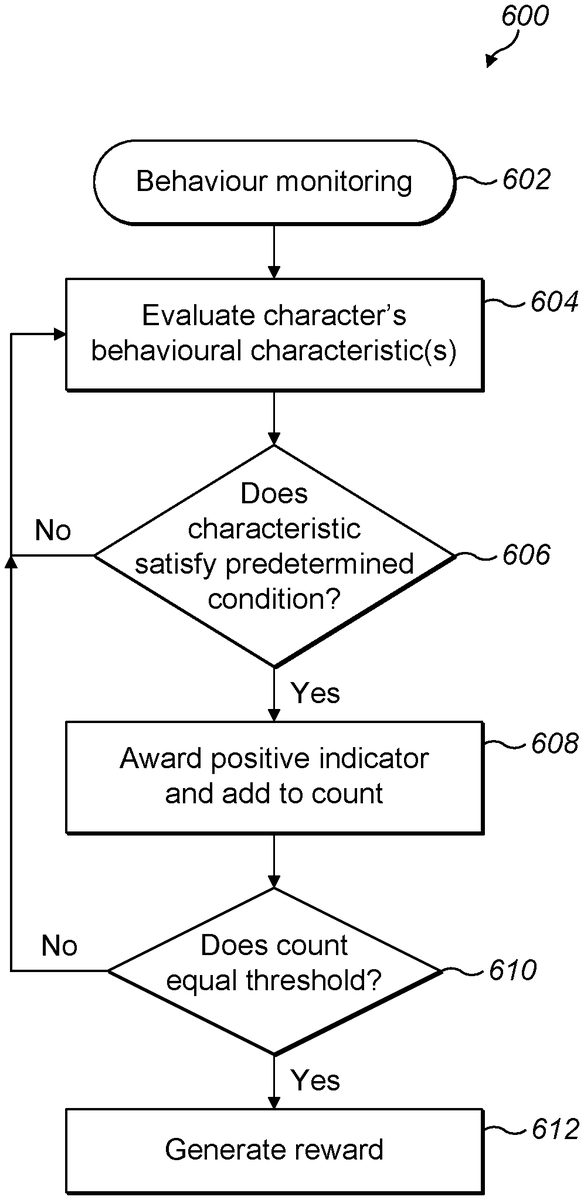
FIG. 6is a procedural flow diagram of a behaviour monitoring and reward generating routine600according to a second embodiment, in which a positive indicator is generated in response to a behavioural characteristic satisfying a predetermined condition, and a reward is generated when the indicator count reaches a predetermined threshold.
Following the initiation602of the routine (e.g. due to the player character commencing combat against an enemy character), the routine causes the character behaviour monitoring unit105/205to evaluate604one or more player-controlled behavioural characteristic(s) of the player character and to determine606whether the or each evaluated behavioural characteristic satisfies a respective predetermined condition, the predetermined condition being respective to the behavioural trait associated with the class of the player character. Examples of such behavioural traits and the respective predetermined conditions are discussed below, with reference toFIG. 8.
In this case, if the evaluated behavioural characteristic satisfies the respective predetermined condition (“Yes” in determination606), a positive indicator is generated608by the award generating unit113/213and is added to a count. The indicator count is maintained by the award generating unit113/213and may be stored in an indicator count table in the memory106/206or data storage means115/215of the video game apparatus14or server22. Examples of such an indicator count table are discussed below, with reference toFIG. 10.
However, if the evaluated behavioural characteristic does not satisfy the respective predetermined condition (“No” in determination606), a positive indicator is not generated and the routine continues to evaluate604the player character's behavioural characteristic(s).
The award generating unit113/213also determines610whether the indicator count, when the value thereof has changed, is equal to a threshold value. If the indicator count is equal to the threshold value (“Yes” in determination610), a reward is then generated612by the award generating unit113/213. Examples of such rewards are discussed below, with reference toFIG. 11. The applicable threshold value may be obtained from a threshold lookup table (as discussed below, with reference toFIG. 9).
However, if the indicator count is not equal to the threshold value (“No” in determination610), the routine continues to evaluate604the player character's behavioural characteristic(s) as shown in the flow diagram.
Third Embodiment
FIG. 7is a procedural flow diagram of a behaviour monitoring and reward generating routine700according to a third embodiment, in which a positive indicator is generated in response to a behavioural characteristic satisfying a predetermined condition, a negative indicator is generated in response to a behavioural characteristic not satisfying a predetermined condition, and a reward is generated when the overall indicator count (i.e. the sum of the positive indicators and any negative indicators) reaches a predetermined positive threshold.
Following the initiation702of the routine (e.g. due to the player character commencing combat against an enemy character), the routine causes the character behaviour monitoring unit105/205to evaluate704one or more player-controlled behavioural characteristic(s) of the player character and to determine706whether the or each evaluated behavioural characteristic satisfies a respective predetermined condition, the predetermined condition being respective to the behavioural trait associated with the class of the player character. Examples of such behavioural traits and the respective predetermined conditions are discussed below, with reference toFIG. 8.
In this case, if the evaluated behavioural characteristic satisfies the respective predetermined condition (“Yes” in determination706), a positive indicator is generated708by the award generating unit113/213and is added to a count. The indicator count is maintained by the award generating unit113/213and may be stored in an indicator count table in the memory106/206or data storage means115/215of the video game apparatus14or server22. Examples of such an indicator count table are discussed below, with reference toFIG. 10.
However, in this case, if the evaluated behavioural characteristic does not satisfy the respective predetermined condition (“No” in determination706), a negative indicator is generated by the award generating unit113/213and is added to the count (i.e. to take the count negative if starting from zero, or to at least partially offset any positive indicator that has already been added to the count) and the routine continues to evaluate704the player character's behavioural characteristic(s).
The award generating unit113/213also determines710whether the indicator count, when the value thereof has changed, is equal to a positive threshold value. If the indicator count is equal to the positive threshold value (“Yes” in determination710), a reward is then generated712by the award generating unit113/213. Examples of such rewards are discussed below, with reference toFIG. 11. The applicable positive threshold value may be obtained from a threshold lookup table, for example as shown inFIG. 9, which is discussed in greater detail below.
However, if the indicator count is not equal to the threshold value (“No” in determination710), the routine continues to evaluate704the player character's behavioural characteristic(s) as shown in the flow diagram.
In a variant of this embodiment, if in determination710it is determined that the indicator count is equal to a negative threshold value, the award generating unit113/213may generate a punishment for the player character. Examples of such punishments are discussed below, with reference toFIG. 11. The applicable positive threshold value may be obtained from a threshold lookup table, for example as shown inFIG. 9, which is discussed in greater detail below.
In another embodiment, the award generating unit113/213may be configured to only generate negative indicators when the evaluated behavioural characteristic does not satisfy the respective predetermined condition, but does not generate any positive indicators when the evaluated behavioural characteristic does satisfy the respective predetermined condition. Accordingly, this can result in the player character receiving a punishment when the indicator count reaches a negative threshold value, but no “positive” reward is attainable in this case. This embodiment is not presently preferred, as it merely punishes behaviour that is not befitting of the character class, rather than positively rewarding behaviour that is befitting of the character class.
In a yet further embodiment, that is also not presently preferred, the award generating unit113/213may be configured to generate an immediate punishment when the evaluated behavioural characteristic does not satisfy the respective predetermined condition. This may be in addition to the possible generation of a direct reward if the evaluated behavioural characteristic does satisfy the respective predetermined condition (as per the first embodiment described above). Alternatively, in this further embodiment, only punishments may be awarded.
In the above embodiments that use positive and/or negative indicators that are added to a total count (e.g. the second and third embodiments described above), the magnitude of the positive and/or negative indicators need not be the same. Rather, the positive and negative indicators may be adjusted, essentially by applying one or more scaling factors, such that a positive indicator increases the value of the indicator count by a first value, whereas a negative indicator decreases the value of the indicator count by a second value (the second value being different from the first). Such first and second values may be obtained from a lookup table, for example as shown inFIG. 12, which is discussed in greater detail below.
When a positive indicator or reward is awarded, or when a negative indicator or punishment is awarded, the user may be notified on-screen, so that they are made aware that their control of the player character is (or is not) commensurate with desirable behavioural traits of their character class. From this, the user may learn that certain behavioural characteristics for that character class are desirable, whilst others are not.
Moreover, by way of guidance, a textual caption may be displayed on the screen, to indicate to the user the behavioural trait(s) associated with the relevant character class. From such guidance, the user may be expected to control their player character in a manner that is befitting to their character class.
Monitored Behavioural Characteristic(s)
As mentioned above, the monitoring of a player character's behavioural characteristics may include the gathering and storing of information relating to the behaviour of the player character when it commences combat (i.e. the monitoring is triggered by the engagement of the player character in combat with an enemy character), or over an extended period of time during a gameplay session. Such data may be stored in the data storage means115/215. The time over which the character's behaviour is monitored may be the entire length of the combat event, or the entire length of the gameplay session, or discrete parts of the gameplay session.
When monitoring the player character's behavioural characteristics, one parameter that may be monitored is the distance between the player character and the enemy character—for instance at the moment when combat between the player character and the enemy character is commenced.
Another parameter that may be monitored is the weapon which is possessed by the player character, as selected by the player, e.g. when commencing combat, or over an extended period of time. Where monitoring is carried out throughout a gameplay session, a parameter may be a measure of the proportion of time in the game session in which the character possesses a particular weapon. Alternatively, a parameter may be a measure of the number of times the player character possesses a particular weapon during the course of the gameplay session.
Alternatively, another parameter relating to weapon use that may be monitored may be the number of attacks of one or more enemy characters by the player character when using a particular weapon, or a ratio or percentage of the amount of time the player character spends using a particular weapon as a proportion of the overall time spent in combat with one or more enemy characters.
The behavioural traits associated with a particular character class, positive and/or negative indicators, threshold values for the issuance of rewards or punishments, the types of rewards or punishments that may be issued, and any scaling factors that may be applied to the positive and/or negative indicators (i.e. the so-called first and second values discussed above), may be stored in data storage means (e.g.115/215ofFIG. 3 or 4) for subsequent retrieval. When operating a personal computer or video game console as in the scenario depicted inFIG. 1, the data storage means may comprise, for example, a hard disk or memory within or local to the control unit14of the user's video game apparatus10, although it may alternatively comprise a remote network-based storage device in communication with the video game apparatus10via a network. On the other hand, when operating a network-based video game system as inFIG. 2, the data storage means may comprise a remote network-based storage device (e.g. in the server22or connected thereto), in communication with the user's terminal device26via network24, or a local storage device within or local to the user's terminal device26.
Illustrative Tables
Referring toFIGS. 8 to 12, the character behaviour monitoring unit105/205and award generating unit113/213may retrieve stored data from various tables, for use in the determination of the appropriate reward or punishment to be issued to the player character. These tables will now be discussed in detail:
Behavioural Trait Lookup Table
FIG. 8shows a behavioural trait lookup table, which contains a list of character classes and associated behavioural traits that are befitting to the respective character classes (i.e. to be promoted within the game). In each case it also contains information on the respective predetermined condition that must be satisfied by a player character during the game for the behavioural trait to be detected as being carried out.
By way of example, the table inFIG. 8depicts five exemplary character classes with eight associated behavioural traits and nine corresponding predetermined conditions. The exemplary character classes are sniper (denoted in the table by CC1), up-close fighter (CC2), wizard (CC3), pyromancer (CC4), and devastator (CC5).
Referring first to character class CC1(sniper) in the table ofFIG. 8, this character class has two associated behavioural traits, denoted by BT1and BT2. The behavioural trait BT1is the engagement in combat with an enemy character at a relatively long distance. As shown under the “predetermined condition” column for this behavioural trait, the predetermined condition that must be satisfied for the character behaviour monitoring unit105/205to determine that this behavioural trait is being carried out is that the distance (d) between the sniper player character and the enemy character during combat is greater than a threshold distance (denoted as dcci inFIG. 8).
The second behavioural trait associated with CC1is BT2, which is the use of a sniper rifle as a weapon. The predetermined condition that must be satisfied for the character behaviour monitoring unit105/205to determine that this behavioural trait is being carried out is that the weapon used by the player character is a sniper rifle, as shown in the “predetermined condition” column for BT2inFIG. 8.
The second character class listed in the table inFIG. 8is CC2(up-close fighter). This character class also has two behavioural traits, denoted by BT3and BT4. The behavioural trait BT3is the engagement in combat with an enemy character at a relatively short distance, and is determined to be carried out if the distance (d) between the player character and the enemy character during combat is less than a threshold distance (denoted as dcc2inFIG. 8).
The second behavioural trait associated with CC2is BT4, which is the use of a melee weapon. The predetermined condition that must be satisfied for the character behaviour monitoring unit105/205to determine that this behavioural trait is being carried out is that the weapon used by the player character is a melee weapon.
In the examples given in the table inFIG. 8, the third character class, CC3(wizard), has only one associated behavioural trait, BT5, and a corresponding predetermined condition. This behavioural trait BT5is the use of magic as a weapon. The predetermined condition that must be satisfied for the character behaviour monitoring unit105/205to determine that this behavioural trait is being carried out is the use of magic by the player character as a weapon.
The fourth exemplary character class, CC4(pyromancer), has two associated behavioural traits, BT6and BT7. BT6is the use of fire magic and the predetermined condition of this behavioural trait is the use of fire magic by the player character as a weapon.
BT7is the engagement of combat between the player character and an enemy character over a relatively long distance. The predetermined condition that must be satisfied for the character behaviour monitoring unit105/205to determine that this behavioural trait is being carried out is that the distance (d) between the pyromancer player character and the enemy character during combat is greater than a threshold distance (denoted as dcc4inFIG. 8).
The final exemplary character class listed inFIG. 8is CC5(devastator). This character class has one associated behavioural trait, BT8, namely the infliction of death and destruction in the game world. However, this behavioural trait has two corresponding predetermined conditions, either of which, if satisfied, causes the character behaviour monitoring unit105/205to determine that this behavioural trait is being carried out. The first predetermined condition is that the number of deaths of enemy characters, killed by the devastator player character, denoted in the table by ndeath, exceeds a threshold number (ndeathCC5). The second predetermined condition is that the number of in-game objects destroyed by the devastator player character, denoted in the table by ndestruction, exceeds a threshold number (ndestructionCC5).
Threshold Lookup Table
FIG. 9shows an example of a threshold lookup table containing positive and negative threshold values. As discussed in relation to the second and third embodiments above, a reward may be issued by the award generating unit113/213if the sum total of positive (and any negative) indicators reaches the positive threshold value. On the other hand, as discussed in relation to the third embodiment above, a punishment may be issued by the award generating unit113/213if the sum total of negative (and any positive) indicators reaches the negative threshold value.
Notably, the lookup table shown inFIG. 9shows that the positive and negative thresholds can vary in magnitude depending on the character class and other factors, such as the experience points earned by the character, or the number of hours the game has been played. Experience points may be earned by the character as a result of successful playing of the game. The overall trend in the different threshold values shown inFIG. 9is that, as a player spends longer playing the game, or the player character acquires more experience points, the positive threshold values increase in magnitude, whereas the negative threshold values decrease in magnitude.
Accordingly, an inexperienced player should be able to obtain a reward relatively easily for controlling their player character in a manner befitting of the character type (as a consequence of the positive threshold value being initially relatively low), thereby incentivising the player to continue playing in that desirable manner. However, a more experienced player would be required to reach a higher positive threshold value before receiving a reward, as they would be expected to be more capable of controlling their player character in a manner befitting of the character type.
Conversely, by virtue of the negative threshold values being initially relatively high in magnitude, an inexperienced player ought not to receive a punishment too early in the game, which would potentially be demoralising for the player. On the other hand, a more experienced player would be expected to be more capable of controlling their character in a manner befitting of the character type, hence the lower magnitude of the negative threshold at which a punishment would be given to them.
The positive and negative thresholds may also be specific to the user or player character.
Naturally the threshold lookup table shown inFIG. 9is merely an example, for an embodiment such as the above-described third embodiment in which both positive and negative threshold values are used. In other embodiments the threshold values may be fixed, i.e. do not vary depending on the character class, the user or player character, the experience points, or the number of hours the game has been played.
It will also be appreciated that, for embodiments such as the above-described second embodiment which only use a positive threshold value, such a lookup table would not include any negative threshold values.
Behaviour Monitoring (Indicator Count) Table
FIG. 10shows an example of a behaviour monitoring (indicator count) table, logging (in the left hand column) the sum total of positive (and any negative) indicators awarded by the award generating unit113/213thus far during the gameplay. In this example, the table also includes the applicable positive and negative threshold values—in this example, taken from the lookup table inFIG. 9, for the case of a sniper class player character (CC1) having20experience points or two playing hours. Naturally, for embodiments that only use a positive threshold value, such a table would not include a negative threshold value.
In accordance with presently-preferred embodiments, once a reward (or punishment) is issued, the indicator count in the table is reset to zero.
Reward/Punishment Lookup Table
FIG. 11shows an example of a reward/punishment lookup table and provides a stored reference for the award generating unit113/213to determine which reward or punishment is to be issued to the player character, e.g. when the total indicator count reaches a positive or negative threshold value. In the example shown inFIG. 11, it can be seen that the rewards and punishments vary according to character class. For instance, the reward for CC1(sniper character class) is the issuance of more experience points, whilst the punishment for CC1is the character not receiving healing. On the other hand, the reward for CC2(up-close fighter character class) is an increase in the character's health, whilst again the punishment for CC2is the character not receiving healing. It will be appreciated that such rewards are intended to be appropriate for the character classes in question. A sniper character (by the nature of their role in the game) is less likely to have received damage to their health during the gameplay, and therefore a reward of experience points may be considered to be a more desirable reward than an increase in health. On the other hand, an up-close fighter character is more likely to have received damage to their health during the gameplay, and therefore an increase in health may be considered to be a more desirable reward than a reward of experience points.
As a punishment, the character not receiving healing may be in respect of healing the character would otherwise receive over time through the normal course of the game. Alternatively, the character not receiving healing may be in respect of healing that would otherwise be received from other players or from interactable elements of the game such as medical packs or food.
It will be appreciated that the rewards described herein are primarily rewards that are issued to the player character. However, in alternative embodiments, the rewards may be of a form that may be issued to the user (i.e. the operator of the player character) themself—e.g. a reward having financial value, or a credit that may be used towards an online transaction such as a game download, etc.
First and Second Value Lookup Table
As discussed above, in certain embodiments a positive indicator may increase the value of an indicator count by a first value, whereas a negative indicator may decrease the value of the indicator count by a second value. Such first and second values may be obtained by the award generating unit113/213from a lookup table such as the one illustrated inFIG. 12. This shows that, not only are the first and second values different from one another, but that they may also vary according to the character class. The first and second values may also be specific to the user or player character.
Exemplary Character Types and Behavioural Traits
To illustrate how embodiments of the invention may be implemented within a game,FIGS. 13 to 17depict a series of screen shots illustrating examples of player character behaviour for different character classes. In practice, such video screens may be generated by the image generator111/211, virtual camera control unit112/212, and character generating unit114/214, under the control of processor104/204(seeFIGS. 3 and 4). It will of course be appreciated that, in the presentFIGS. 13 to 17, black and white line drawings are used to represent what would typically be displayed to the user as rendered video (preferably photorealistic video rendering) in the game.
Depending on the configuration of the game, the user may provide input (e.g. via input device103ofFIG. 3) to select a weapon with which to equip the player character, as well as moving the player character within the game world and causing the weapon to be fired or otherwise used.
In the examples shown inFIGS. 13 to 17, the enemy character305is a computer-controlled character, also known as a non-player character. However, alternatively, the enemy character may be another player character, for example a member of an opposing team.
Sniper Class—Befitting Behaviour
FIG. 13shows an example of a player character303being of a sniper class. In this example, the player character303is being controlled in a manner befitting of that particular character class, for which a positive indicator or reward may be awarded.
More particularly, as shown, the player character303is engaging in combat with an enemy character305. In a manner befitting to the sniper character class, the user has equipped the player character303with a sniper rifle304as a weapon, and has positioned the player character303a relatively long distance d from the enemy character305(i.e. greater than the distance dcci given inFIG. 8). Moreover, the user has positioned the player character303behind a boulder306to provide cover.
Thus, the example depicted inFIG. 13shows the user carrying out behaviours which are commensurate with desirable behavioural traits of the sniper character class, namely (a) engaging in combat with an enemy character at a relatively long distance from the enemy character, and (b) using a sniper rifle as a weapon—both of which may lead to a positive indicator or reward being awarded. In this example, a further desirable trait, which may also be rewarded, is the use of obstacles in the terrain, such as the boulder306, as cover (e.g. to shield the player character303from return fire from the enemy character305).
Sniper Class—Unbefitting Behaviour
By way of contrast,FIG. 14shows the player character303ofFIG. 13being controlled in a manner that is not befitting of the sniper character class, as a result of which a negative indicator or punishment may be awarded.
More particularly, as shown, the player character303is engaging in combat with the enemy character305, but the distance d between the player character303and the enemy character305is relatively short (i.e. less than the distance dcci given inFIG. 8). Moreover, the user has not positioned the player character303behind any occluding object to provide cover.
It will therefore be appreciated that, in the example shown inFIG. 14, the user is not carrying out behaviours which are commensurate with desirable behavioural traits of the sniper character class, which may consequently lead to a negative indicator or punishment being awarded.
Close-Combat Fighter Class—Befitting Behaviour
FIG. 15shows an example of a player character307being of a close-combat fighter class (also known as an up-close fighter). In this example, the player character307is being controlled in a manner befitting of that particular character class, for which a positive indicator or reward may be awarded.
More particularly, as shown, the player character307is engaging in combat with an enemy character305. In a manner befitting to the close-combat fighter character class, the user has equipped the player character307with a melee weapon, namely a sword308, and has positioned the player character307a relatively short distance d from the enemy character305(i.e. less than the distance dcc2given inFIG. 8).
Thus, the example depicted inFIG. 15shows the user carrying out behaviours which are commensurate with desirable behavioural traits of the close-combat fighter character class, namely (a) engaging in combat with an enemy character at a relatively short distance from the enemy character, and (b) using a melee weapon—both of which may lead to a positive indicator or reward being awarded.
Wizard Class—Befitting Behaviour
FIG. 16shows an example of a player character309being of a wizard class. In this example, the player character309is being controlled in a manner befitting of that particular character class, for which a positive indicator or reward may be awarded.
More particularly, as shown, the player character309is engaging in combat with an enemy character305. In a manner befitting to the wizard character class, the user is using magic (in this case, generating lightning310) as a weapon.
Thus, the example depicted inFIG. 16shows the user carrying out behaviour which is commensurate with a desirable behavioural trait of the wizard character class, namely the use of magic as a weapon, which may lead to a positive indicator or reward being awarded.
Pyromancer Class—Befitting Behaviour
Finally,FIG. 17shows an example of a player character311being of a pyromancer class. In this example, the player character311is being controlled in a manner befitting of that particular character class, for which a positive indicator or reward may be awarded.
More particularly, as shown, the player character311is engaging in combat with an enemy character305. In a manner befitting to the pyromancer character class, the user is using fire magic (in this case, to generate a fireball312) as a weapon, and is engaging with the enemy character305at a relatively long distance d (i.e. greater than the distance dcc4given inFIG. 8.
Thus, the example depicted inFIG. 17shows the user carrying out behaviours which are commensurate with desirable behavioural traits of the pyromancer character class, namely (a) engaging in combat with an enemy character at a relatively long distance from the enemy character, and (b) using fire magic as a weapon—both of which may lead to a positive indicator or reward being awarded.
Modifications and Alternatives
Detailed embodiments and some possible alternatives have been described above. As those skilled in the art will appreciate, a number of modifications and further alternatives can be made to the above embodiments whilst still benefiting from the inventions embodied therein. It will therefore be understood that the invention is not limited to the described embodiments and encompasses modifications apparent to those skilled in the art lying within the scope of the claims appended hereto.
Claims
- A non-transitory computer-readable recording medium including a program which is executed by a computer apparatus to provide a video game that is progressed by controlling a character operated by a player in a virtual game world, the program causing the computer apparatus to function as: a character generating unit that generates the character operated by the player, wherein the character is of one of a plurality of character classes in the game world, each character class having at least one associated behavioural trait;a character behaviour monitoring unit that evaluates a player-controlled behavioural characteristic of the character and determines whether the evaluated behavioural characteristic satisfies a respective predetermined condition, the predetermined condition being respective to the behavioural trait associated with the character class;and an award generating unit that generates at least one of: a positive indicator if the evaluated behavioural characteristic satisfies the respective predetermined condition;and a negative indicator if the evaluated behavioural characteristic does not satisfy the respective predetermined condition, wherein the award generating unit is configured to maintain an indicator count, wherein the award generating unit is configured to increase a value of the indicator count when a positive indicator is generated, and to issue a reward to the player when the value of the indicator count is equal to a positive threshold value, wherein the award generating unit is further configured to decrease the value of the indicator count when a negative indicator is generated, and to issue a punishment to the player when the value of the indicator count is equal to a negative threshold value, and wherein once the reward or punishment is issued, the indicator count is reset to zero.
- The non-transitory computer-readable recording medium according to claim 1, wherein, when a positive indicator is generated, the award generating unit is configured to increase the value of the indicator count by a first value, and when a negative indicator is generated, the award generating unit is configured to decrease the value of the indicator count by a second value.
- The non-transitory computer-readable recording medium according to claim 2, wherein the first and second values are specific to the character operated by the player.
- The non-transitory computer-readable recording medium according to claim 2, wherein the first and second values are specific to the character class.
- The non-transitory computer-readable recording medium according to claim 2, wherein the first value is different from the second value.
- The non-transitory computer-readable recording medium according to claim 1, wherein the positive threshold value is specific to the character operated by the player.
- The non-transitory computer-readable recording medium according to claim 1, wherein the positive threshold value is specific to the character class.
- The non-transitory computer-readable recording medium according to claim 1, wherein the negative threshold value is specific to the character operated by the player.
- The non-transitory computer-readable recording medium according to claim 8, wherein the program causes the positive threshold value and/or the negative threshold value to change as a function of time the player has been playing the game.
- The non-transitory computer-readable recording medium according to claim 8, wherein the program causes the positive threshold value and/or the negative threshold value to change as a function of experience points accumulated by the character in the game.
- The non-transitory computer-readable recording medium according to claim 1, wherein the negative threshold value is specific to the character class.
- The non-transitory computer-readable recording medium according to claim 1, where the issued reward comprises at least one of: an increase in the character's health, or the issuance of one or more experience points.
- The non-transitory computer-readable recording medium according to claim 1, wherein the issued punishment comprises the character not receiving healing.
- The non-transitory computer-readable recording medium according to claim 1, wherein the character behaviour monitoring unit is configured to evaluate the behavioural characteristic of the character when the character commences combat.
- The non-transitory computer-readable recording medium according to claim 1, wherein the program allows the player to choose their character from one of the plurality of character classes.
- A non-transitory computer-readable recording medium including a program which is executed by a computer apparatus to provide a video game that is progressed by controlling a character operated by a player in a virtual game world, the program causing the computer apparatus to function as: a character generating unit that generates the character operated by the player, wherein the character is of one of a plurality of character classes in the game world, each character class having at least one associated behavioural trait;a character behaviour monitoring unit that evaluates a player-controlled behavioural characteristic of the character and determines whether the evaluated behavioural characteristic satisfies a respective predetermined condition, the predetermined condition being respective to the behavioural trait associated with the character class;and an award generating unit that generates at least one of:, a positive indicator if the evaluated behavioural characteristic satisfies the respective predetermined condition;and a negative indicator if the evaluated behavioural characteristic does not satisfy the respective predetermined condition, wherein the award generating unit is configured to maintain an indicator count, wherein the award generating unit is configured to increase a value of the indicator count when the positive indicator is generated, and to issue a reward to the player when the value of the indicator count is equal to a positive threshold value, wherein the award generating unit is configured to decrease the value of the indicator count when the negative indicator is generated, and to issue a punishment to the player when the value of the indicator count is equal to a negative threshold value, wherein the positive threshold value and/or negative threshold value is specific to at least one of the character, the character class, time the player has been playing the game, or experience points accumulated by the character, and wherein once the reward or punishment is issued, the indicator count is reset to zero.
Disclaimer: Data collected from the USPTO and may be malformed, incomplete, and/or otherwise inaccurate.