U.S. Pat. No. 11,389,725
REBALANCING OF IN-GAME ACTIVITY IN MULTIPLAYER VIDEO GAMES
AssigneeSQUARE ENIX LTD.
Issue DateNovember 20, 2020
Illustrative Figure
Abstract
A computer-readable medium including a program which is executed by at least a first and second computer apparatus in a network to provide a video game that is progressed by at least first and second players using said first and second computer apparatus respectively controlling at least first and second player characters in a virtual multiplayer game world in which the difficulty of the game is defined by at least an enemy difficulty, wherein the virtual multiple player game world comprises at least one gaming arena and has at least one game level, the program causing the computer apparatus to function as: an enemy difficulty determining unit configured to detect a change in the number of player characters and to determine a new enemy difficulty in dependence on the change in the number of player characters; an enemy modulating unit configured to modulate the enemy difficulty to the determined new enemy difficulty; and an enemy generating unit configured to generate at least one enemy character at a rate, and/or having an enemy attribute, according to the determined new enemy difficulty.
Description
DETAILED DESCRIPTION OF PREFERRED EMBODIMENTS The present embodiments represent the best ways known to the Applicant of putting the invention into practice. However, they are not the only ways in which this can be achieved. To adjust and rebalance in-game activity in a multiplayer video game in response to player drop-in or drop-out, embodiments of the present invention provide an enemy difficulty determining, enemy modulating and enemy generating routine that forms part of the video game. The concept of “enemy difficulty” is essentially the difficulty faced by the player characters in respect of defeating the enemy characters they encounter, and is discussed in greater detail below. The enemy difficulty may be a function of one or more of: the number of enemy characters present; the rate of generation of enemy characters; and attributes of the enemy characters (e.g. enemy health, enemy damage, enemy resistance, enemy armour, enemy type, enemy strength, enemy equipment, enemy skill and enemy ability). The video game is provided as a computer program. The computer program may be supplied on a computer-readable medium (e.g. a non-transitory computer-readable recording medium such as a CD or DVD) having computer-readable instructions thereon. Alternatively the computer program may be provided in a downloadable format, over a network such as the Internet, or may be hosted on a server. With reference toFIG. 1, the video game program may be executed on a video game apparatus10, such as a personal computer or a video game console that is connected to a network such as the Internet. The video game apparatus10comprises a display screen12on which the video game is displayed, and a control unit14which typically includes at least a Central Processing Unit (CPU), a Read Only Memory (ROM) and a Random Access Memory (RAM). The control unit14may also include a Graphics Processing Unit (GPU) ...
DETAILED DESCRIPTION OF PREFERRED EMBODIMENTS
The present embodiments represent the best ways known to the Applicant of putting the invention into practice. However, they are not the only ways in which this can be achieved.
To adjust and rebalance in-game activity in a multiplayer video game in response to player drop-in or drop-out, embodiments of the present invention provide an enemy difficulty determining, enemy modulating and enemy generating routine that forms part of the video game.
The concept of “enemy difficulty” is essentially the difficulty faced by the player characters in respect of defeating the enemy characters they encounter, and is discussed in greater detail below. The enemy difficulty may be a function of one or more of: the number of enemy characters present; the rate of generation of enemy characters; and attributes of the enemy characters (e.g. enemy health, enemy damage, enemy resistance, enemy armour, enemy type, enemy strength, enemy equipment, enemy skill and enemy ability).
The video game is provided as a computer program. The computer program may be supplied on a computer-readable medium (e.g. a non-transitory computer-readable recording medium such as a CD or DVD) having computer-readable instructions thereon. Alternatively the computer program may be provided in a downloadable format, over a network such as the Internet, or may be hosted on a server.
With reference toFIG. 1, the video game program may be executed on a video game apparatus10, such as a personal computer or a video game console that is connected to a network such as the Internet. The video game apparatus10comprises a display screen12on which the video game is displayed, and a control unit14which typically includes at least a Central Processing Unit (CPU), a Read Only Memory (ROM) and a Random Access Memory (RAM). The control unit14may also include a Graphics Processing Unit (GPU) and a sound processing unit. The display screen12and the control unit14may be provided in a common housing, or may be separate connected units. The video game apparatus10also includes one or more user input devices by which the user can control a player character in the game. Such a user input device may comprise, for example, a mouse, a keyboard, a hand-held controller (e.g. incorporating a joystick and/or various control buttons), or a touchscreen interface integral with the display screen12(e.g. as in the case of a smartphone or a tablet computer).
Alternatively, with reference toFIG. 2, the video game program may be executed within a server-based video game system20. The video game system20comprises a server device22, a communication network24(e.g. the Internet), and a plurality of user terminals26operated by respective users. The server device22communicates with the user terminals26through the communication network24. Each user terminal26may comprise a network-connected video game apparatus10as described above, such as a personal computer or a video game console, or a smartphone, a tablet computer, or some other suitable piece of user equipment. The video game program may be at least partly executed on the server22, which may stream user-specific game content (e.g. video in real time) to each of the plurality of user terminals26. At each user terminal the respective user can interact with the game and provide input that is transmitted to the server22, to control the progress of the game for the user. Alternatively, for a given user, the video game program may be executed within the respective user terminal26, which may interact with the server22when necessary.
In any case, the video game progresses in response to user input, with the user input controlling a player character. A given user's display screen may display the respective player character's field of view in the game world in a “first-person” manner, preferably in three dimensions, and preferably using animated video rendering (e.g. photorealistic video rendering in particular), in the manner of a virtual camera.
Alternatively, the user's display screen may display the player character and other objects or characters in the game world in a “third-person” manner, again preferably in three dimensions, and preferably using animated video rendering (e.g. photorealistic video rendering in particular), in the manner of a virtual camera.
FIG. 3is a block diagram showing the configuration of the video game apparatus10shown inFIG. 1, in the case of the game being executed on such apparatus. It will be appreciated that the contents of the block diagram are not exhaustive, and that other components may also be present.
As illustrated, the control unit14of the video game apparatus10includes an input device interface102to which an input device103(e.g. a mouse, a keyboard or a hand-held controller, e.g. incorporating a joystick and/or various control buttons, as mentioned above) is connected, a processor (e.g. CPU)104, and an image generator (e.g. GPU)111to which a display unit12is connected.
The control unit14also includes memory (e.g. RAM and ROM)106, a sound processor107connectable to a sound output device108, a DVD/CD-ROM drive109operable to receive and read a DVD or CD-ROM110(both being examples of a computer-readable recording medium), a communication interface116connectable to the communication network24(e.g. the Internet), and data storage means115via which data can be stored on a storage device (either within or local to the video game apparatus10, or in communication with the control unit14via the network24).
The video game program causes the control unit14to take on further functionality of an enemy difficulty determining unit105, a virtual camera control unit112, an enemy modulating unit113, and an enemy generating unit114.
An internal bus117connects components102,104,105,106,107,109,111,112,113,114,115and116as shown.
FIG. 4is a block diagram showing the configuration of the server apparatus22shown inFIG. 2, in the case of the game being executed within a server-based video game system. It will be appreciated that the contents of the block diagram are not exhaustive, and that other components may also be present.
As illustrated, the server apparatus22includes a processor (e.g. CPU)204, and an image generator (e.g. GPU)211, memory (e.g. RAM and ROM)206, a DVD/CD-ROM drive209operable to receive and read a DVD or CD-ROM210(both being examples of a computer-readable recording medium), a communication interface216connected to the communication network24(e.g. the Internet), and data storage means215via which data can be stored on a storage device (either within or local to the server apparatus22, or in communication with the server apparatus22via the network24).
The video game program causes the server apparatus22to take on further functionality of an enemy difficulty determining unit205, a virtual camera control unit212, an enemy modulating unit213, and an enemy generating unit214.
An internal bus217connects components204,205,206,209,211,212,213,214,215and216as shown.
Via the communication interface216and the network24, the server apparatus22may communicate with a user terminal26(e.g. video game apparatus10) as mentioned above, during the course of the video game. Amongst other things, the server apparatus22may receive user input from the input device103of the video game apparatus10, and may cause video output to be displayed on the display screen12of the video game apparatus10.
Enemy Difficulty Balancing
In accordance with the present disclosure, to rebalance the in-game activity and maintain a difficulty of a multiplayer video game despite a player leaving or joining the game, the enemy difficulty is modulated to a new enemy difficulty following a change in the number of player characters.
As described above, the video game program may be executed on a network-connected video game apparatus10, or within a server-based video game system20. Moreover, instead of being hosted by a server, one or more selected user terminals26may at least partially host the game.
The video game may be progressed by at least first and second players using, respectively, a first and a second network-connected computer apparatus (e.g.10or26), respectively controlling first and second player characters in a virtual game world comprising at least one gaming arena and having at least one game level. The difficult of such a game to the players is determined by at least the enemy difficulty.
FIG. 5is a procedural flow diagram of an enemy difficulty determining, enemy modulating, and enemy generating routine500according to embodiments of the invention, in which at least one enemy character is generated at a rate and/or having an enemy attribute according to a determined enemy difficulty, responsive to a change in the number of player characters resulting from player drop-in or drop-out.
The overall routine500comprises three main processes: determining enemy difficulty501, modulating enemy difficulty504, and generating enemy character(s)506.
Following the initiation of the routine500, triggered by a change in the number of player characters, the routine causes the enemy difficulty determining unit105/205to detect502the change in the number of player characters, and to determine503a new enemy difficulty in dependence on the change in the number of player characters. Examples of changes in the number of player characters are described below with reference toFIGS. 6, 7, 9a,9band10ato10c. Examples of a new enemy difficulty are described below with reference toFIG. 12.
Continuing with the routine500illustrated inFIG. 5, once a new enemy difficulty has been determined, the enemy difficulty is modulated to the new enemy difficulty505by the enemy modulating unit113/213. Examples of such modulation are described below with reference toFIG. 12.
Following the modulation of the enemy difficulty to the new enemy difficulty505, at least one enemy character is generated507by the enemy generating unit114/214at a rate and/or having an enemy attribute according to the determined enemy difficulty. Examples of such enemy generating are described below with reference toFIGS. 7, 9b,10band10c.
In particular, the enemy generating unit114/214may be configured to decrease the rate of generation of enemy characters in response to the enemy difficulty determining unit105/205detecting a reduction in the number of player characters, and/or to increase the rate of generation of enemy characters in response to the enemy difficulty determining unit105/205detecting an increase in the number of player characters. It will be appreciated that changing the rate of generation of enemy characters results in a change in the number of enemy characters encountered by the player characters.
Alternatively, or in addition, the enemy modulating unit113/213may be configured to modulate at least one enemy attribute of the enemy characters in response to the enemy difficulty determining unit105/205detecting a change in the number of player characters.
The enemy modulating unit113/213may be configured to apply the new enemy difficulty to existing enemy characters encountered by the player characters.
Alternatively, the enemy generating unit114/214may be configured to apply the new enemy difficulty to newly-generated enemy characters, e.g. in the player characters' current phase of the game, or in the next phase that the player characters enter. The concept of phases of the game will be described next. Referring now toFIG. 6, the video game of the present invention is progressed through a virtual multiplayer game world600such as the one shown inFIG. 6.
As shown inFIG. 6, the virtual multiplayer game world600comprises a gaming arena601. In the example depicted inFIG. 6the gaming arena601is made up of six gaming phases602,603labelled A to F.
Referring toFIGS. 6 and 8a, the gaming phases602,603are arranged so that the game may be progressed though a consecutive order of gaming phases602,603. In the illustrated example, the first gaming phase602is labelled A, the second gaming phase is labelled B, and so on, through to the last gaming phase603which is labelled F. The player progresses through the video game by progressing through the gaming phases A to F consecutively.
Referring now toFIG. 8b, in a game there may be more than one gaming arena, each with a corresponding game level (e.g. levels 1 to 4). Equally there may be more than one game level (e.g. levels 1 to 4) within a single gaming arena.
In the illustrated example, takingFIGS. 8aand 8btogether, each phase A-D has a corresponding game level 1-4, with the game level increasing incrementally and correspondingly to the consecutive increase of the gaming phase. In other words, the first gaming phase A has the first game level (level 1) and the second gaming phase B has the second game level (level 2), and so on.
As mentioned above, the enemy generating unit113/213may be configured to apply the new enemy difficulty to newly-generated enemy characters. These may be in the player characters' current phase of the game, or in the next phase that the player characters enter.
Examples of Changing Enemy Difficulty
The following are examples of changing the enemy difficulty following drop-in or drop-out of player characters.
Drop-in of Player Characters
To begin with,FIG. 6depicts two player characters604in the first gaming phase602(phase A) along with three enemy characters605.
FIG. 7shows an enlarged view700of a region703within the first gaming phase602(phase A), in which the two player characters604are in the process of being joined by a third player character705who is dropping-in to the game. In the manner outlined above with reference toFIG. 5, in response to this increase in the number of player characters the enemy generating unit114/214increases the rate of generation of the enemy characters605. This has the effect of generating two additional enemy characters702, thus maintaining a suitable level of difficulty for the increased number of player characters604,705in the game, and rebalancing the gameplay.
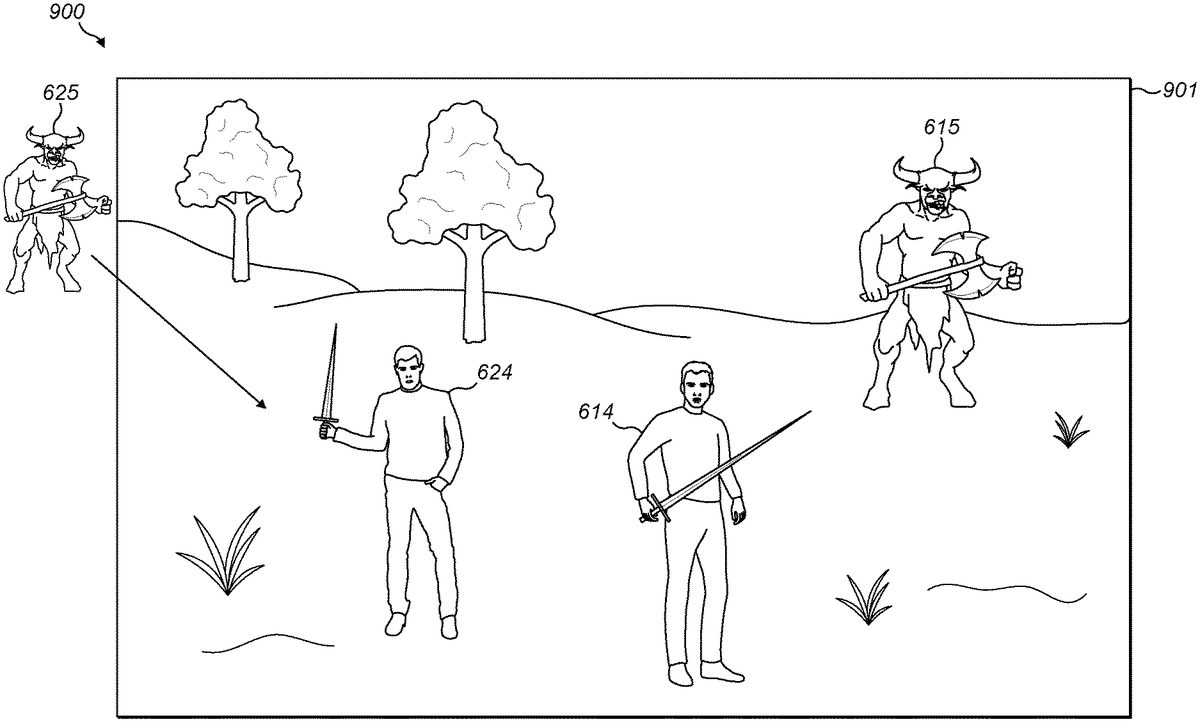
A variant of the example illustrated inFIGS. 6 and 7is depicted inFIGS. 9aand 9b, which depict screenshots900of a user's field of view901from a third-person perspective, including a first player character614controlled by the user. In practice, such video screens may be generated by the image generator111/211and virtual camera control unit112/212, under the control of processor104/204(seeFIGS. 3 and 4). It will of course be appreciated that, in the presentFIGS. 9aand 9b, black and white line drawings are used to represent what would typically be displayed to the user as rendered video (preferably photorealistic video rendering) in the game.
FIG. 9ashows the first player character614engaging in battle with a first enemy character615.
FIG. 9bshows the first player character614having been joined by a second player character624, controlled by a respective user who has dropped-in to the game. In the manner outlined above with reference toFIG. 5, in response to this increase in the number of player characters the enemy generating unit114/214increases the rate of generation of the enemy characters, resulting in the generation of a second enemy character625who can be seen inFIG. 9bapproaching the battle, initially from outside of the user's field of view901. The direction of motion of the second enemy character625is depicted with an arrow pointing towards the player characters614,624.
Drop-In and Drop-Out of Player Characters
FIG. 10ashows a schematic view1000from above, of a region1001within a game phase1001in which a first player character1014and a second player character1024are surrounded in battle by a first enemy character1015, a second enemy character1025and a third enemy character1035.
FIG. 10bshows the view ofFIG. 10awith the addition of a third player character1034who has dropped-in to that game phase. As can be seen inFIG. 10b, in response to the third player character1034joining the game phase the enemy generating unit114/214generates a fourth enemy character1045who travels towards the player characters1014,1024,1034as shown by the arrow (in a similar manner to the enemy character625inFIG. 9b), to join the battle and rebalance the gameplay.
In alternative circumstances as shown inFIG. 10c, the second player character1024drops-out of the game, as shown by the cross through the second player character1024. In the manner outlined above with reference toFIG. 5, in response to this decrease in the number of player characters the enemy generating unit114/214decreases the rate of generation of the enemy characters. In the first instance, this is manifested by the third enemy character1035leaving the battle, thereby decreasing the difficulty to a new (lower) enemy difficulty.
Deferred Application of New Enemy Difficulty
In the implementations described above, the application of a new enemy difficulty generally occurs in the same phase as that in which the change in the number of player characters is detected.
However, in alternative implementations the enemy difficulty determining unit105/205may be configured to detect a change in the number of player characters in a first phase and to determine a new enemy difficulty, for application in a second phase, in dependence on said change in the number of player characters in the first phase. That is to say, the enemy difficulty is kept constant whilst the player characters remain in the first phase, despite player drop-in or drop-out having occurred in the first phase, and application of the new enemy difficulty is deferred until the player characters enter a subsequent (second) phase.
Consequently, enemies in the player characters' current phase (the first phase) are not suddenly affected by the new enemy difficulty, which could otherwise appear incongruous to the users. Instead, new enemies in the subsequent phase (the second phase) are affected by the new enemy difficulty, thereby avoiding subjecting the users to a sudden change in the enemies.
In preferred embodiments the second phase is the phase immediately subsequent to the first phase in the progress of the game.
Thus, the enemy modulating unit113/213may be configured to modulate the enemy difficulty of the second gaming phase to the determined new enemy difficulty.
To implement this, the enemy generating unit114/214may be configured to generate at least one enemy character at a rate, and/or having an enemy attribute, in the second gaming phase according to the determined new enemy difficulty.
Use of Spawn Points
As those skilled in the art will appreciate, the term “spawn point” may be used to refer to a location in the virtual multiplayer game world at which enemy characters are generated (i.e. “spawned”). Conversely, the term “despawning”, in the context of the present invention, refers to the removal of an enemy character from the virtual multiplayer game world.
In the exemplary implementations described above, the new enemy characters are generated or removed directly in response to a change in the number of player characters. This may be done (but not necessarily) using spawn points.
In other implementations which use spawn points, the generation of enemy characters at a rate according to a new enemy difficulty may comprise increasing or decreasing the number of spawn points in the vicinity of the player characters, or increasing or decreasing the rate of respawn from an existing or fixed number of spawn points.
Enemy Character Modulation
In some embodiments, following a change in the number of player characters, the rate of generation of enemy characters may stay the same but the attributes of the enemy characters may change, to thereby rebalance the gameplay.
For example, if the number of player characters decreases, the enemy characters may be modulated (by the enemy modulating unit113/213) by decreasing one or more of the enemy characters' attributes (e.g. health, damage, resistance, armour, type, strength, equipment, skill or ability) such that the enemy characters become easier to defeat, but without decreasing their number.
In some implementations, the modulation of such enemy character attributes is applied to existing enemy characters. Alternatively, in other implementations the modulation of enemy attributes may be applied to newly-generated enemy characters, e.g. in the player characters' current phase of the game, or in the next phase that the player characters enter.
Illustrative Tables
Referring toFIGS. 11 to 15, the enemy difficulty determining unit105/205, the enemy modulating unit113/213and the enemy generating unit114/214may retrieve stored data from various tables for use in the determination of the new enemy difficulty and generation of enemy characters. Examples of such tables will now be discussed in detail:
Player Character Table (FIG. 11)
FIG. 11shows a player character table which contains data relating to the player characters who are currently active in the virtual multiplayer game world. By way of example, the table inFIG. 11includes an identification of the player character with a player character ID. This may be a username or simply a unique number.
In the example provided inFIG. 11the player character IDs are “Player 1” and “Player 2” and for each player the host status, connection speed ranking, game level reached, player character experience, player character skill level, player character ability and player character strength value are stored.
“Host status” indicates whether or not each player's respective computer apparatus is at least partially hosting the video game, and the “connection speed ranking” indicates the order of the connection speed of that computer apparatus to the network, “1” being the fastest.
“Game level reached” indicates the highest level reached by each player in the video game, “player character experience” indicates how much experience the respective player character has accumulated in the video game, and “player character skill level” and “player character ability” indicate further attributes of the player character (in respect of the type of fighting in which the player character is skilled, e.g. close-combat melee fighting, or longer-distance archery).
“Player character strength value” is an aggregate value which denotes the overall strength of the player character, for use by the enemy difficulty determining unit105/205when determining a new enemy difficulty. The player character strength value may be determined according to the procedural flow diagram shown inFIG. 16, which is described in more detail below.
Enemy Difficulty Table (FIG. 12)
FIG. 12shows an enemy difficulty table which contains a series of values which may be used by the system to determine a new enemy difficulty in accordance with embodiments of the invention.
The table includes an indication of the number of player characters, the player character strength value, the game level and a resulting enemy difficulty value.
The “number of player characters” may be an indication of the number of player characters in the virtual multiplayer game world or in a particular gaming phase.
The “player character strength value” is an aggregate of the individual player character strength values as indicated in the table ofFIG. 11and mentioned above, and as determined by the process shown inFIG. 16.
The “game level” is an indication of the overall game level for the given phase or gaming arena, as described in more detail above, particularly with reference toFIG. 8b.
The resulting “enemy difficulty value” provides a numerical indication to the system of a suitable new enemy difficulty. The enemy difficulty value is determined by the system by conflating the values given in the preceding columns, i.e. the number of player characters, the player character strength value and the game level.
Conflation
According to certain implementations of the invention, the enemy modulating unit113/213may be configured to conflate (essentially superimpose) the modulation of the enemy difficulty due to a change in the number of player characters with a further modulation of the enemy difficulty due to other in-game factors.
For example, the enemy modulating unit113/213may be configured to conflate the modulation of the enemy difficulty due to a change in the number of player characters with a further modulation of the enemy difficulty due to a change in the game level of the video game.
Alternatively, the enemy modulating unit113/213may be configured to conflate the modulation of the enemy difficulty due to a change in the number of player characters with a further modulation of the enemy difficulty due to a change in the experience, skill and/or ability of at least one of the player characters.
As a further alternative, the enemy modulating unit113/213may be configured to conflate the modulation of the enemy difficulty due to a change in the number of player characters with a further modulation of the enemy difficulty due to a change in the gaming arena/phase of the player characters.
Accordingly, a reduction in the enemy difficulty due to a decrease in the number of player characters may be at least partially offset by an increase in the enemy difficulty due to an increase in the game level of the video game or the progression of the player characters into a new gaming arena or phase.
Alternatively, a reduction in the enemy difficulty due to a decrease in the number of player characters may be at least partially offset by an increase in the enemy difficulty due to an increase in the experience, skill or ability of at least one of the player characters (including in respect of a recently-joined player character).
Returning to the table shown inFIG. 12, eight representative rows of values have been provided to show how enemy difficulty values may change as a function of a change in the number of player characters (e.g. from 1 to 4), the game level (e.g. 3 or 4) and the player character strength value. However in practical implementations this table may consist of a single row of values which is updated in real time and indicates the enemy difficulty value for a given moment of gameplay.
Player Character Count Table (FIG. 13)
The table shown inFIG. 13contains a count of player characters currently in each individual gaming phase, and also includes (as the sum of the preceding values) the total number of player characters in the overall arena of the virtual multiplayer game world.
This count may be used by other elements of the system, for example to determine a new enemy difficulty as described above, and as used within the table ofFIG. 12, as also described above.
Enemy Difficulty Table (FIG. 14)
The enemy difficulty table shown inFIG. 14includes the enemy difficulty value, as determined above with reference toFIG. 12, an enemy character generation rate and an enemy character attribute value.
This table may be used by the enemy generating unit114/214to look-up a suitable enemy character generation rate and a suitable enemy character attribute value for a determined enemy difficulty.
In the present example the enemy character attribute is represented as a numerical value which provides a look-up reference to tableFIG. 15, described below, for determining the enemy attributes of the enemy characters to be generated by the enemy generating unit114/214. The enemy character generation rate is a measure of the frequency with which the new enemy characters will be generated.
Enemy Attribute Lookup Table (FIG. 15)
Finally,FIG. 15shows an enemy character attribute look-up table which may be accessed by the enemy generating unit114/214to determine one or more enemy attributes which it may bestow upon an enemy character, according to a determined new enemy difficulty.
As shown inFIG. 15, the at least one enemy attribute may comprise one or more of: enemy health, enemy damage, enemy resistance, enemy armour, enemy type, enemy strength, enemy equipment, enemy skill and enemy ability. Indeed, the at least one enemy attribute may comprise all of the above-listed attributes.
With the example shown inFIG. 15, each enemy character attribute value (as extracted from the enemy difficulty table ofFIG. 14) has a corresponding set of attributes which define the enemy characters to be created.
In the case of enemy health, enemy damage, enemy resistance, enemy armour, and enemy strength, these are numerical values, as those skilled in the art will appreciate.
In the case of enemy type, this is an indication of, for example, the size, shape and look of the enemy character, for a specified enemy character attribute value. The enemy characters shown inFIGS. 9aand 9bare so-called “tanks”, for example, with such a character type being specified when the enemy character attribute value inFIG. 15is 3. On the other hand, when the enemy character attribute value is 1 or 2, smaller less fearsome enemy characters (e.g. so-called “pawns”) may be specified, as are better matched to less able player characters, for example.
Determining a Player Character Strength
As illustrated by the flow diagram1600inFIG. 16, the aggregate “player character strength value” (as given in the table ofFIG. 11, and as used in the table ofFIG. 12) may be determined1601by the following procedure, carried out by the enemy difficulty determining unit105/205:
Firstly, the highest game level reached by the player character is identified1602, by querying the stored information in the player character table as shown inFIG. 11.
Subsequently, the amount of game experience of the player character is identified1603, along with the skill level of the player character1604and the ability/abilities of the player character1605, again from information stored in the player character table as shown inFIG. 11.
This information is then used by the enemy difficulty determining unit105/205to calculate1606a player character strength value from the above-identified player character attributes. The calculated player character strength value is then used in the table ofFIG. 12, for determining the enemy difficulty value.
Transfer of Hosting Responsibility
As mentioned above, at least part of the video game may be hosted on at least one of the computer apparatus operated by at least one of the players—for example, the first computer apparatus, of the first player.
The video game program may cause the computer apparatus to function as a hosting transfer unit, operable to transfer hosting responsibility from said computer apparatus to another player's computer apparatus.
The hosting transfer unit may be configured such that, in the event that the first player initiates disconnection of the first computer apparatus from the network, hosting of the game is at least partially transferred to the computer apparatus of another player still connected to the network. This is ideally performed before the first computer apparatus completes its disconnection from the network, so as to provide continuity of the game for the other players.
Alternatively, in the event that a new player drops-in to the video game and the said new player connects to the network with a computer apparatus capable of providing faster hosting, the hosting transfer unit may be configured to at least partially transfer hosting of the game to the new player's computer apparatus.
In some embodiments, the enemy difficulty may at least initially be based on a game level reached by the player of the computer apparatus that is currently hosting the game.
Modifications and Alternatives
Detailed embodiments and some possible alternatives have been described above. As those skilled in the art will appreciate, a number of modifications and further alternatives can be made to the above embodiments whilst still benefiting from the inventions embodied therein. It will therefore be understood that the invention is not limited to the described embodiments and encompasses modifications apparent to those skilled in the art lying within the scope of the claims appended hereto.
Claims
- A non-transitory computer-readable medium including a program which is executed by at least a first and second computer apparatus in a network to provide a video game that is progressed by at least first and second players using said first and second computer apparatus respectively controlling at least first and second player characters in a virtual multiplayer game world in which the difficulty of the game is defined by at least an enemy difficulty, wherein the virtual multiple player game world comprises at least one gaming arena and has at least one game level, the program causing the computer apparatus to function as: an enemy difficulty determining unit configured to detect a change in the number of player characters and to determine a new enemy difficulty in dependence on the change in the number of player characters;an enemy modulating unit configured to modulate the enemy difficulty to the determined new enemy difficulty;and an enemy generating unit configured to generate at least one enemy character at a rate, and/or having an enemy attribute, according to the determined new enemy difficulty;wherein the at least one gaming arena comprises at least a first gaming phase that the player characters are currently in, and a second gaming phase that the player characters may subsequently enter, the second gaming phase being in a separate region from the first gaming phase within the gaming arena;and wherein the enemy difficulty determining unit is further configured to detect a change in the number of player characters in the first gaming phase and to determine a new enemy difficulty, for application in the second gaming phase but not in the first gaming phase, in dependence on said change in the number of player characters in the first gaming phase.
- The non-transitory computer-readable medium according to claim 1 , wherein the enemy generating unit is configured to decrease the rate of generation of enemy characters in response to the enemy difficulty determining unit detecting a reduction in the number of player characters, and/or to increase the rate of generation of enemy characters in response to the enemy difficulty determining unit detecting an increase in the number of player characters.
- The non-transitory computer-readable medium according to claim 1 , wherein the enemy modulating unit is configured to modulate at least one enemy attribute of the enemy characters in response to the enemy difficulty determining unit detecting a change in the number of player characters.
- The non-transitory computer-readable medium according to claim 1 , wherein the enemy modulating unit is configured to apply the new enemy difficulty to existing enemy characters.
- The non-transitory computer-readable medium according to claim 1 , wherein the enemy generating unit is configured to apply the new enemy difficulty to newly-generated enemy characters.
- The non-transitory computer-readable medium according to claim 1 , wherein the at least one enemy attribute comprises one or more of: enemy health, enemy damage, enemy resistance, enemy armour, enemy type, enemy strength, enemy equipment, enemy skill and enemy ability.
- The non-transitory computer-readable medium according to claim 1 , wherein the enemy modulating unit is further configured to modulate the enemy difficulty of the second gaming phase to the determined new enemy difficulty.
- The non-transitory computer-readable medium according to claim 7 , wherein the enemy generating unit is further configured to generate at least one enemy character at a rate, and/or having an enemy attribute, in the second gaming phase according to the determined new enemy difficulty.
- The non-transitory computer-readable medium according to claim 1 , wherein the enemy difficulty modulating unit is further configured to conflate said modulation of the enemy difficulty with a further modulation of the enemy difficulty due to a change in the game level of the video game.
- The non-transitory computer-readable medium according to claim 1 , wherein the enemy difficulty modulating unit is further configured to conflate said modulation of the enemy difficulty with a further modulation of the enemy difficulty due to a change in the experience, skill and/or ability of at least one of the player characters.
- The non-transitory computer-readable medium according to claim 1 , wherein the enemy difficulty modulating unit is further configured to conflate said modulation of the enemy difficulty with a further modulation of the enemy difficulty due to a change in the gaming arena of at least one of the player characters.
- The non-transitory computer-readable medium according to claim 1 , wherein the game is at least partially hosted on the first computer apparatus and wherein the program further causes the computer apparatus to function as a hosting transfer unit, operable to transfer hosting responsibility from the first computer apparatus to another player's computer apparatus.
- The non-transitory computer-readable medium according to claim 12 , wherein the hosting transfer unit is configured such that, in the event that the first player initiates disconnection of the first computer apparatus from the network, hosting of the game is at least partially transferred to the second computer apparatus.
- The non-transitory computer-readable medium according to claim 12 , wherein the hosting transfer unit is configured such that, in the event that a third player joins the game, over the network, using a third computer apparatus capable of providing faster hosting than the first computer apparatus, hosting of the game is at least partially transferred to the third computer apparatus.
- The non-transitory computer-readable medium according to claim 12 , wherein the enemy difficulty is at least initially based on a game level reached by the player of the computer apparatus that is currently hosting the game.
Disclaimer: Data collected from the USPTO and may be malformed, incomplete, and/or otherwise inaccurate.