U.S. Pat. No. 11,369,864
INTERACTIVE VIDEO GAME WITH TOYS HAVING INTERCHANGEABLE PARTS
AssigneeActivision Publishing, Inc.
Issue DateDecember 20, 2012
Illustrative Figure
Abstract
A video game includes a peripheral device that senses the presence and identity of physical toys and/or toy parts near or on the peripheral device. Each of the toy parts and toys includes an identification device such as an RFID tag. Each of the toys parts may be combined to form a toy assembly which may be associated with a corresponding game character or object. The toy parts included in a toy assembly may store information about the status of the corresponding character or object in the game, for example, a name of characters configured using the toy part, a score, a number of times the toy part has been used, and/or a video game level achieved during video game play by a video game character associated with the toy part. The information about the toy part and configured toy assembly may be updated during game play.
Description
DETAILED DESCRIPTION FIG. 1is a block diagram illustrating an example of a video game system in accordance with aspects of the present invention. Referring toFIG. 1, the video game system100includes game system140and a toy assembly comprised of a plurality of component toy parts120a-n. The toy parts may be physically combined, coupled, connected or otherwise adjoined to create a toy assembly. In some embodiments, the toy parts may be coupled in an interlocked fashion to create a toy assembly, for example via a physical locking mechanism, electromagnetic or other locking mechanism. In various embodiments the toy parts120a-nmay be connected by a force, for example a physical or electromagnetic force, such as by way of interlocking physical components, frictional fittings, or magnetic couplings, or by way of other known connections. Each of the toy parts120a-nmay include a rewriteable data storage component, such as RAM or rewritable REID tag. The memory or tag may store data reflecting the identification of the toy part. In addition, in various embodiments the memory may store other data corresponding to a portion of a character or other object within the game executed on game platform140which the toy part represents. The other data may include data such as strength, experience, wealth, health, ownership, achievements, activity level, use or other game play data of the portion of the character or other object. For example, if the toy part corresponds to an arm of a character in game play, the memory of the toy part may store information regarding strength or health of the arm. In some embodiments the memory may store other data, for example the other data mentioned above, with respect to a character or object as a whole, and in some embodiments all toy parts which in combination correspond to the character or object may store some ...
DETAILED DESCRIPTION
FIG. 1is a block diagram illustrating an example of a video game system in accordance with aspects of the present invention. Referring toFIG. 1, the video game system100includes game system140and a toy assembly comprised of a plurality of component toy parts120a-n. The toy parts may be physically combined, coupled, connected or otherwise adjoined to create a toy assembly. In some embodiments, the toy parts may be coupled in an interlocked fashion to create a toy assembly, for example via a physical locking mechanism, electromagnetic or other locking mechanism. In various embodiments the toy parts120a-nmay be connected by a force, for example a physical or electromagnetic force, such as by way of interlocking physical components, frictional fittings, or magnetic couplings, or by way of other known connections.
Each of the toy parts120a-nmay include a rewriteable data storage component, such as RAM or rewritable REID tag. The memory or tag may store data reflecting the identification of the toy part. In addition, in various embodiments the memory may store other data corresponding to a portion of a character or other object within the game executed on game platform140which the toy part represents. The other data may include data such as strength, experience, wealth, health, ownership, achievements, activity level, use or other game play data of the portion of the character or other object. For example, if the toy part corresponds to an arm of a character in game play, the memory of the toy part may store information regarding strength or health of the arm. In some embodiments the memory may store other data, for example the other data mentioned above, with respect to a character or object as a whole, and in some embodiments all toy parts which in combination correspond to the character or object may store some or all of such information. The memory may be rewritable so that the stored attributes and characteristics of the toy parts may be updated during each game session and utilized in subsequent game sessions.
The game platform140is a system for executing game software and in various embodiments may comprise a device such as a personal computer, laptop, tablet, game console, portable game platform, or mobile device, or in some embodiments one or more devices in communication with one or more servers. In some embodiments the game platform140comprises a processor for executing program instructions providing for game play and associated circuitry, a video game controller180, a display device170, and in some embodiments a peripheral device (not shown inFIG. 1) for communicating with a toy or toy parts.
The game platform140may connect or be coupled to a display device or have a display device integrated with or within the game platform for displaying graphics associated with the game operating on the game platform140. The instructions providing for game play may be stored on removable media, for example, an optical disk or cartridge, or otherwise stored in memory of the game platform. Accordingly, the game platform, for example a game console, may include an optical drive, for example, a DVD-ROM drive, for reading the instructions for game play. In other embodiments, the instructions providing for game play may be stored in a remote server that are accessed by a game platform, for example a computer, PC, game console, or mobile device. In yet other embodiments, the instructions providing for game play may be stored locally in the game device memory.
The toy parts120a-nmay communicate with game platform140directly or via a peripheral device. In some embodiments a first toy part120amay communicate information to second toy part120band the second toy part120bmay communicate information relating to both first toy part120aand second toy part120bto game platform140, either directly or via peripheral130as depicted inFIG. 1. Similarly, in some embodiments multiple toy parts may communicate information to the second toy part, either directly or through one or more intervening toy parts, with the second toy part communicating information to the game platform, either directly or through the peripheral. In alternative embodiments, the toy parts120a-ncommunicate with game platform140independently.
FIG. 2depicts an example of a toy assembly for use in conducting a video game in accordance with aspects of the present invention. Referring toFIG. 2, a toy assembly200is configured as a fantasy toy figure. Of course, the toy assembly200could instead be configured as an action figure, robot figure, a vehicle, building sets, or other toy figure, in most embodiments using different appropriate toy parts. The toy assembly200ofFIG. 2includes three to parts: a head210, a torso220, and legs230. Although three toy parts are shown, the number and type of toy parts are exemplary only and should not be considered as limiting. For example, the arms included in torso220and the tail240included in the legs230may also be provided as separate toy parts. As another example, head210may be part of torso220, in which case toy assembly200would include only two toy parts.
Each of the different toy parts may be part of a class of toy parts for use in various toy assemblies. In some embodiments, a toy assembly may be configured according to preference using a plurality of interchangeable head parts, a plurality of interchangeable torso parts, and a plurality of interchangeable leg parts. For example, the head210may be replaced with a different head, for example an elephant ad, to create a character having a different head with the same torso220and legs230. Other combinations of parts from the various categories of parts may be utilized. In some embodiments, the toy parts comprise accessories or other objects to be used by the toy character. For example, a toy part may comprise a weapon, shield, tool, clothing, accoutrements or other item.
The toy parts may be physically combined, coupled, connected or otherwise adjoined to create a toy assembly. In some embodiments, the toy parts may be coupled in an interlocked fashion to create a toy assembly, for example via a physical locking mechanism, electromagnetic mechanism or other locking mechanism. As shown inFIG. 2, the head210includes a connector205which may be received in receptacle215of the torso220to couple head210to the torso220. Torso220includes a connector225which may be received in receptacle235of the legs to couple the torso220to the legs230.
In some embodiments, the connectors for each of the toy parts may be configured so as to restrict connection of toy parts, for example, to restrict use of a head toy part to replace a legs toy part.
Each to part includes machine-readable information, for example, memory, a radio frequency identification (RFID) tag or a barcode. The machine-readable information may be sensed, read, and/or in some embodiments written, directly by a game console, or in some embodiments indirectly by way of sending data and commands to the toy to write the data to memory of the toy parts. The machine-readable information may include a numeric identifier. In some embodiments, the communication with the toy may be conducted via a peripheral such as a peripheral or other reader. The machine-readable information allows the reader, or the processor of the game console, to distinguish one toy part from other toy parts, and the machine-readable information may therefore be considered to include a toy part identifier, and in some embodiments, each particular toy part may have its own distinct identifier. In addition, in some embodiments the machine readable information includes additional information related to player achievement in a video game when the part is in use.
FIG. 3is a diagram depicting an embodiment of the electronic components of toy parts in connection with the present invention. First toy part310comprises an RFID tag315. RFID tag315utilizes a wireless system that uses radio-frequency electromagnetic fields to transfer data from (and in various embodiments to) the tag coupled, for example for purposes of automatic identification and tracking. Some tags require no battery and are powered by the electromagnetic fields used to read them. Others use a local power source and emit radio waves (electromagnetic radiation at radio frequencies).
RFID tag315contains numerical information for identifying first toy part310. First toy part310may be physically coupled to a second toy part320. Second toy part320includes a circuit325, for example an inductor circuit, for receiving the RFID electromagnetic field from RFID tag315in first toy part310. When first toy part310and second toy part320are sufficiently proximate to one another or in contact with one another, the numerical information in RFID tag315is transmitted to the inductor circuit325. Inductor circuit325is electronically coupled to an interface327, such as a near field transmitter in second to part320. Interface327communicates with peripheral330. The near field transmitter may also be an RFID tag, in some embodiments.
The peripheral330includes a radio-frequency interface335to communicate with toys and/or toy parts. In many embodiments, the radio-frequency interface is an RFID interface. In other embodiments, the peripheral may include a different interface for communicating with toys, such as an optical interface or a wired interface. Further in some embodiments the toy may include a wired connection to the peripheral device, or in some embodiments, a wired connection to the game platform, possibly dispensing with the peripheral device. Similarly, in some embodiments the toy may include wireless communication capabilities of the type commonly used with computers, for example Bluetooth, NFC or Wi-Fi capabilities. The peripheral330may then transmit the information received from RFID tag315associated with first toy part310and information received from an RFID tag in second toy part320to a game platform utilizing antenna340.
FIG. 4is a diagram depicting an embodiment of the electronic components of parts in connection with the present invention. First toy part410comprises an RFID tag or a storage device. The RFID tag contains numerical information for identifying first toy part410. First toy part410may be physically coupled to second to part420. First toy part410includes one or more plugs or connectors430that fit into a receptacle(s)440on second toy part420. In some embodiments, the connector(s)430and receptacle(s)440may be used to provide an electrical connection between the two toy parts to enable the transmission of data between the connected toy parts. In some embodiments, the first toy part410and second toy part420may utilize magnetic connectors to maintain contact between the toy parts. For example, the first toy part410and second to part420may each have a magnetic element. When e connector(s)430and receptacle(s)440are brought into proximity, the magnetic attraction between the magnet and its complement, whether another magnet or a ferromagnetic material, maintains the toy parts in contact with one another. In embodiments in which the connectors are used to provide electrical connection between the toy parts, the magnetic elements may maintain the contacts in an electrically conductive relationship. When the connectors associated with first toy part410are in contact with receptacle associated with second toy part420, data from a memory device or numerical information in an RFID tag in first toy part410may be transmitted to second toy part420for subsequent transmission to a game platform, and/or in some embodiments vice versa. In some embodiments, strength of transmitters for communication between the two toy parts is selected to be sufficiently low such that successful communication between the toy parts requires contact between the toy parts. Such a configuration may be beneficial, for example, to reduce or eliminate interference with other communications to the game platform or a peripheral, or receipt of extraneous communications by same.
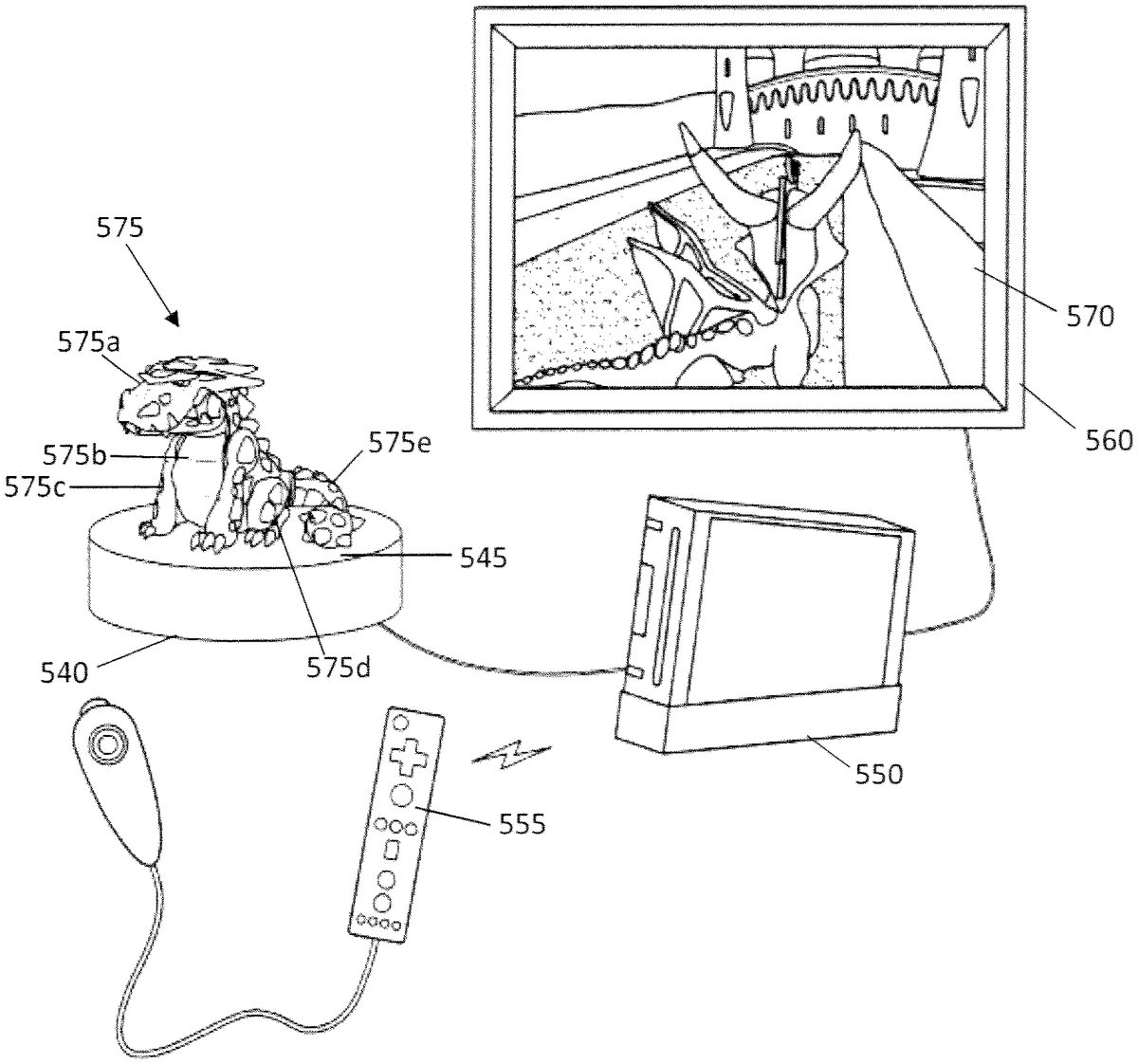
FIG. 5illustrates an example of a video game system in accordance with aspects of the invention. The video game system includes a game console550with a processor for executing program instructions providing for game play and associated circuitry, user input devices such as a game controller555, a display device560for displaying game action, a peripheral device540, and a toy assembly575. Toy assembly575is comprised of a plurality of interconnected toy parts, including head part575a, torso part575b, arm parts575c, leg parts575d, and tail part575e, each of which includes memory storing identification information.
The peripheral device540may provide the capability to read and write information to the toy assembly575and/or its component toy parts. The processor, responsive to inputs from the user input devices and the peripheral device, generally commands display on the display device of game characters in and interacting with a virtual world of game play and possibly each other. In addition, the processor, responsive to inputs from the peripheral device, may be used to add characters and objects to the virtual world, with the characters able to manipulate the added objects and move about the virtual world. For example, the processor may include characters in game play based on inputs from the peripheral device, and the processor may control actions and activities of game characters based on inputs from the user input devices.
The instructions providing for game play are generally stored on removable media, for example, an optical disk. Accordingly, the game console may include an optical drive, for example, a DVD-ROM drive, for reading the instructions for game play. In some embodiments the game console may be a personal computer, including similar internal circuitry as herein described, as well as, for example, a built-in display and built-in user input devices, such as a keyboard and a touch pad. In other embodiments, the instructions providing for game play may be stored in a remote server that are accessed by a computer or mobile device. In yet other embodiments, the instructions providing for game play may be stored locally in the game device memory.
The display device is generally coupled to the game platform by a cable, although in some embodiments a wireless connection may be used. In many embodiments, the display device is a liquid crystal display. In some embodiments, the display device is a television. In some embodiments, the display device is a cathode ray display, a plasma display, an electroluminescent display, an LED or OLED display, or other display. A display screen570of the display device displays video images of game play, generally as commanded by the processor or other associated circuitry of the game platform. In the embodiment ofFIG. 5, the display screen shows a screen shot of video game play. As illustrated, the screen shot shows a display of a character, generally controlled by and animated in accordance with user inputs, approaching an inanimate item in the form of what may be considered a castle.
The peripheral device, in some embodiments and as shown inFIG. 5, has a substantially flat upper surface for placement of toys thereon. The game player generally places game toys, for example, toy assembly575in the form and representative of a dragon as shown inFIG. 5, on the flat surface of the peripheral device during game play. The toy assembly575is generally in the form of and representative of a game item such as a game character or other game item. In several embodiments, the toy assembly is associated with a game character during game play.
Peripheral540includes a surface545where toy assembly575may be placed. Peripheral540may be coupled with a game platform550either through a wired or wireless connection. Game platform550may be any form of game platform, such as game console (e.g., Xbox, Playstation, Wii, NDS), computer, mobile device or other device for executing game software either locally or from a server. The game platform550executes software for a video game. The game platform550may be connected to a display560. In other embodiments, a display may be incorporated into the game platform550, such as in mobile devices or portable computer devices.
The display560provides for the visual display of graphics associated with the game570. A software program running on the game platform550allows the game platform550to identify the individual toy parts and determine the corresponding toy assembly575. The game platform550then displays graphically a virtual representation of the toy assembly575comprised of the toy parts assembled or combined together. The virtual representation may be displayed in a virtual environment on a display device560associated with the game platform550. The toy parts interact dynamically with the software program so that the virtual representation of the toy on the display device corresponds to the physical appearance of the toy assembly. The user can interchange toy parts with a contemporaneous graphical display of the corresponding virtual representation. Accordingly, a user can affect in real time the appearance and interaction between the virtual character and the virtual environment by modifying the physical toy parts and accessory parts.
A user may control the movements of the virtual character in the game using a controller555. The controller555may be a separate from the game platform550or integrated therein.
Each toy part575a-emay include a memory or tag for identifying the part. For example, in some embodiments, each part575a-eincludes an RFID tag with a numerical code to uniquely identify the part. The information pertaining to the identification of each part575a-emay be communicated to the game platform550through the peripheral540. In alternative embodiments, the toy parts575a-emay communicate with the game platform550directly. In still other embodiments, the toy parts575a-emay communicate with each other and provide combined information to the game platform550either directly or through a peripheral540. In other embodiments, each toy part includes a rewritable memory. Information relating to the toy part may be stored in the memory. For example, information pertaining to the ownership of the toy part, the use of the toy part in connection with one or more game platforms, achievements accomplished in the game while using the toy part, or attributes of the toy part within the virtual environment may be stored and updated in the memory. For example, as the user uses the toy part in connection with playing a video game on a game platform, data relating to accomplishments and challenges overcome by the user in the video game may be stored in the memory of the toy part. As another example, the user may be given opportunities to modify certain virtual attributes associated with one or more toy parts as he or she plays the video game. The stored information may be used in subsequent game sessions and across various game platforms so that the virtual attributes of each toy part and each accessory part persist.
FIG. 6is a flow diagram of a process for selecting and communicating with toy parts in accordance with aspects of the present invention. In some embodiments the process is performed by a game platform, for example as discussed with respect toFIG. 1. At block605, the process identifies toy parts. In some embodiments, the process may identify toy parts within a defined region. For example, the process may determine what toy parts are on the surface of a video game peripheral as shown inFIG. 5. In various embodiments, the toy parts may be identified by RFID, barcodes, QR-codes, or optical recognition. In one embodiment, identification of toy parts includes a video game peripheral reading identifiers of the toys and supplying the identifiers to a video game console.
In block610, the process selects a toy part for communication. In some embodiments, the process may select multiple toy parts of a toy assembly for communication. The process may select the to part by transmitting a selection command having an identifier matching the identifier of the toy part. In many embodiments, the process expects to receive an acknowledgment of the selection from the toy part. When an acknowledgment not received, the process may retransmit the selection command or may signal a video game associated with the process that the selected toy is not available.
In block615, the process configures a virtual character. The process may configure the virtual character based on the identified parts. In embodiments, the process may configure the virtual character based on configuration information indicating how the identified toy parts are connected. For example, the configuration information may include the identification of coupled toy parts and information regarding the connector and receptacle through which the toy parts are coupled.
In block620, the process communicates with the toy parts. For example, the process may read from a particular memory location of the toy parts or may write to a particular memory location of the toy parts. In various embodiments the process communicates with the toy parts during game, for example communicates relating to presence of a corresponding virtual character in the game or changes to the states of the virtual character. In many embodiments, the process expects to receive an acknowledgment or response from the toy parts, and when not received, the process may retransmit the command or may signal the video game associated with the process that the selected toy part is not available. The process thereafter returns.
FIG. 7is a flow diagram of a process for conducting video game play in accordance with aspects of the present invention. In some embodiments the process is performed by a game platform, for example as discussed with respect toFIG. 1. In block705, the process requests toy part identification. In some embodiments, the process may identify toy parts within a defined region. For example, the process may determine what toy parts are on the surface of a video game peripheral as shown inFIG. 5. In various embodiments, the toy parts may be identified by RFID, barcodes, QR-codes, or optical recognition. In one embodiment, identification of toy parts includes a video game peripheral reading identifiers of the toys and supplying the identifiers to a video game console.
In block710, the process determines a toy configuration based on the toy part identifications. In some embodiments, the process may use a lookup table or other database to determine a configuration based on the toy parts identified. In some embodiments, the process may communicate with the toy parts to receive connection information indicating the other parts a particular toy part is connected to and an indication of which connector of the toy part is used to make such connection.
In block715, the process determines if the toy configuration is acceptable. The process may utilize a set of configuration rules to determine whether a configuration is acceptable. In some embodiments, the process may determine acceptability of the toy configuration based on whether the toy assembly is complete. For example, the toy configuration may be deemed unacceptable if all of the receptacles of a torso part are not filled with a suitable toy part. In some embodiments, the toy configuration may be unacceptable if a toy part is not properly installed in a receptacle or has been inserted in an inappropriate receptacle. For example, the configuration may be deemed unacceptable if a tail part is installed in a receptacle configured to receive a head part.
If the toy configuration is not acceptable, at block720, the process may request reconfiguration, for example by way of commanding presentation, by way of a display in some embodiments, to a use that the toy assembly be reconfigured. Thereafter the process returns to block705.
When the toy configuration is deemed acceptable, at block725, the process may generate a virtual character corresponding to a physical to assembly including each of the identified toy parts.
In block730, the process conducts video game play using the virtual character. As the virtual toy is used to progress through the video game, data relating to accomplishments and challenges overcome by the user in the video game may be stored in the memory of the toy parts of the toy assembly.
Thereafter the process returns.
FIG. 8is a flow diagram of a process for conducting video game play in accordance with aspects of the present invention. In some embodiments the process is performed by a game platform, for example as discussed with respect toFIG. 1. In block805, the process determines a toy configuration based on toy parts identified. In some embodiments, the process may use a lookup table or other database to determine a configuration based on the toy parts identified. In some embodiments, the process may communicate with the toy parts to receive connection information indicating the other parts a particular toy part is connected to and an indication of which connector of the toy part is used to make such connection.
In block810, the process detects a change in the configuration of the physical toy. In some embodiments, a change may be detected when an identified toy part is removed from a defined area, for example, a surface of peripheral550shown inFIG. 5.
In block815, the process may receive toy part identification information. In some embodiments, the process may identify toy parts located in a predefined region. In some embodiments, the process may determine the toy part identification only for the new toy parts added.
In block820, the process may determine a new toy configuration. In some embodiments, the process may use a lookup table or other database to determine a configuration based on the toy parts identified including the new toy part(s). In some embodiments, the process may communicate with the toy parts to receive connectiion information indicating the other parts a particular toy part is connected to and an indication of which connector of the toy part is used to make such connection.
In block825, the process may conduct game play with a virtual character corresponding to the new toy assembly. Thereafter, the process returns.
FIG. 9depicts a block diagram of a process for identification of one or more toy assemblies by the game platform. In the present embodiment, the toy assemblies comprise two parts—a top part and a bottom part. When a top toy part is properly connected to the bottom toy part a complete toy assembly is assembled. In some embodiments, the system will not recognize toy parts that do not comprise a complete toy assembly. In block910, the system starts up. At this time, the system is capable of communicating with the toy parts and receive identification information for toy parts.
In block920, the system determines if a complete toy assembly is in communication with the game platform. If no complete toy assembly is detected by the system, the system prompts the user to place a complete toy assembly in communication with the game platform at block930.
In block940, the system determines if more than one toy assembly is in communication with the game platform. If only a single complete toy assembly is in communication with the game platform, the system can depict the toy assembly in the game environment for game play in block950. If multiple complete toy assemblies come into communication with the game platform asynchronously, the system can determine the respective to assemblies based on the timing of the communication of the toy parts with the system in block970. For example, if first complete toy assembly comprising toy part A and toy part B and a second toy assembly comprising toy part X and toy part Y are in communication with the game system, the game system can determine that the first toy assembly comprises toy part A and toy part B (as opposed to some other combination with toy part X or toy part Y) because toy part A and toy part B are in communication with the system at or about the same time, and toy part X and toy part Y come into communication with the system at a different time. If however the first toy assembly and second toy assembly come into communication with the system at or about the same time in block960, the system may have difficulty identifying which toy parts constitute the respective toy assemblies, since four or more to parts have been identified by the game platform at or about the same time. In this situation, the user may be prompted to replace the toy assemblies in communication with the system at different times in block980.
After recognition and identification by the system, toy parts may be associated with player based on the toy part identification number. Therefore, the game can easily recognize two players using the same type of parts and still update each toy's data based on player association.
In other embodiments, more sophisticated RFID chips may be utilized to provide communication between the various toy parts and the game platform. For example, the first toy part may comprise an RFID chip that provides an indication of whether a second toy part is in contact with the first toy part.
Although the invention has been discussed with respect to various embodiments, it should be recognized that the invention comprises the novel and non-obvious claims supported by this disclosure.
Claims
- A computer-implemented method for use in providing a video game, comprising: receiving information from a plurality of toy parts coupled together to form a toy assembly;determining a configuration of the toy assembly based on the information from the plurality of toy parts;displaying a virtual character corresponding to the toy assembly for use in the video game based on the determined configuration;and conducting video game play using the virtual character;wherein the information includes a unique identification and attribute information for each toy part, further including updating the attribute information for each toy part based on the video game play.
- A computer-implemented method for use in providing a video game, comprising: receiving information from a plurality of toy parts coupled together to form a toy assembly;determining a configuration of the toy assembly based on the information from the plurality of toy parts;displaying a virtual character corresponding to the toy assembly for use in the video game based on the determined configuration;and conducting video game play using the virtual character;wherein the information includes a unique identification and attribute information for each toy part;and wherein the attribute information includes at least health of the toy part.
- A computer-implemented method for use in providing a video game, comprising: receiving information from a plurality of toy parts coupled together to form a toy assembly;determining a configuration of the toy assembly based on the information from the plurality of toy parts;displaying a virtual character corresponding to the toy assembly for use in the video game based on the determined configuration;and conducting video game play using the virtual character;wherein the information includes a unique identification and attribute information for each toy part;and wherein the attribute information includes at least an experience level of the toy part.
- A video game system, comprising: a game device including a processor, memory storing program instructions for providing for video game play, and a user input device;a peripheral device including a surface for placing objects thereon, the peripheral device including a wireless transceiver for communicating with objects placed on the surface, the peripheral device communicatively couplable to the game device;and a plurality of toy parts physically combinable into a toy assembly, the toy parts each including an identification of the toy part, at least one of the toy parts including a wireless transceiver for communicating with the peripheral device, at least some of the other of the toy parts including communication elements for communicating with various of the toy parts such that each of the toy parts may communicate their identification to the toy part including the wireless transceiver when combined into the toy assembly, and at least one of the toy parts storing attribute information for a character representing the toy assembly in game play;the program instructions for providing for video game play including program instructions for determining if the toy assembly is configured in a valid configuration, program instructions for commanding display of the character representing the toy assembly in game play, the character controllable by a user operating the user input device.
- The toy assembly of claim 4 , wherein the wireless transceiver of the at least one of the toy parts is part of an RFID tag.
- The toy assembly of claim 4 , wherein the communication elements comprise inductive communication elements.
- The toy assembly of claim 4 , wherein the communications elements comprise electrical contacts.
Disclaimer: Data collected from the USPTO and may be malformed, incomplete, and/or otherwise inaccurate.