U.S. Pat. No. 11,351,464
AUTOMATED COACHING FOR ONLINE GAMING
AssigneeElectronic Arts Inc.
Issue DateApril 2, 2020
Illustrative Figure
Abstract
A game coaching system identifies gameplay data associated with online game players of an online game and determines, based at least in part on the gameplay data, a performance model to predict performance metric(s) of individual players. The performance model may be used to conduct a sensitivity analysis to determine which perturbations to individual parameters of gameplay data result in improvements to the performance metric(s) of a player. This sensitivity analysis may be used to identify action(s) to recommend to the player to improve his or her gameplay performance. The action(s) that are recommended to the player may be decided based at least in part on the predicted impact of those action(s) on player performance and/or the ease of implementing the action(s). The game coaching system may provide updated action recommendations to players to allow the player to improve his or her gameplay performance over time.
Description
DETAILED DESCRIPTION Example embodiments of this disclosure describes methods, apparatuses, computer-readable media, and system(s) for coaching online game players to improve their gaming skills in a particular online game. An online game player may become disengaged from an online game if he or she is not able to improve his or her performance in the online game over time. With the complexity of modern online games, it may be difficult for players to know how to improve their online gaming performance. According to example embodiments of the disclosure, players may be provided with recommendations to improve their online gaming performance. These recommendations may be specific actions that one can take when playing the online game. According to example embodiments of the disclosure, game coaching system(s) may be able to generate a performance model associated with the gameplay of a certain online game. This performance model may be generated using a collection of player gaming data associated with a plurality of players who have played the online game for which the performance model is to be generated. The player gaming data may include one or more performance metrics (e.g., damage per match score, matchmaking rating, etc.), as well as one or more gameplay data associated with individual ones of the players. The gameplay data may include various characteristics of a player's gameplay, such as, in the context of a battle royale, first person shooter-type game, the amount of use of certain types of weapons, level of walking/running, levels of climbing, levels of communications with other players, accuracy of weapons use, etc. It will be appreciated that other online games and/or genres of online games may have different gameplay data types. The gameplay data, as described herein, may include numerical and/or descriptive characteristics of a player's gameplay in one or many sessions ...
DETAILED DESCRIPTION
Example embodiments of this disclosure describes methods, apparatuses, computer-readable media, and system(s) for coaching online game players to improve their gaming skills in a particular online game. An online game player may become disengaged from an online game if he or she is not able to improve his or her performance in the online game over time. With the complexity of modern online games, it may be difficult for players to know how to improve their online gaming performance. According to example embodiments of the disclosure, players may be provided with recommendations to improve their online gaming performance. These recommendations may be specific actions that one can take when playing the online game.
According to example embodiments of the disclosure, game coaching system(s) may be able to generate a performance model associated with the gameplay of a certain online game. This performance model may be generated using a collection of player gaming data associated with a plurality of players who have played the online game for which the performance model is to be generated. The player gaming data may include one or more performance metrics (e.g., damage per match score, matchmaking rating, etc.), as well as one or more gameplay data associated with individual ones of the players. The gameplay data may include various characteristics of a player's gameplay, such as, in the context of a battle royale, first person shooter-type game, the amount of use of certain types of weapons, level of walking/running, levels of climbing, levels of communications with other players, accuracy of weapons use, etc. It will be appreciated that other online games and/or genres of online games may have different gameplay data types. The gameplay data, as described herein, may include numerical and/or descriptive characteristics of a player's gameplay in one or many sessions of an online game. In other words, the gameplay data may include descriptive statistics and/or summaries of the aspects of a player's gameplay over a period of time and/or number of sessions.
The game coaching system(s) may generate the performance model using any suitable modeling technique, such as any suitable machine learning algorithms, regressions models, heuristics, or the like. In some cases, the game coaching system(s) may train, using the gameplay data and the player performance data, a random forest model to predict performance metric(s) based on gameplay data122. Although discussed herein in the context of a random forest model, the performance model may be any one or combination of decision tree models, gaussian tree models, Bernoulli models, linear regression models, neural network models, Bayesian network models, any variety of heuristics (e.g., genetic algorithms, swarm algorithms, etc.), combinations thereof, or the like. After the performance model is generated, the performance model may be deployed for the purposes of predicting player performance improvements resulting from a player's changes in actions during gameplay.
In some cases, the performance model may be trained on a first subset of training data (e.g., gameplay data of players and corresponding player performance data) and a second subset of the training data may be used to determine the predictive capability of the model. In other words, the model may be evaluated using the second subset of training data using any suitable metric (e.g., mean-squared error (MSE)), and if the performance model is considered to sufficiently predictive of the associated performance metric, then the performance model may be deployed. However, if the model does not meet a threshold level of performance (e.g., MSE is above a threshold level) then the performance model may be further trained using additional training data and/or different parameters of the training model. When the performance model is predicting the performance metric to an acceptable level of accuracy and/or precision, the performance model may be deployed for determining actions that would aid a player in improving his or her gameplay performance.
In example embodiments, the game coaching system(s) may use the performance model, as described herein, to perform an analysis of how a player can improve his or her gameplay performance, as measured by his or her player performance data. For example, the game coaching system(s) may test a variety of hypothetical changes in a player's gameplay data to determine which changes may result in improvements to that player's gameplay performance. This analysis may include a sensitivity analysis where various gameplay data associated with a player may be perturbed by a predetermined and/or variable amount to identify the effect of that perturbation on the player's expected performance. For example, if a player throws 75 grenades during gameplay of a certain online game, the game coaching system(s) may determine what the effect of the player throwing 72 grenades would be on his or her damage per match score, as well as the effect of the player throwing 78 grenades on his or her damage per match score. Although a +/−3 grenades thrown perturbation is used in this example sensitivity analysis of the number of grenades thrown, it should be understood that any suitable magnitude of perturbation may be used with any quantifiable gameplay data to determine its impact on one or more performance metric. Additionally, although the perturbation, in this example, is symmetric, where the perturbation for the increase in the number of grenades thrown (e.g., +3 grenades) is the same as perturbation for the decrease in the number of grenades thrown (e.g., −3 grenades), it should be understood that according to example embodiments of the disclosure, the perturbations to the high side and the perturbations to the low side may be non-symmetric. Continuing with the example, if it is determined that throwing three extra grenades result in an improvement in the player's damage per match score, then the game coaching system(s) may recommend to the player to throw more grenades during gameplay. This action recommendation may be displayed to the player via his or her client device with which he or she plays the online game.
In example embodiments of the disclosure, the impact on performance of changing a number of gameplay data types of a player may be determined. From this type of sensitivity analysis, the most impactful changes of the gameplay data may be translated to actions that the player can take to improve performance. For example, this analysis can determine that the player may improve his or damage per match score by 30 points by throwing 2 more grenades, but only 14 points by running 5% more. If only one recommendation is to be made to the player, the recommendation may be to throw more grenades, rather than to run more during gameplay. In other cases, the game coaching system(s) may identify several different actions that could be taken to improve a player's performance and recommend the three most impactful ones of those several actions. Indeed, the game coaching system(s) may identify any suitable number of actions to help a player's gameplay performance and provide any suitable subset of those actions as recommendations to the player.
According to example embodiments of the disclosure, recommendations of actions to improve one's performance may be made to players considering both the impact of those actions, as well as the ease of implementation of those actions. In other words, if the game coaching system(s) identify a first action that may have a greater positive impact on performance than a second action, but the first action may be more difficult to implement than the second action, then the game coaching system(s) may prioritize the recommendation of the second action even though its impact to performance improvement may be less than the first action. For example, the game coaching system(s) may determine that improving accuracy of grenades by 5% would result in a 45 point improvement in a player's damage per match score and that throwing 2 more grenades would result in a 35 point improvement in that player's damage per match score, the game coaching system(s) may prioritize the recommendation of throwing more grenades than improving accuracy, since it may be easier to throw more grenades than to improve a skill, like improved accuracy. Thus, each action may have an ease of implementation metric associated with it for the purposes of determining which actions to recommend to a player to improve his or her gameplay.
The game coaching system(s), in example embodiments, may also be able to provide revised action recommendations to a player over time. For example, if a player plays an online game and is provided with actions to perform to improve his or her gameplay, by the mechanisms disclosed herein, the game coaching system(s) may perform another analysis of that player's gameplay at some point in the future to provide additional recommendations for improving performance. In some cases, if a player performs some of the initial recommended actions, then at the later time, other actions may be recommended to the player, based on the performance improvement analysis performed at the later time. In these cases, the game coaching system(s) may use gameplay data associated with the player during a time period after when the initial recommendations were made to perform the second gameplay improvement analysis.
In still further example embodiments, the game coaching system(s) may be able to monitor a player's behavior (e.g., engagement, number of hours played in a week, number of days played in a month, number of hours played per session, etc.). This behavior data may be used by the game coaching system(s) to provide feedback as to whether providing action recommendations to improve gameplay has an effect on player engagement. In some cases, the game coaching system(s) may perform an A/B test (e.g., split/bin test) to determine the effectiveness of providing action recommendations to players. For example, action recommendations may be provided to a first group of players and not to a second group of players and the game coaching system(s) may determine if there are any and/or a magnitude of difference across any number of engagement metrics between the first group and the second group. The game coaching system(s) may also be configured to perform a longitudinal study on players to whom action recommendations are provided. For example, a particular player or a group of players' engagement during a time period prior to providing the player or players with action recommendations may be compared to the same player or group of players' engagement after providing him/her/them with action recommendations.
Certain implementations and embodiments of the disclosure will now be described more fully below with reference to the accompanying figures, in which various aspects are shown. However, the various aspects may be implemented in many different forms and should not be construed as limited to the implementations set forth herein. It will be appreciated that the disclosure encompasses variations of the embodiments, as described herein. Like numbers refer to like elements throughout.
FIG. 1illustrates a schematic diagram of an example environment100with online gaming system(s)130and game coaching system(s)110to provide automated coaching to player(s)102(1),102(2), . . .102(N) for online gaming, in accordance with example embodiments of the disclosure. The player(s)102(1),102(2), . . .102(N), hereinafter referred to individually or collectively as player(s)102, may interact with respective game client device(s)104(1),104(2), . . .104(N), hereinafter referred to individually or collectively as game client device(s)104to play online game(s) hosted by online gaming system(s)130.
The player(s)102may be either streaming players102or non-streaming players102. The non-streaming players may play using client devices104that locally render the game to respective players102. For streaming players102rendered game content may be provided to client devices104of the players102by the online gaming system(s)130and/or associated streaming systems. The mechanisms as described herein may be applied to either or both streaming and/or non-streaming players102.
The game client devices104may be configured to render content associated with the online game to respective players102. This content may include video, audio, haptic, combinations thereof, or the like content components. The game client device(s)104may receive game state information from the one or more online gaming system(s)130that may host the online game played by the player(s)102of environment100. The game client device(s)104may use the game state information to render current events of the online game as content. The game state information may be received repeatedly and/or continuously and/or as events of the online game transpire. The game state information may be based at least in part on the interactions that each of the player(s)102have via their input device(s) associated with their client device(s)104responsive to events of the online game hosted by the online gaming system(s)130.
As events transpire in the online game, the online gaming system(s)130may update game state information and send that game state information to the game client device(s)104. For example, if the players102are playing an online soccer game, and the player102playing one of the goalies move in a particular direction, then that movement and/or goalie location may be represented in the game state information that may be sent to each of the game client device(s)104for rendering the event of the goalie moving in the particular direction. In this way, the content of the online game is repeatedly updated throughout game play. When the game client device(s)104receive the game state information from the online gaming system(s)130, the game client device(s)104may render updated content associated with the online game to its respective player102. This updated content may embody events that may have transpired since the previous state of the game (e.g., the movement of the goalie).
The game client device(s)104may accept input from respective players102via respective input device(s) of the client device104, such as joysticks, touch screens, gamepads, or the like. The input from the players102may be responsive to events in the online game. For example, in an online basketball game, if a player102sees an event in the rendered content, such as an opposing team's guard blocking the paint, the player102may provide input to his/her client device104to try to shoot a three-pointer. Intended action by the player102, as captured via input devices of the client devices104may be sent to the online gaming system(s)130.
The game client device(s)130may be any suitable device, including, but not limited to a Sony Playstation® line of systems, a Microsoft Xbox® line of systems, any gaming device manufactured by Sony, Microsoft, Nintendo, an Intel-Architecture (IA)® based system, an Apple Macintosh® system, a netbook computer, a notebook computer, a desktop computer system, a set-top box system, a handheld system, a smartphone, a personal digital assistant, combinations thereof, or the like. In general, the game client device(s)104may execute programs thereon to interact with the online gaming system(s)130and render game content based at least in part on game state information received from the online gaming system(s)130. Additionally, the client device(s)104may send indications of player input to the online gaming system(s)130. Game state information and player input information may be shared between the client device(s)104and the online gaming system(s)130using any suitable mechanism, such as application program interfaces (APIs).
The online gaming system(s)130may receive inputs from various players102and update the state of the online game based thereon. As the state of the online game is updated, the state may be sent the various client system(s)104for rendering online game content to players102. In this way, the online gaming system(s)130host the online game. As described herein, in some cases, the online gaming system(s)130and/or associated system(s), such as a streaming system (not shown), may provide streaming content to one or more of the client devices104, when the associated players102play in streaming mode. The streaming players102may experience (e.g., view, hear, feel, etc.) the content associated with the online game on their client devices104based at least in part on streaming content as received from the online gaming system(s)130.
The game coaching system(s)110may receive, manage, and/or access information about the players102who play online game(s). The player related data may be stored and/or accessed by the game coaching system(s)110in a player profile datastore112. The player102related data may be stored as player gaming data120corresponding to respective players102, and may include information such as any variety of gaming data, such as gameplay data122, player performance data124, player behavior data126, player recommendation data128, combinations thereof, or the like. According to example embodiments, the parameters and values, as stored and available in the player gaming data120may be used to determine a performance model that predicts a player's performance based on a variety of gameplay data122of an online game, as well as actions that would improve a player's performance on the online game. Thus, the game coaching system(s)110provide recommendations of actions to players102via their respective client devices104, as described herein, using the player gaming data120, as stored in the player profile datastore112.
The gameplay data122of a player gaming data120may indicate a variety of gameplay related information about the corresponding player102. For example, the gameplay data122may include data related to a particular online game are for which action recommendations may be made to the player102to improve the player's performance. The gameplay data122of a player102may indicate various metrics associated with how the player102plays the online game for which recommendations are to be made. This gameplay data122may be received from the online gaming system(s)130and/or determined at the game coaching system(s)110based at least in part on data received from the online gaming system(s)130.
The game play data122may indicate data associated with how a player102plays the online game for which action recommendations are to be made for improvement and/or what the player does during gameplay. For example, for a first-person shooter/battle royale style game (e.g., APEX LEGENDS by ELECTRONIC ARTS), the various aspects of what the player102does during gameplay may be tracked over different periods of time. The frequency of use of particular weapons may be tracked (e.g., how many grenades were used, how many shots were fired, etc.) over the last game or any grouping of games and/or time periods of gameplay. Additionally, movement may be tracked (e.g., percentage of time running, percentage of time walking, levels of climbing/descent, etc.). Further still, team/cooperation factors may be tracked (e.g., number of times assisting other players, pinging other players for recovery and/or help, frequency of communications, toxic communications, over-pinging for help, etc.).
Although described herein in the context of a battle royale style game, it will be appreciated that the techniques described herein may be applied to any style of online games and individual online games and/or types/genres of games may use different gameplay data122for the purposes of performance model building and/or providing recommended actions to individual players102. For example, in an American football online game, the types of gameplay data122that may be tracked and used for providing recommendations to players102may include number of passes attempted, number of rush plays attempted, number of fourth down attempts, average number of players rushing the quarterback, proximity of receiver coverage, etc. In other words, any of the aforementioned parameters, as determined from online game play for an ensemble of players102, may be used to generate a performance model and then those parameters pertaining to an individual player102may be used, in conjunction with the performance model, to make action recommendations to the player102. For example, such action recommendations may be to attempt more rush plays and fewer pass plays, use an additional player to protect the quarterback, attempt fewer long field goals, etc.
As yet a further example of gameplay data122, consider a mixed martial arts online game. The gameplay data122that may be tracked by the game coaching system(s)110in conjunction with the online gaming system(s)130may include number of punches attempted, number of kicks attempted, proximity when punching, proximity when kicking, percentage of body hits, percentage of face hits, percentage blocking, etc. Again, the game coaching system(s)110may be configured to use any of these parameters, as determined from online game play for an ensemble of players102, to generate a performance model and then those parameters pertaining to an individual player102, in conjunction with the performance model, to make action recommendations to the player. For example, such action recommendations may be to attempt more body blows, rather than face hits, spend more time blocking, move away from the opponent when kicking, etc.
The game coaching system(s)110may be configured to store and then later access information about individual players, such as from the player's player gaming data120to generate performance model(s) and/or recommendations for individual players102to improve their gameplay. In some cases, the game coaching system(s)110may access an ensemble of gameplay data122of a plurality of players102for the purposes of generating performance model(s) using the gameplay data122. In other cases, the game coaching system(s)110may be configured to access gameplay data122corresponding to an individual player102for the purposes of determining one or more actions to recommend to the player102to improve his or her gameplay performance. It should be understood that the gameplay data122may include numerical and/or descriptive characteristics of a player's gameplay in one or many sessions of a corresponding online game. In other words, the gameplay data122may include descriptive statistics and/or summaries of the aspects of a player's gameplay over a period of time and/or number of sessions.
As described herein, the gameplay data122may be used to generate one or more performance model(s) to model one or more performance metric(s) that may be stored as player performance data124. These performance metrics may include any suitable metric that indicates the performance of a player102, and such metrics may not be limited to a final score. As an example, in the context of a battle royale style game, a performance metric may include a damage per match score. Thus, in this case, the performance model for this type of online game may use gameplay data122to predict the damage per match score. Other types of player performance data124may include scores, levels played, total time played, number of lives attained, number of extended plays, skill levels attained, wins, wins minus losses, score delta (score minus opposition's score), combinations thereof, or the like. The player performance data124for a plurality of players102of an online game may be used, in conjunction with the gameplay data122of those players102, to generate a performance model to predict the performance data124from the gameplay data122. When the performance model is used to recommend actions to individual players102, those actions may be to help the players102improve their performance metrics, as embodied in the player performance data124. The performance model, after being generated may be stored, managed, updated, and/or accessed in a game performance model datastore114.
The player behavior data126may indicate a player's engagement with the online game for which recommendations are to be made. Engagement may be assessed as how many times or how often a player102plays the online game over a given period of time. For example, the player behavior data126associated with a particular player102may indicate the number of hours that player102played the online game over the past month or over the past week, or how many sessions he or she played over a two week period, etc. The game coaching system(s)110may determine the relative level of a player's engagement by comparing his or her player behavior data126to the player behavior data126of other players102. Additionally, the game coaching system(s)110may determine changes in a particular player's level of engagement based at least in part on changes in the player's player behavior data126over time. For example, a player may have played a particular online game for 5 hours on one week and then for 8 hours in the subsequent week. This may indicate that the player's level of engagement has increased from the first week to the subsequent week.
The player recommendation data128may indicate action recommendations that were made to a player102. These action recommendations may be stored along with a timestamp. The game coaching system(s)110may be configured to store a record of actions recommended to individual players102over time. The game coaching system(s)110may also be configured to access the player recommendation data128for a player102and determine if that player had implemented some of the recommended actions made to him or her.
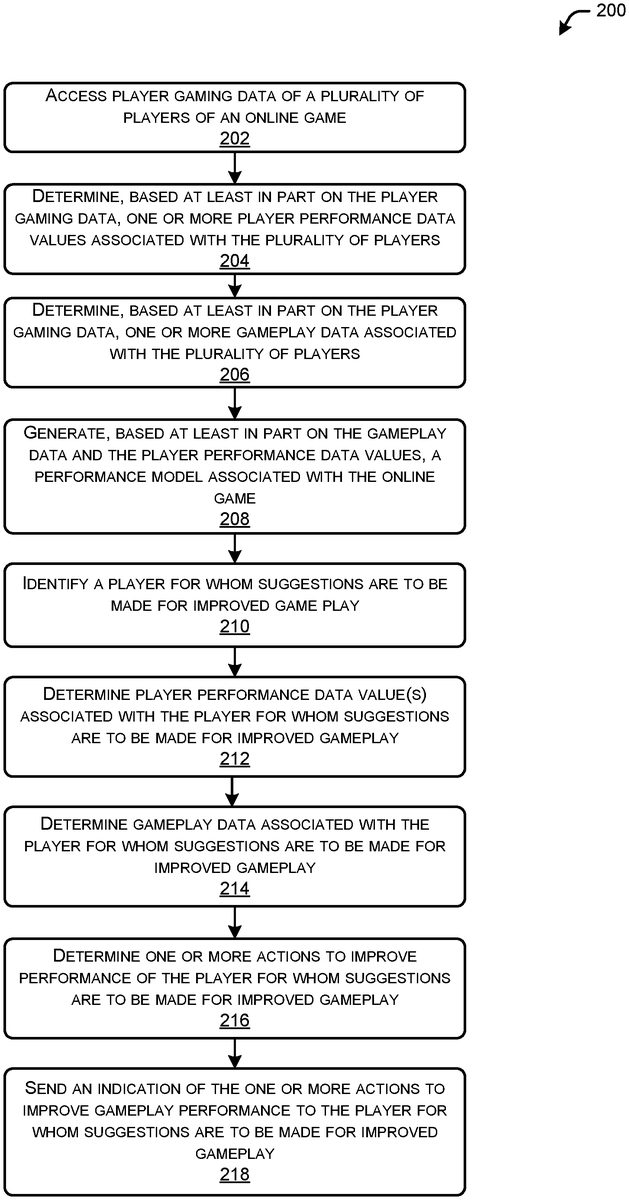
FIG. 2illustrates a flow diagram of an example method200to provide a player102with recommendations to perform one or more actions to improve his or her online gaming performance, in accordance with example embodiments of the disclosure. The method200may be performed by the game coaching system(s)110, in cooperation with one or more entities of environment100.
At block202, player gaming data associated with an online game of a plurality of players may be accessed. This player gaming data120may be accessed from the player profile datastore112by the game coaching system(s)110. At block204, one or more player performance data may be determined based at least in part on the player gaming data. In example embodiments, the player performance data124for the plurality of players102may be stored as part of their player gaming data120. The player performance data124may be accessed by the game coaching system(s)110from the player profile datastore112. At block206, one or more gameplay data may be determined for the plurality of players based at least in part on the player gaming data. In example embodiments, the gameplay data122for the plurality of players102may be stored as part of their player gaming data120. The gameplay data122may be accessed by the game coaching system(s)110from the player profile datastore112.
At block208, a performance model associated with the online game may be generated based at least in part on the gameplay data and the player performance data. The game coaching system(s)110may generate the performance model using any suitable modeling technique, such as any suitable machine learning algorithms, regressions models, heuristics, or the like. In some example embodiments, the game coaching system(s)110may train, using the gameplay data122and the player performance data126, a random forest model to predict performance metric(s) based on the gameplay data122. Although discussed herein in the context of a random forest model, the performance model may be any one or combination of decision tree models, gaussian tree models, Bernoulli models, linear regression models, neural network models, Bayesian network models, any variety of heuristics (e.g., genetic algorithms, swarm algorithms, etc.), combinations thereof, or the like.
The game coaching system(s)110may identify parameters for training the performance model. For example, for a random forest model, parameters, such as the number of trees, maximum number of features per tree, maximum number of nodes per tree, maximum number of terminal nodes, etc., may be determined. In some example embodiments, the parameters for training the performance model may be received from an operator who guides the training of the performance model. In some cases, the training the performance model may be supervised. In other cases, the training may be unsupervised or a combination of supervised and unsupervised.
In some cases, the performance model may be trained on a first subset of training data (e.g., gameplay data122of the plurality of players102and corresponding player performance data126) and a second subset of the training data may be used to determine the predictive capability of the model. In example embodiments, the performance model may be evaluated using the second subset of training data using any suitable metric, such as MSE, and if the performance model is considered to sufficiently predictive of the associated performance metric, then the performance model may be stored in the game performance model datastore114and/or deployed. However, if the model does not meet a threshold level of performance, such as if the MSE level is greater than a corresponding threshold level, then the performance model may be further trained using additional training data and/or using different parameters of the training model. When the performance model is predicting the performance metric to an acceptable level of accuracy and/or precision, the performance model may be stored in the game performance model datastore114and/or deployed for determining actions that would aid a player in improving his or her gameplay performance.
At block210, a player for whom suggestions are to be made for improved gameplay may be identified. In some cases, this player102, who is identified as potentially benefiting from action recommendations for improved gameplay, may be at a beginner or intermediate level, in example embodiments. In other example embodiments, the player102identified as potentially benefiting from action recommendations for improved gameplay may be a player102whose performance, as indicated by their player performance data124, may have stagnated over time and/or recently. The player's proficiency level and/or performance changes over time may be determined from the player's player performance data124, as can be accessed from the player profile datastore112.
At block212, player performance data associated with the player for whom suggestions are to be made for improved gameplay may be determined. As discussed herein, this player performance data124of the player102may be accessed from the player gaming data120, as stored in the player profile datastore112. At block214, gameplay data associated with the player for whom suggestions are to be made for improved gameplay may be determined. As discussed herein, this gameplay data122of the player102may be accessed from the player gaming data120, as stored in the player profile datastore112.
At block216, one or more actions to improve performance of the player for whom suggestions are to be made for gameplay may be determined. In example embodiments, a sensitivity analysis may be performed by perturbing individual ones of the parameters of the gameplay data122to predict, using the performance model, the effect of the perturbation. Those perturbations that are predicted to improve the player's performance may be identified. The corresponding actions of the perturbations that are predicted to improve gameplay performance may be identified.
At block218, an indication of the one or more actions to improve performance may be sent to the player for whom suggestions are to be made for improved gameplay. In example embodiments, indications of the one or more actions may be sent by the game coaching system(s)110to the client device104associated with the player102for whom these action suggestions are made. The player's client device104may display the recommended one or more actions to the player102.
It should be noted that some of the operations of method200may be performed out of the order presented, with additional elements, and/or without some elements. Some of the operations of method200may further take place substantially concurrently and, therefore, may conclude in an order different from the order of operations shown above.
FIG. 3illustrates a flow diagram of an example method300by which a to generate various performance models corresponding to different characters, platforms, and/or performance metrics, in accordance with example embodiments of the disclosure. The method300may be performed by the game coaching system(s)110, in cooperation with one or more entities of environment100.
At block302, different performance metrics for an online game that is to be modeled using a performance model may be determined. As discussed herein, there may be a performance model generated for each of the different performance metrics that are to be modeled. At block304, different client device platforms for which performance models are to be generated may be identified. As discussed herein, there may be a performance model generated for each of the different client device types. At block306, different characters for which performance models are to be generated may be identified. As discussed herein, there may be a performance model generated for each of the different characters or avatars in the online game. At block308, a performance model for a particular performance metric, a particular client device type, and a particular character may be generated. In example embodiments, this performance model may be generated by some or all of the processes of method400ofFIG. 4, as described herein.
At block310, it may be determined if there are additional characters for which a performance model is needed. If it is determined that there are additional characters for which a performance model is to be determined, then the method300may return to block308to generate an additional performance model to the additional character. If, however, it is determined that there are no additional characters for which a performance model is needed, then the method300may proceed to block312, where it may be determined if there are additional client device platforms for which a performance model is needed. If it is determined that there is an additional client device platform for which a performance model is to be determined, then the method300may return to block308to generate an additional performance model corresponding to the additional client device type. If, however, it is determined that there is no additional client device type for which a performance model is needed, then the method300may proceed to block314, where it may be determined if there are additional performance metrics for which a performance model is needed. If it is determined that there is an additional performance metric for which a performance model is to be determined, then the method300may return to block308to generate an additional performance model corresponding to the additional performance metric. If, however, it is determined that there are no additional performance metric for which a performance model is needed, then the method300may proceed to block316, where each of the generated performance models may be deployed to provide recommendations to players to improve their gameplay. The game coaching system(s)110may store each of the performance models in the game performance model datastore114associated with their respective client device types, performance metrics, and/or characters for retrieval later on to perform sensitivity analysis.
It should be noted that some of the operations of method300may be performed out of the order presented, with additional elements, and/or without some elements. Some of the operations of method300may further take place substantially concurrently and, therefore, may conclude in an order different from the order of operations shown above.
FIG. 4illustrates a flow diagram of an example method by which a performance model is generated and deployed, in accordance with example embodiments of the disclosure. The method400may be performed by the game coaching system(s)110, in cooperation with one or more entities of environment100. In example embodiments, the method400may be an implementation of the processes of block308ofFIG. 3. In other words, the method400may be implemented for each character, client device type, and/or performance metric. Thus, in some cases, the method400may be used to generate a performance model corresponding to each character within an online game, types of client devices, and/or performance metrics.
At block402, player performance metric values that are to be used for generating a performance model for an online game may be identified. These player performance metric values may be retrieved from the player profile datastore112, as player performance data124, by the game coaching system(s)110. The player performance metric values may pertain to a plurality of players102who have played the online game. In some example embodiments, to make the performance model generated more targeted, particular player's performance metric values may be used, such as players who are beginners and/or intermediate level players102. Additionally, in some cases, the performance metric values may be associated with a particular character/avatar in a particular online game, a particular client device type, and/or for a specific performance metric.
At block404, gameplay data corresponding to the player performance metric values may be determined. This gameplay data122may also be retrieved by the game coaching system(s)110from the player profile datastore112. The combination of the gameplay data122and corresponding player performance metric values may serve as training data for training the performance model. As described herein, in some cases, the performance metric values may be for a particular character/avatar in a particular online game, a particular client device type, and/or for a specific performance metric.
At block406, a model type for the performance model may be determined. The model type may be selected from any suitable type of model. The types of models may include a random forest model, decision tree models, gaussian tree models, Bernoulli models, linear regression models, neural network models, Bayesian network models, any variety of heuristics (e.g., genetic algorithms, swarm algorithms, etc.), combinations thereof, or the like. In some example embodiments, the performance model may be a model type where the inputs of the gameplay data122parameters are not abstracted. In example embodiments, the selected model type may be a random forest model.
At block408, one or more training parameters according to which to train the performance model may be identified. For a random forest model, the training parameters may include the number of trees, maximum number of features per tree, maximum number of nodes per tree, maximum number of terminal nodes, etc., may be determined. Other model types may include other training or modeling parameters. In example embodiments, the one or more training parameters may be provided to the game coaching system(s)110by an operator. At block410, the performance model may be trained based at least in part on the performance metric values, the gameplay data, and/or the one or more training parameters.
At block412, the performance model may be tested using additional training data to determine the predictive capability of the performance model. In some cases, the additional training data may have been partitioned off from the original training data as identified by the processes of blocks402and404. Any suitable type of test may be performed to determine the predictive capability of the newly generated performance model. For example, MSE metric of the performance model may be determined.
At block414, it may be determined if the performance model meets a threshold level of predictive capability. In some cases, the MSE may be compared to a threshold level to determine if the performance model meets the threshold level of predictive capability. If it is determined that the performance model meets a threshold level of predictive capability, then the method400proceeds to block416, where the performance model may be stored in the game performance model datastore and/or deployed to provide recommendations to players to improve their gameplay. However, if it is determined that the performance does not meet a threshold level of predictive capability, then the method may return to block408to retrain the performance model using different training parameters and/or additional training data (e.g., player performance data124, gameplay data122, etc.). The game coaching system(s)110may store the performance model in the game performance model datastore114, when finalized, such as in association with the particular character/avatar, the particular client device type, and/or for the specific performance metric with which the performance model is associated.
It should be noted that some of the operations of method400may be performed out of the order presented, with additional elements, and/or without some elements. Some of the operations of method400may further take place substantially concurrently and, therefore, may conclude in an order different from the order of operations shown above.
FIG. 5illustrates a schematic diagram of an example environment500by which a performance model is generated and deployed, in accordance with example embodiments of the disclosure. At block510, the game coaching system(s)110may review a variety of player gaming data120corresponding to respective players102to identify players102who are at an intermediate level. The performance model to be generated may be targeted to the intermediate level to help players at the intermediate level improve their gameplay. In this case, the intermediate level may correspond to a performance metric in the form of damage per match score of between 80 and 300. As a result, the player gaming data120for players102with damage per match scores of between 80 and 300 may be used to generate the performance model. Additionally, the players102may be selected for contributing player gaming data120that pertain to a particular character/avatar and/or a particular client device type for which the performance model is to be generated.
At block520, gameplay data122corresponding to the players102with the targeted damage per match score may be associated with the damage per match score of each of the players102. The gameplay data122and the corresponding damage per match score serves as the training data for training the performance model. In example embodiments, this training data may be associated with the particular character/avatar and/or the particular client device type for which the performance model is to be generated. At block530, the performance model type may be determined as a random forest model. Additionally, the parameters for the random forest model, such as the number of trees, maximum number of features per tree, maximum number of nodes per tree, maximum number of terminal nodes, etc., may be determined. At block540, the performance model may be generated by training the random forest model on the model training data according to the performance model parameters to predict damage per match score.
At block550, the model accuracy of the performance model may be determined by using the newly generated performance model to predict the damage per match score for additional players using their gameplay data122, where the actual damage per match score of these players102is known. Additionally, a mean-squared error (MSE) may be determined using the predicted damage per match and the actual damage per match score. At block560, it may be determined if the MSE is less than a threshold level. If the MSE is less than a threshold level, then the performance model may be determined to have an acceptable level of predictive capability, and at block570, the performance model may be deployed to predict actions that would improve a player's damage per match score. The game coaching system(s)110may store the performance model in the game performance model datastore114. The performance model may be stored in association with the particular character/avatar and/or the particular client device type to which it pertains. However, if at block560, it is determined that the MSE is not within an acceptable threshold, then at block530, the parameters of the performance model training may be modified and/or additional training data may be used to retrain the performance model.
FIG. 6illustrates a flow diagram of an example method by which one or more actions may be recommended to a player to improve his or her gameplay performance, in accordance with example embodiments of the disclosure. The method600may be performed by the game coaching system(s)110, in cooperation with one or more entities of environment100.
At block602, it may be determined that a player playing an online game is to be provided with suggestions to improve his or her gameplay performance. In some cases, this player102, who is identified as potentially benefiting from action recommendations for improved gameplay, may be at a beginner or intermediate level, in example embodiments. In other example embodiments, the player102identified as potentially benefiting from action recommendations for improved gameplay may be a player102whose performance, as indicated by their player performance data124, may have stagnated over time and/or recently. The player's proficiency level and/or performance changes over time may be determined from the player's player performance data124, as can be accessed from the player profile datastore112.
At block604, a plurality of gameplay data associated with the player may be determined. This gameplay data122may include a variety of parameters indicating the type of gameplay data, as well as values corresponding to those parameters. The parameters of the gameplay data122may indicate statistical representations of how the player102plays the online game. For example, in the context of a battle royale style game, the parameters may include number of weapons used, types of weapons used, weapon use accuracy, percentage time running, number of communications with teammates, etc. In some cases, the parameters may represent the corresponding player's gameplay over a predetermined period of time and/or a predetermined number of sessions. For example, a number of times a shotgun is fired during gameplay may be an average number of times the shotgun is fired over the past two weeks of the corresponding player playing the online game. As another example, the percentage of time the player102is moving during gameplay (e.g., the avatar of the player102is moving in the online game) may be the average percentage of time the player102is moving over the past 30 gameplay sessions.
At block606, a performance model for estimating the gameplay performance of the player may be identified. As discussed herein, there may be a variety of performance models associated with each online game. For example, there may be a separate performance model for different types of client devices104(e.g., smartphone, laptop, game machine, etc.), different game characters and/or avatars, and/or different performance metrics (score, kills, wins minus losses, etc.). In other cases, there may only be a single performance model associated with a particular online game. When there are multiple performance models associated with an online game, the appropriate performance model may be selected corresponding to the player's avatar, performance metric to be modeled, and/or client device type. The game coaching system(s)110may retrieve the performance model from the game performance model datastore114.
At block608, based at least in part on the performance model, the effects of small changes in individual ones of the gameplay data may be determined. In other words, a particular parameter of the gameplay data122may be perturbed from its baseline level and used to predict a change in the performance metric of the player performance data124that is to be improved for the player102. In some cases, the perturbation may be symmetric, where the parameter value being tested may be increased by the same amount by which it is decreased to study the effect of increasing or decreasing that parameter value. In other cases, the perturbation may not be symmetric, where the parameter value being tested may be increased by a different amount than by which it is decreased to study the effect of increasing or decreasing that parameter value. Each of the parameter values that are to be tested may be perturbed and then applied to the performance model, with all other parameter values unchanged for their base levels, to study the effects of changing each of the parameter values. This procedure may also be referred to as a sensitivity analysis.
At block610, the small changes in the individual ones of the gameplay data that result in a positive impact on gameplay performance may be identified. Thus, the perturbations that are predicted to result in an improvement in the player's gameplay are identified based at least in part on the determination of the effects of small changes in the value of each of the parameters of the gameplay data122of the player102.
At block612, one or more actions that may improve the player's gameplay performance may be determined based at least in part on the small changes in the individual ones of the gameplay data that result in a positive impact on gameplay performance. These actions may be determined based at least in part on the direction of perturbation of a particular parameter of the gameplay data122that are predicted to improve the player's performance. For example, if it is determined that the upward perturbation of the number of grenades thrown during gameplay is likely to improve gameplay performance, then the associated action to recommend to the player102may be to increase the number of grenades thrown during gameplay.
At block614, at least one of the one or more actions that will improve the player's gameplay performance may be recommended to the player. This process may involve sending an indication of the one or more actions to the player's client device104to be displayed to the player102. In example embodiments, the recommendation(s) made to the player102may also be logged, such as part of the player recommendation data128associated with the player102in the player gaming data120. In example embodiments, the actions that have the greatest impact (e.g., the most improvement in the performance metric) may be presented to the player102.
In example embodiments, the one or more actions may embody various levels of aggregation or stratification. For example, one suggestion may be to “use more X pings” which may be a more specific suggestion than to communicate more with teammates. Thus, there may be different ways to present the recommendation to users, such as by grouping elements of the specific recommendations and/or using dimensional reduction techniques to provide a more generalized recommendation (e.g., “communicate more,” rather than “send more X pings”).
It should be noted that some of the operations of method600may be performed out of the order presented, with additional elements, and/or without some elements. Some of the operations of method600may further take place substantially concurrently and, therefore, may conclude in an order different from the order of operations shown above.
FIG. 7illustrates a flow diagram of an example method700by which one or more actions may be recommended to a player to improve his or her gameplay performance based on actionability metrics, in accordance with example embodiments of the disclosure. The method700may be performed by the game coaching system(s)110, in cooperation with one or more entities of environment100.
At block702, it may be determined that a player playing an online game is to be provided with suggestions to improve his or her gameplay performance. In some cases, this player102, who is identified as potentially benefiting from action recommendations for improved gameplay, may be at a beginner or intermediate level, in example embodiments. In other example embodiments, the player102identified as potentially benefiting from action recommendations for improved gameplay may be a player102whose performance, as indicated by his or her player performance data124, may have stagnated over time and/or recently. The player's proficiency level and/or performance changes over time may be determined from the player's player performance data124, as can be accessed from the player profile datastore112.
At block704, a plurality of gameplay data associated with the player may be determined. This gameplay data122may include a variety of parameters indicating the type of gameplay data, as well as values corresponding to those parameters. The parameters of the gameplay data122may indicate statistical representations of how the player102plays the online game. For example, in the context of a basketball simulation game, the parameters may include number of field goal attempts, number of three pointer attempts, number of rebounds, number of assists, field goal percentage, etc. In some cases, the parameters may represent the corresponding player's gameplay over a predetermined period of time and/or a predetermined number of sessions. For example, a number of three pointer attempts may be an average number of three pointer attempts over the past month of the corresponding player playing the online game. As another example, the number of rebounds the player102is making during gameplay (e.g., the avatar of the player102is making rebounds) may be the average number of rebounds per game the player102is making over the past 10 gameplay sessions.
At block706, a performance model for estimating the gameplay performance of the player may be identified. As discussed herein, there may be a variety of performance models associated with each online game. For example, there may be a separate performance model for different types of client devices104(e.g., smartphone, laptop, game machine, etc.), different game characters and/or avatars, and/or different performance metrics (score, kills, wins minus losses, etc.). In other cases, there may only be a single performance model associated with a particular online game. When there are multiple performance models associated with an online game, the appropriate performance model may be selected corresponding to the player's avatar, performance metric to be modeled, and/or client device type. The game coaching system(s)110may retrieve the performance model from the game performance model datastore114.
At block708, based at least in part on the gameplay data and the performance model, a sensitivity analysis may be performed of the gameplay data on the gameplay performance. To perform the sensitivity analysis, a particular parameter of the gameplay data122may be perturbed from its baseline level and used to predict a change in the performance metric of the player performance data124that is to be improved for the player102. In some cases, the perturbation may be symmetric, where the parameter value being tested may be increased by the same amount by which it is decreased to study the effect of increasing or decreasing that parameter value. In other cases, the perturbation may not be symmetric, where the parameter value being tested may be increased by a different amount than by which it is decreased to study the effect of increasing or decreasing that parameter value. Each of the parameter values that are to be tested may be perturbed and then applied to the performance model, with all other parameter values unchanged for their base levels, to study the effects of changing each of the parameter values.
At block710, one or more actions that may improve the player's gameplay performance may be determined based at least in part on the sensitivity analysis. These actions may be determined based at least in part on the direction of perturbation of a particular parameter of the gameplay data122that are predicted to improve the player's performance. For example, if it is determined that the upward perturbation of the number of passes attempted on third down during gameplay is likely to improve gameplay performance, then the associated action to recommend to the player102may be to increase the number of passes thrown on third down during gameplay.
At block712, actionability metrics associated with individual ones of the one or more actions that will improve the player's gameplay performance may be determined. The actionability metric may indicate the relative ease for the player102of implementing individual ones of the one or more actions that may improve the player's gameplay performance. For example, skill-based actions (e.g., improve accuracy, improve speed, etc.) may be more difficult to improve for a player102than more simple implementations of actions (e.g., more shooting, less walking, etc.). The ease of implementing an action may be quantified by any suitable mechanism and/or scale. For example, a 1 to 100 scale, where 1 is easy and 100 is hard may be used. Alternatively, a 0 to 10 scale, where 0 is hard and 1 is easy, may be used. In some cases, the actionability metrics associated with potential action may be stored in association with the action, such as in a look-up table stored in memory and/or storage of the game coaching system(s)110. In example embodiments, the actionability metrics may be determined based at least in part on prior recommendations to players102. For example, recommendations that were made to other players102that were effectively implemented by those players102may result in an indication of easier implementation in the actionability metric, while other recommendations that were not implemented effectively or took other players102additional time to implement may be indicated as a harder implementation in the actionability metric.
At block714, at least one of the one or more actions that will improve the player's gameplay performance may be recommended to the player based at least in part on the actionability metrics. Thus, the action recommendations that may be made by method700may be based not only on the impact of an action, but also on the actionability or the ease of implementation of that action. This process may involve sending an indication of the one or more actions to the player's client device104to be displayed to the player102. In example embodiments, the recommendation(s) made to the player102may also be logged, such as part of the player recommendation data128associated with the player102in the player gaming data120. As described herein, the recommendations made to the player102may at any suitable level of granularity and/or level of aggregation (e.g., “move more” versus “run more” or “walk more”).
It should be noted that some of the operations of method700may be performed out of the order presented, with additional elements, and/or without some elements. Some of the operations of method700may further take place substantially concurrently and, therefore, may conclude in an order different from the order of operations shown above.
FIG. 8illustrates a schematic diagram of an example environment800a performance model is deployed and used to make specific recommendations to a player to improve his or her gameplay, in accordance with example embodiments of the disclosure. A player810may be identified as to be provided with recommendation to improve his or her gameplay of an online game. At block820, a variety of gameplay data122of the player810may be determined. This gameplay data122may provide statistical indications of the player's gaming characteristics over a certain period of time. For example, the player810, during gameplay, may use 83 grenades on average, and may loot ping 28 times on average, etc. At block830, perturbations to the player's gameplay data may be determined. These perturbations may be predetermined in some embodiments. In other cases, these perturbations may be determined from the player's gameplay data122. In yet other cases, the perturbations may be defined by an operator overseeing and/or conducting this analysis. The perturbations may represent the magnitude that each of the parameters of the gameplay data122may be changed from the player's baseline values to determine an effect on player performance data124. Although in this example, the perturbations are symmetric, it should be understood that the perturbations in other examples may not be symmetric.
The perturbed gameplay data122and the parameters thereof, as shown, may be applied to the performance model, which in this case (e.g., in a battle royale game) may be to predict a damage per match score as the performance metric. For each parameter of the gameplay data122, a lower end value reduced from baseline value by the corresponding perturbation value may be applied to the performance model, as well as an upper end value increased from baseline value by the corresponding perturbation value, while all of the other parameter values are held the same. For example, the performance model may be used to determine for this player810, what the effect of him or her using 85 grenades (e.g., baseline 83 grenades plus perturbation value 2 grenades) is predicted to be and what the effect of him or her using 81 grenades (e.g., baseline 83 grenades plus perturbation value 2 grenades) is predicted to be, while each of the other parameters of the gameplay data122are held at the baseline values for the player810. This process may be repeated for each of the gameplay data122parameters and for each perturbation to be tested on each of the gameplay data122parameters.
At block850, the expected damage per match scores may be determined from the performance model and the application of the perturbations from the baseline values to the performance model to perform the sensitivity analysis. This sensitivity analysis may indicate the damage per match score expected if the player was to play the online game according to each of the perturbed gameplay data values. From these predictions of the damage per match scores, it can be determined which particular perturbations to which particular gameplay data122parameters result in improvements in the player's damage per match score over his or her baseline score of 137. For example, it can be seen that increasing grenade usage is predicted to increase the player's damage per match score, while decreasing grenade usage is predicted to decrease the player's damage per match score. In contrast, changing the amount of loot ping, by the player810, is not expected to affect the player's damage per match score. As can be seen in this example, increasing grenade accuracy may result in the greatest improvement to the player's damage per match score (e.g., an increase from137to144).
At block860, for each of the perturbed changes in the parameters of the gameplay data122of the player810that result in an improvement in gameplay performance, the corresponding actions (e.g., increase grenade use, increase walking duration, increase grenade accuracy, decrease climbing elevation, etc.) may be determined. Furthermore, the ease of implementation of each of these actions may be determined. In example embodiments, the ease of implementation levels of each action may be predetermined and saved for access by the game coaching system(s)110, such as in a look-up table. In other cases, the ease of implementation may be determined based on other factors associated with the player810, such as how long he or she has been playing the online game. As seen here, it may be determined that the ease of implementing decreased climbing may be relatively easy, as indicated with an ease of implementation value of 1. On the other hand, a skill improvement action of increased grenade accuracy may be much more difficult to implement than decreasing climbing elevation, as indicated with an ease of implementation value of 8. Although particular ease of implementation values and scales are shown here, it should be appreciated that the ease of implementation may be quantified on any suitable scale and/or system (e.g., 1 to 100 scale, where 1 is easy and 100 is hard, 0 to 1 scale where 0 is hard and 1 is easy, etc.).
At block870, a subset of actions (e.g., three actions) may be suggested to the player810. This suggestion may be based on both the impact (e.g., the change in damage per match score) expected from an action, as well as the ease of implementation of that action. In this case, even though increasing grenade accuracy is a relatively impactful action, due to its relative difficulty to implement, it may not be one of the three action recommendations made to the player810. In this case, climbing fewer hills, walking more, and increasing grenade use may be suggested to the player810to improve his or her gameplay. In example embodiments, the game coaching system(s)110may send indications of these actions to a client device104associated with the player810for the client device104to display these action recommendations to the player810.
FIG. 9illustrates a flow diagram of an example method900by which recommendations may be made to a player102over time, in accordance with example embodiments of the disclosure. The method900may be performed by the game coaching system(s)110, in cooperation with one or more entities of environment100.
At block902, a first set of gameplay data associated with a player over a first time period may be determined. This first set of gameplay data122may be accessed by the game coaching system(s)110from the player profile datastore112. At block904, a first set of actions that will improve the player's gameplay performance may be recommended to the player102based at least in part on the first set of gameplay data122. This process may be performed using a performance model, as stored and/or accessed from the game performance model datastore114. The first set of actions that will improve the player's gameplay performance may be determined by the method600ofFIG. 6or the method700ofFIG. 7.
At block906, a second set of gameplay data associated with the player over a second time period may be determined. This second set of gameplay data122may be accessed by the game coaching system(s)110from the player profile datastore112, and the second time period may be non-overlapping with the first time period in some example embodiments. In alternative embodiments, the first time period and the second time period may be partially overlapping. At block908, a second set of actions that will improve the player's gameplay performance may be recommended to the player102based at least in part on the second set of gameplay data122. The second set of actions that will improve the player's gameplay performance may be determined by the method600ofFIG. 6or the method700ofFIG. 7.
At block910, one or more actions from the first set of actions that were implemented may be indicated to the player. This may be performed by determining if the player's gameplay data122from the first time period and from the second time period indicate the player102increased any of the activities suggested to him or her after the first time period. A log of the player's recommendation may be stored by the game coaching system(s)110as the player recommendation data128in the player profile datastore112. If the player102implemented any of those activities, then the player102may be made aware of those changes in his or her actions that were implemented. In some example embodiments, a score improvement resulting from the player102implementing one or more recommended actions may be indicated to the player102. At block912, one or more actions from the first set of actions that were not implemented may be indicated to the player. In some cases, activities not implemented may be suggested to the player102again. In the same or different cases, activities that were implemented by the player102after the first time period may be recommended to the player102again, based at least in part on the second sensitivity analysis of blocks906and908. The aforementioned processes can be repeated at a third time period, fourth time period, and so on, to provide the player102with updated action recommendations over time.
It will be appreciated that in method900, a player102may be evaluated over time (e.g., the first time period and then again at the second time period). In some cases, the same performance model may be used over time, and in other cases, the performance model may evolve and/or be refined over time. This mechanism may be used to observe how a player102may have improved in a specific area over time, and also observe any changes in the performance metric (e.g., damage per match).
It should be noted that some of the operations of method900may be performed out of the order presented, with additional elements, and/or without some elements. Some of the operations of method900may further take place substantially concurrently and, therefore, may conclude in an order different from the order of operations shown above.
FIG. 10illustrates a flow diagram of an example method1000by which player performance and/or player engagement may be examined for players102for whom recommendations for improved gameplay were provided versus for players who were not provided with recommendations for improved gameplay, in accordance with example embodiments of the disclosure. In some cases, this may be referred to an A/B test and/or a split test. The method1000may be performed by the game coaching system(s)110, in cooperation with one or more entities of environment100.
At block1002, a group of players that may benefit from recommendations for improving their gameplay performance may be determined. In some cases, these players102, who are identified as potentially benefiting from action recommendations for improvement, may be at a beginner or intermediate level, in example embodiments. In other example embodiments, the players102identified as potentially benefiting from action recommendations for improvement may be players102whose performance, as indicated by their player performance data124, may have stagnated over time and/or recently.
At block1004, a first subset of players may be identified from the group of players. At block1006, a second subset of players may be identified from the group of players. The first and second subsets of players102are non-overlapping. In example embodiments, the entirety of the group of players102may be allocated to one of the first subset or the second subset of players102.
At block1008, players in the first subset of players may be provided with recommendations for improving their gameplay performance. These recommendations of actions to improve gameplay may be provided by the operations of method600and/or method700, ofFIGS. 6 and/or 7, respectively.
At block1010, after a predetermined period of time, the gameplay performance of the first subset of players and the gameplay performance of the second subset of players may be determined. For example, average scores for the first subset of players102and average scores for the second subset of players102may be determined.
At block1012, after the predetermined period of time, player engagement metric(s) associated with the first subset of players and the player engagement metric(s) associated with the second subset of players may be determined. For example, the average number of times players102from the first subset of players102played the online game over the past week and the average number of times players102from the second subset of players102played the online game over the past week may be determined based at least in part on the player behavior data126. At block1014, a comparison of player performance statistics and/or player engagement metric(s) associated with the first subset of players and the second subset of players may be provided. These comparisons may be used by the operator(s) of the online game to determine if the gameplay coaching helps improve player performance and/or engagement.
In addition to performing an A/B analysis, the game coaching system(s)110may also perform a longitudinal analysis in some example embodiments. In other words, the game coaching system(s)110may be configured to determine if a player102becomes more engaged and/or improves his or her performance at a greater rate after he or she is provided with action recommendations for improving his or her gameplay performance compared to a time period before he or she was provided with the action recommendations.
It should be noted that some of the operations of method1000may be performed out of the order presented, with additional elements, and/or without some elements. Some of the operations of method1000may further take place substantially concurrently and, therefore, may conclude in an order different from the order of operations shown above.
FIG. 11illustrates a block diagram of example game coaching system(s)110that may provide action recommendations for online games for improving one's gameplay performance, in accordance with example embodiments of the disclosure. The game coaching system(s)110may include one or more processor(s)1102, one or more input/output (I/O) interface(s)1104, one or more network interface(s)1106, one or more storage interface(s)1108, and computer-readable media1110.
In some implementations, the processors(s)1100may include a central processing unit (CPU), a graphics processing unit (GPU), both CPU and GPU, a microprocessor, a digital signal processor or other processing units or components known in the art. Alternatively, or in addition, the functionally described herein can be performed, at least in part, by one or more hardware logic components. For example, and without limitation, illustrative types of hardware logic components that may be used include field-programmable gate arrays (FPGAs), application-specific integrated circuits (ASICs), application-specific standard products (ASSPs), system-on-a-chip system(s) (SOCs), complex programmable logic devices (CPLDs), etc. Additionally, each of the processor(s)1100may possess its own local memory, which also may store program modules, program data, and/or one or more operating system(s). The one or more processor(s)1100may include one or more cores.
The one or more input/output (I/O) interface(s)1104may enable the game coaching system(s)110to detect interaction with a user and/or other system(s), such as one or more online gaming system(s)130and/or client devices104. The I/O interface(s)1104may include a combination of hardware, software, and/or firmware and may include software drivers for enabling the operation of any variety of I/O device(s) integrated on the game coaching system(s)110or with which the game coaching system(s)110interacts, such as displays, microphones, speakers, cameras, switches, input devices, and/or any other variety of sensors, or the like.
The network interface(s)1106may enable the game coaching system(s)110to communicate via the one or more network(s). The network interface(s)1106may include a combination of hardware, software, and/or firmware and may include software drivers for enabling any variety of protocol-based communications, and any variety of wireline and/or wireless ports/antennas. For example, the network interface(s)1106may comprise one or more of a cellular radio, a wireless (e.g., IEEE 802.1x-based) interface, a Bluetooth® interface, and the like. In some embodiments, the network interface(s)1106may include radio frequency (RF) circuitry that allows the game coaching system(s)110to transition between various standards. The network interface(s)1106may further enable the game coaching system(s)110to communicate over circuit-switch domains and/or packet-switch domains.
The storage interface(s)1108may enable the processor(s)1102to interface and exchange data with the computer-readable medium1110, as well as any storage device(s) external to the game coaching system(s)110, such as the player profile datastore112and/or the game performance model datastore114.
The computer-readable media1110may include volatile and/or nonvolatile memory, removable and non-removable media implemented in any method or technology for storage of information, such as computer-readable instructions, data structures, program modules, or other data. Such memory includes, but is not limited to, RAM, ROM, EEPROM, flash memory or other memory technology, CD-ROM, digital versatile discs (DVD) or other optical storage, magnetic cassettes, magnetic tape, magnetic disk storage or other magnetic storage devices, RAID storage system(s), or any other medium which can be used to store the desired information and which can be accessed by a computing device. The computer-readable media1110may be implemented as computer-readable storage media (CRSM), which may be any available physical media accessible by the processor(s)1102to execute instructions stored on the memory1110. In one basic implementation, CRSM may include random access memory (RAM) and Flash memory. In other implementations, CRSM may include, but is not limited to, read-only memory (ROM), electrically erasable programmable read-only memory (EEPROM), or any other tangible medium which can be used to store the desired information and which can be accessed by the processor(s)1102. The computer-readable media1110may have an operating system (OS) and/or a variety of suitable applications stored thereon. The OS, when executed by the processor(s)1102may enable management of hardware and/or software resources of the game coaching system(s)110.
Several functional blocks having instruction, data stores, and so forth may be stored within the computer-readable media1110and configured to execute on the processor(s)1102. The computer readable media1110may have stored thereon a player manager1112, a model parameter manager1114, a model training manager1116, a sensitivity analysis manager1118, a recommendation manager1120, and an analytics manager1122. It will be appreciated that each of the functional blocks1112,1114,1116,1118,1120,1122, may have instructions stored thereon that when executed by the processor(s)1102may enable various functions pertaining to the operations of the game coaching system(s)110.
The instructions stored in the player manager1112, when executed by the processor(s)1102, may configure the game coaching system(s)110to manage player102accounts for accessing online games, such as online games hosted by the online gaming system(s)130. The player manager1112may include instructions that allow tracking player gaming data120pertaining to each player102, storing player gaming data120and access that player gaming data120. The tracking and/or updating player gaming data120may be performed in cooperation with one or more other entities, such as the online gaming system(S)130and/or client devices104.
The instructions stored in the model parameter manager1114, when executed by the processor(s)1102, may configure the game coaching system(s)110to determine, such as by user input, one or more parameters associated with training a performance model, such as a performance model in the form of a random forest. For example, in the context of a random forest model, the processor(s)1102may be configured to determine such parameters as the number of trees, maximum number of features per tree, maximum number of nodes per tree, maximum number of terminal nodes, etc. Other types of models may have other parameters for training and/or fitting that may be determined by the processor(s)1102.
The instructions stored in the model training manager1116, when executed by the processor(s)1102, may configure the game coaching system(s)110to train the performance model using any variety of parameters for the training. In some cases, the learning may be supervised and in other cases, the learning may be unsupervised or a combination of supervised and unsupervised. The processor(s)1102may also be configured to bin the training data to use part of the training data to train the performance model and used the rest of the training data to evaluate the predictive capability of the performance model. The processor(s)1102may use any suitable metrics, such as mean squared error (MSE), to evaluate the predictive capabilities of the performance model. In some cases, multiple performance models may be generated for an online game, such as corresponding to different client device types, different characters in the online game, and/or different performance metrics.
The instructions stored in the sensitivity analysis manager1118, when executed by the processor(s)1102, may configure the game coaching system(s)110to identify parameters of gameplay data124of a player102that is to be used to perform a sensitivity analysis. The processor(s)1102may identify the magnitude of perturbation of the parameters to be tested, such as to the upside and to the downside. The processor(s)1102may be configured to manage the perturbation levels, such as by storing the perturbation levels corresponding to different parameters of the gameplay data122in computer-readable media1110or in other storage locations.
The instructions stored in the recommendation manager1120, when executed by the processor(s)1102, may configure the game coaching system(s)110to identify actions to recommend to a player102based on the impact of that action and/or the ease of implementation of that action. To this end, the processor(s)1102may manage and/or store, such as in the computer-readable media1110, the ease of implementation metric associated with each of the actions that may be recommended. The processor(s)1102may further be configured to manage and/or store the recommendations made to a player102over time, such as in the player's player recommendation data128as part of the player gaming data120of that player102.
The instructions stored in the analytics manager1122, when executed by the processor(s)1102, may configure the game coaching system(s)110to access player performance data124and/or player behavior data126to determine if players102who are provided with action recommendations, do indeed show an improvement in their performance and/or in their engagement. Additionally, the processor(s)1102may be configured to determine if a player102becomes more engaged and/or improves his or her performance at a greater clip after he or she is provided with action recommendations for improving his or her gameplay performance.
The illustrated aspects of the claimed subject matter may also be practiced in distributed computing environments where certain tasks are performed by remote processing devices that are linked through a communications network. In a distributed computing environment, program modules can be located in both local and remote memory storage devices.
Although the subject matter has been described in language specific to structural features and/or methodological acts, it is to be understood that the subject matter defined in the appended claims is not necessarily limited to the specific features or acts described. Rather, the specific features and acts are disclosed as illustrative forms of implementing the claims.
The disclosure is described above with reference to block and flow diagrams of system(s), methods, apparatuses, and/or computer program products according to example embodiments of the disclosure. It will be understood that one or more blocks of the block diagrams and flow diagrams, and combinations of blocks in the block diagrams and flow diagrams, respectively, can be implemented by computer-executable program instructions. Likewise, some blocks of the block diagrams and flow diagrams may not necessarily need to be performed in the order presented, or may not necessarily need to be performed at all, according to some embodiments of the disclosure.
Computer-executable program instructions may be loaded onto a general purpose computer, a special-purpose computer, a processor, or other programmable data processing apparatus to produce a particular machine, such that the instructions that execute on the computer, processor, or other programmable data processing apparatus for implementing one or more functions specified in the flowchart block or blocks. These computer program instructions may also be stored in a computer-readable memory that can direct a computer or other programmable data processing apparatus to function in a particular manner, such that the instructions stored in the computer-readable memory produce an article of manufacture including instruction that implement one or more functions specified in the flow diagram block or blocks. As an example, embodiments of the disclosure may provide for a computer program product, comprising a computer usable medium having a computer readable program code or program instructions embodied therein, said computer readable program code adapted to be executed to implement one or more functions specified in the flow diagram block or blocks. The computer program instructions may also be loaded onto a computer or other programmable data processing apparatus to cause a series of operational elements or steps to be performed on the computer or other programmable apparatus to produce a computer-implemented process such that the instructions that execute on the computer or other programmable apparatus provide elements or steps for implementing the functions specified in the flow diagram block or blocks.
It will be appreciated that each of the memories and data storage devices described herein can store data and information for subsequent retrieval. The memories and databases can be in communication with each other and/or other databases, such as a centralized database, or other types of data storage devices. When needed, data or information stored in a memory or database may be transmitted to a centralized database capable of receiving data, information, or data records from more than one database or other data storage devices. In other embodiments, the databases shown can be integrated or distributed into any number of databases or other data storage devices.
Many modifications and other embodiments of the disclosure set forth herein will be apparent having the benefit of the teachings presented in the foregoing descriptions and the associated drawings. Therefore, it is to be understood that the disclosure is not to be limited to the specific embodiments disclosed and that modifications and other embodiments are intended to be included within the scope of the appended claims. Although specific terms are employed herein, they are used in a generic and descriptive sense only and not for purposes of limitation.
Claims
- A system, comprising: one or more processors;and one or more computer-readable media storing computer-executable instructions that, when executed by the one or more processors, cause the one or more processors to: identify a plurality of players associated with an online game;determine gameplay data corresponding to the plurality of players;determine player performance data of the plurality of players, the player performance data corresponding to a performance metric associated with the online game;train, using the gameplay data and the player performance data, a performance model to predict a value of the performance metric based at least in part on a set of gameplay data corresponding to individual ones of the plurality of players;determine a first set of gameplay data corresponding to a first player;identify a first value of a first parameter of the first set of gameplay data on which to perform a sensitivity analysis, the sensitivity analysis based at least in part on a first perturbation of the first parameter;perform, using the performance model, the first value of the first parameter, and the first perturbation of the first parameter, the sensitivity analysis;determine, based at least in part on the sensitivity analysis, that the first perturbation to the first value is expected to improve the performance metric corresponding to the first player from a baseline level of the performance metric to a first level of the performance metric;identify a first action corresponding to the first perturbation of the first value of the first parameter;and recommend, to the first player, the first action to improve over the baseline level of the performance metric.
- The system of claim 1 , wherein to train the performance model, the computer-executable instructions further cause the one or more processors to: identify a model type of the performance model;and identify one or more training parameters values associated with the model type of the performance model.
- The system of claim 2 , wherein the model type comprises a random forest model.
- The system of claim 1 , wherein the computer-executable instructions further cause the one or more processors to: determine, based at least in part on the first set of gameplay data, that the first player is to be provided with one or more recommendations to improve gameplay of the online game.
- The system of claim 1 , wherein to perform the sensitivity analysis, the computer-executable instructions further cause the one or more processors to: determine a second value of the first parameter by increasing the first value by the first perturbation;predict, based at least in part on the performance model and the second value of the first parameter, the first level of the performance metric;and determine that the first level is greater than the baseline level.
- The system of claim 1 , wherein the computer-executable instructions further cause the one or more processors to: determine, based at least in part on the sensitivity analysis, that a second perturbation to a second value of a second parameter of the first set of gameplay data is expected to improve the performance metric corresponding to the first player from the baseline level of the performance metric to a second level of the performance metric;identify a second action corresponding to the second perturbation of the second value of the second parameter;identify a first ease of implementation value corresponding to the first action and a second ease of implementation value corresponding to the second action;and determine, based at least in part on the first ease of implementation value and the second ease of implementation value, that the first action is to be recommended to the first player.
- The system of claim 1 , wherein the first set of gameplay data is associated with a first time period, and wherein the computer-executable instructions further cause the one or more processors to: determine a second set of gameplay data corresponding to the first player, the second set of gameplay data associated with a second time period different from the first time period;identify a second value of a second parameter of the second set of gameplay data on which to perform a second sensitivity analysis, the second sensitivity analysis based at least in part on a second perturbation of the second parameter;perform, using the performance model, the second value of the second parameter, and the second perturbation of the second parameter, the second sensitivity analysis;determine, based at least in part on the second sensitivity analysis, that the second perturbation to the second value is expected to improve the performance metric corresponding to the first player from a second baseline level of the performance metric to a second level of the performance metric;identify a second action corresponding to the second perturbation of the second value of the second parameter;and recommend, to the first player, the second action to improve over the second baseline level of the performance metric.
- The system of claim 7 , wherein the computer-executable instructions further cause the one or more processors to: determine, based at least in part on the second set of gameplay data, that the first player had performed the first action;estimate, based at least in part on the performance model, a level of improvement in the performance metric due to the first player performing the first action;and indicate, to the first player, the level of improvement in the first player's performance metric due to performing the first action.
- The system of claim 1 , wherein the computer-executable instructions further cause the one or more processors to: determine a second set of gameplay data corresponding to a second player;identify a second value of the first parameter of the second set of gameplay data on which to perform a second sensitivity analysis, the second sensitivity analysis based at least in part on the first perturbation of the first parameter;perform, using the performance model, the second value of the first parameter, and the first perturbation of the first parameter, the sensitivity analysis;determine, based at least in part on the second sensitivity analysis, that the first perturbation to the second value is expected to reduce the performance metric corresponding to the second player from a second baseline level of the performance metric to a second level of the performance metric;and determine that the first action is not to be recommended to the second player.
- A computer-implemented method, comprising: determining gameplay data corresponding to a plurality of players;determining player performance data of the plurality of players, the player performance data corresponding to a performance metric associated with an online game;training, using the gameplay data and the player performance data, a performance model to predict a value of a performance metric based at least in part on a set of gameplay data corresponding to individual ones of the plurality of players;determining a first set of gameplay data corresponding to a first player;identifying a first value of a first parameter of the first set of gameplay data on which to perform a sensitivity analysis, the sensitivity analysis based at least in part on a first perturbation of the first parameter;performing, using the performance model, the first value of the first parameter, and the first perturbation of the first parameter, the sensitivity analysis;determining, based at least in part on the sensitivity analysis, that the first perturbation to the first value is expected to improve the performance metric corresponding to the first player from a baseline level of the performance metric to a first level of the performance metric;identifying a first action corresponding to the first perturbation of the first value of the first parameter;and recommending, to the first player, the first action to improve over the baseline level of the performance metric.
- The computer-implemented method of claim 10 , wherein the online game is a battle royale genre game and the performance metric is a damage per match score.
- The computer-implemented method of claim 10 , wherein performing the sensitivity analysis further comprises: determining a second value of the first parameter by increasing the first value by the first perturbation;predicting, based at least in part on the performance model and the second value of the first parameter, the first level of the performance metric;and determining that the first level is greater than the baseline level.
- The computer-implemented method of claim 10 , wherein training the performance model further comprises: identifying a model type of the performance model;and identifying one or more training parameters values associated with the model type of the performance model.
- The computer-implemented method of claim 10 , wherein training the performance model further comprises: identifying a second set of gameplay data corresponding to a second plurality of players;identifying a second set of performance metric values corresponding to the second plurality of players;predicting, using the performance model, predicted values of the performance metric;determining mean squared error (MSE) based at least in part on the second set of performance metric values and the predicted values of the performance metric;and determining that the MSE is less than a threshold value.
- The computer-implemented method of claim 10 , wherein the first set of gameplay data is associated with a first time period, the method further comprising: determining a second set of gameplay data corresponding to the first player, the second set of gameplay data associated with a second time period different from the first time period;identifying a second value of a second parameter of the second set of gameplay data on which to perform a second sensitivity analysis, the second sensitivity analysis based at least in part on a second perturbation of the second parameter;performing, using the performance model, the second value of the second parameter, and the second perturbation of the second parameter, the second sensitivity analysis;determining, based at least in part on the second sensitivity analysis, that the second perturbation to the second value is expected to improve the performance metric corresponding to the first player from a second baseline level of the performance metric to a second level of the performance metric;identifying a second action corresponding to the second perturbation of the second value of the second parameter;and recommending, to the first player, the second action to improve over the second baseline level of the performance metric.
- The computer-implemented method of claim 10 , wherein recommending the first action to improve over the baseline level of the performance metric further comprises sending, to a client device associated with the first player, an indication of the first action.
- A system, comprising: one or more processors;and one or more computer-readable media storing computer-executable instructions that, when executed by the one or more processors, cause the one or more processors to: identify a first value of a first parameter of gameplay data on which to perform a sensitivity analysis based at least in part on a first perturbation of the first value, the first value associated with a first player and with an online game;determine a second value of the first parameter by increasing the first value by the first perturbation;predict, based at least in part on a performance model and the second value of the first parameter, a first level of a performance metric;and determine that the first level is greater than a baseline level;identify a first action corresponding to the first perturbation of the first value of the first parameter;and recommend, to the first player, the first action to improve gameplay of the online game.
- The system of claim 17 , wherein the computer-executable instructions further cause the one or more processors to: generate the performance model based at least in part on a set of performance metric levels corresponding to a plurality of players of the online game and a set of gameplay data corresponding to the plurality of players of the online game.
- The system of claim 18 , wherein to generate the performance model, the computer-executable instructions further cause the one or more processors to: identify a second set of gameplay data corresponding to a second plurality of players;identify a second set of performance metric levels corresponding to the second plurality of players;predicting, using the performance model, predicted levels of the performance metric;determining mean squared error (MSE) based at least in part on the second set of performance metric levels and the predicted levels of the performance metric;and determining that the MSE is less than a threshold value.
- The system of claim 17 , wherein the computer-executable instructions further cause the one or more processors to: determine, based at least in part on the baseline level of the performance metric, that the first player is to be provided with a recommendation to improve gameplay.
Disclaimer: Data collected from the USPTO and may be malformed, incomplete, and/or otherwise inaccurate.