U.S. Pat. No. 11,351,456
VIDEO GAME WITH CONTINUOUS BUILD MODE FOR A VIRTUAL CHARACTER
AssigneeNETEASE (HANGZHOU) NETWORK CO., LTD.
Issue DateDecember 5, 2019
Illustrative Figure
Abstract
An information processing method and apparatus, a mobile terminal and a storage medium are provided. The method includes that: at least one virtual character is controlled to enter a continuous building mode in response to a trigger event for starting the continuous building mode; at least one model selection control is provided on a GUI, and each of the at least one model selection control corresponds to different models to be built, and at least one model selection control is configured to receive a first touch operation and determine a model to be built corresponding to the first touch operation; and when determining that at least one virtual character satisfies a preset condition, a building corresponding to the model to be built is built in at least one first building area in a game scene.
Description
DETAILED DESCRIPTION It is to be noted that in the case of no conflict, features in the embodiments and embodiments in the present disclosure may be combined with each other. The present disclosure is described below with reference to the drawings and in conjunction with the embodiments in detail. In order to make those skilled in the art better understand the solutions of the present disclosure, technical solutions in the embodiments of the present disclosure will be clearly and completely described below with reference to the drawings In the embodiments of the present disclosure. It is apparent that the described embodiments are a part of the embodiments of the present disclosure, not all of the embodiments. On the basis of the embodiments of the present disclosure, all other embodiments obtained on the premise of no creative work of those of ordinary skill in the art should fall within the scope of protection of the present disclosure. It is to be noted that the specification and claims of the present disclosure and the terms “first”, “second” and the like in the drawings are used to distinguish similar objects, and do not need to describe a specific sequence or a precedence order. It will be appreciated that data used in such a way may be exchanged under appropriate conditions, in order that the embodiments of the present disclosure described here may be implemented. In addition, terms “include” and “have” and any variations thereof are intended to cover non-exclusive inclusions. For example, it is not limited for processes, methods, systems, products or devices containing a series of steps or elements to clearly list those steps or elements, and other steps or elements which are not clearly listed or are inherent to these processes, methods, products or devices may be included instead. It is ...
DETAILED DESCRIPTION
It is to be noted that in the case of no conflict, features in the embodiments and embodiments in the present disclosure may be combined with each other. The present disclosure is described below with reference to the drawings and in conjunction with the embodiments in detail.
In order to make those skilled in the art better understand the solutions of the present disclosure, technical solutions in the embodiments of the present disclosure will be clearly and completely described below with reference to the drawings In the embodiments of the present disclosure. It is apparent that the described embodiments are a part of the embodiments of the present disclosure, not all of the embodiments. On the basis of the embodiments of the present disclosure, all other embodiments obtained on the premise of no creative work of those of ordinary skill in the art should fall within the scope of protection of the present disclosure.
It is to be noted that the specification and claims of the present disclosure and the terms “first”, “second” and the like in the drawings are used to distinguish similar objects, and do not need to describe a specific sequence or a precedence order. It will be appreciated that data used in such a way may be exchanged under appropriate conditions, in order that the embodiments of the present disclosure described here may be implemented. In addition, terms “include” and “have” and any variations thereof are intended to cover non-exclusive inclusions. For example, it is not limited for processes, methods, systems, products or devices containing a series of steps or elements to clearly list those steps or elements, and other steps or elements which are not clearly listed or are inherent to these processes, methods, products or devices may be included instead.
It is also to be noted that various triggering events disclosed in the present specification may be preset, and different triggering events may trigger to execute different functions.
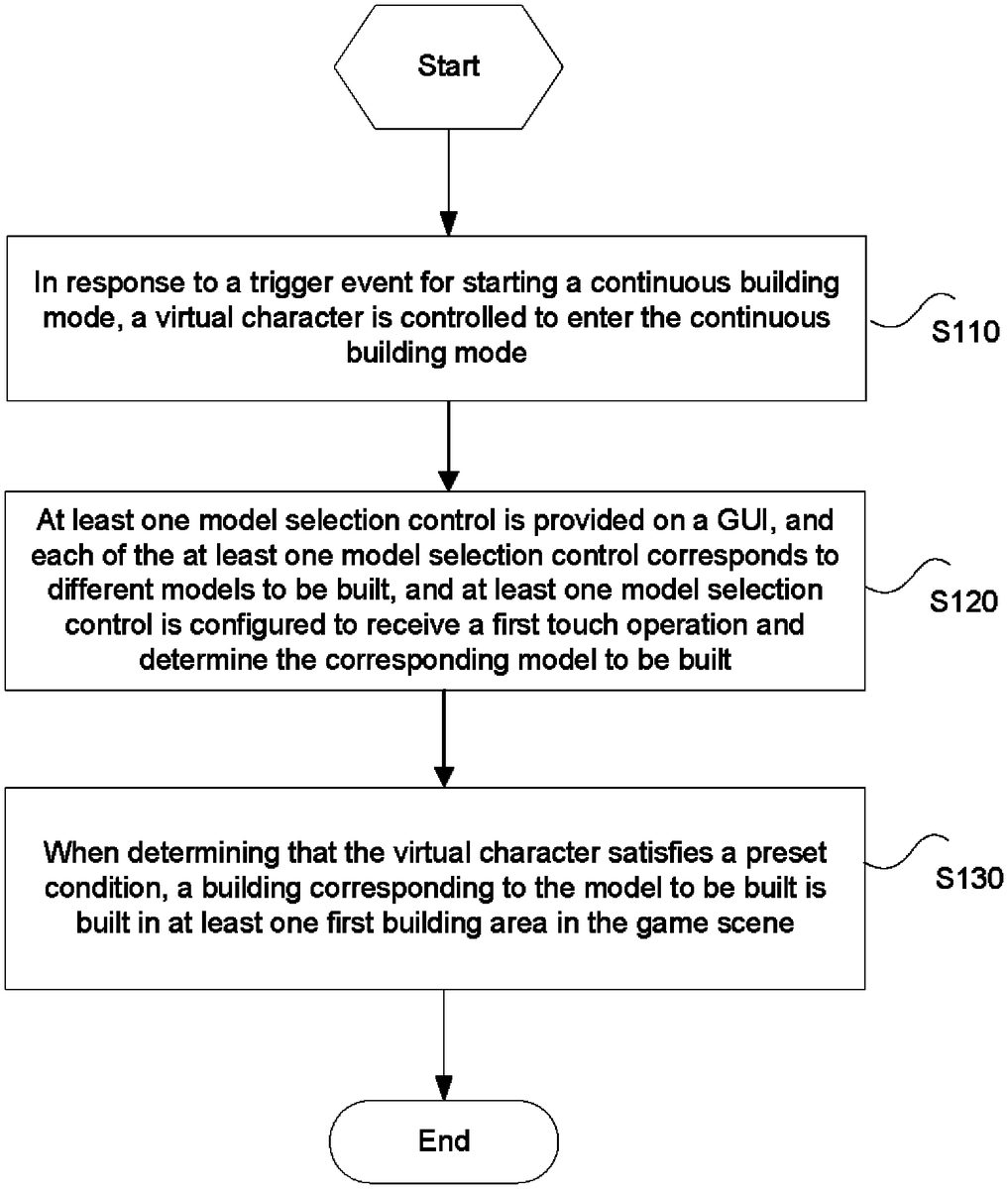
FIG. 1is a flowchart of an information processing method according to an embodiment of the present disclosure. An executed object of the information processing method provided by the embodiment may be any terminal device such as a computer, a tablet computer, a mobile terminal, or an electronic device. This method is applied to a mobile terminal having at least one processor for executing a software application and a touch screen which is rendered with a GUI. Contents at least partially including a local or global game scene are displayed, and the game scene includes at least one virtual character. Moreover, as shown inFIG. 2andFIG. 3, in the present embodiment, the method includes the following steps.
At step S110, in response to a trigger event for starting a continuous building mode, a virtual character30is controlled to enter the continuous building mode.
At step S120, at least one model selection control20is provided on the GUI10, and each of the at least one model selection control corresponds to different models201to be built, and at least one model selection control is configured to receive a first touch operation and determine the corresponding model201to be built.
At step S130, when determining that the virtual character30satisfies a preset condition, a building2011corresponding to the model201to be built is built in at least one first building area40in the game scene.
For a building function in a game, in general, a player may select a position to create a building by a two-hand interaction operation, and then complete a final rendering of an object by a trigger determination operation. When the player wants to build another object, the above interaction process is repeated. Under restriction of hardware conditions of a mobile terminal, controls of a user during a process of building in a game scene through the mobile terminal are too cumbersome, and control fluency is poor. Meanwhile, this interaction mode limits game experience of the player, and especially for complex control games, it is difficult for the player to achieve an orientation selection and building of a model to be built in a very short time.
Through the above implementation manner represented by present embodiment, when the terminal receives the touch operation input by the user for the continuous building mode, the terminal controls the virtual character30in the game to enter the continuous building mode, and when the terminal detects that the virtual character30satisfies the preset condition, the building2011corresponding to the model201to be built is built in the first building area40. In the continuous building mode, the building2011is directly built without executing the touch operation for triggering the determination instruction, so that the building2011to be built is directly built with the selection and movement of the player.
Each step of the information processing method in the present embodiment will be further described below.
In the present exemplary embodiment, some or all of game scene elements of a game are displayed on the GUI10of the touch screen of the terminal, such as game pictures, character or picture effects, human-computer interaction prompts, and virtual buttons for interaction. These game scene elements are controlled to make corresponding outputs in response to at least one input touch operation input by the user for elements in these game scenes on the GUI10of the terminal. For example, when receiving a “shoot” instruction input by the user, the terminal controls a weapon on the GUI10to make an output of a “shooting action”. The respective steps in the present embodiment may be performed simultaneously with each other or sequentially. The respective steps in the present embodiment may be subsequently and automatically performed after being triggered or special steps may be performed according to a user-specific input operation. The method in the game scene in the present embodiment further includes at least one virtual character30. Each of the at least one virtual character30corresponds to each user who uses the terminal. The virtual character30is configured to perform at least one of input motions of moving, jumping, aiming, shooting, building, and attacking according to at least one received input instruction of the user.
At step S110, in response to the trigger event for starting the continuous building mode, the virtual character30is controlled to enter the continuous building mode. In the continuous building mode, the building2011corresponding to the model201to be built is automatically built in a game interface when a game program run by the terminal detects that at least one element of the game scene satisfies the preset condition. The at least one element may be the virtual character30or the like, and the preset condition may include at least one of the followings: time, position, moving speed, moving direction, orientation of the virtual character30, and the like. The trigger event is a touch operation, such as a single click, a double click, a long press, or a slide operation, acting on a blank area or a specific area on the GUI10. It is to be noted that an expression of the virtual character30entering the continuous building mode in this step may refer to that the game program currently run by the terminal enters the continuous building mode, or may refer to that a terminal system enters the continuous building mode, or may refer to that the specific virtual character30enters the continuous building mode.
In the present embodiment, at step S110, the operation of controlling, in response to the trigger event for starting the continuous building mode, the virtual character30to enter the continuous building mode includes: a continuous building mode trigger control50is provided on the GUI10, the continuous building mode trigger control50being configured to control, in response to the touch operation, the virtual character30to enter the continuous building mode. The continuous building mode trigger control50on the GUI10is arranged at an edge of a display interface. In the present embodiment, the continuous building mode trigger control50is arranged at a lower edge of the display interface. In other embodiments, the continuous building mode trigger control50may be arranged at a left edge or a right edge. In other embodiments, the continuous building mode trigger control50may be arranged at other positions according to a custom operation of the user. The continuous building mode trigger control50has a significant characteristic parameter, which is used for facilitating the user to quickly locate the position of the continuous building mode trigger control50. In the present implementation manner, the significant characteristic parameter is different from other virtual control shape parameters. In other embodiments, the significant feature parameter may be at least one of a flicker parameter and a color parameter that is different from other virtual controls.
In other embodiments, at step S110, an operation of controlling, in response to the trigger event for starting the continuous building mode, the virtual character30to enter the continuous building mode includes: a starting gesture for starting the continuous building mode is configured on a setting interface of the game, and when it is determined that an input operation corresponding to the starting gesture is received, the virtual character30is controlled to enter the continuous building mode to control the game. A receiving area101of the starting gesture may be a preset area or a blank area on the GUI10. The blank area is an area, which does not include other virtual spaces, on the game interface.
In other embodiments, the virtual character30may be controlled to enter the continuous building mode by associating a physical button of the terminal with starting of the continuous building mode when the terminal detects that the physical button is pressed. In other embodiments, the starting of the continuous building mode is triggered by a preset audio instruction.
By the above implementation manner, the user may clearly and quickly determine the trigger control50of the continuous building mode to quickly control the virtual character30to enter the continuous building mode, thereby facilitating user operations and improving the user experience.
At step S120, at least one model selection control20is provided on the GUI10. The model selection control20includes different models201to be built. The model selection control20is configured to receive and respond the first touch operation to determine the corresponding model201to be built.
In the present embodiment, the GUI10includes three model selection controls20for receiving and responding the first touch operation to determine the corresponding model201to be built. And the three model selection controls20are arranged in a mode selection control area102with a preset shape202according to a first preset condition. In the present embodiment, the preset shape202is a circle. In other embodiments, the preset shape202may be any shape such as a square, a rectangle or a polygon. In the present embodiment, the mode selection control area102is arranged at the lower right of the GUI10. In other embodiments, the mode selection control area102may be automatically adjusted by means of machine learning, or the mode selection control area102may be determined in a user-defined manner. For example, when the user is used to a left-hand operation, the user may provide the mode selection control area102at the lower left of the GUI10in a user-defined manner. In the present embodiment, the first preset condition is that circumferential arrangement is performed by taking a preset point as a circle center. For example, the circle center is a function prompt control provided on the GUI10. The function prompt control is configured with different display patterns for indicating a weapon type currently selected by the virtual character30, and the function prompt control is configured to respond to an operation instruction input for the control to trigger the corresponding function. When the GUI10receives a weapon selection instruction input by the user, the current game program of the terminal controls the function prompt control to display a corresponding weapon pattern. For example, when a display pattern of the function prompt control is “gun”, and a click or long press is acted on the function prompt control, the “gun” game element in the game scene is controlled for shooting output. In other embodiments, the first preset condition is vertical arrangement at the edge of the GUI10or horizontal arrangement at the edge of the GUI10.
In other embodiments, the model selection control20is a disk-shaped control. The disk-shaped control includes at least one touch response area. The at least one touch response area is configured to receive and respond the first touch operation to determine the corresponding model201to be built.
In other embodiments, the model selection control20may be configured with two or more models201to be built. After the GUI10receives the first touch operation acting on the model selection control20, it is determined whether the first touch operation satisfies the preset condition to control the model selection control20to selectively trigger the corresponding model201to be built.
In the present embodiment, the first touch operation is a click operation within the range of the model selection control20. In other embodiments, the first touch operation is an operation such as long press, double click, re-press or slide within the range of the model selection control20.
In the present embodiment, the model201to be built includes a vertical wall model, a horizontal wall model, and a ladder model. In other embodiments, the model201to be built may also be of other building types, such as houses, stones, trees or other buildings2011.
Through the above implementation manner, the user can quickly select the model201to be built within the range of convenient operation, and it is more suitable for the operating habits of the user, thereby improving the accuracy of the user operation.
At step S130, when determining that the virtual character30satisfies the preset condition, the building2011corresponding to the model201to be built is built in the first building area40in the game scene.
In the present embodiment, when a game program currently run by the terminal determines that the virtual character30is in the continuous building mode, the game program detects whether the virtual character30satisfies the preset condition in each frame of the game screen. When the virtual character30satisfies the preset condition, the building2011corresponding to the model201to be built is built in the first building area40in the game scene, and after the GUI10of the terminal receives a stop instruction for closing the continuous building mode, detecting whether the virtual character30satisfies the preset condition is stopped.
In this way, running steps of the program can be effectively reduced, the occupation and waste of storage resources of the processor are reduced, and the effect of reducing power consumption is achieved.
In other embodiments, the game program detects, at each frame, whether the virtual character is in the continuous building mode and whether the virtual character30satisfies the preset condition. In this way, an occurrence of a mode state detection error in the game can be effectively reduced, and the accuracy of information processing can be improved.
Specifically, at step S130, through detecting position information301of the virtual character30, the first building area40is determined according to a preset rule. A state of the first building area40may be set as a preview state and a hidden state. As shown inFIG. 3, when the first building area40is set as the preview state, the first building area40is controlled to be displayed in a preset color in the game scene. Through the above implementation manner, the user can be more intuitively aware of a final form of the building2011corresponding to the model201to be built, the user operation experience is improved and the occurrence of user mis-building is reduced. As shown in a dashed box inFIG. 4, when the first building area40is set as the hidden state, the position information301of the first building area40in the game scene is hidden in the game scene. When it is detected that the virtual character30satisfies the preset condition, the building2011corresponding to the model201to be built is controlled to be built in the first building area40. Through the above implementation manner, the fidelity of the game can be improved.
FIG. 5is a top view of a game space composed of interconnected virtual geometries according to an exemplary embodiment of the present disclosure. In the present embodiment, at step S130, the operation of building, when determining that the virtual character30satisfies the preset condition, the building2011corresponding to the model201to be built in the first building area40in the game scene includes the following steps.
At step S1301, current position information301and moving state information302of the virtual character30are acquired.
At step S1303, when determining that at least one of the current position information301and the moving state information302satisfies the preset condition, the building2011corresponding to the model201to be built is built in the first building area40in the game scene.
Through the above implementation manner, by determining the current position information301and the moving state information302of the virtual character30controlled by the user satisfying the condition, the building2011corresponding to the model201to be built is built with the position and movement of the virtual character30controlled by the user.
Specifically, at step S1301, the current position information301and the moving state information302of the virtual character30are acquired.
As shown inFIG. 6, a coordinate system XYZ is established in the game scene as a reference for the position and direction of all the game elements in the game scene. The current position information301of the virtual character30is coordinate point information of the position of the virtual character30in a virtual scene, and the current position information301of the virtual character30is determined by acquiring the coordinate point information of the virtual character30. The moving state information302of the virtual character30includes orientation information, moving speed information, moving direction information, and the like of the virtual character30. It is to be noted that the orientation information of the virtual character30in the game scene is different from the moving direction information. The orientation and moving direction of the virtual character30in the game scene are independent of each other and may be superimposed on each other. For example, the orientation of a virtual character30A in the game scene is north, and meanwhile, the virtual character30A is controlled to move at a preset speed V1 and move in the west direction, thereby realizing the performance effect that the virtual character30A in the game scene takes the north direction as the current orientation, and the location change occurs in the game scene with the preset speed V1 as the moving speed and the west direction as the moving direction.
At step S1303, when determining that the at least one of the current position information301and the moving state information302satisfies the preset condition, the building2011corresponding to the model201to be built is built in the first building area40in the game scene.
Specifically, the game program run on the terminal acquires the at least one of the current position information301and the moving state information302of the virtual character30, determines the first building area40according to the at least one of the current position information301and the moving state information302, and further determines whether the at least one of the current position information301and the moving state information302satisfies the preset condition. When the at least one of the current position information301and the moving state information302satisfies the preset condition, the building2011is triggered to be built in the first building area40. The above action of determining the first building area40and the action of triggering to build the building2011may be performed sequentially or simultaneously, and the game player does not feel product interruption during the operations.
In the present embodiment, at step S1303, before building the building2011corresponding to the model201to be built in the first building area40in the game scene, the method further includes the following steps.
At step S1302, the first building area40in the game scene is determined according to the at least one of the current position information301and the moving state information302.
Through the above implementation manner, the program run on the terminal may predetermine the first building area40related to the virtual character30by acquiring the at least one of the current position information301and the moving state information302of the virtual character30controlled by the user, and automatically build the corresponding building2011in the predetermined first building area40by detecting and determining the at least one of the current position information301and the moving state information302of the virtual character30without triggering a determination operation instruction by the user, thus increasing the rendering and response speeds of game images.
Specifically, at step S1302, the first building area40in the game scene is determined according to the at least one of the current position information301and the moving state information302.
As shown inFIG. 6, in the present embodiment, the manner of determining the first building area40in the game scene according to the at least one of the current position information301and the moving state information302includes: at least one geometry60is selected from multiple interconnected virtual geometries60as the first building area40according to the at least one of the position information301and the moving state information302.
The space of the game scene is divided into multiple interconnected virtual geometries60. The geometries60are virtual blocks defined by a coordinate system for constituting the space of the entire game scene, and each of the geometries60has corresponding coordinate value information. The geometry60may be a rectangular parallelepiped, a cube, a parallelepiped, a honeycomb, etc. It can be understood that the virtual geometries60may be interconnected to form the space of the entire game scene.
In the present embodiment, each geometry60is a rectangular parallelepiped with the same length and width. A coordinate system XYZ is established in the space of the game scene, which is horizontal XZ coordinates and a vertical upward coordinate Y, respectively. The way of spatial division refers to dividing the space into an infinite number of rectangular parallelepipeds with intervals of X=5 m, Z=5 m and vertical upward Y=3.5 m. The coordinates of a first geometry601on the X/Y/Z axis as shown inFIG. 7are A: (5, 0, 0), C: (0, 3.5, 0), B: (0, 0, 5). In other embodiments, each geometry60may also be a rectangular parallelepiped with the same length and width, or may be a length, width and height index value set by a developer arbitrarily according to actual conditions.
Through the above implementation manners, on the one hand, the building2011built by the virtual character30and the original building in the game scene can be aligned and interconnected; and on the other hand, physical collision detection between the buildings2011in the game scene is avoided, so that the system overhead can be effectively reduced, and the smooth running of the game can be improved.
The following describes an example in which a space is divided into multiple mutually interconnected rectangular parallelepipeds with the same length and width. It is to be noted that multiple interconnected geometries60that divide the space into any shape are included in the protection scope of the present disclosure.
In the present embodiment, the first building area40is determined by the following steps.
At step S210, current coordinate value information of the virtual character30is acquired.
At step S220, the current coordinate value information of the virtual character30is compared with a coordinate value range of each geometry60.
Specifically, the current coordinate value of the virtual character30may be either a spatial coordinate value, or a point coordinate value. In the present embodiment, the coordinate value information of the virtual character30is the point coordinate value, such as, a point coordinate value of the foot or a point coordinate value of the body center. Since the entire game scene is composed of at least one geometry60, each geometry60has a corresponding spatial coordinate value. In addition, the position information301of each game element may be defined by other definitions.
At step S230, it is determined that the geometry60corresponding to the coordinate value range containing the current coordinate value information of the virtual character30is the first geometry601where the virtual character30is located, and the adjacent first preset number of geometries60is determined as the first building area40according to the first geometry601.
It is to be noted that in a game scene space divided into multiple mutually interconnected geometries60having the same length and width, a surface602of each geometry60and an internal section603may be used as an optional area to be built. And moreover, the components of the original building in the first game scene are also pre-built according to the surface602of the geometry60and the internal section603.
Centering on the first geometry601, multiple second geometries604adjacent to the first geometry601are determined. And an expression of the first geometry601being adjacent to the second geometry604refers to that one surface is shared by the first geometry601and the second geometry604, or one side is shared by the first geometry601and the second geometry604. It is to be noted that the adjacent first building area40may ensure that there is at least one geometry60adjacent to the first geometry601. Since the entire game space is composed of at least one geometry60, the building2011corresponding to each model201to be built is also formed by splicing a preset number of geometries60, so the number of the corresponding geometries60according to the building2011corresponding to the model201to be built is the preset number.
In other embodiments, the first building area40is further determined by the following steps.
At step S310, moving state information302of the virtual character30is acquired.
Specifically, the moving state information302includes moving speed information V and moving direction information D of the virtual character30. A starting coordinate value of the virtual character30is acquired. The starting coordinate value may be periodically updated to reduce the data calculation amount of the terminal. A moving distance in the moving direction D is calculated by the moving speed information V and moving time T. A final coordinate value of the virtual character30is calculated by the moving distance and the starting coordinate value.
At step S320, the final coordinate value information of the virtual character30is compared with a coordinate value range of each geometry60.
At step S330, it is determined that the geometry60corresponding to the coordinate value range containing the final coordinate value information of the virtual character30is the first geometry601where the virtual character30is located, and the adjacent first preset number of geometries60is determined as the first building area40according to the first geometry601.
In the present embodiment, the content of step S320and step S330is similar to step S220and step S230in the previous embodiment, and the descriptions thereof are omitted herein.
In other embodiments, the first building area40is further determined by the following steps.
At step S410, the first geometry601where the virtual character30is located is determined according to the current position information301of the virtual character30. The content of this step is similar to that of step S210in the above embodiment, and the descriptions thereof are omitted herein.
At step S420, the first building area40adjacent to the first geometry601is determined according to the moving state information302of the virtual character30.
In the present embodiment, as shown inFIG. 8, the moving state information302is orientation information of the virtual character30. For example, when the virtual character30faces a first direction, the second geometry604adjacent to the first direction of the current geometry60is determined as the first building area. One surface or one internal section603is selected from the first geometry601or the second geometry604as the first building area40. In an optional implementation manner, a surface602or an internal section603of the first geometry601or the second geometry604appearing in front of the current orientation of the virtual character30is taken as the first building area40. In an optional implementation manner, a surface602or an internal section603of the first geometry601or the second geometry604is determined as the first building area40according to a type of a building model. For example, if the building model is a vertical wall, a vertical surface602of the first geometry601or the second geometry604is used as the first building area40; and if the building model is an obliquely upward ladder, an inclined section603of the first geometry601or the second geometry604is used as the first building area40.
Through the above implementation manners, by geometrically normalizing the game scenes, the building2011and the original building in the game scene can be aligned and interconnected, and the aesthetic feeling of the game images is enhanced. And moreover, physical collision detection between the buildings2011in the game scene is avoided, so that the system overhead can be effectively reduced, and the smooth running of the game can be improved.
In other embodiments, the moving state information302is moving direction information of the virtual character30. For example, when the virtual character30moves in a second direction, the second geometry604adjacent to the first direction of the current geometry60is determined as the first building area.
Through the above implementation manner, the first building area40is determined according to the movement of the virtual character30controlled by the user to build the building2011in the first building area40when the preset condition is satisfied.
At step S1303, when determining that the at least one of the current position information301and the moving state information302satisfies the preset condition, the building2011corresponding to the model201to be built is built in the first building area40.
A specific building trigger area is configured in each geometry60. In the present embodiment, the building trigger area is configured to trigger the building of the building2011corresponding to the model201to be built. When the virtual character30is in the building trigger area and satisfies the preset condition, the building2011corresponding to the model201to be built is built in the first building area40.
Also as show inFIG. 8, in the present embodiment, the building trigger area is a direction identification area configured with preset direction information. The direction identification area includes: a horizontal direction identification area605and a vertical direction identification area606. Each geometry60includes a horizontal plane and a vertical plane. The horizontal direction identification area605is located on the horizontal plane of the geometry60. The vertical direction identification area606is located on the vertical plane of the geometry60.
In the present embodiment, the horizontal direction identification area605includes multiple unidirectional identification areas6051and at least one multi-directional identification area6052. The multiple unidirectional identification areas6051are located at multiple edge areas in different directions on a horizontal direction of the geometry60respectively. And the multi-directional identification area6052is an overlapping area between the multiple unidirectional identification areas6051.
The number of the unidirectional identification areas6051is the same as the number of the sides of the surface602of the geometry60where the unidirectional identification area6051is located. It is to be noted that the number of the unidirectional identification areas6051may also be customized as needed. In the present embodiment, the geometry60is a rectangular parallelepiped with a coordinate system In the game scene as a reference system. The geometry60includes two horizontal planes and four vertical planes. An area formed by a preset distance D inward from four edges of each horizontal plane is defined as the unidirectional identification area6051. In the present embodiment, the preset distance is 150 cm, and the number of horizontal direction identification areas605is four. Each unidirectional identification area6051is configured with preset direction information for representing a direction represented by the unidirectional identification area6051. For example, the four unidirectional identification areas6051respectively represent standard east, south, west and north of the coordinate system in the game scene. The multi-directional identification area6052is an area formed by overlapping at least two unidirectional identification areas6051. The preset direction information configured in the multi-directional identification area6052is the same as the preset direction information In the unidirectional identification areas6051constituting the multi-directional identification area6052. For example, a unidirectional identification area6051including “east direction information” and a unidirectional identification areas6051including “south direction information” constitute the multi-directional identification area6052, and the preset direction information thereof is “east” and “south”. In other embodiments, the preset direction information configured in the multi-directional identification area6052includes preset direction information In the unidirectional identification areas6051constituting the multi-directional identification area6052and direction information jointly constituted by the preset direction information In the unidirectional identification areas6051of the multi-directional identification area6052. For example, a unidirectional identification area6051including “east direction information” and a unidirectional identification areas6051including “south direction information” constitute the multi-directional identification area6052, and the preset direction information thereof is “east”, “south” and “southeast”.
The vertical direction identification area606includes an upper identification area6061and a lower identification area6062, where the upper identification area6061is located in an upper edge area in a vertical direction of the geometry60, and the lower identification area6062is located in a lower edge in the vertical direction of the geometry60. The surface602of the geometry60constituting the game scene and the slope603of the space inside the geometry60may each be the first building area, and the virtual character30moves in the space formed by the surfaces602and the slopes603of the geometries60.
Through the above implementation manner, by dividing the respective surfaces602of the geometries60constituting the game scene into direction identification areas, the terminal can accurately trigger the building operation of the building2011by determining that the virtual character30is in the building trigger area and satisfies the preset condition. Through this spatial division mode, the data processing magnitude of the terminal can be reduced, and the running speed of the system is optimized.
In the present embodiment, at step S13022, the operation of building, when determining that the at least one of the current position information301and the moving state information302satisfies the preset condition, the building2011corresponding to the model201to be built in the first building area40includes the following steps.
At step S510, a horizontal direction identification area605where the virtual character30is currently located is determined according to the current position information301.
At step S520, when determining that the moving state information302of the virtual character30matches preset direction information corresponding to the determined horizontal direction identification area605, the building2011corresponding to the model201to be built is built in at least one first building area40adjacent to the determined horizontal direction identification area605.
Through the above implementation manner, through determining that the current position information301of the virtual character30and the current horizontal identification area satisfy the preset condition to trigger automatic building of the building2011in the first building area40adjacent to the current horizontal identification area, the purpose of directly building the building to be built by following the movement of the virtual character is achieved. The problem of operation interruption caused by the user inputting a confirmation instruction every time the building2011is built in the conventional art is effectively reduced.
Specifically, in step S510, the current horizontal direction identification area605where the virtual character30is located is determined according to the current position information301of the virtual character30.
As shown inFIG. 6andFIG. 8, a coordinate system is established in the game scene, and each object established in the coordinate system may be marked by the coordinate system to determine the position of each object in the coordinate system. The game scene is spatially divided into multiple virtual geometries60by means of coordinates. The space of the entire game scene and all or part of the game elements in the space are composed of these geometries60. Each geometry60also has an independent coordinate system. The horizontal direction identification area605located on the surface602or the interior of each geometry60is divided by the independent coordinate system of each geometry60. In the present embodiment, the unidirectional identification area6051in each horizontal direction identification area605is divided by the independent coordinate system. It is to be noted that the independent coordinate system and the coordinate system of the game scene may be mutually converted. That is, after acquiring an absolute coordinate point of the virtual character30currently in the coordinate system of the game scene, the absolute coordinate point may be converted into a relative coordinate point of each geometry60in the independent coordinate system. The relative coordinate point is compared with the coordinate point range of the unidirectional identification area6051to determine a specific unidirectional identification area6051in the horizontal direction identification area605where the virtual character30is currently located.
In other embodiments, all of the horizontal direction identification areas605and the unidirectional identification areas and the like may also be divided by the coordinate system of the game scene.
Further, in other embodiments, in order to more accurately determine the horizontal direction identification area605where the virtual character30is currently located, the step S510of determining the current horizontal direction identification area605where the virtual character30is located according to the current position information301of the virtual character30further includes the following steps.
At step S5101, a vertical direction identification area606where the virtual character30is currently located is determined according to the current position information301of the virtual character30.
As shown inFIG. 9AandFIG. 9B, the vertical direction identification area606is an upper edge area of the geometry60in the vertical direction or an area near the top end or the bottom end of the inner slope603, and is divided into an upper identification area6061and a lower identification area6062. The coordinate range of the upper identification area6061and the lower identification area6062in the vertical direction is the coordinate range corresponding to the surface602area obtained by the projection of the upper identification area6061and the lower identification area6062in the vertical direction. As shown inFIG. 9A, a point E is a coordinate point of one vertex of the upper identification area6061on the Y axis, a point D is a coordinate point of one vertex of the lower identification area6062on the Y axis, and the surface602areas are divided through the coordinate system of the game scene in the vertical direction, or may be divided through the independent coordinate system corresponding to each geometry60. The coordinate value of the virtual character30in the vertical direction is compared with the coordinate ranges of the upper identification area6061and the lower identification area6062to determine the current vertical direction identification area606where the virtual character is located.
At step S5102, a horizontal plane602of the at least one first building area40is determined according to the type of the vertical direction identification area606.
Specifically, in each geometry60, the vertical direction identification area606is associated with the horizontal plane, and the vertical direction identification area where a virtual character is located is to determine the horizontal plane where the virtual character is located. In the present embodiment, the upper identification area6061is associated with the horizontal plane of the upper layer of the geometry60, i.e., the upper surface602of the geometry60, and the lower identification area6062is associated with the horizontal plane of the bottom layer of the geometry60, i.e., the lower surface602of the geometry60. For example, as shown inFIG. 9, when the virtual character30is in the upper identification area6061, it is determined that the upper surface602is a horizontal plane for determining the first building area40.
At step S5103, a horizontal direction identification area605where the virtual character30is currently located is determined according to the current position information301in the horizontal plane. The content of this step is similar to that in the above embodiment, and the descriptions thereof are omitted herein.
Through the above implementation manner, the vertical direction identification area606is associated with the horizontal direction identification area605. When the virtual character30is displaced in the vertical direction while moving, the horizontal direction identification area605where the virtual character is currently located is determined by determining the corresponding vertical direction identification area606where the virtual character is currently located, and the horizontal direction identification area605is used as a criterion for determining the first building area40. In this way, the building2011built by the virtual character30and the original building in the game scene can be effectively aligned and interconnected. In addition, physical collision detection between the buildings2011in the game scene is avoided, so that the system overhead can be effectively reduced, and the smooth running of the game can be improved.
In step S520, it is determined whether the moving direction information of the virtual character30matches the preset direction information corresponding to the determined horizontal direction identification area605.
Specifically, as shown inFIG. 10, the moving direction information of the virtual character30is acquired. When an angle between the moving direction information and the preset direction information corresponding to the unidirectional identification area6051of the current horizontal direction identification area605is less than 90 degrees, it is determined that the moving direction information of the virtual character30matches the preset direction information corresponding to the determined horizontal direction identification area605. When the moving direction information is located in the preset direction information corresponding to the multi-directional identification area6052of the current horizontal direction identification area605, it is determined that a threshold is satisfied. In the present embodiment, the multi-directional identification area6052includes information of two directions. When the angle between the moving direction information and information of the two directions is less than 90 degrees, it is determined that the moving direction information of the virtual character30matches the preset direction information corresponding to the determined horizontal direction identification area605.
Through the above implementation manner, when detecting that the virtual character30moves toward a preset direction of the unidirectional identification area6051, that is, the operation of building the building2011is directly triggered, the effect of automatic building following the movement of the virtual character30is achieved. Moreover, the operation of building is triggered by setting a threshold, so that the fault tolerance effect is achieved, and the phenomenon of building due to improper operation of the user is avoided.
In other embodiments, at step S520, it is determined whether the time period in which the virtual character30is located in the current horizontal direction identification area605satisfies a preset threshold.
At step S530, if the moving direction information satisfies the preset threshold, the building2011corresponding to the model201to be built is built in at least one first building area40adjacent to the current horizontal direction identification area605.
In the present embodiment, the game scene is formed by splicing the surfaces602of the geometries60adjacent to each other, and the unidirectional identification area6051is included at the edge of each horizontal direction identification area605. Therefore, the unidirectional identification area6051of each geometry60is adjacent to other geometries60. When it is determined that the moving direction information of the virtual character30matches the preset direction information of the unidirectional identification area6051, it is determined that the second geometry604adjacent to the unidirectional identification area6051is the first building area40, and the building2011corresponding to the model201to be built is built in the first building area40. In other implementation manners, the second geometry604may also be one of the geometries60, constituting the first building area40, adjacent to the unidirectional identification area6051of the horizontal direction identification area605where the virtual character30is located. As shown inFIG. 6, when it is determined that the moving direction information of the virtual character30matches the preset direction information of a mufti-directional identification area6052, three geometries604adjacent to the multi-directional identification area6052are determined as the first building area40. For example, when the virtual character30is in the first geometry601and the moving direction information matches east and north direction information preset in the mufti-directional identification area6052, it is determined that the second geometry604adjacent to the east direction of the first geometric body601and the third geometry60adjacent to the north direction are the first building area40, and the building2011corresponding to the model201to be built is built in the first building area40.
It is to be noted that the first building area40may be the surface602or the inner slope603of the geometry60adjacent to the current geometry60where the virtual character is located. The surface602or the inner slope603that is adapted to the model201to be built is automatically selected by the system as the first building area40according to the type of the model201to be built. For example, if the model201to be built is a horizontal wall, when the virtual character30is located in the first unidirectional identification area6051of the horizontal direction identification area605of the first geometry601, the preset direction of the first unidirectional identification area6051is “east”, and when it is detected that the moving direction information of the virtual character30is also “east”, it is determined that the horizontal plane of the second geometry604horizontally adjacent to the east direction of the first geometry601is the first building area40. If the model201to be built is a vertical wall, when the virtual character30is located in the first unidirectional identification area6051of the horizontal direction identification area605of the first geometry601, the preset direction of the first unidirectional identification area6051is “east”, and when it is detected that the moving direction information of the virtual character30is also “east”, it is determined that the horizontal plane of the second geometry604vertically adjacent to the east direction of the first geometry601is the first building area40.
In other embodiments, the step S1303of building, when determining that the at least one of the current position information301and the moving state information302satisfies the preset condition, the building2011corresponding to the model201to be built in the first building area40specifically includes the following steps.
At step S610, a current vertical direction identification area606where the virtual character30is located is determined according to the current position information301of the virtual character30.
The specific manner is similar to the content of step S510in the above embodiment, except that not only the upper identification area6061and the lower identification area6062are configured to determine the horizontal plane of the first building area, but also the upper identification area6061is configured to trigger the building of the building2011corresponding to the model to be built above the geometry60where the virtual character30is located and the lower identification area6062is configured to trigger the building of the building2011corresponding to the model to be built below the geometry60where the virtual character30is located. In each geometry60, the upper identification area6061or the lower identification area6062is located adjacent to the top or bottom horizontal plane of the internal slope603of the geometry60.
At step S620, it is determined whether the moving direction information of the virtual character30matches the preset direction information corresponding to the vertical direction identification area606.
Specifically, component information of the moving direction information of the virtual character30in the vertical direction, that is, a component vector of a direction vector of the moving direction information of the virtual character30in the vertical direction is acquired. When an angle between the component vector and the preset direction information corresponding to the upper identification area6061or the lower identification area6062of the preset direction information corresponding to the current vertical direction identification area606is less than 90 degrees, it is determined that the threshold is satisfied.
At step S630, when determining that the moving state information of the virtual character matches preset direction information corresponding to the determined vertical direction identification area, the building2011corresponding to the model201to be built is built in a preset direction corresponding to the current vertical direction identification area606in at least one first building area40adjacent to the geometry60including the current vertical direction identification area606.
It is to be noted that the vertical direction identification area606is used for controlling the building of the building2011corresponding to the model201to be built in the preset direction of the upper identification area6061or the lower identification area6062. For example, the preset direction of the upper identification area6061is “up”. When the moving direction information of the virtual character30is “up”, the building of the building2011corresponding to the model201to be built above the geometry60where the virtual character30is currently located is controlled.
Further, before controlling the building of the building2011corresponding to the model201to be built in the preset direction of the upper identification area6061or the lower identification area6062, it is also necessary to determine the type of the model201to be built. When a preset type is satisfied, a building direction in the vertical direction is acquired according to the upper identification area6061or the lower identification area6062.
For example, the model201to be built is a ladder, and the ladder includes a slope603for the movement of the virtual character, and the slope603is formed by splicing the internal slopes603of a part of geometries60constituting the ladder. When the virtual character30moves upward along the slope603, the virtual character may pass through the upper identification area6061located at the top of the slope603. When it is detected that a vertical vector of a direction vector of the upward movement of the virtual character30matches the preset “up” direction of the upper identification area6061, and the type of the model201to be built is the ladder, the ladder is controlled to be built upward.
It is to be noted that the vertical direction identification area606is configured to determine the building direction in the vertical direction, and the horizontal direction identification area605is configured to determine the specific building direction on the horizontal plane. For example, in the above illustration, after determining that the ladder is built upward, it is necessary to determine the building direction on the horizontal plane by the horizontal direction identification area605. Meanwhile, although the building direction of the vertical direction is first determined by the vertical direction identification area in the present implementation manner and then the building direction of the horizontal plane is determined by the horizontal direction identification area, in other embodiments, the sequence of steps in the two aspects may be reversed. That is, the building direction on the horizontal plane is first determined by the horizontal direction identification area and then the building direction of the vertical direction is determined by the vertical direction identification area. Of course, the steps in the two aspects may also be performed simultaneously. There is no specific limitation herein.
In other embodiments, the building trigger area is also configured to trigger the determination of the first building area40. Therefore, the manner of determining the first building area40in the game scene according to the at least one of the current position information301and the moving state information302includes: at least one geometry60is selected from multiple interconnected virtual geometries60as the first building area40according to at least one of the position information301and the moving state information302. The determination of the first building area40may also be achieved by the following manners.
At step S710, current coordinate value information of the virtual character30is acquired.
At step S720, a building trigger area where the virtual character30is located is determined according to the current coordinate value information of the virtual character30. The building trigger area is a direction identification area configured with preset direction information. The direction identification area includes a horizontal direction identification area605and a vertical direction identification area606.
At step730, a first building area40adjacent to the first geometry601including the building trigger area is determined according to the building trigger area. Specifically, the first building area40adjacent to the first geometry601including the building trigger area is determined according to preset direction information in the building trigger area where the virtual character30is located. For example, when the virtual character30is in the building trigger area of the upper surface602of the first geometry601, specifically, the unidirectional identification area6051in the building trigger area, the preset direction information in the unidirectional identification area6051is “east”, the second geometry604adjacent to the “east” direction of the first geometry601is determined to be the first building area40.
Through the above implementation manner, the first building area is determined according to the building trigger area where the virtual character30is located, and when the moving direction information of the virtual character30matches the preset direction information in the building trigger area, the building of the building2011corresponding to the model201to be built is triggered, thereby reducing the data information to be acquired and the number of comparisons, and reducing the memory space occupation.
As shown inFIG. 11, an exemplary embodiment also discloses an information processing apparatus. The apparatus is applied to a mobile terminal having at least one processor for executing a software application and a touch screen which is rendered with a GUI. Contents at least partially including a game scene are displayed. The game scene includes at least one virtual character.FIG. 11is a composition diagram of an information processing apparatus according to an embodiment of the present disclosure. As shown inFIG. 11, the apparatus includes: a response element, a control element and a determination element.
The response element is configured to control, in response to a trigger event for starting a continuous building mode, the at least one virtual character to enter the continuous building mode.
The control element is configured to provide at least one model selection control on the GUI, and each of the at least one model selection control corresponds to different models to be built, and the at least one model selection control is configured to receive a first touch operation and determine a model to be built corresponding to the first touch operation.
The determination element is configured to build, when determining that the at least one virtual character satisfies a preset condition, a building corresponding to the model to be built in at least one first building area in the game scene.
Specific details of various component elements in the above embodiment have been described in detail in the corresponding information processing method. In addition, it can be understood that the information processing apparatus further includes other element components corresponding to those in the information processing method. Therefore, detail descriptions are omitted herein.
It is to be noted that although several components or elements of the device for action execution are mentioned in the above detailed description, such division is not mandatory. In fact, according to the implementation manners of the present disclosure, the features and functions of two or more components or elements described above may be embodied in one component or element. Conversely, the features and functions of one component or element described above may be further divided into multiple components or elements and embodied.
FIG. 12is a structural block diagram of a mobile terminal according to an embodiment of the present disclosure. A terminal910of the present embodiment includes: a memory911and a processor912. The memory911and the processor912may be connected by a bus. A software application is executed on the processor of the terminal, and a touch screen of the terminal is rendered with a GUI.
The processor912is provided.
The memory911is configured to store at least one executable instruction of the processor.
The processor is configured to execute the at least one executable instruction to implement the following steps:
in response to a trigger event for starting a continuous building mode, controlling the at least one virtual character to enter the continuous building mode;
providing at least one model selection control on the GUI, and each of the at least one model selection control corresponds to different models to be built, and the at least one model selection control is configured to receive a first touch operation and determine a model to be built corresponding to the first touch operation; and
when determining that the at least one virtual character satisfies a preset condition, building a building corresponding to the model to be built in at least one first building area in the game scene.
In an optional embodiment, before, in response to the trigger event for starting the continuous building mode, controlling the at least one virtual character to enter the continuous building mode the method further includes:
providing a trigger control for starting the continuous building mode on the GUI, the trigger control being configured to control the at least one virtual character to enter the continuous building mode in response to a touch operation.
In an optional embodiment, when determining that the virtual character satisfies the preset condition, building the building corresponding to the model to be built in the at least one first building area includes:
acquiring current position information and moving state information of the at least one virtual character; and
when determining that at least one of the current position information and the moving state information satisfies the preset condition, building the building corresponding to the model to be built in the at least one first building area.
In an optional embodiment, before building the building corresponding to the model to be built in the at least one first building area, the method further includes:
according to the at least one of the current position information and the moving state information, determining the at least one first building area.
In an optional embodiment, a space of the game scene is divided into multiple interconnected virtual geometries.
In an optional embodiment, determining the at least one first building area according to the at least one of the current position information and the moving state information includes:
according to the at least one of the current position information and the moving state information, selecting at least one geometry from the multiple interconnected virtual geometries as the at least one first building area.
In an optional embodiment, each of the multiple interconnected virtual geometries is configured with a direction identification area, the direction identification area comprising: a horizontal direction identification area and a vertical direction identification area.
In an optional embodiment, the horizontal direction identification area comprises multiple unidirectional identification areas and at least one multi-directional identification area, the multiple unidirectional identification areas being located at multiple edge areas in different directions on a horizontal direction of each geometry respectively, and the at least one multi-directional identification area being an overlapping area between the multiple unidirectional identification areas; and the vertical direction identification area comprises an upper identification area and a lower identification area, the upper identification area being located in an upper edge area in a vertical direction of each geometry, and the lower identification area being located in a lower edge area In the vertical direction of each geometry.
In an optional embodiment, when determining that the at least one of the current position information and the moving state information satisfies the preset condition, building the building corresponding to the model to be built in the at least one first building area includes:
determining a horizontal direction identification area where the virtual character is currently located according to the current position information; and
when determining that the moving state information of the virtual character matches preset direction information corresponding to the determined horizontal direction identification area, building the building corresponding to the model to be built in at least one first building area adjacent to the determined horizontal direction identification area.
In an optional embodiment, determining the horizontal direction identification area where the virtual character is currently located according to the current position information includes:
determining a vertical direction identification area where the virtual character is currently located according to the current position information;
determining a horizontal plane of the at least one first building area according to a type of the determined vertical direction identification area; and
in the horizontal plane, determining the horizontal direction identification area where the virtual character is currently located according to the current position information.
Through a mobile terminal provided by one embodiment of the present disclosure, when a user controls a virtual character to build a building corresponding to a model to be built, the number of interactions with a user interface can be reduced, and the building of the building corresponding to the model to be built is automatically completed by determining the situation in a game scene, so that the user completes interaction operations in a very short time, thereby improving the user experience.
FIG. 13is a structural schematic diagram of a storage medium according to an embodiment of the present disclosure. As shown inFIG. 13, a program product1100according to an implementation manner of the present disclosure is described. A computer program is stored thereon. When being executed by a processor, the computer program implements the following steps:
in response to a trigger event for starting a continuous building mode, controlling the at least one virtual character to enter the continuous building mode;
providing at least one model selection control on the GUI, and each of the at least one model selection control corresponds to different models to be built, and the at least one model selection control is configured to receive a first touch operation and determine a model to be built corresponding to the first touch operation; and
when determining that the at least one virtual character satisfies a preset condition, building a building corresponding to the model to be built in at least one first building area in the game scene.
In an optional embodiment, before, in response to the trigger event for starting the continuous building mode, controlling the at least one virtual character to enter the continuous building mode the method further includes:
providing a trigger control for starting the continuous building mode on the GUI, the trigger control being configured to control the at least one virtual character to enter the continuous building mode in response to a touch operation.
In an optional embodiment, when determining that the virtual character satisfies the preset condition, building the building corresponding to the model to be built in the at least one first building area includes:
acquiring current position information and moving state information of the at least one virtual character; and
when determining that at least one of the current position information and the moving state information satisfies the preset condition, building the building corresponding to the model to be built in the at least one first building area.
In an optional embodiment, before building the building corresponding to the model to be built in the at least one first building area, the method further includes:
according to the at least one of the current position information and the moving state information, determining the at least one first building area.
In an optional embodiment, a space of the game scene is divided into multiple interconnected virtual geometries.
In an optional embodiment, determining the at least one first building area according to the at least one of the current position information and the moving state information includes:
according to the at least one of the current position information and the moving state information, selecting at least one geometry from the multiple interconnected virtual geometries as the at least one first building area.
In an optional embodiment, each of the multiple interconnected virtual geometries is configured with a direction identification area, the direction identification area comprising: a horizontal direction identification area and a vertical direction identification area.
In an optional embodiment, the horizontal direction identification area comprises multiple unidirectional identification areas and at least one multi-directional identification area, the multiple unidirectional identification areas being located at multiple edge areas in different directions on a horizontal direction of each geometry respectively, and the at least one multi-directional identification area being an overlapping area between the multiple unidirectional identification areas; and the vertical direction identification area comprises an upper identification area and a lower identification area, the upper identification area being located in an upper edge area in a vertical direction of each geometry, and the lower identification area being located in a lower edge area in the vertical direction of each geometry.
In an optional embodiment, when determining that the at least one of the current position information and the moving state information satisfies the preset condition, building the building corresponding to the model to be built in the at least one first building area includes:
determining a horizontal direction identification area where the virtual character is currently located according to the current position information; and
when determining that the moving state information of the virtual character matches preset direction information corresponding to the determined horizontal direction identification area, building the building corresponding to the model to be built in at least one first building area adjacent to the determined horizontal direction identification area.
In an optional embodiment, determining the horizontal direction identification area where the virtual character is currently located according to the current position information includes:
determining a vertical direction identification area where the virtual character is currently located according to the current position information;
determining a horizontal plane of the at least one first building area according to a type of the determined vertical direction identification area; and
in the horizontal plane, determining the horizontal direction identification area where the virtual character is currently located according to the current position information.
Through a mobile terminal provided by one embodiment of the present disclosure, when a user controls a virtual character to build a building corresponding to a model to be built, the number of interactions with a user interface can be reduced, and the building of the building corresponding to the model to be built is automatically completed by determining the situation in a game scene, so that the user completes interaction operations in a very short time, thereby improving the user experience.
The computer-readable storage medium may include a data signal that is propagated in a baseband or as part of a carrier, carrying readable program code. Such propagated data signals may take a variety of forms including, but not limited to, electromagnetic signals, optical signals, or any suitable combination of the foregoing. The computer-readable storage medium may send, propagate, or transmit a program for use by or in connection with an instruction execution system, apparatus, or device.
Program codes included in the computer-readable storage medium may be transmitted by any suitable medium, including but not limited to wireless, wire, optical cable, radio frequency, etc., or any suitable combination of the foregoing.
In an exemplary embodiment of the present disclosure, an electronic device is also provided. The electronic device may implement functions of a terminal, and the electronic device includes: a processing component and a display apparatus, which may further include at least one processor, and a memory resource represented by a memory and configured to store at least one instruction executable by the processing component, such as an application program. The application program stored in the memory may include at least one component each corresponding to a set of instructions. In addition, the processing component is configured to execute instructions to perform the above-described information processing method.
The electronic device may also include: a power supply component, configured to perform power management on the electronic device; a wired or wireless network interface, configured to connect the electronic device to a network; and an input output (I/O) interface. The electronic device may operate based on an operating system stored in the memory, such as Android, IOS, Windows, Mac OS X, Unix, Linux, FreeBSD, or the like.
Through the description of the above implementation manner, those skilled in the art will readily understand that the example implementation manners described herein may be implemented by software or by software in combination with necessary hardware. Therefore, the technical solution according to the embodiment of the present disclosure may be embodied in the form of a software product, which may be stored in a non-volatile storage medium (which may be a CD-ROM, a USB flash drive, a mobile hard disk, etc.) or on a network. A number of instructions are included to cause a computing device (which may be a personal computer, server, electronic device, or network device, etc.) to perform a method in accordance with an embodiment of the present disclosure.
Other embodiments of the present disclosure will be apparent to those skilled in the art after considering the specification and practicing the present disclosure herein. The present disclosure is intended to cover any variations, uses, or adaptations of the present disclosure, which are in accordance with the general principles of the present disclosure and include common general knowledge or conventional technical means in the art that are not disclosed in the present disclosure. The specification and examples are to be regarded as illustrative, and the true scope and spirit of the present disclosure are pointed out by the claims.
It is to be understood that the present disclosure is not limited to the accurate structure that have been described and shown in the drawings, and may make various modifications and variations without departing the scope thereof. The scope of the present disclosure is limited by the appended claims.
Claims
- An information processing method, applied to a mobile terminal having at least one processor for executing a software application and a touch screen which is rendered with a graphical user interface (GUI) displaying contents at least partially comprising a game scene comprising at least one virtual character, the method comprising: in response to a trigger event for starting a continuous building mode, controlling the at least one virtual character to enter the continuous building mode;providing at least one model selection control on the GUI, wherein each of the at least one model selection control corresponds to different models to be built, and the at least one model selection control is configured to receive a first touch operation and determine a model to be built corresponding to the first touch operation;and when determining that the at least one virtual character satisfies a preset condition, building a building corresponding to the model to be built in at least one first building area in the game scene;wherein in the continuous building mode, the building corresponding to the model to be built is automatically built in the game scene when a game program run by the terminal detects that at least one element of the game scene satisfies the preset condition;wherein at least one element comprises the at least one virtual character, and the preset condition comprises at least one of the followings: time, position, moving speed, moving direction, orientation of the at least one virtual character.
- The information processing method as claimed in claim 1 , wherein in response to the trigger event for starting the continuous building mode, controlling the at least one virtual character to enter the continuous building mode, the method further comprises: providing a trigger control for starting the continuous building mode on the GUI, the trigger control being configured to control the at least one virtual character to enter the continuous building mode in response to a touch operation.
- The information processing method as claimed in claim 1 , wherein when determining that the virtual character satisfies the preset condition, building the building corresponding to the model to be built in the at least one first building area comprises: acquiring current position information and moving state information of the at least one virtual character;and when determining that at least one of the current position information and the moving state information satisfies the preset condition, building the building corresponding to the model to be built in the at least one first building area.
- The information processing method as claimed in claim 3 , wherein before building the building corresponding to the model to be built in the at least one first building area, the method further comprises: according to the at least one of the current position information and the moving state information, determining the at least one first building area.
- The information processing method as claimed in claim 4 , wherein a space of the game scene is divided into a plurality of interconnected virtual geometries.
- The information processing method as claimed in claim 5 , wherein determining the at least one first building area according to the at least one of the current position information and the moving state information comprises: according to the at least one of the current position information and the moving state information, selecting at least one geometry from the plurality of interconnected virtual geometries as the at least one first building area.
- The information processing method as claimed in claim 5 , wherein each of the plurality of interconnected virtual geometries is configured with a direction identification area, the direction identification area comprising: a horizontal direction identification area and a vertical direction identification area.
- The information processing method as claimed in claim 7 , wherein the horizontal direction identification area comprises a plurality of unidirectional identification areas and at least one multi-directional identification area, the plurality of unidirectional identification areas being located at a plurality of edge areas in different directions on a horizontal direction of each geometry respectively, and the at least one multi-directional identification area being an overlapping area between the plurality of unidirectional identification areas;and the vertical direction identification area comprises an upper identification area and a lower identification area, the upper identification area being located in an upper edge area in a vertical direction of each geometry, and the lower identification area being located in a lower edge area in the vertical direction of each geometry.
- The information processing method as claimed in claim 8 , wherein when determining that the at least one of the current position information and the moving state information satisfies the preset condition, building the building corresponding to the model to be built in the at least one first building area comprises: determining a horizontal direction identification area where the virtual character is currently located, according to the current position information;and when determining that the moving state information of the virtual character matches preset direction information corresponding to the determined horizontal direction identification area, building the building corresponding to the model to be built in at least one first building area adjacent to the determined horizontal direction identification area.
- The information processing method as claimed in claim 9 , wherein determining the horizontal direction identification area where the virtual character is currently located according to the current position information comprises: determining a vertical direction identification area where the virtual character is currently located, according to the current position information;determining a horizontal plane of the at least one first building area, according to a type of the determined vertical direction identification area;and in the horizontal plane, determining the horizontal direction identification area where the virtual character is currently located, according to the current position information.
- An information processing apparatus, applied to a mobile terminal having at least one processor for executing a software application and a touch screen which is rendered with a GUI, displaying contents at least partially comprising a game scene, the game scene comprising at least one virtual character, the apparatus comprising: a response element, configured to control, in response to a trigger event for starting a continuous building mode, the at least one virtual character to enter the continuous building mode;a control element, configured to provide at least one model selection control on the GUI, wherein each of the at least one model selection control corresponds to different models to be built, and the at least one model selection control is configured to receive a first touch operation and determine a model to be built corresponding to the first touch operation;and a determination element, configured to build, when determining that the at least one virtual character satisfies a preset condition, a building corresponding to the model to be built in at least one first building area in the game scene;wherein in the continuous building mode, the building corresponding to the model to be built is automatically built in the game scene when a game program run by the terminal detects that at least one element of the game scene satisfies the preset condition;wherein at least one element comprises the at least one virtual character, and the preset condition comprises at least one of the followings: time, position, moving speed, moving direction, orientation of the at least one virtual character.
- The information processing method as claimed in claim 1 , wherein the trigger event is a touch operation acting on a blank area or a specific area on the GUI.
- The information processing method as claimed in claim 1 , wherein an expression of controlling the at least one virtual character to enter the continuous building mode refers to that a game program currently run by the mobile terminal enters the continuous building mode, or a mobile terminal system enters the continuous building mode, or the at least one virtual character enters the continuous building mode.
- The information processing method as claimed in claim 1 , wherein controlling the at least one virtual character to enter the continuous building mode comprises: configuring a starting gesture for starting the continuous building mode on a setting interface;when it is determined that an input operation corresponding to the starting gesture is received, controlling the at least one virtual character to enter the continuous building mode, wherein a receiving area of the starting gesture is a preset area or a blank area on the GUI.
- The information processing method as claimed in claim 1 , wherein the at least one virtual character is controlled to enter the continuous building mode by associating a physical button of the mobile terminal with starting of the continuous building mode when the mobile terminal detects that the physical button is pressed.
- The information processing method as claimed in claim 1 , wherein a plurality of model selection controls are arranged in a mode selection control area with a preset shape according to a first preset condition, wherein the first preset condition is that circumferential arrangement is performed by taking a preset point as a circle center.
- The information processing method as claimed in claim 16 , the mode selection control area is automatically adjusted by means of machine learning, or the mode selection control area is determined in a user-defined manner.
- A mobile terminal executing an information processing method, comprising: a processor;and a memory, configured to store at least one executable instruction of the processor, wherein the processor is configured to perform the information processing method as claimed in claim 1 by executing the at least one executable instruction.
- A non-transitory storage medium applied to an information processing method, a computer program being executed by a processor to implement the information processing method as claimed in claim 1 .
Disclaimer: Data collected from the USPTO and may be malformed, incomplete, and/or otherwise inaccurate.