U.S. Pat. No. 11,344,816
VIDEO GAME WAITING QUEUE AND AUDIENCE INTERACTION
AssigneeAmazon Technologies, Inc.
Issue DateMarch 20, 2020
Illustrative Figure
Abstract
Live camera video of video game players may be captured. Portions of the live video that include the player's faces may be inserted into the faces of characters that are controlled by the players and displayed in real-time. The players may stream video output from the video game to respective groups of spectators. The game video output may include a competition area and a competition audience that includes audience portions based on the groups of spectators that receive the game video output from the players. An audience member may be associated with a spectator, and the spectator's username, profile picture, chat messages and other spectator input may be displayed adjacent to the audience member. A queue of waiting players may be displayed simultaneously with current gameplay in the competition area, and a queued character may move to the competition area when an open competition slot becomes available.
Description
DETAILED DESCRIPTION Various techniques for personalized player, spectator and audience interaction with a video game are described herein. In particular, in some examples, live camera video of a game player may be used to generate a face and/or other features of a video game character. Specifically, while a player is playing a video game, live camera video of the player may be captured using a camera, such as a webcam. In some examples, the live camera video may include video of the player, for example including the player's face, as he or she participates in live gameplay. The video game may include a character controlled by the player, such as a character whose movements and other actions may be controlled by inputs received from the player. The techniques described herein may allow live video of the player's face, such as may be included in the live camera video captured by the webcam or other camera, to be used to generate a face of the character that is controlled by the player. In some examples, if the video game includes multiple players that control multiple characters, then live video of each player may be used to generate a face of a respective character controlled by each player. The use of camera video of the players may create a personalized experience, such as by allowing characters to closely resemble and be easily identified with players by whom they are controlled. Additionally, the video of a player's face may be displayed live and in real-time in a character's face within game video output. The use of live video may be advantageous, such as by allowing characters to reflect expressions (e.g., smiles, frowns, and other facial expressions) as they are being made, thereby allowing players and spectators to easily observe how different players are ...
DETAILED DESCRIPTION
Various techniques for personalized player, spectator and audience interaction with a video game are described herein. In particular, in some examples, live camera video of a game player may be used to generate a face and/or other features of a video game character. Specifically, while a player is playing a video game, live camera video of the player may be captured using a camera, such as a webcam. In some examples, the live camera video may include video of the player, for example including the player's face, as he or she participates in live gameplay. The video game may include a character controlled by the player, such as a character whose movements and other actions may be controlled by inputs received from the player. The techniques described herein may allow live video of the player's face, such as may be included in the live camera video captured by the webcam or other camera, to be used to generate a face of the character that is controlled by the player. In some examples, if the video game includes multiple players that control multiple characters, then live video of each player may be used to generate a face of a respective character controlled by each player. The use of camera video of the players may create a personalized experience, such as by allowing characters to closely resemble and be easily identified with players by whom they are controlled. Additionally, the video of a player's face may be displayed live and in real-time in a character's face within game video output. The use of live video may be advantageous, such as by allowing characters to reflect expressions (e.g., smiles, frowns, and other facial expressions) as they are being made, thereby allowing players and spectators to easily observe how different players are reacting to game events in real-time. Moreover, it is noted that the use of live video may allow the character's face to change dynamically throughout the course of gameplay. This creates a more realistic experience, for example as compared to inserting a static (i.e., non-changing) image into the character's face. The use of live video allows viewers to see how the player's expression and other facial features change dynamically in response to various game events. By contrast, the use of a static image would not allow viewers to see these changes.
A player's character may be displayed by the video game using a character representation that includes a face-related portion and a body-related portion. In some examples, the body-related portion may include graphics generated by the video game, such as a graphically-depicted torso, arms, legs, etc. The face-related portion may include portions of the live camera video that include the face of the player. In some examples, the face-related portion may be attached to, and detachable from, the body-related portion. For example, the face-related portion may be attached to the body-related portion when a character is alive and/or in active competition. However, in some examples, the face-related portion may be detached from the body-related portion, such as when a character is killed or defeated. In some examples, an automated facial detection process may be employed on frames of the live camera video to detect portions of the frames that include the player's face. For each frame, an area of the frame that corresponds to a detected face may then be cropped from the frame. The cropped area may then be resized to a size that is selected for the face-related portion. This process may enable live video of the player's face to be used to generate the character's face, regardless of the size of the player's face in the camera video, regardless of the distance of the player from the camera, and regardless of whether the player's face is centered in the camera video. Moreover, in some examples, if the player's face cannot be detected in one or more frames of the live camera video, then the live camera video may be obfuscated (e.g., blurred, replaced with other content or content from prior frames, etc.) from the face-related portion for the one or more frames. This may prevent inappropriate content from accidentally or even intentionally being included in the field of view of the camera and inserted into the face-related portion of the character.
Furthermore, in some examples, a number of features may be employed to provide additional interactivity between a video game and players as well as spectators of the video game. In particular, in some examples, players of the video game may be streamers that provide video of their gameplay to spectators. The term spectator, as used herein, refers to a user that views video from a video game while not being a current player of the video game. For example, game video output may be captured at a computing device operated by a player and then live streamed to the spectators. In some examples, the captured game video output may be transmitted from the player's device to a video streaming service and, in turn, from the video streaming service to the spectators. Each player may have his or her own respective group of spectators to which a respective game video stream from the player is streamed. In some examples, the video game may include a competition between players, and game video output may display the competition and a competition audience.
Additionally, in some examples, the competition audience may include a number of audience portions, and each of the audience portions may correspond to a respective group of spectators associated with one of the players in the competition. For example, a first audience portion may correspond to a first group of spectators that receive a game video stream from a first player in the competition, while a second audience portion may correspond to a second group of spectators that receive a game video stream from a second player in the competition. Each audience portion may include a number of audience members. In some examples, relative sizes (e.g., number of audience members) of the audience portions may be determined based on relative numbers of spectators in each group of spectators. For example, if the first group of spectators that receive the game video stream from first player is twice the size of the second group of spectators that receive the game video stream from second player, then the first audience portion may be twice the size (e.g., may have twice as many audience members) of the second audience portion. Sizes of the audience portions may be adjusted dynamically during gameplay to represent changes in the sizes of the respective spectator groups. For example, the size of the first audience portion may increase or decrease based upon an increase or decrease of a quantity of spectators in first spectator group. In some examples, when multiple players join a single team within the competition, their respective audience portions may be combined into a combined audience portion, and the size of the combined audience portion may be based on the combined sizes of the spectator groups of the respective players. Additionally, when one or more players leave a team (or the team is dissolved), the combined audience portion may be reduced in size and/or split into one or more different audience portions to reflect the splitting or dissolving of the team.
In some examples, spectators of the game video streams may provide various user input associated with the video game. For example, a video streaming service that provides the game video streams may host a chat service associated with the video game that allows spectators to submit and share chat message input. The video streaming service may also allow spectators to submit and share other input, such as voting in polls, providing emojis, etc. In some examples, one of audience members in an audience portion may be associated with one of the spectators in a respective group of spectators. For example, the audience member may be permanently associated with the spectator or may become temporarily associated with the spectator, such as when the spectator provides input (e.g., submits a chat message, votes in a poll, provides emoji input, etc.). In some examples, the audience member may assume various characteristics of the associated spectator. For example, a profile picture and or identity (e.g., username) of the associated spectator may be displayed adjacent to the audience member or may even be incorporated into the display of the audience member itself (e.g., the spectator's profile picture may be used to generate/render the audience member's face). Moreover, if live video of the spectator is available, the live video may be used to generate the audience member's face. In some examples, an action associated with the audience member may be performed based, at least in part, on user input provided by the associated spectator. For example, an audience member may stand up, speak and/or cheer when the associated spectator provides user input. In one specific example, the audience member may speak text included in a chat message submitted by the associated spectator. In another specific example, text and/or emojis submitted by the associated spectator may be displayed adjacent to the audience member.
Additionally, in some examples, the game video output may include a waiting area that displays one or more waiting characters that are waiting to join a competition that is occurring in the competition area. For example, the waiting area may include a queue of waiting characters and may be displayed adjacent to the competition area. The waiting area and queue may be displayed simultaneously with live competition between players that is displayed in the competition area. In some examples, a player slot within the competition may open, such as when an existing player is defeated, killed or otherwise exits the competition. When this occurs, a character from the waiting area may be assigned to the open player slot, and the character may move from the waiting area to the competition area. Additionally, in some examples, an audience portion associated with the player that exited the competition may be removed from the competition audience and replaced with a new audience portion associated with the new player whose character has filled the open player slot.
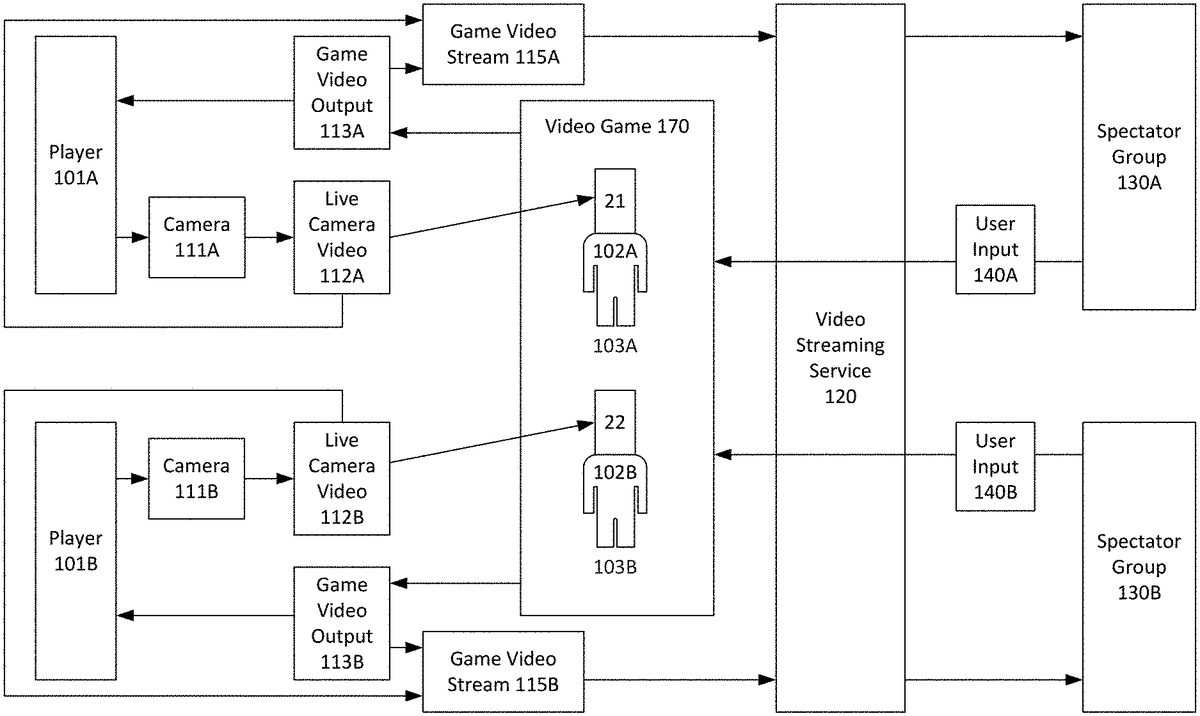
FIG. 1is a diagram illustrating an example video game player and spectator interactivity system that may be used in accordance with the present disclosure. As shown inFIG. 1, players101A and101B may participate in a video game170. In this example, player101A controls a character representation103A within the video game170, while player101B controls a character representation103B within the video game170. For example, movements and other actions of character representations103A and103B may be controlled based on user inputs received from the players101A and101B, respectively. The players101A and101B may provide the user input to control the character representations103A and103B to the video game170, for example via respective video game client applications. In some examples, the video game170may be implemented using video game server components in combination with video game client components. In some examples, respective video game client components may execute on a local/client device operated by each video game player, while the video game server components may be executed on one or more remote servers. Also, in some examples, the video game client components may receive user input from respective players, such as to control characters, etc., and provide the user input to the video game server components. The video game server components may, in turn, update and maintain game state based at least in part on the user inputs. This updated game state may, in turn, be used to generate game video and audio outputs. The video game170may generate a game video output113A, which may be displayed to player101A, for example on a display of a computer system operated by player101A. The video game170may also generate a game video output113B, which may be displayed to player101B, for example on a display of a computer system operated by player101B. In some examples, game video outputs113A and113B may be identical to one another. In other examples, game video outputs113A and113B may differ, such as showing different areas or fields of view of a virtual game world. For example, in some cases, game video output113A may correspond to character representation103A, such as by following and/or centering its field of view on the character representation103A. By contrast, game video output113B may correspond to character representation103B, such as by following and/or centering its field of view on the character representation103B.
In the example ofFIG. 1, players101A and101B are streamers that provide respective game video outputs113A and113B to respective spectator groups130A and130B. Specifically, in this example, game video outputs113A and113B are included in respective game video streams115A and115B that are provided by players101A and101B to video streaming service120. Video streaming service120, in turn, provides respective game video streams115A and115B to respective spectator groups130A and130B. In some examples, players101A and101B may operate one or more screen capture components that capture video that is displayed to the players101A and101B and allow the captured video to be transmitted to the video streaming service120. The game video streams115A and115B may be transmitted from players101A and101B to spectator groups130A and130B over one or more communications networks, for example one or more local area networks (LANs) or one or more wide area networks (WANs), such as the Internet. The game video streams115A and115B may be transmitted from players101A and101B to spectator groups130A and130B using streaming transmission techniques, in which portions of video content may be played and displayed to spectators while subsequent portions of the video content are still being transmitted. In some examples, the game video streams115A and115B may be transmitted from players101A and101B to spectator groups130A and130B using live streaming techniques, in which video of a live event (e.g., video game170) may be transmitted to spectators, and at least part of the video content may be played while the live event is still occurring (e.g., while the video game170is still being played by the players101A and101B), albeit with some small amounts latency between the time that video content is captured by the players101A and101B and the time that the video is eventually played to spectator groups130A and130B.
As also shown inFIG. 1, cameras111A and111B may be employed to capture live camera video112A and112B of players101A and101B, respectively. For example, cameras111A and111B may be webcams included in computer systems operated by players101A and101B. In some examples, the live camera video112A and112B may each include video of a respective player101A and101B, for example including the player's face, as he or she participates in live gameplay. In some examples, live camera video112A and112B may each include video of a respective player101A and101B as he or she provides real-time commentary and/or discussion regarding live gameplay, for example in combination with corresponding audio of the player's voice. As shown inFIG. 1, live camera video112A and112B may each be included in a respective game video stream115A and115B and transmitted to a respective spectator group130A and130B.
The techniques described herein may allow live video of a player's face, such as may be included in the live camera video112A and112B captured by cameras111A and111B, to be used to generate a face of a character that is controlled by the player. The use of camera video of the players may create a personalized experience, such as by allowing characters to closely resemble and be easily identified with players by whom they are controlled. Additionally, the video of a player's face may be displayed live and in real-time in a character's face within game video output. The use of live video may be advantageous, such as allowing characters to reflect expressions (e.g., smiles, frowns, and other facial expressions) as they are being made, thereby allowing players and other spectators to easily observe how different players are reacting to game events in real-time. Specifically, in this example, character representation103A is controlled by player101A and is a visual representation of a character that corresponds to (and is controlled by) player101A. Character representation103B is controlled by player101B and is a visual representation of a character that corresponds to (and is controlled by) player101B. Character representations103A and103B may be rendered in game video output113A and/or game video output113B.
As shown inFIG. 1, character representation103A includes a face-related portion21and a body-related portion102A, while character representation103A includes a face-related portion22and a body-related portion102B. In some examples, the body-related portions102A and102B may include graphics generated by the video game107, such as a graphically-depicted torso, arms, legs, etc. The face-related portion21may include portions of the live camera video112A and that include the face of player101A. The face-related portion22may include portions of the live camera video112B that include the face of player101B. In some examples, each face-related portion21and22may be attachable to, and detachable from, a respective body-related portion102A and102B. For example, the face-related portion21may be attached to the body-related portion102A when a character corresponding to player101A is alive and/or in active competition. However, in some examples, the face-related portion21may be detached from the body-related portion102A, such as when a character corresponding to player101A is killed or defeated. In some examples, upon being detached, the face-related portion21may be manipulated (e.g., thrown, kicked, etc.) by other characters or objects within the video game and may eventually be re-attached to the body-related portion102A. For example, another player could kick the face-related portion21towards the body-related portion102A and thereby cause the face-related portion21to re-attach to body-related portion102A.
In some examples, an automated facial detection process may be employed on frames of the live camera video112A and112B to detect portions of the frames that include the player's face. For each frame, an area of the frame that corresponds to a detected face may then be cropped from the frame. The cropped area may then be resized to a size that is selected for the face-related portion. This process may enable live video of the player's face to be used to generate the character's face, regardless of the size of the player's face in the camera video, regardless of the distance of the player from the camera, and regardless of whether the player's face is centered in the camera video. Referring now toFIG. 2, a frame209A of live camera video112A is shown. The frame209A includes a face210A of player101A. Additionally, a frame209B of live camera video112B is shown. The frame209B includes a face210B of player101B. As shown, face210A of player101A in frame209A is larger than face210B of player101B in frame209B. In some examples, this may be because player101A is closer to his respective camera111A than player101B is to his respective camera111B (and/or because camera11A has a higher zoom level than camera111B). Additionally, it is noted that face210A of player101A is approximately centered in frame209A, while face210B is positioned in the lower left corner of frame209B. However, even though faces210A and210B have different sizes and occupy different positions in respective frames209A and209B, the techniques described herein may nevertheless allow the faces210A and210B to both be used to generate respective face-related portions21and22.
Specifically, as shown inFIG. 2, faces210A and210B may be detected in frames209A and209B, such as using an automated facial detection process. Upon detecting face210A in frame209A, an area211A of frame209A that corresponds to face210A may be identified. Additionally, upon detecting face210B in frame209B, an area211B of frame209B that corresponds to face210B may be identified. In some examples, areas211A and211B may be centered on the respective detected faces210A and210B. Upon being identified, the area211A may be cropped from the frame209A to form cropped video content212A, while the area211B may be cropped from the frame209B to form cropped video content212B. It is noted that it is not required that the cropped video content must include an entire face of a respective player. For example, some areas along the edges of a face (e.g., top of scalp or hair, bottom of chin, ears, etc.) may sometimes not be included in the cropped video content. Moreover, it is also not required that the cropped video content must include only the face. For example, some areas along the edges of the cropped video content may extend beyond the face and may include background (e.g., walls, doors, etc.) that may be adjacent to the face. In some examples, background or other non-facial image content that is included in the cropped video content may be detected and replaced with a filler, such as a solid color filler.
Next, the cropped video content212A may be resized into resized cropped video content213A, which is equivalent to a selected size of face-related portion21in game video output225. The resized cropped video content213A may then be inserted into face-related portion21of character representation103A corresponding to player101A. Similarly, the cropped video content212B may be resized into resized cropped video content213B, which is equivalent to a selected size of face-related portion22in game video output225. The resized cropped video content213B may then be inserted into face-related portion22of character representation103B corresponding to player101B. It is noted that the facial detection, cropping and resizing operations shown inFIG. 2may be performed at a variety of locations, including a client device local to a player and/or one or more game server or other components or devices remote from the player. In some examples, it may be advantageous to perform the facial detection and cropping operations at the client, as this may reduce the amount of video data that may be sent from the client to the game server for processing, thereby potentially reducing the amount of bandwidth required for transmission and potentially improving the speed and quality of transmission. It is noted that, while frames209A and209B include respective faces210A and210B, not every frame of each live camera video may include a player's face. For example, in some cases, players may temporarily step away from a camera or otherwise leave a camera's field of view during gameplay. Also, in some cases, a user could insert inappropriate content into a camera's field of view, such as obscene or offensive content. In some examples, if the player's face cannot be detected in one or more frames of the live camera video, then the live camera video may be obfuscated from the face-related portion for the one or more frames. For example, the face-related portion may include a blurred view of the live camera video or may include one or more prior (non-live) images of the player's face that were detected in one or more prior frames of the live camera video. In other examples, the live camera video may be replaced by a graphical icon or object in the face-related portion that indicates that the player's face cannot currently be detected in the live camera video. This may help to prevent inappropriate content from accidentally or even intentionally being included in the field of view of the camera and inserted into the face-related portion of the character.
In some examples, in addition to live video, live audio of the players101A and101B may also be captured, for example using a microphone that may be included or attached to cameras111A and111B. In some examples, both the live video of the players101A and101B and the live audio of the players101A and101B may be output by the video game170in real-time. This may allow the game audio output to include words that are spoken by players whose faces are shown in the face-related portions of the characters in the game video output.
Referring back toFIG. 2, it is seen that players101A and101B are streamers that provide video of their gameplay (e.g., game video outputs113A and113B in game video streams115A and115B) to spectator groups130A and130B, respectively. In some examples, the video game may include a competition between players, and game video output may display the competition and a competition audience. Additionally, in some examples, the competition audience may include a number of audience portions, and each of the audience portions may correspond to a respective group of spectators associated with one of the players in the competition. For example, a first audience portion may correspond to a first group of spectators that receive a game video stream from a first player in the competition, while a second audience portion may correspond to a second group of spectators that receive a game video stream from a first player in the competition. In some examples, relative sizes (e.g., number of audience members) of the audience portions may be determined based on relative numbers of spectators in each group of spectators. For example, if the first group of spectators that receive the game video stream from first player is twice the size of the second group of spectators that receive the game video stream from second player, then the first audience portion may be twice the size (e.g., may have twice as many audience members) of the second audience portion. Referring now toFIG. 3, it is seen that an example game display300may correspond to a competition between players101A and101B. In some examples, game display300may be included in game video outputs113A and/or113B as well as game video streams115A and/or115B. In this example, game display300includes a competition area in which the competition between players101A and101B occurs. As shown, competition area includes character representation103A (corresponding to player101A) and character representation103B (corresponding to player101A). In the example ofFIG. 3, character representations103A and103B are depicted as circles for ease of illustration and simplicity. It is noted, however, that the character representations103A and103B may take other shapes or forms, such as those shown inFIGS. 1 and 2. In the example ofFIG. 3, game display300also includes a competition audience including audience portions330and340. Specifically, audience portion330corresponds to spectator group130A that receives game video stream115A from player101A, while audience portion340corresponds to spectator group130B that receives game video stream115B from player101B. In this example, audience portion330includes two audience members331-332, while audience portion340includes four audience members341-344. As indicated inFIG. 3, in this example, spectator group130A has a quantity of one-hundred spectators, while spectator group130B has a quantity of two-hundred spectators. In the example ofFIG. 3, each audience member331-332and341-344represents fifty spectators. Specifically, because the spectator group130A includes one-hundred spectators, audience portion330includes two audience members331-332representing fifty spectators each. Additionally, because the spectator group130B includes two-hundred spectators, audience portion330includes four audience members341-344representing fifty spectators each. Thus, in the example ofFIG. 3, the relative sizes (e.g., quantities of included audience members) of audience portions330and340are based on (e.g., are proportional to) relative sizes (e.g., quantities of included spectators) of the respective spectator groups130A and130B.
In the example ofFIG. 3, audience members331-332and341-344are depicted as circles for ease of illustration and simplicity. It is noted, however, that the audience members331-332and341-344may take other shapes or forms. It is also noted that the shapes and forms of the audience members may change dynamically throughout gameplay. It is also noted that, while audience members331-332and341-344each represent fifty spectators in this example, audience members may represent different quantities of spectators—and that these quantities may also change dynamically throughout gameplay. For example, in some cases, there may be a one-to-one correspondence between spectators and audience members, though this ratio may sometimes be impractical or difficult to achieve for games with large quantities of spectators. Additionally, in some cases, when the quantities of spectators of a video game increase over time, the quantity of spectators represented by each audience member may also increase. By contrast, in some cases, when the quantities of spectators of a video game decrease over time, the quantity of spectators represented by each audience member may also decrease. Furthermore, it is noted thatFIG. 3merely illustrates one example arrangement of audience portions (e.g., at opposite ends/edges of a competition area) and that many other different arrangements may be employed. Moreover, in some examples, a variety of different types of audience settings may be employed in combination with the techniques described herein. For example, in some cases, audience members may appear to be sitting in stadium bleachers or auditorium seats. In other examples, audience members may appear to stand at various locations, such as on sidewalks, along edges of a golf course, along a racetrack, in a moving vehicle, etc. In some examples, the arrangements, settings and/or other features of the audience portions may vary based on a quantity of spectators and/or audience members. For example, in some cases, audiences with smaller quantities of audience members may display the audience members with larger sizes and/or more detailed visual features (e.g., facial characteristics, clothing, etc.), while audiences with smaller quantities of audience members may display the audience members with smaller sizes and/or less detailed visual features. For example, for smaller audiences, the entire bodies of audience members may be shown, while, for larger audiences, the audience members may be displayed as packed into bleachers with only their faces being shown.
In some examples, sizes of the audience portions may be adjusted dynamically to represent changes in the sizes of the respective spectator groups. For example, referring now toFIG. 4, it is seen that the quantity of spectators in spectator group130A has increased from one-hundred spectators (as indicated inFIG. 3) to one-hundred-fifty spectators (as indicated inFIG. 3). In order to reflect this increase, an additional third audience member333is added to audience portion330to represent the fifty additional spectators that have been added to spectator group130A. In some examples, information about a player's respective spectator groups, including quantities of spectators and changes in quantities of spectators, may be provided from video streaming service120to one or more video game server components of the video game170. Additionally, in some examples, a player may delegate his or her respective audience portion to another streamer, such as a streamer that is not a current player of the same video game as the delegating player. For example, player101A may delegate his respective audience portion330to another streamer, such as a streamer that is not currently playing video game170. In this example, audience portion330may be replaced with a new audience portion corresponding to another group of spectators that receive video from the other streamer. For example, a relative size of the new audience portion may be based on a relative size of the other group of spectators that receive video from the other streamer. In some examples, when another streamer enters a same chat room as a current game player, the current game player may be presented with an option to delegate his stream to the other streamer.
In some examples, spectators of the game video streams may provide various user input associated with the video game. Unlike game players, however, spectators do not directly control characters that compete with one another within the video game. In some examples, the spectators may view the game video output via a non-game application, such as a client application of the video streaming service and/or a browser application. Moreover, user input may be received from the spectators via one or more interfaces provided by these non-game applications. Referring back toFIG. 1, it is seen that spectators within spectator groups130A and130B may provide user input140A and140B, respectively. In some examples, user input140A and140B from spectator groups130A and130B may be provided to one or more video game server components of the video game170, for example via video streaming service120. The video game server components may, in turn, update game state based on this information. For example, video streaming service120may host a chat service associated with the video game170that allows spectators to submit and share chat message input regarding the video game. The video streaming service may also allow spectators to submit and share other input, such as voting in polls, providing emojis, etc. In one specific example, the user input140A and140B could include requests with instructions for creating certain features in the video game170, such as requests for how to build a boss and/or other graphical objects or features within the video game170. In some cases, the requests could even include images or video specifying how the spectators would like the features to appear within the video game. In some examples, the user input140A and140B may be provided to the video game170, either directly from the spectators or via the video streaming service120or another intermediary. In some examples, one of audience members in an audience portion may be associated with one of the spectators in a respective group of spectators. For example, the audience member may be permanently associated with the spectator or may become temporarily associated with the spectator, such as when the spectator provides input (e.g., submits a chat message, votes in a poll, provides emoji input, etc.). Referring now toFIG. 5A, it is seen that particular spectator (SPECTATOR999) from spectator group130B has been associated with audience member343. In this example, SPECTATOR999 becomes associated with audience member343as a result of SPECTATOR999 providing user input that includes voting in a poll and submitting a chat message relating to the vote. In this example, the association of SPECTATOR999 with audience member343causes the audience member343to stand up and to have the full body of the audience member343be displayed. In some examples, other features or characteristics of an audience member343may change based upon being associated with a spectator, such as a shape, size, color scheme, and the like. As shown inFIG. 5A, when SPECTATOR999 is associated with audience member343, an identity of SPECTATOR999 (e.g., the username SPECTATOR999) is displayed in a username field501adjacent to the audience member343. Additionally, in this example, a profile picture505of SPECTATOR999 is displayed adjacent to audience member343. In some examples, the audience member343may assume various characteristics of SPECTATOR999. For example, the profile picture505of SPECTATOR999 may be used to generate/render the face506of audience member343. Moreover, if live video of SPECTATOR999 is available, the live video may be used to generate the face506of audience member343. In some examples, an audience member may be associated with multiple spectators, and the features or characteristics of the audience member may be adjusted to reflect any of the above or other information for the multiple spectators.
In some examples, an action associated with an audience member may be performed based, at least in part, on user input provided by an associated spectator. For example, various visual and/or audio indicators may be generated to indicate that an associated spectator has provided user input. In some examples, an audience member may stand up, speak and/or cheer when the associated spectator provides user input. In the example ofFIG. 5A, audience member343stands up based on the user input provided by SPECTATOR999. Additionally, a checkmark icon503is displayed adjacent to audience member343to indicate that SPECTATOR999 has voted YES in a poll. Additionally, a message field502displays text of a chat message submitted by SPECTATOR999. In some examples, audience member343may speak the text of the chat message displayed in message field502. Many other types of visual and/or audio indicators of the user input may also be employed. For example, in some cases, an audience member and/or the audience member's username field501could flash and become enlarged to indicate that an associated spectator has provided user input. The audience member may also change location (e.g., move to the front of the bleachers) when it is reflecting user input provided by a spectator. In other examples, messages provided by a spectator could be parsed and keywords within the message could be examined to determine a message context (e.g., happy, sad, excited, frightened, etc.) and a facial expression (e.g., smile, frown, etc.) or other feature (e.g., putting hand over eyes, etc.) of the audience member could be adjusted to reflect the context of the message or to reflect a type of emoji submitted by the spectator.
In some examples, an audience member within one of the audience portions may interact with the competition area. For example, referring now toFIG. 5B, an example is shown in which audience member343throws an object550from audience portion340into the competition area310. In some examples, a spectator associated with viewer343(e.g., SPECTATOR999) may provide user input that causes the object550to be thrown. In one specific example, the audience member may throw trash onto the competition area310, such as to express frustration or displeasure. In another example, the object550may be a weapon or tool, such as a weapon that may be used by a player that the associated spectator wishes to assist. In yet another example, the object550may be an obstacle, such as obstacle that is thrown to a location to obstruct a path of a player that the associated spectator wishes to impede. In some examples, the spectator associated with viewer343may acquire the object550based on his or her relationship with the video streaming service120, such as by acquiring a certain membership or other status level associated with the video streaming service120. In addition to acquiring object550, any of the other fields or visual and audio indicators described above in relation to spectator343may be acquired and generated based on this status level.
In some examples, when multiple players join a single team within the competition, their respective audience portions may be combined into a combined audience portion, and the size of the combined audience portion may be based on the combined sizes of the spectator groups of the respective players. For example, referring toFIG. 6A, it is seen that a third player101C having an associated character representation103C joins a competition that occurs in competition area310. The third player101C provides a game video stream115C to a respective spectator group130C. As shown, an audience portion350is added to the audience to correspond to spectator group130C. The audience portion350has two audience members334and335that represent the one-hundred spectators within spectator group130C. Referring now toFIG. 6B, it is seen that character representations103A and103C (along with their corresponding players101A and101C) have joined a together as a team600. In this example, when players101A and101C join together as a team, their respective audience portions330and350may be merged/combined into a combined audience portion690. As shown, the combined audience portion690includes five audience members631-635that represent the combine two-hundred-fifty spectators in spectator groups130A and130C. It is noted that there is no requirement that players on a team must have their audience portions merged—and in some examples the audience portions330and350may remain separate even when players101A and101C are combined into a single team.
Additionally, when one or more players leave a team (or the team is dissolved), the combined audience portion may be reduced in size and/or split into one or more different audience portions to reflect the splitting or dissolving of the team. For example, in some cases, if players101A and103C were to break up their team and return to competing separately in the competition, then the combined audience portion690could be split back into audience portions330and350as shown inFIG. 6A. By contrast,FIG. 7illustrates an example in which player101C remains in the competition but player101A exits the competition (as opposed to remaining in the game but competing separately). In this example, combined audience portion690is reduced into audience portion350to reflect that player101A has left but that player101C remains in the competition.
In some examples, the game video output may include a waiting area that displays one or more waiting characters that are waiting to join a competition that is occurring in the competition area. For example, the waiting area may include a queue of waiting characters and may be displayed adjacent to the competition area. Referring now toFIG. 8, an example is shown in which game display300includes both a competition area310and a waiting area859. As shown, the waiting area859includes a queue850that includes character representations103D-G for four respective characters that are waiting to join a competition in competition area310. The waiting area859and queue850(including the characters displayed therein) are displayed simultaneously with live competition between players that is displayed in the competition area310. Although the character representations103D-G in waiting area859are displayed as circles inFIG. 9, they may take other shapes or forms, for example including a body-related portion and face-related portion that may include live video of a respective player as described above. In this example, character representation103D is at the front of the queue850, meaning that it will have the highest priority (e.g., ahead of character representations103E-G) to fill the next open competition slot (e.g., when character representations103B and/or103C exit the competition).
In some examples, a player slot within the competition may open, such as when an existing player is defeated, killed or otherwise exits the competition. When this occurs, a character from the waiting area may be assigned to the open player slot, and the character may move from the waiting area to the competition area. Additionally, in some examples, an audience portion associated with the player that exited the competition may be removed from the competition audience and replaced with a new audience portion associated with the new player whose character has filled the open player slot. Referring now toFIG. 9, an example is shown in which player101C has left the competition in competition area310and has been replaced by player101D. To reflect this change in players, the character representation103C associated with exiting player101C (shown previously inFIG. 8) is replaced by character representation103D associated with new player101D (as shown inFIG. 9). Additionally, in this example, when player101D replaces player101C, the audience portion350(corresponding to spectator group130C that receives game video stream115C from player101C) is replaced by audience portion940(corresponding to spectator group130D that receives game video stream115D from player101D). As shown inFIG. 9, spectator group130C has a quantity of two-hundred spectators, and therefore audience portion940includes four audience members941-944to reflect the quantity of two-hundred spectators in spectator group130C.
FIG. 10is a flowchart illustrating an example live camera video character generation process that may be used in accordance with the present disclosure. The process ofFIG. 10is initiated at operation1010, at which a video game is executed that includes a character controlled by a player of the video game. The character is displayed by the video game using a character representation that includes a face-related portion and a body-related portion. For example, referring back toFIG. 1, a video game170may be executed that includes one or more players, such as player101A and player101B. As also shown inFIG. 1, the characters controlled by players101A and101B are displayed by the video game170using character representations103A and103B, respectively. The character representations103A and103B include face-related portions21and22, respectively, and body-related portions102A and102B, respectively.
At operation1012, live camera video is received that is captured from a camera, wherein portions of the live camera video include a face of the player. For example, referring back toFIG. 1, cameras111A and111B may be employed to capture live camera video112A and112B of players101A and101B, respectively. For example, cameras111A and111B may be webcams included in computer systems operated by players101A and101B. The live camera video112A and112B may each include video of a respective player101A and101B, including video of the player's face, as he or she participates in live gameplay. In some examples, live camera video112A and112B may each include video of a respective player101A and101B as he or she provides real-time commentary and/or discussion regarding live gameplay, for example in combination with corresponding audio of the player's voice.
At operation1014, game video output is generated that includes the character representation, wherein the face-related portion of the character representation includes the portions of the live camera video that include the face of the player. For example, referring back toFIG. 1, the video game170may generate game video output113A, which may be displayed to player101A, for example on a display of a computer system operated by player101A. The video game170may also generate game video output113B, which may be displayed to player101B, for example on a display of a computer system operated by player101B. In some examples, the game video output113A may include character representation103A, character representation103B and/or other character representations corresponding to other players. Game video output113B may also include character representation103A, character representation103B and/or other character representations corresponding to other players. The face-related portion21of the character representation103A corresponding to player101A may include portions of the live camera video112A that include the face of player101A. The face-related portion22of the character representation103B corresponding to player101B may include portions of the live camera video112B that include the face of player101B. As described above, the video of a player's may be displayed live and in real-time within a face-related portion of a respective character within game video output. The use of live video may be advantageous, such as by allowing characters to reflect expressions (e.g., smiles, frowns, and other facial expressions) as they are being made, thereby allowing players and spectators to easily observe how different players are reacting to game events in real-time. In some examples, generating of the game video output may include providing, by the video game, frame rendering information to one or more graphics processing units (GPU's) for rendering of frames within the game video output. In some examples, the frame rendering information may include graphics information (e.g., position, texture, lighting, shadow and other information) for graphics and objects in a frame as well as the video contents that are inserted into the face-related portions of character representations in the frame. The one or more GPU's may then render the frames based on this information, and the rendered frames may be displayed as video output from the video game.
In some examples, operation1014may include sub-operations1014A-D. In particular, at sub-operation1014A, portions of the first live camera video that include the face of the player are detected, for example using one or more automated facial detection processes. In some examples, these automated facial detection processes may detect, within one or more frames, one or more shapes that are indicative of features of a face (e.g., ovular shapes for eyes, etc.) and that are at positions, distances and orientations relative to one another that approximately reflect positions, distances and orientations of those features that are common to actual human faces. For example, referring back toFIG. 2, a frame209A of live camera video112A includes a face210A of player101A. Additionally, a frame209B of live camera video112B includes a face210B of player101B. Faces210A and210B may be detected in frames209A and209B, respectively, using an automated facial detection process.
At sub-operation1014B, the live camera video is cropped to form cropped video content that includes the portions of the first live camera video that include the face of the first player. For example, referring back toFIG. 2, upon detecting face210A in frame209A, an area211A of frame209A that corresponds to face210A may be identified. Additionally, upon detecting face210B in frame209B, an area211B of frame209B that corresponds to face210B may be identified. In some examples, areas211A and211B may be centered on the respective detected faces210A and210B. Upon being identified, the area211A may be cropped from the frame209A to form cropped video content212A, while the area211B may be cropped from the frame209B to form cropped video content212B. The cropped video content does not include one or more other portions of the live camera video that do not include the face of the player. For example, as shown inFIG. 2, cropped video content212A does not include portions of frame209A that are external to the area211A and that do not include the face210A. Additionally, cropped video content212B does not include portions of frame209B that are external to the area211B and that do not include the face210B. It is noted, however, that it is not required that the cropped video content must include an entire face of a respective player. For example, some areas along the edges of a face (e.g., top of scalp or hair, bottom of chin, ears, etc.) may sometimes not be included in the cropped video content. Moreover, it is also not required that the cropped video content must include only the face. For example, some areas along the edges of the cropped video content may extend beyond the face and may include background (e.g., walls, doors, etc.) that may be adjacent to the face. In some examples, background or other non-facial image content that is included in the cropped video content may be detected and replaced with padding, such as a solid color filler.
At sub-operation1014C, the cropped video content is resized to a size that is selected for the face-related portion. For example, referring back toFIG. 2, cropped video content212A may be resized into resized cropped video content213A, which is equivalent to a selected size of face-related portion21in game video output225. Similarly, the cropped video content212B may be resized into resized cropped video content213B, which is equivalent to a selected size of face-related portion22in game video output225. At sub-operation operation1014D, the resized cropped video content is inserted into the face-related portion. For example, referring back toFIG. 2, the resized cropped video content213A may be inserted into face-related portion21of character representation103A corresponding to player101A. Additionally, the resized cropped video content213B may be inserted into face-related portion22of character representation103B corresponding to player101B.
As described above, in some cases, players may temporarily step away from a camera or otherwise leave a camera's field of view during gameplay. Also, in some cases, a user could insert inappropriate content into a camera's field of view, such as obscene or offensive content. In some examples, one or more frames of the live camera video may be determined in which the face of the player is not detected, and the live camera video may be obfuscated (e.g., blurred, replaced with other content or content from prior frames, etc.) from the face-related portion for the one or more frames. For example, the face-related portion may include a blurred view of the live camera video or may include one or more prior (non-live) images of the player's face. In other examples, the live camera video may be replaced by a graphical icon or object in the face-related portion that indicates that the player's face cannot currently be detected in the live camera video. This may help to prevent inappropriate content from accidentally or even intentionally being included in the field of view of the camera and inserted into the face-related portion of the character.
FIG. 11is a flowchart illustrating an example player, spectator and audience interaction process that may be used in accordance with the present disclosure. The process ofFIG. 11is initiated at operation1110, at which a video game is executed that comprises a competition, the competition including a first player and a second player. For example, referring back toFIG. 1, video game170may comprise a competition that includes players101A and101B. For example, players101A and101B may be competing against one another or may be on a team competing against one or more other players. At operation1112, a first game video stream associated with the first player is transmitted to a first group of spectators. For example, referring back toFIG. 1, game video stream115A associated with player101A is transmitted to spectator group130A. The first game video stream associated with the first player is also displayed to the first group of spectators. At operation1114, a second game video stream associated with the second player is transmitted to a second group of spectators. For example, referring back toFIG. 1, game video stream115B associated with player101B is transmitted to spectator group130B. The second game video stream associated with the second player is also displayed to the second group of spectators.
At operation1116, game video output is generated that displays the competition and a competition audience, the competition audience including a first audience portion and a second audience portion, wherein the first audience portion is associated with the first group of spectators, and wherein the second audience portion is associated with the second group of spectators. As described above, in some examples, rendered frames of the game video output may be generated by one or more GPU's for example based on frame rendering information provided by the video game. Referring back toFIG. 3, a game display300is shown that may be included in game video output113A and/or game video output113B. The game display300includes a competition area310, which displays a competition that includes players101A and101B, such as by including character representation103A (controlled by player101A) and character representation103B (controlled by player101B). The game display300also includes a competition audience that comprises audience portions330and350. Audience portion330is associated with spectator group130A, which receive game video stream115A associated with player101A. Audience portion350is associated with spectator group130B, which receive game video stream115B associated with player101B. Relative sizes of the first audience portion and the second audience portion are based on relative sizes of the first group of spectators and the second group of spectators. As indicated inFIG. 3, spectator group130A has a quantity of one-hundred spectators, while spectator group130B has a quantity of two-hundred spectators. In the example ofFIG. 3, each audience member331-332and341-344represents fifty spectators. Specifically, because the spectator group130A includes one-hundred spectators, audience portion330includes two audience members331-332representing fifty spectators each. Additionally, because the spectator group130B includes two-hundred spectators, audience portion330includes four audience members341-344representing fifty spectators each. Thus, in the example ofFIG. 3, the relative sizes (e.g., quantities of included audience members) of audience portions330and340are based on (e.g., are proportional to) relative sizes (e.g., quantities of included spectators) of the respective spectator groups130A and130B.
At operation1118, the game video output is included in the first game video stream and/or the second game video stream. For example, as described above, game display300may be included in game video output113A and/or game video output113B. As shown inFIG. 1, game video output113A may in turn be included in game video stream115A that is associated with player101A and transmitted to spectator group130A, while game video output113B may in turn be included in game video stream115B that is associated with player101B and transmitted to spectator group130B.
At operation1120, it is determined if there is a change in the sizes of the first and/or second spectator groups. If so, at operation1122, respective sizes of the first, second and/or other audience portions may be adjusted. As described above, relative sizes of the first audience portion and the second audience portion may be adjusted dynamically based on changes to the relative sizes of the first group of spectators and the second group of spectators. For example, as shown inFIG. 4, when the size of spectator group130A increases from one-hundred to one-hundred-fifty, an additional third audience member333is added to audience portion330to represent the fifty additional spectators that have been added to spectator group130A.
At operation1124, it is determined if there is a change in players and/or player groupings. If so, at operation1126, the first, second and/or other audience portions may be modified, such as by adding, deleting, combining, splitting, reducing, and/or enlarging the audience portions. For example, if a new player joins the competition, then a new audience portion for the new player may be inserted or an existing audience portion may be modified based on the addition of the new player. Additionally, if an existing player exits the competition, then an existing audience portion for the existing player may be removed or an existing audience portion may be modified based on the exiting of the existing player. Furthermore, in some examples, a combined audience portion may be formed to represent a grouping of players, such as a team. For example, if the first player and the second player are combined onto a team, then the first audience portion and the second audience portion may be combined into a combined audience portion. A size of the combined audience portion may be based on a combination of a size of the first spectator group and a size of the second spectator group. If a player joins a player grouping, then a respective audience portion may be modified, such as by enlarging the size of the combined audience portion. If a player leaves a player grouping (or if the player grouping dissolves), then a respective audience portion may be modified, such as by splitting, reducing the size, and/or dissolving the audience portion. For example, when a first player and a second player are split from a same team, the combined audience portion for the team may be split back into the first audience portion and the second audience portion.
At operation1128, it is determined if spectator input is received. If so, at operation1130, an action related to an associated audience member is performed, such as causing the audience member to stand and/or speak, displaying message text and/or an emoji adjacent to the audience member, displaying a profile picture and/or username adjacent to the audience member, and the like. For example, a spectator may be either temporarily or permanently associated with an audience member, such as in response to the spectator providing user input. Additionally, an action related to an audience member may be performed based on user input (e.g., chat input, voice input, emoji input, or voting in a poll) provided by an associated spectator. For example, referring back toFIG. 5A, it is seen that a particular spectator (SPECTATOR999) from spectator group130B may be associated with audience member343. In some examples, a face associated with an audience member may be rendered based on an image (e.g., profile picture) of the associated spectator. Also, in some examples, an identifier (e.g., username) and/or profile picture of an associated spectator may be displayed at a location associated with an audience member. For example, as shown inFIG. 5A, an identity of SPECTATOR999 (e.g., the username SPECTATOR999) is displayed in a username field501adjacent to the audience member343. Additionally, a profile picture505of SPECTATOR999 is displayed adjacent to audience member343. In some examples, the action related to the audience member that is performed may include causing the audience member to perform at least one of speaking or standing. In the example ofFIG. 5A, audience member343stands up based on the user input provided by SPECTATOR999. The action may also include displaying at least one of text, emojis, or graphics at a location associated with the first audience member. In the example ofFIG. 5A, a checkmark icon503is displayed adjacent to audience member343to indicate that SPECTATOR999 has voted YES in a poll. Additionally, a message field502displays text of a chat message submitted by SPECTATOR999. In some examples, audience member343may speak the text of the chat message displayed in message field502.
FIG. 12is a flowchart illustrating an example queueing and audience interaction process that may be used in accordance with the present disclosure. The process ofFIG. 12is initiated at operation1210, at which a request is received from a first player to join a competition within a video game. For example, a player may request to join a competition, such as by providing user input indicative of the request. In some examples, the user input may be received via a video game client application executing on a computing device operated by the player. In some examples, the user input may then be provided from the video game client application to a video game server, such as may maintain game state for the video game. At operation1212, it is determined that none of a plurality of player slots for the competition are open. For example, a video game server may assign players to player slots associated with a competition that occurs within the video game. The video game server may also maintain game state that includes current assignments of players to player slots. In some cases, when the video game server receives a player's request to join a competition, the video game server may examine the current assignments of players to player slots to determine whether any player slots for the competition are currently open. In this example, it is determined that none of the player slots for the competition are currently open. At operation1214, the first player is assigned to a queue of waiting players that are waiting to join the competition. For example, the video game may maintain a queue of waiting players. Upon determining that none of the player slots for the competition are currently open, the video game may assign the first player to the queue of waiting players.
At operation1216, game video output is generated that displays a competition area and a waiting area, the waiting area including a plurality of character representations that represent the waiting players, the plurality of character representations including a first character representation representing the first player, wherein the plurality of character representations included in the waiting area are displayed simultaneously with current gameplay in the competition area. As described above, in some examples, rendered frames of the game video output may be generated by one or more GPU's for example based on frame rendering information provided by the video game. Referring back toFIG. 8, it is seen that game display300may be included in game video output generated by the video game. InFIG. 8, the game display300includes a competition area310and a waiting area859. The waiting area859includes a queue850that includes character representations130D-G that represent the waiting players. In particular, character representation103D may represent the first player (e.g., player101D). The plurality of character representations130D-G included in the waiting area859are displayed simultaneously with current gameplay in the competition area310, such as a competition between character representations103B and103C.
At operation1218, it is determined that one of the plurality of player slots has opened. For example, an existing player in a competition may be killed or defeated or may otherwise exit the game. When this occurs, the video game may update the game state and may accordingly update the current assignment of players to player slots to reflect that a player slot associated with the exiting player has opened. At operation1220, the first player is assigned, based on a position of the first player within the queue, to fill the one of the plurality of player slots that has opened. For example, as shown inFIG. 8, character representation103D is at the front (e.g., rightmost position) of the queue850and therefore has the highest priority of players in the queue850for filling an open player slot in the competition. Thus, in this example, the player101D that controls character representation103D is assigned to join the competition. It is noted that character representation103D may initially be placed at the back (e.g., leftmost position) of the queue850when the join request is initially received and may be gradually moved towards the front of queue850as other higher priority queued players join the competition.
At operation1222, the first character representation is moved from the waiting area to the competition area. For example, referring back toFIG. 9, an example is shown in which player101C has left the competition in competition area310and has been replaced by player101D. To reflect this change in players, the character representation103C associated with exiting player101C (shown previously inFIG. 8) is replaced by character representation103D associated with new player101D (as shown inFIG. 9). At operation1224, an audience portion associated with the exiting player is replaced with a new audience portion associated with the first player. For example, as shown inFIG. 9, when player101D replaces player101C, the audience portion350(corresponding to spectator group130C that receives game video stream115C from player101C) is replaced by audience portion940(corresponding to spectator group130D that receives game video stream115D from player101D). As shown inFIG. 9, spectator group130C has a quantity of two-hundred spectators, and therefore audience portion940includes four audience members941-944to reflect the quantity of two-hundred spectators in spectator group130C. It is noted that, in some examples, as opposed to creating a new audience portion associated with the first player, an existing audience portion may instead be modified based on the first player. For example, if the first player joins the competition as part of a team, then a combined audience portion for the team may be resized based on the size of spectator group130C that receives game video stream115C from player101C. For example, if the exiting player was also part of the team, then the combined audience portion for the team may be resized to account for a difference in size between the exiting player's spectator group and the first player's spectator group.
An example system for transmitting and providing data will now be described in detail. In particular,FIG. 13illustrates an example computing environment in which the embodiments described herein may be implemented.FIG. 13is a diagram schematically illustrating an example of a data center85that can provide computing resources to users70aand70b(which may be referred herein singularly as user70or in the plural as users70) via user computers72aand72b(which may be referred herein singularly as computer72or in the plural as computers72) via a communications network73. Data center85may be configured to provide computing resources for executing applications on a permanent or an as-needed basis. The computing resources provided by data center85may include various types of resources, such as gateway resources, load balancing resources, routing resources, networking resources, computing resources, volatile and non-volatile memory resources, content delivery resources, data processing resources, data storage resources, data communication resources and the like. Each type of computing resource may be available in a number of specific configurations. For example, data processing resources may be available as virtual machine instances that may be configured to provide various web services. In addition, combinations of resources may be made available via a network and may be configured as one or more web services. The instances may be configured to execute applications, including web services, such as application services, media services, database services, processing services, gateway services, storage services, routing services, security services, encryption services, load balancing services, application services and the like. These services may be configurable with set or custom applications and may be configurable in size, execution, cost, latency, type, duration, accessibility and in any other dimension. These web services may be configured as available infrastructure for one or more clients and can include one or more applications configured as a platform or as software for one or more clients. These web services may be made available via one or more communications protocols. These communications protocols may include, for example, hypertext transfer protocol (HTTP) or non-HTTP protocols. These communications protocols may also include, for example, more reliable transport layer protocols, such as transmission control protocol (TCP), and less reliable transport layer protocols, such as user datagram protocol (UDP). Data storage resources may include file storage devices, block storage devices and the like.
Each type or configuration of computing resource may be available in different sizes, such as large resources—consisting of many processors, large amounts of memory and/or large storage capacity—and small resources—consisting of fewer processors, smaller amounts of memory and/or smaller storage capacity. Customers may choose to allocate a number of small processing resources as web servers and/or one large processing resource as a database server, for example.
Data center85may include servers76aand76b(which may be referred herein singularly as server76or in the plural as servers76) that provide computing resources. These resources may be available as bare metal resources or as virtual machine instances78a-d(which may be referred herein singularly as virtual machine instance78or in the plural as virtual machine instances78).
The availability of virtualization technologies for computing hardware has afforded benefits for providing large scale computing resources for customers and allowing computing resources to be efficiently and securely shared between multiple customers. For example, virtualization technologies may allow a physical computing device to be shared among multiple users by providing each user with one or more virtual machine instances hosted by the physical computing device. A virtual machine instance may be a software emulation of a particular physical computing system that acts as a distinct logical computing system. Such a virtual machine instance provides isolation among multiple operating systems sharing a given physical computing resource. Furthermore, some virtualization technologies may provide virtual resources that span one or more physical resources, such as a single virtual machine instance with multiple virtual processors that span multiple distinct physical computing systems.
Referring toFIG. 13, communications network73may, for example, be a publicly accessible network of linked networks and possibly operated by various distinct parties, such as the Internet. In other embodiments, communications network73may be a private network, such as a corporate or university network that is wholly or partially inaccessible to non-privileged users. In still other embodiments, communications network73may include one or more private networks with access to and/or from the Internet.
Communication network73may provide access to computers72. User computers72may be computers utilized by users70or other customers of data center85. For instance, user computer72aor72bmay be a server, a desktop or laptop personal computer, a tablet computer, a wireless telephone, a personal digital assistant (PDA), an e-book reader, a game console, a set-top box or any other computing device capable of accessing data center85. User computer72aor72bmay connect directly to the Internet (e.g., via a cable modem or a Digital Subscriber Line (DSL)). Although only two user computers72aand72bare depicted, it should be appreciated that there may be multiple user computers.
User computers72may also be utilized to configure aspects of the computing resources provided by data center85. In this regard, data center85might provide a gateway or web interface through which aspects of its operation may be configured through the use of a web browser application program executing on user computer72. Alternately, a stand-alone application program executing on user computer72might access an application programming interface (API) exposed by data center85for performing the configuration operations. Other mechanisms for configuring the operation of various web services available at data center85might also be utilized.
Servers76shown inFIG. 13may be servers configured appropriately for providing the computing resources described above and may provide computing resources for executing one or more web services and/or applications. In one embodiment, the computing resources may be virtual machine instances78. In the example of virtual machine instances, each of the servers76may be configured to execute an instance manager80aor80b(which may be referred herein singularly as instance manager80or in the plural as instance managers80) capable of executing the virtual machine instances78. The instance managers80may be a virtual machine monitor (VMM) or another type of program configured to enable the execution of virtual machine instances78on server76, for example. As discussed above, each of the virtual machine instances78may be configured to execute all or a portion of an application.
It should be appreciated that although the embodiments disclosed above discuss the context of virtual machine instances, other types of implementations can be utilized with the concepts and technologies disclosed herein. For example, the embodiments disclosed herein might also be utilized with computing systems that do not utilize virtual machine instances.
In the example data center85shown inFIG. 13, a router71may be utilized to interconnect the servers76aand76b. Router71may also be connected to gateway74, which is connected to communications network73. Router71may be connected to one or more load balancers, and alone or in combination may manage communications within networks in data center85, for example, by forwarding packets or other data communications as appropriate based on characteristics of such communications (e.g., header information including source and/or destination addresses, protocol identifiers, size, processing requirements, etc.) and/or the characteristics of the private network (e.g., routes based on network topology, etc.). It will be appreciated that, for the sake of simplicity, various aspects of the computing systems and other devices of this example are illustrated without showing certain conventional details. Additional computing systems and other devices may be interconnected in other embodiments and may be interconnected in different ways.
In the example data center85shown inFIG. 13, a server manager75is also employed to at least in part direct various communications to, from and/or between servers76aand76b. WhileFIG. 13depicts router71positioned between gateway74and server manager75, this is merely an exemplary configuration. In some cases, for example, server manager75may be positioned between gateway74and router71. Server manager75may, in some cases, examine portions of incoming communications from user computers72to determine one or more appropriate servers76to receive and/or process the incoming communications. Server manager75may determine appropriate servers to receive and/or process the incoming communications based on factors such as an identity, location or other attributes associated with user computers72, a nature of a task with which the communications are associated, a priority of a task with which the communications are associated, a duration of a task with which the communications are associated, a size and/or estimated resource usage of a task with which the communications are associated and many other factors. Server manager75may, for example, collect or otherwise have access to state information and other information associated with various tasks in order to, for example, assist in managing communications and other operations associated with such tasks.
It should be appreciated that the network topology illustrated inFIG. 13has been greatly simplified and that many more networks and networking devices may be utilized to interconnect the various computing systems disclosed herein. These network topologies and devices should be apparent to those skilled in the art.
It should also be appreciated that data center85described inFIG. 13is merely illustrative and that other implementations might be utilized. It should also be appreciated that a server, gateway or other computing device may comprise any combination of hardware or software that can interact and perform the described types of functionality, including without limitation: desktop or other computers, database servers, network storage devices and other network devices, PDAs, tablets, cellphones, wireless phones, pagers, electronic organizers, Internet appliances, television-based systems (e.g., using set top boxes and/or personal/digital video recorders) and various other consumer products that include appropriate communication capabilities.
In at least some embodiments, a server that implements a portion or all of one or more of the technologies described herein may include a computer system that includes or is configured to access one or more computer-accessible media.FIG. 14depicts a computer system that includes or is configured to access one or more computer-accessible media. In the illustrated embodiment, computing device15includes one or more processors10a,10band/or10n(which may be referred herein singularly as “a processor10” or in the plural as “the processors10”) coupled to a system memory20via an input/output (I/O) interface30. Computing device15further includes a network interface40coupled to I/O interface30.
In various embodiments, computing device15may be a uniprocessor system including one processor10or a multiprocessor system including several processors10(e.g., two, four, eight or another suitable number). Processors10may be any suitable processors capable of executing instructions. For example, in various embodiments, processors10may be embedded processors implementing any of a variety of instruction set architectures (ISAs), such as the x86, PowerPC, SPARC or MIPS ISAs or any other suitable ISA. In multiprocessor systems, each of processors10may commonly, but not necessarily, implement the same ISA.
System memory20may be configured to store instructions and data accessible by processor(s)10. In various embodiments, system memory20may be implemented using any suitable memory technology, such as static random access memory (SRAM), synchronous dynamic RAM (SDRAM), nonvolatile/Flash®-type memory or any other type of memory. In the illustrated embodiment, program instructions and data implementing one or more desired functions, such as those methods, techniques and data described above, are shown stored within system memory20as code25and data26.
In one embodiment, I/O interface30may be configured to coordinate I/O traffic between processor10, system memory20and any peripherals in the device, including network interface40or other peripheral interfaces. In some embodiments, I/O interface30may perform any necessary protocol, timing or other data transformations to convert data signals from one component (e.g., system memory20) into a format suitable for use by another component (e.g., processor10). In some embodiments, I/O interface30may include support for devices attached through various types of peripheral buses, such as a variant of the Peripheral Component Interconnect (PCI) bus standard or the Universal Serial Bus (USB) standard, for example. In some embodiments, the function of I/O interface30may be split into two or more separate components, such as a north bridge and a south bridge, for example. Also, in some embodiments some or all of the functionality of I/O interface30, such as an interface to system memory20, may be incorporated directly into processor10.
Network interface40may be configured to allow data to be exchanged between computing device15and other device or devices60attached to a network or networks50, such as other computer systems or devices, for example. In various embodiments, network interface40may support communication via any suitable wired or wireless general data networks, such as types of Ethernet networks, for example. Additionally, network interface40may support communication via telecommunications/telephony networks, such as analog voice networks or digital fiber communications networks, via storage area networks such as Fibre Channel SANs (storage area networks) or via any other suitable type of network and/or protocol.
In some embodiments, system memory20may be one embodiment of a computer-accessible medium configured to store program instructions and data as described above for implementing embodiments of the corresponding methods and apparatus. However, in other embodiments, program instructions and/or data may be received, sent or stored upon different types of computer-accessible media. Generally speaking, a computer-accessible medium may include non-transitory storage media or memory media, such as magnetic or optical media—e.g., disk or DVD/CD coupled to computing device15via I/O interface30. A non-transitory computer-accessible storage medium may also include any volatile or non-volatile media, such as RAM (e.g., SDRAM, DDR SDRAM, RDRAM, SRAM, etc.), ROM (read only memory) etc., that may be included in some embodiments of computing device15as system memory20or another type of memory. Further, a computer-accessible medium may include transmission media or signals such as electrical, electromagnetic or digital signals conveyed via a communication medium, such as a network and/or a wireless link, such as those that may be implemented via network interface40.
A network set up by an entity, such as a company or a public sector organization, to provide one or more web services (such as various types of cloud-based computing or storage) accessible via the Internet and/or other networks to a distributed set of clients may be termed a provider network. Such a provider network may include numerous data centers hosting various resource pools, such as collections of physical and/or virtualized computer servers, storage devices, networking equipment and the like, needed to implement and distribute the infrastructure and web services offered by the provider network. The resources may in some embodiments be offered to clients in various units related to the web service, such as an amount of storage capacity for storage, processing capability for processing, as instances, as sets of related services and the like. A virtual computing instance may, for example, comprise one or more servers with a specified computational capacity (which may be specified by indicating the type and number of CPUs, the main memory size and so on) and a specified software stack (e.g., a particular version of an operating system, which may in turn run on top of a hypervisor).
A compute node, which may be referred to also as a computing node, may be implemented on a wide variety of computing environments, such as commodity-hardware computers, virtual machines, web services, computing clusters and computing appliances. Any of these computing devices or environments may, for convenience, be described as compute nodes.
A number of different types of computing devices may be used singly or in combination to implement the resources of the provider network in different embodiments, for example computer servers, storage devices, network devices and the like. In some embodiments a client or user may be provided direct access to a resource instance, e.g., by giving a user an administrator login and password. In other embodiments the provider network operator may allow clients to specify execution requirements for specified client applications and schedule execution of the applications on behalf of the client on execution platforms (such as application server instances, Java™ virtual machines (JVMs), general-purpose or special-purpose operating systems, platforms that support various interpreted or compiled programming languages such as Ruby, Perl, Python, C, C++ and the like or high-performance computing platforms) suitable for the applications, without, for example, requiring the client to access an instance or an execution platform directly. A given execution platform may utilize one or more resource instances in some implementations; in other implementations, multiple execution platforms may be mapped to a single resource instance.
In many environments, operators of provider networks that implement different types of virtualized computing, storage and/or other network-accessible functionality may allow customers to reserve or purchase access to resources in various resource acquisition modes. The computing resource provider may provide facilities for customers to select and launch the desired computing resources, deploy application components to the computing resources and maintain an application executing in the environment. In addition, the computing resource provider may provide further facilities for the customer to quickly and easily scale up or scale down the numbers and types of resources allocated to the application, either manually or through automatic scaling, as demand for or capacity requirements of the application change. The computing resources provided by the computing resource provider may be made available in discrete units, which may be referred to as instances. An instance may represent a physical server hardware platform, a virtual machine instance executing on a server or some combination of the two. Various types and configurations of instances may be made available, including different sizes of resources executing different operating systems (OS) and/or hypervisors, and with various installed software applications, runtimes and the like. Instances may further be available in specific availability zones, representing a logical region, a fault tolerant region, a data center or other geographic location of the underlying computing hardware, for example. Instances may be copied within an availability zone or across availability zones to improve the redundancy of the instance, and instances may be migrated within a particular availability zone or across availability zones. As one example, the latency for client communications with a particular server in an availability zone may be less than the latency for client communications with a different server. As such, an instance may be migrated from the higher latency server to the lower latency server to improve the overall client experience.
In some embodiments the provider network may be organized into a plurality of geographical regions, and each region may include one or more availability zones. An availability zone (which may also be referred to as an availability container) in turn may comprise one or more distinct locations or data centers, configured in such a way that the resources in a given availability zone may be isolated or insulated from failures in other availability zones. That is, a failure in one availability zone may not be expected to result in a failure in any other availability zone. Thus, the availability profile of a resource instance is intended to be independent of the availability profile of a resource instance in a different availability zone. Clients may be able to protect their applications from failures at a single location by launching multiple application instances in respective availability zones. At the same time, in some implementations inexpensive and low latency network connectivity may be provided between resource instances that reside within the same geographical region (and network transmissions between resources of the same availability zone may be even faster).
As set forth above, content may be provided by a content provider to one or more clients. The term content, as used herein, refers to any presentable information, and the term content item, as used herein, refers to any collection of any such presentable information. A content provider may, for example, provide one or more content providing services for providing content to clients. The content providing services may reside on one or more servers. The content providing services may be scalable to meet the demands of one or more customers and may increase or decrease in capability based on the number and type of incoming client requests. Portions of content providing services may also be migrated to be placed in positions of reduced latency with requesting clients. For example, the content provider may determine an “edge” of a system or network associated with content providing services that is physically and/or logically closest to a particular client. The content provider may then, for example, “spin-up,” migrate resources or otherwise employ components associated with the determined edge for interacting with the particular client. Such an edge determination process may, in some cases, provide an efficient technique for identifying and employing components that are well suited to interact with a particular client, and may, in some embodiments, reduce the latency for communications between a content provider and one or more clients.
In addition, certain methods or process blocks may be omitted in some implementations. The methods and processes described herein are also not limited to any particular sequence, and the blocks or states relating thereto can be performed in other sequences that are appropriate. For example, described blocks or states may be performed in an order other than that specifically disclosed, or multiple blocks or states may be combined in a single block or state. The example blocks or states may be performed in serial, in parallel or in some other manner. Blocks or states may be added to or removed from the disclosed example embodiments.
It will also be appreciated that various items are illustrated as being stored in memory or on storage while being used, and that these items or portions thereof may be transferred between memory and other storage devices for purposes of memory management and data integrity. Alternatively, in other embodiments some or all of the software modules and/or systems may execute in memory on another device and communicate with the illustrated computing systems via inter-computer communication. Furthermore, in some embodiments, some or all of the systems and/or modules may be implemented or provided in other ways, such as at least partially in firmware and/or hardware, including, but not limited to, one or more application-specific integrated circuits (ASICs), standard integrated circuits, controllers (e.g., by executing appropriate instructions, and including microcontrollers and/or embedded controllers), field-programmable gate arrays (FPGAs), complex programmable logic devices (CPLDs), etc. Some or all of the modules, systems and data structures may also be stored (e.g., as software instructions or structured data) on a computer-readable medium, such as a hard disk, a memory, a network or a portable media article to be read by an appropriate drive or via an appropriate connection. The systems, modules and data structures may also be transmitted as generated data signals (e.g., as part of a carrier wave or other analog or digital propagated signal) on a variety of computer-readable transmission media, including wireless-based and wired/cable-based media, and may take a variety of forms (e.g., as part of a single or multiplexed analog signal, or as multiple discrete digital packets or frames). Such computer program products may also take other forms in other embodiments. Accordingly, the present invention may be practiced with other computer system configurations.
Conditional language used herein, such as, among others, “can,” “could,” “might,” “may,” “e.g.” and the like, unless specifically stated otherwise, or otherwise understood within the context as used, is generally intended to convey that certain embodiments include, while other embodiments do not include, certain features, elements, and/or steps. Thus, such conditional language is not generally intended to imply that features, elements and/or steps are in any way required for one or more embodiments or that one or more embodiments necessarily include logic for deciding, with or without author input or prompting, whether these features, elements and/or steps are included or are to be performed in any particular embodiment. The terms “comprising,” “including,” “having” and the like are synonymous and are used inclusively, in an open-ended fashion, and do not exclude additional elements, features, acts, operations and so forth. Also, the term “or” is used in its inclusive sense (and not in its exclusive sense) so that when used, for example, to connect a list of elements, the term “or” means one, some or all of the elements in the list.
While certain example embodiments have been described, these embodiments have been presented by way of example only and are not intended to limit the scope of the inventions disclosed herein. Thus, nothing in the foregoing description is intended to imply that any particular feature, characteristic, step, module or block is necessary or indispensable. Indeed, the novel methods and systems described herein may be embodied in a variety of other forms; furthermore, various omissions, substitutions and changes in the form of the methods and systems described herein may be made without departing from the spirit of the inventions disclosed herein. The accompanying claims and their equivalents are intended to cover such forms or modifications as would fall within the scope and spirit of certain of the inventions disclosed herein.
Claims
- A computing system comprising: one or more processors;and one or more memories having stored therein computing instructions that, upon execution by the one or more processors, cause the computing system to perform operations comprising: receiving a request from a first player to join a competition within a video game;determining that none of a plurality of player slots for the competition are open;assigning the first player to a queue of waiting players that are waiting to join the competition;generating game video output that displays a competition area, a waiting area, and a plurality of audience portions, the waiting area including a plurality of character representations that represent the waiting players, the plurality of character representations including a first character representation representing the first player, wherein the plurality of character representations included in the waiting area are displayed simultaneously with current gameplay in the competition area;determining that one of the plurality of player slots has opened;assigning, based on a position of the first player within the queue, the first player to fill the one of the plurality of player slots;moving the first character representation from the waiting area to the competition area;and inserting, into the plurality of audience portions, a first audience portion associated with a first group of spectators that receive a first game video stream associated with the first player, wherein the plurality of audience portions further comprises a second audience portion associated with a second group of spectators that receive a second game video stream associated with a second player in the competition.
- The computing system of claim 1 , wherein the first audience portion replaces another audience portion corresponding to another player that the first player replaced within the competition.
- The computing system of claim 1 , wherein the operations further comprise: combining the first player and the second player into a team;and combining the first audience portion and the second audience portion into a combined audience portion associated with the team.
- A computer-implemented method comprising: receiving a request from a first player to join a competition within a video game;determining that none of a plurality of player slots for the competition are open;assigning the first player to a queue of waiting players that are waiting to join the competition;generating game video output that displays a competition area and a waiting area, the waiting area including a plurality of character representations that represent the waiting players, the plurality of character representations including a first character representation representing the first player, wherein the plurality of character representations included in the waiting area are displayed simultaneously with current gameplay in the competition area, wherein the game video output includes a competition audience having a plurality of audience portions;determining that one of the plurality of player slots has opened;assigning, based on a position of the first player within the queue, the first player to fill the one of the plurality of player slots;moving the first character representation from the waiting area to the competition area and inserting, into the plurality of audience portions, a first audience portion associated with a first group of spectators that receive a first game video stream associated with the first player.
- The computer-implemented method of claim 4 , wherein the first audience portion replaces another audience portion corresponding to another player that the first player replaced within the competition.
- The computer-implemented method of claim 4 , wherein the plurality of audience portions further comprises a second audience portion associated with a second group of spectators that receive a second game video stream associated with a second player in the competition.
- The computer-implemented method of claim 6 , further comprising: combining the first player and the second player into a team;and combining the first audience portion and the second audience portion into a combined audience portion associated with the team.
- The computer-implemented method of claim 7 , wherein a size of the combined audience portion is based on a combination of a size of the first group of spectators and a size of the second group of spectators.
- The computer-implemented method of claim 8 , further comprising splitting the combined audience portion back into the first audience portion and the second audience portion when the first player and the second player are split from the team.
- One or more non-transitory computer-readable storage media having stored thereon computing instructions that, upon execution by one or more computing devices, cause the one or more computing devices to perform operations comprising: receiving a request from a first player to join a competition within a video game;determining that none of a plurality of player slots for the competition are open;assigning the first player to a queue of waiting players that are waiting to join the competition;generating game video output that displays a competition area and a waiting area, the waiting area including a plurality of character representations that represent the waiting players, the plurality of character representations including a first character representation representing the first player, wherein the plurality of character representations included in the waiting area are displayed simultaneously with current gameplay in the competition area, wherein the game video output includes a competition audience having a plurality of audience portions;determining that one of the plurality of player slots has opened;assigning, based on a position of the first player within the queue, the first player to fill the one of the plurality of player slots;moving the first character representation from the waiting area to the competition area and inserting, into the plurality of audience portions, a first audience portion associated with a first group of spectators that receive a first game video stream associated with the first player.
- The one or more non-transitory computer-readable storage media of claim 10 , wherein the first audience portion replaces another audience portion corresponding to another player that the first player replaced within the competition.
- The one or more non-transitory computer-readable storage media of claim 11 , wherein the plurality of audience portions further comprises a second audience portion associated with a second group of spectators that receive a second game video stream associated with a second player in the competition.
- The one or more non-transitory computer-readable storage media of claim 12 , wherein the operations further comprise: combining the first player and the second player into a team;and combining the first audience portion and the second audience portion into a combined audience portion associated with the team.
- The one or more non-transitory computer-readable storage media of claim 13 , wherein a size of the combined audience portion is based on a combination of a size of the first group of spectators and a size of the second group of spectators.
- The one or more non-transitory computer-readable storage media of claim 14 , wherein the operations further comprise splitting the combined audience portion back into the first audience portion and the second audience portion when the first player and the second player are split from the team.
Disclaimer: Data collected from the USPTO and may be malformed, incomplete, and/or otherwise inaccurate.