U.S. Pat. No. 11,344,795
TRACKING PLAYING CARDS DURING GAME PLAY USING RFID TAGS
AssigneeThe Pokémon Company International, Inc.
Issue DateApril 3, 2020
Illustrative Figure
Abstract
A system having a radio-frequency-identification (RFID) tag reader and a camera to map playing cards to RFID tag values. Each card is inserted into a sleeve that has an RFID tag. During or after insertion of a card into a sleeve, the camera captures an image of the card and the RFID reader captures an RFID tag value for the sleeve. The identity of the card is then determined from the captured image and mapped to the RFID tag value. This mapping information is generated for each card-sleeve pair in a card deck and utilized to track the movement of the cards during game play. The RFID tag value of each card-sleeve pair in the card deck is captured before and after a player draws a card from the deck. The missing RFID tag values are compared to the mapping information to identify which cards where drawn by the player.
Description
DETAILED DESCRIPTION The following description, along with the accompanying drawings, sets forth certain specific details in order to provide a thorough understanding of various disclosed embodiments. However, one skilled in the relevant art will recognize that the disclosed embodiments may be practiced in various combinations, without one or more of these specific details, or with other methods, components, devices, materials, etc. In other instances, well-known structures or components that are associated with the environment of the present disclosure, including but not limited to the communication systems and networks, have not been shown or described in order to avoid unnecessarily obscuring descriptions of the embodiments. Additionally, the various embodiments may be methods, systems, media, or devices. Accordingly, the various embodiments may be entirely hardware embodiments, entirely software embodiments, or embodiments combining software and hardware aspects. Throughout the specification, claims, and drawings, the following terms take the meaning explicitly associated herein, unless the context clearly dictates otherwise. The term “herein” refers to the specification, claims, and drawings associated with the current application. The phrases “in one embodiment,” “in another embodiment,” “in various embodiments,” “in some embodiments,” “in other embodiments,” and other variations thereof refer to one or more features, structures, functions, limitations, or characteristics of the present disclosure, and are not limited to the same or different embodiments unless the context clearly dictates otherwise. As used herein, the term “or” is an inclusive “or” operator, and is equivalent to the phrases “A or B, or both” or “A or B or C, or any combination thereof,” and lists with additional elements are similarly treated. The term “based on” is not exclusive and allows for being based on additional features, functions, aspects, or limitations not described, unless the context clearly dictates otherwise. In addition, throughout the specification, the meaning of “a,” “an,” and ...
DETAILED DESCRIPTION
The following description, along with the accompanying drawings, sets forth certain specific details in order to provide a thorough understanding of various disclosed embodiments. However, one skilled in the relevant art will recognize that the disclosed embodiments may be practiced in various combinations, without one or more of these specific details, or with other methods, components, devices, materials, etc. In other instances, well-known structures or components that are associated with the environment of the present disclosure, including but not limited to the communication systems and networks, have not been shown or described in order to avoid unnecessarily obscuring descriptions of the embodiments. Additionally, the various embodiments may be methods, systems, media, or devices. Accordingly, the various embodiments may be entirely hardware embodiments, entirely software embodiments, or embodiments combining software and hardware aspects.
Throughout the specification, claims, and drawings, the following terms take the meaning explicitly associated herein, unless the context clearly dictates otherwise. The term “herein” refers to the specification, claims, and drawings associated with the current application. The phrases “in one embodiment,” “in another embodiment,” “in various embodiments,” “in some embodiments,” “in other embodiments,” and other variations thereof refer to one or more features, structures, functions, limitations, or characteristics of the present disclosure, and are not limited to the same or different embodiments unless the context clearly dictates otherwise. As used herein, the term “or” is an inclusive “or” operator, and is equivalent to the phrases “A or B, or both” or “A or B or C, or any combination thereof,” and lists with additional elements are similarly treated. The term “based on” is not exclusive and allows for being based on additional features, functions, aspects, or limitations not described, unless the context clearly dictates otherwise. In addition, throughout the specification, the meaning of “a,” “an,” and “the” include singular and plural references.
FIGS. 1A-1Billustrate context diagrams of environments that utilize radio-frequency-identification (RFID) tags to track playing cards in accordance with embodiments described herein.FIG. 1Aillustrates an environment100A where a user118is inserting playing cards124into corresponding sleeves120. The environment100A includes a table116, a computing device104, a camera114, and an RFID reader110. In some embodiments, the RFID reader110may be embedded or built into the table116. In other embodiments, the RFID reader110may be positioned on top of the table116in front of the user118.
Briefly, the user118removes a playing card124bfrom a stack of playing cards124aand a sleeve120bfrom a stack of sleeves120a. Each sleeve120is sized and shaped to fit around a playing card124. In some embodiments, the sleeve120opens at one end to allow the playing card124to slide into and be encased in the sleeve120. In general, the sleeves120include a transparent side and an opaque side. The transparent side allows a player to see the playing face of the inserted playing card124. And the opaque side prevents players from seeing the back side of the inserted playing card124(e.g., to hinder a player's ability to view markings or other identifying information on a back side of the playing card that can give away the actual identify of the playing card).
The user118inserts the playing card124binto the sleeve120bto create a card-sleeve pair. Moreover, each sleeve120has an RFID tag (not illustrated) affixed thereto, which is illustrated inFIG. 1B. Each RFID tag is configured to transmit or send a unique RFID tag value in response to receiving an interrogation signal from the RFID reader110. The RFID tag value may also be referred to as an RFID tag number, RFID tag identifier, or RFID tag ID. The RFID tags allow for each sleeve120to be uniquely identifiable from the RFID tag value. In some embodiments, the RFID tag value of the RFID tag affixed to a sleeve may be referred to as the RFID tag value of the sleeve.
As the playing card124bis being inserted into the sleeve120b, the camera114captures one or more images of the playing card124band the RFID reader110captures the RFID tag value associated with the sleeve120b. After capturing the images and RFID tag value, the camera114and the RFID reader110provide the captured images and RFID tag value to the computing device104. The computing device104employs image recognition techniques on the images to identify the playing card124b. In various embodiments, the computing device stores an image or identifiable information for each of a plurality of possible playing cards124. The computing device can then compare the captured image to the stored images such that a match identifies the particular card124bin the image captured by the camera114. In some embodiments, the particularly identified card may be referenced by a name, number, or other label.
Once the playing card124bis identified, its referenced identity (e.g., a card name or identification number) is mapped to the captured RFID tag value of the sleeve120b. This card-sleeve pair mapping is stored in a table, database, or other data structure. The user118can create a card deck containing a plurality of card-sleeve pairs by continuing to insert the playing cards124into the sleeves120. As each corresponding card-sleeve pair is created, the computing device104maps the corresponding card's identity to the corresponding sleeve RFID tag value for the corresponding card-sleeve pair using the images captured by the camera114and the RFID tag values captured by the RFID reader110. The mapping information for each card-sleeve pair in a deck of cards may be referred to as the card deck mapping information. One non-limiting example of the mapping or association between playing card124band sleeve120bmay be “Tag Value 0x00120423” is associated with card “Blagatortoise EX card143from Wind Water set 2” in the deck of player Bob Jones.
In some embodiments, the card-sleeve pair mapping may not be between the identified playing card and the RFID tag value associated with a sleeve, rather the RFID tag value may be modified to be the identity of the playing card. Referring to the example above, the “Tag Value 0x00120423” may be modified or overwritten to be “Bob Jones—Blagatortoise EX card143from Wind Water set 2.” In this way, the identity of the playing card can be determined from the outputted RFID tag value captured by the RFID reader, rather than accessing a separate mapping database. In some embodiments, the RFID tag of a sleeve may be modified after the playing card is paired with the sleeve and the identity of the playing card determined. In various embodiments, these RFID tags may be rewritable, which allows for the RFID tags to be set to output different RFID tag values based on the playing cards inserted therein. In this way, the RFID tag values are specific to the cards inserted therein, which can change from one card game to another when the sleeves are reused and separate or different playing cards are inserted therein.
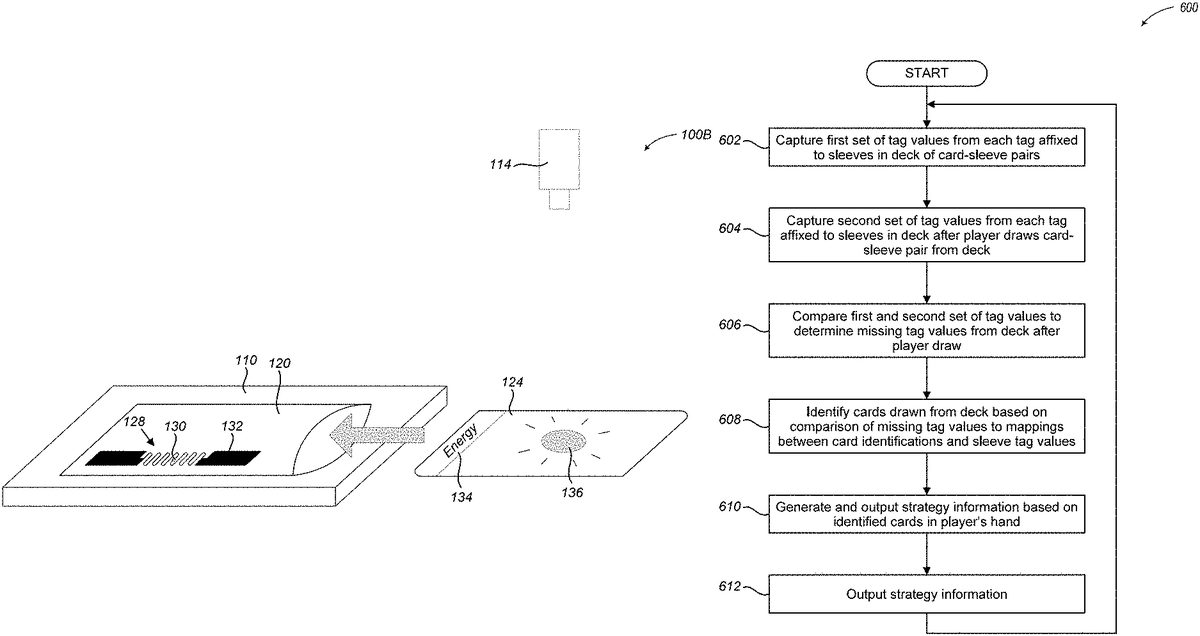
FIG. 1Bprovides additional details of the card-sleeve insertion process. Similar to environment100A inFIG. 1A, environment100B includes a camera114and an RFID reader110. As mentioned above, the sleeve120includes or has an affixed RFID tag128. The RFID tag128may be affixed to the sleeve120by being built into the sleeve120, stuck onto a portion of the sleeve120(e.g., similar to a sticker), or otherwise attached to the sleeve120. In some embodiments, the RFID tag128is affixed to the sleeve120during manufacturing of the sleeve120. In other embodiments, the RFID tag128is affixed to the sleeve120after manufacturing, such as by the user118inFIG. 1A.
The RFID tag128includes an antenna132and a chip130. The chip130captures, via the antenna132, interrogation signals transmitted by the RFID reader110. Once energized, the chip130transmits its corresponding RFID tag value via antenna132, which is captured by the RFID reader110. In this way, a unique identifier is associated with the sleeve120(i.e., the RFID tag value of the RFID tag128).
The camera114captures images of a playing face of the playing card124. As mentioned above, image processing techniques may be employed on the images to identify the playing card124. In the illustrated example, the playing card124includes a header134and a graphic136. The image recognition process may be configured to analyze the captured image for an outline or shape of the playing card124, the header134, the graphic136, or a combination thereof to identify the playing card124. It should be recognized that different playing cards have different characteristics. Thus, the image recognition process may be configured to look for text, symbols, logos, icons, graphics, colors, numbers, or other identifying marks on the playing card124.
In various embodiments, the camera114may capture images of the playing card124as the playing card124is being inserted into the sleeve120or after the playing card124is fully inserted into the sleeve120. Likewise, the RFID reader110may capture an RFID tag value for the sleeve120from the RFID tag128as the playing card124is being inserted into the sleeve120or after the playing card124is fully inserted into the sleeve120. The camera114and the RFID reader110may be synchronized to capture the respective images and RFID tag value at a same time or within a selected threshold time of one another.
AlthoughFIGS. 1A-1Billustrate the generation of the card-sleeve pairs as being performed by a person, embodiments are not so limited. For example a mechanical device can be utilized to insert the playing card into the sleeve. Such a device may include a mechanism for opening the sleeve, such as blown air, arms that enter the sleeve and then move opposite one another to open the sleeve, or other opening mechanism, and a mechanism for sliding the card into an opened sleeve, such as a sliding arm that pushes the card into the sleeve, positioning of the sleeve and card to allow gravity to pull the card into the sleeve, or other mechanisms. The timing of capturing images of the playing card and capturing RFID tag values associated with a sleeve may be correlated to the mechanical device's insertion of the card into the sleeve. Thus, the use of a mechanical device can automate the process of inserting cards into sleeves, while also increasing the accuracy and timing of the camera capturing images of the card.
Moreover, as mentioned herein, the RFID tag128may be rewritable, such that the information transmitted by the RFID tag128in response to an interrogation signal is the information that identifies the playing card124. In at least one such embodiment, the environment100B may also include an RFID writer (not shown) to modify the RFID tag value associated with the RFID tag128after the playing card124is identified (e.g., via image recognition techniques employed on images of the playing card124captured by camera114). In yet other embodiments, a user may manually input or select an identity of the playing card124via a graphical user interface, which can then be mapped to the RFID tag value or written onto the RFID tag120.
FIG. 2illustrates a block diagram of the components utilized in tracking playing cards with RFID tags in accordance with embodiments described herein. Example200includes computing device104, camera114, and RFID reader110. The computing device104sends an image request to the camera114. The camera114captures an image of the card124based on the request and returns the captured image to the computing device104. The computing device104also sends an RFID tag ID request to the RFID reader110. The RFID reader110includes an RFID transmitter146, which transmits interrogation signals. An RFID tag128on the sleeve120receives the interrogation signals and responds with the tag's value or ID. An RFID receiver148on the RFID reader110receives the RFID tag value from the RFID tag128. The RFID reader110then sends the RFID tag value to the computing device104. In some embodiments, the image request and the RFID tag ID request includes timing information to synchronize or coordinate the capturing of the image with the capture of the RFID tag value associated with the sleeve120.
FIG. 3illustrates a context diagram of an environment300in which RFID tag values are utilized to track mapped card-sleeve pairs during the playing of a card game in accordance with embodiments described herein. Environment300includes a table138, a camera114, and a computing device104. In some embodiments, the camera114may be optional and may not be included.
In general, one or more users or players create one or more card decks, each having a plurality of card-sleeve pairs. Each card-sleeve pair may be generated using embodiments described herein to map a card to an RFID tag value of a sleeve of a corresponding card-sleeve pair, such as discussed above inFIGS. 1A-1BandFIG. 2. In this way, each deck of cards includes corresponding card-sleeve pair mapping information, as described herein.
After the card decks are created, the players may engage in playing a card game. In the illustrated example, the card game is played on a table138. The table138is illustrated as having a Player_A side160and Player_B side162.
The Player_A side160includes a deal area152aand a playing area144a. The deal area152ais a position on the table138in which Player_A maintains his or her draw pile or deck of cards140that includes a plurality of card-sleeve pairs (the computing device104already having stored thereon the card-sleeve mapping information for each card-sleeve pair in the deck of cards140).
The deal area152aincludes an RFID transmitter146aand an RFID receiver148a. The deck of cards140is positioned adjacent to the RFID transmitter146aand the RFID receiver148a. In this illustration, the deck of cards140is positioned on top of the RFID receiver148aand next to the RFID transmitter146a. The positioning of the RFID transmitter146ais in a vertical arrangement so as to transmit interrogation signals horizontally or orthogonal to the direction in which the deck of cards140are stacked. This vertical arrangement improves the propagation of the interrogation signals through the deck of cards140. In other embodiments, not illustrated, the RFID transmitter146aand the RFID receiver148amay be in different positions or configurations from what is shown or they may be integrated into a single housing (not shown).
The playing area144ais a position on the table138in which Player_A places card-sleeve pairs142a-142cduring game play. These card-sleeve pairs142a-142care generally referred to as the cards in play, played cards, active cards, or other like terminology depending on the card game being played.
The Player_B side162of the table138is similar to the Player_A side160. The Player_B side161includes a deal area152band a playing area144b. The deal area152bis a position on the table138in which Player_B maintains his or her draw pile or deck of cards150that includes a plurality of card-sleeve pairs, which are distinct from the card-sleeve pairs in the deck of cards140for Player_A (the computing device104already having stored thereon the card-sleeve mapping information for each card-sleeve pair in the deck of cards150). The deal area152bincludes an RFID transmitter146band an RFID receiver148b, similar to the Player_A side160. The deck of cards150is positioned adjacent to the RFID transmitter146band the RFID receiver148b. The arrangement and configuration of the RFID transmitter146b, the RFID receiver148b, and the deck of cards150for the Player_B side162may be similar to or different from the arrangement and configuration of the RFID transmitter146a, the RFID receiver148a, and the deck of cards140for the Player_A side160. Likewise, the playing area144bis a position on the table138in which Player_B places card-sleeve pairs154a-154cduring game play.
As the card game is being played, players draw playing cards from their deck of cards, play cards in their playing area, and may also discard cards into a discard pile (not illustrated). By implementing embodiments described herein, the computing device104can track whether a playing card is in a player's hand, whether it has been played, or whether the card has been discarded.
For example, during Player_A's turn, Player_A picks up the card deck140, removes a card-sleeve pair from the deck140to include in their hand, and returns the card deck140to deal area152a. The RFID transmitter146acontinuously transmit interrogation signals or it may transmit interrogation signals only when the card deck140is positioned in the deal area152a(e.g., adjacent to the RFID transmitter146aand the RFID receiver148a). In response to receiving the interrogation signals when the card deck140is positioned in the deal area152a, the RFID tags associated with each card-sleeve pair in the deck of cards140transmits is corresponding RFID tag value. A first set of RFID tag values associated with each card-sleeve pair in the deck of cards140is obtained by the RFID receiver148abefore Player_A picks up the card deck140. And a second set of RFID tag values is then obtained after Player_A returns the card deck140to the deal area152a. The computing device104compares to first and second sets of RFID tag values. The RFID tag value that is in the first set, but not in the second set, is identified as the card-sleeve pair that was removed from the deck of cards140and placed into Player_A's hand. In some embodiments, multiple card-sleeve pairs may be removed from the deck of cards140, which results in missing multiple RFID tag values. The missing RFID tag values are then compared to the mapping information for the deck of cards140to identify which card or cards where drawn by Player_A. The identity of the card can then be provided to an audience, to commentators, or utilized to generate strategy information associated with the game as it is being played.
Player_B can likewise draw one or more card-sleeve pairs from the deck of cards150. The computing device104identifies which card or cards are drawn by Player_B's based on the RFID tag values obtained by the RFID receiver148bbefore and after Player_B removes a card-sleeve pair from the deck of cards150and the mapping information for the deck of cards150.
As the card game is being played, Player_A may play a card-sleeve pair142ainto the playing area144a. The camera114captures images of the table138as card-sleeve pairs are played into the playing area144aand provides the images to the computing device104. The computing device104analyzes the captured images to identify which particular cards were played, similar to what is described herein for identifying a card when it is paired with a sleeve. In some embodiments, the playing area144amay include an RFID reader that is configured to send interrogation signals and receive RFID tag values from RFID tags affixed to the card-sleeve pairs142a-142cwhen placed in the playing area144a. The computing device104can then utilize the received RFID tag values to determine which cards were played based on the RFID tag value and the card-sleeve pair mapping information for the deck of cards140. In at least one such embodiment, camera114may be optional and may not be utilized. The identity of the cards being played can then be utilized to modify the strategy information associated with the game as it is being played.
When it is Player_B's turn to play a card, Player_B may do so by placing a card-sleeve pair154ainto the playing area144b. Card-sleeve pairs154placed into the playing area144bmay be identified by capturing images with camera114or RFID tag values, similar to what is described with respect to card-sleeve pairs played into the playing area144afor Player_A.
In some embodiments, the table138may include discard pile areas (not illustrated) for Player_A and Player_B. Card-sleeve pairs placed into the discard pile areas may be identified by capturing images with camera114or RFID tag values, similar to what is described with respect to card-sleeve pairs played into the playing areas144aand144b. In at least one such embodiment, the discard pile areas may include an additional respective RFID reader (not illustrated) specifically for identifying card-sleeve pairs placed into the respective discard pile.
In some embodiments, the playing areas144aand144bdo not have RFID transmitters and receivers and these are only provided in the respective deal areas152aand152b. Similarly, in some embodiments, the deal areas152aand152bdo not have RFID transmitters and receivers and these are only provided in the respective playing areas144aand144b.
Providing the cameras114during the game play is optional. Since the identity of the cards is being determined based on the RFID of the card-sleeve pairs during game play, a camera is not used in some embodiments.
AlthoughFIG. 3illustrates the card game as including two players (Player_A and Player_B) and two decks of cards (140and150), embodiments are not so limited. Rather, the number of players, the number of card decks, and the number of card-sleeve pairs in each deck may be different from what is illustrated based on the particular type of card game being played. Likewise, the number and arrangement of cameras and the number and arrangement of RFID readers may differ from what is illustrated depending on the particular type of card game being played, the number of players, the number of card piles or playing areas in which to track the placement or removal of card-sleeve pairs, etc.
Moreover, althoughFIG. 3is described as utilizing decks of card-sleeve pairs and their corresponding mapping information, embodiments are not so limited. Rather, in some embodiments, the RFID tags may be affixed to the playing cards themselves, without the use of a sleeve, and each playing card itself has mapping information to its correspondingly affixed RFID tag.
The operation of certain aspects of the disclosure will now be described with respect toFIGS. 4-8. In at least one of various embodiments, processes400,500,600,700, and800described in conjunction withFIGS. 4-8, respectively, may be implemented by or executed on one or more computing devices, such as computing device104.
FIG. 4illustrates a logical flow diagram generally showing one embodiment of a process400for mapping playing cards with sleeves that include RFID tags in accordance with embodiments described herein.
Process400begins, after a start block, at block402, where one or more images are captured of a playing card being inserted into a tagged sleeve. The images are of the playing face of the playing card, i.e., the informational side of the playing card and not the generic back side of the playing card.
In some embodiments, the images may be captured as a user is or is about to physically insert the playing card into the tagged sleeve or after the playing card has been inserted into the sleeve. In at least one embodiment, a camera may capture images at selected times, at selected time intervals (e.g., every 3 seconds), continuously (e.g., multiple consecutive video frames), or in response to user action or trigger. Examples of such user actions or triggers may include the user pushing a button when the playing card is in the field of view of the camera, the user placing the playing card in a particular position on a table (which can be identified by an inferred sensor or other detection sensor), the camera capturing additional images to detect when the user is inserting a playing card into a sleeve, etc.
Process400proceeds to block404, where an RFID tag value of the sleeve is captured. In various embodiments, an RFID tag reader captures RFID tag vales at selected times, at selected time intervals (e.g., every 3 seconds), continuously, or in response to user action or trigger, similar to the images captured in block402. In some embodiments, the capturing of the images at block402and the capturing of the RFID tag values at block404are synchronized to occur at the same time or correlated to occur within some time period of one another. In this way, an RFID tag value from an RFID affixed to the sleeve is captured relative to when an image of a playing card being inserted into the sleeve is captured. In various embodiments, the combination of a card inserted into a sleeve may be referred to as a card-sleeve pair.
Although process400illustrates the capturing of the image of the playing card before the captured of the RFID tag value, embodiments are not so limited. And in some embodiments, the capturing of the RFID tag value may be before the capturing of the images of the playing card.
Process400continues at block406, where the playing card is identified based on the captured image from block402. In some embodiments, a database of images of all possible playing cards may be maintained, such that the captured image can be compared to the images in the database to identify the playing card. In other embodiments, the database may include partial images or instructions on how to identify a playing card from the features or characteristics on the face of the playing card. In various embodiments, one or more image recognition techniques may be employed to identify the playing card. For example, the image can be analyzed for a particular text, symbols, logos, icons, graphics, colors, numbers, or other identifying marks on the playing card. In various embodiments, the playing card may be identified using a trained artificial intelligence model. In some embodiments, the artificial intelligence model may be trained using a database of known playing cards.
Process400proceeds next to block408, where a card mapping between the identified playing card and the sleeve RFID tag value is generated. In some embodiments, this mapping may be generated by storing relationship or association between the playing card and the RFID tag value, such as in a table or other data structure. As mentioned above, the combination of the playing card in the sleeve may be referred to as a card-sleeve pair. Thus, the mapping of a card-sleeve pair includes an RFID tag value of the sleeve and an identity of the playing card (e.g., a name, number, or type of the playing card).
Process400continues next to block410, where the mapped card and sleeve are added to a mapped card deck. In various embodiments, the mapped card deck includes a plurality of mappings between cards and their respective sleeves. Thus, the card deck may include a plurality of card-sleeve pairs, and the mapped card deck may include the mapping information for each of the plurality of card-sleeve pairs.
Process400proceeds to decision block412, where a determination is made whether to map another playing card with another sleeve. In some embodiments, this determination may be based on the number of playing cards, or card-sleeve pairs, in a card deck. For example, some card decks may include 52 cards, while others may include 60 cards, which may depend on the types of playing cards or the card game being played. In other embodiments, this determination may be based on whether additional images, or sensor readings, indicate that the user is inserting another playing card into another sleeve, which may continue until the user stops or inputs a stop command. If another playing card and sleeve are to be mapped together, process400returns to block402to capture additional images of a next playing card and RFID tag values of a next sleeve (at block404). Otherwise, process400continues to block414.
At block414, the mapped card deck is stored. In some embodiments, the mapped card deck is associated with a particular player and stored in a database with other mapped card decks for other players. In other embodiments, a single mapped card deck is utilized for multiple players.
After block414, process400terminates or otherwise returns to a calling process to perform other actions.
Although process400is described as mapping a playing card to a sleeve during a single-stage process as the playing card is being inserted into the sleeve, embodiments are not so limited. Rather, in some other embodiments, a two-stage process may be employed. In this process, a plurality of playing cards may be inserted into a plurality of corresponding sleeves to make a plurality of card-sleeve pairs during a first stage. Then each card-sleeve pair can then be positioned such that a camera can capture an image of the playing card in the sleeve and an RFID reader can capture an RFID tag value of an RFID tag affixed to that sleeve during a second stage. This two-stage process may improve efficiency and synchronization because the user does not have to keep the playing card and sleeve in a particular location as the playing card is being inserted into the sleeve. Likewise, a user can manually insert the playing cards into the sleeve, and an automated machine may be used to systematically capture images and RFID tag values of each card-sleeve pair.
Moreover, process400is described as mapping a playing card with a sleeve, embodiments are not so limited. Rather, in some embodiments, the playing card may be mapped to an RFID tag value of an RFID tag that is built into, stuck onto, or otherwise affixed to the playing card itself, such as during the manufacturing process or at a later time. In this example, the images captured at block402may be of the playing card just prior to, as, or just after an RFID tag is affixed to the playing card. Similar to what is described above, the capturing of the RFID tag value may be synchronized to the image capture. In some embodiments, the capturing of the RFID tag value and the capturing of the images may be some time apart from one another, such as when the affixing is done in an automated assembly line process during manufacturing.
FIG. 5illustrates a logical flow diagram generally showing one embodiment of a process500for mapping playing cards with sleeves that include RFID tags in accordance with embodiments described herein.
Process500begins, after a start block, at block502, where one or more images are captured of a playing card being inserted into a tagged sleeve, similar to what is described above in conjunction with block402inFIG. 4.
Process500proceeds to block504, where the playing card is identified based on the captured image from block502, similar to what is described above in conjunction with block406inFIG. 4.
Process500continues at block506, where the RFID tag value is assigned with information regarding the identified playing card. In some embodiments, the actual RFID tag identifier is modified to be the card identification information. In other embodiments, the RFID tag identifier is modified to include the card identification information along with the identifier of the RFID tag. In yet other embodiments, a rewritable field associated with the RFID tag is modified to include the card identification information.
The card identification information that is written to the RFID tag is, or includes, the information that the RFID tag is to transmit when responding to an interrogation signal. In this way, the RFID tag of a sleeve responds with the identification of the playing card that is inserted into that sleeve.
Process500proceeds next at decision block508, where a determination is made whether to map another card and sleeve. In various embodiments, this determination may be similar to what is described above in conjunction with decision block412inFIG. 4. If another card and sleeve are to be mapped, process500flows to block502; otherwise, process500terminates or otherwise returning to a calling process to perform other actions.
FIG. 6illustrates a logical flow diagram generally showing one embodiment of a process600for utilizing RFID tagged playing cards to track card movement throughout a card game in accordance with embodiments described herein.
Process600begins, after a start block, at block602, where a first set of RFID tag values are captured from each RFID tag affixed to card sleeves in a deck of card-sleeve pairs. In various embodiments, an RFID transmitter sends an interrogation signal through the deck of card-sleeve pairs. The RFID tags affixed to the sleeves of each card-sleeve pair respond to the interrogation signal by sending their corresponding RFID tag value. An RFID receiver captures these returned RFID tag values. The RFID transmitter and the RFID receiver may collectively be referred to as the RFID reader.
As described above, in some embodiments, the RFID transmitter and the RFID receiver may be configured to be in a same housing such that a single RFID reader that is positioned adjacent to the deck of cards (e.g., under the deck of cards) and configured to send interrogation signals and receive RFID tag values. In other embodiments, the RFID transmitter and the RFID receiver may be arranged and configured in two distinct and separate housings. In this way, the RFID transmitter can be in one position adjacent to the deck of cards (e.g., next to a stacked deck of cards) to send interrogation signals through the deck of cards orthogonal to a direction in which the playing cards are stacked and the RFID receiver can be in a different position adjacent to the deck of cards (e.g., under the deck of cards) to receive RFID tag values. The RFID transmitter is adjacent to the deck of cards when the deck of cards is within a threshold distance from the RFID transmitter to have its corresponding RFID tag receive the interrogation signals and respond with an RFID tag value. The RFID receiver is adjacent to the deck of cards when the RFID receiver is within a threshold distance from the deck of cards to receive the RFID tag values send from the corresponding RFID tags in the deck.
Process600proceeds to block604, where a second set of RFID tag values are captured from each RFID tag affixed to card sleeves in a deck of card-sleeve pairs. In various embodiments, block604performs embodiments of block602to capture RFID tag values, but the second set of tag values are captured after a player has removed one or more card-sleeve pairs from the deck.
In some embodiments, the second set of RFID tag values may be captured in response to the RFID receiver capturing RFID tag values after a selected period of time of not capturing RFID tag values. For example, after the first set of tag values is captured at block602, the player may pick up the deck to remove a playing card. During this time, the RFID reader may be too far away from the deck in the players hand to energize the RFID tags or capture RFID tag values from the tags in the deck. Once the player replaces the deck adjacent to the RFID reader, the tags can once again receive interrogation signals and respond with RFID tag values, which are again captured by the RFID reader as the second set of RFID tag values.
Process600continues at block606, where the first and second set of tag values are compared to determine which tag values are in the first set of tag values but missing from the second set of tag values. The missing tag values indicate that the corresponding tag is no longer in the deck of cards and thus the corresponding card-sleeve pair for that tag was removed from the deck by the player.
Process600proceeds next to block608, where the cards drawn from the deck are identified based on a comparison of the missing tag values to the card-sleeve pair mappings. As discussed above, the card-sleeve pair mappings correlate which playing card is inserted into which sleeve. Thus, the missing tag values can be compared to the card-sleeve pair mappings to identify the particular playing cards that were removed from the deck and are now in the player's hand.
In some embodiments, a database of card-sleeve pair mappings is accessed to obtain the identity of the playing card based on the corresponding missing tag values, such as where the card-sleeve pair mappings include an association between a playing card's identification and an RFID tag value, as described herein and generated by process400inFIG. 4. In other embodiments, the missing tag values include the identity of the missing cards. As described herein, such as in process500inFIG. 5, the tag values may be modified or written to include or be the playing card's identification. In at least one such embodiment, a mapping database does not have to be accessed because the tag value received from a RFID tag on a sleeve includes the information that identifies the particular card inserted into that sleeve.
Process600continues next to block610, where strategy information is generated based on the identified playing cards in the player's hand. In various embodiments, the strategy information is generated based on previously identified playing cards in the player's hand, previously identified playing cards in another player's hand, playing cards identified as being played or discarded (e.g., at block704inFIG. 7), playing cards still in the deck, or some combination thereof.
The strategy information may include statistical information of the player winning the hand or game, statistical information of which playing card the player is likely to play next, information related to general game strategy based on the combination of the playing cards in the player's hand, etc. In other embodiments, the strategy information may simply include a list of the playing cards in each player's hand.
Process600proceeds to block612, where the strategy information is output to a user. For example, the strategy information may be displayed to a commentator for the commentator to discuss the current status of the game and various strategies and options available to the players. In other embodiments, the strategy information may be overlaid onto a video stream of the players playing the game. In this way, audience members can see what playing cards are in the player's hands, as well as other types of strategy or statistical information.
After block612, process600loops to block602to capture another set of RFID tag values and wait for a player to draw another playing card from the deck.
FIG. 7illustrates a logical flow diagram generally showing another embodiment of a process700for utilizing RFID tagged playing cards to track card movement throughout a card game in accordance with embodiments described herein;
Process700begins, after a start block, at block702, where images or RFID tag values are captured of one or more playing cards being played or discarded during the playing of a game. In some embodiments, images or RFID tag values may be captured at selected times, at a selected interval, or in response to a game trigger. For example, an RFID tag reader may be positioned on the table where playing cards are played or discarded. The game trigger may occur when the RFID tag reader for the discard pile or the played card area captures a new RFID tag value. Similarly, a camera may be positioned and configured to captured images of played or discarded cards. The images can be analyzed using image recognition techniques to identify that a playing card was played or discarded.
Process700proceeds to block704, where the played or discarded cards are identified based on the captured images or RFID tag values. In embodiments where the played or discarded card is identified by an image, the image may be analyzed to identify the played or discarded card, similar to block406inFIG. 4. In embodiments where the played or discarded card is identified by an RFID tag value, then the card may be identified by comparing the RFID tag value to the card-sleeve pair mappings, similar to block606inFIG. 6.
Process700continues at block706, where the strategy information is revised based on the identified cards being played or discarded. In various embodiments, the revised strategy information is generated similar to block610inFIG. 6taking into account the playing cards in each player's hand, the playing cards now played or discarded, the playing cards still in the deck, or some combination thereof.
Process700proceeds next to block708, where the revised strategy information is output to the user, similar to block610inFIG. 6.
After block708, process700loops to block702continue to capture images or RFID tag values of cards played or discarded during the playing of the game
FIG. 8illustrates a logical flow diagram generally showing one embodiment of a process800for generating a list of playing cards in a deck. In various embodiments, process800may be performed by a computing system that includes a camera to capture images of playing cards, a lighting source to illuminate playing cards for image capture, a first mechanism that physically moves playing cards from a stack of cards into a position in front of the camera, a second mechanism that physically moves playing cards from in front of the camera to a new stack, and optionally an RFID reader.
Process800begins, after a start block, at block802, where a playing card is removed from a stack of a plurality of playing cards. In some embodiments, the first mechanism may pick up the playing card from the stack, such as by using a suction mechanism or mechanical fingers. In other embodiments, the first mechanism may swipe the playing card away from the stack, such as to remove the top or bottom playing card of the stack.
Process800proceeds to block804, where the playing card is positioned in front of the camera. In various embodiments, the first mechanism may include an arm, extension member, paddle, wheel, or other mechanical means to move the playing card from the stack location to a position in front of the camera with the face of the playing card directed at the camera. In some embodiments, the first mechanism may continue to hold on to the playing card while positioned in front of the camera. In other embodiments, the first mechanism may release the playing card in front of the camera and return to the stack of playing cards to remove another playing card from the stack.
Process800continues at block806, where an image of the playing card is captured using the camera. The image is of the playing face of the playing card, i.e., the informational side of the playing card and not the generic back side of the playing card. In various embodiments, one or more light sources may be positioned to illuminate the face of the playing card to improve image quality.
In various embodiments, the camera captures the image of the playing card when the first mechanism has positioned the playing card in front of the camera. In some embodiments, one or more sensors may be used to detect if when the playing card is positioned in front of the camera. In other embodiments, the camera may capture the image of the playing card in response to a timing mechanism that is calibrated based on a time from when the first mechanism removes the playing card from the stack of cards to when the playing card is positioned in front of the camera.
Process800proceeds to block808, where the playing card is identified based on the captured image. In various embodiments, block808may employ embodiments of block406inFIG. 4to identify the playing card.
Process800continues next at block810, where the computing system utilizes an RFID scanner to scan for an RFID tag associated with the playing card. In some embodiments, the playing card may have already been inserted into a sleeve that includes an RFID tag, as described herein. In other embodiments, the system may include a mechanism that automatically inserts the playing card into a sleeve that includes an RFID tag. In yet other embodiments, the playing card may itself have an RFID tag embedded or attached to it.
Process800proceeds next to decision block812, where a determination is made whether an RFID tag is detected. In various embodiments, an RFID tag is detected if a known or expected tag value is obtain during the scan. If an RFID tag is detected, process800flows to block814; otherwise. Process800flows to block816.
At block814, the RFID tag value obtained during the scan is associated with the playing card. In various embodiments, block814may employ embodiments of block408inFIG. 4to generate a card mapping between the identified card and the RFID tag value. After block814, process800continues at block816.
In various embodiments, the RFID scanning features of process800may be optional and may not be performed. According, block810, decision block812, and block814may be optional and may not be performed, and process800may flow from block808to block816. In at least one such embodiment, the computing system that performs process800may not include an RFID reader.
At block816, the identity of the playing card is stored in a card list. This card list is an aggregated list of all playing cards in the stack of cards that have been identified. In some embodiments, where an RFID tag value is associated with the card, this association or mapping is also stored with the identity of the playing card in the card list, similar to block410inFIG. 4.
Process800continues next at block818, where the playing card is positioned in a new stack. In various embodiments, a second mechanism, such as an arm, extension member, paddle, wheel, or other mechanical means, moves the playing card from in front of the camera to a location of the new stack. In at least one embodiment, the second mechanism may pick up the playing card from in front of the camera, such as by using suction or mechanical finders. The second mechanism may then more the playing card to the new stack and release the playing card on the new stack. In some embodiments, when the first mechanism holds the playing card in front of the camera and does not release the playing card, the second mechanism may be the first mechanism, which then moves the playing card to the new stack before releasing the playing card.
Process800proceeds to decision block820, where a determination is made whether there is another playing card in the stack of playing cards. In some embodiments, the stack of playing cards may include a known number of cards, such as 60 or 100. The computing system may maintain a counter for each playing card identified and stop when the counter reaches the known number of playing cards. In other embodiments, a sensor may be utilized to determine when the stack of playing cards is empty.
If there is another playing card in the stack, then process800loops to block802to remove a next playing card from the stack; otherwise, process800terminates or otherwise returns to a calling process. In some embodiments, process800may output (not illustrated) the aggregated list of identified playing cards, such as via a display device, printer device, or to another database or computing system. Process800can be utilized at card tournaments to create a list of playing cards in each player's deck; utilized by a card shop to identify all playing cards in a player's collection; etc.
It will be appreciated that in some embodiments the functionality provided by the processes discussed above may be provided in alternative ways, such as being split among more processes or consolidated into fewer processes. Similarly, in some embodiments, the illustrated processes may provide more or less functionality than is described. In addition, while various operations may be illustrated as being performed in a particular manner or order (e.g., in serial or in parallel, or synchronous or asynchronous), the operations may be performed in other orders or manners in other embodiments. For example, with respect to process800inFIG. 8, an image of a first playing card may be captured at block806in parallel with a second playing card being removed from the stack at block802. Therefore, embodiments of the foregoing processes and methods may contain additional acts not shown inFIGS. 4-8, may not contain all of the acts shown inFIG. 408, may perform acts shown inFIG. 408in various orders, may combine acts, and may be modified in various respects.
FIG. 9shows a system diagram that describes one implementation of computing systems for implementing embodiments described herein. System900includes computing device104, RFID reader110, and camera114.
As described herein, computing device104is a computing device that can perform functionality described herein for receiving image data and RFID tag values to map playing cards and sleeve for each of a plurality card-sleeve pairs (or mapping playing cards to affixed RFID tag values), as well as to monitor the playing of a card game to determine which playing cards have been drawn into a player's hand, played, or otherwise discarded based on the RFID tag values and the corresponding mapping information. Accordingly, various embodiments described herein may be implemented in software, hardware, firmware, or in some combination thereof. The computing device104includes memory904, one or more processors922, display924, input/output (I/O) interfaces926, other computer-readable media928, network interface930, and other components932.
Processor922includes one or more processing devices that execute computer instructions to perform actions, including at least some embodiments described herein. In various embodiments, the processor922may include one or more central processing units (CPUs), programmable logic, or other processing circuitry.
Memory904may include one or more various types of non-volatile and/or volatile storage technologies. Examples of memory904include, but are not limited to, flash memory, hard disk drives, optical drives, solid-state drives, various types of random access memory (RAM), various types of read-only memory (ROM), other computer-readable storage media (also referred to as processor-readable storage media), or other memory technologies, or any combination thereof. Memory904may be utilized to store information, including computer-readable instructions that are utilized by processor922to perform actions, including at least some embodiments described herein.
Memory904may have stored thereon various modules, such as card mapping module908and card tracking module910. The card mapping module908provides functionality to receive images of playing cards from the camera114and RFID tag values from the RFID reader110and generate a mapping between an identity of the card and the RFID tag value, as described herein. In various embodiments, the card mapping module also includes image processing and analysis functionality to perform image recognition techniques to identify the playing card from the captured images, as described herein. The card tracking module910provides functionality to track playing cards during the playing of a card game based on images of playing cards from the camera114and RFID tag values from the RFID reader110, as described herein. In some embodiments, the card tracking module910generates statistical information about the playing of the card game based on what cards are in the players' hands, what cards have been played, etc.
Memory904may also store other programs918and other content920. Other programs918may include operating systems, user applications, or other computer programs. Content920may include the mapping information for one or more card-sleeve pairs or one or more card-tag pairs or one or more decks of cards, as described herein.
Display924is a display device capable of rendering statistical information to a user, as generated by the card tracking module910. The display924may be a liquid crystal display, light emitting diode, or other type of display device, and may include a touch sensitive screen capable of receiving inputs from a user's hand, stylus, or other object.
I/O interfaces926may include interfaces for the RFID reader110, the camera114, or various other input or output devices, such as audio interfaces, other video interfaces, USB interfaces, physical buttons, keyboards, or the like. Other computer-readable media928may include other types of stationary or removable computer-readable media, such as removable flash drives, external hard drives, or the like.
Network interfaces930are configured to communicate with other computing devices via a communication network (not illustrated). For example, in some embodiments, the computing device104may communicate with a remote server to have the server perform the image recognition functionality described herein to identify playing cards from images. Network interfaces930include transmitters and receivers (not illustrated) to send and receive data via one or more wired or wireless communication networks.
The computing device104is also in communication with the RFID reader110and the camera114. The RFID reader110includes an RFID transmitter146and an RFID receiver148. The RFID transmitter transmits interrogation signals and the RFID receiver148receives RFID tag values sent in response to the interrogation signals, as described herein and utilized by the card mapping module908and the card tracking module910. The camera114is configured to capture one or more images of playing cards to be utilized by the card mapping module908, and in some embodiments the card tracking module910. AlthoughFIG. 9illustrates a single RFID reader110and a single camera114, embodiments are not so limited. In some embodiments, the computing device104may be in communication with a plurality of RFID readers110, a plurality of camera114or some combination thereof.
The various embodiments described above can be combined to provide further embodiments. These and other changes can be made to the embodiments in light of the above-detailed description. In general, in the following claims, the terms used should not be construed to limit the claims to the specific embodiments disclosed in the specification and the claims, but should be construed to include all possible embodiments along with the full scope of equivalents to which such claims are entitled. Accordingly, the claims are not limited by the disclosure.
Claims
- A system, comprising: a radio-frequency-identification (RFID) tag reader;a plurality of playing-card sleeves having RFID tags affixed thereto;a plurality of playing cards having one card within each respective sleeve;a camera that captures images of a plurality of playing cards;and a computing device that includes: a memory that stores computing instructions and card deck mapping information for a deck of playing cards that includes a plurality of pairs of a card and a sleeve for that card;and a processor that executes the computer instructions to: prior to playing a game with the deck of playing cards: capture, via the camera, a first image of a first playing card of the plurality of playing cards in association with the first playing card being inserted into a first sleeve of the plurality of playing-card sleeves to make a first card-sleeve pair of the plurality of card-sleeve pairs in the deck of playing cards prior to playing a game;capture, via the RFID tag reader, a first radio-frequency-identification-tag value from a first RFID tag affixed to the first sleeve;determine an identification of the first playing card based on the first image;generate a first mapping for the first card-sleeve pair between the identification of the first playing card and the first radio-frequency-identification-tag value for the first sleeve;and store the first mapping in the card deck mapping information in the memory;during playing of the game: capture, via the RFID tag reader, a first set of RFID tag values from a first set of radio-frequency-identification tags affixed to a first set of card-sleeve pairs from the plurality of card-sleeve pairs in the deck of playing cards;capture, via the RFID tag reader after at least one card-sleeve pair is removed from the deck of playing cards, a second set of RFID tag values from a second set of radio-frequency-identification tags affixed to a second set of card-sleeve pairs from the plurality of card-sleeve pairs in the deck of playing cards;determine a third set of RFID tag values based on a comparison between the first set and the second set of RFID tag values;determine an identification of at least one playing card of the at least one card-sleeve pairs based on the card deck mapping information and the third set of RFID tag values;generate strategy information for the game based on the at least one identified playing card;capture, via the camera, an image of a playing card that is played or discarded during the game;identify the played or discarded card based on the image;and modify the strategy information for the game based on the played or discarded card.
- The system of claim 1 , wherein the processor of the computing device further executes the computer instructions prior to playing the game to: capture, via the camera, a second image of a second playing card of the plurality of playing cards in association with the second playing card being inserted into a second sleeve of the plurality of playing-card sleeves to make a second card-sleeve pair of the plurality of card-sleeve pairs in the deck of playing cards prior to playing the game;capture, via the RFID tag reader, a second RFID tag value from a second radio-frequency-identification tag affixed to the second sleeve;determine an identification of the second playing card based on the second image;generate a second mapping for the second card-sleeve pair between the identification of the second playing card and the second RFID tag value for the second sleeve;and store the second mapping in the card deck mapping information in the memory.
- The system of claim 1 , wherein the processor of the computing device further executes the computer instructions during playing of the game to: capture, via the RFID tag reader, a second RFID tag value of a second playing-card sleeve that is pair with a second playing card that is played or discarded during the game;identify the second played or discarded card based on the second RFID tag value and the card deck mapping information;and modify the strategy information for the game based on the second played or discarded card.
- The system of claim 1 , wherein the RFID tag reader includes: a RFID tag transmitter that is positioned to send interrogation signals through the plurality of card-sleeve pairs in the deck of playing cards orthogonal to a direction in which the plurality of card-sleeve pairs are stacked;and a RFID tag receiver that is physically separate from the RFID tag transmitter to receive the first and second sets of RFID tag values from a first and second sets of radio-frequency-identification tags affixed to the first and second sets of card-sleeve pairs in the deck of playing cards.
- The system of claim 4 , wherein the RFID tag receiver is positioned under the deck of playing cards in the direction in which the plurality of card-sleeve pairs are stacked.
- A method, comprising: inserting a playing card of a plurality of playing cards into a respective sleeve of a plurality of sleeves to create a plurality of card-sleeve pairs in a deck prior to playing a card game;capturing an image of each respective playing card of the plurality of playing cards in association with the respective card being inserted into the respective sleeve of the plurality of sleeves;determining an identification of each respective card of the plurality of playing cards based on the image of the respective cards;modifying an RFID tag value of each respective RFID tag affixed to each respective sleeve in association with the respective card being inserted into the respective sleeve based on the identification of each respective card;capturing, prior to at least one card-sleeve pair being removed from the deck, a first set of modified RFID tag values of the cards in the deck;removing at least one card-sleeve pair from the deck;capturing, after at least one card-sleeve pair is removed from the deck during the playing of the card game, a second set of modified RFID tag values of the cards in the deck;and determining an identification of at least one card that has been removed from the deck based on at least one modified RFID tag value being in the first set of modified RFID tag values but not in the second set of modified RFID tag values.
- The method of claim 6 , further comprising: generating strategy information for the game based on the at least one identified playing card.
- The method of claim 7 , further comprising: capturing a modified RFID tag value of a playing-card sleeve that is paired with a card that is discarded during the playing of the card game;identifying the discarded card based on the modified RFID tag value;and modifying the strategy information for the card game based on the discarded card.
- The method of claim 6 , wherein capturing the first and second sets of modified RFID tag values includes: transmitting, via a RFID tag transmitter, interrogation signals through the plurality of card-sleeve pairs;and receiving, via a RFID tag receiver that is physically separate from the RFID tag transmitter, the first and second sets of modified RFID tag values from a first and second sets of RFID tags affixed to the first and second sets of card-sleeve pairs.
- The method of claim 9 , wherein the transmitting the interrogation signals includes transmitting the interrogation signals to the plurality of card-sleeve pairs orthogonal to a direction in which the plurality of card-sleeve pairs are positioned during the playing of the card game, and wherein receiving the first and second sets of modified RFID tag values includes receiving the first and second sets of RFID tag values in the direction in which the plurality of card-sleeve pairs are stacked.
- The method of claim 9 , wherein modifying the RFID tag value of each respective RFID tag includes: setting an output value for each respective RFID tag to include identification information of the respective card inserted into the respective sleeve.
- A computing device, comprising: a memory that stores computing instructions and card deck mapping information that maps a respective radio-frequency-identification (RFID) tag value of each of a plurality of radio-frequency-identification tags to an associated playing card of a plurality of playing cards;and a processor that executes the computer instructions to: obtain a first set of RFID tag values from a first set of radio-frequency-identification tags of the plurality of radio-frequency-identification tags associated with a first set of cards of the plurality of cards;obtain a second set of RFID tag values from a second set of radio-frequency-identification tags of the plurality of radio-frequency-identification tags associated with a second set of cards of the plurality of cards in response to at least one card being removed from the first set of cards;determine a third set of RFID tag values based on a comparison between the first set and the second set of RFID tag values;determine an identification of at least one card that is associated with the third set of RFID tag values based on the card deck mapping information;obtain a RFID tag value from a radio-frequency-identification tag associated with a card that is played or discarded during playing of a card game;identify the played or discarded card based on the RFID tag value and the card deck mapping information;and generate strategy information for the card game based on the played or discarded card.
- The computing device of claim 12 , wherein the processor further executes the computer instructions to: obtain a first image of a first card of the plurality of cards in association with the first card being inserted into a first sleeve to make a first card-sleeve pair;obtain a first RFID tag value from a first radio-frequency-identification tag affixed to the first sleeve;determine an identification of the first playing card based on the first image;generate a first mapping for the first card-sleeve pair between the identification of the first card and the first RFID tag value for the first sleeve;and store the first mapping in the card deck mapping information in the memory.
- The computing device of claim 12 , wherein the processor further executes the computer instructions to: obtain an image of each respective card of a plurality of cards in association with the respective card being inserted into a respective sleeve of a plurality of card sleeves;obtain a RFID tag value from each respective radio-frequency-identification tag affixed to each respective sleeve in association with the respective card being inserted into the respective sleeve;determine an identification of each respective card of the plurality of cards based on the image of the respective cards;and generate the card deck mapping information to include mappings between the identification of each respective card with the RFID tag value of the respective sleeve.
- The computing device of claim 12 , wherein the processor further executes the computer instructions to: obtain an image of a second card that is played or discarded during playing of the card game;identify the second played or discarded card based on the image;and generate strategy information for the card game based on the second played or discarded card.
- A method, comprising: inserting a playing card of a plurality of playing cards into a respective sleeve of a plurality of sleeves to create a plurality of card-sleeve pairs in a deck prior to playing a card game;capturing an image of each respective playing card of the plurality of playing cards in association with the respective card being inserted into the respective sleeve of the plurality of sleeves;determining an identification of each respective card of the plurality of playing cards based on the image of the respective cards;modifying an RFID tag value of each respective RFID tag affixed to each respective sleeve in association with the respective card being inserted into the respective sleeve based on the identification of each respective card;capturing, prior to at least one card-sleeve pair being removed from the deck, a first set of modified RFID tag values of the cards in the deck;removing at least one card-sleeve pair from the deck;capturing, after at least one card-sleeve pair is removed from the deck during the playing of the card game, a second set of modified RFID tag values of the cards in the deck;and determining an identification of at least one card that has been removed from the deck based on at least one modified RFID tag value being in the first set of modified RFID tag values but not in the second set of modified RFID tag values;generating strategy information for the game based on the at least one identified card;capturing a second image of a card that is played during the playing of the card game;identifying the played card based on the second image;and modifying the strategy information for the card game based on the played card.
Disclaimer: Data collected from the USPTO and may be malformed, incomplete, and/or otherwise inaccurate.