U.S. Pat. No. 11,315,385
Customized Collusion Avoidance Policies For Esports
AssigneeAG 18, LLC
Issue DateApril 29, 2019
Illustrative Figure
Abstract
Various embodiments of the present technology generally relate to customized collusion avoidance policies for eSports. In some embodiments, an eSports gaming platform can receive a notification request to connect one or more eSports player terminals to an eSports game. The notification request can include eSports player terminal information (e.g., a location). A customized collusion avoidance policy can be dynamically generated based, at least in part, on the location of the eSports player terminal. The customized collusion avoidance policy can include one or more actions that are triggered in response to events detected at the eSports player terminal. The customized collusion avoidance policy can be enforced during eSports game play by monitoring for any of the events identified in the customized collusion avoidance policy and, in response to detecting any of the events, executing a corresponding combination of the one or more actions.
Description
The drawings have not necessarily been drawn to scale. Similarly, some components and/or operations may be separated into different blocks or combined into a single block for the purposes of discussion of some of the embodiments of the present technology. Moreover, while the technology is amenable to various modifications and alternative forms, specific embodiments have been shown by way of example in the drawings and are described in detail below. The intention, however, is not to limit the technology to the particular embodiments described. On the contrary, the technology is intended to cover all modifications, equivalents, and alternatives falling within the scope of the technology as defined by the appended claims. DETAILED DESCRIPTION Various embodiments of the present technology provide networked, interactive gaming. According to some embodiments of the technology, players may engage in interactive games that require at least one player decision after the game has begun. Interactive games can include games of skill, games of chance and/or hybrid games that mix games of chance and games of skill. Examples of interactive games include, but are not limited to, poker, blackjack, video and arcade games, virtual reality games, eSports, live dealer, pinball, games of chance with bonus rounds that include games of skill, and others. The interactive games can include head-to-head games where one player or team of players compete directly against another player or team of players. In some embodiments, the interactive game may be a single player game where the player is trying to meet various objectives (e.g., score a desired number of points, reach a certain level, complete a screen within a limited time frame, and the like). With respect to poker, for example, a player must decide whether to bet, raise, call, or fold after having seen his cards and the action of other players. ...
The drawings have not necessarily been drawn to scale. Similarly, some components and/or operations may be separated into different blocks or combined into a single block for the purposes of discussion of some of the embodiments of the present technology. Moreover, while the technology is amenable to various modifications and alternative forms, specific embodiments have been shown by way of example in the drawings and are described in detail below. The intention, however, is not to limit the technology to the particular embodiments described. On the contrary, the technology is intended to cover all modifications, equivalents, and alternatives falling within the scope of the technology as defined by the appended claims.
DETAILED DESCRIPTION
Various embodiments of the present technology provide networked, interactive gaming. According to some embodiments of the technology, players may engage in interactive games that require at least one player decision after the game has begun. Interactive games can include games of skill, games of chance and/or hybrid games that mix games of chance and games of skill. Examples of interactive games include, but are not limited to, poker, blackjack, video and arcade games, virtual reality games, eSports, live dealer, pinball, games of chance with bonus rounds that include games of skill, and others. The interactive games can include head-to-head games where one player or team of players compete directly against another player or team of players. In some embodiments, the interactive game may be a single player game where the player is trying to meet various objectives (e.g., score a desired number of points, reach a certain level, complete a screen within a limited time frame, and the like).
With respect to poker, for example, a player must decide whether to bet, raise, call, or fold after having seen his cards and the action of other players. With respect to blackjack, a player must decide whether to hit, stand, split, double down, or surrender after having seen his cards and the dealer's up card. With respect to video games, player interactions are needed throughout the game to make decisions to navigate obstacles, fire weapons, and the like depending on the particular video game. Other games can have similar actions during the progress of the game. These types of player decisions are in direct contrast with slot machines in which players merely decide to initiate a game, after which no player decision is made until the conclusion of the game. In other words, no intermediate decisions are made in non-interactive games.
“Networked” gaming allows players to participate from different locations, although in some embodiments, players may play from a common location via a local network. The game, however, is typically administered by a processor separate from a player's terminal. By allowing participation from a large number of locations simultaneously, the quality and variety of the gaming opportunity is enhanced through increased demand. “Interactive games,” unlike, for example, slots, require at least one player decision after the game has begun.
Some embodiments of the technology also provide players the opportunity to participate in networked gaming anonymously. Unlike, for example, Internet poker, in which a player must disclose at least some personal information to create a player account, embodiments of the present technology allow players to enter a game without disclosing any personal information. While some embodiments provide loyalty programs to encourage longer sessions, return customers, and the like, players are not required to participate in loyalty programs. Players may simply deposit funds into a player terminal and enter a game. Hence, no disclosure of personal information is required to participate in games according to embodiments of the present technology.
Further, according to various embodiments, player terminals can be located at licensed gaming locations. Licensed gaming locations can include any state or, in the future, federal land whereby a player can play on a personal computing device through a network with a licensed operator. Licensing may be governed by the Nevada Gaming Control, tribal council, and/or a regulatory agency setup within a state. In the future, the federal government may permit federal licenses for certain operators. For example, if Caesars Entertainment is licensed in Nevada and someone is playing on their system/networked servers that would be permitted and considered a licensed jurisdiction. Some states, jurisdictions or specific areas (e.g., schools, churches, etc.) may still have bans on gambling in those locations. As such, some embodiments of the present technology may use various location deriving techniques (e.g., geolocation, GPS signals, IP addresses, and others) to determine if the player terminals that are mobile are in a banned location or in a location where gambling would be permitted.
This also contrasts with traditional Internet poker and the like, wherein player terminals (e.g., personal computers, table tops, laptops, tablets, smartphones, and the like) may be located anywhere. Hence, according to some embodiments of the technology, a player may engage in these games without fear of running afoul of gambling laws. While locations may include casinos, restaurants, bars, race tracks, hotels (including individual hotel rooms), and the like, players are secure in the fact that the location is authorized to provide the gaming opportunity.
Further still, in some embodiments, efforts are made to protect players from unsavory activities that have prevented the emergence of such gaming opportunities heretofore. For example, collusion and other forms of cheating are addressed through player terminal placement, privacy features, electronic monitoring, and/or the like. Hence, players are provided an enhanced gaming opportunity, even with respect to “live” games in which cheating is often hard to detect, since a casino does not see every player's hole cards, players are able to “mark” cards since the cards are physically handled, and colluding players can use sophisticated forms of signaling that go unnoticed by the dealer, floor personnel, or the “eye in the sky.” In some embodiments, payouts may be withheld for a period of time (e.g., 24 or 48 hours) to allow for a review of the game play by various hardware and/or software systems that can be used to detect colluding players or other types of cheating.
In some embodiments, the player terminals will need to display various information about the gaming session the player is about to enter. This information can include various rules, limitations and payouts. Since some player terminals may be able to support different games, variable payback, varying skill levels, and multiple profit models (e.g., rake, fixed fee, etc.), the player terminal can display this type of information clearly to the user.
Players also may compete for enhanced prizes over and above the current “pot.” For example, in poker, players may be given bonus jackpots for hitting a certain, usually rare, hand (e.g., a Royal Flush). Also, players may receive a “consolation prize” in the form of a “bad beat” jackpot (e.g., having an aces full house beaten by four of a kind or better). These jackpots may be progressive and could grow to be much more valuable than the contested pot. In blackjack, players can receive bonuses for hitting, for example, an ace and jack of spades blackjack. In some embodiments, bonus rounds may be added with different interactive games (e.g., a game of skill or a game of chance). The bonus round games may be selected by the player before or after the main gaming session. In other embodiments, the bonus round may be randomly selected by the player terminal, the host computing system, or a gaming platform. Still yet, the bonus round may only be presented to players that win the main gaming session or the bonus round may be randomly presented. These and other features and enhancements will be described more fully in the ensuing detailed description.
In the following description, for the purposes of explanation, numerous specific details are set forth in order to provide a thorough understanding of embodiments of the present technology. It will be apparent, however, to one skilled in the art that embodiments of the present technology may be practiced without some of these specific details. While, for convenience, embodiments of the present technology are described with reference to interactive gaming on various devices, embodiments of the present technology are equally applicable to various other cloud-based gaming technologies.
The techniques introduced here can be embodied as special-purpose hardware (e.g., circuitry), as programmable circuitry appropriately programmed with software and/or firmware, or as a combination of special-purpose and programmable circuitry. Hence, embodiments may include a machine-readable medium having stored thereon instructions which may be used to program a computer (or other electronic devices) to perform a process. The machine-readable medium may include, but is not limited to, floppy diskettes, optical discs, compact disc read-only memories (CD-ROMs), magneto-optical discs, ROMs, random access memories (RAMs), erasable programmable read-only memories (EPROMs), electrically erasable programmable read-only memories (EEPROMs), magnetic or optical cards, flash memory, or other type of media/machine-readable medium suitable for storing electronic instructions.
The phrases “in some embodiments,” “according to some embodiments,” “in the embodiments shown,” “in other embodiments,” and the like generally mean the particular feature, structure, or characteristic following the phrase is included in at least one implementation of the present technology, and may be included in more than one implementation. In addition, such phrases do not necessarily refer to the same embodiments or different embodiments.
Attention is directed toFIG. 1, which illustrates an exemplary gaming network100according to embodiments of the technology. The gaming network100includes a host computer system102and a communications network104through which a plurality of gaming locations106communicate with the host computer system102. It should be appreciated that the gaming network100is merely exemplary of a number of possible gaming network configurations according to embodiments of the present technology. Further, although the ensuing description will relate to a poker gaming network, this is not a requirement. Embodiments of the present technology may relate to many other types and varieties of games.
This exemplary host computer system102includes an internal network108, a web server110, a game server112, a game storage arrangement114, a player storage arrangement116, and an administrator computing device118. In this specific embodiment, the various components of the host computer system102are co-located; in other embodiments, the components may be distributed geographically. As those skilled in the art will appreciate, other exemplary host computer systems according to embodiments of the technology may include different components than those illustrated and described herein.
Each gaming location106may include a local server120and one or more player terminals122. In some embodiments, the local server120may simply facilitate communication between the player terminals122and the host computer system102. In other embodiments, the local server120administers the games, tracks players for loyalty purposes, manages player deposits, and/or the like. In some embodiments, there may be more than 1 server at these locations handling different aspects of the gaming system. For example, there may be servers dedicated to accounting and money management, servers dedicated for detecting collusion and/or other types of cheating (e.g., automated play), servers managing the loyalty/rewards systems, and the like.
The various servers, networks, computing devices, and storage arrangements may be any of a variety of well-known devices. For example, in some embodiments, the communications network104is the Internet, the servers110,112,120are standard products offered, for example, by Dell Corp., the storage arrangements114,116are typical optical, magnetic, solid state, or similar mass storage devices, and the administrator computing device118is a typical desktop computer. The player terminals122will be described in greater detail below.
According to embodiments of the technology, the gaming locations106are licensed gaming locations, such as casinos, race tracks, licensed networks that comply with state or federal regulations, or the like. In some embodiments, the gaming locations106are gas stations, hotels, stores, airports, or other locations at which gaming is legal. The gaming locations106specifically exclude locations where gaming is not legal. In accordance with various embodiments, gaming locations need not be attended. As such, players may be able to enter and exit games, deposit and receive money, interact with the player's terminal, and the like, without the assistance of an attendant at the gaming location.
The player terminals122at the gaming locations106may be in wired or wireless communication with the local server120. In accordance with various embodiments, player terminals122can include customized electronic devices built for interactive game play. In some embodiments, the player terminals122can include personal computing devices running customized software (e.g., a gaming application running on a mobile device such as a mobile phone or tablet). It should be appreciated that the terminals may be wirelessly connected directly to the host computer system102via the communications network104. Other examples are possible. In some embodiments, hotel guests at casino/hotels may “check out” player terminals122and engage in gaming from their hotel rooms. In other embodiments, player terminals122are in every room in a hotel and players may engage in gaming using the terminals without ever leaving their rooms.
As will be described in greater detail below, in some embodiments, players can anonymously engage in games via the gaming network100. That is, a player may insert cash into a terminal or otherwise deposit monetary value (e.g., via a credit card, PayPal®, digital currency transfer, etc.), select a game, and begin playing without creating a user account. This is a significant difference between embodiments of the present technology and previously-known gaming networks, such as Internet poker in which players must create user accounts.
As will be described in greater detail hereinafter, players may engage in interactive games from any location. For example, players at terminal122-21and122-25from gaming location106-2may be involved in the same poker game as players using terminals122-53and122-56from the gaming location106-5. The host computer system102administers the game and distributes information about the action of the game to appropriate player terminals. Cards are dealt to players in the game, although players are only able to view their own cards and any community cards. Betting proceeds from one player to the next, and the host computer system102informs each player of the action prior to his turn.
Of course, all players in a particular game may be playing from the same location. The players may be playing next to one another at a common bank of machines or they may be distributed throughout the gaming location (e.g., some in their hotel rooms, some on one floor of a casino, and the remainder on another floor of the casino). Still yet, some players may be remotely located and playing via a network connection with players in a fixed gaming location. Other player may be playing from their homes, parks, restaurants, bars, and other locations. Many examples are possible.
It is important to note, however, that gaming locations and the gaming network operator may take special steps to ensure players are not the victim of collusion or other forms of cheating. For example, if two players playing from the same location are within eyesight of each other's terminals, then they may be able to see each other's hole cards or signal each other their holding. This form of collusion provides these players with a significant advantage over other players in the game. Similarly, an individual player may be the innocent victim of another player who can see his hole cards or other position within a game without his knowledge. Hence, the gaming location may employ any of a number of measures to prevent such cheating.
In some embodiments, when a player enters a game from a specific terminal at a gaming location, other terminals within proximity (e.g., three rows of machines, 100 feet, the same floor of the casino, etc.) of the player's terminal may be locked out of the game the player entered. Of course, nothing would prevent two players seated at terminals next to one another from playing in different games. Similarly, wireless terminals may have features that allow them to know when they are in proximity of one another and perform similar lockouts. For example, these features can include, in some embodiments, one or more of proximity sensors, IP address monitoring and tracing, reporting of GPS locations, beacon-based technology, and the like. As another example, player terminals may be distributed and fixed within a gaming location. Various mapping technology can be used to create location maps that can be used as part of the proximity detection.
With respect to an individual player who has another player looking over his shoulder to see his hole cards, player terminals may have a “hole card reveal” button or the like that allows players to quickly view their hole cards, whereas the cards are otherwise “face down” on the terminal display. While not a guarantee that other players cannot see his cards, a player using such a feature is better able to protect his hand. Shielding on the terminal and/or smaller displays or other features may be used to enhance a player's ability to protect his hand.
Despite all efforts to minimize cheating through visual means, players may nevertheless collude by communicating with one another via phone calls, texting, or the like. Such collusion may be dealt with in any of a variety of ways by various embodiments of the present technology. For example, player terminals or the gaming location in general may employ electronic countermeasures that disrupt cell phone signals. As one example, when the player terminals are personal computing devices (e.g., a smartphone or a tablet), the application running the gaming software may completely deactivate one or more features of the smartphone or tablet such as cellular service, texting, Internet, etc. Still yet, some embodiments of the gaming software may identify the mobile number associated with the mobile device. As such, any incoming call when a game is in session may use the caller ID to block (or securely withhold) calls or text messages from other players in the common gaming session.
In some embodiments, the gaming network operator may employ collusion detection software that monitors player action. Since the host computer system102knows all players' cards or activity within the gaming session, unusual action by a player may trigger a flag, after which the player's action is given higher scrutiny. Players suspected of colluding may be immediately barred from a game and their deposits held pending resolution.
Having generally described a gaming network100according to embodiments of the technology, attention is directed toFIG. 2, which provides greater detail relating to the flow of funds in such a network. According to this example, players202engage in gaming using player terminals204. The players202may insert value (e.g., cash, points, credits, etc.) into the terminals204to thereby engage in the games offered by the terminals. When a player202-1is ready to cash out of a game, the terminal204-1is configured to dispense value back to the player202-1.
Excess value travels from the player terminals204to a local depository206and/or vice versa. In some cases, the value moves electronically, for example, if the value is measured in points or credits. In others cases, for example, if the value is in the form of paper currency and/or coin, value is physically moved from the local depository206to the player terminals204(“terminal fills”) and vice versa. Occasionally, player cash outs are handled from the local depository206directly to the player. In one such example, a player202-5is due a higher cash out than the terminal204-5can provide. The player202-5may have experienced an exceptional winning session, the gaming location may require the player202-5to complete tax forms for IRS reporting, the player202-5may have won a specialty jackpot that is paid from the local depository206, the player terminal204-5may be configured to only print “tickets” which players202redeem for cash at a cashier's cage, credit a player's loyalty card or bank card, and/or the like. Many other such examples exist.
In some examples, value is paid from a local depository206to a central depository208and vice versa. As in the immediately-previous discussion, the central depository208may occasionally pay value directly to a player202-1.
In a specific embodiment, the local depository206is a licensed gaming location and the central depository208is the operator of the gaming network100. The operator enlists the gaming location to house terminals in return for a portion of the revenue generated by the network. The compensation to the gaming location may be in proportion to the revenues generated at the gaming location. For example, if the gaming network operator provides interactive poker, each contested pot may be “raked” a certain percentage (e.g., 3% to a maximum of $4). Hence, the winning player's pot may be light a $4 rake. The gaming locations from which the players are engaged in the game may keep $2 of the $4, while the remainder is remitted to the operator. Because players may engage in the same poker game from different locations, occasional revenue balancing may be required to compensate gaming locations at which players have winnings in excess of deposits. Likewise, locations at which players lose more over a period of time provide the excess to the operator for distribution to the locations with the higher wins. In some embodiments, large payouts may be made by the manufacturer, the casino, or some other third party. For example, mega jackpots/progressives that are pooled can get paid by the manufactures in many instances.
Individual gaming locations and/or the operator of the gaming network may offer promotions to increase player interest. For example, as will be described in greater detail hereinafter, gaming locations may offer “high hand” jackpots. Such jackpots are paid to players for making particular high hands such as four aces, a royal flush, or the like. The jackpot may be reset to a starting value (e.g., $100 for four aces) and increase in proportion to revenues at the gaming locations until the high hand is again hit. Different gaming locations may have different high hand jackpot amounts. In fact, the high hand may be game specific, i.e., there may be one high hand jackpot for four aces in all Texas Hold'em games and a different four aces high hand jackpot for 7-card Stud games. Jackpots also may be specific to various game limits. High hand jackpots may be paid to players directly from the local depository206.
The gaming network operator also may offer specialty jackpots, such as “bad beat” jackpots, in which players who have a high value hand beaten may share (e.g., four-of-a-kind beaten by a higher hand). As with the high hand jackpots, bad beat jackpots may reset to a nominal value after being hit and increase as a function of revenue. The revenue base for a bad beat jackpot offered by the gaming network operator may be substantially larger than the revenue base for locally-offered high hand jackpots, in which case, the bad beat jackpot may grow at a faster rate. As with the high hand jackpots, bad beat jackpots may be game and limit specific.
Of course, the preceding discussion should not be understood to limit bad beat jackpots to being offered by the gaming network operator or high hand jackpots to being offered by the local gaming location. Further, other types and varieties of jackpots may be offered at any level of the network.
Attention is directed toFIG. 3, which illustrates an exemplary functional diagram300of the host computer system102. The functional diagram300depicts several program modules as well as basic computer functions. For example, the I/O module302handles input to and output from a processing environment and/or the communications network104. The graphics module304provides control over the graphics displayed on player terminals and/or administrative computers. The terminal control module306provides the capability of the host computer system102to interact with and/or control a player terminal122. The game storage arrangement308houses software or other computer-executable code that controls the games offered.
A number of processing environments are also included in some embodiments. For example, a game processor310controls one or more interactive games using the computer executable code from the game storage arrangement308. A tournament processor312performs a similar function for player tournaments. A loyalty tracker314keeps up with the play of registered players to thereby reward players for the amount of time they spend playing. An accounting processor316controls the flow of money and/or other forms of value within the network. A collusion detection processor318monitors such things as unusual action taken by a specific player, frequent occurrences of the same players playing together in the same games, and the like. A software test environment320allows new games and/or processes to be tested in an environment that does not affect ongoing operations. A waiting list queue322allows players to wait in line for a specific game or table. An evaluation module324allows for the monitoring of the communication latency between the plurality of player terminals and the host computer system.
Those skilled in the art will appreciate that this is but one of many possible exemplary functional diagrams for a gaming network according to embodiments of the technology.
FIG. 4illustrates an example of various components that may be used within a player terminal in accordance with some embodiments of the present technology. As shown inFIG. 4, player terminals122may include memory402(e.g., volatile memory and/or nonvolatile memory), processor(s)404, power supply406(e.g., battery), for executing processing instructions, and operating system408. Additional components may include data storage component410(e.g., hard drive, flash memory, memory card, etc.), one or more network interfaces (e.g., Bluetooth® Interface412; and Network Communication Interface414, which enables the player terminal to communicate by transmitting and receiving wireless signals using licensed, semi-licensed or unlicensed spectrums over a telecommunications network), audio interface416, microphone418, display420, keypad or keyboard422, SIM card424, other input and/or output interfaces426, and gaming module428. The various components of a mobile device may be interconnected via a bus.
Memory402can be any device, mechanism, or populated data structure used for storing information. In accordance with some embodiments of the present technology, memory402can encompass any type of, but is not limited to, volatile memory, nonvolatile memory and dynamic memory. For example, memory402can be random access memory, memory storage devices, optical memory devices, media magnetic media, floppy disks, magnetic tapes, hard drives, SDRAM, RDRAM, DDR RAM, erasable programmable read-only memories (EPROMs), electrically erasable programmable read-only memories (EEPROMs), compact disks, DVDs, and/or the like. In accordance with some embodiments, memory402may include one or more disk drives, flash drives, one or more databases, one or more tables, one or more files, local cache memories, processor cache memories, relational databases, flat databases, and/or the like. In addition, those of ordinary skill in the art will appreciate many additional devices and techniques for storing information which can be used as memory402.
Memory402may be used to store instructions for running one or more applications or modules on processor(s)404. For example, memory402could be used in one or more embodiments to house all or some of the instructions needed to execute the functionality of the various system components and/or modules. Processor(s)404are the main processors of player terminal122which may include application processors, baseband processors, various coprocessors, and other dedicated processors for operating player terminal122. For example, an application processor can provide the processing power to support software applications, memory management, graphics processing, and multimedia. An application processor may be communicably coupled with memory402and configured to run the operating system408, the user interface, and the applications stored on memory402or data storage component410. A baseband processor may be configured to perform signal processing and implement/manage real-time radio transmission operations of a player terminal (e.g., a mobile device). These processors, along with the other components, may be powered by power supply406. The volatile and nonvolatile memories found in various embodiments may include storage media for storing information such as processor-readable instructions, data structures, program modules, or other data. Some examples of information that may be stored include basic input/output systems (BIOS), operating systems, and applications.
Operating system408can also provide common services for software applications running on processor(s)404. According to the embodiments shown inFIG. 4, gaming module428can include identification module430, policy enforcement module432, payout adjustment module434, skill level adjustment module436, accounting module438, and state recordation module440. Each of these modules can be embodied as special-purpose hardware (e.g., one or more ASICS, PLDs, FPGAs, or the like), or as programmable circuitry (e.g., one or more microprocessors, microcontrollers, or the like) appropriately programmed with software and/or firmware, or as a combination of special purpose hardware and programmable circuitry. Other embodiments of the present technology may include some, all, or none of these modules and components along with other modules, applications, and/or components. Still yet, some embodiments may incorporate two or more of these modules and components into a single module and/or associate a portion of the functionality of one or more of these modules with a different module. For example, in one embodiment, identification module430and policy enforcement module432can be combined into a single module for identifying and enforcing various policies on a player terminal.
Identification module430can be used to gather information about the player terminal, current and/or past gaming sessions, player information, specific hardware and software configurations of the player terminal, GPS coordinates, associated telephone numbers, IP addresses, e-mail addresses, user identifiers, international mobile station equipment identity (IMEI), mobile equipment identifiers (MEID), integrated circuit card identifiers (ICCID), part identifiers, software identifiers, current gaming session identifiers, identification of any nearby player terminals, and the like. This information can be used in a variety of ways, including by policy enforcement module432which can set customized collusion avoidance policies that can, in some embodiments, be dynamically set (e.g., based on location, current gaming session, etc.).
Payout adjustment module434can be used to dynamically adjust the payout of a gaming session. For example, there may be minimum payout requirements (e.g., between 85% and 98%) that are required to be met over a period of time (e.g., daily, weekly, monthly, and yearly). As such, the payout module can ensure those minimum requirements are met. Payout adjustment module434may also be able to adjust the payout based on the profit model being used for a particular gaming session. For example, some games may take a fee or percentage off the top, a rake (e.g., 1% to 15%, fifty cents, one dollar, etc.) of the money at play. As another example, the games may use a pooled liquidity model for jackpots where the money is derived from multiple sources (e.g., multiple casinos). As such, the percentage may be different depending on the game play location or other factor. Still yet, payout adjustment module434may be connected to a casino or other rewards system and grant higher payouts based on various reward models (e.g., number of visits, average bet, total money bet, holiday/birthday month, gift, etc.).
Skill level adjustment module436can be used to adjust playing parameters within the game. Examples of playing parameters can include, but are not limited to, number of lives, amount of time to complete an objective, game speed, amount of ammo, firing rates, items caught, items chosen, number of automated opponents, automated opponent strengths, and the like. The higher the skill level set by skill level adjustment module436, the higher the payout. Accounting module438can be used to interface with various existing backend accounting systems and other reporting and record keeping systems (e.g., IRS reporting systems). In some embodiments, accounting module438may be used to implement procedures that are designed to detect and prevent transactions that may be associated with money laundering, fraud and other criminal activities and to ensure compliance with all federal laws related to money laundering.
State recordation module440can be used to capture the state of the gaming session. This can include a variety of game states including, but not limited to, wager, payout levels, skill level settings, and others. The state of the gaming session can be repeatedly captured so that in the event of a communication failure, terminal fault, or other issue that would prevent the gaming session from being completed a record of the current state can be reconstructed. For example, in some embodiments, the state may be captured at least every second. In other embodiments, the state may be captured more or less quickly depending on game dynamics. The state captured by state recordation module440may also be used (possibly with state information from other player terminals of the same gaming session) by a collusion avoidance module to determine if any collusion is occurring. In some embodiments, the state information captured by state recordation module440can be used to generate various gaming analytics. In some embodiments, the host computer (or gaming platform) may capture the snapshots of the state information directly.
State recordation module440may store the state information in database for regulatory compliance, analytics, or other purpose. For example, in some embodiments, all the game play within a period of time (e.g., a five year period, a two year period, a year, a month, a week, a day, etc.) could be recorded and stored in the database. In other embodiments, a limited number of gaming sessions could be recorded (e.g., last one hundred, last thirty, etc.). Still yet, some embodiments of state recordation module440may only record (or record for longer period of time) games that have betting above a set threshold (e.g., $500, $1000, etc.).
The state information recorded by state recordation module may be a direct copy of the game play or only information sufficient to reproduce the game play. For example, in some embodiments, the state information may include various gaming parameters (e.g., ammo amounts, number of lives, level, etc.), gaming session identifier, date and time the interactive gaming session is opened or terminated, the date and time the interactive gaming session is logged in to or is logged out of by various player terminals, the physical location, by state or foreign jurisdiction, of the authorized player while logged in to the interactive gaming account, and/or other types of information.
In some embodiments, the player terminals can provide for social media, chatting and other communication channels. For example, some embodiments, may have interfaces that allow for third party access through another gateway like Facebook® or other social media. Some embodiments of the player terminals may allow for picture in picture or multiple screens. For example, players may be able to play an interactive game via one screen or video channel and in the second screen or video channel being displayed in the picture in picture (PIP) thereby allowing players to play more than one at a time. The additional screens or video channel, for example, could be used to watch sports, fantasy sports betting, ordering drinks or food, and the like. In some embodiments, additional screens may be present to present various promotions such as ticket sells for shows, restaurant deals, future room bookings, room upgrades, and the like.
Some embodiments of the player terminals may also include external video outputs that allow for display of the game by others. For example, in various tournament play (e.g., eSports), the external video outputs may allow others to watch the game play. In various embodiments, the player terminals may support virtual reality interfaces, hologram generation systems, and other visualization systems for the gaming. The player terminals, in some embodiments, can include various sensors to detect gestures that can be interpreted as controls for betting, controlling gaming action, ordering drinks, etc.
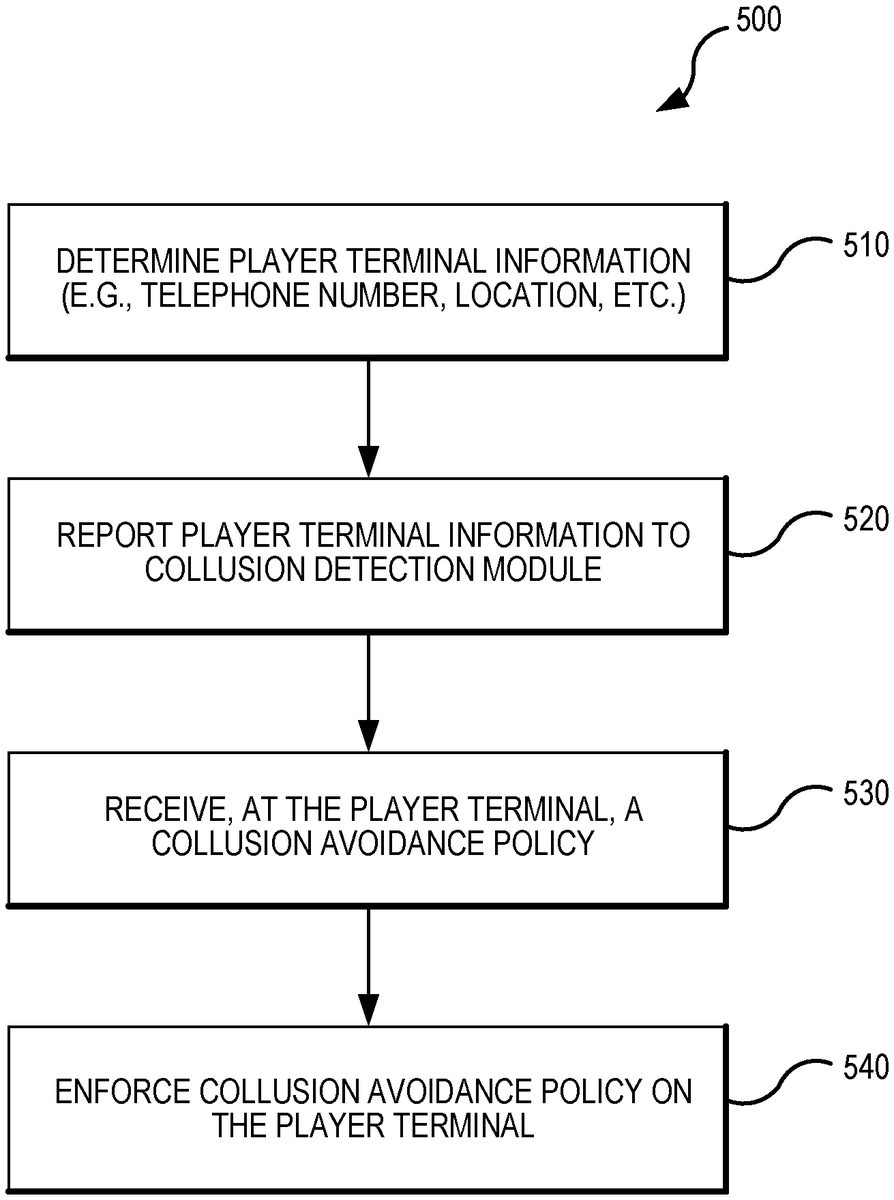
FIG. 5illustrates an example of a set of operations500for enforcing a collusion avoidance policy on a player terminal in accordance with various embodiments of the present technology. Various embodiments of the present technology allow for heterogeneous player terminals that can be at either fixed locations or mobile (i.e., able to move to different locations). Since the player terminals may have different capabilities and may even be owned and operated by a player (e.g., a tablet), each player terminal may need different and/or dynamically changing collusion avoidance policies. For example, a player terminal that is mobile may be able to be positioned nearby (e.g., within 25 feet) of a second player terminal that is stationary. As such, the collusion avoidance policies may need to be dynamically updated so that those player terminals may not participate in the same gaming session. In some instances, for example in various eSports events and other team based gaming session, the collusion avoidance policies may allow multiple players to collude. As such, this type of dynamic policy adjustment can allow, in some embodiments, the collusion detection and enforcement to be appropriately set or even completely disengaged.
As illustrated inFIG. 5, for example, collection operation510determines the player terminal information. Player terminal information can include information regarding specific hardware and software configurations of the player terminal. In some embodiments, the player terminal information can include player information collected via the player terminal. In accordance with various embodiments, and depending on the type of player terminal, collecting the player terminal information can be done in a variety of ways. For example, the player terminal information could be automatically collected by accessing various sensors, components, operating systems, and/or software associated with the player terminal. In some embodiments, the player terminal location may be monitored over long periods of time and predictive analytics or learning algorithms can be used to generate a likely current location for the player based on historical information.
In some embodiments, the player terminal information could include GPS coordinates, telephone numbers, IP addresses, e-mail addresses, user identifiers, international mobile station equipment identity (IMEI), mobile equipment identifiers (MEID), integrated circuit card identifiers (ICCID), part identifiers, software identifiers, current gaming session identifiers, identification of any nearby player terminals, and the like. As another example, management software or gaming software loaded on the player terminal may send out or monitor for beacon signals (e.g., using Bluetooth® or other short range communication protocols) that can be received or transmitted by monitoring stations located at various physical locations (e.g., at a casino, airport, etc.).
The player terminal information can be reported, during reporting operation520, to a collusion detection module. The collusion detection module may be part of the player terminal or separate from the player terminal. Reporting operation520may stream the information to the collusion detection module or send the information in batches. As the player terminal information changes, the changes can be detected and then sent to the collusion detection module. This may be particularly helpful in reducing traffic between the player terminal and a separate collusion module. The collusion detection module can then process the player terminal information along with other information such as, for example, collusion rules to develop a collusion avoidance policy. Once the player terminal information is received during receiving operation530, the player terminal can enforce the collusion avoidance policy on the player terminal during enforcement operation540.
FIG. 6illustrates an example of a set of operations600for detecting automated play on a player terminal in accordance with one or more embodiments of the present technology. As illustrated inFIG. 6, monitoring operation610can monitor player action within a gaming session. Using the player action, determination operation620determines action variability. For example, the variability in responding to various game play situations, the player's logic in responding to various game play situations, the player's strategy, the player's response time for responding to various game play situations, the player's betting patterns, and/or other information derivable from monitoring player actions. In some embodiments, determination operation620may also monitor various biometrics of the player or record the player with a camera.
Using the action variability, determination operation630can determine if a player terminal is using automated play during the gaming session. This may be a score, a percentile, confidence level, a range, or other indicator that automated play is likely occurring. If determination operation630determines that automated play is occurring (or likely occurring), then determination operation630branches to enforcement operation640. During enforcement operation640, the collusion avoidance policy can be enforced and may include a variety of actions including, but not limited to holding the game, terminating gaming sessions, holding payouts subject to further review, initiating review of other available data (e.g., from video surveillance systems), creating entries in a user tracking system and the like. The collusion avoidance policy may have variable enforcement depending on the confidence or likelihood of the automated play, the betting amount, the identity of the player, the number of auto play triggers for the identified player, and the like. Such features may be manually engaged or disengaged by the operators or be associated with a set of rules that can allow the system to automatically engage or disengage the feature in some embodiments.
If determination operation630determines that automated play is not occurring (or not likely occurring), then determination operation630branches to allowance operation650, which allows the game play to continue and returns to monitoring operation610where the player action within a gaming session is monitored. If determination operation630flags the play as potentially automated, then determination operation630branches to review operation660which can allow the game to continue with a heightened level of review or elevate the review to other systems or gaming administrators for review. During this time, the game may be allowed to continue to collect additional evidence with monitoring operation610or a collusion avoidance policy may be enforced with enforcement operation640. The collusion avoidance policy may request that an additional game be played where the gaming action is varied (e.g., speed, difficulty level, etc.) to determine if automated playing is occurring.
FIG. 7illustrates an example of a set of operations700for setting and updating a gaming session payout on a player terminal in accordance with some embodiments of the present technology. As illustrated inFIG. 7, receiving operation710receives information regarding a baseline skill distribution for one or more interactive games (e.g., Pac-Man, Tetris, etc.). This baseline may be collected offline or via terminals over a period of time. Using the baseline skill distribution, payout operation720sets the initial game payout based on the baseline skill distribution. As players play the interactive games, additional live game play statistics can be received from one or more terminals during playing operation730. The skill distribution can be updated based on the additional live game play statistics during update operation740. Using the updated skill distribution, determination operation750can determine if a game payout modification is needed. If determination operation750determines that a game payout modification is not needed, then determination operation750can branch to initiation operation760to initiate a gaming session with a set payout. If determination operation750determines that a game payout modification is needed, the determination operation750can branch to setting operation770where a fixed payout for a gaming session is updated and set. Once the payout is set, then the gaming session can be initiated from initiation operation760.
FIG. 8illustrates an example of a set of operations800for determining if network connection is sufficient for allowing a gaming session according to various embodiments of the present technology. As illustrated inFIG. 8, receiving operation810can receive a request for a player terminal to enter a gaming session. Connection operation820can determine the connection information between the player terminal and the host server. The connection information may include information such as, but not limited to, upload speeds, download speeds, connection type (e.g., fiber/cat-5, WiFi, cellular, miracast etc.), and other connection information. Using the connection information, determination operation830can determine whether the gaming criteria is met. For example, the gaming criteria can include minimum upload speeds, minimum download speeds, and the like. If determination operation830determines the gaming criteria has been met, then determination operation830can branch to initiation operation840where the gaming session can be initiated. If determination operation830determines the gaming criteria has not been met, then determination operation830can branch to denial operation850where a gaming session is not initiated and then suggestion operation860can be used to suggest an alternative game based on the connection information.
FIG. 9illustrates an exemplary player terminal900according to embodiments of the technology. Only the most relevant aspects of the user interface portion of the player terminal900are illustrated and described herein. It should be apparent that the user interface may be part of a hand-held player terminal, a free standing player terminal (e.g., a tabletop gaming console, a dedicated gaming enclosure with electronics supporting the game, etc.), a computing device configured as a player terminal (e.g., a laptop, mobile phone, tablet, e-reader, etc.), a “set-top” gaming console, and/or the like. Further, it is not necessary for all elements of the player terminal illustrated and described herein to be included in the player terminal.
The terminal includes a jackpot payout information area902, a game display area904, a player interaction area906, and a cash and credit interaction area908. The jackpot payout information area902includes information about the status of jackpot accumulations. The amounts associated with the various jackpots may increase with time and may be game specific. For example, if the player terminal provides the possibility to engage in different types of games and limits, then the jackpot amounts displayed in the jackpot information area may change with different player game selections.
The game display area904provides a visual depiction of the game in which the player is involved. For example, the game display area904may show a poker table910and players912sitting around the table. As players are dealt cards, the cards may appear in front of each player. As players bet, chips may be displayed in front of the players. At the end of each betting round, the chips from the round may be scooped into the middle of the table to symbolize the pot for which the players are competing. As the action proceeds around the table, the next player to act may be highlighted and that player's terminal may beep, or otherwise alert the player that it is his turn to act. Community cards may appear on the table for all players to see. At the conclusion of the hand, the pot may be pushed to the winning player as the hole cards of all players still in the hand are revealed. Each player's present bankroll may be graphically or numerically displayed so that all players know how much each player has available to wager.
The game display area904may be where players look to view their hole cards. A player's hole cards may be continuously displayed. In some embodiments, however, steps are taken to help ensure a player's hole cards remain hidden from other players potentially playing at nearby terminals to thereby prevent cheating. In some embodiments, a button is included (e.g., the enter button932) that causes the hole cards to be revealed. If the button is not depressed, then the hole cards are simply shown as face down. This way, players can quickly glance at their cards thereby reducing the risk that someone else can view their hole cards. In other embodiments, hole cards may be displayed on a separate display screen. In either case, shielding, glass coatings, polarization screens, and/or the like may be employed to prevent others from viewing a player's hole cards.
The player interaction area906includes player buttons, input devices, and the like through which players interact with the game. It should be appreciated that the player interaction area906may comprise touch screen buttons on the game display area904. Hence, it should be understood that this embodiment is merely exemplary of a number of possible embodiments as will be appreciated by those skilled in the art.
The player interaction area906in this embodiment includes discard buttons920for draw games (e.g., 5-card draw, 2-7 triple draw lowball, etc.). Players use these buttons to identify cards to be discarded in a drawing round. The player interaction area906also includes a bet button922, a raise button924, a fold button926, a call button927, and a check button928. These buttons are used to take the appropriate action according to each button's name. In some embodiments, additional input buttons and devices are included. For example, a track ball930may be included for indicating how much a player wants to bet in unstructured games. It also may be used to select from several choices displayed on the display screen904. It may be used in combination with the enter button932to confirm a selection. A cash out button934allows a player to leave a game with the value the player has presently accumulated. Those skilled in the art will appreciate many other possibilities in light of this disclosure. For example, depending on the type of game play contemplated, the player interaction area could include other types of input devices to accept inputs. These input devices can include, but are not limited to voice recognition, actuators, joysticks, 3D-image tracking systems to monitor player motions, and the like.
The cash and credit interaction area908provides a loyalty card accepter940, a bill or ticket accepter/dispenser942, and a coin dispenser944. These items work in ways similar to analogous devices on, for example, video poker machines, except that the player terminal sends signals to the host computer system in response to player actions taken with respect to cashing in and out.
Those skilled in the art will appreciate that the foregoing description is merely exemplary of a number of possible player terminal embodiments. For example, other embodiments may include all touch screen controls, may only accept bills and dispense tickets, may not include jackpot values, and the like. Most embodiments, however, minimally include a display area through which the action is depicted and which may include player input buttons that change depending on the state of the game. It should also be appreciated that the display region may show display screens that allow players to select games and limits, enter personal information, if desired, and advertise promotions and the like when the terminal is not in use. Many other possibilities exist and are apparent to those skilled in the art in light of this disclosure.
FIG. 10illustrates an example of a player terminal1000according to some embodiments of the present technology. As illustrated in player terminal1000, there may be a player interaction area1010where the interactive game is presented. The performance area1020can show various challenge levels, typical success rates, payouts, and other information. Game selection area1030may be used to select the one or more games being played, the skill level, bets, and objectives for winning.
FIG. 11illustrates an example of a set of operations1100for selecting game play within a gaming session according to various embodiments of the present technology. While some terminals may be fixed and generally available for play, other player terminals may be personal computing devices of the player. As such, receiving operation1110can receive a notification that a player terminal has joined the network. Using update operation1120, the player terminal can be updated with the available games or a list of the available games. The player can be presented with an opportunity to select a plurality of games for play. For example, during selection operation1130, an indication can be received indicating the main game and the bonus round game that the player would like to combine.
Some embodiments set various rules for how the games may be paired. For example, one rule may require that at least one of the games is an interactive game. As another example, the rules may seek to limit or minimize the average estimated play time. As such, only those games with average game play below a particular threshold may be presented as pairing options once the first game has been selected. Determination operation1140can determine if the pairing rules have been satisfied. If determination operation determines that the pair rules have not been satisfied, then determination operation1140branches to selection operation1130where different selections can be made. If determination operation determines that the pair rules have been satisfied, then determination operation1140branches to initiation operation1150where the gaming session is initiated.
FIG. 12illustrates an example of a set of operations1200for operating an interactive game according to one or more embodiments of the present technology. The method may be implemented in gaming network100ofFIG. 1or other appropriate system. Those skilled in the art will appreciate that other exemplary embodiments may include more, fewer, or different steps than those illustrated and described here. Further, other exemplary embodiments may traverse the steps in different orders than shown herein.
The set of operations1200begins at block1202at which a host computer system, such as the host computer system102, initiates a game session. A game session, could be, for example, a poker game among several players. The game session could consist of one or more hands of poker in which players compete against one another for the pot. The game session could be a series of blackjack hands in which one or more players compete against the house as is known in the art. The game session also could be a series of hands of other games such as gin rummy, bridge, and the like. As another example, the game session could be any type of interactive game such as a game of skill, game of chance, or a hybrid game that includes a game of skill and a game of chance as regular game play or in a bonus.
In some embodiments, initiating a game session comprises making a selection available on one or more player terminals. The selection allows players at the player terminals to enter the game session. Any number of game sessions could be available at any given time for players to enter. The games may comprise a variety of games (e.g., Texas Hold'em, 7-Card Stud, Omaha, Draw poker, 2-7 lowball, Blackjack, Bridge, pinball, Grand Theft Auto, Tetris, Minecraft, Hearthstone, Super Mario, Super Mario Kart, Pac-Man, Guitar Hero, Galaga, League of Legends, Frogger, StarCraft, Donkey Kong, words with friends, Sonic the Hedgehog, Counter-Strike, Metroid, Ms. Pac-Man, Space Invaders, Punch-Out, Rainbow Six Seige, Fallout, Final Fantasy, Call of Duty, Street Fighter, Dota, Journey, Dark Souls, etc.) and a variety of limits ($0.25/$0.50, $11$2, $11$2 Blind No Limit, $10/$20, $500/$1000, etc.). In some embodiments, the players may be able to select the game played in the gaming session and a game of skill to be played in the bonus round. In some embodiments, the game session may be a tournament, which may be a single-table tournament or a multi-table tournament.
At block1204, players are joined to the game session. This may comprise receiving a signal from a player terminal that the player desires to enter the game and has deposited sufficient funds to enter the game. The player is assigned to a seat (or is allowed to select a seat) at a virtual table, which may be displayed as shown inFIG. 9. The player's bankroll (i.e., the player's stake in the game) may be depicted at the virtual table.
In some embodiments, players may be provided with an option to change their perspective of the virtual table. For example, a player may desire to “sit” at the bottom of the table in the seat identified as912-5inFIG. 9. If the player is seated in a different seat, the player may elect to “rotate” the perspective of the table so that the player is depicted in the desired position. This does not change the player's position at the table with respect to the other players; it merely changes the player's perspective for display purposes. This option may be useful in reducing cheating, since the player may relocate his position at the table to a position that obstructs the view of a potential cheater located near the player's terminal. Of course, a player my elect to take a different seat at the table in some embodiments.
In some embodiments, players are randomly assigned to a game session. While a player may identify the game and what limit the player wants to play, the table to which the player is assigned is not up to the player. This minimizes the chance that a group of colluding players are able to sit at the same table. Of course, a player can always request a table change or leave the game entirely.
In some embodiments, players enter a waiting list for certain games and limits. If, for example, all the seats at a desired table are taken, a player may request to be placed on a waiting list for that game. Players may enter waiting lists for specific games and/or limits. When a seat opens in a game session that corresponds to the list in which a player is waiting at the top of the list, the player is given the opportunity to enter the game session.
As described previously, collusion or other forms of cheating may be addressed by prohibiting players from engaging in the same game session from locations proximate one another. For example, if a casino has a plurality of player terminals distributed throughout the casino, then players may be prevented from joining the same game session from neighboring terminals. After a player joins a game session from a specific terminal, nearby terminals are “locked out” of that game session. The same process may be followed at all locations. If players are playing from wireless terminals, the wireless terminals may have proximity detection features that perform a similar function of locking out nearby terminals. Many other possibilities exist. In some embodiments, all or certain players may be permitted to communicate and collude during an interactive gamine session (e.g., in eSports or other team-based gaming). As such, some embodiments allow for the collusion detection to be suspended during certain permitted game types or as selected by an operator.
Once a sufficient number of players are joined to a game session, a game, or hand, is initiated at block1206. If, for example, the game is Texas Hold'em Poker, two cards are dealt to each player in the hand.
At block1208, the game proceeds as is known in the art, with the host computer system sending signals to each player terminal indicating the state of the game. The player terminals provide a visual representation of the game state, and a player whose turn it is to act is provided with a set of options. Hence, play continues at block1210with the host computer system receiving signals indicating a player's action. The actions of blocks1208and1210continue with players interactively checking, betting, raising, calling, or folding and the host computer system updating the state of the game by sending signals to the player terminals. If the game limits are fixed, players merely need to indicate their selection for the action to proceed. If, however, the game is “no limit,” “pot limit,” or another non-structured betting limit, then players also indicate the size of each bet.
At block1212, a winner is determined and the value of the pot is awarded to the winning player. A new game may then be initiated at block1206. Since players are able to enter and leave game sessions at any time, new players may be joined at block1204to replace any players that leave the game session. While the foregoing description focuses on poker being played in the game session, those skilled in the art will appreciate that other forms of poker and other interactive games may be played according to other embodiments of the present technology.
FIG. 13illustrates an example of a set of operations1300for developing customized collusion avoidance policies according to some embodiments of the present technology. As illustrated inFIG. 13, receiving operation1310can receive (e.g., at a gaming platform) a notification requesting a list of accessible games that a player at the player terminal can select to play. Collection operation1320can collect player terminal information from the player terminal. In some embodiments, the player terminal information can include a location of the player terminal. Identification operation1330can identify a list of accessible games. In some embodiments, the list of accessible games can be based, at least in part, on the location of the player terminal.
Transmission operation1340can transmit (e.g., from the gaming platform and to the player terminal) the list of accessible games available to that the player terminal (e.g., based on location of the player terminal). Generation operation1350can dynamically generate a customized collusion avoidance policy for the player terminal based, at least in part, on the location of the player terminal. In other embodiments, the customized collusion avoidance policy may be based on other factors, data, timing, or information. For example, the customized collusion avoidance policy may be based on a profile created of the individual player. Transmission operation1360can transmit to the player terminal the customized collusion avoidance policy developed for that player terminal.
Enforcement operation1370enforces the customized collusion avoidance policy on the player terminal during game play. The customized collusion avoidance policy can include one or more rules (e.g., terminating gaming session, holding payouts subject to further review, initiating review of other available data such as, but not limited to, surveillance data or historical plays with other specific individuals, creating entries in a user tracking system, updating a user profile, etc.) to be executed or enforced in response to detection actions or events. For example, the customized collusion avoidance policy may identify terminals in a gaming session and if a mobile terminal approaches (e.g., within a proximity) another terminal within the gaming session, the mobile terminal can be warned and then gameplay at the mobile terminals can be terminated if the mobile terminal gets closer or does not leave the area within a period of time (e.g., 5 seconds).
FIG. 14illustrates an example of a set of operations1400for applying customized collusion avoidance policies according to one or more embodiments of the present technology. As illustrated in the embodiments shown inFIG. 14, creation operation can create a record of the game play occurring at the player terminal. Evaluation operation1420can evaluate the record of the game play in view of the customized collusion avoidance policy. Distribution operation1430can distribute any winnings by adding to a credit total after the record of the game play is evaluated in view of the customized collusion avoidance policy.
FIG. 15illustrates an example of a set of operations1500for pairing bonus games in accordance with various embodiments of the present technology. In the embodiments shown inFIG. 15, receiving operation1510can receive (e.g., from the player terminal) a selection from a player of a first game and a bonus round game from the list of accessible games. Determination operation1520can determine whether the first game and the bonus round game satisfy a pairing rule. Initiation operation1530can initiate, in response to a determination that the pairing rule is satisfied, a gaming session based on the first game and the bonus round game.
FIG. 16illustrates an example of a set of operations1600for setting a payout based, at least in part, on the skill level of the player in accordance with some embodiments of the present technology. As illustrated inFIG. 16, determination operation can determine a skill level of a player. Payout adjustment operation can adjust and set the payout that is based, at least in part, on the skill level of the player. For example, as described inFIG. 7, the payout can be adjusted or set based on a baseline skill distribution of players to ensure that a desired payout (e.g., as required by law) over time is likely.
Exemplary Computer System Overview
Aspects and implementations of the interactive gaming system of the disclosure have been described in the general context of various steps and operations. A variety of these steps and operations may be performed by hardware components or may be embodied in computer-executable instructions, which may be used to cause a general-purpose or special-purpose processor (e.g., in a computer, server, cloud-based gaming platform or other computing device) programmed with the instructions to perform the steps or operations. For example, the steps or operations may be performed by a combination of hardware, software, and/or firmware.
FIG. 17is a block diagram illustrating an example machine representing the computer systemization of the host computer system. The gaming controller1700may be in communication with entities including one or more users1725client/terminal devices1720(e.g., devices122), user input devices1705, peripheral devices1710, optional co-processor device(s) (e.g., cryptographic processor devices)1715, and networks1730(e.g.,104inFIG. 1). Users may engage with the gaming controller1700via terminal devices1720over networks1730. In some embodiments, all or a portion of the communications between terminal devices1720and gaming controller1700can be encrypted. The law requires cryptography for some things.
Computers may employ central processing units (CPUs) or processors to process information. Processors may include programmable general-purpose or special-purpose microprocessors, programmable controllers, application-specific integrated circuits (ASICs), programmable logic devices (PLDs), embedded components, a combination of such devices and the like. Processors execute program components in response to user and/or system-generated requests. One or more of these components may be implemented in software, hardware or both hardware and software. Processors pass instructions (e.g., operational and data instructions) to enable various operations.
The gaming controller1700may include clock1765, CPU1770, memory such as read only memory (ROM)1785and random access memory (RAM)1780and co-processor1775among others. These controller components may be connected to a system bus1760, and through the system bus1760to an interface bus1735. Further, user input devices1705, peripheral devices1710, co-processor devices1715, and the like, may be connected through the interface bus1735to the system bus1760. The interface bus1735may be connected to a number of interface adapters such as processor interface1740, input output interfaces (I/O)1745, network interfaces1750, storage interfaces1755, and the like.
Processor interface1740may facilitate communication between co-processor devices1715and co-processor1775. In one implementation, processor interface1740may expedite encryption and decryption of requests or data. Input output interfaces (I/O)1745facilitate communication between user input devices1705, peripheral devices1710, co-processor devices1715, and/or the like and components of gaming controller1700using protocols such as those for handling audio, data, video interface, wireless transceivers, or the like (e.g., Bluetooth®, IEEE 1394a-b, serial, universal serial bus (USB), Digital Visual Interface (DVI), 802.11a/b/g/n/x, cellular, etc.). Network interfaces1750may be in communication with the network1730. Through the network1730, gaming controller1700may be accessible to remote terminal devices1720(e.g., player terminals122illustrated inFIG. 1). Network interfaces1750may use various wired and wireless connection protocols such as, direct connect, Ethernet, wireless connection such as IEEE 802.11a-x, miracast and the like. Some components of the interactive gaming system may include various protocols or comply with various standards or certifications set forth by different associations or regulatory agencies. For example, some embodiments may use the slot accounting system (SAS) protocol or comply with the game to system (G2S) standard.
Examples of network1730include the Internet, Local Area Network (LAN), Metropolitan Area Network (MAN), a Wide Area Network (WAN), wireless network (e.g., using Wireless Application Protocol WAP), a secured custom connection, and the like. The network interfaces1750can include a firewall which can, in some aspects, govern and/or manage permission to access/proxy data in a computer network, and track varying levels of trust between different machines and/or applications. The firewall can be any number of modules having any combination of hardware and/or software components able to enforce a predetermined set of access rights between a particular set of machines and applications, machines and machines, and/or applications and applications, for example, to regulate the flow of traffic and resource sharing between these varying entities. The firewall may additionally manage and/or have access to an access control list which details permissions including, for example, the access and operation rights of an object by an individual, a machine, and/or an application, and the circumstances under which the permission rights stand. Other network security functions performed or included in the functions of the firewall, can be, for example, but are not limited to, intrusion-prevention, intrusion detection, next-generation firewall, personal firewall, etc., without deviating from the novel art of this disclosure.
Storage interfaces1755may be in communication with a number of storage devices such as, storage devices1790, removable disc devices, and the like. The storage interfaces1755may use various connection protocols such as Serial Advanced Technology Attachment (SATA), IEEE 1394, Ethernet, Fiber, Universal Serial Bus (USB), and the like.
User input devices1705and peripheral devices1710may be connected to I/O interface1745and potentially other interfaces, buses and/or components. User input devices1705may include card readers, finger print readers, joysticks, keyboards, microphones, mouse, remote controls, retina readers, touch screens, sensors, and/or the like. Peripheral devices1710may include antenna, audio devices (e.g., microphone, speakers, etc.), cameras, external processors, communication devices, radio frequency identifiers (RFIDs), scanners, printers, storage devices, transceivers, and/or the like. Co-processor devices1715may be connected to the controller1700through interface bus1735, and may include microcontrollers, processors, interfaces or other devices.
Computer executable instructions and data may be stored in memory (e.g., registers, cache memory, random access memory, flash, etc.) which is accessible by processors. These stored instruction codes (e.g., programs) may engage the processor components, motherboard and/or other system components to perform desired operations. The controller1700may employ various forms of memory including on-chip CPU memory (e.g., registers), RAM1780, ROM1785, and storage devices1790. Storage devices1790may employ any number of tangible, non-transitory storage devices or systems such as fixed or removable magnetic disk drive, an optical drive, solid state memory devices and other processor-readable storage media. Computer-executable instructions stored in the memory may include an interactive gaming platform having one or more program modules such as routines, programs, objects, components, data structures, and so on that perform particular tasks or implement particular abstract data types. For example, the memory may contain operating system (OS) component1795, modules and other components, database tables, and the like. These modules/components may be stored and accessed from the storage devices, including from external storage devices accessible through an interface bus1735.
The database components can store programs executed by the processor to process the stored data. The database components may be implemented in the form of a database that is relational, scalable and secure. Examples of such database include DB2, MySQL, Oracle, Sybase, and the like. Alternatively, the database may be implemented using various standard data-structures, such as an array, hash, list, stack, structured text file (e.g., XML), table, and/or the like. Such data-structures may be stored in memory and/or in structured files.
The gaming controller1700may be implemented in distributed computing environments, where tasks or modules are performed by remote processing devices, which are linked through a communications network, such as a Local Area Network (“LAN”), Wide Area Network (“WAN”), the Internet, and the like. In a distributed computing environment, program modules or subroutines may be located in both local and remote memory storage devices. Distributed computing may be employed to load balance and/or aggregate resources for processing. Alternatively, aspects of the gaming controller1700may be distributed electronically over the Internet or over other networks (including wireless networks). Those skilled in the relevant art(s) will recognize that portions of the interactive gaming system may reside on a server computer, while corresponding portions reside on a client computer. Data structures and transmission of data particular to aspects of the gaming controller1700are also encompassed within the scope of the disclosure.
CONCLUSION
Unless the context clearly requires otherwise, throughout the description and the claims, the words “comprise,” “comprising,” and the like are to be construed in an inclusive sense, as opposed to an exclusive or exhaustive sense; that is to say, in the sense of “including, but not limited to.” As used herein, the terms “connected,” “coupled,” or any variant thereof means any connection or coupling, either direct or indirect, between two or more elements; the coupling or connection between the elements can be physical, logical, or a combination thereof. Additionally, the words “herein,” “above,” “below,” and words of similar import, when used in this application, refer to this application as a whole and not to any particular portions of this application. Where the context permits, words in the above Detailed Description using the singular or plural number may also include the plural or singular number respectively. The word “or,” in reference to a list of two or more items, covers all of the following interpretations of the word: any of the items in the list, all of the items in the list, and any combination of the items in the list.
The above Detailed Description of examples of the technology is not intended to be exhaustive or to limit the technology to the precise form disclosed above. While specific examples for the technology are described above for illustrative purposes, various equivalent modifications are possible within the scope of the technology, as those skilled in the relevant art will recognize. For example, while processes or blocks are presented in a given order, alternative implementations may perform routines having steps, or employ systems having blocks, in a different order, and some processes or blocks may be deleted, moved, added, subdivided, combined, and/or modified to provide alternative or subcombinations. Each of these processes or blocks may be implemented in a variety of different ways. Also, while processes or blocks are at times shown as being performed in series, these processes or blocks may instead be performed or implemented in parallel, or may be performed at different times. Further, any specific numbers noted herein are only examples: alternative implementations may employ differing values or ranges.
Having described several embodiments, it will be recognized by those of skill in the art that various modifications, alternative constructions, and equivalents may be used without departing from the spirit of the technology. Additionally, a number of well-known processes and elements have not been described in order to avoid unnecessarily obscuring the present technology. Accordingly, the above description should not be taken as limiting the scope of the technology, which is defined in the following claims.
The teachings of the technology provided herein can be applied to other systems, not necessarily the system described above. The elements and acts of the various examples described above can be combined to provide further implementations of the technology. Some alternative implementations of the technology may include not only additional elements to those implementations noted above, but also may include fewer elements.
These and other changes can be made to the technology in light of the above Detailed Description. While the above description describes certain examples of the technology, and describes the best mode contemplated, no matter how detailed the above appears in text, the technology can be practiced in many ways. Details of the system may vary considerably in its specific implementation, while still being encompassed by the technology disclosed herein. As noted above, particular terminology used when describing certain features or aspects of the technology should not be taken to imply that the terminology is being redefined herein to be restricted to any specific characteristics, features, or aspects of the technology with which that terminology is associated. In general, the terms used in the following claims should not be construed to limit the technology to the specific examples disclosed in the specification, unless the above Detailed Description section explicitly defines such terms. Accordingly, the actual scope of the technology encompasses not only the disclosed examples, but also all equivalent ways of practicing or implementing the technology under the claims.
To reduce the number of claims, certain aspects of the technology are presented below in certain claim forms, but the applicant contemplates the various aspects of the technology in any number of claim forms. For example, while only one aspect of the technology is recited as a computer-readable medium claim, other aspects may likewise be embodied as a computer-readable medium claim, or in other forms, such as being embodied in a means-plus-function claim. Any claims intended to be treated under 35 U.S.C. § 112(f) will begin with the words “means for”, but use of the term “for” in any other context is not intended to invoke treatment under 35 U.S.C. § 112(f). Accordingly, the applicant reserves the right to pursue additional claims after filing this application to pursue such additional claim forms, in either this application or in a continuing application.
Claims
- An eSports player terminal for use by a player for playing a cloud-based eSports game via the Internet, the eSports player terminal comprising: one or more processors;at least one sensor in communication with the one or more processors, wherein the at least sensor includes means for determining a geographical location of the eSports player terminal;a network communication interface in communication with the one or more processors;and a memory in communication with the one or more processors, the memory having stored thereon instructions that when executed by the one or more processors cause the eSports player terminal to: cause the at least one sensor to automatically collect eSports player terminal information including data encoding a location of the eSports player terminal, wherein the data encoding the location of the eSports player terminal includes at least one of: GPS coordinates, an IP address, a predicted current location of the eSports player terminal, a geolocation derived from a beacon-based technology, and a geolocation derived from a proximity sensor;cause the network communication interface to transmit, to a host computer system of an eSports gaming platform, a signal encoding a request to connect the eSports player terminal to the host computer system, wherein the host computer system is cloud-based and is positioned at a location remote from, and in communication via the Internet with, the network communication interface, and wherein the signal includes at least the data encoding the location of the eSports player terminal;in response to the signal encoding the request being transmitted, cause the network communication interface to receive a customized collusion avoidance policy from the host computer system to be implemented for an eSports gaming session being played on the eSports player terminal according to the eSports player terminal information and based, at least in part, on the data encoding the location of the eSports player terminal, wherein the customized collusion avoidance policy includes one or more eSports game control actions that are triggered or deactivated in response to player activity events indicative of actual or potential collusion or cheating by the player;implement electronic countermeasures at the eSports player terminal according to the customized collusion avoidance policy to prevent cheating or unauthorized collusion by the player in the eSports game;cause the network communication interface to transmit, to the host computer system, signals encoding data representative of one or more of the player activity events indicative of actual or potential collusion or cheating by the player;detect, based on the signals encoding data representative of one or more of the player activity events, the one or more of the player activity events indicative of actual or potential collusion or cheating by the player in the eSports gaming session;and responsive to the one or more of the player activity events indicative of actual or potential collusion or cheating by the player in the eSports gaming session being detected, execute, automatically and in the absence of involvement of the player, a corresponding combination of the one or more eSports game control actions in the eSports gaming session.
- The eSports player terminal of claim 1 , wherein the instructions when executed by the one or more processors further cause the eSports player terminal to: create a record of game play occurring at the eSports player terminal;and distribute winnings to the player by adding to a credit total after the record of the game play is evaluated in view of the customized collusion avoidance policy.
- The eSports player terminal of claim 2 , wherein the instructions when executed by the one or more processors further cause the eSports player terminal to evaluate the record of the game play in view of the customized collusion avoidance policy.
- The eSports player terminal of claim 1 , wherein the instructions when executed by the one or more processors further cause the eSports player terminal to cause the network communication interface to: transmit, to the host computer system, a notification that the eSports player terminal is joining a network;and receive, from the host computer system, a list of available games based on the data encoding the location of the eSports player terminal.
- The eSports player terminal of claim 1 , wherein the instructions when executed by the one or more processors further cause the eSports player terminal to: cause the network communication interface to: transmit, to the host computer system, a notification that the eSports player terminal is joining a network;and receive, from the host computer system, available games that can be played via the eSports player terminal;monitor the eSports player terminal for a selection from the player of a first game and a bonus round game from the available games;determine whether the first game and the bonus round game satisfy a pairing rule;and initiate, in response to determining that the pairing rule is satisfied, the eSports gaming session based on the first game and the bonus round game.
- The eSports player terminal of claim 5 , wherein the available games include games of skill, games of chance, hybrid games of skill and chance, video games, or arcade games.
- The eSports player terminal of claim 1 , wherein the instructions when executed by the one or more processors further cause the eSports player terminal to participate in the eSports game, and wherein the customized collusion avoidance policy allows multiple players to collude during at least part of the eSports game.
- The eSports player terminal of claim 1 , wherein the instructions when executed by the one or more processors further cause the eSports player terminal to: cause the network communication interface to transmit and receive, to and from the host computer system, respectively, signals encoding data representative of: player actions in, and a state of, the eSports game.
- The eSports player terminal of claim 1 , wherein the one or more eSports game control actions include at least one of: terminating the eSports gaming session, holding payouts subject to further review, initiating review of other available data, and creating entries in a user tracking system.
- The eSports player terminal of claim 1 , wherein the instructions when executed by the one or more processors further cause the eSports player terminal to: determine, using a skill level adjustment module, a skill level of a player;and set, using a payout adjustment module, a payout that is based, at least in part, on the skill level of the player.
- The eSports player terminal of claim 1 , wherein the instructions when executed by the one or more processors further cause the eSports player terminal to determine a current gaming session on the eSports player terminal, and wherein the instructions when executed by the one or more processors further cause the eSports player terminal to dynamically set the customized collusion advance policy based, at least in part, on the current gaming session.
- The eSports player terminal of claim 1 , wherein the data encoding the location of the eSports player terminal includes the geolocation derived from the beacon-based technology, wherein the beacon-based technology includes monitoring stations located at various physical locations, and wherein the instructions when executed by the one or more processors further cause the eSports player terminal to transmit or monitor beacon signals that can be received or transmitted by the monitoring stations.
- The eSports player terminal of claim 12 , wherein the beacon signals include short range communication protocols.
- The eSports player terminal of claim 1 , wherein enforcement of the customized collusion avoidance policy on the eSports player terminal is variable depending on a confidence or a likelihood of automated play, betting amount, identity of a player, or number of auto play triggers.
- The eSports player terminal of claim 1 , further comprising external audio and video outputs to allow gameplay to be displayed on a viewing terminal.
- The eSports terminal of claim 1 , wherein the eSports player terminal information further includes: capabilities of the eSports player terminal, an IP address of the eSports player terminal, user identifiers, an international mobile station equipment identity (IMEI), a mobile equipment identifiers (MEID), integrated circuit card identifiers (ICCID), part identifiers, software identifiers, current gaming session identifiers, or an identification of any nearby eSports player terminals.
- The eSports player terminal of claim 1 , wherein the eSports player terminal is a mobile eSports player terminal.
- A method in a host computer system of an eSports gaming platform for creating and enforcing a customized collusion avoidance policy on an eSports player terminal programmed or configured for use by a player for playing a cloud-based eSports game via the Internet, the method comprising: receiving, from the eSports player terminal, a signal encoding a request to connect the eSports player terminal to the eSports game, wherein the host computer system is cloud-based and is positioned at a location remote from, and in communication via the Internet with, the eSports player terminal, wherein the signal encoding the request includes eSports player terminal information including data encoding a location of the eSports player terminal, wherein at least the data encoding the location of the eSports player terminal is automatically collected by at least one sensor of the eSports player terminal, and wherein the data encoding the location of the eSports player terminal includes at least one of: GPS coordinates, an IP address, a predicted current location of the eSports player terminal, a geolocation derived from a beacon-based technology, and a geolocation derived from a proximity sensor;determining and monitoring the location of the eSports player terminal based on the data encoding the location of the eSports player terminal;generating a customized collusion avoidance policy for an eSports gaming session being played on the eSports player terminal according to the eSports player terminal information and based, at least in part, on the data encoding the location of the eSports player terminal;implement electronic countermeasures at the eSports player terminal according to the customized collusion avoidance policy to prevent cheating or unauthorized collusion by the player in the eSports gaming session;receiving and monitoring signals from the eSports player terminal representative of player activity events in the eSports gaming session detected at the eSports player terminal to facilitate deriving data indicative of actual or potential collusion or cheating by the player, wherein the customized collusion avoidance policy includes one or more eSports game control actions that are triggered or deactivated in response to one or more of the player activity events detected at the eSports player terminal;identifying, based on the signals representative of player activity events, at least one of the player activity events as indicative of actual or potential collusion or cheating by the player in the eSports gaming session;and responsive to identifying the at least one of the player activity events indicative of actual or potential collusion or cheating, executing, automatically and in the absence of involvement of the player, a corresponding combination of the one or more eSports game control actions in the eSports gaming session.
- The method of claim 18 , further comprising: evaluating capabilities of the eSports player terminal to determine whether a gaming criteria is met;and denying the eSports player terminal connection to the eSports game when the gaming criteria is determined to not be met.
- The method of claim 19 , wherein the gaming criteria includes minimum upload speeds, minimum download speeds, or processing speeds.
- The method of claim 18 , further comprising: creating a record of the eSports game play occurring at the eSports player terminal;and distributing winnings by adding to a credit total after the record of the eSports game play is evaluated in view of the customized collusion avoidance policy.
- The method of claim 21 , further comprising evaluating the record of the eSports game play in view of the customized collusion avoidance policy.
- The method of claim 18 , further comprising: receiving, from the eSports player terminal, a selection from the player of a first eSports game and a bonus round game from the list of accessible eSports games;determining whether the first eSports game and the bonus round game satisfy a pairing rule;and initiating, in response to determining that the pairing rule is satisfied, the eSports gaming session based on the first eSports game and the bonus round game.
- The method of claim 18 , wherein the one or more eSports game control actions include at least one of: terminating the eSports gaming session, holding payouts subject to further review, initiating review of other available data, and creating entries in a user tracking system.
- The method of claim 18 , further comprising: determining a skill level of a player;and setting a payout that is based, at least in part, on the skill level of the player.
- The method of claim 18 , wherein the eSports player terminal information further includes: telephone numbers, IP addresses, e-mail addresses, user identifiers, an international mobile station equipment identity (IMEI), mobile equipment identifiers (MEID), integrated circuit card identifiers (ICCID), part identifiers, software identifiers, current gaming session identifiers, and identification of any nearby player terminals.
- The method of claim 18 , further comprising displaying the eSports game on one or more viewing terminals to allow viewers to watch.
- The method of claim 18 , further comprising transmitting the customized collusion avoidance policy to the eSports player terminal.
- The method of claim 28 , wherein the list of accessible games is restricted to eSports games available at the location of the eSports player terminal.
- An eSports system for use by a player for playing a cloud-based eSports game via the Internet, the eSports system comprising: one or more processors;a network communication interface in communication with the one or more processors;a display in communication with the one or more processors to depict eSports gaming action in an eSports gaming session;a player interaction area in communication with the one or more processors to receive inputs from a player in response to the eSports gaming action presented on the display;and a memory in communication with the one or more processors, the memory having stored thereon instructions that when executed by the one or more processors cause the eSports system to: automatically gather eSports game information including data encoding a location of an eSports player terminal operated by the player, wherein at least the data encoding the location of the eSports player terminal is automatically collected by at least one sensor of the eSports player terminal, and wherein the data encoding the location of the eSports player terminal includes at least one of: GPS coordinates, an IP address, a predicted current location of the eSports player terminal, a geolocation derived from a beacon-based technology, and a geolocation derived from a proximity sensor;generate a customized collusion avoidance policy for the eSports gaming session according to the eSports game information and based, at least in part, on the data encoding the location of the eSports player terminal;implement electronic countermeasures at the eSports player terminal according to the customized collusion avoidance policy to prevent cheating or unauthorized collusion by the player in the eSports game;monitor signals encoding data representative of triggering events in the eSports gaming session to facilitate detection of actual or potential collusion or cheating by the player in the eSports game, wherein the customized collusion avoidance policy includes one or more eSports game control actions that are triggered or deactivated in response actual or potential collusion or cheating by the player being detected in the eSports game;in response to actual or potential collusion or cheating by the player being detected in the eSports game, automatically execute a corresponding combination of the one more eSports game control actions in the eSports gaming session.
- The eSports system of claim 30 , wherein when executed by the one or more processors cause the eSports system to dynamically change the customized collusion avoidance policy based on updated eSports game information gathered by the eSports system.
- The eSports system of claim 30 , wherein the eSports game information further includes data encoding locations of multiple eSports player terminals.
- The eSports system of claim 32 , wherein the customized collusion avoidance policy allows eSports player terminals within a specified range to participate in the same eSports gaming session.
- The eSports system of claim 30 , wherein the customized collusion avoidance policy identifies team members and allows the team members of the same team to work together with collaborative eSports gaming action.
- The eSports system of claim 30 , wherein the eSports game terminal further includes telephone numbers, e-mail addresses, user identifiers, international mobile station equipment identity (IMEI), mobile equipment identifiers (MEID), integrated circuit card identifiers (ICCID), part identifiers, software identifiers, current gaming session identifiers, or identification of any nearby player terminals.
- The eSports system of claim 30 , further comprising a hologram generation system to generate a hologram.
- The eSports system of claim 30 , wherein the one or more eSports game control actions include at least one of: terminating eSports gaming session, holding payouts subject to further review, initiating review of other available data, and creating entries in a user tracking system.
- The eSports system of claim 30 , further comprising: a payment interaction area to allow the player to purchase credits via digital currency transfer, wherein the credits purchased are then added to a credit total usable to place bets on the eSports gaming action;and a betting interface to receive a bet having a betting value that is then deducted from the credit total.
- The eSports system of claim 38 , further comprising a credit interface allowing betters to deposit monetary value.
- The eSports system of claim 39 , wherein the monetary value is transferred via a credit card, online payment system, or a digital currency transfer.
- The eSports system of claim 30 , further comprising: a skill level adjustment module to determine a skill level of the player;and a payout adjustment module to set a payout that is based, at least in part, on the skill level of the player.
- The eSports system of claim 30 , wherein the eSports game information further includes: capabilities of the eSports player terminal, an IP address of the eSports player terminal, user identifiers, an international mobile station equipment identity (IMEI), a mobile equipment identifiers (MEID), integrated circuit card identifiers (ICCID), part identifiers, software identifiers, current gaming session identifiers, or an identification of any nearby eSports player terminals.
Disclaimer: Data collected from the USPTO and may be malformed, incomplete, and/or otherwise inaccurate.