U.S. Pat. No. 11,302,141
Customized electronic game play systems and methods
AssigneeAG 18 LLC
Issue DateJune 22, 2020
Illustrative Figure
Abstract
A system and method for peer-to-peer gaming is described. One embodiment includes a system for peer-to-peer gaming, the system comprising an at least one gaming client, wherein the at least one gaming client is configured to accept a selection of an at least one gaming option from a player, and allow the player to play a game based on the selection of the at least one gaming option; an administration server, wherein the administration server is configured to receive the selection of the at least one gaming option from the at least one gaming client, and initiate the game for the player based on the selection of the at least one gaming option; and an at least one gaming server, wherein the at least one gaming sever is configured to run the game and transmit data about the game to the administration server.
Description
The drawings have not necessarily been drawn to scale. For example, the dimensions of some of the elements in the figures may be expanded or reduced to help improve the understanding of the embodiments of the present technology. Similarly, some components and/or operations may be separated into different blocks or combined into a single block for the purposes of discussion of some of the embodiments of the present technology. Moreover, while the technology is amenable to various modifications and alternative forms, specific embodiments have been shown by way of example in the drawings and are described in detail below. The intention, however, is not to limit the technology to the particular embodiments described. On the contrary, the technology described herein is intended to cover all modifications, equivalents, and alternatives falling within the scope of the technology as defined by the appended claims. DETAILED DESCRIPTION Various embodiments of the present technology generally relate to interactive gaming systems. More specifically, some embodiments provide for techniques for location-based regulation and restrictions of interactive gaming systems. Some embodiments provide for a system comprising an at least one gaming client. The gaming client can be configured to accept a selection of at least one gaming option from a player, and allow the player to play a game based on the selection of the at least one gaming option. In some embodiments, the particular games, gambling currencies (e.g., virtual currency, real-money currency, cryptocurrency, etc.), betting amounts, and/or other options presented for selection by the player may change based on time and/or other criteria (e.g., location, player volume, licensing deals, type and/or capabilities of gaming client, etc.). Some embodiments can include an administration server configured to receive the selection of the at least one gaming option from the at least one gaming client, and initiate the game ...
The drawings have not necessarily been drawn to scale. For example, the dimensions of some of the elements in the figures may be expanded or reduced to help improve the understanding of the embodiments of the present technology. Similarly, some components and/or operations may be separated into different blocks or combined into a single block for the purposes of discussion of some of the embodiments of the present technology. Moreover, while the technology is amenable to various modifications and alternative forms, specific embodiments have been shown by way of example in the drawings and are described in detail below. The intention, however, is not to limit the technology to the particular embodiments described. On the contrary, the technology described herein is intended to cover all modifications, equivalents, and alternatives falling within the scope of the technology as defined by the appended claims.
DETAILED DESCRIPTION
Various embodiments of the present technology generally relate to interactive gaming systems. More specifically, some embodiments provide for techniques for location-based regulation and restrictions of interactive gaming systems. Some embodiments provide for a system comprising an at least one gaming client. The gaming client can be configured to accept a selection of at least one gaming option from a player, and allow the player to play a game based on the selection of the at least one gaming option. In some embodiments, the particular games, gambling currencies (e.g., virtual currency, real-money currency, cryptocurrency, etc.), betting amounts, and/or other options presented for selection by the player may change based on time and/or other criteria (e.g., location, player volume, licensing deals, type and/or capabilities of gaming client, etc.). Some embodiments can include an administration server configured to receive the selection of the at least one gaming option from the at least one gaming client, and initiate the game for the player based on the selection of the at least one gaming option. The system may also include at least one gaming server configured to run the game and transmit data about the game to the administration server.
In the following description, for the purposes of explanation, numerous specific details are set forth in order to provide a thorough understanding of embodiments of the present technology. It will be apparent, however, to one skilled in the art that embodiments of the present technology may be practiced without some of these specific details. While, for convenience, embodiments of the present technology are described with reference to various network-based gaming devices, embodiments of the present technology are equally applicable to various other variations including multiple player devices and direct device to device game play.
The techniques introduced here can be embodied as special-purpose hardware (e.g., circuitry), as programmable circuitry appropriately programmed with software and/or firmware, or as a combination of special-purpose and programmable circuitry. Hence, embodiments may include a machine-readable medium having stored thereon instructions which may be used to program a computer (or other electronic devices) to perform a process. The machine-readable medium may include, but is not limited to, floppy diskettes, optical disks, compact disc read-only memories (CD-ROMs), magneto-optical disks, ROMs, random access memories (RAMs), erasable programmable read-only memories (EPROMs), electrically erasable programmable read-only memories (EEPROMs), magnetic or optical cards, flash memory, or other type of media/machine-readable medium suitable for storing electronic instructions.
The phrases “in some embodiments,” “according to some embodiments,” “in the embodiments shown,” “in other embodiments,” and the like generally mean the particular feature, structure, or characteristic following the phrase is included in at least one implementation of the present technology, and may be included in more than one implementation. In addition, such phrases do not necessarily refer to the same embodiments or different embodiments.
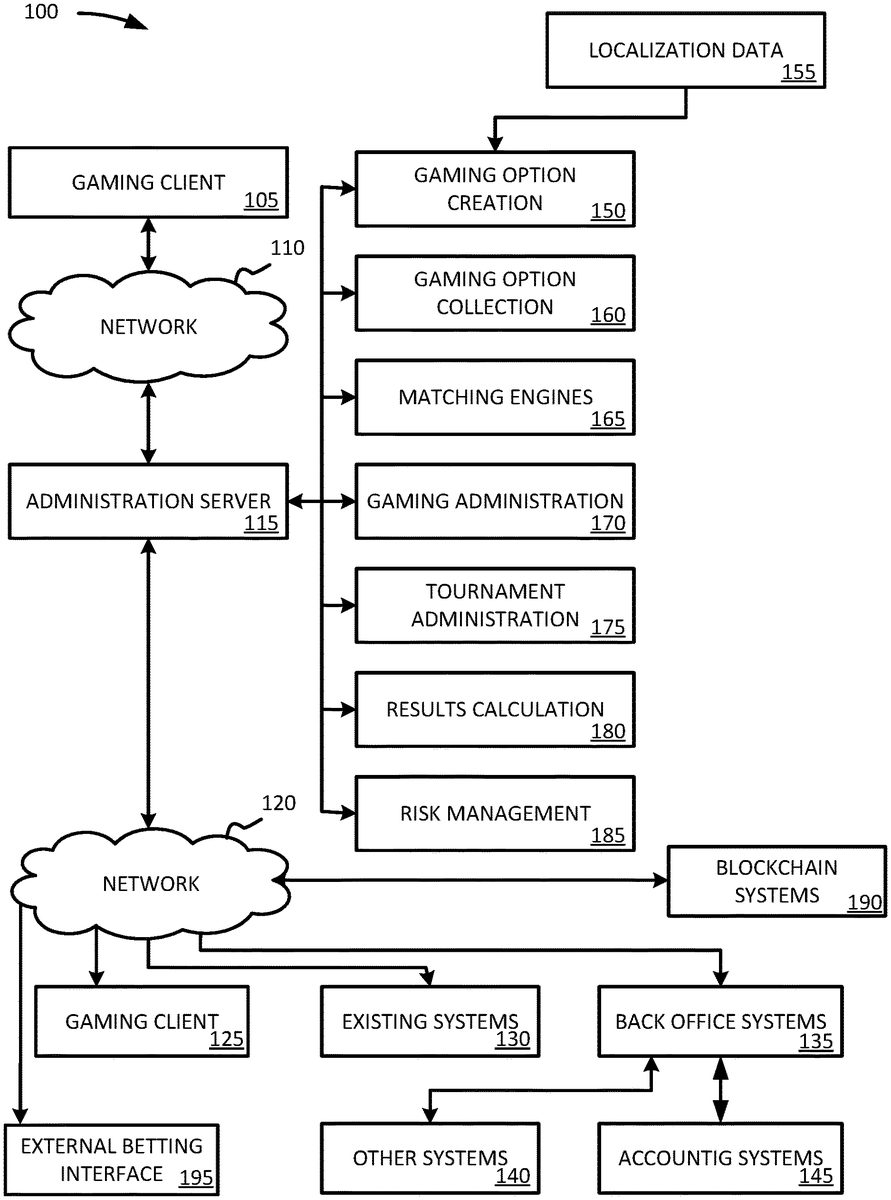
Referring now to the drawings and in particular to the network layout inFIG. 1, it illustrates an embodiment of a high-level network architecture of some embodiments of the present technology. The arrangement illustrated inFIG. 1is a logical arrangement and not meant to be an actual hardware design. Thus, the components can be combined or further separated in an actual implementation. As shown in the embodiments illustrated inFIG. 1, the network architecture can include one or more gaming clients105, network110, administration server115, network120, gaming server125, existing system130, back office systems135, other systems140, accounting system145, gaming option creation module150, localization data module155, gaming option collection module160, matching engine165, game administration module170, tournament administration module175, results calculation module180, risk management module185, blockchain system190, and/or external betting interface195.
As illustrated inFIG. 1, gaming client105and administration server115are connected over network110. Gaming client105represents the hardware and included software that is used by individual users, or players, who want to participate in various gaming sessions including various interactive gaming and peer-to-peer skill-based gaming session. For example, according to various embodiments of the present technology, a player could be provided, or use, a variety of clients such as touch screen kiosks, palmtops, PDAs, wireless tablets, smart phones, smart televisions, game top boxes, slot/video machines and/or other devices. In one embodiment, gaming client105can be a custom-built end-user interface that utilizes currently deployed equipment on the casino floor such as wireless handheld devices, kiosks, interactive TVs, smart phones, tables, laptops, or other electronic devices.
The interface of gaming client105can be customizable for visual consistency with an existing framework. For example, the interface could be adapted to run on an existing slot machine, video-based gambling machine, wireless device (e.g., laptop, smart phone, tablet, wearable, etc.) or other electronic devices. In one embodiment of the present technology, slot machine games can be run on gaming client105during certain periods of time, while allowing interactive or peer-to-peer gaming on the client at other periods of time. These periods may be set by a casino so that the available games change automatically during set time periods. In some embodiments, which games are available for play may be selected based on game selection criteria. For example, in some embodiments, the casino may make a deal with a game provider or other third-party to always have at least two gaming clients available for playing a particular game or group of games. As such, as players use the dedicated gaming terminals for that game the offering of other gaming clients may be changed so that the minimum available offerings are present.
For example, the types of games presented may be selected or customized based on various themes (e.g., sports themes, holiday themes, birthday themes, celebrations, etc.). For example, during the men's basketball NCAA final four championships, more games may be presented that have a basketball theme. As another example, the games presented may be selected based on teams or schools that are participating in a sporting event on a particular weekend or day. Such customizations of games can apply to both the cabinet games being presented within the casino as well as mobile games that are available to players gambling on a mobile device.
In yet another embodiment, gaming client105could offer peer-to-peer gaming options, different slot machine type options and various other games for consumer choice. In some embodiments, players may be tracked (e.g., via room card, mobile device, etc.). Various analytics can be used to create custom profiles of the players. The profiles can be used to dynamically present customized gaming options on player terminals as the players engage or are in proximity. For example, the player may enter a room key or other rewards card or code. In other embodiments, the player's phone may be able to communicate with player terminals or signs located on the casino floor. In response to the identification of the player different gaming options may be listed, customized, or presented first. In this way, casinos, hotels and similar establishments would be able to provide a high level of flexibility in gaming options, while simplifying the hardware and software infrastructure. Other options, variations and modifications are possible.
InFIG. 1, gaming client105is shown connected to the administration server115via a network110. In one embodiment, network110could be a Local Area Network (LAN) limited to a single casino, hotel, or other establishment. In another embodiment, network110could comprise a Wide Area Network (WAN) linking numerous casinos within a gaming jurisdiction (e.g., the state of Nevada or an Indian Reservation). In yet another example, a LAN could be used to connect various casinos spaced relatively close together, such as in Las Vegas. Gaming client105and administration server115may be connected to network110through communications interfaces. This interface could be a network interface that is suited for network110. The features and functions of this network will depend on where and how the system is implemented. Those skilled in the art will realize various modifications and variations consistent with the present technology.
In one embodiment, administration server115could be located in the same location as gaming client105. In another embodiment, administration server115could be located in a remote location. In yet another embodiment, administration server115could be located in a central location with gaming client105at another location. The type of connection between the server and client, whether wireless or wired, on an Ethernet, etc., will vary depending on the implementation of the system. Those skilled in the art will be aware of many modifications and variations allowed by the present technology.
InFIG. 1, administration server115may also be connected to a variety of other systems such as, but not limited to, existing systems130, back office systems135, and gaming server125via network120. Network120may be the same or different than network110. Existing Systems130may include current casino gaming systems or payout systems. Back Office Systems135may include Accounting Systems145or Other Systems140. Gaming Server125may contain multiple games that can be downloaded or run by gaming client105. Note that gaming server125could be one server or a set of servers. Any of existing systems130, back office systems135, or gaming server125could be housed in one machine or across a number of machines. Those skilled in the art will be aware of many modification and variations allowed by the present technology.
There are many ways that the player could play a game on gaming client105. In one exemplary embodiment, a game would be deployed on a client using an HTTP/web server and a web browser client. The HTTP/web server could communicate with the administration Server115and the server would serve/distribute the interface to each client using any available browser/client-side technologies like but not limited to: HTML, JavaScript, DHTML, AJAX, Flash, Shockwave, Java, Active X, Silverlight, or VBscript. In some embodiments, a customized client/server model could be used, where administration server115communicates to a server based application (an EXE and/or DLL, etc. . . . ), which would then communicate to a customized user-interface application (an EXE, etc) In yet another example, a server-side application could be produced that would contain both the server-side functionality and the client side functionality, but then also provide client side interaction by emulating/replicating the client side interface out on to the gaming client105. In some embodiments, gaming client105will not actually produce the interface. Rather, the client would present a series of images/interfaces that were transferred from administration server115. This method's process is similar to a traditional terminal/emulator client-server application. In all of these cases, the player may receive a unique and customized interface.
The multitude of game distribution methods are required to be able to serve the varying types of games and their methods of game play and interaction. In one embodiment, gaming client105will include a universal controller (not shown) that allows the player to play various types of games using the same controller. In another embodiment, each type of gaming client105will have its own type of game controller options available. Gaming client105could further be identified by the user of gaming client105. For example, administration server115may know gaming client105as a player gaming client or as a competitor gaming client. This list is not exhaustive and those skilled in the art will be aware of many modifications and variations allowed by the present technology.
Administration Server115is an open and flexible gaming platform that can be used for real money wagering in legal gaming jurisdictions like Nevada and Indian reservations. Similar to the Windows operating system, which can act as a base platform and accept and run many different types of applications, an open and flexible gaming platform can act as a base platform for skill-based, and chance-based, games created by various game developers (e.g., card game developers, skill-based game developers, chance-based game developers, etc.). The server can also be dynamically adjusted for localization requirements such as language, currency and legal issues.
As illustrated inFIG. 1, administration server115can include, or be communicably coupled to, a number of modules, such as: gaming option creation150, gaming option collection160, matching engine165, game administration170, tournament administration175, results calculation180, and risk management185. Gaming option creation module150can take information from localization data module155to determine which games are available on administration server115. The localization data can be provided as a packet that includes a variety of information, such as, but not limited to a device ID, player ID, a series of one or more location estimates (e.g., location estimate1, location estimate2, etc.), time stamp, confidence level, and the like. For example, in accordance with various embodiments, the location of the player may be determined using one or more location estimation techniques such as, but not limited to, IP address location estimation, geo-fencing, reports from a player terminal (e.g., where the location was identified using GPS), and/or other techniques. In some embodiments, manual check-ins by the player, video surveillance with facial recognition software, and information from other systems may also be incorporated into the location estimation.
Gaming option collection module160can collect a selection of gaming options. Matching engine module165can match players on the system. Game administration module170can oversee game play. Tournament administration module175can keep track of multiple games in a tournament. Tournament administration module175can keep track of winners in multiple games to showcase, display, or otherwise depict a scoreboard or leaderboard showing players and current scores or winnings in the current competition. Results calculation module180can calculate results from games and how to distribute winnings. Risk management module185can allow the system to adjust game play based on specific risk factors (e.g., latency, connection quality, speed of mobile processors, hardware configurations, skill level of players, dollar amounts being bet, security protocols, VPN speeds, detection of bots, robots or automated play, etc.). The server could consist of a single server or multiple servers. In some embodiments, gaming client105can communicate with the administration server115and gaming server125throughout the entire game play. Those skilled in the art will realize that many physical variations could be made to the number of devices used to create administration server115.
After the game, paying winnings to the player can be done in a number of ways. Referring again toFIG. 1, a player could receive currency at an embodiment of gaming client105. Additionally, a player could receive a “Ticket-Out” that can be turned in for cash or tokens that can be exchanged for cash or for play at another client. In one embodiment, such as a car racing game, a player could have selected a betting option such as $1/second-won-by. In this embodiment, there could be a constant interaction between gaming server125and accounting systems145to record live payout information. For example, if a player is 5 seconds ahead, he or she could have a monitor showing a $5 lead. As the lead changes, the monitor reflecting the monetary bet could also change. In this embodiment, the game could stop if a player's lead reaches a certain predetermined value, or if accounting systems145determine that the player's account only has sufficient funds to cover the current total. Many variations and modifications to completion and payout will be required by various betting types and gaming options. Those skilled in the art will be aware of modifications the present technology to account for these situations.
Blockchain system190can be used to track player activity, rewards, bets payouts, and or other data. For example, some embodiments of the present technology allow for the creation, destruction, and/or merging of various virtual items (e.g., skins, crates, weapons, prizes, bins, paint jobs, digital items, virtual items, crypto collectables, non-fungible tokens (NFTs)). These virtual items may be created in a limited supply to increase demand within a marketplace or based on external sponsors who pay money for creation of limited virtual items. As such, as the items are created an entry is created in the blockchain system. The owner can be initially assigned to the system (or null) indicating that the gaming system can distribute the items per a set of rules (e.g., one award per day, random offer, etc.) which are part of, linked to, or referenced within the blockchain entry. Once ownership of the virtual item is transferred to the player a new blockchain is created indicating the change in ownership. Similarly, as the items are used, destroyed, combined with other virtual items, etc., blockchain system190can verify that the action is available or authorized and then create an updated or new entry within the blockchain ledger. Blockchain system190may also support cryptocurrencies (e.g., BITCOIN) for betting and receipt of winnings.
External betting interface195can support betting on the multi-player games currently going on. For example, external betting interface195can allow individuals other than the players to bet on the outcome of the game, the activity within the game (e.g., fastest lap, most kills, first to miss a shot, etc.), or other events. External betting interface195may require that these bets be small (e.g., $10 or less) or smaller than the amount bet by the players. In some embodiments, the touchscreens or physical interfaces for receiving the external bets may be part of the gaming client. In other embodiments, the external betting system may be supported on mobile clients that are in communication with external betting interface195. The collocated interfaces maybe valuable for attracting bets within a casino while ordinary players are participating, the roaming mobile interfaces may be useful for higher profile gaming (e.g., eSports or ranked players competing). External betting interface195may also support fantasy eSports betting, parimutual betting on registered players or teams, and the like.
For purposes of discussion, the present technology primarily uses examples of systems and methods for skill-based gaming and skill-based games. This is in no way intended as a limitation of the present technology to only skill-based games. In some embodiments, the system can support skill-based games as well as traditional card games or other chance-based games. Even though Poker, in the strictest sense, is not a skill-based game, there are many advantages for setting up the system to be able to run Poker in addition to skill-based games. For example, given that Poker and other card games are well known and accepted in legal gaming jurisdictions, it is beneficial (although not required) for the system to be capable of serving as a platform for Poker style games. Moreover, by presenting a similar setup and feel to the skill-based platform for skill-based and Poker style games, the system seems more familiar to players, making it easier to transition to skill-based gaming.
FIG. 2illustrates a set of components within, or associated with, administration server115according to one or more embodiments of the present technology. According to the embodiments shown inFIG. 2, administration server115can include memory205, one or more processors210, operating system215, player interface220, rules engine225, data collection230, gaming option creation module150, gaming option collection module160, matching engine165, game initiation module235, results calculation module180, payout determination module240, risk management module185, accounting module245, and graphical user interface (GUI) generation module250. Each of these modules can be embodied as special-purpose hardware (e.g., one or more ASICS, PLDs, FPGAs, or the like), or as programmable circuitry (e.g., one or more microprocessors, microcontrollers, or the like) appropriately programmed with software and/or firmware, or as a combination of special purpose hardware and programmable circuitry. These modules are described according to their function and could be grouped differently. As those skilled in the art understand, many of these functions could be combined together into one software module and similarly, many of these functions could be divided into several different software modules. Other embodiments of the present technology may include some, all, or none of these modules and components along with other modules, applications, and/or components. Still yet, some embodiments may incorporate two or more of these modules and components into a single module and/or associate a portion of the functionality of one or more of these modules with a different module. For example, in one embodiment, gaming option creation module150and gaming option collection module160can be combined into a single module for customizing gaming. The functional modules are discussed briefly with regard toFIG. 2and in more detail with regard to the subsequent flow charts.
Memory205can be any device, mechanism, or populated data structure used for storing information. In accordance with some embodiments of the present technology, memory405can encompass any type of, but is not limited to, volatile memory, nonvolatile memory and dynamic memory. For example, memory205can be random access memory, memory storage devices, optical memory devices, media magnetic media, floppy disks, magnetic tapes, hard drives, SDRAM, RDRAM, DDR RAM, erasable programmable read-only memories (EPROMs), electrically erasable programmable read-only memories (EEPROMs), compact disks, DVDs, and/or the like. In accordance with some embodiments, memory205may include one or more disk drives, flash drives, one or more databases, one or more tables, one or more files, local cache memories, processor cache memories, relational databases, flat databases, and/or the like. In addition, those of ordinary skill in the art will appreciate many additional devices and techniques for storing information which can be used as memory205.
Memory205may be used to store instructions for running one or more applications or modules on processor(s)210. For example, memory205could be used in one or more embodiments to house all or some of the instructions needed to execute the functionality of operating system215, player interface220, rules engine225, data collection230, gaming option creation module150, gaming option collection module160, matching engine165, game initiation module235, results calculation module180, payout determination module240, risk management module185, accounting module245, and/or GUI generation module250. Operating system215provides a software package that is capable of managing the hardware resources of administration server115. Operating system215can also provide common services for software applications running on processor(s)210.
Player interface module220can be an input-output controller and serve as the interface for the player to interact with the other modules. In some embodiments, player interface module220can also direct communication from other modules to the client. For example, the module could present, among other things, game options to the player and the game itself. Rules engine225, in accordance with some embodiments, can set forth various rules such as game selection timing, betting amounts, jurisdictional or location rules, and the like.
Data collection module230can collect various data about individual game player and the players. This data can be used to create player and gaming profiles, generate analytics, and as criteria for game presentation. In some embodiments, various machine learning techniques may be employed to identify gaming characteristics that attract certain players. Once identified, the gaming characteristics (e.g., color schemes, minimum betting amounts, types of games—arcade games, poker games, skill-based games, augmented reality games, virtual reality games etc.—location, etc.) can be dynamically changed on the player terminals within the casino.
Gaming option creation module150can be configured to create a list of the available game options. This module can use information about the location of the user, such as legal jurisdiction and casino location, to determine which game options are presented to the player. For example, in accordance with various embodiments, the location of the player may be determined based on IP addresses, geo-fencing, reports from a player terminal (e.g., where the location was identified using GPS), and/or other techniques. Player interface module220could access gaming option creation module150to present the player with a list of gaming options. For example, that list may include which games are available, such as Poker or 9-Ball, arcade games, card games, esport game, racing games, shooting games, board games, virtual reality games, augmented reality games, match 3, pinball, Tetris, Scrabble, 2 Dots, Angry Birds, and the like. The list may also include the wager amounts available for each game. This is not meant to be an exclusive list. A person having skill in the art will understand what other options would be appropriate.
Gaming option collection module160can be configured to collect a selection from the list of gaming options presented to the player. For example, gaming option collection module160could access player interface module220to receive which gaming options the player selected. This is just one embodiment of the present technology. Those skilled in the art will understand modifications and variations of the module consistent with the present technology.
Matching engine165can be configured to match players who wish to play a game together. It uses information obtained through the player interface module270to find players that are compatible. Matching is discussed later with respect to the subsequent flow charts.
Game initiation module280may be located outside of the embodiment shown inFIG. 2. If the game software is located outside the system, game initiation module280communicates information, including player information and player selected options, to the game software. The module also connects player interface module270with the game software. In the alternative, if the game software is located inside the system, game initiation module280can start a game. After a game has finished, or during game play, the module reports information about the game to the system. This information can be used later in calculating winnings and results.
Results calculation module180, can (e.g., at the end of a game) determine which objectives each player achieved. This module can use information received from game initiation module235in order to determine the game result. In some games, the result is simple, such as each hand of black jack. In other games, such as football, the result may be more complicated. In some embodiments, results calculation module180will receive the final result. In other embodiments, results calculations module180will have to calculate the winner based on received game information.
Payout determination module240can (e.g., after the end of a game) determine whether each player may have some winnings. The operator of the game usually deducts an administrative fee before paying out winnings. This module takes information from results calculation module180to determine each player's appropriate winnings. Winnings could be in many forms, including, but not limited to: points, credits, virtual currencies (e.g., skins, crates, etc.), cryptocurrencies, or hard currency. After determining the amount of winnings due to the player, the payout determination module240can initiates a payout to the player. Depending on the type of winnings, the module may communicate to different systems. For example, if the player is to receive hard currency, payout determination module240may initiate another system (not shown) to produce coins for the player. Results calculation module180and payout determination module240can work together to tabulate the results of a game or set of games and pay out any winnings due to a player.
Risk management module185can monitor player activity in order to prevent collusion or other prohibited or illegal behavior. For example, risk management module185may use account information in order to determine if some players are violating rules of the system. In one embodiment, risk management module185could monitor playing behaviors of users to detect possible collusion. In another embodiment, risk management module185could determine which gaming options are available to the player. For example, in Solitaire tournaments where all players are given the same starting board, the module could monitor to see if a certain group of players are consistently playing in the same Solitaire tournaments. Similarly, in car racing games for more than two players, the module could monitor to ensure that a certain group of players are not consistently competing in the same races in order to work together and reach an unfair advantage.
In another embodiment, risk management module185may eliminate a player if the module detects prohibited behavior. For example, after a game, the risk management module may eliminate a player before giving the player any winnings. In another example, the module may eliminate the player during the game. None of these options are exclusive and risk management module185consistent with the present technology could include all or none of these example functions and could include other functions as well. Many variations and modifications of the functions of this module depending on the type of game and types of bets would be known to those skilled in the art based on the present technology.
Accounting module245can manage all bets, funds transfers and other accounting functions. The module could take care of debiting and crediting a player's account. In an embodiment of the present technology, even receipt of funds from the player to start a game could be monitored by the Accounting module245. In yet another embodiment, payout determination module240may direct the accounting module245to credit the player's account.
GUI generation module250can generate one or more GUI screens that allow for interaction with a user or administrator. In at least one embodiment, GUI generation module250can generate a graphical user interface allowing a user to set preferences, review reports (e.g., from risk management module185or accounting module245), author custom reports, set device constraints, and/or otherwise receive or convey information about various gaming activity to the user. The examples provided herein are exemplary only. The explanation of these modules and their uses are merely indicative. A person skilled in the art will recognize additional variations and embodiments.
FIG. 3illustrates examples of user-interface screens consistent with one or more embodiments of the present technology. In the embodiments illustrated inFIG. 3, a player could select both the game and stakes at the same time. If a player wants to play 9-Ball, he or she could select that game and the stakes he or she wanted to play at ($1 or $5). The screens shown inFIG. 3could be separate screens or a player could be provided with numerous different games all within a specific betting range. Additional variations and embodiments would be realized by one of skill in the art.
FIG. 4illustrates another example of a representation of software modules that could be used by and with a peer-to-peer platform consistent with some embodiments of the present technology.FIG. 4represents a functional combination and not intended to be an actual network design. The figure shows a different combination of the functional modules described inFIGS. 1 and 2. Again, this embodiment is not intended to be limiting, but rather is intended to further explain an embodiment of the technology.
Note that the embodiments displayed inFIGS. 1, 2 and 4are different embodiments of the present technology. Those having skill in the art will understand possible variations of the technology beyond these embodiments.
Overview of System
InFIG. 5, a flow chart represents broadly one method by which the present technology can conduct a game for a player. First, the system presents a player with a list of player gaming options1100. Once the player has made a selection from the list of player gaming options, the system collects that selection1200. The system then matches the player with a competitor1300and collects a bet from the player1400. Next, the system initiates a game based on the selection of player gaming options1500. Finally, after the game has completed, the system compensates the player1600. It is not necessary that the steps run in this specific order. The steps may run out of order or be run in a loop. Additionally, the set of steps may run in a loop inside the larger method. Finally, this listing of steps is not exhaustive. Another embodiment consistent with the present technology may have a more steps or less steps. Those having skill in the art will understand possible variations of the technology beyond these embodiments.
Gaming Options
Gaming options are the parameters for a game. The system uses the gaming options to initiate the game for the player. For example, gaming options may include: a game type, such as Poker, 9-Ball, chess, or a football arcade game; a bet amount for a particular game type, such as $5 or 10 points; a specific competitor to play against, where the competitor may be identified in many ways, including but not limited to: console location, account name, nick name, or record; or even a preset game, complete with bet and game type, such as a game of chess with a $5 jackpot. This is not meant to be an exhaustive list. A person having skill in the art will understand what other gaming options are consistent with the present technology.
In one embodiment, a set of gaming options presented to a player could be referred to as Player Gaming Options, whereas a set of gaming options presented a competitor could be referred to as Competitor Gaming Options. These references are not limiting. Those skilled in the art will understand how to refer to different sets of gaming options.
Before presenting a player with gaming options, the system determines which gaming options are available to the player. Referring toFIG. 11, the system could first create a list of legal gaming options in the player's location1020. The list of legal gaming options might include limits on wagers or types of games allowed, such as a $100 per hand limit on poker or a prohibition on any game except slots. For example, if the jurisdiction does not allow real-money gambling (i.e., a zero dollar per hand limit), the game may allow the player to use virtual currency, cryptocurrency, virtual goods (e.g., skins, crates, etc.). The system then could remove any gaming options that are not available on the system1030. Some operators of the system may wish to establish a minimum or maximum betting amount or may or may not have a license for certain games such as a Football game. If the system is not authorized to offer a type of game, then the player will not be able to select that type of game as a gaming option. Once the system has determined the list of available gaming options, it presents the player with the list of player gaming options1100.
While determining gaming options, the system may manage risk by modifying the available gaming options based on the possibility for a player acting illegally or in a prohibited way. The system may determine that a number of players are sitting near each other and will limit the ability to play a collaborative game among those players. Further, the system may keep records of past players based on data entered by a player, such as account information or other identifying features, such as a frequent player card, a scanned driver's license, or a scanned credit card. This list of entered data is not exhaustive. Those skilled in the art will understand how to receive identifying information about a player. For example, referring toFIG. 12, the system could first collect past players and games played by past players1060. It then could determine whether a group of players play games together regularly1070. If a group does play together regularly, the system can adjust the available gaming options1080. Finally, the system will present the player with a modified list of player gaming options1100.
Gaming Option Selection
After a player is presented with a list of gaming options, the player selects from the list of gaming options to start a game. The steps by which a player selects from the list of gaming options can be varied. The options herein described are merely exemplary; there are other orders in which a player can be presented with, and select from, a list of gaming options.
In an embodiment, a player could first select the player's preferred game type and then be presented with a list of competitors who are also interested in playing that game type. In another embodiment, a player could select a general category, such as a Sports Type Video Game category, and be presented with a list of competitors who are interested in that category of game types. After selecting the game type or game category, a player may be provided the opportunity to challenge another individual player in a heads up one-on-one (peer-to-peer) match where the competitive environment is a skill-based game. The game could be anything from Solitaire to Chess to Football.
In yet another embodiment, a player could select to play a series of games. For example, if a player considered himself or herself well-rounded in many different games, that player could challenge a competitor to a best two out of three where each game is a different skill-based game. A player could also play a best two out of three using the same skill-based game. In yet another embodiment, instead of a series type competition (best two out of three, best three out of five, etc.) the competition could be based on a total number of points between a multiple game competition. For example, if players are playing Pong, each player could agree that the player with the highest point total after two events (rather than just one) is the winner. Many alternatives consistent with the present technology will be realized by those skilled in the art. Variations on how to group players (such as by skill level or experience or participation in an ongoing tournament) could also be used.
In yet another embodiment, the system could provide a player with the ability to play the computer in a game of the player's choice (for a fee, or for free) while the player waits for competitors willing to compete.
In addition to the game and competitor, gaming option selection could include betting ranges. Betting ranges could be pre-selected options by the system, in which case, a player will select a betting range. In the alternative, a player could be allowed to select his or her acceptable betting ranges. The betting ranges may also be determined by external factors, such as house stakes and local laws.
It is not necessary for a player to pick every possible gaming option for each game. In certain embodiments, a player may only pick one gaming option.
Matching
In order to participate in a peer-to-peer competitive game, a player needs a game to play and a competitor. Referring again toFIG. 5, the system could select a betting range before presenting the player with a list of player gaming options1100, or the player could select a betting range when the system collects the selection of player gaming options1200. For example, a player could first select a betting range and then be presented with a list of competitors in that betting range. In another example, a player could select a game to play, then a betting range, and then be presented with a list of competitors willing to play the same game for similar amounts. Those skilled in the art will realize many variations to the order of the steps consistent with the present technology.
In one embodiment, referring toFIG. 8, after collecting the selection of player gaming options1200, the system could collect at least one selection of competitor gaming options1310. The system would then match the player and competitor based on their respective gaming options1320before collecting a bet from the player1400and initiating a game based on the selected gaming options1500. The system would match the player and the competitor if their selections were compatible. In one embodiment, a player's and at least one competitor's selections would be compatible if their selections were identical. In another embodiment, a player and at least one competitor would be compatible if their selection of gaming options were closely related. In yet another embodiment, the system would create a list of compatible competitors. The list of compatible competitors would include all of the at least one competitors that are compatible with the player. Those skilled in the art will understand the many variations of matching players with competitors consistent with the present technology.
In an embodiment where players are allowed to select their own acceptable betting ranges, the system would automatically determine what players have betting ranges that overlap so that players are given a list of player gaming options that include options to play competitors who are willing to play for an acceptable amount.
In another embodiment, a player could select a betting range before selecting a game and/or competitor. For example, a player who is willing to risk less could select a lower betting range such as $5-$50 so they know he or she will find competitors willing to play for lower amounts. Conversely, a player who is only interested in playing for larger amounts could select a higher betting range such as $200-500. The betting ranges presented here are exemplary only. One skilled in the art will realize that betting ranges could vary and a betting range could be single value rather than a range of values (e.g., players willing to bet $10, players willing to bet $20, etc.).
Negotiation
The present technology can also allow a player and competitor to negotiate with each other, through the system, to determine how much to bet before playing. The bet could be of any value including a points style bet or a financial bet (e.g., money bet). In some embodiments, a player and competitor will negotiate the bet before playing the game. This may be facilitated through communication channels (e.g., video chat, chat room, instant messaging, etc.) hosted by the gaming system. In some embodiments, player profiles and rankings may be presented to each other. A history of game play between the players may be presented showing historical win rates, last game played, and the like.
In one embodiment, represented inFIG. 9, a player is presented with a list of competitors1150. After the system collects the player's selection of a competitor1250, the system initiates contact between the player and the selected competitor1350. Once contact is initiated, the player and competitor can negotiate selected gaming options (not shown). This negotiation may fail and the player can restart the process. If the player and competitor come to an agreement, the system collects the selected player gaming options1200. Finally, the system collects a bet from the player1400and initiates a game based on the selection of player gaming options1500. For example, in such an embodiment, the system could present a new player with competitors waiting for a game. This presentation may include chatting (e.g., video chat, text-based chat, etc.) capability such that individuals can stir up competition. In addition, it may provide a list of competitors such that a returning player can locate familiar names and challenge those individuals. Similarly, as shown inFIG. 3, the system could provide a list of competitors with varying ranks and experience and allow a player to challenge a given competitor. In addition, two players who have been competing in one type of skill-based game (such as a sports type video game) could decide to keep competing against each other but in a different skill-based game (such as a more intellectual type game such as Chess or a different type of video game).
In another embodiment, a player could negotiate the wager they wish to compete for. In some embodiments, a player would negotiate the money they wish to compete for. In other embodiments, a player could negotiate for points or some other non-monetary value. In this embodiment, the interface will allow a player and competitors to communicate back and forth until they come to an acceptable bet. A player could be limited to betting within the original range they selected, or could be given the ability to negotiate for any amount.
In yet another embodiment, a player could negotiate the amount of points they wish to compete for. This could be used in, among other things, a tournament style of play where all players are originally assigned an equal number of points and the last player standing, or the player with the most points after a certain amount of time, wins. Many points styled tournaments or competitions could be imagined by those skilled in the art consistent with the present technology.
Funds Receipt
Once the bet has been determined, the agreed upon bet can either be deducted from the players account (this includes either points from a points account or money from a cash account), or money can be deposited into a “Cash In” device as the form of payment for the game. In addition, in some embodiments, the “Cash In” device could accept tickets from “Ticket Out” devices that could have been turned into cash. In another embodiment, the device could accept tokens. Still yet, the device may accept credit cards or electronic payment methods such as, but not limited to, electronic transfers, electronic wallets, electronic accounts, near-field communications, cryptocurrencies, bitcoins, etc. The ability to use the “Cash In” device allows for individuals to play the system without having to register or set up an account. Alternatively, by registering or setting up an account, players would have greater flexibility in using the system. Incentives, such as frequent player bonuses, could be established to help promote registration and player loyalty. In addition, registration may be required for certain types of tournaments or games, such as to prevent collusion or in order to track payouts for tax purposes or other legal issues.
Referring again toFIG. 5, in one embodiment, the system collects a bet from a player1400before initiating a game1500. This is not meant to be limiting. The system may collect funds at a different point in the process. The system may also work off of an account, as discussed above. Those skilled in the art will realize many variations to the order of the steps and methods consistent with the present technology.
Game Play
The methods in which a game can be rendered to a player via a user interface device can be accomplished in many different ways. Referring toFIG. 7, the system transfers player identification and at least the game type to the gaming server1510. Then the system connects the player gaming client and gaming server1520so that the player can play the game (not shown). As the game is running or once the game is complete, the system collects results from the gaming server1530. This information will be used to determine results and any possible winnings. Player identification could be the player's account, identification of the console that the player is operating, or other identifying information. This list of possible player identifications is not exhaustive. Those skilled in the art will understand variations of player identification consistent with the present technology.
In another embodiment not shown, the system also transfers competitor identification to the gaming server. The system then connects the competitor gaming client to the gaming server. The types of competitor identification would be the same as player identification.
In another embodiment not shown, the system includes a module to run the game. The gaming client is initially connected to the system during option selection and the system initiates the game by running the game itself. In this way, there is no communication with an external gaming server.
Completion and Payout
Now referring toFIG. 6, to compensate the player, the system first determines which objectives the player achieved in the game1610. Then it determines which objectives any competitors achieved in the game1620. The system then calculates any winnings for the player1630based on objectives achieved and other information, including but not limited to: the rules of the game, location-based restrictions on payouts (e.g., real-money allowed, limits on real-money payouts, virtual currency allowed, only virtual currencies such as skins, bins, and crates, etc.) and any selected gaming options. Once the amount of winnings is calculated, the system initiates payment1640. In order to effect payment, the system may compensate a player with tokens, a “Ticket-Out,” real money, cryptocurrency, game item (e.g., skin, crate, containers, etc.) or crediting the player's account. In some embodiments, the payout may be through an electronic payment system to a user account (e.g., virtual currency account, bank account, casino account, cryptocurrency account, etc.). This example is but one embodiment of the present technology. Those skilled in the art will understand the modifications and variations possible to completing and compensating a player.
In some embodiments of the present technology, the player is compensated an amount of the player's winnings less an administrative fee. This fee may be masked so that the player does not ever see the total player winnings so that the player does not know that the winnings are reduced by the administrative fee. This fee could be given to the operator of the game, the business where the game is located, the licensee of the game, the licensor of the system, or another person. This list is not meant to be exhaustive. Those skilled in the art will understand other persons to whom an administrative fee will be paid.
Multi-Player Skill-Based Tournaments
The present technology also includes systems and methods to conduct Skill-based Tournaments. Referring toFIG. 1, the Tournament Administration module175oversees these tournaments. While those skilled in the art will realize many variations and modifications consistent with the present technology, for purposes of description exemplary Skill-based Tournaments are described herein.
A tournament style of play provides players the opportunity to play the games without having to challenge other players to a match and negotiate a fee. Tournament style of play additionally allows for an added dynamic of a “Many vs. Many” environment, which provides many additional options for payouts and Tournament types.
In one exemplary embodiment, players could select tournament play and be presented with a list of available tournaments, such as the following:
IDGAMEPLAYERSBET2032Pool6 out of 9$0.502390Pool9 out of 9$5.002798Pool1 out of 9$1.002109Car Racing8 out of 9$10.002249Car Racing2 out of 9$100.00. . .
From here, a tournament player, such as Player1, can join any “Table” that is not full of players. For example, Player1could pick either “Table” ID2109or2249in order to play the Car Racing game. In this embodiment, the Car Racing game could be a video type game that looks like a standard car racing video game. In this example, ID2109has nine (9) “seats” at an entry fee of $10 per player with eight (8) players already seated and ready to play. Alternatively, if Player1wants to play for a higher fee he or she could select ID2249at $100 a player.
If Player1selects ID2109, Player1will be “seated” for the competition and Player1′saccount will be deducted by $10.00. Alternatively, Player1could be asked to deposit $10 using the “Cash In” device. Various rules could be used to determine when the precondition for the start of the tournament has been met. In some embodiments, the tournament could begin once nine players are seated. In other embodiments, the tournament could begin at a predetermined time as long at least two (2), or perhaps more, players are seated. Various rules and variations consistent with the present technology could be used. While the collection of funds from a player could be performed at various points in the process, in one or more embodiments, a player can only hold a seat in the tournament with a complete entry fee.
Once funds have been collected from all players and the precondition for beginning the tournament has been met, the players will be allowed to compete in the “Game” of multiplayer Car Racing. For this embodiment, all nine (9) players in the tournament could be actively competing against each other in an interactive Skill-based gaming environment. Upon completion of the Car Racing game, the winning player or players would receive their winnings. The winnings could be determined by various methods. For example, after the house takes a cut of the pot, a set percentage could be paid to the first place winner, second place player, etc. This could be as simple as the house taking 5%, the second place player receiving back his or her stake, and the first place winner receiving the remainder. Those skilled in the art will realize numerous modifications consistent with the present technology.
After the game finishes, all players could be given the opportunity to start a new multiplayer Car Racing game or to select a different game or the same game but under different conditions. In one embodiment, a rematch process could go on continuously as long as there are a minimum of two (2) players at a “Table” and both players have enough money in their account or with them such that they can enter it into the “Cash In” device. The “Table” can be a virtual table where the players are located at a console, video gaming machine, handheld device, cellphone, laptop, or other electronic device. The “Table” may also be a physical device or table in some embodiments.
Numerous tournament types could be implemented on the system in the present technology. In some embodiments, the tournament activity may be recorded in a blockchain system (e.g., blockchain system190inFIG. 1) that may be public, private, or a hybrid blockchain system. Exemplary tournaments are described herein.
Delayed Tournaments
In one embodiment, players are offered an opportunity to play in tournaments where players play a skill-based game, but not in a heads up one-on-one fashion, but as a single player trying to get the best score possible.
Delayed tournaments are tournaments in which all participants need to play the game within a validity period. In one embodiment, the tournament could be limited to a fixed number of players. In another embodiment, the tournament could have no limit on the number of players but could require a certain minimum number of players to have played during a defined time period.
Referring now toFIG. 10, this figure demonstrates an exemplary method for a delayed tournament. First, a validity period for the delayed tournament is selected1040. For example, in one embodiment, a Delayed Tournament requires that five (5) players play a game within a 24 hour period from noon of one day to noon of the following day. The tournament requires an entry fee and the game is Pool. Adam, Brian, Chris and David are the first four (4) players to enter the tournament, pay the entry fee and post a score. Each of the four (4) players plays the game in “single player” mode. Each player is presented with the exact same Pool game. The Tournament starts at 1 pm and Adam finishes his game at 1:10 pm, Brian finishes his game at 2:30 pm, Chris at 3:43 pm and David at 2:00 am the next day.
The delayed tournament is not finished yet because this tournament needs five (5) total players. The system presents a player with a set of valid gaming options1160. So at 9:30 am, the system presents Eric with a Delayed Tournament that needs one more player. Then, the system collects Eric's selection of the tournament1200, and the system collects his $2 entry fee1400. The system then initiates a game for Eric1500. When he finishes the game, the tournament is complete, and the winners account is paid right away1660.
In one embodiment, if no fifth (5th) player joined the game before the 24 hour time limit had elapsed, then all of the players would be refunded their money. In another embodiment, if no fifth (5th) player joined the game, the tournament would simply close and pay out according to the first four (4) players.
This delayed method of tournament game play allows the ability to provide skill-based game play without the need of readily available players to compete against at a specific time. Additionally, this tournament type allows for a defined and concise structure that allow for a varying selection of game options, end times, participants and a layer of strategy when picking tournaments to play.
Players can sit down at a machine, play their game, post a score and check their account later to see if they won or lost that tournament, all on their own schedule. In addition, in one embodiment, rather than using an account, players could still use the “Cash In” and “Ticket Out” device. For example, if a player does not set up an account they could receive a ticket that identifies the player as a specific participant in the tournament. That ticket can then be used to check the tournament status, and once the tournament is complete the ticket can have a monetary value depending on the outcome.
Jackpot Tournaments
This type of tournament is just a modification of a Delayed Tournament. In a Jackpot Tournament, there is no limit to how many players can play in the tournament, each player adds to the Jackpot, and when the tournament ends, the player with the best score is appointed the winner. Additionally, if there are enough players in a Jackpot tournament, other players could be awarded winnings.
In one embodiment, a player can enter Jackpot Tournaments as many times as he or she wants, paying the entry fee each time. In some embodiments, these types of tournaments many only allow a best score to qualify for winnings. In other embodiments, players would be permitted to collect winnings for multiple scores. Those skilled in the art will appreciate and understand modifications and variations consistent with the present technology.
Client Device
FIG. 13illustrates an example of various components that may be used within a client device (e.g., a player terminal such as a gaming cabinet or a mobile device) in accordance with some embodiments of the present technology. As shown inFIG. 13, client device105may include memory1302(e.g., volatile memory and/or nonvolatile memory), processor(s)1304, power supply1306(e.g., battery), for executing processing instructions, and operating system1308. Additional components may include data storage component1310(e.g., hard drive, flash memory, memory card, etc.), one or more network interfaces (e.g., Bluetooth® Interface1312; and Network Communication Interface1314, which enables the player terminal to communicate by transmitting and receiving wireless signals using licensed, semi-licensed or unlicensed spectrums over a telecommunications network), audio interface1316, microphone1318, display1320, keypad or keyboard1322, SIM card1324, other input and/or output interfaces1326, and gaming module1328. The various components of a mobile device may be interconnected via a bus.
Memory1302can be any device, mechanism, or populated data structure used for storing information. In accordance with some embodiments of the present technology, memory1302can encompass any type of, but is not limited to, volatile memory, nonvolatile memory and dynamic memory. For example, memory1302can be random access memory, memory storage devices, optical memory devices, media magnetic media, floppy disks, magnetic tapes, hard drives, SDRAM, RDRAM, DDR RAM, erasable programmable read-only memories (EPROMs), electrically erasable programmable read-only memories (EEPROMs), compact disks, DVDs, and/or the like. In accordance with some embodiments, memory1302may include one or more disk drives, flash drives, one or more databases, one or more tables, one or more files, local cache memories, processor cache memories, relational databases, flat databases, and/or the like. In addition, those of ordinary skill in the art will appreciate many additional devices and techniques for storing information which can be used as memory1302.
Memory1302may be used to store instructions for running one or more applications or modules on processor(s)1304. For example, memory1302could be used in one or more embodiments to house all or some of the instructions needed to execute the functionality of the various system components and/or modules. Processor(s)1304are the main processors of player terminal122which may include application processors, baseband processors, various coprocessors, and other dedicated processors for operating player terminal122. For example, an application processor can provide the processing power to support software applications, memory management, graphics processing, and multimedia. An application processor may be communicably coupled with memory1302and configured to run the operating system1308, the user interface, and the applications stored on memory1302or data storage component1310. A baseband processor may be configured to perform signal processing and implement/manage real-time radio transmission operations of a player terminal (e.g., a mobile device). These processors, along with the other components, may be powered by power supply1306. The volatile and nonvolatile memories found in various embodiments may include storage media for storing information such as processor-readable instructions, data structures, program modules, or other data. Some examples of information that may be stored include basic input/output systems (BIOS), operating systems, and applications.
Operating system1308can also provide common services for software applications running on processor(s)1304. According to the embodiments shown inFIG. 13, gaming module1328can include identification module1330, policy enforcement module1332, virtual reality (VR) module1334, wagering module1336, team module1338, and state recordation module1340. Each of these modules can be embodied as special-purpose hardware (e.g., one or more ASICS, PLDs, FPGAs, or the like), or as programmable circuitry (e.g., one or more microprocessors, microcontrollers, or the like) appropriately programmed with software and/or firmware, or as a combination of special purpose hardware and programmable circuitry. Other embodiments of the present technology may include some, all, or none of these modules and components along with other modules, applications, and/or components. Still yet, some embodiments may incorporate two or more of these modules and components into a single module and/or associate a portion of the functionality of one or more of these modules with a different module. For example, in one embodiment, identification module1330and policy enforcement module1332can be combined into a single module for identifying and enforcing various policies on a player terminal.
Identification module1330can be used to gather information about the player terminal, current and/or past gaming sessions, player information, specific hardware and software configurations of the player terminal, GPS coordinates, associated telephone numbers, IP addresses, e-mail addresses, user identifiers, international mobile station equipment identity (IMEI), mobile equipment identifiers (MEID), integrated circuit card identifiers (ICCID), part identifiers, software identifiers, current gaming session identifiers, identification of any nearby player terminals, and the like. This information can be used in a variety of ways, including by policy enforcement module1332which can set customized gaming restriction policies that can, in some embodiments, be dynamically set (e.g., based on location, current gaming session, etc.).
VR module1334can be used to allow a variety of virtual reality experiences as part of the game play. Wagering module1336can be used to can be used to accept, track and process bets placed by the players. Team module1338can be used to track and communicate with players that have organized into teams for competition purposes.
State recordation module1340can be used to capture the state of the gaming session. This can include a variety of game states including, but not limited to, wager, payout levels, skill level settings, and others. The state of the gaming session can be repeatedly captured so that in the event of a communication failure, terminal fault, or other issue that would prevent the gaming session from being completed a record of the current state can be reconstructed. For example, in some embodiments, the state may be captured at least every second. In other embodiments, the state may be captured more or less quickly depending on game dynamics. The state captured by state recordation module1340may also be used (possibly with state information from other player terminals of the same gaming session) by a collusion avoidance module to determine if any collusion is occurring. In some embodiments, the state information captured by state recordation module1340can be used to generate various gaming analytics. In some embodiments, the host computer (or gaming platform) may capture the snapshots of the state information directly.
State recordation module1340may store the state information in database for regulatory compliance, analytics, or other purpose. For example, in some embodiments, all the game play within a period of time (e.g., a five year period, a two year period, a year, a month, a week, a day, etc.) could be recorded and stored in the database. In other embodiments, a limited number of gaming sessions could be recorded (e.g., last one hundred, last thirty, etc.). Still yet, some embodiments of state recordation module1340may only record (or record for longer period of time) games that have betting above a set threshold (e.g., $500, $1000, etc.).
The state information recorded by state recordation module may be a direct copy of the game play or only information sufficient to reproduce the game play. For example, in some embodiments, the state information may include various gaming parameters (e.g., ammo amounts, number of lives, level, etc.), gaming session identifier, date and time the interactive gaming session is opened or terminated, the date and time the interactive gaming session is logged in to or is logged out of by various player terminals, the physical location, by state or foreign jurisdiction, of the authorized player while logged in to the interactive gaming account, and/or other types of information.
In some embodiments, the player terminals can provide for social media, chatting and other communication channels. For example, some embodiments, may have interfaces that allow for third party access through another gateway like Facebook® or other social media. Some embodiments of the player terminals may allow for picture in picture or multiple screens. For example, players may be able to play an interactive game via one screen or video channel and in the second screen or video channel being displayed in the picture in picture (PIP) thereby allowing players to play more than one at a time. The additional screens or video channel, for example, could be used to watch sports, fantasy sports betting, ordering drinks or food, and the like. In some embodiments, additional screens may be present to present various promotions such as ticket sells for shows, restaurant deals, future room bookings, room upgrades, and the like.
Some embodiments of the player terminals may also include external video outputs that allow for display of the game by others. For example, in various tournament play (e.g., eSports), the external video outputs may allow others to watch the game play. In various embodiments, the player terminals may support virtual reality interfaces, hologram generation systems, and other visualizations system for the gaming. The player terminals, in some embodiments, can include various sensors to detect gestures that can be interpreted as controls for betting, controlling gaming action, ordering drinks, etc. In addition, some player terminals may have voice recognition software which can be used as a technique to identify player locations. Some embodiments may also be able to mimic voices of different people (e.g., famous people, friends, etc.) that can be used as the computer voice while the player is playing or interacting with a player terminal.
Exemplary Computer System Overview
Aspects and implementations of the interactive gaming system of the disclosure have been described in the general context of various steps and operations. A variety of these steps and operations may be performed by hardware components or may be embodied in computer-executable instructions, which may be used to cause a general-purpose or special-purpose processor (e.g., in a computer, server, cloud-based gaming platform or other computing device) programmed with the instructions to perform the steps or operations. For example, the steps or operations may be performed by a combination of hardware, software, and/or firmware.
FIG. 14is a block diagram illustrating an example machine representing the computer systemization of the gaming system. The gaming controller1400may be in communication with entities including one or more users1425client/terminal devices1420(e.g., devices122), user input devices1405, peripheral devices1410, optional co-processor device(s) (e.g., cryptographic processor devices)1415, and networks1430(e.g.,110and120inFIG. 1). Users may engage with the gaming controller1400via terminal devices1420over networks1430. In some embodiments, all or a portion of the communications between terminal devices1420and gaming controller1400can be encrypted. The law requires cryptography for some things.
Computers may employ central processing units (CPUs) or processors to process information. Processors may include programmable general-purpose or special-purpose microprocessors, programmable controllers, application-specific integrated circuits (ASICs), programmable logic devices (PLDs), embedded components, a combination of such devices and the like. Processors execute program components in response to user and/or system-generated requests. One or more of these components may be implemented in software, hardware or both hardware and software. Processors pass instructions (e.g., operational and data instructions) to enable various operations.
The gaming controller1400may include clock1465, CPU1470, memory such as read only memory (ROM)1485and random access memory (RAM)1480and co-processor1475among others. These controller components may be connected to a system bus1460, and through the system bus1460to an interface bus1435. Further, user input devices1405, peripheral devices1410, co-processor devices1415, and the like, may be connected through the interface bus1435to the system bus1460. The interface bus1435may be connected to a number of interface adapters such as processor interface1440, input output interfaces (I/O)1445, network interfaces1450, storage interfaces1455, and the like.
Processor interface1440may facilitate communication between co-processor devices1415and co-processor1475. In one implementation, processor interface1440may expedite encryption and decryption of requests or data. Input output interfaces (I/O)1445facilitate communication between user input devices1405, peripheral devices1410, co-processor devices1415, and/or the like and components of gaming controller1400using protocols such as those for handling audio, data, video interface, wireless transceivers, or the like (e.g., Bluetooth®, IEEE 1494a-b, serial, universal serial bus (USB), Digital Visual Interface (DVI), 802.11a/b/g/n/x, cellular, etc.). Network interfaces1450may be in communication with the network1430. Through the network1430, gaming controller1400may be accessible to remote terminal devices1420(e.g., gaming client105illustrated inFIG. 1). Network interfaces1450may use various wired and wireless connection protocols such as, direct connect, Ethernet, wireless connection such as IEEE 802.11a-x, miracast and the like. Some components of the interactive gaming system may include various protocols or comply with various standards or certifications set forth by different associations or regulatory agencies. For example, some embodiments may use the slot accounting system (SAS) protocol or comply with the game to system (G2S) standard.
Examples of network1430include the Internet, Local Area Network (LAN), Metropolitan Area Network (MAN), a Wide Area Network (WAN), wireless network (e.g., using Wireless Application Protocol WAP), a secured custom connection, and the like. The network interfaces1450can include a firewall which can, in some aspects, govern and/or manage permission to access/proxy data in a computer network, and track varying levels of trust between different machines and/or applications. The firewall can be any number of modules having any combination of hardware and/or software components able to enforce a predetermined set of access rights between a particular set of machines and applications, machines and machines, and/or applications and applications, for example, to regulate the flow of traffic and resource sharing between these varying entities. The firewall may additionally manage and/or have access to an access control list which details permissions including, for example, the access and operation rights of an object by an individual, a machine, and/or an application, and the circumstances under which the permission rights stand. Other network security functions performed or included in the functions of the firewall, can be, for example, but are not limited to, intrusion-prevention, intrusion detection, next-generation firewall, personal firewall, etc., without deviating from the novel art of this disclosure.
Storage interfaces1455may be in communication with a number of storage devices such as, storage devices1490, removable disc devices, and the like. The storage interfaces1455may use various connection protocols such as Serial Advanced Technology Attachment (SATA), IEEE 1494, Ethernet, Fiber, Universal Serial Bus (USB), and the like.
User input devices1405and peripheral devices1410may be connected to I/O interface1445and potentially other interfaces, buses and/or components. User input devices1405may include card readers, finger print readers, joysticks, keyboards, microphones, mouse, remote controls, retina readers, touch screens, sensors, and/or the like. Peripheral devices1410may include antenna, audio devices (e.g., microphone, speakers, etc.), cameras, external processors, communication devices, radio frequency identifiers (RFIDs), scanners, printers, storage devices, transceivers, and/or the like. Co-processor devices1415may be connected to the controller1400through interface bus1435, and may include microcontrollers, processors, interfaces or other devices.
Computer executable instructions and data may be stored in memory (e.g., registers, cache memory, random access memory, flash, etc.) which is accessible by processors. These stored instruction codes (e.g., programs) may engage the processor components, motherboard and/or other system components to perform desired operations. The controller1400may employ various forms of memory including on-chip CPU memory (e.g., registers), RAM1480, ROM1485, and storage devices1490. Storage devices1490may employ any number of tangible, non-transitory storage devices or systems such as fixed or removable magnetic disk drive, an optical drive, solid state memory devices and other processor-readable storage media. Computer-executable instructions stored in the memory may include an interactive gaming platform having one or more program modules such as routines, programs, objects, components, data structures, and so on that perform particular tasks or implement particular abstract data types. For example, the memory may contain operating system (OS) component1495, modules and other components, database tables, and the like. These modules/components may be stored and accessed from the storage devices, including from external storage devices accessible through an interface bus1435.
The database components can store programs executed by the processor to process the stored data. The database components may be implemented in the form of a database that is relational, scalable and secure. Examples of such database include DB2, MySQL, Oracle, Sybase, and the like. Alternatively, the database may be implemented using various standard data-structures, such as an array, hash, list, stack, structured text file (e.g., XML), table, and/or the like. Such data-structures may be stored in memory and/or in structured files.
The gaming controller1400may be implemented in distributed computing environments, where tasks or modules are performed by remote processing devices, which are linked through a communications network, such as a Local Area Network (“LAN”), Wide Area Network (“WAN”), the Internet, and the like. In a distributed computing environment, program modules or subroutines may be located in both local and remote memory storage devices. Distributed computing may be employed to load balance and/or aggregate resources for processing. Alternatively, aspects of the gaming controller1400may be distributed electronically over the Internet or over other networks (including wireless networks). Those skilled in the relevant art(s) will recognize that portions of the interactive gaming system may reside on a server computer, while corresponding portions reside on a client computer. Data structures and transmission of data particular to aspects of the gaming controller1400are also encompassed within the scope of the disclosure.
CONCLUSION
Unless the context clearly requires otherwise, throughout the description and the claims, the words “comprise,” “comprising,” and the like are to be construed in an inclusive sense, as opposed to an exclusive or exhaustive sense; that is to say, in the sense of “including, but not limited to.” As used herein, the terms “connected,” “coupled,” or any variant thereof means any connection or coupling, either direct or indirect, between two or more elements; the coupling or connection between the elements can be physical, logical, or a combination thereof. Additionally, the words “herein,” “above,” “below,” and words of similar import, when used in this application, refer to this application as a whole and not to any particular portions of this application. Where the context permits, words in the above Detailed Description using the singular or plural number may also include the plural or singular number respectively. The word “or,” in reference to a list of two or more items, covers all of the following interpretations of the word: any of the items in the list, all of the items in the list, and any combination of the items in the list.
The above Detailed Description of examples of the technology is not intended to be exhaustive or to limit the technology to the precise form disclosed above. While specific examples for the technology are described above for illustrative purposes, various equivalent modifications are possible within the scope of the technology, as those skilled in the relevant art will recognize. For example, while processes or blocks are presented in a given order, alternative implementations may perform routines having steps, or employ systems having blocks, in a different order, and some processes or blocks may be deleted, moved, added, subdivided, combined, and/or modified to provide alternative or subcombinations. Each of these processes or blocks may be implemented in a variety of different ways. Also, while processes or blocks are at times shown as being performed in series, these processes or blocks may instead be performed or implemented in parallel, or may be performed at different times. Further, any specific numbers noted herein are only examples: alternative implementations may employ differing values or ranges.
Having described several embodiments, it will be recognized by those of skill in the art that various modifications, alternative constructions, and equivalents may be used without departing from the spirit of the technology. Additionally, a number of well-known processes and elements have not been described in order to avoid unnecessarily obscuring the present technology. Accordingly, the above description should not be taken as limiting the scope of the technology, which is defined in the following claims.
The teachings of the technology provided herein can be applied to other systems, not necessarily the system described above. The elements and acts of the various examples described above can be combined to provide further implementations of the technology. Some alternative implementations of the technology may include not only additional elements to those implementations noted above, but also may include fewer elements.
These and other changes can be made to the technology in light of the above Detailed Description. While the above description describes certain examples of the technology, and describes the best mode contemplated, no matter how detailed the above appears in text, the technology can be practiced in many ways. Details of the system may vary considerably in its specific implementation, while still being encompassed by the technology disclosed herein. As noted above, particular terminology used when describing certain features or aspects of the technology should not be taken to imply that the terminology is being redefined herein to be restricted to any specific characteristics, features, or aspects of the technology with which that terminology is associated. In general, the terms used in the following claims should not be construed to limit the technology to the specific examples disclosed in the specification, unless the above Detailed Description section explicitly defines such terms. Accordingly, the actual scope of the technology encompasses not only the disclosed examples, but also all equivalent ways of practicing or implementing the technology under the claims.
To reduce the number of claims, certain aspects of the technology are presented below in certain claim forms, but the applicant contemplates the various aspects of the technology in any number of claim forms. For example, while only one aspect of the technology is recited as a computer-readable medium claim, other aspects may likewise be embodied as a computer-readable medium claim, or in other forms, such as being embodied in a means-plus-function claim. Any claims intended to be treated under 35 U.S.C. § 112(f) will begin with the words “means for”, but use of the term “for” in any other context is not intended to invoke treatment under 35 U.S.C. § 112(f). Accordingly, the applicant reserves the right to pursue additional claims after filing this application to pursue such additional claim forms, in either this application or in a continuing application.
Claims
- A method in a computer for operating an electronic gaming system, the method comprising: communicating with a gaming client operable by a player for playing an electronic game;receiving a first signal from the gaming client encoding data representative of an identity of a player positioned at or near the gaming client;in response to receiving the first signal, accessing a memory storage device storing a custom profile for the player;causing a graphical user interface (GUI) to be generated on a display of the gaming client to enable interaction by the player with the electronic gaming system, wherein causing the GUI to be generated includes presenting customized gaming options to the player according to the custom profile for the player, the customized gaming options including a listing of at least one electronic game;receiving, via the GUI, a second signal from the gaming client encoding data representative of a selection of the electronic game;in response to receiving the second signal, initiating the electronic game for play by the player on the gaming client according to the customized gaming options;receiving at least a third signal from the gaming client encoding data representative of player characteristics ascertained during game play by the player in the electronic game;and in response to receiving the at least a third signal, updating the custom profile according to the player characteristics.
- The method of claim 1 further comprising determining a location of the gaming client.
- The method of claim 2 , wherein: the first signal further encodes data representative of the location of the gaming client;and determining the location of the gaming client comprises determining the location of the gaming client according to, and in response to receiving, the first signal.
- The method of claim 3 , wherein the data representative of the location of the gaming client includes at least one of: global positioning system (GPS) coordinates, an IP address, geo-fencing data, and a player reported location, of the gaming client.
- The method of claim 2 , wherein presenting customized gaming options to the player comprises presenting the customized gaming options to the player further according to the location of the gaming client.
- The method of claim 5 , wherein: determining the location of the gaming client comprises determining that the gaming client is located in a legal gambling jurisdiction;and in response to determining that the gaming client is located in a legal gambling jurisdiction, presenting the customized gaming options to the player including an electronic game involving real money wagering, or in response to determining that the gaming client is not located in a legal gambling jurisdiction, presenting the customized gaming options to the player not including the electronic game involving real money wagering.
- The method of claim 6 further comprising: further in response to determining that the gaming client is located in the legal gambling jurisdiction, presenting the customized gaming options to the player including the electronic involving real money wagering subject to a limit including at least one of: a wager amount, and a type of electronic game, according to the location of the gaming client.
- The method of claim 1 , wherein presenting customized gaming options to the player comprises presenting a first set of gaming options to the player on the display at least one of: prior to in time, and positioned above, a second set of gaming options on the display.
- The method of claim 1 , wherein: the customized gaming options further include one or more preferences for the at least one electronic game;and the second signal further encodes data representative of the one or more preferences.
- A system for hosting an electronic game, the system comprising: a memory storage device;a communications interface;a processor operably coupled to: the memory storage device, and the communications interface, the processor configured to execute program instructions to cause the system to: communicate, using the communications interface, with a gaming client operable by a player for playing an electronic game;receive, using the communications interface, a first signal from the gaming client encoding data representative of an identity of a player positioned at or near the gaming client;in response to the first signal being received, access the memory storage device storing a custom profile for the player;cause a graphical user interface (GUI) to be generated on a display of the gaming client to enable interaction by the player with the electronic gaming system, wherein to cause the GUI to be generated on the display, the processor is further configured to execute the program instructions to cause the system to present customized gaming options to the player according to the custom profile for the player, the customized gaming options including a listing of at least one electronic game;receive, using the communications interface and via the GUI, a second signal from the gaming client encoding data representative of a selection of the electronic game;in response to the second signal being received, initiate the electronic game for play by the player on the gaming client according to the customized gaming options;receive, using the communications interface, at least a third signal from the gaming client encoding data representative of player characteristics ascertained during game play by the player in the electronic game;and in response to the at least a third signal being received, update the custom profile according to the player characteristics.
- The system of claim 10 , wherein to receive the first signal from the gaming client, the processor is further configured to execute the program instructions to cause the system to receive the first signal relayed by the gaming client from a communication device carried by the player.
- The system of claim 10 , wherein the gaming client includes at least one of: a mobile device carried by the player, and a gaming device positioned in a gaming facility.
- The system of claim 10 , wherein to cause the GUI to be generated on the display, the processor is further configured to execute the program instructions to cause the system to customize at least one of: an appearance, and content, of the GUI according to the custom profile for the player.
- The system of claim 10 , wherein the electronic game is at least one of: a tournament racing game, an arcade game, a video game, a puzzle game, a word game, a trivia game, a virtual reality game, an augmented reality game, or a card game.
- The system of claim 10 , wherein the processor is further configured to execute the program instructions to cause the system to: monitor a location of the gaming client;and update the listing of at least one electronic game based on a jurisdictional authorization for the location.
- The system of claim 10 , wherein: the customized gaming options further include one or more preferences for the at least one electronic game;and the second signal further encodes data representative of the one or more preferences.
- A non-transitory computer readable medium having program instructions stored thereon which, which when executed by a machine in an electronic gaming system, cause the machine to: communicate with a gaming client operable by a player for playing an electronic game;receive a first signal from the gaming client encoding data representative of an identity of a player positioned at or near the gaming client;in response to the first signal being received, access a memory storage device storing a custom profile for the player;cause a graphical user interface (GUI) to be generated on a display of the gaming client to enable interaction by the player with the electronic gaming system, wherein to cause the GUI to be generated on the display, the processor is further configured to execute the program instructions to cause the system to present customized gaming options to the player according to the custom profile for the player, the customized gaming options including a listing of at least one electronic game;receive, via the GUI, a second signal from the gaming client encoding data representative of a selection of the electronic game;in response to the second signal being received, initiate the electronic game for play by the player on the gaming client according to the customized gaming options;receive at least a third signal from the gaming client encoding data representative of player characteristics ascertained during game play by the player in the electronic game;and in response to the at least a third signal being received, update the custom profile according to the player characteristics.
- The non-transitory computer readable medium of claim 17 , wherein, when executed by the machine to receive the first signal from the gaming client, the program instructions further cause the machine to receive the first signal relayed by the gaming client from a communication device carried by the player.
- The non-transitory computer readable medium of claim 17 , wherein the gaming client includes at least one of: a mobile device carried by the player, and a gaming device positioned in a gaming facility.
- The non-transitory computer readable medium of claim 17 , wherein, when executed by the machine to cause the GUI to be generated on the display on the gaming client, the program instructions further cause the machine to customize at least one of: an appearance, and content, of the GUI according to the custom profile for the player.
- The non-transitory computer readable medium of claim 17 , wherein the electronic game is at least one of: a tournament racing game, an arcade game, a video game, a puzzle game, a word game, a trivia game, a virtual reality game, an augmented reality game, or a card game.
- The non-transitory computer readable medium of claim 17 , wherein, when executed by the machine, the program instructions further cause the machine to: monitor a location of the gaming client;and update the listing of at least one electronic game based on a jurisdictional authorization for the location.
- The non-transitory computer readable medium of claim 17 , wherein: the customized gaming options further include one or more preferences for the at least one electronic game;and the second signal further encodes data representative of the one or more preferences.
Disclaimer: Data collected from the USPTO and may be malformed, incomplete, and/or otherwise inaccurate.