U.S. Pat. No. 11,270,549
APPARATUS AND METHODS FOR MONITORING AND FILTERING PLAYER INPUTS MADE IN A VIDEO GAMING SYSTEM
AssigneeEveri Games, Inc.
Issue DateJanuary 22, 2020
Illustrative Figure
Abstract
A method includes receiving game command input signals on a game controller signal input path to a gaming device and splitting the game command input signals from the game controller signal input path onto a signal monitoring path. Game command data representing the game command input signals from the monitoring path are stored and used in evaluating two or more game control aspects associated with the game command data to produce a respective automation indicator for each game control aspect. The respective automation probabilities for each game control aspect are combined to produce an overall automation indicator value. A participation status of the player may then be modified in response to a characteristic of the overall automation indicator value.
Description
DESCRIPTION OF REPRESENTATIVE EMBODIMENTS Referring toFIG. 1, an example gaming machine101is configured to allow two players to play a video game against each other and/or against players competing through other gaming machines of a video gaming system. To accommodate two players, example gaming machine101includes dual player button decks103and105located on a button deck support107so that the players may position themselves either sitting or standing to face the display screen109of the gaming machine. Display screen109is illustrated showing an interactive competition game with game characters (also referred to as “avatars”)111and113. Each player button deck103and105includes controls that enable a respective player to provide player inputs in the course of the game such as to control their respective character's movements, attacks, defenses, and perhaps other actions or activity in the course of the game so as to accumulate points or otherwise compete in the game. One or more jacks115may be provided in addition to player button deck103and one or more jacks117may be provided in addition to player button deck105. These jacks115and117may be positioned on the front edge of button deck support107, under that support, or at any other convenient location, and may comprise universal I/O connectors or gaming platform-specific connectors. Jacks115and117enable each player to connect a game controller device (e.g. game controller317shown inFIGS. 3 and 4) and use the game controller device to provide player inputs to the game. FIG. 2shows an alternative gaming machine201, similar to gaming machine101, but placing player button decks203and205in a more central location of button deck support207. Gaming machine201includes display screen209shown in this example as displaying game characters211and213. Jacks (not shown) may also be included in gaming machine201corresponding to jacks115and117shown in the example ofFIG. 1. Although both gaming machines101and201include dual button panels to facilitate two-player gaming at the gaming machine, both gaming machines may be configured to allow only a ...
DESCRIPTION OF REPRESENTATIVE EMBODIMENTS
Referring toFIG. 1, an example gaming machine101is configured to allow two players to play a video game against each other and/or against players competing through other gaming machines of a video gaming system. To accommodate two players, example gaming machine101includes dual player button decks103and105located on a button deck support107so that the players may position themselves either sitting or standing to face the display screen109of the gaming machine. Display screen109is illustrated showing an interactive competition game with game characters (also referred to as “avatars”)111and113. Each player button deck103and105includes controls that enable a respective player to provide player inputs in the course of the game such as to control their respective character's movements, attacks, defenses, and perhaps other actions or activity in the course of the game so as to accumulate points or otherwise compete in the game. One or more jacks115may be provided in addition to player button deck103and one or more jacks117may be provided in addition to player button deck105. These jacks115and117may be positioned on the front edge of button deck support107, under that support, or at any other convenient location, and may comprise universal I/O connectors or gaming platform-specific connectors. Jacks115and117enable each player to connect a game controller device (e.g. game controller317shown inFIGS. 3 and 4) and use the game controller device to provide player inputs to the game.
FIG. 2shows an alternative gaming machine201, similar to gaming machine101, but placing player button decks203and205in a more central location of button deck support207. Gaming machine201includes display screen209shown in this example as displaying game characters211and213. Jacks (not shown) may also be included in gaming machine201corresponding to jacks115and117shown in the example ofFIG. 1. Although both gaming machines101and201include dual button panels to facilitate two-player gaming at the gaming machine, both gaming machines may be configured to allow only a single player to play games through the respective gaming machine. Of course, other gaming machine embodiments according to the various aspects of the present invention may be configured only for single-player play at that gaming machine or for more than two players.
As will be discussed in more detail below, the games available through the example gaming machines101and201may be games that are played through popular video gaming systems such as the various generation XBOX® platforms and the various generation PLAYSTATION® platforms. The example characters111,113,211, and213are game characters from the STREET FIGHTER® game series which includes titles for the XBOX® and PLAYSTATION® platforms, and well as for PC. In order to facilitate play through these popular video game systems, gaming machines101and201include at least one gaming console for one of these systems. For example, gaming machine101may house an XBOX ONE® console. It is also possible that a gaming machine such as gaming machine101houses multiple different video gaming system consoles to accommodate player preferences. Controls shown for gaming machines101and201, such as at least some of the buttons included in button panels103and105inFIG. 1, and the devices which may be connected to jacks115and117inFIG. 1, may be controls which provide inputs to the one or more video gaming system consoles included in the gaming machine. Regardless of the gaming device or gaming devices included in the gaming machine, some aspects of the present invention facilitate wagering on various results that may be obtained in these games. Other aspects of the present invention facilitate control of games conducted through these video gaming systems to allow extra-platform control of tournaments (that is, control from outside of the platform).
FIG. 3illustrates an example e-sports gaming system301configurable to provide one or more competitive games which may support tournament play and wagering in accordance with one or more embodiments. E-sports gaming system301includes one or more e-sports gaming machines101connected to e-sports system server303through a suitable network304which may comprise any suitable wired and/or wireless network. E-sports gaming machines101are also connected to an e-sports system game controller (which may be referred to as a “virtual game controller”)321which is illustrated in this example system301as having a communication path319separate from the network304. The nature of the communications to and from e-sports gaming machine101will be described further below particularly in connection withFIG. 4.
E-sports gaming system301further includes a wagering backend server223, a wager account server325, Internet server322, video streaming server324, display manager306, and additional gaming devices326. These additional devices are preferably interconnected in network304.
E-sports gaming machines101are also each connected to one or more game controllers317and to the display manager306. The connection between each game controller317and the respective e-sports gaming machine101may be through a respective jack associated with the e-sports gaming machine such as jacks115and117shown inFIG. 1. As discussed in connection withFIG. 1above, the game controllers which allow a player to make game control player inputs in the course of a video game conducted through the e-sports gaming machine101may also be integrated into the e-sports gaming machine and may comprise the control panels103and105as shown inFIG. 1. The connection to display manager306may be any suitable connection for communicating a video signal output from gaming machine101to display manager306. For example, the connection between a given gaming machine101and display manager may comprise an HDMI, VGA, or some other connection through which a video signal (or data from which a video signal may be generated) may be communicated. Display manager306may direct the video signal in the appropriate format to displays305to allow patrons to watch e-sports games in real time and to watch replays and recasts of e-sports games.
FIG. 3also shows that e-sports gaming system301may communicate with external devices such as a remote wagering device327or a remote gaming site328which may itself include numerous wagering devices.FIG. 3shows these external devices and systems connected over the Internet, however, any communications link may be employed to support the communications described further below, particularly in connection with the flowchart ofFIG. 5.
E-sports system301supports the play of e-sports games particularly through popular video gaming systems and facilitates wagering on various results that may occur in these games. For example, a player may login to a video gaming system supported at e-sports gaming machine101and play a game on that platform. The play may be competitive against one or more other players or may be against an AI (game—controlled character) supported by the game. In other types of games the player or players may traverse an obstacle course or track and compete to produce the best score determined by any suitable metric or combination of metrics. The player may also enter wagers on various results that may occur in the game such as point totals, times (in clocked racing games for example), either at the completion of a game or at some point within the course of a game. System users other than the player may also wager on one or more results that may occur in the game, and these results may or may not be the same results on which a video game player places a wager. The results on which wagers may be placed will be discussed further below in connection withFIGS. 5-8. The other user may be a player also participating in the same game through another gaming machine101or through any other gaming device with connectivity to the network supported by the video gaming system, or may be a spectator with respect to the video game played through e-sports gaming machine101such as a user at another gaming machine which supports e-sports wagers or a local wagering device326inFIG. 3, or a remote wagering device such as device327or a device at a remote gaming site such as site328.
E-sports system server303may function in system301to set up, initiate, and monitor, games played on e-sports gaming machines101. E-sports system server303may also (in cooperation with wagering backend server323and wager account server325) determine and award payouts for wager-determinant conditions detected in the games played on the e-sports gaming machines. Although system301may allow players to select players against which they compete in a given game conducted through e-sports gaming machines101, and may allow manual set up and initiation of games, embodiments of the system may facilitate e-sports tournaments that are set up and initiated by or through e-sports system server303functioning alone or with other elements in the system as a tournament processing device. For e-sports tournaments conducted through system301, a player may sign up or enroll for a tournament through a player enrollment device310where a player may input player information, such as by sliding a player card, driver's license or other readable ID card or by using a keypad to enter requested information, and pay a fee, if required. Such a player enrollment device may be attended by a casino employee, or may be an unattended, self-service device. The player enrollment device functions may also be implemented in a gaming machine101, additional gaming machine326, or at a remote device or system such as remote wagering device327or a device at remote gaming site328. Regardless of how and where the player information is entered, the information is transmitted to the e-sports system server303. An operator of e-sports system301may organize one or more tournaments for simultaneous processing by tournament system server303and organize the enrolled players according to the tournaments that the players have been signed up to play. Players may be called to play a given round of a tournament at selected times or they may be able to play on a first come first serve basis depending upon the tournament. At selected times, e-sports system server303may transmit selected player information to selected e-sports gaming machines101to be displayed on respective display screens109or other display screens associated with the gaming machines101to identify one or more competitors, such as two competitors for a two-person gaming machine101, at the respective gaming machines101. E-sports system server303may also transmit one or more instructions to each participating gaming machine101to select the particular tournament game to be played and initiate play at the participating gaming machine101. These communications to select a particular tournament game and initiate play, or any other communications that must be executed by the video gaming device included in the gaming machine, may be performed through e-sports virtual game controller321as will be described further below. The player information may also be displayed on selected external displays305to enable spectators and bettors to see who is competing and what the game is to be played. Processes for setting up and controlling tournaments through e-sports system server303will be described in further detail below in connection with the flow diagram ofFIG. 9. Where e-sports system server303administers e-sports tournaments, it may also maintain tournament player scores and rankings in the fashion disclosed in incorporated U.S. Pat. No. 9,443,394. Current rankings in tournaments may be communicated to display controller320for controlling one or more displays330to display leaderboard information such as current leaders. Display controller320may also cause video of the e-sports game players to be displayed at leaderboard displays330similarly to the player video displayed as described in U.S. Pat. No. 9,443,394.
Wagering backend server323functions in system301to provide probabilities for various results which may happen in games played through the system. In particular, wagering backend server323may provide predictive analytics based on past activity of game play to determine the probability of results happening in a game played through system301and on which a wager may be placed. In some cases result probabilities provided by wagering backend server may not be based on past game play or may be based only partially on past game play, and may be generated in some other suitable fashion.
Wager account server325inFIG. 3functions to support user accounts for facilitating wagering activity. Generally, a user wishing to place wagers in e-sports system301will establish an account maintained by wager account server325, and will have some value (either monetary value or conceivably non-monetary value such as player points) in the account. Wagering accounts may be opened and maintained in any suitable way. For example, users may be allowed to open and fund an account remotely through an Internet web page or through a tournament enrollment device310. E-sports gaming machines101, and other gaming machines such as gaming machine326, may also include features to allow a user to fund a wagering account maintained through wager account server325. Some implementations of system301may also allow wager funding on a wager-by-wager basis through a user's credit or debit card and/or through some other credit or funding mechanism. Wagers placed in the system301may be deducted from the user's account maintained through account server325, and any winnings may be credited to that account.
Additional gaming devices326may comprise and gaming machines providing reel-type or other wagering games. These additional gaming machines may or may not allow play in e-sports games, but may allow wagers placed on e-sports games conducted by players on gaming machines101. Gaming machine326may display an e-sports competition on one or more of the displays associated with that gaming machine while the player at that machine plays a standard wagering game such as a video card game or a reel-type game, for example. The player at a gaming machine326may be enabled to bet on any result in the displayed e-sports game conducted through gaming machine101, such as the winner or loser of the e-sports game or the number of points scored by one or more competitors in the e-sports game, or some other final or interim result for which wagering is supported through the wagering backend server323.
Remote wagering device327may comprise any suitable device through which wagers may be placed on e-sports games conducted through gaming machines101. For example,327may be a smart phone, tablet, laptop, or PC running an application that enables a user to view a wagering screen and place bets on results in e-sports games played through gaming machines101or through a gaming machine101and one or more other gaming devices on the given video gaming system (that is, gaming devices which may or may not be included in a gaming machine101or in system301). Alternatively, remote wagering device327may comprise a wagering kiosk that provides a wagering interface through which a user may place bets on results in e-sports games played through gaming machines101or through a gaming machine101and one or more other gaming devices. Remote wagering device327may also receive and display streaming video of e-sports games monitored through e-sports gaming system301.
Remote gaming site328may comprise a casino or other wagering facility having e-sports wagering kiosks or e-sports wagering-enabled gaming machines such as gaming machine326. Displays at remote gaming site328(which may include displays associated with e-sports wagering-enabled gaming machines and other devices at the remote gaming site), may display e-sports games which are monitored through system301to allow the remote users to follow the action in the e-sports games, particularly those on which the users have placed wagers. Remote gaming site328may also include gaming machines such as gaming machines101through which e-sports games are played.
Video streaming server324is included in system301to provide video streams of e-sports games that are monitored by the system and on which wagers may be placed according to aspects of the present invention. In some embodiments, video streaming server324may receive data representing any or all video signals received at display manager306, and may convert those signals to a format suitable for streaming through Internet server322.
It should be noted that the block diagram ofFIG. 3separates components according to their function in system301, and is not intended to imply that the functions must be performed through separate physical devices. For example, a single processing device may be programmed or otherwise configured to perform the functions of the e-sports system sever303and virtual game controller321. Similarly, the functions of wagering backend server323and wager account server325may be performed on a single processing device such as a server with sufficient capacity. The invention is not limited to any particular arrangement of processing devices to perform the various functions provided in e-sports gaming system301.
Referring now to the block diagram ofFIG. 4, gaming machine101includes a gaming device (a game console or any other type of gaming device)409that is operatively connected to button panels103and105, and to external game controllers317through jacks115and117. Gaming device409is also operatively connected to provide a video output to a video signal splitter407which splits the signal into multiple streams. These multiple streams of the video signal output from gaming device409are directed in this illustrated embodiment to display109of the gaming machine, and also to a gaming machine processor408which serves as an image evaluation processor as will be described below in connection withFIGS. 5-8. The video output signal from gaming device409is also directed to display manager306(FIG. 3) so that the video may be displayed as desired on displays305and also converted to a streaming format for display at remote devices. Gaming device409may comprise an XBOX®, PLAYSTATION®, or other gaming console or system (such as a PC) and is operable to present a game for one or more players and to communicate with the applicable gaming system through network connection411. It is noted that network connection is a separate connection in this embodiment since gaming device409will generally have its own onboard network interface device (not shown). Also, network connection411may be to network304or a separate local area network that provides Internet access to device409. Local inputs during the play of a game through gaming device409may be provided by players through integrated player controls103and105, or through game controllers317which may be connected via jacks115and117. Other inputs, particularly inputs for setting up a game in a tournament, may be provided through input path319which connected to the virtual controller321shown inFIG. 3. All of the input routes are through a switch415which may be controlled through virtual controller321as will be described below in connection withFIG. 9. The example e-sports gaming machine101shown inFIG. 4further includes an input monitor412interposed together with an input filter413between gaming device409and switch415. As will be described further below in connection withFIGS. 11 and 12, input monitor412is operable to monitor inputs during the course of play in a game to detect prohibited play such as automated play which could provide a player with an unfair advantage in a game. Input filter413is included to block certain prohibited inputs in the course of game play such as a “pause” command that might otherwise be available for gaming device409. Further details of example button filters will be described below in connection withFIGS. 13 and 14.
FIG. 4also shows that gaming machine101includes a player interface418. Player interface418is illustrated here as being connected to processor408and functions to allow a player at gaming machine101to interact with system301separately from game play through gaming device409. For example, player interface418may allow the player to place wagers on their own and other e-sports games. In some embodiments player interface418may include a currency acceptor, credit card, or player card reader, and controls such as physical or virtual (touchscreen-implemented) buttons. These elements allow the player to enter or insert value into the gaming system301which may be tracked, for example, by wager account server325inFIG. 3, and may further allow the player at the gaming machine to select both the type of result for a wager and also the wager amount. Player interface418in this example embodiment communicates across network304through network interface410included in gaming machine101.
Although the example e-sports tournament gaming machine101is shown as having a single display device109controlled by gaming device409, other implementations may have an additional display controlled by suitable processor (such as processor408in the example ofFIG. 4). This second display may be controlled by the processor and other elements in the system (such as e-sports system server303) to display real-time leader board information including current relative positions of participants in tournament play within the second display area and may further be configured to display at least one of the player video feeds together with an individual result of play in a tournament game.
There is wide variation possible in e-sports gaming machines within the scope of the present invention. In addition to e-sports tournament components described above in connection withFIG. 4, the e-sports tournament gaming machines such as gaming machine101may optionally include conventional gaming components, such as printers and bill acceptors, operable to provide traditional wagering games. The e-sports gaming machines may also be automatically convertible between in-revenue and out-of-revenue operating modes through instructions transmitted by e-sports system server303or a separate tournament server. Additionally the e-sports tournament gaming machines101may include video cameras connected to provide live video feed to one or more external displays such as displays330inFIG. 3, such as during tournament play when live video feed of the players and the player tournament positions may be driven in real-time to the external displays. More detailed descriptions of the in-revenue and out-of-revenue gaming machine configurations and automation together with a tournament server is more fully described in U.S. Pat. No. 9,443,394 filed Jun. 24, 2013, and entitled “Convertible In-Revenue and Out-of-Revenue Gaming System and Method with a Real-Time Streaming Video Feed and Display” which is incorporated by reference.
FIG. 5illustrates a method according to one aspect of the invention. In particular the method shown inFIG. 5illustrates how a video signal from a video game is processed to resolve a wager on a result in the video game. The method includes receiving a wager for a result in the game as shown at process block501. The method also includes receiving a video signal for the game as shown at process block503. The process then goes through a series of steps shown within dashed box504which represent an image evaluation process which ultimately detects a result in the video game so that the wager received at process block501may be resolved. If the result is detected as indicated by an affirmative outcome at decision box510, the process includes producing an output identifying the detected result as indicated at process block512and communicating that output to a process shown in dashed box520for resolving the wager placed at501. This output is received as indicated at process block514and the payout, if any, for the wager is identified at process block515. Any payout awarded as indicated at process block518.
In the context of the example gaming system301shown inFIG. 3, and gaming machine shown inFIG. 4, the steps shown in dashed box504plus the step shown at process block512are steps that may be performed by the processor408inFIG. 4serving as an image evaluation processing system. The steps shown in dashed box520are steps that may be performed by e-sports system server303shown inFIG. 3in cooperation with wagering backend server323and wager account server325.
The wager received at process block501may be received from a gaming machine such as gaming machine101involved in the e-sports game or may be received from any other wagering device configured to place a wager for the video game e-sport contest. For example, the wager may be placed through a remote wagering device such as a device327shown inFIG. 3or at a kiosk or other wagering device at a remote gaming site328inFIG. 3. Also, the wager received for the game at process block501inFIG. 5could be received from an additional gaming machine such as one of the additional gaming machines326shown inFIG. 3. Regardless of from where and specifically how the wager is received, the wager has the effect of setting the result to be detected by the evaluation shown in dashed box504inFIG. 5. For example, a patron may place a wager that a given contestant, either a character in the game or a player controlling a character in the game, will win a given match in the video game representing an e-sport contest. In that case a state in the game from which the result can be detected is a state in which the video game generates an image showing one of the contestants as the winner for that contest. As another example, a patron may place a wager that a given contestant, again either a game character or a player controlling a given character in the contest, will be the first to lose a “life” in the course of an e-sport match. In this example the state in the game from which the result can be detected is the state in which the video game first generates an image showing that a character has lost a life in the contest. This latter example is an example of a result which is an interim result in the game, while the former example is an example where the result to be detected may a final result in the game. Given the connection between the wager received at process block501and the result to be detected (and the video game state which shows the result to be detected) which is the subject of the evaluation process shown in dashed box504, it will be appreciated that the process steps shown inFIG. 5are conducted for each wager received for the game and that these processes are conducted in parallel by the data processing systems which perform the various processing steps. That is, for a given e-sport contest each wager which defines a result to be detected generates an instance of the process shown inFIG. 5.
In the context of the example system and e-sports gaming machine shown inFIGS. 3 and 4, the video signal received as shown at process block503inFIG. 5is received by processor408from splitter407which splits the video output from the gaming device409. The video signal may be in any form which may be output from the gaming device such as HDMI and VGA for example. Regardless of the specific video format, and as is well known in the art, the video signal comprises a stream of data defining a series of image frames which are displayed sequentially on a display device (such as device109inFIGS. 1 and 4) in order to produce the desired video image on the display device. The display device shows the series of frames rapidly at a suitable frame rate to produce a desired smoothness of motion for the video. Each frame in the series of frames making up the video signal received at process block503inFIG. 5is made up of a series of pixels with each pixel defining the light to be produced in the display device a particular point in two dimensions across the display screen.
The evaluation process shown in dashed box504includes sampling a video frame from the video signal as indicated at process block505. The sampling step may include simply storing the data representing a frame from the sequence of video frames in suitable storage of the implementing processing device, processor408in the example ofFIG. 4. The illustrated method inFIG. 5also includes converting the video frame data to pixel data according to a predefined standard as shown at process block506. This conversion may, for example, produce a set of pixel data that represents a two dimensional array of pixels stored in any suitable data format. The evaluation process then includes searching the pixel data of the frame output from process block506for a result characteristic corresponding to the result to be detected in the game. This searching process is shown at process block507inFIG. 5and may be performed by any suitable technique, including by comparing the pixel data from process block506to a set of stored data (which may be referred to as “result image definition data”) which defines an image or portion thereof expected to be displayed for the result to be detected. Such a comparison performed at process block507is conducted to determine if there is a match between the pixel data produced according to process block506and the stored result image definition data for the result to be detected (the result set by the wager received at process block501). For example, assume that the wager received for the game at process block501is a wager that player A will ultimately win a given video game contest against player B. This wager sets the wager result to be detected as the state of the video game in which one of the players or their avatar/game character is shown as the winner of the contest. In this case the stored data for a comparison to the pixel data from process block506(where a data comparison technique is used) is data which defines the display in the game showing the overall result and indicating that one of the players (or their avatar/game character) has won the contest. If the comparison conducted at process block507in this case indicates a match in pixel data, it can then be determined from the matching which player has won and thus the result is detected. If the result is not detected as indicated by a negative outcome at decision box510, the process returns back to sample and process/evaluate another video frame from the video signal. However, if the result is detected by the search indicated at process block507, the process proceeds to process block512to produce an output identifying the detected result.
The output produced at process block512may comprise any suitable output that will facilitate the process steps shown in dashed block box520, namely, determining the payout for the wager, if any, and awarding that payout. Going back to the example in which the wager was that player A will win in the game against player B, the output produced at process block512would be any output that identifies whether or not player A has won the game. If player A has lost the instance of the video game, the payout determination at process block515may be that no payout should be made and thus no award would be paid at process block518. However, if the output at process block512indicates that player A has won, the process at block515determines the payout based on the applicable odds which may for example be determined by a suitable odds setting arrangement such as wagering backend server323inFIG. 3. In any event the payout determined at process block515is awarded in some suitable fashion as indicated at process block518. This awarding step in the case of system301shown inFIG. 3may include an instruction from e-sport system server303to wager account server325to increment the patron's account by the determined payout amount, (which may be in the form of credits redeemable for value, cash, player club points, or in any other form).
The schematic representations of video game images (that is, screenshots) ofFIGS. 6-8may be used to describe examples of instances of the process shown inFIG. 5and certain elements of the process which may be employed in various embodiments of the invention. Referring first to the example screen display600ofFIG. 6, the display represents a display that may be produced in the video game at the conclusion of a contest between a character1and character2. In this example the display includes an area601which will contain an image of character1and also an area602which will contain an image of character2. Another area604on the display includes a banner or descriptive text such as the term “WINNER” in a position in relation to the character that has won the match, in this case character1. Referring back to the example in the previous paragraphs discussingFIG. 5, character1may be a character controlled by player A whereas character2may be a character controlled by player B. In this example, the search of pixel data performed at process block507inFIG. 5will be a search for a screen display containing the result characteristic indicating parts of the display shown inFIG. 6or a screen display containing the opposite result characteristic indicator in which the WINNER banner is not in area604but is in an area located above character2in area602. Where the search for the result characteristic is performed by comparing the pixel data generated for the given image frame with stored result image definition data, the comparison forFIG. 6would result in a match of pixel data defining the term “WINNER” in the display and/or other result indicating characteristics of the display. It should be noted here that if the video screen display had produce pixel data showing the term “WINNER” positioned over the image of character to that is player B's character, this would also indicate the result in the contest and would produce a positive outcome at decision box510inFIG. 5. However, in this latter case the output produced according to the process at block512inFIG. 5would indicate that player A had lost the contest.
The search for a result characteristic (as at507inFIG. 5) comprising a textual label as in the example ofFIG. 6, provides a convenient example for describing a manner in which the present invention may detect a result in the video game on which a wager is placed. However, embodiments of the present invention are certainly not limited to searching for textual or alphanumeric labels in the image frame being evaluated. Numerous other result characteristics might be used in a given embodiment depending somewhat upon the nature of the image frame being evaluated. For example, a video game which may be used in a gaming system such as system301inFIG. 3might be configured so that the result of a contest is always displayed in a box defined in the display as a rectangle or some other geometric pattern, and the position of that box in the display may indicate which contestant won the contest. In this case, the search, whether by comparison of stored result image indicating data or otherwise, might be for the geometric pattern in the display and not for an alphanumeric characters. Other example result characteristics which might be the subject of the search at block507ofFIG. 5might be a certain color in a certain area of the image frame. Also the search at block507inFIG. 5might be for two or more result characteristics to provide higher confidence in accurately detecting the result.
In order to reduce the amount of processing that must be performed in the search at process block507inFIG. 5, and depending upon the video game generating the image frames under evaluation, some implementations of the present invention may initially search the pixel data of a given frame for some threshold characteristic distinct from the result itself that will only be present in a frame showing the result to be detected. For example, the image represented inFIG. 6includes the characters “VS.” in the display showing the result of the contest. Where such a threshold characteristic exists, an embodiment of the present invention may include a separate threshold search that is performed to detect the threshold characteristic prior to or as part of the search indicated at process block507inFIG. 5. If the threshold characteristic is detected the search may continue for the result to be detected. However, if the threshold characteristic is not detected, the process may loop back to begin processing the next video frame sampled according to process block505inFIG. 5.
Referring now to the example ofFIG. 7, the image from which the video frame pixel data is produced does not rely on a textual label such as the term “WINNER” as inFIG. 6, but rather point totals for the match. In this case the display700would include an area701showing character1and an area702showing an image of character2. A point total for the match is included at a given position proximate to each character image, area703above area701and area704above area702. In this example, the search to be conducted at507inFIG. 5might be a search for point totals, that is, numeric values, in the areas703and704. The search conducted at507inFIG. 5, whether by a pixel data comparison technique or otherwise, would in this case not only search for the numeric values in the expected areas, but would also include the step of evaluating the point totals detected to determine which player/character had the higher point total and thus won the contest. Of course, a threshold characteristic search may be performed in connection with the example display ofFIG. 7, such as for the textual label “VS.” as described above in connection withFIG. 6.
FIG. 8shows yet another example of a video game image from which a result in the video game may be detected. In this particular example the image800may be one displayed during the course of a game and before an overall result for the game may be determined. Thus the result to be detected from the image may be an interim result. The image800includes an area801containing an image of character1and an area802containing an image of character2at a given point in time in the game. In the example of a combat game, the image may show a point in time in which the two characters are in the midst of combat. In this example, the game includes status bars, in this case two separate bars, in an area proximate to the given character. Status bars803are associated with character1and status bars804are associated with character2. Each set of status bars803and804may, for example, include a health bar and a strength or power bar. The result to be detected in image800may, for example, be a result that is indicated by the set of status bars. For example, a wager received at501inFIG. 5may be a wager that player A (who controls character1in the game from which image800is taken) will lose a life first in the contest before player B (who controls character2). The game may be configured such that every time a character loses a life a health bar associated with that character reduces to zero so as to disappear from the screen until the character re-spawns. Thus the result to resolve a wager regarding the first player to lose a life in the contest can be detected from an image in the game in which the health bar for one of the characters first reduces to zero. In this example scenario, the search conducted at507inFIG. 5could be for a representation of a player health bar at a zero level and then for which character the zero health bar is associated. From this information an output identifying the detected result may be produced according to block512inFIG. 5
In each of the examples described above in connection withFIGS. 6-8, the wager is resolved by a result in a contest between two characters. Of course in other games there may be three or more characters which may each be controlled by a different player. It is also possible that characters controlled by different players may represent a team and a wager may be placed on a result associated with team play. In each case, the search process performed at block507inFIG. 5would search for some characteristic in the given image under evaluation which indicates a result from which the wager placed for the game may be resolved.
It should be noted that wagers may be placed in the process ofFIG. 5on results which are transient in the game, and thus appear in an image from the video stream for only a limited number of images. This is particularly the case for interim results such as the above example of the first character to lose a life in the game. The limited number of image frames showing a result affects the sampling rate from the incoming video stream in the sense that the sampling rate must be high enough to ensure detection of a transient result from which the given wager may be resolved.
The above examples described in connection with the process shown inFIG. 5each refer to a result associated with an individual instance of a video game conducted through a gaming machine101inFIGS. 1, 3, and 4. The present invention is not, however, limited to individual game results. For example, a patron may place a wager that a given player will win a given tournament among many players. Such a wager can only be resolved after a number of instances of the video game until ultimately a winner of the tournament is declared in accordance with the tournament rules. In this case, the process steps shown in dashed box504inFIG. 5may be performed for each instance of a game in the tournament and the result of that instance reported to e-sport system server for processing in accordance with dashed box520. However, the processing here may include maintaining the individual game results so that the ultimate tournament winner can be identified. Thus the process at block514may include maintaining and tabulating the result information, and the process would proceed to determine the payout at process block515only once the tournament winner has been identified from the result outputs for the various individual matches in the tournament.
In order to facilitate setting up tournaments between e-sports players and facilitate player progression through the given tournament, e-sports gaming system301shown inFIG. 3includes an arrangement that allows the match set up in the underlying e-sports game to be overridden by the e-sports gaming system. Typically in an e-sports game conducted through a platform such as XBOX ONE®, a player logs into an XBOX ONE® console, selects a game to play, and then navigates through a setup process for the game to select various options and to select an opponent or have the system select an opponent (which may be another player or an AI). The setup overriding arrangement according to some embodiments of the present invention blocks local controller inputs that an e-sports player might otherwise make, and in the place of the local controller inputs makes virtual controller inputs to select an opponent and otherwise control the game setup process.
FIG. 9shows process for controlling e-sports game setup according to an implementation of the present invention. The process ofFIG. 9includes first receiving a video signal from the e-sports gaming device as shown at process block901. This video signal may be a signal split from the gaming device by splitter407shown inFIG. 4. The process then includes a number of steps shown in dashed box902which detect a game setup state in the game and produce a suitable output when the state is detected.FIG. 9also shows a number of steps in dashed box904which respond to the output indicating the setup state is detected. This response is to generate inputs and communicate those inputs to the gaming device to set up play for a given player.
The example process shown in dashed box902is similar to the result detection process shown inFIG. 5in that it relies on sampling video frames from the game device to detect a particular image state. In the process ofFIG. 5that state conveys a result in the game, while in the process ofFIG. 9the state detected is a setup state apparent from an image frame of the received video signal. The process includes sampling a video frame from the video signal as shown at process block906and then converting the video frame pixel data as necessary as shown at process block907. These processes at906and907ofFIG. 9correspond to the processes at block505and506inFIG. 5and all of the variations and characteristics of those processes apply equally to the processes at906and907. The process further includes searching the pixel data to for a setup state as shown at process block909. In the event the setup state is detected from the operation at process block909, the process includes branching from decision box910to produce an output for the tournament server as shown at process block912. If the setup state is not detected, as indicated by a negative outcome at decision box910, the process loops back to sample another frame at process block906. Once the output has been produced for the processes in dashed box904according to this example, the process determines whether set up is complete (that is, will be complete after the processes at dashed box904are completed). This may be discerned from the setup state detected by the search indicated at process block909. If set up is complete as indicated by an affirmative outcome at decision box914, the process simply terminates as indicated at915. However, if set up is not complete, the process loops back to sample another image from the video signal to initiate the process for detecting the next setup state in the game setup process.
The search techniques described above in connection with process block507ofFIG. 5apply equally to the search performed at block909inFIG. 9. However, in the case of process block909, the search is for pixel data that would be expected at a given setup state of the game. Where the search is conducted by comparing the pixel data from the sampled frame, to stored data, the stored data would be data defining pixels of an image or portion of an image included in the image frame for the setup state to be detected. An example of such a state will be described below in connection withFIG. 10.
In response to the output produced as shown at process block912and received at process block921, the example process shown inFIG. 9includes blocking local controller inputs for a given e-sports gaming machine as shown at process block922. This may be accomplished by controlling the switch415in the example e-sports gaming machine ofFIG. 4to prevent inputs from button panels103,105and any game controllers317which may be connected. The process ofFIG. 9next includes generating gaming device setup control signals as shown at process block924and then communicating these gaming device setup control signals to the gaming device as shown at process block925.
The process shown inFIG. 9may be initiated in a number of different ways within the scope of the present invention. In some implementations an e-sports player may enroll in a tournament at a tournament enrollment device such as device310inFIG. 3. A player may also enroll in an e-sports tournament through an interface such as interface418included at e-sports gaming machine101inFIG. 4, or an additional gaming machine326locally in system301, or through a gaming machine, enrollment station/kiosk, or e-sports gaming machine at a remote gaming site such as328inFIG. 3. After enrollment, the player may be directed to one of the e-sports gaming machines (101inFIGS. 3 and 4) at a specific time. The player may then login to the gaming device409at that e-sports gaming machine. The setup state detection process shown in dashed box902inFIG. 9may be initiated at the scheduled time for the player or perhaps somewhat before that time to ensure that the desired setup state is detected. In this example the setup state may be the state of the gaming device409and image output from the gaming device at the point in time at which the player is logged in to the video gaming system supported by the gaming device.
In the context of the example gaming system301shown inFIG. 3and the example e-sports gaming machine101shown inFIG. 4, the image evaluation process shown at dashed box902inFIG. 9may be performed by processor408operating as an image evaluation processor. In such an implementation, the output produced at block912inFIG. 9may be a network communication initiated by processor408. The process shown at dashed box904inFIG. 9may be performed by e-sport system server303in concert with e-sports system game controller321inFIG. 3, together servicing as a tournament processing device. In particular, e-sport system server303may receive the output produced according to process block912inFIG. 9as a communication over network304inFIG. 3. The e-sport system server303may then direct the e-sport system game controller321to send a command through path319to block local controller inputs (in accordance with block922inFIG. 9), and generate the appropriate gaming device setup control signals (in accordance with block924inFIG. 9). These gaming device setup control signals are communicated to the e-sports gaming machine and applied as gaming controller inputs (in accordance with block925inFIG. 9) by e-sports system game controller321.
The display image representation ofFIG. 10may be used to describe a set up display which may be detected according to the process in block dashed box902ofFIG. 9. This display image1000in the example ofFIG. 10may, for example, be the display produced at gaming device409inFIG. 4in response to a player logging on to the platform. Display image1000includes an area1001in which a username is displayed for the user that has logged on, along with an area1002for various applications (games) which are available on the gaming device409. Image1000may include other information and advertisements as shown in field1005and other information in a field1006. The state of the gaming device409indicated by image1000is a state in which the user/player may select a game, and then go through a sequence in which the player sets up play in the game by perhaps selecting an opponent and perhaps selecting other characteristics of game play. However, according to aspects of the present invention, this initial setup state is a state in which the e-sport system server303and virtual controller321may take over the setup process so that the respective e-sport gaming machine may be used to play a scheduled tournament e-sport game.
In implementations of the invention where the search conducted at block909in the process ofFIG. 9is performed by conducting a comparison of the pixel data from the sampled image and stored image data, the stored image data may include pixel definitions for any suitable characteristics of the example image shown inFIG. 10. A suitable characteristic or set of characteristics would be those that are unique to the setup state indicated by the image inFIG. 10. Where any of the areas1001,1002,1005, and1006include a border, the stored image data might include pixel data that would be expected to define the given border. As another example, where the location of the user name in the image is unique to the setup state, the search conducted at909inFIG. 9may be a search for alphanumeric characters in the area1001in the pixel data defined by example image1000. Such a search may be conducted by comparison to stored data or by any suitable algorithm.
Prior to the start of a tournament round, respective display screens109may prompt each player to respond and each player may be required to input (at the respective gaming machine101) information requested on the display screen109. For example, players may be prompted in this fashion to log in to the gaming device409of the gaming machine101(FIG. 3) and to otherwise enter identifying information. The prompt may be displayed as an overlay on display screen109of each gaming machine, or could be displayed at some other display device of the gaming machine such as player interface418. Alternatively, the prompt may be displayed through a group display device such as display305in the example system shown inFIG. 3. In some instances, game play may comprise play of a live player with a virtual player, such that virtual controller321may be automated to play according to a selected player level, versus a live player entering inputs at the respective player gaming device. As game play proceeds, the live play displayed on respective display screens109may be shown substantially in real-time or replayed on various external displays305according to tournament software executed by the e-sports system server303. When the selected games are completed, either in accordance with a timer or game rules, the winning player or team is determined by the e-sports system server303which causes the game results to be displayed on one or more display screens in the system301.
FIGS. 11 and 12may be used to describe further aspects of the input monitoring device (input monitor)412shown in the example e-sports gaming machine101ofFIG. 4. As shown inFIG. 11, the example input monitoring device412includes an input sniffer/signal splitter component1101, a data storage unit1102, an input speed evaluator unit1103, an input timing evaluator unit1105, an input mistake evaluator unit1107, a variance evaluator unit1109, and an overall probability determining unit1111. Input sniffer/signal slitter1101is operable to split off the game command input signals from an input path1112from a game controller (317inFIG. 4) to the gaming system (109inFIG. 4) and direct the signals along a monitoring path1113to processor1110which implements the various evaluation units in this example. Input sniffer/signal splitter1101also allows these game command input signals (from a given player's game controller) to pass through to the gaming device409so as not to interrupt the play of the game in progress through the gaming system. Processor1110receives the signals from monitoring path1112and interprets the signals to produce representative data (game command data) which the processor stores at a suitable storage device such as data storage unit1102. Once the game command data has been stored, one or more processes are performed by each evaluation unit1103,1105,1107, and1109to read the data from storage1102and perform analysis to determine a probability based on the respective game control aspect that the game controller input was automated. Each evaluation unit1103,1105,1107, and1109reports its results to probability determining unit1111which computes an overall probability of automation associated with the game controller input or a number of such inputs.
Each evaluator unit1103,1105,1107, and1109, as well as the overall probability determining unit1111may be a program module of an input monitoring device master program executed by the processor shown at dashed box1110within input monitoring device412. Alternatively, evaluator units1103,1105,1107, and1109and unit1111may comprise separate general purpose processors or separate application specific processors or circuitry dedicated to perform the specific function of the unit.
In the example arrangement shown inFIG. 11, the final result is communicated to the e-sports system server303and/or some other server1114, either of which may direct further action based on the final result. In particular, the further action may be to disqualify the player associated with the game control input for a current game and/or ban the player for future e-sports games conducted through gaming system301inFIG. 3. In some implementations the further action may be automated, or may be made by a system operator after evaluating the output from unit1111, which may be sent to a suitable display device associated with e-sports system server303or server1114.
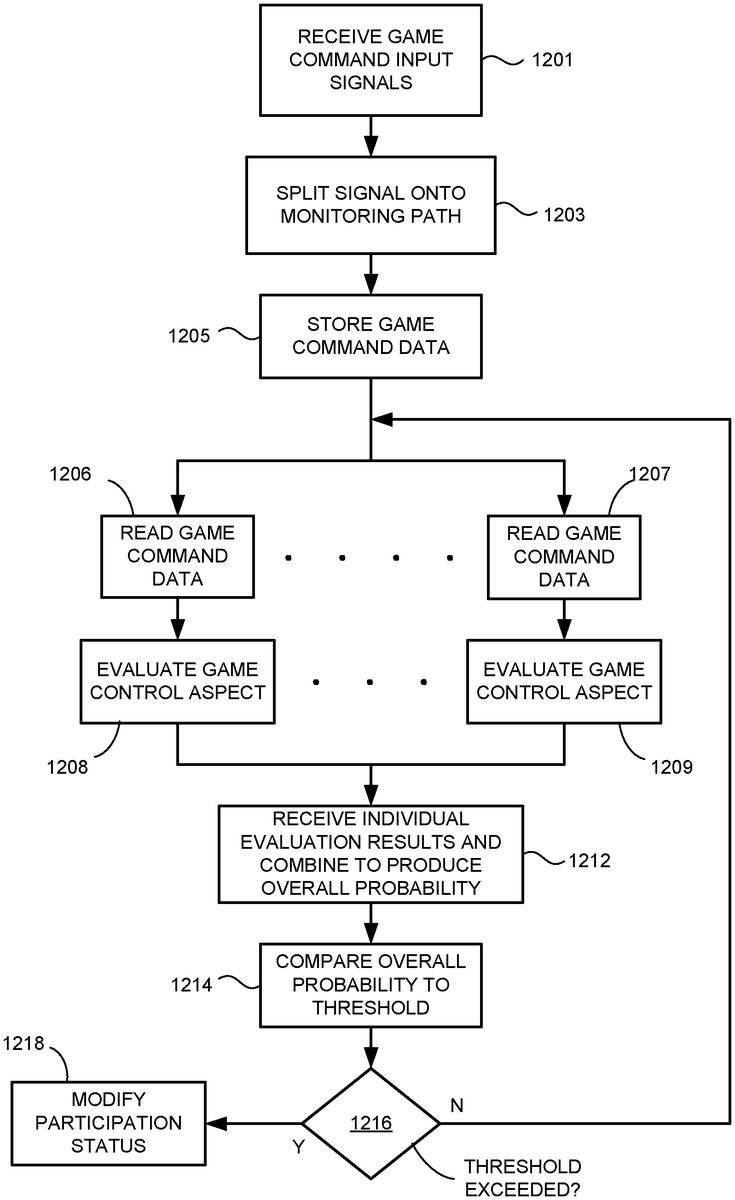
The flowchart ofFIG. 12illustrates an example process performed by input monitor412according to an aspect of the present invention. The process includes receiving game command input signals as indicated at process block1201. These are the game command signals that are directed from the player's controller to an input port of the gaming device in the course of the game. The process further includes splitting the signals onto a monitoring path as indicated at process block1203while allowing the signals to also continue on to the gaming device input port. As shown at process block1205, signals received on the monitoring path are interpreted as necessary to produce command data representative of the game commands from the player's game controller and stored in suitable data storage. Periodically or in response to certain events in the course of the game or after completion of a game, the process includes reading the game command data from storage and evaluating a game control aspect of the data. This reading and evaluation is performed for two or more game control aspects as indicated inFIG. 12by process blocks1206,1207,1208, and1209and may be conducted in parallel as indicated in the figure. Game control aspects which may be evaluated to provide an indication of improperly automated inputs include input speed, rate of mistakes, variance between inputs, and timing of inputs. Each evaluation indicated at process box1208and1209inFIG. 12produces a probability that the input or stream of inputs (or any subset of inputs) under investigation were improperly automated. The process then includes receiving the individual evaluation results as indicated at process block1212and combining those results to produce and overall probability that the game control input or series of inputs were automated. In some implementations of the invention the process includes comparing this overall probability to a threshold probability as shown at process block1214. If threshold is not exceeded as indicated by a negative outcome at decision box1216method includes simply looping back to perform the evaluation for another input or series of inputs. However, if the threshold value is exceeded, the illustrated process includes modifying the participation status of the player who has made the inputs as indicated at process block1218.
The process steps shown inFIG. 12from process block1205to1212may all be performed by a single processing device such as device1110shown inFIG. 11or by multiple processing devices included in the monitoring unit if the unit is implemented with multiple processing devices for the storage and evaluation tasks. The steps of taking action on the overall probability such as comparing the overall probability to a threshold and modifying a player's participation status as shown at process block1218may be performed at the monitoring unit such as412, or may be performed at a separate device in the e-sports gaming system (301inFIG. 3) to which the overall probability is communicated. Modifying the participation status of the player shown at process block1218may be performed either manually by a system operator in response to a notice from the system that an automation probability threshold has been exceeded. Alternatively the incidents of a threshold being exceeded may be reported to a suitable processing device in the system (such as e-sports system server303inFIG. 3) which automatically modifies the participation status of the player associated with the input signals which were evaluated according to the process shown inFIG. 12.
Although input speed, rate of input mistakes, variance between inputs, and input timing have been provided as examples of game control aspects which may be evaluated in accordance with aspects of the present invention, the invention is by no means limited to these game control aspects. Any game control aspect which may indicate improper automation may be employed in various implementations. Also, althoughFIG. 12suggests that the various game control aspects are evaluated simultaneously, the invention is not limited to such implementations. For example, a probability for one or more game control aspects may be produced for one or more inputs or series of game control inputs to the gaming device, while a probability for one or more different game control aspects may be produced for other inputs or other series of inputs, and these probabilities may be combined as indicated at block1212to provide an overall probability over a given period of time.
Input monitoring according to the present invention is not limited to any particular technique for receiving game command input signals, that is, game control signals ostensibly from a player's game controller to the gaming device, or to any particular technique for splitting the game command input signals onto the monitoring path. The techniques for splitting the game command input signals include simply applying the signals to a separate path (the monitoring path) where they may be processed as described above in connection withFIG. 12. Other techniques include receiving the game command input signals at a suitable processing device so that data representations of the signals may be buffered and then transmitting signals replicated from the buffered data on to the gaming device. The buffered data representations of the received game command input signals in this technique may be read from the buffer for storage according to process block1205inFIG. 12and then processed further in accordance with the method shown in that figure. In this latter technique, reading from the buffer represents splitting the incoming game command input signals onto the monitoring path.
Referring toFIG. 13, an example button filter413is shown connected to receive the input from a player controller317(as described above in connection withFIG. 4) before the gaming device409(also described above in connection withFIG. 4). Button filter413is configured to filter the signals resulting from certain button presses so that the signals do not reach gaming device409. In particular, button filter413receives inputs in the form of game command input signals from player controller317, determines if any of the input signals represent prohibited commands at that point in the game, and then either stores the commands deemed prohibited or transmits commands which are not deemed prohibited on to the gaming device409. The illustrated button filter413inFIG. 13includes a data processing device1301connected to receive game command input signals sent from the game controller317. Data processing device1301is also operatively connected to transmit non-prohibited input commands (that is, signals representing those commands) to a suitable input port of gaming device409. Suitable memory is preferably included with data processing device1301to facilitate the prohibited/non-prohibited determination as will be described below in connection withFIG. 14. Additional data storage1302is provided in this example arrangement inFIG. 13to provide a storage location for rejected inputs and information on those rejected inputs such as a timestamp indicating the date and time the input was filtered, and perhaps other information. It will be appreciated that button filter413is configured so that the determination as to whether a given input is prohibited is executed very quickly, perhaps in a few microseconds, as to not impact game play.
One use case for button filter413is in a gaming tournament, where “pause” and “home” buttons are preferably not allowed to be pressed during a match. In this example, button filter413functions to filter out all “pause” and “home’ button presses so that a player may not interrupt the game in progress.
FIG. 14shows an example process which may be performed by input filter413. The process includes receiving the game command input signal is indicated by process block1401and storing data representing the game command input as shown at process block1404. The process then compares the stored data representing the game input command to an active set of command input records as shown at process block1405. If this comparison indicates that the command input is a prohibited input at the point in time at which the input is received, as indicated by an affirmative outcome at decision box1407, the process stores the command input in a fashion to maintain a record of the input and does not transmit a corresponding signal on to the gaming device. This action is shown at process block1412inFIG. 14. However, if the comparison indicates that the command input is not a prohibited input, process proceeds to transmit a replica of the received signal to the gaming system as shown at process block1410. Regardless of the result from decision box1407, the process terminates as to that received game command input signal once the action is taken at blocks1410or1412.
It will be appreciated that the process shown inFIG. 14is preferably performed for each command entered by a player in the course of a game on the gaming system. However, each comparison may not be to the same set of command input records. Because certain game command inputs may be prohibited at certain stages of the game and not at others, the invention encompasses storing different sets of command input records for comparison as shown at process block1405. The process may include monitoring the state of the game and activating a set of command input records corresponding to a given game state in response to the detection of that state of the game. Thus button filter device413is capable of holding multiple configurations in storage associated with the device, each with a unique to a list of unacceptable inputs to be filtered. Once a configuration is chosen, its list is then considered active and the device will reject all inputs matching the configuration. In any case, any suitable logic may be applied in the comparison indicated at1405inFIG. 14to determine whether the input in question is prohibited. Thus, the set of command input records may list prohibited inputs or allowed inputs. In the former a match indicates the input is prohibited, while in the latter a match in the comparison indicates the input in question is not prohibited.
Because the signal received as indicated at process block1401will be a signal encoded for transmission according to a transmission standard acceptable to the gaming device, the signal may be decoded to a suitable representation of the corresponding game command in order to facilitate buffering and processing. This decoding may be performed by data processing device1301in the example arrangement ofFIG. 13. Similarly, when a replica signal is to be transmitted as indicated at process block1410, processing device1301may perform the encoding necessary to transmit the replicated signal. Alternative arrangements may place the decoding and encoding functions in a processing device separate from the device that performs the comparison indicated at1405inFIG. 14.
Input monitor412and button filter413have been described above as separate devices in order to more clearly describe the structure and function of each device. However, implementations of an input monitor and button filter according to aspects of the present invention may include combining elements of the two devices. For example, a data processing device such as device1301inFIG. 13may function to buffer data representations of the incoming game command input signals transmitted from a player's game controller, and the buffered data representations may be used both for the processing steps for the input monitor and for the button filter. That is, the buffered data representations may be stored and processed as shown for example at process blocks1205through1212inFIG. 12, and also may be used in the process shown at process blocks1405of the example process shown inFIG. 14. In these implementations, the processing device1301inFIG. 3may be operable to perform all of the process steps shown inFIG. 14and the process steps1201and1203in the example process ofFIG. 12. Other implementations may use a single processing device to perform the functions of processing device1110inFIG. 11and processing device1301inFIG. 13.
As used herein, whether in the above description or the following claims, the terms “comprising,” “including,” “carrying,” “having,” “containing,” “involving,” and the like are to be understood to be open-ended, that is, to mean including but not limited to. Also, it should be understood that the terms “about,” “substantially,” and like terms used herein when referring to a dimension or characteristic of a component indicate that the described dimension/characteristic is not a strict boundary or parameter and does not exclude variations therefrom that are functionally similar. At a minimum, such references that include a numerical parameter would include variations that, using mathematical and industrial principles accepted in the art (e.g., rounding, measurement or other systematic errors, manufacturing tolerances, etc.), would not vary the least significant digit.
Any use of ordinal terms such as “first,” “second,” “third,” etc., in the following claims to modify a claim element does not by itself connote any priority, precedence, or order of one claim element over another, or the temporal order in which acts of a method are performed. Rather, unless specifically stated otherwise, such ordinal terms are used merely as labels to distinguish one claim element having a certain name from another element having a same name (but for use of the ordinal term).
In the above descriptions and the following claims, terms such as top, bottom, upper, lower, and the like with reference to a given feature are intended only to identify a given feature and distinguish that feature from other features. Unless specifically stated otherwise, such terms are not intended to convey any spatial or temporal relationship for the feature relative to any other feature.
The term “each” may be used in the following claims for convenience in describing characteristics or features of multiple elements, and any such use of the term “each” is in the inclusive sense unless specifically stated otherwise. For example, if a claim defines two or more elements as “each” having a characteristic or feature, the use of the term “each” is not intended to exclude from the claim scope a situation having a third one of the elements which does not have the defined characteristic or feature.
The above described preferred embodiments are intended to illustrate the principles of the invention, but not to limit the scope of the invention. Various other embodiments and modifications to these preferred embodiments may be made by those skilled in the art without departing from the scope of the present invention. For example, in some instances, one or more features disclosed in connection with one embodiment can be used alone or in combination with one or more features of one or more other embodiments. More generally, the various features described herein may be used in any working combination. Also, although the above description refers to the evaluation of a video signal from a game to determine a result or setup state of the game, the audio signal of a game may also be evaluated to determine or to aid in determining a result or setup state of the game.
Claims
- A method including: (a) receiving game command input signals on a game controller signal input path to a gaming device, the game command input signals comprising signals associated with a player and operable for controlling play in a competitive video game for the player while the player participates in a competition against other players;(b) splitting the game command input signals from the game controller signal input path onto a signal monitoring path;(c) storing game command data representing the game command input signals from the signal monitoring path in a command data storage system;(d) evaluating two or more game control aspects associated with the game command data to produce a respective automation indicator for each game control aspect;(e) combining the respective automation indicator for each game control aspect to produce an overall automation indicator value indicating a determination of whether the player is using automation to assist playing in the competition;and (f) modifying a participation status of the player in response to a characteristic of the overall automation indicator value.
- The method of claim 1 wherein the competitive video game is an e-sports competition in which at least two players compete.
- The method of claim 1 wherein the characteristic of the overall automation indicator value comprises a relationship between the overall automation indicator value and a threshold value.
- The method of claim 1 wherein modifying the participation status of the player includes disqualifying the player for the video game in which the game command input signals were received.
- The method of claim 1 wherein modifying the participation status of the player includes disqualifying the player for a future instance of the video game in which the game command input signals were received.
- The method of claim 1 wherein the two or more game control aspects associated with the game command data are selected from the group consisting of input speed, rate of input mistakes, variance between inputs, and input timing.
- The method of claim 1 wherein evaluating two or more game control aspects associated with the game command data includes evaluating input speed, rate of input mistakes, variance between inputs, and input timing.
- An input monitor for a video gaming system, the input monitor including: (a) a signal splitter connected in a game controller input signal path between a game controller input point and an input port of a gaming device, the signal splitter operable to direct game command input signals for a competitive video game on the game controller input signal path onto a signal monitoring path while a player participates in a competition against other players;(b) a data storage device operatively connected to store game command data representing the game command input signals from the signal monitoring path;(c) two or more evaluation units operatively connected to read the game command data stored on the data storage device, each evaluation unit operable to evaluate a respective game control aspect associated with the game command data and to produce a respective automation indicator for the respective game control aspect indicating a determination of whether the player is using automation to assist playing in the competitive video game;and (d) a combination unit operatively connected to receive the respective automation indicator for each respective game control aspect, the combination unit operable to combine the respective automation indicator for each game control aspect to produce an overall automation indicator value.
- The input monitor of claim 8 wherein the input monitor is operable to monitor input for a competitive video game that is an e-sports competition in which at least two players compete.
- The input monitor of claim 8 further comprising at least one processor in communication with the input monitor and executing participation program code executable to modify a participation status of the player in response to a characteristic of the overall automation indicator value, wherein the characteristic of the overall automation indicator value comprises a relationship between the overall automation indicator value and a threshold value.
- The input monitor of claim 10 wherein modifying the participation status of the player includes disqualifying the player for the video game in which the game command input signals were received.
- The input monitor of claim 10 wherein modifying the participation status of the player includes disqualifying the player for a future instance of the video game in which the game command input signals were received.
- The input monitor of claim 8 wherein each of the two or more evaluation units is operable to evaluate a respective game control aspect selected from the group consisting of input speed, rate of input mistakes, variance between inputs, and input timing.
- The input monitor of claim 8 wherein game control aspects evaluated by the two or more evaluation units comprise input speed, rate of input mistakes, variance between inputs, and input timing.
- A program product comprising one or more non-transitory computer readable data storage devices storing program code, the program code including: (a) game command data storage program code executable to receive game command input signals comprising signals taken from a game controller signal input path to a gaming device for a competitive video game while a player participates in a competition against other players and to store game command data representing the game command input signals;(b) evaluation program code executable to evaluate two or more game control aspects associated with the game command data to produce a respective automation indicator for each game control aspect indicating a determination of whether the player is using automation to assist playing in the competition;(c) combination program code executable to combine the respective automation indicator for each game control aspect to produce an overall automation indicator value;and (d) participation program code executable to modify a participation status of the player in response to a characteristic of the overall automation indicator value.
- The program product of claim 15 wherein the competitive video game is an e-sports competition in which at least two players compete.
- The program product of claim 15 wherein the characteristic of the overall automation indicator value comprises a relationship between the overall automation indicator value and a threshold value.
- The program product of claim 15 wherein modifying the participation status of the player includes disqualifying the player for a future instance of the video game in which the game command input signals were received.
- The program product of claim 15 wherein the two or more game control aspects associated with the game command data are selected from the group consisting of input speed, rate of input mistakes, variance between inputs, and input timing.
- The program product of claim 15 wherein evaluating two or more game control aspects associated with the game command data includes evaluating input speed, rate of input mistakes, variance between inputs, and input timing.
Disclaimer: Data collected from the USPTO and may be malformed, incomplete, and/or otherwise inaccurate.