U.S. Pat. No. 11,250,666
Systems and methods for location-based game play on computing devices
AssigneeE2interactive Inc
Issue DateOctober 29, 2018
Illustrative Figure
Abstract
Systems and methods are provided for: receiving, from a terminal, identification information associated with a user, wherein the receipt of the identification information is caused by an identification operation performed at at least one of the terminal or a remote processing system located away from the terminal; determining gaming rules associated with a physical jurisdiction for the terminal, wherein a first portion of the gaming rules is provisioned at the terminal, and wherein a second portion of the gaming rules is provisioned by a remote processing system located away from the terminal; and determining, based on at least one of the first portion of the gaming rules or the second portion of the gaming rules, whether the user associated with the identification information is eligible to participate in a game associated with the physical jurisdiction.
Description
DETAILED DESCRIPTION The present disclosure provides a game play system and game play methods to allow for game play (e.g., lottery play) purchases at a variety of outlets while complying with various governmental restrictions regulating game plays. Game plays may include various types of games, including, but not limited to lottery wagers, lottery draws, scratch tickets, virtual scratch tickets, branded games, second chance games, etc. Thus, the game play system and game play methods allow access for making game play purchases beyond the traditional manned lottery authority terminals providing paper tickets, although the game play system and game play methods could also be used in the context of manned terminals. Indeed, the game play system and game play methods allow for convenient, every day access to game play purchases at various payment-enabled terminals. Further, the game play system and game play methods allow for a substantially “ticketless” game play—or, a “ticketless” lottery wager. Specially, the game play system and game play methods provide for storing, managing, and redeeming of game play purchases so that a user is not required to present a paper lottery ticket or lottery bearer instrument to redeem winnings. Instead, a winning game play is associated with the user's payment card number in secure storage within the game play system, and winnings may be automatically directed to an account associated with the user's payment card and/or may be effected based on the user's payment card number. In addition, the game play system and game play methods allow for a user to purchase a game play using a payment card (e.g., a debit or credit card) instead of cash. Similarly, the game play system and game play methods allow for a user to purchase a game play using a device carrying or providing payment card data (e.g., an ...
DETAILED DESCRIPTION
The present disclosure provides a game play system and game play methods to allow for game play (e.g., lottery play) purchases at a variety of outlets while complying with various governmental restrictions regulating game plays. Game plays may include various types of games, including, but not limited to lottery wagers, lottery draws, scratch tickets, virtual scratch tickets, branded games, second chance games, etc. Thus, the game play system and game play methods allow access for making game play purchases beyond the traditional manned lottery authority terminals providing paper tickets, although the game play system and game play methods could also be used in the context of manned terminals. Indeed, the game play system and game play methods allow for convenient, every day access to game play purchases at various payment-enabled terminals.
Further, the game play system and game play methods allow for a substantially “ticketless” game play—or, a “ticketless” lottery wager. Specially, the game play system and game play methods provide for storing, managing, and redeeming of game play purchases so that a user is not required to present a paper lottery ticket or lottery bearer instrument to redeem winnings. Instead, a winning game play is associated with the user's payment card number in secure storage within the game play system, and winnings may be automatically directed to an account associated with the user's payment card and/or may be effected based on the user's payment card number. In addition, the game play system and game play methods allow for a user to purchase a game play using a payment card (e.g., a debit or credit card) instead of cash. Similarly, the game play system and game play methods allow for a user to purchase a game play using a device carrying or providing payment card data (e.g., an NFC-enabled user device).
As used herein, payment-enabled terminals may refer to a variety of terminals and payment platforms, including, but not limited to, swipe-enabled terminals, swipe-enabled point of sale (POS) systems, Card Reader in Dispenser terminals (CRIND terminals), payment-enabled “smart” devices (e.g., tablets, netbooks, mobile devices, etc.), payment kiosks, self-service payment terminals, automated teller machines (ATMs), “tap” payment platforms, near-field communication payment platforms, proximity-based communication payment platforms, barcode scan payment platforms, cloud-enabled payment devices and interfaces, and cloud-enabled point of sale platforms.
The game play system and game play methods disclosed herein allow for seamless and integrated game play transactions to a user at a payment-enabled terminal. The game play system and game play methods link gaming partners and financial payment partners together with a user at a payment-enabled terminal. In doing so, the game play system and the game play methods allow for a user to purchase a game play or lottery wager at the payment-enabled terminal by receiving the request from the user, provisioning various game play regulations to determine whether the request is valid, effecting the financial transaction associated with the game play purchase, providing information related to the game play purchase to the user, effecting various automatic redemption processes, notifying the user about winning plays, etc. Various aspects, features, and functionality of the game play system and the game play methods are discussed in further detail in commonly-assigned U.S. patent application Ser. Nos. 11/734,207, 13/280,196, 61/593,762, 61/696,533, Ser. Nos. 13/757,512, and 13/829,776, which are each herein incorporated by reference for all purposes.
Disclosed herein are game play systems and methods for facilitating a game play purchase by a user at a payment-enabled terminal. The game play system may store a plurality of records of game play number sets associated with respective payment card numbers; and receive a payment card number associated with the user. The payment card number may originate at the payment-enabled terminal and may be identified when the user swipes its payment card at the payment-enabled terminal. The game play system may also associate the payment card number with a game play number set received from a gaming operator. The game play system may further communicate to the transaction database the payment card number and game play number set for storage at the transaction database.
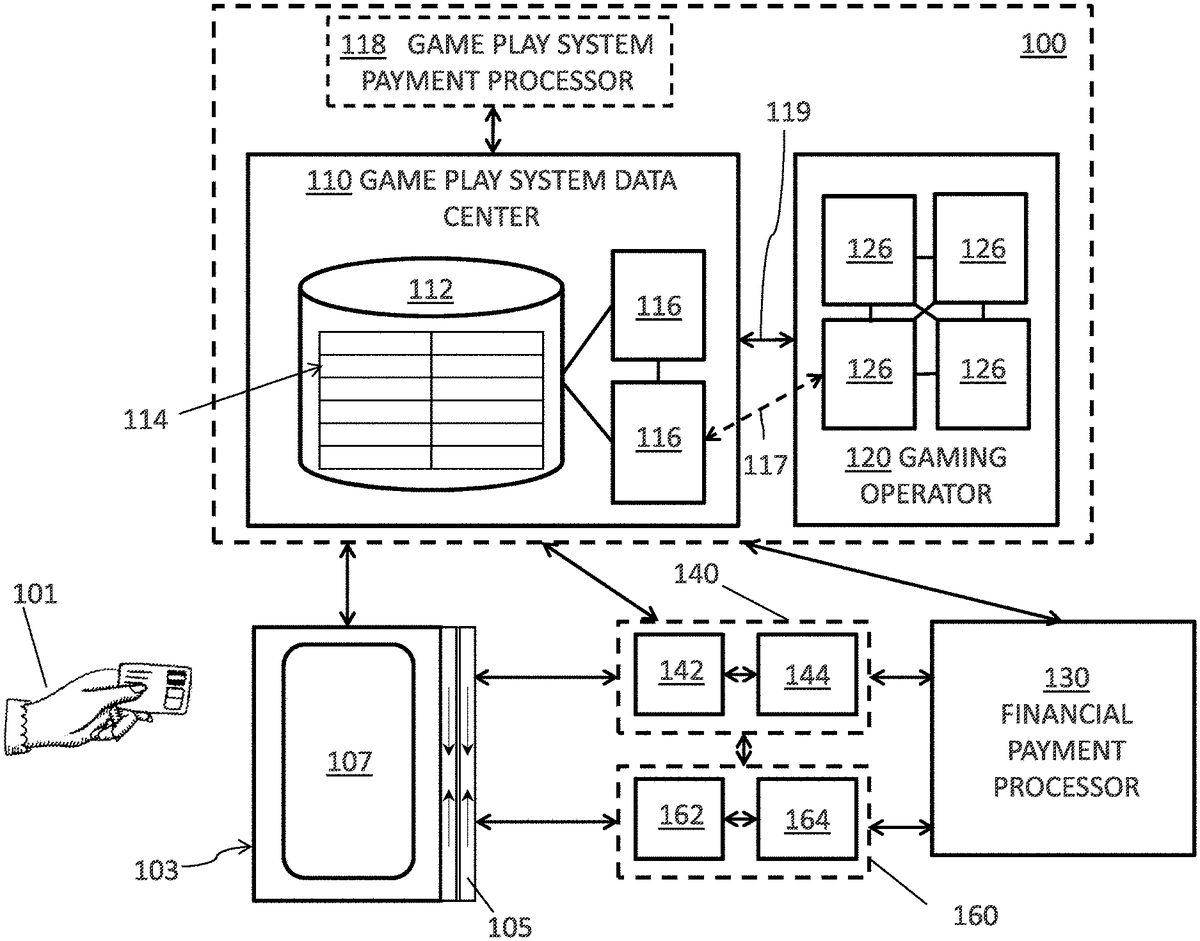
FIG. 1Ais a schematic diagram illustrating a game play system100for facilitating a game play purchase by a user at a payment-enabled terminal103. The payment-enabled terminal103may include a user interface107, swipe105, a pin pad (not shown), or various peripherals. In an embodiment, the user interface107is a touch screen.
The game play system100includes a game play data center110having a game play transaction database112for storing game play records114and one or more game play transaction processing servers116in communication with the transaction database112. The game play data center110is in communication with a gaming operator120having one or more gaming operator servers126. The gaming operator servers126are operable to generate game play number sets, and the transaction processing server116receives a game play number set for a given game play transaction from the gaming operator120. In an embodiment, the gaming operator is part of the game play system100, and includes one or more gaming operator servers126in communication with the game play transaction processing servers116over an intersystem network117. In another embodiment, the gaming operator is located remotely from the game play system100and is in communication with the game play transaction processing servers116over a secure network connection119. In either embodiment, the game play transaction processing servers116are operable to receive information from the gaming operator120and/or gaming operator servers126relating to a game play transaction.
In some embodiments, the game play system100further comprises a game play system payment processor118in communication with the game play data center110. The game play system payment processor118may conduct a financial transaction associated with the game play purchase independent of a financial payment processor130, upon receiving communications from the game play transaction processing servers116to that effect. In other embodiments, the game play system100communicates with the financial payment processor130to initiate a financial transaction associated with the game play purchase.
Still referring toFIG. 1A, the game play system100may be in communication with a payment-enabled terminal103, a media server160, an electronic payment host140, and/or a financial payment processor130. The electronic payment host140may include a payment host142and/or a payment network data center144. The media server160may include a media host162and/or a payment host164.
For example, in an embodiment, the payment-enabled terminal103may be a fuel pump payment interface in communication with a local point of sale terminal (not shown), and the electronic payment host140may be a point of sale host. In an alternative embodiment, the payment-enabled terminal103may be a fuel pump interface in communication with the media server160. The media server160may further be in communication with the electronic payment host140and/or may be in communication with the financial payment processor130. As another example, in an embodiment, the payment-enabled terminal103may be an in-lane grocery point of sale terminal, and the electronic payment host140may be an electronic payment system host associated with the in-lane grocery point of sale system. As another example, in an embodiment, the payment-enabled terminal103may be a self-serve grocery kiosk in connection with a grocery local point of sale terminal, and the electronic payment host140may be an electronic payment system host associated with the grocery store local point of sale terminal. As another example, in an embodiment, the payment-enabled terminal103may be a swipe-enabled electronic tablet in communication with a local electronic tablet payment system server, and the electronic payment host140may be a gateway associated with the local electronic tablet payment system server.
Other interfaces and connectivity with fuel pump systems, grocery payment systems, and electronic tablet payment systems are also further described below, and the game play system may bypass an electronic payment host140in certain embodiments. Indeed, any payment-enabled device103that includes a user interface107and a mechanism for determining a payment card number, that is connected, generally speaking, to a payment network, may communicate with the game play system100. Game play purchases are, thus, possible through a variety of payment-enabled devices103.
The game play transaction processing servers116may receive a payment card number associated with the user101. The payment card number originates at the payment-enabled terminal103and is identified when the user101swipes its payment card at the payment-enabled terminal103or when the payment card number is otherwise determined (e.g., through a mobile “tap” or NFC communication) at the payment-enabled terminal103. The game play transaction processing servers116may also associate the payment card number with a game play number set received from a gaming operator120. The game play transaction processing servers116may communicate the payment card number and game play number set to the transaction database112for storage in records114.
Still referring toFIG. 1A, the game play system100is operable to effect ticketless game plays by associating the user's payment card number with a game play number set. For example, the game play transaction database112may store a plurality of records114of game play number sets associated with respective payment card numbers. The game play transaction processing servers116may manage ticketless lottery transactions by associating, storing, and referencing the plurality of records114of game play number sets and their respective payment card numbers. The game play system100is also operable to effect automatic winner redemption by initiating payment to an account tied to a payment card number associated with a winning game play number set. The game play system100may also manage second chance game plays based on the plurality of records114of game play number sets associated with respective payment card numbers stored at the transaction database112. For example, the game play system100may reference the plurality of records114to identify non-winning game play number sets. The game play system100may then use a random number generator (or other game play mechanism) to run a second chance play for the users associated with the non-winning game play number sets. The “winnings” for the second chance game play may include, but is not limited to, a game play, a store promotion, or free merchandise. For example, if a user purchased the game play at a payment-enabled terminal associated with a particular store, then the game play system may manage and run second chance game plays for that store, and “winnings” for the second chance game play may include a store promotion for that store.
A user101of the game play system100may use a credit card or debit card to conduct the game play purchase. Thus, the payment card number may be a credit card number or a debit card number.
Further, the connections between the various system elements may be wired or wireless, and may also be cloud-based communications. For example, in an embodiment shown inFIG. 1B, the game play system100is in communication with a cloud media server160, cloud e-commerce platform140, and/or a cloud based financial payment processor130. The game play system100may also be cloud-based. A transmitter-receiver190associated with the payment-enabled terminal103may communicate with the various systems100,160,140, and/or130. Thus, the payment-enabled terminal103may receive communications, instructions, data, content for display at the payment-enabled terminal103over the cloud from the game play system100.
Referring back toFIG. 1A, the transaction database112is further operable to store one or more sets of gaming rules associated with respective jurisdictions, and the transaction processing servers116are operable to provision the gaming rules for a given game play purchase. The game play transaction processing servers116may further lookup a payment card number in the game play transaction database to determine the eligible lottery transactions associated with the payment card number. The transaction processing servers116may provision the gaming rules based a user's age, based on payment card limits, based on responsible game play restrictions, draw break buffers, and/or based on other time and day restrictions. In some embodiments, the remote system associated with the payment-enabled terminal103(or the payment-enabled terminal itself) may provision all or a portion of the gaming rules for the game play purchase in cooperation with the transaction processing servers116. The game play system100may provide instructions for the provisioning of all or a portion of the gaming rules to the remote system associated with the payment-enabled terminal103(or to the payment-enabled terminal itself) substantially in real-time. Thus, gaming rule provisioning may be conducted wholly at the game play system100, wholly at the remote system associated with the payment-enabled terminal (or the payment-enabled terminal itself) in communication with the game play system100, or at a combination of the game play system100and the remote system, depending on the payment-enabled terminal capability and the connection between the payment-enabled terminal103and the game play system100. Further, the gaming provisioning may be done substantially in real-time, based on predetermined logic or rules that are regularly updated, or a combination of both, depending on the payment-enabled terminal capability and the connection between the payment-enabled terminal103and the game play system100.
The game play system100may further direct or control the content displayed at a user interface107of the payment-enabled terminal103. Generally speaking, the presentment of content displayed at the user interface107may be all or partially directed by the game play system100, or may be all or partially directed by the remote system associated with the payment-enabled terminal103, or may be a combination of remote system presentment of content and game play system100presentment of content, depending on the payment-enabled terminal capability and the connection between the payment-enabled terminal103and the game play system100. Further, presenting content to the user at the payment-enabled terminal103may be done substantially in real-time, based on predetermined logic that is regularly updated, or a combination of both, depending on the payment-enabled terminal capability and the connection between the payment-enabled terminal103and the game play system100.
In an embodiment, the game play system100stores user-specific administrative data, including, but not limited to, user preferences for presentment of data at the user interface107, game play options, etc. In an embodiment, user-specific administrative data is stored in the game play transaction database112and is associated with respective payment card numbers, thereby allowing for the game play system100to control content at the payment-enabled terminal103, on a user-specific basis, upon receipt of a payment card number. The game play system100may further be operable to manage the display of content at the payment-enabled terminal103based on the user-specific administrative data, depending on the payment-enabled terminal capability and the connection between the payment-enabled terminal103and the game play system100.
FIG. 2Ais a schematic diagram illustrating a game play system200in communication with a fuel payment system251. The game play system200may include a game play data center210having a game play transaction database212for storing game play records214and one or more game play transaction processing servers216in communication with the transaction database212.
The game play data center210is in communication with a gaming operator220having one or more gaming operator servers (see, e.g.,FIG. 1A). The gaming operator servers are operable to generate game play number sets, and the transaction processing server216receives a game play number set for a given game play transaction from the gaming operator220. In an embodiment, the gaming operator is part of the game play system200, and includes one or more gaming operator servers in communication with the game play transaction processing servers216over an intersystem network. In another embodiment, the gaming operator220is located remotely from the game play system200and is in communication with the game play transaction processing servers216over a secure network connection. In either embodiment, the game play transaction processing servers216are operable to receive information from the gaming operator220and/or gaming operator servers relating to a game play transaction.
In some embodiments, the game play system200further comprises a game play system payment processor218in communication with the game play data center210. The game play system payment processor218may conduct a financial transaction associated with the game play purchase independent of the financial payment processor230, upon receiving communications from the game play transaction processing servers216to that effect. In other embodiments, the game play system200communicates with the financial payment processor230to initiate a financial transaction associated with the game play purchase.
The fuel payment system may include a fuel pump208, a local point of sale terminal246, a point of sale host network240, media server260, and/or a financial payment processor230. The game play system200may be in communication with the fuel pump208, local point of sale terminal246, media server260, point of sale host network240, and/or financial payment processor230directly or indirectly through communication servers, gateways, or other hosts. Thus, the transaction processing server216of the game play system200may receive the payment card number from a several parts of the fuel pump system251. The fuel pump208may include a payment-enabled terminal203, which may include a user interface207for interacting with a user201, a swipe205for reading a user payment card, and/or a pin pad209. In alternative embodiments, the payment-enabled terminal may include other kinds of swipe-enabled terminals, swipe-enabled point of sale (POS) systems, Card Reader in Dispenser terminals (CRIND terminals), payment-enabled “smart” devices (e.g., tablets, netbooks, mobile devices, etc.), payment kiosks, self-service payment terminals, automated teller machines (ATMs), “tap” payment platforms, near-field communication payment platforms, proximity-based communication payment platforms, barcode scan payment platforms, cloud-enabled payment devices and interfaces, and cloud-enabled point of sale platforms. Thus, the payment card number may be identified when the user201swipes its payment card at the fuel pump payment-enabled terminal203or when a payment card number is otherwise determined (e.g., via “tap” of a mobile device or NFC communication) at the payment-enabled terminal203. In an embodiment, the user interface207comprises a media screen. The user interface (media screen)207may display media content guiding the user201through a game play purchase.
As discussed above in relation toFIGS. 1A and 1B, gaming rule provisioning may be conducted wholly at the game play system200, wholly at the fuel payment system251associated with the payment-enabled terminal203(or the payment-enabled terminal203itself), or at a combination of the game play system200and the fuel payment system251. Further, the gaming provisioning may be done substantially in real-time, based on predetermined logic or rules that are regularly updated, or a combination of both. The game play system200may further direct or control the content displayed at a user interface207of the payment-enabled terminal203. Generally speaking, the presentment of content displayed at the user interface207may be all or partially directed by the game play system200, or may be all or partially directed by the fuel payment system251associated with the payment-enabled terminal203, or may be a combination of fuel payment system251presentment of content and game play system200presentment of content. Further, presenting content to the user at the payment-enabled terminal203may be done substantially in real-time, based on predetermined logic that is regularly updated, or a combination of both.
FIG. 2Bis a schematic diagram illustrating a game play system200in communication with an embodiment of a fuel pump system251. The fuel pump system251includes a fuel pump208, a local point of sale terminal246, a point of sale host network240, and a financial payment processor230. The fuel pump208is in communication with the local point of sale terminal246, which is in communication with the point of sale host network240, which communicates with the financial payment processor230to effect a fuel pump payment transaction. The fuel pump system251further includes a media-enabled electronic payment system261. The media-enabled electronic payment system261controls the user interface207to conduct a payment transaction and/or to display media content. In this embodiment, the user interface207is a media screen. The media-enabled electronic payment system261includes a media host262in communication with a payment host264. The media host262displays and controls the media content presented to the user201and also receives user inputs from the swipe205, pin pad209, and the user interface208, and the payment host264effects a payment transaction.
The game play system200may communicate with the media server260to effect a game play purchase. The game play system200is communication with the payment host264of the media payment system260. The payment host264is in communication with the transaction processing server216. Thus, the transaction processing server216of the game play system200may receive the payment card number from the payment host264of the media payment system260.
Further, gaming rule provisioning may be conducted wholly at the game play system200, wholly at the media server260, or at a combination of the game play system200and the media server260. Further, the gaming provisioning may be done substantially in real-time, based on predetermined logic or rules that are regularly updated, or a combination of both. The game play system200may further direct or control the content displayed at a user interface207of the payment-enabled terminal203through the media server260. Generally speaking, the presentment of content displayed at the user interface207may be all or partially directed by the game play system200, or may be all or partially directed by the media server260associated with the payment-enabled terminal203, or may be a combination of media server260presentment of content and game play system200presentment of content. Further, presenting content to the user at the payment-enabled terminal203may be done substantially in real-time, based on predetermined logic that is regularly updated, or a combination of both.
FIG. 2Cis a schematic diagram illustrating a game play system in communication with another embodiment of a fuel pump system251. The fuel pump system251may include a fuel pump208, a local point of sale terminal246, a point of sale data center248, and a financial payment processor230to effect a fuel pump payment transaction. In some embodiments, the point of sale terminal246is in direct communication with the financial payment processor230, bypassing a point of sale data center248, to effect the transaction. In such an embodiment, the game play system200receives the payment card number from the point of sale terminal246associated with the fuel pump208or the financial payment processor230. Accordingly, the game play transaction server may receive the payment card number from the point of sale terminal246or the financial payment processor230.
In other embodiments, the fuel pump208is in communication with the local point of sale terminal246, which is in communication with the point of sale data center248, which communicates with the financial payment processor230to effect a fuel pump payment transaction. The point of sale data center248may include a point of sale host (not shown) and a communications exchange server211. In such embodiments, the game play system200receives the payment card number from the communications exchange server211located at a point of sale data center248. Accordingly, the game play transaction server may receive the payment card number from the communications exchange server211.
Thus game play system200may communicate with the point of sale terminal246, the financial payment processor230, and/or the communications exchange server211to effect a game play purchase. The game play system200may also communicate with the financial payment processor230or the game play system payment processor218to effect the game play purchase transaction.
Further, gaming rule provisioning may be conducted wholly at the game play system200; at one or more of the POS246, communication exchange server211, and financial payment processor230; or at a combination of the game play system200and one or more of the POS246, communication exchange server211, and financial payment processor230. Further, the gaming provisioning may be done substantially in real-time, based on predetermined logic or rules that are regularly updated, or a combination of both. The game play system200may further direct or control the content displayed at a user interface207of the payment-enabled terminal203through one or more of the POS246, communication exchange server211, and financial payment processor230. Generally speaking, the presentment of content displayed at the user interface207may be all or partially directed by the game play system200, or may be all or partially directed by one or more of the POS246, communication exchange server211, and financial payment processor230associated with the payment-enabled terminal203, or may be a combination of one or more of the POS246, communication exchange server211, and financial payment processor230presentment of content and game play system200presentment of content. Further, presenting content to the user at the payment-enabled terminal203may be done substantially in real-time, based on predetermined logic that is regularly updated, or a combination of both.
FIG. 2Dis a schematic diagram illustrating a game play system200in communication with another embodiment of a fuel pump system251. The fuel pump system251may include a fuel pump208, a local point of sale terminal246, and a financial payment processor230to effect a fuel pump payment transaction. The fuel pump may also include a fuel pump server213in communication with the user interface207. In this embodiment, the user interface is a media screen, and the media server213is operable to control display of media content at the media screen and to receive user inputs at the screen207, swipe205, and/or pin pad209. The game play system200receives the payment card number from the fuel pump server213of the gas pump208. In particular, the game play transaction server216may receive the payment card number from the fuel pump server213.
Thus game play system200may communicate with the fuel pump server213to effect a game play purchase. The game play system200may also communicate with the financial payment processor230or the game play system payment processor218to effect the game play purchase transaction.
Further, gaming rule provisioning may be conducted wholly at the game play system200, wholly at the fuel pump server213, or at a combination of the game play system200and the media server260. Further, the gaming provisioning may be done substantially in real-time, based on predetermined logic or rules that are regularly updated, or a combination of both. The game play system200may further direct or control the content displayed at a user interface207of the payment-enabled terminal203through the fuel pump server213. Generally speaking, the presentment of content displayed at the user interface207may be all or partially directed by the game play system200, or may be all or partially directed by the media server260associated with the payment-enabled terminal203, or may be a combination of fuel pump server213presentment of content and game play system200presentment of content. Further, presenting content to the user at the payment-enabled terminal203may be done substantially in real-time, based on predetermined logic that is regularly updated, or a combination of both.
FIG. 2Eis a schematic diagram illustrating a game play system200in communication with another embodiment of a fuel pump system251. The fuel pump system251may include a fuel pump208, a local point of sale terminal246, and a financial payment processor230to effect a fuel pump payment transaction. The financial payment processor may include a communications exchange server215in communication with the game play system200. The communications exchange server215receives the user's payment card number from the point of sale terminal246, which receives the user's payment card number from the payment-enabled terminal203. The game play system200receives the payment card number from the communications exchange server215of the financial payment processor230. In particular, the game play transaction server216may receive the payment card number from the communications exchange server215of the financial payment processor230.
Thus game play system200may communicate with the communications exchange server215of the financial payment processor230to effect a game play purchase. The game play system200may also communicate with the financial payment processor230or the game play system payment processor218to effect the game play purchase transaction.
Further, gaming rule provisioning may be conducted wholly at the game play system200, wholly at the communications exchange server215, or at a combination of the game play system200and the media server260. Further, the gaming provisioning may be done substantially in real-time, based on predetermined logic or rules that are regularly updated, or a combination of both. The game play system200may further direct or control the content displayed at a user interface207of the payment-enabled terminal203through the communications exchange server215. Generally speaking, the presentment of content displayed at the user interface207may be all or partially directed by the game play system200, or may be all or partially directed by the media server260associated with the payment-enabled terminal203, or may be a combination of communications exchange server215presentment of content and game play system200presentment of content. Further, presenting content to the user at the payment-enabled terminal203may be done substantially in real-time, based on predetermined logic that is regularly updated, or a combination of both.
FIG. 2Fis a schematic diagram illustrating a game play system200in communication with another embodiment of a fuel pump system251. The fuel pump system251may include a fuel pump208, a local point of sale terminal246, and a centralized payment system217to effect a fuel pump payment transaction. The centralized payment system217may include a financial payment data center associated with the fuel pump system and a financial payment processor. The centralized payment system217is in communication with the game play system200. The centralized payment system217receives the user's payment card number from the point of sale terminal246, which receives the user's payment card number from the payment-enabled terminal203. The game play system200receives the payment card number from the centralized payment system217. In particular, the game play transaction server216may receive the payment card number from the centralized payment system217.
Thus game play system200may communicate with the centralized payment system217of the financial payment processor230to effect a game play purchase. The game play system200may also communicate with the centralized payment system217or the game play system payment processor218to effect the game play purchase transaction.
Further, gaming rule provisioning may be conducted wholly at the game play system200, wholly at the centralized payment system217, or at a combination of the game play system200and the centralized payment system217. Further, the gaming provisioning may be done substantially in real-time, based on predetermined logic or rules that are regularly updated, or a combination of both. The game play system200may further direct or control the content displayed at a user interface207of the payment-enabled terminal203through the centralized payment system217. Generally speaking, the presentment of content displayed at the user interface207may be all or partially directed by the game play system200, or may be all or partially directed by the centralized payment system217associated with the payment-enabled terminal203, or may be a combination of centralized payment system217presentment of content and game play system200presentment of content. Further, presenting content to the user at the payment-enabled terminal203may be done substantially in real-time, based on predetermined logic that is regularly updated, or a combination of both.
FIG. 2Gis a schematic diagram illustrating a game play system200in communication with a cloud-based embodiment of a fuel pump system251. The fuel pump system251may include a fuel pump208and a transmitter-receiver290. The transmitter-receiver290may send and receive communications to and from a cloud-based media server260, a cloud e-commerce platform240, and a financial payment processor230to effect a fuel pump payment transaction. The transmitter-receiver290may further be in communication with the game play system200. The game play system200may also be in communication with the cloud-based media server260, the cloud e-commerce platform240, and/or the financial payment processor230.
The game play system200receives the payment card number from the transmitter-receiver290either directly or indirectly through one or more of the cloud media server260, cloud e-commerce platform240, and financial payment processor230. Thus game play system200may communicate with the payment-enabled terminal203via the cloud to effect a game play purchase.
FIG. 3Ais a schematic diagram illustrating a game play system300in communication with a grocery payment system352. The game play system300may include a game play data center310having a game play transaction database312for storing game play records314and one or more game play transaction processing servers316in communication with the transaction database312.
The game play data center310is in communication with a gaming operator320having one or more gaming operator servers (see, e.g.,FIG. 1A). The gaming operator servers are operable to generate game play number sets, and the transaction processing server316receives a game play number set for a given game play transaction from the gaming operator320. In an embodiment, the gaming operator is part of the game play system300, and includes one or more gaming operator servers in communication with the game play transaction processing servers316over an intersystem network. In another embodiment, the gaming operator320is located remotely from the game play system300and is in communication with the game play transaction processing servers316over a secure network connection. In either embodiment, the game play transaction processing servers316are operable to receive information from the gaming operator320and/or gaming operator servers relating to a game play transaction.
In some embodiments, the game play system300further comprises a game play system payment processor318in communication with the game play data center310. The game play system payment processor318may conduct a financial transaction associated with the game play purchase independent of the financial payment processor330, upon receiving communications from the game play transaction processing servers316to that effect. In other embodiments, the game play system300communicates with the financial payment processor330to initiate a financial transaction associated with the game play purchase.
The grocery payment system may include a networked register390, payment-enabled terminal303, an electronic payment system355, and a financial payment processor330. The game play system300may be in communication with the networked register390, media server360, payment-enabled terminal303, electronic payment system355, and/or financial payment processor330directly or indirectly through communication servers, gateways, or other hosts. The media server360may include a media host362and/or a payment host364.
Thus, the transaction processing server316of the game play system300may receive the payment card number from the grocery payment system352. The payment-enabled terminal303may include a user interface307for interacting with a user301and swipe305for reading a user payment card. Thus, the payment card number may be identified when the user301swipes its payment card at the payment-enabled terminal303, or when a payment card number is otherwise determined (e.g., via “tap” of a mobile device or NFC communication) at the payment-enabled terminal303. In an embodiment, the payment-enabled terminal303is a local point of sale terminal in the grocery store. The point of sale terminal may further include a pin pad309. In an embodiment, the user interface307comprises a media screen. The user interface (media screen)307may display media content guiding the user301through a game play purchase. The media server360may control or direct the display of media content at the user interface307and may also receive data and information input by the user301at the interface307, pin pad309, and/or swipe305.
As discussed above in relation toFIGS. 1A and 1B, gaming rule provisioning may be conducted wholly at the game play system300, wholly at the fuel payment system352associated with the payment-enabled terminal303(or the payment-enabled terminal303itself), or at a combination of the game play system300and the fuel payment system352. Further, the gaming provisioning may be done substantially in real-time, based on predetermined logic or rules that are regularly updated, or a combination of both. The game play system300may further direct or control the content displayed at a user interface307of the payment-enabled terminal303. Generally speaking, the presentment of content displayed at the user interface307may be all or partially directed by the game play system300, or may be all or partially directed by the fuel payment system352associated with the payment-enabled terminal303, or may be a combination of fuel payment system352presentment of content and game play system300presentment of content. Further, presenting content to the user at the payment-enabled terminal303may be done substantially in real-time, based on predetermined logic that is regularly updated, or a combination of both.
FIG. 3Bis a schematic diagram illustrating a game play system300in communication with an embodiment of the grocery payment system352. In in embodiment, the grocery store payment system352is an in-lane grocery payment system.
The grocery payment system352includes a networked register390, payment-enabled terminal303, an electronic payment system355, and a financial payment processor330. The payment-enabled terminal303is in communication with an electronic payment system355, which communicates with a financial payment processor330. The grocery payment system352may further include a payment host357associated with the payment-enabled terminal303. The payment host357may direct the display of transaction content on the user interface307of the payment-enabled terminal303. In an embodiment, the user interface307is a media screen, and the host357directs the display of media transaction content on the media screen.
The game play system300may communicate with the payment host357to effect a game play purchase by the user301. The game play system300may also communicate with the financial payment processor330or the game play system payment processor318to effect the game play purchase transaction. The game play system300is communication with the payment host357. The payment host357is in communication with the transaction processing server316. Thus, the transaction processing server316receives the payment card number from the payment host357. The transaction processing server316also may provide instructions to the payment host357for directing the display of game-related content on the user interface307.
Further, gaming rule provisioning may be conducted wholly at the game play system300, wholly at the payment host357, or at a combination of the game play system300and the payment host357. Further, the gaming provisioning may be done substantially in real-time, based on predetermined logic or rules that are regularly updated, or a combination of both. The game play system300may further direct or control the content displayed at a user interface307of the payment-enabled terminal303through the payment host357. Generally speaking, the presentment of content displayed at the user interface307may be all or partially directed by the game play system300, or may be all or partially directed by the payment host357associated with the payment-enabled terminal303, or may be a combination of payment host357presentment of content and game play system300presentment of content. Further, presenting content to the user at the payment-enabled terminal303may be done substantially in real-time, based on predetermined logic that is regularly updated, or a combination of both.
FIG. 3Cis a schematic diagram illustrating a game play system300in communication with another embodiment of the grocery payment system352. The grocery payment system352includes a networked register390, payment-enabled terminal303, a store server358, an electronic payment system355, and a financial payment processor330. The payment-enabled terminal303is in communication with the store server358, which communicates with an external electronic payment system355, which communicates with a financial payment processor330.
The game play system300may communicate with the in-store server358to effect a game play purchase by the user301. In other embodiments, the game play system300may communicate with the electronic payment system355or the financial payment processor330to effect a game play purchase by the user301. The game play system300may also communicate with the financial payment processor330or the game play system payment processor318to effect the game play purchase transaction. The game play system300is communication with the in-store server358. The in-store server358is in communication with the transaction processing server316. Thus, the transaction processing server316receives the payment card number from the in-store server358. Alternatively, the game play system300may receive the payment card numbers from one or more of the electronic payment system355and the financial payment processor330. The transaction processing server316also may provide instructions to the in-store server358for directing the display of game-related content on the user interface307.
Further, gaming rule provisioning may be conducted wholly at the game play system300, wholly at the in-store server358, or at a combination of the game play system300and one or more of the in-store server358, the electronic payment system355, and the financial payment processor330. Further, the gaming provisioning may be done substantially in real-time, based on predetermined logic or rules that are regularly updated, or a combination of both. The game play system300may further direct or control the content displayed at a user interface307of the payment-enabled terminal303through one or more of the in-store server358, the electronic payment system355, and the financial payment processor330. Generally speaking, the presentment of content displayed at the user interface307may be all or partially directed by the game play system300, or may be all or partially directed by one or more of the in-store server358, the electronic payment system355, and the financial payment processor330associated with the payment-enabled terminal303, or may be a combination of one or more of the in-store server358, the electronic payment system355, and the financial payment processor330presentment of content and game play system300presentment of content. Further, presenting content to the user at the payment-enabled terminal303may be done substantially in real-time, based on predetermined logic that is regularly updated, or a combination of both.
FIG. 3Dis a schematic diagram illustrating a game play system in communication with another embodiment of the grocery payment system352. The grocery payment system352includes a networked register390, payment-enabled terminal303, an electronic payment system355, an electronic payment system host356, and a financial payment processor330. The payment-enabled terminal303is in communication with the electronic payment system355, which communicates with an electronic payment system host356, which communicates with a financial payment processor330.
The game play system300may communicate with the electronic payment system host356or with the electronic payment system355to effect a game play purchase by the user301. Thus, the game play system300directs the game play purchase via the electronic payment system host356or the electronic payment system355. The game play system300may also communicate with the financial payment processor330or the game play system payment processor318to effect the game play purchase transaction. The game play system300is communication with the electronic payment system host356or with the electronic payment system355. The electronic payment system host356is located remotely from and in communication with the electronic payment system355associated with the in-lane grocery payment system352. The electronic payment system host356is in communication with the transaction processing server316. Thus, the transaction processing server316receives the payment card number from the electronic payment system host356or from the electronic payment system355. The transaction processing server316also may provide instructions to the electronic payment system host356or the electronic payment system355for directing the display of game-related content on the user interface307.
Further, gaming rule provisioning may be conducted wholly at the game play system300, wholly at one or more of the electronic payment system host356or the electronic payment system355, or at a combination of the game play system300and one or more of the electronic payment system host356or the electronic payment system355. Further, the gaming provisioning may be done substantially in real-time, based on predetermined logic or rules that are regularly updated, or a combination of both. The game play system300may further direct or control the content displayed at a user interface307of the payment-enabled terminal303through one or more of the electronic payment system host356or the electronic payment system355. Generally speaking, the presentment of content displayed at the user interface307may be all or partially directed by the game play system300, or may be all or partially directed by one or more of the electronic payment system host356or the electronic payment system355associated with the payment-enabled terminal303, or may be a combination of one or more of the electronic payment system host356or the electronic payment system355presentment of content and game play system300presentment of content. Further, presenting content to the user at the payment-enabled terminal303may be done substantially in real-time, based on predetermined logic that is regularly updated, or a combination of both.
FIG. 3Eis a schematic diagram illustrating a game play system300in communication with a cloud-based embodiment of a grocery payment system352. The grocery payment system352may include a register390, payment enabled terminal303, and a transmitter-receiver390. The transmitter-receiver390may send and receive communications to and from a cloud-based media server360, a cloud e-commerce platform340, and a financial payment processor330to effect a grocery payment transaction. The transmitter-receiver390may further be in communication with the game play system300. The game play system300may also be in communication with the cloud-based media server360, the cloud e-commerce platform340, and/or the financial payment processor330.
The game play system300receives the payment card number from the transmitter-receiver390either directly or indirectly through one or more of the cloud media server360, cloud e-commerce platform340, and financial payment processor330. Thus, game play system300may communicate with the payment-enabled terminal303via the cloud to effect a game play purchase.
FIG. 4Ais a schematic diagram illustrating a game play system in communication with a self-service grocery payment system453. The game play system400may include a game play data center410having a game play transaction database412for storing game play records414and one or more game play transaction processing servers416in communication with the transaction database412.
The game play data center410is in communication with a gaming operator420having one or more gaming operator servers426. The gaming operator servers (see, e.g.,FIG. 1A) are operable to generate game play number sets, and the transaction processing server416receives a game play number set for a given game play transaction from the gaming operator420. In an embodiment, the gaming operator is part of the game play system400, and includes one or more gaming operator servers in communication with the game play transaction processing servers416over an intersystem network. In another embodiment, the gaming operator420is located remotely from the game play system400and is in communication with the game play transaction processing servers416over a secure network connection. In either embodiment, the game play transaction processing servers416are operable to receive information from the gaming operator420and/or gaming operator servers relating to a game play transaction.
In some embodiments, the game play system400further comprises a game play system payment processor418in communication with the game play data center410. The game play system payment processor418may conduct a financial transaction associated with the game play purchase independent of the financial payment processor430, upon receiving communications from the game play transaction processing servers416to that effect. In other embodiments, the game play system400communicates with the financial payment processor430to initiate a financial transaction associated with the game play purchase.
The self-service grocery payment system453may include a payment-enabled terminal403, an in-store point of sale446, an electronic payment system host455, and financial payment processor430. The self-service grocery payment system453may further include a kiosk server459in communication with the user interface407. In an embodiment, the user interface407is a media screen, and the kiosk server459provides media content for display on the media screen.
The payment-enabled terminal may be a self-service kiosk, and the transaction processing server416may receive the payment card number from the kiosk server459in communication with the self service kiosk. In an embodiment, the kiosk server459is connected with the self-service kiosk through a local grocery store network491, and the transaction processing server416communicates with the kiosk server459through a firewall492associated with the local grocery store network491.
Thus, the transaction processing server416of the game play system400may receive the payment card number from the kiosk server459. The payment-enabled terminal403may include a user interface407for interacting with a user401and swipe405for reading a user payment card. Thus, the payment card number may be identified when the user401swipes its payment card at the payment-enabled terminal403, or when a payment card number is otherwise determined (e.g., via “tap” of a mobile device or NFC communication) at the payment-enabled terminal403. The payment-enabled terminal403may further include a pin pad409. In an embodiment, the user interface407comprises a media screen. The media screen may display media content guiding the user401through a game play purchase, and the media content may be received from the kiosk server459in communication with the transaction processing server416. The game play system400may also be in communication with the POS446, e-payment system host455and/or the financial payment processor430, and the game play transaction servers416may receive the payment card number from any of the POS446, e-payment system host455and/or the financial payment processor430.
As discussed above in relation toFIGS. 1A and 1B, gaming rule provisioning may be conducted wholly at the game play system400, wholly at the fuel payment system453associated with the payment-enabled terminal403(or the payment-enabled terminal403itself), or at a combination of the game play system400and the fuel payment system453. Further, the gaming provisioning may be done substantially in real-time, based on predetermined logic or rules that are regularly updated, or a combination of both. The game play system400may further direct or control the content displayed at a user interface407of the payment-enabled terminal403. Generally speaking, the presentment of content displayed at the user interface407may be all or partially directed by the game play system400, or may be all or partially directed by the fuel payment system453associated with the payment-enabled terminal403, or may be a combination of fuel payment system453presentment of content and game play system400presentment of content. Further, presenting content to the user at the payment-enabled terminal403may be done substantially in real-time, based on predetermined logic that is regularly updated, or a combination of both.
FIG. 4Bis a schematic diagram illustrating a game play system300in communication with a cloud-based embodiment of a kiosk system453. The kiosk system453may include a kiosk with user interface407, payment enabled terminal403, store server459, and/or a transmitter-receiver490. The transmitter-receiver490may send and receive communications to and from a cloud-based media server460, a cloud e-commerce platform440, and a financial payment processor430to effect a grocery payment transaction. The transmitter-receiver490may further be in communication with the game play system400. The game play system400may also be in communication with the cloud-based media server460, the cloud e-commerce platform440, and/or the financial payment processor430.
The game play system400receives the payment card number from the transmitter-receiver490either directly or indirectly through one or more of the cloud media server460, cloud e-commerce platform440, and financial payment processor430. Thus, game play system400may communicate with the payment-enabled terminal403via the cloud to effect a game play purchase.
FIG. 5is a schematic diagram illustrating a game play system in communication with an electronic tablet payment system570. The game play system500may include a game play data center510having a game play transaction database512for storing game play records514and one or more game play transaction processing servers516in communication with the transaction database512.
The game play data center540is in communication with a gaming operator520having one or more gaming operator servers (see, e.g.FIG. 1A). The gaming operator servers are operable to generate game play number sets, and the transaction processing server516receives a game play number set for a given game play transaction from the gaming operator520. In an embodiment, the gaming operator is part of the game play system500, and includes one or more gaming operator servers in communication with the game play transaction processing servers516over an intersystem network. In another embodiment, the gaming operator520is located remotely from the game play system500and is in communication with the game play transaction processing servers516over a secure network connection. In either embodiment, the game play transaction processing servers516are operable to receive information from the gaming operator520and/or gaming operator servers relating to a game play transaction.
In some embodiments, the game play system500further comprises a game play system payment processor518in communication with the game play data center510. The game play system payment processor518may conduct a financial transaction associated with the game play purchase independent of the financial payment processor530, upon receiving communications from the game play transaction processing servers516to that effect. In other embodiments, the game play system500communicates with the financial payment processor530to initiate a financial transaction associated with the game play purchase.
The electronic tablet payment system570may include a payment-enabled terminal503, local tablet server572, a gateway594, and financial payment processor530. The local tablet server572is in communication with the user interface507of the payment-enabled terminal503. In an embodiment, the payment-enabled terminal503comprises an electronic tablet571and a swipe505. The payment-enabled terminal503may further comprise a pin pad509. In an embodiment, the user interface507is a media screen, and the local tablet server572provides media content for display on the media screen.
The transaction processing server516may receive the payment card number from the local tablet server572in communication with the electronic tablet571. In an embodiment, the local tablet server572is connected with the electronic tablet571through a local network, and the transaction processing server516communicates with the local tablet server572. Thus, the transaction processing server516may receive the payment card number from the electronic tablet payment system570. The transaction processing server516may receive the payment card number from the swipe enabled terminal503, the local server572, the gateway594, and/or the financial payment processor530.
Thus, the transaction processing server516of the game play system500may receive the payment card number from the local tablet server572. The payment-enabled terminal503may include a user interface507for interacting with a user501and swipe505for reading a user payment card. Thus, the payment card number may be identified when the user501swipes its payment card at the payment-enabled terminal503, or when a payment card number is otherwise determined (e.g., via “tap” of a mobile device or NFC communication) at the payment-enabled terminal503. The media screen may display media content guiding the user501through a game play purchase, and the media content may be received from the local tablet server572in communication with the transaction processing server516.
As discussed above in relation toFIGS. 1A and 1B, gaming rule provisioning may be conducted wholly at the game play system500, wholly at the fuel payment system570associated with the payment-enabled terminal503(or the payment-enabled terminal503itself), or at a combination of the game play system500and the fuel payment system570. Further, the gaming provisioning may be done substantially in real-time, based on predetermined logic or rules that are regularly updated, or a combination of both. The game play system500may further direct or control the content displayed at a user interface507of the payment-enabled terminal503. Generally speaking, the presentment of content displayed at the user interface507may be all or partially directed by the game play system500, or may be all or partially directed by the fuel payment system570associated with the payment-enabled terminal503, or may be a combination of fuel payment system570presentment of content and game play system500presentment of content. Further, presenting content to the user at the payment-enabled terminal503may be done substantially in real-time, based on predetermined logic that is regularly updated, or a combination of both.
FIG. 6Ais a schematic diagram illustrating a game play system600in communication with an electronic tablet payment system680. The game play system600may include a game play data center610having a game play transaction database612for storing game play records614and one or more game play transaction processing servers616in communication with the transaction database612.
The game play data center610is in communication with a gaming operator620having one or more gaming operator servers (see, e.g.,FIG. 1A). The gaming operator servers are operable to generate game play number sets, and the transaction processing server616receives a game play number set for a given game play transaction from the gaming operator620. In an embodiment, the gaming operator is part of the game play system600, and includes one or more gaming operator servers in communication with the game play transaction processing servers616over an intersystem network. In another embodiment, the gaming operator620is located remotely from the game play system600and is in communication with the game play transaction processing servers616over a secure network connection. In either embodiment, the game play transaction processing servers616are operable to receive information from the gaming operator620and/or gaming operator servers relating to a game play transaction.
In some embodiments, the game play system600further comprises a game play system payment processor618in communication with the game play data center610. The game play system payment processor618may conduct a financial transaction associated with the game play purchase independent of the financial payment processor630, upon receiving communications from the game play transaction processing servers616to that effect. In other embodiments, the game play system600communicates with the financial payment processor630to initiate a financial transaction associated with the game play purchase.
The electronic tablet payment system680may include a payment-enabled terminal603, gateway694, financial payment processor630, and local tablet server682. The local tablet server682is in communication with the user interface607of the payment-enabled terminal603. In an embodiment, the payment-enabled terminal603comprises an electronic tablet681and a swipe605. In an embodiment, the user interface607is a media screen, and the local tablet server682provides media content for display on the media screen.
The transaction processing server616may receive the payment card number from the electronic tablet681in communication with the local tablet server682. In an embodiment, the local tablet server682is connected with the electronic tablet671through a local network, and the transaction processing server616communicates with the electronic tablet681. Thus, the transaction processing server616may receive the payment card number from the electronic tablet681. In other embodiments, the transaction processing server616may receive the payment card number from the gateway694or financial payment processor630.
Thus, the transaction processing server616of the game play system600may receive the payment card number from the electronic tablet system680. The payment-enabled terminal603may include a user interface607for interacting with a user601and swipe605for reading a user payment card. Thus, the payment card number may be identified when the user601swipes its payment card at the payment-enabled terminal603, or when a payment card number is otherwise determined (e.g., via “tap” of a mobile device or NFC communication) at the payment-enabled terminal603. The media screen may display media content guiding the user601through a game play purchase, and the media content may be provided to the electronic tablet681by the local tablet server682, the game play transaction processing server616, or a combination of both.
As discussed above in relation toFIGS. 1A and 1B, gaming rule provisioning may be conducted wholly at the game play system600, wholly at the fuel payment system680associated with the payment-enabled terminal603(or the payment-enabled terminal603itself), or at a combination of the game play system600and the fuel payment system680. Further, the gaming provisioning may be done substantially in real-time, based on predetermined logic or rules that are regularly updated, or a combination of both. The game play system600may further direct or control the content displayed at a user interface607of the payment-enabled terminal603. Generally speaking, the presentment of content displayed at the user interface607may be all or partially directed by the game play system600, or may be all or partially directed by the fuel payment system680associated with the payment-enabled terminal603, or may be a combination of fuel payment system680presentment of content and game play system600presentment of content. Further, presenting content to the user at the payment-enabled terminal603may be done substantially in real-time, based on predetermined logic that is regularly updated, or a combination of both.
FIG. 6Bis a schematic diagram illustrating a game play system600in communication with a cloud-based embodiment of a electronic tablet payment system680. The electronic tablet payment system680may include a kiosk with user interface607, payment enabled terminal603, local server682, and/or a transmitter-receiver690. The transmitter-receiver690may send and receive communications to and from a cloud-based media server660, a cloud e-commerce platform640, and a financial payment processor630to effect a grocery payment transaction. The transmitter-receiver690may further be in communication with the game play system600. The game play system600may also be in communication with the cloud-based media server660, the cloud e-commerce platform640, and/or the financial payment processor630.
The game play system600receives the payment card number from the transmitter-receiver690either directly or indirectly through one or more of the cloud media server460, cloud e-commerce platform640, and financial payment processor630. Thus, game play system600may communicate with the payment-enabled terminal603via the cloud to effect a game play purchase.
FIG. 7is a flow diagram illustrating a game play purchase process700in the game play system. The game play purchase is made by a user at a payment-enabled terminal. The game play purchase process700may include receiving, at a game play transaction processing server, a game play purchase request (action702). The game play purchase request may include a payment card number.
The game play purchase process700may also include determining a game play number set in response to the game play purchase request (action704). The determining may further include requesting a game play number set (action706) from a gaming operator and receiving the game play number set (action708) from the gaming operator. Thus, determining the game play number set may include receiving the game play number set from a remote gaming operator. Alternatively, the determining the game play number set may include generating the game play number set at one or more gaming operator servers in communication with the game play transaction processing server over a local network. Thus, the determining may be done locally at a gaming operator server in communication with the game play transaction processing server.
The game play purchase process700may also include associating, at the transaction processing server, the payment card number with the game play number set (action710). The game play purchase process700may also include storing, at a game play transaction database, the associated payment card number and game play number set (action712).
The receiving (action702) may include receiving the game play purchase request may include receiving the payment card number from a fuel pump system; receiving the payment card number from a grocery payment system; and/or receiving the payment card number from an electronic tablet payment system.
The game play purchase process700may further include determining, at the transaction processing server, gaming rules associated with a jurisdiction associated with the payment-enabled terminal by referencing gaming rules stored in the transaction database. The game play purchase700process may further include provisioning the gaming rules after receiving the game play purchase request. (Not shown.) The provisioning may include administering age, payment card, responsible game play, and/or time restrictions.
The game play purchase process700may allow for effecting ticketless game plays by associating the payment card number with the game play number set. The game play purchase process700may also allow for managing ticketless game plays by storing the plurality of records of game play number sets associated with respective payment card numbers at the transaction database. The game play purchase process700may also allow for effecting automatic winner redemption by initiating payment to an account associated with a payment card number associated with a winning game play number set. Further, the game play purchase process700may allow for managing second chance game plays based on the plurality of records of game play number sets associated with respective payment card numbers stored at the transaction database. Pre-registration is not required for second chance games, as the second chance player may be associated with its payment card number. The payment card number used in the game play purchase process700may be a credit or debit card number.
Various aspects, features, and functionality relating to game play purchases in the game play system and/or using the game play methods are discussed in further detail in commonly-assigned U.S. patent application Ser. Nos. 11/734,207, 13/280,196, 61/593,762, 61/696,533, Ser. Nos. 13/757,512, and 13/829,776, which are each herein incorporated by reference for all purposes.
FIG. 8is a flow diagram illustrating an automatic redemption process800for a winning game play purchase in the game play system. The automatic redemption process800may include determining, at a game play transaction processing server, one or more winning game play number sets (action802). The automatic redemption process800may further include querying a game play transaction database for the one or more winning game play number sets (action804). The game play transaction database includes a plurality of records of game play number sets associated with respective payment card numbers.
The automatic redemption process800may further include determining whether a winner exists (action806). For example, if a record in the plurality of records of game play number sets associated with respective payment card numbers matches the one or more winning game play number sets, a winner is determined (YES), and the automatic redemption process800may further include determining a payment card number associated with the matching record (action808), and initiating a redemption payment using the payment card number (action810). Initiating a redemption payment (action810) may include initiating payment to an account associated with the payment card number. If a record in the plurality of records of game play number sets associated with respective payment card numbers does not match the one or more winning game play number sets, a winner is not determined (NO), and the process800ends for a particular gaming instance. The process800may be repeated for other gaming instances—for example, other games in a given jurisdiction, other dates, other jurisdictions, etc.
Various aspects, features, and functionality relating to redemption in the game play system and/or using the game play methods are discussed in further detail in commonly-assigned U.S. patent application Ser. Nos. 11/734,207, 13/280,196, 61/593,762, 61/696,533, Ser. Nos. 13/757,512, and 13/829,776, which are each herein incorporated by reference for all purposes.
While various embodiments in accordance with the disclosed principles have been described above, it should be understood that they have been presented by way of example only, and are not limiting. Thus, the breadth and scope of the invention(s) should not be limited by any of the above-described exemplary embodiments, but should be defined only in accordance with the claims and their equivalents issuing from this disclosure. Furthermore, the above advantages and features are provided in described embodiments, but shall not limit the application of such issued claims to processes and structures accomplishing any or all of the above advantages.
Additionally, the section headings herein are provided for consistency with the suggestions under 37 C.F.R. 1.77 or otherwise to provide organizational cues. These headings shall not limit or characterize the invention(s) set out in any claims that may issue from this disclosure. Specifically and by way of example, although the headings refer to a “Technical Field,” such claims should not be limited by the language chosen under this heading to describe the so-called technical field. Further, a description of a technology in the “Background” is not to be construed as an admission that technology is prior art to any invention(s) in this disclosure. Neither is the “Summary” to be considered as a characterization of the invention(s) set forth in issued claims. Furthermore, any reference in this disclosure to “invention” in the singular should not be used to argue that there is only a single point of novelty in this disclosure. Multiple inventions may be set forth according to the limitations of the multiple claims issuing from this disclosure, and such claims accordingly define the invention(s), and their equivalents, that are protected thereby. In all instances, the scope of such claims shall be considered on their own merits in light of this disclosure, but should not be constrained by the headings herein.
Claims
- A processing system configured to: receive, from a terminal, identification information associated with a user, wherein the receipt of the identification information is caused by an identification operation performed by at least one of the terminal or the processing system located away from the terminal;determine gaming rules associated with a physical jurisdiction associated with the terminal, wherein the gaming rules are provisioned in response to receiving a game play request at or from the terminal, wherein a first portion of the gaming rules is provisioned at or by the terminal, and wherein a second portion of the gaming rules is provisioned at or by the processing system located away from the terminal;determine, based on at least one of the first portion of the gaming rules or the second portion of the gaming rules, whether the user associated with the identification information is eligible to participate in a game associated with the physical jurisdiction;and in response to determining the user associated with the identification information is eligible to participate in the game associated with the physical jurisdiction, enable participation of the user associated with the identification information in the game associated with the physical jurisdiction, wherein presentation of game content associated with the game at the terminal is controlled by control data associated with at least one of the terminal or the processing system, wherein the presentation of the game content associated with the game at the terminal is further based on an attribute of the terminal, and wherein first game content for the game presented at a first terminal associated with a first location is different from second game content for the game presented at a second terminal at a second location.
- The processing system of claim 1 , wherein the game is associated with a game play set.
- The processing system of claim 1 , wherein the game is presented on the terminal or on a second terminal.
- The processing system of claim 1 , wherein content associated with the game is presented on a user interface of the terminal and is at least partially directed or controlled by the processing system.
- The processing system of claim 1 , wherein the terminal is associated with or comprised in at least one of a gas or fuel pump, a retail terminal, a kiosk, or a mobile device.
- The processing system of claim 1 , wherein the game comprises a lottery game.
- The processing system of claim 1 , wherein the game comprises a non-lottery game.
- The processing system of claim 1 , wherein the attribute of the terminal further comprises at least one of a display capability of the terminal, or a capability of connecting the terminal to a network.
- The processing system of claim 1 , wherein logic for the presentation of the game content is updated based on the attribute of the terminal or based on a connection between the processing system and the terminal.
- A method comprising: receiving, from a terminal, identification information associated with a user, wherein the receipt of the identification information is caused by an identification operation performed by at least one of the terminal or a remote processing system located away from the terminal;determining gaming rules associated with a physical jurisdiction associated with the terminal, wherein the gaming rules are provisioned in response to receiving a game play request at or from the terminal, wherein a first portion of the gaming rules is provisioned at or by the terminal, and wherein a second portion of the gaming rules is provisioned at or by the remote processing system located away from the terminal;determining, based on at least one of the first portion of the gaming rules or the second portion of the gaming rules, whether the user associated with the identification information is eligible to participate in a game associated with the physical jurisdiction;and in response to determining the user associated with the identification information is eligible to participate in the game associated with the physical jurisdiction, enabling participation of the user associated with the identification information in the game associated with the physical jurisdiction, wherein presentation of game content associated with the game at the terminal is controlled by control data associated with at least one of the terminal or the remote processing system, wherein first game content for a first game presented at a first terminal associated with a first location is different from second game content for a second game presented at a second terminal at a second location.
- The method of claim 10 , wherein the game is presented on the terminal or on a second terminal.
- The method of claim 10 , wherein content associated with the game is presented on a user interface of the terminal and is at least partially directed or controlled by the remote processing system.
- The method of claim 10 , wherein the terminal is associated with or comprised in a at least one of a gas or fuel pump, a retail terminal, a kiosk, or a mobile device.
- The method of claim 10 , wherein the game comprises a lottery game.
- The method of claim 10 , wherein the game comprises a non-lottery game.
- The method of claim 10 , wherein the determination of whether the user associated with the identification information is eligible to participate in the game associated with the physical jurisdiction is performed by at least one of the remote processing system or the terminal.
- The method of claim 10 , further comprising receiving the game play request from the terminal.
- The method of claim 10 , wherein the game is associated with a game play set.
- The method of claim 10 , further comprising initiating the presentation of the game on the terminal or on a second terminal.
- The method of claim 19 , further comprising initiating the presentation of the game on the terminal or the second terminal based on at least one of a display capability of the terminal, or a capability of connecting the terminal to a network.
Disclaimer: Data collected from the USPTO and may be malformed, incomplete, and/or otherwise inaccurate.