U.S. Pat. No. 11,247,121
COMPUTER-READABLE NON-TRANSITORY STORAGE MEDIUM HAVING GAME PROGRAM STORED THEREIN, GAME SYSTEM, GAME APPARATUS, AND GAME PROCESSING CONTROL METHOD FOR CORRECT DIRECTION DETERMINATION
AssigneeNINTENDO CO., LTD.
Issue DateJanuary 3, 2020
Illustrative Figure
Abstract
In the exemplary embodiment, a computer is caused to: perform question presentation processing of designating a correct direction for each question by display; specify an input direction on the basis of the operation data transmitted from an operation device; perform correct answer determination for whether the input direction is the designated correct direction or a direction other than the designated correct direction on the basis of a predetermined determination condition; in performing the correct answer determination, change the determination condition in accordance with the correct direction so that the specified input direction becomes likely to be determined to be the correct answer; and progress a game on the basis of a result of the correct answer determination.
Description
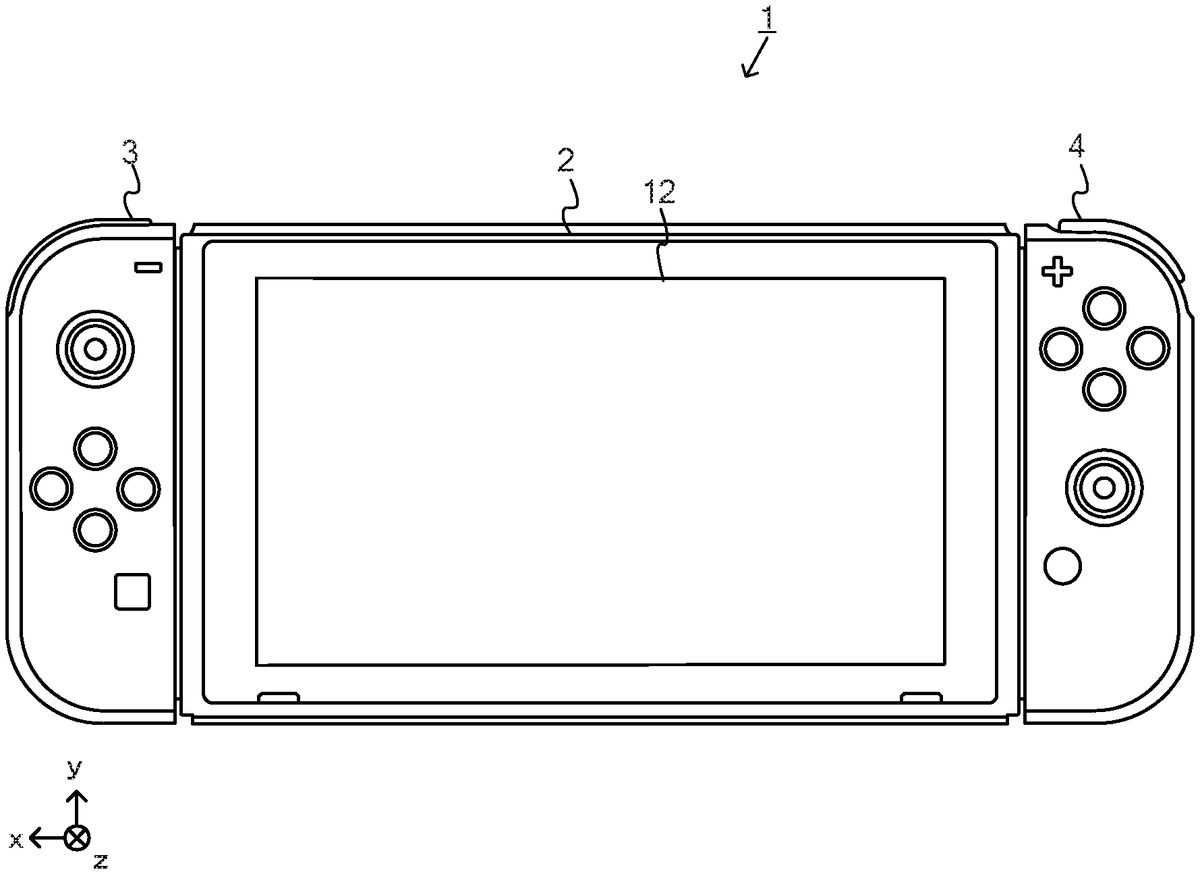
DETAILED DESCRIPTION OF NON-LIMITING EXAMPLE EMBODIMENTS Hereinafter, the exemplary embodiments will be described. First, a game system according to an example of an exemplary embodiment is described below. An example of a game system1according to the exemplary embodiment includes a main body apparatus (an information processing apparatus; which functions as a game apparatus main body in the exemplary embodiment)2, a left controller3, and a right controller4. Each of the left controller3and the right controller4is attachable to and detachable from the main body apparatus2. That is, the game system1can be used as a unified apparatus obtained by attaching each of the left controller3and the right controller4to the main body apparatus2. Further, in the game system1, the main body apparatus2, the left controller3, and the right controller4can also be used as separate bodies (seeFIG. 2). Hereinafter, first, the hardware configuration of the game system1according to the exemplary embodiment is described, and then, the control of the game system1according to the exemplary embodiment is described. FIG. 1is a diagram showing an example of the state where the left controller3and the right controller4are attached to the main body apparatus2. As shown inFIG. 1, each of the left controller3and the right controller4is attached to and unified with the main body apparatus2. The main body apparatus2is an apparatus for performing various processes (e.g., game processing) in the game system1. The main body apparatus2includes a display12. Each of the left controller3and the right controller4is an apparatus including operation sections with which a user provides inputs. FIG. 2is a diagram showing an example of the state where each of the left controller3and the right controller4is detached from the main body apparatus2. As shown inFIGS. 1 and 2, the left controller3and the right controller4are attachable to and detachable from the main body apparatus2. It should be noted that hereinafter, ...
DETAILED DESCRIPTION OF NON-LIMITING EXAMPLE EMBODIMENTS
Hereinafter, the exemplary embodiments will be described. First, a game system according to an example of an exemplary embodiment is described below. An example of a game system1according to the exemplary embodiment includes a main body apparatus (an information processing apparatus; which functions as a game apparatus main body in the exemplary embodiment)2, a left controller3, and a right controller4. Each of the left controller3and the right controller4is attachable to and detachable from the main body apparatus2. That is, the game system1can be used as a unified apparatus obtained by attaching each of the left controller3and the right controller4to the main body apparatus2. Further, in the game system1, the main body apparatus2, the left controller3, and the right controller4can also be used as separate bodies (seeFIG. 2). Hereinafter, first, the hardware configuration of the game system1according to the exemplary embodiment is described, and then, the control of the game system1according to the exemplary embodiment is described.
FIG. 1is a diagram showing an example of the state where the left controller3and the right controller4are attached to the main body apparatus2. As shown inFIG. 1, each of the left controller3and the right controller4is attached to and unified with the main body apparatus2. The main body apparatus2is an apparatus for performing various processes (e.g., game processing) in the game system1. The main body apparatus2includes a display12. Each of the left controller3and the right controller4is an apparatus including operation sections with which a user provides inputs.
FIG. 2is a diagram showing an example of the state where each of the left controller3and the right controller4is detached from the main body apparatus2. As shown inFIGS. 1 and 2, the left controller3and the right controller4are attachable to and detachable from the main body apparatus2. It should be noted that hereinafter, the left controller3and the right controller4will occasionally be referred to collectively as a “controller”.
FIG. 3is six orthogonal views showing an example of the main body apparatus2. As shown inFIG. 3, the main body apparatus2includes an approximately plate-shaped housing11. In the exemplary embodiment, a main surface (in other words, a surface on a front side, i.e., a surface on which the display12is provided) of the housing11has a generally rectangular shape.
It should be noted that the shape and the size of the housing11are optional. As an example, the housing11may be of a portable size. Further, the main body apparatus2alone or the unified apparatus obtained by attaching the left controller3and the right controller4to the main body apparatus2may function as a mobile apparatus. The main body apparatus2or the unified apparatus may function as a handheld apparatus or a portable apparatus.
As shown inFIG. 3, the main body apparatus2includes the display12, which is provided on the main surface of the housing11. The display12displays an image generated by the main body apparatus2. In the exemplary embodiment, the display12is a liquid crystal display device (LCD). The display12, however, may be a display device of any type.
The main body apparatus2includes speakers (i.e., speakers88shown inFIG. 6) within the housing11. As shown inFIG. 3, speaker holes11aand11bare formed on the main surface of the housing11. Then, sounds output from the speakers88are output through the speaker holes11aand11b.
Further, the main body apparatus2includes a left terminal17, which is a terminal for the main body apparatus2to perform wired communication with the left controller3, and a right terminal21, which is a terminal for the main body apparatus2to perform wired communication with the right controller4.
As shown inFIG. 3, the main body apparatus2includes a slot23. The slot23is provided on an upper side surface of the housing11. The slot23is so shaped as to allow a predetermined type of storage medium to be attached to the slot23. The predetermined type of storage medium is, for example, a dedicated storage medium (e.g., a dedicated memory card) for the game system1and an information processing apparatus of the same type as the game system1. The predetermined type of storage medium is used to store, for example, data (e.g., saved data of an application or the like) used by the main body apparatus2and/or a program (e.g., a program for an application or the like) executed by the main body apparatus2. Further, the main body apparatus2includes a power button28.
The main body apparatus2includes a lower terminal27. The lower terminal27is a terminal for the main body apparatus2to communicate with a cradle. In the exemplary embodiment, the lower terminal27is a USB connector (more specifically, a female connector). Further, when the unified apparatus or the main body apparatus2alone is mounted on the cradle, the game system1can display on a stationary monitor an image generated by and output from the main body apparatus2. Further, in the exemplary embodiment, the cradle has the function of charging the unified apparatus or the main body apparatus2alone mounted on the cradle. Further, the cradle has the function of a hub device (specifically, a USB hub).
FIG. 4is six orthogonal views showing an example of the left controller3. As shown inFIG. 4, the left controller3includes a housing31. In the exemplary embodiment, the housing31has a vertically long shape, i.e., is shaped to be long in an up-down direction (i.e., a y-axis direction shown inFIGS. 1 and 4). In the state where the left controller3is detached from the main body apparatus2, the left controller3can also be held in the orientation in which the left controller3is vertically long. The housing31has such a shape and a size that when held in the orientation in which the housing31is vertically long, the housing31can be held with one hand, particularly the left hand. Further, the left controller3can also be held in the orientation in which the left controller3is horizontally long. When held in the orientation in which the left controller3is horizontally long, the left controller3may be held with both hands.
The left controller3includes an analog stick32. As shown inFIG. 4, the analog stick32is provided on a main surface of the housing31. The analog stick32can be used as a direction input section with which a direction can be input. The user tilts the analog stick32and thereby can input a direction corresponding to the direction of the tilt (and input a magnitude corresponding to the angle of the tilt). It should be noted that the left controller3may include a directional pad, a slide stick that allows a slide input, or the like as the direction input section, instead of the analog stick. Further, in the exemplary embodiment, it is possible to provide an input by pressing the analog stick32.
The left controller3includes various operation buttons. The left controller3includes four operation buttons33to36(specifically, a right direction button33, a down direction button34, an up direction button35, and a left direction button36) on the main surface of the housing31. Further, the left controller3includes a record button37and a “−” (minus) button47. The left controller3includes a first L-button38and a ZL-button39in an upper left portion of a side surface of the housing31. Further, the left controller3includes a second L-button43and a second R-button44, on the side surface of the housing31on which the left controller3is attached to the main body apparatus2. These operation buttons are used to give instructions depending on various programs (e.g., an OS program and an application program) executed by the main body apparatus2.
Further, the left controller3includes a terminal42for the left controller3to perform wired communication with the main body apparatus2.
FIG. 5is six orthogonal views showing an example of the right controller4. As shown inFIG. 5, the right controller4includes a housing51. In the exemplary embodiment, the housing51has a vertically long shape, i.e., is shaped to be long in the up-down direction. In the state where the right controller4is detached from the main body apparatus2, the right controller4can also be held in the orientation in which the right controller4is vertically long. The housing51has such a shape and a size that when held in the orientation in which the housing51is vertically long, the housing51can be held with one hand, particularly the right hand. Further, the right controller4can also be held in the orientation in which the right controller4is horizontally long. When held in the orientation in which the right controller4is horizontally long, the right controller4may be held with both hands.
Similarly to the left controller3, the right controller4includes an analog stick52as a direction input section. In the exemplary embodiment, the analog stick52has the same configuration as that of the analog stick32of the left controller3. Further, the right controller4may include a directional pad, a slide stick that allows a slide input, or the like, instead of the analog stick. Further, similarly to the left controller3, the right controller4includes four operation buttons53to56(specifically, an A-button53, a B-button54, an X-button55, and a Y-button56) on a main surface of the housing51. Further, the right controller4includes a “+” (plus) button57and a home button58. Further, the right controller4includes a first R-button60and a ZR-button61in an upper right portion of a side surface of the housing51. Further, similarly to the left controller3, the right controller4includes a second L-button65and a second R-button66.
Further, the right controller4includes a terminal64for the right controller4to perform wired communication with the main body apparatus2.
FIG. 6is a block diagram showing an example of the internal configuration of the main body apparatus2. The main body apparatus2includes components81to91,97, and98shown inFIG. 6in addition to the components shown inFIG. 3. Some of the components81to91,97, and98may be mounted as electronic components on an electronic circuit board and accommodated in the housing11.
The main body apparatus2includes a processor81. The processor81is an information processing section for executing various types of information processing to be executed by the main body apparatus2. For example, the processor81may be composed only of a CPU (Central Processing Unit), or may be composed of a SoC (System-on-a-chip) having a plurality of functions such as a CPU function and a GPU (Graphics Processing Unit) function. The processor81executes an information processing program (e.g., a game program) stored in a storage section (specifically, an internal storage medium such as a flash memory84, an external storage medium attached to the slot23, or the like), thereby performing the various types of information processing.
The main body apparatus2includes a flash memory84and a DRAM (Dynamic Random Access Memory)85as examples of internal storage media built into the main body apparatus2. The flash memory84and the DRAM85are connected to the processor81. The flash memory84is a memory mainly used to store various data (or programs) to be saved in the main body apparatus2. The DRAM85is a memory used to temporarily store various data used for information processing.
The main body apparatus2includes a slot interface (hereinafter abbreviated as “I/F”)91. The slot I/F91is connected to the processor81. The slot I/F91is connected to the slot23, and in accordance with an instruction from the processor81, reads and writes data from and to the predetermined type of storage medium (e.g., a dedicated memory card) attached to the slot23.
The processor81appropriately reads and writes data from and to the flash memory84, the DRAM85, and each of the above storage media, thereby performing the above information processing.
The main body apparatus2includes a controller communication section83. The controller communication section83is connected to the processor81. The controller communication section83wirelessly communicates with the left controller3and/or the right controller4. The communication method between the main body apparatus2and the left controller3and the right controller4is optional. In the exemplary embodiment, the controller communication section83performs communication compliant with the Bluetooth (registered trademark) standard with the left controller3and with the right controller4.
The processor81is connected to the left terminal17, the right terminal21, and the lower terminal27. When performing wired communication with the left controller3, the processor81transmits data to the left controller3via the left terminal17and also receives operation data from the left controller3via the left terminal17. Further, when performing wired communication with the right controller4, the processor81transmits data to the right controller4via the right terminal21and also receives operation data from the right controller4via the right terminal21. Further, when communicating with the cradle, the processor81transmits data to the cradle via the lower terminal27. As described above, in the exemplary embodiment, the main body apparatus2can perform both wired communication and wireless communication with each of the left controller3and the right controller4. Further, when the unified apparatus obtained by attaching the left controller3and the right controller4to the main body apparatus2or the main body apparatus2alone is attached to the cradle, the main body apparatus2can output data (e.g., image data or sound data) to the stationary monitor or the like via the cradle.
Here, the main body apparatus2can communicate with a plurality of left controllers3simultaneously (in other words, in parallel). Further, the main body apparatus2can communicate with a plurality of right controllers4simultaneously (in other words, in parallel). Thus, a plurality of users can simultaneously provide inputs to the main body apparatus2, each using a set of the left controller3and the right controller4. As an example, a first user can provide an input to the main body apparatus2using a first set of the left controller3and the right controller4, and simultaneously, a second user can provide an input to the main body apparatus2using a second set of the left controller3and the right controller4.
Further, the display12is connected to the processor81. The processor81displays a generated image (e.g., an image generated by executing the above information processing) and/or an externally acquired image on the display12.
The main body apparatus2includes a codec circuit87and speakers (specifically, a left speaker and a right speaker)88. The codec circuit87is connected to the speakers88and a sound input/output terminal25and also connected to the processor81. The codec circuit87is a circuit for controlling the input and output of sound data to and from the speakers88and the sound input/output terminal25.
The main body apparatus2includes a power control section97and a battery98. The power control section97is connected to the battery98and the processor81. Further, although not shown inFIG. 6, the power control section97is connected to components of the main body apparatus2(specifically, components that receive power supplied from the battery98, the left terminal17, and the right terminal21). Based on a command from the processor81, the power control section97controls the supply of power from the battery98to the above components.
Further, the battery98is connected to the lower terminal27. When an external charging device (e.g., the cradle) is connected to the lower terminal27, and power is supplied to the main body apparatus2via the lower terminal27, the battery98is charged with the supplied power.
FIG. 7is a block diagram showing examples of the internal configurations of the main body apparatus2, the left controller3, and the right controller4. It should be noted that the details of the internal configuration of the main body apparatus2are shown inFIG. 6and therefore are omitted inFIG. 7.
The left controller3includes a communication control section101, which communicates with the main body apparatus2. As shown inFIG. 7, the communication control section101is connected to components including the terminal42. In the exemplary embodiment, the communication control section101can communicate with the main body apparatus2through both wired communication via the terminal42and wireless communication not via the terminal42. The communication control section101controls the method for communication performed by the left controller3with the main body apparatus2. That is, when the left controller3is attached to the main body apparatus2, the communication control section101communicates with the main body apparatus2via the terminal42. Further, when the left controller3is detached from the main body apparatus2, the communication control section101wirelessly communicates with the main body apparatus2(specifically, the controller communication section83). The wireless communication between the communication control section101and the controller communication section83is performed in accordance with the Bluetooth (registered trademark) standard, for example.
Further, the left controller3includes a memory102such as a flash memory. The communication control section101includes, for example, a microcomputer (or a microprocessor) and executes firmware stored in the memory102, thereby performing various processes.
The left controller3includes buttons103(specifically, the buttons33to39,43,44, and47). Further, the left controller3includes the analog stick (“stick” inFIG. 7)32. Each of the buttons103and the analog stick32outputs information regarding an operation performed on itself to the communication control section101repeatedly at appropriate timing.
The left controller3includes inertial sensors. Specifically, the left controller3includes an acceleration sensor104. Further, the left controller3includes an angular velocity sensor105. In the exemplary embodiment, the acceleration sensor104detects the magnitudes of accelerations along predetermined three axial (e.g., xyz axes shown inFIG. 4) directions. It should be noted that the acceleration sensor104may detect an acceleration along one axial direction or accelerations along two axial directions. In the exemplary embodiment, the angular velocity sensor105detects angular velocities about predetermined three axes (e.g., the xyz axes shown inFIG. 4). It should be noted that the angular velocity sensor105may detect an angular velocity about one axis or angular velocities about two axes. Each of the acceleration sensor104and the angular velocity sensor105is connected to the communication control section101. Then, the detection results of the acceleration sensor104and the angular velocity sensor105are output to the communication control section101repeatedly at appropriate timing.
The communication control section101acquires information regarding an input (specifically, information regarding an operation or the detection result of the sensor) from each of input sections (specifically, the buttons103, the analog stick32, and the sensors104and105). The communication control section101transmits operation data including the acquired information (or information obtained by performing predetermined processing on the acquired information) to the main body apparatus2. It should be noted that the operation data is transmitted repeatedly, once every predetermined time. It should be noted that the interval at which the information regarding an input is transmitted from each of the input sections to the main body apparatus2may or may not be the same.
The above operation data is transmitted to the main body apparatus2, whereby the main body apparatus2can obtain inputs provided to the left controller3. That is, the main body apparatus2can determine operations on the buttons103and the analog stick32based on the operation data. Further, the main body apparatus2can calculate information regarding the motion and/or the orientation of the left controller3based on the operation data (specifically, the detection results of the acceleration sensor104and the angular velocity sensor105).
The left controller3includes a power supply section108. In the exemplary embodiment, the power supply section108includes a battery and a power control circuit. Although not shown inFIG. 7, the power control circuit is connected to the battery and also connected to components of the left controller3(specifically, components that receive power supplied from the battery).
As shown inFIG. 7, the right controller4includes a communication control section111, which communicates with the main body apparatus2. Further, the right controller4includes a memory112, which is connected to the communication control section111. The communication control section111is connected to components including the terminal64. The communication control section111and the memory112have functions similar to those of the communication control section101and the memory102, respectively, of the left controller3. Thus, the communication control section111can communicate with the main body apparatus2through both wired communication via the terminal64and wireless communication not via the terminal64(specifically, communication compliant with the Bluetooth (registered trademark) standard). The communication control section111controls the method for communication performed by the right controller4with the main body apparatus2.
The right controller4includes input sections similar to the input sections of the left controller3. Specifically, the right controller4includes buttons113, the analog stick52, and inertial sensors (an acceleration sensor114and an angular velocity sensor115). These input sections have functions similar to those of the input sections of the left controller3and operate similarly to the input sections of the left controller3.
The right controller4includes a power supply section118. The power supply section118has a function similar to that of the power supply section108of the left controller3and operates similarly to the power supply section108.
In the exemplary embodiment, it is assumed that the game is played in a state in which the main body apparatus2alone is mounted on the cradle with the left controller3and the right controller4detached from the main body apparatus2, and an image generated and outputted by the main body apparatus2is displayed on a stationary monitor, as an example.
Next, the outline of the game process assumed in the exemplary embodiment will be described. In the exemplary embodiment, a game in which correct directions are presented in advance and a player is caused to perform direction inputs in the correct directions, is assumed. Specifically, a plurality of questions are prepared, and in each question, one of four directions, i.e., up, down, left, and right is defined as a direction that is a “correct answer” (hereinafter, correct direction). Then, correct directions in the respective questions are indicated as “question presentation” to a player in advance. Thereafter, the player is caused to perform direction inputs using the controller, and whether or not each input direction is the correct direction is determined, while the game progresses. In particular, in this game, correct directions for a plurality of questions are indicated to a player in a certain order at the time of question presentation, and the player is caused to input the correct directions in this order. In other words, the game tests the player's memory. More specifically, the game assumed in the exemplary embodiment is a flag swing game. In this game, the directions in which a flag is to be swung are indicated (question-presented) to a player in advance, and the player performs direction inputs using the controller to cause a player object to swing the flag.
Next, operations in the game assumed in the exemplary embodiment will be described. In this game, direction inputs are performed using the inertial sensors. That is, a player swings the controller in the up/down/left/right direction, to perform a direction input in each direction.FIG. 8shows an example of the player and the orientation of the controller when this game is played. In the example shown inFIG. 8, the player plays the game with the right hand holding the right controller4in the orientation in which the right controller4is vertically long. In the direction input operation, the orientation in which the y-axis direction of the right controller4is horizontal to the ground (the orientation in which the y-axis direction of the right controller4is perpendicular to the gravity direction, or the orientation in which the y-axis direction of the right controller4is parallel to the z axis of the real space coordinate system inFIG. 8) is defined as “reference orientation”. Then, the player performs an action of swinging the right controller4in the up/down/left/right direction on the basis of the “reference orientation”. A motion of the right controller4along with the action is detected and a swing in the up/down/left/right direction is treated as a direction input to each direction.
For reference,FIG. 9andFIG. 10show the reference orientation and examples of changes in the orientation of the right controller4to the up/down/left/right directions.FIG. 9is a schematic view showing an example of change in the orientation of the right controller4along with a swing in the up-down direction. As shown inFIG. 9, an operation of turning the orientation about the x-axis direction of the right controller4as a turning axis so that the head of the right controller4faces upward (positive direction of the y axis in the real space coordinate system) is treated as an input to “upward direction” (hereinafter, upward swing). On the other hand, an operation of turning the orientation so that the head of the right controller4faces downward (negative direction of the y axis in the real space coordinate system) is treated as an input to “downward direction” (hereinafter, downward swing). Next,FIG. 10is a schematic view showing an example of change in the orientation of the right controller4along with a swing in the left-right direction. As shown inFIG. 10, an operation of turning the orientation about the z-axis direction of the right controller4as a turning axis so that the head of the right controller4faces leftward (positive direction of the x axis in the real space coordinate system) is treated as an input to “leftward direction” (hereinafter, leftward swing). On the other hand, an operation of turning the orientation so that the head of the right controller4faces rightward (negative direction of the x axis in the real space coordinate system) is treated as an input to “rightward direction” (hereinafter, rightward swing).
In this example, the case of using the right controller4is shown. However, the same processing is applicable even in the case of using the left controller3.
Next, flow of the game will be described with reference to screen examples. Here, the number of questions is four, as an example. The correct directions are up, right, left, and then down, in the order from the first question. When the game is started, a “model example” indicating the order in which the flag is to be swung is presented to the player (in other words, questions are presented).FIG. 11andFIG. 12show examples of screens for presenting the model example. InFIG. 11, a model example presenting character holding a flag is displayed, and a message for presenting the model example is also displayed.FIG. 12shows the model example presenting character actually swinging the flag. Here, a motion (animation) of the model example presenting character swinging the flag in the order of up, right, left, down is to be displayed (meanwhile, the player needs to memorize the order in which the flag is to be swung).
After the presentation of the model example is finished, a preparatory screen for answering is displayed as shown inFIG. 13. In this screen, a player character201holding a flag is displayed, and an instruction for causing the player to hold the controller in the horizontal orientation is displayed. Accordingly, the player holds the controller in the orientation as shown above inFIG. 8. When a state in which the orientation of the controller is horizontal and at rest has continued for a predetermined time period, it is determined that the player is ready for answering. Then, although not shown, a message or the like to indicate start of answering is displayed as appropriate, and an input of an answer is started. Subsequently, the player performs answering operations. That is, the player sequentially performs operations of swinging the controller in directions that the player thinks are in accordance with the order indicated by the model example (depending on the player's own memory). Namely, direction inputs are sequentially performed. In this example, the number of questions are four, and one question corresponds to one swing operation. Therefore, the player needs to perform four swing operations in total.FIG. 14shows an example of a screen when the answer is being inputted. The player character201in the screen is swinging the flag in a predetermined direction in accordance with the player's operation of swinging the controller. In addition, information indicating the number of questions remaining is also displayed above the player character201. In this example, every time one direction input (one swing operation) is performed, whether the inputted direction is correct or incorrect is indicated. In another example, correct/incorrect indication may be collectively displayed after inputs for four questions are finished. When an input is incorrect, the answering may be finished here. The correct/incorrect indication is presented by displaying a circle or x mark on the screen as appropriate, for example. Then, when the answer inputs are finished, a result screen as shown inFIG. 15is displayed. In the result screen, the number of correct answers, the score, and the like are displayed.
In the case of performing direction inputs by continuously swinging the controller as in this example, between the inputs, there is a possibility that an input in a direction different from the direction that the player originally desires to input occurs and thus erroneous determination is performed. That is, depending on the way (habit) of the player's swing, some motion in the trajectory of change in the orientation of the controller (orientation change process) might be determined to be an input in a direction different from an intended direction. For example, in the case of swinging rightward and then upward, even though the player thinks that the player is raising the arm straightly upward, the controller (head thereof) might not be directed straightly upward but might be in an orientation tilted obliquely rightward, and at this time, there is a possibility that the swing is determined to be a rightward swing. In addition, when the controller is in an intermediate orientation before completely changing into the upward orientation, there is a possibility that the swing is determined to be a rightward swing at some timing. In addition, for example, in the case of swinging the controller rightward and then upward, depending on the player's way of swinging, the habit, or the like, an input in the downward direction can occur momentarily before swinging upward (for example, unconsciously “holding” in the downward direction in order to swing in the upward direction). In such a case, even though the player intends to swing the controller from right to up, there is a possibility that it is erroneously determined that inputs from right to down are performed. In view of such problems, in the exemplary embodiment, input determination control is performed for decreasing the possibility of erroneous determination in the case of continuously performing direction inputs, so as to facilitate a correct direction input. Hereinafter, the summary of the input determination control according to the exemplary embodiment will be described.
In the exemplary embodiment, a projection vector is used for determination of the input direction. Specifically, a virtual plane (hereinafter, projection plane) perpendicular to the frontward direction of the player is assumed. On the projection plane, an orientation vector in the y-axis direction (seeFIG. 4andFIG. 5) of the controller is projected while the vector in the reference orientation as described later is set as an origin, whereby a projection vector is calculated. Then, input direction determination is performed on the basis of the projection vector.
Here, as a premise for the input direction determination according to the exemplary embodiment, the definition of the angle of the projection vector on the projection plane in the exemplary embodiment will be described.FIG. 16shows the definition of the angle of the projection vector on the projection plane. As shown inFIG. 16, the right side of the y axis is allocated as a region of 0 degrees to 180 degrees, and the left side of the y axis is allocated as a region of 0 degrees to −180. In the following description, for the angle of the projection vector, such a definition is used as a premise.
In addition, as a premise for the input direction determination according to the exemplary embodiment, the definition of “magnitude of input” in the exemplary embodiment will be described. The magnitude of input is the magnitude of a direction input performed by an operation of the player swinging the controller in the up/down/left/right direction. Basically, the projection vector becomes a greater vector as the player directs the controller upward, downward, leftward, or rightward more definitely. However, it is conceivable that, when the player swings the controller, the controller is excessively moved to be directed frontward relative to the projection plane. For example, the case of swinging the right controller4upward is assumed. In this case, if the momentum of the swing is great, it is conceivable that the right controller4is not stopped with the head of the right controller4directed straightly upward, but comes into an orientation slightly tilted backward of the player, as shown inFIG. 17. In such a case, the magnitude of input is greater as compared to a state in which the head of the right controller4is directed straightly upward, but the magnitude of the projection vector is smaller as compared to a state in which the head of the right controller4is directed straightly upward. Considering this, in the exemplary embodiment, the magnitude of input is calculated as follows.
The case of upward swing will be described as an example. First, regarding the correspondence between the range of the magnitude of input and change in the orientation, values in a range of 0 to 2 are allocated as shown inFIG. 18. InFIG. 18, the magnitude of input in the reference orientation is defined as 0, and the magnitude of input in a state in which the head of the controller is directed straightly upward (orientation in which the y axis of the controller is parallel to the projection plane) is defined as 1. Further, the magnitude of input in a state in which the head of the controller is directed in the negative direction of the z axis in the real space coordinate system is defined as 2.
Under such an allocation, the orientation in which the head of the controller is slightly tilted backward of the player (orientation in which the controller is directed frontward relative to the projection plane) as shown inFIG. 17will be used as an example. In this case, the magnitude of input is calculated as “2−magnitude of projection vector”. For example, it is assumed that the magnitude of the projection vector in the orientation shown inFIG. 17is 0.8. In this case, the magnitude of input is calculated as 2−0.8=1.2. That is, whether or not the controller is in an orientation directed frontward relative to the projection plane is determined, and if a result of the determination is affirmative, the magnitude of input is calculated as “2−magnitude of projection vector”. On the other hand, if a result of the determination is negative, the magnitude of the projection vector is calculated directly as the magnitude of input. Whether or not the controller is in an orientation directed frontward relative to the projection plane can be determined on the basis of outputs from the inertial sensors (e.g., rotation angle of the controller). In the exemplary embodiment, the magnitude of input is calculated as a value that varies in a range of 0 to 2 by the above calculation method.
Next, various thresholds used for input direction determination in the exemplary embodiment and the determination method using these will be described. Basically, the input direction is determined by referring to the direction of the projection vector on the projection plane. In the exemplary embodiment, as determination results, five types, i.e., “up”, “down”, “left”, “right”, and “none” are obtained. In addition, as the thresholds used for the determination, an angle that is determined to be an upward direction, an angle that is determined to be a leftward direction, an angle that is determined to be a rightward direction, and an angle that is determined to be a downward direction, are set. In addition, a magnitude of input required for each direction is also set (for example, as compared to the up/down direction, a direction input in the left/right direction is required to be a more definite input).
In the exemplary embodiment, the thresholds used for the above determination are roughly classified into three types of thresholds. Then, on the basis of the magnitude of input, three types of determinations are performed in stages using the three types of thresholds. In the following description, the three types of determinations are referred to as “first determination”, “second determination”, and “third determination”. These determinations are performed in the order of “first determination”, “second determination”, “third determination”, and if it is determined that there is any direction input in any of the determinations, the “present input direction” becomes definite there. In the determination, input determination control is performed in which, mainly, the size of an area where the input is determined to be correct on the projection plane is adjusted in accordance with the correct direction in each question, thereby decreasing the possibility of erroneous determination and facilitating a correct direction input. Hereinafter, these three types of determinations will be described.
[First Determination]
First, the first determination will be described. In the first determination, the case where “the magnitude of input is great to a certain extent” is assumed. That is, the first determination is performed when an input that is great to a certain extent is performed. In this example, basically, control is performed so as to adjust the size of an area where the input is determined to be a correct direction for each question on the projection plane, but in the case where the input is great to a certain extent, it is considered that the player completely indicates a predetermined direction. Therefore, in this case, the control of increasing the angle (area size) in which the input is determined to be a correct direction more than necessary is refrained as much as possible. This is based on the standpoint that, even if the input is performed in an incorrect direction, judging from such a great magnitude of the input, this merely means that the player really makes a wrong direction input.
FIG. 19schematically shows a first threshold used in the first determination. This is conceptually a state in which the projection plane is roughly divided into four areas. InFIG. 19, the center of the projection plane is the origin. The origin corresponds to the reference orientation (projection vector thereof). InFIG. 19, a black filled part represents a non-determination area. This area indicates the minimum magnitude of input needed for being determined to be a valid direction input. In the exemplary embodiment, the magnitude of input corresponding to the non-determination area in the first threshold is 0.9. That is, the first determination is performed when an input with a magnitude greater than 0.9 occurs.
In the first threshold, first, an area where the input is determined to be the upward direction on the projection plane (hereinafter, referred to as upward area) is an area that is outside the non-determination area and in a range of −40 degrees to +40 degrees. In addition, an area where the input is determined to be the rightward direction (hereinafter, referred to as rightward area) is an area that is outside the non-determination area and in a range of +40 degrees to +120 degrees. An area where the input is determined to be the leftward direction (hereinafter, referred to as leftward area) is an area that is outside the non-determination area and in a range of −40 degrees to −120 degrees. An area where the input is determined to be the downward direction (hereinafter, referred to as downward area) is an area that is outside the non-determination area and in a range of −120 degrees to −180 degrees and a range of +180 degrees to +120 degrees. Hereinafter, the boundary line representing the angle at the boundary between the areas corresponding to the respective directions is referred to as angle threshold.
In the first determination, the angle thresholds in the first threshold for which the angles are set as described above is changed for each question in accordance with the correct direction thereof, and then the direction of the projection vector is determined. Specific examples of this change will be shown below. First, in the case where the correct direction is “upward”, the angle threshold range of the upward area is changed to −70 degrees to +70 degrees, as shown inFIG. 20. That is, by increasing the central angle of the upward area, the upward area itself is enlarged to a certain extent (these changed values are also intended to prevent the area from being enlarged more than necessary, as described above). In the case where the correct direction is “rightward”, the angle threshold range of the rightward area is changed to +40 degrees to +145 degrees, as shown inFIG. 21. That is, the rightward area is enlarged to a certain extent. In the case where the correct direction is “leftward”, the angle threshold range of the leftward area is changed to −40 degrees to −145 degrees, as shown inFIG. 22. That is, the leftward area is enlarged to a certain extent. In the case where the correct direction is “downward”, the angle thresholds are not changed. The above specific changed values are merely examples, and in another exemplary embodiment, other values may be used in accordance with the game contents or the like.
Thus, for each question, the area in the direction corresponding to the correct direction is enlarged, so that the input is more likely to be determined to be a correct input in the direction.
[Adjustment with Last Input Taken into Consideration]
In the exemplary embodiment, in addition to the adjustment according to the correct direction as described above, adjustment with the last input direction taken into consideration is also performed. This is performed considering that an erroneous input is likely to occur depending on flow of the player's operation of inputting directions. That is, control is also performed so that, depending on a combination of the direction inputted by the player last time (for last question) and a correct direction that will be inputted from now, the size of the area corresponding to the correct direction is further changed or not changed. For example, the case where the last input direction is “leftward” or “rightward” and the correct direction to be inputted next is “upward”, is assumed. In this case, when the player tries to move the controller “upward”, the player might turn the wrist once and thus it might be determined that a “downward” input is performed. Considering such a situation, in the case of input combination from “left” or “right” to “upward”, the angle threshold ranges for the left and the right are enlarged so that the “downward” area is reduced, and thus the input is less likely to be determined to be a “downward” input. Conversely, it is also possible that such control as to enlarge the determination areas as described above is not performed, depending on the combination of directions.
In the exemplary embodiment, in the first determination, the above adjustment with the last input taken into consideration is controlled as follows. That is, in the case where the correct direction is “upward” and the last input direction is “downward” (in the case of combination from downward to upward), adjustment of enlarging the angle threshold range for the upward area as described above is not performed. This is because, in the case of movement from down to up, it is considered that the input direction is less likely to deviate.
[Measure for Case where Input Determination Occurs without Orientation Change]
In the exemplary embodiment, in addition to the adjustment with the last direction taken into consideration as described above, adjustment for preventing input determination from occurring even though the controller is not moved is also performed. For example, the case where the correct direction in the first question is “rightward” and the correct direction in the second question is “upward”, is assumed. In this case, the thresholds as shown inFIG. 21are used for determination in the first question, and the thresholds as shown inFIG. 20are used for determination in the second question. In the first question, the angle of the projection vector corresponding to the player's input is assumed to be +41 degrees. In this case, in the first question, since the input is within the range of the rightward area, the input is determined to be a “rightward” direction input. Thereafter, it is assumed that the game shifts to the processing for the second question and the controller is not moved. In this case, in determination for the second question, the direction at +41 degrees is included in the upward area, and therefore, if the determination is performed in this state, the input is determined to be an upward direction input (in other words, an input in a direction other than the rightward direction) even though the player has not moved the controller (the orientation is not changed at all). Considering this, in the exemplary embodiment, in the case where the present input direction can be determined to be a different direction between both questions (even though the orientation of the controller has not changed), control is also performed so that an angle that is the present input angle (=last input angle) plus or minus 5 degrees is set as a new angle threshold. Whether to perform plus-direction adjustment or minus-direction adjustment is determined so that the present input direction becomes the input direction in the last question. For example, in the above case, in order that +41 degrees which is the angle of the present projection vector is included in the “rightward” direction, +36 degrees obtained by subtracting 5 degrees from +41 degrees is set as an angle threshold for the boundary between the upward direction and the rightward direction.
[Second Determination]
Next, the second determination will be described. In the exemplary embodiment, the second determination is performed when the magnitude of input is 0.9 or smaller. That is, when the condition for performing the first determination is not satisfied, the second determination is performed. For the second determination, thresholds corresponding to the upward, downward, leftward, and rightward directions are prepared in advance (i.e., preset). These thresholds are referred to as second thresholds. Hereinafter, with reference to the drawings, an example of the second threshold corresponding to each direction will be described.
FIG. 23shows an example of the second threshold used in the case where the correct direction is the upward direction (hereinafter, referred to as second upward direction threshold). In the second upward direction threshold, the magnitude of input needed is set at 0.5 for all of the upward, downward, leftward, and rightward directions. The upward area is a range of −68 degrees to +68 degrees. The rightward area is a range of +68 degrees to +120 degrees, and the leftward area is a range of −68 degrees to −120 degrees. A range of −120 degrees to −180 degrees and a range of +180 degrees to +120 degrees are the downward area.
Next,FIG. 24shows an example of the second threshold used in the case where the correct direction is the leftward or rightward direction (hereinafter, referred to as second leftward/rightward direction threshold). In the second leftward/rightward direction threshold, the magnitude of input needed is set at 0.5 for all of the upward, downward, leftward, and rightward directions. The upward area is a range of −40 degrees to +40 degrees. The rightward area is a range of +40 degrees to +145 degrees, and the leftward area is a range of −40 degrees to −145 degrees. The downward area is a range of −145 degrees to −180 degrees and a range of +180 degrees to +145 degrees.
Next,FIG. 25shows an example of the second threshold used in the case where the correct direction is the downward direction (hereinafter, referred to as second downward direction threshold). In the second downward direction threshold, the magnitude of input needed is set at 0.15 for all of the upward, downward, leftward, and rightward directions. The upward area is a range of −40 degrees to +40 degrees. The rightward area is a range of +40 degrees to +120 degrees, and the leftward area is a range of −40 degrees to −120 degrees. The downward area is a range of −120 degrees to −180 degrees and a range of +180 degrees to +120 degrees.
As described above, a plurality of second thresholds are selectively used in accordance with the correct direction, whereby the input is more likely to be determined to be correct for each direction.
Also in the second determination, as in the first determination, adjustment with the last input taken into consideration is performed. Specifically, for the above second threshold, the following adjustment is further performed. First, in the case where the correct direction is the upward direction and the last input direction is the leftward or rightward direction, the second upward direction threshold is adjusted as shown inFIG. 26. That is, the angle thresholds are not changed but the magnitude of input (size of non-determination area) needed is adjusted. Specifically, the magnitude of input needed for upward direction determination is changed from 0.5 to 0.86. In the case where the correct direction is the leftward direction and the last input direction is the rightward direction or in the case where the correct direction is the rightward direction and the last input direction is the leftward direction, the second leftward/rightward direction threshold is adjusted as shown inFIG. 27. That is, the magnitude of input needed for the rightward direction and the leftward direction is changed from 0.5 to 0.3 (as a result, a motion of moving from the leftward/rightward direction to the opposite direction can be detected even if the magnitude of input is small).
In this example, in the second determination, adjustment with the last direction taken into consideration is not particularly performed in the case where the correct direction is the downward direction.
Also in the second determination, adjustment for coping with input determination in the case where the orientation of the controller is not changed, as described in the first determination, is performed.
[Third Determination]
Next, the third determination will be described. In the exemplary embodiment, the third determination is performed when it is determined that there is no direction input in the second determination.FIG. 28shows a schematic view of the third threshold used in the third determination. In the third threshold, the magnitude of input needed is set at 0.45 for the upward direction, and 0.4 for the other directions. The upward area is a range of −60 degrees to +60 degrees. The rightward area is a range of +60 degrees to +125 degrees, and the leftward area is a range of −60 degrees to −125 degrees. The downward area is a range of −125 degrees to −180 degrees and a range of +180 degrees to +125 degrees.
In the third determination, in the case where the correct direction is the downward direction, the following adjustment is performed for the third threshold shown inFIG. 28, to perform input direction determination. That is, as shown inFIG. 29, the size of the rightward area is changed to a range of +60 degrees to +120 degrees, and the size of the leftward area is changed to a range of −60 degrees to −120 degrees (that is, the downward area is slightly enlarged).
Also in the third determination, as in the first and second determinations, adjustment with the last input taken into consideration is performed. Specifically, the following adjustment is further performed for the above third threshold. First, in the case where the correct direction is the upward direction and the last input direction is the downward direction, the size of the upward area is changed to a range of −40 degrees to +40 degrees, as shown inFIG. 30. In the case where the correct direction is the upward direction and the last input direction is the leftward or rightward direction, the size of the rightward area is changed to a range of +60 degrees to +140 degrees and the size of the leftward area is changed to a range of −60 degrees to −140 degrees, as shown inFIG. 31.
Next, in the case where the correct direction is the downward direction and the last input direction is the upward direction, in addition to the above-described change as shown inFIG. 29, the magnitude of input needed for the downward direction is changed from 0.4 to 0.45 as shown inFIG. 32.
Also in the third determination, adjustment for coping with input determination in the case where the orientation of the controller is not changed, as described in the first determination, is performed.
Thus, by providing the third determination, it is possible to determine the input direction even if the input is such an input that is not determined to be a direction input in the second determination (the magnitude of the input is rather small).
The “present input direction” can be determined by the determination method as described above. Here, in the exemplary embodiment, the determined “present input direction” is not immediately made definite as the “answer for the question”, but after a time period corresponding to a predetermined number of frames has elapsed, the determined “present input direction” is made definite as the “answer for the question”. Specifically, in the case where the “present input direction” is the correct direction, the “present input direction” is made definite as the correct answer when the direction input has continued for five frames. In the case where the “present input direction” is incorrect, the “present input direction” is made definite as an incorrect answer when the direction input has continued for twelve frames. Thus, when the controller is moved with a trajectory passing across an incorrect direction, the incorrect direction can be prevented from being erroneously detected as a definite answer.
As described above, in the exemplary embodiment, three types of thresholds are used for determining the input direction, and for each type of threshold, the configuration thereof is changed in accordance with the correct direction. Thus, the player's input can become more likely to be determined to be an input in the correct direction.
The above-described specific values in each type of threshold are merely an example, and values according to the game contents may be set as appropriate.
Next, with reference toFIG. 33toFIG. 41, the game process executed in the exemplary embodiment will be described in more detail.
[Used Data]
First, various data used in this game system1will be described.FIG. 33shows an example of a program and information to be stored in the DRAM85of the main body apparatus2. The DRAM85stores a game process program401, operation data402, question data405, first threshold data409, second threshold data410, third threshold data414, present direction data415, last input direction data416, correct/incorrect definite determination data417, answer result data418, and the like.
The game process program401is a program for executing the game process according to the exemplary embodiment. Specifically, this is a program for executing the process shown in the flowchart inFIG. 35described later.
The operation data402is data indicating various operations performed on the controller. The operation data402includes inertial sensor data403, button data404, and the like. The inertial sensor data403is acceleration data and angular velocity data outputted from the acceleration sensors104,114and the angular velocity sensors105,115. The button data404is data indicating whether each button is pressed.
The question data405is data regarding each question to be presented in this game process. Here, in this game, correct directions for a plurality of questions are presented in a certain order, and the player is caused to perform inputs in this order. The set of questions to be presented at one time is referred to as “stage” in this example. That is, a plurality of questions are included in one stage. In the question data405, data is stored on a stage basis. Specifically, plural sets of stage information406are stored in the question data405. InFIG. 33, the stage information is shown as n-th stage information (n is an integer starting from 1).FIG. 34shows an example of the data structure of the stage information406. The stage information406is configured as table-format data having items of question presentation order4061and correct direction information4062. The question presentation order4061is information indicating the order in which the questions are to be presented. In this example, this corresponds to the order in which the flag is to be swung. The correct direction information4062is information indicating correct directions for the respective questions.
Returning toFIG. 33, the first threshold data409is data that defines the details of the first threshold as shown inFIG. 19. That is, the first threshold data409is data that defines the magnitude of input needed and the angle thresholds corresponding to the up/down/left/right boundaries.
The second threshold data410is data that defines the details of the second threshold. In this example, the second threshold data410includes second upward direction threshold data411, second leftward/rightward direction threshold data412, and second downward direction threshold data413. These data respectively correspond to the second upward direction threshold, the second leftward/rightward direction threshold, and the second downward direction threshold as described inFIG. 23toFIG. 25.
In the exemplary embodiment, thresholds used for rightward direction determination and leftward direction determination in the second determination are substantially the same, and therefore the same common data is used between the rightward direction and the leftward direction. However, in another exemplary embodiment, thresholds with different configurations for the leftward direction and the rightward direction may be used, and respective different data therefor may be stored.
Next, the third threshold data414is data that defines the details of the third threshold described above with reference toFIG. 28.
The present direction data415is data indicating the “present input direction”. That is, the present direction data415is data indicating the input direction at the present frame that is determined through the above-described determination. As the initial value thereof, information indicating “unspecified” which indicates that the present direction has not been determined yet, is set.
The last input direction data416is data indicating the input direction that has become definite as the answer for the last question (whether correct or incorrect).
The correct/incorrect definite determination data417is data to be used in processing for making the “answer for the question” definite after a time period corresponding to a predetermined number of frames has elapsed. Specifically, in this data, the history of the present direction data415can be stored for up to the past twelve frames. Data for a frame beyond twelve frames is deleted from the oldest one.
The answer result data418is data for storing the player's answer contents for the respective questions. For example, this data indicates whether or not each question is unanswered, and if the answer is not unanswered, indicates the answer content. This data is used for final score calculation and the like. The progress of answering (the number of answered questions) can also be obtained on the basis of this data.
Besides, although not shown, various data to be used in the game process, such as data indicating the projection vector calculated in the process, and image data of the model example presenting character, the player character, and the like, are also stored in the DRAM85.
[Detailed Flowchart]
Next, with reference to the flowchart shown inFIG. 35, flow of the game process executed by the game system1will be described. The processing loop in steps S3to S5inFIG. 35is repeatedly executed every frame (e.g., 1/60 s), for example.
When the game is started, various data to be used in the game process are initialized, and then the processor81executes question presentation processing in step S1. This is processing for presenting a “model example” as shown inFIG. 11, to the player. Specifically, the processor81acquires the stage information406corresponding to the stage for presenting questions at this time, from the question data405. Subsequently, the processor81generates and displays a question presentation screen as shown inFIG. 11. Then, the processor81presents correct directions, i.e., the order in which the controller (flag) is to be swung, to the player, on the basis of the question presentation order4061and the correct direction information4062included in the stage information406. Specifically, the processor81causes the model example presenting character to perform a motion of swinging the flag object in the correct direction for each question in the order indicated by the question presentation order4061.
After the question presentation processing is finished, next, in step S2, the processor81executes game start processing. Specifically, the processor81displays a preparatory screen as shown inFIG. 13and an indication for promoting the player to hold the controller in the reference orientation. Thereafter, when it is confirmed that the controller is in the reference orientation, for example, countdown for starting answer input is displayed and reception of answer inputs from the player is started. The confirmation of the reference orientation is performed through, for example, determination for whether or not the state in which the controller is horizontal and at rest as shown inFIG. 8or the like has continued for a predetermined number of frames, on the basis of the inertial sensor data403.
Next, in step S3, the processor81executes an answer input and determination process.FIG. 36andFIG. 37are flowcharts showing the details of the answer input and determination process. InFIG. 36, first, in step S11, the processor81acquires the operation data402.
Next, in step S12, the processor81calculates the projection vector on the basis of the inertial sensor data403. Specifically, the processor81calculates a three-dimensional vector indicating the orientation of the y-axis direction (seeFIG. 5) of the controller on the basis of the inertial sensor data403. Then, the processor81calculates a two-dimensional projection vector by projecting the three-dimensional vector on the above-described projection plane with the reference orientation set as an origin. Thus, the direction of the projection vector and the magnitude of the projection vector can be calculated.
Next, in step S13, the processor81calculates the magnitude of input described above with reference toFIG. 18. For example, the processor81determines whether the orientation of the controller is in a range of 0 to 1 or in a range of 1 to 2 as shown inFIG. 18. Then, if the orientation is in a range of 1 to 2, the processor81calculates a value obtained by “2−magnitude of projection vector”, as the magnitude of input. On the other hand, if the orientation is in a range of 0 to 1, the processor81calculates the magnitude of the projection vector directly as the magnitude of input.
In this example, the following processing is performed using the calculated magnitude of input. However, in another exemplary embodiment, the magnitude of input may be reflected in the “magnitude of the projection vector”, and then processing using the magnitude of the projection vector may be performed.
Next, in step S14, the processor81initializes the present direction data415.
Next, in step S15, the processor81executes a first determination process.FIG. 38is a flowchart showing the details of the first determination process. First, in step S31, the processor81determines whether or not the calculated magnitude of input is greater than 0.9. As a result of the determination, if the calculated magnitude of input is not greater than 0.9 (NO in step S31), the processor81finishes the first determination process. That is, the first determination process is finished in a state in which the “present input direction” has not been determined.
On the other hand, if the magnitude of input is greater than 0.9 (YES in step S31), the processor81reads the first threshold data409in step S32.
Next, in step S33, the processor81acquires the correct direction information4062for the present question. Then, the processor81executes processing for adjusting the angle thresholds in accordance with the correct direction as described above with reference toFIG. 20toFIG. 22.
Next, in step S34, the processor81executes angle threshold adjustment processing with the last input direction taken into consideration. That is, the processor81executes processing of further adjusting the angle thresholds for a predetermined direction on the basis of the last input direction data416and the correct direction at this time. In the case of the first question, the last input direction has not been determined (for example, the content of the last input direction data416is determined to be unspecified), and therefore the above processing is not performed.
Next, in step S35, the processor81executes adjustment processing for coping with a phenomenon in which, even though the orientation of the controller is not changed, the input direction is determined to be different between processing for the last frame and processing for the present frame, as described above. For example, the processor81performs determination as to the input direction, using the angle of the input direction indicated by the last input direction data416and the threshold adjusted through the processing until step S34(threshold to be used at this time). Then, the processor81determines whether or not the determination result differs from the input direction in the processing for the last frame. That is, the processor81determines whether or not input determination occurs even though the controller is not moved. As a result, if performing determination as to the last input angle on the basis of the threshold used at this time leads to a determination result different from the last determination result, processing of further adjusting the angle threshold for the threshold that is used in the determination at this time is performed as described above. Also here, in the case of the first question, the last input direction data416does not exist yet, and therefore the above processing is not performed.
Next, in step S36, the processor81performs determination as to the present input direction, using the first threshold that has undergone the various adjustments described above, and the above calculated projection vector (direction thereof). Subsequently, in step S37, the processor81stores information indicating the determination result, into the present direction data415. That is, the “present input direction” has been determined (here, determined to be “upward”, “downward”, “leftward”, or “rightward”). Further, the processor81adds the same information as the present direction data415, also to the correct/incorrect definite determination data417. Thus, the first determination process is finished.
Returning toFIG. 36, next, in step S16, the processor81determines whether or not the “present input direction” has been determined through the first determination process, by referring to the present direction data415. As a result, if the “present input direction” has been determined (YES in step S16), the process proceeds to step S20described later.
On the other hand, if the “present input direction” has not been determined yet (NO in step S16), the processor81executes the second determination process in step S17.FIG. 39is a flowchart showing the details of the second determination process. First, in step S41, the processor81acquires the correct direction information4062for the present question. Further, the processor81reads any one of the second upward direction threshold data411, the second leftward/rightward direction threshold data412, and the second downward direction threshold data413, in accordance with the correct direction for the present question.
Next, in step S42, the processor81executes angle threshold adjustment processing with the last input direction taken into consideration. That is, the processor81executes processing of further adjusting the angle threshold for a predetermined direction on the basis of the last input direction data416and the correct direction for the present question. As in the above step S34, in the case of the first question, the above processing is not performed.
Next, in step S43, the processor81executes adjustment processing for coping with a phenomenon in which, even though the orientation of the controller is not changed, the input direction is determined to be different between processing for the last frame and processing for the present frame, as in the above step S35. Also here, as in the above step S35, the above processing is not performed in the case of the first question.
Next, in step S44, the processor81performs determination as to the present input direction, using the second threshold that has undergone the above various adjustments, and the direction of the projection vector and the magnitude of input calculated as described above. This determination result is “upward”, “downward”, “leftward”, “rightward”, or “none”. Here, the case where the determination result is “none” is, for example, when the magnitude of input calculated in the above step S13is smaller than the “magnitude of input” needed in the above adjusted second threshold.
Next, in step S45, whether or not the determination result is “none” is determined. As a result, if the determination result is not “none” (NO in step S45), the processor81stores information indicating the above determination result into the present direction data415in step S46. That is, the present input direction should be determined to be “upward”, “downward”, “leftward”, or “rightward”. Further, the processor81adds the same information as the present direction data415, also to the correct/incorrect definite determination data417. Thus, the second determination process is finished. On the other hand, if the determination result is “none” (YES in step S45), the second determination process is finished without performing the processing in the above step S46.
Returning toFIG. 36, next, in step S18, the processor81determines whether or not the present input direction has been determined to be “none” through the second determination process. That is, the processor81determines whether or not any one of “upward”, “downward”, “leftward”, and “rightward” has been set in the present direction data415. As a result of the determination, if the present input direction is not “none” (any one of “upward”, “downward”, “leftward”, and “rightward” has been set) (NO in step S18), the process proceeds to step S20described later. On the other hand, if the present input direction is “none” (YES in step S18), the processor81executes the third determination process in step S19.
FIG. 40is a flowchart showing the details of the third determination process. First, in step S51, the processor81reads the third threshold data414.
Next, in step S52, the processor81executes angle threshold adjustment processing with the last input direction taken into consideration. That is, the processor81executes processing of further adjusting the angle threshold for a predetermined direction on the basis of the last input direction data416and the correct direction information4062at this time. As in the above step S34, the above processing is not performed in the case of the first question.
Next, in step S53, the processor81executes adjustment processing for coping with a phenomenon in which, even though the orientation of the controller is not changed, the input direction is determined to be different between processing for the last frame and processing for the present frame, as described above. Also here, as in the above step S35, the above processing is not performed in the case of the first question.
Next, in step S54, the processor81performs determination as to the present input direction, using the third threshold that has undergone the above adjustment, and the direction of the projection vector and the magnitude of input calculated as described above. The determination result is “upward”, “downward”, “leftward”, “rightward”, or “none”.
Next, in step S55, the processor81stores information indicating the determination result into the present direction data415. Thus, the “present input direction” has been determined, including the case of “none”. Further, the processor81adds the same information as the present direction data415, also to the correct/incorrect definite determination data417. Thus, the third determination process is finished.
Next, in step S20inFIG. 37, the processor81executes a correct/incorrect definite determination process. This is a process for making a correct/incorrect answer definite by confirming whether or not the correct/incorrect state has continued for a predetermined number of frames.FIG. 41is a flowchart showing the details of the correct/incorrect definite determination process. First, in step S61, the processor81determines whether or not the present input direction is the correct direction for the question at this time, by referring to the present direction data415. As a result, if the present input direction is the correct direction (YES in step S61), next, in step S62, the processor81determines whether or not a state in which the orientation of the controller is in the correct direction has continued for five frames, by referring to the correct/incorrect definite determination data417. As a result of the determination, if the correct direction state has continued for five frames (YES in step S62), the processor81executes processing for definitely determining that the answer for the question at this time is correct, in step S63. Specifically, the processor81sets information indicating that the present question is answered correctly, in the answer result data418. Further, the processor81sets information indicating the input direction made definite here, in the last input direction data416.
On the other hand, if the correct direction state has not continued for five frames (NO in step S62), the processing in the above step S63is not performed and the correct/incorrect definite determination process is finished.
On the other hand, as a result of the determination in step S61, if the present input direction is not the correct direction (NO in step S61), next, in step S64, the processor81determines whether or not a state of not being the correct direction has continued for twelve frames. That is, the processor81determines whether or not a state in which the orientation of the controller is in a predetermined one direction other than the correct direction has continued for twelve frames. For example, if the correct direction is the upward direction, the processor81determines whether or not the rightward, leftward, or downward direction input has continued for twelve frames. That is, in the case where the present input direction is “none”, such counting of the number of frames for making the incorrect answer definite is not performed.
As a result of the determination, if a state in which an input in a predetermined one direction that is an incorrect direction is being performed has continued for twelve frames (with the same orientation kept) (YES in step S64), the processor81executes processing for definitely determining that the answer for the question at this time is incorrect, in step S65. That is, the processor81sets information indicating that the answer for the present question is incorrect, in the answer result data418. Further, the processor81sets information indicating the input direction made definite here, in the last input direction data416.
On the other hand, as a result of the determination, if the above state has not continued for twelve frames (NO in step S64), the processing in the above step S65is not performed and the correct/incorrect definite determination process is finished.
Returning toFIG. 37, next, in step S21, the processor81determines whether or not the answer for the present question has become definite as the correct answer through the correct/incorrect definite determination process. As a result, if the answer has become definite as the correct answer (YES in step S21), the processor81executes processing for correct answer case, in step S22. Specifically, the processor81performs various settings for displaying a representation for correct answer (e.g., representation of displaying a circle mark). Besides, the processor81performs processing for updating indication of the number of questions remaining, and the like.
On the other hand, if the answer for the present question is not definite as the correct answer (NO in step S21), the processor81determines whether or not the answer for the present question has become definite as an incorrect answer through the correct/incorrect definite determination process, in step S23. As a result, if the answer has become definite as an incorrect answer (YES in step S23), the processor81executes processing for incorrect answer case, in step S24. Specifically, the processor81performs various settings for displaying a representation for incorrect answer (e.g., representation of displaying an x mark). Besides, the processor81performs processing for updating indication of the number of questions remaining, and the like.
On the other hand, as a result of the determination in step S23, if neither a correct answer nor an incorrect answer has become definite for the present question (NO in step S23), the processing in the above step S24is not performed and the answer input and determination process is finished.
Returning toFIG. 35, if the answer input and determination process is finished, the processor81generates and displays a screen in which the above processing result is reflected, in step S4. Thus, an operation of the player character201swinging the flag in accordance with the present input direction, representation of the correct/incorrect answer for each question, and the like are displayed.
Next, in step S5, the processor81determines whether or not the player has finished inputting answers. For example, in the case where the player is caused to answer all the questions, the processor81determines whether or not direction inputs that have become definite as correct or incorrect answers have been performed for times corresponding to the number of the questions, on the basis of the answer result data418. Alternatively, the answering may be finished at the time when any of the questions is incorrectly answered. As a result of the determination, if the answer input has not been finished yet (NO in step S5), the process returns to step S3to repeat the processing.
On the other hand, if the answer input has been finished (YES in step S5), in step S6, the processor81executes result display processing. The processor81performs score calculation and the like by referring to the answer result data418, and generates and displays a result screen in the present stage. Thus, the game process (for one stage) is finished.
As described above, in the exemplary embodiment, in a game in which correct directions are presented to a player in advance and the player is caused to input the directions, the determination condition used for correct answer determination is adjusted in accordance with the correct direction so that each answer becomes more likely to be determined to be correct. Thus, the frequency of occurrence of erroneous determination can be decreased.
(Modifications)
In the above exemplary embodiment, a one-player game has been assumed as an example. However, for example, a two-player competitive game may be applied. For example, with one player using the right controller4and another player using the left controller3, the two players may be caused to input answers simultaneously. Then, the one who has inputted more correct answers earlier may win the game.
Regarding the timings of question presentation and answer input, in the above example, correct directions for a set of questions for one stage are collectively presented in advance and the player is caused to input answers. However, the way of presentation of correct directions and answer input is not limited thereto. The above processing is also applicable to such a game that, like a music game, images of arrows indicating correct directions move from the upper side to the lower side of the screen and the player is caused to perform direction inputs in accordance with the timings at which the arrow images come to a predetermined position on the screen, for example. In this case, each of the moving arrow images corresponds to the “question” described above.
In the above determination (specifying) method for input directions, a projection vector obtained by projecting the orientation of the controller on a projection plane is used, as an example. Namely, the input directions are specified by confirming change in the orientation of the controller. However, in another exemplary embodiment, a method in which the movement direction of the controller is specified on the basis of the inertial sensor data403and the input direction is specified on the basis of the movement direction, may be used. That is, a direction input may be performed by moving the controller in parallel. Also in this case, the determination condition (e.g., various thresholds described above) used for input direction determination may be changed in accordance with each correct direction before the determination is performed.
For a direction input in answering, instead of an input using the inertial sensors as described above, an operation device such as a so-called analog stick or touch panel capable of analog input may be used. The above processing is applicable even in the case of using such an operation device capable of analog input. As a matter of course, the above processing is applicable even in the case of performing a direction input by means of button input using a direction key, a direction button, or the like.
In the above exemplary embodiment, roughly three types of thresholds are used as the thresholds for input direction determination, and several examples of each type of threshold have been shown. However, as a matter of course, in another exemplary embodiment, thresholds other than the above examples may be used. For example, in the case where the upward direction or the downward direction is the correct direction, a threshold as shown inFIG. 42may be used. In the example inFIG. 42, the magnitude of input needed for the upward area and the downward area is set to be smaller than the magnitude of input needed for the leftward area and the rightward area. That is, the distance from the origin is set to be shorter. Such setting is made considering that, when performing a direction input by swinging the controller, it might be more difficult to perform a direction input in the upward/downward direction than in the leftward/rightward direction (in particular, in the case of swinging the controller with a wrist as a fulcrum). By this setting, an input in the upward/downward direction becomes more likely to be detected, and thus, when the upward/downward direction is a correct direction, the input is more likely to be determined to be correct. Besides, depending on the game content, only the magnitude of input needed for the downward area may be reduced. Alternatively, the needed magnitude of input may be set to be smaller than that for the upward area. This is based on the standpoint that, when the controller is swung with a wrist as a fulcrum, an input in the downward direction is least recognizable among the upward, downward, leftward, and rightward directions (a wrist is least bendable in the downward direction).
Without limitation to the game system1as shown in the above exemplary embodiment, in another exemplary embodiment, an information processing apparatus such as a smartphone or a tablet terminal capable of a game process as described above may be used. As the controller, a controller communicable with such a smartphone or the like may be used.
While the exemplary embodiments have been described herein, it is to be understood that the above description is, in all aspects, merely an illustrative example, and is not intended to limit the scope thereof. It is to be understood that various modifications and variations can be made without deviating from the scope of the exemplary embodiments.
Claims
- A computer-readable non-transitory storage medium having stored therein a game program for causing a computer of an information processing apparatus to execute a game process that causes a player to perform a direction input in a correct direction that is a correct answer for each of a plurality of questions, the game program causing the computer to: perform question presentation processing of designating the correct direction for each question by display;acquire operation data transmitted from an operation device;specify an input direction on the basis of the operation data;perform correct answer determination for whether the input direction is the designated correct direction or a direction other than the designated correct direction on the basis of a predetermined determination condition;in performing the correct answer determination, change the determination condition in accordance with the correct direction so that the specified input direction becomes likely to be determined to be the correct answer;and progress a game on the basis of a result of the correct answer determination.
- The storage medium according to claim 1 , wherein the operation device includes an inertial sensor, and the operation data includes data based on a detection result from the inertial sensor, the game program causing the computer to: calculate an orientation or a movement direction of the operation device on the basis of the operation data;and specify the input direction on the basis of the orientation or the movement direction of the operation device.
- The storage medium according to claim 2 , the game program causing the computer to: calculate a vector indicating a predetermined axis of the operation device, as the orientation;set a determination area for a value of the vector;perform the correct answer determination using, as the determination condition, whether or not the vector is included in a determination area corresponding to the correct answer;and in performing the correct answer determination, change the determination condition so that the input direction becomes likely to be determined to be the correct answer, by enlarging the determination area corresponding to the correct answer, for each question.
- The storage medium according to claim 3 , wherein the vector is a projection vector obtained by projecting a three-dimensional vector indicating the predetermined axis of the operation device, on a two-dimensional plane such that a vector corresponding to a reference orientation is set as an origin, the determination area is composed of areas divided in upward, downward, leftward, and rightward directions by lines passing through the origin with respect to the two-dimensional projection vector, the areas respectively including non-determination areas which are within a predetermined distance from the origin and in which an input is determined to be none of direction inputs, and direction determination areas located outside the non-determination areas and divided in the upward, downward, leftward, and rightward directions, the direction determination areas being for determining a direction input in each of the upward, downward, leftward, and rightward directions, and in the correct answer determination, a central angle of the direction determination area corresponding to the correct answer is set to be great.
- The storage medium according to claim 4 , wherein the non-determination areas are set such that a distance from the origin for the downward area or the upward and downward areas is shorter than a distance from the origin for the leftward and rightward areas.
- The storage medium according to claim 1 , wherein the operation data includes data indicating the magnitude of input, the program game causing the computer to: when the magnitude of input is greater than a predetermined threshold, perform another determination processing of determining the input direction, before performing the correct answer determination;and as a result of the other determination processing, if the input direction is the designated correct direction, progress the game in a manner corresponding to a case where the input direction is the correct answer, without performing the correct answer determination.
- The storage medium according to claim 1 , the game program causing the computer to, in the correct answer determination, make the determination definite when a state in which the input direction is determined to be any direction has continued for a predetermined time period, and change the determination condition such that, in a case where the input direction is determined to be the correct direction, the determination that the input direction is the correct direction becomes definite within a shorter continuation time period than in a case where the input direction is determined to be a direction other than the correct direction, so that the input direction becomes likely to be determined to be the correct answer.
- A game system for executing a game process that causes a player to perform a direction input in a correct direction that is a correct answer for each of a plurality of questions, the game system comprising: an operation device;and a processor, the processor being configured to: perform question presentation processing of designating the correct direction for each question by display;acquire operation data transmitted from an operation device;specify an input direction on the basis of the operation data;perform correct answer determination for whether the input direction is the designated correct direction or a direction other than the designated correct direction on the basis of a predetermined determination condition;in performing the correct answer determination, change the determination condition in accordance with the correct direction so that the specified input direction becomes likely to be determined to be the correct answer;and progress a game on the basis of a result of the correct answer determination.
- The game system according to claim 8 , wherein the operation device includes an inertial sensor, and the operation data includes data based on a detection result from the inertial sensor, the processor being configured to: calculate an orientation or a movement direction of the operation device on the basis of the operation data;and specify the input direction on the basis of the orientation or the movement direction of the operation device.
- The game system according to claim 9 , the processor being configured to: calculate a vector indicating a predetermined axis of the operation device, as the orientation;set a determination area for a value of the vector;perform the correct answer determination using, as the determination condition, whether or not the vector is included in a determination area corresponding to the correct answer;and in performing the correct answer determination, change the determination condition so that the input direction becomes likely to be determined to be the correct answer, by enlarging the determination area corresponding to the correct answer, for each question.
- The game system according to claim 10 , wherein the vector is a projection vector obtained by projecting a three-dimensional vector indicating the predetermined axis of the operation device, on a two-dimensional plane such that a vector corresponding to a reference orientation is set as an origin, the determination area is composed of areas divided in upward, downward, leftward, and rightward directions by lines passing through the origin with respect to the two-dimensional projection vector, the areas respectively including non-determination areas which are within a predetermined distance from the origin and in which an input is determined to be none of direction inputs, and direction determination areas located outside the non-determination areas and divided in the upward, downward, leftward, and rightward directions, the direction determination areas being for determining a direction input in each of the upward, downward, leftward, and rightward directions, and in performing the correct answer determination, a central angle of the direction determination area corresponding to the correct answer is set to be great.
- The game system according to claim 11 , wherein the non-determination areas are set such that a distance from the origin for the downward area or the upward and downward areas is shorter than a distance from the origin for the leftward and rightward areas.
- The game system according to claim 8 , wherein the operation data includes data indicating the magnitude of input, the processor being configured to: when the magnitude of input is greater than a predetermined threshold, perform another determination processing of determining the input direction, before performing the correct answer determination;and as a result of the other determination processing, if the input direction is the designated correct direction, progress the game in a manner corresponding to a case where the input direction is the correct answer, without performing the correct answer determination.
- The game system according to claim 8 , the processor being configured to, in the correct answer determination, make the determination definite when a state in which the input direction is determined to be any direction has continued for a predetermined time period, and change the determination condition such that, in a case where the input direction is determined to be the correct direction, the determination that the input direction is the correct direction becomes definite within a shorter continuation time period than in a case where the input direction is determined to be a direction other than the correct direction, so that the input direction becomes likely to be determined to be the correct answer.
- A game apparatus for executing a game process that causes a player to perform a direction input in a correct direction that is a correct answer for each of a plurality of questions, the game apparatus being configured to: perform question presentation processing of designating the correct direction for each question by display;acquire operation data transmitted from an operation device;specify an input direction on the basis of the operation data;perform correct answer determination for whether the input direction is the designated correct direction or a direction other than the designated correct direction on the basis of a predetermined determination condition;in performing the correct answer determination, change the determination condition in accordance with the correct direction so that the specified input direction becomes likely to be determined to be the correct answer;and progress a game on the basis of a result of the correct answer determination.
- The game apparatus according to claim 15 , wherein the operation device includes an inertial sensor, and the operation data includes data based on a detection result from the inertial sensor, the game apparatus being configured to: calculate an orientation or a movement direction of the operation device on the basis of the operation data;and specify the input direction on the basis of the orientation or the movement direction of the operation device.
- The game apparatus according to claim 16 , the game apparatus being configured to: calculate a vector indicating a predetermined axis of the operation device, as the orientation;set a determination area for a value of the vector;perform the correct answer determination using, as the determination condition, whether or not the vector is included in a determination area corresponding to the correct answer;and in performing the correct answer determination, change the determination condition so that the input direction becomes likely to be determined to be the correct answer, by enlarging the determination area corresponding to the correct answer, for each question.
- The game apparatus according to claim 15 , the game apparatus being configured to, in the correct answer determination, make the determination definite when a state in which the input direction is determined to be any direction has continued for a predetermined time period, and change the determination condition such that, in a case where the input direction is determined to be the correct direction, the determination that the input direction is the correct direction becomes definite within a shorter continuation time period than in a case where the input direction is determined to be a direction other than the correct direction, so that the input direction becomes likely to be determined to be the correct answer.
- A game processing control method for causing a computer to execute a game process that causes a player to perform a direction input in a correct direction that is a correct answer for each of a plurality of questions, the game processing control method causing the computer to: perform question presentation processing of designating the correct direction for each question by display;acquire operation data transmitted from an operation device;specify an input direction on the basis of the operation data;perform correct answer determination for whether the input direction is the designated correct direction or a direction other than the designated correct direction on the basis of a predetermined determination condition;in performing the correct answer determination, change the determination condition in accordance with the correct direction so that the specified input direction becomes likely to be determined to be the correct answer;and progress a game on the basis of a result of the correct answer determination.
- The game processing control method according to claim 19 , wherein the operation device includes an inertial sensor, and the operation data includes data based on a detection result from the inertial sensor, the game processing control method causing the computer to: calculate an orientation or a movement direction of the operation device on the basis of the operation data;and specify the input direction on the basis of the orientation or the movement direction of the operation device.
- The game processing control method according to claim 20 , the game processing control method causing the computer to: calculate a vector indicating a predetermined axis of the operation device, as the orientation;set a determination area for a value of the vector;perform the correct answer determination using, as the determination condition, whether or not the vector is included in a determination area corresponding to the correct answer;and in performing the correct answer determination, change the determination condition so that the input direction becomes likely to be determined to be the correct answer, by enlarging the determination area corresponding to the correct answer, for each question.
- The game processing control method according to claim 19 , the game processing control method causing the computer to, in the correct answer determination, make the determination definite when a state in which the input direction is determined to be any direction has continued for a predetermined time period, and change the determination condition such that, in a case where the input direction is determined to be the correct direction, the determination that the input direction is the correct direction becomes definite within a shorter continuation time period than in a case where the input direction is determined to be a direction other than the correct direction, so that the input direction becomes likely to be determined to be the correct answer.
Disclaimer: Data collected from the USPTO and may be malformed, incomplete, and/or otherwise inaccurate.