U.S. Pat. No. 11,241,617
SMART TRIGGER-STOPS FOR VIDEOGAME CONTROLLERS
AssigneePerformance Designed Products LLC
Issue DateApril 14, 2020
Illustrative Figure
Abstract
Videogame controllers with smart trigger stops may include: a housing including a trigger, the trigger movable along a path of travel; a sensor configured to detect the position of the trigger and to generate a signal representing trigger position; a processor configured to interpret signals generated by the sensor and cause an output signal to be transmitted to a gaming console; a trigger-stop that is movable between an engaged position and a disengaged position, the trigger-stop in the disengaged position allowing the trigger to move along the entire path of travel, the trigger-stop in the engaged position blocking the trigger from moving along the entire path of travel; and a switch coupled with the housing and the trigger-stop, wherein movement of the trigger-stop from the disengaged position to the engaged position flips the switch and causes the processor to map received signals to generated signals in a different manner.
Description
The figures are not intended to be exhaustive or to limit the invention to the precise form disclosed. It should be understood that the invention can be practiced with modification and alteration, and that the disclosed technology be limited only by the claims and the equivalents thereof. The drawings and examples described herein are provided to facilitate the reader's understanding of the disclosed technology, and shall not be considered limiting of the breadth, scope, or applicability of the present disclosure to variations or modifications upon the same that one of ordinary skill in the art would appreciate upon review of this disclosure. It should also be noted that for clarity and ease of illustration these drawings are not necessarily made to scale. DETAILED DESCRIPTION The present disclosure is directed toward smart trigger-stops and related systems and methods for altering or enhancing videogame controller performance. Embodiments of the disclosed technology include a mechanical trigger-stop that may be engaged by triggering an actuator accessible to a user on the exterior of controller (e.g., moving a lever, a pin, a post, a slider, a knob, etc., touching a capacitive or other touch-sensitive switch, applying pressure to a squeeze switch, and so on). The controller may be configured such that triggering the actuator not only imposes a manual trigger-stop on the trigger, but can also engage a trigger-stop mode of the controller. For example, triggering the actuator may actuate a switching mechanism (e.g., a switch, relay, electronic signal, etc.), of the controller that imposes a different signal mapping scheme/profile from the scheme/profile applied under normal operation (i.e., when the trigger-stop is not engaged). As another example, triggering the actuator may set a bit or otherwise signal a processor in the controller to apply a different signal mapping scheme/profile to the affected trigger. That is, ...
The figures are not intended to be exhaustive or to limit the invention to the precise form disclosed. It should be understood that the invention can be practiced with modification and alteration, and that the disclosed technology be limited only by the claims and the equivalents thereof.
The drawings and examples described herein are provided to facilitate the reader's understanding of the disclosed technology, and shall not be considered limiting of the breadth, scope, or applicability of the present disclosure to variations or modifications upon the same that one of ordinary skill in the art would appreciate upon review of this disclosure. It should also be noted that for clarity and ease of illustration these drawings are not necessarily made to scale.
DETAILED DESCRIPTION
The present disclosure is directed toward smart trigger-stops and related systems and methods for altering or enhancing videogame controller performance. Embodiments of the disclosed technology include a mechanical trigger-stop that may be engaged by triggering an actuator accessible to a user on the exterior of controller (e.g., moving a lever, a pin, a post, a slider, a knob, etc., touching a capacitive or other touch-sensitive switch, applying pressure to a squeeze switch, and so on). The controller may be configured such that triggering the actuator not only imposes a manual trigger-stop on the trigger, but can also engage a trigger-stop mode of the controller. For example, triggering the actuator may actuate a switching mechanism (e.g., a switch, relay, electronic signal, etc.), of the controller that imposes a different signal mapping scheme/profile from the scheme/profile applied under normal operation (i.e., when the trigger-stop is not engaged). As another example, triggering the actuator may set a bit or otherwise signal a processor in the controller to apply a different signal mapping scheme/profile to the affected trigger.
That is, embodiments may be implemented such that actuating the trigger-stop not only reduces the amount the trigger may be pulled before being stopped (e.g., to afford quicker response times), but also modifies the signal mapping scheme/profile (i.e., a trigger-stop mode) so that the controller can generate a signal of sufficient strength (or other quality) to activate the relevant functionality despite the limited path along which the trigger may move on account of the trigger-stop having been engaged. Embodiments may also be implemented in which the actuator may also be used to disengage the trigger-stop and/or trigger-stop mode.
FIG. 1Aillustrates a top perspective view of an example videogame controller100with which the smart trigger-stop systems and assemblies of the present disclosure may be implemented, in accordance with one or more embodiments. As shown, controller100may include a housing150configured with handles that may be held by a user. Controller100may also include controls such as, for example, one or more buttons (e.g., buttons191,193,194,197), joysticks (e.g., joysticks192,196), directional pads (e.g., directional pad1916), bumpers (e.g., bumper190) and triggers (e.g., left trigger110) that may be exposed or accessible through the top and/or forward face of housing150such that a user may maneuver them with his/her fingers. One of more of these controls may be operatively coupled (e.g., mechanically and/or electrically coupled) to one or more internal components housed within and carried by housing100.
For example, trigger110may be physically coupled with the housing150via a hinge, and electrically coupled with an internal sensor configured to detect trigger110's movements and generate or affect signal(s) corresponding to such movements (or actuate a sequence of steps that results in such signal(s) being generated (e.g., via a transducer) or affected (e.g., by a variable resistor)). As may be observed, trigger110may be depressed or otherwise displaced to a certain degree/distance when pulled or pressed by a user, and then may spring back to its resting position when released. The path along which trigger110(or a portion of trigger110) moves when pulled is referred to herein as the “travel path” or “path of travel.”
In general, the controller design generally defines the maximum distance the trigger may be pulled or otherwise moved along the travel path before being stopped or blocked by another structure (e.g., blocked by a portion of the housing, or a structure coupled with the housing such as a guide component). As explained in more detail with reference to the figures that follow, a smart trigger-stop system may be deployed in connection with controller100in order to “stop” the movement of trigger110at some point before it reaches the maximum travel distance, thereby reducing the length of travel trigger110may move upon before hitting a mechanical stop. In some embodiments, such smart trigger-stop systems may be engaged by moving or affecting an actuator operatively coupled thereto that is accessible to a user from outside of the controller housing, an example of which is shown inFIG. 1B(see, e.g., slider122).
FIG. 1Billustrates a bottom perspective view of the example videogame controller depicted inFIG. 1A. As depicted, controller100may include one or more exposed actuators (e.g., controls or other components) operatively coupled thereto that is/are accessible to a user via the exterior of the housing150. In the illustrated example, slide switch122is provided as an actuator to engage or disengage a trigger-stop function. Although the actuator in this example is illustrated as a slide switch, other switches or mechanisms—which may be mechanical in nature (physical slider), or electrical in nature (e.g., touch sensor), or a combination of both—can be provided as an actuator to engage or disengage the trigger-stop function. In this example, slide switch122may be moved from side-to-side along an exterior portion of housing150. Slide switch122may comprise one or more features or be operatively coupled to one or more components such that movement of the slide switch122from side-to-side (i.e., from a first position to a second position, and vice versa) causes a trigger-stop mode for the trigger to engage or disengage.
For example, moving slide switch122toward trigger110(into the position shown) may move an internal trigger-stop structure into an engaged position, while moving slide switch122away from trigger110(back toward the center of the device) may move the internal trigger-stop structure into a disengaged position. Further, triggering an actuator (such as by moving slide switch122in the illustrated example to effectuate the movement of a corresponding trigger-stop structure) may, in some embodiments, also cause the controller to impose a signal mapping scheme/profile that is different from the scheme/profile applied under normal operation (i.e., engaging a trigger-stop mode that is different than a normal operation mode).
The trigger-stop actuator may be a distinct mechanical structure that is physically coupled (directly or indirectly) with the corresponding trigger-stop mechanism to facilitate such movements, or it may be an extension of the trigger-stop structure (integral to the structure) that is configured to extend through the shell of the housing150so that a portion is exposed and/or accessible to a user from a position outside the housing150. In some example embodiments, a tool such as a screwdriver or hex key may be needed to access/operate the trigger stop actuator, and in some example embodiments the actuator may be accessed/operated by fingers of a user's hand. In an example embodiment, the trigger-stop actuator may be configured to be communicatively coupled to the corresponding trigger-stop mechanism such that it sends a signal (e.g., electrical, RF, optical or otherwise) to the trigger-stop mechanism to engage or disengage the trigger-stop mode.
It should also be noted that the trigger-stop actuator (e.g., an exposed component or extension of the trigger-stop structure) need not be in the form of a slide switch as shown in the illustrated example. The trigger-stop actuator may be implemented using any of a number of different actuators such as, for example, a knob, a lever, a switch, a handle, a dial, a capacitive switch, a squeeze switch, an optical sensor, or any other structure that may be implemented to allow the user to change the length of the path the trigger may travel, and/or the mode of the controller.
Moreover, although the example trigger-stop actuator shown inFIG. 1B(the slide switch122) is depicted to suggest that it may be moved by the finger of a user, the exposed components of the present disclosure are not limited to such implementations. For example, in some embodiments the trigger-stop actuator may require a tool (e.g., hex key, a screw driver, etc.), key or other implement to trigger the actuator. As explained in further detail with reference to example embodiments shown inFIGS. 2-4C, trigger-stop actuators (such as slide switch122) may be triggered (e.g., maneuvered, touched, etc.) by a user to effectuate a movement of a trigger-stop mechanism operatively coupled thereto.
FIG. 2illustrates a top perspective view of the example videogame controller shown inFIG. 1Awith a top portion of the housing150removed to expose example trigger-stop mechanism components in accordance with one or more embodiments of the present disclosure. As shown in this example, gaming controller100may include one or more triggers110, trigger-stops120, switches123, sensors170, processors175, memory180, transmitters185, and/or power sources190. Any one or more of the foregoing may be mechanically and/or electrically coupled with one another and/or with housing150of gaming controller100, and may operate alone or together (e.g., as described herein) to facilitate one or more implementations of the smart trigger-stop technology disclosed herein. For simplicity, various electrical components in the exemplary embodiment illustrated are depicted symbolically using boxes (e.g., sensor170, processor175, etc.).
As shown in this example, trigger-stop120may be movably coupled with housing150such that a user may move trigger-stop120from a disengaged position into an engaged position (i.e., from a first position into a second position) and vice versa by moving the slide switch122from side-to-side as discussed above (reference numeral132inFIG. 2pointing to an outline of slide switch122's coupling point on the underside of trigger-stop120).
FIG. 3illustrates a magnified view of various internal components and features of the controller shown inFIG. 2and relating to the smart trigger-stop technology as implemented in accordance with one or more embodiments of the present disclosure. As may be observed from the example illustrated inFIG. 3, moving trigger-stop120from the disengaged position to the engaged position (e.g., moving the trigger-stop120as depicted to the left along track126) may: (i) cause a portion of trigger-stop120to move into a portion of trigger110's travel path (the travel path indicated symbolically by the broken line referenced as numeral113) and thereby block or otherwise reduce the degree to which trigger110may be pulled/depressed, and/or (ii) cause a switch123coupled to trigger-stop120to be flipped and thereby signal to processor175that the trigger-stop120is in the engaged position and that signal transmissions responsive to trigger movements should be adjusted accordingly (i.e., the signals should be processed in accordance with a different signal mapping scheme/profile).
In the depicted embodiment, trigger110includes arm extension111, which may move along travel path113as the trigger110is pressed by a user. When the trigger-stop120is in a disengaged position, trigger110and arm extension111may move along their entire travel path freely. That is, trigger arm extension111may move freely from Position A (the resting position) to Position C (the fully pulled position) without being stopped or blocked along the way. On the other hand, when the trigger-stop120is moved into the engaged position, a blocking portion121of trigger-stop120may fall within a portion of trigger110's travel path113such that the trigger110is stopped before reaching the fully pulled position (Position C). That is, trigger arm extension111may be stopped or blocked at Position B as the trigger moves along the travel path113, thereby reducing the total distance the trigger may travel before being stopped. As such, a user may be able to receive tactile feedback on their trigger finger (indicating the trigger has been sufficiently pressed) more quickly than when the trigger-stop is not engaged. In particular, the user may feel the impact between the blocking portion121of the trigger-stop120and the arm extension111of trigger110more quickly than they might feel the impact of the arm extension111with some other native feature of the controller demarking the end of the travel path113at Position C. Because the travel path of trigger110may be reduced by engaging trigger-stop120, a user may fully engage the trigger controls of controller100more quickly and with greater efficiency.
Similarly, moving trigger-stop120from the engaged position to the disengaged position (e.g., moving the trigger-stop120as depicted to the right along track126(shown inFIG. 2)) may: (i) cause the blocking portion121of trigger-stop120to move out of trigger arm extension111's travel path113, thereby allowing the trigger110to be pulled back along the entire travel path and (ii) cause switch123to be flipped back and thereby signal to processor175that the trigger-stop120is in the disengaged position and that signal transmissions responsive to trigger movements may be processed in accordance with the original/normal signal mapping scheme (i.e., the normal trigger mode may be reestablished).
The blocking portion121of trigger-stop120may be any portion or feature of the trigger-stop120structure (e.g., an edge, an arm, an extension, a lip, a corner, a flange, etc.), or any separate component coupled with and/or protruding from the trigger-stop120structure. For example, as shown inFIG. 2, blocking portion121of the trigger-stop120may be a flange that extends from an elbow like structure comprising part of the trigger-stop120. When the trigger-stop120is moved into the engaged position, a leading edge of the flange falls within the travel path113of the trigger110such that when the trigger110is pulled back by a user, the trigger110is partially blocked from its full range of movement along the travel path113by the imposition of the blocking portion121(the flange) of the trigger-stop120.
Although the examples depicted with reference toFIG. 2use a mechanical coupling to slide a trigger stop120into place to block the travel of a trigger110, other examples can use electromechanical solutions. For example, a solenoid, voice coil actuator or other like device can be used to implement the trigger stop mechanism. Consider the example of a voice coil actuator. In this case, the trigger stop actuator can be configured to send an electrical signal to the voice coil. Current in the voice coil from the signal (directly or indirectly) causes the shaft of the actuator to move into the path of the trigger (e.g., into path113) to block the trigger from its full range of motion. To disengage, another signal from the trigger stop actuator can be used to reverse the direction of current in the coil and remove the actuator shaft from the path of the trigger.
As noted above, movement of the trigger-stop120into an engaged position may cause a switch123coupled to trigger-stop120to be flipped and thereby signal to processor175that the trigger-stop120is in the engaged position and that signal transmissions responsive to trigger movements should be adjusted accordingly (i.e., the signals should be processed in accordance with a different signal mapping scheme/profile). As shown, in some embodiments switch123may be positioned or otherwise arranged relative to the trigger-stop120and/or actuator in a manner that causes the switch123to be flipped back and forth as the trigger-stop120is moved into and out of the engaged position and disengaged position.
For example, trigger-stop120may be configured with an aperture fitted to receive a slider knob124of switch123. As trigger-stop120moves into the engaged position (i.e., to the left inFIG. 2), the trigger-stop120structure defining the aperture may push the slider knob124of switch123and thereby flip the switch123. Similarly, as trigger-stop120moves from the engaged position back into the disengaged position, trigger-stop120structure may push the slider knob124of switch123back and thereby flip the switch123into its original position (e.g., an “off” or “on” state, depending on design/preference). The reader should note that slider knob124and switch123will in some embodiments be different components than, although operatively coupled with, slide switch122. In some embodiments there may be more or less than two (as shown here) switch type mechanisms operatively coupled with one another to carry out the functionality and technology disclosed.
Controller100may include a sensor170operatively coupled to trigger110and configured to detect trigger movements and generate a signal representative of such movements. Sensor170may be any type of sensor configured to detect movements of the trigger and transduce them into electrical signals representative of such movements, including but not limited to any one or more capacitive, resistive, inductive, piezoelectric, or optical sensors known in the art. For instance, sensor170may include one or more of a proximity sensor, a rotation sensor, an encoder, a photoelectric sensor, a capacitive displacement sensor, an optical sensor, a strain gauge, and the like. Sensor170may detect trigger110movements in any manner, directly or indirectly, including by detecting movements of one or more objects extending from or operatively coupled trigger110such as arm extension111, guiding element112(shown inFIG. 3), a spring, a hinge, etc.). One of ordinary skill in the art after reading this description will appreciate the many ways in which various sensors may be employed to detect trigger movements, and it should be understood that any and all such implementations fall within the scope of the present disclosure. For example, instead of trigger-stop120engaging the slider knob123of switch124—to effectuate a different mapping scheme—when the actuator (e.g., slide switch122) is moved, the slide switch122may itself may have electrical contacts that when closed send a signal to the processor indicating the mode change (i.e., the change in the mapping scheme). The same may be implemented using a double pole switch that send a one or a ground to the processor. One of ordinary skill in the art after reading this description will appreciate that the present disclosure extends to all such variations, modifications, and implementations.
Signals generated by sensor170responsive to trigger110's movements may be provided to processor175for processing. In some instances, the signal(s) generated by the sensor170undergo one or more pre-processing operations before being provided to the processor175. The signals generated by sensor170and provided as input to processor175may be directly related the trigger's position along the travel path113(which may correspond directly to how far the trigger has been pulled/pressed back by the user). Processor175may process the signals received from the sensor170according to one or more signal mapping schemes/profiles before causing the transmitter170(via transmitter logic and circuitry configured for either wired or wireless communication) to transmit a corresponding signal to a connected gaming console.
The signal mapping scheme may be carried out or otherwise applied in any manner, including in some instances by processor175executing machine-machine-readable instructions stored in memory180(e.g., a computer program medium) that effectuate the signal mapping scheme. The signal ultimately conveyed to the gaming console (e.g., transmitted via transmitter70) may be directly related to how far back the trigger is pulled/pressed. The gaming console may receive the signal from the transmitter and effectuate the gameplay functionality that corresponds to the trigger110movement detected (e.g., the degree of trigger pull detected).
Switch123may be operatively coupled with processor175such that the state/condition of the switch is known to the processor175, and the processor175may process the signals generated by sensor170differently depending on the condition/state of the switch123. For example, processor175may process the signals generated by sensor170in accordance with different machine-readable instructions (or in accordance with an alternative algorithm or rule nested in the same set of instructions), based on the condition/state of the switch123. For instance, if trigger-stop120is in the disengaged position, the switch123may be in an “off” mode and, based on the “off” mode of the switch123, processor175may execute a first subset of instructions that map trigger movements to transmission output signals in accordance with a first mapping scheme/profile (also referred to herein as a “first signaling profile”). On the other hand, if trigger-stop120is moved into the engaged position causing the switch123to flip into an “on” mode, processor175may execute a second set of instructions mapping the trigger movements to transmission output signals in accordance with a second mapping scheme/profile (also referred to herein as a “second signaling profile”). The “on” mode may correspond to the “trigger-stop mode”, and the “off” mode may correspond to the “normal mode”. The first signaling profile and the second signaling profile may be different. Example signaling profiles that may be implemented in accordance with one or more embodiments of the present disclosure are discussed in more detail below (with reference toFIGS. 5A-5C).
It will be understood by one of ordinary skill in the art that processor175may cause a signal to be transmitted to a gaming console (or to a dongle connected thereto) in any manner, including over a wired or wireless (via transmitter70) channel. That is, in some embodiments the signals/information about trigger movements may be communicated to the gaming console via a wireless interface (e.g., a transmitter at the controller in communication with a receiver at the console), and in other embodiments the signals/information about trigger movements may be may communicated to the gaming console via a wired interface (e.g., a cable).
Trigger-stop120may be movably coupled with the housing150in any manner that allows it to be selectively positioned within the housing150to impede some movement of the trigger110. As shown, in some embodiments the trigger-stop120may cause a switch123to be flipped (changing the mode) when moved into and/or out of one or more such positions. For example, housing150may be configured with a track126or rail that trigger-stop120can be movably coupled with such that trigger-stop120may be moved back and forth along the track126(i.e., the trigger-stop120may be moved from side-to-side along the track126(based on a user moving slider122back and forth), into and out of an engaged position).
Controller100may further include a power source190configured to enable operation of the various electronic components described above, among others. Power source190may be any power source. In some embodiments the power source190is a battery or other electrochemical cell. In other embodiments the power source190is provided by an AC line that may be plugged into an interface at the controller (not shown).
As noted,FIG. 3illustrates a magnified view of example trigger and trigger-stop componentry, here depicting trigger-stop120in both an engaged position (unshaded) and a disengaged position (shaded) in accordance with one or more embodiments of the present disclosure. As may be observed, moving trigger-stop120from the disengaged position (shaded) to the engaged position (unshaded) causes the blocking portion121of trigger-stop120to move into trigger110's travel path. The travel path130may be defined in part by an aperture of a guide element112within which an elbow extension or knob of arm extension111may be situated. In the engaged position, trigger-stop120will stop the trigger110along the travel path before it reaches the fully-pulled position (Position C). Additionally, moving trigger-stop120from the disengaged position into the engaged position may cause switch123(which may be mechanically or electrically coupled with trigger-stop120) to be flipped. Flipping the switch into a different state/mode/condition may signal to processor175that the trigger-stop120is in the engaged position and that the controller100's signal transmissions responsive to trigger movement(s) should be adjusted accordingly (i.e., the signals should be processed in accordance with a modified signal mapping scheme (e.g., a different mode/profile)).
FIG. 3illustrates that sensor170may be configured to detect trigger movements indirectly by measuring changes in another object or structure with which trigger110is operatively coupled (here, guide element112represents an exemplary other object). As shown, trigger110may be configured to interact with guide element112(e.g., the arm extension111configured with an elbow extension or knob fitted to nest within and glide along an aperture of guide element112as the trigger110is being pulled). As trigger110is pulled and the knob of arm extension111moves backward along travel path113(i.e., within the aperture of guide element112), the guide element112may be moved (e.g., shifted, rotated, twisted, translated, etc.). In the example configuration shown, guide element112may rotate about an axis, Ag, as a result of trigger110being pulled/pressed. As depicted, sensor170may be operatively coupled with guide element112and configured to detect changes in guide element112caused by movements of the trigger. For example, sensor170may be configured to detect rotational movement of guide element112about axis, Ag, as trigger110is pulled back by a user. Sensor170may generate signal(s) representing such movements and processor175may receive and process the signal in accordance with a mapping scheme (i.e., a signaling profile).
As may be appreciated from reviewingFIG. 3, trigger110may be rotatably coupled to the housing150via a spring-loaded hinge assembly. The spring-loaded hinge assembly may include a pin116and barrel114configuration, with a spring115applying a force between housing150and trigger110that imposes a resistance to trigger depressions. Though not specifically depicted, spring-loaded hinge assembly may further comprise another barrel or sleeve member that is coupled to the housing and which holds the pin116in place relative to the housing. The barrel or sleeve member of the housing150and barrel114of trigger110may be fitted together to create a common channel through which pin116may disposed. Such spring-loaded trigger coupling mechanisms are commonly known, and one of ordinary skill in the art will appreciate that this and/or any other trigger coupling configuration may be used or implemented in connection with one or more embodiments of the present disclosure. Employing a spring-loaded hinge mechanism as shown, trigger110may be depressed at least partially into the housing when pulled or pressed by a user (e.g., by a user's finger pressing on the trigger surface to depress the trigger110), and then return to its original position when not being pulled by a user (e.g., by the force imposed by spring115).
Accordingly, as may be observed, the trigger-stop120mechanism of the present disclosure may be selectively moved into and out of an engaged position to block or otherwise limited certain movements of the trigger110as desired. As noted above, a switch123may be positioned or coupled with trigger-stop120such that movement of the trigger-stop120into and out of the engaged position causes a slider knob124of the switch123to be flipped back and forth. In some embodiments this may be effectuated by an aperture125or cutout within the trigger-stop120structure that is fitted to receive a portion of the slider24of switch123. In operation, as trigger-stop120is moved from a disengaged position to an engaged position, the location of the aperture125moves from Position D to Position E and causes a movement of the slider knob124of switch123(i.e., thereby flipping the switch to display a different status/mode/condition). Flipping the switch into a different state/mode/condition in this manner may signal to processor175that the trigger-stop120is in an engaged position and that the controller100's signal transmissions responsive to trigger movement(s) should be adjusted accordingly (i.e., the signals should be processed in accordance with a modified signal mapping scheme).
FIGS. 4A-4Cillustrate various perspective views of the trigger and trigger-stop componentry shown inFIG. 3in accordance with one or more embodiments of the present disclosure.
FIG. 4Aillustrates a magnified perspective side view of the smart trigger-stop assembly shown inFIG. 3, the trigger in a released/unpressed position. As shown, in the unpressed position, the elbow knob of extension arm111is in Position A. As a user presses the upon the surface of trigger110, the elbow knob of the extension arm111may move along the travel path113between Position A and Position C when the trigger-stop120is in a disengaged position. When the trigger-stop120is in an engaged position, extension arm111may be stopped along the travel path (e.g., extension arm111runs into blocking portion121) such that elbow knob may only move along the travel path113from Position A to Position B. As elbow knob of arm extension111moves along the travel path113it may cause guide element112to rotate about an axis, Ag. Such rotations or other movements of the guide element112may actuate sensor170, and sensor170(e.g., a transducer) may generate a signal representative of the degree to which trigger110moved along the path of travel (e.g., based on the rotation of guide element112).
FIG. 4Billustrates a magnified perspective aerial view of the example trigger and trigger-stop assembly depicted inFIG. 4A, in accordance with one or more embodiments of the present disclosure. The depicted view demonstrates how the trigger-stop120may be coupled to a slide switch122, which in this example is configured to extend through the housing150of videogame controller100to enable a user to maneuver the trigger-stop120relative to the trigger110(e.g., along track126). As shown, trigger-stop120may be integrated or mechanically coupled with a slide switch122that connects to the trigger-stop120structure at one end, and extends into and/or through an opening in housing150at another end such that it is accessible to a user.
FIG. 4Cillustrates a magnified perspective bottom view of the example trigger and trigger-stop assembly depicted inFIG. 4B, in accordance with one or more embodiments of the present disclosure. The embodiment illustrated depicts the portion of the slider122that may extend through the housing to be made accessible to the user, consistent with the view depicted inFIG. 1B. As may be seen with reference to either or both ofFIGS. 1B and 4C, slide switch122may extend through housing to enable a user to maneuver the trigger-stop120relative to the trigger110.
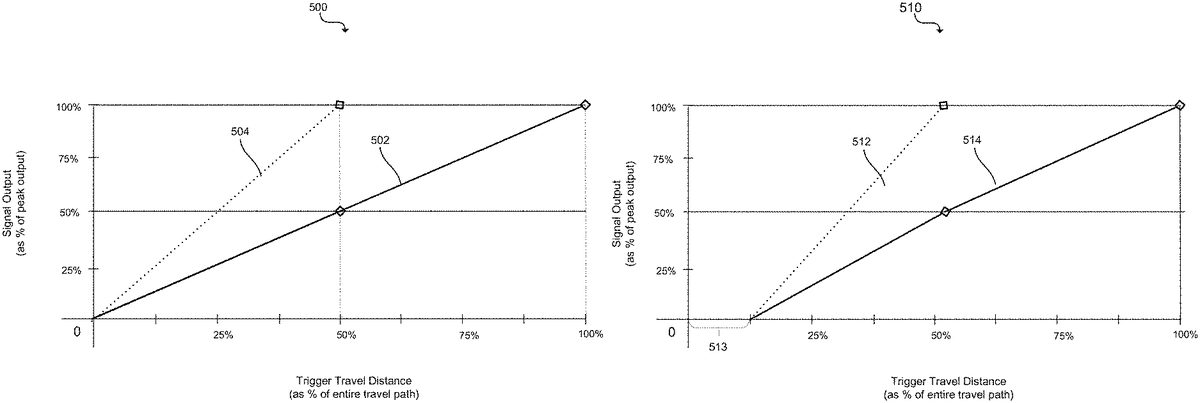
FIG. 5Ais a graphical depiction of exemplary signal output profiles (i.e., signal mapping schemes) that may be implemented in accordance with one or more embodiments of the present disclosure. Assuming a linear mapping profile, which may be implemented in accordance with some embodiments, line502represents the signal output profile under normal operating conditions (i.e., when trigger-stop is not engaged). As the trigger is gradually pulled from its resting position (e.g., 0% displacement along the travel path) to its fully pulled position (e.g., 100% displacement along the travel path), the signal communicated to the console may gradually increase in strength (e.g., voltage), as shown, from 0% signal strength (i.e., no signal) to 100% signal strength (i.e., maximum output strength, e.g., 1 mV). The relationship between the relative degree of trigger pull and the signal output to the controller may be linear (as shown), or follow any other relationship or pattern (e.g., nonlinear, exponential, power, etc.).
As a smart trigger-stop in accordance with the present disclosure is engaged by a user, the trigger travel path is reduced and the signal mapping scheme is adjusted (i.e., a different mode is implemented). For example, as shown inFIG. 5A, dotted line504represents the signal output profile when a trigger-stop mode is implemented, e.g., when the trigger stop120of the present disclosure is moved to block the normal trigger travel path such that the trigger is stopped at the half-way point along the travel path (i.e., 50% displacement along the travel path). In some embodiments, the movement of the trigger-stop120may flip a switch in the controller that signals to the processor to apply an adjusted signal mapping scheme. As depicted, the adjusted signal mapping scheme (represented by dotted line504) may effectively double the slope of the signal output in the mapping relationship. That is, the signal strength for a given degree of trigger pull may have twice the magnitude when the trigger-stop is engaged than when it is not. Thus, as shown in the example profile depicted inFIG. 5A, even though with the trigger-stop engaged the trigger may only be pulled back to half the original distance, the signal generated or affected (and/or sequentially provided to the console) exhibits 100% signal strength just as if the trigger had been pulled back the entire distance under the normal mode.
Accordingly, not only may a smart trigger-stop of the present disclosure provide a way to shorten the trigger travel distance that must be effectuated before the trigger is stopped (and/or the user receives haptic feedback indicating the trigger has been pulled back as far as possible), but the trigger stop may further cause a signal mapping scheme to be implemented such that when the associated trigger is pulled, the output signal provided to the gaming console (either directly or as through a sequence filters, amplifiers, relays, processing steps, etc.) sufficiently activates the gaming functionality of interest despite the actual trigger position being different from the position that would have otherwise been required to generate a signal of equal strength (or other attribute) under normal operating mode (i.e., when the trigger stop is not engaged). For example, when the trigger-stop is engaged the trigger may only be pulled half-way (or some other distance shorter than the full distance), the gaming console may receive a signal (generated by the controller or a component thereof) that indicates that the trigger has been pulled much farther along the travel path than it actually has. Accordingly, the smart trigger-stop technology of the present disclosure may quicken response times by reducing trigger travel distances without loss of gaming functionality.
FIG. 5Bis another graphical depiction of exemplary signal output profiles (i.e., signal mapping schemes) that may be implemented in accordance with one or more embodiments of the present disclosure. The signal output profiles ofFIG. 5Bare similar to those depicted inFIG. 5A, but with a small buffer zone513where no signal is produced. That is, if the trigger is moved by an amount that falls within the buffer zone (up to 12.5% movement along the travel path in this example), no signal will be produced. This feature allows a user to rest their fingers on the trigger surface (thereby causing the trigger to become slightly depressed) without unintentionally activating gaming functions.
FIG. 5Cis another graphical depiction of exemplary signal output profiles (i.e., signal mapping schemes) that may be implemented in accordance with one or more embodiments of the present disclosure. Line524represents the signal output profile applied when a trigger-stop is not engaged, while dotted line522represents the signal output profile when a trigger-stop of the present disclosure is engaged such that the trigger is stopped at or shortly after the half-way point along the travel path (i.e., 50% displacement along the travel path). As depicted, line524may define a linear and gradual relationship between the degree of trigger pull and the strength of signal output. Also as depicted by dotted line522, in some embodiments the signal output generated or affected when the trigger-stop is in the engaged position may follow a step-function type relationship—an “on” or “off” type profile that is effectuated at a certain point along the trigger's path of travel (e.g., at the point of impact with the trigger-stop, or slightly before, here at 50% of the travel distance). This hybrid arrangement may be implemented in one or more embodiments to allow the trigger to function like a button during combat type games (with the trigger-stop being engaged), and then switch back to the gradient styled signaling profile when playing games that call for such a gradient (e.g., racing games). Although the point at which the step-function type signal is activated is depicted as being at 50% of the travel path in the example shown inFIG. 5C, it will be appreciated that the step-up point may be set at any point along the travel distance (any desired percentage of max distance), and in some embodiments may be adjustable by a user (e.g., via adjusting a multi-staged trigger stop that has more than two positions).
It should be understood that the graphical representations of signaling output profiles inFIGS. 5A-5Care only examples, and that any modifications or variations of the same may be implemented in accordance with one or more embodiments of the present disclosure. For instance, the signal output profile for the trigger-stop mode (dotted line504) is shown to peak at a point when the trigger has been pulled to 50% of the entire travel distance. In other embodiments, the signal may peak at a point when the trigger has been pulled to more or less than 50% of the entire travel path. Similar such variations and changes may also be considered with reference toFIGS. 5B-5C. It should also be noted that although signal output is often discussed herein with reference to signal strength, any signal parameter or characteristic (e.g., frequency/wavelength, amplitude, etc.) useful for communicating and/or carrying information may be utilized in embodiments of the present technology, and any such parameter may be scaled and/or adjusted to compensate for reduced trigger travel caused by engaged trigger-stops.
FIG. 6illustrates a top perspective view of another example videogame controller employing smart trigger-stop technology in accordance with one or more embodiments of the present disclosure. The embodiment depicted inFIG. 6employs an axle226and a lever instead of the track126and slider122used in the embodiments depicted inFIGS. 2-4Dto move the trigger-stop component into and out of an engaged position. As noted previously, any mechanism for effectuating the technology disclosed herein may be utilized, and the scope of the present disclosure should not be construed as being limited to the embodiments illustrated in the Figures, nor to the specific example mechanisms described herein for carrying out the technology. One of ordinary skill in the art will appreciate that many variations and modifications to the embodiments discussed herein may be made and implemented without exceeding the scope of the present disclosure.
With reference to the embodiment depictedFIG. 6, as shown, an exemplary gaming controller200in accordance with one or more implementations of the present disclosure may include one or more triggers210, trigger-stops220, switches223(or other actuators or sensors), sensors270, processors275, memory280, transmitters285, and/or power sources290. Any one or more of the foregoing may be mechanically and/or electrically coupled with one another and/or with housing250of gaming controller200, and may operate alone or together (as described herein) to facilitate one or more implementations of the smart trigger-stop technology disclosed herein. For simplicity, various electrical components in the exemplary embodiment illustrated are depicted symbolically using boxes (e.g., sensor270, processor275, etc.).
As shown, trigger-stop220may be movably coupled with housing250such that a user may move trigger-stop220from a disengaged position into an engaged position (i.e., from a first position into a second position) and vice versa by moving the actuator (lever component222) from side-to-side.
Similar to the embodiments discussed above with reference toFIGS. 2-4C, moving trigger-stop220from a disengaged position to an engaged position (e.g., moving the lever222such that trigger-stop220rotates about axle226) may: (i) cause a portion of trigger-stop220to move into a portion of trigger210's travel path (the travel path indicated symbolically by the broken line referenced as numeral213) and thereby block or otherwise reduce the degree to which trigger210may be pulled/depressed, and (ii) cause a switch223coupled to trigger-stop220to be flipped and thereby signal to processor275that the trigger-stop220is in an engaged position and that signal transmissions responsive to trigger movements should be adjusted accordingly (i.e., the signals should be processed in accordance with a different signal mapping scheme (e.g., signal scheme described by dotted line504ofFIG. 5A).
In the depicted embodiment, trigger210includes arm extension211which may move along travel path213as the surface of trigger210is pressed by a user. When the trigger-stop220is in a disengaged position, trigger210may move along the entire travel path freely. That is, trigger arm extension211may move freely from Position A (the resting position) to Position C (the fully pulled position) without being stopped or blocked along the way. On the other hand, when the trigger-stop220is moved into the engaged position, a blocking portion221of trigger-stop220may fall within a portion of trigger210's travel path213such that the trigger210is stopped before reaching the fully pulled position (Position C). That is, trigger arm extension211may be stopped or blocked at Position B as the trigger moves along the travel path213, thereby reducing the total distance the trigger may travel before being stopped. As such, user may be able to receive tactile feedback at their fingertip (indicating the trigger has been sufficiently pressed) more quickly than when the trigger-stop is not engaged. In particular, the user may feel the impact between the blocking portion221of the trigger-stop220and the arm extension211of trigger210more quickly than they might feel the impact of the arm extension111with some other native feature of the controller at the end of the travel path113(at Position C). Because the travel path of trigger210may be reduced by engaging trigger-stop220, a user may operate the trigger controls of controller200in less time and with greater efficiency.
The remaining features of the embodiment depicted inFIG. 6have been adequately described with reference to prior figures (with similar numerals representing similar features).
FIG. 7illustrates a magnified view of exemplary trigger and trigger-stop componentry, here depicting trigger-stop220in both an engaged position (unshaded) and a disengaged position (shaded), in accordance with one or more embodiments of the present disclosure. As may be observed, moving trigger-stop220from the disengaged position (shaded) to the engaged position (unshaded) causes the blocking portion221of trigger-stop220to move into trigger200's travel path. The travel path213may be defined in part by an aperture of a guide element212within which an elbow knob/extension of arm extension211may be situated. In the engaged position, trigger-stop220will stop trigger210along the travel path before it reaches the fully-pulled position (Position C). Additionally, moving trigger-stop220from the disengaged position into the engaged position may cause switch223(which may be mechanically or electrically coupled with trigger-stop220) to be flipped/switched. Flipping the switch into a different state/mode/condition may signal to processor275that the trigger-stop220is in the engaged position and that the controller200's signal transmissions responsive to trigger movement(s) should be adjusted accordingly (i.e., the signals should be processed in accordance with a modified signal mapping scheme).
FIGS. 8A-8Cillustrate various perspective views of the example trigger and trigger-stop componentry shown inFIG. 6in accordance with one or more embodiments of the present disclosure.
FIG. 8Aillustrates a magnified perspective side view of the smart trigger-stop assembly shown inFIG. 6, the trigger in a released/unpressed position. As shown, a slider224of switch223may be inserted into an aperture or other feature of trigger-stop220. The slider224may be positioned such that the movement (e.g., rotation) of the trigger-stop220structure causes the slider224to move between two or more positions. As may be recognized, when trigger-stop220is engaged, blocking portion221may prevent elbow knob of arm extension211from moving beyond a certain point (e.g., Position B) along the path from Position A (resting position) to Position C (fully pulled position).
FIGS. 8B and 8Cillustrates magnified perspective views of the example trigger and trigger-stop assembly depicted inFIG. 8A, in accordance with one or more embodiments of the present disclosure. The depicted views demonstrates that trigger-stop220may be included or otherwise coupled to a lever component222, lever component222being configured to extend through the housing250of videogame controller200to enable a user to maneuver the trigger-stop220relative to the trigger210and at least partially block its range of movement (e.g., causing trigger-stop220to rotate about axel226until blocking portion221is in the arm extension211's path of travel).
It is reemphasized here that the drawings have been provided for illustration purposes only, and merely depict typical or example embodiments of the disclosed technology. Variations and modifications will be apparent to a person of ordinary skill in the art after reviewing this disclosure, and all such variations and modifications are intended to fall within the scope of the present disclosure. For instance,FIG. 3depicts how a blocking mechanism (e.g.121) may be moved into and out of engaged and disengaged positions by being moved from side to side (e.g., from right to left) andFIG. 7depicts how a blocking mechanisms (e.g.,221) may be moved into and out of engaged and disengaged positions by being rotated (e.g., clockwise or counterclockwise), but other mechanisms may also be employed—e.g., such as a blocking mechanism situated along the imaginary line in the extension arm's path of travel that can slide forward or backward along that line (deeper or less deep into the path) to adjust the throw of the trigger. In such an instance, the farther the blocking mechanism is slid into position, the shorter the distance before the trigger (or extension arm) hits the stop (of which the blocking mechanism may be a part).
In another example modification or variation, the smart trigger stop technology of the present disclosure may be adapted to include an adjustable trigger stop with more than one engaged position (i.e., a multimodal trigger-stop assembly). For instance, referring toFIG. 7, the smart trigger-stop assembly may include allow for lever222to be moved by degrees (e.g., a little or a lot, or anywhere in between) to correspondingly move blocking mechanism221by degrees and thereby change the position at which the trigger is blocked so that the user can select a very short throw, a medium throw, etc. instead of being limited to either a fully engaged or fully disengaged options (e.g., blocked or un-blocked in a “binary” fashion). In such an embodiment, as well as others, switch223may be a variable switch instead of an on/off switch. Such a variable switch may change the signal level, current, duty cycle or other signal parameter that is sent to the processor such that the processor may determine at what point along the path the stop is positioned. The processor and/or controller may further be configured to incrementally change the signal output profile (i.e., the mapping scheme or mapping profile) as the signal parameter received from the variable switch incrementally changes in response to movements of the blocking mechanism (which may situate of the blocking mechanism in one of a plurality of different positions). That is, although much of this disclosure describes embodiments implemented to provide dual-mode (i.e., two-stage) trigger-stop functionality (as depicted inFIG. 3), in other embodiments the trigger-stop technology may be implemented to provide a multi-mode (i.e., multi-stage) stopping functionality.
Furthermore, and though not depicted in detail in the foregoing figures, the smart trigger stop technology of the present disclosure may also include a trigger rebound component coupled to one or both of the trigger (or a subcomponent or extension of the trigger) and the trigger stop (or a subcomponent or extension of the trigger stop), the trigger rebound component may be any material or mechanism configured to provide forward thrust to the trigger upon being pulled back to a stopping point. For example, an elastomeric material may be coupled to the leading edge of the blocking portion of a trigger-stop, the elastomeric material providing a degree of bounce-back to the trigger so as to decrease the amount of time it takes the trigger to return to the released/relaxed position. In other examples a spring, coil, plunger, solenoid or any other component of mechanism may be deployed to achieve added bounce in the trigger rebound.
FIG. 9depicts a system within which one or more embodiments of the present disclosure may be implemented. As shown, system900may include a display901, a videogame console902, and a videogame controller903including one or more smart trigger stops as disclosed herein. Any one or more of videogame controller903, the videogame console902, and the display901may be communicatively, electrically, and/or mechanically coupled with one another to facilitate a gaming experience for a user. The electrical circuitry included in controller903may generate a signal responsive to trigger movements and convey that signal to console902. Console902may process the signal and effectuate a gaming function or operation the signal is mapped to, and generate appropriate signal to modify the video experience viewed on the display901based, in whole or in part, on the signal received from the controller. The components of system900are depicted as being communicatively coupled through one or more wires (e.g., wire904,905). However, it should be noted that wireless communication protocols may also be employed as desired in the various embodiments of the present disclosure. Moreover, although not depicted in this manner, in some embodiments of the present disclosure the display903, the console902, and the controller901may all be comprised in a single device (e.g., a handheld Nintendo 3DS). Further, any one or more of the foregoing may include or be otherwise deployed with computing modules and/or technology that enables any one or more of the features and/or technologies disclosed herein.FIG. 10discusses such modules in greater detail.
Referring now toFIG. 10, computing module1200may represent, for example, computing or processing capabilities found within desktop, laptop, notebook, gaming consoles, and tablet computers; hand-held computing devices (tablets, PDA's, smart phones, cell phones, palmtops, etc.); wearable computing devices such as smartwatches; mainframes, supercomputers, workstations or servers; or any other type of special-purpose or general-purpose computing devices as may be desirable or appropriate for a given application or environment. Computing module1200might also represent computing capabilities embedded within or otherwise available to a given device. For instance, a computing module might be found in other electronic devices such as, for example, digital cameras, videogame consoles, gaming controllers, navigation systems, cellular telephones, videogame controllers portable computing devices, modems, routers, WAPs, terminals and other electronic devices that might include some form of processing capability.
Computing module1200might include, for example, one or more processors (e.g., such as processor175, processor275, etc.), controllers, control modules, or other processing devices, such as a processor1204. Processor1204might be implemented using a general-purpose or special-purpose processing engine such as, for example, a microprocessor, controller, or other control logic. In the illustrated example, processor1204is connected to a bus1202, although any communication medium can be used to facilitate interaction with other components of computing module1200or to communicate externally.
Computing module1200might also include one or more memory modules, simply referred to herein as main memory1208. For example, preferably random access memory (RAM) or other dynamic memory, might be used for storing information and instructions to be executed by processor1204. Main memory1208might also be used for storing temporary variables or other intermediate information during execution of instructions to be executed by processor1204. Computing module1200might likewise include a read only memory (“ROM”) or other static storage device coupled to bus1202for storing static information and instructions for processor1204.
The computing module1200might also include one or more various forms of information storage mechanism1210, which might include, for example, a media drive1212and a storage unit interface1220. The media drive1212might include a drive or other mechanism to support fixed or removable storage media1214. For example, a hard disk drive, a solid state drive, a magnetic tape drive, an optical disk drive, a CD, DVD, or Blu-ray drive (R or RW), or other removable or fixed media drive might be provided. Accordingly, storage media1214might include, for example, a hard disk, a solid state drive, magnetic tape, cartridge, optical disk, a CD, DVD, Blu-ray or other fixed or removable medium that is read by, written to or accessed by media drive1212. As these examples illustrate, the storage media1214can include a computer usable storage medium having stored therein computer software or data.
In alternative embodiments, information storage mechanism1210might include other similar instrumentalities for allowing computer programs or other instructions or data to be loaded into computing module1200. Such instrumentalities might include, for example, a fixed or removable storage unit1222and an interface1220. Examples of such storage units1222and interfaces1220can include a program cartridge and cartridge interface, a removable memory (for example, a flash memory or other removable memory module) and memory slot, a PCMCIA slot and card, and other fixed or removable storage units1222and interfaces1220that allow software and data to be transferred from the storage unit1222to computing module1200.
Computing module1200might also include a communications interface1224. Communications interface1224might be used to allow software and data to be transferred between computing module1200and external devices. Examples of communications interface1224might include a modem or softmodem, a network interface (such as an Ethernet, network interface card, WiMedia, IEEE 802.XX or other interface), a communications port (such as for example, a USB port, IR port, RS232 port Bluetooth® interface, or other port), or other communications interface. Software and data transferred via communications interface1224might typically be carried on signals, which can be electronic, electromagnetic (which includes optical) or other signals capable of being exchanged by a given communications interface1224. These signals might be provided to communications interface1224via a channel1228. This channel1228might carry signals and might be implemented using a wired or wireless communication medium. Some examples of a channel might include a phone line, a cellular link, an RF link, an optical link, a network interface, a local or wide area network, and other wired or wireless communications channels.
In this document, the terms “computer program medium” and “computer usable medium” are used to generally refer to transitory or non-transitory media such as, for example, memory1208, storage unit1220, media1214, and channel1228. These and other various forms of computer program media or computer usable media may be involved in carrying one or more sequences of one or more instructions to a processing device for execution. Such instructions embodied on the medium, are generally referred to as “computer program code” or a “computer program product” (which may be grouped in the form of computer programs or other groupings). When executed, such instructions might enable the computing module1200to perform features or functions of the present application as discussed herein.
Although described above in terms of various exemplary embodiments and implementations, it should be understood that the various features, aspects and functionality described in one or more of the individual embodiments are not limited in their applicability to the particular embodiment with which they are described, but instead can be applied, alone or in various combinations, to one or more of the other embodiments of the application, whether or not such embodiments are described and whether or not such features are presented as being a part of a described embodiment. Thus, the breadth and scope of the present application should not be limited by any of the above-described exemplary embodiments.
Terms and phrases used in this document, and variations thereof, unless otherwise expressly stated, should be construed as open ended as opposed to limiting. As examples of the foregoing: the term “including” should be read as meaning “including, without limitation” or the like; the term “example” is used to provide exemplary instances of the item in discussion, not an exhaustive or limiting list thereof; the terms “a” or “an” should be read as meaning “at least one,” “one or more” or the like; and adjectives such as “conventional,” “traditional,” “normal,” “standard,” “known” and terms of similar meaning should not be construed as limiting the item described to a given time period or to an item available as of a given time, but instead should be read to encompass conventional, traditional, normal, or standard technologies that may be available or known now or at any time in the future. Likewise, where this document refers to technologies that would be apparent or known to one of ordinary skill in the art, such technologies encompass those apparent or known to the skilled artisan now or at any time in the future.
The presence of broadening words and phrases such as “one or more,” “at least,” “but not limited to” or other like phrases in some instances shall not be read to mean that the narrower case is intended or required in instances where such broadening phrases may be absent. The use of the term “module” does not imply that the components or functionality described or claimed as part of the module are all configured in a common package. Indeed, any or all of the various components of a module, whether control logic or other components, can be combined in a single package or separately maintained and can further be distributed in multiple groupings or packages or across multiple locations.
Additionally, the various embodiments set forth herein are described in terms of exemplary block diagrams, flow charts and other illustrations. As will become apparent to one of ordinary skill in the art after reading this document, the illustrated embodiments and their various alternatives can be implemented without confinement to the illustrated examples. For example, block diagrams and their accompanying description should not be construed as mandating a particular architecture or configuration.
While various embodiments of the present disclosure have been described above, it should be understood that they have been presented by way of example only, and not of limitation. Likewise, the various diagrams may depict an example architectural or other configuration for the disclosure, which is done to aid in understanding the features and functionality that can be included in the disclosure. The disclosure is not restricted to the illustrated example architectures or configurations, but the desired features can be implemented using a variety of alternative architectures and configurations. Indeed, it will be apparent to one of skill in the art how alternative functional, logical or physical partitioning and configurations can be implemented to implement the desired features of the present disclosure. Also, a multitude of different constituent module names other than those depicted herein can be applied to the various partitions. Additionally, with regard to flow diagrams, operational descriptions and method claims, the order in which the steps are presented herein shall not mandate that various embodiments be implemented to perform the recited functionality in the same order unless the context dictates otherwise.
Although the disclosure is described above in terms of various exemplary embodiments and implementations, it should be understood that the various features, aspects and functionality described in one or more of the individual embodiments are not limited in their applicability to the particular embodiment with which they are described, but instead can be applied, alone or in various combinations, to one or more of the other embodiments of the disclosure, whether or not such embodiments are described and whether or not such features are presented as being a part of a described embodiment. Thus, the breadth and scope of the present disclosure should not be limited by any of the above-described exemplary embodiments.
Terms and phrases used in this document, and variations thereof, unless otherwise expressly stated, should be construed as open ended as opposed to limiting. As examples of the foregoing: the term “including” should be read as meaning “including, without limitation” or the like; the term “example” is used to provide exemplary instances of the item in discussion, not an exhaustive or limiting list thereof; the terms “a” or “an” should be read as meaning “at least one,” “one or more” or the like; and adjectives such as “conventional,” “traditional,” “normal,” “standard,” “known” and terms of similar meaning should not be construed as limiting the item described to a given time period or to an item available as of a given time, but instead should be read to encompass conventional, traditional, normal, or standard technologies that may be available or known now or at any time in the future. Likewise, where this document refers to technologies that would be apparent or known to one of ordinary skill in the art, such technologies encompass those apparent or known to the skilled artisan now or at any time in the future.
The presence of broadening words and phrases such as “one or more,” “at least,” “but not limited to” or other like phrases in some instances shall not be read to mean that the narrower case is intended or required in instances where such broadening phrases may be absent. The use of the term “module” does not imply that the components or functionality described or claimed as part of the module are all configured in a common package. Indeed, any or all of the various components of a module, whether control logic or other components, can be combined in a single package or separately maintained and can further be distributed in multiple groupings or packages or across multiple locations.
Additionally, the various embodiments set forth herein are described in terms of exemplary block diagrams, flow charts and other illustrations. As will become apparent to one of ordinary skill in the art after reading this document, the illustrated embodiments and their various alternatives can be implemented without confinement to the illustrated examples. For example, block diagrams and their accompanying description should not be construed as mandating a particular architecture or configuration.
Claims
- A videogame controller, comprising: a housing;a trigger movably coupled to the housing via a spring-loaded hinge, the trigger pivotable about a first axis along a travel path in a direction transverse to the axis from a default position to a fully depressed position;a processor configured to communicate output signals to a gaming console based at least in part on movement of the trigger;a trigger stop assembly comprising a lever rotatably coupled to the housing about a second axis generally transverse to the first axis, and a stop member configured to define a travel limit of the trigger when the trigger is fully depressed and contacts at least a portion of the stop member, the travel limit of the trigger being adjustable between a plurality of travel limit positions by varying a position of the stop member relative to the trigger when fully depressed between a plurality of stop member positions, said plurality of stop member positions corresponding to different angular positions of the lever;and an electrical switch configured to communicate with the processor, wherein the processor is configured to map the travel span of the trigger for any of the plurality of travel limit positions to an output signal range proportionally such that the output signal communicated by the processor is the same when the trigger is fully depressed irrespective of the travel limit position set for the trigger.
- The videogame controller of claim 1 , wherein the plurality of travel limit positions includes a relatively short trigger throw position, a full travel trigger throw position, and at least one medium trigger throw position that is greater than the short trigger throw position and smaller than the full travel trigger throw position.
- The videogame controller of claim 1 , wherein the trigger-stop assembly includes an actuator attached to the lever and configured to at least partially extend through an opening in the housing, the actuator configured to be engaged by a user to move the stop member between the plurality of stop member positions.
- The videogame controller of claim 1 , wherein the electrical switch is configured detect the travel limit position for the trigger based on the position of the stop member, and to communicate a signal indicative of the set travel limit position to the processor.
- The videogame controller of claim 4 , wherein the electrical switch is a variable switch that varies one or more signal parameters chosen from a group consisting of signal level, current, and duty cycle so that the processor can determine at what point along the path the stop member is positioned.
- The videogame controller of claim 1 , further comprising a sensor configured to detect a position of the trigger along the travel path and configured to generate or affect a signal representative of a trigger position, the sensor configured to communicate with the processor.
- The videogame controller of claim 1 , wherein movement of the lever between different positions simultaneously actuates the electrical switch between different operating modes.
- A videogame controller, comprising: a housing;a trigger movably coupled to the housing via a spring-loaded hinge, the trigger pivotable about a first axis along a travel path in a direction transverse to the axis from a default position to a fully depressed position;a processor configured to communicate output signals to a gaming console based at least in part on movement of the trigger;a trigger stop assembly comprising a lever rotatably coupled to the housing about a second axis generally transverse to the first axis, an actuator attached to the lever and configured to at least partially extend through an opening in the housing, the actuator configured to be engaged by a user to move the lever, and a stop member configured to define a travel limit of the trigger when the trigger is fully depressed and contacts at least a portion of the stop member, the travel limit of the trigger being adjustable between a plurality of travel limit positions by varying a position of the stop member relative to the trigger when fully depressed between a plurality of stop member positions, said plurality of stop member positions corresponding to different angular positions of the lever;and an electrical switch configured to communicate with the processor, the electrical switch configured detect the travel limit position for the trigger based on the position of the stop member, and to communicate a signal indicative of the set travel limit position to the processor, wherein the processor is configured to map the travel span of the trigger for any of the plurality of travel limit positions to an output signal range proportionally such that the output signal communicated by the processor is the same when the trigger is fully depressed irrespective of the travel limit position set for the trigger.
- The videogame controller of claim 8 , wherein the plurality of travel limit positions includes a relatively short trigger throw position, a full travel trigger throw position, and at least one medium trigger throw position that is greater than the short trigger throw position and smaller than the full travel trigger throw position.
- The videogame controller of claim 8 , wherein the electrical switch is a variable switch that varies one or more signal parameters chosen from a group consisting of signal level, current, and duty cycle so that the processor can determine at what point along the path the stop member is positioned.
- The videogame controller of claim 8 , further comprising a sensor configured to detect a position of the trigger along the travel path and configured to generate or affect a signal representative of a trigger position, the sensor configured to communicate with the processor.
- The videogame controller of claim 8 , wherein movement of the lever between different positions simultaneously actuates the electrical switch between different operating modes.
- A videogame controller, comprising: a housing;a trigger movably coupled to the housing via a spring-loaded hinge, the trigger pivotable about a first axis along a travel path in a direction transverse to the axis from a default position to a fully depressed position;a processor configured to communicate output signals to a gaming console based at least in part on movement of the trigger;a trigger stop assembly comprising a lever rotatably coupled to the housing about a second axis generally transverse to the first axis, and a stop member configured to define a travel limit of the trigger when the trigger is fully depressed and contacts at least a portion of the stop member, the travel limit of the trigger being adjustable between a plurality of travel limit positions by varying a position of the stop member relative to the trigger when fully depressed between a plurality of stop member positions, said plurality of stop member positions corresponding to different angular positions of the lever;an electrical switch configured to communicate with the processor, the electrical switch configured detect the travel limit position for the trigger based on the position of the stop member, and to communicate a signal indicative of the set travel limit position to the processor;and a sensor configured to detect a position of the trigger along the travel path and configured to generate or affect a signal representative of a trigger position, the sensor configured to communicate with the processor, wherein the processor is configured to map the travel span of the trigger for any of the plurality of travel limit positions to an output signal range proportionally such that the output signal communicated by the processor is the same when the trigger is fully depressed irrespective of the travel limit position set for the trigger.
- The videogame controller of claim 13 , wherein the plurality of travel limit positions includes a relatively short trigger throw position, a full travel trigger throw position, and at least one medium trigger throw position that is greater than the short trigger throw position and smaller than the full travel trigger throw position.
- The videogame controller of claim 13 , wherein the trigger-stop assembly includes an actuator attached to the lever and configured to at least partially extend through an opening in the housing, the actuator configured to be engaged by a user to move the stop member between the plurality of stop member positions.
- The videogame controller of claim 13 , wherein the electrical switch is a variable switch that varies one or more signal parameters chosen from a group consisting of signal level, current, and duty cycle so that the processor can determine at what point along the path the stop member is positioned.
- The videogame controller of claim 13 , wherein movement of the lever between different positions simultaneously actuates the electrical switch between different operating modes.
Disclaimer: Data collected from the USPTO and may be malformed, incomplete, and/or otherwise inaccurate.