U.S. Pat. No. 11,213,754
VIDEO GAME CENTER FOR A CONTROLLED ENVIRONMENT FACILITY
AssigneeGlobal Tel*Link Corporation
Issue DateAugust 10, 2017
Illustrative Figure
Abstract
In the present disclosure, systems and methods are described for video gaming in a controlled environment facility. A video game server allows tenants of a controlled environment facility to play video games that are served and monitored by the video game server. In embodiments, users may initiate a game session to play games in a single player mode, competitive multiplayer or cooperative multiplayer mode depending on the game being played. The video game server maintains block lists for each user such that those users may not initiate or engage in the same game sessions with each other. In game sessions with two or more users, the video game server allows users to communicate via audio or text communications. The video game server may monitor those communications for potential security concerns. Users may also view videos of previously completed or live game sessions, subject to similar security monitoring measures.
Description
The present disclosure will be described with reference to the accompanying drawings. In the drawings, like reference numbers indicate identical or functionally similar modules. DETAILED DESCRIPTION The following Detailed Description refers to accompanying drawings to illustrate exemplary embodiments consistent with the disclosure. References in the Detailed Description to “one exemplary embodiment,” “an exemplary embodiment,” “an example exemplary embodiment,” etc., indicate that the exemplary embodiment described may include a particular feature, structure, or characteristic, but every exemplary embodiment may not necessarily include the particular feature, structure, or characteristic. Moreover, such phrases are not necessarily referring to the same exemplary embodiment. Further, when a particular feature, structure, or characteristic is described in connection with an exemplary embodiment, it is within the knowledge of those skilled in the relevant art(s) to affect such feature, structure, or characteristic in connection with other exemplary embodiments whether or not explicitly described. The exemplary embodiments described herein are provided for illustrative purposes, and are not limiting. Other exemplary embodiments are possible, and modifications may be made to the exemplary embodiments within the spirit and scope of the disclosure. Therefore, the Detailed Description is not meant to limit the invention. Rather, the scope of the invention is defined only in accordance with the following claims and their equivalents. Embodiments may be implemented in hardware (e.g., circuits), firmware, software, or any combination thereof. Embodiments may also be implemented as instructions stored on a machine-readable medium, which may be read and executed by one or more processors. A machine-readable medium may include any mechanism for storing or transmitting information in a form readable by a machine (e.g., a computing device). For example, a machine-readable medium may include read only memory (ROM); random access memory (RAM); magnetic disk storage media; optical storage media; flash memory devices; electrical, optical, acoustical or other ...
The present disclosure will be described with reference to the accompanying drawings. In the drawings, like reference numbers indicate identical or functionally similar modules.
DETAILED DESCRIPTION
The following Detailed Description refers to accompanying drawings to illustrate exemplary embodiments consistent with the disclosure. References in the Detailed Description to “one exemplary embodiment,” “an exemplary embodiment,” “an example exemplary embodiment,” etc., indicate that the exemplary embodiment described may include a particular feature, structure, or characteristic, but every exemplary embodiment may not necessarily include the particular feature, structure, or characteristic. Moreover, such phrases are not necessarily referring to the same exemplary embodiment. Further, when a particular feature, structure, or characteristic is described in connection with an exemplary embodiment, it is within the knowledge of those skilled in the relevant art(s) to affect such feature, structure, or characteristic in connection with other exemplary embodiments whether or not explicitly described.
The exemplary embodiments described herein are provided for illustrative purposes, and are not limiting. Other exemplary embodiments are possible, and modifications may be made to the exemplary embodiments within the spirit and scope of the disclosure. Therefore, the Detailed Description is not meant to limit the invention. Rather, the scope of the invention is defined only in accordance with the following claims and their equivalents.
Embodiments may be implemented in hardware (e.g., circuits), firmware, software, or any combination thereof. Embodiments may also be implemented as instructions stored on a machine-readable medium, which may be read and executed by one or more processors. A machine-readable medium may include any mechanism for storing or transmitting information in a form readable by a machine (e.g., a computing device). For example, a machine-readable medium may include read only memory (ROM); random access memory (RAM); magnetic disk storage media; optical storage media; flash memory devices; electrical, optical, acoustical or other forms of propagated signals (e.g., carrier waves, infrared signals, digital signals, etc.), and others. Further, firmware, software, routines, instructions may be described herein as performing certain actions. However, it should be appreciated that such descriptions are merely for convenience and that such actions in fact result from computing devices, processors, controllers, or other devices executing the firmware, software, routines, instructions, etc. Further, any of the implementation variations may be carried out by a general purpose computer, as described below.
For purposes of this discussion, any reference to the term “module” shall be understood to include at least one of software, firmware, and hardware (such as one or more circuit, microchip, or device, or any combination thereof), and any combination thereof. In addition, it will be understood that each module may include one, or more than one, component within an actual device, and each component that forms a part of the described module may function either cooperatively or independently of any other component forming a part of the module. Conversely, multiple modules described herein may represent a single component within an actual device. Further, components within a module may be in a single device or distributed among multiple devices in a wired or wireless manner.
The following detailed description of the exemplary embodiments will so fully reveal the general nature of the invention that others can, by applying knowledge of those skilled in relevant art(s), readily modify and/or adapt for various applications such exemplary embodiments, without undue experimentation, without departing from the spirit and scope of the disclosure. Therefore, such adaptations and modifications are intended to be within the meaning and plurality of equivalents of the exemplary embodiments based upon the teaching and guidance presented herein. It is to be understood that the phraseology or terminology herein is for the purpose of description and not of limitation, such that the terminology or phraseology of the present specification is to be interpreted by those skilled in relevant art(s) in light of the teachings herein.
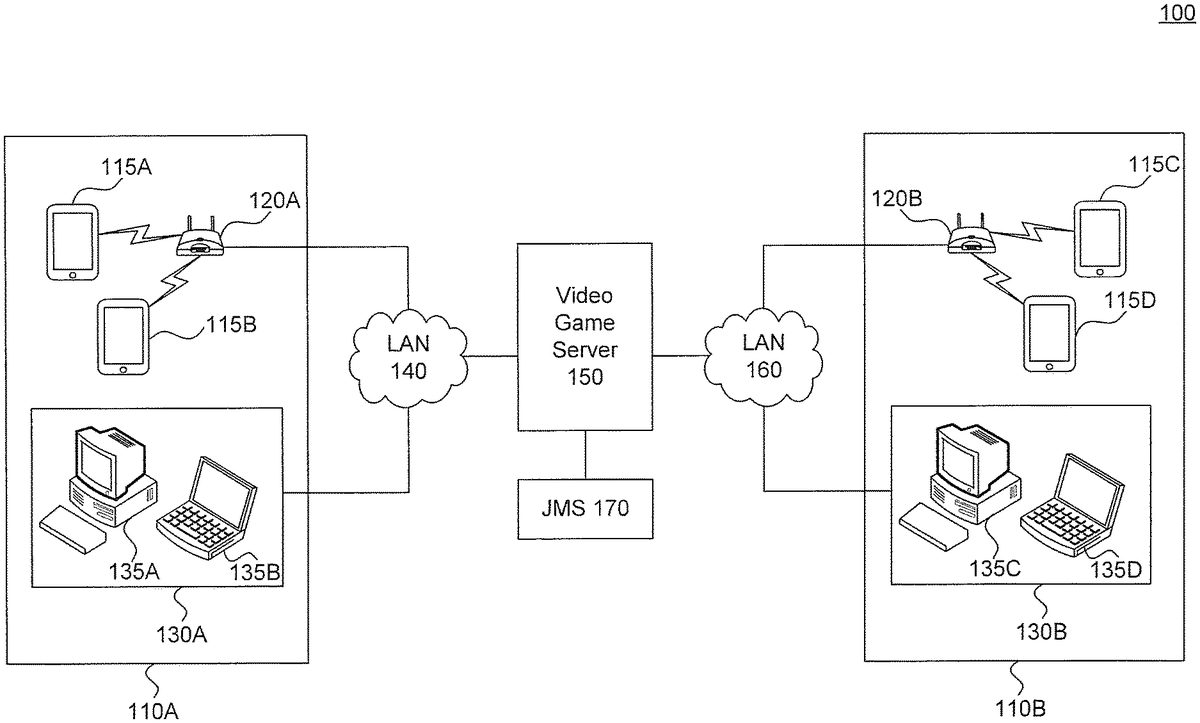
FIG. 1illustrates system100of a controlled environment facility that employs a video game center, according to some embodiments. In embodiments, system100includes a controlled environment facilities110A and110B, local area networks (LANs)140and160, video game center system150, a jail management server (JMS)170, and a financial accounting system180. Controlled environment facility110A may include electronic devices115A-B, and controlled environment facility110B may include electronic devices115C-D. In embodiments, electronic devices115A-D may be smartphone devices, tablet devices, or other small personal computing devices (PCs) that are issued by the controlled environment facilities to tenants of the controlled environment facilities. Controlled environment facility110A may include enclosure130A that includes electronic devices135A-B, and facility110B may include enclosure130B that electronic devices135C-D. Enclosures130A and130B may be publically accessible, secure rooms in which tenants of controlled environment facilities110A and110B may enter to engage in video gaming or other general purpose computing (such as web surfing).
Electronic devices115A-B may be connected to LAN140via wireless access point120A, and electronic devices115C-D may be connected to LAN160via wireless access point120B. In embodiments, wireless access points120A and120B may be operating on a wireless standard such as IEEE 802.11, or a base station operating on 3G or 4G standards such as Universal Mobile Telecommunication System (UMTS), Global System for Mobile Communications (GSM), Long-term Evolution (LTE), etc. The base station could be a “small-cell” or “femtocell” technology similar to a commercially available base station meant to cover smaller or confined areas. In any case, security parameters and settings available with the equipment allow secure transmission of voice and other data to LANs140and160. Wireless access points120A and120B may be connected to LANs140and160respectively via a wired interface using IEEE 802.3 “Ethernet” connections. Similarly, electronic devices135A-B may be connected to LAN140via a wired connection via a wired interface using IEEE 802.3 “Ethernet” connections. Electronic devices135C-D may be connected to LAN160via a wired connection via a wired interface using IEEE 802.3 “Ethernet” connections.
LANs140and160serve to connect the various electronic devices within controlled environment facilities110A and110B to the video game server150. Video game server150serves the various functions that allow video games to be played on electronic devices115A-D and135A-D. In addition, the video game server150performs the functions to allow interactive video game playing between the users of electronic devices115A-D and135A-D, allowing for cooperative or competitive gameplay between different tenants of controlled environment facilities110A and110D. In embodiments, video game server150may be implemented on one or many server devices, each of which include processors, memory, long-term storage, and various communicative ports such as IEEE 802.3 Ethernet that allow the servers to interlink with each other and with LANs140and160. In embodiments, video game server150may store some or all of the game data for the video games that are deemed suitable for tenants of controlled environment facilities110A and110B. In embodiments, some or all of the game data may be transmitted to electronic devices115A-D and135A-D during a game session. Different configurations that allow video game server150to serve video gaming to controlled environment facilities110A and110B will be discussed in greater detail below with respect toFIGS. 3A-C.
In embodiments, video game server150may also be connected to jail management server (JMS)170. JMS170can consist of one or many servers, and hosts a database that stores broad information on tenants of controlled environment facilities110A and110B. JMS170is maintained by controlled environment facility administration or by the provider of video game server150. The behavioral history will contain information regarding an tenant's past infractions within the controlled environment facility itself (e.g., altercations with other tenants) and also infractions related to video gaming behavior.
JMS170may also include information relating to the financial accounts for tenants of controlled environment facilities110A and110B. In embodiments, a tenant of a controlled environment facility may have a financial account associated with the tenant that can be used to purchase items and services from the controlled environment facility. This financial account may be debited when such services and items are purchased. In embodiments, for a tenant that wishes to engage in video gaming, the financial account associated with the tenant may be debited to pay a registration fee associated with creating an account within video game server150, or purchase games offered by video game server150.
FIG. 2illustrates a block diagram of video game server200according to some embodiments. Video game server200may be an embodiment of video game server150depicted inFIG. 1. Video game server200includes a network interface210, application server220, user database230, chat server240, game stats database250, video storage260, and validation server270. In embodiments, the various elements of video game server200may be implemented on one or many servers, each of which include processors, memory, long-term storage, and various communicative ports such as IEEE 802.3 Ethernet that allow the servers to interlink with each other and with LANs such as LAN140and160ofFIG. 1. Furthermore, video game server may be communicatively coupled to JMS170.
Network interface210serves to connect the other elements of video game server200to outside networks. Network interface210is responsible for routing packets to and from video game server200. This may include routing both game data and voice packet data between video game server200and LANs, such as LAN140and160ofFIG. 1, that connect video game server200to controlled environment facilities such as controlled environment facilities110A and110B ofFIG. 1. Application server220serves as the main processing center of the video game server200, where applications execute for remote users which have logged into video game server200. In an embodiment, instructions for a video game may execute directly in application server220, and images of the video game may be sent to a device, such as devices115A-D and135A-D ofFIG. 1, via network interface210.
In another embodiment, instructions for a video game may execute in local devices at a controlled environment facility, such as devices115A-D and135A-D ofFIG. 1, while application server220may host a game session involving two or more users using different devices within one or more controlled environment facilities. In this case, application server220may send and receive metadata related to video game progress, such as user positions within a game map, actions performed by the game characters as input by the users using the devices, and voice and text data being sent by users during the game session to communicate with the other users. In this embodiment, application server220is responsible for synchronizing the different game data such as action data, user positions, and metadata, as described above, to ensure that each user has an accurate and fair representation of the game session at any given time. Application server220is also responsible for synchronizing the voice and text data such that all users that are supposed to receive some set of data (for example, two users on a same team during a cooperative game session) receive that data in a timely fashion.
User database230stores information related to any tenants from controlled environment facilities that have registered with video game server200to play video games. In an embodiment, user database230is implemented on long-term storage such as a hard disk, storage area network, or network-attached storage. In embodiments, user database230may store a user profile for each registered user that has information such as a legal name, behavioral record, criminal record, and “block list” of other users that the user may not interact with. The user profiles stored in user database230may also include several other pieces of user information as related to video gaming conventions, which is described in greater detail relative toFIG. 4.
Chat server240performs functions related to both audio and textual communication between users during a competitive or cooperative game session. In embodiments, chat server240may be implemented on one or many servers, each of which include processors, memory, long-term storage, and various communicative ports such as IEEE 802.3 Ethernet that allow the servers to interlink with each other and with LANs such as LAN140and160ofFIG. 1. The servers which implement chat server240may be included as part of the overall set of servers that implement video game server200, or as a separate set of servers dedicated only to receiving and sending communication data separate from the game session data which is served by application server220.
In embodiments, users who engage in either a competitive or cooperative game session may communicate via microphones that capture audio, such as a microphone on the electronic device they are using to access video game server200, or a separate microphone that is communicatively coupled to the electronic device. The audio data may be sent as voice over internet protocol (VOIP) data packets that are received and sent by video game server200via network interface210. In another embodiment they may also type text messages to each other that appear on-screen during a game session via a keyboard (either tactile or touch screen) that is included on the electronic device being used to access video game server200, or a separate keyboard that is communicatively coupled to the electronic device. This text data may also be sent and received as data packets by video game server200via network interface210.
Chat server240establishes a chat session by which the users participating in a game session may exchange communication data, either audio or text data as described above. Audio module242of chat server240may handle audio data received by chat server240, while text module244may handle text data received by chat server240. In an embodiment, audio module242receives audio data from different users engaging in a shared game session (either cooperative or competitive) and ensures that the audio data received is mixed properly and sent to other users that are permitted to receive the audio. The mixing of the audio data is required so that audio communication between different users is received in a timely fashion so that users are able to engage in intelligible conversation during a game session. Audio module242also ensures that audio data only be sent to users who are permitted to receive the audio information within the context of the game session. For example, a user may only wish to communicate with members of his own team during a team competition style of game (e.g. a football video game) to plan out strategy during a game session, or may wish to communicate with all users in the game session to engage in friendly or competitive banter.
Game stats database250stores information related to a video game served by video game server200that may be appropriate for public viewing. For example, high score data for either individuals or teams may be made available publically to users of a particular video game, or even to any users of the services offered by video game server200. This may encourage competition and camaraderie between different tenants of the controlled environment facilities.
Video storage260stores videos of game sessions that may be played back by users of video game server200. Video of a particular user's screen during a game session may be stored on video storage260which may then be played back by a user of video game server200for entertainment purposes. In an embodiment, user database230is implemented on long-term storage such as a hard disk, storage area network, or network-attached storage. In an embodiment, a user of video game server200may search through a library of videos to view playback of another user's game session, subject to security constraints such as the user not being on the block list of the other user, or vice versa. In addition, video storage260may store videos that may be investigated for potential security concerns, as will be described in more detail below.
Validation server270handles the validation steps required before a game session is initiated by video game server200. In an embodiment, validation server270stores fingerprint samples and voice print samples of each user registered with video game server200, so that when a user attempts to access the system, various comparison test can be performed to determine that the user has properly identified himself and is allowed to access video game server200to initiate a game session. Validation server270may also handle PIN inputs by the inmate.
Game repository280stores game data for any game offered by video game server200. In an embodiment, user database230is implemented on long-term storage such as a hard disk, storage area network, or network-attached storage. In an embodiment, game data for a particular video game may be stored in game repository280and loaded onto application server200so that a user of video game server200may play the video game. In another embodiment, upon purchase of a video game by a user of video game server200, game repository280sends the game data via network interface210to an electronic device being used by the user to access video game server200. The game data for the video game is then permanently stored on the electronic device. When a user logs into video game server200using the electronic device, the video game is then made accessible to the user of the electronic device. If the user logs into the video game server200using a different electronic device, game repository280may again send the game data for the video game to the different electronic device.
Security module290handles detection of potential security issues during game sessions handled by video game server200. In embodiments, users of video game server200may engage in illicit communications using a game session as a cover. For example, during a game session involving multiple users in either cooperative or competitive games, users may communicate via audio or text communications as described above. Users may communicate about illicit activity during a game session rather than about happenings in the game session. Furthermore, users may be able to alter the environment of a game session such that images may appear on screen that may also signal some kind of illicit communication.
In order to monitor potential for illicit activity, security module290may receive the audio packets, such as VoIP packets, or text data packets, as described above, and monitor their contents for potential security concerns. In embodiments, security module290receives packets from audio module242or text module244from within chat server240. In embodiments, security module may monitor text data packets to see if key words or phrases are used that may signal some kind of illicit activity. In another embodiment, security module290uses speech recognition techniques to monitor audio decoded from audio packets, such as VoIP packets, for key words spoken by a user within the game session. In another embodiment, security module290uses speaker recognition techniques to inspect audio decoded from audio packets, such as VoIP packets, to determine if a particular user within the game session represents a voice that is not associated with the user, or if multiple voices are present within the audio packets received from a single user.
FIG. 3Aillustrates a configuration for how a video game server and an electronic device operate during a game session, according to embodiments.FIG. 3Adepicts video game server320, electronic device302, JMS308, and LAN310. Video game server320may be an embodiment of video game server200ofFIG. 2or video game server150ofFIG. 1. Electronic device302may be an embodiment of electronic devices115A-D and135A-D ofFIG. 1. JMS308may be an embodiment of JMS170ofFIG. 1.
FIG. 3Adepicts a configuration for a game which does not allow for cooperative or competitive play between two live users. In an embodiment, a user of electronic device302wishes to play a video game represented by game data305. Game data305represents the vast majority of the instructions for executing the video game on the local device. This data may include world maps, image files, sound files, and any other game data that is not strictly related to the interactions between the user of the device and other users within the game session. In this case, because the game does not allow a game session with multiple users, there is no data to be received related to other users within the game session. The user accesses video game server320via LAN310via a wireless access point, such as wireless access point120A or120B ofFIG. 1, or may access LAN310directly via a wireline connection using an Ethernet connection. Video game server320then confirms that the user is permitted to play the video game represented by game data305by checking the user's status in user database324, and the user may then begin a game session by accessing game data305. Game data305is stored locally at electronic device302.
During the game session, session data312may be sent to video game server320via LAN310. In embodiments, session data312may include video of the game session to be stored in video storage within video game server320, such as video storage326. Session data312may include high score information or timing information in the case of a speed run to be stored in game stats database322.
FIG. 3Billustrates another configuration for how a video game server and an electronic device operate during a game session, according to embodiments.FIG. 3Bdepicts video game server350, electronic devices332A and332B, JMS308, and LANs340A and340B. Video game server350may be an embodiment of video game server200ofFIG. 2or video game server150ofFIG. 1. Electronic devices332A and332B may be embodiments of electronic devices115A-D and135A-D ofFIG. 1. JMS308may be an embodiment of JMS170ofFIG. 1. LANs340A and340B may be embodiments of LAN140or160ofFIG. 1.
FIG. 3Bdepicts a configuration in for a game where multiple users may play within a game session either cooperatively or competitively. In embodiments, users of electronic devices335A and335B access video game server350and request to play a video game represented by game data335A and335B. Game data335A and335B both represent the same video game, and are stored electronic devices332A and332B respectively. Game data335A and335B represents the vast majority of the instructions for executing the video game on the local devices. This data may include world maps, image files, sound files, and any other game data that is not strictly related to the interactions between the user of the device and other users within the game session. This data is accessed and executed locally by electronic devices335A and335B, while any data related to the positions and actions of other users within the game session is received from video game server350. Video game server350may receive the requests and determine that the users of devices332A and332B both are permitted to play the video game represented by game data335A and335B by checking user database358to see that the users have purchased and are currently permitted to play the video game. Video game server350may check user database358to determine that the users of electronic devices332A and332B are permitted to play with each other in a single game session.
Video game server350may then start a game session that is joined by the users of electronic devices332A and332B via application server354. As was discussed above, application server354hosts a game session and is responsible for synchronizing the different session data such as action data, user positions, and other metadata to ensure that each user within the game session has an accurate and fair representation of the game session at any given time. Game data335A and335B are stored locally in electronic devices332A and332B.
During the game session, electronic devices332A and332B may send and receive data from video game server350. In particular, electronic devices may send and receive session data342,344,346, and348. Session data342,344,346and348represents action data, user positions, and other metadata that represent the actions and statuses of the user of electronic devices332A and332B during a game session. For example, in a game involving a world map such as a strategy game or a role-playing game, session data342,344,346, and348may represent the position of the users of devices332A and332B within the world map. If a user performs a particular action, such as attacking the other user within the game session, session data342,344,346, and348may also reflect that this action is taken. As was discussed above, application server354is responsible for ensuring that all of this data is synchronized properly such that the various metadata represented by session data342,344,346, and348is giving a fair representation of each user's status while the game session is ongoing.
As with the configuration illustrated inFIG. 3A, session data342,344,346, and348may include video of the game session to be stored in a video storage within video game server320, such as video storage359. Session data342,344,346, and348may include high score information or timing information in the case of a speed run to be stored in game stats database352.
In embodiments, the users of electronic devices332A and332B may also communicate with each other to coordinate their gameplay in a cooperative game, or to have friendly banter during a competitive game. Thus, electronic devices332A and332B may also send and receive a stream of communication data packets341,343,345, and347. In embodiments, communication data341,343,345, and347may represent both audio data, represented by VoIP packets, and text data, represented by regular data packets. To handle these packets, video game server350employs chat server356to synchronize communication data packets341,343,345, and347such that they are delivered in a timely and properly ordered fashion so that the users of electronic devices332A and332B are able to engage in intelligible conversation during a game session. In embodiments, chat server386may mix the audio derived from communication data packets and form mixed audio communication data packets. In such cases, communication data packets sent to electronic devices from video game server350, such as communication data packets343and347, may be mixed audio communication data packets reflecting the mixed audio of multiple users within the game session.
Because users may attempt to use the game session as a façade to engage in illicit conversations, security module354within video game server350may employ several algorithms to detect potential issues with the conversation between inmates. In an embodiment security module354may monitor text data packets to see if keywords or phrases are used that may signal some kind of illicit activity. In another embodiment, security module354uses speech recognition techniques to monitor audio decoded from audio packets, such as VoIP packets, for key words spoken by a user within the game session. In another embodiment, security module354uses speaker recognition techniques to inspect audio decoded from audio packets, such as VoIP packets, to determine if a particular user within the game session represents a voice that is not associated with the user, or if multiple voices are present within the audio packets received from a single user.
FIG. 3Cillustrates another configuration for how a video game server and an electronic device operate during a game session, according to embodiments.FIG. 3Bdepicts video game server380, electronic devices362A and362B, JMS308, and LANs370A and370B. Video game server380may be an embodiment of video game server200ofFIG. 2or video game server150ofFIG. 1. Electronic devices362A and362B may be embodiments of electronic devices115A-D and135A-D ofFIG. 1. JMS308may be an embodiment of JMS170ofFIG. 1. LANs370A and370B may be embodiments of LAN140or160ofFIG. 1.
FIG. 3Cdepicts another configuration for a game where multiple users may play within a game session either cooperatively or competitively. In embodiments, users of electronic devices362A and362B access video game server380and request to play a video game. Video game data is not stored locally in electronic devices362A and362B, and is instead stored only in video game server380within game repository388. Therefore, in the configuration ofFIG. 3C, the instructions and large files for executing the video game on the local devices, including world maps, image files, sound files, and any other game data that is not strictly related to the interactions between the user of the device and other users within the game session, must be sent during the game session. In addition, any data related to other users within the current game session must also be sent during the game session, similar to the configuration depicted inFIG. 3B. Video game server380may receive the requests and determine that the users of devices362A and362B both are permitted to play the video game stored in game repository388by checking user database387to see that the users have purchased and are currently permitted to play the video game. Video game server380may check user database387to determine that the users of electronic devices362A and362B are permitted to play with each other in a single game session.
Video game server380may then start a game session that is joined by the users of electronic devices362A and362B via application server389. As was discussed above, application server389hosts a game session and is responsible for synchronizing the different session data such as action data, user positions, and other metadata to ensure that each user within the game session has an accurate and fair representation of the game session at any given time. In an embodiment, application server389is responsible for sending game data stored in game repository388to electronic device362A and362B.
During the game session, electronic devices362A and362B may send and receive data from video game server380. In particular, electronic devices may send and receive session data372,374,376, and378. Session data372,374,376, and378represents action data, user positions, and other metadata that represent the actions and statuses of the user of electronic devices362A and362B during a game session. For example, in a game involving a world map such as a strategy game or a role-playing game, session data372,374,376, and378may represent the position of the users of devices362A and362B within the world map. If a user performs a particular action, such as attacking the other user within the game session, session data372,374,376, and378may also reflect that this action is taken. As was discussed above, application server389is responsible for ensuring that all of this data is synchronized properly such that the various metadata represented by session data372,374,376, and378is giving a fair representation of each user's status while the game session is ongoing.
In embodiments, session data372,374,376, and378may also include game data stored in game repository388. Because in this configuration game data is not stored locally in electronic device362A and362B, application server389may also send game data regularly to electronic device362A and362B in addition to action data, user position, and other metadata.
As with the configuration illustrated inFIG. 3A, session data372,374,376, and378may include video of the game session to be stored in a video storage within video game server380, such as video storage383. Session data372,374,376, and378may include high score information or timing information in the case of a speed run to be stored in game stats database382.
In embodiments, the users of electronic devices362A and362B may also communicate with each other to coordinate their gameplay in a cooperative game, or to have friendly banter during a competitive game. Thus, electronic devices362A and362B may also send and receive a stream of communication data packets371,373,375, and377. In embodiments, communication data371,373,375, and377may represent both audio data, represented by VoIP packets, and text data, represented by regular data packets. To handle these packets, video game server380employs chat server356to synchronize communication data packets371,373,375, and377such that they are delivered in a timely and properly ordered fashion so that the users of electronic devices362A and362B are able to engage in intelligible conversation during a game session. In embodiments, chat server386may mix the audio derived from communication data packets and form mixed audio communication data packets. In such cases, communication data packets sent to electronic devices362A and362B from video game server380, such as communication data packets373and377, may be mixed audio communication data packets reflecting the mixed audio of multiple users within the game session.
Because users may attempt to use the game session as a façade to engage in illicit conversations, security module384within video game server380may employ several algorithms to detect potential issues with the conversation between inmates. In an embodiment security module384may monitor text data packets to see if keywords or phrases are used that may signal some kind of illicit activity. In another embodiment, security module384uses speech recognition techniques to monitor audio decoded from audio packets, such as VoIP packets, for key words spoken by a user within the game session. In another embodiment, security module384uses speaker recognition techniques to inspect audio decoded from audio packets, such as VoIP packets, to determine if a particular user within the game session represents a voice that is not associated with the user, or if multiple voices are present within the audio packets received from a single user.
FIG. 4illustrates a user profile400according to an embodiment. A video game server, such as video game server150ofFIG. 1or video game server200ofFIG. 2, may store user profile for a user that has registered with the video game server. User profile400may include legal name402, a user “handle”404, reputation rating406, a list of purchased games410including video games411-414, block list420including other user handles421-423, and high risk list430including user handle431-432. This list of elements is not meant to be limiting.
Legal name402may be the legal name of the individual registered with the video game server. This name does not typically appear anywhere during a game session, and is only used for record keeping purposes. This allows the video game system to link with a JMS, such as JMS170, to keep record of the activities of the user associated with the user profile. User handle404is the main identifying information by which users may identify each other and themselves during and prior to a game session. User handle404is used in game. In embodiments, during a game session, user handle404may appear on the screen of the user's electronic device when accessing the video game server, and on the screens of other users within the game session at various points during the game session. Prior to the game session beginning, this user handle may also appear on the screen of other users when selecting teams or competitors prior to a multi-player session beginning. This handle may also be associated with a high score list, where a high score in a game may be listed with the user handle that attained that high score in order to foster a competitive atmosphere for other users playing that game.
Reputation rating406is a rating that reflects the conduct of the user during game sessions. A user that is seen as a “poor sport”, who is verbally abusive, or may otherwise be thought to be cheating may receive a poorer rating than another more well-behaved user. This rating may be based on the ratings given to the user by other users that have played alongside the user during a game session, and may also be changed by the administrator of a controlled environment facility in which the user resides or by the administrator of the video game server itself. In embodiments, reputation rating406may be used by the video game server to determine if a user's access to the video game server or to particular games which the user has purchased should be restricted. In embodiments, reputation rating406may be viewed by other users in the system prior to initiating a game session with that user. In embodiments, the rating may be a verbal rating ranging from “poor” to “great”, or a numerical value from1to10, or various other common reputation rating schemes.
Purchased game list410is a list of games which the user has purchased, and therefore may be permitted to play during a game session. In embodiments, this list will add an entry, such as video games411-414, whenever a user purchases a video game. This list may be used by a validation server within the video game server, such as validation server of270, to determine if a user may initiate a game session for a particular game.
Block list420is a list of user handles with which the user associated with handle404may not interact. In embodiments, this list may be changed by administrators of the controlled environment facility, an administrator of the video game server, or an authorized third party such as a law enforcement official. In embodiments, block list420may be based on a similar block list within a JMS, such as JMS170ofFIG. 1. In embodiments, the user associated with user profile400sends a request to the video game server to initiate a game session with one of the user handles421-423. The video game server, and in particular a validation server such as validation server270ofFIG. 2or a security module within the video game server such as security module290ofFIG. 2, determines that the game session is not permitted because the user associated with user profile400is not allowed to engage in a game session with the user associated with one of the user handles421-423in block list420. In this way, clear security challenges can be prevented by simply denying the users' the ability to engage in a game session with each other if those users are considered to be a security risk.
High risk list430is a list of user handles with which the user associated with handle404may interact, but is considered to be a high risk association. Thus, high risk list430is similar to block list420in that it flags user handles of users that may pose a security risk, but the security risk is not considered high enough to deny the initiation of a game session outright. In embodiments, this list may be changed by administrators of the controlled environment facility, an administrator of the video game server, or an authorized third party such as a law enforcement official. In embodiments, high risk list420may be based on a similar high risk list within a JMS, such as JMS170ofFIG. 1. In embodiments, the user associated with user profile400sends a request to the video game server to initiate a game session with one of the user handles431-432. The video game server, and in particular a validation server such as validation server270ofFIG. 2or a security module within the video game server such as security module290ofFIG. 2, determines that the game session is high risk because the user associated with user profile400because the user associated with user profile400is attempting to initiate a game session with one of the high risk user handles431-432. This game session may be flagged for extra scrutiny during the game session, and may also be investigated after the game session is complete. In an embodiment, the video game server may require that game session video is recorded from all users in the game session, so that the videos may be investigated for potential illicit activity after the game session is complete.
FIG. 5illustrates team profiles according to an embodiment. Certain video games, such as video game505, in this case called “Mega Race”, may have a team play dynamic in which multiple users within a same team may play against another team. Team profiles510-540may store information about each team that has been created to play video game505.
Each team may have a group handle, such as group handles512,522,532, and542, which are used to identify the team. In embodiments, during a game session, group handles512,522,532, and542, may appear on the screen of a user's electronic device when accessing the video game server, and on the screens of other users within the game session at various points during the game session. Prior to the game session beginning, this group handles512,522,532, and542, may also appear on the screen of other users when selecting teams or competitors prior to a multi-player session beginning. Each team may also have a record, such as records514,524,534, and544, which are associated with the team's performance in past game sessions. Each record514,524,534, and544, may have a win, loss and draw number associated with the group appearing in that order. For example, the team associated with team profile410may have a record of “15-5-2”, indicating 15 wins, 5 losses, and 2 draws in 22 prior game sessions of video game505.
Based on records514,524,534, and544, each team may also have a rank516,526,536and546. This rank reflects the relative performance of the respective team relative to the other teams for video game505. InFIG. 5, for example, the rank is based on the number of wins regardless of loss or draw numbers, so that the team associated with profile510has the highest rank of “1” because it has 15 wins in prior game sessions of video game505, which is the largest number of wins achieved by any of the teams. The team associated with profile2has a rank of “2” because it has 13 wins in prior game sessions of video game505. The other teams are ranked in similar fashion. In embodiments, the rank may be based on some weighted score of the win, loss, and draw record, depending on the particulars of the video game. In other embodiments, the rank may be based on some performance metric specific to the video game, such as speed with which a particular stage of the video game is completed.
Finally, each team has a member list, such as member lists518,528,538, and548, consisting of user handles518A-D,528A-D,538A-D, and548A-D respectively. These user handles reflect the members of each team. Thus, during a game session, user handles518A-D may be considered part of the same team and may work cooperatively within the game session to defeat the members of the other team. In embodiments, the user handles of each team may be associated with their own respective block lists, such as block list420ofFIG. 4, which may prevent particular teams from engaging in a competitive game session because the user handles in the member list of one team may appear on the block lists of user handles of the other team. In embodiments, a game session where a user handle from one team appears on the block list of a user handle of the opposing team may still be allowed, where any attempted communication between members of opposing teams may simply be discarded by the video game server. Thus, members within one team, such as the members associated with user handles518A-D, may still be able to communicate with each other to cooperate to win the current game session, but not be allowed to communicate with members of another team, such as the members associated with user handles528A-D, if such block list issues exist as described above.
FIG. 6illustrates flowchart600for initiating a game session, according to embodiments. In embodiments, the method illustrated by flowchart600may be performed by a video game server, such as video game server200ofFIG. 2or video game server150ofFIG. 1.
In step602, a game session request is received from a requesting user by the video game server. The game session request is received by a validation server within the video game server, such as validation server270ofFIG. 2. The game session request may include a user handle of the requesting user, a video game that the user wishes to play during the game session, and one or more other user handles that the requesting user wishes to engage with in the game session. In step604, the video game server determines if this game request is allowed. In embodiments, in step604, a validation server of the video game server, such as validation server270ofFIG. 2, may determine if the requesting user has purchased the video game being requested by checking a purchased games list, such as purchased games list410ofFIG. 4, and if the requesting user's reputation rating, such as reputation rating406ofFIG. 4, is high enough to permit the requesting user to play the game. If either of these conditions is not satisfied, then in step606the video game server may reject the request and the requesting user may not initiate a game session of the requested video game.
If the video game server does determine that the requesting user may play the game, then in step610, the game data is loaded to the client. Depending on the video game configuration, such as those configurations depicted inFIGS. 3A-C, this step may be performed differently. In embodiments, if the game data is already present on the electronic device that the requesting user is using, such as in those configurations depicted inFIGS. 3A and 3B, only metadata that establishes the game session may be sent by the video game server to the requesting user. In other embodiments, if game data is not already present on present on the electronic device being used by the requesting user, then the video game server may send all of the game data to the electronic device, where it can either be permanently stored or deleted after the game session is complete.
In step615, the video game server determines if the game session request received in step602also includes one or more other user handles with which the requesting user wishes to initiate a game session. If the request includes no such other user handles, then in step617, the game session may be initiated and the requesting user may begin playing the game.
In embodiments, a video of the game session may be recorded by the electronic device. The electronic device may then send the video to the application server at the conclusion of the game session, at which point the application server may store the video in video storage within the video game server, such as video storage260ofFIG. 2. In another embodiment, the application server may record a video of the game session, and then send the video to the video storage of the video game server. In an embodiment, the video of the video game session may be a video file of the game session in one of many known digital video standards, such as Moving Parts Expert Group 3 (MPEG-3). In another embodiment, the video of the video game is a record of all metadata received from the electronic device and sent to the electronic device during the game session, such as session data312ofFIG. 3A, session data342,344,346and348ofFIG. 3B, and session data372,374,376and378ofFIG. 3C. Using this metadata, a “video” of the game session can be generated after the conclusion of the videogame where events that occur within the game session can be recreated using the metadata.
If other user handles do exist within the request, then in step620the video game server checks to determine if any of the user handles reflect users that the requesting user is not allowed to interact with. In embodiments, a validation server of the video game server, such as validation server270ofFIG. 2, may check the block list associated with the requesting user, such as block list420ofFIG. 4, to determine if the requesting user is attempting to initiate a game session with any of its blocked users, such as blocked user handles421-423ofFIG. 4. If the video game server determines in step625that the game session is not allowed because the requesting user is attempting to initiate a game session with one of its blocked users, then the request is rejected in step627and the game session is not initiated. If the video game server determines that the game session is allowed, then in step630the video game server may send a request to the other user indicating that the requesting user wishes to initiate a game session with the other user.
When the other user receives the request via another electronic device, the other user may accept the request. At this point, the game session may be initiated by the video game server. An application server within the video game server, such as application server220ofFIG. 2, may then perform the necessary actions to create the game session and begin exchanging data between with the requesting user and the other users in the game session, according to the video game configuration as depicted inFIGS. 3A-C.
In embodiments, the application server may record a video of the game session, and then send the video to video storage of the video game server, such as video storage260ofFIG. 2. In an embodiment, the video of the video game session may be a video file of the game session in one of many known digital video standards, such as Moving Parts Expert Group 3 (MPEG-3). In another embodiment, the video of the video game is a record of all metadata received from the electronic device and sent to the electronic device during the game session, such as session data312ofFIG. 3A, session data342,344,346and348ofFIG. 3B, and session data372,374,376and378ofFIG. 3C. Using this metadata, a “video” of the game session can be generated after the conclusion of the videogame where events that occur within the game session can be recreated using the metadata.
FIG. 7illustrates flowchart700for initiating a challenge request from a requesting user to a challenged user. In embodiments, a requesting user may wish to challenge another user, referred to here as a challenged user, to compete in a video game. The challenged user, however, may not be available to initiate a game session with the requesting user at the time the challenge is issued, or may simply wish to ignore the challenge from the requesting user. In embodiments, the method depicted inFIG. 7is performed by a video game server, such as video game server200ofFIG. 2or video game server150ofFIG. 1.
In step712, the video game server receives a challenge request from a requesting user that indicates a video game and a user handle which the requesting user wishes to challenge. In another embodiment, the requesting user may also associate the challenge request with a time limit which requires the challenged user to accept the challenge within a given time frame. If the time frame expires, then the challenge is rescinded. The video game server may vet the challenge request in step714to determine that the requesting user and the challenged user are allowed to engage each other in similar fashion to step620ofFIG. 6. In embodiments, the video game server checks the block lists of both the requesting user and the challenged user to determine if the challenge request is allowed.
In step730, the challenge request is sent to the challenged user. If the challenged user is not logged into the video game server at the time the challenge request is received, the challenge request may be stored in a user profile database, such as user profile database230ofFIG. 2, and the challenged user will be notified of the pending challenge when the challenged user has logged into the video game server. In embodiments, the video game server may also associate the challenge request with a time limit.
In step735, the video game server continuously monitors the challenge request to determine if the challenge request has expired. If the time limit has not expired, or if no time limit is associated with the challenge request, then video game server does not determine that the challenge request has expired. However, if the challenge request has expired, then in step740the challenge request is rescinded and the challenged user is not notified of the pending challenge request upon their accessing the video game server. In the case of tournament-style play, to be described below, the challenged user's place in a competition may also be forfeit if the challenged user fails to respond to a challenge request.
In embodiments, a video game server may also host a tournament competition of a particular video game, in which multiple users of the video game system may enter a competition to compete with each other. Video game server may schedule a series of match ups between the multiple users that enter the competition, and the users that are defeated in each match up are eliminated from the competition while the victorious user advances in the competition until all but one user remains in the tournament. In embodiments, the competition may also be a team competition in which different teams, such as those depicted inFIG. 5, may enter the competition rather than individual competitors.
FIG. 8depicts a tournament competition that may be implemented by a video game server, according to an embodiment. As described above, a video game server, such as video game server200ofFIG. 2or video game server150ofFIG. 1, may host a tournament competition where multiple users who have access to a particular video game are paired to compete, where the victors from respective game sessions are then paired against each other until all users but one are eliminated. Four game sessions810A-D are started in which 8 users compete. After game sessions810A-D conclude, four victors remain, at which point two game sessions820A and820B can pair the four victors from game sessions810A-D. Game session830may pair the two victors from game sessions820A and820B, and the victor from game session830may be declared the winner of the tournament competition. A person with ordinary skill in the art will understand that the tournament style play depicted inFIG. 8is not limited to eight players.
In embodiments, the video game server performs steps714-740ofFIG. 7to advance the tournament competition depicted inFIG. 7forward. The video game server may itself generate the challenge requests after the pool of users in the tournament competition is established. In embodiments, the video game server does not issue challenge requests for two users if either user appears in the other's block list. This extends to team tournament competitions as well, where the video game server may not issue challenge requests for two teams if members of either team appear in the block lists of the members of the other team. In embodiments, the challenge requests are associated with time limits such that if either user for a game session810A-D,820A-B, or830is not able to join a game session to advance the tournament competition in a timely fashion, they may forfeit their game to the other user and fail to advance.
FIG. 9illustrates flowchart900for monitoring chat communications between players during a game session. As was described above, a major problem for video gaming within a controlled environment is the monitoring of communications between users during a game session. Text or audio communications which are intended to allow users to communicate with each other for strategizing or friendly banter during a game session may be used instead to engage in illicit conversation or activities. In embodiments, the method illustrated by flowchart900may be performed by a video game server, such as video game server200ofFIG. 2or video game server150ofFIG. 1.
In step910, a game session is initiated. In embodiments, the video game server may initiate a game session between two or more users as described above relative to flowcharts600and700ofFIGS. 6 and 7. In step920, a chat session may be initiated during the game session so that users in the game session may communicate with each other. In an embodiment, communication between users may be audio conversation that is carried as VoIP data packets between the video game server and the electronic devices being used by the different users in the game session. A chat server within the video game server, such as chat server240ofFIG. 2, may receive VoIP data packets from the users in the game session, mix and synchronize the audio data generated by the different users as described above relative to chat server240ofFIG. 2, and transmit the mixed audio as VoIP data packets to the users in the game session. In another embodiment, the communication between users may be via text conversation that is carried by data packets between the video game server and the electronic devices being used by the different users in the game session. A chat server within the video game server, such as chat server240ofFIG. 2, may receive the data packets of text conversation from the users in the game session, mix and synchronize the conversation data generated by the different users as described above relative to chat server240ofFIG. 2, and transmit the text conversation as data packets to the users in the game session.
In step922, the video game server begins monitoring the chat session to if any illicit activity may be occurring within the conversation. A security module within the video game server, such as security module290ofFIG. 2, may monitor the packets received by the video game server during the game session. In embodiments, as was discussed above relative to security module290ofFIG. 2, security module may monitor text data packets to see if key words or phrases are used that may signal some kind of illicit activity. In another embodiment, the security module uses speech recognition techniques to monitor audio decoded from audio packets, such as VoIP packets, for key words spoken by a user within the game session. In another embodiment, the security module uses speaker recognition techniques to inspect audio decoded from audio packets, such as VoIP packets, to determine if a particular user within the game session represents a voice that is not associated with the user, or if multiple voices are present within the audio packets received from a single user.
If, in step925, an infraction is detected by the security module, a corrective action may take place in step927. In embodiments, the corrective action taken may be the termination of the game session. In another embodiment, conversation between the users may be muted but the game session may be allowed to continue. In another embodiment, a verbal or visual warning may appear on the screens of the electronic devices of the users that an infraction has occurred. In another embodiment, the video game server may then report to a JMS, such as JMS170ofFIG. 1, that an infraction has occurred. In another embodiment, the video game server may reduce the reputation rating of each user in the game session, such as reputation rating406ofFIG. 4.
FIG. 10illustrates system1000for video playback of a previously completed game session. System1000includes electronic devices1002A and1002B, LANs1006A and1006B, JMS1008, and Video Game Server1020. Video game server320may be an embodiment of video game server200ofFIG. 2or video game server150ofFIG. 1. Electronic device302may be an embodiment of electronic devices115A-D and135A-D ofFIG. 1. JMS308may be an embodiment of JMS170ofFIG. 1.
FIG. 10depicts a scenario in which one or more users of video game server1020wish to watch a video of a previously completed game session. In embodiments, users may be using electronic devices1002A and1002B to watch the video. In another embodiment, the users may watch video of a game session in progress via electronic devices1002A and1002B in a manner similar to a live sports event. In such a scenario, the users of electronic devices1002A and1002B may wish to chat with each other while watching the video of this live game session. In some embodiments, game data1005A and1005B may be stored on electronic devices1002A and1002B. In some embodiments, certain video games may require game data1002A and1002B to be stored locally on electronic device1002A and1002B for those devices to view the video successfully.
Video game server1020may receive a request to watch a video of a game session from a requesting user via electronic device1002A and1002B. A validation server on video game server, such as validation server270ofFIG. 2, may determine if the user sending the request is permitted to watch the video. In an embodiment, if any user that played in the game session of the video being requested appears on the block list of the requesting user, such as block list420ofFIG. 4, then the video game server may reject the request by the requesting user to watch the video. In an embodiment, when a live game session is being viewed by multiple users of video game server1020, if any of the users already watching the video of the live game session are on the block list of the requesting user, such as block list420ofFIG. 4, then the request may be denied and the requesting user may not be permitted to watch playback of the video. In another embodiment, if a user already watching the video of the live game session is on the block list of the requesting user, then video game server may permit the requesting user to watch the video while preventing any audio or text communication from being exchanged between the requesting user and the user on the requesting user's block list.
In embodiments, once the validation server has confirmed that a requesting user of electronic device1002A or1002B is permitted to watch the requested video, video game server1020may send video to the user of electronic device1002A as video data packets1012A and1013A, and to the user of electronic device1002B as video data packets1012B and1013B. Electronic device1002A may take video data packets1012A and1013A and convert them to a video using existing standards such as the Moving Picture Experts Group 3 (MPEG3) standard. Likewise, electronic device1002B may take video data packets1012B and1013B and convert them to a video using existing standards such as the Moving Picture Experts Group 3 (MPEG3) standard.
A chat server within video game server1020, such as chat server240ofFIG. 2, may handle any communications occurring between electronic devices1002A and1002B. To exchange conversation between users, audio data or text data may be sent from electronic device1002A to video game server1020as VOIP data packets or regular data packets, such as packets1016A and1017A. Likewise, audio data or text data may be sent from electronic device1002B to video game server1020as VOIP data packets or regular data packets, such as packets1016B and1017B. In an embodiment, the chat server within video game server1020may mix VOIP packets received from multiple users and output that audio as a VOIP packet, such as packet1018A or packet1018B, to electronic device1002A and1002B respectively. The chat server within video game server1020may also mix text data packets received from multiple users and output that text as packets1018A and1018B to electronic devices1002A and1002B, respectively. In embodiments, the chat server may mix the audio derived from communication data packets and form mixed audio communication data packets. In such cases, communication data packets sent to electronic devices1002A and1002E from video game server1020, such as communication data packets1018A and1018B, may be mixed audio communication data packets reflecting the mixed audio of multiple users within the game session.
In order to monitor potential for illicit activity, security module1024within video game server1020may receive the audio packets, such as VoIP packets, or text data packets and monitor their contents for potential security concerns. In embodiments, security module1024receives packets1016A,1017A,1016B, and1017B. In embodiments, security module may monitor text data packets to see if key words or phrases are used that may signal some kind of illicit activity. In another embodiment, security module1024uses speech recognition techniques to monitor audio decoded from audio packets, such as VoIP packets, for key words spoken by a user within the game session. In another embodiment, security module1024uses speaker recognition techniques to inspect audio decoded from audio packets, such as VoIP packets, to determine if a particular user within the game session represents a voice that is not associated with the user, or if multiple voices are present within the audio packets received from a single user.
FIG. 11illustrates flowchart1100for serving a video of a game session, according to embodiments. As was described relative toFIG. 10, a requesting user may request a video playback of a previously played game session from a video game server for entertainment purposes. The steps of flowchart1100may be executed by a video game server, such as video game server1020ofFIG. 10, video game server200ofFIG. 2, or video game server150ofFIG. 1.
In step1102, a video game server is accessed by a requesting user via an electronic device. The requesting user, via the electronic device, may provide a user handle, such as user handle404ofFIG. 4, as well as a password or biometric input to the video game server to allow the user of electronic device to access the services of the video game server. Step1102may be handled specifically by a validation server within the video game server, such as validation server270ofFIG. 2.
In step1104, the requesting user may request a video of a game session from the video game server via the electronic device. In an embodiment, the video may be a video of a previously played and completed game session. In another embodiment, the video may be live streaming video of an ongoing game session.
In step1110, the validation server within the video game server may determine if the requesting user is permitted to view the video. In embodiments, the validation server within the video game server may determine if any user that appears within the video of the game session—in other words, any user that was/is playing within the game session of the video being requested—appears on the block list of the requesting user, such as block list404ofFIG. 4. In another embodiment, when a video of a live game session is being requested, the validation server may determine if the users already watching the live game session are on the block list of the requested user.
In step1115, if any of the users within the video of the game session is on the requesting user's block list, then in step1115the request is determined to be disallowed. In an embodiment, a corrective action may be taken in step1117against the requesting user for making the video request. In step1118, the request for the video may be rejected.
If, in step1115, the request is determined to be allowable because no users either within the game session of the video being requested or, in the case of a live game session video, no users already viewing the video of the live game session are determined to be on the block list of the requesting user, the request may be accepted in step1120. At this point, video game server may begin sending video as video packets to the electronic device of the requesting user.
In another embodiment, in step1115, the request for a video of a live game session may still be allowed even if other users already watching the live game session are on the block list of the requested user. As was described above, the concern in this scenario is that spectators of the live game session may communicate with each other via audio or text chat, and some of those spectators may appear on the block lists of other spectators. In this scenario, audio or text chat may be disabled for the requesting user by the video game server. In another embodiment, audio and text chat may be allowed for the requesting user, but audio packets and text chat packets from a user on the requesting user's block list may simply be filtered such that no communication from the user on the requesting user's block list is allowed to reach the requesting user. Likewise, any audio and text chat packets from the requesting user may be filtered such that no communication from the requesting user is allowed to reach the user on the requesting user's block list.
It will be apparent to persons skilled in the relevant art(s) that various modules and features of the present disclosure, as described herein, can be implemented in hardware using analog and/or digital circuits, in software, through the execution of computer instructions by one or more general purpose or special-purpose processors, or as a combination of hardware and software.
Embodiments of the present disclosure can be implemented in hardware, or as a combination of software and hardware. Consequently, embodiments of the disclosure may be implemented in the environment of a computer system or other processing system. For example, video game server200depicted inFIG. 2and its associated operational flows depicted inFIGS. 6, 7, 9, and 11can be implemented in the environment of one or more computer systems or other processing systems. An example of such a computer system1200is shown inFIG. 12. One or more of the modules depicted in the previous figures, particularly the various modules of video game server200depicted inFIG. 2, can be at least partially implemented on one or more distinct computer systems1200.
FIG. 12illustrates an exemplary embodiment of computer system1200that can be used to implement the methods and apparatus of the present invention. Computer system1200includes one or more processors, such as processor1204. Processor1204can be a special purpose or a general purpose digital signal processor. Processor1204is connected to a communication infrastructure1206(for example, a bus or network). Various software implementations are described in terms of this exemplary computer system. After reading this description, it will become apparent to a person skilled in the relevant art(s) how to implement the disclosure using other computer systems and/or computer architectures.
Computer system1200also includes a main memory1208, preferably random access memory (RAM), and may also include a secondary memory1230. Secondary memory1230may include, for example, a hard disk drive1212and/or a removable storage drive1214, representing a floppy disk drive, a magnetic tape drive, an optical disk drive, or the like. Removable storage drive1214reads from and/or writes to a removable storage unit1218in a well-known manner. Removable storage unit1218represents a floppy disk, magnetic tape, optical disk, or the like, which is read by and written to by removable storage drive1214. As will be appreciated by persons skilled in the relevant art(s), removable storage unit1218includes a computer usable storage medium having stored therein computer software and/or data.
In alternative implementations, secondary memory1230may include other similar means for allowing computer programs or other instructions to be loaded into computer system1200. Such means may include, for example, a removable storage unit1222and an interface1220. Examples of such means may include a program cartridge and cartridge interface (such as that found in video game devices), a removable memory chip (such as an EPROM, or PROM) and associated socket, a thumb drive and USB port, and other removable storage units1222and interfaces1220which allow software and data to be transferred from removable storage unit1222to computer system1200.
Computer system1200may also include a communications interface1224. Communications interface1224allows software and data to be transferred between computer system1200and external devices. Examples of communications interface1224may include a modem, a network interface (such as an Ethernet card), a communications port, a PCMCIA slot and card, etc. Software and data transferred via communications interface1224are in the form of signals which may be electronic, electromagnetic, optical, or other signals capable of being received by communications interface1224. These signals are provided to communications interface1224via a communications path1226. Communications path1226carries signals and may be implemented using wire or cable, fiber optics, a phone line, a cellular phone link, an RF link and other communications channels.
As used herein, the terms “computer program medium” and “computer readable medium” are used to generally refer to tangible storage media such as removable storage units1218and1222or a hard disk installed in hard disk drive1210. These computer program products are means for providing software to computer system1200.
Computer programs (also called computer control logic) are stored in main memory1208and/or secondary memory1230. Computer programs may also be received via communications interface1224. Such computer programs, when executed, enable the computer system1200to implement the present disclosure as discussed herein. In particular, the computer programs, when executed, enable processor1204to implement the processes of the present disclosure, such as any of the methods described herein. Accordingly, such computer programs represent controllers of the computer system1200. Where the disclosure is implemented using software, the software may be stored in a computer program product and loaded into computer system1200using removable storage drive1214, interface1220, or communications interface1224.
In another embodiment, features of the disclosure are implemented primarily in hardware using, for example, hardware components such as application-specific integrated circuits (ASICs) and gate arrays. Implementation of a hardware state machine so as to perform the functions described herein will also be apparent to persons skilled in the relevant art(s).
Claims
- A system for serving a video game session for an electronic device, comprising: a user database configured to store a user profile of a user of the electronic device, a validation server, configured to: receive a game session request from the electronic device, the game session request including a user handle associated with the user and a video game title;retrieve a reputation rating of the user based on the user handle, the reputation rating being an indicator of conduct by the user during previous game sessions, the reputation rating of the user being modifiable by an administrator;and determine that the game session request is valid based on the reputation rating;an application server, configured to: in response to the validation server determining that the game session request is valid, establish a game session with the electronic device for the user to play a video game associated with the video game title;distribute the reputation rating to other players in the game session for review;and receive game metadata from the electronic device;and a security subsystem configured to: receive a stream of voice communications exchanged between the user and other users;perform voice recognition on the received voice communications, detect key words or key phrases indicative of illicit activity within the voice communications based on the voice recognition;perform speaker recognition on the received voice communications;and determine, based on the speaker recognition, that a game participant is not the user, and is unauthorized.
- The system of claim 1 , wherein the validation server is further configured to determine that the game session request is valid by determining that the video game title appears in a purchased games list of the user profile that indicates that the video game title has been purchased by the user, in order to determine that the game session request is valid.
- The system of claim 1 , wherein the game session request further includes another user handle associated with another user, and wherein to determine that the game session request is valid, the validation server is further configured to: determine that the video game title appears in a purchased games list of the user profile that indicates that the video game title has been purchased by the user;and determine that the another user handle does not appear on a block list of the user profile.
- The system of claim 3 , wherein the application server is further configured to: in response to the validation server determining that the game session request is valid;send a second game session request to another electronic device of the another user indicating that the user wishes to play the video game with the another user;receive a response from the another electronic device indicating that the another user accepts the second game session request;and establish the game session with the electronic device and the another electronic device for the user and the another user to play the video game.
- The system of claim 4 , further comprising a chat server configured to: establish a chat session with the electronic device and the another electronic device;receive a stream of a first set of communication data packets from the electronic device;receive another stream of a second set of communication data packets from the another electronic device;generate a mixed stream of communication data packets from the first set of communication data packets and the second set of communication data packets;and send the mixed stream of communication packets to the electronic device and the another electronic device.
- The system of claim 5 , wherein the security subsystem is further configured to: determine that at least one of the electronic device and the another electronic device has violated a security policy based on the key words and key phrases;and perform a corrective action in response to determining that the at least one of the electronic device and the another electronic device has violated the security policy, wherein the voice communications are received as another stream of communication data packets.
- The system of claim 6 , wherein the security subsystem is further configured to determine that the stream of communication data packets or the another stream of data communication packets includes a key word.
- The system of claim 6 , wherein the stream of communication data packets and the another stream of data communication packets are Voice over Internet Protocol (VoIP) packets.
- The system of claim 8 , wherein the chat server is further configured to: create a mixed audio stream from an audio stream based on the stream of communication data packets and another audio stream based on the another stream of communication data packets;and convert the mixed audio stream into the mixed stream of communication data packets, the mixed stream of communication data packets being VoIP packets.
- The system of claim 1 , further comprising a game repository storing game data associated with the video game title, and wherein the application server is further configured to: determine that the game data is not stored on the electronic device;and send the game data to the electronic device.
- A system for serving a video game session for an electronic device, comprising: a user database configured to store a user profile of a user of the electronic device, wherein the user profile includes a game list of authorized games;a validation server, configured to: receive a game session request from the electronic device, the game session request including a user handle associated with the user and an identification of a video game the user wishes to play;retrieve a reputation rating of the user based on the user handle, the reputation rating being an indicator of conduct by the user during previous game sessions, the reputation rating being modifiable by an administrator;and validate the game session request based on the game session request, the user profile, and the reputation rating;an application server, configured to: in response to the validation server validating the game session request, establish a game session with the electronic device, the game session facilitating the user playing the video game;distribute the reputation rating to other players in the game session for review;and receive game metadata from the electronic device;and a security subsystem configured to: receive a stream of voice communications exchanged between the user and other users;perform voice recognition on the received voice communications;and detect key words or key phrases indicative of illicit activity within the voice communications based on the voice recognition, perform speaker recognition on the received voice communications;and determine, based on the speaker recognition, that a game participant is not the user, and is unauthorized.
- The system of claim 11 , wherein the validation server is further configured to determine that the video game is listed in the game list.
- The system of claim 11 , wherein the game session request further includes a second user identifier associated with a second user.
- The system of claim 13 , wherein the user profile includes a blocked player list, and wherein the validation server is further configured to determine that the second user identifier is not listed in the blocked player list.
- The system of claim 14 , wherein in response to the validation server validating the game session request, the application server is further configured to: send a second game session request to a second electronic device associated with the second user;receive a response from the second electronic device accepting the second game session request;and establish a second game session between the electronic device and the second electronic device.
- The system of claim 15 , further comprising a chat server configured to: establish a chat session between the electronic device and the second electronic device;receive a first stream of voice data packets from the electronic device and a second stream of voice data packets from the second electronic device;generate a mixed stream of voice data packets from the first stream and the second stream;transmit the mixed stream of voice data packets to the electronic device and the second electronic device.
- The system of claim 16 , wherein the security subsystem is further configured to: monitor at least one of the first stream, the second stream, or the mixed stream;detect a violation of a security policy based on the monitoring;and perform a correction in response to the violation.
- The system of claim 17 , wherein the security subsystem is further configured to detect one or more keywords during the monitoring.
- The system of claim 17 , wherein the reputation rating is an indicator of good or poor conduct by the user during previous game session.
- The system of claim 19 , further comprising a video composition server configured to generate a video of the video game session, and to store the video in a video database.
Disclaimer: Data collected from the USPTO and may be malformed, incomplete, and/or otherwise inaccurate.