U.S. Pat. No. 11,213,748
CONTENT STREAMING WITH GAMEPLAY LAUNCH
AssigneeSony Interactive Entertainment Inc
Issue DateNovember 11, 2019
Illustrative Figure
Abstract
A system and method for launching gameplay from streaming content is provided. Information regarding media content may be stormed in memory. Such media content may have at least one or more trigger points and each trigger point may be associated with a set of game data specific to a gameplay scene within an interactive title. The media content may be streamed to a user device over a communication network. A selection of one of the at least one or more trigger points may be received over the communication network from the user device. Identifying the set of game data associated with the selected trigger point may be identified and the interactive title for gameplay may be launched by the user device based on the identified set of game data associated with the selected trigger point.
Description
DETAILED DESCRIPTION The detailed description set forth below is intended as a description of various configurations of the subject technology and is not intended to represent the only configurations in which the technology can be practiced. The appended drawings are incorporated herein and constitute a part of the detailed description. The detailed description includes specific details for the purpose of providing a more thorough understanding of the technology. However, it will be clear and apparent that the technology is not limited to the specific details set forth herein and may be practiced without these details. In some instances, structures and components are shown in block diagram form in order to avoid obscuring the concepts of the subject technology. Embodiments of the present invention include systems and methods for launching gameplay from streaming content. Information regarding media content may be stored in memory. Such media content may have at least one or more trigger points and each trigger point may be associated with a set of game data specific to a gameplay scene within an interactive title. The media content may be streamed to a user device over a communication network. A selection of one of the at least one or more trigger points may be received over the communication network from the user device. Identifying the set of game data associated with the selected trigger point may be identified and the interactive title for gameplay may be launched by the user device based on the identified set of game data associated with the selected trigger point. FIG. 1illustrates a network environment100in which a system for launching gameplay from streaming content may be implemented. The network environment100may include one or more interactive content source servers110that provide interactive content (e.g., video games, interactive video, etc.), platform servers120, and user devices140. Interactive content ...
DETAILED DESCRIPTION
The detailed description set forth below is intended as a description of various configurations of the subject technology and is not intended to represent the only configurations in which the technology can be practiced. The appended drawings are incorporated herein and constitute a part of the detailed description. The detailed description includes specific details for the purpose of providing a more thorough understanding of the technology. However, it will be clear and apparent that the technology is not limited to the specific details set forth herein and may be practiced without these details. In some instances, structures and components are shown in block diagram form in order to avoid obscuring the concepts of the subject technology.
Embodiments of the present invention include systems and methods for launching gameplay from streaming content. Information regarding media content may be stored in memory. Such media content may have at least one or more trigger points and each trigger point may be associated with a set of game data specific to a gameplay scene within an interactive title. The media content may be streamed to a user device over a communication network. A selection of one of the at least one or more trigger points may be received over the communication network from the user device. Identifying the set of game data associated with the selected trigger point may be identified and the interactive title for gameplay may be launched by the user device based on the identified set of game data associated with the selected trigger point.
FIG. 1illustrates a network environment100in which a system for launching gameplay from streaming content may be implemented. The network environment100may include one or more interactive content source servers110that provide interactive content (e.g., video games, interactive video, etc.), platform servers120, and user devices140.
Interactive content source servers110may maintain and host interactive content titles (e.g., video games, interactive books, interactive movies, etc.) available for play to a user device140over a communication network. Such interactive content servers110may be implemented in the cloud (e.g., one or more cloud servers). Each interactive content title may include one or more activities available within the content title. The one or more activities may be playable by a single user or by multiple users. Each activity may include an activity identifier. In one example, the interactive content title is a video game title having different modes of competitive gameplay available within that game title. In another example, the interactive content title is another video game title having an interactive storyline for single user play.
The platform server120may be responsible for communicating with the different interactive content source servers110in order to provide gameplay launch from streaming content. Such server120may be implemented in the cloud (e.g., one or more cloud servers). The interactive content source servers110may communicate with multiple platform servers120. The platform server120may carry out instructions, for example, for storing information regarding media content in memory. Such media content may have at least one or more trigger points and each trigger point may be associated with a set of game data specific to a gameplay scene within an interactive title. The platform server120may also carry out instructions, for example, for receiving information regarding a current user status for each activity. The platform server120may also carry out instructions, for example, for streaming the media content over a communication network to a user device. The platform server120may also carry out instructions, for example, for receiving a selection of one of the at least one or more trigger points over the communication network from the user device. The platform server120may also carry out instructions, for example, for identifying the set of game data associated with the selected trigger point. The platform server120may also carry out instructions, for example, for launching the interactive title for gameplay on the user device based on the identified set of game data associated with the selected trigger point.
The interactive content titles and their corresponding one or more activities and associated one or more actions may be provided through an application programming interface (API)130, which allows various types of interactive content sources server110to communicate with different platform servers120and different user devices140. API130may be specific to the particular computer programming language, operating system, protocols, etc., of the interactive content source servers110providing the interactive content titles, the platform servers120providing the associated templates, and user devices140receiving the same. In the network environment100that includes multiple different types of interactive content source servers110(or platform servers120or user devices140), there may likewise be a corresponding number of APIs130.
The user device140may include a plurality of different types of computing devices. For example, the user device140may include any number of different gaming consoles, mobile devices, laptops, and desktops. Such user devices140may also be configured to access data from other storage media, such as, but not limited to memory cards or disk drives as may be appropriate in the case of downloaded services. Such devices140may include standard hardware computing components such as, but not limited to network and media interfaces, non-transitory computer-readable storage (memory), and processors for executing instructions that may be stored in memory. These user devices140may also run using a variety of different operating systems (e.g., iOS, Android), applications or computing languages (e.g., C++, JavaScript). An exemplary user device140is described in detail herein with respect toFIG. 5.
FIG. 2is a flowchart illustrating an exemplary method200for making launching gameplay from streaming content. The method200ofFIG. 2Amay be embodied as executable instructions in a non-transitory computer readable storage medium including but not limited to a CD, DVD, or non-volatile memory such as a hard drive. The instructions of the storage medium may be executed by a processor (or processors) to cause various hardware components of a computing device hosting or otherwise accessing the storage medium to effectuate the method. The execution of the instructions may be implemented on the cloud servers (e.g., the steps identified inFIG. 2are performed in the cloud). The steps identified inFIG. 2(and the order thereof) are exemplary and may include various alternatives, equivalents, or derivations thereof including but not limited to the order of execution of the same.
In step210, information regarding media content is stored in memory by the platform servers120and/or interactive content source servers110. Such media content may have at least one or more trigger points and each trigger point may be associated with a set of game data specific to a gameplay scene within an interactive title. Each set of game data may include an activity identifier to identify an activity associated with the gameplay scene and may include data regarding a game character (e.g., skill level, items, weapons, mounts, etc.) and a status of the game character (e.g., level of health, level of mana, etc.) within the gameplay scene. Such media content may also include a plurality of timestamps and each timestamp may correspond to a media content scene within the media content. Similarly, such interactive title may include a plurality of timestamps and each timestamp may correspond to a gameplay scene and/or an activity within the interactive title. The plurality of timestamps of the media content may correspond to the plurality of timestamps of the interactive title.
The media content may be provided by a user (e.g., User Generated Content), a platform (e.g., Sony PlayStation®), a publisher of the interactive title, or a third party publisher. Media content may include previous gameplay, cut scenes, or content provided by a publisher. In some examples, such gameplay and cut scenes are combined in line with a storyline of the interactive title to create a “movie” version of the interactive title. The media content may include a linear storyline or a storyline containing multiple storylines and endings. The at least one or more trigger points within the media content may correspond to battles, bosses, alternative endings, alternative storylines, or quests integral to the storyline, thereby allowing a user to experience and play portions of the interactive title most important to the storyline. The at least one or more trigger points may also correspond to alternative loadouts, talent or skill trees, equipment, inventory, levels, builds, and/or other player configurations.
The at least one or more trigger points of media content provided by the user or peers may correspond to user save points or check points within the associated interactive title. In other words, as the user saves during gameplay of the interactive title, the save point is recorded and associated with a trigger point. Similarly, each set of game data at each trigger point may be based on user gameplay data captured at the user save point. For example, data about the game character and the status of the game character may be based on the user's game character at the user save point.
The at least one or more trigger points of media content provided by the platform, publisher, or third party publisher or may otherwise be determined by platform, publisher, or third party publisher. For example, the platform, publisher, or third party publisher may associate each trigger point with a start of an activity (e.g., a battle, a boss, a quest, a mission, etc.). In other examples, each trigger point may correspond to alternative loadouts, talent or skill trees, equipment, inventory, levels, builds, and other player configurations. Similarly, each set of game data at each trigger point may be determined by the platform, publisher, or third party publisher. For example, the platform, publisher, or third party publisher may equip the game character with high, low, or between high and low quality items and weapons and/or set the game character at the highest, lowest, or between the highest and lowest skill level possible.
In step220, the media content may be streamed over a communication network by the platform servers120and/or interactive content source servers110to the user device140. In other examples, the media content may be locally saved on the platform server120or the user device140. The media content may be streamed when the user device140is online or offline and/or when the platform server120is online or offline. Streaming the media content may further include displaying a notification when play of the streamed media content reaches one of the at least one or more trigger points. A user may select to play the game at the media content scene or may select to resume streaming of the media content. The notification may also be displayed for a short duration and automatically resume streaming of the media content if a selection is not received. A user may also manually select a trigger point without the notification during streaming or may pause streaming to select a trigger point. Such media content may be streamed with standard streaming controls (e.g., pause, play, fast forward, rewind, selection of any media content scene to begin streaming, selection of chapters) and additional controls to launch gameplay, described and shown relative toFIG. 4.
In step230, a selection of one of the at least one or more trigger points may be received by the platform servers120and/or interactive content source servers110over the communication network from the user device140. In some examples, receiving the selection of one of the at least one or more trigger points includes receiving input (e.g., input from a controller or a voice input) during play of the streamed media content at the user device140. Such input may specify a media location associated with the selected trigger point. The media location may also include a timestamp from the plurality of timestamps.
In step240, the set of game data associated with the selected trigger point may be identified by the platform servers120and/or interactive content source servers110. In some examples, identifying the set of game data associated with the selected trigger point includes matching the media location of the selected trigger point to a corresponding gameplay location of the gameplay scene within the interactive title. The gameplay location may be a location in the gameplay closest to the corresponding media location. For example, the gameplay location may be a start of an activity nearest the corresponding media location. In other examples, identifying the set of game data identifies the activity associated with an activity identifier received with the selected trigger point. In yet other examples, such matching of the media location to the gameplay location may include matching the timestamp of the media location to a timestamp of the gameplay location.
In step250, the interactive title may be launched for gameplay by the user device140based on the identified set of game data associated with the selected trigger point. Launching the gameplay may further include launching the activity associated with the activity identifier of the identified set of game data. In some examples, the interactive title is launched at the matched gameplay location or matched timestamp as described above. Launching the interactive title may include having the interactive title suspended in a background of the user device140or platform server120, such that the interactive title is already booted and ready for play. Launching the interactive title from a suspended interactive title can open the suspended interactive title and navigate to the selected gameplay scene based on the identified set of game data. Alternatively, launching the interactive title may first launch the interactive title, and then navigate to the selected gameplay scene based on the identified set of game data. Further, launching the interactive title for gameplay may be performed when the user device140and/or the platform server120are both online or offline or when one of the user device140and/or the platform server120are online and the other is offline. In another example, the media content may be streamed on a mobile device, which may send instructions to a console to launch the interactive title when a trigger point is received. In the same example, the interactive title may be launched and ready for gameplay when the user switches from the mobile device to the console.
The gameplay may end either by the user reaching a predetermined end point of the gameplay or by receiving a selection from the user to end gameplay. The predetermined end point may correspond to the end of the activity. When gameplay ends, an end gameplay location of the gameplay may be identified. The end gameplay location may correspond to the received selection from the user to end gameplay or the predetermined end point of the gameplay. The end gameplay location may be matched to another media location and streaming of the media content may resume at the another media location. Matching the end gameplay location to the another media location may include matching a timestamp of the end gameplay location to a timestamp of the another media location. In other examples, the streaming of the media content may resume at another media location based on a game state status. For example, a character of the user may die during a battle and change the game state status from active to inactive and may resume streaming of the media based on the inactive game state status. Such return to the streaming media from gameplay creates a seamless user transition from gameplay to the streaming media and together with the steps described above, creates a unique user experience of transitioning between the streaming media to gameplay and vice versa for seamless interaction.
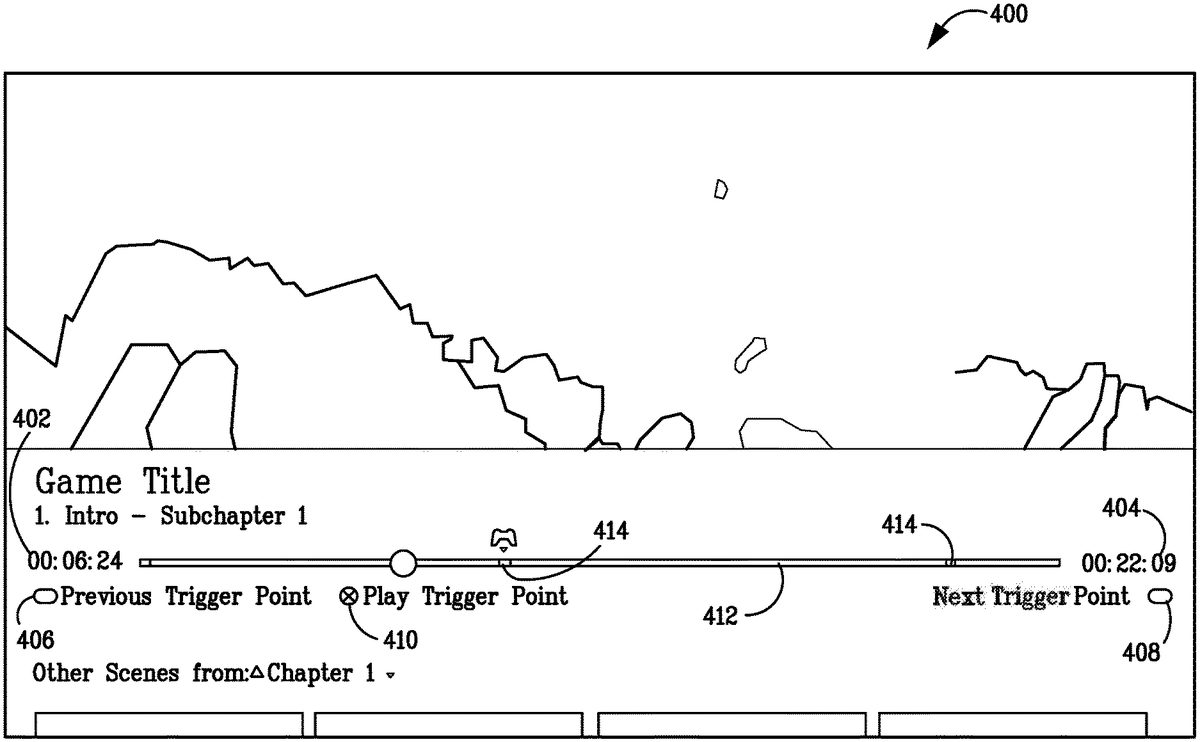
FIG. 3illustrates an exemplary user interface300for a media content scene list302of the interactive title andFIG. 4illustrates an exemplary user interface400for user controls402provided during streaming content. Such user interfaces300,400illustrate a user experience provided by the systems and methods described above. The user interface300provides a media content scene list302of the media content and may provide a switch304to deactivate media content scenes304(e.g., block, blur, hide, grey out, or otherwise make media content scenes304inaccessible). The media content scenes304may also be automatically deactivated or blocked until a user gains access to the interactive content title (e.g., purchases, redeems a promo code, etc.). For example, a user may watch a limited version of the media content (e.g., demo, trailer, or test media content) and may access one gameplay scene of the interactive title, but may be blocked from accessing further media content and gameplay scenes until the user has purchased or otherwise gained access to the interactive title.
The media content scene list302may be organized and displayed by each chapter and sub-chapter. Each media content scene may correspond to one of the at least one or more trigger points, though in other examples some or none of the media content scenes of the media content scene list302may correspond to the at least one or more trigger points. In other words, a media content scene may correspond to a trigger point or a media content scene may not correspond to a trigger point. Selection of a media content scene may begin streaming the media content at the selected media content scene.
As shown inFIG. 4, streaming media content may include standard streaming information such as an elapsed time402of the media content scene and a total time404of the media content scene and user controls such as pause, resume streaming, move to a previous trigger point406, move to a next trigger point408, or play trigger point410. Selection of the play trigger point410may launch the gameplay as described above relative toFIG. 2. The user interface400may also show a timeline412of the media content scene and the user may select any portion of the timeline for viewing. One or more trigger points414available for gameplay may also be displayed on the timeline412. As previously described, such trigger point414may be provided by a user save point or predetermined by a platform, publisher, or third party publisher. The user may advance or skip to any of the trigger points414displayed. Each of the one or more trigger points414may be displayed in different colors, highlighted, or shapes based on a type of the trigger point414. The trigger point414may indicate that branching media content or an important event may occur at such trigger point414and may be displayed in a different color or shape or highlighted differently from the other trigger points414. For example, a highlighted and glowing trigger point414may indicate that the user can select one of a plurality of branching media content, otherwise an automatic selection may occur. In other examples, a red trigger point414may indicate that a final boss battle may occur.
The systems and methods provided for launching gameplay from streaming content provides a unique user experience for consumption of media content with interactive gameplay. Such interactive media content may allow a user to view media content in a conventional manner while being able to begin gameplay at any media content scene or any predetermined media content scene. As such, users can experience an engaging storyline of an interactive title without having to play through the entire interactive title. Rather, users can selectively play portions of the interactive title while still experiencing the storyline. Further, users who have already played through the entire game can also selectively play through the interactive title. For example, a user can play their favorite media content scenes while re-watching the story. Thus, a unique user experience of interactive streaming media content is provided.
FIG. 5is an exemplary user electronic entertainment system that may be used in launching gameplay from streaming content. The entertainment system500ofFIG. 5includes a main memory505, a central processing unit (CPU)510, vector unit515, a graphics processing unit520, an input/output (I/O) processor525, an I/O processor memory530, a peripheral interface535, a memory card540, a Universal Serial Bus (USB) interface545, and a communication network interface550. The entertainment system500further includes an operating system read-only memory (OS ROM)555, a sound processing unit560, an optical disc control unit570, and a hard disc drive565, which are connected via a bus575to the I/O processor525.
Entertainment system500may be an electronic game console. Alternatively, the entertainment system500may be implemented as a general-purpose computer, a set-top box, a hand-held game device, a tablet computing device, a virtual reality device, an augmented reality device, or a mobile computing device or phone. Entertainment systems may contain more or less operating components depending on a particular form factor, purpose, or design.
The CPU510, the vector unit515, the graphics processing unit520, and the I/O processor525ofFIG. 5communicate via a system bus585. Further, the CPU510ofFIG. 5communicates with the main memory505via a dedicated bus580, while the vector unit515and the graphics processing unit520may communicate through a dedicated bus590. The CPU510ofFIG. 5executes programs stored in the OS ROM555and the main memory505. The main memory505ofFIG. 5may contain pre-stored programs and programs transferred through the I/O Processor525from a CD-ROM, DVD-ROM, or other optical disc (not shown) using the optical disc control unit570. I/O Processor525ofFIG. 5may also allow for the introduction of content transferred over a wireless or other communications network (e.g., 4G, LTE, 1G, and so forth). The I/O processor525ofFIG. 5primarily controls data exchanges between the various devices of the entertainment system500including the CPU510, the vector unit515, the graphics processing unit520, and the peripheral interface535.
The graphics processing unit520ofFIG. 5executes graphics instructions received from the CPU510and the vector unit515to produce images for display on a display device (not shown). For example, the vector unit515ofFIG. 5may transform objects from three-dimensional coordinates to two-dimensional coordinates, and send the two-dimensional coordinates to the graphics processing unit520. Furthermore, the sound processing unit560executes instructions to produce sound signals that are outputted to an audio device such as speakers (not shown). Other devices may be connected to the entertainment system500via the USB interface545, and the communication network interface550such as wireless transceivers, which may also be embedded in the system500or as a part of some other component such as a processor.
A user of the entertainment system500ofFIG. 5provides instructions via the peripheral interface535to the CPU510, which allows for use of a variety of different available peripheral devices (e.g., controllers) known in the art. For example, the user may instruct the CPU510to store certain game information on the memory card540or other non-transitory computer-readable storage media or instruct a character in a game to perform some specified action.
The present invention may be implemented in an application that may be operable by a variety of end user devices. For example, an end user device may be a personal computer, a home entertainment system (e.g., Sony PlayStation2® or Sony PlayStation3® or Sony PlayStation4®), a portable gaming device (e.g., Sony PSP® or Sony Vita®), or a home entertainment system of a different albeit inferior manufacturer. The present methodologies described herein are fully intended to be operable on a variety of devices. The present invention may also be implemented with cross-title neutrality wherein an embodiment of the present system may be utilized across a variety of titles from various publishers.
The present invention may be implemented in an application that may be operable using a variety of devices. Non-transitory computer-readable storage media refer to any medium or media that participate in providing instructions to a central processing unit (CPU) for execution. Such media can take many forms, including, but not limited to, non-volatile and volatile media such as optical or magnetic disks and dynamic memory, respectively. Common forms of non-transitory computer-readable media include, for example, a floppy disk, a flexible disk, a hard disk, magnetic tape, any other magnetic medium, a CD-ROM disk, digital video disk (DVD), any other optical medium, RAM, PROM, EPROM, a FLASHEPROM, and any other memory chip or cartridge.
Various forms of transmission media may be involved in carrying one or more sequences of one or more instructions to a CPU for execution. A bus carries the data to system RAM, from which a CPU retrieves and executes the instructions. The instructions received by system RAM can optionally be stored on a fixed disk either before or after execution by a CPU. Various forms of storage may likewise be implemented as well as the necessary network interfaces and network topologies to implement the same.
The foregoing detailed description of the technology has been presented for purposes of illustration and description. It is not intended to be exhaustive or to limit the technology to the precise form disclosed. Many modifications and variations are possible in light of the above teaching. The described embodiments were chosen in order to best explain the principles of the technology, its practical application, and to enable others skilled in the art to utilize the technology in various embodiments and with various modifications as are suited to the particular use contemplated. It is intended that the scope of the technology be defined by the claim.
Claims
- A method for launching gameplay from streaming content, the method comprising: storing information regarding a plurality of media content streams in memory, each media content stream having one or more trigger points, each trigger point associated with a set of game data specific to a gameplay scene within an associated interactive title that includes a plurality of different gameplay scenes, wherein each media content stream depicts one or more players playing the interactive title in the specific gameplay scene;monitoring a portion of one of the media content streams that is being streamed over a communication network to a user device, wherein the streamed portion depicts an identified one of the different gameplay scenes of the interactive title;receiving a selection of one of the trigger points during streaming of the streamed portion by the user device, the selection received over the communication network from the user device;identifying that the selected trigger point is associated with the identified gameplay scene of the interactive title;retrieving the set of game data that is specific to the identified gameplay scene;and launching the interactive title for gameplay by the user device based on the retrieved set of game data specific to the identified gameplay scene depicted in the streamed portion.
- The method of claim 1 , wherein receiving the selection of the selected trigger point comprises receiving input during the streaming of the media content stream at the user device, the input specifying a media location associated with the selected trigger point.
- The method of claim 2 , wherein identifying that the identified gameplay scene is associated with the selected trigger point comprises matching the media location of the selected trigger point to a corresponding gameplay location of the gameplay scene within the interactive title.
- The method of claim 3 , wherein the interactive title is launched at the matched gameplay location.
- The method of claim 3 , wherein matching the media location to the gameplay location includes matching a timestamp of the media location to a timestamp of the gameplay location.
- The method of claim 3 , further comprising: identifying an end gameplay location of the gameplay;matching the end gameplay location to another media location;and allowing the user device to resume streaming of the media content stream at the another media location.
- The method of claim 3 , further comprising allowing the user device to resume streaming of the media content stream at another media location based on a game-state status.
- The method of claim 1 , further comprising generating a display of a timeline of the media content stream, wherein the trigger points are displayed within the timeline.
- The method of claim 1 , wherein at least one of the trigger points is based on user gameplay data captured at a save point in the interactive title.
- The method of claim 1 , wherein the retrieved set of game data includes status data regarding a game character depicted within the identified gameplay scene.
- The method of claim 10 , wherein the game character status data defines at least one of a skill level, gear, and items of the game character within the identified gameplay scene.
- The method of claim 1 , wherein the retrieved set of game data includes an activity identifier associated with an activity depicted within the identified gameplay scene.
- The method of claim 12 , wherein launching the interactive title includes launching the activity associated with the activity identifier.
- The method of claim 1 , wherein the streamed portion further includes a notification that is displayed when play of the streamed portion reaches one of the trigger points.
- The method of claim 1 , further comprising blocking one or more of the trigger points based on a user of the user device having access to the interactive title.
- A system for launching gameplay from streaming content, the system comprising: memory that stores information regarding a plurality of media content streams, each media content stream having one or more trigger points, each trigger point associated with a set of game data specific to a gameplay scene within an associated interactive title that includes a plurality of different gameplay scenes, wherein each media content stream depicts one or more players playing the interactive title in the specific gameplay scene;a communication interface that communicates over a communication network, wherein the communication interface: monitors a portion of one of the media content streams that is being streamed over the communication network to a user device, wherein the streamed portion depicts an identified one of the different gameplay scenes of the interactive title, and receives a selection of one of the trigger points during streaming of the streamed portion by the user device, the selection received over the communication network from the user device;and a processor that executes instructions stored in the memory, wherein execution of the instructions by the processor: identifies that the selected trigger point is associated with the identified gameplay scene of the interactive title;retrieves the set of game data that is specific to the identified gameplay scene;and launches the interactive title for gameplay by the user device based on the retrieved set of game data specific to the identified gameplay scene depicted in the streamed portion.
- The system of claim 16 , wherein receiving the selection of the selected trigger point comprises receiving input during the streaming of the media content stream at the user device, the input specifying a media location associated with the selected trigger point.
- The system of claim 17 , wherein identifying the identified gameplay scene associated with the selected trigger point comprises matching the media location of the selected trigger point to a corresponding gameplay location of the gameplay scene within the interactive title.
- The system of claim 18 , wherein the interactive title is launched at the matched gameplay location.
- The system of claim 18 , wherein matching the media location to the gameplay location includes matching a timestamp of the media location to a timestamp of the gameplay location.
- The system of claim 18 , wherein execution of the instructions by the processor further: identifies an end gameplay location of the gameplay;matches the end gameplay location to another media location;and allows the user device to resume streaming of the media content stream at the another media location.
- The system of claim 18 , wherein execution of the instructions by the processor further allows the user device to resume streaming of the media content stream at another media location based on a game-state status.
- The system of claim 16 , wherein execution of the instructions by the processor further generates a display of a timeline of the media content stream, wherein the trigger points are displayed within the timeline.
- The system of claim 16 , wherein at least one of the trigger points is based on user gameplay data captured at a save point in the interactive title.
- The system of claim 16 , wherein the identified set of game data includes status data regarding a game character depicted within the identified gameplay scene.
- The system of claim 25 , wherein the game character status data defines at least one of a skill level, gear, and items of the game character within the identified gameplay scene.
- The system of claim 16 , wherein the retrieved set of game data includes an activity identifier associated with an activity depicted within the identified gameplay scene.
- The system of claim 27 , wherein launching the interactive title includes launching the activity associated with the activity identifier.
- The system of claim 16 , wherein streamed portion further includes a notification that is displayed when play of the streamed portion reaches one of the trigger points.
- A non-transitory, computer-readable storage medium having embodied thereon instructions executable by a processor to perform a method for launching gameplay from streaming content, the method comprising: storing information regarding a plurality of media content streams in memory, each media content stream having one or more trigger points, each trigger point associated with a set of game data specific to a gameplay scene within an associated interactive title that includes a plurality of different gameplay scenes, wherein each media content stream depicts one or more players playing the interactive title in the specific gameplay scene;monitoring a portion of one of the media content streams that is being streamed over a communication network to a user device, wherein the streamed portion depicts an identified one of the different gameplay scenes of the interactive title;receiving a selection of one of the trigger points during streaming of the streamed portion by the user device, the selection received over the communication network from the user device;identifying that the selected trigger point is associated with the identified gameplay scene of the interactive title;retrieving the set of game data that is specific to the identified gameplay scene;and launching the interactive title for gameplay by the user device based on the retrieved set of game data specific to the identified gameplay scene depicted in the streamed portion.
Disclaimer: Data collected from the USPTO and may be malformed, incomplete, and/or otherwise inaccurate.