U.S. Pat. No. 11,207,593
SCALABLE STATE SYNCHRONIZATION FOR DISTRIBUTED GAME SERVERS
AssigneeElectronic Arts Inc
Issue DateMay 29, 2020
Illustrative Figure
Abstract
Various aspects of the subject technology relate to systems, methods, and machine-readable media for game state synchronization. The method includes recording game state changes in a distributed queue. The method also includes updating a global state based on the recorded game state changes in the distributed queue. The method also includes recording a snapshot of the global state, the snapshot comprising an offset from a latest game state change recorded in the distributed queue. The method also includes updating at least one in-sync service of a plurality of in-sync services based on the game state changes and the snapshot of the global state.
Description
In one or more implementations, not all of the depicted components in each figure may be required, and one or more implementations may include additional components not shown in a figure. Variations in the arrangement and type of the components may be made without departing from the scope of the subject disclosure. Additional components, different components, or fewer components may be utilized within the scope of the subject disclosure. DETAILED DESCRIPTION In the following detailed description, numerous specific details are set forth to provide a full understanding of the present disclosure. It will be apparent, however, to one ordinarily skilled in the art that the embodiments of the present disclosure may be practiced without some of these specific details. In other instances, well-known structures and techniques have not been shown in detail so as not to obscure the disclosure. A cloud game may utilize many game engine instances and cloud servers to power a single seamless large game world that includes thousands of players. The cloud game may also utilize a large number of complex artificial intelligence (AI) and gameplay systems for various purposes, such as for simulating weather, running an in-game economy, etc. The cloud game may further include rendering of physical objects, which may be run at a higher fidelity than other aspects of the game. In such a setting, it is challenging to reliably synchronize a continuously changing global state, including game world data, machine-learning models, etc., to all engines and servers in near real-time so that the players may enjoy a seamless gaming experience. Aspects of the present disclosure address these issues by providing for systems and methods for scalable near real-time state synchronization of distributed game servers. In an aspect, a distributed state-update queue records state changes occurring in a game. A coordinator service keeps ...
In one or more implementations, not all of the depicted components in each figure may be required, and one or more implementations may include additional components not shown in a figure. Variations in the arrangement and type of the components may be made without departing from the scope of the subject disclosure. Additional components, different components, or fewer components may be utilized within the scope of the subject disclosure.
DETAILED DESCRIPTION
In the following detailed description, numerous specific details are set forth to provide a full understanding of the present disclosure. It will be apparent, however, to one ordinarily skilled in the art that the embodiments of the present disclosure may be practiced without some of these specific details. In other instances, well-known structures and techniques have not been shown in detail so as not to obscure the disclosure.
A cloud game may utilize many game engine instances and cloud servers to power a single seamless large game world that includes thousands of players. The cloud game may also utilize a large number of complex artificial intelligence (AI) and gameplay systems for various purposes, such as for simulating weather, running an in-game economy, etc. The cloud game may further include rendering of physical objects, which may be run at a higher fidelity than other aspects of the game. In such a setting, it is challenging to reliably synchronize a continuously changing global state, including game world data, machine-learning models, etc., to all engines and servers in near real-time so that the players may enjoy a seamless gaming experience.
Aspects of the present disclosure address these issues by providing for systems and methods for scalable near real-time state synchronization of distributed game servers. In an aspect, a distributed state-update queue records state changes occurring in a game. A coordinator service keeps an up-to-date global state and periodically takes snapshots of the game state. During bootstrap, individual services of the game may apply a latest snapshot and then apply state changes that occurred after the latest snapshot (e.g., based on an offset from the state-update queue). As a result, all engines and servers may reliably synchronize their local state with the global state in near real-time.
The disclosed system addresses a problem in traditional video games tied to computer technology, namely, the technical problem of game state synchronization. The disclosed system solves this technical problem by providing a solution also rooted in computer technology, namely, by providing for scalable near real-time state synchronization of distributed game servers.
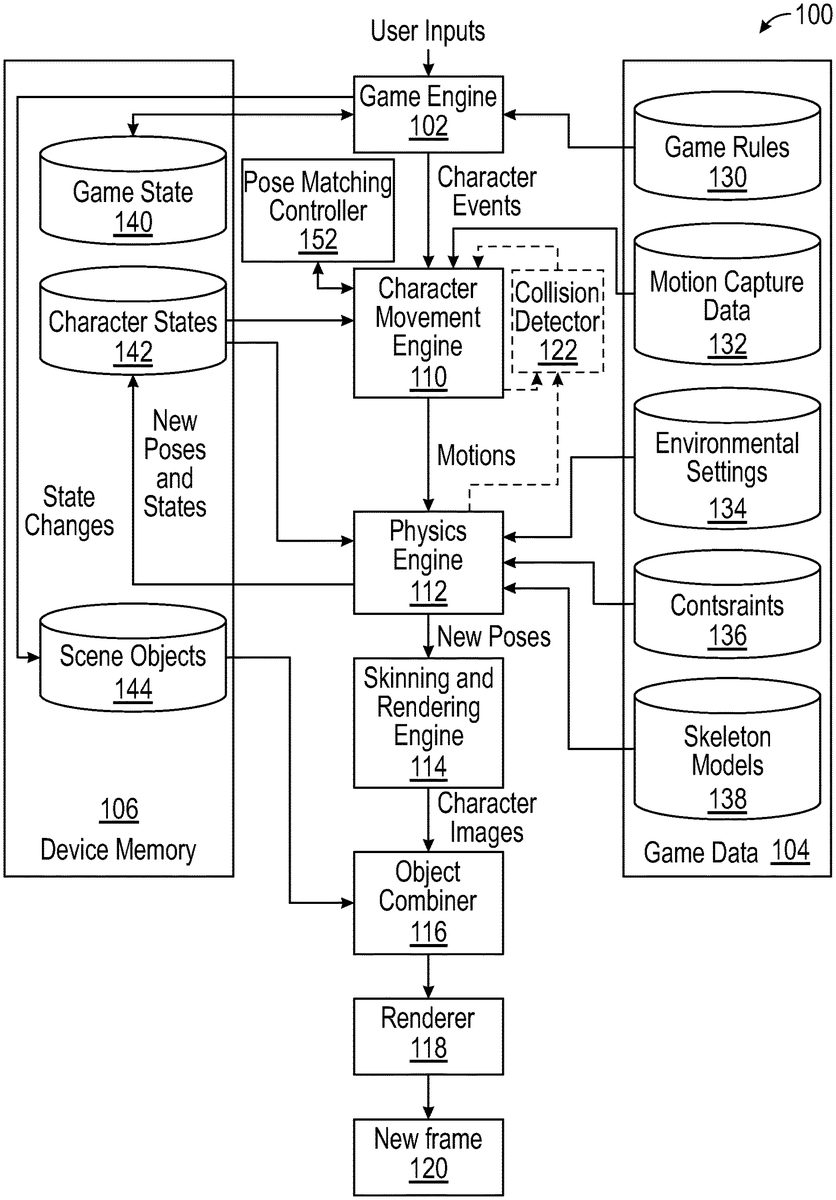
FIG. 1illustrates implementations of some elements of a video game system100in accordance with one or more implementations of the subject technology. In particular,FIG. 1illustrates implementations of elements involved in execution of gameplay within a game application. The game application may be executed by a user computing device, such as that described below with respect toFIG. 2. The game system100may receive user input to control aspects of the game according to game rules130. Game rules130may be specified in instruction form on game media. Examples of game rules130include rules for scoring, possible inputs, actions/events, movement in response to inputs, and the like. Other components can control what inputs are accepted and how the game progresses, and other aspects of gameplay. The elements inFIG. 1illustrate elements used for generating and rendering animation within the game based on various inputs.
As shown inFIG. 1, by system100, user inputs and game code/data may be used to generate display video. The game system also handles playing the game and presenting corresponding audio output. The description ofFIG. 1is focused on generating frames of display video for the game. A game engine102receives the user inputs and determines character events, such as actions, collisions, runs, throws, attacks and other events appropriate for the game.
The character events are conveyed to a character movement engine110that determines the appropriate motions the characters should make in response to the events. Further, the character movement engine110may generate a character pose that can be passed directly or provided to a skinning and rendering engine114or to a physics engine112for further processing. This generated character pose may be referred to as the “target pose.” The physics engine112tracks the target pose by, for example, calculating the torques and forces necessary to make the ragdoll representation of the character follow the target pose. In calculating the torques and forces for making the ragdoll representation of the character follow the target pose, the physics engine112may account for or incorporate external forces and collision constraints in its calculations. A muscle system inside or communicating with the physics engine112may account for forces that a representation of muscles associated with the character, or its ragdoll representation, may apply in attempting to follow the target pose. By accounting for the representation of the muscles associated with the character, the physics engine112can determine how closely the target pose will be followed by the ragdoll. Muscle tensions for the character can be tweaked to follow the target pose loosely or closely. The physics engine112may generate the final character pose that may be provided to the skinning and rendering engine114. The skinning and rendering engine114in turn provides character frames to an object combiner116to combine animate, inanimate, and background objects into a full scene. The full scene is conveyed to a renderer118, which generates a new frame120therefrom.
Game code/data104is shown comprising game rules130, prerecorded motion capture data132(e.g., poses/paths), environmental settings134, constraints136(such as strength and velocity constraints), and skeleton models138. The device executing the game might have memory106for game state140, character states142and scene object storage144. Character states142can comprise storage for a current pose of characters being animated.
During operation, the game engine102reads in game rules130and considers game state140to arrive at character events. Character movement engine110reads in prerecorded poses/paths from a motion capture data repository132as well as character states142. The motion capture data repository132can store motion capture clips in the form of marker positions and/or a hierarchy of relative joint orientations. The pose for each frame within the collection of animation clips may be uniquely identified by a corresponding hierarchy of relative joint orientations. An optional collision detector engine122can detect collisions generated by the physics engine112and alert the game engine to the collisions, which may result in the triggering of specific game events. Further, the detection of collisions may result in a recalculation of the final pose by the physics engine112.
In some implementations, the character movement engine110can work in conjunction with the physics engine112to create a procedural animation. In some such implementations, the physics engine112may generate a final pose for an object or character that differs from the target pose, in, response to, for example, a collision detected by the collision detector122. The character pose may be generated on a frame-by-frame basis and can be based at least in part on one or more physics rules implemented by the physics engine112. For example, the final pose may be based at least in part on the target pose provided by the character movement engine110and the impact of a collision force and/or a gravitational value. The character movement engine110can use the final pose to identify a motion capture frame included in the motion capture data132, which may be provided as the target pose for the next frame in the procedural animation. The strength of the muscles determined by the physics engine112may be used to determine how closely the new target pose will be followed when generating the subsequent frame. Advantageously, in certain implementations, using the final pose to select a motion capture frame and updating the target pose for the next frame update based on the selected motion capture frame enables more fluid procedural animation compared to pre-existing processes. Further, the use of procedural animation can result in a larger variety of animation within a game while reducing storage space for the game data104of a game. In certain implementations, one or more of the game engine102, the character movement engine110, the physics engine112, and the collision detector122, among other systems may be configured to execute the processes.
As needed, character movement engine110may also use other data elements shown, such as skeleton models138, also referred to as rigs. Rigs are often used in character animations. A typical rig may comprise a collection of character components, such as a skeletal structure and a mesh to be skinned over the skeletal structure. A typical rig comprises a skeletal structure for a character and includes a plurality of degrees of freedom. A rig may also comprise a set of animation controls that enable an animator to move the various components of the character in order to create motion in an animation. Character movement engine110might also introduce character movements for randomness, personality, and so forth.
In certain implementations, the character movement engine110provides a target pose based on, game rules. For example, the game logic may select an, animation to be played, and a current frame of the animation may dictate the target pose. The physics engine112can receive the target pose as an input and can calculate the forces and torques to make the ragdoll representation follow the target pose. The strength of the muscles of the ragdoll may determine how closely the target pose is followed by the ragdoll when generating the procedural animation. Further, the physics engine112may modify the calculation of the path followed by the ragdoll based at least in part on external forces and/or collision constraints that occur with respect to the character in the video game. Thus, in some cases, even with strong muscles, the target pose may not be reached if, for example, a collision occurs or there is an obstacle in the path of one or more of the character's limbs.
The pose matching controller152can identify one or more frames from an animation to display based on how well a character pose from one animation matches a character pose from another animation. For example, the pose matching controller152can identify a number of pose features or reference features from a character in a particular animation, or a current frame from the particular animation and determine the difference between the pose features and corresponding pose features from frames of a second animation. In some implementations, a particular frame of an animation is compared to one or more frames from another animation. For example, upon receiving a trigger to change animations, the pose matching controller152may compare a current frame and/or a subsequent frame to one or more frames of a new animation to be displayed. The frame from the second animation with pose features that has the smallest difference compared to the pose features of the particular animation may be selected as a start frame when transitioning from the particular animation to the second animation. Advantageously, in certain implementations, the pose matching controller152enables animations to appear smoother or more realistic compared to systems that start subsequent animations at the same start frame each time and/or without accounting for the frame of a the current animation when transitioning to a new animation.
The skinning and rendering engine114takes into account the surfaces, colors and textures of the body parts of posed characters and renders character images. Object combiner116can then combine the character images with inanimate and background objects obtained from scene objects storage144to provide a complete scene to renderer118.
FIG. 2illustrates an implementation of a user computing system200, which may also be referred to as a gaming system, in accordance with one or more implementations of the subject technology. As illustrated, the user computing system200may be a single computing device that can include a number of elements. However, in some cases, the user computing system200may include multiple devices. For example, the user computing system200may include one device that includes that includes a central processing unit and a graphics processing unit, another device that includes a display, and another device that includes an, input mechanism, such as a keyboard or mouse.
The user computing system200can be an implementation of a computing system that can execute a game system, such as the game system100described with respect toFIG. 1. In the non-limiting example ofFIG. 2, the user computing system200is a touch-capable computing device capable of receiving input from a user via a display202. However, the user computing system200is not limited as such and may include non-touch capable implementations, which do not include a display202.
The user computing system200includes a display202and an interface204, and is configured to execute a game application210. For example, the display202and the interface204may include touchscreen displays and touchscreen interfaces in addition to standard displays and interfaces. This game application may be a video game or an application that executes in conjunction with or in support of the video game, such as a video game execution environment. Further, the game application may include one or more of the features described with respect to the game system100. Although described as a game application210, in some implementations the application210may be another type of application that may include procedural animations based on motion capture data and/or that may transition between two different animations, such as educational software. While user computing system200includes the display202, it is recognized that a variety of input devices may be used in addition to or in place of the display202.
The user computing system200can include one or more processors, such as central processing units (CPUs), graphics processing units (GPUs), and accelerated processing units (APUs). Further, the user computing system200may include one or more data storage elements. In some implementations, the user computing system200can be a specialized computing device created for the purpose of executing game applications210. For example, the user computing system200may be a video game console. The game applications210executed by the user computing system200may be created using a particular application programming interface (API) or compiled into a particular instruction set that may be specific to the user computing system200. In some implementations, the user computing system200may be a general purpose computing device capable of executing game applications210and non-game applications. For example, the user computing system200may be a laptop with an integrated display or desktop computer with an external display.
A game application210can be configured to be executed on the user computing system200. The game application210may also be referred to as a video game, a game, game code and/or a game program. A game application should be understood to include software code that a user computing system200can use to provide a game for a user to play. A game application210might comprise software code that informs a user computing system200of processor instructions to execute, but might also include data used in the playing of the game, such as data relating to constants, images and other data structures. For example, in the illustrated implementation, the game application includes a game engine212, game data214, and game state information216.
The interface204or another component of the user computing system200, such as the operating system, can provide user input, such as touch inputs, to the game application210. In some implementations, the user computing system200may include alternative or additional user input devices, such as a mouse, a keyboard, a camera, a game controller, and the like. A user can interact with the game application210via the interface204and/or one or more of the alternative or additional user input devices. The game engine212can be configured to execute aspects of the operation of the game application210within the user computing system200. Execution of aspects of gameplay within a game application can be based, at least in part, on the user input received, the game data214, and game state information216. The game data214can include game rules, prerecorded motion capture poses/paths, environmental settings, constraints, animation reference curves, skeleton models, and/or other game application information. Further, the game data214may include information that is used to set or adjust the difficulty of the game application210.
The game engine212can execute gameplay within the game according to the game rules. Some examples of game rules can include rules for scoring, possible inputs, actions/events, movement in response to inputs, and the like. Other components can control what inputs are accepted and how the game progresses, and other aspects of gameplay. During execution of the game application210, game state information216can be stored, which can include character states, environment states, scene object storage, and/or other information associated with a state of execution of the game application210. For example, the game state information216can identify the state of the game application at a specific point in time, such as a character position, character action, game level, attributes, and other information contributing to a state of the game application.
The game engine212can receive the user inputs and determine in-game events, such as actions, collisions, runs, throws, attacks and other events appropriate for the game application210. During operation, the game engine212can read in game data214and game state information216in order to determine the appropriate in-game events. In one example, after the game engine212determines the character events, the character events can be conveyed to a movement engine that can determine the appropriate motions the characters should make in response to the events and passes those motions on to an animation engine. The animation engine can determine new poses for the characters and provide the new poses to a skinning and rendering engine. The skinning and rendering engine, in turn, can provide character images to an object combiner in order to combine animate, inanimate, and background objects into a full scene. The full scene can conveyed to a renderer, which can generate a new frame for display to the user. The process can be repeated for rendering each frame during execution of the game application. Though the process has been, described in the context of a character, the process can be applied to any process for processing events and rendering the output for display to a user.
As described above, being able to reliably synchronize global shared state in near real-time across game engines and servers is a critical requirement for many cloud gaming use cases. According to embodiments, each game engine and server may reliably synchronizes its local state with the global state in near real-time independently. Each game engine and server may efficiently update to a most recent snapshot to catch up to the latest global state for capacity expansion and light-weight recovery. According to aspects, the system may utilize a state-update queue to cleanse events and prevent invalid events to flood a game cluster. Accordingly, the system enables a large number of heterogeneous game engines and servers to synchronize to the global state in a simple unified way, as will be described in more detail below.
FIG. 3illustrates an exemplary system300for game state synchronization, according to certain aspects of the present disclosure. The system300may include game engines and servers302, similar to the above described inFIGS. 1 and 2. The system300may further include a state change queue304(e.g., a distributed queue), a coordinator service306, global state storage308, snapshot storage310, and in-sync services312.
According to aspects, the game engines and servers302may generate state changes320based on player inputs to a video game. For example, the video game may be an online interactive multiplayer game. The state changes320may relate to changes in game states from previously generated state changes. For example, the state changes320may include data regarding a combination of visual, audio, and/or animation cues that have been modified from a previous game state. Each state change320may be recorded in the state change queue304. For example, the state change queue304may record each state change320in order of receipt, such that a latest state change is last in the state change queue304. In this way, state changes320may be implemented in chronological order of occurrence.
According to aspects, the state changes320may be relayed by the coordinator service306to the global state storage308as they occur. For example, the coordinator service306may be configured to monitor the state change queue304for a latest state change. Once recorded in the state change queue304, the coordinator service306may forward the state change320to the global state storage308. The global state storage308may implement the state change320to update a global state of the game. According to aspects, the global state may relate to an overall global state of the game running on all game engines and servers302, or the global state may relate to individual game states of individual game engines and servers302.
In an implementation, the snapshot storage310may record a snapshot322of a latest global state from the global state storage308. For example, the snapshot storage310may be configured to take a snapshot322at even intervals, such as every hour, every day, etc. According to an aspect, the snapshot storage310may be configured to take a snapshot322at adaptive intervals. For example, the intervals may be based on data volume trend, or heuristic on time intervals. A machine learning algorithm may be utilized to optimize the intervals. It is understood that longer or shorter intervals may be implemented without departing from the scope of the disclosure.
According to aspects, the snapshot storage310may also record a queue offset324along with the snapshot322. For example, the snapshot322may relate to a latest global state of the game, and the queue offset324may relate to a latest state change320that was implemented into the global state.
According to aspects, the in-sync services312may receive the state changes320from the state change queue304. The state changes320may then be applied to each in-sync service312as appropriate. For example, each in-sync service312may relate to a different function of the game, and so each state change320may be applied independently to specific in-sync services312. According to aspects, the in-sync services312may also be configured to receive the snapshot322and the queue offset324from the snapshot storage310. For example, the snapshot322and the queue offset324may be received by the in-sync services312as the snapshots322are taken. The in-sync services312may then utilize the snapshot322and queue offset324to confirm that the global state reflected in each of the in-sync services312is up-to-date without errors. If there are inconsistencies, then the snapshot322and queue offset324may be utilized to update the in-sync services312accordingly to the correct latest global state. Additionally, if connection errors occur, or any other errors that may cause a loss in global state information, the in-sync services312may utilize the snapshot322and queue offset324to quickly catch up to the latest global state without much delay. In this way, the snapshot322and the queue offset324may be utilized to quickly bootstrap a game to a latest global state in various situations.
It is understood that although each component has been described individually, they all may operate simultaneously and continuously to maintain a latest global state. For example, the state changes320may be queued in the state change queue304at the same time as other state changes304are consumed by the coordinator service306and the in-sync services312simultaneously. According to aspects, the state change queue304may act as a buffer for state changes320so that if too many state changes320occur at once, they may all be recorded in order of occurrence and implemented based on a least recent state change to a most recent state change.
FIG. 4illustrates an exemplary system400configured for game state synchronization, in accordance with one or more implementations. In some implementations, system400may include one or more computing platforms402. Computing platform(s)402may be configured to communicate with one or more remote platforms404according to a client/server architecture, a peer-to-peer architecture, and/or other architectures. Remote platform(s)404may be configured to communicate with other remote platforms via computing platform(s)402and/or according to a client/server architecture, a peer-to-peer architecture, and/or other architectures. Users may access system400via remote platform(s)404.
Computing platform(s)402may be configured by machine-readable instructions406. Machine-readable instructions406may include one or more instruction modules. The instruction modules may include computer program modules. The instruction modules may include one or more of game state recording module408, game state updating module410, snapshot recording module412, offset recording module414, service updating module416, game state receiving module418, game state coordinating module420, and/or other instruction modules.
Game state recording module408may be configured to record game state changes in a distributed queue. By way of non-limiting example, the game state changes may include changes to a combination of visual, audio, animation cues, etc.
Global state updating module410may be configured to update a global state of the game based on recorded game state changes in the distributed queue.
Snapshot recording module412may be configured to record a snapshot of the global state.
Offset recording module414may be configured to record an offset from a latest game state change recorded in the distributed queue.
Service updating module416may be configured to update at least one in-sync service of a plurality of in-sync services.
Game state receiving module418may be configured to receive each game state from a plurality of game engines and servers.
Game state coordinating module420may be configured to coordinate implementation of each recorded game state into the global state.
In some implementations, computing platform(s)402, remote platform(s)404, and/or external resources424may be operatively linked via one or more electronic communication links. For example, such electronic communication links may be established, at least in part, via a network such as the Internet and/or other networks. It will be appreciated that this is not intended to be limiting, and that the scope of this disclosure includes implementations in which computing platform(s)402, remote platform(s)404, and/or external resources424may be operatively linked via some other communication media.
A given remote platform404may include one or more processors configured to execute computer program modules. The computer program modules may be configured to enable an expert or user associated with the given remote platform404to interface with system400and/or external resources424, and/or provide other functionality attributed herein to remote platform(s)404. By way of non-limiting example, a given remote platform404and/or a given computing platform402may include one or more of a server, a desktop computer, a laptop computer, a handheld computer, a tablet computing platform, a NetBook, a Smartphone, a gaming console, and/or other computing platforms.
External resources424may include sources of information outside of system400, external entities participating with system400, and/or other resources. In some implementations, some or all of the functionality attributed herein to external resources424may be provided by resources included in system400.
Computing platform(s)402may include electronic storage426, one or more processors428, and/or other components. Computing platform(s)402may include communication lines, or ports to enable the exchange of information with a network and/or other computing platforms. Illustration of computing platform(s)402inFIG. 4is not intended to be limiting. Computing platform(s)402may include a plurality of hardware, software, and/or firmware components operating together to provide the functionality attributed herein to computing platform(s)402. For example, computing platform(s)402may be implemented by a cloud of computing platforms operating together as computing platform(s)402.
Electronic storage426may comprise non-transitory storage media that electronically stores information. The electronic storage media of electronic storage426may include one or both of system storage that is provided integrally (i.e., substantially non-removable) with computing platform(s)402and/or removable storage that is removably connectable to computing platform(s)402via, for example, a port (e.g., a USB port, a firewire port, etc.) or a drive (e.g., a disk drive, etc.). Electronic storage426may include one or more of optically readable storage media (e.g., optical disks, etc.), magnetically readable storage media (e.g., magnetic tape, magnetic hard drive, floppy drive, etc.), electrical charge-based storage media (e.g., EEPROM, RAM, etc.), solid-state storage media (e.g., flash drive, etc.), and/or other electronically readable storage media. Electronic storage426may include one or more virtual storage resources (e.g., cloud storage, a virtual private network, and/or other virtual storage resources). Electronic storage426may store software algorithms, information determined by processor(s)428, information received from computing platform(s)402, information received from remote platform(s)404, and/or other information that enables computing platform(s)402to function as described herein.
Processor(s)428may be configured to provide information processing capabilities in computing platform(s)402. As such, processor(s)428may include one or more of a digital processor, an analog processor, a digital circuit designed to process information, an analog circuit designed to process information, a state machine, and/or other mechanisms for electronically processing information. Although processor(s)428is shown inFIG. 4as a single entity, this is for illustrative purposes only. In some implementations, processor(s)428may include a plurality of processing units. These processing units may be physically located within the same device, or processor(s)428may represent processing functionality of a plurality of devices operating in coordination. Processor(s)428may be configured to execute modules408,410,412,414,416,418, and/or420, and/or other modules. Processor(s)428may be configured to execute modules408,410,412,414,416,418, and/or420, and/or other modules by software; hardware; firmware; some combination of software, hardware, and/or firmware; and/or other mechanisms for configuring processing capabilities on processor(s)428. As used herein, the term “module” may refer to any component or set of components that perform the functionality attributed to the module. This may include one or more physical processors during execution of processor readable instructions, the processor readable instructions, circuitry, hardware, storage media, or any other components.
It should be appreciated that although modules408,410,412,414,416,418, and/or420are illustrated inFIG. 4as being implemented within a single processing unit, in implementations in which processor(s)428includes multiple processing units, one or more of modules408,410,412,414,416,418, and/or420may be implemented remotely from the other modules. The description of the functionality provided by the different modules408,410,412,414,416,418, and/or420described below is for illustrative purposes, and is not intended to be limiting, as any of modules408,410,412,414,416,418, and/or420may provide more or less functionality than is described. For example, one or more of modules408,410,412,414,416,418, and/or420may be eliminated, and some or all of its functionality may be provided by other ones of modules408,410,412,414,416,418, and/or420. As another example, processor(s)428may be configured to execute one or more additional modules that may perform some or all of the functionality attributed below to one of modules408,410,412,414,416,418, and/or420.
The techniques described herein may be implemented as method(s) that are performed by physical computing device(s); as one or more non-transitory computer-readable storage media storing instructions which, when executed by computing device(s), cause performance of the method(s); or, as physical computing device(s) that are specially configured with a combination of hardware and software that causes performance of the method(s).
FIG. 5illustrates an example flow diagram (e.g., process500) for contextual matchmaking, according to certain aspects of the disclosure. For explanatory purposes, the example process500is described herein with reference toFIGS. 1-4. Further for explanatory purposes, the steps of the example process500are described herein as occurring in serial, or linearly. However, multiple instances of the example process500may occur in parallel. For purposes of explanation of the subject technology, the process500will be discussed in reference toFIGS. 1-4.
At step502, game state changes are recorded in a distributed queue. At step504a global state is updated based on the recorded game state changes in the distributed queue. At step506, a snapshot of the global state is recorded. For example, the snapshot may include an offset from a latest game state change recorded in the distributed queue. At step508, at least one in-sync service of a plurality of in-sync services is updated based on the game state changes and the snapshot of the global state.
For example, as described above in relation toFIGS. 1-4, at step502, game state changes (e.g., state changes320) are recorded in a distributed queue (e.g., state change queue304) through a game state recording module408. For example, the state change may be received from game engines and servers100,200,302. At step504a global state (e.g., global state database308) is updated (e.g., through global state updating module410) based on the recorded game state changes in the distributed queue. At step506, a snapshot (e.g., snapshot322) of the global state is recorded through the snapshot recording module412. For example, the snapshot may include an offset (e.g., offset324) from a latest game state change recorded in the distributed queue. At step508, at least one in-sync (e.g., in-sync services312) service of a plurality of in-sync services is updated (e.g., through service updating module416) based on the game state changes and the snapshot of the global state.
According to an aspect, the snapshots are periodically recorded at adaptive intervals. For example, the intervals may be based on data volume trend, or heuristic on time intervals. A machine learning algorithm may be utilized to optimize the intervals. In an implementation, the snapshots may be periodically recorded at even intervals. According to an aspect, players are matched based on results of a matching algorithm.
According to an aspect the process500may further include receiving the game state changes from a plurality of game engines of a plurality of game servers.
According to an aspect the process500may further include monitoring, through a coordinator service, the distributed queue for game state changes.
According to an aspect, the distributed queue comprises a plurality of game state changes stored in sequence. According to an aspect, each of the in-sync services independently updates based on the offset.
According to aspects, the process500may further include storing the global state in a global state database, and storing the snapshot in in a snapshot database.
FIG. 6is a block diagram illustrating an exemplary computer system600with which aspects of the subject technology can be implemented. In certain aspects, the computer system600may be implemented using hardware or a combination of software and hardware, either in a dedicated server, integrated into another entity, or distributed across multiple entities.
Computer system600(e.g., server and/or client) includes a bus608or other communication mechanism for communicating information, and a processor602coupled with bus608for processing information. By way of example, the computer system600may be implemented with one or more processors602. Processor602may be a general-purpose microprocessor, a microcontroller, a Digital Signal Processor (DSP), an Application Specific Integrated Circuit (ASIC), a Field Programmable Gate Array (FPGA), a Programmable Logic Device (PLD), a controller, a state machine, gated logic, discrete hardware components, or any other suitable entity that can perform calculations or other manipulations of information.
Computer system600can include, in addition to hardware, code that creates an execution environment for the computer program in question, e.g., code that constitutes processor firmware, a protocol stack, a database management system, an operating system, or a combination of one or more of them stored in an included memory604, such as a Random Access Memory (RAM), a flash memory, a Read Only Memory (ROM), a Programmable Read-Only Memory (PROM), an Erasable PROM (EPROM), registers, a hard disk, a removable disk, a CD-ROM, a DVD, or any other suitable storage device, coupled to bus608for storing information and instructions to be executed by processor602. The processor602and the memory604can be supplemented by, or incorporated in, special purpose logic circuitry.
The instructions may be stored in the memory604and implemented in one or more computer program products, i.e., one or more modules of computer program instructions encoded on a computer readable medium for execution by, or to control the operation of, the computer system600, and according to any method well-known to those of skill in the art, including, but not limited to, computer languages such as data-oriented languages (e.g., SQL, dBase), system languages (e.g., C, Objective-C, C++, Assembly), architectural languages (e.g., Java, .NET), and application languages (e.g., PHP, Ruby, Perl, Python). Instructions may also be implemented in computer languages such as array languages, aspect-oriented languages, assembly languages, authoring languages, command line interface languages, compiled languages, concurrent languages, curly-bracket languages, dataflow languages, data-structured languages, declarative languages, esoteric languages, extension languages, fourth-generation languages, functional languages, interactive mode languages, interpreted languages, iterative languages, list-based languages, little languages, logic-based languages, machine languages, macro languages, metaprogramming languages, multiparadigm languages, numerical analysis, non-English-based languages, object-oriented class-based languages, object-oriented prototype-based languages, off-side rule languages, procedural languages, reflective languages, rule-based languages, scripting languages, stack-based languages, synchronous languages, syntax handling languages, visual languages, with languages, and xml-based languages. Memory604may also be used for storing temporary variable or other intermediate information during execution of instructions to be executed by processor602.
A computer program as discussed herein does not necessarily correspond to a file in a file system. A program can be stored in a portion of a file that holds other programs or data (e.g., one or more scripts stored in a markup language document), in a single file dedicated to the program in question, or in multiple coordinated files (e.g., files that store one or more modules, subprograms, or portions of code). A computer program can be deployed to be executed on one computer or on multiple computers that are located at one site or distributed across multiple sites and interconnected by a communication network. The processes and logic flows described in this specification can be performed by one or more programmable processors executing one or more computer programs to perform functions by operating on input data and generating output.
Computer system600further includes a data storage device606such as a magnetic disk or optical disk, coupled to bus608for storing information and instructions. Computer system600may be coupled via input/output module610to various devices. The input/output module610can be any input/output module. Exemplary input/output modules610include data ports such as USB ports. The input/output module610is configured to connect to a communications module612. Exemplary communications modules612include networking interface cards, such as Ethernet cards and modems. In certain aspects, the input/output module610is configured to connect to a plurality of devices, such as an input device614and/or an output device616. Exemplary input devices614include a keyboard and a pointing device, e.g., a mouse or a trackball, by which a user can provide input to the computer system600. Other kinds of input devices614can be used to provide for interaction with a user as well, such as a tactile input device, visual input device, audio input device, or brain-computer interface device. For example, feedback provided to the user can be any form of sensory feedback, e.g., visual feedback, auditory feedback, or tactile feedback, and input from the user can be received in any form, including acoustic, speech, tactile, or brain wave input. Exemplary output devices616include display devices such as an LCD (liquid crystal display) monitor, for displaying information to the user.
According to one aspect of the present disclosure, the above-described gaming systems can be implemented using a computer system600in response to processor602executing one or more sequences of one or more instructions contained in memory604. Such instructions may be read into memory604from another machine-readable medium, such as data storage device606. Execution of the sequences of instructions contained in the main memory604causes processor602to perform the process steps described herein. One or more processors in a multi-processing arrangement may also be employed to execute the sequences of instructions contained in memory604. In alternative aspects, hard-wired circuitry may be used in place of or in combination with software instructions to implement various aspects of the present disclosure. Thus, aspects of the present disclosure are not limited to any specific combination of hardware circuitry and software.
Various aspects of the subject matter described in this specification can be implemented in a computing system that includes a back end component, e.g., such as a data server, or that includes a middleware component, e.g., an application server, or that includes a front end component, e.g., a client computer having a graphical user interface or a Web browser through which a user can interact with an implementation of the subject matter described in this specification, or any combination of one or more such back end, middleware, or front end components. The components of the system can be interconnected by any form or medium of digital data communication, e.g., a communication network. The communication network can include, for example, any one or more of a LAN, a WAN, the Internet, and the like. Further, the communication network can include, but is not limited to, for example, any one or more of the following network topologies, including a bus network, a star network, a ring network, a mesh network, a star-bus network, tree or hierarchical network, or the like. The communications modules can be, for example, modems or Ethernet cards.
Computer system600can include clients and servers. A client and server are generally remote from each other and typically interact through a communication network. The relationship of client and server arises by virtue of computer programs running on the respective computers and having a client-server relationship to each other. Computer system600can be, for example, and without limitation, a desktop computer, laptop computer, or tablet computer. Computer system600can also be embedded in another device, for example, and without limitation, a mobile telephone, a PDA, a mobile audio player, a Global Positioning System (GPS) receiver, a video game console, and/or a television set top box.
The term “machine-readable storage medium” or “computer readable medium” as used herein refers to any medium or media that participates in providing instructions to processor602for execution. Such a medium may take many forms, including, but not limited to, non-volatile media, volatile media, and transmission media. Non-volatile media include, for example, optical or magnetic disks, such as data storage device606. Volatile media include dynamic memory, such as memory604. Transmission media include coaxial cables, copper wire, and fiber optics, including the wires that comprise bus608. Common forms of machine-readable media include, for example, floppy disk, a flexible disk, hard disk, magnetic tape, any other magnetic medium, a CD-ROM, DVD, any other optical medium, punch cards, paper tape, any other physical medium with patterns of holes, a RAM, a PROM, an EPROM, a FLASH EPROM, any other memory chip or cartridge, or any other medium from which a computer can read. The machine-readable storage medium can be a machine-readable storage device, a machine-readable storage substrate, a memory device, a composition of matter effecting a machine-readable propagated signal, or a combination of one or more of them.
As the user computing system600reads game data and provides a game, information may be read from the game data and stored in a memory device, such as the memory604. Additionally, data from the memory604servers accessed via a network the bus608, or the data storage606may be read and loaded into the memory604. Although data is described as being found in the memory604, it will be understood that data does not have to be stored in the memory604and may be stored in other memory accessible to the processor602or distributed among several media, such as the data storage606.
As used herein, the phrase “at least one of” preceding a series of items, with the terms “and” or “or” to separate any of the items, modifies the list as a whole, rather than each member of the list (i.e., each item). The phrase “at least one of” does not require selection of at least one item; rather, the phrase allows a meaning that includes at least one of any one of the items, and/or at least one of any combination of the items, and/or at least one of each of the items. By way of example, the phrases “at least one of A, B, and C” or “at least one of A, B, or C” each refer to only A, only B, or only C; any combination of A, B, and C; and/or at least one of each of A, B, and C.
To the extent that the terms “include”, “have”, or the like is used in the description or the claims, such term is intended to be inclusive in a manner similar to the term “comprise” as “comprise” is interpreted when employed as a transitional word in a claim. The word “exemplary” is used herein to mean “serving as an example, instance, or illustration”. Any embodiment described herein as “exemplary” is not necessarily to be construed as preferred or advantageous over other embodiments.
A reference to an element in the singular is not intended to mean “one and only one” unless specifically stated, but rather “one or more”. All structural and functional equivalents to the elements of the various configurations described throughout this disclosure that are known or later come to be known to those of ordinary skill in the art are expressly incorporated herein by reference and intended to be encompassed by the subject technology. Moreover, nothing disclosed herein is intended to be dedicated to the public regardless of whether such disclosure is explicitly recited in the above description.
While this specification contains many specifics, these should not be construed as limitations on the scope of what may be claimed, but rather as descriptions of particular implementations of the subject matter. Certain features that are described in this specification in the context of separate embodiments can also be implemented in combination in a single embodiment. Conversely, various features that are described in the context of a single embodiment can also be implemented in multiple embodiments separately or in any suitable subcombination. Moreover, although features may be described above as acting in certain combinations and even initially claimed as such, one or more features from a claimed combination can in some cases be excised from the combination, and the claimed combination may be directed to a subcombination or variation of a subcombination.
The subject matter of this specification has been described in terms of particular aspects, but other aspects can be implemented and are within the scope of the following claims. For example, while operations are depicted in the drawings in a particular order, this should not be understood as requiring that such operations be performed in the particular order shown or in sequential order, or that all illustrated operations be performed to achieve desirable results. The actions recited in the claims can be performed in a different order and still achieve desirable results. As one example, the processes depicted in the accompanying figures do not necessarily require the particular order shown, or sequential order, to achieve desirable results. In certain circumstances, multitasking and parallel processing may be advantageous. Moreover, the separation of various system components in the aspects described above should not be understood as requiring such separation in all aspects, and it should be understood that the described program components and systems can generally be integrated together in a single software product or packaged into multiple software products. Other variations are within the scope of the following claims.
Claims
- A computer-implemented method for game state synchronization, comprising: recording game state changes in a distributed queue;updating a global state based on the recorded game state changes in the distributed queue;recording a snapshot of the global state, the snapshot comprising an offset from a latest game state change recorded in the distributed queue;updating at least one in-sync service of a plurality of in-sync services based on the game state changes and the snapshot of the global state;and causing display of an output via a computing device, the output based on the game state changes and the snapshot of the global state.
- The computer-implemented method of claim 1 , wherein snapshots are periodically recorded at adaptive intervals.
- The computer-implemented method of claim 1 , further comprising: receiving the game state changes from a plurality of game engines of a plurality of game servers.
- The computer-implemented method of claim 1 , further comprising: monitoring, through a coordinator service, the distributed queue for game state changes.
- The computer-implemented method of claim 1 , wherein the distributed queue comprises a plurality of game state changes stored in sequence.
- The computer-implemented method of claim 1 , wherein each of the in-sync services independently updates based on the offset.
- The computer-implemented method of claim 1 , further comprising: storing the global state in a global state database;and storing the snapshot in a snapshot database.
- A system for game state synchronization, comprising: a processor;and a memory comprising instructions stored thereon, which when executed by the processor, causes the processor to perform: recording game state changes in a distributed queue;updating a global state based on the recorded game state changes in the distributed queue;recording a snapshot of the global state, the snapshot comprising an offset from a latest game state change recorded in the distributed queue;updating at least one in-sync service of a plurality of in-sync services based on the game state changes and the snapshot of the global state;and causing display of an output based on the game state changes and the snapshot of the global state.
- The system of claim 8 , wherein snapshots are periodically recorded at adaptive intervals.
- The system of claim 8 , further comprising stored sequences of instructions, which when executed by the processor, cause the processor to perform: receiving the game state changes from a plurality of game engines of a plurality of game servers.
- The system of claim 8 , further comprising stored sequences of instructions, which when executed by the processor, cause the processor to perform: monitoring, through a coordinator service, the distributed queue for game state changes.
- The system of claim 8 , wherein the distributed queue comprises a plurality of game state changes stored in sequence.
- The system of claim 8 , wherein each of the in-sync services independently updates based on the offset.
- The system of claim 8 , further comprising stored sequences of instructions, which when executed by the processor, cause the processor to perform: storing the global state in a global state database;and storing the snapshot in a snapshot database.
- A non-transitory computer-readable storage medium comprising instructions stored thereon, which when executed by one or more processors, cause the one or more processors to perform operations for game state synchronization, the operations comprising: recording game state changes in a distributed queue;updating a global state based on the recorded game state changes in the distributed queue;recording a snapshot of the global state, the snapshot comprising an offset from a latest game state change recorded in the distributed queue;updating at least one in-sync service of a plurality of in-sync services based on the game state changes and the snapshot of the global state;and causing display of an output based on the game state changes and the snapshot of the global state.
- The non-transitory computer-readable storage medium of claim 15 , wherein snapshots are periodically recorded at adaptive intervals.
- The non-transitory computer-readable storage medium of claim 15 , comprising further instructions which, when executed by the one or more processors, cause the one or more processors to perform operations comprising: receiving the game state changes from a plurality of game engines of a plurality of game servers.
- The non-transitory computer-readable storage medium of claim 15 , comprising further instructions which, when executed by the one or more processors, cause the one or more processors to perform operations comprising: monitoring, through a coordinator service, the distributed queue for game state changes.
- The non-transitory computer-readable storage medium of claim 15 , wherein the distributed queue comprises a plurality of game state changes stored in sequence.
- The non-transitory computer-readable storage medium of claim 15 , wherein each of the in-sync services independently updates based on the offset.
Disclaimer: Data collected from the USPTO and may be malformed, incomplete, and/or otherwise inaccurate.