U.S. Pat. No. 11,185,776
SYSTEMS AND METHODS FOR PROVIDING A DYNAMIC OBSTACLE IN A COMPUTER GAME
AssigneePlaytika Ltd.
Issue DateJanuary 13, 2020
Illustrative Figure
Abstract
A system and method for providing a dynamic obstacle in a computer game may include: altering a display of each of a subset of game assets displayed by a computer system with a visual indication that indicates that the subset of game assets are available for inhibition; displaying associated with a game asset an inhibitor, wherein displaying an inhibitor associated with the game asset indicates that the game asset is inhibited; and periodically removing from display the inhibitor from one game asset of the subset of game assets and displaying the inhibitor associated with another game asset of the subset of game assets.
Description
It will be appreciated that for simplicity and clarity of illustration, elements shown in the figures have not necessarily been drawn to scale. For example, the dimensions of some of the elements may be exaggerated relative to other elements for clarity. Further, where considered appropriate, reference numerals may be repeated among the figures to indicate corresponding or analogous elements. DETAILED DESCRIPTION In the following description, various aspects of the present invention will be described. For purposes of explanation, specific configurations and details are set forth in order to provide a thorough understanding of the present invention. However, it will also be apparent to one skilled in the art that the present invention may be practiced without the specific details presented herein. Furthermore, well known features may be omitted or simplified in order not to obscure the present invention. Although some embodiments of the invention are not limited in this regard, discussions utilizing terms such as, for example, “processing,” “computing,” “calculating,” “determining,” “establishing”, “analyzing”, “checking”, or the like, may refer to operation(s) and/or process(es) of a computer, a computing platform, a computing system, or other electronic computing device that manipulates and/or transforms data represented as physical (e.g., electronic) quantities within the computer's registers and/or memories into other data similarly represented as physical quantities within the computer's registers and/or memories or other information transitory or non-transitory or processor-readable storage medium that may store instructions, which when executed by the processor, cause the processor to execute operations and/or processes. Although embodiments of the invention are not limited in this regard, the terms “plurality” and “a plurality” as used herein may include, for example, “multiple” or “two or more”. The terms “plurality” or “a plurality” may be used throughout the specification to describe two or more components, devices, elements, units, parameters, or the like. ...
It will be appreciated that for simplicity and clarity of illustration, elements shown in the figures have not necessarily been drawn to scale. For example, the dimensions of some of the elements may be exaggerated relative to other elements for clarity. Further, where considered appropriate, reference numerals may be repeated among the figures to indicate corresponding or analogous elements.
DETAILED DESCRIPTION
In the following description, various aspects of the present invention will be described. For purposes of explanation, specific configurations and details are set forth in order to provide a thorough understanding of the present invention. However, it will also be apparent to one skilled in the art that the present invention may be practiced without the specific details presented herein. Furthermore, well known features may be omitted or simplified in order not to obscure the present invention.
Although some embodiments of the invention are not limited in this regard, discussions utilizing terms such as, for example, “processing,” “computing,” “calculating,” “determining,” “establishing”, “analyzing”, “checking”, or the like, may refer to operation(s) and/or process(es) of a computer, a computing platform, a computing system, or other electronic computing device that manipulates and/or transforms data represented as physical (e.g., electronic) quantities within the computer's registers and/or memories into other data similarly represented as physical quantities within the computer's registers and/or memories or other information transitory or non-transitory or processor-readable storage medium that may store instructions, which when executed by the processor, cause the processor to execute operations and/or processes. Although embodiments of the invention are not limited in this regard, the terms “plurality” and “a plurality” as used herein may include, for example, “multiple” or “two or more”. The terms “plurality” or “a plurality” may be used throughout the specification to describe two or more components, devices, elements, units, parameters, or the like. The term “set” when used herein may include one or more items unless otherwise stated. Unless explicitly stated, the method embodiments described herein are not constrained to a particular order or sequence. Additionally, some of the described method embodiments or elements thereof can occur or be performed in a different order from that described, simultaneously, at the same point in time, or concurrently.
Embodiments of the invention may provide a dynamic obstacle or an inhibitor and a display of same to a computer game. The dynamic obstacle or inhibitor may add a challenging feature to a computer game and may increase the interest of the player in the game and thus increase player retention. Embodiments of the invention may improve the technology of computer games by providing a dynamic obstacle or inhibitor that may add a challenging feature to a computer game. Adding challenging features to a computer game may increase the interest of the player in the computer game and thus increase player retention.
Reference is made toFIG. 1, which schematically illustrates a system100, according to embodiments of the invention. System100may include one or more player devices or user devices110connectable to a network140, e.g., the internet, and one or more game servers120, each connectable to network140.
Each of player devices110and game servers120may be or may include a computing device such as computing device700depicted inFIG. 6. One or more database135may be or may include a storage device such as storage device730. Database135may store parameters related to a computer game, including game assets and inhibitors, according to embodiments of the invention.
According to some embodiments, a game server120may host a computer game as disclosed herein. The computer game may be offered to any of player devices110over network140. Other system architectures may be used, for example according to some embodiments, the computer game may be self-contained in player device110.
Networks140may include any type of network or combination of networks available for supporting communication between player devices110and game servers120. Networks140may include for example, wired and wireless telephone networks, the Internet and intranet networks, etc.
Reference is made toFIG. 2, which is a flowchart of a method for providing a dynamic obstacle in a computer game, according to embodiments of the invention. An embodiment of a method providing a dynamic obstacle in a computer game may be performed, for example, by the systems shown inFIGS. 1 and 6, but other hardware may be used.
In operation210, a computer game may be offered or provided, or displayed, to a user; e.g. a game server (e.g. game server210) may execute code to generate a game which may be displayed on a player device (e.g. device110), and a user may provide input to the player device which may cause the player device or the game server to play the game and alter display of the game. The computer game may include game assets usable by the player to achieve game goals according to game rules. For example, the computer game may be a card game and the game assets may include cards (e.g. conventional playing cards from a 52 card playing card deck, or other types of cards). For example, in a card computer game a plurality of cards may be placed in piles and the user may play with one card at a time according to game rules. Specifically, in a Solitaire commuter card game, cards may be placed in piles where the top card in each pile may face up (e.g., the value of the card is visible and the card is usable by the player) while other cards in the pile may face down (e.g., the value of the card is not visible and the card is not usable by the player). A user may be requested to sort the cards using any of the up-facing cards, according to specific rules. When a user uses or plays with a card in a pile, a next card in the pile faces up. Other computer card games or other computer games may be provided to the user.
In operation220, each of a subset of game assets may be marked, e.g., with a visual indication. For example, the display of marking each of a subset of game assets displayed by a computer system may be altered with a visual indication. The visual indication or marking may indicate that the marked game assets are susceptible to or available for inhibition or blocking. Inhibition may refer to preventing a player from using, or preventing a player from playing with the marked game asset in the game, as long as the game asset is inhibited. Being susceptible or available for inhibition may imply that the marked game assets may sometime in the progression of the game be inhibited. Assets not susceptible or available for inhibition cannot be inhibited or blocked, per the game operation or rules. In a certain computer game, some of the game assets may be susceptible for inhibition and some may not. For example, in a Solitaire computer card game, some cards facing up may be susceptible for inhibition and may be marked, e.g., with a visual indication.FIG. 3is an example of a marking that indicates that the marked game assets are susceptible for inhibition, according to embodiments of the invention. The game asset inFIG. 3is a card310and the visual indication of the exemplary inhibitor is a lily320. A marking may be any visual inhibition displayed associated with, covering, partially covering, or over the asset.
In operation230, an inhibitor, also referred to as a dynamic obstacle, may be provided and displayed. According to some embodiments, the inhibitor may be associated with, mark or visually placed on, over, or partially over one or some of the game assets that are susceptible or available for inhibition. Associating an inhibitor with a game asset may, per the rules or execution of the game (as executed by, e.g. a game server) inhibit or block the game asset (e.g., a card in a card game), and the player may not be able to play with that game asset as long as the inhibitor is associated with the game asset. For example, in some embodiments, visually placing the inhibitor on a game asset may indicate that the game asset is inhibited or blocked, and the player may not be able to play with that game asset as long as the inhibitor is placed on the game asset. Thus, the player may be able to play with, or use in the computer game, the game assets that are not inhibited, and may not be allowed to use the game assets that are inhibited.FIG. 4is an example of an inhibitor, according to embodiments of the invention. The game asset inFIG. 4is a card410and the visual indication of the exemplary inhibitor is a frog420. Other assets and other inhibitors may be used.
In operation240, the inhibitor may be moved from one game asset to another game asset that is susceptible or available for inhibition, e.g., by the system. For example, an inhibitor may be removed from display from a first game asset, and may start to be displayed associated with another game asset. As noted, when an inhibitor is associated with a game asset, the player is prevented from using this game asset, and may play with other game assets that are available for him, including those that are marked as susceptible or available for inhibition. Thus, when the inhibitor is moved from one game asset to another game asset, the game asset that was previously inhibited by the inhibitor is no longer inhibited and the player may play with this game asset. According to some embodiments, the inhibitor may be moved from one game asset to another game asset (e.g., removed from display from one game asset and displayed associated with another game asset) until all the game assets that are marked as susceptible or available for inhibition, except for the game asset that is currently inhibited, have been played with.
According to some embodiments, the inhibitor may be moved periodically or occasionally, e.g., from time to time or sporadically, once per a period of time, every duration of time X, etc. among the game assets that are susceptible for inhibition. Moving the inhibitor may include stopping displaying the inhibitor on or associated with a first asset and starting displaying the inhibitor on or associated with a second asset. According to some embodiments, the inhibitor may be moved randomly among the game assets that are susceptible for inhibition. According to some embodiments, the inhibitor may be moved according to a predetermined pattern among the game assets that are susceptible for inhibition. According to some embodiments, the inhibitor may be moved among the game assets that are susceptible for inhibition according to a weighted random pattern. According to some embodiments, the inhibitor may be moved from one game asset that is susceptible for inhibition to another game asset that is susceptible for inhibition only after a player gained a predetermined number of points, or performed a predetermined game-related task in the computer game, as designed by the game developer.
According to some embodiments, an undo function may be provided in the computer game. For example, when used or selected by the player in the computer game, the undo function may move the inhibitor to the game asset that was previously inhibited by the inhibitor. When continuing to play after using an undo function, the inhibitor may jump or be moved to a different game asset that is susceptible for inhibition (unless the inhibitor is moved according to a predetermined pattern).
In operation250, the inhibitor may be removed from the computer game or from a level in the computer game, after all the game assets that were susceptible for inhibition, except for the game asset that is currently inhibited, have been played with.
In some embodiments more than one inhibitor may be provided. In some embodiments a plurality of inhibitors may be associated with a single type of marking. Thus, all the game assets that are susceptible for inhibition may be associated with the same marking or visual sign, and the plurality of inhibitors may be moved among all the game assets that are susceptible for inhibition. According to some embodiments, each inhibitor may be associated with a dedicated marking, and each inhibitor may be moved among the game assets that are marked with the marking that is associated with that inhibitor.
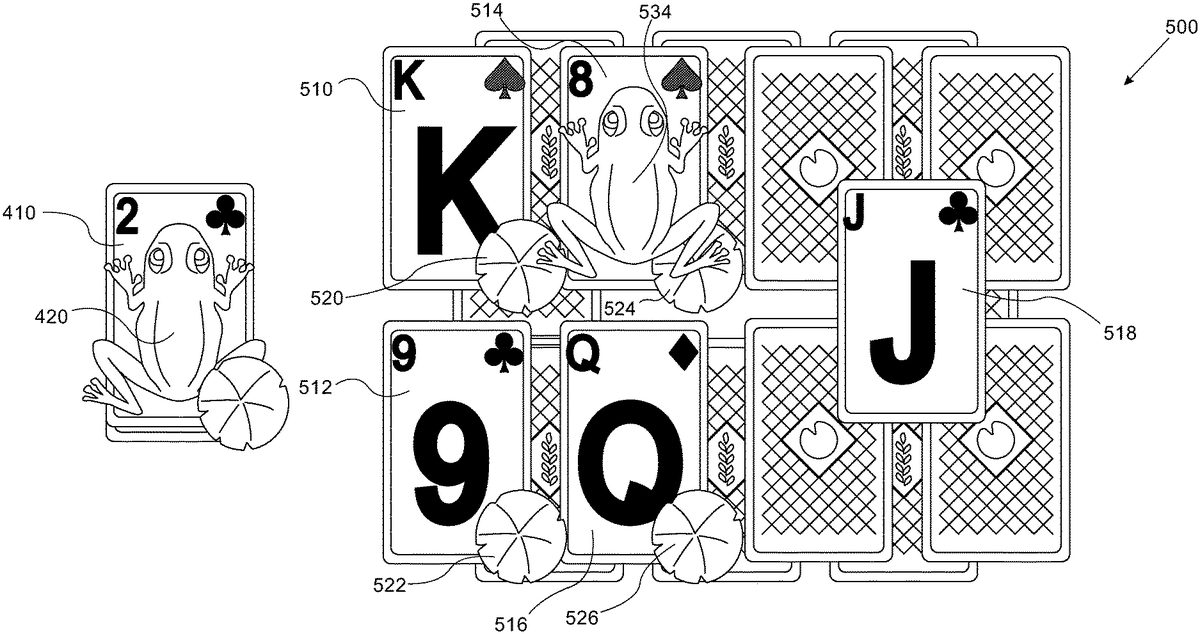
FIG. 5is a partial screenshot500of a card game, according to embodiments of the invention. The game assets displayed in the game inFIG. 5are cards510,512,514,516and518, the visual indication of the exemplary inhibitor is a lily520,522,524and526and the visual indication of the exemplary inhibitor is a frog534. Thus, in the example provided inFIG. 5, cards510,512,514,516, are each marked by a lily520,522,524and526, respectively, and are therefore susceptible for inhibition. Card514is inhibited or blocked by frog534. Card518is not marked by a lily and is not susceptible to or available for inhibition. At this point in the computer card game, the user may play with cards510,512,516and518, and may not play with card514that is blocked or inhibited by frog534. At any point in time, or after the player achieves a game goal, frog534may jump or move to one of cards510,512,516, which are marked by a lily520,522and526. If, after frog534jumps to another card510,512,516the player uses an undo function, frog534may jump back to card514.
FIG. 6illustrates an example computing device according to an embodiment of the invention. Various components such as user devices110, game servers120, and other modules, may be or include computing device700, or may include components such as shown inFIG. 6. For example, a first computing device700with a first processor705may be used to provide a dynamic obstacle in a computer game.
Computing device700may include a processor705that may be, for example, a central processing unit processor (CPU), a chip or any suitable computing or computational device, an operating system715, a memory720, a storage730, input devices735and output devices740. Processor705may be or include one or more processors, etc., co-located or distributed. Computing device700may be for example a workstation or personal computer, or may be at least partially implemented by one or more remote servers (e.g., in the “cloud”).
Operating system715may be or may include any code segment designed and/or configured to perform tasks involving coordination, scheduling, arbitration, supervising, controlling or otherwise managing operation of computing device700, for example. Operating system715may be a commercial operating system. Memory720may be or may include, for example, a Random Access Memory (RAM), a read only memory (ROM), a Dynamic RAM (DRAM), a Synchronous DRAM (SD-RAM), a double data rate (DDR) memory chip, a Flash memory, a volatile memory, a non-volatile memory, a cache memory, a buffer, a short term memory unit, a long term memory unit, or other suitable memory units or storage units. Memory720may be or may include a plurality of, possibly different memory units.
Executable code725may be any executable code, e.g., an application, a program, a process, task or script. Executable code725may be executed by processor705possibly under control of operating system715. For example, executable code725may be or include an application to provide a dynamic obstacle or inhibitor and a display of same in a computer game. In some embodiments, more than one computing device700may be used. For example, a plurality of computing devices that include components similar to those included in computing device700may be connected to a network and used as a system.
Storage730may be or may include, for example, a hard disk drive, a floppy disk drive, a Compact Disk (CD) drive, a CD-Recordable (CD-R) drive, a universal serial bus (USB) device or other suitable removable and/or fixed storage unit. In some embodiments, some of the components shown inFIG. 6may be omitted. For example, memory720may be a non-volatile memory having the storage capacity of storage730. Accordingly, although shown as a separate component, storage730may be embedded or included in memory720.
Input devices735may be or may include a mouse, a keyboard, a touch screen or pad or any suitable input device. It will be recognized that any suitable number of input devices may be operatively connected to computing device700as shown by block735. Output devices740may include one or more displays, speakers and/or any other suitable output devices. It will be recognized that any suitable number of output devices may be operatively connected to computing device700as shown by block740. Any applicable input/output (I/O) devices may be connected to computing device700as shown by blocks735and740. For example, a wired or wireless network interface card (NIC), a modem, printer or facsimile machine, a universal serial bus (USB) device or external hard drive may be included in input devices735and/or output devices740. Network interface750may enable device700to communicate with one or more other computers or networks. For example, network interface750may include a WiFi or Bluetooth device or connection, a connection to an intranet or the internet, an antenna etc.
Embodiments described in this disclosure may include the use of a special purpose or general-purpose computer including various computer hardware or software modules, as discussed in greater detail below.
Embodiments within the scope of this disclosure also include computer-readable media, or non-transitory computer storage medium, for carrying or having computer-executable instructions or data structures stored thereon. The instructions when executed may cause the processor to carry out embodiments of the invention. Such computer-readable media, or computer storage medium, can be any available media that can be accessed by a general purpose or special purpose computer. By way of example, and not limitation, such computer-readable media can comprise RAM, ROM, EEPROM, CD-ROM or other optical disk storage, magnetic disk storage or other magnetic storage devices, or any other medium which can be used to carry or store desired program code means in the form of computer-executable instructions or data structures and which can be accessed by a general purpose or special purpose computer. When information is transferred or provided over a network or another communications connection (either hardwired, wireless, or a combination of hardwired or wireless) to a computer, the computer properly views the connection as a computer-readable medium. Thus, any such connection is properly termed a computer-readable medium. Combinations of the above should also be included within the scope of computer-readable media.
Computer-executable instructions comprise, for example, instructions and data which cause a general purpose computer, special purpose computer, or special purpose processing device to perform a certain function or group of functions. Although the subject matter has been described in language specific to structural features and/or methodological acts, it is to be understood that the subject matter defined in the appended claims is not necessarily limited to the specific features or acts described above. Rather, the specific features and acts described above are disclosed as example forms of implementing the claims.
As used herein, the term “module” or “component” can refer to software objects or routines that execute on the computing system. The different components, modules, engines, and services described herein may be implemented as objects or processes that execute on the computing system (e.g., as separate threads). While the system and methods described herein are preferably implemented in software, implementations in hardware or a combination of software and hardware are also possible and contemplated. In this description, a “computer” may be any computing system as previously defined herein, or any module or combination of modulates running on a computing system.
For the processes and/or methods disclosed, the functions performed in the processes and methods may be implemented in differing order as may be indicated by context. Furthermore, the outlined steps and operations are only provided as examples, and some of the steps and operations may be optional, combined into fewer steps and operations, or expanded into additional steps and operations.
The present disclosure is not to be limited in terms of the particular embodiments described in this application, which are intended as illustrations of various aspects. Many modifications and variations can be made without departing from its scope. Functionally equivalent methods and apparatuses within the scope of the disclosure, in addition to those enumerated, will be apparent to those skilled in the art from the foregoing descriptions. Such modifications and variations are intended to fall within the scope of the appended claims. The present disclosure is to be limited only by the terms of the appended claims, along with the full scope of equivalents to which such claims are entitled. It is also to be understood that the terminology used in this disclosure is for the purpose of describing particular embodiments only, and is not intended to be limiting.
This disclosure may sometimes illustrate different components contained within, or connected with, different other components. Such depicted architectures are merely exemplary, and many other architectures can be implemented which achieve the same or similar functionality.
Aspects of the present disclosure may be embodied in other forms without departing from its spirit or essential characteristics. The described aspects are to be considered in all respects illustrative and not restrictive. The claimed subject matter is indicated by the appended claims rather than by the foregoing description. All changes which come within the meaning and range of equivalency of the claims are to be embraced within their scope.
Claims
- A method for providing a dynamic obstacle in a computer game, the method comprising: altering a display of each of a subset of game assets displayed by a computer system with a visual indication that indicates that the subset of game assets are available for inhibition;displaying associated with a game asset an inhibitor, wherein displaying the inhibitor associated with the game asset indicates that the game asset is inhibited;and periodically removing from display the inhibitor from one game asset of the subset of game assets and displaying the inhibitor associated with another game asset of the subset of game assets, wherein the inhibitor is removed from display from one game asset of the subset of game assets and displayed associated with another game asset of the subset of game assets only after a player gained a predetermined number of points in the game.
- The method of claim 1 , wherein the computer game is a card game and the game assets are cards.
- The method of claim 2 , wherein displaying associated with a card the inhibitor prevents the user from playing with the card.
- The method of claim 1 , comprising removing from display the inhibitor from one game asset of the subset of game assets and displaying the inhibitor associated with another game asset of the subset of game assets until all the game assets of the subset of game assets, except for the game asset that is currently inhibited, have been played with.
- The method of claim 1 , comprising removing the inhibitor from the computer game after all the game assets of the subset of game assets, except for the game asset that is currently inhibited, have been played with.
- The method of claim 1 , wherein the inhibitor is removed from display from one game asset of the subset of game assets and displayed associated with another game asset of the subset of game assets randomly among the game assets of the subset of game assets.
- The method of claim 1 , wherein the inhibitor is removed from display from one game asset of the subset of game assets and displayed associated with another game asset of the subset of game assets according to a predetermined pattern among the game assets of the subset of game assets.
- The method of claim 1 , wherein the inhibitor is be removed from display from one game asset of the subset of game assets and displayed associated with another game asset of the subset of game assets according to a weighted random pattern.
- The method of claim 1 , comprising: providing an undo function, wherein when used, the undo function removes the inhibitor from display from the one game asset of the subset of game assets and displays the inhibitor associated with a game asset previously inhibited by the inhibitor.
- A system for providing a dynamic obstacle in a computer game, the system comprising: a memory;a processor configured to: alter a display of each of a subset of game assets displayed by a computer system with a visual indication that indicates that the subset of game assets are available for inhibition;display associated with a game asset an inhibitor, wherein displaying the inhibitor associated with the game asset indicates that the game asset is inhibited;and periodically remove from display the inhibitor from one game asset of the subset of game assets and display the inhibitor associated with another game asset of the subset of game assets, wherein the processor is configured to remove the inhibitor from display from one game asset of the subset of game assets and display associated with another game asset of the subset of game assets only after a player gained a predetermined number of points in the game.
- The system of claim 10 , wherein the computer game is a card game and the game assets are cards, wherein displaying associated with a card the inhibitor prevents the user from playing with the card.
- The system of claim 10 , wherein the processor is configured to remove from display the inhibitor from one game asset of the subset of game assets and display the inhibitor associated with another game asset of the subset of game assets until all the game assets of the subset of game assets have been played with.
- The system of claim 10 , wherein the processor is configured to remove the inhibitor after all the game assets of the subset of game assets, except for the game asset that is currently inhibited, have been played with.
- The system of claim 10 , wherein the processor is configured to remove the inhibitor from display from one game asset of the subset of game assets and display associated with another game asset of the subset of game assets randomly among the game assets of the subset of game assets.
- The system of claim 10 , wherein the processor is configured to remove the inhibitor from display from one game asset of the subset of game assets and display associated with another game asset of the subset of game assets according to a predetermined pattern among the game assets of the subset of game assets.
- The system of claim 10 , wherein the processor is configured to move the inhibitor among the game assets of the subset of game assets according to a weighted random pattern.
- The system of claim 10 , wherein the processor is configured to: provide an undo function, wherein when used, the undo function removes the inhibitor from display from the one game asset of the subset of game assets and displays the inhibitor associated with a game asset previously inhibited by the inhibitor.
- A method for providing a dynamic obstacle in a computer game, the method comprising: marking each of a subset of game assets with a visual indication that indicates that the marked game assets are susceptible for inhibition;providing an inhibitor, wherein placing the inhibitor on a game asset indicates that the game asset is inhibited;and moving the inhibitor from one game asset of the subset of game assets to another game asset of the subset of game assets, only after a player gained a predetermined number of points in the game.
Disclaimer: Data collected from the USPTO and may be malformed, incomplete, and/or otherwise inaccurate.