U.S. Pat. No. 11,183,009
ONLINE GAMING PLATFORM USING A GRID CONFIGURATION
Issue DateOctober 23, 2019
Illustrative Figure
Abstract
An online gaming system allows players to select squares in a grid that corresponds to a game. The game includes two teams. One team is assigned to the rows of the grid and the other team is assigned to the columns. Numbers are randomly assigned to each row and each column such that each square is uniquely located according the random numbers based on the row and the column. During the game, a payout event occurs such that the scores for each team are used to identify a corresponding row and corresponding column. A winning square is identified using the row and column corresponding the scores. The player having the winning square automatically receives a prize or winnings.
Description
DETAILED DESCRIPTION OF THE PREFERRED EMBODIMENTS Reference will now be made in detail to specific embodiments of the present invention. Examples of these embodiments are illustrated in the accompanying drawings. While the embodiments will be described in conjunction with the drawings, it will be understood that the following description is not intended to limit the present invention to any one embodiment. On the contrary, the following description is intended to cover alternatives, modifications, and equivalents as may be included within the spirit and scope of the appended claims. Numerous specific details are set forth in order to provide a thorough understanding of the present invention. Online sports gambling offers many different options, systems, league configurations, and the like. Each different type, however, requires a certain level of skill and knowledge to successfully compete. Otherwise, casual fans are taken advantage of by other players having inside knowledge or the ability to devote vast amounts of time to research on which team to pick to win a game, match, or series. Further, some fans do not want to bet against their teams or favorite players yet would like to place wagers on the games. They find themselves not enjoying online gambling. Fantasy leagues require a season long commitment and an upfront fee. Some players in fantasy leagues subscribe to special services or even use software algorithms to pick optimal teams. Again, this excludes the casual fan that does not want to spend hours researching teams and players. League predators take advantage of casual users as well by playing in newcomer leagues or matches to cheat. Other issues include betting on sports that are not popular or even conducive for betting. Most leagues involve football, basketball, baseball, and maybe soccer and hockey. Very little online wagering occurs for sports that are not popular ...
DETAILED DESCRIPTION OF THE PREFERRED EMBODIMENTS
Reference will now be made in detail to specific embodiments of the present invention. Examples of these embodiments are illustrated in the accompanying drawings. While the embodiments will be described in conjunction with the drawings, it will be understood that the following description is not intended to limit the present invention to any one embodiment. On the contrary, the following description is intended to cover alternatives, modifications, and equivalents as may be included within the spirit and scope of the appended claims. Numerous specific details are set forth in order to provide a thorough understanding of the present invention.
Online sports gambling offers many different options, systems, league configurations, and the like. Each different type, however, requires a certain level of skill and knowledge to successfully compete. Otherwise, casual fans are taken advantage of by other players having inside knowledge or the ability to devote vast amounts of time to research on which team to pick to win a game, match, or series. Further, some fans do not want to bet against their teams or favorite players yet would like to place wagers on the games. They find themselves not enjoying online gambling.
Fantasy leagues require a season long commitment and an upfront fee. Some players in fantasy leagues subscribe to special services or even use software algorithms to pick optimal teams. Again, this excludes the casual fan that does not want to spend hours researching teams and players. League predators take advantage of casual users as well by playing in newcomer leagues or matches to cheat.
Other issues include betting on sports that are not popular or even conducive for betting. Most leagues involve football, basketball, baseball, and maybe soccer and hockey. Very little online wagering occurs for sports that are not popular or viewed by the public. This may be due to little information available to make an informed wager or not enough interest to warrant gambling websites to host the platforms for such betting.
The disclosed embodiments overcome these problems and others. The disclosed platform configures a grid that allows users to place bets on games, statistics, results, and anything else that results in numbers produced by the event. The numbers are used to determine the winners of the wagers for the event. The grid includes rows and columns, usually in a 10×10 configuration. Numbers are randomly assigned to each row and column. The numbers generated from the event are compared to the randomly assigned numbers to determine winners.
For many years, office pools utilize a similar system using paper grids and picking numbers randomly. The disclosed embodiments differ from such systems as the grid configuration is online. Numbers are randomly assigned and kept secret according to an algorithm. Winners are paid immediately and not after the event or win the other users “pay up.” Winners also may be paid out during games and do not need to wait until the end of a season or game to determine. For example, winners may be paid out during the end of periods, quarters, or halves. Due to being online, the matches are made available anywhere and not just in a specific setting or location. The participants in a match may be kept secret from each other. Moreover, a match may be started after the game has started without any aspect of the ongoing game influencing the probability of final winners of the match.
Another difference is that anyone can participate in a match, even players that have no specific knowledge of the game, sport, teams, or players. Success relies on randomly assigned numbers and not on the achievements of a team or player. The disclosed embodiments level the playing field, so to speak, for online gambling. Fans of unpopular teams or sports may participate in matches as well as the only requirement to determine winners is a score or statistical result. Fan interest may be kept in games that become blowouts or boring as the numbers generated during the game influence who wins.
A player of legal age may sign up as a member of the disclosed gaming network. The player uses a credit card or other form of payment to add funds to the gaming account. The player then browses the games available on the website and selects ones of interest. The player enters a match having a grid and purchases boxes or squares within the grid. The player does not see the numbers for the rows and columns within the grid. One does not know what numbers he/she may have for the selected square.
The numbers are randomly generated when the grids are generated. Alternatively, the numbers may be randomly assigned to the rows and columns after the grid is full with bids from players. In any event, players do not know the numbers for the rows and columns when placing their bet. The numbers assigned to the rows and columns are encrypted for full security. Thus, even if the website or platform gets hacked, no one will be able to determine the numbers for the matches. The numbers will become visible once all the squares are purchased.
A single box, or square, in the grid cannot be purchased by more than one player. A single player, however, may purchase more than one box per match. As soon as a box, or square, is purchased, the funds in the internal gaming account are reduced. The system, or website, keeps track of the purchases with details including the amount spent and the date and time of the purchases. When the game is complete, a site administrator may enter the results as numbers. Alternatively, the system may grab the scores from well known sports websites. This action will automatically identify the winning squares in the grid, based on the scores of the teams or sides in the game. The winners may be paid directly or through third party network, or may have the winnings placed into the internal account.
The disclosed embodiments are configured as special purpose hardware within a system, as programmable circuitry appropriately programmed with software or firmware, or as a combination of special-purpose and programmable circuitry. Some embodiments may include a machine-readable medium having stored thereon instructions that are used to processor for a computer or other electronic device to perform a process or series of processes. The machine-readable medium is non-transitory.
FIG. 1depicts a gaming network100according to the disclosed embodiments. Gaming network100includes a host computer system102and communication network104through which a plurality of gaming locations106communicate with the host computer systems. Host computer system102includes an internal network108, a web server110, a game server112, a game storage database114, a player storage database116, and an administrator computing device118. In some embodiments, various components of host computer system102are located together or substantially near each other, such as in the same building. In other embodiments, host computer system102may be distributed in that various servers, databases, and devices are located separate from each other and connected through communication network104. As can be appreciated, a single feature shown in host computer system102may actually be embodied by multiple entities. For example, game server112may include two or more servers that perform the functionality of the game server.
Gaming network100also includes gaming locations106. Gaming location106may include a local server120and one or more player devices122. In some embodiments, local server120facilitates communication between players devices122and host computer system102. In other embodiments, local server120administers the matches, tracks players and selections, manages player deposits and payouts, and the like. Further, more than one server may act as the local server. These servers may be dedicated to different functions within gaming system100, as disclosed below.
Gaming locations106also may be known as hubs or other terms that designate a local server120communicating with host computer system102. In some embodiments, gaming locations may not be used, such that player devices122communicate directly with host computer system102to participate in matches and contests online. Further, users of player devices122are not prohibited from participating in matches with other users at other gaming locations.
An example process for participating in a gaming match or pool is provided below. Gaming location106-1may pertain to a geographical area, such as a zip code or county. Users in this location access a local server120, usually an online access provider, to participate in gaming network100. Player devices122-11,122-12,122-13,122-14,122-15, and122-16are located in this area and associated with a user. Player devices may be computers, smartphones, tablets, gaming consoles, processing units, and the like. The users of these devices log onto gaming network100and place bets on matches that relate to actual games and sporting events. The matches will be disclosed in greater detail later.
Another gaming location may be106-4, which includes player devices122-41,122-42,122-43,122-44,122-45, and122-46. The users of these player devices also may participate in gaming network100. Host computer system102may indicate online through communications network104that matches are being held related to a Monday night football game. Users may participate in these matches. Thus, the users, for example, of player devices122-16,122-14,122-53,122-42, and122-33may participate in a match related to the football game. At certain points during the game, one of the users associated with these devices will win, which results in financial compensation to that user. The winning amount may be sent to the user over communication network104using administrator computing device118. The winner will be notified at his/her respective player device.
As can be appreciated, gaming network100is not limited to a specific location or group of users. A user in gaming location106-1may compete against those in gaming locations106-2or106-5. Further, all matches and gaming events are centralized using host computer system102. Friends from any location may participate in matches against each other. Unlike “office pools,” matches are conducted online and in real-time.
FIG. 2depicts the economic components of gaming network100according to the disclosed embodiments.FIG. 2shows the flow of funds within gaming network100.
Players202engage in gaming using devices204. Players202may provide value, such as cash, points, credits, and the like, through devices204to engage in the games offered by host computer system102. Host computer system102will provide matches which players202participate. When player202-1wins a match within gaming network100, device204-1is configured to receive the value of the winnings.
Local depository206may receive and distribute funds to players202. Local depository206may be connected to central depository208, which controls the funds as matches proceed and are completed. Local depository206may relate to a location where players202are playing, even though devices204move. As players202and devices204move around, different local depositories206may interact with them to receive and distribute funds. In some embodiments, value is paid from a local depository206to central depository and vice versa. In other embodiments, central depository208may pay funds directly to players202.
In alternative embodiments, local depository206may correspond to a fixed location within a business establishment, such as a casino. Gaming network100may have a direct relationship with the casino to promote matches and games, while providing special offers to players202using gaming network100through the casino. For example, players using local depository206at the casino may receive reduced entry fees to matches or access to a greater number of sports and matches than players outside the casino. Meanwhile, the casino may pay for use of local depository206. Local depository206confirms the location and status of players202to receive these benefits as well as providing real-time feedback to the casino. Central depository208, however, still controls all receipts and payouts in gaming network100.
FIG. 3depicts an example of a host computer system102according to the disclosed embodiments.FIG. 3shows several program modules as well as computer functions that configure host computer system102into a special purpose machine. I/O module302handles input to and output from a processing environment or communication network104. Graphics module304provides control over the graphics displayed on devices, computers, administrative terminals, and the like. Terminal control module306provides the capability of host computer system102to interact with or control a player device within gaming network100. Game storage arrangement308stores software or other computer-executable code that controls the games or matches offered over gaming network100.
A game processor310may control one or more matches or games using the computer executable code from game storage arrangement308. A tournament processor312performs a similar function for possible tournaments. A loyalty tracker314keeps information about the participation of registered players to thereby reward players for the number of matches or amount of time they spend using gaming network100. An accounting processor316may control the flow of funds or other forms of value within gaming network100. A collusion detection processor318monitors such occurrences as unusual action taken by a specific player, frequent violations of gaming rules, fraud or attempted fraud, and the like.
A software test environment allows new games, matches, or processes to be tested in an environment that does not affect ongoing operations. This may be especially important to not disrupt ongoing matches within gaming network100. As can be appreciated, matches related to sporting events may occur around the clock as the matches are not limited by time zone or location. A waiting list queue322allows players to wait in line for a specific match, sport, and the like. For example, players may wish to participate in a baseball game between two fierce rivals. As matches are set up, then players are taken from waiting list queue322. An evaluation module324allows for the monitoring of the communication latency between the devices of the players and host computer system102.
FIG. 4depicts components of a device204used by a player202within gaming network100according to the disclosed embodiments. Device204may be a computing device that hosts various applications and programs. In some embodiments, device204is configured to become a special purpose machine to implement a gaming module428to use within gaming network100.
Device204includes memory402, such as volatile memory or nonvolatile memory, processor(s)404, power supply, or battery,406, and operating system408for executing instructions. Additional components may include data storage component410, such as a hard drive, a flash drive or memory, a memory card, and the like, one or more network interfaces412, and network communication interface414, which enables device204to communicate by transmitting and receiving wired and wireless signals over networks, audio interface416, SIM card424, other input or output interfaces426, and gaming module428. The components shown therein may be connected by a bus.
Memory402may be used to store instructions for running one or more applications or modules on at least one processor404. For example, memory402could be used in one or more embodiments to store all or some of the instructions needed to execute the functionality of the various system components or modules. One or more processors are the main processors of device204, which may include application processors, baseband processors, various coprocessors, and other dedicated processors for operating device204. An application processor may provide the processing power to support software applications, memory management, graphics processing, and multimedia functions. An application processor may by communicably coupled with memory402and configured to execute operating system408, a user interface, and the applications stored on memory402or data storage component410.
A baseband processor may be configured to perform signal processing and implement/manage real-time radio transmission operations of a device, such as a mobile device. These processors, along with the other components, may be powered by power supply406. The volatile and nonvolatile memories found the various embodiments may include storage media for storing information, such as processor-readable instructions, data structures, program modules, and other data. Some examples of information that may be stored include basic input/output systems (BIOS), operating systems, and applications. Operating system408may provide common services for software applications executing on one or more processors404.
Gaming module428may include identification module430, policy enforcement module432, payout adjustment module434, skill level adjustment module436, accounting module438, and state recordation module440. Each of these modules can be embodied as special-purpose hardware or as programmable circuitry, such as one or more processors, appropriately programmed with software or firmware, or as a combination of special purpose hardware and programmable circuitry.
Identification module430may be used to gather information about the device, current or past gaming sessions, player information, specific hardware, and software configurations of the device, GPS coordinates, associated telephone numbers, IP addresses, email addresses, user identifiers, international mobile station equipment identity (IMEI), mobile equipment identifiers (MEID), integrated circuit card identifiers (ICCID), part identifiers, software identifiers, current gaming or match session identifiers, identification of nearby player devices, and the like. This information may be used in variety of ways, including policy enforcement module432that can set customized collusion avoidance policies that can, in some embodiments, be dynamically set, based on location, current gaming session, and the like.
Payout adjustment module434may be used to dynamically adjust the payout of a gaming or match session. For example, there may be minimum payout requirements, such as during times in the game or match, such as halftime or the end of the game. Payout adjustment module434may ensure that winnings are provided as soon as possible to players so that there is no lag or delay associated with other online gambling platforms. Payout adjustment module434also may adjust the payout based on rules associated with the match. For example, some matches may take a fee or percentage of the top of the money involved in the match. Using the example, there may be a 1% fee to cover processing and overhead for conducting the match. The percentage may be different depending on the location of the player or other factors. Frequent players may have these fees waived.
Skill level adjustment module436may be used to adjust playing parameters for matches. For example, the higher the skill level, then the more matches one can participate. One who knows how to participate in matches can be access additional or higher stakes matches. Accounting module438may be used to interface with various existing backend accounting systems, reporting systems, and record keeping systems. In some embodiments, accounting module438may be used to implement procedures that are designed to detect and prevent transactions that may be associated with money laundering, fraud or other criminal activities, and to ensure compliance with all federal and state laws.
State recordation module440may be used to capture the state of a match. The “state” may include a variety of game states including wagers, payout levels, skill level settings, and others. The state of the gaming session may be repeatedly captured so that in the event of a communication failure, device fault, or the problem, a record of the current state may be reconstructed. For example, the state may be captured every second or depending on match dynamics. The state captured by state recordation module440also may be used by a collusion avoidance module to determine if any collusion is occurring. The state information captured by state recordation module440may be used to generate various game and match analytics. Host computer system102may capture the state information directly from the device.
State recordation module440may store the state information in a database for regulatory compliance, analytics, or other purposes. For example, all game play within a period of time may be recorded and stored in the database. In other embodiments, a limited number of gaming sessions may be recorded, such as the last one hundred matches. Other embodiments may include state recordation module440recording state information for matches over a set threshold, such as 1000.
In some embodiments, the devices used by the players to access gaming network100may provide for social media, chatting, and other communication channels. For example, some embodiments may have interfaces that allow for third party access through another gateway, such as Facebook™ or other social media platforms. Some embodiments of the devices may allow for picture in picture or multiple screens. As a match is occurring, a player may talk with other players in the match and share opinion about the play of the teams.
FIG. 5depicts a match grid500for use in gaming network100according to the disclosed embodiments. As disclosed above, a match corresponds to a game or other sporting event, such as a meet or tournament, is planned. Game may refer to any event where scores or statistics are generated based on the efforts of participants. The outcome is not predetermined. Further, the game is not one of “chance” where there are predictable or even odds of winning, such as blackjack. The scores in the game are generated during the game and over a period of time. The scores are readily identifiable and trackable.
In some embodiments, grid500is generated when one or more players202in gaming network100want to initiate a match. Host computer system102may generate grid500automatically for games or at the request of a player. Preferably, grid500is a 10×10 grid to represent the numbers from 0-9. The numbers relate the “ones” digit in a score. For example, a score of 84 would be a “4” in the grid. As disclosed later, the numbers are randomly assigned to each column C and row R of grid500.
Grid500is displayed on a screen of a device connected to gaming network100. Thus, squares501also are shown. Given a 10×10 grid, there should be 100 squares501available for a match. The squares may have different graphical properties depending in their status. A clear square, such as square501, indicates no one has selected that square yet. It is available for selection. A darkened square503may indicate that the square is taken and not available for selection. If the player clicks or indicates darkened square503for selection, a prompt may be displayed that the square is not available. A shaded square502may indicate that the square has been selected but funds for the selection, or bet, have not been received. Gaming network100will not assign the square to a player until appropriate funds have been received. Again, a prompt may be displayed that the square is unavailable. If the player selecting square502cannot pay the bet, then the square becomes available for selection. The player can wait a few minutes to see if it becomes available. A lightly shaded square504may indicate that a player is thinking about that square, but has not initiated payment for it. The player might be debating whether to participate or not. Lightly shaded square504still may be available for purchase if the player looking at grid500acts accordingly. The player also may select square504without a prompt indicating it is taken. If the player funds his/her account to purchase the square, then he/she will obtain it for the match.
In other embodiments, different sized grids500may be generated. A range may be used to determine the winning squares, such as 0-1, 2-3, or so on. This grid would be 5×5. Some games may not have scores above a certain amount, such as a European football game. A grid for such a game may rarely exceed 4 goals on either side. In this instance, rows R and columns C may be generated for numbers 0-4, with separate ones for 5-9. The generation of grid500is dynamic and adjustable.
FIG. 6depicts a match screen600for a game using gaming network100according to the disclosed embodiments. Match screen600may be displayed on a device connected or accessible by gaming network100. Match screen600includes grid500. Grid500includes the squares that are selected by placing bets or wagers associated with the match. As the squares are selected, grid500fills up until every square is selected. At that time, numbers are assigned randomly to each row R and column C Grid500in match screen600is not yet filled so no numbers have been assigned.
Match screen600includes information about the game to which it corresponds and the account for the player. Match detailed information602may be displayed along with the time events that payouts will occur, such as quarter, half, and the end of the game. It also may list the participants of the game, also shown with grid500. Team616may be assigned rows R while team618may be assigned columns C. The numbers assigned to rows R will pertain to the scores of team616while the numbers assigned to columns C will pertain to the scores of team618. Designation of which team is placed where may be based on home-visitor team status, favored teams, randomly, and the like.
Match screen600also includes various boxes and buttons to help the player select and purchase squares in grid500. Display box604indicates that price for a square for the match. Prices may be different between matches even though they relate to the same game. Display box606indicates that date and time of the game. Alternatively, it may display the current date and time. It also may indicate any cut off times or dates to participate in the match and select squares.
Display box608indicates the number of squares currently selected in their cost. The selected squares are shown in grid500as darkened squares620. If the player has not purchased squares620, then they may exhibit a lighter shade. Display box610may provide a legend for noting that status of the squared in grid500. This legend may or may not be similar to the explanations provided above forFIG. 5. Button612may be displayed. If button612is selected, then the prizes associated with this match are shown. Button614allows the player to purchase the selected squares according to the costs shown in display box608.
FIG. 7depicts match screen600after purchase of squares within gaming network100according to the disclosed embodiments. Match screen600is pretty much the same as the one shown inFIG. 6, except the player has completed purchases of squares620. These are shown as purchased squares702. As can be seen, no numbers are assigned to rows R or columns C yet. Thus, the player does not know which numbers are associated with squares702. Display box608may be updated to show that the player has no more selections left and that the ones for squares702have been purchased.
As can be seen, purchased squares702include a graphic or icon. The icon may serve to indicate the player to other people in the match. Other players will know that the player is participating in this match for the Cleveland-Golden State game. As one browses for matches to engage, he/she can see the icons for purchased squares and decide to play based on who is involved. Icons also may serve for the organizer of a match to identify players that do not belong. For example, an office match may only allow participation by designated employees of the company. Each employee has an icon that allows everyone to know if someone outside the company is participating.
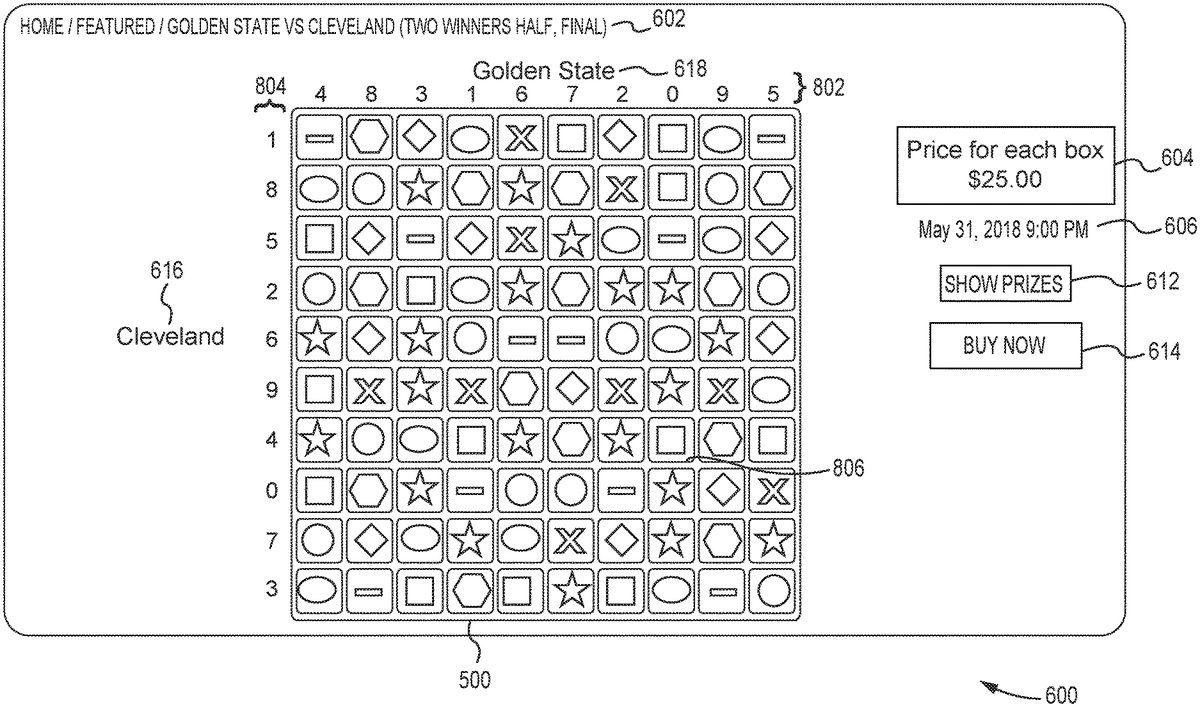
FIG. 8depicts match screen600with a completed grid500according to the disclosed embodiments. Completed grid500has every square selected and paid for. Thus, this match for the Cleveland-Golden State game is filled. No further squares may be purchased. As shown inFIG. 8, different graphics are used for the different players. One can know what players are involved by seeing the avatar or icon for the players. Match screen600also includes display boxes604and606and buttons612and614.
A difference between match screen600ofFIG. 8and the other screens is the use of match numbers for the rows and columns After every square is purchased, the disclosed embodiments randomly assign numbers between 0-9 for each row and each column. After a number is assigned, it is removed from the pool of numbers to assign to the remaining rows or columns Thus, every number between 0-9 is assigned. The process is disclosed in greater detail below.
Column numbers802correspond to the ones digit of the score by Golden State. Column numbers802are assigned randomly starting with the column at the left side of grid500. As shown, the number assigned to this column is 4. The number 4 is then removed from the pool of available numbers. The process moves to the next column and randomly assigns the number 8, which is then removed from the pool of available numbers. This proceeds until the right most column of grid500is reached. The only number left in the pool is 5, so it is assigned to this column.
The randomly assignment process is repeated from row numbers804, which corresponds to the ones digit of the score for Cleveland. The process may start with the uppermost row of grid500and proceeds downwards to the bottom row. Thus, each square in grid500has a unique column, row number assignment. For example, the square in the upper left corner is 4,1. The square corresponding to 6,9 is in the middle portion of grid500.
Payout events may be instances during the game where the scores of the teams are used to payout winnings to players. At the payout event, the score of each team is noted. The ones digits of the scores, such as 7 of 27, are used to select the appropriate row and column number. Each team's score is used. Once the ones digits are available, the winning square is determined within grid500. For example, after the first quarter, the score is Cleveland 24 and Golden State 30. The ones digits are 4 and 0. The disclosed embodiments go to the row having the number 4 and the column having the number 0. This square is shown by winning square806inFIG. 8. This process is repeated for each payout event until the game is over.
FIG. 9depicts a flowchart900for playing in a match according to the disclosed embodiments. Flowchart900may relate to how a player signs up and participates in gaming network100. Step902executes by registering the player as a member of gaming network100. The player may enter the usual information, such as name, email, password, icon or avatar, interests, favorite teams, and the like. Step904executes by adding funds to the player's account. The funds will be used for wagers in matches to purchase squares. The amount of funds available may be shown in a display box on match screen600.
Step906executes by browsing for games available in which to participate. One may browse by league, team, player, and the like. Step908executes by selecting a match to play. The match should display a grid500with available squares to purchase, as disclosed above. Step910executes by selecting one or more squares with the funds available. Once grid500is filled, no further squares may be purchased and the match is locked.
Step912executes by watching the game. In other words, the game starts and accumulates scores between each team or player. At certain instances during the game, payout events occur. Thus, step914executes by determining whether a payout event has occurred. If no, then flowchart900returns back to step912. If step914is yes, then step916executes by determining whether the player had a winning square during the payout event. The scores from each team is used to determine the row number and the column number used to determine the winning square. If step916is yes, then step918executes by receiving the winnings by the player. A prize for the match is paid out. If step916, then step920executes by the player receiving no winnings for the match.
Flowchart900may return back to step908unless the game is still ongoing. If so, then flowchart900returns to step912. Flowchart900may repeat this process until the game is over. Then, the match is done and all prizes paid out.
FIG. 10depicts a flowchart1000for generating a grid and playing a match according to the disclosed embodiments. Flowchart1000is disclosed from the perspective of host computer system102of gaming network100. Step1002executes by identifying a game for which to provide matches to players. As noted, most sporting events may be used for matches. Step1004executes by setting parameters for the matches corresponding to the game. Parameters may include when payout events occur, price per square, limits on the number of squares one can purchase for a match, skill level of the players, and the like. Parameters also include how many rows and columns will be used in the grid for the scoring breakdown. Most matches will use0-9but other number combinations may be used for specific sports.
Step1006executes by opening at least one match for play corresponding the game. Multiple matches may be set up for each game. Thus, for each match, step1008executes by generating a grid based on the number of rows and columns for the scores. The parameters may determine the number of rows and columns Step1010executes by receiving selections by players for the squares in grid500. After each purchase, step1012executes by adjusting the account for that player. The amount for a bid on a square is withdrawn times the number of squares selected.
Flowchart1000then goes to step1014. Step1014executes by determining whether grid500is full. If no, then flowchart1000returns to step1010to continue receiving selections for square and receiving payments. If step1014is yes, then step1015executes by assigning the random numbers to the rows and columns as disclosed above. The numbers for the rows and columns are not known to the players until grid500is full. Thus, no one can purchase squares for specific scores. Numbers also may be encrypted until a full review is made for the match. For example, the numbers may be compared to other matches to make sure that certain patterns are not repeated or redundant. An algorithm may determine whether the final grid is acceptable.
In an alternative embodiment, step1015may be executed after step1008, when grid500is generated. Row numbers802and column numbers804are assigned but encrypted for secrecy. Thus, the processing for each match may be reduced as host computer system102does not need to wait until the squares in grid500are full to finalize numbers. This process may be preferred in the event that not every square is purchased. The match may still go on as planned. Winning squares under this scenario may not result in any prizes for that payout event. The prizes or winnings may be added to the next payout event or may be forfeited to gaming network100.
Step1016executes by waiting for the game to commence. Step1018executes by monitoring the game once it starts and the scores as they accumulate. Step1020executes by determining whether a payout event occurred. If no, then flowchart1000returns to step1018to continue monitoring the game. If step1020is yes, then step1022executes by paying out the winnings for the match based on the parameters. After the winnings are paid out, then step1024executes by determining whether the game is over. In other words, no time is left to play the game. If no, then flowchart1000returns to step1018. If step1024is yes, then step1026executes by ending the match.
As can be seen, any level of player may participate in a match corresponding to a game. One does not need to follow teams, leagues, players, and other specific knowledge to compete. The odds to win are balanced and even across the grid. The only way to increase one's odds of winning is to purchase more scores. Gaming network may limit the number of squares one may purchase for a match in order to allow more players to compete.
It will be apparent to those skilled in the art that various modifications to the disclosed embodiments without departing from the spirit or scope of the invention. Thus, it is intended that the present invention covers the modifications and variations disclosed above provided that these changes come within the scope of the claims and their equivalents.
Claims
- A method for hosting an online match corresponding to a game over a private network, wherein the game includes two teams or sides, each team having a score, the method comprising: generating a grid having a plurality of rows and a plurality of columns for the online match, wherein the grid includes a plurality of squares, each square of the plurality of squares having a unique location within the grid corresponding to random numbers assigned to each row of the plurality of rows and to each column of the plurality of columns and further wherein a first team is associated with the plurality of rows and a second team is associated with the plurality of columns;receiving a selection for one or more squares within the grid according the rows and columns, wherein the selection corresponds to a purchase amount based on the number of selected squares;assigning a first graphical property to the one or more squares, wherein the first graphical property indicates that the one or more squares are still available for purchase;receiving payment of the purchase amount over the network from a local depository within the private network and associated with a location of a player on the network, wherein the local depository changes as the location of the player changes;depositing the payment of the purchase amount into a central depository for the private network from the local depository;assigning a second graphical property to the one or more squares, wherein the second graphical property includes an icon to identify the player and indicates that the one or more squares are not available for purchase;repeating the receiving steps until the grid is full or ready to close;determining a score for the first team and a score for the second team at a payout event during the game;identifying a winning square from the plurality of squares based on the scores, wherein the score for the first team is used to identify a row in the grid and the score of the second team is used to identify a column in the grid that includes the winning square;and paying a prize or winning amount based on the winning square to the local depository from the central depository.
- The method of claim 1 , further comprising selecting the grid from a plurality of grids generated for the online match.
- The method of claim 1 , further comprising capturing a state of the online match.
- The method of claim 1 , wherein the paying the prize or winning amount includes distributing the prize or winning amount from a local depository.
- The method of claim 1 , further comprising masking the random numbers until the grid is full or closed.
- A method for placing a bet for an online match corresponding to a game, wherein the game includes two teams or sides, each team having a score, the method comprising: accessing the online match through an application or website connected to a private network;selecting one or more squares in a grid, wherein the grid includes a plurality of rows associated with a first team and a plurality of columns associated with a second team, each row having a randomly assigned number and each column having a randomly assigned number;assigning a first graphical property to the one or more squares, wherein the first graphical property indicates that the one or more squares are still available for purchase;paying a purchase amount based on the number of selected squares from a local depository within the private network and associated with a location of a player on the network, wherein the local depository changes as the location of the player changes, wherein each selected square has a unique location within the grid based on its position within the plurality of rows and the plurality of columns;depositing the payment of the purchase amount into a central depository for the private network from the local depository;assigning a second graphical property to the one or more squares, wherein the second graphical property includes an icon to identify a player within the game and indicates that the one or more squares are not available for purchase;determining a score for the first team and a score for the second team at a payout event during the game;identifying a winning square for the payout event by row identified from the score for the first team and a column identified by the score of the second team;and automatically paying a prize or winnings based on the winning square from the central depository to the local depository.
- The method of claim 6 , further comprising randomly assigning the numbers to each row and to each column after paying the purchase amount.
- The method of claim 6 , further comprising monitoring a transmission of the game to receive score updates.
- An online gaming system for hosting an online match corresponding to a game over a private network, wherein the game includes two teams or sides, each team having a score, the online gaming system configured to generate a grid having a plurality of rows and a plurality of columns for the online match, wherein the grid includes a plurality of squares, each square of the plurality of squares having a unique location within the grid corresponding to random numbers assigned to each row of the plurality of rows and to each column of the plurality of columns and further wherein a first team is associated with the plurality of rows and a second team is associated with the plurality of columns;receive a selection for one or more squares within the grid according the rows and columns, wherein the selection corresponds to a purchase amount based on the number of selected squares;assign a first graphical property to the one or more squares, wherein the first graphical property indicates that the one or more squares are still available for purchase;receive payment of the purchase amount over the network from a local depository within the private network and associated with a location of a player on the network, wherein the local depository changes as the location of the player changes;deposit the payment of the purchase amount into a central depository for the private network from the local depository;assign a second graphical property to the one or more squares, wherein the second graphical property includes an icon to identify a player within the game and indicates that the one or more squares are not available for purchase;repeat the receive action until the grid is full or ready to close;determine a score for the first team and a score for the second team at a payout event during the game;identify a winning square from the plurality of squares based on the scores, wherein the score for the first team is used to identify a row in the grid and the score of the second team is used to identify a column in the grid that includes the winning square;and pay a prize or winning amount to the purchaser of the winning square from the central depository to the local depository.
Disclaimer: Data collected from the USPTO and may be malformed, incomplete, and/or otherwise inaccurate.