U.S. Pat. No. 11,173,406
COMPUTER-READABLE NON-TRANSITORY STORAGE MEDIUM HAVING GAME PROGRAM STORED THEREIN, GAME SYSTEM, GAME APPARATUS, AND GAME PROCESSING METHOD
AssigneeNINTENDO CO., LTD.
Issue DateDecember 26, 2019
Illustrative Figure
Abstract
At least one unit region on a virtual field is set as a special region associated with a special effect, based on setting data received via a network. Furthermore, movement and fighting of a player character are controlled, and, when the player character reaches the special region, the special effect is exhibited. Information of the unit region in which an event has occurred in a game is transmitted via the network. The special region is set (1) based on the frequency with which the event occurs for each unit region, or (2) based on the setting data which represents the special region and is defined based on the information of the unit region.
Description
DETAILED DESCRIPTION OF NON-LIMITING EXAMPLE EMBODIMENTS Hereinafter, one exemplary embodiment will be described. It is to be understood that, as used herein, elements and the like written in a singular form with a word “a” or “an” attached before them do not exclude those in the plural form.FIG. 1is a schematic diagram illustrating a non-limiting example of the entire configuration of an information processing system according to the present embodiment. An information processing system100of the present embodiment includes a server101and a plurality of information processing terminals102. The server101and each information processing terminal102are configured to be able to communicate with each other via the Internet103. In the present embodiment, with such a configuration, information processing is executed. Hereinafter, a description will be given with game processing as an example of the information processing. Specifically, game processing for which a game program is installed on the information processing terminal102and which is executed while communication with the server101is being performed as necessary, will be described as an example. [Hardware Configuration of Server] Next, the hardware configuration of the server101will be described.FIG. 2is a block diagram illustrating a non-limiting example of a hardware configuration of the server101. The server101includes at least a processor111, a memory112, and a communication section113. The processor111executes various programs for controlling the server101. In the memory112, various programs to be executed by the processor111and various kinds of data to be used by the processor111are stored. The communication section113connects to a network by means of wired or wireless communication and transmits/receives predetermined data to/from each information processing terminal102or another server (not shown). [Hardware Configuration of Information Processing Terminal] FIG. 3is a block diagram illustrating a non-limiting example of a hardware configuration of the information processing terminal102in which game processing according to the present embodiment is executed. Here, in the present embodiment, ...
DETAILED DESCRIPTION OF NON-LIMITING EXAMPLE EMBODIMENTS
Hereinafter, one exemplary embodiment will be described. It is to be understood that, as used herein, elements and the like written in a singular form with a word “a” or “an” attached before them do not exclude those in the plural form.FIG. 1is a schematic diagram illustrating a non-limiting example of the entire configuration of an information processing system according to the present embodiment. An information processing system100of the present embodiment includes a server101and a plurality of information processing terminals102. The server101and each information processing terminal102are configured to be able to communicate with each other via the Internet103. In the present embodiment, with such a configuration, information processing is executed. Hereinafter, a description will be given with game processing as an example of the information processing. Specifically, game processing for which a game program is installed on the information processing terminal102and which is executed while communication with the server101is being performed as necessary, will be described as an example.
[Hardware Configuration of Server]
Next, the hardware configuration of the server101will be described.FIG. 2is a block diagram illustrating a non-limiting example of a hardware configuration of the server101. The server101includes at least a processor111, a memory112, and a communication section113. The processor111executes various programs for controlling the server101. In the memory112, various programs to be executed by the processor111and various kinds of data to be used by the processor111are stored. The communication section113connects to a network by means of wired or wireless communication and transmits/receives predetermined data to/from each information processing terminal102or another server (not shown).
[Hardware Configuration of Information Processing Terminal]
FIG. 3is a block diagram illustrating a non-limiting example of a hardware configuration of the information processing terminal102in which game processing according to the present embodiment is executed. Here, in the present embodiment, for example, a smart device such as a smartphone and a tablet-type information processing apparatus, a game apparatus such as a stationary game apparatus and a hand-held game apparatus, a personal computer, or the like is assumed as the information processing terminal102.
InFIG. 3, the information processing terminal102includes a processor121, a memory122, an operation section123, and a display section124. The processor121executes later-described game processing or executes a system program (not shown) for controlling overall operation of the information processing terminal102, thereby controlling operation of the information processing terminal102. The processor121may include a single processor or a plurality of processors. In the memory122, various programs to be executed by the processor121and various kinds of data to be used in the programs are stored. The memory122is, for example, a flash EEPROM or a hard disk device. The operation section123is an input device for receiving an operation from a user, and is implemented by, for example, various pointing devices, various press-type buttons, an analog stick, a touch panel, or the like. The display section124is a screen for outputting a game image generated as a result of the information processing, and is, for example, a liquid crystal display device. In the present embodiment, an exemplary case where the information processing terminal102has the display section124, will be described. However, in another exemplary embodiment, a game image may be output to an external display unit (for example, a television). The information processing terminal102also includes a communication section (not shown) for communication with the server101.
[Outline of Game Processing According to the Present Embodiment]
Next, the outline of game processing executed in the present embodiment will be described. A game to be executed in the present embodiment is a turn-based strategy type simulation game (hereinafter, referred to as TBSG). In the present embodiment, a TBSG in which the total of two armies of one player's side army and one hostile army fight with each other, is assumed to be executed. In this TBSG, a game piece in the simulation game is referred to as “unit”. Furthermore, a player's side unit is referred to as “player's side army unit” and a unit of a hostile army is referred to as “hostile army unit”. In the present embodiment, a human character is assumed as each unit, and at least parameters about fighting capability are set for each unit. The parameters about the fighting capability are, for example, various kinds of parameters which can be used when a unit fights with another unit, and include HP (hit point as a life parameter), MP (magic point), attacking power, the number of times a weapon is used, the number of times a special skill is used, and the like. The hostile army unit can be defeated if the HP of a hostile army unit is made 0 by a fight between the units. Meanwhile, a player's side army unit may be defeated by a hostile army unit. In the present embodiment, a state in which a unit defeats another unit/is defeated by another unit is referred to as “defeat”. In the present embodiment, the “defeat” represents a state where, since the life parameter such as HP of the unit is made 0, the unit does not exist on a play map. In another exemplary embodiment, “defeat” may represent a state where a unit cannot do any subsequent actions although the unit exists on the play map.
In the TBSG according to the present embodiment, a play map corresponding to a scene based on game progress is previously defined. Specifically, in this TBSG, the game progresses according to a story. The story includes storylines that diverge during the game, and a player is allowed to enjoy various story developments by playing the game multiple times. Each story development is called “route” in the present embodiment. Each route is constituted by units each called “chapter”. A “play map” that is a virtual field for playing the TBSG by using each unit is prepared for each chapter. That is, in the present embodiment, a play map based on a scene which can be specified by the route and the chapter is previously defined.
In the present embodiment, a collection of “cells” each of which is a quadrangular (square) region constitutes the play map (arranged so as to be grid-shaped). In the present embodiment, one cell is a minimum moving unit of each unit. That is, the cell may be a unit region for movement of each unit. In the present embodiment, the size of the play map is up to 32×32 cells, and the size is previously defined according to each chapter. This quadrangular shape of the cell is an example. In another exemplary embodiment, the cell may have a hexagonal or a triangular shape, or may have a variable shape. The cells may not be arranged so as to be grid-shaped as in the present embodiment, and the cells may be discretely arranged as in, for example, a board game such as a Japanese game called “sugoroku”.
[Example of Screen]
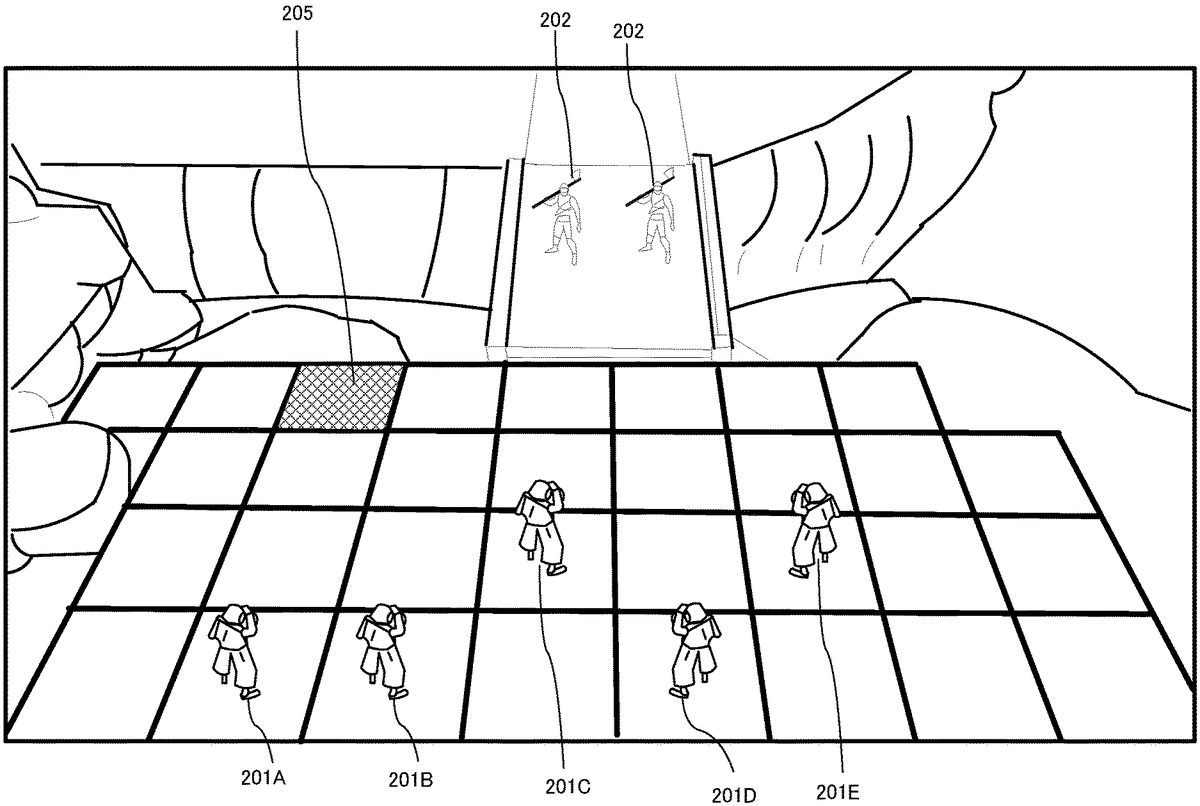
FIG. 4illustrates a non-limiting example of a screen for the TBSG according to the present embodiment. The exemplary screen represents a game screen obtained by taking an image of a play map (corresponding to the ground and topography in a virtual game space) and a three-dimensional virtual game space in which each unit is disposed, by a virtual camera, at a predetermined position behind a player's side army unit201. A position, an angle, an angle of view, or the like of the virtual camera can be optionally changed according to an operation by a player. InFIG. 4, a total of five player's side army units201which are player's side army units201A to201E (hereinafter, may be collectively called player's side army unit201) are disposed on the cells of the play map (ground portion). Furthermore, two hostile army units202are disposed on the cells (positions on a bridge) on the screen depth side relative to the player's side army unit201.FIG. 4shows an example where it is turn of the player's side army, and the player's side army unit201C is an object to be currently operated. Therefore, a range where the player's side army unit201C is movable is distinctly displayed by the cells (when the movement-allowed range need not be displayed in the game, a boundary line between the cells may be displayed or may not be displayed).
In the TBSG according to the present embodiment, some “bonus cells” are set on the play map. The bonus cell is a cell at which a predetermined effect that is advantageous for the player's side army (player) can be obtained when the player's side army unit201reaches the cell. In the present embodiment, when the player's side army unit201“ends an action (the unit ends an action in the turn)” on a predetermined cell, it is determined that the cell is reached. The predetermined effect represents, for example, an effect of obtaining a predetermined item, an effect of restoring various status values of the player's side army unit201, and an effect of improving various status values. In the example shown inFIG. 4, a cell205on around the center on the left side of the screen is set as the bonus cell as described above. A visual effect for allowing a player to visually recognize the bonus cell is set. For example, a display mode is changed from a display mode for another cell. In the exemplary screen, for example, an effect of the bonus cell being displayed so as to have a mesh-like pattern is used as the visual effect. In the present embodiment, the effect is exhibited in the bonus cell only one time. After the effect has been exhibited, the above-described visual effect is canceled.
Outline of Features of the Present Embodiment
In the present embodiment, as described above, the information processing terminal102can communicate with the server101via a network. Therefore, the information processing terminal102communicates with the server101before start of the play map or at time when the play map is cleared, and can obtain predetermined data from the server101or transmit predetermined data to the server101. In the present embodiment, the network function is used to set a position of the bonus cell described above according to information based on a play result of each player. The information based on the play result of a player is, for example, transmitted from the game apparatus to the server101when a play map is cleared. In the present embodiment, the frequency with which a predetermined event occurs is used as the information based on the play result. Specifically, the frequency of occurrence of an event of “defeating a hostile army unit” and the frequency of occurrence of an event of “the player's side army unit being defeated” are used. Therefore, in the present embodiment, information such as the defeat-number information and being-defeated-number information is used. The defeat-number information indicates how many hostile army units have been defeated and in what cells the hostile army units have been defeated on a play map which has been cleared at that time (which has been played at that time) (how many times the defeat event has occurred). In other words, the defeat-number information indicates, for each cell, the number of times the hostile army unit has been defeated. The being-defeated-number information indicates how many player's side units have been defeated and in what cells the player's side units have been defeated (how many times the being-defeated event has occurred). In other words, the being-defeated-number information indicates, for each cell, the number of times the player's side army unit has been defeated. In the present embodiment, when a TBSG game using a play map is started, the defeat-number information and the being-defeated-number information are obtained from the server101. The position of the bonus cell described above is set based on the information (the setting method will be described below in detail).
[Outline of Process of Transmission to Server]
The outline of the process for setting the bonus cell according to the present embodiment will be described below. Firstly, a process of transmitting, to the server101, the information based on the play result will be described. In the present embodiment, when a predetermined play map has been cleared, a process of transmitting, to the server101, the defeat-number information and the being-defeated-number information in the play map is performed. More specifically, in the present embodiment, when the play map has been cleared, communication with the server101is temporarily performed, to obtain, from the server101, the most recent defeat-number information and being-defeated-number information at that time. A process of transmitting, to the server101, a result obtained by adding the obtained contents to the defeat number and the being-defeated number, respectively, which are counted until the play map played this time is cleared, is performed. In the server101, a process of storing data of the defeat-number information and the being-defeated-number information which have been transmitted most recently, is performed. That is, the defeat-number information and the being-defeated-number information are updated with the most recently received contents. For example, when a player A has cleared a certain play map, the most recent defeat-number information and being-defeated-number information at that time are obtained from the server101. For example, when the information indicates that the defeat number in a certain cell (here, referred to as a cell A for convenience sake) is “10”, and the defeat number indicating the number of the hostile army units defeated by the player A in the cell A in this play is “3”, “3” is added to the defeat number in the cell A in the obtained information. The defeat-number information and the being-defeated-number information are transmitted to the server101after the addition. The server101receives the information and updates the content with this information, to update the defeat number in the cell A from 10 to 13. Thereafter, when the transmission process is similarly performed by another information processing terminal102when the play map has been cleared, the defeat-number information indicating that the defeat number in the cell A is “13” is transmitted to said another information processing terminal102, and the defeat number is further added to the transmitted defeat-number information.
The above-described transmission process is performed by each of the plurality of the information processing terminals102. As a result, the defeat-number information and the being-defeated-number information for each player are transmitted to the server from each of the information processing terminals102, and the defeat numbers and being-defeated numbers for a plurality of players can be accumulated.
In the present embodiment, an exemplary case where the most recently received defeat-number information and being-defeated-number information are stored (updated) in the server101in order to reduce process steps in the server101, is described. However, in another exemplary embodiment, the server may perform aggregating and statistical process for the defeat number and the being-defeated number, based on data transmitted from each of the information processing terminals102. The defeat number information and the being-defeated-number information obtained as a result of the process may be stored.
[Outline of Setting of Position of Bonus Cell]
Next, the outline of a process of setting a position of the above-described bonus cell will be described. An exemplary case where three bonus cells are set based on the being-defeated-number information, and ten bonus cells are set based on the defeat-number information, will be described. When a player starts to play with a certain play map, the information processing terminal102firstly obtains, from the server101, the defeat-number information and the being-defeated-number information corresponding to the play map. Next, the information processing terminal102specifies positions of the top three cells in the order starting from the greatest being-defeated number, based on the being-defeated-number information. These cells may be cells at which the player's side army unit is likely to be defeated. Hereinafter, these cells may be referred to as “defeated cells”. Furthermore, the information processing terminal102specifies positions of the top ten cells in the order starting from the greatest defeat-number, based on the defeat-number information. These cells may be cells at which the hostile army unit is likely to be defeated (hereinafter, these cells may be referred to as defeat cells). The information processing terminal102sets the specified cells as the bonus cells described above. In the following description, the bonus cell corresponding to the defeated cell is referred to as a first bonus cell, and the bonus cell corresponding to the defeat cell is referred to as a second bonus cell.
The number of the bonus cells to be set may be predetermined for each play map. For example, the number of the bonus cells to be set may be increased for a large play map, and the number of the bonus cells to be set may be reduced for a small play map. The number of the bonus cells to be set is an exemplary one, and any number may be used according to a game content.
In the present embodiment, the number of the defeated cells is set to be less than the number of defeat cells. This is because, for example, the number of times the hostile army unit appears is greater than the number of times the player's side army unit appears in each play map. However, in another exemplary embodiment, a ratio between the defeated cells and the defeat cells may be optionally set. Both the numbers may be equal to each other, or the ratio therebetween according to the present embodiment may be inverted.
Next, an effect which is set for each of the first bonus cell and the second bonus cell will be described. In the present embodiment, as the effect set for the first bonus cell, an effect of changing a status and a parameter such as restoring and increasing a status value of the player's side army unit and increasing a parameter value such as “fame value” (which rarely increases in the game), is mainly set. Meanwhile, as an effect for the second bonus cell, an effect of obtaining some item such as obtaining a predetermined item as “loot” is mainly set. In the present embodiment, as an item which can be obtained as the effect for the second bonus cell, an item which is not rare (availability difficulty level is low) is set. In consideration that the first bonus cell is basically a cell at which the player's side army unit has been defeated, and the set number of the first bonus cells is less than that of the second bonus cells, the effect obtained in the first bonus cell is set to be highly valued. Needless to say, this setting of the effect is an example, and the contents of the effect may be set as appropriate according to the game content in another exemplary embodiment.
[Reset of Counting of Bonus Cells]
Furthermore, in the present embodiment, when the defeat number in a predetermined cell becomes greater than or equal to a predetermined value, the defeat number in the cell is temporarily reset to 0. The same applies to the being-defeated number. Thus, in a case where, for example, the top ten cells having the great defeat numbers are selected and used as described above, the cells having the great defeat numbers can be prevented from being constantly selected as the top cells. As a result, the lineup of the cells included in the top ten cells can be changed, and the positions at which the bonus cells are set can be (almost compulsorily) changed.
Thus, in the present embodiment, when a play map is started, positions of the bonus cells are set based on the information about the defeat numbers and the being-defeated numbers from a plurality of players. Thus, in a case where a player plays with the same play map, when play start timing is different, the player is allowed to play with the play map in which the disposition of the bonus cells is different. The positions at which the bonus cells are disposed can be effectively and automatically changed according to the tendency of the actual play contents by the players. Disposition, of the bonus cells, which has not been expected by a developer can be automatically realized after sales of the game, thereby enhancing game entertainment interactivity.
[Details of Game Processing According to the Present Embodiment]
Next, the TBSG process according to the present embodiment will be specifically described with reference toFIG. 5toFIG. 25.
[Data to be Used]
Firstly, various data used in this TBSG process will be described. Firstly, data used in the server101will be described.FIG. 5shows a non-limiting example of a memory map indicating examples of various data to be stored in the memory112of the server101. A server program401, server storage data402, and the like are stored in the memory112of the server101.
The server program401is a program for performing control of transmitting to and receiving from the information processing terminal102the server storage data402, and storing the server storage data402. The server storage data402includes information of the defeat number and the being-defeated number as described above. A data structure of the server storage data402will be described with reference toFIG. 6. The server storage data402shown inFIG. 6is data having items of at least a route ID411, a chapter ID412, defeat-number information413, and being-defeated-number information414, in the format of a table. The route ID411and the chapter ID412are IDs for identifying the route and the chapter as described above. In other words, the route ID411and the chapter ID412are information for identifying the play map.
The defeat-number information413indicates the defeat number in each of the cells that constitute the play map identified by the route ID411and the chapter ID412. As described above, the play map has a size of up to 32×32 cells. Therefore, the defeat-number information413is structured as array data corresponding to up to 32×32 cells.FIG. 7shows an image diagram of the data structure of the defeat-number information413. InFIG. 7, for easy understanding of the description, the defeat-number information413is indicated in the format of a two-dimensional table in which the horizontal axis represents x coordinates and the vertical axis represents y coordinates. This is the same as a bird's eye view of the play map. Each cell can be identified in the form of (x axis, y axis). Specifically, each cell can be identified from (1, 1) to up to (32, 32). As shown inFIG. 7, as information corresponding to each cell, information indicating (the cumulative amount of) the defeat number of the defeated hostile army units in the cell, is indicated. In the present embodiment, the defeat number is indicated as an integer in a numerical range of 0 to 65535. When the defeat number is greater than 65535, the defeat number is temporarily reset to 0 as described above.
Returning toFIG. 6, the being-defeated-number information414indicates the being-defeated number in each of the cells that constitute the play map identified by the route ID411and the chapter ID412. The data structure of the being-defeated-number information414is the same as that of the defeat-number information413described with reference toFIG. 7(array data corresponding to up to 32×32 cells). Therefore, description thereof is omitted.
Next, various data stored in a memory of the information processing terminal102will be described.FIG. 8shows a non-limiting example of a memory map indicating examples of various data to be stored in the memory122of the information processing terminal102. In the memory122of the information processing terminal102, a terminal game program501, unit master data502, map master data503, bonus effect defining data504, play map data505, a unit list506, defeat-number count data507, being-defeated-number count data508, action history data509, data-to-be-transmitted-to-server510, operation data511, and the like are stored.
The terminal game program501is a program for executing game processing according to the present embodiment. Specifically, the terminal game program501is a program for executing a process shown in a flow chart inFIG. 15described below.
The unit master data502is a database for defining all the units that appear in this TBSG. That is, the unit master data502is data on which the player's side army unit201and the hostile army unit202are based, and includes various parameters for each unit and data representing an outer appearance or the like of each unit. A predetermined unit that appears in the play map is selected according to the play map, and various player's side army units201and various hostile army units202are generated based on the unit master data502, and disposed on the play map.
The map master data503is a database for defining a basic structure of the play map.FIG. 9illustrates a non-limiting example of the data structure of the map master data503. The map master data503has items of a route ID521, a chapter ID522, and map structure information523. The route ID521and the chapter ID522are information for identifying the play map. The map structure information523is information for defining a basic structure of the play map. Specifically, the map structure information523includes various kinds of information, other than the information about the bonus cell, for structuring the play map, for example, the map structure information523includes the size (the number of cells) of the play map, information indicating the topography of each cell, and the outer appearance and the topography effect of each cell. Furthermore, the map structure information523includes various kinds of information, about the play map, which is necessary for game processing, for example, the map structure information523includes information that defines victory conditions and being-defeated conditions in the map, which are not shown.
Returning toFIG. 8, the bonus effect defining data504defines various effects which are set in the above-described bonus cells. In the present embodiment, various effects obtained in the bonus cells are configured to be changed according to a degree of the game progress.FIG. 10illustrates a non-limiting example of a data structure of the bonus effect defining data504. The bonus effect defining data504has a game progress degree531and an effect content table532. The game progress degree531is information that defines a degree of the game progress as described above. The effect content table532is data for defining the effect which is set in the bonus cell based on the degree of the game progress. The effect content table532includes first bonus cell information533that indicates a plurality of effect contents which can be set in the first bonus cells, and second bonus cell information534that indicates a plurality of effect contents which can be set in the second bonus cells. In the example shown inFIG. 10, when the degree of the game progress indicates “chapter 1 to chapter 2” of the story, ten effects of effect1to effect10are defined as the effects which can be set in the first bonus cells. Ten effects of effect11to effect20having different effect contents are defined as the effects which can be set in the second bonus cells. In the bonus cell setting process described below, any of the effect1to the effect10is selected and set for each first bonus cell. Similarly, any of the effect11to the effect20is selected and set for each second bonus cell.
Returning toFIG. 8, the play map data505is data for defining the play map. Specifically, the play map data505corresponds to the contents obtained by adding information about the bonus cells defined based on the server storage data402and the bonus effect defining data504, to the map generated based on the map master data503.FIG. 11illustrates a non-limiting example of a data structure of the play map data505. The play map data505includes items of coordinate information541, topography information542, bonus cell information543, and other information544, in the format of a table. The coordinate information541is information for specifying a position of each of the cells that constitute the play map. The topography information542indicates the topography of the cell. The bonus cell information543indicates whether or not the cell is an effective bonus cell, and also indicates the contents of the bonus cell when the cell is an effective bonus cell.FIG. 12illustrates a non-limiting example of a data structure of the bonus cell information543in detail. The bonus cell information543includes an effectiveness flag5431, classification information5432, and an effect content5433. The effectiveness flag5431is information that indicates whether or not the cell is an effective bonus cell. In the present embodiment, the effect for the bonus cell is exhibited only once. Therefore, a content indicating “effective” is set for the bonus cell in which the effect has not been exhibited, and a content indicating “non-effective” is set for the bonus cell in which the effect has been exhibited. Furthermore, “non-effective” is set as an initial value for cells which are not set as the bonus cells. The classification information5432indicates whether a cell is the first bonus cell or the second bonus cell when the cell is set as the bonus cell. In the present embodiment, when the bonus cell is indicated by using a visual effect, the visual effect may be different between the first bonus cell and the second bonus cell. The effect content5433is information that defines the content of the effect to be exhibited when a cell is set as the bonus cell.
Returning toFIG. 11, the other information544includes various kinds of information, for defining the play map, other than the above-described information. For example, various event contents (for example, conversation event) that are generated when a predetermined unit is moved to the cell are defined.
Returning toFIG. 8, the unit list506is information about the player's side army units201and the hostile army units202that appear in the play map.FIG. 13illustrates a non-limiting example of a data structure of the unit list506. The unit list506is data that includes items of a unit ID551, an existence flag552, hostile side/player's side information553, class information554, HP/MP information555, position information556, and the like, in the format of a table. The unit ID551is an ID for uniquely identifying the unit. The existence flag552is information indicating whether or not the unit exists on the play map. In other words, the existence flag552is information indicating whether or not a unit has been defeated. When the unit is not defeated, information indicating “exist” is set. When the unit has been defeated, information indicating “flee” is set. The hostile side/player's side information553indicates whether the unit is a “player's side army unit” or a “hostile army unit”. The class information554indicates a kind of the unit. The HP/MP information555indicates a (the most recent) HP (hit point)/MP (magic point) of the unit. In the present embodiment, the unit having the HP of 0 is regarded as having been defeated, and “flee” is set in the existence flag552. The position information556indicates a position of the unit. When the existence flag552indicates “exist”, the position information556indicates what cell the unit is currently on. When the existence flag552indicates “flee”, the position information556indicates a position (cell) at which the unit has been defeated (that is, indicates the last position of the unit).
Returning toFIG. 8, the defeat-number count data507indicates the defeat number of the hostile army units having been defeated and the cells at which the hostile army units have been defeated. That is, the defeat-number count data507includes information indicating how many hostile army units have been defeated and the cells at which the hostile army units have been defeated. The defeat-number count data507is structured as array data corresponding to up to 32×32 cells according to the size (the number of cells) of the play map.FIG. 14illustrates a non-limiting example of an image of a data structure of the defeat-number count data507. Similarly to the defeat-number information413of the server storage data402described above, inFIG. 14, the defeat-number count data507is indicated in the format of a two-dimensional table in which the horizontal axis represents x coordinates and the vertical axis represents y coordinates. Each time a hostile army unit is defeated in a predetermined cell, 1 is added to the defeat number corresponding to the cell.
Returning toFIG. 8, the being-defeated-number count data508indicates the number of the player's side army units having been defeated, and the cells at which the player's side army units have been defeated. That is, the being-defeated-number count data508is information indicating how many player's side army units have been defeated and the cells at which the player's side army units have been defeated. The data structure is the same as that of the defeat-number count data507, and the description thereof is omitted.
Next, the action history data509represents, as a history, an action of each unit in each turn. The TBSG of the present embodiment has a “return function” that allows a player to return some turns and perform the returned turns again, which will be described below in detail. The action history data509is used when the return function is used by a player.
The data-to-be-transmitted-to-server510is used when the defeat number and the being-defeated number counted by using the defeat-number count data507and the being-defeated-number count data508are transmitted to the server101. The data structure of the data-to-be-transmitted-to-server510is the same as the data structure of one record (corresponding to one lateral row inFIG. 11) of the server storage data402(seeFIG. 11) described above.
The operation data511indicates a content of an operation performed by a player on the operation unit123, and is transmitted from the operation unit123to the processor121at predetermined time intervals. The operation data511includes information representing pressed states of various buttons, coordination information of an input to a touch panel, and the like.
Various other data, such as BGM data, which is necessary for the TBSG process is also stored in the memory122, which is not shown.
Next, information processing according to the present embodiment will be described in detail with reference to flow charts shown inFIG. 15toFIG. 25. The process for the TBSG as described above is mainly performed by the information processing terminal102, and communication with the server101is partially performed as described above. Therefore, the process performed by the server101will be briefly described before the process performed by the information processing terminal102is described.
[Details of Process Performed by the Server101]
In the server101, a process of transmitting the server storage data402according to a request from the information processing terminal102is performed as appropriate. Furthermore, a process of receiving the data-to-be-transmitted-to-server510transmitted from the information processing terminal102and updating the server storage data402based on the contents thereof is performed as appropriate.
[Details of Process Performed by the Processor121]
Next, game processing performed by the information processing terminal102will be described in detail.FIG. 15is a flow chart showing a non-limiting example of game processing performed by the processor121of the information processing terminal102. The processing is performed according to a player providing, through the operation unit123, an instruction for starting the TBSG process using the play map. Firstly, in step S1, the processor121performs a process for preparing the play map as described above. Thereafter, the processor121performs the TBSG process using the prepared play map.
FIG. 16is a flow chart showing a non-limiting example of a play map preparation process of step S1in detail. Firstly, in step S11, the processor121determines the current game progressing state, that is, determines the route ID and the chapter ID corresponding to the current route and chapter. Next, the processor121obtains the map structure information523corresponding to the current route and chapter, from the map master data503. The processor121generates the play map data505based on the map structure information523. At this time point, nothing is set in the bonus cell information543of the play map data505.
Next, in step S12, the processor121performs a process of obtaining information of the defeat number and the being-defeated number from the server101. Specifically, a request for transmission of the defeat-number information413and the being-defeated-number information414based on the current route and chapter is transmitted to the server101. In response thereto, the corresponding defeat-number information413and being-defeated-number information414are transmitted from the server101. The processor121receives the defeat-number information413and the being-defeated-number information414which are transmitted from the server101.
For this reception process, in another exemplary embodiment, the entirety of the server storage data402may be received. The processor121may identify and obtain the defeat-number information413and the being-defeated-number information414corresponding to the current route and chapter with reference to the received server storage data402.
Next, in step S13, the processor121performs a process of setting positions and effects of the three first bonus cells based on the received being-defeated-number information414. Specifically, the processor121specifies the positions of the top three cells in the order starting from the greatest being-defeated number with reference to the received being-defeated-number information414. Next, the processor121selects the effect content table532according to the current degree of the game progress with reference to the bonus effect defining data504. The processor121determines the effect in each of the three specified cells with reference to the first bonus cell information533. Specifically, the processor121selects any one of the effects defined in the first bonus cell information533, at random, for each cell. The processor121sets the bonus cell information543based on the determined content. Specifically, firstly, the processor121specifies the coordinate information541corresponding to the three specified cells with reference to the play map data505generated in step S11. The processor121sets the following information in the bonus cell information543corresponding to each piece of the coordinate information541. Firstly, the information indicating “effective” is set in the effectiveness flag5431. The information indicating the “first bonus cell” is set in the classification information5432. The information indicating the content of the effect determined in the above-described process is set in the effect content5433. Thus, three first bonus cells are set in the play map data505.
Next, in step S14, the processor121performs a process of setting positions and effects of the ten second bonus cells based on the received defeat-number information413. Specifically, the processor121specifies the positions of the top ten cells in the order starting from the greatest defeat number with reference to the received defeat-number information413. Next, the processor121determines the effect in each of the ten specified cells, at random, with reference to the second bonus cell information534. The processor121sets, in the play map data505, the information of the ten second bonus cells for which the effects have been determined. At this time, the information indicating the “second bonus cell” is set in the classification information5432. Furthermore, the processor121sets information indicating “non-effective” in the effectiveness flag5431of the bonus cell information543for the cells which are not set as the first bonus cell and the second bonus cell.
When the second bonus cell is set, a method for extracting the top ten cells in the order starting from the greatest defeat-number is used. Therefore, the same cell as the cell that is set as the first bonus cell may be selected as a candidate that is set as the second bonus cell. In this case, the first bonus cell is controlled so as to be prioritized. For example, when, as a result of extracting the top ten cells, the cell at the fifth order position is the same as the cell that has been set as the first bonus cell, the cell at the fifth order position is not adopted as the second bonus cell, and the cell at the subsequent order position is controlled to be selected. In the present embodiment, the total number of the second bonus cells to be set is 10. Therefore, the cell at the eleventh order position in the order starting from the greatest defeat number is selected as the tenth cell.
When a plurality of the cells are at the same order position in each of the first bonus cell and the second bonus cell (as long as the first bonus cell and the second bonus cell do not overlap each other), a plurality of cells at the same order position are selected such that the total number of the bonus cells to be set is not exceeded. For example, it is assumed that, when the top ten cells in the order starting from the greatest defeat number are extracted, the number of the cells at each of the first to the eighth order positions is one and the number of the cells at the tenth order position is one, and the number of the cells at the ninth order position is two. In this case, the cell at the tenth order position is not adopted, and eight cells at the first to the eighth order positions and 2 cells at the ninth order positions are adopted, and are set as the ten second bonus cells in total. Furthermore, when the number of cells at the ninth order position is not two but three, two cells among them are selected. In this case, two of the cells at the same order position may be selected by using a predetermined ordering algorithm, or may be selected at random.
For example, at a time immediately after the game is released, although the top ten cells in the order starting from the greatest defeat number are attempted to be extracted as candidates that are to be set as the second bonus cells, ten cells may not be obtained (this may apply to the first bonus cell). In this case, a cell at a previously defined position may be set as the bonus cell.
When the first bonus cell and the second bonus cell have been set as described above, the processor121subsequently generates, in step S15, the play map based on the play map data505in which the bonus cell information543has been set.
Next, in step S16, the processor121arranges various units on the play map. In the subsequent step S17, the processor121causes the virtual camera to take an image of the play map and a virtual game space in which various units are arranged, generates a game image, and outputs the game image to the display section124. At this time, the game image is generated so as to exhibit a predetermined visual effect for each bonus cell for which the effectiveness flag5431is “effective”, such that a player is allowed to visually recognize the (effective) bonus cell. Different visual effects are exhibited for the first bonus cell and the second bonus cell, respectively. The play map preparation process ends with this.
After the game image is output, an operation performed by a player may be received in order to allow the player to change a position at which the player's side army unit201is disposed. The play map preparation process may end with the determination operation for the change.
Next, the TBSG process of step S2will be described in detail.FIG. 17is a flow chart showing a non-limiting example of the TBSG process in detail. Firstly, in step S21, the player's-side-army's turn process is performed. In this process, an action of the player's side army unit201is controlled based on the operation performed by the player, and various game processing is performed.
FIG. 18toFIG. 19are each a flow chart showing a non-limiting example of the player's-side-army's turn process in detail. Firstly, in step S31, the processor121obtains the operation data511.
Next, in step S32, the processor121determines whether or not the content of the operation represents an instruction for using a “return” function. As described above, the return function is a function for allowing a player to return some turns and perform the returned turns again (which will be described below in detail).
When the result of the determination indicates that the content of the operation does not represent an instruction for return (NO in step S32), the processor121subsequently specifies, in step S33, a unit to be operated as a current operation subject among the player's side army units201, based on the content of the operation. A game image having various visual effects (display of a movement-allowed range, or the like) for allowing a player to recognize a current operation subject, is generated and displayed.
Next, in step S34, the processor121obtains the operation data511. In the subsequent step S35, the processor121performs a process of controlling an action of the unit to be operated, based on the content of the operation. The content of the action is, for example, “move”, “attack a hostile army unit”, “use an item, magic”, or the like”. In the case of “move”, the unit to be operated is controlled to move to a cell designated by the player. In the case of “attack a hostile army unit”, a process for fight between the unit to be operated and a hostile army unit specified as an object to be attacked is performed. As a result, various parameters such as the HP are changed (for example, consumption and/or subtraction of a parameter).
Nest, in step S36, the processor121determines whether or not the player's side army unit201has been defeated. That is, the processor121determines whether or not the player's side army unit201in which the HP is 0 is among the player's side army units201in each of which the existence flag552represents “exist”. When the result of the determination indicates that the player's side army unit201has been defeated, the processor121performs a process for a defeated state in step S37. This is a process for counting the being-defeated number.FIG. 20is a flow chart showing a non-limiting example of the process for a defeated state in detail. Firstly, in step S51, the processor121specifies a cell at which the player's side army unit201has been defeated. The processor121adds one to the being-defeated number, for the cell, corresponding to the being-defeated-number count data508.
Next, in step S52, the processor121sets, as “flee”, the existence flag552for the player's side army unit201having been defeated. Furthermore, the processor121sets, in the position information556, a position of the cell at which the defeated player's side army unit201has been disposed, and updates the unit list506. The process for the defeated state ends with this.
Returning toFIG. 18, when the result of the determination in step S36indicates that the player's side army unit201is not defeated (No in step S36), the process step of step S37is not performed and the process proceeds to the subsequent step.
Next, in step S38, the processor121determines whether or not the hostile army unit202has been defeated. That is, the processor121determines whether or not the hostile army unit202in which the HP is 0 is among the hostile army units202in each of which the existence flag552represents “exist”. When the result of the determination indicates that the hostile army unit202has been defeated (YES in step S38), the processor121performs a process for a state where a hostile unit has been defeated, in step S39. This is a process for counting the defeat number.FIG. 21is a flow chart showing a non-limiting example of the process for a state where a hostile unit has been defeated, in detail. Firstly, in step S61, the processor121specifies a cell at which the defeated hostile army unit202has been disposed. The processor121adds one to the defeat number, for the cell, corresponding to the defeat-number count data507.
Next, in step S62, the processor121sets, as “flee”, the existence flag552for the hostile army unit202having been defeated. Furthermore, the processor121sets, in the position information556, a position of the cell at which the defeated hostile army unit202has been disposed, and updates the unit list506. The process for the state where a hostile unit has been defeated ends with this.
Returning toFIG. 18, when the result of the determination in step S38indicates that the hostile army unit202is not defeated (NO in step S38), the process step of step S39is not performed, and the process proceeds to the subsequent step.
Next, in step S40inFIG. 19, the processor121determines whether or not the unit to be operated “ends an action”. The unit to be operated automatically “ends an action” not only when the player explicitly designates “end an action” but also when the player's unit has been defeated. When the result of the determination does not indicate “end an action” (NO in step S40), the process is returned to step S34, and the process for the unit to be operated is repeated.
Meanwhile, when the unit to be operated “ends an action” (YES in step S40), the processor121performs a bonus cell determination process in step S41. This process is for exhibiting, when the action ends on a bonus cell, an effect set in the bonus cell.FIG. 22is a flow chart showing a non-limiting example of the bonus cell determination process in detail. Firstly, in step S71, the processor121determines whether or not player's side army unit in which the existence flag552indicates “exist” is on the bonus cell in which “effective” is set in the effectiveness flag5431. Therefore, in a case where the player's side army unit has been defeated before ending an action, the player's side army unit does not satisfy this condition (since “flee” is set in the existence flag552). When the result of the determination indicates that the player's side army unit that is in “existence” is not on the “effective” bonus cell (NO in step S71), the bonus cell determination process ends (that is, the effect set in the bonus cell is not exhibited). Meanwhile, when the player's side army unit which is in the “existence” is on the “effective” bonus cell (YES in step S71), the processor121subsequently performs, in step S72, a process for exhibiting the effect defined in the effect content5433corresponding to the bonus cell. For example, a process of restoring the HP (in the case of the first bonus cell), or a process for providing a predetermined weapon item to the player's side army unit201(in the case of the second bonus cell) is performed.
Next, in step S73, the processor121sets “non-effective” in the effectiveness flag5431corresponding to the bonus cell for which the effect has been exhibited this time. This can prevent the effect from being exhibited for the cell after that. The bonus cell determination process ends with this.
Returning toFIG. 19, the processor121subsequently updates the content of the unit list506in step S42such that a state after the end of the action is reflected in the unit list506. For example, when a player has merely moved the unit to be operated and ended the action of the unit to be operated, the processor121updates the unit list506such that the position, of the unit to be operated, at the end of the action is reflected in the position information556.
Next, in step S43, the processor121determines whether or not the player has made an instruction for ending the player's-side-army's turn. When the instruction for the end is not made (NO in step S43), the process is returned to step S31and repeated. When the instruction for ending the player's-side-army's turn is made (YES in step S43), the processor121ends the player's-side-army' turn process.
Next, a case where the result of the determination in step S32indicates that the content of the operation is an instruction for “return” (YES in step S32) will be described. In this case, in step S44, the processor121performs the return process. In the return process, a predetermined number of turns can be returned based on the content of the operation performed by the player. In the present embodiment, an exemplary case where the return is performed in units of turns, will be described. That is, the play can be returned in units of turns such that the play is returned to one turn previous play, two turns previous play . . . . In order to perform such a return process, for example, the content of the unit list506at the start of each turn is copied and stored in the action history data509. In another exemplary embodiment, the return may be performed not for each turn but for each unit.
FIG. 23is a flow chart showing a non-limiting example of the return process in detail. Firstly, in step S81, the processor121determines an amount to be returned (the number of turns to be returned) based on the operation data511. Next, in step S82, the processor121performs a process of returning the number of turns with reference to the action history data509. As a result, a state at the start of the returned-turns-previous operation content is reproduced. For example, in the case of two turns being returned, states and disposition of various kinds of units are changed so as to reproduce a state at the start of two-turns-previous operation content. According thereto, the content for the returned turns in the action history data509, is also erased.
Next, in step S83, the processor121performs a process of subtracting the defeat number, in each cell, in the returned turns, from the defeat-number count data507. That is, the process is performed such that the return process is reflected also in the defeat-number count data507. In the present embodiment, when the return process is performed, the return process is not reflected in the being-defeated-number count data508. For example, a case where, after one player's side army unit has been defeated in the sixth turn, the return to the fourth turn is performed, is assumed. In this case, the defeat number of the hostile units which have been defeated between the fourth turn and the sixth turn is subtracted and the defeat number of the hostile units is returned to the previous number (the defeat number is not counted.). However, the number of the player's side army units which have been defeated in the sixth turn is not subtracted and the number of the player's side army units is not returned to the previous number. Therefore, if the player's side army unit is defeated in the same cell after the return, the being-defeated number is further added. This is because the set number of the first bonus cells is less than the set number of the second bonus cells, and influence on the player is great when the player's side army unit is defeated, and, therefore, data for the defeated state is to be collected as much as possible and is to be provided to the player. That is, in general, the number of the player's side army units that appear on the play map is set to be less than the number of the hostile army units, and, therefore, the player may consider that reduction (defeated state) of the number of the player's side army units is to be prevented as much as possible. Therefore, as much data as possible is to be collected for a cell at which the player's side army unit is defeated, and “a dangerous place at which the player's side army unit is likely to be defeated” is to be presented as the first bonus cell. Meanwhile, a position at which a hostile unit is defeated is less valuable than a position at which the player's side army unit is defeated. Therefore, the number of the hostile units is returned to the previous number.
Next, in step S84, the processor121erases the contents of the action history data509corresponding to the returned turns. Thereafter, a game image obtained by taking an image of a virtual game world in a returned state is generated and displayed. The return process ends with this.
Returning toFIG. 18, when the return process has been ended, the process is returned to step S31. Thus, the player's-side-army's turn is started in the returned state. Description of the player's-side-army's turn process is ended with this.
Returning toFIG. 17, subsequently, in step S22, a hostile-army's turn process is performed. The hostile-army's turn process is the same as the player's-side-army's turn process except that the processor121(AI) instead of a player operates the hostile army units, and the return process is not performed in the hostile-army's turn process.
FIG. 24shows a non-limiting example of the hostile-army's turn process in detail. Firstly, in step S91, the processor121selects a hostile army unit which is caused to act. In the subsequent step S92, the processor121controls an action of the hostile army unit which is caused to act. That is, for example, a movement process and a process of attacking the player's side army unit are performed.
Next, in step S93, the processor121determines whether or not the player's side army unit201has been defeated. When the player's side army unit201has been defeated (YES in step S93), the processor121performs a process for a defeated state in step S94. This process is the same as the process step of step S37, and the description thereof is omitted. When the player's side army unit201is not defeated (NO in step S93), the process step of step S94is skipped.
Next, in step S95, the processor121determines whether or not the hostile army unit202has been defeated. When the hostile army unit202has been defeated (YES in step S95), the processor121performs a process for a state where a hostile army unit has been defeated in step S96. This process is the same as the process step of step S39, and the description thereof is omitted. When the hostile army unit202is not defeated (NO in step S95), the process step of step S96is skipped.
Next, in step S97, the processor121updates the unit list506such that the result of the action of the hostile army unit which is caused to act is reflected in the unit list506. In the subsequent step S98, the processor121determines whether or not all the hostile army units that are in “existence” at that time, have “ended actions”. When a hostile army unit that has not “ended an action” is remaining (NO in step S98), the process is returned to step S91and repeated. When all the hostile army units have “ended actions” (YES in step S98), the hostile-army's turn process ends.
Returning toFIG. 17, in step S23, the processor121subsequently determines whether or not a victory condition which is set in the currently played play map has been satisfied. When the result of the determination indicates that the victory condition has been satisfied (YES in step S23), the processor121performs a count data transmission process in step S24. In this process, information about the defeat number and the being-defeated number which have been counted before the play map having been played this time is cleared, is transmitted to the server101.FIG. 25is a flow chart showing a non-limiting example of the count data transmission process in detail. Firstly, in step S101, the processor121obtains, from the server101, the defeat-number information413and the being-defeated-number information414corresponding to the route and chapter (that is, the play map which has been cleared this time) in the same process as the process step of step S12. That is, the most recent defeat-number information and being-defeated-number information at this time point are obtained.
Next, in step S102, the processor121performs a process of adding the content of the being-defeated-number count data508to the content of the being-defeated-number information414. That is, the processor121adds the being-defeated number, for the corresponding cell, which is in the being-defeated-number count data508to the being-defeated number, for the cell, which is in the being-defeated-number information414. At this time, when the result of the addition indicates that a cell in which the being-defeated number exceeds a predetermined value (in the present embodiment, 65535) is present, the processor121sets the being-defeated number to 0 for the cell. That is, the processor121resets the being-defeated number.
Next, in step S103, the processor121performs a process of adding the content of the defeat-number count data507to the content of the defeat-number information413. That is, the processor121adds the defeat number, for the corresponding cell, which is in the defeat-number count data507to the defeat number, for the cell, which is in the defeat-number information413. Also at this time, similarly to step S102, when the result of the addition indicates that the defeat number exceeds a predetermined value, the processor121resets the defeat number for the cell.
Next, in step S104, the processor121stores, as the data-to-be-transmitted-to-server510, data including the defeat-number information413and the being-defeated-number information414obtained by the addition, and the route ID411and the chapter ID412corresponding to the play map which has been played this time.
Next, in step S105, the processor121communicates with the server101, to transmit the data-to-be-transmitted-to-server510to the server101. According thereto, the server101performs a process of receiving the data-to-be-transmitted-to-server510, and updating the contents of the defeat-number information413and the being-defeated-number information414which are specified by the route ID411and the chapter ID412. The count data transmission process ends with this.
Returning toFIG. 17, in step S25, the processor121subsequently performs a process of displaying a predetermined victory presentation. Thereafter, the TBSG process ends.
Meanwhile, when the result of the determination in step S23indicates that the victory condition is not satisfied (NO in step S23), the processor121determines in step S26whether or not a being-defeated condition which is set in the currently played play map is satisfied. When the result of the determination indicates that the being-defeated condition is not satisfied (NO in step S26), the process is returned to step S21, and the TBSG process is repeated. Meanwhile, when the being-defeated condition is satisfied (YES in step S26), the processor121performs a process of displaying a predetermined being-defeated presentation in step S27, and the TBSG process ends. In the present embodiment, the count data transmission process is performed only when the victory condition of the play map is satisfied. However, in another exemplary embodiment, the count data transmission process may be performed also when the being-defeated condition is satisfied. Furthermore, in another example, when the being-defeated condition is satisfied, only the information of the being-defeated number may be transmitted. As described above, it is because as much data as possible is to be collected for the cell in which the player's side army unit is defeated.
The detailed description of the game processing according to the present embodiment ends with this.
As described above, in the present embodiment, the defeat number of the defeated hostile army units in each cell in the play map and the being-defeated number of the defeated player's side army units therein are transmitted to the server101based on the play results from a plurality of players. Therefore, data obtained by aggregating each of the defeat-numbers and the being-defeated numbers in each cell is stored in the server101. When the TBSG is started by using a play map, positions of the bonus cells are set based on the defeat number and the being-defeated number. Therefore, even in the same play map, the disposition of the bonus cells is different when a play start time is different. Therefore, disposition of the bonus cells can be effectively and automatically changed according to the tendency of actual play contents from a plurality of players. Thus, the disposition (structure) of the map in the TBSG can be continuously changed to enhance interactivity of the TBSG.
Modification
In the above-described exemplary embodiment, the information processing terminal102determines positions at which the bonus cells are disposed, based on the defeat number and the being-defeated number. In another exemplary embodiment, the server101may determine positions at which the bonus cells are disposed, based on the defeat number and the being-defeated number, and transmit the setting data indicating the determined positions of the bonus cells, to the information processing terminal102. For example, in the play map preparation process, the server101may perform the process steps corresponding to step S12to S14, and transmit the setting data indicating the positions of the bonus cells to the information processing terminal102. Then, the information processing terminal102may generate the play map in which the bonus cells are set, based on the setting data.
In the above-described exemplary embodiment, the defeat number is counted for all the hostile army units. In another exemplary embodiment, the defeat number may not be counted for some hostile army unit, according to the content of the play map. For example, a boss character which is disposed at a fixed position on the play map and does not move from the cell may not be counted so as to be included in the defeat number even if the boss character is defeated. For such a hostile army unit which does not move, the defeated cell is also fixed, and the defeat number in the cell tends to be inevitably greater than the defeat number in the other cells. If a bonus cell disposed at a fixed position is included, randomness of the positions at which the bonus cells are disposed may be reduced. Therefore, in another exemplary embodiment, the defeat number may not be counted for such a hostile army unit which is fixedly disposed.
Other examples of the hostile army unit for which the defeat number is not counted include the hostile army units which infinitely appear unless the victory condition or the being-defeated condition is satisfied. Examples thereof include the hostile army units that appear as a “dispatched troop” or “reinforcements”. The defeat number is likely to extremely increase for such hostile army units at some cells depending on the positions where they appear, and the positions at which the bonus cells are disposed may not be changed well. Therefore, the defeat number may not be counted for such hostile army units.
In the above-described exemplary embodiment, the defeat-number and the being-defeated number are transmitted to the server101at a time when the victory condition has been satisfied (time at which the defeat number and the being-defeated number are determined). In another exemplary embodiment, the defeat number may be determined and transmitted when the victory condition has been satisfied while the being-defeated number may be transmitted to the server101each time the player's side army unit is defeated (that is, may be transmitted in real time). This is because as much data as possible is to be collected for the cell at which the player's side army unit is defeated.
In the above-described exemplary embodiment, when the hostile army unit is defeated, the defeat number is counted as one even for the same cell each time the hostile army unit is defeated. In another exemplary embodiment, the defeat number may be counted only once in each cell. That is, in this case, this cell is handled as a “cell at which the hostile army unit has been defeated once”. Also in this case, the positions at which the bonus cells are disposed can be dynamically changed.
In the above-described exemplary embodiment, for example, the positions of the bonus cells are set in the order starting from the “greatest” defeat number. In another exemplary embodiment, the positions of the bonus cells may be set in the order staring from the “smallest” defeat-number and being-defeated number. When this applies to a game in which, for example, the player's side army unit is assumed to be defeated many times, the position at which the player's side army unit is less likely to be defeated can be suggested to a player.
As to the effect to be set for the bonus cells, in the above-described exemplary embodiment, the effect content table532is changed according to the degree of the game progress. In another exemplary embodiment, the effect content (table in which the effects are defined) may be made different according to the defeat-number and the being-defeated number. For example, as the effect content table532for setting in a certain first bonus cell, the different effect content tables532may be prepared for the being-defeated number of 1000, the being-defeated number of 5000, and the being-defeated number of 10000, respectively. In this case, the effect content tables532may be set such that the greater the being-defeated number is, the more advantageous the effect to be exhibited is to the player. For example, the HP is restored 10 times when the being-defeated number is 1000, whereas the HP is restored 50 times when the being-defeated number is 10000.
In the above-described exemplary embodiment, as to the effect to be set in the bonus cell, the effect is selected at random from the plurality of effects defined in the effect content table532. In another exemplary embodiment, in addition to the effect being selected at random, an effect may be exhibited by determination. For example, as to the effect to be exhibited for the first bonus cell, an effect of “obtaining an empirical value” may be set as a first effect to be exhibited by determination, and an effect which is selected at random as described above may be exhibited as a second effect different from the first effect. That is, two kinds of effects, that is, the first effect having fixed contents and the second effect which is randomly selected, may be exhibited.
Disposition of not only the bonus cells described above but also the other constituent elements of the play map may be changed based on the defeat number and the being-defeated number. For example, the position of a “treasure box” disposed on the play map may be randomly determined based on the defeat number and the being-defeated number. Furthermore, the disposition of the topography itself (that is, topographic structure itself of the play map) may be changed based on the defeat number and the being-defeated number. For example, the topography of the cells in which the being-defeated number is great may be changed to topography (that is, topography in which the unit is not easily defeated) in which the unit defense coefficient is increased, for example, changed from “plain” to “mountain”.
In the above-described exemplary embodiment, the predetermined event is, for example, an event of “defeating the hostile army unit” and an event of the “player's side army unit being defeated”. Other than this, for example, the following “events” may be counted. Firstly, the number of times an event of “using predetermined magic or skill” occurs may be counted for each cell. For example, the cell in which magic and/or skill for restoring the HP is used many times may be counted. In another example, a game may be structured such that a “trap” is set in a predetermined cell on the play map as described above, and a hostile army unit that has passed on the trap or has ended an action on the trap is damaged. The number of times the “trap” has operated is counted, and the positions at which the bonus cells are disposed may be determined based on the counted number of times.
A subject for performing the above-described process is not limited to the above-described one. For example, in the information processing system, a system on the server101side may be configured by a plurality of information processing devices, and the plurality of information processing devices may share a process to be performed on the server101side. Furthermore, a main process among a series of processes, as described above, to be performed by the information processing terminal102may be performed by a device of the server, and the information processing terminal102may perform a part of the processes. Furthermore, a so-called cloud gaming configuration may be adopted. For example, the information processing terminal102transmits, to the server101, the operation data511representing an operation performed by a user, and the server101performs various game processing, and streaming distribution and transmission of the results of the processing to the information processing terminal102as a moving image and/or audio may be performed.
Claims
- A computer-readable non-transitory storage medium having a game program stored therein, the game program causing a computer of an information processing apparatus to: receive setting data via a network;set, in a virtual field which is disposed in a virtual space and divided in a plurality of unit regions, at least one unit region defined based on the setting data having been received, as a special region associated with a special effect;causing an image of the virtual space to be displayed;perform game processing including at least a process of controlling movement of at least one player character in the image of the virtual space by using each unit region as a movement unit, based on an operation performed by a player, updating the virtual field in the virtual space, causing the player character to fight with a hostile character disposed in the virtual field, and exhibiting the special effect associated with the special region when the player character reaches the special region;and generate event occurrence information that includes information of the unit region in which an event has occurred in the game processing, and transmit the event occurrence information via the network at defined times, wherein the special region is set, based on a frequency with which the event occurs for each unit region, from the setting data which is generated according to the event occurrence information transmitted from a plurality of the information processing apparatuses and which includes statistical data that is data about the number of times the event occurs, or the special region is set based on the setting data which indicates the special region defined according to the statistical data that is data about the number of times the event occurs, where the number of times is based on event occurrence information of a plurality of information processing apparatuses.
- The computer-readable non-transitory storage medium having stored therein the game program according to claim 1 , wherein the event occurrence information includes information of a position of the unit region in which the player character has been disposed at occurrence of a being-defeated event in which the player character is defeated in the fight, and the unit region in which the being-defeated event occurs with high frequency is set as the special region.
- The computer-readable non-transitory storage medium having stored therein the game program according to claim 2 , wherein the game processing further includes a return process of returning, according to an instruction from the player, a state of the virtual field that includes the player character and the hostile character, to a state at a time before the instruction, and the event occurrence information includes information of a position of the unit region in which the being-defeated event occurs in a returned state, also when the return process has been performed.
- The computer-readable non-transitory storage medium having stored therein the game program according to claim 2 , wherein the game processing includes a process of consuming a parameter for fighting capability of the player character in the fight with the hostile character, and the special effect includes an effect of restoring the parameter of the player character after has been consumed when the player character reaches the special region.
- The computer-readable non-transitory storage medium having stored therein the game program according to claim 1 , wherein the event occurrence information includes information of the unit region in which the hostile character has been disposed at occurrence of a defeat event in which a hostile character is defeated in the fight.
- The computer-readable non-transitory storage medium having stored therein the game program according to claim 1 , wherein the special effect includes an effect of obtaining an item.
- The computer-readable non-transitory storage medium having stored therein the game program according to claim 1 , wherein the game processing is performed until a clearing condition is satisfied in the virtual field corresponding to a scene based on game progress, and the setting data associated with the scene and the virtual field is received when the game processing according to at least the scene is started, and wherein the defined times includes when the clearing condition is satisfied.
- The computer-readable non-transitory storage medium having stored therein the game program according to claim 1 , wherein the setting data includes data representing the number of times the event has occurred for each unit region, and the event occurrence information includes data representing the number of times obtained by adding the number of times of occurrence of the event for each unit region in the game processing to the number of times, of occurrence of the event for each unit region, which is included in the setting data obtained when the setting data is received.
- The computer-readable non-transitory storage medium having stored therein the game program according to claim 8 , wherein, when the number of times of occurrence of the event for each unit region exceeds a predetermined value, the number of times, of occurrence of the event in the unit region, which is included in the event occurrence information is reset and wherein the defined times includes when the event occurrence information is reset.
- A game system comprising: a plurality of information processing apparatuses;and a server, wherein each of the information processing apparatuses performs: obtaining setting data via a network from the server;setting, in a virtual field which is disposed in a virtual space and divided in a plurality of unit regions, at least one unit region defined based on the setting data having been received, as a special region associated with a special effect;displaying an image of the virtual space;game processing including at least a process of controlling movement of at least one player character in the image of the virtual space by using each unit region as a movement unit, based on an operation performed by a player, updating the virtual field in the virtual space, causing the player character to fight with a hostile character disposed in the virtual field, and exhibiting the special effect associated with the special region when the player character reaches the special region;and generating event occurrence information that includes information of the unit region in which an event has occurred in the game processing, and transmitting the event occurrence information via the network to the server at defined times, and the server generates the setting data that includes statistical data that is data about the number of times the event occurs, according to the event occurrence information transmitted from the plurality of information processing apparatuses, and the special region is set based on the statistical data by each information processing apparatus, or the server generates the setting data that includes the statistical data, according to the event occurrence information transmitted from the plurality of information processing apparatuses, and generates the setting data which indicates the special region based on a frequency with which the event occurs for each unit region.
- The game system according to claim 10 , wherein the event occurrence information includes information of a position of the unit region in which the player character has been disposed at occurrence of a being-defeated event in which the player character is defeated in the fight, and the unit region in which the being-defeated event occurs with high frequency is set as the special region in the special region setting process.
- The game system according to claim 11 , wherein the game processing further includes a return process of returning, according to an instruction from the player, a state of the virtual field that includes the player character and the hostile character, to a state at a time before the instruction, and the event occurrence information includes information of a position of the unit region in which the being-defeated event occurs in a returned state, also when the return process has been performed.
- The game system according to claim 11 , wherein the game processing includes a process of consuming a parameter for fighting capability of the player character in the fight with the hostile character, and the special effect includes an effect of restoring the parameter, for the fighting capability, of the player character that has reached the special region when the parameter has been consumed.
- The game system according to claim 10 , wherein the event occurrence information includes information of the unit region in which the hostile character has been disposed at occurrence of a defeat event in which a hostile character is defeated in the fight.
- The game system according to claim 10 , wherein the special effect includes an effect of obtaining an item.
- The game system according to claim 10 , wherein the game processing is performed until a clearing condition is satisfied in the virtual field corresponding to a scene based on game progress, and the setting data associated with the scene and the virtual field is received when the game processing according to at least the scene is started, and wherein the defined times includes when the clearing condition is satisfied.
- The game system according to claim 10 , wherein the setting data includes data representing the number of times the event has occurred for each unit region, and the event occurrence information includes data representing the number of times obtained by adding the number of times of occurrence of the event for each unit region in the game processing to the number of times, of occurrence of the event for each unit region, which is included in the setting data obtained.
- The game system according to claim 17 , wherein, when the number of times of occurrence of the event for each unit region exceeds a predetermined value, the number of times, of occurrence of the event in the unit region, which is included in the event occurrence information is reset and wherein the defined times includes when the event occurrence information is reset.
- The computer-readable non-transitory storage medium having stored therein the game program according to claim 1 , wherein the special region is displayed with a visual effect different from the other regions.
- The computer-readable non-transitory storage medium having stored therein the game program according to claim 1 , wherein the special effect is based on game progress.
- The computer-readable non-transitory storage medium having stored therein the game program according to claim 1 , wherein once the player reaches the special region and the special effect associated with the special region is exhibited by the player character in the game processing, resetting the special region such that the special region is not associated with the special effect.
- The computer-readable non-transitory storage medium having stored therein the game program according to claim 1 , when the setting data is received from a server at defined times of game progress.
- The computer-readable non-transitory storage medium having stored therein the game program according to claim 1 , wherein the special effect is based on the type of event used to generate the event occurrence information used to set the special region.
- The computer-readable non-transitory storage medium having stored therein the game program according to claim 23 , wherein the special region comprises a first special region and a second special region, where the first special region is set based on a being-defeated event with high frequency and the second special region is set based on a defeated event in which the hostile character is defeated in the fight at a high frequency.
- The computer-readable non-transitory storage medium having stored therein the game program according to claim 23 , wherein the first special region has a first special effect and the second special region has a second special effect, where the first special effect is different from the second special effect.
- A game apparatus comprising: a processor configured to obtain setting data via a network;set, in a virtual field which is disposed in a virtual space and divided in a plurality of unit regions, at least one unit region defined based on the setting data having been received, as a special region associated with special effect;display an image of the virtual space;game processing including at least a process of controlling movement of at least one player character in the image of the virtual space by using each unit region as a movement unit, based on an operation performed by a player, updating the virtual field in the virtual space, causing the player character to fight with a hostile character disposed in the virtual field, and exhibiting the special effect associated with the special region when the player character reaches the special region;and generate event occurrence information that includes information of the unit region in which a event has occurred in the game processing, and transmit the event occurrence information via the network at a defined times, and the special region is set, based on a frequency with which the event occurs for each unit region, from the setting data which is generated according to the event occurrence information transmitted from a plurality of the information processing apparatuses and which includes statistical data that is data about the number of times the event occurs, or the special region is set based on the setting data which indicates the special region defined according to the statistical data that is data about the number of times the event occurs, where the number of times is based on event occurrence information of a plurality of information processing apparatuses.
- A game processing method for controlling a computer of an information processing system that includes a server and a plurality of information processing apparatuses, the method causing a computer of each information processing apparatus to execute: receive setting data via a network from the server;set, in a virtual field which is disposed in a virtual space and divided in a plurality of unit regions, at least one unit region defined based on the setting data having been received, as a special region associated with a special effect;cause an image of the virtual space to be displayed;perform game processing including at least a process of controlling movement of at least one player character in the image of the virtual space by using each unit region as a movement unit, based on an operation performed by a player, updating the virtual field in the virtual space, causing the player character to fight with a hostile character disposed in the virtual field, and exhibiting the special effect associated with the special region when the player character reaches the special region;and generate event occurrence information that includes information of the unit region in which an event has occurred in the game processing, and transmit the event occurrence information via the network to the server at defined times, wherein the setting data includes statistical data that is data about the number of times the event occurs, according to the event occurrence information transmitted from the plurality of information processing apparatuses, and the special region is set based on the statistical data in each information processing apparatus, or the setting data indicates the special region, the special region determined based on the statistical data that is data about the number of times the event occurs, where the number of times is based on event occurrence information of a plurality of information processing apparatuses.
Disclaimer: Data collected from the USPTO and may be malformed, incomplete, and/or otherwise inaccurate.