U.S. Pat. No. 11,158,346
DETERMINING HIGH-INTEREST DURATIONS OF GAMEPLAY SESSIONS FROM USER INPUTS
AssigneeNvidia Corp
Issue DateSeptember 27, 2019
Illustrative Figure
Abstract
In various examples, durations of relatively high user activity within a gameplay session may be determined from user input events using a running user activity measurement. Once a duration is identified, it may be further analyzed to merge the duration with one or more other durations and/or to determine or predict whether the duration would be of sufficient interest for further action. A user interest score for an identified duration may be computed based on a set of the user input events that occur in the duration and used to determine and/or predict whether the duration would be of sufficient interest for further action. In some cases, an action may be performed based on determining the user interest score is greater than a statistical value that is computed from user interest scores of multiple identified durations.
Description
DETAILED DESCRIPTION The disclosure provides approaches which may be used to automatically identify durations of relatively high interest within a gameplay session. The disclosure also provides approaches for determining and/or predicting whether a duration within a gameplay session would be of sufficient interest for further action. These approaches may be used separately or in combination. For example, in combination, the approaches may be used to automatically identify durations of relatively high interest within a gameplay session and determine and/or predict whether the identified durations would be of sufficient interest for further action. Various types of actions are contemplated as being without the scope of the present disclosure, examples of which are described herein. In embodiments, as a user (e.g., gamer) plays a game, user inputs may be captured and used to generate (e.g., periodically during or after the gameplay session) a running user activity measurement (e.g. a metric) collected over a period of time of a gameplay session. The user activity measurement may be used to determine and/or identify durations of relatively high user activity within the gameplay sessions and—in some embodiments—corresponds to a frequency of user input events (e.g., keys per second) generated by the user inputs. Once a duration is identified, it may be further analyzed to merge the duration with one or more other durations and/or to determine or predict whether the duration would be of sufficient interest for further action (e.g., using approaches described herein). In some embodiments, the system may identify a duration based on a time(s) that the user activity measurement exceeds a threshold value. For example, a start of the duration may correspond to a time at which the user activity measurement is greater than the threshold value and/or an end of the duration may correspond to a time at which the user ...
DETAILED DESCRIPTION
The disclosure provides approaches which may be used to automatically identify durations of relatively high interest within a gameplay session. The disclosure also provides approaches for determining and/or predicting whether a duration within a gameplay session would be of sufficient interest for further action. These approaches may be used separately or in combination. For example, in combination, the approaches may be used to automatically identify durations of relatively high interest within a gameplay session and determine and/or predict whether the identified durations would be of sufficient interest for further action. Various types of actions are contemplated as being without the scope of the present disclosure, examples of which are described herein.
In embodiments, as a user (e.g., gamer) plays a game, user inputs may be captured and used to generate (e.g., periodically during or after the gameplay session) a running user activity measurement (e.g. a metric) collected over a period of time of a gameplay session. The user activity measurement may be used to determine and/or identify durations of relatively high user activity within the gameplay sessions and—in some embodiments—corresponds to a frequency of user input events (e.g., keys per second) generated by the user inputs. Once a duration is identified, it may be further analyzed to merge the duration with one or more other durations and/or to determine or predict whether the duration would be of sufficient interest for further action (e.g., using approaches described herein).
In some embodiments, the system may identify a duration based on a time(s) that the user activity measurement exceeds a threshold value. For example, a start of the duration may correspond to a time at which the user activity measurement is greater than the threshold value and/or an end of the duration may correspond to a time at which the user activity measurement is less than the threshold value. The threshold value may correspond to a statistic computed from values of the user activity measurement over the gameplay session and/or many gameplay sessions of the user and/or other users. For example, the statistic may correspond to an average or percentile of the user activity measurement over the gameplay session(s).
To determine and/or predict whether a duration within a gameplay session is of sufficient interest for further action, the system may analyze user input events generated by user inputs to one or more input devices during the gameplay session. To do so, the system may compute a user interest score for a duration of relatively high user activity based on a set of the user input events that occur in the duration. For example, the user interest score may be based on various factors, such as a number of the user input events that occur in the duration (density), one or more action commands that are entered during the duration, a length of the duration, and/or an actuation speed (urgency) of the one or more input devices during the duration. The system may use the user interest score to determine and/or predict whether the duration is of sufficient interest for further action. For example, the system may compute a statistical value on user interest scores of a plurality of durations of the gameplay session (and/or other gameplay sessions) and an action may be performed based at least in part on comparing the user interest score of the duration to the statistical value (e.g., determining the user interest score is greater than the statistical value or other threshold value). In some embodiments, the statistical value corresponds to a Median Absolute Deviation (MAD) score that is computed for the user interest scores.
Using disclosed approaches, the processing required to determine durations of relatively high interest may be reduced by focusing the analysis on durations of a gameplay session that include relatively high user activity. Further, the computing resources used by the system to identify the durations for further analysis may be low, as analysis of video data is not required (although may be used in some embodiments). Also, in examples where the user activity measurement is monitored during the gameplay session, the durations may be identified and actions may be performed during the gameplay session. Thus, for example, the system may use the actions to affect the gameplay session and/or to begin or complete actions to prepare for completion of the gameplay session (e.g., the process of identifying game highlights).
Various potential actions may be performed based on determining and/or predicting a duration of interest within a gameplay session. For example, the system may present or cause presentation of an indication of the duration. The indication may comprise, for example, a notification or other indicator presented during the gameplay session, a highlight reel of video clips (or game summarization) presented after or at the end of the gameplay session that corresponds to the duration, and/or a graphical element operable to save and/or share a video clip that corresponds to the duration. In some examples, an action may include performing further analysis on the duration, such as by applying image and/or video data of the duration to an object detection model or other machine learning model (e.g., deep learning and/or convolutional neural network models). For example, the object detection model may be used to identify one or more objects in a scene, and based on the one or more objects, the system may present content to the user during the gameplay session. This may include, for example, presenting a recommendation that is based on the object(s) such as a button(s) to press or other user inputs to provide for a given situation. In further respects, a duration of interest may be identified to a user to assist the user in generating and/or selecting ground truth data (e.g., corresponding to the duration) to train a machine learning model.
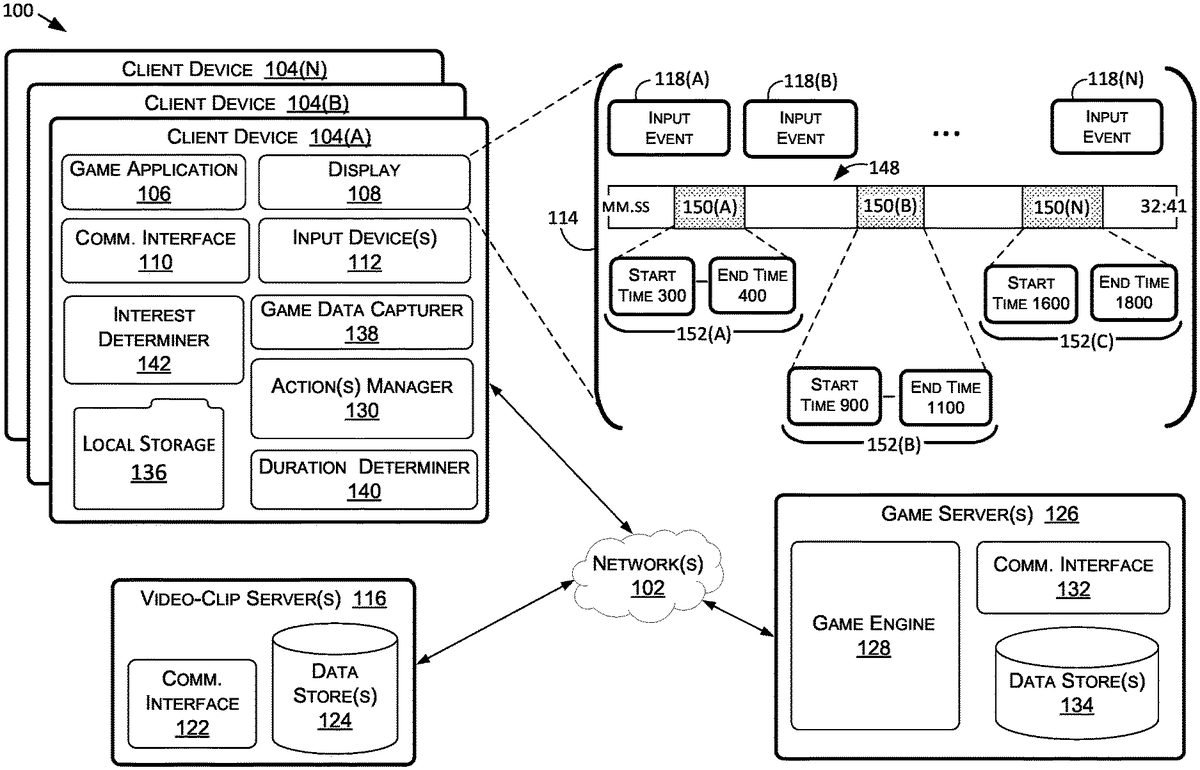
With reference toFIG. 1,FIG. 1is an example system diagram for determining high-interest durations of gameplay sessions from user inputs, in accordance with some embodiments of the present disclosure. It should be understood that this and other arrangements described herein are set forth only as examples. Other arrangements and elements (e.g., machines, interfaces, functions, orders, groupings of functions, etc.) may be used in addition to or instead of those shown, and some elements may be omitted altogether. Further, many of the elements described herein are functional entities that may be implemented as discrete or distributed components or in conjunction with other components, and in any suitable combination and location. Various functions described herein as being performed by entities may be carried out by hardware, firmware, software, or any combination thereof. For instance, various functions may be carried out by a processor executing instructions stored in memory.
The interest determining system100ofFIG. 1may include, one or more components instantiated using among other things, client devices104(A),104(B), and104(N) (referred to collectively herein as “client devices104”), a video-clip server(s)116, and/or a game server(s)126. Although the client devices104(A),104(B), and104(N) are illustrated inFIG. 1, this is not intended to be limiting. In any example, there may be any number of the client devices104. The interest determining system100(and the components and/or features thereof) may be implemented using one or more computing devices, such as the computing device900ofFIG. 9, described in more detail below.
Components of the interest determining system100may communicate over a network(s)102. The network(s)102may include a wide area network (WAN) (e.g., the Internet, a public switched telephone network (PSTN), etc.), a local area network (LAN) (e.g., Wi-Fi, ZigBee, Z-Wave, Bluetooth, Bluetooth Low Energy (BLE), Ethernet, etc.), a low-power wide-area network (LPWAN) (e.g., LoRaWAN, Sigfox, etc.), a global navigation satellite system (GNSS) network (e.g., the Global Positioning System (GPS)), and/or another network type. In any example, each of the components of the interest determining system100may communicate with one or more of the other components via one or more of the network(s)102.
The client devices104may include a smart phone, a laptop computer, a tablet computer, a desktop computer, a wearable device, a game console, a virtual reality system (e.g., a headset, a computer, a game console, remote(s), controller(s), and/or other components), a streaming device, (e.g., an NVIDIA SHIELD), a smart-home device that may include an intelligent personal assistant, and/or another type of device capable of supporting game play.
The client devices104may each include a game application106, a display108, a communication interface110, an input device(s)112, a local storage136, a game data capturer138, an actions manager130, a duration determiner140, and an interest determiner142. Although only a few components and/or features of the client device104are illustrated inFIG. 1, this is not intended to be limiting. For example, the client devices104may include additional and/or alternative components, such as those described below with respect to the computing device900ofFIG. 9.
The game application106may be a mobile application, a computer application, a console application, and/or another type of application. The game application106may include instructions that, when executed by a processor(s), cause the processor(s) to, without limitation, receive input data representative of user inputs to the one or more input device(s)112, transmit the input data to the game server(s)126, retrieve game data from memory or local storage, receive the game data using the communication interface110from the game server(s)126, and cause display of the game on the display108. In other words, the game application106may operate as a facilitator for enabling playing of a game associated with the game application on the client devices104. The game application106may also include instructions that, when executed by a processor(s), cause the processor(s) to transmit data to, and receive data from, the video-clip server(s)116. For example, the game application106may transmit to the video-clip server(s)116video recordings generated when games are played on the client devices104, and receive from the video-clip servers(s)116video clips that that are associated with identified durations of relatively high interest by interest determiner142.
The game application106and/or patches or updates to the game application106may be downloaded from the game server(s)126or may be downloaded from another server(s), such as a server of a content delivery network (CDN). For example, the game server(s)126may be located in a different country or on a different continent, so to reduce the download time, the game application106and/or the patches or updates may be stored on different servers around the globe. As such, when the client devices104are downloading the game application106and/or the patches or updates, the client devices104may connect to a more local server that is part of the CDN, for example.
In some examples, the client devices104may render the game using the game application106, while in other examples, the client devices104may receive display data (e.g., encoded display data, as described with respect toFIG. 8) and use the display data to display the game on the display108. In some examples, a first client device, such as client device104(A), may render the game while a second client device, such as client device104(B), may receive the display data and display the game using the display data. In examples where the display data is received by the client device (e.g., where the client device104does not generate the rendering), the interest determining system100may be part of a game streaming system, such as the game streaming system800ofFIG. 8, described in more detail below.
The client device104(A) may display, via the display108, a plurality of gameplay sessions over time, such as a gameplay session114. The gameplay sessions, such as the gameplay session114, may include any number of gameplay sessions participated in by users of the client device104(A). Similarly, users of each of the client devices104, in addition to the client device104(A), may participate in any number of gameplay sessions.
The display108may include any type of display capable of displaying a game (e.g., a light-emitting diode display (LED), an organic LED display (OLED), a liquid crystal display (LCD), an active matrix OLED display (AMOLED), a quantum dot display (QDD), a plasma display, an LED/LCD display, and/or another type of display). In some examples, the display108may include more than one display (e.g., a dual-monitor display for computer gaming, a first display for configuring a game and a virtual reality display for playing the game, etc.). In some examples, the display is a touch-screen display, such as a touch-screen of a smart phone, tablet computer, laptop computer, or the like, where the touch-screen is at least one of the input device(s)112of the client device104.
The input device(s)112may include any type of devices that are capable of providing user inputs associated with a game, such as user inputs to the game and/or used to control the game. The input device(s) may include a keyboard, a mouse, a microphone(s), a touch-screen display, a controller(s), a remote(s), a headset (e.g., sensors of a virtual reality headset), and/or other types of input devices.
The communication interface110may include one or more components and features for communicating across one or more networks, such as the network(s)102. The communication interface110may be configured to communicate via any number of network(s)102, described herein. For example, to communicate in the interest determining system100ofFIG. 1, the client devices104may use an Ethernet or Wi-Fi connection through a router to access the Internet in order to communicate with the video-clip server(s)116, the game server(s)126, and/or with others of the client devices104.
The local storage136may include any of a variety of computer-readable media. The computer-readable media may be any available media that can be accessed by the client device104(A). The computer-readable media may include both volatile and nonvolatile media, and removable and non-removable media. By way of example, and not limitation, the computer-readable media may comprise computer-storage media and communication media. The local storage136may include additional or alternative components, such as those described below with respect to the memory904ofFIG. 9.
Additional aspects will now be described, including operations that may be carried out in the course of rendering the gameplay session114and/or analyzing game-session data (e.g., user input data and/or video data associated with a gameplay session) generated as a result of playing the game during the gameplay session114. The gameplay session114may be associated with any number of input events118(A)-118(N) (referred collectively herein as “input events118” or “user input events118”), a timeline148, time segments150(A)-150(N) (referred collectively herein as “time segments150”), and durations152(A)-152(N) (referred collectively herein as “durations152”).
In accordance with embodiments of the disclosure, the duration determiner140may analyze the game-session data to identify one or more of the durations152(A)-152(N) of relatively high user activity during the gameplay session114. Additionally or alternatively, the interest determiner142may analyze the durations152(A)-152(N) to determine and/or predict whether an identified duration is of sufficient interest for further action based on corresponding game-session data.
The game application106and/or the game data capturer138may include instructions that, when executed, record or otherwise capture at least some of the game-session data (e.g., corresponding to the input events118and/or video frames of gameplay) from gameplay sessions114and store the recorded game-session data locally on the client device104(e.g., in local storage136) or transmit the recorded game-session data to the video-clip server116or the game server126to be stored in the data stores(s)124and/or134, respectively. Game-session data may include user input data associated with a gameplay session and/or video data associated with a gameplay session. In examples where the client device104does not generate the rendering of a game (such as the game streaming system800ofFIG. 8described in more herein), the game server(s)126might record and store the video data or transmit the video data to the video-clip server(s)116for storage in the data store(s)124.
The game data capturer138may be part of the game application106or may be part of a separate application (e.g., one or more system services, programs, etc.). The game data capturer138may be a component of the input device(s)112or may be executed by some other component of the client devices104. The game data capturer138may include instructions that, when executed by a processor(s), cause the processor(s) to (by example and without limitation) record or log game data, such as input-device usage data, video data, and/or other data associated with a gameplay session. Examples of input-device usage data includes user input data descriptive or representative of keyboard, mouse, or other input-device usage, such as user input events, and that is associated with one or more gameplay sessions, such as the gameplay session114. Examples of information that might be recorded include user input events, which may correspond to keyboard strokes, mouse clicks, mouse movement, microphone inputs, video-camera inputs, and/or inputs to the client devices104during the gameplay sessions. Examples of a user input event include a predefined input or combination of inputs that registers as a user input event (e.g., by an operating system of the client device104(A)), such as a key press (e.g., a key down or a key up), a gesture, a mouse movement, a game command, or a predefined combination and/or pattern of particular key and/or other inputs (which may collectively register as a single input event). For example, a user input event may be identified for each key press provided to an input device.
Examples of the input events for the gameplay session114include the input events118(A)-118(N), which may each be identified from corresponding input event data that is representative of an input event (also referred to as a “user input event”). For each input event, the game data capturer138may store metadata descriptive of or otherwise associated with the input event. As an example, the game data capturer138may store timestamp information (e.g., a timestamp) that correlates with timing information of the game-session data (e.g., along the timeline148). Another example of the metadata is a gameplay session identification information (e.g., a gameplay session identifier) that identifies the gameplay session in which the input event was received. A further example of the metadata is an application or game identification information (e.g., an application or game identifier) that identifies the game or application in which the input event was received. A further example is input identification information (e.g., one or more input identifiers) that identifies what input(s) was actuated to trigger the user input event (e.g., a key(s) pressed).
The timeline148is associated with the gameplay session114and indicates relative time designations at which each of the time segments150may be sequentially positioned. For illustrative purposes, the time segments150are depicted on the timeline148. Each time segment150may span a specific duration of time in the timeline148, and may define one or more corresponding durations152(A)-152(N). Each time segment150may be associated with one or more of the input events118(A)-118(N). For example, any number of the input events118(A)-118(N) may have a timestamp that falls within a corresponding time segment.
The duration determiner140may be configured to analyze user input data of gameplay sessions, such as input event data, to identify durations of relatively high user activity during the gameplay sessions. For example, the duration determiner140may analyze the input events118associated with the gameplay session114(and/or other game-session data) to determine the time segments150that define the corresponding durations152. This analysis may be performed on real-time game-session data during a gameplay session, or on non-real-time game-session data (e.g., in the local storage136), such as after completion of the gameplay session. The duration determiner140may be part of the game application106or may be part of a separate application (e.g., one or more system services, programs, etc.). In some examples, the duration determiner140is part of the same application as the game data capturer138. Further, like the game data capturer138, in some embodiments, the duration determiner140is at least partially on the video-clip server(s)116and/or the game server(s)126in addition to or instead of the client device104(A). To identify durations of relatively high user activity, the duration determiner140may determine durations of relatively higher levels (e.g., frequencies or concentrations) of user activity during a gameplay session based on the input events. For example, the duration determiner140may use the input events118of the gameplay session114to determine the time segments150during the gameplay session114that include higher levels of action relative to other time segments in the gameplay session114and these the time segments150may define the durations152of relatively high user activity. For example, the time segment150(A) within the gameplay session114may be identified by the duration determiner140as the duration152(A) of relatively high user activity based at least in part on the time segment150(A) having a relatively high value(s) of a user activity measurement for the time segment150(A), which may correspond to high Keys Per Second (KPSs), a high percentage of action-key selections per second, and/or other frequency based input-device metrics. In at least one embodiment, to determine durations of relatively high user activity, the duration determiner140computes the user activity measurement and compares the user activity measurement to a threshold value. The duration determiner140may compute the user activity measurement for a gameplay session (e.g., the gameplay session114) from the input events (e.g., the input events118) of the gameplay session. To do so, the duration determiner140may analyze the input events using metadata associated with the input events, such as the timestamp information. For example, the timestamp information may be used to compute the frequency at which the input events are generated, the speed at which inputs are actuated, and whether and/or how many action commands that are predefined for a game of the gameplay session were actuated. By way of example, an action command may refer to a predefined input actuation (e.g., an input event) such as a key or combination of input actuations (e.g., an input event(s)) such as keys for a game that when present results in an objective being met in the game (e.g., left mouse button click initiates weapon deployment or changes weapons, right mouse button click initiates shield deployment, left trigger initiates vehicle drifting, keys a and b together with a right trigger may initiates building a structure, etc.). Action commands may be predefined for a particular game and/or games. Thus, one game or application may have a different set of action commands than another game or application. The input identification information may also be used in embodiments where the frequency is based on predefined input events or types of input events being generated (e.g., predefined inputs and/or action commands).
The user activity measurement may be a running user activity measurement having values computed periodically (e.g., every second) or iteratively and/or may be computed as needed. The duration determiner140may define a time segment of a gameplay session based at least in part on a time(s) that the user activity measurement determines a value(s) of the user activity measurement exceeds the threshold value (e.g., the user activity measurement threshold256ofFIG. 2). For example, a start time of a duration may be (based on) a time at which the duration determiner140determines the user activity measurement has exceeded the threshold value such that it is greater than the threshold value. Additionally or alternatively, a time of a duration may be (based on) a time at which the duration determiner140determines the user activity measurement has exceeded the threshold value such that it is less than the threshold value.
In some examples, the time at which the user activity measurement exceeds the threshold value such that it is greater than the threshold value may be used as the start time of the time segment150(A). Additionally or alternatively, the time at which the user activity measurement exceeds the threshold value such that it is less than the threshold value may be used as the end time of the time segment150(A). In examples, a start time and/or an end time of a duration may be different than a time at which the duration determiner140determines the user activity measurement has exceeded the threshold value. For example, the duration determiner140may use the time to define the start time and may derive the end time from the start time (e.g., by adding a minute or other amount of time to the start time). Similarly, the duration determiner140may use the time to define the end time and derive the start time from the end time (e.g., by subtracting a minute or other amount of time from the end time). As further examples, the duration determiner140may use the time to define the start time and/or the end time as a duration of time that occurs before and/or after the identified time. For example, where the time corresponds to when the user activity measurement exceeds the threshold value, an amount of time may be added before and/or after that time to define the time segment.
In at least one embodiment, the threshold value may be hardcoded or may be computed. For example, the duration determiner140may compute a statistic from values of the user activity measurement over the gameplay session114and/or many gameplay sessions of the user and/or other users. The statistic may correspond to an average or percentile of the user activity measurement over at least a portion of a gameplay session(s). The statistic may be used as the threshold value or otherwise define the threshold value. The threshold value may be user-specific and based on user interactions with gameplay session and/or gameplay session specific based on the gameplay session being analyzed. In further embodiments, the determined statistic may be global and based on user interactions of other users in gameplay sessions of the game. Where the duration determiner140determines the threshold value during the gameplay session (e.g., in real-time) the statistic may be based on at least a portion of the gameplay session leading up to a current time (e.g., the time associated with the user activity measurement). Where the duration determiner140determines the threshold value after the gameplay session, the statistic may be based on at least any portion of the gameplay session before and/or after the time associated with the user activity measurement being compared to the threshold value. In any example, the statistic (and threshold value) may be updated based on the time being compared to the threshold value or the same statistic (or threshold value) may be used for each comparison.
In at least one embodiment, when identifying durations, the duration determiner140may distinguish between input events that correspond to gameplay activity and input events that correspond to non-gameplay activity. Input events that correspond to gameplay activity may include input events that control or effectuates gameplay within a gameplay session. An example of an input event that corresponds to gameplay activity is an action command. Further examples, include an input actuation or combination of input actuations that effectuate directional movement (e.g., steering, exploring, etc.), weapons deployment (e.g., firing a weapon, reloading a weapon, switching weapons, etc.), speed adjustments (e.g., running, walking, etc.), body positioning (e.g., standing, crouching, etc.), and the like.
In contrast, input events that correspond to non-gameplay activity may include input events that do not control or effectuate gameplay within a gameplay session. Examples of input events that correspond to non-gameplay activity may include input events that control or effectuate activity that accompanies or facilitates gameplay activity, such as communication between gamers (e.g., teammates, etc.) during a gameplay session, setting game options such as resolution, volume level, etc., navigating a menu to initiate gameplay, etc. For example, input events that correspond to non-gameplay activity may include those that initiate a communication mode between users and/or players (e.g., enables voice recordings, keyboard chat, etc.), define content of a communication (e.g., typing of a message), terminate the communication mode, and/or transmit the communication to at least one other user and/or player.
Various approaches may be used by the duration determiner140to identify input events that correspond to non-gameplay activity. In some examples, one or more input events may be predefined as non-gameplay activity commands (e.g., in the corresponding metadata) to indicate that corresponding non-gameplay activity. Non-gameplay activity commands may be game-specific and/or predefined for a particular game or games. In some examples, one or more non-gameplay activity commands may be predefined as initiation commands that initiate input events that correspond to non-gameplay activity and the duration determiner140may consider subsequent input events (e.g., of a particular type such as message defining or menu navigation input events) as non-gameplay activity (and/or perform further analysis to determine the input events correspond to non-gameplay activity based on identifying the command).
Also in some examples, one or more non-gameplay activity commands may be predefined as termination commands that terminate input events that correspond to non-gameplay activity and the duration determiner140may consider previous input events (e.g., of a particular type such as message defining or menu navigation input events) as non-gameplay activity (and/or perform further analysis to determine the input events correspond to non-gameplay activity based on identifying the command). For example, the duration determiner140may determine input events between an initiation command and a termination command correspond to non-gameplay activity. As indicated, one or more input events that correspond to gameplay activity may still be present between the commands (e.g., a user may use a mouse to control gameplay while typing a message on a keyboard), but the commands may identify particular types of input events as corresponding to non-gameplay activity.
In at least one embodiment, the duration determiner140may value (e.g., weight) input events that correspond to non-gameplay activity differently than (e.g., less than) input events that correspond to gameplay activity in computing the user activity measurement. As another example, the duration determiner140may discard input events that correspond to non-gameplay activity when computing the user activity measurement. These approaches may make it less likely that the duration determiner140identifies durations in which user activity is largely attributable to non-gameplay activity. In some embodiments, once the duration determiner140identifies a duration of relatively high user activity, the duration determiner140can compare the duration to a configurable minimum and/or maximum length duration threshold to determine whether to discard the duration or maintain the duration for additional analysis by, for example, the interest determiner142. For example, the duration determiner140may discard an identified duration of relatively high user activity if the duration falls below the minimum length duration (e.g., 10 seconds or less). Similarly, the duration determiner140may discard or truncate the identified duration of relatively high user activity if the duration exceeds the maximum length duration (e.g., greater than one minute).
In embodiments, the minimum and maximum length durations may be hardcoded or configurable, or may be dynamic and automatically determined by the duration determiner140. Also, in some examples, the duration determiner140may merge a duration with at least one other duration based on determining one or more of those durations fall below the minimum length duration. Another factor the duration determiner140may use to merge durations is the proximity of the durations in the gameplay session. For example, durations may be merged into a single duration based on the duration determiner140determining the durations are within a threshold proximity of one another. The duration determiner140may also add time to a duration (merged or otherwise) to reach at least the minimum length duration and/or truncate a duration (merged or otherwise) to stay under at least the maximum length duration.
The interest determiner142may be configured to determine and/or predict whether an identified duration (e.g., identified by the duration determiner140) within a gameplay session is of sufficient interest for further action based on user input events generated by user inputs to one or more input devices during a gameplay session. As with the duration determiner140, the interest determiner142may be part of the game application106or may be part of a separate application (e.g., one or more system services, programs, etc.). In some examples, interest determiner142is part of the same application as the game data capturer138. Further, the interest determiner142may at least partially be instantiated or otherwise executed on the video-clip server(s)116and/or the game server(s)126in addition to or instead of being instantiated or otherwise executed on the client device104(A).
To determine whether a duration is of sufficient interest for further action, the interest determiner142may compute a user interest score. The user interest score for a duration may be based on a set of the user input events of a gameplay session that occur during the identified duration. For example, for the duration152(A), the user interest score may be computed from the input events118that have a timestamp within the duration152(A) and/or the time segment150(A) (e.g., between the start time and end time of the duration). The interest determiner142may compute the user interest score based on various factors, such as a number of the user input events that occur in the duration, one or more action commands that are entered during the duration, a length of the duration, a number or presence of input events that correspond to non-gameplay activity during the duration, and/or an actuation speed of the one or more input devices during the duration.
In at least one embodiment, the interest determiner142may value (e.g., weight) within a duration input events that correspond to non-gameplay activity differently than (e.g., less than) input events that correspond to gameplay activity in computing the user interest score for the duration. As another example, the interest determiner142may discard input events that correspond to non-gameplay activity when computing the user interest score or otherwise account for the presence and/or amount of those input events.
In operation, the duration determiner140identifies a duration to have relatively high user activity. Once a duration is identified, the interest determiner142may determine whether the identified duration is of sufficient interest based at least in part on calculating the user interest score for the identified duration by applying an interest-level algorithm to user input data associated with the identified duration. An example of such an algorithm is a High Energy Area Technique (“HEAT”) algorithm, which can be expressed with the following equation (1):
HEAT=log(k*(Afactor*D)2*Kc*Smax) (1)
where,Afactor=High constant (e.g., greater than 1), if an action command is present in the duration and is otherwise=1,L=A length of the duration,Kc=# of keys and/or input events in the duration,Smax=Max speed of actuation among keys and/or input events in the duration, andk=a constant.
Any of the above examples of factors for an interest-level algorithm may be used without the others and/or in a different formula or equation. In some examples, rather than being set to a high constant when an action command is present, the Afactormay be based on (e.g., increase based on) the number of action commands in the duration. A user interest score may be computed for each duration that is specific to the duration. Based on the user interest scores (e.g., values of HEAT) for each identified duration, the interest determiner142may determine or predict which of those durations, if any, correlate with potentially high interest. For example, using the user interest scores, the interest determiner142may compare a threshold value to each user interest score to determine whether a duration(s) is of sufficiently high interest (e.g., is greater than the threshold value) to perform some further action, such as to present to a user. In some embodiments, the threshold value is a statistical value computed from the user interest scores of the identified durations of the gameplay session. In further examples, the statistical value may additionally or instead be computed from user interest scores of durations from one or more other gameplay session of the user, other users, and/or the same game.
As an example, the statistical value may correspond to a Median Absolute Deviation (MAD) score that is computed from the user interest scores. In any example, the statistical value may correspond to a minimum user interest score required for an identified duration to be determined or predicted to be of high interest. In operation, the interest determiner142may compare each user interest score of a duration to the determined statistical value to determine whether the further action is warranted for the duration. If the user interest score for an identified duration exceeds the statistical value, the identified duration may be deemed a duration of high interest and a corresponding action may be performed. Similarly, if the user interest score for an identified duration falls below the statistical value, the identified duration may be discarded as lacking sufficient predicted interest and/or a different corresponding action may be performed (or no duration action regarding the duration). MAD is one example of a statistical value which may be computed, but other statistics may be used, such as a standard deviation, an average, etc. In various examples, the statistical value may correspond to a robust statistic, such as a robust measure of statistical dispersion of the user interest scores (e.g., MAD).
In addition to or instead of using the statistical value to predict or determine whether a duration is of sufficiently high interest, the interest determiner142may user other factors, such as whether the duration includes at least one action command and/or whether the user interest score is greater than a baseline threshold value. For example, the interest determiner142may determine a duration is of sufficiently high predicted interest when its user interest score exceeds the statistical value. However, when the user interest score does not exceed the statistical value, the interest determiner142may still determine the duration is of sufficiently high interest based on the other factors.
The action(s) manager130may be configured to enable the various actions that may be performed during or after a gameplay session based on the interest determiner142determining and/or predicting a duration is of sufficiently higher interest for further action. For example, the action manager130may enable or cause presentation of an indication of the duration on a display, such as the display108, as further described with respect toFIG. 3. In some embodiments, the indications include one or more buttons or other graphical user interface elements. When, actuated (e.g., by a user), the graphical user interface element(s) may initiate functions and operations to enable the user to perform various tasks relating to an identified duration. Examples include saving a video-clip corresponding to the duration (e.g., to the local storage136) and/or sharing the video-clip (e.g., via social media). As further examples, an indication of a duration may include a notification, which may be presented on the client device104(A). Examples include visual and/or audio content to notify the user of various actions that s/he can take during the gameplay session. These are just some non-limiting examples of the indications which may be presented for a duration(s).
The video-clip server(s)116may include one or more servers for storing, trimming, sharing, or otherwise editing video-clips associated with identified durations of relatively high interest recorded during gameplay session114. Although only a few components and/or features of the video-clip server(s)116are illustrated inFIG. 1, this is not intended to be limiting. For example, the video-clip server(s)116may include additional or alternative components, such as those described below with respect to the computing device900ofFIG. 9.
The video-clip server(s)116may be separate or distinct from the game server(s)126; however, this is not intended to be limiting. Further, the video-clip server(s)116may not be included in some embodiments of the interest determining system100, but may be used to facilitate one or more of the actions performed by the action manager130. In some examples, the video-clip server(s)116may be implemented as the same or similar servers to the game server(s)126(e.g., running as a task on the game server(s)126). In some examples, the video-clip server(s)116may be operated or hosted by a first entity (e.g., a first company) and the game server(s)126may be operated or hosted by a second entity (e.g., a second, different company). In such examples, the second entity may be a game developer or publisher, and the first entity and the second entity may share data such that the first entity can identify interesting video clips that correspond to the identified durations using data received from the second entity and/or the client device104(A). In other examples, the video-clip server(s)116and the game server(s)126may be operated or hosted by the same entity. In further examples, the interest determining system100may be implemented completely on a client device104and/or one or more of the components and/or functionality thereof shown as being included in a server may be at least partially implemented on the client device104.
The video-clip server(s)116may include a communications interface122and a data store(s)124. As described herein, one or more video clips may be generated based on the durations of gameplay sessions, which may be identified and/or selected using the duration determiner140and/or the interest determiner142. The video-clip server(s)116may receive the video clips based on the identified durations from the game server(s)126or the client device(s)104. As another example, the video-clip server(s)116may receive the video clip timestamp data generated by the interest determiner140and generate the video clips from game-session data (e.g., video data) stored in a data store, such as the data store(s)124, based on the identified durations of relatively high interest.
The communication interface122may include one or more components and features for communicating across one or more networks, such as the network(s)102. The communication interface122may be configured to communicate via any number of network(s)102, described herein. For example, to communicate in the interest determining system100ofFIG. 1, the video-clip server(s)116may communicate over a LAN and/or the Internet with other video-clip server(s), the game server(s)126, and/or the client devices104. The video-clip server(s)116may exchange various information with the game server(s)126and/or the client device(s)104, including video clips, information representative of an identified duration of high interest, and an indication of whether a video clip was shared or stored by a user or a duration was selected by a use for sharing, storage, or another action.
The game server(s)126may include one or more servers (e.g., dedicated game servers) for storing, hosting, managing, and, in some examples, rendering a game. In some examples, first game server(s)126may be used to create, update, and modify a game (e.g., the program code of the game), and second game server(s)126may be used to host the game (e.g., as dedicated game servers). Although only a few components and/or features of the game server(s)126are illustrated inFIG. 1, this is not intended to be limiting. For example, the game server(s)126may include additional or alternative components, such as those described below with respect to the computing device900ofFIG. 9.
The game server(s)126may include one or more APIs to enable game play by the client device(s)104and/or to enable communication of information (e.g., user input data, etc.) with the video-clip server(s)116. For example, the game server(s)126may include one or more game APIs that interface with the game applications106of the client devices104to enable game play by the client devices104. As another example, the game server(s)126may include one or more gameplay session APIs that interface with the duration determiner140to pass data representative of durations of relatively high user activity to the interest determiner142for further analysis. As a further example, the game server(s)126may include one or more APIs that interface with the duration determiner140to receive the identified durations of relatively high user activity to determine whether each is a duration of sufficiently high interest for further action. Although different APIs are described herein, the APIs may be part of a single API, two or more of the APIs may be combined, different APIs may be included other than those described as examples herein, or a combination thereof.
The game server(s)126may include the game engine128. The game engine128may include the functionality of a game that enables a game to be played by one or more users over a network, such as network(s)102. For example, the gameplay session114may be played using the game engine128. The game engine128may include a rendering engine, an audio engine, a physics engine, an animation engine, an artificial intelligence engine, a networking engine, a streaming engine, a memory management engine, and/or other components or features. The game engine128may be used to generate some or all of the user input data during a gameplay session.
The communication interface132of the game server(s)126may include one or more components and features for communicating across one or more networks, such as the network(s)102. The communication interface132may be configured to communicate via any number of network(s)102, described herein. For example, to communicate in the interest determining system100ofFIG. 1, the game server(s)126may communicate over a LAN with other game server(s) and/or over the Internet with other game server(s)126, video-clip server(s)116, and/or the client devices104.
Referring now toFIG. 2,FIG. 2is an example graphical representation illustrating potential high-interest durations of gameplay sessions from user inputs, in accordance with some embodiments of the present disclosure.FIG. 2includes a graph200, on which the x-axis represents time (in seconds), while the y-axis represents a value of a user activity measurement, as described herein. The graph200shows an example of a user activity measurement threshold256, which the duration determiner140may use to identify a duration of relatively higher user activity. The user activity measurement threshold256may in some embodiments indicate or define a minimum level of the user activity measurement that must be reached for a duration of high user activity to be identified.
FIG. 2graphically indicates time segments254(A)-254(E) along with values of the user activity measurement at given times (T) during a gameplay session (e.g., the gameplay session114). The duration determiner140may sample the values of the user activity measurement at any suitable time and/or interval(s) to determine the time segments254(A)-254(E) and identify corresponding durations of relatively high user activity. The time segment254(A) may be defined by times T2and T3at which the values are greater than the user activity measurement threshold256. Also, the time segment254(A) may be defined by times T4and T5at which the values are greater than the user activity measurement threshold256. The duration determiner140may determine a duration corresponding to the time segment254(A) and a duration corresponding to the time segment254(B) using any suitable approach described herein. In some examples, the time T2may be a start time of the duration corresponding to the time segment254(A) and the time T3may be an end time of the duration corresponding to the time segment254(A). The other times labeled inFIG. 2may similarly indicate start and end times of corresponding durations and/or time segments.
As described herein, in some embodiments, the duration determiner140may determine that the duration corresponding to the time segment254(A) is less than a minimum length duration (e.g., defined by the time T3minus the time T2). In such an example, the duration determiner140may merge the duration corresponding to the time segment254(A) with the duration corresponding to the time segment254(B). The merged duration may correspond to the time segment260ofFIG. 2and have a start time corresponding to the time T2of the time segment254(A) and an end time corresponding to the time T5of the time segment254(B). In some embodiments, the durations may be merged based on a proximity durations. For example, the proximity may correspond to a difference between the time T3of the time segment254(A) and the time T4of the time segment254(B). Where the difference is below a threshold value, the duration determiner140may merge the durations.
For example, a user may be playing a real-time strategy game in which the user is in the middle of a skirmish with an opponent. When the user is actively participating in the skirmish, the user activity measurement may be high. Should the user briefly retreat and wait for the opponent to pursue, however, the user activity measurement level might drop below the user activity measurement threshold256, as shown. Subsequently, the opponent may pursue the user and the user may reengage the opponent resulting in a spike in the user activity measurement above the user activity measurement threshold256, as shown. In this scenario, the duration determiner140may merge the durations together resulting a composite duration of relatively high user activity.
The duration determiner140may also determine a duration corresponding to the time segment254(C) having a start time corresponding to time T7and/or an end time corresponding to time T12. Further, the duration determiner140may determine a duration corresponding to the time segment254(D) having a start time corresponding to time Tip and/or an end time corresponding to time T20. As a further example, the duration determiner140may determine a duration corresponding to the time segment254(E) having a start time corresponding to time T23and/or an end time corresponding to time T25.
In the examples described with respect toFIG. 2, the duration determiner140may identify four durations of relatively higher user activity in a corresponding game session. Those durations may correspond to the time segments260,254(C),254(D), and254(E). The interest determiner142may then compute a user interest score for each of the durations using approaches described herein (e.g., using HEAT). For example, the user interest score for the duration corresponding to the time segment260may be computed from the input events that occurred between the time T2and the time T5. Further, the interest determiner142may compute the statistical value from the four user interest scores (e.g., a MAD score). The interest determiner142may determine that the user interest scores for each of the durations corresponding to the time segments260,254(C), and254(E) are greater than (or equal to) the statistical value, and therefore of sufficient interest for further action by the action manager130. The interest determiner142may also determine that the user interest score for the duration corresponding to the time segment254(D) is less than the statistical value, and therefore may take no action on duration or provide a corresponding indicator to the action manager130, such that a different action may be taken for that duration.
With reference toFIG. 3,FIG. 3is an example of a user interface that may be used to present an indication of a duration of a gameplay session. As described herein, the indication may be presented based at least in part on the user interest score for the duration exceeding the threshold value. The user interface is shown as being presented during a gameplay session, but could be presented at any suitable time and may or may not be part of the game and/or an application used to present the game. The indication shown includes graphical user interface elements that correspond to a duration(s).
As an example, a menu302is shown that displays graphical user interface elements as the indicators, such as buttons304(A) and304(B). When actuated (e.g., by a user), the buttons304(A) and304(B) initiate corresponding functions and operations to enable the action manager130to perform various tasks relating to an identified duration of relatively high user activity within the gameplay session. For example, as a user (e.g., gamer) plays a game, user input data may be captured by the game data capturer138and used to identify durations of relatively high user activity, as described herein. Of the durations, the interest determiner142may determine a duration is of sufficiently high interest to present an indication of the duration. As a result, one or more of the buttons304(A) and304(B) may be populated on the display108to enable saving the identified duration(s) as a video clip(s) and/or sharing the identified duration(s) as a video clip(s). As such, upon actuation of the button304(A) or304(B), the identified duration of relatively high user activity within the gameplay session may be saved and/or shared.
The menu302ofFIG. 3also includes a notification304(C) as another example of a potential indication of a duration. The notification304(C) may notify a user of various actions that the user can take during the gameplay session. For example, if a user is attempting to complete a puzzle-based mission, but continually fails, the interest determining system100may recognize the user's inability to complete the puzzle based on a corresponding duration selected by the interest determiner142. The notification304(C) may be used to indicate to the user one or more user inputs to provide to advance or otherwise assist in the game.
The indications and notifications ofFIG. 3are merely examples of indications of durations that may be presented during or after a gameplay session. As described herein, and by way of non-limiting example, other indications may include a highlight reel or game summarization (e.g., video clips corresponding to the durations) presented during or after a gameplay session, as well as any other indication operable to save, edit, and/or share a video clip that corresponds to an identified duration (e.g., in a video editor application). In some embodiments, the interest determining system100may generate data representative of the highlight reel from the video clips (e.g., video frames extracted from video data of the gameplay session and/or timestamps of the video frames that correspond to the video clips) that correspond the durations and that are identified from video data of a gameplay session. For example, the video-clip server(s)116, the game server(s)126(e.g., the game engine128) and/or the client device104(A) (e.g., the game application106) may generate data representative of the highlight reel. In at least one embodiment the data includes identifiers (e.g., metadata) of locations of the video clips within a video that includes each of the video clips and optionally video clips of intervening portions of the gameplay session. Additionally or alternatively, in at least one embodiment the data includes video data, such as a concatenated sequence of the video clips, which may or may not include intervening video clips.
In some embodiments, the indications may be presented that enable the user to initiate the action manager130to take additional actions, including performing further analysis on the duration, such as by applying image and/or video data of game-session data that corresponds to the duration to an object detection model or other machine learning model (e.g., deep learning and/or convolutional neural network models). For example, the object detection model may be used to identify one or more objects in a scene, and based on the one or more objects, the action manager130may present content to the user during or after the gameplay session. The content may include, for example, presenting recommendations that are based on the object(s) such as button(s) to press or other user inputs to provide for a given situation. The notification304(C) ofFIG. 3may be one such example of a recommendation. In further situations, a duration of high interest may be indicated to a user (e.g., as a recommendation) to assist the user in generating and/or selecting ground truth data (e.g., corresponding to the duration) to train a machine learning model.
Now referring toFIGS. 4 through 6, each block of methods400through600and other methods described herein comprise a computing process that may be performed using any combination of hardware, firmware, and/or software. For instance, various functions may be carried out by a processor executing instructions stored in memory. The methods may also be embodied as computer-usable instructions stored on computer storage media. The methods may be provided by a standalone application, a service or hosted service (standalone or in combination with another hosted service), or a plug-in to another product, to name a few. In addition, methods400through600are described, by way of example, with respect to the interest determining system100ofFIG. 1. However, these methods may additionally or alternatively be executed by any one system, or any combination of systems, including, but not limited to, those described herein.
FIG. 4is a flow diagram showing a method400for determining a high-interest duration of a gameplay session from user input data based on a value of a user activity measurement, in accordance with some embodiments of the present disclosure. The method400, at block B402, includes determining a value of a user activity measurement of a gameplay session based on user input events. For example, the duration determiner140may determine, from user input data of the gameplay session114, a value of a user activity measurement of the gameplay session114based on the user input events118generated by user inputs to input devices during the gameplay session114.
At block B404, the method400includes identifying a duration within the gameplay session based on the value of the user activity measurement. For example, the duration determiner140may identify a start and/or end time of the duration based on the value of the user activity measurement exceeding a threshold value.
At block B406, the method400includes computing a user interest score for the duration based on a set of the user input events that occur in the duration. For example, the interest determiner142may compute a user interest score for the duration based on a set of the user input events118that occur in the duration. The user interest score may be computed using an interest-level algorithm, such as HEAT.
At block B408, the method400includes determining the user interest score exceeds a threshold value. For example, the interest determiner142may determine the user interest score of the duration is greater than a MAD value or other statistical value computed from other durations of the gameplay session that are identified by the duration determiner140.
At block B410, the method400includes based on the user interest score exceeding the threshold value, presenting an indication of the duration. For example, the action manager130may cause presentation of an indication of the duration on the client device104(A) (e.g., as inFIG. 3).
Now referring toFIG. 5,FIG. 5is a flow diagram showing a method500for monitoring a user activity measurement to determine high-interest durations of gameplay sessions from user input data, in accordance with some embodiments of the present disclosure. The method500, at block B502, includes monitoring a user activity measurement over a period of time during a gameplay session. For example, the duration determiner140may monitor a user activity measurement of the gameplay session114over a period of time of the gameplay session114. The user activity measurement may correspond to a frequency of the user input events118generated by user inputs to one or more input devices during the gameplay session114. The monitoring may occur, for example, in real-time and/or during the gameplay session114. For example, the duration determiner140may compute the user activity measurement periodically or at some interval or other trigger.
At block B504, the method500includes based on the monitoring, determining whether the user activity measurement exceeds a threshold value. For example, the duration determiner140may determine the user activity measurement has transitioned from being less than the user activity measurement threshold256to being greater than the user activity measurement threshold256ofFIG. 2or has transitioned from being greater than the user activity measurement threshold256to being less than the user activity measurement threshold256ofFIG. 2.
At block B506, the method500includes based on the user activity measurement exceeding the threshold value, determining a duration of high user activity. For example, the duration determiner149may determine a time segment based on a time at which the user activity measurement exceeds the threshold value to determine a corresponding duration of high user activity.
At bock B508, the method500includes computing a user interest score based on a set of the user input events that occur in the duration. For example, the interest determiner142may compute the user interest score for the duration based on a set of the user input events118that occur within the duration.
At block B510, the method500includes presenting an indication of the duration based on the user interest score. For example, the action manager130may cause presentation of the indication on the client device104(A).
FIG. 6is a flow diagram showing a method600for determining a user interest score for a duration of relatively high user activity in a gameplay session from user input data, in accordance with some embodiments of the present disclosure. The method600, at block B602, includes determining a duration of relatively high user activity within a gameplay session based on user input events. For example, the duration determiner140may determine, from user input data of the gameplay session114, a duration of relatively high user activity within the gameplay session114based on the user input events118generated by user inputs to input devices during the gameplay session114.
At block B604, the method600includes computing a user interest store based on user input events that occur in the duration. For example, the interest determiner142may compute a user interest store for the duration based on a number of the user input events118that occur in the duration of relatively high user activity and/or other factors associated the duration and/or with the user input events that are in the duration.
At block B606, the method600includes presenting an indication of the duration of relatively high user activity based on the user interest score. For examples, the action manager130may cause presentation on the client device104(A) an indication of the duration of relatively high user activity based on the user interest score.
Now referring toFIG. 7,FIG. 7is a flow diagram showing a method700for generating data representative of a highlight reel based on durations of relatively high user activity in a gameplay session, in accordance with some embodiments of the present disclosure. At block702, the method700includes determining durations of relatively high user activity. For examples, the duration determiner140may determine durations of relatively higher user activity in the gameplay session114based on the input events118.
At block704, the method700includes computing user interest scores for the durations. For example, the interest determiner142may determiner user interest scores for the durations based on sets of the user input events118that occur in the durations.
At block706, the method700includes selecting one or more of the durations based on the user interest scores. For example, the interest determiner142may select one or more of the durations based on comparing the user interest scores to a threshold value (e.g., a statistical value).
At block708, the method700includes identifying one or more video clips that correspond to the selected one or more durations. For example, the video clip server(s)116, the game application106, the game engine128and/or the action manager130may identify one or more video clips that correspond to the selected one or more durations.
At block710, the method700includes generating data representative of a highlight reel. For example, the game application106, the game engine128and/or the action manager130may generate data representative of a highlight reel. The game application106, the game engine128and/or the action manager130may also present the highlight reel, cause presentation of the highlight reel, and/or enable and facilitate or effectuate the user saving and/or sharing the highlight reel.
Now referring toFIG. 8,FIG. 8is an example system diagram for a game streaming system800, in accordance with some embodiments of the present disclosure.FIG. 8includes game server(s)802(which may include similar components, features, and/or functionality to the game server(s)126ofFIG. 1and/or the computing device600ofFIG. 6), client device(s)804(which may include similar components, features, and/or functionality to the client devices104ofFIG. 1and/or the computing device900ofFIG. 9), and network(s)806(which may be similar to the network(s)102ofFIG. 1).
In at least one embodiment, the game server(s)802may host a cloud computing platform used by the client device(s)804. For example, the gameplay sessions of a game(s) presented using the game application106of the client device104(A) may be facilitated by the cloud computing platform. In various embodiments, the cloud computing platform may generate the rendering of the gameplay session (e.g., the video data thereof) that may be presented on the display108. The cloud computing platform may, for example, by dynamically provisions and may provide wholly and/or partially virtualized computing environments. As an example, the cloud computing platform may run each game hosted on the cloud computing platform on one or more virtual machines.
In the system800, for a gameplay session, the client device(s)804may only receive input data in response to inputs to the input device(s), transmit the input data to the game server(s)802, receive encoded display data from the game server(s)802, and display the display data on the display824. As such, the more computationally intense computing and processing is offloaded to the game server(s)802(e.g., rendering of the gameplay session is executed by the GPU(s) of the game server(s)802). In other words, the gameplay session is streamed to the client device(s)804from the game server(s)802, thereby reducing the requirements of the client device(s)804for graphics processing and rendering.
For example, with respect to an instantiation of a gameplay session, a client device804may be displaying a frame of the gameplay session on the display824based on receiving the display data from the game server(s)802. The client device804may receive an input to one of the input device(s) and generate input data in response. The client device804may transmit the input data to the game server(s)802via the communication interface820and over the network(s)806(e.g., the Internet), and the game server(s)802may receive the input data via the communication interface818. The CPU(s) may receive the input data, process the input data, and transmit data to the GPU(s) that causes the GPU(s) to generate a rendering of the gameplay session. For example, the input data may be representative of a movement of a character of the user in a game, firing a weapon, reloading, passing a ball, turning a vehicle, etc. The rendering component812may render the gameplay session (e.g., representative of the result of the input data) and the render capture component814may capture the rendering of the gameplay session as display data (e.g., as image data capturing the rendered frame of the gameplay session). The encoder816may then encode the display data to generate encoded display data and the encoded display data may be transmitted to the client device804over the network(s)806via the communication interface818. The client device804may receive the encoded display data via the communication interface820and the decoder822may decode the encoded display data to generate the display data. The client device804may then display the display data via the display824.
Further, at least a portion of the game data capturer138ofFIG. 1may reside on a client device804and may be used to provide the input data and/or input event data to the game server(s)802. The CPU(s)808may receive the input data, process the input data, and/or use the duration determiner140and/or the interested determiner142to identify durations and predict interesting durations. In at least one embodiment, the client device804may process the input data, and/or use the duration determiner140and/or the interested determiner142to identify durations and predict interesting durations.
FIG. 9is a block diagram of an example computing device900suitable for use in implementing some embodiments of the present disclosure. Computing device900may include a bus902that directly or indirectly couples the following devices: memory904, one or more central processing units (CPUs)906, one or more graphics processing units (GPUs)908, a communication interface910, input/output (I/O) ports912, input/output components914, a power supply916, and one or more presentation components918(e.g., display(s)).
Although the various blocks ofFIG. 9are shown as connected via the bus902with lines, this is not intended to be limiting and is for clarity only. For example, in some embodiments, a presentation component918, such as a display device, may be considered an I/O component914(e.g., if the display is a touch screen). As another example, the CPUs906and/or GPUs908may include memory (e.g., the memory904may be representative of a storage device in addition to the memory of the GPUs908, the CPUs906, and/or other components). In other words, the computing device ofFIG. 9is merely illustrative. Distinction is not made between such categories as “workstation,” “server,” “laptop,” “desktop,” “tablet,” “client device,” “mobile device,” “hand-held device,” “game console,” “electronic control unit (ECU),” “virtual reality system,” and/or other device or system types, as all are contemplated within the scope of the computing device ofFIG. 9.
The bus902may represent one or more busses, such as an address bus, a data bus, a control bus, or a combination thereof. The bus902may include one or more bus types, such as an industry standard architecture (ISA) bus, an extended industry standard architecture (EISA) bus, a video electronics standards association (VESA) bus, a peripheral component interconnect (PCI) bus, a peripheral component interconnect express (PCIe) bus, and/or another type of bus.
The memory904may include any of a variety of computer-readable media. The computer-readable media may be any available media that may be accessed by the computing device900. The computer-readable media may include both volatile and nonvolatile media, and removable and non-removable media. By way of example, and not limitation, the computer-readable media may comprise computer-storage media and communication media.
The computer-storage media may include both volatile and nonvolatile media and/or removable and non-removable media implemented in any method or technology for storage of information such as computer-readable instructions, data structures, program modules, and/or other data types. For example, the memory904may store computer-readable instructions (e.g., that represent a program(s) and/or a program element(s), such as an operating system. Computer-storage media may include, but is not limited to, RAM, ROM, EEPROM, flash memory or other memory technology, CD-ROM, digital versatile disks (DVD) or other optical disk storage, magnetic cassettes, magnetic tape, magnetic disk storage or other magnetic storage devices, or any other medium which may be used to store the desired information and which may be accessed by computing device900. As used herein, computer storage media does not comprise signals per se.
The communication media may embody computer-readable instructions, data structures, program modules, and/or other data types in a modulated data signal such as a carrier wave or other transport mechanism and includes any information delivery media. The term “modulated data signal” may refer to a signal that has one or more of its characteristics set or changed in such a manner as to encode information in the signal. By way of example, and not limitation, the communication media may include wired media such as a wired network or direct-wired connection, and wireless media such as acoustic, RF, infrared and other wireless media. Combinations of any of the above should also be included within the scope of computer-readable media.
The CPU(s)906may be configured to execute the computer-readable instructions to control one or more components of the computing device900to perform one or more of the methods and/or processes described herein. The CPU(s)906may each include one or more cores (e.g., one, two, four, eight, twenty-eight, seventy-two, etc.) that are capable of handling a multitude of software threads simultaneously. The CPU(s)906may include any type of processor, and may include different types of processors depending on the type of computing device900implemented (e.g., processors with fewer cores for mobile devices and processors with more cores for servers). For example, depending on the type of computing device900, the processor may be an ARM processor implemented using Reduced Instruction Set Computing (RISC) or an x86 processor implemented using Complex Instruction Set Computing (CISC). The computing device900may include one or more CPUs906in addition to one or more microprocessors or supplementary co-processors, such as math co-processors.
The GPU(s)908may be used by the computing device900to render graphics (e.g., 3D graphics). The GPU(s)908may include hundreds or thousands of cores that are capable of handling hundreds or thousands of software threads simultaneously. The GPU(s)908may generate pixel data for output images in response to rendering commands (e.g., rendering commands from the CPU(s)906received via a host interface). The GPU(s)908may include graphics memory, such as display memory, for storing pixel data. The display memory may be included as part of the memory904. The GPU(s)808may include two or more GPUs operating in parallel (e.g., via a link). When combined together, each GPU908may generate pixel data for different portions of an output image or for different output images (e.g., a first GPU for a first image and a second GPU for a second image). Each GPU may include its own memory, or may share memory with other GPUs.
In examples where the computing device900does not include the GPU(s)908, the CPU(s)906may be used to render graphics.
The communication interface910may include one or more receivers, transmitters, and/or transceivers that enable the computing device800to communicate with other computing devices via an electronic communication network, included wired and/or wireless communications. The communication interface910may include components and functionality to enable communication over any of a number of different networks, such as wireless networks (e.g., Wi-Fi, Z-Wave, Bluetooth, Bluetooth LE, ZigBee, etc.), wired networks (e.g., communicating over Ethernet), low-power wide-area networks (e.g., LoRaWAN, SigFox, etc.), and/or the Internet.
The I/O ports912may enable the computing device900to be logically coupled to other devices including the I/O components914, the presentation component(s)918, and/or other components, some of which may be built in to (e.g., integrated in) the computing device900. Illustrative I/O components914include a microphone, mouse, keyboard, joystick, game pad, game controller, satellite dish, scanner, printer, wireless device, etc. The I/O components914may provide a natural user interface (NUI) that processes air gestures, voice, or other physiological inputs generated by a user. In some instances, inputs may be transmitted to an appropriate network element for further processing. An NUI may implement any combination of speech recognition, stylus recognition, facial recognition, biometric recognition, gesture recognition both on screen and adjacent to the screen, air gestures, head and eye tracking, and touch recognition (as described in more detail below) associated with a display of the computing device900. The computing device900may be include depth cameras, such as stereoscopic camera systems, infrared camera systems, RGB camera systems, touchscreen technology, and combinations of these, for gesture detection and recognition. Additionally, the computing device900may include accelerometers or gyroscopes (e.g., as part of an inertia measurement unit (IMU)) that enable detection of motion. In some examples, the output of the accelerometers or gyroscopes may be used by the computing device900to render immersive augmented reality or virtual reality.
The power supply916may include a hard-wired power supply, a battery power supply, or a combination thereof. The power supply916may provide power to the computing device900to enable the components of the computing device900to operate.
The presentation component(s)918may include a display (e.g., a monitor, a touch screen, a television screen, a heads-up-display (HUD), other display types, or a combination thereof), speakers, and/or other presentation components. The presentation component(s)918may receive data from other components (e.g., the GPU(s)908, the CPU(s)906, etc.), and output the data (e.g., as an image, video, sound, etc.).
The disclosure may be described in the general context of computer code or machine-useable instructions, including computer-executable instructions such as program modules, being executed by a computer or other machine, such as a personal data assistant or other handheld device. Generally, program modules including routines, programs, objects, components, data structures, etc., refer to code that perform particular tasks or implement particular abstract data types. The disclosure may be practiced in a variety of system configurations, including hand-held devices, consumer electronics, general-purpose computers, more specialty computing devices, etc. The disclosure may also be practiced in distributed computing environments where tasks are performed by remote-processing devices that are linked through a communications network.
As used herein, a recitation of “and/or” with respect to two or more elements should be interpreted to mean only one element, or a combination of elements. For example, “element A, element B, and/or element C” may include only element A, only element B, only element C, element A and element B, element A and element C, element B and element C, or elements A, B, and C. In addition, “at least one of element A or element B” may include at least one of element A, at least one of element B, or at least one of element A and at least one of element B. Further, “at least one of element A and element B” may include at least one of element A, at least one of element B, or at least one of element A and at least one of element B.
The subject matter of the present disclosure is described with specificity herein to meet statutory requirements. However, the description itself is not intended to limit the scope of this disclosure. Rather, the inventors have contemplated that the claimed subject matter might also be embodied in other ways, to include different steps or combinations of steps similar to the ones described in this document, in conjunction with other present or future technologies. Moreover, although the terms “step” and/or “block” may be used herein to connote different elements of methods employed, the terms should not be interpreted as implying any particular order among or between various steps herein disclosed unless and except when the order of individual steps is explicitly described.
Claims
- A method comprising: determining a first indicia of a frequency of user input events during a gameplay session;identifying a duration of potential interest within the gameplay session based at least in part on comparing the first indicia of a frequency of the user input events during the gameplay session to a second indicia of a frequency of the user input events during the duration of potential interest;computing a user interest score for the duration of potential interest based at least in part on a set of the user input events that occur in the duration of potential interest;determining the user interest score exceeds a threshold value;and presenting, on a user device, an indication of the duration of potential interest based at least in part on the user interest score exceeding the threshold value.
- The method of claim 1 , wherein the second indicia comprises a metric, one or more values of the metric represent a quantity of the user input events per unit time, each of the values corresponds to a different time, and each of the user input events represents one or more predefined user inputs.
- The method of claim 1 , wherein each of the user input events represents a respective button actuation or a respective combination of button actuations.
- The method of claim 1 , wherein the second indicia comprises a value of a metric, identifying the duration of potential interest within the gameplay session comprises determining the second indicia exceeds the first indicia, and the first indicia comprises an average or percentile of the metric over a plurality of gameplay sessions.
- The method of claim 1 , further comprising identifying, from the set of the user input events, one or more action commands that are predefined for a game of the gameplay session, wherein the user interest score is increased based on the one or more action commands being identified from the set of user input events, and wherein the one or more action commands represent a particular objective being met in controlling the game.
- The method of claim 1 , further comprising determining that the set of the user input events do not include one or more action commands that are predefined for a game of the gameplay session, wherein the user interest score is decreased based on the one or more action commands not being included in the set of user input events.
- The method of claim 1 , wherein the second indicia comprises a running frequency of the user input events.
- The method of claim 1 , wherein the user interest score is computed based on a length of the duration of potential interest within the gameplay session.
- The method of claim 1 , wherein the user interest score is computed using a different value that represents an actuation speed of one or more input devices used to generate the user input events.
- The method of claim 1 , further comprising identifying one or more of the user input events as corresponding to non-gameplay activity, wherein the second indicia is computed based on determining the one or more of the input events correspond to non-gameplay activity.
- A method comprising: monitoring a first indicia of a frequency of user input events over a period of time of a gameplay session;defining, based at least on the monitoring, a duration within the gameplay session based at least in part on determining a time that the first indicia of a frequency of the user input events exceeds a second indicia of a frequency of the user input events;computing a user interest score for the duration based at least in part on a set of the user input events that occur in the duration;and presenting, on a user device, an indication of the duration based at least in part on the user interest score.
- The method of claim 11 , wherein determining the time includes determining the first indicia is greater than the second indicia, and a start time of the duration is based on the time.
- The method of claim 11 , wherein determining the time includes determining the first indicia is less than the second indicia, and an end time of the duration is based on the time.
- The method of claim 11 , wherein the second indicia comprises an average of the first indicia over the gameplay session.
- The method of claim 11 , further comprising: determining a different duration within the gameplay session based at least in part on determining a different time that first indicia exceeds the second indicia within the gameplay session;computing a user interest score for the different duration based at least in part on a set of the user input events that occur in the different duration;and presenting, on the user device, an indication of the different duration based at least in part on the user interest score for the different duration.
- The method of claim 11 , wherein the duration is one of a plurality of durations within the gameplay session that are determined from the monitoring of the first indicia, and the method further comprises computing a statistical value on user interest scores of the plurality of durations, wherein presenting the indication of the duration is based on determining the user interest score is greater than the statistical value.
- A method comprising: determining durations of relatively high user activity within a gameplay session based at least in part on comparing a first indicia of a frequency of user input events to a second indicia of a frequency of the user input events;computing user interest scores for the durations of relatively high user activity based on sets of the user input events that occur in the durations of relatively high user activity;selecting one or more of the durations of relatively high user activity based on the user interest scores;based on the selection of the one or more of the durations, identifying from video data of the gameplay session, one or more video clips that correspond to the one or more of the durations;and generating data representative of a highlight reel of the gameplay session from the one or more video clips identified from the video data.
- The method of claim 17 , wherein the data representative of the highlight reel includes data representative of video frames of the video clips extracted from the video data based on the one or more of the durations.
- The method of claim 17 , wherein each duration of the durations is identified based at least on determining the first indicia, at a time that corresponds to the duration, exceeds the second indicia, and the second indicia corresponds to times of a plurality of the durations.
- The method of claim 17 , further comprising: determining a different duration of relatively high user activity within the gameplay session based at least in part on the user input events;and merging the different duration with the one or more of the durations based on a length of the different duration and a proximity of the different duration to the one or more of the durations to form a combined duration within the gameplay session, wherein the at least one of the one or more video clips correspond to the combined duration.
Disclaimer: Data collected from the USPTO and may be malformed, incomplete, and/or otherwise inaccurate.