U.S. Pat. No. 11,144,978
SYSTEMS AND METHODS TO SUPPORT CUSTOM BUNDLING OF VIRTUAL ITEMS WITHIN AN ONLINE GAME
AssigneeMythical, Inc.
Issue DateFebruary 25, 2021
Illustrative Figure
Abstract
Systems and methods to support custom bundling of virtual items within an online gaming platform are disclosed. Exemplary implementations may: facilitate entry and/or selection of virtual items that are owned by a first user; initiate bundling of the virtual items into a custom item bundle; create a digital asset that represents rights pertaining to the custom item bundle; record the digital asset of a decentralized ledger; transfer to rights to other users; distribute amounts of consideration to the user who owns particular rights pertaining to the custom item bundle.
Description
DETAILED DESCRIPTION FIG. 1illustrates a system100configured to support custom bundling of virtual items within a game and/or an online gaming platform, in accordance with one or more implementations. System100may include one or more online gaming platforms105, server(s)102, electronic storage130, user interface(s)125, decentralized ledger server(s)111, client computing platform(s)104, external resources138, and/or other components. Users123(also referred to as players) may include one or more of a first user, a second user, a third user, a fourth user, and/or other users. As used in descriptions herein, any use of the term “user” may refer to user(s)123. Electronic storage130amay be similar to electronic storage130as described elsewhere in this disclosure, though included in decentralized ledger servers111. Processor(s)132amay be similar to processor(s)132as described elsewhere in this disclosure, though included in decentralized ledger servers111. Machine instructions106amay be similar to machine instructions106as described elsewhere in this disclosure, though included in decentralized ledger servers111. Instances of online games may be executed within one or more online gaming platforms105. As used herein, online gaming platform105may refer to either an individual game (e.g., an interactive online game), a type of gaming console and its ecosystem, and/or both. Online gaming platform105may be configured to host (and/or execute instances of) the one or more (online) games. Online gaming platform105may be operated, hosted, and/or owned by one or more stakeholders of online gaming platform105. For example, a platform operator (and/or another stakeholder) may sell in-game digital assets (e.g., characters, weapons, resources, etc.) to users123of online gaming platform105. In some implementations, individual players may own individual virtual items, and exchange these items with other individual players. Due to an exchange, ownership rights (and/or other rights) of an in-game digital asset (“digital asset” for short) may transition from an original owner to a new owner (even if there may, in some implementations, be one or more ...
DETAILED DESCRIPTION
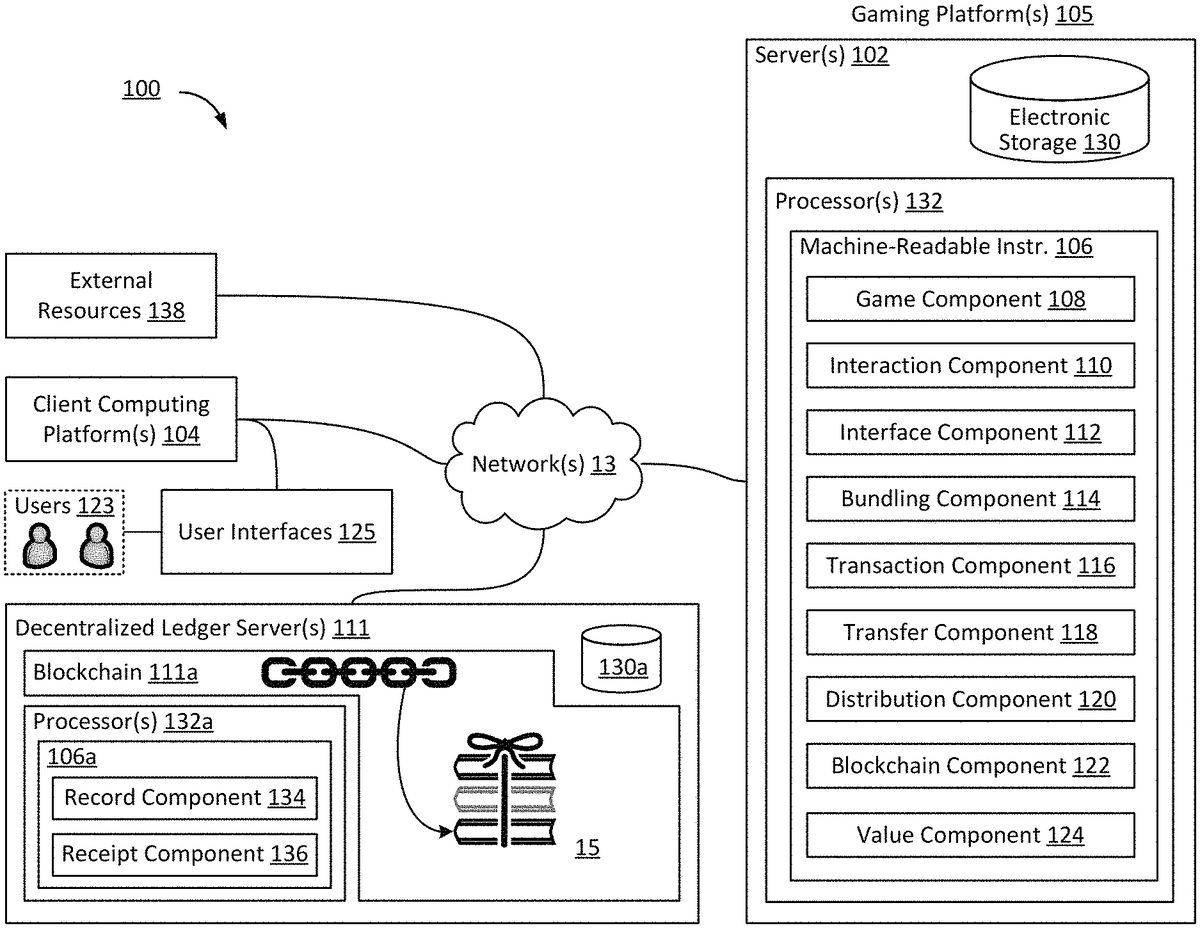
FIG. 1illustrates a system100configured to support custom bundling of virtual items within a game and/or an online gaming platform, in accordance with one or more implementations. System100may include one or more online gaming platforms105, server(s)102, electronic storage130, user interface(s)125, decentralized ledger server(s)111, client computing platform(s)104, external resources138, and/or other components. Users123(also referred to as players) may include one or more of a first user, a second user, a third user, a fourth user, and/or other users. As used in descriptions herein, any use of the term “user” may refer to user(s)123. Electronic storage130amay be similar to electronic storage130as described elsewhere in this disclosure, though included in decentralized ledger servers111. Processor(s)132amay be similar to processor(s)132as described elsewhere in this disclosure, though included in decentralized ledger servers111. Machine instructions106amay be similar to machine instructions106as described elsewhere in this disclosure, though included in decentralized ledger servers111.
Instances of online games may be executed within one or more online gaming platforms105. As used herein, online gaming platform105may refer to either an individual game (e.g., an interactive online game), a type of gaming console and its ecosystem, and/or both. Online gaming platform105may be configured to host (and/or execute instances of) the one or more (online) games. Online gaming platform105may be operated, hosted, and/or owned by one or more stakeholders of online gaming platform105. For example, a platform operator (and/or another stakeholder) may sell in-game digital assets (e.g., characters, weapons, resources, etc.) to users123of online gaming platform105. In some implementations, individual players may own individual virtual items, and exchange these items with other individual players. Due to an exchange, ownership rights (and/or other rights) of an in-game digital asset (“digital asset” for short) may transition from an original owner to a new owner (even if there may, in some implementations, be one or more intermediary and/or temporary owners during the process of performing the exchange). In some implementations, digital assets may be associated with other rights than ownership rights, such as, by way of non-limiting example, distribution rights.
In some implementations, distribution rights of digital assets may reflect rights held by the individual ones of the users to receive certain distributions of benefits upon certain events within the game, including but not limited to the occurrences of exchanges involving particular digital assets. That is, the individual users may own/hold rights to particular digital assets that guarantee them benefits upon (future) events and/or exchanges involving those digital assets regardless of whether the individual users own/hold the ownership rights for those digital assets. In some implementations, the distribution gains may result from a particular action or activity (such as, e.g., the use or sale of a particular digital asset), e.g., within the online gaming platform105, of a particular digital asset. As used herein, a distribution triggered by a particular action or activity may include one or more of a portion of the proceeds of the particular action or activity, a fee related to the particular action or activity, a minimum payment triggered by the occurrence of the particular action or activity (or a set of particular actions or activities), and/or another arrangement for payment and/or compensation, including but not limited to combinations of fixed fees, minimum fees, percentages of sales, percentages of profits, and/or other arrangements. The term “portion” does not imply or require a percentage or ratio, but rather is intended to signify that beneficiaries (i.e., the users that hold or own the distribution rights) may receive something of value and/or use. The distribution gains may include one or more virtual currencies such as virtual tokens, virtual stars, virtual points, virtual real-world currencies (e.g., US Dollars), and/or other gains that are based on the particular digital assets.
In some implementations, the digital assets may include and/or be virtual items that are not fungible and may be usable within an online gaming platform105. In some implementations, the digital assets may represent three-dimensional in-game user-controllable characters that can interact with other (in-game) virtual items within online gaming platform105. By way of non-limiting example, digital assets may represent virtual items. In some implementations, virtual items may include one or more of weapons, toys, characters, abilities, skills, tools, pets, clothing, vehicles, game levels, missions, assignments, chapters, tasks, mini-games, restricted areas within a virtual space, restricted modes of gameplay, access rights within an online game, and/or other virtual items. In some implementations, virtual items may refer to any item or object within gaming platform105that a user may use, own, sell, trade, destroy, and/or otherwise effectuate a change of ownership of.
As used herein, a digital asset is fungible if it is functionally and/or physically indistinguishable from another digital asset. For example, a payment token such as a Bitcoin may be a fungible digital asset. A digital asset may be non-fungible if it is unique, or one-of-a-kind. For example, a specific individual Crypt® Kitty™ may be a non-fungible digital asset. A digital asset may be semi-fungible if there is a set of a limited number of similar but distinguishable digital assets. For example, a limited-edition Blanko™ or another in-game character may be a semi-fungible digital asset. For example, one of a limited number of 2-dimensional or 3-dimensional in-game virtual items may be a semi-fungible digital asset. For example, a digital ticket to a show, concert, exhibition, and/or other event may be a semi-fungible digital asset. For example, a piece of art or jewelry (e.g., as a virtual item or as representing a physical item) may be a semi-fungible digital asset. As used herein, both non-fungible and semi-fungible digital assets are considered as “not fungible” digital assets. In some implementations, digital assets may be usable within one or more games.
Online gaming platform(s)105may include server(s)102. Server(s)102may be configured to communicate with one or more client computing platforms104according to a client/server architecture and/or other architectures. Client computing platform(s)104may be configured to communicate with other client computing platforms via server(s)102and/or according to a peer-to-peer architecture and/or other architectures. Users may access system100via client computing platform(s)104. In some implementations, system100and/or decentralized ledger server(s)111may be configured to communicate with one or more of online gaming platform(s)105, users123, and/or other entities and/or components. Users123may include players who play and/or otherwise interact on online gaming platform105.
Server(s)102may include electronic storage130, processor(s)132, machine-readable instructions106, and/or other components. Processor(s)132amay be similar to processor(s)132as described elsewhere in this disclosure, though included in decentralized ledger servers111. Machine-readable instructions106amay be similar to machine-readable instructions106as described elsewhere in this disclosure, though included in decentralized ledger servers111. Server(s)102may be configured by machine-readable instructions106. Machine-readable instructions106may include one or more instruction components. The instruction components may include computer program components. The instruction components may include one or more of a game component108, an interaction component110, an interface component112, a bundling component114, a transaction component116, a transfer component118, a distribution component120, a blockchain component122, a value component124, a record component134, a receipt component136, and/or other instruction components.
Decentralized ledger server(s)111may include one or more of electronic storage130a, processor(s)132a, machine-readable instructions106a, a blockchain111a, and/or other components. Machine-readable instructions106amay include one or more instruction components. The instruction components may include computer program components. The instruction components may include one or more of record component134, receipt component136, and/or other instruction components. As depicted inFIG. 1, blockchain111amay include a custom item bundle15(by way of non-limiting example, ownership rights to custom item bundle15may be recorded on blockchain111a).
In some implementations, blockchain111amay be maintained by a distributed computing platform (not shown inFIG. 1). In some implementations, the distributed computing platform may be implemented by a set of client computing platforms and/or servers (including, for example, one or more decentralized ledger servers111). The distributed computing platform may support a virtual machine (not shown inFIG. 1). The distributed computing platform and/or the virtual machine may form a runtime environment for smart contracts and/or other executable code. In some implementations, the distributed computing platform may include electronic storage configured to store part or all of blockchain111a. The smart contracts may be stored on blockchain111a. In some implementations, the distributed computing platform may be the EOSIO platform. In some implementations, the distributed computing platform may be Ethereum. In some implementations, the distributed computing platform may be similar to Ethereum. In some implementations, the virtual machine may be a decentralized virtual machine.
Elements of blockchain111amay be grouped together in units that are referred to as blocks. For example, an individual block may include one or more assets and one or more transactions. For example, an individual block may be linked to one or more other individual blocks. Individual blocks may be linked or chained together to form a structure of blocks and/or a hierarchy of blocks, such as, e.g., a chain of blocks. An individual block may include one or more assets, one or more transactions, and/or other information.
In some implementations, blockchain111amay be publicly accessible and append-only. In some implementations, existing blocks of blockchain111acan substantially not be altered or deleted, unless multiple copies are altered. This is unlikely to happen provided that the multiple copies stored on different computing platforms, e.g., in different geographical locations. Blockchain111amay be replicated on multiple computing platforms, preferably in multiple different geographical locations. Additionally, individual blocks may be linked together in a manner that prevents tampering, such as, e.g., using a hash chain and/or digital signatures. In particular, hash values may be generated using fixed-output-length one-way hashing functions that take variable-length input, and may be effectively impossible (or, at least, computationally infeasible) to reverse. As such, a hashing function may provide one-way encryption. By way of non-limiting example, the hashing function may be SHA-256, BLAKE2, SHAKE256, and/or another hashing function. Contents of individual blocks, transactions, and/or assets may be digitally signed in a manner that proves integrity and/or prevents tampering, e.g., by providing authentication.
In some implementations, game component108may be configured to execute, via online gaming platform105, an instance of a game. The instance of the game may facilitate presentation of the game to users123. For example, the instance of the game may be an online game executed with online gaming platform105. Game component108may be configured to implement in-game actions in the instance of the game, e.g., in response to action requests for the in-game actions by the users. In some implementations, game component108may be arranged, organized, and/or otherwise included in online gaming platform105. As used herein, the term “game” may refer to one or more games within gaming platform105. In some implementations, the game may be provided via a virtual space, and may include a plurality of resource types and/or maps.
The presentation of the game may be based on the views of the game that are determined during execution of the game. In some implementations, the view may be communicated (e.g., by streaming, via object/position data, and/or other information) from decentralized ledger server(s)111and/or other sources to client computing platforms104for presentation to users123. The view determined and transmitted to a given client computing platform104may correspond to a location in the virtual space (e.g., the location from which the view is taken, the location the view depicts, and/or other locations), a zoom ratio, a dimensionality of objects, a point-of-view, and/or view parameters. In some implementations, one or more view parameters may be selectable by a user.
The instance of the game may include a simulated space that is accessible by users123by clients (e.g., client computing platforms104) that present the views of the virtual space to a user. The simulated space may have a topography, express ongoing real-time interaction by one or more users123, and/or include one or more objects positioned within the topography that are capable of locomotion and/or movement within the topography. In some implementations, the topography may be a 2-dimensional topography. In some implementations, the topography may be a 3-dimensional topography. The topography may include dimensions of the simulated space, and/or surface features of a surface or objects that are native to the simulated space. In some implementations, the topography may include a surface (e.g., a ground surface) that runs through at least a substantial section of the simulated space. In some implementations, the topography may describe a volume with one or more bodies positioned therein. The instance executed by the computer components may be synchronous, asynchronous, and/or semi-synchronous.
Within the instance of the game, users123may control characters, objects, simulated physical phenomena, and/or other elements within the virtual space to interact with the virtual space and/or each other. The user characters may include avatars. As used herein, the term “user character” may refer to an object or group of objects present in the virtual space, that correspond(s) to an individual user. A particular user character may be controlled by the particular user with which it is associated. Such user characters may be referred to as user-controlled characters. User-controlled element(s) may move through and interact with the virtual space (e.g., non-user characters in the virtual space, other objects in the virtual space, etc.). In some implementations, user-controlled characters may be capable of locomotion within the topography of the simulated space that is included in the instance of the game. In some implementations, user-controlled elements controlled by and/or associated with a given user may be created and/or customized by the given user. Individual users123may have an “inventory” of virtual goods and currency (e.g., resources of the plurality of resource types) that the individual user can use (e.g., by manipulation of a user character and/or other user-controlled elements) and/or other items, to perform in-game actions within the virtual space. By way of non-limiting illustration, users123may include the first user and the second user that interact with online gaming platform105. The first user and the second user may control digital assets (e.g., characters) in a game hosted by online gaming platform105. In some implementations, user inventories may be managed using blockchain111a. For example, ownership rights (and/or other types of rights) of individual virtual items included in an individual user inventory may be recorded on blockchain111a. In some implementations, individual user inventories may correspond to individual smart contracts stored on blockchain111a.
Interaction component110may be configured to enable, facilitate, and/or implement in-game actions by users123in instances of games. In some implementations, interaction component110may be configured to operate in response to instructions and/or action requests by users123. For example, one or more users may interact within gaming platform105to build, create, gather, find, combine, and/or otherwise generate content (i.e., user-generated content). In some implementations, operations may be accomplished by interaction component110through user interfaces125. Isi particular, operations pertaining to a particular user may be accomplished through a particular user interface of a particular client computing platform104, where the particular client computing platform104is associated with the particular user.
Interface component124may be configured to facilitate interaction of users123with system100. In some implementations, interface component may be configured to facilitate interaction by users123through user interfaces125. For example, a particular user may be associated with a particular client computing platform104, which may include a particular user interface125. In some implementations, interface component124may be configured to facilitate entry and/or selection of virtual items for bundling through one or more user interfaces125. The virtual items may be usable within a particular instance of a particular game. In some implementations, interface component124may be configured to initiate bundling of virtual items (e.g., as previously selected) through one or more user interfaces125. In some implementations, interface component124may facilitate entry and/or selection of two or more virtual items. In some implementations, interface component124may facilitate entry and/or selection of three or more virtual items. In some implementations, interface component124may facilitate entry and/or selection through (presentation of) one or more user interfaces125(such as, by way of non-limiting example, a bundling interface).
By way of non-limiting example,FIG. 4illustrates a user interface125a(i.e., a bundling interface), depicting a user inventory41, as may be used in system100. As depicted, user inventory41may include a list of different virtual items and/or assets currently owned by a particular user, including virtual items 1-2-3-4-5. User interface125afurther depicts item information regarding these virtual items, as indicated by item information 1-2-3-4-5, which correspond to virtual items 1-2-3-4-5, respectively. For example, “virtual item 1” may be a pair of shoes45a, “virtual item 2” may be a pair of binoculars45b, and “virtual item 5” may be a map45c, as depicted inFIG. 4. User interface125amay further include graphical user interface elements such as, by way of non-limiting example, action buttons42a,42b,42c. Upon engagement by a user, action button42amay initiate a process to use “virtual item 1”. Likewise, upon engagement by a user, action button42bmay initiate a different process to use “virtual item 5”. User interface125amay include a field45used for bundling multiple virtual items into custom item bundle15a. For example, the user may drag items from inventory41into field45. As depicted, the user has moved “virtual item 1”, “virtual item 2”, and “virtual item 5” into field45. Upon engagement by a user, action button42c(labeled “Initiate bundling”) may initiate the bundling of the virtual items in field45into custom item bundle15a. Upon creation (and/or recordation) of this custom item bundle15a, certain value may be unlocked in the instance of the game. As an example of unlocked value, the owner of this custom item bundle may obtain improved and/or increased skill as an explorer, e.g., by virtue of synergistic effects between the items of these shoes, binoculars, and this map. Other potentially useful additions might a shovel, a flashlight, etc.
As another example, a custom item bundle that includes a water bottle, protein powder, and dumbbells may unlock value for a game character related to (improved) working out. As another example, a custom item bundle that includes a lab coat, a clipboard, and a microscope may unlock value in the game related to (increased levels of) science and/or innovation. As another example, a custom item bundle that includes a red stapler, a hilarious coffee mug, and a messenger bag may unlock in-game value related to (increased levels of) office success and/or productivity. As another example, a custom item bundle that includes a pair of jorts, at least two articles of clothing that depict an energy drink logo, and a regrettable tattoo may unlock abilities related to (increased occurrences of) being offered a variety of clandestine goods and/or services within the game. In some implementations, a custom item bundle may include virtual items from different games (i.e., a first virtual item from a first game, a second virtual item from a second game, etc.). For example, the unlocked value may pertain to the first game, the second game, or both games.
Bundling component114may be configured to bundle virtual items into custom item bundles. In some implementations, bundling component114may be configured to initiate bundling of virtual items into custom item bundles. For example, a custom item bundle may include multiple virtual items. In some implementations, a custom item bundle may include and/or represent certain rights pertaining to the virtual items that are included. For example, a particular custom item bundle may include ownership rights of the virtual items that are included, such that exchanging the particular custom item bundle to another user implies that the included virtual items are also exchanged. For example, a given custom item bundle may include distribution rights pertaining to the virtual items that are included, such that exchanging the given custom item bundle to another user implies that the distribution rights for the included virtual items are also exchanged. In some implementations, a custom item bundle may be entirely separate from the included items such that exchanging the bundle does not affect rights pertaining to the included virtual items, and vice versa.
Bundling component114may be configured to create and/or generate digital assets, tokens, and/or other virtual items. By way of non-limiting example, operations by bundling component114may be performed responsive to the bundling of virtual items into a custom item bundle. In some implementations, a created and/or generated digital asset may represent one or more rights pertaining to a custom item bundle. In some implementations, a created and/or generated token may represent one or more rights pertaining to a custom item bundle. In some implementations, a created and/or generated virtual item may represent one or more rights pertaining to a custom item bundle. For example, the represented rights may include one or more of ownership rights, distribution rights, and/or other rights pertaining to the custom item bundle. In some implementations, bundling component114may be configured to perform tokenization of custom item bundles and/or their included virtual items.
Transaction component116may be configured to generate and/or record transactions on a decentralized ledger (e.g., blockchain111a) implemented by one or more decentralized ledger servers (e.g., decentralized ledger server111). In some implementations, one or more transactions may reflect that particular rights (e.g., ownership rights, distribution rights, and/or other rights) pertaining to a particular virtual item (e.g., a custom item bundle, a digital asset, a token, and/or another virtual item) are owned by particular users. In some implementations, transaction component116may be configured to generate (sets of) instructions that, upon execution by the decentralized ledger (e.g., blockchain111a), assign particular rights to particular users. In some implementations, transaction component116may be configured to generate (sets of) instructions that, upon execution by the decentralized ledger (e.g., blockchain111a), modify particular rights that are recorded on the decentralized ledger.
Transfer component118may be configured to transfer particular rights (e.g., as pertaining to a custom item bundle) from one user to another user (e.g., as part of an exchange between users). For example, transfer component118may transfer ownership rights. For example, transfer component118may transfer distribution rights. In some implementations, transfer component118may be configured to generate (sets of) instructions that, upon execution by the decentralized ledger (e.g., blockchain111a), effectuate a transfer of particular rights. In some implementations, transfer component118may be configured to generate (sets of) instructions that, upon execution by the decentralized ledger (e.g., blockchain111a), effectuate a particular assignment of the particular rights that are recorded on the decentralized ledger.
Distribution component120may be configured to determine distributions (e.g., portions of certain amounts of consideration and/or other benefits) in accordance with distribution rights. Distribution component120may be configured to distribute these determined portions to the users who own those distribution rights. For example, assume that a first user exchanges a particular custom item bundle to a second user for 100 coins. Assume the distribution rights amount to 5% of these types of exchanges. Accordingly, whichever user owns the distribution rights to the particular custom item bundle will receive a distribution of 5% of these 100 coins (or, 5 coins). Note that ownership rights and distribution rights may be exchanged independently of each other. For example, assume the second user exchanges the particular custom item bundle to a third user for 200 coins. Accordingly, whichever user owns the distribution rights to the particular custom item bundle will receive a distribution of 5% of these 200 coins (or, 10 coins). This may still be the same user who received the first distribution of 5 coins. In some implementations, this user could be the first user, the second user, the third user, and/or a different user (neither the first, second, nor third user). In some implementations, distributions may be triggered by other events in the game than exchanges of digital assets between users. For example, certain types of use of a digital asset may provide and/or otherwise effectuate some benefit to the owner of the digital asset. In some cases, the owner of the distribution rights may be entitled to a portion of such a benefit. In some implementations, distribution component120may be configured such that distributions are provided by one or more smart contracts recorded on blockchain111a.
Blockchain component122may be configured to generate instructions for execution by a decentralized ledger (e.g., blockchain111a). In some implementations, blockchain component122may provide an abstraction layer (for blockchain111a) and/or application programming interface (API) (for blockchain111a) to users and/or other components of system100. For example, an instruction or function call to blockchain component122may be converted, translated, and/or otherwise processed into a set of instructions that are executable by the decentralized ledger (e.g., blockchain111a).
In some implementations, blockchain component122may be configured to generate instructions to form digital assets (e.g., as created by bundling component114) as smart contracts. Blockchain component122may transfer these instructions to decentralized ledger server111and/or blockchain111afor execution and/or recording.
Value component124may be configured to unlock value within the instance of the game responsive to the bundling of virtual items into a custom item bundle. In some implementations, value component124may be configured to unlock value within the instance of the game responsive to the creation of a digital assets that represents rights pertaining to a custom item bundle. In some implementations, value component124may be configured to unlock value within the instance of the game responsive to the recording of rights (e.g., on blockchain111a) pertaining to a custom item bundle. In some implementations, unlocked value may be a reward (e.g., a virtual item or a skill or a progress level) provided by the game to a particular user. In some implementations, unlocked value may be a particular status (e.g., as indicated by a badge) provided by the game to a particular user. In some implementations, unlocked value may be access to in-game content (e.g., a new level or mission) provided by the game to a particular user. In some implementations, unlocked value may increase the power, skill or ability of the particular user (or a character controlled by the particular user). In some implementations, unlocked value may be reverted and/or otherwise undone upon the loss or destruction of the custom item bundle. In some implementations, unlocked value may persist upon the loss or destruction of the custom item bundle.
Receipt component136may be configured to receive (sets of) instructions to add, modify, and/or remove recorded rights in blockchain111a. For example, instruction component136may receive one or more sets of instructions from transfer component118, gaming platform105, and/or other components of system100. Receipt component136may provide received sets of instructions to record component134for execution. In some implementations, execution of individual ones of the instructions received to modify recorded rights may include invoking one or more function calls of an Application Programming Interface (API). For example, the API may be configured to provide interactive communication between blockchain111aand other components of system100. For example, in some implementations, API function calls may be implemented as function calls to smart contracts stored on blockchain111a. In some implementations, receipt component136may be arranged, organized, and/or otherwise included in decentralized ledger server111and/or blockchain111a.
Record component134may be configured to record (ownership) rights pertaining to digital assets, e.g., on blockchain111a. In some implementations, record component134may record rights on electronic storage130a. In some implementations, record component134may record rights on blockchain111a. The rights may include ownership rights, distribution rights, and/or other rights. For example, particular recorded rights may reflect ownership of a particular digital asset by a particular user or group of users. For example, the particular digital asset may be not fungible, and may represent a three-dimensional in-game user-controllable item or character that can interact with other virtual items within gaming platform105. Recorded rights may be asset-specific. For example, distribution rights for a particular digital asset may designate rights to certain distributions of benefits upon an exchange involving the particular digital asset.
In some implementations, record component134may be configured to record rights in blockchain111a. In some implementations, record component134may add, modify, and/or remove recorded rights. For example, in accordance with received instructions from instruction component136, record component134may transfer ownership of a particular digital asset from a first owner to a second owner (e.g., from an original owner to a new owner) such that the recorded rights on blockchain111ano longer reflect the ownership of the particular digital asset by the first user. In some implementations, in accordance with received instructions, record component134may transfer ownership of a particular digital asset temporarily, e.g., from a first owner to a temporary second owner. In some case, a temporary owner may be a holding account that is merely used until ownership is transferred to either the original owner or a new owner. As used herein, the term “temporary” (and derivatives thereof) refers to a transfer or to ownership that is either known to be changed and/or modified within a predetermined period, or expected to be changed and/or modified within a predetermined period. Conversely, a non-temporary transfer from a first owner to a second owner (due to a particular exchange) can conceivably be changed and/or reverted (back from the second owner to the first owner) due to a separate and new exchange that is independent of the first particular exchange. In some implementations, in accordance with received instructions, record component134may transfer ownership of a particular digital asset non-temporarily from a first owner to a second owner, e.g., when a particular exchange is not reversible or no longer reversible. In some implementations, record component134may be arranged, organized, and/or otherwise included in blockchain111a.
In some implementations, record component134may be configured to obtain asset-specific rights (e.g., ownership rights, distribution rights, and/or other rights) for particular digital assets. In some implementations, record component134may be configured to access blockchain111ato obtain the asset-specific rights (that are recorded on blockchain111a, e.g., in one or more smart contracts).
By way of non-limiting example,FIG. 3Aillustrates a blockchain111bthat implements a blockchain including a block 0, a block 1, and a block 2. As time progresses, more blocks may be added to blockchain111b. The blocks within blockchain111bare ordered. As shown in block 0, two assets (indicated by a capital “A”) are created and/or generated, and subsequently assigned to two users or players: a first asset is assigned to user i (Ui), a second asset is assigned to user j (Uj), and a third asset, a smart contract51indicated by a capital “C”, is assigned to user “a” (Ua, e.g., an administrative user). As used in the context of blockchains, assignments may be recordations of ownership (also referred to as recordings of ownership). These assets may be individually manifested, deployed, and/or instantiated on blockchain111b. Block 1 is connected to block 0 (as indicated by a link50a), for example, by including an address of block 1 in block 0, or vice versa. Likewise, block 1 is connected to block 2, as indicated by a link50b.
In block 1, one asset (labeled Ax) is assigned to user q (Uq), for example by associating an account address of user q to asset Ax. For example, asset Ax may be created through a function of smart contract51. Asset Ax may represent ownership rights of a particular custom item bundle (e.g., a bundle referred to as the “Explorer Trifecta”) as indicated by metadata52(e.g., storing information including recorded rights pertaining to this custom item bundle) and depicted by image53. For example, this particular custom item bundle may be similar to custom item bundle15a(inFIG. 4). Additionally, block 1 includes two transactions (indicated by a capital “T”): a first transaction from user i to user j, and a second transaction from user j to user k. Block 2 includes a first transaction from user j to user m, and a second transaction from user j to user n. In some implementations, based on the contents of the blocks, any user of blockchain111bmay determine the current assets of blockchain111b, the balances of any user, and the current owners of any asset. In some implementations, the balance of a particular user may be verified prior to adding a transaction that reduces that particular user's balance. For example, an individual user may not be allowed to transfer assets the individual user does not own.
By way of non-limiting example,FIG. 3Billustrates a blockchain111cthat includes the same blocks as blockchain111bofFIG. 3A, plus additional blocks (block 3, block 4, block 5) that have been appended to the blockchain. Block 3 may be connected to block 2 (as indicated by a link50c), block 4 may be connected to block 3 (as indicated by a link50d), and block 5 may be connected to block 4 (as indicated by a link50e). In block 3, an asset (labeled Ax) is assigned to user p (Up), for example by associating an account address of user p to this particular asset Ax. For example, this particular asset Ax may be created through another call of a function of smart contract51. For example, this asset Ax may represent ownership rights of a different custom item bundle (e.g., a bundle referred to as the “Office Hero”, which includes a red stapler, a hilarious coffee mug, and a messenger bag) as indicated by metadata54(e.g., storing information including recorded rights pertaining to this particular custom item bundle) and depicted by image55.
InFIG. 5B, a function call to a particular function defined by smart contract51(e.g., to initiate a particular distribution related to asset Ax) may be depicted and/or implemented as a transaction (e.g., the function may be invoked in exchange for consideration). In some implementations, smart contract51may have been posted to blockchain111bby an administrative user. Block 4 includes a transaction (indicated by a capital “T”) from user i to user n. For example, the transaction may represent a purchase of a first virtual item by user n. Additionally, block 4 includes a transaction from user “a” to the same smart contract as depicted in block 0. For example, the transaction may represent user “a” initiating one or more particular distributions to (the owners of) particular assets Ax. By way of non-limiting example, perhaps these particular assets Ax were involved in some type of usage within the game or in some type of exchange that triggered its distribution rights. Block 5 includes a first transaction T1 representing a transfer of a distribution from the first asset Ax (of block 1) to the current owner of this asset Ax (this custom item bundle); here this owner is user q. Additionally, block 5 includes a second transaction T2 representing a transfer of a distribution from the second asset Ax (of block 3) to the current owner of this asset Ax (this custom item bundle); here this owner is user p.
Referring toFIG. 1, in some implementations, server(s)102, client computing platform(s)104, and/or external resources138may be operatively linked via one or more electronic communication links. For example, such electronic communication links may be established, at least in part, via a network such as the Internet and/or other networks. It will be appreciated that this is not intended to be limiting, and that the scope of this disclosure includes implementations in which server(s)102, client computing platform(s)104, and/or external resources138may be operatively linked via some other communication media.
A given client computing platform104may include one or more processors configured to execute computer program components. The computer program components may be configured to enable an expert or user associated with the given client computing platform104to interface with system100and/or external resources138, and/or provide other functionality attributed herein to client computing platform(s)104. By way of non-limiting example, the given client computing platform104may include one or more of a desktop computer, a laptop computer, a handheld computer, a tablet computing platform, a NetBook, a Smartphone, a gaming console, and/or other computing platforms.
External resources138may include sources of information outside of system100, external entities participating with system100, external providers of computation and/or storage services, and/or other resources. In some implementations, some or all of the functionality attributed herein to external resources138may be provided by resources included in system100.
Server(s)102may include communication lines, or ports to enable the exchange of information with a network and/or other computing platforms. Illustration of server(s)102inFIG. 1is not intended to be limiting. Server(s)102may include a plurality of hardware, software, and/or firmware components operating together to provide the functionality attributed herein to server(s)102. For example, server(s)102may be implemented by a cloud of computing platforms operating together as server(s)102.
Electronic storage130may comprise non-transitory storage media that electronically stores information. The electronic storage media of electronic storage130may include one or both of system storage that is provided integrally (i.e., substantially non-removable) with server(s)102and/or removable storage that is removably connectable to server(s)102via, for example, a port (e.g., a USB port, a firewire port, etc.) or a drive (e.g., a disk drive, etc.). Electronic storage130may include one or more of optically readable storage media (e.g., optical disks, etc.), magnetically readable storage media (e.g., magnetic tape, magnetic hard drive, floppy drive, etc.), electrical charge-based storage media (e.g., EEPROM, RAM, etc.), solid-state storage media (e.g., flash drive, etc.), and/or other electronically readable storage media. Electronic storage130may include one or more virtual storage resources (e.g., cloud storage, a virtual private network, and/or other virtual storage resources). Electronic storage130may store software algorithms, information determined by processor(s)132, information received from server(s)102, information received from client computing platform(s)104, and/or other information that enables server(s)102to function as described herein.
Processor(s)132may be configured to provide information processing capabilities in server(s)102. As such, processor(s)132may include one or more of a digital processor, an analog processor, a digital circuit designed to process information, an analog circuit designed to process information, a state machine, and/or other mechanisms for electronically processing information. Although processor(s)132is shown inFIG. 1as a single entity, this is for illustrative purposes only. In some implementations, processor(s)132may include a plurality of processing units. These processing units may be physically located within the same device, or processor(s)132may represent processing functionality of a plurality of devices operating in coordination. Processor(s)132may be configured to execute components108,110,112,114,116,118,120,122,124,134, and/or136, and/or other components. Processor(s)132may be configured to execute components108,110,112,114,116,118,120,122,124,134, and/or136, and/or other components by software; hardware; firmware; some combination of software, hardware, and/or firmware; and/or other mechanisms for configuring processing capabilities on processor(s)132. As used herein, the term “component” may refer to any component or set of components that perform the functionality attributed to the component. This may include one or more physical processors during execution of processor readable instructions, the processor readable instructions, circuitry, hardware, storage media, or any other components.
It should be appreciated that although components108,110,112,114,116,118,120,122,124,134, and/or136are illustrated inFIG. 1as being implemented within a single processing unit, in implementations in which processor(s)132includes multiple processing units, one or more of components108,110,112,114,116,118,120,122,124,134, and/or136may be implemented remotely from the other components. The description of the functionality provided by the different components108,110,112,114,116,118,120,122,124,134, and/or136described below is for illustrative purposes, and is not intended to be limiting, as any of components108,110,112,114,116,118,120,122,124,134, and/or136may provide more or less functionality than is described. For example, one or more of components108,110,112,114,116,118,120,122,124,134, and/or136may be eliminated, and some or all of its functionality may be provided by other ones of components108,110,112,114,116,118,120,122,124,134, and/or136. As another example, processor(s)132may be configured to execute one or more additional components that may perform some or all of the functionality attributed below to one of components108,110,112,114,116,118,120,122,124,134, and/or136.
FIG. 2illustrates a method200to support custom bundling of virtual items within an online gaming platform, in accordance with one or more implementations. The operations of method200presented below are intended to be illustrative. In some implementations, method200may be accomplished with one or more additional operations not described, and/or without one or more of the operations discussed. Additionally, the order in which the operations of method200are illustrated inFIG. 2and described below is not intended to be limiting.
In some implementations, method200may be implemented in one or more processing devices (e.g., a digital processor, an analog processor, a digital circuit designed to process information, an analog circuit designed to process information, a state machine, and/or other mechanisms for electronically processing information). The one or more processing devices may include one or more devices executing some or all of the operations of method200in response to instructions stored electronically on an electronic storage medium. The one or more processing devices may include one or more devices configured through hardware, firmware, and/or software to be specifically designed for execution of one or more of the operations of method200.
At an operation202, an instance of a game is executed within the online gaming platform to facilitate presentation of the game to users, and in-game actions are implemented in the instance of the game in response to action requests for the in-game actions by the users. The presentation of the game is based on views of the game that are determined during execution of the instance of the game. The users include a first user, a second user, and a third user that interact with the instance of the game. In some embodiments, operation202is performed by one or both of a game component and an interaction component the same as or similar to game component108and interaction component110(shown inFIG. 1and described herein).
At an operation204, entry and/or selection is facilitated, by the first user, of two or more virtual items that are owned by the first user. The two or more virtual items are usable within the instance of the game. In some embodiments, operation204is performed by an interface component the same as or similar to interface component112(shown inFIG. 1and described herein).
At an operation206, bundling is initiated, by the first user, of the two of more virtual items into a custom item bundle such that subsequently, the custom item bundle includes the two or more virtual items. In some embodiments, operation206is performed by an interface component the same as or similar to interface component112(shown inFIG. 1and described herein).
At an operation208, responsive to the bundling of the two or more virtual items into the custom item bundle, a digital asset is created that represents a set of rights pertaining to the custom item bundle. The digital asset is associated with each of the two of more virtual items. The set of rights includes ownership rights pertaining to the custom item bundle, and distribution rights pertaining to the custom item bundle. In some embodiments, operation208is performed by a bundling component the same as or similar to bundling component114(shown inFIG. 1and described herein).
At an operation210, one or more transactions are recorded on a decentralized ledger implemented by a decentralized ledger server. The one or more transactions reflect the ownership rights pertaining to the custom item bundle as being owned by the first user, and the distribution rights pertaining to the custom item bundle as being owned by the first user. In some embodiments, operation210is performed by a transaction component the same as or similar to transaction component116(shown inFIG. 1and described herein).
At an operation212, the ownership rights pertaining to the custom item bundle are transferred to the second user in exchange for a first amount of consideration. In some embodiments, operation212is performed by a transfer component the same as or similar to transfer component118(shown inFIG. 1and described herein).
At an operation214, a first portion of the first amount of consideration is distributed to whichever user owns the distribution rights of the custom item bundle. In some embodiments, operation214is performed by a distribution component the same as or similar to distribution component120(shown inFIG. 1and described herein).
At an operation216, the ownership rights pertaining to the custom item bundle are transferred from the second user to the third user in exchange for a second amount of consideration. In some embodiments, operation216is performed by a transfer component the same as or similar to transfer component118(shown inFIG. 1and described herein).
At an operation218, a second portion of the second amount of consideration is distributed to whichever user owns the distribution rights of the custom item bundle. In some embodiments, operation218is performed by a distribution component the same as or similar to distribution component120(shown inFIG. 1and described herein).
Although the present technology has been described in detail for the purpose of illustration based on what is currently considered to be the most practical and preferred implementations, it is to be understood that such detail is solely for that purpose and that the technology is not limited to the disclosed implementations, but, on the contrary, is intended to cover modifications and equivalent arrangements that are within the spirit and scope of the appended claims. It is to be understood that the present technology contemplates that, to the extent possible, one or more features of any implementation can be combined with features of any other implementation.
Claims
- A system configured for supporting custom bundling of virtual items within an online gaming platform, the system comprising: one or more processors configured by machine-readable instructions to: execute, within the online gaming platform, an instance of a game to facilitate presentation of the game to users, and implement in-game actions in the instance of the game in response to action requests for the in-game actions by the users, wherein presentation of the game is based on views of the game that are determined during execution of the instance of the game, wherein the users include a first user, a second user, and a third user that interact with the instance of the game;facilitate entry and/or selection, by the first user, of two or more virtual items that are owned by the first user, wherein the two or more virtual items are usable within the instance of the game;initiate bundling, by the first user, of the two of more virtual items into a custom item bundle such that subsequently, the custom item bundle includes the two or more virtual items;responsive to the bundling of the two or more virtual items into the custom item bundle, create a digital asset that represents a set of rights pertaining to the custom item bundle, wherein the digital asset is associated with each of the two of more virtual items, wherein the set of rights includes: (i) ownership rights pertaining to the custom item bundle, and (ii) distribution rights pertaining to the custom item bundle;record, on a decentralized ledger implemented by a decentralized ledger server, one or more transactions that reflect: (i) the ownership rights pertaining to the custom item bundle as being owned by the first user, and (ii) the distribution rights pertaining to the custom item bundle as being owned by the first user;responsive to recordation of the ownership rights pertaining to the custom item bundle as being owned by the first user, unlock value for the first user within the instance of the game;transfer the ownership rights pertaining to the custom item bundle to the second user in exchange for a first amount of consideration;responsive to recordation of the ownership rights pertaining to the custom item bundle as being owned by the second user, (i) remove the value for the first user within the instance of the game such that the first user no longer has the value that was previously unlocked, and (ii) unlock the value for the second user within the instance of the game;distribute a first portion of the first amount of consideration to whichever user owns the distribution rights of the custom item bundle;transfer the ownership rights pertaining to the custom item bundle from the second user to the third user in exchange for a second amount of consideration;responsive to recordation of the ownership rights pertaining to the custom item bundle as being owned by the third user, (i) remove the value for the second user within the instance of the game such that the second user no longer has the value that was previously unlocked, and (ii) unlock the value for the third user within the instance of the game;and distribute a second portion of the second amount of consideration to whichever user owns the distribution rights of the custom item bundle.
- The system of claim 1 , wherein the one or more processors are configured to facilitate the entry and/or the selection through presentation of a bundling interface, wherein the bundling interface is presented to the first user on a first client computing platform that is associated with the first user.
- The system of claim 2 , wherein the entry and/or the selection of the two or more virtual items includes moving the two or more virtual items into a particular field of the bundling interface.
- The system of claim 2 , wherein initiation of the bundling is accomplished by the first user through use of a graphical user interface element in the bundling interface.
- The system of claim 1 , wherein transferring the ownership rights pertaining to the custom item bundle from the first user to the second user effectuates a transfer of the two of more virtual items included in the custom item bundle from the first user to the second user.
- The system claim 1 , wherein the one or more processors are further configured by the machine-readable instructions to: generate a set of instructions to form the digital asset as a smart contract;transfer the set of instructions to the decentralized ledger server;wherein the system further comprises: the decentralized ledger server comprising one or more processors configured by machine-readable instructions to: receive and execute the set of instructions to record the digital asset on the decentralized ledger as the smart contract.
- The system of claim 6 , wherein distribution of the second portion of the second amount of consideration is accomplished by recording a transaction on the decentralized ledger, wherein the transaction invokes a function of the smart contract such that execution of the function transfers the second portion of the second amount of consideration to a blockchain address that is associated with whichever user owns the distribution rights of the custom item bundle.
- The system of claim 1 , wherein the value is at least one of a reward that is usable within the instance of the game, a status identifier that is visible to other users within the instance of the game, and a skill that is usable within the instance of the game.
- The system of claim 1 , wherein the value represents progress of a level of the first user within the instance of the game.
- A method to support custom bundling of virtual items within an online gaming platform, the method comprising: executing, within the online gaming platform, an instance of a game to facilitate presentation of the game to users, and implementing in-game actions in the instance of the game in response to action requests for the in-game actions by the users, wherein the presentation of the game is based on views of the game that are determined during execution of the instance of the game, wherein the users include a first user, a second user, and a third user that interact with the instance of the game;facilitating entry and/or selection, by the first user, of two or more virtual items that are owned by the first user, wherein the two or more virtual items are usable within the instance of the game;initiating bundling, by the first user, of the two of more virtual items into a custom item bundle such that subsequently, the custom item bundle includes the two or more virtual items;responsive to the bundling of the two or more virtual items into the custom item bundle, creating a digital asset that represents a set of rights pertaining to the custom item bundle, wherein the digital asset is associated with each of the two of more virtual items, wherein the set of rights includes: (i) ownership rights pertaining to the custom item bundle, and (ii) distribution rights pertaining to the custom item bundle;recording, on a decentralized ledger implemented by a decentralized ledger server, one or more transactions that reflect: (i) the ownership rights pertaining to the custom item bundle as being owned by the first user, and (ii) the distribution rights pertaining to the custom item bundle as being owned by the first user;responsive to recordation of the ownership rights pertaining to the custom item bundle as being owned by the first user, unlocking value for the first user within the instance of the game;transferring the ownership rights pertaining to the custom item bundle to the second user in exchange for a first amount of consideration;responsive to recordation of the ownership rights pertaining to the custom item bundle as being owned by the second user, (i) removing the value for the first user within the instance of the game such that the first user no longer has the value that was previously unlocked, and (ii) unlocking the value for the second user within the instance of the game;distributing a first portion of the first amount of consideration to whichever user owns the distribution rights of the custom item bundle;transferring the ownership rights pertaining to the custom item bundle from the second user to the third user in exchange for a second amount of consideration;responsive to recordation of the ownership rights pertaining to the custom item bundle as being owned by the third user, (i) removing the value for the second user within the instance of the game such that the second user no longer has the value that was previously unlocked, and (ii) unlocking the value for the third user within the instance of the game;and distributing a second portion of the second amount of consideration to whichever user owns the distribution rights of the custom item bundle.
- The method of claim 10 , wherein facilitating the entry and/or the selection includes presenting a bundling interface, wherein the bundling interface is presented to the first user on a first client computing platform that is associated with the first user.
- The method of claim 11 , wherein facilitating the entry and/or the selection of the two or more virtual items includes the first user moving the two or more virtual items into a particular field of the bundling interface.
- The method of claim 11 , wherein initiating the bundling is accomplished by the first user through use of a graphical user interface element in the bundling interface.
- The method claim 13 , wherein transferring the ownership rights pertaining to the custom item bundle from the first user to the second user includes transferring the two of more virtual items included in the custom item bundle from the first user to the second user.
- The method of claim 10 , further comprising: generating a set of instructions to form the digital asset as a smart contract;transferring the set of instructions to the decentralized ledger server;and receiving and executing the set of instructions to record the digital asset on the decentralized ledger as the smart contract.
- The method of claim 15 , wherein distributing the second portion of the second amount of consideration includes recording a transaction on the decentralized ledger, wherein the transaction invokes a function of the smart contract such that execution of the function transfers the second portion of the second amount of consideration to a blockchain address that is associated with whichever user owns the distribution rights of the custom item bundle.
- The method of claim 10 , wherein the value is at least one of a reward that is usable within the instance of the game, a status identifier that is visible to other users within the instance of the game, and a skill that is usable within the instance of the game.
- The method of claim 10 , wherein the value represents progress of a level of the first user within the instance of the game.
Disclaimer: Data collected from the USPTO and may be malformed, incomplete, and/or otherwise inaccurate.