U.S. Pat. No. 11,123,632
METHOD AND APPARATUS FOR CONTROLLING VIDEOGAMES
Issue DateJuly 29, 2019
Illustrative Figure
Abstract
A system for driving physical characteristics of a virtual world of a videogame provided with a physics engine module. The system including a gaming apparatus and a standard primary control device and an additional control device including a stationary base and a sphere. The stationary base is adapted to support the sphere and the sphere is detachable from the stationary base and manipulable by a player. The sphere is provided with a unique identifier and a communication system with the base. The sphere and the base include sensors. The system including means for detecting physical parameters within a player environment and using them to drive corresponding physical characteristics of the virtual world of the videogame.
Description
BEST MODE FOR CARRYING OUT THE INVENTION With reference to the attached drawings, and in particular toFIG. 1of the same, an embodiment example of a gaming system consisting of a gaming controller object of the invention (100) is shown. Said controller can possibly be used together with a standard controller (300) to control a videogame running on a gaming apparatus (200), such as a console, a personal computer, a smartphone, or equivalent videogame devices. The controller (100) can be connected to the gaming apparatus (200) via a wired or wireless interface connection (170). The controller (100) object of the invention consists of an element, for example in the form of a sphere (110), made preferably but not necessarily of transparent material (101) inside which a physical miniature (103) representing the same virtual world object of the videogame being run (203). The sphere (110) can be freely manipulated by the player or supported on a suitable base (150) and is provided with a wireless communication system with said base (150) which is, in turn, connected to the wired or wireless gaming apparatus (200), through an appropriate interface (170). With reference to the attached drawings and in particular toFIG. 2thereof, a form of the controller is represented with the electronic components installed on the device. Inside the sphere (110), a movement sensor (111), a temperature sensor (112), and a light sensor (113) are installed, useful for transducing and mapping in terms of said variables the actions performed physically by the player on the sphere itself. Always inside the sphere (110) there are also a magnetic switch (114), to allow the activation of the sphere itself, and a wireless acquisition and communication device (115), adapted to transfer the sensor data to the base (150). Said communication device (115) is also provided with a ...
BEST MODE FOR CARRYING OUT THE INVENTION
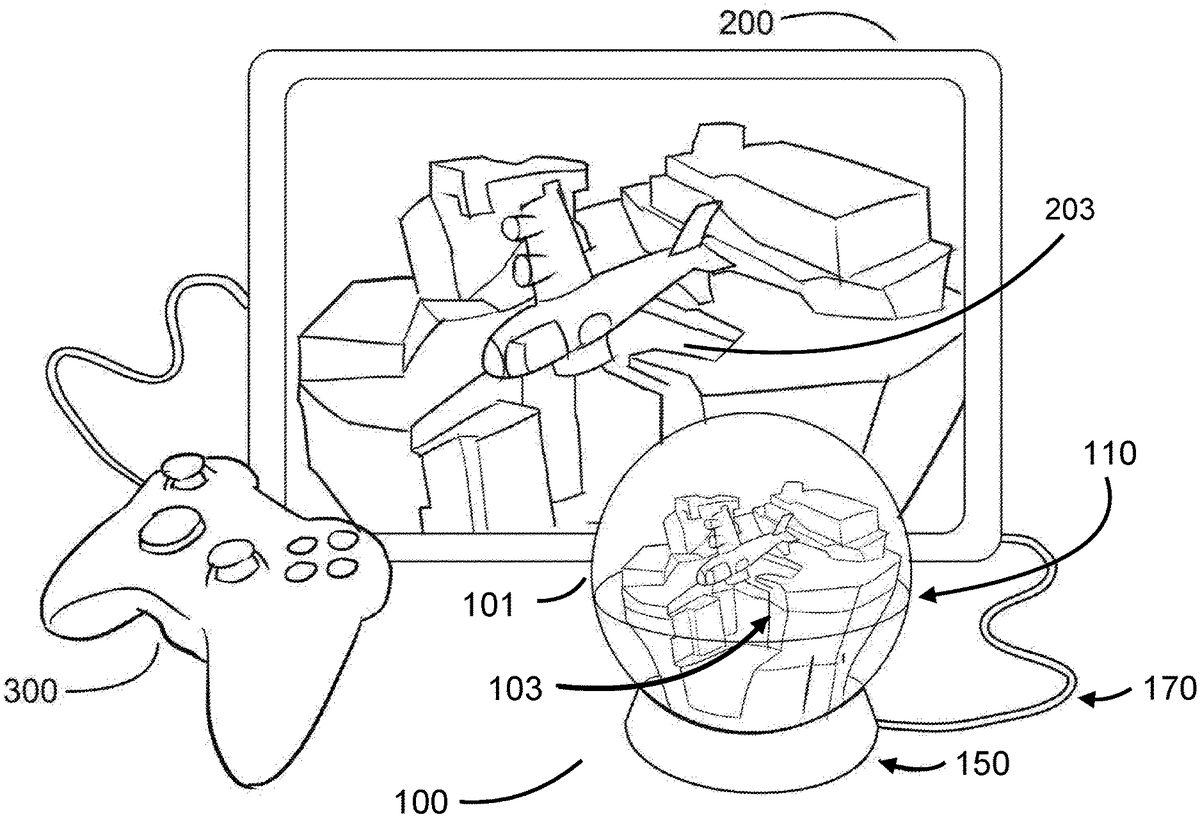
With reference to the attached drawings, and in particular toFIG. 1of the same, an embodiment example of a gaming system consisting of a gaming controller object of the invention (100) is shown. Said controller can possibly be used together with a standard controller (300) to control a videogame running on a gaming apparatus (200), such as a console, a personal computer, a smartphone, or equivalent videogame devices. The controller (100) can be connected to the gaming apparatus (200) via a wired or wireless interface connection (170).
The controller (100) object of the invention consists of an element, for example in the form of a sphere (110), made preferably but not necessarily of transparent material (101) inside which a physical miniature (103) representing the same virtual world object of the videogame being run (203).
The sphere (110) can be freely manipulated by the player or supported on a suitable base (150) and is provided with a wireless communication system with said base (150) which is, in turn, connected to the wired or wireless gaming apparatus (200), through an appropriate interface (170).
With reference to the attached drawings and in particular toFIG. 2thereof, a form of the controller is represented with the electronic components installed on the device. Inside the sphere (110), a movement sensor (111), a temperature sensor (112), and a light sensor (113) are installed, useful for transducing and mapping in terms of said variables the actions performed physically by the player on the sphere itself. Always inside the sphere (110) there are also a magnetic switch (114), to allow the activation of the sphere itself, and a wireless acquisition and communication device (115), adapted to transfer the sensor data to the base (150). Said communication device (115) is also provided with a unique identification code, which also allows recognition of the sphere in use, and is powered by an appropriate battery power supply system (116). The base (150) is, in turn, equipped with a temperature sensor (152) to detect the ambient temperature and possibly compare it with the one detected by the corresponding sensor (112) of the sphere (110), on which the player can freely intervene. In a similar manner, the base (150) is provided with a light sensor (153) to measure the light of the physical environment in which the player operates and possibly compare it with the one detected by the corresponding light sensor (113) of the sphere (110). The parameters detected by the sensors positioned on the base (150) are collected by an acquisition and communication unit (155) which, by wireless connection with the corresponding unit (115) placed on the sphere (110), also centralizes all the information related to the different sensors and transmits them via an appropriate interface (170) to the gaming apparatus. On the base (150) there is also a magnet (154), able to activate the magnetic switch on the sphere (114) when it is placed on the base, in order to start the communication between the two units placed on the sphere (115) and on the base (155), as well as allowing the system to detect when the user is freely interacting with the controller and when, instead, he is holding it on the base.
With reference to the attached drawings and in particular toFIG. 3of the same, a plurality of spheres (110,120,130) can be used, alternatively used in combination with the base (150), to recall and univocally control specific environments or virtual worlds, within the videogame (203) running in the gaming apparatus (200); said plurality of spheres is representative of the possibility of using different miniatures in correspondence with different games or different scenarios of a same game.
The attached drawings and in particularFIG. 4represent the algorithm through which the possible direct and indirect actions that the player makes with the sphere in the physical world (unpredictable beforehand) are mapped through the physics parameters detected by the sensors installed on the sphere (110) itself and on the base (150) and subsequently interpreted and processed by the algorithm and transferred to the game in the form of parameters, useful to modify, in coherence with the actions undertaken, the virtual gaming environment, modifying the relative virtual physical parameters (gravity, ambient light, temperature, etc.).
In particular, to discern between the variations of the various parameters voluntarily implemented by the user and involuntary variations, linked to changes in environmental conditions, the system compares the corresponding values (where present) detected by the sensors on the base and on the sphere; if the sphere is on the base, the system will be considered as a whole, averaging the values measured by the corresponding sensors and interpreting the commands as “environmental” changes, which will be assigned a certain “weight” limited to the transposition of the variations within the virtual world; if, instead, the sphere is moved directly by the player and used separately from the base, the variation of the different parameters will be detected according to the difference between the “direct” measurement (detected by the sphere) and the “indirect” measurement (detected by the base) of the same parameter, in order to identify more precisely the user's will; the system will assign a much higher “weight” to these variations in transposing information from the physical to the virtual world.
Said algorithm also defines the modalities with which the variations detected by the various sensors are transferred to the physics engine integrated in the videogame, modifying the parameters of the corresponding physical characteristics of the virtual world; in particular, to improve the level of interaction, each variable will be assigned predetermined variables, depending on the videogame and/or the scenario, useful to define the proportion with which, for each characteristic, the variations detected in the physical world will have to be transposed in the gaming world (for example, a variation of a few degrees of the temperature of the physical world could be transposed into a variation of many degrees of temperature in the virtual world), as well as the speed with which such changes will occur (for example, a rapid change of the light intensity detected by the sensors could be transposed into a corresponding variation in terms of intensity, but more gradual, of the in-game light).
The attached drawings and, in particular,FIGS. 5, 6, 7 and 8, represent various direct and indirect methods, with which the user can obtain the same variation of the gaming parameters consistent with the changes made to the control device, in the physical world; in the specific case, in the representation ofFIG. 5, the controller is illuminated and the sun shines in the virtual gaming world; inFIG. 6the user shades the device with his hands and night falls in the game; inFIG. 7the light of the room is turned off, and night falls in the game; inFIG. 8the device is put in the dark by covering it with a cloth and night falls in the game.
The attached drawings and, in particular,FIGS. 9 and 10, represent the reflection in the videogame of the user's “mechanical” interactions with the world's miniature is represented; in particular, by modifying the orientation of the additional controller, a consistent variation of gravity in the virtual world is determined.
The attached drawings and, in particular,FIGS. 11 and 12, represent the reflection in the videogame of the physical interactions performed by the user on the control device, and in particular, inFIG. 11, the sphere is placed in a cold place and in the virtual world the temperature decreases coherently and snow starts falling; inFIG. 12, the sphere is placed in a warm place and in the virtual world the temperature rises in a coherent way.
INDUSTRIAL APPLICABILITY
The invention can be realized with technical equivalents, with supplementary materials or solutions suitable for the purpose and the application scope. Conformation and dimensions of the constituent parts may vary in a suitable, but consistent way with the proposed solution.
By way of example and not of limitation, it is noted that the geometric shapes of the involved parts may be varied while maintaining the above-mentioned functionalities. In particular, the shapes of the element hypothesized for a representative but non-limiting purpose as sphere (110), of the base (150) and, of course, of the miniatures (113) may change according to the different games or the different purposes. At the hardware level, it will be possible to change the number and type of sensors installed on the sphere (110) and on the base (150), including any types of additional sensors with respect to those presented in the exemplary embodiment; as an example, additional magnetic field sensors, microphones, etc. can be integrated into the base or sphere.
By varying these implementations, it will be necessary to change the conditioning, acquisition and communication circuits between elements, without, however, departing from the purpose and scope of application of the proposed solution.
ADVANTAGES OF THE INVENTION AND SCOPE OF THE CLAIMED PROTECTION
The proposed solution is effective, easy to implement and use and allows to greatly increase the integration and interaction between the physical world and the virtual world of a videogame. In particular, it greatly increases the spectrum of actions coming from the physical world that can be translated in a non-univocal, predetermined or predictable manner into variations of the virtual gaming world and used to modify its development in a non-deterministic manner.
The proposed solution is applied to videogame control systems (game controllers) to be used on gaming devices such as PCs, consoles, tablets, smartphones or equivalent electronic devices to run software for ludic and recreational activities.
Claims
- System for driving physical characteristics of a virtual world of a videogame ( 203 ) provided with a physics engine module, said system including a gaming apparatus ( 200 ) and a standard primary control device ( 300 ), said system further comprising: a) an additional control device ( 100 ) comprising a stationary base ( 150 ) and a sphere ( 110 ), said stationary base ( 150 ) being adapted to support said sphere ( 110 ), said sphere ( 110 ) being detachable from said stationary base ( 150 ) and manipulable by a player, said sphere ( 110 ) being provided with a unique identifier and a communication system with said base ( 150 ), both said sphere ( 110 ) and said base ( 150 ) comprising sensors;b) means for detecting physical parameters within a player environment and using the detected physical parameters to drive corresponding physical characteristics of the virtual world of the videogame ( 203 );wherein said means detect players voluntary interactions by collecting and comparing data from said sensors of the stationary base ( 150 ) with data from said sensors of the sphere ( 110 ) and by processing such data depending on whether the sphere ( 110 ) is placed on the stationary base ( 150 ) or not.
- The system according to claim 1 wherein said sphere ( 110 ) is made of transparent material ( 111 ) and contains a physical miniature ( 113 ), representing a virtual scenario of the videogame ( 203 ) and said sphere ( 110 ) includes a motion sensor ( 111 ), a temperature sensor ( 112 ), a light sensor ( 113 ), a wireless communication system ( 115 ), a battery ( 116 ) and a magnetic switch ( 114 ).
- The system according to claim 1 , wherein said stationary base ( 150 ) includes a temperature sensor ( 152 ), a light sensor ( 153 ), a wireless acquisition and communication system ( 155 ) and a magnet ( 154 ) capable of exciting the magnetic switch ( 114 ) of the sphere ( 110 ), when said sphere ( 110 ) is positioned on said stationary base ( 150 ).
- The system according to claim 1 wherein said sphere ( 110 ) can be replaced by another sphere chosen from a plurality of additional spheres ( 120 , 130 ), wherein said additional spheres ( 120 , 130 ) are provided with a unique identifier and a miniature representing a different scenario of the virtual world of a videogame ( 203 ).
- The system according to claim 1 , wherein the data relating to the sensors positioned on both the base ( 150 ) and the sphere ( 110 ) are collected by the acquisition and communication unit ( 155 ) and transmitted to the gaming device through an interface ( 170 ).
- A method ( 400 ) for detecting the players voluntary interactions by collecting, comparing and processing data gathered from sensors of the sphere ( 110 ) and the stationary base ( 150 ) defined in claim 1 , and for driving the corresponding physical parameters of a videogame virtual world through a physics engine module ( 203 );the method comprising: a) acquiring the physical parameters detected by the sensors placed on the stationary base ( 150 ) and on the sphere ( 110 ) and detecting the variations over time of such physical parameters;b) checking for the presence of the sphere ( 110 ) on the stationary base ( 150 );c) computing the players voluntary interactions values by comparing the variations detected by the corresponding sensors of the sphere ( 110 ) and the stationary base ( 150 ), as follows: if the sphere ( 110 ) is placed on the stationary base ( 150 ) the values acquired from the sensors are averaged;if the sphere ( 110 ) is not placed on the stationary base ( 150 ) the values acquired from the sensors are subtracted;d) transmitting said players voluntary interactions values to the physics engine module of the videogame ( 203 ) and converting said values into corresponding physical characteristics of the virtual world of the videogame ( 203 ).
Disclaimer: Data collected from the USPTO and may be malformed, incomplete, and/or otherwise inaccurate.