U.S. Pat. No. 11,071,918
VIDEO GAME MODIFICATION BASED ON USER STATE
AssigneeInternational Business Machines Corporation
Issue DateMarch 13, 2012
Illustrative Figure
Abstract
Provided are techniques for modifying the action of a computer game based upon information corresponding to a user. Information may include, but is not limited to, the health and social status of a user and current events. Information related to a particular game player is collected and mapped to moves, scenes and scoring algorithms corresponding to a game. If necessary, moves, scenes and scoring algorithms in the game are modified to accommodate the particular player based upon the collected information.
Description
DETAILED DESCRIPTION As will be appreciated by one skilled in the art, aspects of the present invention may be embodied as a system, method or computer program product. Accordingly, aspects of the present invention may take the form of an entirely hardware embodiment, an entirely software embodiment (including firmware, resident software, micro-code, etc.) or an embodiment combining software and hardware aspects that may all generally be referred to herein as a “circuit,” “module” or “system.” Furthermore, aspects of the present invention may take the form of a computer program product embodied in one or more computer readable medium(s) having computer readable program code embodied thereon. Any combination of one or more computer readable medium(s) may be utilized. The computer readable medium may be a computer readable signal medium or a computer readable storage medium. A computer readable storage medium may be, for example, but not limited to, an electronic, magnetic, optical, electromagnetic, infrared, or semiconductor system, apparatus, or device, or any suitable combination of the foregoing. More specific examples (a non-exhaustive list) of the computer readable storage medium would include the following: an electrical connection having one or more wires, a portable computer diskette, a hard disk, a random access memory (RAM), a read-only memory (ROM), an erasable programmable read-only memory (EPROM or Flash memory), an optical fiber, a portable compact disc read-only memory (CD-ROM), an optical storage device, a magnetic storage device, or any suitable combination of the foregoing. In the context of this document, a computer readable storage medium may be any tangible medium that can contain, or store a program for use by or in connection with an instruction execution system, apparatus, or device. A computer readable signal medium may include a propagated data signal with computer readable program code embodied therein, for example, in baseband or ...
DETAILED DESCRIPTION
As will be appreciated by one skilled in the art, aspects of the present invention may be embodied as a system, method or computer program product. Accordingly, aspects of the present invention may take the form of an entirely hardware embodiment, an entirely software embodiment (including firmware, resident software, micro-code, etc.) or an embodiment combining software and hardware aspects that may all generally be referred to herein as a “circuit,” “module” or “system.” Furthermore, aspects of the present invention may take the form of a computer program product embodied in one or more computer readable medium(s) having computer readable program code embodied thereon.
Any combination of one or more computer readable medium(s) may be utilized. The computer readable medium may be a computer readable signal medium or a computer readable storage medium. A computer readable storage medium may be, for example, but not limited to, an electronic, magnetic, optical, electromagnetic, infrared, or semiconductor system, apparatus, or device, or any suitable combination of the foregoing. More specific examples (a non-exhaustive list) of the computer readable storage medium would include the following: an electrical connection having one or more wires, a portable computer diskette, a hard disk, a random access memory (RAM), a read-only memory (ROM), an erasable programmable read-only memory (EPROM or Flash memory), an optical fiber, a portable compact disc read-only memory (CD-ROM), an optical storage device, a magnetic storage device, or any suitable combination of the foregoing. In the context of this document, a computer readable storage medium may be any tangible medium that can contain, or store a program for use by or in connection with an instruction execution system, apparatus, or device.
A computer readable signal medium may include a propagated data signal with computer readable program code embodied therein, for example, in baseband or as part of a carrier wave. Such a propagated signal may take any of a variety of forms, including, but not limited to, electro-magnetic, optical, or any suitable combination thereof. A computer readable signal medium may be any computer readable medium that is not a computer readable storage medium and that can communicate, propagate, or transport a program for use by or in connection with an instruction execution system, apparatus, or device.
Program code embodied on a computer readable medium may be transmitted using any appropriate medium, including but not limited to wireless, wireline, optical fiber cable, RF, etc., or any suitable combination of the foregoing.
Computer program code for carrying out operations for aspects of the present invention may be written in any combination of one or more programming languages, including an object oriented programming language such as Java, Smalltalk, C++ or the like and conventional procedural programming languages, such as the “C” programming language or similar programming languages. The program code may execute entirely on the user's computer, partly on the user's computer, as a stand-alone software package, partly on the user's computer and partly on a remote computer or entirely on the remote computer or server. In the latter scenario, the remote computer may be connected to the user's computer through any type of network, including a local area network (LAN) or a wide area network (WAN), or the connection may be made to an external computer (for example, through the Internet using an Internet Service Provider).
Aspects of the present invention are described below with reference to flowchart illustrations and/or block diagrams of methods, apparatus (systems) and computer program products according to embodiments of the invention. It will be understood that each block of the flowchart illustrations and/or block diagrams, and combinations of blocks in the flowchart illustrations and/or block diagrams, can be implemented by computer program instructions. These computer program instructions may be provided to a processor of a general purpose computer, special purpose computer, or other programmable data processing apparatus to produce a machine, such that the instructions, which execute via the processor of the computer or other programmable data processing apparatus, create means for implementing the functions/acts specified in the flowchart and/or block diagram block or blocks.
These computer program instructions may also be stored in a computer readable medium that can direct a computer, other programmable data processing apparatus, or other devices to function in a particular manner, such that the instructions stored in the computer readable medium produce an article of manufacture including instructions which implement the function/act specified in the flowchart and/or block diagram block or blocks.
The computer program instructions may also be loaded onto a computer, other programmable data processing apparatus, or other devices to cause a series of operational actions to be performed on the computer, other programmable apparatus or other devices to produce a computer implemented process such that the instructions which execute on the computer or other programmable apparatus provide processes for implementing the functions/acts specified in the flowchart and/or block diagram block or blocks.
Given the rise in popularity of motion-based computer gaming, such as but not limited to Wii by Nintendo and Kinect by Microsoft, players with physical, emotional or mental conditions may experience difficulty or injury due to actions necessary to properly play a particular game. Although motion-based games that aid in rehabilitation either exist or are under development, there is currently no technology available that enables a game to be modified based upon one or more of the following player states: physical state, emotional state or mental state. For example, a player with back problems may have difficulty in conjunction with a bowling game or specific yoga positions.
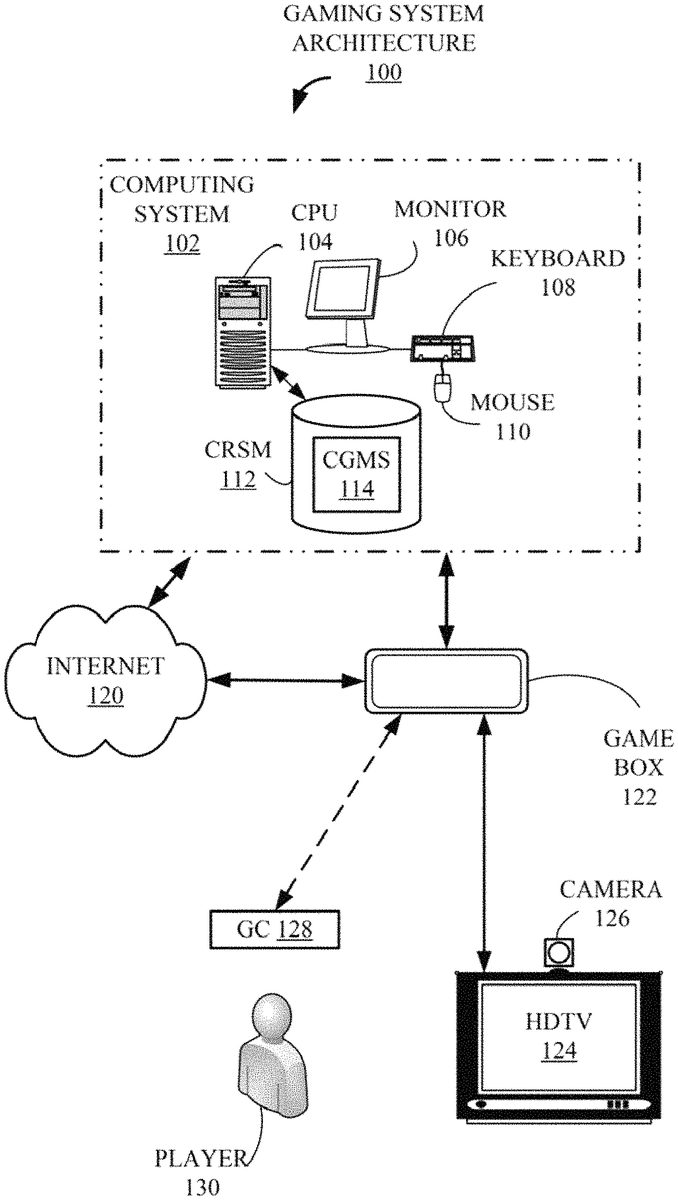
Turning now to the figures,FIG. 1is a block diagram of an example of a gaming system architecture100that incorporates the claimed subject matter. A computing system102includes a central processing unit (CPU)104, coupled to a monitor106, a keyboard108and a pointing device, or “mouse,”110, which together facilitate human interaction with game system100and computing system102. Also included in computing system102and attached to CPU104is a computer-readable storage medium (CRSM)112, which may either be incorporated into client system102i.e. an internal device, or attached externally to CPU104by means of various, commonly available connection devices such as but not limited to, a universal serial bus (USB) port (not shown). CRSM112is illustrated storing a Computer Game Modification System (CGMS)114that implements aspects of the claimed subject matter. Although described as stored and executed in conjunction with computing system102, CGMS114may also be implemented in conjunction with a game box122, as a standalone component coupled to game box122or as a service delivered to either computing system102or game box122from a server (not shown) via the Internet120. Although in this example, computing system102and game box122are communicatively coupled to the Internet120, they could also be coupled through any number of communication mediums such as, but not limited to, a local area network (LAN) (not shown). Regardless of the specific implementation, logic associated with CGMS114is typically stored on a CRSM and executed on a processor.
In this example, game box122is coupled to a high definition television (HDTV)124that may render a video signal originating from game box122in conjunction with any games. A camera126may provide feedback to game box122corresponding to motions of a player130. A game controller (GC)128provides a way for player130to interact with game box122and thereby control game setup and actions. It should be understood that game system architecture100is just one example of a system that may implement the claimed subject matter. One with skill in the relevant arts will appreciate that there are other equally applicable architectures as well. For example, a game may be controlled and rendered entirely on computing system100without one or more of game box122, HDTV124, camera126and GC128. In addition, some current video gaming systems simply monitor a player's movements with devices such as camera126, thereby turning the player themselves into the game controller. It should also be noted that a typical gaming system might include less, additional or different components.
FIG. 2is a block diagram of CGMS104, first introduced inFIG. 1, in greater detail. For the sake of the following examples, logic associated with CGMS104is assumed to execute on computer102(FIG. 1) and stored in CRSM112(FIG. 1), although as explained above the technology may be incorporated into game box122(FIG. 1), incorporated into a standalone component coupled to game box122or provided as a service by a server (not shown) via a communication medium such as, but not limited to, the Internet120. It should also be understood that the claimed subject matter can be implemented in many types of computing systems and data storage structures but, for the sake of simplicity, is described only in terms of computer102and system architecture100(FIG. 1).
CGMS104includes an input/output (I/O) module140, a graphical user interface (GUI)142, a data cache component144, a mapping module146, an analysis module148and a game modification module150. It should be noted that the representation of CGMS104inFIG. 2is a logical model. In other words, components140,142,144,146,148and150may be stored in the same or separates files and loaded and/or executed within system100either as a single system or as separate processes interacting via any available inter process communication (IPC) techniques.
Logic associated with I/O module140handles communication between CGMS104and other components of computing system102and system architecture100. Logic associated with GUI142enables users of CGMS104to interact with and to define the desired functionality of CGMS104. Data cache144is a data repository for information that CGMS104requires during setup and normal operation. Examples of the types of information stored in data cache144include user data152, game data154, resource data156, option parameters158and working data160.
User data152stores information about specific users of CGMS104. Types of information may include, but is not limited to, physical and social information concerning each user. For example, user data152may include information that a particular user such as player130(FIG. 1) currently has an injured right arm. Such information may either be entered by user130or a system administrator via GUI142or discovered from analysis of health and social data repositories to which user130has provided access via such means as the Internet120(FIG. 1). For example a health repository may include information provided by user130or personal medical records to which user130has provided access. A Social data repository may be, but is not limited to, a social networking website on which user130has provided access and posted a story about injuring the arm in a basketball game on the previous day. Another example may be user data relating to a particular event that might make user130uncomfortable. A description on a social networking website of an uncomfortable situation that was experienced by user130or a close associate may, for example, be employed by CGMS104to trigger modifications of relevant scenes in a particular game. In addition, user data may include information corresponding to historical data related to game playing sessions of the current game or other games.
Game data154stores information about different games that may be configured in accordance with the claimed subject matter. An example of such information includes, but is not limited to, a listing of physical moves required and a correspondence to the various body parts that may either be required or impacted by each particular move. Another example is a listing of social content of particular scenes in each game, e.g. scene 1 includes a first type of situation that is known to make user130uncomfortable; scene 2 includes a second type of situation known to make user130uncomfortable; and so on. In addition, game data154stores information about alternative physical moves and social situations relating to a particular move. For example, a move that impacts a player's wrist may be modified to a move that impacts a player's arm with minimal impact on the wrist.
Resource data156stores information about sources of information that may be employed to implement the claimed subject matter. Examples include, but are not limited to, health records provided by user130, social networking sites and news outlets. Option parameters158stores information concerning user and administrator parameters for controlling the operation of CGMS104. Examples include, but are not limited to, the colors displayed in conjunction with GUI142to the time, amount and degree of weight to apply in game modification with respect to a particular situation or injury. One user may require a week to recover from a sprained wrist; another user may only require three days. A news report of an event that may make user130uncomfortable gleaned from a news source may be configured to trigger game modification for one week or one month. Working data160stores information that CGMS104, uses during normal operations, including, but not limited to, the results of ongoing calculations.
Logic associated with mapping module146controls the mapping of information in user data152to game data154. For example, information in user data152indicating that player130has suffered a sprained wrist is mapped information in game data154indicating that one particular move in a game selected for play by user130requires use of or has an impact on the wrist.
Logic associated with analysis module148collects information from sources listed in resource data156and determines whether or not the collected information is relevant to player130and a game selected for play. Analysis module may also employ user data152that indicates a particular user's previous responses to moves or scenes. For example, although a particular move may not cause a player injury, the speed or power with which a player typically performs the move may not be in accordance with that which is desirable for the player. Therefore, the move may be replaced by a different move given the player's history with respect to similar moves. If a determination is made that collected information is relevant, logic associated with game modification module150modifies a relevant game by, for example, substituting one move or scene for another move or scene, respectively. Game scoring may also be modified. For example, if a player chooses to perform an ill-advised move, the player's score can be negatively impacted or the player may be prevented from moving to another level of game play. Components and data stores142,144,146,148,150,152,154,156,158and160are described in more detail below in conjunction withFIGS. 3-5.
FIG. 3is an example of a flowchart of a Setup CGMS process200that implements aspects of the claimed subject matter. In this example, logic associated with process200is stored on CRSM112(FIG. 1) in conjunction with CGMS114(FIGS. 1 and 2) and executed on one or more processors (not shown) of CPU104(FIG. 1) of computing system102(FIG. 1).
Process200starts in a “Begin Setup CGMS” block202and proceeds immediately to an “Identify Game” block204. During processing associated with block204, a particular game that has been initiated is identified, i.e. correlated with stored information on different games (see154,FIG. 2) In other words, player130initiates a game, in this example by turning on game box122(FIG. 1) and selecting a game and then the game is correlated with stored game data. During processing associated with a “Game Configured?” block206, a determination is made as to whether or not the particular game identified during processing associated with block204is configured to take advantage of the disclosed technology. If so, control proceeds to a “Collect Data” block208. During processing associated with block208, relevant information associated with the current player130, current game and identified resources is collected from user data152(FIG. 2), game data154(FIG. 2) and sources identified in resource data156(FIG. 2), respectively (see146FIG. 2).
During processing associated with an “Analyze Info” block210, the data gathered during processing associated with block208is analyzed for its potential impact on the current game (see148,FIG. 2;300,FIG. 5). Based upon this analysis, during processing associated with a “Modification (Mod.) Necessary?” block212, a determination is made as to whether or not the current game should be modified. If so, control proceeds to a “Modify Game” block214. During processing associated with block214, appropriate changes are made to the current game, including but not limited to, the elimination of specific moves or scenes, substitution of moves or scenes with alternative and modification of scoring algorithms. During processing associated with an “Initiate Game” block216, the current game is initiated with the modifications implemented during processing associated with block214and player130may then begin game play (see250,FIG. 4).
If, during processing associated with block212a determination is made that no modification to the current game are necessary, or, during processing associated with block206, a determination is made that the current game is not configured to implement the claimed subject matter, control proceeds to Initiate Game block216and the game is initiated without modification. Finally, once a determination has been made during processing associated with block206that the current game is not properly configured, or, once the game has been initiated during processing associated with block216, control proceeds to an “End Setup CGMS” block219, process200is complete.
FIG. 4is an example of a flowchart of an Operate CGMS process250that implements dynamic aspects of the claimed subject matter. Like process200(FIG. 3), in this example, logic associated with process250is stored on CRSM112(FIG. 1) in conjunction with CGMS114(FIGS. 1 and 2) and executed on one or more processors (not shown) of CPU104(FIG. 1) of computing system102(FIG. 1).
Process250starts in a “Begin Operate CGMS” block252and proceeds immediately to an “Initiate Game” block254. During processing associated with block254, a game, the “current” game, is initiated (see216,FIG. 3). At this point, game initiating may include some configuration by player130(FIG. 1). During processing associated with a “Receive Move” block256, player130makes a move within the current game. During processing associated with block an “Analyze Next Move/Scenes” block258, an analysis of the next scheduled move and scene in response to the payer's move received during processing associated with block256are performed.
During processing associated with a “Conditions (Cond.) Changed?” block260, a determination is made as to whether or not any change has occurred in the player's situation that would warrant further game modification. For example, during game play it might be ascertained that a particular move is not within the current capability of player130. If so, during processing associated with a “Modify Next Move/Scenes” block262further analysis is made with respect to the player and game (see148,FIG. 2;300,FIG. 5) and any additional modifications may be implemented (see214,FIG. 3) to moves, scenes and/or soring algorithms. During processing associated with an “Implement Move” block264, the next move/scene in the modified game is implemented, control returns to Received Move block256and processing continues as described above.
Finally, process250is halted by means of an asynchronous interrupt268, which passes control to an “End Operate CGMS” block269in which process250is complete. Interrupt268is typically generated when the player130ends the game or game box122or computing system102is turned off. During normal operation, process250continuously loops through the blocks256,258,260,262and264, processing moves as a player130generates them. In this manner, the disclosed technology can dynamically respond to changing conditions with respect to player130.
FIG. 5is an example of an Analyze Information (“Info”) process300that may implement aspects of the claimed subject matter. Like processes200(FIG. 3) and250(FIG. 4), in this example, logic associated with process250is stored on CRSM112(FIG. 1) in conjunction with CGMS114(FIGS. 1 and 2) and executed on one or more processors (not shown) of CPU104(FIG. 1) of computing system102(FIG. 1).
Process300starts in a “Begin Analyze Info” block302and proceeds immediately to an “Update Info” block304. During processing associated with block304, nay changes to user data152(FIG. 2), game data154(FIG. 2) and sources identified in resource data156(FIG. 2) are noted. During processing associated with a “Correlate to Game/User” block306, changes detected during processing associated with block304are mapped to the particular game and player. During processing associated with an “Update Relevant?” block308, a determination is made as to whether or not the detected changes are relevant, i.e. are significant enough to implement changes to moves, scenes and/or scoring algorithms. If so, control proceeds to a “Correlate to Moves” block310. During processing associated with block310, the changes identified are mapped to particular moves, scenes and scoring algorithms (see146,FIG. 2).
During processing associated with a “Substitution (Sub.) Necessary?” block312, a determination is made as to whether or not individual moves, scenes and/or scoring algorithms need to be modified. If so, control proceeds to a “Substitute Moves/Scenes” block314during which the appropriate modifications are implemented.
Finally, once a determination has been made during processing associated with block308that updates are not relevant, during processing associated with block312that substitutions are not necessary, or, during processing associated with block314, appropriate substitutions have been made, control proceeds to an “End Analyze Info” block319during which process300is complete.
The terminology used herein is for the purpose of describing particular embodiments only and is not intended to be limiting of the invention. As used herein, the singular forms “a”, “an” and “the” are intended to include the plural forms as well, unless the context clearly indicates otherwise. It will be further understood that the terms “comprises” and/or “comprising,” when used in this specification, specify the presence of stated features, integers, steps, operations, elements, and/or components, but do not preclude the presence or addition of one or more other features, integers, steps, operations, elements, components, and/or groups thereof.
The corresponding structures, materials, acts, and equivalents of all means or step plus function elements in the claims below are intended to include any structure, material, or act for performing the function in combination with other claimed elements as specifically claimed. The description of the present invention has been presented for purposes of illustration and description, but is not intended to be exhaustive or limited to the invention in the form disclosed. Many modifications and variations will be apparent to those of ordinary skill in the art without departing from the scope and spirit of the invention. The embodiment was chosen and described in order to best explain the principles of the invention and the practical application, and to enable others of ordinary skill in the art to understand the invention for various embodiments with various modifications as are suited to the particular use contemplated.
The flowchart and block diagrams in the Figures illustrate the architecture, functionality, and operation of possible implementations of systems, methods and computer program products according to various embodiments of the present invention. In this regard, each block in the flowchart or block diagrams may represent a module, segment, or portion of code, which comprises one or more executable instructions for implementing the specified logical function(s). It should also be noted that, in some alternative implementations, the functions noted in the block may occur out of the order noted in the figures. For example, two blocks shown in succession may, in fact, be executed substantially concurrently, or the blocks may sometimes be executed in the reverse order, depending upon the functionality involved. It will also be noted that each block of the block diagrams and/or flowchart illustration, and combinations of blocks in the block diagrams and/or flowchart illustration, can be implemented by special purpose hardware-based systems that perform the specified functions or acts, or combinations of special purpose hardware and computer instructions.
Claims
- A method, comprising: collecting, by a camera configured to monitor motions of a player of a computing game, a set of information relating to the player prior to the playing of the computing game by the player;mapping the set of information to correlate a datum of the set of information to a particular game element of the computing game, wherein the datum comprises the speed with which a player performed a move in a prior playing session of the computing game and is an indication of a decreased ability of the player to play the computing game;analyzing the datum and the game element to determine a need to modify the game element;in response to a determination of the need to modify the game element, modifying the game element to decrease a skill level associated with the computing game;and implementing the modified game element in conjunction with a playing session of the computing game.
- The method of claim 1 , wherein the game element is a player move of the computing game.
- The method of claim 1 , wherein the game element is a rendered scene of the computing game.
- The method of claim 1 , wherein the game element is a scoring algorithm corresponding to the computing game.
- The method of claim 1 , the collecting of information also comprising gathering information from a plurality of sources comprising: medical information;social networks;news outlets;and online data repositories.
- The method of claim 1 , the collecting of information comprising an analyzing a game playing history corresponding to a previous session of the computing game.
- The method of claim 1 , the collecting of information comprising an analysis of a game playing history corresponding to a second computing game different than the computing game.
- An apparatus, comprising: a processor;a non-transitory computer readable storage medium coupled to the processor;and logic, stored on the computer readable storage medium and executed on the processor, for: collecting, by a camera configured to monitor motions of a player of a computing game, a set of information relating to the player prior to the playing of the computing game by the player;mapping the set of information to correlate a datum of the set of information to a particular game element of the computing game, wherein the datum comprises the speed with which a player performed a move in a prior playing session of the computing game and is an indication of a decreased ability of the player to play the computing game;analyzing the datum and the game element to determine a need to modify the game element;in response to a determination of the need to modify the game element, modifying the game element to decrease a skill level associated with the computing game;and implementing the modified game element in conjunction with a playing session of the computing game.
- The apparatus of claim 8 , wherein the game element comprises a player move of the computing game.
- The apparatus of claim 8 , wherein the game element comprises a rendered scene of the computing game.
- The apparatus of claim 8 , wherein the game element comprises a scoring algorithm corresponding to the computing game.
- The apparatus of claim 8 , the logic for collecting of information also comprising logic for gathering information from a plurality of sources comprising: medical information;social networks;news outlets;and online data repositories.
- The apparatus of claim 8 , the logic for collecting of information comprising logic for analyzing a game playing history corresponding to a previous session of the computing game.
- The apparatus of claim 8 , the logic for collecting of information comprising logic for analyzing a game playing history corresponding to a second computing game different than the computing game.
- A computer programming product, comprising: a non-transitory computer readable storage medium;and logic, stored on the computer readable storage medium for execution on a processor, for: collecting, by a camera configured to monitor motions of a player of a computing game, a set of information relating to the player of a computing game prior to the playing of the computing game by the player;mapping the set of information to correlate a datum of the set of information to a particular game element of the computing game, wherein the datum comprises the speed with which a player performed a move in a prior playing session of the computing game and is an indication of a decreased ability of the player to play the computing game;analyzing the datum and the game element to determine a need to modify the game element;in response to a determination of the need to modify the game element, modifying the game element to decrease a skill level associated with the computing game;and implementing the modified game element in conjunction with a playing session of the computing game.
- The computer programming product of claim 15 , wherein the game element comprises a player move of the computing game.
- The computer programming product of claim 15 , wherein the game element comprises a rendered scene of the computing game.
- The computer programming product of claim 15 , wherein the game element comprising a scoring algorithm corresponding to the computing game.
- The computer programming product of claim 15 , the logic for collecting of information also comprising logic for gathering information from a plurality of sources comprising: medical information;social networks;news outlets;and online data repositories.
- The computer programming product of claim 15 , the logic for collecting of information comprising logic for analyzing a game playing history corresponding to a previous session of the computing game.
- A method, comprising: collecting, by a camera configured to monitor motions of a player of a computing game, a set of information relating to the player, wherein the information is collected prior to the playing of the computing game by the player;mapping the set of information to correlate a datum of the set of information to a scoring algorithm of the computing game, wherein the datum comprises the speed with which a player performed a move in a prior playing session of the computing game;analyzing the datum and the game element to determine a need to modify the scoring algorithm;in response to a determination of the need to modify the game element, modifying the scoring algorithm;and implementing the modified scoring algorithm in conjunction with a paying session of the computing game.
Disclaimer: Data collected from the USPTO and may be malformed, incomplete, and/or otherwise inaccurate.