U.S. Pat. No. 11,007,445
TECHNIQUES FOR CURATION OF VIDEO GAME CLIPS
AssigneeLenovo (Singapore) Pte. Ltd.
Issue DateAugust 16, 2019
U.S. Patent No. 11,007,445: Techniques for curation of video game clips
U.S. Patent No. 11,007,445: Techniques for curation of video game clips
Issued May 18, 2021, to Lenovo Singapore Pte Ltd
Filed/Priority to August 16, 2019
Overview:
U.S. Patent No. 11,007,445 (the ‘445 patent) relates to computer curation of video game clips from a user’s gameplay of a video game. The ‘445 patent details a device which has stored, executable instructions for: analyzing a user’s video game gameplay and generating one or more searchable video clips based on that gameplay. The analysis includes analysis of audio from a user’s microphone and at least one searchable video is generated upon identification from detecting: laughter, a positive exclamation, or a negative exclamation. Similarly, the analysis can be of user inputs by associating them with similar input sequences. The ‘445 patent allows videos to be searchable by key terms, including terms relating to: input sequences, funny moments, attacks on particular areas of the body, and losses. The video clip can be from the perspective of the character controlled by the user or from the perspective of another character. The ‘445 patent could shorten editing time for clips from longer streams for video game streamers.
Abstract:
In one aspect, a device includes at least one processor and storage accessible to the at least one processor. The storage may include instructions executable by the at least one processor to analyze a user’s gameplay of a video game and to curate one or more video clips based on the user’s gameplay. The video game clips may be curated based on player input to an input device, player audio from a microphone, and/or player video from a camera.
Illustrative Claim:
- A device, comprising: at least one processor; and storage accessible to the at least one processor and comprising instructions executable by the at least one processor to: analyze a user’s gameplay of a video game; and generate one or more searchable video clips based on the user’s gameplay; wherein the analysis of the user’s gameplay of the video game comprises analysis of audio from the user detected via a microphone, and wherein at least one of the searchable video clips is generated based on identification from the audio of one or more of: laughter, a positive exclamation by the user, a negative exclamation by the user.
Illustrative Figure
Abstract
In one aspect, a device includes at least one processor and storage accessible to the at least one processor. The storage may include instructions executable by the at least one processor to analyze a user's gameplay of a video game and to curate one or more video clips based on the user's gameplay. The video game clips may be curated based on player input to an input device, player audio from a microphone, and/or player video from a camera.
Description
DETAILED DESCRIPTION Certain aspects of the present application deal with concepts related to combining a set of artificial intelligence agents that may be trained specifically on a markup of video game-related content using audio, video, and even player input as features for generating useful and searchable content. That content may include video clips of gameplay, “killshot” video clips where a player showed exceptional gaming skill, and montages of video clips. The game may be an augmented or virtual reality game as well as a more traditional type of game presented on a television display or desktop computer display. The AI model may be comprised of multiple machine learning/artificial intelligence techniques to enable its features, from simple search to an advanced neural network. Furthermore, in some examples the AI model may be trained on a few different games all of the same class (or having the same player movement mechanics) and then used to produce searchable content on a different game of the same class for which the AI model has not been trained. To assist with the forgoing, different data formats for gameplay captures may be used. Those formats may include video, audio, and also controller and/or keyboard/mouse input (e.g., polled at least at 500 Hz). The present application may thus enable features such as computer discernment between action sequences where the user was active and action sequences that were driven by other players so that the latter may not be included in a search related to the user. E.g., in a fighting game, the user could search all the videos where that user executed a particular “combo” (sequence of inputs) within a specific time frame that is determined to not be random and therefore is something to highlight to the user. As another example, in a shooting game, the ...
DETAILED DESCRIPTION
Certain aspects of the present application deal with concepts related to combining a set of artificial intelligence agents that may be trained specifically on a markup of video game-related content using audio, video, and even player input as features for generating useful and searchable content. That content may include video clips of gameplay, “killshot” video clips where a player showed exceptional gaming skill, and montages of video clips. The game may be an augmented or virtual reality game as well as a more traditional type of game presented on a television display or desktop computer display. The AI model may be comprised of multiple machine learning/artificial intelligence techniques to enable its features, from simple search to an advanced neural network. Furthermore, in some examples the AI model may be trained on a few different games all of the same class (or having the same player movement mechanics) and then used to produce searchable content on a different game of the same class for which the AI model has not been trained.
To assist with the forgoing, different data formats for gameplay captures may be used. Those formats may include video, audio, and also controller and/or keyboard/mouse input (e.g., polled at least at 500 Hz).
The present application may thus enable features such as computer discernment between action sequences where the user was active and action sequences that were driven by other players so that the latter may not be included in a search related to the user. E.g., in a fighting game, the user could search all the videos where that user executed a particular “combo” (sequence of inputs) within a specific time frame that is determined to not be random and therefore is something to highlight to the user. As another example, in a shooting game, the platform may organize a montage with “killshots” performed by the user. As yet another example, a “play of the game” tailored to each specific user may be produced and presented to the respective user. In some examples, the platform may even search and organize moments of victory for the user, regardless of game so that moments of victory where the user prevailed in multiple different games are aggregated and presented together.
Prior to delving into the details of the instant techniques, with respect to any computer systems discussed herein, a system may include server and client components, connected over a network such that data may be exchanged between the client and server components. The client components may include one or more computing devices including televisions (e.g., smart TVs, Internet-enabled TVs), computers such as desktops, laptops and tablet computers, so-called convertible devices (e.g., having a tablet configuration and laptop configuration), and other mobile devices including smart phones. These client devices may employ, as non-limiting examples, operating systems from Apple Inc. of Cupertino, Calif., Google Inc. of Mountain View, Calif., or Microsoft Corp. of Redmond, Wash. A Unix® or similar such as Linux® operating system may be used. These operating systems can execute one or more browsers such as a browser made by Microsoft or Google or Mozilla or another browser program that can access web pages and applications hosted by Internet servers over a network such as the Internet, a local intranet, or a virtual private network.
As used herein, instructions refer to computer-implemented steps for processing information in the system. Instructions can be implemented in software, firmware or hardware, or combinations thereof and include any type of programmed step undertaken by components of the system; hence, illustrative components, blocks, modules, circuits, and steps are sometimes set forth in terms of their functionality.
A processor may be any general purpose single- or multi-chip processor that can execute logic by means of various lines such as address lines, data lines, and control lines and registers and shift registers. Moreover, any logical blocks, modules, and circuits described herein can be implemented or performed with a general purpose processor, a digital signal processor (DSP), a field programmable gate array (FPGA) or other programmable logic device such as an application specific integrated circuit (ASIC), discrete gate or transistor logic, discrete hardware components, or any combination thereof designed to perform the functions described herein. A processor can also be implemented by a controller or state machine or a combination of computing devices. Thus, the methods herein may be implemented as software instructions executed by a processor, suitably configured application specific integrated circuits (ASIC) or field programmable gate array (FPGA) modules, or any other convenient manner as would be appreciated by those skilled in those art. Where employed, the software instructions may also be embodied in a non-transitory device that is being vended and/or provided that is not a transitory, propagating signal and/or a signal per se (such as a hard disk drive, CD ROM or Flash drive). The software code instructions may also be downloaded over the Internet. Accordingly, it is to be understood that although a software application for undertaking present principles may be vended with a device such as the system100described below, such an application may also be downloaded from a server to a device over a network such as the Internet.
Software modules and/or applications described by way of flow charts and/or user interfaces herein can include various sub-routines, procedures, etc. Without limiting the disclosure, logic stated to be executed by a particular module can be redistributed to other software modules and/or combined together in a single module and/or made available in a shareable library.
Logic when implemented in software, can be written in an appropriate language such as but not limited to C# or C++, and can be stored on or transmitted through a computer-readable storage medium (that is not a transitory, propagating signal per se) such as a random access memory (RAM), read-only memory (ROM), electrically erasable programmable read-only memory (EEPROM), compact disk read-only memory (CD-ROM) or other optical disk storage such as digital versatile disc (DVD), magnetic disk storage or other magnetic storage devices including removable thumb drives, etc.
In an example, a processor can access information over its input lines from data storage, such as the computer readable storage medium, and/or the processor can access information wirelessly from an Internet server by activating a wireless transceiver to send and receive data. Data typically is converted from analog signals to digital by circuitry between the antenna and the registers of the processor when being received and from digital to analog when being transmitted. The processor then processes the data through its shift registers to output calculated data on output lines, for presentation of the calculated data on the device.
Components included in one embodiment can be used in other embodiments in any appropriate combination. For example, any of the various components described herein and/or depicted in the Figures may be combined, interchanged or excluded from other embodiments.
“A system having at least one of A, B, and C” (likewise “a system having at least one of A, B, or C” and “a system having at least one of A, B, C”) includes systems that have A alone, B alone, C alone, A and B together, A and C together, B and C together, and/or A, B, and C together, etc.
The term “circuit” or “circuitry” may be used in the summary, description, and/or claims. As is well known in the art, the term “circuitry” includes all levels of available integration, e.g., from discrete logic circuits to the highest level of circuit integration such as VLSI, and includes programmable logic components programmed to perform the functions of an embodiment as well as general-purpose or special-purpose processors programmed with instructions to perform those functions.
Now specifically in reference toFIG. 1, an example block diagram of an information handling system and/or computer system100is shown that is understood to have a housing for the components described below. Note that in some embodiments the system100may be a desktop computer system, such as one of the ThinkCentre® or ThinkPad® series of personal computers sold by Lenovo (US) Inc. of Morrisville, N.C., or a workstation computer, such as the ThinkStation®, which are sold by Lenovo (US) Inc. of Morrisville, N.C.; however, as apparent from the description herein, a client device, a server or other machine in accordance with present principles may include other features or only some of the features of the system100. Also, the system100may be, e.g., a game console such as XBOX®, and/or the system100may include a mobile communication device such as a mobile telephone, notebook computer, and/or other portable computerized device.
As shown inFIG. 1, the system100may include a so-called chipset110. A chipset refers to a group of integrated circuits, or chips, that are designed to work together. Chipsets are usually marketed as a single product (e.g., consider chipsets marketed under the brands INTEL®, AMD®, etc.).
In the example ofFIG. 1, the chipset110has a particular architecture, which may vary to some extent depending on brand or manufacturer. The architecture of the chipset110includes a core and memory control group120and an I/O controller hub150that exchange information (e.g., data, signals, commands, etc.) via, for example, a direct management interface or direct media interface (DMI)142or a link controller144. In the example ofFIG. 1, the DMI142is a chip-to-chip interface (sometimes referred to as being a link between a “northbridge” and a “southbridge”).
The core and memory control group120include one or more processors122(e.g., single core or multi-core, etc.) and a memory controller hub126that exchange information via a front side bus (FSB)124. As described herein, various components of the core and memory control group120may be integrated onto a single processor die, for example, to make a chip that supplants the “northbridge” style architecture.
The memory controller hub126interfaces with memory140. For example, the memory controller hub126may provide support for DDR SDRAM memory (e.g., DDR, DDR2, DDR3, etc.). In general, the memory140is a type of random-access memory (RAM). It is often referred to as “system memory.”
The memory controller hub126can further include a low-voltage differential signaling interface (LVDS)132. The LVDS132may be a so-called LVDS Display Interface (LDI) for support of a display device192(e.g., a CRT, a flat panel, a projector, a touch-enabled light emitting diode display or other video display, etc.). A block138includes some examples of technologies that may be supported via the LVDS interface132(e.g., serial digital video, HDMI/DVI, display port). The memory controller hub126also includes one or more PCI-express interfaces (PCI-E)134, for example, for support of discrete graphics136. Discrete graphics using a PCI-E interface has become an alternative approach to an accelerated graphics port (AGP). For example, the memory controller hub126may include a 16-lane (x16) PCI-E port for an external PCI-E-based graphics card (including, e.g., one of more GPUs). An example system may include AGP or PCI-E for support of graphics.
In examples in which it is used, the I/O hub controller150can include a variety of interfaces. The example ofFIG. 1includes a SATA interface151, one or more PCI-E interfaces152(optionally one or more legacy PCI interfaces), one or more USB interfaces153, a LAN interface154(more generally a network interface for communication over at least one network such as the Internet, a WAN, a LAN, etc. under direction of the processor(s)122), a general purpose I/O interface (GPIO)155, a low-pin count (LPC) interface170, a power management interface161, a clock generator interface162, an audio interface163(e.g., for speakers194to output audio), a total cost of operation (TCO) interface164, a system management bus interface (e.g., a multi-master serial computer bus interface)165, and a serial peripheral flash memory/controller interface (SPI Flash)166, which, in the example ofFIG. 1, includes BIOS168and boot code190. With respect to network connections, the I/O hub controller150may include integrated gigabit Ethernet controller lines multiplexed with a PCI-E interface port. Other network features may operate independent of a PCI-E interface.
The interfaces of the I/O hub controller150may provide for communication with various devices, networks, etc. For example, where used, the SATA interface151provides for reading, writing or reading and writing information on one or more drives180such as HDDs, SDDs or a combination thereof, but in any case the drives180are understood to be, e.g., tangible computer readable storage mediums that are not transitory, propagating signals. The I/O hub controller150may also include an advanced host controller interface (AHCI) to support one or more drives180. The PCI-E interface152allows for wireless connections182to devices, networks, etc. The USB interface153provides for input devices184such as keyboards (KB), mice, video game controllers, and various other devices (e.g., cameras, phones, storage, media players, etc.).
In the example ofFIG. 1, the LPC interface170provides for use of one or more ASICs171, a trusted platform module (TPM)172, a super I/O173, a firmware hub174, BIOS support175as well as various types of memory176such as ROM177, Flash178, and non-volatile RAM (NVRAM)179. With respect to the TPM172, this module may be in the form of a chip that can be used to authenticate software and hardware devices. For example, a TPM may be capable of performing platform authentication and may be used to verify that a system seeking access is the expected system.
The system100, upon power on, may be configured to execute boot code190for the BIOS168, as stored within the SPI Flash166, and thereafter processes data under the control of one or more operating systems and application software (e.g., stored in system memory140). An operating system may be stored in any of a variety of locations and accessed, for example, according to instructions of the BIOS168.
Still further, the system100may include an audio receiver/microphone191that provides input from the microphone191to the processor122based on audio that is detected, such as via a user providing audible input to the microphone. The system100may also include a camera193that gathers one or more images and provides input related thereto to the processor122. The camera193may be a thermal imaging camera, an infrared (IR) camera, a digital camera such as a webcam, a three-dimensional (3D) camera, and/or a camera otherwise integrated into the system100and controllable by the processor122to gather pictures/images and/or video.
Also, the system100may include a GPS transceiver195that is configured to communicate with at least one satellite to receive/identify geographic position information and provide the geographic position information to the processor122consistent with present principles, such as to determine a location at which a particular video game player is playing a video game. However, it is to be understood that another suitable position receiver other than a GPS receiver may be used in accordance with present principles to determine the location of the system100.
Additionally, though not shown for simplicity, in some embodiments the system100may include a gyroscope that senses and/or measures the orientation of the system100and provides input related thereto to the processor122, as well as an accelerometer that senses acceleration and/or movement of the system100and provides input related thereto to the processor122.
It is to be understood that an example client device or other machine/computer may include fewer or more features than shown on the system100ofFIG. 1. In any case, it is to be understood at least based on the foregoing that the system100is configured to undertake present principles.
Turning now toFIG. 2, example devices are shown communicating over a network200such as the Internet in accordance with present principles. It is to be understood that each of the devices described in reference toFIG. 2may include at least some of the features, components, and/or elements of the system100described above. Indeed, any of the devices disclosed herein may include at least some of the features, components, and/or elements of the system100described above.
FIG. 2shows a notebook computer and/or convertible computer202, a desktop computer204, a wearable device206such as a smart watch, a smart television (TV)208, a smart phone210, a tablet computer212, a keyboard216, a mouse218, a video game controller220, and a server214such as an Internet server that may provide cloud storage accessible to the devices202-212,216-220. It is to be understood that the devices202-220are configured to communicate with each other over the network200to undertake present principles.
Further describing the video game controller220, note that in certain examples it may include a joystick222for controlling movement of a video game character and taking other actions. The controller220may also include one or more depressable buttons224also for controlling a video game character and taking other actions to participate in a video game.
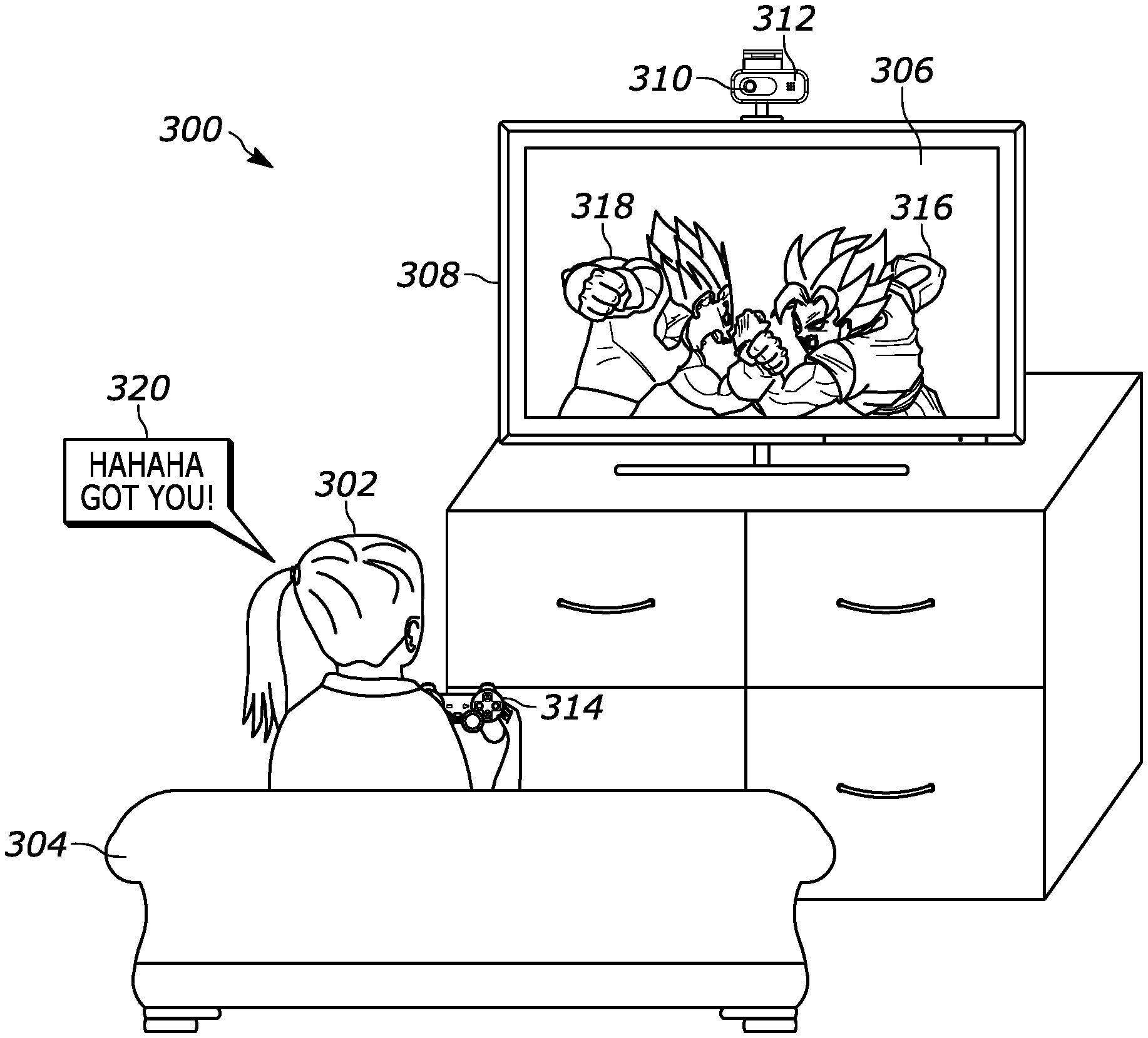
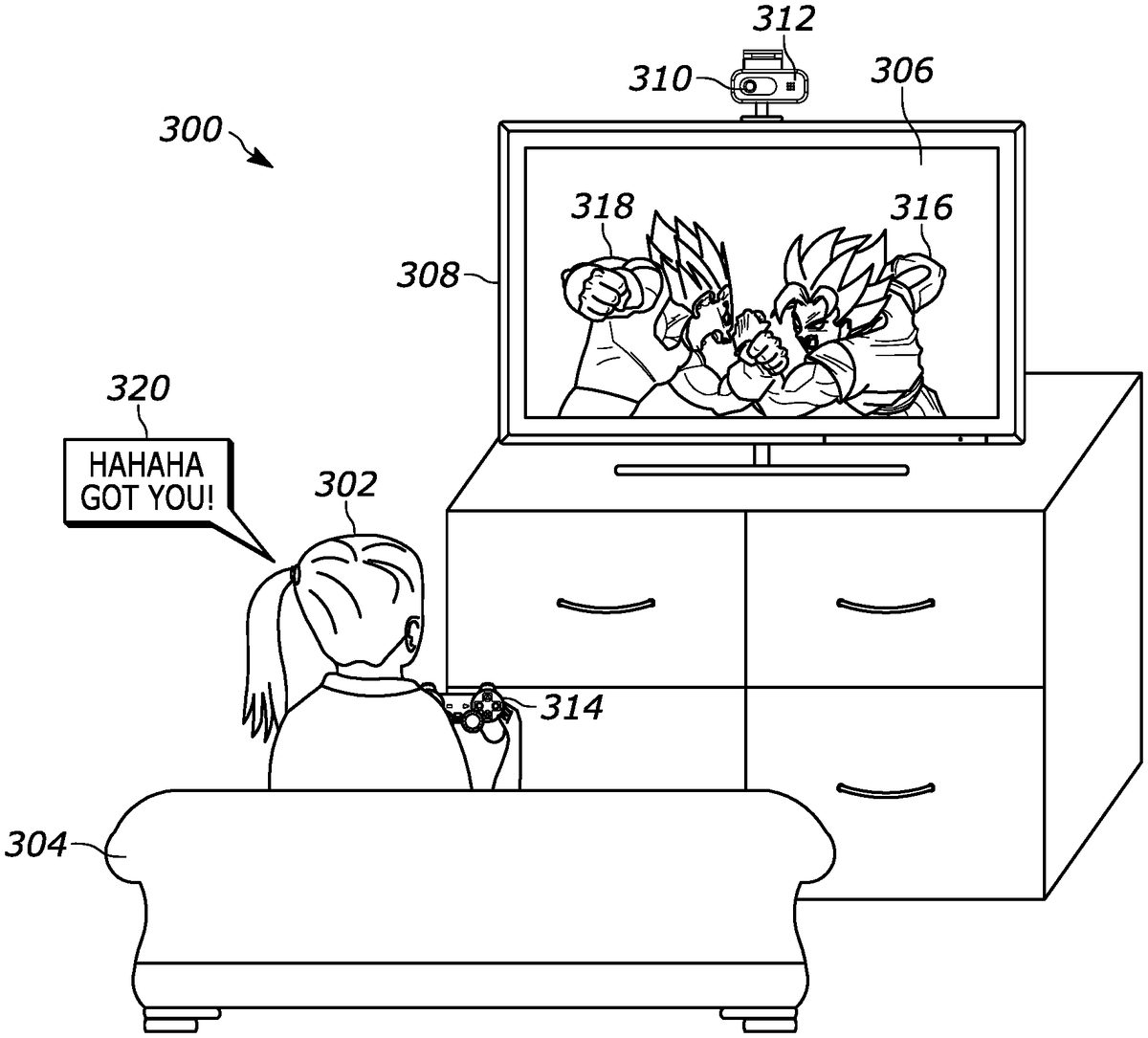
Now in reference toFIG. 3, an example illustration of a residential environment300of a particular human video game player302is shown. As depicted inFIG. 3, the player302is sitting on a couch304while playing a video game306presented using a television display308and its associated speakers (not shown), possibly under control of a video game console (also not shown) or other device such as the television display308itself and/or a remotely-located server. The television display308may also include a camera310to collect images or video of the player302while playing the game306, as well as a microphone312to collect audio from the player302while playing the game306.
As also shown inFIG. 3, the player302is using a video game controller314to execute a kill shot using a first video game character316controlled by the player302via the controller314. Note that only the arm of the character316is shown on the television display308as the game is being presented from the point of view of the character316himself. As shown, the kill shot is directed in the video game306to a second video game character318that is an opponent of the player302and/or character316. The character318may controlled by another human player located in the environment300or remotely from the environment300. Or, the character318may be controlled by a computer that is executing the video game306itself and thus is not under control of another human being.
As also shown inFIG. 3, upon landing the kill shot on the character318, the player302may exclaim “Ha ha ha. I got you!” as illustrated by speech bubble320. The microphone312may detect this exclamation, and in response the device executing the game306and/or an associated device may store audio data of this exclamation and associate it with one or more other pieces of data, such as video game video of the kill shot being performed, video collected by the camera310showing the player302while landing the kill shot, and data indicating the inputs of the player302using the controller314to land the kill shot.
More than one video clip may be curated by using such data and associations. The curated video clips may then be presented to the player302and others for searching and viewing in a straightforward manner, as depicted inFIG. 4.
Specifically,FIG. 4shows an example graphical user interface (GUI)400that may be presented on a display of a computing device, such as the television308, a smartphone of the player302, or the display of another device. In some examples, the GUI400and its associated video clips may be stored in a cloud storage location somewhere where they may be accessed publicly by others over the Internet.
As shown, the GUI400relates to a video game titled “Zombie Invasion”. Should a user wish to view curated video game clips for other games, the user may direct touch or cursor input to selector402to cause another menu to be presented from which the user may select another video game for which a similar GUI of curated video clips may be presented.
As also shown, the GUI400may include one or more columns for searching amongst the video clips for “Zombie Invasion”. The clips themselves may be represented in column404by thumbnail screen shots406of a frame of the respective clips. Each thumbnail screen shot406may be selected via touch or cursor input to initiate playback of the associated video clip itself.
Each of the ensuing columns to be described may be searchable by selecting the respective title of the column itself shown at the top of the column (e.g., “time/date”, “player”, “location”, etc.). In response to selection of the respective title, the shots406may then be reorganized in column404in a particular manner based on the sorting for the respective other column that is selected. For instance, shots406may be organized top to bottom in reverse chronological order as shown in column408based on selection of the title “time/date”409for the column408. As another example, shots406may be organized top to bottom by human video game player according to alphabetical order of the first character of the respective player's name based on selection of the title “player”411for the column410, though this sorting is not shown inFIG. 4since, in the example shown, the shots406have already been ordered top to bottom in column404in reverse chronological order.
As still another example, shots406may be organized top to bottom by geographical location and/or a user-designated location name based on selection of the title “location”413for the column412. Example geographical locations within the state of North Carolina are shown in the GUI400, as well as example user-designed location names associated with geographical locations such as “David's house”. In some implementations, the shots406may be sorted top to bottom based on selection of the title “location”413for the column412in alphabetical order of a first character of the location name.
The GUI400also shows that a column414may be presented. The column414may pertain to “kill shots”, which may be video game character attacks or attack patterns that resulted in a video game opponent being killed in the video game. As shown, the column414may indicate particular types of kill shots, as well as a particular video game character or type of character that was killed for the “Zombie Invasion” video game. As an example, an entry in column414may indicate a kill shot to an opponent's head or chest, where the opponent may be a video game “boss” (e.g., lead character or character encountered at the end of a level or the game itself). The opponent may also be a minion of the boss. “Not applicable” entries may also be indicated for shots406and associated videos that do not show a kill shot, and may further indicate in some examples that the respective shot406actually shows the associated video game player indicated in column410as losing to a video game opponent. Based on selection of the title “kill shot”415at the top of column414, the shots406may be organized top to bottom according to an alphabetical order of the first character of the respective name of the kill shot as indicated in column414.
The GUI400may also include a column416. The column416may pertain to similar input combinations provided by a respective player listed in column410via an input device used to play the video game “Zombie Invasion”. The input combinations may include inputs to a joystick on a video game controller as well as inputs to buttons on the video game controller, a keyboard, a mouse, or whatever other input device might be used to play the video game.
A sequence may be determined, for instance, based on game data accompanying the video game indicating that a single character move or particular action is to be executed based on a particular sequence of plural inputs. A sequence may also be determined based on identification of the player as practicing a particular input combination a threshold number of times greater than one while waiting for the game to load or for a particular level to load. Then the device executing the video game may identify the input sequence during gameplay based on the inputs of the sequence being received in the specified sequence all within a threshold non-zero time of each other. The threshold time may be specified by the game developer or other person or entity.
Furthermore, note that in some examples input sequences may be identified as similar and hence indicating the same input combination based on an artificial intelligence engine or other computer program determining similarity of input sequences within a threshold tolerance. The threshold tolerance may be used since, for example, not every joystick movement might be precisely the same each time the respective player executes a particular input combination at least in part using the joystick.
As shown inFIG. 4, boxes in the column416may indicate respective directional inputs418of a particular input sequence using arrows in certain directions to indicate joystick or arrow key inputs in those respective directions as part of the respective combination. Boxes in column416may also indicate certain button inputs420of the sequence by indicating the respective button itself (e.g., an “A”, “B”, or “C” button as shown). Similar button combinations may then be listed or grouped together in the column416based on selection of the title417to sort the shots406by listing shots top to bottom consecutively that all indicate the same input sequence. One or more listing parameters may be used for which group of shots to list first, such as listing combinations with initial “up” directional inputs first at the top of the column416, then combinations with initial “down” directional inputs below that, then combinations with initial “right” directional inputs below that, then combinations with initial “left” directional inputs below that, then combinations with initial “A” button inputs below that, then combinations with initial “B” button inputs below that, then combinations with initial “C” button inputs below that, and so on.
Still in reference toFIG. 4, the GUI400may also include a column422. The column422may allow for searching or sorting of the shots406and hence corresponding video clips based on other categories or types of highlights besides kill shots. For example, other categories of highlights might include wins where a player from column410prevails over a video game opponent, win celebrations the player might do after winning against a video game opponent, amusing or funny moments that might have occurred during gameplay, moments of positive exclamations (e.g., “David can't contain himself” because of happiness in beating a certain opponent or level), moments of negative exclamations (e.g., “John throws his controller down” because of frustration in not being able to beat a certain opponent of level), etc. In this respect, note that in some examples the respective shots406may be selectable to initiate playback not only of video clips of the gameplay itself but also associated video clips showing the player himself or herself while playing the video game as might have been collected, e.g., using the camera312described above.
Another example of a category of highlights may be high-action sequences where the respective player is involved in performing a threshold non-zero number of moves using his or her video game character all within a threshold time of each other. In fact,FIG. 4shows a sub-category of that where it indicates a high-action loss to a video game opponent in particular.
The moves or move sequences from gameplay that result in these types of highlights may be identified and categorized by an artificial intelligence categorization engine. The engine may have been built by the video game's developers, by the developers of the underlying video game system itself (e.g., XBOX®), etc. and may have been built using training data in supervised or unsupervised fashion to identify and categorize certain events indicated in video game streams. The highlights indicated in column422may be sorted and grouped consecutively from top to bottom in the column422based on selection of the title423and listed in alphabetical order of the first character of the respective highlight category or type.
Column424indicates yet another way to search video clips related to gameplay of the game “Zombie Invasion”. Column424pertains to montages that were generated from multiple, separate video clips generated at different points of time during gameplay that have been combined together to form a respective montage of continuous video based on the commonality of the respective video clips. Note that the text for each entry in column424may itself be a selectable link to initiate playback of the respective montage that was generated. Also note that each separate video clip associated with the respective shot406as listed in column404may form part of the respective montage indicated in column424for the same respective row.
Thus, for instance, the “play all similar” link in the first row for column424may be selected to play a video montage of head kill shots of the same boss as indicated in column415. Other options may include a “play best of” option where the best respective video clips of a respective type may be grouped as a montage and presented (as might have been determined using artificial intelligence software), as well as a “play all head kill shots from this week” option to initiate playback of a montage of all head kill shots performed by a particular player within the specified time frame. Other example montages may relate to chest shots where the player used his or her video game character to strike an opponent in the chest, as well as montages of frustrating moments endured by a certain player and montages of all video clips in which a particular input combination was performed by the player. The respective montages in each row may then be grouped together, top to bottom, in alphabetical order of the first character of the montage type based on selection of the title425.
The GUI400may include still other columns providing other ways to search video clips associated with the respective screen shots406. For instance, a column426may be presented for searching other attacks that might have been performed by a respective player other than a kill shot attack. Note that where kill shots are indicated for the respective video clip in column414, a simple “not applicable” indicator may be presented in column426for the same shot406. But for non-kill shots, the type of non-kill shot attack may be listed. For example, the attack may be an attack striking the leg of a video game opponent or a double face punch that does not end up killing the opponent. These attacks may be sorted based on selection of the title427, top to bottom, in alphabetical order of the first character of the first word listed for each entry in this column.
Still further, in some embodiments the GUI400ofFIG. 4may include a custom search feature428where a user may enter search parameters or keywords into input box430. These parameters or keywords may then be fed into an artificial intelligence model that may then use them to identify all video clips that might conform to the parameter(s) or be associated with the keyword(s). Those video clips may then be listed as part of the GUI400or as part of a separate GUI for the user to peruse them and select them for playback. The parameters or keywords may be user-defined, and/or they may correspond to the titles for each column discussed above.
Referring now toFIG. 5, it shows example logic that may be executed by a device such as the system100, a video game console, a server, etc. consistent with present principles for curating video game-related videos for searching and viewing. In some examples, the logic ofFIG. 5may be executed in conjunction with use of an artificial intelligence model that may classify various video clips of gameplay, such as the model600ofFIG. 6that will be described later.
Beginning at block500, the device may collect data during gameplay of a particular video game. Then at block502the device may analyze the data, which may include audio data indicating words and sounds made by a particular video game player while playing the video game, video data indicating actions and mannerisms of the particular video game player while playing the video game, and input device data indicating various inputs that the player provided via a controller, keyboard, etc. to play the video game. As shown for block502, this analysis may be performed using machine learning and/or an artificial neural network of the model referenced above.
From block502the logic may then proceed to block504where the device may, based on the analysis of block502, identify or classify consecutive frames of video of the gameplay as respective video clips indicating kill shots, particular button combinations, wins against video game opponents, funny moments, etc. and then extract those video clips from the stored video at block506. The identification or classification may be performed using the machine learning or artificial neural network described above. Additionally or alternatively, the identification/classification may be performed using object recognition software and/or using action recognition software (e.g., to identify kill shots and other moves), using voice recognition software and sentiment classification (e.g., to identify exclamations, laughter, etc.), based on identifying a certain predefined input sequence as being executed as indicated in the input data, etc. Also note that the corresponding gameplay audio for the respective video clip that indicates sounds from the video game may also be included in each extracted video clip, as well as audio from the player himself or herself as detected by a microphone. The audio from the player may be merged with the gameplay audio and included as part of an extracted video clip.
The logic may then move to block508where the device may curate and tag the extracted video clips based on the identifications or classifications. For example, the classifications themselves may be used as searchable tags for the video clips, e.g., kill shots or even head kill shots in particular that are tagged in metadata for the respective clips.
From block508the logic may then proceed to block510where the device may make the video clips (or even still pictures) available for searching and viewing. For example, the device may store the video clips and their respective tags and other metadata at a storage location accessible to one or more video game players, and even the public at large. The device may also make a GUI like the GUI400ofFIG. 4available for searching and viewing of the video clips, such as through an online website or portal, through a video game service, through a mobile device application, etc.
Now describingFIG. 6, it shows an example artificial intelligence architecture/model600which may be used by a device consistent with present principles. The architecture600may include various video game inputs602, a classification layer604, and a fusion layer606.
First describing the video game inputs602, they may be collectively synchronized or grouped based on the inputs all being related to a multimodal event such as a kill shot or other game event for which multiple different types of data are collected. Thus, the inputs602may include video frames608that may be image frames from gameplay involving the event as sampled at a particular frame rate such as a 60 Hz window size (and even video of the associated player while playing the video game). The inputs602may also include audio samples610, which may be recordings of both audio from a microphone indicating words spoken by a player of the video game during the event, as well as audio from gameplay of the video game itself such as words spoken by video game characters and sounds generated by the characters and other sounds generated by the game itself during the event. The inputs610may be audio samples that are sampled at a particular rate such as a 16 KHz window size.
The inputs602may also include analog controller input612generated by input devices used by the player to play the video game during the event, such as mice, joysticks, video game controllers, keyboards, etc. The inputs602may also include digital controller input614generated by those input devices during the event. Both the inputs612and614may be user inputs that are sampled at a one KHz window size.
The classification layer604may take the inputs602and transform them into normalized data (e.g., using onehot encoding and binning) that can be fed into convolutional neural networks, which may be each trained with a single label determined by a developer that ties or links a multimodal event together.
As shown inFIG. 6for the classification layer604, a sliding window or stream of “F” frames of the video input608may be progressively fed into a convolutional neural network (CNN)616for video classification of the input608. One example CNN that may be used for the CNN616is an Inception ConvNet CNN, though other CNNs for video classification that also have input and output layers as well as multiple hidden layers in between may also be used.
As also shown for the classification layer604, a sliding window or stream of “S” samples of the input610may be progressively fed into another CNN618for audio classification of the input610. Still further, a heatmap of “K” samples for the input device inputs612,614may be progressively fed into a CNN620for heatmap classification. Output class labels626from outputs layers of the CNNs616,618, and620may then be fed as input into a long short-term memory (LSTM) recurrent neural network (RNN)622for output fusion. Example labels626include “victory_moment”, “headshot”, and “epic_dodge”.
In some examples, during training, outputs from the CNNs616,618,620may be abstracted out using a softmax function for a respective hidden layer toward the end of each respective network616,618,620. The respective hidden layer may be selected from each of the CNNs616,618,620by a developer and may be a layer just before the output classification layer, e.g. a hidden layer one or two layers before the output classification layer. So, for instance, this hidden layer may be established by a matrix of weights that comes before the final label “decision” step of the output layer. Thus, each of the CNNs616,618, and620may be trained to predict the same class label independent of the other networks616,618,620.
Output fusion may then occur at the fusion layer606using the LSTM RNN622to render an output class label624based on the fusion for a given window of gameplay, which may then be used for searching and curating of corresponding screenshots and video (e.g., video used as part of the input602) consistent with present principles. The window may be as big or small as warranted, e.g., as specified by a developer. The RNN622may even maintain a memory of the various inputs to it over time so that the final decision of the class may have a temporal weight. Specifically, the probability of a class label may not be independent at every time step so if at a previous time step the model600put out “victory_moment” as a label, then at the next time step “victory_moment” may be heavily expected to be the next label again, and thus the label may decay as the model600gains more evidence that this label is correct or not.
Now describingFIG. 7, it shows an example settings GUI700that may be presented on the display of a video game player's device for configuring settings of a system configured to undertake present principles. Each setting or option to be described below may be selected by directing touch or cursor input to the adjacent check box.
Thus, the GUI700may include a first setting702that is selectable to configure the user's device or another device operating consistent with present principles to undertake the actions described herein to identify and curate video clips for searching and viewing. For instance, the setting702may be selected to set or enable a device to present the GUI400ofFIG. 4, to undertake the logic ofFIG. 5, and/or to use the architecture ofFIG. 6.
The GUI700may also include a setting704that is selectable to enable or set the device to only curate and present video clips to a particular user of that particular user's own actions during gameplay and not the actions of any other players. Thus, the GUI400ofFIG. 4may be tailored to a particular user in this example.
The GUI700may also include various other options706for selecting various types of data to use for video clip curation. These types of data may include controller or keyboard input, audio of the player as he or she plays the game (as opposed to audio of the game itself), video of the player as he or she plays the game (as opposed to video of the game itself), and video of the game itself but from the virtual perspective of another player of the video game as might be presented on the display of another player's device that might be playing the video game as that character. This video from the virtual perspective of another player/character may then be included in a video or video montage that may be selected for playback based on manipulation of the GUI400.
The GUI700may further include various options708to specify types of video clips of gameplay to curate. This may include video clips identified as indicating kill shots, wins over video game opponents, losses against video game opponents, and funny or amusing moments during gameplay.
It may now be appreciated that present principles provide for an improved computer-based user interface that improves the functionality and ease of use of the devices disclosed herein. The disclosed concepts are rooted in computer technology for computers to carry out their functions.
It is to be understood that whilst present principals have been described with reference to some example embodiments, these are not intended to be limiting, and that various alternative arrangements may be used to implement the subject matter claimed herein. Components included in one embodiment can be used in other embodiments in any appropriate combination. For example, any of the various components described herein and/or depicted in the Figures may be combined, interchanged or excluded from other embodiments.
Claims
- A device, comprising: at least one processor;and storage accessible to the at least one processor and comprising instructions executable by the at least one processor to: analyze a user's gameplay of a video game;and generate one or more searchable video clips based on the user's gameplay;wherein the analysis of the user's gameplay of the video game comprises analysis of audio from the user detected via a microphone, and wherein at least one of the searchable video clips is generated based on identification from the audio of one or more of: laughter, a positive exclamation by the user, a negative exclamation by the user.
- The device of claim 1 , wherein the analysis of the user's gameplay of the video game comprises analysis of user inputs received via an input device, and wherein the instructions are executable to: analyze the user inputs received via the input device by associating similar input sequences that are identified from the user inputs;and make video clips of the similar sequences searchable by input sequence.
- The device of claim 2 , wherein each similar input sequence comprises plural inputs received within a threshold non-zero time of each other.
- The device of claim 1 , wherein at least one of the searchable video clips is generated based on identification from the audio of laughter.
- The device of claim 1 , wherein at least one of the searchable video clips is generated based on identification from the audio of a positive exclamation by the user.
- The device of claim 1 , wherein at least one of the searchable video clips is generated based on identification from the audio of a negative exclamation by the user.
- The device of claim 1 , wherein at least one of the searchable video clips comprises video from the perspective of a first video game character different a second video game character controlled by the user.
- The device of claim 7 , wherein the first video game character is a character controlled by another person besides the user.
- The device of claim 1 , wherein the one or more video clips are searchable by one or more of: attacking a particular area of an opponent's body, moments the user does not prevail against a video game opponent, amusing or funny moments.
- The device of claim 1 , wherein the one or more video clips are searchable by one or more of: montage of attacking a particular area of an opponent's body, montage of moments the user does not against a video game opponent, montage of amusing or funny moments.
- A computer-implemented method, comprising: analyzing, using a device, data of a user playing a video game;and making video clips of the user's gameplay searchable based on the analysis;wherein at least one of the video clips comprises video from the perspective of a first video game character different a second video game character controlled by the user;and wherein the analyzing of the data of the user playing the video game comprises analyzing audio from the user detected via a microphone, and wherein the method comprises making at least one of the video clips searchable based on identification from the audio of one or more of: laughter, a positive exclamation by the user, a negative exclamation by the user.
- A computer readable storage medium (CRSM) that is not a transitory signal, the computer readable storage medium comprising instructions executable by at least one processor to: analyze a user's gameplay of a video game;and generate one or more searchable video clips based on the user's gameplay;wherein at least one of the searchable video clips comprises video from the perspective of a first video game character different a second video game character controlled by the user;and wherein the analysis comprises analysis, using at least one artificial neural network, of similar player input sequences to an input device, and wherein the searchable video clips are grouped together by similar player input sequence.
- The computer-implemented method of claim 11 , wherein the first video game character is a character controlled by another person besides the user.
- The computer-implemented method of claim 11 , wherein at least one of the video clips is made searchable based on identification from the audio of laughter.
- The computer-implemented method of claim 11 , wherein at least one of the video clips is made searchable based on identification from the audio of a positive exclamation by the user and/or a negative exclamation by the user.
- The CRSM of claim 12 , wherein the analysis of the user's gameplay of the video game comprises analysis of audio from the user detected via a microphone, and wherein at least one of the searchable video clips is generated based on identification from the audio of one or more of: laughter, a positive exclamation by the user, a negative exclamation by the user.
- The CRSM of claim 16 , wherein at least one of the searchable video clips is generated based on identification from the audio of laughter.
- The CRSM of claim 16 , wherein at least one of the searchable video clips is generated based on identification from the audio of a positive exclamation by the user and/or a negative exclamation by the user.
- The computer-implemented method of claim 11 , wherein the analyzing comprises analyzing, using at least one artificial neural network, similar player input sequences to an input device, and wherein the video clips are made searchable by similar player input sequence.
Disclaimer: Data collected from the USPTO and may be malformed, incomplete, and/or otherwise inaccurate.