U.S. Pat. No. 10,987,596
SPECTATOR AUDIO ANALYSIS IN ONLINE GAMING ENVIRONMENTS
AssigneeAmazon Technologies, Inc.
Issue DateMay 17, 2019
Illustrative Figure
Abstract
An audio analysis system that may analyze participant audio input in a game spectating environment. The audio analysis system may receive audio input for participants (broadcasters and/or spectators) in a game spectating system. The audio analysis system may analyze the audio input to generate audio analysis information for broadcasts, and provide the information to the game spectating system. The audio analysis information may be applied in the game spectating system in various ways. For example, the information may be used to determine active or popular broadcasts, broadcasters, games, and/or recordings of broadcasts, and the active or popular content may be indicated to spectators via a game spectating user interface. The audio analysis system may provide an application programming interface (API) to receive the audio input and to provide audio analysis information.
Description
While embodiments are described herein by way of example for several embodiments and illustrative drawings, those skilled in the art will recognize that embodiments are not limited to the embodiments or drawings described. It should be understood, that the drawings and detailed description thereto are not intended to limit embodiments to the particular form disclosed, but on the contrary, the intention is to cover all modifications, equivalents and alternatives falling within the spirit and scope as defined by the appended claims. The headings used herein are for organizational purposes only and are not meant to be used to limit the scope of the description or the claims. As used throughout this application, the word “may” is used in a permissive sense (i.e., meaning having the potential to), rather than the mandatory sense (i.e., meaning must). Similarly, the words “include”, “including”, and “includes” mean including, but not limited to. DETAILED DESCRIPTION Various embodiments of methods and apparatus for analyzing and applying audio input from participants in online gaming environments are described. Online games and game spectating systems may support audio (voice or speech) input/output and communications for game players and/or for game spectators. For example, a player in an online game may communicate commands, suggestions, comments, strategy, chat, or other information to other players within the game via audio input to a respective computing device. As another example, a broadcaster may provide vocal commentary to spectators via an audio channel of a game spectating system. As another example, spectators in an online game system may provide cheers, comments, or other audio input to an online game, or spectators in a game spectating system may provide cheers, comment, chat, or other audio input for broadcasts via audio input channels to the game spectating system. Aggregated participants' (player and/or spectator) audio signals may ...
While embodiments are described herein by way of example for several embodiments and illustrative drawings, those skilled in the art will recognize that embodiments are not limited to the embodiments or drawings described. It should be understood, that the drawings and detailed description thereto are not intended to limit embodiments to the particular form disclosed, but on the contrary, the intention is to cover all modifications, equivalents and alternatives falling within the spirit and scope as defined by the appended claims. The headings used herein are for organizational purposes only and are not meant to be used to limit the scope of the description or the claims. As used throughout this application, the word “may” is used in a permissive sense (i.e., meaning having the potential to), rather than the mandatory sense (i.e., meaning must). Similarly, the words “include”, “including”, and “includes” mean including, but not limited to.
DETAILED DESCRIPTION
Various embodiments of methods and apparatus for analyzing and applying audio input from participants in online gaming environments are described. Online games and game spectating systems may support audio (voice or speech) input/output and communications for game players and/or for game spectators. For example, a player in an online game may communicate commands, suggestions, comments, strategy, chat, or other information to other players within the game via audio input to a respective computing device. As another example, a broadcaster may provide vocal commentary to spectators via an audio channel of a game spectating system. As another example, spectators in an online game system may provide cheers, comments, or other audio input to an online game, or spectators in a game spectating system may provide cheers, comment, chat, or other audio input for broadcasts via audio input channels to the game spectating system. Aggregated participants' (player and/or spectator) audio signals may be used to provide background chatter or “crowd noise” for an online game or broadcast. The participants' audio input signals may be captured by audiovisual (A/V) input components on the participants' respective client devices, digitized, and transmitted over a network to the online game or spectating system. At the online game or spectating system, at least some of the participants' audio signals may be aggregated, processed, and transmitted to the players' and/or spectators' client devices for output as game or broadcast audio.
Embodiments of audio analysis methods and systems are described that may process and analyze the various audio inputs from players, broadcasters, and/or spectators in online gaming environments and apply the analysis information to affect game play and/or game spectating in various ways. Embodiments of an audio analysis module or system are described that may, for example, be used with online games to process and apply audio input from players and/or spectators of the online game to affect play of the online game. In addition, embodiments of an audio analysis module or system are described that may be used in a game spectating system to process and apply audio input from broadcasters and/or spectators in the game spectating system to affect online games and/or the game spectating system.
In some embodiments, game player audio for multiple players (e.g., players in groups or teams) may be analyzed to determine, for example, the current states (e.g., emotions, moods, excitement level, stress level, anger, sadness, happiness, frustration, fear, shock, surprise, amusement, etc.) of the players/groups, and game play may be affected based on the analysis. In some embodiments, game spectator audio for multiple spectators may be analyzed to determine, for example, the states (e.g., emotions, moods, excitement level, stress level, anger, sadness, happiness, frustration, fear, shock, surprise, amusement, etc.) of the spectators or crowd, and game play may be affected based on the analysis. In some embodiments, player and/or spectator audio may be analyzed to determine events or states within one, two or more broadcasts or channels in a game spectating system, and the analysis results may be used to affect the game spectating interface, for example by indicating or highlighting broadcasts or events of interest within broadcasts to the spectators. In some embodiments, player and/or spectator audio may be analyzed to determine interesting or notable events (“highlights”) in the broadcasts and/or games executing on the game systems. Highlight segments may be extracted from the broadcasts according to the highlight data; the highlight segments may then be presented to participants via respective participant devices.
Game systems may provide a speech interface via which game players can vocally enter commands to the game engine, for example to control game execution or control the players' in-game characters. For example, a player may speak “pause game” or “end game” commands to control game execution, or may speak commands such as “turn left”, “look up”, and “open door” to control actions of the player's in-game character. While embodiments of an audio analysis system may analyze vocal inputs to a game system's speech interface to detect states (emotion, mood, excitement etc.) of the players, the audio analysis system does not itself act as a speech interface to the game engine to interpret and execute vocal commands to the game engine.
In at least some embodiments, an audio analysis module or system may include, but is not limited to, an emotion recognition component and a speech recognition component. The emotion recognition component may receive and analyze voice input from participants, for example using one or more signal analysis techniques, to determine emotions or emotional states (e.g., excitement, stress, fear, shock, surprise, amusement, anger, sadness, happiness, frustration, etc.) for participants or groups of participants from the participants' vocal patterns. The identified emotions or states may then be applied to determine information about and affect a game or broadcast in various ways as described herein. The speech recognition component may receive and analyze voice input from participants to detect and extract speech for participants, may recognize speech patterns that identify particular participants, and may extract words and/or phrases that may be applied to determine information about and affect a game or broadcast in various ways as described herein.
Online games are network-based games that may allow one, two, or more players, in some cases even thousands of players, to simultaneously participate in a game from consumer devices coupled to a network. At least some online games may provide a “spectator” or “observer” mode that allows spectators to watch game play from consumer devices coupled to the network without directly participating in the game. At least some online games may also allow game sessions to be recorded and played back for viewing by the players and/or spectators.
Online games that may be implemented in online gaming environments as described herein may vary from tightly scripted games to games that introduce varying amounts of randomness to the game play. An online game may, for example, be a game in which the players attempt to achieve some goal or overcome some obstacle, and may include multiple levels that the players have to overcome. An online game may, for example, be a game in which the players cooperate to achieve goals or overcome obstacles, or a game in which one or more of the players compete against one or more other players, either as teams or as individuals. Alternatively, an online game may be a game in which the players may more passively explore and make discoveries within a complex game universe without any particular goals in mind, or a “world-building” online game in which the players may actively modify their environments within the game universe. Online games may include everything from relatively simple, two-dimensional (2D) casual games to more complex 2D or three-dimensional (3D) action, sports, or strategy games, to multiplayer online battle arena (MOBA) games, to complex 3D massively multiplayer online games (MMOGs) such as massively multiplayer online role-playing games (MMORPGs) that may simultaneously support hundreds or thousands of players in a persistent online “world”.
Game spectating systems may include network-based video streaming systems that may allow players to broadcast live streams of their online game play to tens, hundreds, thousands or more spectators, while allowing the spectators to select the broadcasts of particular players (also referred to as channels) for viewing. A game spectating system may support live streaming of broadcasts from tens, hundreds, or thousands of players simultaneously. A game spectating system may record at least some live broadcasts and allow the recorded broadcasts to be played back for viewing by spectators. A game spectating system may support live and recorded broadcasts for one, two, or more different online games.
In this document, the term “player” is generally used to refer to an actual human that actively participates in an online game, the term “spectator” is generally used to refer to an actual human that watches live or recorded game play online without directly participating in the game as a player, the term “participant” is generally used to collectively refer to players (active participants) and spectators (passive participants), the term “client” (as in “client device”, “game client”, “broadcasting client”, and “spectating client”) is generally used to refer to a hardware and/or software interface to a game system or streaming system via which a participant interacts with the game system and/or spectating system, and the term “character” or “game character” is generally used to refer to a player's in-game presence or “avatar” that the player may control via a game client on a client device to interact with other game characters, other game entities, and other objects within the game environment during a game session.
While embodiments are primarily described herein in the context of analyzing and applying audio input in multiplayer online gaming environments in which two or more players remotely participate in online game sessions, it is to be noted that embodiments may also be applied in single-player online games, as well as in single-player and multiplayer games that are not necessarily online, such as single-player and multiplayer console games that may be played locally/offline. In addition, in some embodiments, a spectating system may support broadcasts of live and/or recorded digital media content from sources other than game systems, for example from sports games, competitions, concerts, and other events including but not limited to live streams from electronic spectator sports (eSports) competitions, and embodiments may also be applied to analyze and apply audio input for these broadcasts.
While embodiments are primarily described herein in the context of analyzing and applying audio input in online gaming environments to detect states of participants affect an online game and/or spectating system broadcast, it is to be noted that embodiments may also analyze content of other participant inputs to the online gaming environment, for example text input to an online chat user interface element of an online game or spectating system broadcast, and may use that analysis alone or in combination with the audio analysis to detect states of participants and affect an online game and/or spectating system broadcast as described herein.
In addition, some embodiments may also collect and analyze other data from the participants, and may use that analysis alone or in combination with the analysis of the participant audio and/or textual inputs to detect states of participants and to affect an online game and/or spectating system broadcast as described herein. As an example, some embodiments may obtain and analyze biometric data (e.g., pulse, heartrate, perspiration, etc.) for participants, for example from wearable devices that collect biometrics, and that analysis may be used alone or in combination with analysis of other inputs such as audio inputs to determine states of participants and affect an online game and/or spectating system broadcast as described herein
As another example, some embodiments may obtain images of participants' faces (broadcasters, players, commentators and/or spectators) captured during game play or broadcast, for example images captured by cameras attached to or integrated with the participants' respective client devices. The images may be analyzed, for example using facial recognition techniques and techniques that detect emotions via analysis of facial expressions, and that analysis may be used alone or in combination with analysis of other inputs such as audio inputs to determine states of participants and affect an online game and/or spectating system broadcast as described herein.
As another example, some embodiments may obtain images of participants' eyes (broadcasters, players, commentators and/or spectators) captured during game play or broadcast, for example images captured by cameras attached to or integrated with wearable computing devices such as smart glasses, goggles, optical head-mounted displays, virtual reality (VR) headsets, and the like. The images may be analyzed, for example using techniques that detect emotions or other states via tracking and analysis of eye movements, blinking, dilation, and so on, and that analysis may be used alone or in combination with analysis of other inputs such as audio inputs to determine states of participants and affect an online game and/or spectating system broadcast as described herein.
Audio Analysis and Application in Online Game Systems
FIG. 1is a high-level block diagram that illustrates providing analysis of player and/or spectator audio in an online game system, according to at least some embodiments. In some embodiments, an online game system may include a game system100and multiple client devices; the client devices may include player devices120A and spectator devices120B. The game system100stores game data and information, implements game logic, and serves as an execution environment for the online game. Each client device120may include, but is not limited to, input and output components and client software for the online game via which respective players can participate in a game session currently being executed by the game system100, and via which one or more spectators may watch current game sessions or recorded game sessions.
The online game system may also include an audio analysis module or system110. In some embodiments, audio analysis system110may include one or more computing devices, for example one or more server devices, that implement an audio analysis engine that provides audio analysis functionality and one or more application programming interfaces (APIs) to the audio analysis functionality. Audio analysis system110may also include or access other devices including but not limited to storage devices for storing audio analysis information for individual participants (players and/or spectators), groups, crowds, and/or games including but not limited to audio content patterns (emotion and/or speech patterns) that can be matched or mapped to individual participants' states, group or crowd states, particular game events, keywords and key phrases, and so on. In some embodiments, audio analysis system110may be implemented as a separate system from game system100, for example as a network-based service that is accessible by one or more entities including but not limited to game system100. In some embodiments, audio analysis system110may instead be implemented as a component, module, or subsystem of a game system100.FIGS. 14 and 15illustrate components and operations of an audio analysis system110, according to at least some embodiments.
In some embodiments, audio analysis system110functionality may be implemented in part on client devices120. For example, in some embodiments, an audio analysis client module may be installed on at least some client devices120, may locally perform audio analysis for a participant (player or spectator) associated with the client device120, and may stream or upload the participant audio analysis information to the game system100and/or audio analysis system110for aggregation with other audio information and further analysis.FIG. 16illustrates analysis of audio performed at least in part on client devices in an online gaming environment, according to at least some embodiments.
FIG. 2is a high-level flowchart of a method for analyzing and applying audio input from participants in an online game system, according to at least some embodiments. The method ofFIG. 2may, for example, be implemented in online game systems as illustrated inFIG. 1.
As indicated at200ofFIG. 2, digital audio input may be obtained from participants (players and/or spectators) in a current game session in an online game system, for example a multiplayer online game. Referring toFIG. 1, in some embodiments, client devices120may include audiovisual (A/V) components that may receive and digitize audio (e.g., voice or speech) input from game players and/or game spectators during game play and/or game spectating. In some embodiments, game system100may receive player audio input from player devices120A, and may also receive spectator audio input from spectator devices120B. The digital audio input may, for example, be received by game system100as an audio track in video input, as Voice over IP (VoIP), or according to other network formats or protocols.
In some embodiments, metadata may be obtained for the audio input signals. The metadata may, for example, identify respective participants corresponding to the audio input signals, indicate whether a participant is a player or a spectator, and indicate other known information about the participant and/or game session. In some embodiments, at least some of the metadata may be obtained from profile information for participants (spectators and/or players) in the online gaming environment, for example participant profiles maintained by the game system100. For players, the metadata may, for example, indicate the players' roles or characters within the virtual game universe, the players' affiliations (e.g., groups or teams) in the game session, indicate the current location, orientation, view, status, time (within the game universe or game session timeline) and other information for the player's character within the game session or game universe, and so on. For spectators, the metadata may, for example, uniquely identify the spectator, and may also indicate spectating information such as where, what, and who the spectator is currently viewing within the game universe/game session, team or player affiliations or favorites, spectating history, and so on.
As indicated at202ofFIG. 2, the digital audio input may be analyzed to determine information about the participants and/or the game session. Referring toFIG. 1, in some embodiments, the game system100may provide the received audio input to an audio analysis system110. The audio analysis system110may perform signal analysis, for example time- and frequency-domain analysis, on the audio signals to determine one or more audio signal metrics (voice and/or speech metrics) from the audio signals. The metrics may, for example, include one or more of amplitude, pitch, duration, and frequency metrics, and in general any relevant metric that can be extracted from an audio or voice signal. The audio signal metrics may be analyzed, for example by comparing the metrics to known or learned audio content patterns for individual participants or groups of participants according to one or more emotion recognition and speech recognition techniques, to determine information about the participants and/or the game session.
In some embodiments, the audio signals may be individually analyzed to determine voice and/or speech metrics for each audio input, and the metrics may then be normalized, aggregated, and analyzed to determine information about groups of participants (players and/or spectators). In some embodiments, instead of or in addition to separately analyzing the audio signals and then aggregating the metrics for further analysis, the audio signals may be aggregated or combined and analyzed collectively to generate metrics for and information about groups of participants.
In some embodiments, the metadata obtained for the audio input signals may be used when analyzing the audio input signals to determine information about the spectators and/or players. For example, the metadata may indicate affiliations or team preferences for spectators of a sports game based on the spectators' profile information maintained by the game system100. The spectator audio signals for a game may be segmented into two or more groups according to the metadata, for example into groups of fans of two opposing teams in a sports game such as football according to the spectators' indicated team affiliations, and analyzed separately according to the groups to determine group-specific information about the current game session. For example, the group-specific information may indicate which group of spectators are currently cheering or booing, which group is the loudest and/or quietest, and so on. Player/broadcaster audio signals may also be segmented into groups (e.g., opposing teams) according to player profile information for player group analysis.
In some embodiments, the determined information may, for example, indicate an emotion or emotional state or states (e.g., excitement, stress, anger, sadness, happiness, frustration, fear, shock, surprise, amusement, etc.) of individual participants (players and/or spectators) based on the analysis of the individual participants' vocalizations or other sounds in the respective audio signals. In some embodiments, the determined information may also indicate other information about individual participants, for example affiliations or preferences of spectators. For example, spectators may be detected to be fans of particular players or teams based on the analysis of the individual participants' vocalizations or other sounds in the respective audio signals. In some embodiments, the determined information may be use to segment participants into two or more groups, for example fans of particular players or teams, based on the analysis of the individual participants' vocalizations or other sounds in the respective audio signals. In some embodiments, the determined information may instead or also indicate a state or states for a group or crowd (e.g., excitement, stress, approval, disapproval, etc.) based on an analysis of the combined audio signal metrics for two or more participants (players and/or spectators). In some embodiments, the information may also indicate a level for a determined state, for example an indication of how excited a crowd of spectators appears to be based on an analysis of aggregated spectator audio input.
In some embodiments, the information may also indicate particular events in an online game session. For example, in some embodiments, at least some of the audio content patterns to which the audio signal metrics are matched may be mapped to particular types of events in the respective online game. For example, in a sports game, particular crowd (spectator) and/or player audio content patterns may be mapped to big plays, such as scoring plays or great defensive plays. In some embodiments, the information may anticipate or predict a potential upcoming event in an online game session. For example, in a sports game, particular crowd (spectator) and/or player audio content patterns may be mapped to what typically happens prior to a particular big event, such as crowd silence or chanting before an important offensive play in a football game, or very low crowd noise before a big defensive play in a football game. In some embodiments, the information may also indicate locations and times within the game universe for particular events to which the analyzed audio signals are mapped. For example, analysis of aggregated spectator or player audio signals and correlated metadata may indicate a particular location or area in the online game universe, and a particular time within the game timeline.
In some embodiments, the information may also indicate other information about individual participants, for example affiliations or preferences of spectators (e.g., fans of particular players or teams). For example, spectators may be detected to be fans of a particular player or team based at least in part on their audible input (cheering, booing, loud, quiet, etc.) at particular times or in response to particular events in a game or broadcast. As another example, spectators may be detected to be fans of a particular player or team based at least in part on particular keywords, phrases, or chants recognized in their speech input to the broadcast. In some embodiments, a spectator's detected affiliations or preferences may be added to their profile information. In some embodiments, the spectator's profile information may be modified over time based upon additional analysis of their audio or other inputs.
As indicated at204ofFIG. 2, the audio analysis information may be applied within the online game system. In some embodiments, the audio analysis information may be used to provide visual feedback or other feedback to the participants within the game environment, for example by displaying game and/or spectating information for participants via a user interface (UI) to the game system100provided by a game client executing on the client devices120. The following provides several examples of applying audio analysis information within an online game system. However, note that these examples are not intended to be limiting.
As an example of applying audio analysis information within an online game system, in some embodiments, two or more players may be participating as a team, there may be one or more teams, and the audio that is analyzed may include the collaborative in-game voice chat of the players within the team(s). The audio analysis information may indicate an emotion or emotional state (e.g., stress, excitement, calmness, anger, sadness, happiness, frustration, etc.) for a team as a whole, for a collection of two or more teams, and/or for the individual players within the team(s). This information may be displayed or otherwise provided to the team members and/or other players in the game (e.g., players on other teams, players that are controlling or commanding one or more teams, and so on), and may, for example, be used in making game-playing decisions by team members or team commanders. For example, in a battle game, a commander of two or more teams may decide to send a second team into an area that a first team is in based on excitement or stress level detected from the audio signals of the first team.
As another example of applying audio analysis information within an online game system, the audio analysis information may indicate an emotion or emotional state (e.g., stress, excitement, anger, sadness, happiness, frustration, etc.) for one or more of the players, and the players' avatars or online characters as displayed in the game universe may be visually modified, for example using colors, to indicate the respective players' emotions or emotional states. For example, currently stressed or angry players' online characters may be shaded red, while currently calm players' characters are not shaded or are shaded green or blue. As another example, the expression on the faces of the players' online characters may be modified to indicate the detected emotion or emotional state of the respective players. As another example, a visual and/or audio indication of an online character's heartbeat or pulse may be provided to indicate a player's excitement level as detected from analysis of audio input from the player. In some embodiments, the players' online characters may be otherwise affected by the audio analysis information for the respective players. For example, the online characters of currently excited players may be given an “adrenalin boost” that temporarily affects the online characters' capabilities, strength, speed, etc.
As another example of applying audio analysis information within an online game system, the audio analysis information for spectators may be leveraged to identify particular players or teams who are of interest. For example, the audio signals for spectators viewing a particular player or team may indicate that the player/team is involved in an exciting or interesting game event. This information may be displayed or otherwise provided to game players and/or spectators, for example as a marker or other highlight on a displayed game map for the game universe.
As another example of applying audio analysis information within an online game system, the audio analysis information for spectators may be leveraged to affect particular players or teams within the game. For example, the audio signals for spectators viewing a particular player or team may indicate that the player/team has spectator backing or is a spectator favorite. This information may be used to positively affect or reward the player/team within the game, for example by boosting player/team health, providing supplies, providing points, or in various other ways. Conversely, spectator audio analysis may be used to identify players/teams that have low spectator approval, which may be used to negatively affect the players/teams in-game.
As another example of applying audio analysis information within an online game system, the audio analysis information for players and/or spectators may be leveraged to identify particular locations, areas, or regions within the game world at which activity is “hot”. For example, the audio signals for players in and/or spectators viewing a particular area or location may indicate that the players and/or spectators are excited and thus that game activity is “hot” in that area. A user interface to the online game may display a map or portion of a map of the online game world, and areas or locations that have been identified as active according to analysis of the audio signals may be marked or highlighted on the map.
As another example of applying audio analysis information within an online game system, the audio analysis information for players and/or spectators may be leveraged to identify the times and locations of particular important events or “highlights” in the game session, and to mark or tag recordings of the game sessions indicating the important events. For example, the audio signals for players in and/or spectators viewing a game session may indicate that the players and/or spectators are excited at particular times and locations, and thus that important or interesting events happened at those times/locations. A recording of the game session or of a participant's view of the game session may be tagged with metadata indicating the times and locations of the detected events. A playback of the game session may then indicate to the viewer(s) the tagged events so that the viewer(s) can jump to the game session highlights. In some embodiments, the game session highlights may be presented to the viewers via a highlight user interface (UI). In some embodiments, the viewers may be allowed to vote on highlights via the UI.FIG. 12illustrates an example method for determining and presenting highlights in a game spectating environment, according to at least some embodiments.FIG. 13provides a non-limiting example of a highlight user interface for a game spectating system, according to some embodiments.
In some game system environments, a game session, and thus a recording of the session, may include multiple games, matches, or portions of games. As another example of applying audio analysis information within an online game system, the audio analysis information for participants may be leveraged to identify multiple games, matches, or portions of games (quarters, halves, innings, etc.) within a session. For example, audio signals for participants in a game session may indicate breaks in action at particular times in the session, or may indicate other events that may be used to determine the start and end of games, matches, and so on. A recording of the game session may be tagged with metadata indicating the determined start/stop times of games, matches, etc. on the recording. During a playback of the game session, the game system UI may indicate the tagged events to the viewer(s) so that the viewer(s) can select or jump to particular games, matches, etc.
As another example of applying audio analysis information within an online game system, the audio analysis information for players and/or spectators may be segmented into two or more groups (e.g., opposing teams, fans of particular players or teams, etc.) based on profile information for the respective participants and analyzed separately according to the groups to determine group-specific information about games. For example, the group-specific information may indicate which group of spectators are currently cheering or booing, which group is the loudest and/or quietest, and so on. The group-specific information may be used to provide visual feedback to the players and/or spectators, for example visual feedback indicating current levels of excitement in the groups supporting opposing teams. For example, virtual representations of spectators on one side of a stadium or arena in an online sports game may be made to stand up, wave flags, or otherwise visually respond when spectators that are determined to be fans of a particular team and/or player are cheering or booing loudly.
In some embodiments, game system100may record at least some of the game sessions, and the recordings may be made available to players and/or spectators for replay. The recordings may include recorded player and/or spectator audio. As another example of applying audio analysis information within an online game system, the audio information from online game sessions may be analyzed, and the analysis may be used in ranking or recommending recordings of the game sessions and/or to tag events of interest within the recordings of the game sessions. In some embodiments, the spectator and/or player audio generated during the game sessions may be analyzed to determine particular recorded game sessions of interest. In some embodiments, the recordings of interest may be indicated on at least some of the client devices120, for example by highlighting the recordings on the game client user interface (UI). In some embodiments, the audio generated by the spectators and/or players during the game session may be analyzed to determine particular events of interest within the game session. In some embodiments, the events of interest within a recorded game session may be tagged with metadata stored with the recordings, and the events of interest may be indicated on a client device120when playing back the recording, for example by highlighting the events on a timeline of the recorded game session on the game client UI. The analysis of the audio information from the game sessions may be performed during the live game session, or alternatively may be performed on the recorded or archived game session data.
As indicated by the arrow returning from element204to element200, in at least some embodiments, the method ofFIG. 2may be an iterative process in which audio input for a game session is iteratively obtained, analyzed and applied within the online game system while the game session is active.
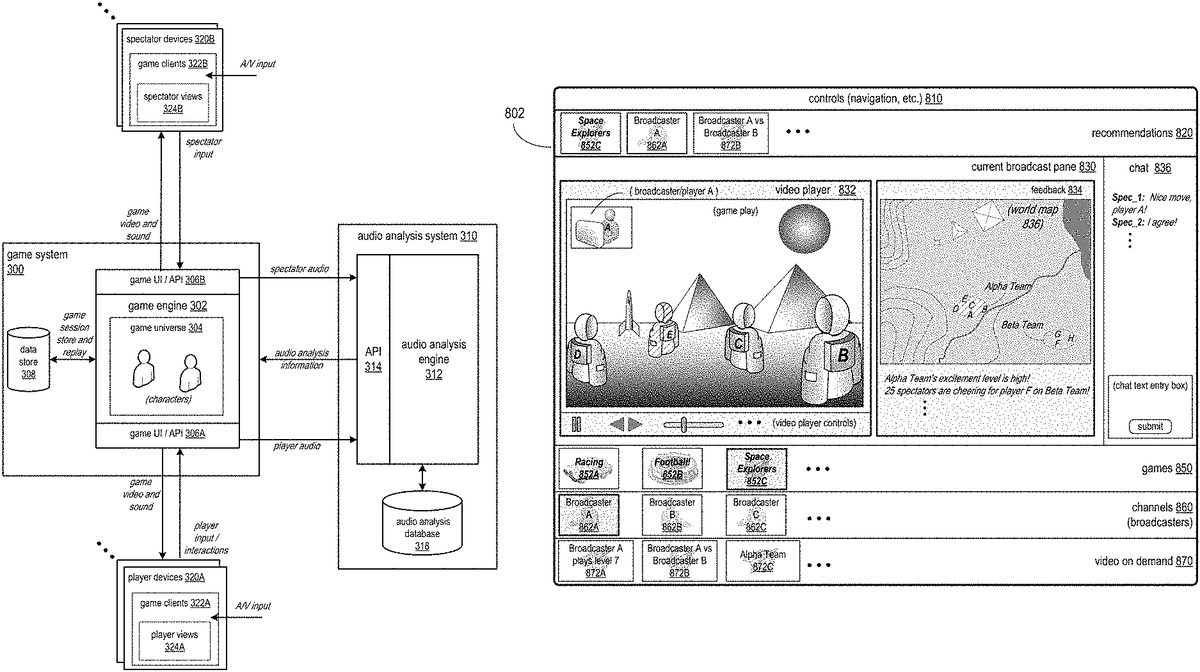
FIG. 3illustrates an audio analysis module or system that provides analysis of player and/or spectator audio in an online game system, according to at least some embodiments.FIG. 3shows an online game system as illustrated inFIG. 1in more detail. In some embodiments, an online game system may include a game system300and multiple client devices; the client devices may include player devices320A and spectator devices320B. The online game system may also include an audio analysis module or system310.
In at least some embodiments, a game system300stores game data and information in a data store308, implements game logic (game engine302), and serves as an execution environment for the online game. The game system300may also implement one or more user interfaces (UIs) and one or more application programming interfaces (APIs) (shown as UI/API306A and306B) to the game system functionality. In some embodiments, game system300may include one or more computing devices, for example one or more server devices, that implement the game logic, and may also include other devices including but not limited to storage devices that store game data including but not limited to recordings of game sessions and participant information. However, in some embodiments, functionality and components of game system300may be implemented at least in part on one or more of the client devices. An example computing device that may be used in a game system300is illustrated inFIG. 18.
A client device320may be any of a variety of consumer devices including but not limited to desktop computer systems, laptop/notebook computer systems, pad/tablet devices, smartphone devices, game consoles, handheld gaming devices, and wearable devices. Wearable devices may include, but are not limited to, gaming glasses or goggles and gaming “watches” or the like that are wearable on the wrist, arm, or elsewhere. Thus, client devices320may range from powerful desktop computers configured as gaming systems down to “thin” mobile devices such as smartphones, pad/tablet devices, and wearable devices. Each client device320may implement an operating system (OS) platform that is compatible with the device. A client device may include, but is not limited to, input and output components and client software (game client322) for the online game via which respective players can participate in a game session currently being executed by the game system300, and via which one or more spectators may watch current game sessions or recorded game sessions. The game client322on a particular client device320may be tailored to support the configuration and capabilities of the particular device type and the OS platform of the device. An example computing device that may be used as a client device320is illustrated inFIG. 18.
In at least some embodiments, the game system300may implement an online multiplayer game, and the game system300may be or may include one or more devices on a network of a game provider that implement the game engine302and UI/API306and that serve as or provide an execution environment for the online multiplayer game. In these online multiplayer game environments, client devices320are typically remotely located from the game system300and access the game system300via wired and/or wireless connections over an intermediate network or networks such as the Internet. Further, client devices320may typically have both input and output capabilities for playing and/or spectating the online multiplayer game.
In some embodiments, instead of a game system300implemented according to a client-server model or variation thereof in which one or more devices such as servers host most or all of the functionality of the online game, a game system300may at least in part be implemented as or on local devices that implement at least a portion of the game logic, for example gaming consoles that serve as local execution environments for console-based online multiplayer games installed on the console or executed from media inserted into the console. One or more client devices320may be local to the system300and access the system300via local wired or wireless connections for game play or spectating.
In some embodiments, instead of a game system300implemented according to a client-server model or variation thereof in which one or more devices such as servers host most or all of the functionality of the game system300, a game system300may be implemented according to a distributed or peer-to-peer architecture in which at least some of the game functionality and components of the game system300are distributed among one, two, or more client devices that collectively participate in a peer-to-peer relationship to execute, play in, and/or spectate game sessions.
In some embodiments, an online game system may also include an audio analysis module or system310. In some embodiments, audio analysis system310may include one or more computing devices, for example one or more server devices, that implement an audio analysis engine312and one or more application programming interfaces (APIs)314to the audio analysis functionality. Audio analysis system310may also include other devices including but not limited to storage devices that store audio analysis information (shown as audio analysis database318) for individual participants, groups, crowds, and/or games including but not limited to audio content patterns that can be matched or mapped to individual participants' states, group or crowd states, particular game events, and so on. In some embodiments, audio analysis system310may be implemented as a separate system from game system300, for example as a network-based service that is accessible by one or more entities including but not limited to game system300. In some embodiments, audio analysis system310may instead be implemented as a component, module, or subsystem of a game system300.FIGS. 14 and 15illustrate operations of an example audio analysis system310, according to at least some embodiments.
In some embodiments, audio analysis system310functionality may be implemented in part on client devices320. For example, in some embodiments, an audio analysis client module may be installed on at least some client devices320, may locally perform audio analysis for a participant (player or spectator) associated with the client device320, and may stream or upload the participant audio analysis information to the game system300and/or audio analysis system310for aggregation and analysis with other audio information.FIG. 16illustrates analysis of audio performed at least in part on client devices in an online game system, according to at least some embodiments.
For a particular game session, the game engine302of the game system300may generate a game universe304that includes the game session's context, characters, and environment. The players manipulate their characters within this universe304via the players' client devices320A. The game system300may generate and display a view324A of the game universe304from the perspective of each player's character to the player via the game client322A on the player's respective client device320A, and may receive player input to and interactions with the game universe304via the player's manipulation of each player's respective character via the game client322on the player's respective client device320A. The game system300may also generate and display a view324B of the game universe304from the current perspective or viewpoint of each spectator via the game client322B on the spectator's respective client device320B. However, note that the spectators typically do not have characters or avatars that appear within the game universe304.
The following is a broad description of an example method for game execution, and is not intended to be limiting. Typically, game logic/execution of the game system300is implemented in game engine302according to event-driven architecture in which a game event loop monitors for and reacts to players' inputs to and interactions with the game universe304via their characters as controlled by client devices320A. Based upon the players' inputs and interactions with the universe304and on other game factors (e.g., scripted events and/or a randomness component) at iterations of the game event loop, the game session progresses along a game session timeline, with the game universe304being modified and updated accordingly.
In some embodiments, concurrent with the game event loop execution, game system300renders a 2D or 3D representation of the universe304based on the current state of the universe304, generates video and sound according to a video frame rate based upon the rendering, and sends or streams the video and sound output to the client devices320A and/or320B for display. Note that video and sound may be generated for and sent or streamed to each client device320A or320B according to a corresponding participant's current perspective or view of the universe304. The game clients322on these client devices320may be referred to as “thin” game clients as the game clients may not implement a 2D or 3D rendering component. However, in some embodiments, at least a portion of the actual rendering may be performed by “thick” game clients322on the client devices320that do implement a 2D or 3D rendering component. In these implementations, instead of the game system300performing the full rendering of the game universe304into video and sound and sending the video and sound to “thin” game clients322on client devices320for display, the game system300may instead send universe304data to the client devices320from which thick game clients322can render and display video and sound.
Client devices320may include audiovisual (A/V) components such as video cameras and microphones that may receive audio (e.g., voice or speech) input from game players and/or spectators during game play and/or spectating. In some embodiments, game system300may receive player audio input from player devices320A, and may also receive spectator audio input from spectator devices320B. In some embodiments, the game system300may receive the audio input via UI/API306A and306B. The audio input may, for example, be received by game system300as audio tracks in video input, as Voice over IP (VoIP), or according to other network formats or protocols that support digital audio transmission. Game system300may communicate with the audio analysis system310via API314to provide spectator and/or player audio to the audio analysis system310for analysis and to receive audio analysis information from the audio analysis system310. The game system300may then apply the audio analysis information to affect game play in various ways, for example as described in reference to element204ofFIG. 2.
While embodiments are primarily described in the context of analyzing and applying audio input in a game system300, it is to be noted that embodiments may also analyze content of other participant input to a game system300, for example text input to a chat user interface element provided by the game client322interface, and may use that analysis alone or in combination with the audio analysis to detect states of participants and affect an online game and/or spectating system broadcast, for example as described in reference to element204ofFIG. 2. In addition, some embodiments may also collect and analyze other data from the participants, including but not limited to images of the participants' faces and/or eyes, and may use that analysis alone or in combination with the analysis of the participant audio and/or textual inputs to detect states of participants and to affect an online game and/or spectating system broadcast as described herein.
Audio Analysis and Application in a Game Spectating System
FIG. 4is a high-level block diagram that illustrates providing analysis of player and/or spectator audio in a game spectating system, according to at least some embodiments. A game spectating system may include a spectating system430, one or more game systems400, and multiple client devices; the client devices may include broadcaster devices420A and spectator devices420B. Each broadcaster device420A may include, but is not limited to, input and output components and game client software for at least one online game400via which respective players can participate in game sessions currently being executed by the game system(s)400. Each broadcaster device420A may also include input and output components (e.g., video cameras and microphones) and broadcasting client software for the spectating system430via which respective players (or broadcasters) may generate live A/V streams of their online game play and commentary for broadcasting to spectators via the game spectating system430. The players or broadcasters may also receive spectator feedback (e.g., audio and/or textual commentary or chat) from the spectating system430, for example via the broadcasting client software. Each spectator device420B may include, but is not limited to, input and output components and spectating client software via which respective spectators may interact with the spectating system430to select, receive, and view live broadcasts from the broadcasters or playbacks of previously recorded broadcasts, and via which the spectators may provide spectator feedback (e.g. audio or textual commentary) for broadcasts.
Spectating system430may be a network-based video streaming system that may allow players to broadcast live streams of their online game play to tens, hundreds, thousands or more spectators, while allowing the spectators to select the broadcasts of particular players (also referred to as channels) for viewing. A spectating system430may support live broadcasts for one, two, or more different game systems400, and may support live streaming of broadcasts from tens, hundreds, or thousands of broadcaster devices420A to the spectator devices420B. In some embodiments, a spectating system430may record at least some live broadcasts and allow the recorded broadcasts to be played back for viewing by spectators.
WhileFIG. 4shows game systems400as separate from spectating system430, in some embodiments, at least one game system400may be implemented at least in part by spectating system430. In some embodiments, one or more broadcaster devices420A may be implemented within spectating system430.
In some embodiments, a spectating system430may support broadcasts of live and/or recorded digital media content via broadcaster devices420A from sources490other than game systems400. For example, in some embodiments, the spectating system430may support live or recorded broadcasts of streams from sports games, competitions, concerts, and other events including but not limited to live streams from electronic spectator sports (eSports) competitions. eSports (also referred to as competitive gaming) generally refers to organized multiplayer video game competitions. For example, video cameras and audio equipment may be installed in an arena or other venue in which an event such as a sports game or an eSports competition is being held. Video and/or audio feeds from the equipment may be input to one or more broadcaster devices420A that may composite and stream the audio/video (A/V) inputs to the spectating system430. For eSports events, game A/V may be added to the stream along with the feeds from the cameras and audio equipment. Commentators and/or broadcasters may input their audio, text, and/or video content into the stream as well. The live stream may be broadcast to spectator devices420B by the spectating system430, and/or may be recorded for rebroadcast. Spectators may view the broadcast on spectator devices420B, and may also input A/V and/or text input via the spectating system430clients on their devices420B.
The game spectating system may also include an audio analysis module or system410. In some embodiments, audio analysis system410may include one or more computing devices, for example one or more server devices, that implement an audio analysis engine that provides audio analysis functionality and one or more application programming interfaces (APIs) to the audio analysis functionality. Audio analysis system410may also include or access other devices including but not limited to storage devices for storing audio analysis information for individual participants (players, broadcasters, and/or spectators), groups, crowds, and/or games including but not limited to audio content patterns (emotion and/or speech patterns) that can be matched or mapped to individual participants' states, group or crowd states, particular game events, keywords and key phrases, and so on. In some embodiments, audio analysis system410may be implemented as a separate system from spectating system430, for example as a network-based service that is accessible by one or more entities including but not limited to spectating system430. In some embodiments, audio analysis system410may instead be implemented as a component, module, or subsystem of spectating system430.FIGS. 14 and 15illustrate components and operations of an audio analysis system410, according to at least some embodiments.
In some embodiments, audio analysis system410functionality may be implemented in part on client devices420. For example, in some embodiments, an audio analysis client module may be installed on at least some client devices420, may locally perform audio analysis for a participant (broadcaster or spectator) associated with the client device420, and may stream or upload the participant audio analysis information to the spectating system430and/or audio analysis system410for aggregation and analysis with other audio information.FIG. 16illustrates analysis of audio performed at least in part on client devices in a game spectating system, according to at least some embodiments.
FIG. 5is a high-level flowchart of a method for analyzing and applying player audio in a game spectating system, according to at least some embodiments. The method ofFIG. 5may, for example, be implemented in a game spectating system as illustrated inFIG. 4.
As indicated at500ofFIG. 5, digital audio input may be obtained from participants (broadcasters and/or spectators) in active broadcasts in a game spectating system. Referring toFIG. 4, in some embodiments, client devices420may include audiovisual (A/V) components that may receive and digitize audio (e.g., voice or speech) input from broadcasters and/or spectators during broadcasts. In some embodiments, spectating system430may receive broadcaster audio input from broadcaster devices420A, and may also receive spectator audio input from spectator devices420B. The digital audio input may, for example, be received by spectating system430as an audio track in video input, as Voice over IP (VoIP), or according to other network formats or protocols.
In some embodiments, metadata may be obtained for the audio input signals. The metadata may, for example, identify respective participants corresponding to the audio input signals, indicate whether a participant is a broadcaster or a spectator, and indicate other known information about the participant and/or broadcast. In some embodiments, at least some of the metadata may be obtained from profile information for participants (spectators and/or broadcasters) in the spectating system, for example from participant profiles maintained by the spectating system430and/or game systems400. For broadcasters, the metadata may, for example, indicate the identity of the broadcaster within the spectating system, indicate the online game400that the broadcaster is currently playing/broadcasting, indicate the broadcaster's roles or characters within the virtual game universe of the online game400, indicate the broadcaster's affiliations (e.g., groups or teams) in the online game400, indicate the current location, orientation, view, status, time (within the game universe or game session timeline) and other information for the broadcaster's character within the game session or game universe, indicate the broadcaster's broadcasting and game playing histories, and so on. For spectators, the metadata may, for example, uniquely identify the spectator, identify the game and broadcast that the spectator is currently watching, indicate the spectator's affiliations (e.g., favorite team) in the online game universe, indicate a current location and/or view for the spectator in the game universe (e.g., which side of a stadium the spectator is (virtually) located at), spectating history, and so on.
As indicated at502ofFIG. 5, the digital audio input may be analyzed to determine information about the broadcasts. Referring toFIG. 4, in some embodiments, the spectating system430may provide the received audio input to an audio analysis system410. The audio analysis system410may perform signal analysis, for example time- and frequency-domain analysis, on the audio signals to determine one or more metrics (voice and/or speech metrics) from the audio signals. The metrics may, for example, include one or more of amplitude, pitch, duration, and frequency metrics, and in general any relevant metric that can be extracted from an audio or voice signal. The audio signal metrics may be analyzed, for example by comparing the metrics to known or learned audio content patterns for individual participants or groups of participants according to one or more emotion recognition and speech recognition techniques, to determine information about the participants and/or the broadcasts.
In some embodiments, the audio signals may be individually analyzed to determine voice and/or speech metrics for each audio input, and the metrics may then be aggregated and analyzed to determine information about groups of participants (e.g., crowds of spectators) associated with a broadcast or broadcasts. In some embodiments, instead of or in addition to separately analyzing the audio signals and then aggregating the metrics for further analysis, the audio signals from a broadcast may be aggregated or combined and analyzed collectively to generate metrics for and information about the spectators watching the broadcast. For example, the audio signals may be aggregated and analyzed as “crowd noise” for the broadcasts.
In some embodiments, the metadata obtained for the audio input signals may be used when analyzing the audio input signals to determine information about the broadcasts, spectators, players, and/or games. For example, the metadata may indicate affiliations or team preferences for spectators of a sports game based on the spectators' profile information maintained by the spectating system430. The spectator audio signals for a game may be segmented into two or more groups according to the metadata (e.g., into groups of fans of two opposing teams in a sports game such as football according to the spectators' indicated team affiliations) and analyzed separately according to the groups to determine group-specific information about the games in the spectating system. For example, the group-specific information may indicate which group of spectators are currently cheering or booing, which group is the loudest and/or quietest, and so on. Player audio signals may also be segmented into groups (e.g., opposing teams in a game) according to player profile information for player group analysis.
In some embodiments, the determined information may, for example, indicate an emotion or emotional state or states (e.g., excitement, stress, fear, shock, surprise, amusement, anger, sadness, happiness, frustration, etc.) of individual participants (broadcasters and/or spectators) based on the analysis of the individual participants' vocalizations or other sounds in the respective audio signals. In some embodiments, the determined information may instead or also indicate a state or states for a group or crowd of participants (e.g., excitement, stress, approval, disapproval, etc.) based on an analysis of the combined audio signal metrics for two or more participants (broadcasters and/or spectators). In some embodiments, the information may also indicate a level for a determined state, for example an indication of how excited a group or crowd of spectators watching a particular broadcast appears to be based on an analysis of aggregated spectator audio input for the broadcast.
In some embodiments, the determined information may also indicate particular events in a broadcast or game session being streamed. For example, in some embodiments, at least some of the audio patterns to which the audio signal metrics from a broadcast are matched may be mapped to particular types of events in an online game that is being broadcast on a broadcaster's channel. For example, in a sports game, particular crowd (spectator) and/or player audio patterns may be mapped to big plays, such as scoring plays or great defensive plays. In some embodiments, the information may anticipate or predict a potential upcoming event in an online game session. For example, in a sports game, particular crowd (spectator) and/or player audio patterns may be mapped to what typically happens prior to a particular big event, such as crowd silence or chanting before an important offensive play in a football game, or very low crowd noise before a big defensive play in a football game. In some embodiments, the information may also indicate locations and times for particular game universe events to which the analyzed audio signals are mapped. For example, analysis of spectator and broadcaster audio signals and the correlated metadata may indicate a particular location or area in an online game universe, and a particular time within the game timeline, for a game session being broadcast by the broadcaster.
In some embodiments, the audio inputs for two or more broadcasts may be separately analyzed to determine audio metrics for each broadcast (e.g., how loud or excited the crowd of spectators watching the broadcast are, or how excited or vocal the respective broadcaster is), and then the metrics for the broadcasts may be collectively analyzed to determine meta-information about the broadcasts, for example which broadcast is currently most popular, which broadcast has the loudest or most crowd noise, and so on.
In some embodiments, a spectating system430may support broadcasts of live and/or recorded digital media content via broadcaster devices420A from sources490other than game systems400. For example, in some embodiments, the spectating system430may support broadcasts of live streams from sports games, competitions, concerts, and other events including but not limited to live streams from electronic spectator sports (eSports) competitions. For example, video cameras and audio equipment may be installed in an arena or other venue in which an event such as a sports game or an eSports competition is being held. Video and/or audio feeds from the equipment may be input to one or more broadcaster devices420A that may composite and stream the audio/video (A/V) inputs to spectators via the spectating system430. Commentators, broadcasters, and spectators may input their audio, text, and/or video content to the broadcast as well. In these embodiments, audio, text, or other inputs including but not limited to commentator, broadcaster, and spectator audio and text may be analyzed to determine information about the events being broadcast, and the determined information may be applied to the broadcasts in the spectating system environment in various ways, for example as described below in reference to element504.
As indicated at504ofFIG. 5, the audio analysis information may be applied within the game spectating system. In some embodiments, the audio analysis information may be used to provide visual or other feedback to the participants within the game spectating system, for example by displaying game and/or spectating information for spectators via a spectating user interface (UI) to the game spectating system430provided by a spectating client executing on the spectator devices420B.FIGS. 8 and 9provide non-limiting examples of a spectating UI for a game spectating system, according to some embodiments. In some embodiments, the audio analysis information may also be used to display game and/or spectating information for the broadcasters via a broadcaster user interface (UI) provided via a broadcasting client on the broadcaster devices420A.FIG. 10provides a non-limiting example of a broadcaster UI for a game spectating system, according to some embodiments. The following provides several examples of applying audio analysis information within a game spectating system. However, note that these examples are not intended to be limiting.
As an example of applying audio analysis information within a game spectating system, the audio analysis information for spectators of one or more broadcasts of a particular online game may be leveraged to identify particular players, locations, areas, or regions within a game world of the online game being broadcast for which activity is “hot”, for example as illustrated inFIG. 8. A map or portion of a map of the online game world may be displayed on at least some of the spectator devices420B, for example by a spectating UI as illustrated inFIG. 8, and players, teams, areas, regions, or locations that have been identified as active within the game according to analysis of the audio signals may be marked or highlighted on the map. In some embodiments, instead of or in addition to a map of active or interesting players and/or locations, textual information may be displayed indicating particularly players and/or locations of interest as determined by analysis of the audio signals. In some embodiments, audio announcements or sounds may be used to call attention to particular players and/or locations. In some embodiments, the information about players and/or locations of interest within a game world may also be provided to the game players, for example via feedback of the audio analysis information to the broadcaster devices420A and/or to the game system400.
As another example of applying audio analysis information within a game spectating system, the audio analysis information may indicate an emotion or emotional state (e.g., stress, excitement, anger, sadness, happiness, frustration, etc.) for one or more of the broadcasters, and the players' avatars or online characters in the game universe may be visually or otherwise affected in response to the respective broadcaster's detected state, for example as illustrated inFIG. 8.
As another example of applying audio analysis information within a game spectating system, the audio analysis information for spectators may be leveraged to affect the game characters and game play of the broadcasters. For example, the audio signals for spectators viewing a particular player's broadcast may indicate that the player/broadcaster has spectator backing or is a spectator favorite when compared to other players in the game, for example as illustrated inFIG. 10. This information may be used to positively affect or reward the player within the game, for example by boosting player health, providing supplies, providing points, or in various other ways. Conversely, spectator audio analysis may be used to identify players that have low spectator approval, which may be used to negatively affect the player in-game. In some embodiments, teams of players corresponding to broadcasters may be identified, and the teams may be affected in-game by the analysis of spectator audio for broadcaster(s) that are on the team.
As another example of applying audio analysis information within a game spectating system, aggregated audio analysis information for spectators of broadcasts of online games may be leveraged to identify particular currently active channels or broadcasts of interest, for example as illustrated inFIG. 8. In some embodiments, the channels of interest may be indicated on at least some of the spectator devices420B, for example by highlighting the channel(s) on a spectating UI, or adding the channels to a “recommended” or “hot” list for currently active channels. In some embodiments, the information about channels of interest may also be provided to the broadcasters, for example via feedback of the audio analysis information to the broadcaster devices420A indicating comparative channel popularity or ranking according to analysis of crowd noise for the respective channels.
As another example of applying audio analysis information within a game spectating system, aggregated audio analysis information for spectators of broadcasts of online games may be leveraged to identify particular broadcasters of interest. In some embodiments, the broadcasters of interest may be indicated on at least some of the spectator devices420B, for example by highlighting the broadcasters and/or the channel(s) associated with the identified broadcasters on the spectating UI, or adding the broadcaster(s) to a “recommended” or “hot” list for broadcasters, for example as illustrated inFIG. 8. In some embodiments, the information about broadcasters may also be provided to the broadcasters, for example via feedback of the audio analysis information to the broadcaster devices420A indicating the broadcasters' respective current popularity according to analysis of crowd noise on the broadcasters' respective channels.
As another example of applying audio analysis information within a game spectating system, the aggregated audio analysis information for spectators of broadcasts of online games may be leveraged to identify particular online games of interest, for example games for which activity is currently “hot” or interesting according to the “crowd noise” within the current game. In some embodiments, the games of interest may then be indicated on at least some of the spectator devices420B, for example by highlighting the games on the spectating UI, for example as illustrated inFIG. 8.
As another example of applying audio analysis information within a game spectating system, the spectator audio signals for a game or broadcast may be used to detect affiliations or preferences of spectators and to segment the spectators into two or more groups (e.g., fans of particular players or teams) based on the analysis. For example, spectators may be detected to be fans of a particular player or team based at least in part on their audible input (cheering, booing, loud, quiet, etc.) at particular times or in response to particular events in a game or broadcast. As another example, spectators may be detected to be fans of a particular player or team based at least in part on particular keywords, phrases, or chants recognized in their speech input to the broadcast. In some embodiments, a spectator's detected affiliations or preferences may be added to their profile information. In some embodiments, the spectator's profile information may be modified over time based upon additional analysis of their audio or other inputs.
As another example of applying audio analysis information within a game spectating system, the spectator audio signals for a game or broadcast may be segmented into two or more groups (e.g., fans of particular players or teams), for example based on profile information for the respective spectators or analysis of the spectators' individual audio signals to detect affiliations or preferences, and analyzed separately according to the groups to determine group-specific information about games in the spectating system. For example, the group-specific information may indicate which group of spectators are currently cheering or booing, which group is the loudest and/or quietest, and so on. The group-specific information may be used to provide visual and/or audio feedback to the players and/or spectators in the game spectating system, for example visual and/or audio feedback indicating current levels of excitement in the groups supporting opposing teams. For example, virtual representations of spectators on one side of a stadium or arena in an online sports game may be made to stand up, wave flags, or otherwise visually respond when spectators that are determined to be fans of a particular team and/or player are cheering or booing loudly, for example as illustrated inFIG. 9.
As another example of applying audio analysis information within a game spectating system, spectator audio output may be provided by the game spectating system via audio channel(s) of the broadcast to the spectators, particular groups of the spectators (e.g., to particular fans), and/or to the broadcaster(s) in response to the audio analysis information. For example, when spectators that are determined to be fans of a particular team and/or player are cheering or booing loudly, spectator audio output of the cheers or boos may be provided by the game spectating system to at least some of the spectators (e.g., to the fans of a particular team) via an audio channel of the broadcast. As another example, particularly interesting audio inputs may be detected from individual spectators or groups of spectators (e.g., a particular spectator cheering or chanting loudly, heckling a player, etc.), and spectator audio output of the interesting audio inputs may be provided by the game spectating system via an audio channel of the broadcast. In some embodiments, the spectator audio output may be generated from or as a mix of the spectator audio input(s). In some embodiments, the spectator audio output may be “canned”, pre-recorded, or synthesized sounds or sound tracks (e.g., crowd cheers or boos) that are played in response to the audio analysis information.
As another example of applying audio analysis information within a game spectating system, the individual spectator audio signals for a game or broadcast may be analyzed to detect currently interesting spectators, for example particular spectators that are cheering or chanting loudly or heckling a player, or spectators that are particularly happy, angry, or excited. The spectator's interesting audio input may be provided to other participants (spectators and/or broadcasters) by the game spectating system via an audio channel of the broadcast. In addition, in some embodiments, video or images of spectators that are identified as currently interesting based upon their audio input may be provided to the spectators and/or broadcasters, for example in a picture-on-picture window908overlaid on the broadcast video as shown inFIG. 9. The video may be video of the interesting spectator(s) captured by video cameras in their spectating environment or simulated video or images of avatars representing the spectator(s) and simulating their detected emotional state.
In some embodiments, spectating system430may record at least some of the broadcasts, and the recordings may be made available to spectators for replay. The recordings may include recorded spectator audio as well as the broadcasters' A/V stream. As another example of applying audio analysis information within a game spectating system, the crowd noise from broadcasts of online games may be analyzed, and the analysis may be used in ranking or recommending recordings of the broadcasts and/or to tag events of interest within the recordings of the broadcasts. In some embodiments, the crowd noise generated during the live broadcasts may be analyzed to determine particular recordings of interest. In some embodiments, the recordings of interest may be indicated on at least some of the spectator devices420B, for example by highlighting the recordings on the spectating UI. In some embodiments, the crowd noise generated during the live broadcasts may be analyzed to determine particular events of interest within the broadcasts. In some embodiments, the events of interest within a recorded broadcast may be tagged with metadata stored with the recordings, and the events of interest may be indicated on a spectator device420B when playing back the recording, for example by highlighting the events on a timeline of the recording on the spectating UI. The analysis of the audio information from the broadcasts to determine broadcasts and/or events of interest may be performed during the original live broadcasts, or alternatively may be performed on the recorded or archived broadcast data.
Broadcasts in a game spectating system, and thus recording of the broadcasts, may include multiple games or matches for a given game. For example, a broadcast of an eSports event may include multiple games or matches between players or teams competing in the eSports event. As another example of applying audio analysis information within a game spectating system, the audio analysis information for participants may be leveraged to identify and dag games or matches in recordings of the broadcasts. For example, audio signals for participants may indicate breaks in action at particular times, or other events that may be indicate the start and end of games, matches, and so on. A recording of the broadcast may be tagged with metadata indicating the determined start/stop times of games or matches on the recording. The spectating system UI may then indicate the tagged games or sessions to spectators so that the spectators can select or jump to particular recordings of games, or matches.
In some embodiments, the audio analysis information may be provided to one or more game systems400within the game spectating system. The audio analysis information may then be applied within the game system to affect game play within the game systems, for example as described in reference to element204ofFIG. 2.
As indicated by the arrow returning from element504to element500, in at least some embodiments, the method ofFIG. 5may be an iterative process in which audio input is iteratively obtained, analyzed and applied within the game spectating system while the game spectating system is active.
FIG. 6illustrates an audio analysis module or system that provides analysis of player and/or spectator audio in a game spectating system, according to at least some embodiments.FIG. 6shows a game spectating system as illustrated inFIG. 4in more detail. A game spectating system may include a spectating system630, one or more game systems600that each serve as an execution environment for an online game, and multiple client devices; the client devices may include broadcaster devices620A and spectator devices620B. The game spectating system may also include an audio analysis module or system610.
In at least some embodiments, game spectating system630may be a network-based video streaming system that may allow players to broadcast live streams of their online game play to tens, hundreds, or thousands of spectators, while allowing the spectators to select the broadcasts of particular players (also referred to as channels) for viewing via spectating client682software on the client devices. A spectating system630may support live broadcasts for one, two, or more different game systems600, and may support live streaming of broadcasts from tens, hundreds, or thousands of broadcaster devices620A to tens, hundreds, or thousands of spectator devices620B. In some embodiments, game spectating system630may include one or more servers632that implement live streaming of broadcasts received from many broadcaster devices620A to many spectator devices620B.
In some embodiments, game spectating system630may also include other devices including but not limited to storage devices (shown as data store638) that store data including but not limited to recordings of broadcasts and participant (spectator and broadcaster) information including but not limited participant profile information. Game spectating system630may store recordings of at least some broadcasts to a data store638, and may allow users to select and play back the recordings via spectating client682software on the client devices. A game spectating system630may also implement one or more user interfaces (UIs) and one or more application programming interfaces (APIs) to the game spectating system functionality. For example, a game spectating system630may implement a broadcasting UI/API634that broadcasters may access via broadcasting clients626to broadcast their live game play and other A/V input as a live stream, and a spectating UI/API636that spectators may access via spectating clients682to select, receive, and view live broadcasts from the broadcasters or playbacks of previously recorded broadcasts, and via which the spectators may provide spectator feedback (e.g. audio or textual commentary) for broadcasts.
WhileFIG. 6shows game systems600as separate from spectating system630, in some embodiments, at least one game system600may be implemented at least in part by spectating system630.
In some embodiments, at least some components of a game spectating system may be implemented in the context of a service provider that provides virtualized resources on a provider network to clients of the service provider, for example as illustrated inFIG. 17. For example, a game spectating system630and an audio analysis system610may be implemented as services on a provider network as illustrated inFIG. 17, and one or more game systems600may be implemented by game providers on the provider network.
A client device620may be any of a variety of consumer devices including but not limited to desktop computer systems, laptop/notebook computer systems, pad/tablet devices, smartphone devices, game consoles, handheld gaming devices, and wearable devices. Thus, client devices620may range from powerful desktop computers configured as gaming systems down to “thin” mobile devices such as smartphones, pad/tablet devices, and wearable devices. Each client device620may implement an operating system (OS) platform that is compatible with the device. A client device may include, but is not limited to, input and output components and client software. The client software on a particular client device620may be tailored to support the configuration and capabilities of the particular device type and the OS platform of the device. Each broadcaster device620A may include, but is not limited to, input and output components and game client622software for at least one online game600via which respective players can participate in game sessions currently being executed by the game system(s)600. Each broadcaster device620A may also include input and output components (e.g., video cameras and microphones) and broadcasting client626software for the spectating system630via which respective players/broadcasters may generate live A/V streams of their online game play and commentary for broadcasting to spectators via the game spectating system630. The broadcasters may also receive spectator feedback (e.g., audio and/or textual commentary or chat) from the spectating system630, for example via the broadcasting client626software. Each spectator device620B may include, but is not limited to, input and output components and spectating client682software via which respective spectators may interact with the spectating system630to select, receive, and view live or recorded broadcasts684, and via which the spectators may provide spectator feedback (e.g. audio or textual commentary) to broadcasters. An example computing device that may be used as a client device620is illustrated inFIG. 18.
In some embodiments, a game spectating system may also include an audio analysis system610. In some embodiments, audio analysis system610may include one or more computing devices, for example one or more server devices, that implement an audio analysis engine612and one or more application programming interfaces (APIs)614to the audio analysis functionality. Audio analysis system610may also include other devices including but not limited to storage devices that store audio analysis information (shown as audio analysis database618) for individual participants, groups, crowds, and/or games including but not limited to audio patterns that can be matched or mapped to individual participants' states, group or crowd states, particular game events, and so on. In some embodiments, audio analysis system610may be implemented as a separate system from spectating system630, for example as a network-based service that is accessible by one or more entities including but not limited to spectating system630. In some embodiments, audio analysis system610may instead be implemented as a component, module, or subsystem of spectating system630.FIGS. 14 and 15illustrate operations of an example audio analysis system610, according to at least some embodiments.
In some embodiments, audio analysis system610functionality may be implemented in part on client devices620. For example, in some embodiments, an audio analysis client module may be installed on at least some client devices620, may locally perform audio analysis for a participant (player/broadcaster or spectator) associated with the client device620, and may stream or upload the participant audio analysis information to the spectating system630and/or audio analysis system610for aggregation and analysis with other audio information.FIG. 16illustrates analysis of audio performed at least in part on client devices in a game spectating system, according to at least some embodiments.
The following is a broad description of an example method for streaming live broadcasts in a game spectating system, and is not intended to be limiting. Typically, a game system600renders a 2D or 3D representation of a game universe based on the current state of the universe, generates video and sound, and sends or streams the video and sound (A/V) output to a broadcaster device620A for processing and/or display by a game client622. On the broadcaster device620A, the player/broadcaster uses broadcasting client626software and A/V components of the device620A to construct a live stream for broadcast; the live stream may include the game A/V received from the game system600, and may also include video and audio input of the player captured by A/V components (e.g., a video camera and microphone) of the device620A either as a separate stream or embedded in the game A/V stream. The live stream of the broadcast is sent to the spectating system630via the broadcasting UI/API634. On the spectating system630, one or more servers632process the input stream for broadcast to spectator devices620B. On a spectator device620B, a spectator may select a particular broadcast or channel for viewing via the spectating client682. The server(s)632may then stream the live broadcast to the spectating client682on the respective spectator device620A via spectating UI/API636for display as broadcast684. The spectator may use spectating client682software and A/V components of the device620B (e.g., a microphone) to provide audio input (e.g., vocal commentary or chat) regarding the current broadcast684being viewed.
While the above primarily describes audio input to broadcasts in a game spectating system630, in some embodiments, spectators and/or broadcasters may also provide other input, for example text input or “chat” using keyboards or other text input devices or interfaces of the respective client devices620.
As described above, client devices620may include audiovisual (A/V) components such as video cameras and microphones that may receive audio (e.g., voice or speech) input from broadcasters and/or spectators during broadcasts. In some embodiments, spectating system630may receive broadcaster audio input from broadcaster devices620A, and may also receive spectator audio input from spectator devices620B. In some embodiments, the spectating system630may receive the audio input via UI/APIs634and636. The audio input may, for example, be received by spectating system630as audio tracks in video input, as Voice over IP (VoIP), or according to other network formats or protocols that support digital audio transmission. Spectating system630may communicate with the audio analysis system610via API614to provide spectator and/or player audio to the audio analysis system610for analysis and to receive audio analysis information from the audio analysis system610. The spectating system630may then apply the audio analysis information to affect game play and/or game spectating in various ways, for example as described in reference to element504ofFIG. 5.
In some embodiments, a spectating system630may support broadcasts of live and/or recorded digital media content via broadcaster devices620A from sources other than game systems600. For example, in some embodiments, the spectating system630may support broadcasts of live streams from sports games, competitions, concerts, and other events including but not limited to live streams from electronic spectator sports (eSports) competitions. In these embodiments, audio inputs including but not limited to the spectator audio inputs may be analyzed to determine information about the event being broadcast, and the analysis may be applied in various ways.
While embodiments are primarily described in the context of analyzing and applying audio input in a spectating system630, it is to be noted that embodiments may also analyze content of other participant input to a spectating system630, for example text input to a chat836user interface element of the spectating system630as illustrated inFIG. 8, and may use that analysis alone or in combination with the audio analysis to affect game play and/or game spectating in various ways, for example as described in reference to element504ofFIG. 5. In addition, some embodiments may also collect and analyze other data from the participants, including but not limited to images of the participants' faces and/or eyes, and may use that analysis alone or in combination with the analysis of the participant audio and/or textual inputs to detect states of participants and to affect an online game and/or spectating system broadcast as described herein.
FIG. 7is a high-level block diagram that illustrates providing analysis of player and/or spectator audio for game systems700and a game spectating system730in an online gaming environment, according to at least some embodiments. As shown inFIG. 7, in some embodiments, an audio analysis system710may be implemented as a network-based service that is accessible by one or more entities including but not limited to game systems700and game spectating system730. Game players may use broadcaster devices720A to access game systems700to play online games; the game systems700may access the audio analysis system710to analyze and apply in-game audio input from the players, for example as described in reference toFIGS. 1 through 3. In addition, game players may use broadcaster devices720A to send live streams of their game play to game spectating system730; game spectators may use spectator devices720B to select and view the broadcasts, and to provide audio commentary or feedback for the broadcasts to the game spectating system730. The game spectating system730may access the audio analysis system710to analyze and apply audio input from the broadcasters and spectators to affect game spectating, for example as described in reference toFIGS. 4 through 6. The audio analysis system710may provide game-specific audio analysis information to the game systems700and/or to the spectating system, may provide broadcast-specific audio analysis information to the game spectating system730, and may also provide analysis of aggregated audio information for broadcasts or games to the game spectating system730.
FIGS. 8 through 10provide non-limiting examples of user interfaces to a game spectating system, and show several non-limiting examples of various affects that analysis of participant audio may have within a game and game spectating environment.
FIG. 8provides a non-limiting example of a spectating user interface (UI) to a game spectating system, according to some embodiments. A spectating UI802may, for example be presented as a Web page of a game spectating website via a Web browser, as an interface to a game spectating Web application or mobile application, or as an interface to other network-based applications. A spectating UI802may include one or more panes or regions including one or more of, but not limited to, controls810, recommendations820, current broadcast pane830, games850, channels860, and video on demand870. Controls810may include one or more UI elements for navigating or otherwise interacting with the game spectating system or service. Games850may display UI elements852corresponding to one or more online games852supported by or currently available through the game spectating system. This example shows a racing852A game, a football852B game, and a space explorer852C game. Channels860may display UI elements862corresponding to one or more currently active (or upcoming) broadcasts or channels862, for example channels862corresponding to broadcasters for a currently selected game852. In this example, the space explorer852C game is selected, and channels862shows three broadcasters A, B, and C for the currently selected game852C. Video on demand870may, for example, display UI elements872corresponding to one or more videos872, including but not limited to previously recorded broadcasts that are available for viewing. In this example, video on demand870shows example pre-recorded videos872for the currently selected game852C. Recommendations820may display UI elements corresponding to one or more of recommended games852, channels862(broadcasters), and recorded videos872.
In some embodiments, content of recommendations820, channels860, and/or video on demand870may be determined at least in part according to a currently selected game852. For example, in some embodiments, a spectator may select a game852C to view the currently active channels862for the selected game852, and to view recordings of broadcasts for the selected game852. While not shown, in some embodiments, the UI802may allow the spectator to select particular broadcasters, and the content of recommendations820, channels860, and/or video on demand870may be determined at least in part according to the currently selected broadcaster.
Current broadcast pane830may include a video player832that displays the video stream for a currently selected live broadcast or channel862(in this example, channel862A), or a currently selected video872being played to the respective spectator device. The video stream may include game play video, for example shown from the broadcaster/player's viewpoint or perspective or from a bird's eye view, and a window showing a live view of the broadcaster/player, in this example broadcaster/player A. The video player832typically also plays the mixed audio stream including the game audio, the broadcaster audio, and the audio commentary or “crowd noise” from the spectators. In some embodiments, the audio may also include commentary or play-by-play calls from a commentator. In some embodiments, current broadcast pane830may also include a chat836pane in which broadcaster and/or spectator text chat may be displayed. In some embodiments, current broadcast pane830may also include one or more UI elements834via which audio analysis feedback information may be displayed.
As mentioned above in reference to element504ofFIG. 5, the spectating system may apply audio analysis information to affect game spectating in various ways. The following provides several examples of applying audio analysis information within a game spectating user interface (UI). However, note that these examples are not intended to be limiting.
As an example, referring toFIG. 8, the audio analysis information may be used to determine currently active or popular games852, channels862, and/or recorded videos872. The active or popular items may, for example, be included as recommendations822in the recommendations820pane. This example shows the space explorers852C game, broadcaster A862A channel, and a “broadcaster A vs. broadcaster B”872game session recording from game852C in the recommendations820pane. Instead or in addition, active or popular items may be highlighted, ranked, or otherwise indicated in the respective panes850,860, and/or870. In some embodiments, a spectator may select a recommended or highlighted game852to view current channels862for the game, or select a highlighted channel862or recorded video872for viewing in current broadcast pane830.
As another example, the audio analysis information for spectators of one or more broadcasts862of a particular online game852and/or of one or more broadcasters/players of the game852may be leveraged to identify an emotion or emotional state or other information for one or more particular players within a game world of the online game852being broadcast, and this information may be provided to the game system and visually indicated to the spectators and/or broadcasters/players in the game video. For example, as shown inFIG. 8, player E's character has been highlighted to visually indicate an emotion or emotional state of the player based upon analysis of the player's audio input.
As another example, the audio analysis information for spectators of one or more broadcasts862of a particular online game852and/or of one or more broadcasters/players of the game852may be leveraged to identify particular players, teams, locations, areas, or regions within a game world of the online game852being broadcast for which activity is “hot”. In some embodiments, a world map836or portion of a map of the online game862world may be displayed on at least some of the spectator devices, for example as an audio analysis feedback834UI element, and players, teams, areas, regions, or locations that have been identified as active within the game according to analysis of the audio signals may be marked or highlighted or otherwise visually indicated on the map836. In some embodiments, a spectator may then select an indicated player, team, or area via the UI element834to view associated current channels862for the game852, and may select a channel862for viewing in current broadcast pane830. In the example shown inFIG. 8, the Alpha Team region on the map836has been highlighted based upon analysis of audio input from the players on the team and/or from the spectators viewing the team via one or more broadcasts.
As another example, spectator audio signals for a game or broadcast may be segmented into two or more groups (e.g., fans of particular players or teams) and analyzed separately according to the groups to determine group-specific information about games or broadcasts in the spectating system. The group-specific information may be provided to the online game852and used to provide visual feedback to spectators via the spectating UI802, for example visual feedback in the video player832indicating current levels of excitement in the groups supporting opposing teams.
Note that the content of the spectating UI802may vary for different spectators, for example based upon profile, preference and/or UI options and configuration information for the individual spectators or group profile information for groups of spectators. For example the types of games850that are displayed may vary based upon a spectator's profile or preferences. As another example, content of one or more of the UI elements may be different for fans of different teams or players.
FIG. 9provides a non-limiting example of a spectating user interface902for a game spectating system on a device900in which spectators' audio input results in visual and/or audio indications of the spectators' state or excitement level. As shown inFIG. 9, a spectator's device900may implement a spectating UI902, and may include a microphone906to collect spectator920audio and speakers904to output game audio (including spectator audio and/or crowd noise, broadcaster commentary, etc.). In some embodiments, virtual representations922of spectators (e.g., the spectators' avatars) may be divided into two or more groups (e.g., fans of particular players or teams, in this example fans of teams A and B), for example based on profile information for the respective spectators920or analysis of the spectators' individual audio signals to detect the spectators' affiliations or preferences. As shown in the example ofFIG. 9, the virtual representations922of spectators on one side of a football stadium or basketball arena in an online sports game (team B fans, in this example) may be made to stand up, wave flags, or otherwise visually respond when the spectators920who are fans of a particular team and/or player are audibly cheering or booing loudly.
Instead of or in addition to the visual indications, spectator audio output indicating sounds or noises generated by the spectators or by particular groups of the spectators may be provided to the spectators920via the spectators' devices900by the game spectating system in response to analysis of the spectators' audio input via the devices900. For example, when spectators that are determined to be fans of a particular team and/or player are cheering or booing loudly, spectator audio output including the cheers or boos may be provided by the game spectating system via an audio channel of the broadcast to the spectators or to particular groups of the spectators. As another example, particularly interesting audio inputs may be detected from individual spectators or groups of spectators (e.g., a particular spectator cheering or chanting loudly), and spectator audio output of the interesting audio inputs may be provided by the game spectating system via an audio channel of the broadcast. In some embodiments, the spectator audio output may be generated from or as a mix of the spectator audio input(s). In some embodiments, the spectator audio output may be “canned”, pre-recorded, or synthesized sounds or sound tracks (e.g., crowd cheers or boos) that are played in response to the audio analysis information.
In addition to providing audio output from interesting spectator audio inputs, in some embodiments, video or images of one or more spectators that are identified as currently interesting based upon their current audio input may be provided to spectators and/or broadcasters, for example in a picture-on-picture window908overlaid on the broadcast video in the spectator UI902as shown inFIG. 9. The video may be video of the interesting spectator(s) captured by video cameras in their spectating environment or simulated video or images of avatars representing the spectator(s) and simulating their detected emotional state.
Note that the content of the spectating UI902may vary for different spectators920, for example based upon profile, preference and/or UI options and configuration information for the individual spectators920or group profile information for groups of spectators920. For example, the view of the game displayed in UI902may vary based upon a spectator920's team affiliation. As another example, window908may show different interesting spectators to fans of different teams. In addition, the audio output by the game spectating system, for example via device900, may vary for different spectators920based upon profile, preference and/or UI options and configuration information for the individual spectators920or group profile information for groups of spectators920. For example, in the example ofFIG. 9, fans of team A may hear different crowd noise than fans of team B. As another example, different interesting audio outputs from individual spectators or groups of spectators may be output based upon a spectator's preferences or affiliations.
In some embodiments, the spectating UI902may allow a spectator920to select particular spectators920to hear their current audio input and/or to view video of the spectators920via a picture-on-picture window908, for example by clicking on a spectator's avatar displayed on the UI902. In some embodiments, the spectating UI902may allow a spectator920to select particular players in the game being viewed to hear their current audio input and/or to view video of the players in the game via a picture-on-picture window908, for example by clicking on a player's avatar or character displayed on the UI902.
FIG. 10provides a non-limiting example of a broadcaster user interface for a game spectating system, according to some embodiments. A broadcaster's device1000may implement a game and broadcasting UI1002, and may include an A/V device1008(e.g., a video camera) to collect broadcaster/player1020audio and video input and speakers1004to output game audio (including spectator audio and/or crowd noise.).
In some embodiments, a world map1012or portion of a map of the online game world may be displayed on UI1002, for example as a window within or overlaying the game play window, and players, teams, areas, regions, or locations that have been identified as active within the game according to analysis of the audio signals may be marked or highlighted or otherwise visually indicated on the map1012. In the non-limiting example shown inFIG. 10, a region1014has been highlighted on the map1012based upon analysis of audio input from the game players and/or from the spectators watching broadcasts of the game. Broadcaster/player A's team location is shown by the oval marked with an X. Broadcaster/player A and his team may, in some cases, take action based upon the visual indication of activity in region1014.
In some embodiments, an audience tracking1010pane may be displayed on UI1002. The audience tracking1010may provide information and feedback to the broadcaster/player1020based on the analysis of the audio signals collected from the spectators of the broadcaster/player1020(broadcaster/player A, in this example). In the non-limiting example shown inFIG. 10, audience tracking1010pane includes a count of broadcaster/player A's spectators, provides a visual indication of the current noise level of the spectators, and shows a graph of the spectators' noise level over time. In some embodiments, audio analysis information for one or more other broadcasters/players may also be provided so that a broadcaster/player can compare their audience response to that of other players.
In some embodiments, instead of or in addition to the visual indications as described above, spectator audio output, for example output indicating the “crowd noise” or other sounds generated by the spectators or by particular groups of the spectators, may be provided to the broadcaster1020via device1000by the game spectating system in response to analysis of spectators' audio inputs. For example, when spectators that are determined to be fans of a particular team and/or player are cheering or booing loudly, spectator audio output including the cheers or boos may be provided by the game spectating system via an audio channel to the broadcaster's device1000. In some embodiments, the spectator audio output may be generated from or as a mix of the spectator audio input(s). In some embodiments, the spectator audio output may be “canned”, pre-recorded, or synthesized sounds or sound tracks (e.g., crowd cheers or boos) that are played in response to the audio analysis information.
Analysis of Participant Audio Input in Online Gaming Environments
This section describes methods of analyzing participant audio input by an audio analysis system in online gaming environments, for example to determine events in online games, according to some embodiments. Participants in online gaming environments (e.g., online game systems as illustrated inFIGS. 1 through 3or game spectating systems as illustrated inFIGS. 4 through 8) may include spectators and players/broadcasters. In some embodiments, player/broadcaster audio may be analyzed by an audio analysis system to determine events or states within an online game. In some embodiments, spectator audio may be analyzed by an audio analysis system to determine events or states within an online game. In some embodiments, player/broadcaster and spectator audio may both be analyzed, and the combined analysis information may be used to determine events or states within an online game.
FIG. 11is a flowchart of a method for analyzing participant audio to determine information about game sessions in an online gaming environment, according to at least some embodiments. The method ofFIG. 11may, for example, be implemented by an audio analysis system for an online game as illustrated inFIGS. 1 through 3or by an audio analysis system in a game spectating system as illustrated inFIGS. 4 through 10.
As indicated at1100ofFIG. 11, audio input may be obtained by the audio analysis system from participants in an online gaming environment. The audio input may, for example, be obtained from spectators and/or players of an online game, for example as described in reference to element200ofFIG. 2. The audio input from an online game may include in-game voice chat and communications of the game players, and may also include comments, chat, and other vocalizations of the players and/or spectators. As another example, audio input may be obtained from broadcasters and/or spectators in a game spectating system, for example as described in reference to element500ofFIG. 5. Note that the broadcasters may be participating as players in, and commenting on, online games. The audio input for a broadcast channel in a game spectating system may include in-game voice chat and communications of the game players, and may also include comments, chat, and other vocalizations of the broadcasters and/or spectators. In some embodiments, the audio input may also include commentary provided by a commentator for an online game.
As indicated at1102ofFIG. 11, the participants' audio input may be analyzed by the audio analysis system to determine information about the participants' states. The audio signals may be analyzed, for example by comparing the signals to known or learned audio signal patterns for the individual participants to determine information about the participants. In some embodiments, the audio analysis system may perform signal analysis, for example time- and frequency-domain analysis, on the participants' audio signals to determine one or more audio signal metrics (voice and/or speech metrics) from the audio signals.FIG. 14illustrates processing audio signals to generate information in an audio analysis system, according to at least some embodiments. The metrics may, for example, include one or more of amplitude, pitch, duration, and frequency metrics, and in general any relevant metric that can be extracted from an audio or voice signal. The participants' audio signal metrics (voice and/or speech metrics) may be compared to known or learned audio content patterns for individual participants or groups of participants according to one or more emotion recognition and speech recognition techniques to determine information about the participants or groups. In some embodiments, the determined information may, for example, indicate an emotion or emotional state or states (e.g., excitement, stress, fear, shock, surprise, amusement, anger, sadness, happiness, frustration, etc.) of individual players and/or spectators based on the analysis of the participants' vocalizations, speech, or other sounds in the respective audio signals. In some embodiments, the information may also indicate a level for a determined state, for example an indication of how excited a participant appears to be when compared to a threshold or average for individual participants.
In some embodiments, the audio signal metrics for game players may be analyzed, for example by comparing the metrics to known or learned audio content patterns for individual players and/or groups or teams of players in an online game according to one or more emotion recognition and speech recognition techniques, to determine information about the players, groups of players, and/or the game session. In some embodiments, the audio signal metrics for game spectators may be analyzed, for example by comparing the metrics to known or learned audio content patterns for spectators, groups, or crowds of an online game according to one or more emotion recognition and speech recognition techniques, to determine information about the spectators, the game players, and/or the game session.
As indicated at1104ofFIG. 11, the information about the participants' states may be analyzed by the audio analysis system to determine information about a current game session in the game spectating system. In some embodiments, the participants' audio signals may be individually analyzed to determine voice and/or speech metrics for each participant's audio input, and the metrics may then be aggregated and analyzed according to one or more emotion recognition and speech recognition techniques to determine information about groups of players and/or groups or crowds of spectators. In some embodiments, instead of or in addition to separately analyzing the audio signals and then aggregating the metrics for further analysis, the audio signals may be aggregated or combined and analyzed collectively to generate metrics for and information about groups of players and/or groups or crowds of spectators.
In some embodiments, the information determined from analysis of the participants' individual audio signals may be normalized, aggregated, and used to determine a state or states for groups of participants (e.g., excitement, stress, approval, disapproval, etc.) based on an analysis of the aggregated information for the participants in the group. The aggregated information may, for example, be compared to known or learned voice, emotion, and/or speech patterns for groups of participants in an online game to determine information about the online game. In some embodiments, the information may also indicate a level for a determined state, for example an indication of how excited a group of participants appears to be when compared to a threshold or average for groups of participants.
In some embodiments, the determined information for game players may, for example, indicate an emotion or emotional state or states (e.g., excitement, stress, fear, shock, surprise, amusement, anger, sadness, happiness, frustration, etc.) of individual players based on the analysis of the individual players' vocalizations or other sounds in the respective audio signals. In some embodiments, the determined information may instead or also indicate a state or states for a group or team of players (e.g., excitement, stress, approval, disapproval, etc.) based on an analysis of the combined audio signal metrics for two or more players. In some embodiments, the information may also indicate a level for a determined state, for example an indication of how excited a team of players appears to be based on an analysis of aggregated player audio input for the team.
In some embodiments, the determined information may, for example, indicate an emotion or emotional state or states (e.g., excitement, stress, fear, shock, surprise, amusement, anger, sadness, happiness, frustration, etc.) of individual spectators based on the analysis of the individual spectators' vocalizations or other sounds in the respective audio signals. In some embodiments, the determined information may instead or also indicate a state or states for a group or crowd of spectators (e.g., excitement, stress, approval, disapproval, etc.) based on an analysis of the combined audio signal metrics for two or more spectators. In some embodiments, the information may also indicate a level for a determined state, for example an indication of how excited a crowd of spectators appears to be based on an analysis of aggregated spectator audio input.
In some embodiments, the determined information may indicate particular events in an online game session. For example, in some embodiments, at least some of the audio content patterns to which the audio signal metrics are matched may be mapped to particular types of events in the respective online game. For example, in a sports game, particular player and/or spectator audio patterns may be mapped to big plays, such as scoring plays or great defensive plays. In some embodiments, the information may anticipate or predict a potential upcoming event in an online game session. For example, in a sports game, particular player and/or spectator audio patterns may be mapped to what typically happens prior to a particular play or other event, for example particular vocalizations used to signal other team members prior to a play. As another example, particular spectator audio patterns may be mapped to what typically happens prior to a particular big event, such as crowd silence or chanting before an important offensive play in a football game, or very low crowd noise before a big defensive play in a football game. In some embodiments, the information may also indicate locations and times within the game universe for particular events to which the analyzed audio signals are mapped. For example, analysis of aggregated player and/or spectator audio signals and correlated metadata may indicate a particular location or area in the online game universe, and/or a particular time within the game timeline, at which important or exciting events happen.
In some embodiments, at least some of the participants' spoken words or phrases may be identified (e.g., using speech recognition technology) and analyzed, alone or in combination with other voice analysis metrics determined for the participants, to determine information (e.g., particular game events) for the respective content (e.g., game). For example, particular words or phrases, or keywords and key phrases, used by a broadcaster, commentator, or spectator(s) may be mapped to particular game events, game players, and so on, and may be used to provide visual or other feedback to spectators and/or players of the game being commented on, or to tag recordings of the video content with metadata identifying the particular events. As another example, particular voice inflections or intonations of participants may be identified and mapped to particular game events or situations (e.g., tense moments before big plays), and this information may be used to provide feedback to participants, to tag recordings, and so on.
As indicated at1106ofFIG. 11, the audio analysis system may provide the information about the current game session in the online gaming environment to the game system and/or game spectating system. The current information may, for example, be provided to a game system as illustrated inFIGS. 1 through 3, or to game system(s) in a game spectating system as illustrated inFIGS. 4 through 10. Instead or in addition, the current information may be provided to a game spectating system in a game spectating system as illustrated inFIGS. 4 through 10.
As indicated at1108ofFIG. 11, a game system and/or game spectating system may provide feedback to the participants (players and/or spectators) based on the provided information. The feedback may include, but is not limited to, visual feedback. For example, an online game may use the provided information to provide visual or other feedback to players and/or spectators or to otherwise affect game play, for example as described in reference to element204ofFIG. 2. Instead or in addition, the current information may be provided to a game spectating system in a game spectating system as illustrated inFIGS. 4 through 10. The game spectating system may then use the provided information to provide visual or other feedback to broadcasters and/or spectators or to otherwise affect the game spectating system, for example as described in reference to element504ofFIG. 5.
As indicated by the arrow returning from element1108to element1100inFIG. 11, in at least some embodiments, the method ofFIG. 11may be an iterative process in which audio input is iteratively obtained, analyzed, and applied within an online gaming environment. For example, the method ofFIG. 11may be an iterative process in which audio input for an online game and/or broadcast is iteratively obtained, analyzed and applied within an online gaming environment while the online game and/or broadcast is active. Note that a game spectating system may concurrently stream multiple broadcasts to spectators via multiple broadcast channels, with each broadcast channel corresponding to a particular broadcaster. The method ofFIG. 11may be applied to each broadcast channel in the game spectating system.
Commentator Audio Analysis
In some embodiments, in addition to players and spectators, participants in an online gaming environment may include commentators. A commentator may be a spectator that watches live or recorded game play without directly participating in the game. However, instead of just contributing to “crowd noise”, a commentator may generally be someone that is knowledgeable about the game and that provides audio commentary on the game being watched, for example game analysis, player analysis, and play-by-play commentary. One or more commentators may provide audio commentary for a given game being broadcast in a spectating system. In some embodiments, commentator audio may be added to an A/V input stream being broadcast to spectators, and may be provided to the spectators in the environment as a separate audio channel. In some embodiments, instead of or in addition to analyzing player and/or spectator audio, commentator audio may be analyzed to determine information about a game being broadcast, and the analysis of the commentator audio may be applied in the game spectating system in various ways.
In some embodiments, the game commentator audio input may be provided to an audio analysis system, for example as illustrated inFIG. 14. The audio analysis system may analyze the commentator audio input to determine information about the video content (e.g., game) being commented on. In some embodiments, the audio analysis system may perform signal analysis on a commentator's audio signal to determine one or more metrics from the audio signal. The metrics may, for example, include one or more of amplitude, pitch, duration, and frequency metrics, and in general any relevant voice analysis metric that can be extracted from an audio or voice signal. The audio signal metrics may be analyzed, for example by comparing the metrics to known or learned audio patterns for the commentator, to help determine information about the commentator(s) and/or video content (e.g., game) being commented on. In addition, since commentators may typically be knowledgeable about the content (e.g., game) that they are commenting on, at least some of a commentator's spoken words or phrases may be identified (e.g., using speech recognition technology) and analyzed, alone or in combination with the voice analysis metrics determined for the commentator, to determine information (e.g., particular game events) for the respective content (e.g., game). For example, particular words or phrases used by a commentator may be mapped to particular game events, game players, and so on, and may be used to provide visual or other feedback to spectators and/or players of the game being commented on, or to tag recordings of the video content with metadata identifying the particular events. As another example, particular voice inflections or intonations of a commentator may be identified and mapped to particular game events or situations (e.g., tense moments before big plays), and this information may be used to provide feedback to participants, to tag recordings, and so on.
The commentator audio analysis information may, for example, be provided to an online game system as illustrated inFIGS. 1 through 3or to a game system in a game spectating system as illustrated inFIGS. 4 through 10. Instead or in addition, the current information may be provided to a game spectating system in a game spectating system as illustrated inFIGS. 4 through 10. An online game may use the provided information to provide visual or other feedback to players and/or spectators or to otherwise affect game play, for example as described in reference to element204ofFIG. 2. Instead or in addition, the current information may be provided to a game spectating system in a game spectating system as illustrated inFIGS. 4 through 10. The game spectating system may then use the provided information to provide visual or other feedback to broadcasters and/or spectators or to otherwise affect the game spectating system, for example as described in reference to element504ofFIG. 5.
Determining and Presenting Broadcast Highlights
In some embodiments, player and/or spectator audio may be analyzed to determine interesting or notable events (“highlights”) in the broadcasts and/or games executing on the game systems. Highlight segments may be extracted from the broadcasts according to the highlight data. In some embodiments, each highlight segment includes an interesting or notable event from a respective game or broadcast as determined according to the highlight data for the game. In some embodiments, sets or “reels” of highlights may be determined according to one or more highlight selection criteria such as game genres, game titles, player/broadcasters, time periods, spectator voting, and so on. The highlights may be presented to participants via respective participant devices. In some embodiments, the participants may selectively view the highlights and/or highlight reels via a highlight user interface (UI).
FIG. 12is a high-level flowchart of an example method for determining and presenting highlights for a broadcast in a game spectating environment, according to at least some embodiments. The method ofFIG. 12may, for example, be implemented by an audio analysis system for an online game as illustrated inFIGS. 1 through 3or by an audio analysis system in a game spectating system as illustrated inFIGS. 4 through 10. In some embodiments, at least part of the method ofFIG. 12may be implemented by a highlight service in a network-based game and/or game spectating environment, for example as illustrated inFIG. 17.
As indicated at1200ofFIG. 12, audio input may be obtained for a broadcast in a game spectating environment. Referring toFIG. 4, spectating system430may receive broadcasts of players' game play from broadcaster devices420A and stream the broadcasts to spectator devices420B for viewing by respective spectators. Each broadcast includes video showing game play of a respective broadcaster participating as a player in a game executing on a game system400, and may also include audio (e.g., voice or speech) input from players and/or spectators during the broadcast.
As indicated at1210ofFIG. 12, the audio inputs may be processed to determine highlight segments from the broadcasts. Referring toFIG. 4, in some embodiments, the spectating system430may provide the received audio input to an audio analysis system410. The audio analysis system410may perform signal analysis, for example time- and frequency-domain analysis, on the audio signals to determine one or more metrics from the audio signals. The metrics may, for example, include one or more of amplitude, pitch, duration, and frequency metrics, and in general any relevant metric that can be extracted from an audio or voice signal. The audio signal metrics may be analyzed, for example by comparing the metrics to known or learned audio patterns for individual participants or groups of participants, to determine information about the participants and/or the broadcasts. In some embodiments, the determined information may indicate highlight events in a broadcast or game session being streamed. For example, in a sports game, particular crowd (spectator) and/or player audio patterns may be mapped to big plays, such as scoring plays or great defensive plays. As another example, in a MOBA or MMOG game, particular spectator and/or player audio patterns may indicate big fights or battles. In some embodiments, in addition to determining highlights that show interesting or notable events from broadcasts, spectator and/or player audio inputs may be analyzed to generate information that anticipates or predicts potential upcoming highlight events in game sessions or broadcasts. For example, in a sports game, particular crowd (spectator) and/or player audio patterns may be mapped to what typically happens prior to a particular big event, such as crowd silence or chanting before an important offensive play in a football game, or very low crowd noise before a big defensive play in a football game.
As indicated at1220ofFIG. 12, the highlights may be presented to participants via a user interface. Referring toFIG. 4, in some embodiments, access to the highlights may be provided via a highlight user interface (UI) presented to the participants on respective client devices420. In some embodiments, spectators may selectively view specific highlights via the highlight UI. In some embodiments, particular sets or “reels” of highlights (e.g., highlights from particular genres, games, etc.) may be provided to the spectators via the highlight UI based on the spectators' specified or otherwise determined highlight viewing preferences.
FIG. 13provides a non-limiting example of a highlight user interface for a game spectating system, according to some embodiments. A highlight UI1302may, for example be presented as a Web page of a game spectating website via a Web browser, as an interface to a game spectating Web application or mobile application, or as an interface to other network-based applications. A highlight UI1302may include one or more panes or regions including one or more of, but not limited to, controls1310and a highlight pane1340via which a spectator may select and view highlights. Controls1310may include one or more UI elements for navigating or otherwise interacting with the game spectating system or service. Highlight pane1340may include a current highlight1342pane that displays highlights, for example highlights from a currently selected highlight reel1348, or highlights from a current broadcast.
Highlight pane1340may also include a highlight info/controls1344pane that may display information about the current highlight1342. Highlight info/controls1344pane may also include one or more UI elements via which a spectator can control the current highlight1342display, for example pause/resume, volume, and forward/backward controls. In some embodiments, highlight info/controls1344pane may also include one or more UI elements via which a spectator may vote (e.g., with an up or down vote) on a current highlight1342.
In some embodiments, highlight pane1340may also include a highlight filter/preferences pane1344that may include one or more UI elements via which a spectator may specify their highlight viewing preferences, for example by selecting genres, games, broadcasters/players, and/or time frames of interest to the spectator. In some embodiments, highlight pane1340may include an available highlights1346pane that may display one or more available highlights or highlight reels1348, for example highlights1348determined according to the spectators' current preferences1344, or highlights automatically selected from a current broadcast.
Audio Analysis System Details
FIG. 14is a high-level illustration of processing audio signals to generate information in an audio analysis system, according to at least some embodiments. The audio analysis system1410may, for example, be implemented in an online game system as illustrated inFIGS. 1 through 3or in a game spectating system as illustrated inFIGS. 4 through 10. Audio analysis system1410may receive audio signals from client devices1420. Client devices1420may include player, broadcaster, spectator, and/or commentator devices as illustrated inFIGS. 1 through 13.
In at least some embodiments, an audio analysis system1410may include, but is not limited to, an audio signal processing1430component or module, an emotion recognition1440component or module, a speech recognition1450component or module, and an audio content analysis1460component or module. The audio analysis system1410may also include or have access to audio analysis data1418.
In at least some embodiments, audio signal processing1430component may perform signal analysis, for example time- and frequency-domain analysis, on the audio input signals to determine and extract voice and/or speech metrics from the audio input signals according to one or more audio models maintained in audio analysis data1418. The metrics may, for example, include one or more of amplitude, pitch, duration, and frequency metrics for individual participants and/or for groups of participants, and in general any relevant metric that can be extracted from an audio input signal or collection of audio input signals. In some embodiments, audio signal processing1430component may output voice metrics to emotion recognition1440component, and speech metrics to speech recognition1450component.
In at least some embodiments, emotion recognition1440component may apply an emotion recognition technique. In at least some embodiments, the emotion recognition technique may be a statistical pattern recognition technique that compares the voice metrics to known or learned voice patterns for individual participants or groups of participants according to one or more emotion models maintained in audio analysis data1418to determine emotions or emotional states (e.g., excitement, stress, fear, shock, surprise, amusement, anger, sadness, happiness, frustration, etc.) for participants or groups of participants from the participants' vocal patterns. In various embodiments, for example, a Maximum Likelihood Bayes classifier (MLB), Kernel Regression (KR), or K-nearest neighbors (KNN) statistical pattern recognition technique may be used. Note, however, that other types of emotion recognition techniques may be used. In at least some embodiments, emotion recognition1440component may output the detected emotions to audio content analysis1460component.
In at least some embodiments, speech recognition1450component may apply a speech recognition technique. In at least some embodiments, the speech recognition technique may be a pattern recognition technique that compares the speech metrics to known or learned speech patterns for individual participants or groups of participants according to one or more speech models maintained in audio analysis data1418to detect and extract speech (e.g., words and phrases, keywords, key phrases, etc.) from the audio input signals according to the participants' speech patterns. In some embodiments, for example, a stochastic modeling technique such as a hidden Markov modeling (HMM) technique may be used. Note, however, that other types of pattern recognition techniques, or other classes of speech recognition techniques, may be used. In at least some embodiments, speech recognition1450component may output the detected speech to audio content analysis1460component.
In at least some embodiments, audio content analysis1460component may map the detected emotions and/or speech (referred to collectively as audio content) to known or learned audio content patterns maintained in audio analysis data1418to determine information about participants, games, and/or broadcasts from the extracted content of the audio input signals. The audio content patterns may include, but are not limited to, emotion patterns corresponding to particular emotions or emotional states for individuals, groups, and crowds in online gaming environments, and speech patterns (e.g., keywords or word patterns) corresponding to emotions, game events, and so on in online gaming environments. The determined information may include one or more of, but is not limited to: information identifying current emotions or emotional states for particular participants or groups of participants (players, teams of players, broadcasters, and/or spectators); information identifying hotspots in games; information identifying particular players or teams of players of interest (e.g., “hot” teams or “hot” players) in games; information identifying active or popular players/teams, broadcasters, games, and/or broadcasts; information identifying highlights from games or broadcasts; information identifying particular events in games and/or broadcasts; and in general any information that can be determined for participants, games, and/or broadcasts from audio input signals as described herein.
In some embodiments, at least some of the audio content patterns may be generic to players, games and/or broadcasts, and the audio content may, for example, be mapped to general events or general types of events in games and/or broadcasts according to the patterns. In some embodiments, at least some of the audio content patterns may be specific to particular online games, and the audio content may, for example, be mapped to particular events or types of events within the online games according to the game-specific patterns. The audio analysis system1410may output the audio analysis information generated by the audio content analysis1460component to one or more game and/or spectating systems1400. The audio analysis information may, for example, be provided to an online game in an online game system as illustrated inFIGS. 1 through 3or to game system in a game spectating system as illustrated inFIGS. 4 through 10. The online game system may then use the provided audio analysis information to affect game play, for example as described in reference to element204ofFIG. 2. Instead or in addition, the audio analysis information may be provided to a game spectating system in a game spectating system as illustrated inFIGS. 4 through 10. The game spectating system may then use the provided audio analysis information to affect the game spectating system, for example as described in reference to element504ofFIG. 5.
In some embodiments, instead of or in addition to the audio analysis information determined from the detected emotions and/or detected speech, the audio analysis system1410may provide at least some of the detected emotions and/or detected speech to a game and/or spectating system1400for application within the game and/or spectating system1400.
As described above, embodiments may maintain audio models, emotion models, speech models, and audio content patterns as audio analysis data1418, and may access the audio analysis data1418when processing the audio signals, performing emotion and speech recognition, and mapping detected audio content to audio content patterns. Some embodiments may use speaker-independent voice and speech recognition techniques that are designed to generally recognize anyone's voice and speech (words and phrases). However, some embodiments may use speaker-dependent voice and speech recognition techniques. In either case, the data sets and models may be initialized or trained, and voice, speech, and emotion patterns for individuals or groups may be learned or improved over time.
In some embodiments, the audio analysis system1410may use feedback and machine learning techniques to train and improve the data sets used in extracting voice and speech metrics from audio input, recognizing emotions and speech from the extracted metrics, and mapping the emotions and speech to audio content patters. For example, in embodiments that use speaker-independent voice and speech recognition techniques, the data sets may be initialized by collecting a corpus of speech examples from many individuals and developing statistical models from the corpus of examples. The data sets may be improved over time, for example by adding new samples obtained during usage to the statistical model, or by receiving feedback from the participants to indications of participants' speech and/or emotions as recognized by the system1410.
In embodiments that use speaker-dependent voice and speech recognition techniques, the system1410may create and maintain data sets for individual participants that may be used in recognizing voices, emotions, and speech (e.g., words or phrases) for the individuals. In some embodiments, a participant's data set may be initially trained by the participant by speaking words and phrases, exhibiting different emotions, and providing feedback so that the system1410can analyze how the participant talks and establish baselines for the participants. As the participant uses the system1410over time, the additional samples of the participant's speech and emotions may be used to improve or refine the data set. Further, the participant may provide additional feedback to improve the quality of the voice, emotion, and speech recognition. For example, the system1410may visually indicate a participant's spoken words and/or emotions as recognized by the system1410and ask the participant if its interpretations of the participant's audio inputs are correct. The participant may respond, and the response may be used to improve the participant's data set.
FIG. 15is a block diagram that illustrates processing participant audio according to audio analysis data in an audio analysis system, according to at least some embodiments. The audio analysis system1510may, for example, be implemented in an online game system as illustrated inFIGS. 1 through 3or in a game spectating system as illustrated inFIGS. 4 through 10. Audio analysis system1510may receive participant audio signals (e.g., player, broadcaster, spectator, and/or commentator audio signals) from client devices1520. Client devices1520may include player, broadcaster, spectator, and/or commentator devices as illustrated inFIGS. 1 through 11. A participant-specific analysis component1524may analyze the individual participants' audio signals according to participant audio analysis data1526to generate participant information. Participant audio analysis data1526may, for example, include participant-specific emotion and/or speech patterns that can be matched to voice and/or speech metrics extracted from the participants' audio signals to, for example, determine emotional states (e.g., excitement, stress, fear, shock, surprise, amusement, etc.) for the individual participants, or recognize keywords or word patterns spoken by the participants.
A group analysis component1512may receive participant information output by the participant analysis component1524. The group analysis component1512may normalize and aggregate the participant information, and analyze the aggregated information according to group audio analysis data1514to generate group/crowd information. Group audio analysis data1514may, for example, include emotion and/or speech patterns that can be matched to aggregated emotion and/or speech metrics to, for example, determine states (e.g., excitement, stress, fear, shock, surprise, amusement, etc.) at the group or crowd level.
A game-specific analysis component1516may receive participant information output by the participant analysis component1524and/or group/crowd information output by the group analysis component1512. The game-specific analysis component1516may, for example, map the group and/or participant emotion and/or speech information to game-specific events according to game-specific audio analysis data1518to generate game event information. Game-specific audio analysis data1518may, for example, include emotion and/or speech patterns that are matched or mapped to particular game events.
The audio analysis system may output participant information, group/crowd information, and/or game event information to one or more game or spectating systems1500. The participant information may include, but is not limited to, indications of emotional states for the individual participants and words or phrases spoken by the participants as detected by participant analysis1524. Group/crowd information may include, but is not limited to, indications of states (e.g., excitement, stress, fear, shock, surprise, amusement, etc.) at the group or crowd level as determined by group analysis1512. Game event information may include, but is not limited to, indications of particular game events as determined by the game-specific analysis1516. The information may, for example, be provided to an online game system as illustrated inFIGS. 1 through 3or to a game system in a game spectating system as illustrated inFIGS. 4 through 10. The online game system may then use the provided information to affect game play, for example as described in reference to element204ofFIG. 2. Instead or in addition, the current information may be provided to a game spectating system in a game spectating system as illustrated inFIGS. 4 through 10. The game spectating system may then use the provided information to affect the game spectating system, for example as described in reference to element504ofFIG. 5.
In some embodiments, the audio analysis system1510may use feedback and machine learning techniques as described above in reference toFIG. 14to train and improve the data sets used in participant analysis1524, group analysis1512, and/or game-specific analysis1516.
FIG. 16is a block diagram that illustrates analysis of audio performed at least in part on client devices in an online gaming environment, according to at least some embodiments. An online gaming environment may include a game or spectating system1800, an audio analysis system1810, and client devices1820. Client devices1820may include player, broadcaster, spectator, and/or commentator devices as illustrated inFIGS. 1 through 13. Audio analysis system1810may implement an audio analysis engine1812and an API1814to the audio analysis functionality. Audio analysis system1810may also store audio analysis information (shown as audio analysis database1818) for groups, crowds, and/or games including but not limited to audio content patterns that can be matched or mapped to group or crowd states, particular game events, and so on.
In some embodiments, client devices1820may include client1822software for receiving and processing A/V input and for communicating with game or spectating system1800to participate in or spectate games. In some embodiments, an audio analysis client module1824may be installed on at least some client devices1820. In some embodiments, participant audio analysis data1826may be stored locally on client devices1820. Participant audio analysis data1826may, for example, include learned audio patterns corresponding to the individual participant's voice and states (e.g., emotional states). The audio analysis client module1824may locally perform audio analysis for a participant (player or spectator) associated with the client device1820according to participant audio analysis data1826specific to the participant. Performing audio analysis for a participant may, for example, include matching or mapping the participant's audio signal to the participant's audio patterns maintained in participant audio analysis data1826. Audio analysis client module1824may stream or upload the participant audio analysis information to audio analysis system1810via API1814for aggregation and analysis with other audio information.
At the audio analysis system1810, audio analysis engine1812may normalize and aggregate participant audio analysis information from multiple participants and perform analysis of the aggregated information according to audio analysis data stored in audio analysis database1818to generate audio analysis information. The audio analysis information may include audio analysis data for groups, crowds, and/or games including but not limited to audio patterns that can be matched or mapped to group or crowd states, particular game events, and so on. The audio analysis information may be provided to the game or spectating system1800. The audio analysis information may, for example, be provided to an online game system as illustrated inFIGS. 1 through 3or to a game system in a game spectating system as illustrated inFIGS. 4 through 10. The game system may then use the audio analysis information to affect game play, for example as described in reference to element204ofFIG. 2. Instead or in addition, the audio analysis information may be provided to a game spectating system in a game spectating system as illustrated inFIGS. 4 through 10. The game spectating system may then use the audio analysis information to affect the game spectating system, for example as described in reference to element504ofFIG. 5.
Example Online Gaming Network Environments
FIG. 17illustrates an example network-based game and game spectating environment, according to at least some embodiments. Embodiments of game systems, spectating systems, and/or audio analysis systems that implement the methods and apparatus for analyzing and applying audio input from participants in online gaming environments as described herein in reference toFIGS. 1 through 16may be implemented in the context of a service provider that provides virtualized resources (e.g., virtualized computing resources, virtualized storage resources, virtualized database (DB) resources, etc.) on a provider network1990to clients of the service provider, for example as illustrated inFIG. 17. Virtualized resource instances may be provisioned via one or more provider network services1992, and may be rented or leased to the clients of the service provider, for example to developer1970clients that develop and provide game systems1900or other systems or services via the provider network1990and services1992.
In at least some embodiments, one or more developers1970may access one or more of services1992of the provider network1990via application programming interfaces (APIs) to the services1992to configure a game system1900, audio analysis service1910, and/or game spectating service1930on the provider network1990. A game system1900, audio analysis service1910, or game spectating service1930may include multiple virtualized resource instances (e.g., computing resources, storage resources, DB resources, etc.).
At least some of the resource instances on the provider network1990(e.g., computing resources) may be implemented according to hardware virtualization technology that enables multiple operating systems to run concurrently on a host computer, i.e. as virtual machines (VMs) on the host. The provider network1990, via the services1992, may enable the provisioning of logically isolated sections of the provider network1990to particular clients as client private networks on the provider network1990. At least some of a client's resources instances on the provider network1990may be provisioned in the client's private network. For example, inFIG. 17, one or more game systems1900may be implemented as or in private networks of respective developers1970that are provisioned on provider network1990via one or more of the services1992. As another example, an audio analysis service1910, and/or game spectating service1930may be provisioned in private networks on provider network1990via one or more of the services1992.
The provider network1990, via the services1992, may provide flexible provisioning of resource instances to clients in which virtualized resource instances can be automatically added to or removed from a configuration on the provider network1990in response to changes in demand or usage, thus enabling an implementation on the provider network1990to automatically scale to handle computation and/or storage needs. For example, one or more additional computing and/or storage resources may be automatically added to a game system1900, to audio analysis service1910, and/or to game spectating service1930in response to an increase in game playing, broadcasting, and/or game spectating from broadcaster/player devices1920and/or spectator devices1980. Conversely, if and when usage drops below a threshold, resources can be removed from a game system1900, audio analysis service1910, and/or game spectating service1930.
Illustrative System
In at least some embodiments, a computing device that implements a portion or all of the methods and apparatus for analyzing and applying audio input from participants in online gaming environments as described herein may include a general-purpose computer system that includes or is configured to access one or more computer-accessible media, such as computer system2000illustrated inFIG. 18. In the illustrated embodiment, computer system2000includes one or more processors2010coupled to a system memory2020via an input/output (I/O) interface2030. Computer system2000further includes a network interface2040coupled to I/O interface2030.
In various embodiments, computer system2000may be a uniprocessor system including one processor2010, or a multiprocessor system including several processors2010(e.g., two, four, eight, or another suitable number). Processors2010may be any suitable processors capable of executing instructions. For example, in various embodiments, processors2010may be general-purpose or embedded processors implementing any of a variety of instruction set architectures (ISAs), such as the x86, PowerPC, SPARC, or MIPS ISAs, or any other suitable ISA. In multiprocessor systems, each of processors2010may commonly, but not necessarily, implement the same ISA.
System memory2020may be configured to store instructions and data accessible by processor(s)2010. In various embodiments, system memory2020may be implemented using any suitable memory technology, such as static random access memory (SRAM), synchronous dynamic RAM (SDRAM), nonvolatile/Flash-type memory, or any other type of memory. In the illustrated embodiment, program instructions and data implementing one or more desired functions, such as those methods, techniques, and data described above for analyzing and applying audio input from participants in online gaming environments, are shown stored within system memory2020as code2025and data2026.
In one embodiment, I/O interface2030may be configured to coordinate I/O traffic between processor2010, system memory2020, and any peripheral devices in the device2000, including network interface2040, input/output (I/O) devices, or other peripheral interfaces. In some embodiments, I/O interface2030may perform any necessary protocol, timing or other data transformations to convert data signals from one component (e.g., system memory2020) into a format suitable for use by another component (e.g., processor2010). In some embodiments, I/O interface2030may include support for devices attached through various types of peripheral buses, such as a variant of the Peripheral Component Interconnect (PCI) bus standard or the Universal Serial Bus (USB) standard, for example. In some embodiments, I/O interface2030may support one or more input/output peripheral devices or components2070of system2000, such as cursor control, keyboard, display, video, and/or audio I/O devices2070or components. In some embodiments, the function of I/O interface2030may be split into two or more separate components, such as a north bridge and a south bridge, for example. Also, in some embodiments some or all of the functionality of I/O interface2030, such as an interface to system memory2020, may be incorporated directly into at least one processor2010.
Network interface2040may be configured to allow data to be exchanged between computer system2000and other devices2060attached to a network or networks2050, such as other computer systems or devices as illustrated inFIGS. 1 through 17, for example. In various embodiments, network interface2040may support communication via any suitable wired or wireless general data networks, such as types of Ethernet network, for example. Additionally, network interface2040may support communication via telecommunications/telephony networks such as analog voice networks or digital fiber communications networks, via storage area networks such as Fibre Channel SANs, or via any other suitable type of network and/or protocol.
In some embodiments, system memory2020may be one embodiment of a computer-accessible medium configured to store program instructions and data as described above forFIGS. 1 through 17for implementing embodiments of methods and apparatus for analyzing and applying audio input from participants in online gaming environments. However, in other embodiments, program instructions and/or data may be received, sent or stored upon different types of computer-accessible media. Generally speaking, a computer-accessible medium may include non-transitory storage media or memory media such as magnetic or optical media, e.g., disk or DVD/CD coupled to computer system2000via I/O interface2030. A non-transitory computer-accessible storage medium may also include any volatile or non-volatile media such as RAM (e.g. SDRAM, DDR SDRAM, RDRAM, SRAM, etc.), ROM, etc, that may be included in some embodiments of computer system2000as system memory2020or another type of memory. Further, a computer-accessible medium may include transmission media or signals such as electrical, electromagnetic, or digital signals, conveyed via a communication medium such as a network and/or a wireless link, such as may be implemented via network interface2040.
CONCLUSION
Various embodiments may further include receiving, sending or storing instructions and/or data implemented in accordance with the foregoing description upon a computer-accessible medium. Generally speaking, a computer-accessible medium may include storage media or memory media such as magnetic or optical media, e.g., disk or DVD/CD-ROM, volatile or non-volatile media such as RAM (e.g. SDRAM, DDR, RDRAM, SRAM, etc.), ROM, etc., as well as transmission media or signals such as electrical, electromagnetic, or digital signals, conveyed via a communication medium such as network and/or a wireless link.
The various methods as illustrated in the Figures and described herein represent exemplary embodiments of methods. The methods may be implemented in software, hardware, or a combination thereof. The order of method may be changed, and various elements may be added, reordered, combined, omitted, modified, etc.
Various modifications and changes may be made as would be obvious to a person skilled in the art having the benefit of this disclosure. It is intended to embrace all such modifications and changes and, accordingly, the above description to be regarded in an illustrative rather than a restrictive sense.
Claims
- A system, comprising: one or more computing devices configured to implement a game spectating system configured to: receive spectator audio input for a plurality of spectators associated with a plurality of spectator devices receiving a video broadcasted from a broadcaster device via the game spectating system;analyze the spectator audio input to generate audio analysis information, wherein the audio analysis information indicates that the plurality of spectators are respectively associated with a particular group of a plurality of groups;and send, to the game spectating system, one or more indications of the group as metadata for the plurality of spectators to affect the video.
- The system of claim 1 , wherein the game spectating system is further configured to: determine that at least one spectator of the plurality of spectators is associated with the particular group based at least in part on detection of particular keywords in the spectator audio input.
- The system of claim 1 , wherein the game spectating system is further configured to: map a portion of the spectator audio input to an event that occurred in the video;determine that the event correlates to the particular group;and associate at least one spectator of the plurality of spectators with the particular group based at least in part on a determination that the portion of the spectator audio input is mapped to the event correlated to the particular group.
- The system of claim 3 , wherein the game spectating system is further configured to: correlate an audio pattern of the portion of the spectator audio input with an event type of the event;receive additional spectator audio input for the plurality of spectators;determine whether an additional audio pattern of the additional spectator audio input is similar to the audio pattern;and based at least in part on a determination that the additional audio pattern is similar to the audio pattern, determine that an upcoming event is of the event type.
- The system of claim 1 , wherein the game spectating system is further configured to: generate profile information indicating respective associations of the plurality of spectators with the plurality of groups;and store the profile information to the game spectating system.
- The system of claim 1 , wherein the game spectating system is further configured to: determine one or more other spectator devices associated with the particular group;and broadcast spectator audio output, generated based at least in part on the spectator audio input, to one or more other spectator devices associated with the particular group, wherein the spectator audio input is not broadcast to spectator devices associated with another group of the plurality of groups.
- The system of claim 6 , wherein the game spectating system is further configured to: generate the spectator audio output by selecting one or more pre-recorded sound tracks based at least in part on the audio analysis information.
- A method, comprising: performing, by an audio analysis module implemented on one or more computing devices: receiving spectator audio input for a plurality of spectators associated with a plurality of spectator devices receiving a video broadcasted from a broadcaster device via a game spectating system;analyzing the spectator audio input to generate audio analysis information, wherein the audio analysis information indicates that the plurality of spectators are respectively associated with a particular group of a plurality of groups;and sending, to the game spectating system, one or more indications of the group as metadata for the plurality of spectators to affect the video.
- The method of claim 8 , further comprising: determining that at least one spectator of the plurality of spectators is associated with the particular group based at least in part on detection of particular keywords in the spectator audio input.
- The method of claim 8 , further comprising: mapping a portion of the spectator audio input to an event that occurred in the video;determining that the event correlates to the particular group;and associating at least one spectator of the plurality of spectators with the particular group based at least in part on a determination that the portion of the spectator audio input is mapped to the event correlated to the particular group.
- The method of claim 10 , further comprising: correlating an audio pattern of the portion of the spectator audio input with an event type of the event;receiving additional spectator audio input for the plurality of spectators;determining whether an additional audio pattern of the additional spectator audio input is similar to the audio pattern;and based at least in part on a determination that the additional audio pattern is similar to the audio pattern, determining that an upcoming event is of the event type.
- The method of claim 8 , further comprising: generating profile information indicating respective associations of the plurality of spectators with the plurality of groups;and storing the profile information to the game spectating system.
- The method of claim 8 , further comprising: determining one or more other spectator devices associated with the particular group;and broadcasting spectator audio output, generated based at least in part on the spectator audio input, to one or more other spectator devices associated with the particular group, wherein the spectator audio input is not broadcast to spectator devices associated with another group of the plurality of groups.
- The method of claim 13 , further comprising: generating the spectator audio output by selecting one or more pre-recorded sound tracks based at least in part on the audio analysis information.
- One or more non-transitory, computer-readable storage media comprising instructions that, when executed on or across one or more processors, cause the one or more processors to: receive spectator audio input for a plurality of spectators associated with a plurality of spectator devices receiving a video broadcasted from a broadcaster device via a game spectating system;analyze the spectator audio input to generate audio analysis information, wherein the audio analysis information indicates that the plurality of spectators are respectively associated with a particular group of a plurality of groups;and send, to the game spectating system, one or more indications of the group as metadata for the plurality of spectators to affect the video.
- The one or more non-transitory, computer-readable storage media of claim 15 , further comprising instructions that, when executed on or across the one or more processors, cause the one or more processors to: determine that at least one spectator of the plurality of spectators is associated with the particular group based at least in part on detection of particular keywords in the spectator audio input.
- The one or more non-transitory, computer-readable storage media of claim 15 , further comprising instructions that, when executed on or across the one or more processors, cause the one or more processors to: map a portion of the spectator audio input to an event that occurred in the video;determine that the event correlates to the particular group;and associate at least one spectator of the plurality of spectators with the particular group based at least in part on a determination that the portion of the spectator audio input is mapped to the event correlated to the particular group.
- The one or more non-transitory, computer-readable storage media of claim 17 , further comprising instructions that, when executed on or across the one or more processors, cause the one or more processors to: correlate an audio pattern of the portion of the spectator audio input with an event type of the event;receive additional spectator audio input for the plurality of spectators;determine whether an additional audio pattern of the additional spectator audio input is similar to the audio pattern;and based at least in part on a determination that the additional audio pattern is similar to the audio pattern, determine that an upcoming event is of the event type.
- The one or more non-transitory, computer-readable storage media of claim 15 , further comprising instructions that, when executed on or across the one or more processors, cause the one or more processors to: generate profile information indicating respective associations of the plurality of spectators with the plurality of groups;and store the profile information to the game spectating system.
- The one or more non-transitory, computer-readable storage media of claim 15 , further comprising instructions that, when executed on or across the one or more processors, cause the one or more processors to: determine one or more other spectator devices associated with the particular group;and broadcast spectator audio output, generated based at least in part on the spectator audio input, to one or more other spectator devices associated with the particular group, wherein the spectator audio input is not broadcast to spectator devices associated with another group of the plurality of groups.
Disclaimer: Data collected from the USPTO and may be malformed, incomplete, and/or otherwise inaccurate.