U.S. Pat. No. 10,967,263
PRE-PLAY AND POST-PLAY VIDEO GAME CHARACTER PRESENTATION AND EQUIPPING
AssigneeActivision Publishing, Inc.
Issue DateApril 28, 2017
Illustrative Figure
Abstract
Systems and methods for pre-game and post-game video game character presentation and equipping are disclosed. According to one aspect of the invention, a computer implemented method useful for video game play comprises: determining identities and equipment of at least some game characters for participation in game play; in a time period outside of game play, providing information for rendering the game characters with their equipment in a scene having visual characteristics of a virtual world for game play; providing game players the opportunity to change and/or purchase equipment for their game characters; and providing for game play including the game characters.
Description
DETAILED DESCRIPTION FIG. 1illustrates a system in accordance with aspects of the invention. A first game console113and a second game console114, each with associated monitor and game controller, are each configured for play of a video game. Although only two game consoles are explicitly shown inFIG. 1, in many embodiments the system ofFIG. 1includes many game consoles. The game console may be any suitable compute device (e.g., Xbox, PlayStation, Wii, personal computers, laptops, tablets, smartphones, etc.). The game consoles are coupled to a network115. The network may be a broad area network, for example the Internet. In addition to the game consoles, compute devices (which have for example at least one processor and memory), such as a smartphone117, and a personal computer, shown in the form a laptop computer119may also be coupled to the network. In some embodiments, some or all of these other compute devices each may be configured for play of the video game. The smartphone is generally coupled to the Internet by way of a wireless cellular communications system, which may include wired communications links in addition to wireless communication channels. The server, laptop, and smartphone, of course, each have one or more processors, memory, communication circuitry, and associated hardware. Also coupled to the network is a server111. The server may be for example be part of a server farm, including multiple servers, some of which may provide similar functions, and the server farm may be located at a co-location facility or other facility providing security, environmental conditioning, and wired Internet connections. The server may be for example be part of a server farm, including multiple servers, some of which may provide similar functions, and the server farm may be located at a co-location facility or other facility providing security, environmental conditioning, and wired Internet connections. During ...
DETAILED DESCRIPTION
FIG. 1illustrates a system in accordance with aspects of the invention. A first game console113and a second game console114, each with associated monitor and game controller, are each configured for play of a video game. Although only two game consoles are explicitly shown inFIG. 1, in many embodiments the system ofFIG. 1includes many game consoles. The game console may be any suitable compute device (e.g., Xbox, PlayStation, Wii, personal computers, laptops, tablets, smartphones, etc.). The game consoles are coupled to a network115. The network may be a broad area network, for example the Internet.
In addition to the game consoles, compute devices (which have for example at least one processor and memory), such as a smartphone117, and a personal computer, shown in the form a laptop computer119may also be coupled to the network. In some embodiments, some or all of these other compute devices each may be configured for play of the video game. The smartphone is generally coupled to the Internet by way of a wireless cellular communications system, which may include wired communications links in addition to wireless communication channels. The server, laptop, and smartphone, of course, each have one or more processors, memory, communication circuitry, and associated hardware.
Also coupled to the network is a server111. The server may be for example be part of a server farm, including multiple servers, some of which may provide similar functions, and the server farm may be located at a co-location facility or other facility providing security, environmental conditioning, and wired Internet connections. The server may be for example be part of a server farm, including multiple servers, some of which may provide similar functions, and the server farm may be located at a co-location facility or other facility providing security, environmental conditioning, and wired Internet connections.
During game play the compute devices, which include at least one processor, computer memory, communication circuitry, and associated other hardware, execute program instructions to provide for play of the video game, generally in conjunction with the server. Video game players provide game play inputs using their respective input devices, for example game controllers, and the associated monitors display game play events. In various embodiments the video game may be an action game, for example a fighting game or a first-person shooter game, a role playing game, or a vehicle simulator game.
The server, in addition to possibly other functions, performs functions related to video game play amongst users of the compute devices. In some embodiments the server may distribute game state and/or action information received from the compute devices to allow for coordinated game play amongst multiple game players, and in some embodiments the server may also determine game states based on information received from the compute devices regarding actions taken during game play. In some embodiments, one or more compute devices may act as the server, thus allowing users of the compute devices to host multiplayer games.
In various embodiments, prior to and/or after game play, the system ofFIG. 1provides information regarding game characters and a virtual world in which the game occurs or is to occur by way of rendered images including the game players and a scene of, or representative of, the virtual world. The rendered images, in many embodiments, include the game characters in the scene of the virtual world, equipped and ready to play the game, or as equipped at the end of the game. In some embodiments the rendered images may be still images, or a sequence of images providing a video presentation of game characters moving about the scene, or assuming various poses in the scene.
In many embodiments the rendered images are displayed in conjunction with an option to change equipment of, or purchase equipment for, a game character. For example, a game player may realize the equipment could be improved considering the nature of the virtual world or the equipment of the other game characters, who may be teammates during game play. For example, the game character could be dressed in clothing that stands out in the virtual world, when camouflage is desired. Similarly, the game character could be dressed differently than the other teammates when similarity of dress is desired, or vice versa. In addition, a game player may realize that the combination of equipment of the teammates is lacking, or that another game player has particular equipment also desired. As another example, a game player observe the equipment or accessories of one or more other game players and desire to acquire one or more of the observed items.
In some embodiments, a game player can only view game characters, and their equipment, or load out, on their team. In another embodiment each game player can see the equipment loadout of game players from all teams. In this embodiment game player's equipment choices can be influenced by the choices made by the opposing team. Such information regarding the other team's equipment loadout adds a strategic element before game play begins. It also provides the game player an additional opportunity to purchase and use new equipment before game play begins.
Accordingly, selection of the option to purchase and/or change equipment allows a game player to modify equipment selections for the game player's game character. In some embodiments, selection of the option causes the system to present displays relating to and allowing for purchase of equipment or for change of equipment selection, with the system causing return to display of the rendered images after equipment purchase and/or selection is completed.
In some embodiments the rendered images are also displayed in conjunction with message boxes showing communications between game players.
FIG. 2is a flow chart of a process in accordance with aspects of the invention. The process may be performed by the system ofFIG. 1, or portions of the system ofFIG. 1.
In block211, the process provides pre-game play presentation information for display of video game characters, equipped for game play, in a scene having visual characteristics of a virtual world in which game play is to take place. The scene may be termed a lobby. The lobby may provide an opportunity for game players, who may be physically remote from one another, to interact, for example by way of text communications. In one embodiment, a background of the lobby is scenery of the virtual world in which game play will take place. In another embodiment, the background has visual characteristics of a generic facility suitable considering the nature of the game play, for example a generic military equipment storage facility, in the case of a warfare video game. In one embodiment the lobby includes chatroom functionality for game player to game player communication. In some embodiments, the process provides for game players to make changes to the equipment of the video game characters, for example tools, possibly including weapons, clothing, and other items to be carried, used, or called upon by or for the video game characters. For example, more equipment may be available than game play allows a game character to employ, with selection of particular equipment to be used made by the game player. Accordingly, individual game players may switch equipment for a game character prior to game play. In some embodiments, the process allows for game players to obtain a description of the equipment and items used by one or more other players. The description may, in some embodiments, include the purchase price of the items. In some embodiments, the process allows the game player to purchase additional equipment, including the equipment described for the one or more other players. In some embodiments, the process enables one or more of the chatroom functionality, equipment change functionality, and purchase functionality. In addition, for a given game player, the process may make only a subset of other game players viewable in the lobby (e.g., only the given game player's teammates).
In some embodiments, the operations of block211are performed by a server, and the presentation information comprises rendered images. In some embodiments, the operations of block211are performed by a compute device configured for game play, and the presentation information comprises rendered images. In many, perhaps most embodiments, the operations of block211are performed by a combination of a server and a compute device configured for game play, with the server providing information for a compute device configured for game play to use, in conjunction with information possessed by the compute device, to render images comprising the presentation information.
In block213, the process provides for game play. During game play the compute devices and/or server determine game states based on user inputs to the compute device in accordance with program instructions providing for game play, and determine game play presentations based on the game states, also in accordance with program instructions. In some embodiments, game play may be time based, with game play ending after a designated amount of time has passed, and in some embodiments game play may be event based, with game play ending after occurrence of one or more specific events takes place in game play.
As illustrated inFIG. 2, the process thereafter returns. In some embodiments, however, the process may return to block211upon completion of game play, for example to provide for additional interaction involving the game players or to allow the game players to consider or make further equipment changes for the future, while being able to view the equipment of the other game characters.
FIG. 3is a screen shot of a portion of a lobby in accordance with aspects of the invention. The screen shot ofFIG. 3shows a background scene311having visual characteristics of a virtual world in which game play is to take place. In some embodiments, the screen shot may be one of the images of a lobby presented as discussed with respect to the process ofFIG. 2.
As shown inFIG. 3, the scene may be considered to include an interior of a partially enclosed structure in a semi-rural mid-latitude environment. A plurality of game characters, equipped for game play, are shown in the screen shot. For example, a first game character313is shown, along with substantial portions of a second game character315. The first game character is shown wearing dark pants327and holding an assault weapon with launcher tube317. The second game character is shown wearing lighter colored pants325, a camouflage headwrap321, and a light bandana323over the character's face and holding an assault rifle319. The background, the characters, and the equipment are a rendered image in the screen shot ofFIG. 3. In most embodiments, the scene is dynamic, in that the characters may move, and in some embodiments portions of the background as well, and the image of the screenshot is of a stream of images providing a video presentation.
A game player, for example a game player who controls or is to control the first game character, may decide upon viewing the scene that the game player's character has deficient equipment in some manner. For example, the game characters may be part of a team of game players, and it may be desired that all the team members have a common item of clothing, for example a bandana such as the bandana of the second game character. Alternatively or in addition, the first game player may consider that the combination of weapons carried by the team members is lacking, and that the first game character should be equipped with some other weapon.
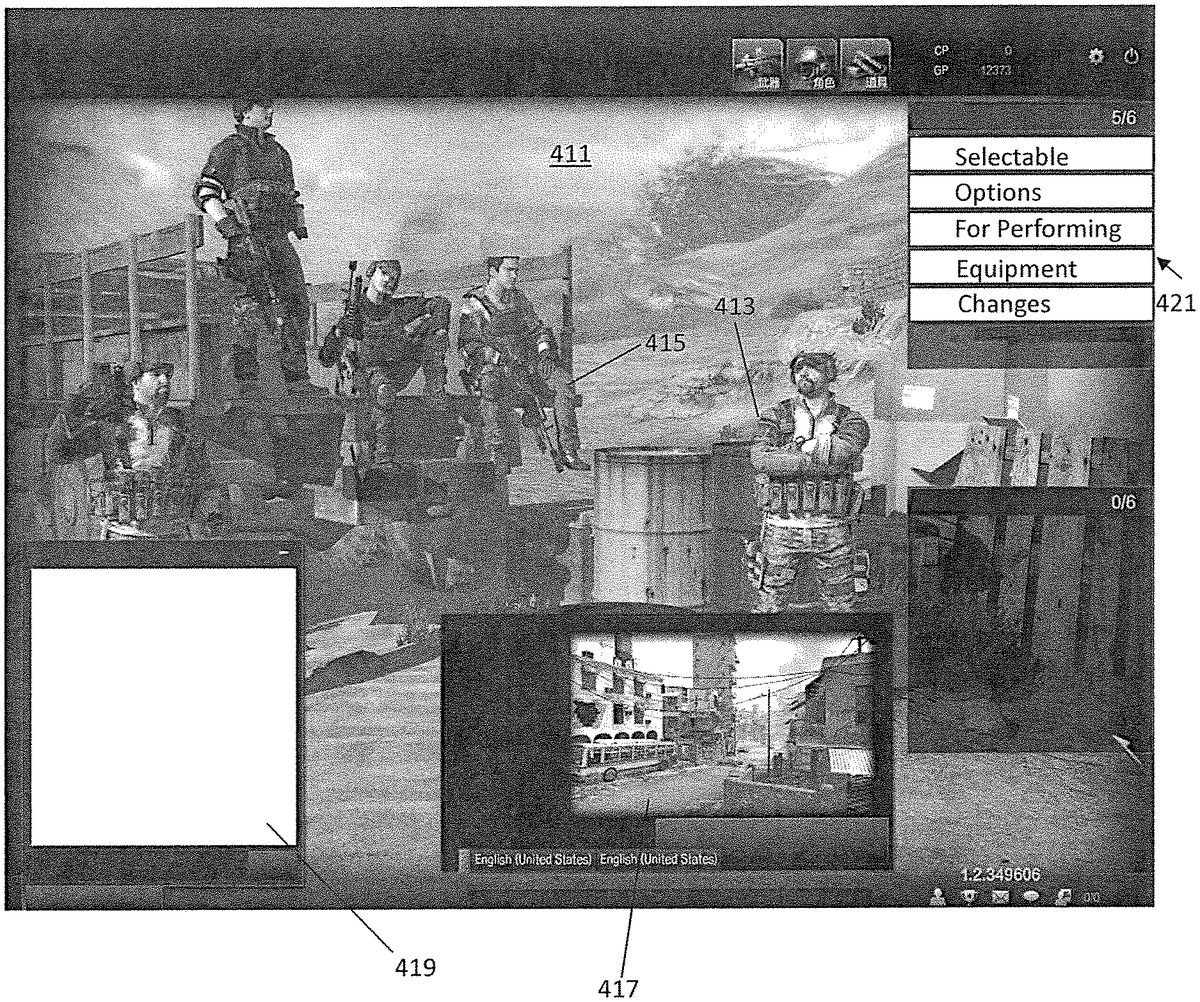
FIG. 4is a screen shot including a lobby in accordance with aspects of the invention. The screen shot ofFIG. 4includes a background scene411having visual characteristics of a virtual world in which game play is to take place. In some embodiments the screen shot include one of the images of a lobby presented as discussed with respect to the process ofFIG. 2.
As shown inFIG. 4, a plurality of game characters are present in the scene, for example game characters413and415. In some embodiments, only a subset of game characters are shown to a given game player (e.g., the given game player's teammates, or the given player's friends or clan members). The scene itself is bounded by a border, which may include selectable options relating to a video game. Inset within the scene is a message box419, for display of messages between game players who control or are to control the game characters. Also inset is an image of a particular location417within the virtual world, which may have some importance to game play in some embodiments. Also inset are selectable options421for performing equipment changes to, or purchasing equipment for, a game character. In some embodiments, selection of such a selectable option results in display of a different screen allowing for equipment changes and/or purchases. In some embodiments, selection of such a selectable option may result in an immediate change in equipment selection for a game character, with the game character then shown in the scene with the changed equipment. In some embodiments selection of such a selectable option results in display of screens allowing for purchase of an option to expand equipment available for selection. In some embodiments the selectable options, or a selectable option, for performing equipment changes, which may involve other presentation screens, may be otherwise provided. For example, a link available on the display may instead be available, and the selectable options421may instead be a list421of team members, or opposing team members, or both. In such embodiments, the process may provide for display of further information regarding a particular team member, for example if a game player scrolls or points to a particular team member using an input device of a compute device. The further information may be, for example, a listing of equipment of that team member. In addition, in some embodiments a selectable option allowing a game player to switch to an opposing team may be provided.
FIG. 5is a flow chart of a process including a pre-game equipment change option in accordance with aspects of the invention in accordance with aspects of the invention. The process may be performed by the system ofFIG. 1, or portions of the system ofFIG. 1.
In block511, the process determines initial personnel and equipment for play in a video game. Personnel are game characters, for example avatars in some embodiments, generally controlled by game players. The game characters may be assigned to a team, and may be assigned to a team for a particular online game play session. Equipment includes, in various embodiments, in-game weapons, associated tactical gear, clothing worn by, or available to, the avatar, or some or all of the foregoing, during game play.
In block513, the process provides display information for images or for use in generating images showing game characters with their equipment in a background scene of or having characteristics of the virtual world in which game play will take place. In one embodiment, equipment is displayed as graphical recreation of the piece of equipment, either held by the game character, about the game character, or placed on the game character's person. In a further embodiment, the equipment is displayed partly as a graphical recreation and partly as text on the screen. In some embodiments, the display information is the display information for the screen shots ofFIGS. 3 and/or 4, or display information for images similar in nature to those screen shots. In some embodiments, the process provides a description of one or more game character's equipment. In some embodiments, the description includes a purchase price for the one or more items. In some embodiments, the process only displays to a given game player a subset of other game players (e.g., the given game player's teammates, friends, or clan members).
In block515, the process determines if game play should begin. In some embodiments game play begins at a predefined time. In some embodiments game play begins when some or all game players provide an indication, using their compute devices for example, that game play should begin. If game play should begin, the process continues to block521, which provides for game play for the course of the game, and then returns. Otherwise the process continues to block517.
Often, a game character's profile will include more equipment than game play allows the game character to employ. Based on the game play scenario, the mix of equipment the game players have equipped, or loaded out, for their game characters could be considered by the game players to be less than ideal. Similarly, a game player may observe another game player's load out and decide that the other player's load out is advantageous to the game player scenario. In such instances, or other instances, individual game players may switch and/or purchase equipment so that the equipment may be utilized during gameplay. Accordingly, in block517, the process determines if a game player has requested an equipment change and/or purchase for the game player's game character. In some embodiments, the process determines if a game player has requested an equipment change and/or purchase if the process receives an indication that a compute device of a game player has received an input requesting an equipment change and/or purchase.
In block519, the process changes equipment and/or transacts a purchase for a game character. In some embodiments the process changes and/or transacts a purchase for equipment for the game character based on menu selections, determined by a compute device based on game player inputs. In one embodiment, available equipment is displayed graphically, and equipment changes effected by receipt of compute device inputs, controlled by the game player, resulting in movement of equipment from an unused state to an in use state. In another embodiment, the equipment available is displayed and selectable in a check box type fashion. In another embodiment, the process allows for the purchase of another game player's entire loadout in one transaction. Once the equipment change or purchase has been made, the process returns to block513and displays the lobby and game characters with their then current equipment.
FIG. 6is a flow chart of a process for providing video game play in accordance with aspects of the invention. The process may be performed by the system ofFIG. 1, or portions thereof, in various embodiments.
In block611the process processes compute device inputs. The compute device inputs are generally controlled by game players operating input devices of or associated with the compute devices.
In block613the process determines a new game state. In most embodiments the process determines a new game state based on the compute device inputs, in accordance with programming instructions of the video game. Generally the game state includes information regarding game character position and posture within a virtual game world, and may include bone information of the game character, an action being taken by the game character, a result of an action taken by other game characters, and other game information.
In block615the process provides the game state information, or portions of the game state information, for display purposes, for example for generation of displays on display elements of or associated with compute devices of game players.
The process thereafter returns, generally to repeat until a conclusion of game play.
FIG. 7is a flow chart of a process including a post-game equipment change option in accordance with aspects of the invention. The process may be performed by the system ofFIG. 1, or portions thereof in various embodiments.
In block711, the process determines game players' end of game equipment in a video game. Equipment includes, in various embodiments, in-game weapons, associated tactical gear, clothing worn by, or available to, the game character, or some or all of the foregoing.
In block713, the process, in a manner similar to that of block513of the process ofFIG. 5, provides display information for images or for use in generating images showing game characters with their equipment in a background scene of or having characteristics of the virtual world in which game play will take place. The display information can be considered display information for a lobby including the game characters. In one embodiment equipment is displayed as graphical recreation of the piece of equipment, either held by the game character, about the game character, or placed on the game character's person. In a further embodiment, the equipment is displayed partly as a graphical recreation and partly as text on the screen. In some embodiments the display information is the display information for the screen shots ofFIGS. 3 and/or 4, or display information for images similar in nature to those screen shots. In some embodiments, only a subset of game players are displayed. For example, only the top performers of the game are displayed. As another example, the top performers of the game may be displayed alongside the worst performers of the game, with the top performers assuming victorious poses while the worst performers assume dejected poses. As another example, only the winning team may be displayed. Of course, these examples are merely illustrative, and any combination of players may be displayed.
In block715, the process determines if a game player has requested an equipment change and/or purchase for the game player's game character. In some embodiments, the process determines if a game player has requested an equipment change and/or purchase if the process receives an indication that a compute device of a game player has received an input requesting an equipment change and/or purchase.
In block717, the process changes and/or transacts a purchase of equipment for a game character. In some embodiments the process changes and/or transacts a purchase of equipment for the game character based on menu selections, determined by a compute device based on game player inputs. In one embodiment, available equipment is displayed graphically, and equipment changes and/or purchases effected by receipt of compute device inputs, controlled by the game player, resulting in movement of equipment from an unused state to an in-use state. In another embodiment, the equipment available is displayed and selectable in a check box type fashion. Once the equipment change and/or purchase has been made, the process returns to block713and displays the lobby and game characters with their then current equipment.
FIG. 8shows a portion of screen shot of a post-game lobby in accordance with aspects of the invention. In various embodiments, the post-game lobby may as be discussed with respect to the pre-game lobbies ofFIGS. 3 and 4. The lobby ofFIG. 8shows game characters, with their equipment, in a scene of or having characteristics of the virtual world of the preceding game play.
FIG. 9shows a further screen shot in accordance with aspects of the invention. In some embodiments the screen shot may include or represent a lobby as discussed herein. The screen shot ofFIG. 9includes a background scene having visual characteristics of a virtual world in which game play is to or has taken place. A game character912is shown in the context of the background.
The screen shot includes a team member listing913and an opposing team member listing915. In some embodiments additional information regarding a particular team member or opposing team member may be displayed if a game player points to or selects one of such teammates, for example using an input device of a compute device. The additional information may be, for example, equipment of that team member or opposing team member. In addition to show a listing of members of the teams, the screen shot also shows a selectable option921allowing a game character of the game player to switch teams.
As with the screenshot ofFIG. 4, the screenshot ofFIG. 9also shows an image of a scene from the virtual world of game play, which may be a scene that may have game importance in during game play, as well as a message box919for displaying messages between game players.
Although the invention has been discussed with respect to various embodiments, it should be recognized that the invention comprises the novel and non-obvious claims supported by this disclosure.
Claims
- A computer implemented method useful for video game play, comprising: determining, in a time period prior to game play, identities and equipment of a plurality of game characters for participation in game play, the plurality of game characters including a first plurality of game characters of a first team and a second plurality of game characters of a second team, the second team being an opposing team to the first team, with at least some of the equipment differing between game characters of the first team;after determining identities and equipment of the plurality of game characters for participation in game play, in the time period prior to game play, rendering, by a game compute device, utilizing at least some information received from a server, the plurality of game characters with their equipment in a scene having visual characteristics of a virtual world for game play;in the time period prior to game play, while the plurality of game characters with their equipment are rendered in the scene having visual characteristics of the virtual world for game play, displaying an option to change equipment of one game character of the first team, and changing equipment, based on receipt of an input of the game compute device, of the one game character of the first team, and further rendering the plurality of game characters, with their equipment in the scene having visual characteristics of the virtual world for game play, wherein the scene having visual characteristics of the virtual world for game play is a scene of the virtual world for game play;prior to commencement of game play, provide a recommendation for one or more pieces of equipment suitable for a game character, the recommendation being based on the characteristics of the virtual world for game play;providing for game play, with the server, including the game characters, the game play provided by the game compute device and based on inputs from the game compute device and game action information received from the server;and after completion of game play, rendering by the game compute device the game characters of at least the first team, with their equipment, in the scene having visual characteristics of the virtual world for game play and changing equipment of the at least one game character of the first team and still further rendering the first plurality of game characters of the first team, with their equipment, in the scene having virtual characteristics of the virtual world for game play.
- The method of claim 1 , wherein the first plurality of game characters of the first team consist of all game characters of the first team.
- The method of claim 1 , wherein the time period prior to game play is a predefined time prior to game play.
- A computer implemented method useful for video game play, comprising: determining, in a time period prior to game play, identities and equipment of a plurality of game characters for participation in game play, the plurality of game characters including a first plurality of game characters of a first team and a second plurality of game characters of a second team, the second team being an opposing team to the first team, with at least some of the equipment differing between game characters of the first team;after determining identities and equipment of the plurality of game characters for participation in game play, in the time period prior to game play, rendering, by a game compute device, utilizing at least some information received from a server, the plurality of game characters with their equipment in a scene having visual characteristics of a virtual world for game play;in the time period prior to game play, while the plurality of game characters with their equipment are rendered in the scene having visual characteristics of the virtual world for game play, displaying an option to change equipment of one game character of the first team, and changing equipment, based on receipt of an input of the game compute device, of the one game character of the first team, and further rendering the plurality of game characters, with their equipment in the scene having visual characteristics of the virtual world for game play, wherein the scene having visual characteristics of the virtual world for game play is a scene of the virtual world for game play;providing for game play, with the server, including the game characters, the game play provided by the game compute device and based on inputs from the game compute device and game action information received from the server;and after completion of game play, rendering by the game compute device the game characters of at least the first team, with their equipment, in the scene having visual characteristics of the virtual world for game play and changing equipment of the at least one game character of the first team and still further rendering the first plurality of game characters of the first team, with their equipment, in the scene having virtual characteristics of the virtual world for game play.
- The method of claim 4 , wherein the first plurality of game characters of the first team consist of all game characters of the first team.
- The method of claim 4 , wherein the time period prior to game play is a predefined time prior to game play.
Disclaimer: Data collected from the USPTO and may be malformed, incomplete, and/or otherwise inaccurate.