U.S. Pat. No. 10,953,318
Enriching Multiplayer Electronic Game Sessions
AssigneeBunch Live Inc
Issue DateJanuary 11, 2019
Illustrative Figure
Abstract
An electronic game subscribes to events—such as a physical gesture or appearance of the user, certain spoken user commands, or the like—identified by a game mediation infrastructure. The game mediation infrastructure receives user input data received from the user's client device, analyzes the data, and determines whether one of the events subscribed to by the electronic game has occurred. If so, the game mediation infrastructure notifies the electronic game of the occurrence of the event, and the electronic game alters the state of the game accordingly. The electronic game may additionally and/or alternatively use an API of the game mediation infrastructure to cause alteration of a user interface of a game mediator component in which the electronic game is displayed, based on actions taking place within the game.
Description
The figures depict various embodiments for purposes of illustration only. One skilled in the art will readily recognize from the following discussion that alternative embodiments of the structures and methods illustrated herein may be employed without departing from the principles of the invention described herein. DETAILED DESCRIPTION FIG. 1is a high-level block diagram illustrating an environment100in which game mediation takes place, according to one embodiment.FIG. 1illustrates two clients110A and110B, a game mediator server130, and a game server140connected by a network120. Only two clients110, one game mediator server130, and one game server140are shown inFIG. 1in order to simplify and clarify the description. Embodiments of the computing environment100can have many clients110, game mediator servers130, and game servers140connected to the network120. Likewise, the functions performed by the various entities ofFIG. 1may differ in different embodiments. FIG. 1uses like reference numerals to identify like elements. A letter after a reference numeral, such as “110A,” indicates that the text refers specifically to the element having that particular reference numeral. A reference numeral in the text without a following letter, such as “110,” refers to any or all of the elements in the figures bearing that reference numeral. For example, “110” in the text refers to reference numerals “110A” and/or “110B” in the figures. A client110is an electronic device used by a user to perform functions such as communication with other clients, executing software applications for various purposes, and consuming electronic content such as content hosted by web servers on the network120. For example, the client may be a smart phone, or a tablet or notebook computer. The client110includes a display on which the user may view content such as electronic games. In addition, the client110includes a user interface (UI), such as physical and/or on-screen buttons, which the user may interact with to perform various functions ...
The figures depict various embodiments for purposes of illustration only. One skilled in the art will readily recognize from the following discussion that alternative embodiments of the structures and methods illustrated herein may be employed without departing from the principles of the invention described herein.
DETAILED DESCRIPTION
FIG. 1is a high-level block diagram illustrating an environment100in which game mediation takes place, according to one embodiment.FIG. 1illustrates two clients110A and110B, a game mediator server130, and a game server140connected by a network120. Only two clients110, one game mediator server130, and one game server140are shown inFIG. 1in order to simplify and clarify the description. Embodiments of the computing environment100can have many clients110, game mediator servers130, and game servers140connected to the network120. Likewise, the functions performed by the various entities ofFIG. 1may differ in different embodiments.
FIG. 1uses like reference numerals to identify like elements. A letter after a reference numeral, such as “110A,” indicates that the text refers specifically to the element having that particular reference numeral. A reference numeral in the text without a following letter, such as “110,” refers to any or all of the elements in the figures bearing that reference numeral. For example, “110” in the text refers to reference numerals “110A” and/or “110B” in the figures.
A client110is an electronic device used by a user to perform functions such as communication with other clients, executing software applications for various purposes, and consuming electronic content such as content hosted by web servers on the network120. For example, the client may be a smart phone, or a tablet or notebook computer. The client110includes a display on which the user may view content such as electronic games. In addition, the client110includes a user interface (UI), such as physical and/or on-screen buttons, which the user may interact with to perform various functions with the client.
The client110includes a game mediator112and an electronic game114. Depending upon the embodiment, the game mediator112and/or game114may be integrated into the operating system, or implemented as an application or other software executing on the client110. In some embodiments, the game114is part of the game mediator112, rather than an independent software item. In other embodiments, the game114is distributed among a plurality of locations, for example, in part on the client110as an independent software item, and in part on the game server140.
The game mediator112runs on the client110and mediates multiplayer gameplay. The game mediator112interacts with one or more games such as the game114, as well as the game mediator server130. The game mediation infrastructure used to enable game sessions includes at least the game mediator112, and in some embodiments also includes the game mediator server130and/or at least one other game mediator112on at least one other client110. Depending upon the embodiment, the game mediation infrastructure controls various aspects of a game playing session, for example, launching a “lobby” for the game playing session, and providing enriched gameplay. In one embodiment, a game playing session may be launched via a UI of the game mediator112, such as the lobby, using a “deep link” (a link, such as a Uniform Resource Locator (URL), to a resource such as a game, and that additionally specifies a more specific context within the resource, such as a particular stage or state of the game). In an embodiment, the game mediator112A runs on a first client110A and interacts with a second client110B, such as with a game mediator112B upon the second client110B, to enable client110B to participate in the game playing session launched by client110A. In other embodiments, more than one client110may be interacted with by the client110A to enable participation in the game playing session launched by client110A, e.g., up to as many as the game being played supports. The lobby is a user interface that provides an environment for communication for clients110associated with a game playing session. The lobby allows clients110to communicate before, during, and/or after game playing sessions, such as by using live video feeds and/or voice. In an embodiment, the lobby has functionality allowing at least one client110to configure game play settings of the game that is to be launched. In an embodiment, the lobby is executed at least in part upon the game mediator server130. The lobby may further include various information about the game playing session, such as usernames or rankings of clients110for the game, as well as a level of the game or other information pertaining to the game playing session. For example, in some embodiments the lobby includes a chatroom in which client110A exchanges text messages with client110B. Alternatively or additionally, as another example, in some embodiments the lobby includes a video call (using live video feeds) with which users of clients110see and hear each other.
FIG. 8illustrates a simplified example of the lobby according to one embodiment, the lobby including video panes810, a settings button820, a games button830, an invite button840, and a joined icon850. The lobby is a page or screen of the game mediator112, which runs upon client110and in the example ofFIG. 8is a mobile device. Each video pane810is associated with a client110joined to the lobby. For example, if clients110A and110B are joined to a lobby, there is a video pane810A for client110A and a video pane810B for client110B, as inFIG. 8. If additional clients110are joined to the lobby, additional panes may be added, which may involve modifying the boundaries of existing panes to accommodate the additional panes on the display. In an embodiment, additional panes are not added if a pane threshold is reached or surpassed. For example, the pane threshold may be a number of panes, or a pane size. Each video pane810presents a live video feed from the associated client110, including both graphical and audio content. The live video feed may be, for example, from a camera of the client110, e.g., displaying an image of the user of the client (or of whatever is in the field of view of the camera). In an embodiment, the client110can disable the presentation of graphical and/or audio content of the client's110live video feed, for example, using the settings button820. In an embodiment, the client110can change the camera used to generate the live video feed, such as switching from a front-facing camera to a rear-facing camera of the client110.
The settings button820controls settings of the game mediator112according to one embodiment. For example, in some embodiments, upon selection of the settings button820by the client110, the game mediator112loads a settings page. At the settings page, one or more settings may be adjusted using the client110, such as enabling or disabling the transmission of audio and/or graphical content by the client110, changing the camera used to generate the live video feed, muting one or more incoming live video feeds from other clients110joined to the lobby, and so on.
The games button830controls game selection in the game mediator112according to one embodiment. For example, upon selection of the games button830by the client110, the game mediator112loads a games page listing the games available for play. At the games page, a game may be selected using the client110. For example, the games page may include a list of available games, including for each listed game a game title, a game icon or image, a game summary, and/or an on-screen button to select the game. For example, a listed game may have title “Fortnite™,” an image of a game character, and a summary “compete in a battle royale.” In an embodiment, the games page further allows the client110to select a portion of the game they wish to play, such as a track where they wish to race within a car racing game, or a location upon a map where a user character should be placed upon loading.
Upon selection of a game by the client110, the game mediator112configures the lobby to attain a look and feel of the selected game based on one or more features of the game. The lobby may be configured to display graphical and/or textual elements of the game, such as a logo, a color scheme, one or more images from the game, and so on. For example, if “Fortnite” is selected, an image from the game of a game character may be displayed with the “Fortnite” logo overlaid. Other aspects of the lobby, such as video panes810, may adjust to accommodate the configuration, as seen inFIG. 9, which illustrates a simplified example of a lobby according to a second embodiment.
FIG. 9illustrates a different state of the lobby, e.g. after a game has been selected.FIG. 9includes a game image910, a game logo920, option buttons930, a video pane940, and a launch button950. The game image910is an image from game A, such as a game character holding a sword in a game landscape. The game logo920is the stylized title of the game, such as how it may appear in-game at a title screen. The option buttons930allow one or more settings to be adjusted, such as the transmission of audio and/or graphical content as part of a live video feed.
The video pane940is a video pane similar to video pane810, though of different dimensions. In an embodiment, each client110joined to the lobby is associated with a video pane that displays the associated client's110live video feed. In an embodiment, there are as many video panes as there are allowed players for the game, and if there are fewer clients110joined to the lobby than there are allowed players for the game, unused video panes include an icon, such as a “+” icon, which the client110may select to access an invitation page as detailed below. The launch button950prompts the game mediator112to launch a game playing session, e.g., to initiate execution of the game playing session.
Returning toFIG. 8, the invite button840controls invitation of clients110to the lobby, according to one embodiment. For example, upon selection of the invite button840by the client, the game mediator112loads an invitation page enabling a user of the client110to send invitations to join the lobby to other clients110. For example, the invitation page may include a list of invitation techniques, including for each listed technique a technique title and a technique icon. For example, an iMessage™ listed technique may include the title “iMessage™” and an iMessage™ icon. The invitation page may also include a list of clients110to whom an invitation may be sent, each listed client110including, for example, a name. Upon selection of one or more clients110for invitation and selection of one or more invitation techniques, the game mediator112generates an invitation message and configures the selected invitation techniques such that the invitation message may be sent. For example, if the invitation technique is a text message and the invitee is a client110associated with the name “Justin,” the game mediator112generates a textual invitation message, opens a text message application upon the client110, addresses the text to the invitee, and pastes the invitation message into a message portion of the text message application. The client110may then send the invitation to the invitee using a button of the text message application.
The joined icon850indicates a number of clients110joined to the lobby. In the example ofFIG. 8, there are two clients110joined to the lobby, hence the joined icon850indicates “2.” In other embodiments, other icons may be present, as well as other buttons, graphical, and/or audio content. For example, the lobby may be configured to display a text string for each client110in the lobby indicating a name associated with the client110. In an embodiment the lobby may include a list of other clients110that are playing games or are preparing to play games, which the client110may select to join another client's110lobby and/or game playing session.
In an embodiment, the lobby may be configured to allow the client110to initiate live streams of gameplay, using, for example, a livestream product such as Facebook Live™, YouTube™, or Twitch™. A live stream of gameplay involves sending a video of gameplay as seen on the screen of a client110playing in the game playing session to a client110not playing in the game playing session. Furthermore, clients110joined to the lobby or who select the lobby may choose to view the live stream, rather than participate in the game playing session. For example, if a game allows a maximum of four players and a fifth client110joints the lobby, the fifth client110may choose to livestream the game playing session despite being unable to play.
In an embodiment, a first client110may invite one or more additional clients110to a game playing session using the game mediator112via the game mediator server130(e.g., using the invite button840in the embodiment ofFIG. 8). Upon receipt of an invitation, the game mediator112of each additional client prompts a user of the additional client110to either accept or reject the invitation. If the invitation is accepted, the game mediator server130may further interact with each accepting client110to enable participation in the game playing session. Furthermore, if the invitation is accepted, the respective client110is added to the lobby, for example, gaining the ability to participate in the chatroom.
Returning toFIG. 1, the electronic game114interacts with the game mediator112to provide game playing sessions to users of clients110. The game114may be a dedicated software application built natively for the client110, code (e.g., HTML 5 code) running within a game playing engine, such as (in some embodiments) the game mediator112, a game built with a framework such as React Native™, or the like. A game playing session involves one or more users interacting with respective clients110to play a set of instances of the game114in coordination with each other. In multiplayer game playing sessions, multiple clients110participate in a single game playing session, interactively playing the same game. In single player game playing sessions, one client110participates in a single game playing session. In some embodiments, the game114runs on the game mediator server130, and is accessed using the client110, which provides an interface to play the game114. For example, the game114executes upon the game mediator server130, which sends the results of the execution of the game114to the clients110. The clients110interact with the results of the execution that are received from the game mediator server130and send the interactions to the game mediator server130, which impact the execution of the game114. The game playing session may progress in this back and forth manner.
There may be different types of games, and the game mediator112and/or game mediator server130may support different types of games differently. One embodiment includes instant games and downloadable games. In such an embodiment, instant games can be played without downloading additional software. For example, the instant game may be at least partially integrated into the game mediator112such that the client110can launch a game without prior installation of additional software. If the client110launches a game playing session using the game mediator112for an instant game, the game mediator112does not check whether the client110has the game installed. In contrast, downloadable games require the downloading of the game by the client110before a game playing session can be launched. If the client110launches a game playing session using the game mediator112for a downloadable game, the game mediator112may check if the client110has the game installed.
The game mediator server130interacts with the clients110to support the operation of the game mediator112. The game mediator server130configures the lobby launched by the game mediator112according to specifics of the game114launched in conjunction with the lobby. For example, the lobby may be configured to show which players are prepared to play a particular game, allow a user to invite other players or to initiate a live stream of game play, and to allow a user to enable configuration of gameplay settings specific to the game114(such as selecting a character to use, or arena in which to play).
Upon receiving a command to launch a game playing session, the game mediator112alerts the game mediator server130, which checks each client110involved in the game playing session. If a certain client110involved in the game playing session does not have the game installed, the game mediator server130sends a deep link to the client110, e.g., a deep link to an application store such as Apple App Store™ or Google Play Store™. The deep link then initiates installation of the game on the certain client110without exiting the game mediator112. Alternatively, the deep link is sent to each client110involved in the game playing session regardless of whether the client110has the game installed or not. If the game is not installed, the deep link facilitates the installation of the game without the user leaving the lobby. The deep link is a uniform resource locator (URL). In an embodiment, the deep link directs the client110to open an application vendor (e.g., an application store) to a page where the game may be downloaded, for example, in a web view of the game mediator112. For example, the deep link includes an identifier associated with the page of the application vendor that is used by the client110to navigate to the page. In another embodiment, the deep link facilitates checking whether the game includes a game mediator software development kit (SDK). If client110and/or game mediator server130, facilitated by the deep link, determines the game has the SDK, it transfers functionality to the game; for example, it may transfer voice and/or video stream controls to the game. Such a transfer allows the user to control various aspects of voice and/or video during gameplay without having to return to the lobby. In other embodiments, other functionality may be transferred to the game, such as livestream functionality, game invitation functionality, and so on. In such embodiments, one or more graphical elements, such as on-screen buttons with which a client110may interact to control functionality passed to the game, may be overlaid upon the game as it is displayed in the course of the game playing session. Furthermore, launching the game itself may involve the use of a deep link to access the game directly from the game mediator112.
Furthermore, in some embodiments the game mediator server130checks the state of the lobby and, depending upon the number of clients110participating in the lobby, suggests to the client110who invited the others that more clients110could be invited. In an embodiment, the game mediator server130hosts the lobby. In an embodiment, when the game mediator server130configures the lobby according to the specifics of the game114, the game114specifies the number of players required to play the game, which the lobby adapts to. For example, the lobby adapts to not launch a gameplay session until the required number of players are in the lobby. In an embodiment, if the minimum number of players are not present in the lobby to launch a game playing session, the lobby prompts the players to invite others. Furthermore, the lobby may be configured to display as many video panes as the game allows.
In some embodiments, lobbies may be private or public. In an embodiment, the player who created the game playing session sets the lobby as private or public. A public lobby is discoverable by users who wish to join a game. A private lobby is accessible only via invitation. Furthermore, the lobby may be configured to allow players who join the lobby to elect to participate in the game playing session as spectators. Spectators watch gameplay but do not themselves play. If a game has reached its maximum amount of players, additional players may only participate as spectators.
The game mediator server130proceeds to launch the game after receiving notifications that each client110that was sent a deep link installed the game and receiving a notification that the client110that commanded launching the game playing session declined to invite more clients110. In an embodiment, the game is hosted on the game server140, and the game mediator server130sends the game server140parameters associated with the game playing session, such as a session identifier, as well as parameters associated with each client110, such as client identifiers. In other embodiments, parameters associated with the game playing session are sent to one or more other destinations to coordinate game play.
The game mediator112uses the client110functionality to enhance gameplay. The game mediator112may enable actions within the game mediator112, such as in the lobby, to affect gameplay, or may enable actions within the game to affect the lobby. The game mediator112has access to the functionality of the client110, further detailed inFIG. 2below. Games such as the game114may use the functionality of the client110via the game mediator112by way of the game SDK/engine230. For example, games may access video content of the clients110using the live video streams of the clients110in the lobby participating in the game playing session.
The game mediator112may enhance gameplay using the audio content of live video streams of the clients110in the lobby participating in the game playing session. Game events may be associated with audio cues, which the game mediator112detects and communicates to the game114via the game SDK/engine230. Game events are associated with audio cues on a subscription basis. For example, in a charades game, each word in a set of candidate words is subscribed to a different audio cue which the game mediator112is set to detect depending upon which word is being guessed. If the word is “car” for example, the game mediator112listens for the word “car” and informs the charades game that it has been spoken. In an embodiment, the game mediator112also informs the game114which client110produced the audio cue. The audio content may also be used for voice recognition. For example, if multiple players are speaking, and one says the correct keyword, the correct player is awarded a point.
In some embodiments, the graphical content of live video streams of the clients110in the lobby participating in the game playing session may be used for gesture recognition to enrich gameplay, i.e., detecting (or subscribing to and then being notified by the game mediator112of) certain gestures, such as smiles, and awarding points to appropriately gesturing users within a game114responsive to detection of those gestures. As another example, if a particular client110participating in a game playing session chooses to overlay a graphic of a wolf's face upon its video pane in the lobby, its character within the game114could likewise gain a wolf façade.
In an embodiment, the game mediator server130uses external livestreaming, rather than the content of live video streams within the lobby, to enhance gameplay. For example, in a pictorial guessing game, the livestream (such as on Facebook Live™ or Twitch™) may be used for players, i.e. viewers of the livestream, to guess what the picture is. The game114subscribes to the game mediator112to listen for certain keywords, and upon detection of those keywords, awards points appropriately to the participant who guessed correctly by saying the keyword, similar to the use of audio content of the live video streams of the clients110in the lobby.
In some embodiments, the game mediator server130provides enriched gameplay functionality by enabling game events to affect the lobby. Game events may be tagged for game mediator112enrichment using the game SDK/engine230. Upon occurrence of the game event within the game playing session, the lobby is adjusted based on the tagged event, as discussed below with respect toFIG. 5. Depending upon the embodiment, the lobby may be adjusted by affecting one or more video panes, audio, or so on. For example, upon an event involving a wolf occurring within the game playing session, the client110who prompted the event may have a wolf mask graphic overlaid upon their video pane in the lobby. As another example, a player's audio content may be filtered to create an audio effect, such as filtering a voice to sound like a dog barking. As a third example, if the game mediator server130determines that two clients110are within a threshold geographical distance of each other, the game mediator server130sends a command to one of the two clients110to mute the volume of the game114(or of specific portions of the game114, such as background music, or the audio content of the live video stream) so as not to have duplicative sound played within a given area. In some embodiments, to determine the geographical distance between clients, the game mediator server130obtains and analyzes device sensor data from the clients110, such as their geolocations (e.g., distance between GPS coordinates) and/or speaker input (e.g., whether there is an echo or other duplicative sounds of the game). In other embodiments, enriched gameplay functionality is provided by the game mediators112collaborating in a peer-to-peer configuration, without the use of the game mediator server130.
The game mediator server130and/or the game mediators112may further use deep links for purposes other than game installation or gameplay initialization. For example, the game mediator server130may obtain information about the gameplay preferences of the user of a client110by using deep links to send requests to each of some set of games, such as a predetermined set of games representative of various categories of game.
The operating system of the client110attempts to relay the deep link request to the applications; if the applications are not installed on the client, the operating system informs the game mediator112of an error. The game mediator112then stores (e.g., as a bit vector) whether each of the games of the set is installed based on whether the operating system indicated an error in response to the sending of the deep link requests. In some embodiments, the game mediator112further makes decisions or identifies implicit preferences for a particular client110based on which of the set of games is installed on that client110. For example, the game mediator112might determine, based on the set of games installed on a given client110, that the user of that client110primarily enjoys puzzle games, and adjust the order of the games available to play, or the look and feel of the lobby, to reflect the user's interest in puzzle games. The game mediator112may also identify users connected to the user associated with the client110, e.g., friends of the user, who also enjoy games of the type determined to be the user's preference. The game mediator112may suggest to the user that the user invite the identified friends to a game. Alternatively, the game mediator112may identify other users to whom the user is not connected (e.g., has never played with) and who enjoy similar games, and may recommend to the user that the user play with the identified users. Furthermore, the game mediator112may use the user's preference to suggest additional games, e.g., games of the same type, that the user may enjoy playing. The game mediator112may also use the user's preferences when determining an advertisement or other sponsored content to display to the user. These various actions may be performed using deep links, e.g., by collecting data on the client110as the client110uses deep links, as described below, and developing implicit preferences for the client110.
Deep links can indicate a particular application to run via the domain portion of the URL, and additional information for the application via the parameters of the URL. For example, to initiate a game114on a client running the IOS™ operating system, a deep link “https://abcd.app.link/connect?mode=internet&teamPassword:12345&bunchRoom=rkHyuCojz &bunchAuth=SJWpHXZzX” might be used, where “https://abcd.app.link” indicates the application, and “mode=internet&teamPassword:12345&bunchRoom=rkHyuCojz&bunchAuth=SJWpHXZzX” indicates the game parameters, which in this example are “mode,” “teamPassword,” “bunchRoom,” and “bunchAuth.” Using this link, a client110may launch a game “abcd” over the internet with other clients110as part of a team, which may be joined to a lobby specified by the “bunchRoom” and authorized using the “bunchAuth.” Additional parameters may be added in this manner to the deep link, such that each game114may have a customized deep link to enable various gameplay customizations to launch the game114with using the game mediator112. For example, the deep link may additionally include a “skin” parameter used to specify a particular character graphic to use in the game114. As a second example, the deep link may additionally include a “level” parameter used to specify a particular level of the game114in to which to launch.
In an embodiment, one or more parameters are encoded (e.g., into a base 64 payload), such as that in the deep link “https://abcd.onelink.me/4289444349?payload=eyJhY3Rpb24iOiJidW5jaC5yb29tIiwiZ2FtZVR5cGUiOjEsInJvb21Ub2tlbiI6InJrSHl1Q29qeiJ9&bunchUID=rgBU5KlNmWhL7OdONOGM4kWfEXD3&bunchRoom=rkHyuCojz&bunchAuth=SJWpHXZzX”, where the data in the “payload” parameter can be decoded to obtain other parameter values. The use of base 64 encoding reduces the number of characters used to represent the payload.
As another example, to initiate downloading a game114, a deep link “https://itunes.apple.com/us/app/id570510529?mt=8” might be used, where “https://itunes.apple.com/us/” indicates the application store ITUNES™, and “app/id570510529?mt=8” indicates an application identifier used to specify the game114to be downloaded. As a still further example, to check whether a game114is installed on a client110, a deep link “abcd://” might be used to determine whether the game114is stored in memory upon the client110. For example, if the deep link does not lead to a folder in memory, the game mediator112may determine that the game114is not installed.
In some embodiments, the game114is hosted by the game server140, which runs the game playing session. Each game114interacts with the game that is run on the game server140to generate the game experience on the clients110. For example, if a user playing a game114on a client110performs an action within the game114, the action is communicated to the game server140, which handles that action and applies it to the corresponding game session, populating that action and its effects to any other clients110/game mediators112that are participating in that session. Upon occurrence of events associated with enriched gameplay functionality (such as an in-game interaction with a certain game character), the game server140notifies the game mediator server130of the event and the client110that triggered the event. In an embodiment, the game mediator server130tracks the game session and identifies events with enriched gameplay functionality.
The network120enables communications among the clients110, the game mediator server130, and the game server140, and can comprise the Internet as well as mobile telephone networks. In one embodiment, the network120uses standard communications technologies and/or protocols. The data exchanged over the network120can be represented using technologies and/or formats including the hypertext markup language (HTML), the extensible markup language (XML), etc. In addition, all or some of links can be encrypted using conventional encryption technologies such as secure sockets layer (SSL), transport layer security (TLS), virtual private networks (VPNs), Internet Protocol security (IPsec), etc. The entities can use custom and/or dedicated data communications technologies instead of, or in addition to, the ones described above.
FIG. 2is a high-level block diagram of the software stack upon which the game mediation infrastructure operates, in one embodiment. At a first or bottom layer reside software components that drive low level functionality including hardware functionality, including WebRTC202, Voice/Video204, Livestream206, GPS208, Accelerometer210, Touch212, and Wifi/Bluetooth214. At a second layer resides software that drives a host application220, such as an operating system. At a third layer resides a game mediator software development kit (SDK)/Engine230. At a fourth or top layer resides a game240(e.g., a game114ofFIG. 1).
The WebRTC202component enables web browsers to communicate in real time. The Voice/Video204component enables use of audio and/or video capabilities of the client device110. The Livestream206component allows for communication of video in real time. The GPS208component provides location information of the client device110. The Accelerometer210component provides acceleration information of the client device110. The Touch212component enables touch input to the client device110. The Wifi/Bluetooth214component enables Wifi and/or Bluetooth functionality to the client device110.
The host application220manages operation of the client110and its software and hardware components. The game mediator SDK/engine230is a software framework used to develop the game mediator112and game240, such as game114, allowing for the interactivity needed to enable mediated and/or enriched gameplay sessions. In some embodiments, the game mediator112and game240are managed by the host application220. For example, the host application220allocates memory for both the game mediator112and the game240.
FIG. 3illustrates the process of launching a multiplayer game playing session using the game mediation system100, in one embodiment. In this embodiment, the game session runs on the game server140. In other embodiments the game session runs elsewhere, e.g., on the client110within the game mediator112, or an independent software item upon the client110similar to the game114. Where the game runs may depend upon the type of game, such as instant games versus downloadable games, as detailed above. In the embodiment ofFIG. 3, the game mediator112coordinates with the game mediator server130to provide game mediation functionality. In other embodiments, game mediation is provided solely by the game mediator112.
First, client110A launches302the game mediator112A. For example, the client110A may open the game mediator112A as an application, loading it into memory for use. The game mediator112A communicates with the game mediator server130to initiate game mediation. Upon selection304of a game114by the client110A, e.g., using the game mediator112A, the game mediator112A communicates with the game mediator server130to configure306a lobby for the game114. In an embodiment, the game mediator112A and/or game mediator server130coordinate to configure the lobby to attain a look and feel of the game114as well as to provide communication between the clients110in the lobby.
The client110A invites308other clients, such as the client110B, using the game mediator112A. The game mediator112A facilitates invitation via one or more techniques. For example, the game mediator112A may send a notification to the game mediator112B on the client110B, alerting the client110B that the client110A has invited the client110B to a game playing session. In some embodiments, the alert includes a textual notification upon the client110B's display. Depending upon the embodiment, the notification may be sent via email, telephone call, or text message, or by way of other social networking applications, such as Facebook™, Twitter™, GroupMe™, WhatsApp™, Snapchat™, LinkedIn™, and/or other applications. For example, the game mediator112A may generate a text message to the client110B that links to the lobby, which the client110A may send using a text message application.
Upon the client110B's acceptance of the invitation, via, for example, sending a request to join the lobby to the game mediator server130, the game mediator server130joins310the client110B to the lobby, thus enabling the client110B and the client110A to communicate. For example, the lobby may include a video, audio, and/or textual chatroom with which the clients110joined to the lobby may communicate. In an embodiment, the lobby updates to indicate that a new client (the client110B) has joined the lobby. This may entail updating a player count, adding a video pane to the lobby, adding a player graphic or icon, and so on.
The client110A commands the game mediator112A to launch312the game114. In response, the game mediator112A commands the game mediator server130to check314, via the game mediator112upon each client110joined in the lobby, whether the client110has the game114installed. In the example ofFIG. 3, the client110B does not have the game114installed. As such, game mediator server130sends316a deep link to client110B which, upon receipt, initiates installation320of the game114upon the client110B. For example, upon receipt of the deep link, the client110B displays a button linking to a download page for the game114. In an embodiment, the client110B also displays a graphic and/or textual summary of the game114. When the client selects the button, the download page opens (e.g., in a web view within the game mediator112B) where the client110B may download and install320the game114. The download page may be, for example, a page in an application store.
In an embodiment, the game mediator server130sends a request to verify installation of the game114to each client110. Upon receipt of the request and verification of installation of the game114, each client110sends a notification to the game mediator server130verifying that the game114is installed upon the client110.
In an embodiment, upon determining that each client110joined to the lobby is ready for the game playing session to launch, e.g., upon verifying that each client110downloaded the game114, the game mediator server130sends a deep link to each client110joined to the lobby linking to a particular point in the game114. When a game session is launched, the clients110joined to the lobby start the game114at that particular point, as specified in the deep link. For example, when the game session is launched, rather than opening the game114to a start page, the game114opens to an in-game lobby or loadout page. As a second example, when the game session is launched, the game114may open to a particular level or location within the game114.
Meanwhile, upon determining (via the check314) that more clients110could be invited to the game playing session, the game mediator sever130suggests318to the client110A (the client110that initiated the game playing session) that more invitations be sent to additional clients110, e.g., via a notification sent to the client110A. In this example, the client110A declines322to invite more players, so game mediator server130proceeds to launch324a session of the game114by communicating with the game server140. In an embodiment, launching324the session of the game114involves sending to the game server140a set of client identifiers, each client identifier of the set corresponding to a client110joined to the lobby. Game server140then starts326the game playing session. In an embodiment, the game playing session is assigned a session identifier by the game server140, and the session identifier is used to distinguish the game playing session from other game playing sessions. In such an embodiment, launching the game involves sending the session identifier to each client110associated with a client identifier that was received by the game server140. In this embodiment, the clients110communicate gameplay instructions to the game server140along with the session identifier, and the game server140communicates gameplay results to the clients110using the client identifiers associated with the session. For example, if a first client110playing the game114swings a sword, the sword swinging gameplay instruction is communicated to the game server140along with the session identifier to impact the associated game playing session. Similarly, the gameplay results of the gameplay instruction are communicated to the first client110, such as graphics to render, audio to play, and/or so on.
FIG. 4illustrates the process of launching a multiplayer game playing session using the game mediation system100, according to a second embodiment in which the lobby is launched before the game114is selected. The client110A launches402the game mediator112A. The client110A then initiates404a lobby, which the game mediator server130proceeds to create. Because the lobby is not for a specific game, it is not configured according to any game's look and feel. Instead, the lobby is a generic lobby. For example, the lobby includes video chat frames and one or more icons and/or on-screen buttons, but no particular color scheme or graphics. In an embodiment, the lobby follows a color scheme consistent with other pages of the game mediator112.
The client110A (the client110that initiated404the lobby) then invites408the client110B to the lobby. The client110B accepts the invitation and thereby joins410the lobby. The client110A then selects412the game114from within the lobby. For example, the client110A selects an on-screen button within the lobby, opening a page listing a plurality of games, from which list the client110A selects412. Upon selection412of a game—in this example, the game114—the game mediator server130and/or the game mediator112configure414the lobby for the game114to attain a look and feel appropriate for the game114.
The process then proceeds similarly to the process ofFIG. 3. The client110A launches416a session of the game114. The game mediator server130and/or the game mediator112checks418the clients110joined to the lobby. The game mediator server130sends420a deep link to the client110B after determining that the client110B does not have the game114installed. The game mediator server130also suggests422to the client110A that the client110A send more invitations. The client110B installs424the game114, and the client110A declines426to invite additional clients110. The game mediator server130thus launches428the session of the game114, which prompts the game server430to start the game session430.
In an alternate embodiment, the client110A launches the game mediator112A and selects a game114, which launches a session of the game114. In such an embodiment the client110A may invite other clients110to the game session from within the game session, for example, using on-screen buttons of the game mediator112A overlaying the game session.
FIG. 5illustrates the process of enriching multiplayer gameplay using the game mediation infrastructure, according to one embodiment. The game114(whether implemented on the game server140, on the client110A, or a combination thereof) subscribes to events associated with the game mediation infrastructure (whether implemented as the game mediators112on the clients110, or on the game mediator server130, or a combination thereof) and alters one or more features of the game in response to occurrence of a subscribed event. For example, in some embodiments, the game114(e.g., as implemented on the game server140) subscribes to one or more events occurring in the lobby associated with the game mediator server130(that is, the events derived from input observed by the game mediators112), and responsive to determining that a subscribed event has occurred (as discussed below), the game114augments one or more features of the game playing session. In some embodiments (described in association withFIG. 6), the game114(e.g., game server140) calls the application programming interface (API) of the game mediation infrastructure (e.g., on the game mediator server130) to alter the state of the lobby.
In the embodiment shown inFIG. 5, the game114(e.g., as implemented on the game server140) adjusts its state based on the occurrence of one or more subscribed events occurring in the lobby. At step502, the game114(e.g., running on the game server140) subscribes to one or more events occurring within the game mediation infrastructure (e.g., on the game mediator server130, or the game mediators112of the clients). In one embodiment, the game mediator server130dynamically provides the game server140with a set of events to which the game server140may subscribe, and the game server140returns a selection of one or more events to which it wishes to subscribe. Alternatively, the game server140does not receive a set of available event subscriptions, but rather statically specifies the events to which it wishes to subscribe. In either embodiment, subscribed events may include high-level semantic events derived by the game mediation infrastructure from input made by game participants, such as identifications of gestures (e.g., shrugging, pointing, smiling, blinking, etc.) or emotions (e.g., “angry”, “sad”, etc.) derived from camera input, identifications of verbal expressions (e.g., sighing, shouting, saying a particular phrase, etc.) derived from audio input, identifications of particular movements (e.g., dancing, jumping) derived from accelerometer input, and/or identifications of phrases derived from text input (e.g., from a chat interface of the lobby), for example. In some embodiments, subscription502is effected by the game114making a call using the API of the game mediation infrastructure to an event subscription function, specifying in the function arguments an identifier of the particular event to which subscription is desired (e.g., the user smiling).
The client110initiates506the game as described above. The game mediation infrastructure (e.g., the game mediator server130) configures508the lobby to attain the look and feel of the selected game based on one or more features of the game. At step510, the game mediation infrastructure (e.g., the game mediator server130) determines that one or more of the subscribed events occurred, based on user input data from the clients110. In one embodiment, detection of a subscribed event is performed by the game mediators112on the clients110and relayed to the game mediator server130, which reports occurrence of the subscribed event to the game114(e.g., as implemented on the game server140). Alternatively, the client110transmits data associated with user input to the game mediator server130, which uses the game mediator SDK230to process the data and determine that a subscribed event has occurred. In still other embodiments, detection of a subscribed event is performed locally on the clients110. For example, in one embodiment, the game mediators112on the clients110read the user input data, detect occurrence of a subscribed event, and provide an indication to the game114that the subscribed event occurred.
As noted, the game mediation infrastructure obtains various types of user input from the client110to determine that a subscribed event has occurred. For example, in an embodiment where the subscribed event is user speech, the user provides input through the microphone on the client110and the game mediation infrastructure (e.g., the game mediator server130) performs speech recognition (e.g., using a natural language understanding model) to determine that the speech input corresponds to subscribed speech. Similarly, if the subscribed event is a user gesture (e.g., a wave or a smile), the game mediator server130performs image recognition on images or video received through the camera on the client110to detect whether the participant made the subscribed gesture.
In other embodiments, the game mediation infrastructure uses device sensor data (which may be considered another form of user input) from the client110to determine that a subscribed event has occurred. For example, the game mediator server130might use GPS and accelerometer data from the client110to determine that a chat participant is moving (e.g., walking, skipping, or dancing), and the game server140may modify the game session to cause the participant's character to make similar movements. In another example, if the game is a racing game, the game mediator server130might use gyroscope data from the client110to determine when the chat participant has tilted the screen of the client110. Responsive to such movement, the game server140can modify the game session to cause the participant's character to turn the wheel of the vehicle that the character is driving.
Responsive to detecting510that a subscribed event has occurred, the game mediator server130notifies512the game server140of the occurrence, and the game server140enacts514one or more responses in the game session.
For each subscribed event, the game114(e.g., as implemented on the game server140) determines504an appropriate response based on the type of subscribed event detected by the game mediation infrastructure. In one embodiment, the subscribed event is a high-level semantic event, such as a user expression. For example, if users Parker and Levi are playing a staring contest game for which the objective is to get the other player to blink first, the game (e.g., on game server140) can augment the score of the game (e.g., by awarding Levi a point) responsive to the game mediation infrastructure (e.g., game mediator server130) notifying the game that Parker blinked. As another example, a subscribed user expression might be “angry.” If the game mediator server130detects that a participant in the live video feed has an angry expression on her face, the game server140can modify the associated game session by, for example, causing the participant's game character to yell or throw an object.
Another type of subscribed event is a semantic event derived from audio input by a participant in the live video feed, such as a phrase determined using automatic speech recognition (ASR). For example, the subscribed event might be the phrase “Open, sesame.” If the game mediation infrastructure (e.g., game mediator server130) determines that a participant says this phrase, the game server140may modify the game session by, for example, causing a door in the game to open. In some embodiments, occurrence of a subscribed event triggers an interaction between multiple players in the game session. For example, if a participant in the live video feed says “high five” or “cheers,” the game server140might cause the participant's character to high five a nearby game character.
Another type of subscribed event is the entry of user text input to a lobby chatroom. For example, if users Christine and Josh are playing a game for which the objective is to get players to input text of a specified keyword or keywords (e.g., answers to the question “What are the top 5 most popular Thanksgiving dishes?”), the game can subscribe to user input of the answers such that if Christine sends a text message through the client110A with the word “stuffing,” the game will augment the score of the game to award her a point. In some embodiments, the game server140also subscribes to variations of keywords (e.g., “dressing” as a variation of the keyword “stuffing”). Additionally, subscribed user text input may be in the form of emojis or gifs. For example, if a chat participant sends a message through the client110A with a hand wave emoji, the game server140can modify the game session to cause the participant's character to wave.
FIG. 6illustrates the process of enriching multiplayer gameplay using the game mediation infrastructure, according to one embodiment. In the embodiment shown inFIG. 6, the game114uses the API of the game mediation infrastructure to adjust the state of the lobby based on actions occurring in the game.
The user of the client110plays606the game. During the game playing session, an action occurs608. In response to the occurrence of the action, the game makes610a call to the API of the game mediation infrastructure. The API of the game mediation infrastructure includes a number of functions for altering the state (e.g., appearance or behavior) of the game mediators112(e.g., of the lobby), such as, but not limited to:
(1) Alteration of the layout of a user interface of the game mediators112, such as a size and location of a gameplay area in which the game is shown within the user interface, and/or of images or videos of the various players in the gameplay session.
(2) Alteration of visual qualities, such as the superimposing of graphics on the user interface, such as the gameplay area (e.g., darkening the gameplay area to indicate that the player has been blinded), or the images or videos of the players in the gameplay session (e.g., superimposing a wolf mask on the image of a player if the player became a wolf in the game).
(3) Alteration of qualities of voices or other audio from clients110of other users in the session. For example, the vocal pitch of a user may be raised or lowered; the speed of the user's speech may be sped up or slowed down; audio effects may be added to the user's audio (e.g., the addition of ocean wave sounds); or the like.
The alterations accomplished via the API may pertain to a character. For example, a game might permit players to select from among an assortment of characters with different accents and appearances. If the user Sadie chooses to play the game as a pirate character, the game (e.g., as implemented on the game server140) notifies the game mediation infrastructure (e.g., the game mediator server130) of the selection, and the game mediation infrastructure can augment Sadie's voice in the live video feed so that she sounds like a pirate and/or overlay graphical elements (e.g., an eye patch, a pirate's hat, or a sword) upon the lobby video pane showing Sadie's image.
The alterations accomplished via the API may also pertain to gameplay features, such as character speech or an event occurring in connection with a character. For example, a game playing event involving a wolf might prompt the game mediation infrastructure to associate a wolf icon with the user of the client110that triggered the event, such as by overlaying an image of a wolf's face upon the associated chat participant's video pane and/or playing a howling sound in the lobby video chat. If a participant's character dies in the game session, the game mediation infrastructure can cause the playing of a sound (e.g., grim music) and/or overlay an icon (e.g., a gravestone or RIP text) on the live video feed. Similarly, if two chat participants are playing a football game and the first participant's character is playing in the game while the second participant's character is injured, the game mediator server130can overlay a football helmet on the head of the first participant and a cast on the arm of the second participant.
Responsive to receipt of the API function call, the game mediation infrastructure makes the alterations612to the state of the lobby that correspond to the called API function. For example, as discussed above, a particular API function call might make the game mediation infrastructure cause a wolf image to be superimposed on the visual representation of a corresponding player in the lobby.
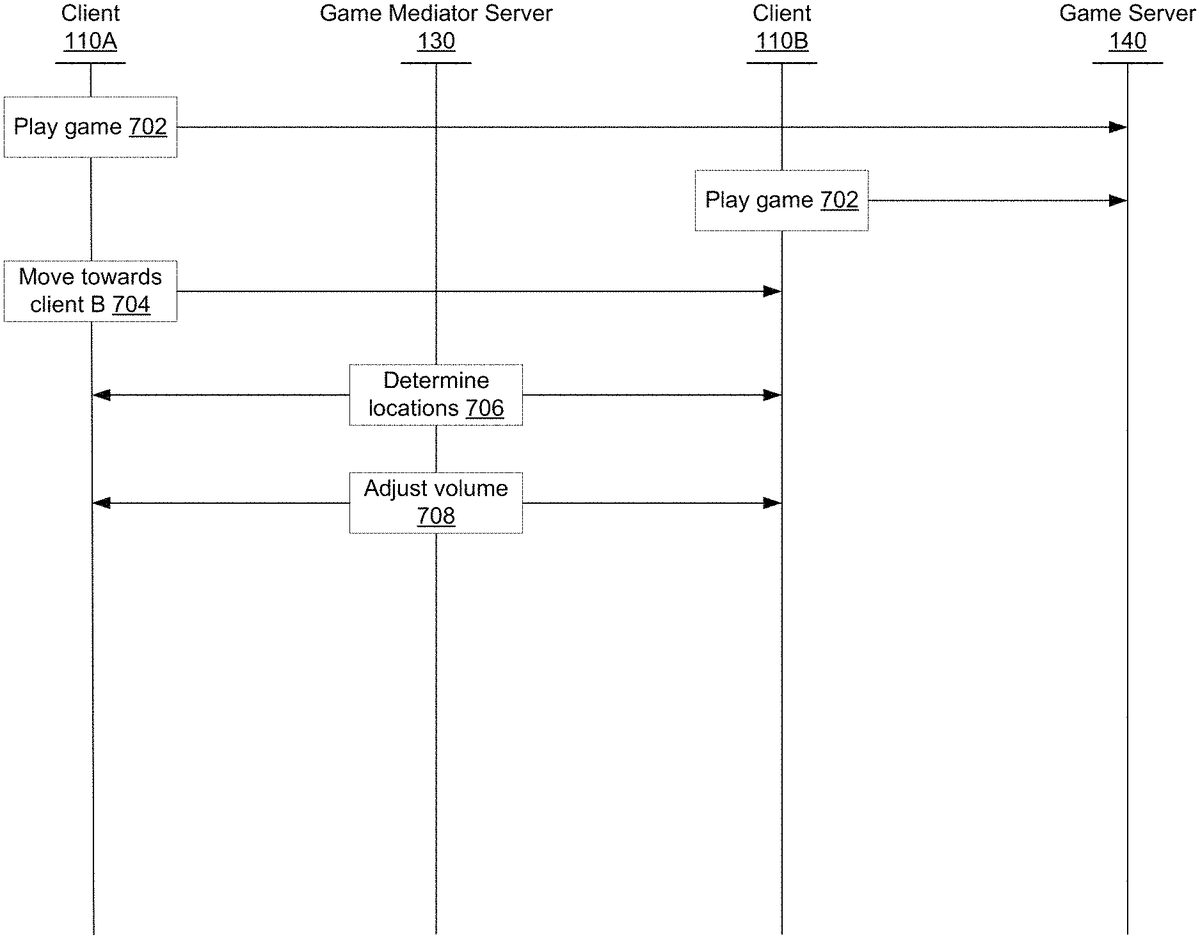
FIG. 7illustrates the process of enriching multiplayer gameplay based on physical location using the game mediation system100, according to an embodiment. Users of the client110A and the client110B play502a game114as participants in the same game playing session. The client110A physically moves504closer to the client110B, passing within a threshold distance. The game mediator server130determines506the locations of the client110A and the client110B and identifies that the clients110are within the threshold distance of each other (e.g., by comparing GPS or other location coordinates, or by comparing audio input received from the clients110and based on a high degree of similarity concluding that the clients are in the same room or other physical area). As a result, the game mediator server130takes an action, such as adjusting508the volume of the client110A and/or the client110B. In an embodiment, adjusting508the volume comprises muting one or both of the clients110, or specific portions thereof (such as a game background soundtrack, game sound effects, etc.), in order to avoid duplicative sounds in the same geographic area.
Other Considerations
The present invention has been described in particular detail with respect to one possible embodiment. Those of skill in the art will appreciate that the invention may be practiced in other embodiments. First, the particular naming of the components and variables, capitalization of terms, the attributes, data structures, or any other programming or structural aspect is not mandatory or significant, and the mechanisms that implement the invention or its features may have different names, formats, or protocols. Also, the particular division of functionality between the various system components described herein is merely for purposes of example, and is not mandatory; functions performed by a single system component may instead be performed by multiple components, and functions performed by multiple components may instead performed by a single component.
Some portions of above description present the features of the present invention in terms of algorithms and symbolic representations of operations on information. These algorithmic descriptions and representations are the means used by those skilled in the data processing arts to most effectively convey the substance of their work to others skilled in the art. These operations, while described functionally or logically, are understood to be implemented by computer programs. Furthermore, it has also proven convenient at times, to refer to these arrangements of operations as modules or by functional names, without loss of generality. As used herein, the term “module” refers to computer program logic utilized to provide the specified functionality. Thus, a module can be implemented in hardware, firmware, and/or software.
Unless specifically stated otherwise as apparent from the above discussion, it is appreciated that throughout the description, discussions utilizing terms such as “determining” or “displaying” or the like, refer to the action and processes of a computer system, or similar electronic computing device, that manipulates and transforms data represented as physical (electronic) quantities within the computer system memories or registers or other such information storage, transmission or display devices.
Certain aspects of the present invention include process steps and instructions described herein in the form of an algorithm. It should be noted that the process steps and instructions of the present invention could be embodied in software, firmware or hardware, and when embodied in software, could be downloaded to reside on and be operated from different platforms used by real time network operating systems.
The present invention also relates to an apparatus for performing the operations herein. This apparatus may be specially constructed for the required purposes, or it may comprise a general-purpose computer selectively activated or reconfigured by a computer program stored on a computer readable medium that can be accessed by the computer. Such a computer program may be stored in a non-transitory computer readable storage medium, such as, but is not limited to, any type of disk including floppy disks, optical disks, CD-ROMs, magnetic-optical disks, read-only memories (ROMs), random access memories (RAMs), EPROMs, EEPROMs, magnetic or optical cards, application specific integrated circuits (ASICs), or any type of computer-readable storage medium suitable for storing electronic instructions, and each coupled to a computer system bus. Furthermore, the computers referred to in the specification may include a single processor or may be architectures employing multiple processor designs for increased computing capability.
The algorithms and operations presented herein are not inherently related to any particular computer or other apparatus. Various general-purpose systems may also be used with programs in accordance with the teachings herein, or it may prove convenient to construct more specialized apparatus to perform the required method steps. The required structure for a variety of these systems will be apparent to those of skill in the art, along with equivalent variations. In addition, the present invention is not described with reference to any particular programming language. It is appreciated that a variety of programming languages may be used to implement the teachings of the present invention as described herein, and any references to specific languages are provided for invention of enablement and best mode of the present invention.
The present invention is well suited to a wide variety of computer network systems over numerous topologies. Within this field, the configuration and management of large networks comprise storage devices and computers that are communicatively coupled to dissimilar computers and storage devices over a network, such as the Internet.
Finally, it should be noted that the language used in the specification has been principally selected for readability and instructional purposes, and may not have been selected to delineate or circumscribe the inventive subject matter. Accordingly, the disclosure of the present invention is intended to be illustrative, but not limiting, of the scope of the invention, which is set forth in the following claims.
Claims
- A computer-implemented method comprising: sending, by an electronic game executing on a client device, to a game mediation infrastructure, a request for subscription to a semantic event, wherein sending the request comprises making a call using an application programming interface of the game mediation infrastructure to an event subscription function, the event subscription function call specifying an identifier of the semantic event to which subscription is desired;providing, by the client device, to the game mediation infrastructure, user input data, the user input data comprising geolocation sensor data;receiving, by the electronic game from the game mediation infrastructure in response to the providing of the user input data, a notification that the semantic event occurred, the semantic event comprising a determination that the client device and at least one other client device are located within a threshold distance of each other;and responsive to receiving the notification, the electronic game altering a state of the game according to the semantic event by adjusting at least a portion of a volume of the game.
- The method of claim 1 , further comprising receiving second user input data comprising camera image data from the client device, and determining, using the second user input data, that a user gesture by a game participant occurred.
- The method of claim 1 , further comprising receiving second user input data comprising audio input data from the client device, and determining, using the second user input data, that a verbal expression by a game participant occurred.
- The method of claim 1 , wherein the game mediation infrastructure comprises: a game mediator server;a game mediator component executing on the client device;and one or more other game mediator components executing on one or more other client devices associated with one or more other game participants.
- The method of claim 1 , wherein adjusting at least a portion of a volume of the game comprises instructing the client device to mute one or more of game sound effects, background music, or audio content of a game video stream.
- A computer-implemented method comprising: receiving, at a game mediation infrastructure from an electronic game executing on a client device, a request for subscription to a semantic event, the electronic game sending the subscription request by making a call using an application programming interface of the game mediation infrastructure to an event subscription function, the event subscription function call specifying an identifier of the semantic event to which subscription is desired;receiving, from game mediator components executing on at least two client devices, user input data, the user input data comprising geolocation sensor data;determining, using the user input data, that the semantic event occurred, the semantic event comprising a determination that the at least two client devices are located within a threshold distance of each other;and responsive to the determination, instructing at least one of the client devices to alter a state of the game by adjusting at least a portion of a volume of the game.
- The method of claim 6 , further comprising: receiving second user input data comprising camera image data from the client device, and determining, using the second user input data, that a user gesture by a game participant occurred.
- The method of claim 6 , further comprising: receiving second user input data comprising audio input data from the client device, and determining, using the second user input data, that a verbal expression by a game participant occurred.
- The method of claim 6 , wherein the game mediation infrastructure comprises: a game mediator server;a game mediator component executing on the client device;and one or more other game mediator components executing on one or more other client devices associated with one or more other game participants.
- The method of claim 6 , wherein adjusting at least a portion of a volume of the game comprises instructing the at least one client device to mute one or more of game sound effects, background music, or audio content of a game video stream.
- A non-transitory computer-readable medium storing instructions that, when executed by a processor, cause the processor to perform operations comprising: sending, by an electronic game executing on a client device, to a game mediation infrastructure, a request for subscription to a semantic event, wherein sending the request comprises making a call using an application programming interface of the game mediation infrastructure to an event subscription function, the event subscription function call specifying an identifier of the semantic event to which subscription is desired;providing, by the client device, to the game mediation infrastructure, user input data, the user input data comprising geolocation sensor data;receiving, by the electronic game from the game mediation infrastructure, in response to the providing of the user input data, a notification that the semantic event occurred, the semantic event comprising a determination that the client device and at least one other client device are located within a threshold distance of each other;and responsive to receiving the notification, the electronic game altering a state of the game according to the semantic event by adjusting at least a portion of a volume of the game.
- The non-transitory computer-readable medium of claim 11 , wherein the operations further comprise receiving second user input data comprising camera image data from the client device, and determining, using the second user input data, that a user gesture by a game participant occurred.
- The non-transitory computer-readable medium of claim 11 , wherein the operations further comprise receiving second user input data comprising audio input data from the client device, and determining, using the second user input data, that a user gesture by a game participant occurred.
- The non-transitory computer-readable medium of claim 11 , wherein the game mediation infrastructure comprises: a game mediator server;a game mediator component executing on the client device;and one or more other game mediator components executing on one or more other client devices associated with one or more other game participants.
- The non-transitory computer-readable medium of claim 11 , wherein adjusting at least a portion of a volume of the game comprises instructing the client device to mute one or more of game sound effects, background music, or audio content of a game video stream.
Disclaimer: Data collected from the USPTO and may be malformed, incomplete, and/or otherwise inaccurate.