U.S. Pat. No. 10,937,275
Live Action Video Games
AssigneeFusion Holdings Limited
Issue DateJune 30, 2020
Illustrative Figure
Abstract
Methods and apparatus are disclosed related to simulated live dealer games. A computing device can receive a request to play a game of chance that includes a plurality of game actions ordered by a game sequence. The computing device can play the game of chance by: determining a particular game action based on the game sequence; determining a plurality of pre-recorded video segments related to the particular game action, where each of the pre-recorded video segments records a respective instance of the particular game action being performed by a person; selecting a particular pre-recorded video segment from the plurality of pre-recorded video segments; and generating a display related to the particular game action that includes at least a portion of the particular pre-recorded video segment.
Description
DETAILED DESCRIPTION I. Introduction Herein are disclosed techniques for “stitching together” pre-recorded video segments related to games of chance to provide an arbitrarily large number of possible game play sequences. Each game play sequence can be divided into game actions, such as waiting for a wager, spinning a roulette ball, and announcing the result of a game, and each game action can be associated with one or more video segments. A video segment can be one or more files and/or or other storage units for storing video data, and perhaps related audio data. As an example, pre-recorded video segments can record instances of a game action, such as segments of a live game play sequence, being performed by a person (e.g., a dealer, a croupier). To provide a display of a game of chance being played, a software application can select and display an associated pre-recorded video segment for each game action of a game play sequence for the game of chance. Many games of chance can be classified as either single-state or multi-state games. In a single-state game, such as roulette, a player places one or more wagers on an outcome of the game, whereupon the croupier may spin the roulette wheel to determine the outcome of the game and thereafter to resolve the player wagers. In a multi-state game such as blackjack the player makes game play decisions at various stages during the course of the game; for example, whether to stand, hit, split, or to surrender during a turn of the blackjack game. Some games of chance can be divided into a plurality of game actions ordered by a game sequence. For example, the game of roulette can be considered to have the following four roulette game actions: a making wagers game action, a ball launch game ...
DETAILED DESCRIPTION
I. Introduction
Herein are disclosed techniques for “stitching together” pre-recorded video segments related to games of chance to provide an arbitrarily large number of possible game play sequences. Each game play sequence can be divided into game actions, such as waiting for a wager, spinning a roulette ball, and announcing the result of a game, and each game action can be associated with one or more video segments. A video segment can be one or more files and/or or other storage units for storing video data, and perhaps related audio data. As an example, pre-recorded video segments can record instances of a game action, such as segments of a live game play sequence, being performed by a person (e.g., a dealer, a croupier). To provide a display of a game of chance being played, a software application can select and display an associated pre-recorded video segment for each game action of a game play sequence for the game of chance.
Many games of chance can be classified as either single-state or multi-state games. In a single-state game, such as roulette, a player places one or more wagers on an outcome of the game, whereupon the croupier may spin the roulette wheel to determine the outcome of the game and thereafter to resolve the player wagers. In a multi-state game such as blackjack the player makes game play decisions at various stages during the course of the game; for example, whether to stand, hit, split, or to surrender during a turn of the blackjack game.
Some games of chance can be divided into a plurality of game actions ordered by a game sequence. For example, the game of roulette can be considered to have the following four roulette game actions: a making wagers game action, a ball launch game action, a ball landing game action, and a settling wagers game action. In this example, a roulette game sequence can be: (1) the making wagers game action takes place where a dealer can accept one or more wagers from one or more players on an outcome of a ball landing in a roulette wheel, (2) the ball launch game action where the roulette wheel is spun and the ball launched into the spinning roulette wheel, (3) the ball landing game action, where the ball launched in the ball launch segment eventually lands into a slot of the roulette wheel to determine an outcome of the game of roulette, and (4) the settling wagers game action, where wagers made during the making wagers segment are either paid off or collected by the house depending on the outcome of the game of roulette determined at the end of the ball landing segment. Similar divisions of other games of chance into respective game actions ordered by respective game sequences are possible as well, including, but not limited to, the games of blackjack, baccarat, poker, boule, craps, chuck-a-luck, Fan Tan, wheel of fortune, and keno.
Continuing with the roulette example, the following set of pre-recorded roulette video segments can be used in order to simulate a live video stream of the game:(a) a “dealer idle and waiting” video segment;(b) a “dealer welcomes player” video segment;(c) a “dealer launches ball” video segment;(d) a set of pre-recorded video segments of the ball landing in each position on the roulette wheel (i.e. 37 video segments for European roulette and 38 video segments for American roulette); and(e) a “dealer congratulates player” video segment.
In other examples, more, fewer, and/or different roulette video segments can be associated with the game of roulette.
The above-mentioned roulette video segments can be associated with the above-mentioned roulette game actions; e.g., the making wagers segment can be associated with the “dealer idle and waiting” and “dealer welcomes player” video segments, the ball launch segment can be associated with the “dealer launches ball” video segment, the ball landing segment can be associated with the set of pre-recorded video segments of the ball landing, and the settling wagers segment can be associated with the “dealer congratulates player” video segment. Then, a software application simulating a live video stream of the game of roulette can use the roulette game sequence to sequence through the above-mentioned roulette game actions while the displaying the above-mentioned roulette video segment(s) associated with each roulette game action in its turn.
In some examples, multiple versions of a video segment can be recorded. For example, a first version of the “dealer idle and waiting” video segment can involve a waiting time of ten seconds, a second version of the “dealer idle and waiting” video segment can last fifteen seconds, and so on. As another example, one version of the video segment can capture a first dealer, and another version of the video segment can capture a second dealer who differs from the first dealer. Still another example can involve different video segment versions of a dealer (or other person) speaking in different languages; e.g., English, Mandarin, Cantonese, French, etc. Many other examples of different video segments and different versions of video segments are possible.
The software application can execute on one computing device and communicate with another computing device, such as a gaming server, to play the game of chance. For example, the gaming server can provide gaming results and perform account management services during game play, such as taking wagers, paying winnings, etc. In some cases, the software application can obtain the video segments as part of an installation package; i.e., the application is bundled with the video segments. In other cases, the gaming server (or another computing device) can transmit one or more video segments to a computing device executing the software application. In some of these cases, a transmitted video segment can be stored in data storage, such as a cache and/or main memory, of the computing device and later replayed from data storage rather than being retransmitted.
The software application can provide a user interface to conduct the game of chance. For example, the user interface can take wagers, display video segments associated with gaming sequences, and display results. In some cases, the user interface can generate a user display that includes video segments, still images, and/or graphical objects, such as a 3D graphical object representing a card, or slot of roulette wheel. In particular examples, the 3D graphical object can represent at least a portion of a video segment, such as a portion of a video segment showing a dealer conducting the game of chance. The user interface can then compose a display from the 3D graphical object representing the dealer, other graphical objects, such as one or more still images of a casino backdrop, and perhaps additional 3D graphical objects, such as 3D graphical objects representing cards.
II. Example Live Action Video Games
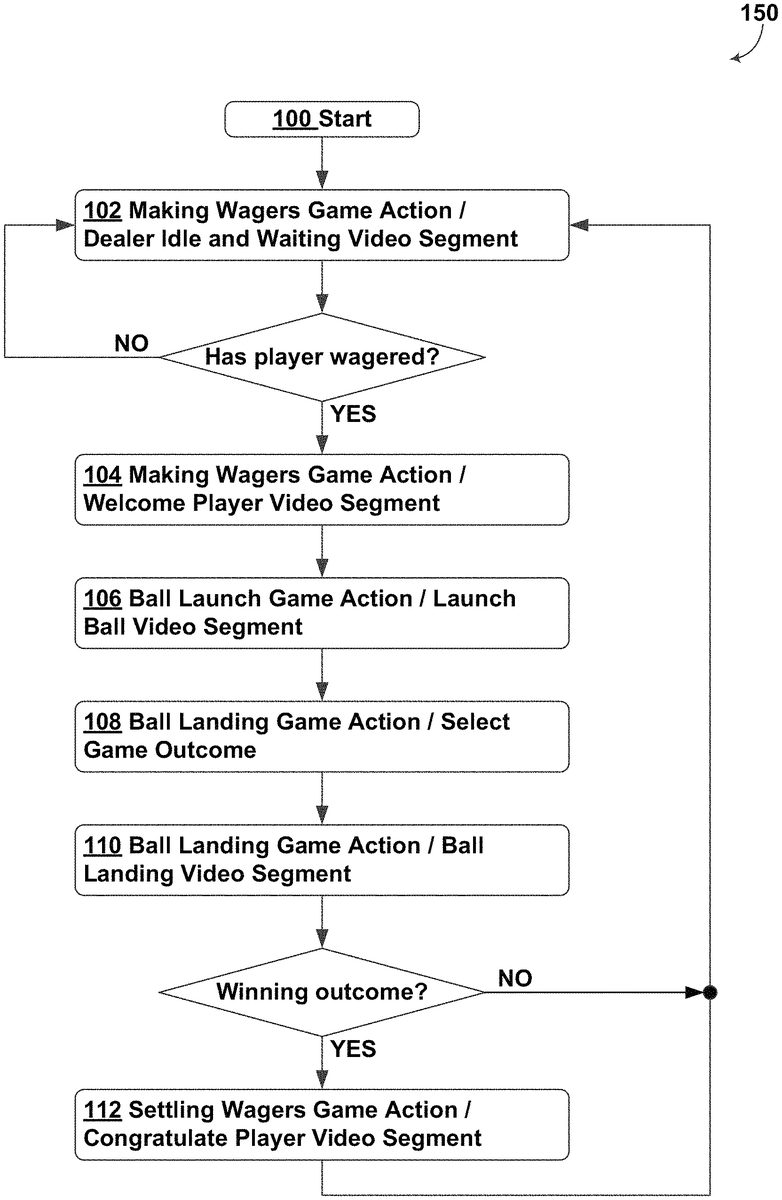
FIG. 1is a flow chart depicting a set of functions150that can be carried out in accordance with an example embodiment. For example, a software application can be executed on a computing device, such as computing device400described below, to carry out some or all the set of functions150. The set of functions150can be performed to carry out a turn of a single-state game of roulette. The set of functions are shown within blocks100through112. A description of those blocks now follows.
At block100the player can launch a roulette game; e.g., start and/or instruct the above-mentioned software application to play the roulette game. For example, the player can provide a request via a user interface to the software application to play the roulette game.
At block102, the software application for the roulette game can begin the making wagers game action by displaying the pre-recorded “dealer idle and waiting” video segment to the player (i.e. segment (a) above). The “dealer idle and waiting” video segment can be displayed until the player has placed one or more wagers on an outcome of the turn of the roulette game.
Next, at block104, once the player has completed wagering, the software application can display the pre-recorded “dealer welcomes player” video segment to the player (i.e., segment (b) above) and then the making wagers game action can be completed. In some embodiments, amounts for wagers made by a player can be deducted from a player's account during block104. The player's account can be maintained by the software application and/or by another computing device; e.g., a gaming server.
Next, at block106, the software application can proceed to the ball launch game action and display the pre-recorded “dealer launches ball” video segment to the player (i.e. segment (c) above).
Next, at block108, the software application can proceed to the ball landing game action where an outcome of the turn of the roulette game is determined by randomly selecting one of the pre-recorded video segments showing a ball landing in one of the positions on a roulette wheel (i.e., one of the segments in (d) above). In some embodiments, the software application can determine the outcome of the game by randomly selecting an outcome and then displaying the pre-recorded video segment corresponding to the outcome of the game.
In other embodiments, a gaming server or other computing device can determine the outcome of the game. In some of these embodiments, the gaming server (or other computing device) can provide an instruction to the software application to display a pre-recorded video segment corresponding to the outcome of the game.
At block110, the software application can display a randomly-selected, pre-recorded video segment of the ball landing on a position on the roulette wheel (i.e. the video segment selected in block108above) to complete the ball landing game action.
Next, at block112, the software application can proceed to the settling wagers game action. During this game action, if the outcome of the turn of the roulette game results in a win for the player, the software application can display the pre-recorded “dealer congratulates player” video segment to the player (i.e., segment (e) above). In some embodiments, amounts won by the player can be added to the player's account. In particular of these embodiments where wagers are deducted when made; i.e., during block104, the settling wagers game action can be omitted if the player does not win any amount during the turn of roulette. In other of these embodiments where wagers are not deducted when made, the settling wagers game action can include deducting wager amounts from the player's account.
After the settling wagers game action has completed, another iteration of the roulette game can commence at block102.
If, on the other hand, the outcome of the turn of the roulette game does not result in a win for the player, the next turn of the game commences at block102.
FIG. 9is a flow chart depicting a set of functions950that can be carried out in accordance with another example embodiment. For example, a software application can be executed on a computing device, such as computing device400described below, to carry out some or all of the set of functions950. The set of functions950can be performed to carry out a turn of a single-state game of roulette. The set of functions950are shown within blocks900through910. A description of those blocks now follows.
At block900the player can launch a roulette game; e.g., start and/or instruct the above-mentioned software application to play the roulette game. For example, the player can provide a request via a user interface to the software application to play the roulette game.
At block902the software application for the roulette game can begin the making wagers game action by displaying a graphical representation of a roulette betting template, without displaying a pre-recorded video segment to the player. The displayed betting template may persist until the player has placed one or more wagers on an outcome of the turn of the roulette game and indicated that the making wagers game action can be completed. Alternatively, the displayed betting template may persist for a predetermined time, whereupon the making wagers game action may terminate. In some embodiments, amounts for wagers made by a player may be deducted from a player's account during block902. The player's account may be maintained by the software application and/or by another computing device; e.g., a gaming server.
Next, at block904, the software application can proceed to the ball launch game action by displaying the pre-recorded “dealer launches ball” video segment to the player (i.e., segment (c) above). The “dealer launches ball” video segment may be displayed contemporaneously with the betting template showing the player's wagers.
Next, at block906, the software application can proceed to the ball landing game action where an outcome of the turn of the roulette game is determined by randomly selecting one of the pre-recorded video segments showing a ball landing in one of the positions on a roulette wheel (i.e., one of the segments in (d) above). In some embodiments, the software application can determine the outcome of the game by randomly selecting an outcome and then displaying the pre-recorded video segment corresponding to the outcome of the game.
At block908, the software application can display a randomly-selected, pre-recorded video segment of the ball landing on a position on the roulette wheel (i.e., the video segment selected in block906above) to complete the ball landing game action.
Next, at block910, the software application can proceed to the settling wagers game action. During this game action, the software application may display, or continue to display, as the case may be, the betting template showing the player's wagers, without displaying a pre-recorded video segment to the player. If the outcome of the turn of the roulette game does not result in a win for the player, the software application may display an animation of the player's losing wagers being cleared from the roulette betting template. If the outcome of the turn of the roulette game results in a win for the player, the software application may display an animation showing the player's winning wager, or wagers, being paid out on the roulette betting template. In some embodiments, amounts won by the player may be added to the player's account.
In particular, in these embodiments where wagers are deducted when made, i.e., during block902, the settling wagers game action can be omitted if the player does not win any amount during the turn of the roulette game. In other embodiments where wagers are not deducted when made, the settling wagers game action can include deducting wager amounts from the player's account.
After the settling wagers game action has completed, another iteration of the roulette game can commence at block902.
It will be appreciated that in order to increase the realism of the synthesised video stream displayed to the payer, and in order to minimise the likelihood of the player becoming aware that a live video stream is not in use, multiple versions of pre-recorded video segments (a) to (e) above can be provided. In one embodiment, N different versions of each pre-recorded video segment can be provided, where N is a positive integer greater than 1. In particular, the set (d) of video segments of the ball landing in particular positions on a roulette wheel can be considered as an N×37 (or, alternatively, an N×38) array of different pre-recorded video segments, where each row of the array comprises a subset of video segments of the ball landing in each position on the roulette wheel, and each column consists of N different pre-recorded video segments of the ball landing in the same position on the roulette wheel, but each displaying a different trajectory of the ball coming to rest.
In this embodiment, whenever a video segment, from classes (a), (b), (c) or (e) above is to be displayed to the player, it can be selected randomly from the corresponding set of N different versions of that class of video segment. Furthermore, whenever a video segment from class (d) above is to be displayed to the player, one of the N rows of the array of video segments can first be selected randomly, where after a specific video segment in the selected row can be chosen randomly for display as the outcome of the turn of the roulette game.
Alternatively, an element of the N×37 array of pre-recorded video segments can be randomly selected and the corresponding video segment displayed to the player.
The N×37 array of pre-recorded video segments of the ball landing in the specific position on the roulette wheel can be tedious to generate, particularly as the number N increases.
In an alternative embodiment, the N×37 array can be replaced by a set of N distinct pre-recorded video segments of the ball landing on the roulette wheel, each displaying a different trajectory of the ball coming to rest on the wheel. In this particular embodiment, when a video segment from class (d) above is to be displayed, a randomly-selected one of the N pre-recorded ball trajectories can be played, and a random number in the range1to37can be graphically superimposed on the rest position of the ball on the roulette wheel to represent the outcome of the turn of the roulette game.
Blackjack can provide a multi-state game example of a live action video game. For instance, the game of blackjack can be considered to have the following four blackjack game actions: a making wagers game action, a player hand game action, a dealer hand game action, and a settling wagers game action. In this example, a blackjack game sequence can be: (1) the making wagers game action takes place where a dealer can accept one or more wagers from one or more players on an outcome based on hands of cards dealt to each of the player and to the dealer, (2) the player hand game action, where the dealer deals cards to the player to determine the player's hand, (3) the dealer hand game action, where the dealer deals cards to the dealer to determine the player's hand, and (4) the settling wagers game action, where wagers made during the making wagers segment are either paid off or collected by the house depending on the outcome of the game of blackjack at the end of the dealer hand game action.
The following set of pre-recorded video segments can be provided in order to simulate a live video stream of the blackjack game:(f) a “dealer opens betting” video segment;(g) a “dealer waits for bets” video segment;(h) a “dealer closes betting” video segment;(i) a “dealer burns card” video segment;(j) a “dealer deals 3 cards” video segment;(k) a “dealer awaits player input” video segment;(l) a “player hits” video segment;(m) a “player stands” video segment;(n) a “dealer deals dealer cards” video segment; and(o) a “dealer congratulates player” video segment.
FIG. 2is a flow chart depicting a set of functions250that can be carried out in accordance with an example embodiment. For example, a software application can be executed on a computing device, such as computing device400described below, to carry out some or all the set of functions250. The set of functions250can be performed to carry out a turn of a multi-state game of blackjack. Example displays that can be generated by the software application while carrying out the set of functions250are shown inFIGS. 3A, 3B, and3C as indicated below.
The set of functions are shown in blocks200through220. A description of those blocks now follows.
At block200the player can launch the blackjack game e.g., start and/or instruct the above-mentioned software application to play the blackjack game. For example, the player can provide a request via a user interface to the software application to play the blackjack game.
At block202ofFIG. 2, the software application can begin with the making wagers game action and displaying the pre-recorded “dealer opens betting” video segment to the player (i.e. segment (f) above). For example, an upper-left portion ofFIG. 3Ashows image302of display300that the software application can generate while executing block202.
Image302shows that display300includes user interface330, pre-recorded video (PRV)332, and three-dimensional (3D) objects334,336. User interface330can be used by a player to instruct the computing device regarding wagers on the game of blackjack. User interface330includes: balance indicator338showing an available amount of money available for wagering, clear button340to clear a current wager amount, wager indicator342showing the current wager amount, wager selectors344enabling selection of wager amounts, confirmation button346to confirm, and thus place, a wager, and range indicator348indicating a range of acceptable wagers. In the example shown in image302, wager indicator342shows the current wager amount of $500 which is within the $1-$500 range of acceptable wagers shown by range indicator348. In other embodiments, more, fewer, and/or different controls and/or information can be provided by user interface330.
Pre-recorded video332of image302shows a female blackjack dealer recorded while opening betting. In some examples, audio can be provided as part of pre-recorded video332; e.g., the dealer can introduce herself (or in other examples, himself), welcome the player to the table, and perhaps make additional introductory comments. 3D objects334illustrate a stack of playing cards, and 3D object336illustrates a playing card in a card shoe. In other examples, other objects than playing cards can be depicted and used as 3D objects in display300and/or other displays generated by the software application.
At block204ofFIG. 2, the software application can continue the making wagers game action of the blackjack game by displaying the pre-recorded “dealer waits for bets” video segment to the player (i.e. segment (g) above). For example, a lower-left portion ofFIG. 3Ashows image304of display300that the software application can generate while executing block204. Image304shows that display300includes a user interface, pre-recorded video, and 3D objects that are consistent with respective user interface330, pre-recorded video332, and 3D objects334,336described above in the context of image302.
As illustrated by the flowchart ofFIG. 2, the “dealer waits for bets” video segment can continue to be displayed; i.e., block204is repeated, until the player has placed a wager on the outcome of the turn of the blackjack game. Once a player has placed a wager, the software application can proceed to block206. In some embodiments, amounts for wagers made by a player can be deducted from a player's account during block204. The player's account can be maintained by the software application and/or by another computing device; e.g., a gaming server.
At block206, once the player has completed wagering, the software application can continue the making wagers game action by displaying the pre-recorded “dealer closes betting” video segment to the player (i.e. segment (h) above). For example, an upper-right portion ofFIG. 3Ashows image306of display300that the software application can generate while executing block206. Image306shows that display300includes pre-recorded video and 3D objects that are consistent with respective pre-recorded video332and 3D objects334,336described above in the context of image302. However, image306shows that display300includes dimmed (i.e., greyed-out) elements of user interface330, such as clear button340, bet selectors344, and confirmation button346, to indicate that betting has closed and, as such, the dimmed elements of user interface330are no longer available for the player's use.
At block208ofFIG. 2, the software application can display the pre-recorded “dealer burns card” video segment to the player (i.e. segment (i) above) as part of the player hand game action. For example, a lower-right portion ofFIG. 3Ashows image308of display300that the software application can generate while executing block208. Image308shows that pre-recorded video350shown in the “dealer burns card” video segment includes the dealer's hand moving a card along a blackjack table. Image308also shows that display300includes a wager indicator similar to wager indicator342described above in the context of image302.
Image308further shows that display300also includes 3D objects that can be generated by the software application, including 3D object352, representing playing cards. Other 3D objects are possible as well. The 3D objects can be integrated with pre-recorded video, such as pre-recorded video350, to display realistic three-dimensional behavior and so enhance the player's perception of playing a live game of chance. In particular, at upper-center of image308, pre-recorded video350shows the dealer's hand appearing to move a card, representing 3D object352. As 3D object352moves along the blackjack table, corner354of 3D object352is turned up relative to corner356, realistically simulating bending of a playing card while being burned (i.e., discarded) to indicate three dimensionality of 3D object352. If the playing card represented by 3D object352were a two dimensional simulation, the playing card would not bend in a realistic fashion; therefore, the turning up of corner354of 3D object352illustrates three dimensionality of 3D object352.
At block210ofFIG. 2, the software application can display the pre-recorded “dealer deals 3 cards” video segment to the player (i.e. segment (j) above) as part of the player hand game action. During block210, the dealer can deal three cards from the card shoe—two cards for the player and a single card for the dealer. The identity of any dealt card can be represented to the player by means of a graphic representation of a card face shown in a 3D object superimposed on pre-recorded video.
For example, an upper-left portion ofFIG. 3Bshows image310of display300that the software application can generate while executing block210. Image310includes 3D object358, dealer count indicator370, dealer cards372, player count indicator380, and player cards382while the dealer is dealing the third card of the “dealer deals 3 cards” video segment. In the example shown in image310, dealer cards372indicate the dealer has one card—the five of diamonds—with a corresponding count of 5 as shown by dealer count indicator370, and player cards382indicate the player has one card—the eight of hearts—with a corresponding count of 8 as shown by player count indicator380. 3D object358illustrates the third card being dealt, which is shown as bent near corners360and362while coming out of the card shoe as indicia of the three dimensionality of 3D object358.
At block212ofFIG. 2, the software application can display the pre-recorded “dealer awaits player input” video segment to the player (i.e. segment (k) above) as part of the player hand game action.
For example, a lower-left portion ofFIG. 3Bshows image312of display300that the software application can generate while executing block212. Image312shows dealer count indicator370, dealer cards372, player count indicator380, player cards382, and action selectors384while the software application awaits input after the three cards of block210have been dealt. In the example shown in image312, dealer cards372indicate the dealer has one card—the ace of spades—which can have a count of either 1 or 11 as shown by dealer count indicator370, and player cards382indicate the player has two cards—the nine of clubs and the four of hearts—having a corresponding count of 13 as shown by player count indicator380.
Image312also shows action selectors384, which include hit button386and stand button388, that the software application can provide to enable player input. The player can select hit button386to instruct the software application to take a hit; i.e., elect to take another card. Alternatively, the player can select stand button to stand; i.e., elect to stop taking cards. In other embodiments, more, fewer, and/or different action selectors384can be provided by the software application.
The “dealer awaits player input” video segment can continue to be displayed until the player has exercised a required game play choice, for example, whether to hit or to stand. If the player decides to hit (e.g., selects hit button386), the software application can proceed to block214. Otherwise, if the player decides to stand (e.g., selects hit button386), the software application can proceed to block216.
At block214ofFIG. 2, the player has elected to hit. Then, the software application can display the pre-recorded “player hits” video segment to the player (i.e. segment (l) above) as part of the player hand game action. This video segment can show a further card being dealt to the player's hand.
For example, an upper-right portion ofFIG. 3Bshows image314aof display300that the software application can generate while executing block214. Image314ashows pre-recorded video374of a dealer's hand dealing a hit card, which is represented by 3D object376. Then, a lower-right portion ofFIG. 3Bshows image314bof display300that the software application can generate while continuing execution of block214. In the example shown in image314b, dealer cards372indicate the dealer has one card—the three of clubs—having a count of 3 as shown by dealer count indicator370. Image314bincludes player cards382that indicate, in this example, the player was initially dealt the eight of diamonds and six of hearts, and has taken the two of diamonds as a hit card, for a corresponding count of 16 as shown by player count indicator380.
Once the player takes a hit, the player's count is increased by the count of the hit card. If the subsequent player count exceeds21, the player “busts” and loses the game. If the player busts, the player's wager can be deducted from the player's account, if not previously deducted, and the software application can proceed to block202for another turn of the blackjack game. Alternatively, if the player does not bust (such as shown in the example of image314b), the software application can proceed to block212.
At block216ofFIG. 2, the player has elected to stand. In accord with that election, the software application can display the pre-recorded “player stands” video segment of the player hand game action to the player (i.e. segment (m) above). For example, an upper portion ofFIG. 3Cshows image316of display300that the software application can generate while executing block216. As the player has elected to stand, the player can take no further action, as indicated by the greyed-out hit button386and stand button388shown in image216. Once the procedures of block216have completed, the software application can proceed to block218.
At block218ofFIG. 2, the software application can display the pre-recorded “dealer deals dealer cards” video segment to the player (i.e. segment (n) above) as part of the dealer hand game action. This video segment can show one or more cards being dealt to the dealer's hand according to rules of the blackjack game. For example, a middle portion ofFIG. 3Cshows image318of display300that the software application can generate while executing block218. Image318shows dealer count indicator370and dealer cards372while the software application deals cards to the dealer. In the example shown in image318, dealer cards372indicate the dealer has two cards—the ace of spades and the three of clubs—which can have a count of either 4 or 14 as shown by dealer count indicator370.
If an outcome had not already been determined prior to the dealer hand segment (e.g., if the player had not busted), the software application can determine the outcome after the dealer hand segment based on the rules of the game of blackjack. That is, the player either: (a) wins, if the player count is higher than the dealer count; (b) loses, if the player count is less than the dealer count; or (c) ties (or “pushes”), if the player count equals the dealer count. In embodiments where wagers are deducted when made; i.e., during block204, the settling wagers game action can be omitted if the player loses during the turn of blackjack. In other of these embodiments where wagers are not deducted when made, the settling wagers game action can include deducting wager amounts from the player's account if the player loses or adding wager amount from the player's account if the player wins.
If the outcome of the turn of the blackjack game results in a win for the player, the software application can proceed to block220. If, on the other hand, the outcome of the turn of the blackjack game does not result in a win for the player, the software application can proceed to block202to commence another next turn of the game. At block220ofFIG. 2, the software application can display the pre-recorded “dealer congratulates player” video segment to the player (i.e. item (o) above) as part of the settling wagers game action. For example, a lower portion ofFIG. 3Cshows image320of display300that the software application can generate while executing block220. In some embodiments, pre-recorded video of the “dealer congratulates player” video segment can have the dealer provide congratulatory remarks to the player and/or encourage the player to play another turn of the game. Once the procedures of block220have completed, the software application can proceed to block202to commence another next turn of the game.
As described above, in connection with the roulette embodiment, in order to minimise the likelihood of the player becoming aware that a live video stream is not in use, multiple versions of pre-recorded video segments (f) to (o) above can be provided. In particular, M different versions of each pre-recorded video segment can be provided, where M is a positive integer greater than 1. In these embodiments, whenever a video segment (f) to (o) above is to be displayed to the player, it can be selected randomly from the corresponding set of M different versions of that class of video segment.
III. Example Architecture
FIG. 4is a block diagram of computing device400, in accordance with an example embodiment. In particular, computing device400can be configured to perform at least one function related: set of functions150, set of functions250, a software application, display300, scenario500, computing device502, gaming server504, scenario600, computing device602, scenario700, computing device702, and/or method800. Computing device400can include one or more processors402, a user interface module404, data storage406, and network-communication interface module420, all of which can be linked together via a system bus, network, or other connection mechanism.
Processors402can include one or more general purpose processors and/or one or more special purpose processors. Processors402that can be configured to execute computer-readable program instructions410that are contained in data storage406, software applications, and/or other instructions as described herein. For example, processors402can comprise one or more general purpose processors (e.g., INTEL single core microprocessors or INTEL multicore microprocessors) and/or one or more special purpose processors (e.g., application-specific integrated circuits (ASICs), graphics processing units (GPUs), field-programmable gate array (FPGAs), and/or digital signal processors (DSPs)).
User interface module404can be operable to send data to and/or receive data from external user input/output devices. For example, user interface module404can be configured to send and/or receive data to and/or from user input devices such as a keyboard, a keypad, a touch screen, a computer mouse, a track ball, a joystick, a camera, a voice recognition module, and/or other similar devices. User interface module404can also be configured to provide output to user display devices, such as one or more cathode ray tubes (CRT), liquid crystal displays, light emitting diodes (LEDs), displays using digital light processing (DLP) technology, printers, light bulbs, and/or other similar devices. User interface module404can also include one or more devices configured to generate audible output(s), such as a speaker, speaker jack, audio output port, audio output device, earphones, and/or other similar devices. Further, in some embodiments, user interface module404can also include one or more devices configured to generate haptic output(s) such as forces, vibrations, and/or motions detectable at least by a user's sense of touch.
Data storage406can include one or more computer-readable storage media that can be read and/or accessed by at least one of processors402. The one or more computer-readable storage media can include volatile and/or non-volatile storage components, such as optical, magnetic, organic or other memory or disc storage, which can be integrated in whole or in part with at least one of processors402. In some embodiments, data storage406can be implemented using a single physical device (e.g., one optical, magnetic, organic or other memory or disc storage unit), while in other embodiments, data storage406can be implemented using two or more physical devices.
Data storage406can include computer-readable program instructions410and perhaps additional data, such as but not limited to video segments stored in video segment storage412.FIG. 4shows that video segment storage412can store video segments related to one or more games of chance, such as “Game1” and “Game2”. Video segment storage412for Game1 can include video segments (VSs)102, VS104, VS106, VS108, VS110, and VS112corresponding to respective blocks102,104,106,108,110, and112of set of functions150; i.e., Game1 can be roulette. Video segment storage412for Game2 can include video segments VS202, VS204, VS206, VS208, VS210, VS212, VS214, VS216, VS218, and VS220, corresponding to respective blocks202,204,206,208,210,212,214,216,218, and220of set of functions250; i.e., Game2 can be blackjack. In other embodiments, video segment storage412can store more, fewer, and/or different video segments than shown inFIG. 4.
As mentioned above, a video segment can be one or more files and/or or other storage units for storing video data, and perhaps related audio data. The video segment can be stored using one or more video file formats, such as but not limited to, Audio Video Interleave (AVI), Windows Media Video (WMV), Advanced Systems Format (ASF), QuickTime, H.264, Advanced Video Coding High Definition (AVCHD), Flash Video, Motion Picture Experts Group (MPEG)-1, MPEG-2, MPEG-4, and DivX. In particular, a video segment can include pre-recorded video and/or audio data recording one or more segments of a “live game play sequence”; that is, a recording of one or more persons, such as a dealer and/or a croupier, involved in playing a game of chance.
Each of the video segments can have one or more versions. For example, video segment VS102is shown having at least three versions: a first version video segment named “VS102_ver1”, a second version video segment “VS102_ver2”, and a third version video segment “VS102_ver3”. Each version can show a respective instance of a particular game action being performed by a person (e.g., a dealer or croupier). However, the performance of the particular game action can vary between different versions. In general, the particular action could be performed by different persons in different versions, or could be performed in different ways by the same person. In some implementations, the different versions can have different durations. For example, the first version of the VS102video segment related to an idle dealer can show a dealer waiting for 10 seconds, the second version of the VS102video segment related to an idle dealer can show a dealer waiting for 20 seconds, and a third version of the VS102video segment related to an idle dealer can show a dealer waiting for 60 seconds.
In some implementations, different versions can be provided having different languages. As another example, the first version of the VS102video segment related to an idle dealer can have a dealer making an introduction in Mandarin, the second version of the VS102video segment can have a dealer making an introduction in Cantonese, a third version of the VS102video segment can have a dealer making an introduction in English, and a fourth version of the VS102video segment related to an idle dealer can show a dealer silently waiting for 60 seconds; i.e., the fourth video segment has no particular language associated with it. In still other examples, different versions can be provided to accommodate user disabilities; e.g., a dealer can use sign language rather than speaking for hearing-impaired players, close-ups can be used to better display the dealer for visually-impaired players, outcomes can be announced audibly and/or provided visually, larger sized cards/count indicators can be used, etc.
Different versions can be provided having different outcomes. For example, the VS110video segment associated with a roulette ball landing can have 38 different outcomes—one for the roulette ball landing in a “0” slot, one for the roulette ball landing in a “00” slot, one for the roulette ball landing in a “1” slot, . . . , and one for the roulette ball landing in a “36” slot. As another example, one version of a video segment related to settling wagers can show a dealer providing encouragement to a losing player while another version of a video segment related to settling wagers can show a dealer congratulating a winning player. Many other example video segments of different durations, languages, and outcomes are possible as well.
A set of versions of a video segment can include different versions for different criteria; e.g., a set of nine versions of the VS102video segment can include three Mandarin-language versions having respective durations of 10, 20, and 60 seconds, three Cantonese-language versions having respective durations of 10, 20, and 60 seconds, and three English-language versions having respective durations of 10, 20, and 60 seconds. Then, the software application can select a particular version from among the set of versions based on user input, user responses, randomly, default values, and/or other criteria. Continuing the set of nine versions of the VS102video segment example above, a player can be queried to determine a language of preference; e.g., Mandarin, Cantonese, or English. Then, a video segment can be selected from among the set of versions; e.g., the 20 second Mandarin-language version of the VS102video segment can be initially played by default for a Mandarin-language player. Based on player response times and/or player selection, the software application can use the faster 10-second Mandarin-language version for a relatively-fast acting player, maintain use of the default 20-second Mandarin-language version for a moderate speed player, or use the slower 60-second Mandarin-language version for a relatively-slow acting player. Further, different versions and sets of versions of video segments can have different variations than between durations, languages, and outcomes; e.g., versions for different locations/backdrops, versions with and without audio, versions with different dealers, versions associated with different gaming entities, etc.
In some embodiments, data storage406can additionally include storage required to perform at least part of the herein-described methods and techniques and/or at least part of the functionality of the herein-described devices.
Network-communications interface module420can include one or more wireless interfaces422and/or one or more wireline interfaces424that are configurable to communicate via a network. Wireless interfaces422can include one or more wireless transmitters, receivers, and/or transceivers, such as a Bluetooth transceiver, a Zigbee transceiver, a Wi-Fi transceiver, a WiMAX transceiver, and/or other similar type of wireless transceiver configurable to communicate via a wireless network. Wireline interfaces424can include one or more wireline transmitters, receivers, and/or transceivers, such as an Ethernet transceiver, a Universal Serial Bus (USB) transceiver, or similar transceiver configurable to communicate via a twisted pair wire, a coaxial cable, a fiber-optic link, or a similar physical connection to a wireline network.
In some embodiments, network communications interface module420can be configured to provide reliable, secured, and/or authenticated communications. For each communication described herein, information for ensuring reliable communications (i.e., guaranteed message delivery) can be provided, perhaps as part of a message header and/or footer (e.g., packet/message sequencing information, encapsulation header(s) and/or footer(s), size/time information, and transmission verification information such as CRC and/or parity check values). Communications can be made secure (e.g., be encoded or encrypted) and/or decrypted/decoded using one or more cryptographic protocols and/or algorithms, such as, but not limited to, DES, AES, RSA, Diffie-Hellman, and/or DSA. Other cryptographic protocols and/or algorithms can be used as well or in addition to those listed herein to secure (and then decrypt/decode) communications.
In some embodiments, computing device400can include one or more sensors. The sensor(s) can be configured to measure conditions in an environment for computing device400and provide data about that environment. For example, the sensor(s) can include one or more of: (i) an identification sensor to identify other objects and/or devices, such as, but not limited to, an RFID reader, proximity sensor, one-dimensional barcode reader, two-dimensional barcode (e.g., Quick Response (QR) code) reader, and a laser tracker, where the identification sensor(s) can be configured to read identifiers, such as RFID tags, barcodes, QR codes, and/or other devices and/or object configured to be read and provide at least identifying information; (ii) a location sensor to measure locations and/or movements of the computing device400, such as, but not limited to, a gyroscope, an accelerometer, a Doppler sensor, a Global Positioning System (GPS) device, a sonar sensor, a radar device, a laser-displacement sensor, and a compass; (iii) an environmental sensor to obtain data indicative of an environment of computing device400, such as, but not limited to, an infrared sensor, an optical sensor, a light sensor, a camera, a biosensor, a capacitive sensor, a touch sensor, a temperature sensor, a wireless sensor, a radio sensor, a movement sensor, a microphone, a sound sensor, an ultrasound sensor, and/or a smoke sensor. Many other examples of sensor(s) are possible as well.
Each computer-readable storage medium (or, more simply “readable medium”) described in this disclosure can include a non-transitory computer-readable medium that includes volatile and/or non-volatile storage components such as optical, magnetic, organic or other memory or disc storage, which can be integrated in whole or in part with a processor. Additionally or alternatively, each computer-readable medium described in this disclosure can include a transitory computer-readable medium. The transitory computer-readable medium can include, but is not limited to, a communications medium such as a digital or analogue communications medium (e.g., a fibre optic cable, a waveguide, a wired communication link, or a wireless communication line).
A network interface, such as network interface communication interface module420or any other network interface disclosed herein, can include an interface to one or more networks and/or communication channels. For example, the network interface can include one or more transmitters configured for transmitting data using the one or more networks and/or communication channels, one or more receivers configured for receiving data using the one or more networks and/or communication channels, and/or one or more transceivers configured to both transmit and receive data using the one or more networks and/or communication channels. In particular, the network interface can be used enable communications between one or more computing devices used by players and one or more gaming servers used to play games of chance and/or provide player accounting services (e.g., player identification, settling of wagers, etc.)
The network interface can further include one or more receivers configured to receive data transmitted over the network or communication channel from another device within or on the network or communication channel. Any of the network interfaces disclosed herein can include circuitry, for example electronic circuitry, for converting data received from the network or communication channel to data that can be provided to a processor for processing the received data. For example, the circuitry of the network interfaces can include a modulator and/or demodulator (modem). Any of the network interfaces disclosed herein can include circuitry, for example electronic circuitry, for converting data received from another device, such as a processor or a computer-readable medium, to data in a form that can be transmitted over a network or communication channel.
IV. Example Communication Flows
FIG. 5illustrates scenario500involving a communication flow between computing device502and gaming server504related to two turns of the game of roulette, in accordance with an example embodiment.FIGS. 6A and 6Billustrate scenario600involving a communication flow between computing device602and gaming server504related to two turns of the game of roulette, in accordance with an example embodiment.FIGS. 7A and 7Billustrate scenario700involving a communication flow between computing device702and gaming server504, in accordance with an example embodiment. Each of scenarios500,600, and700include two turns of the game of American roulette, which are played using a software application executing on a computing device that carries out set of functions150discussed above in the context ofFIG. 1.
Scenarios500,600, and700differ regarding communications between computing devices and gaming server504. The communications between gaming server504and the computing devices in scenarios500,600, and700can involve use of one or more computer networks, including but not limited to, the Internet. The functionality of gaming server504and the computing devices in scenarios500,600, and700can be carried out by computer-executable instructions executing on one or more physical computing devices, such as computing device400. In some examples, gaming server504can include multiple physical computing devices.
In scenario500, computing device502stores copies of all video segments used in the two turns of the game of American roulette, whereas in scenarios600and700gaming server504initially stores the copies of the video segments. In scenario600, computing device602does not cache received copies of the video segments. In scenario700, computing device702does cache received copies of the video segments.
Turning toFIG. 5, scenario500begins at block510, where computing device502installs and stores a software application for playing American roulette. The software application is part of a software installation package that also includes a plurality of video segments to be used by the software application during roulette game play, such as discussed above in the context of set of functions150andFIG. 1. During installation of the software installation package, a player specifies use of the Mandarin language during game play.
At block520, a player instructs computing device502to launch the roulette application. After launching the roulette application, the player can request to play a first turn of the roulette game.
At block522, computing device502can, after receiving the player's request to play the first turn of the roulette game, begin to play the first turn by carrying out the procedures of block102of set of functions150by selecting and displaying a Dealer Idle and Waiting video segment. During scenario500, computing device502selects Dealer Idle and Waiting video segment #3 from among a plurality of versions of the Dealer Idle and Waiting video segment provided in the plurality of video segments installed and stored at block510. In scenario500, computing device502selects Dealer Idle and Waiting video segment #3 based on a duration of the video segment and a Mandarin language of the video segment in accord with the player's language specification at block510. In other scenarios, a Dealer Idle and Waiting video segment can be selected based on more, fewer, and/or different criteria than the duration and the language of the video segment.
At block524, computing device502receives a wager of W1, W1>0, from the player; e.g., the player can utilize a user interface similar to user interface330to make one or more wagers on the first turn of the roulette game.
Upon receiving the wager of W1, computing device502generates and sends Wager message526to gaming server504.FIG. 5shows that Wager message526includes player identification information “P”, wager amount “W1”, and game information “Roulette”. Upon reception of Wager message526, gaming server504verifies that player P has sufficient funds to make the wager, deducts W1 from player P's account to make the requested roulette wager, generates and sends Wager Accepted message528to indicate that player P's wager of W1 has been accepted.
At block530, computing device502can, after receiving Wager Accepted message528, carry out the procedures of block104of the set of functions150to welcome the player by selecting and displaying a Welcome Player video segment. During scenario500, computing device502selects Welcome Player video segment #1 from among a plurality of versions of the Welcome Player video segment provided in the plurality of video segments installed and stored at block510. In scenario500, computing device502selects Welcome Player video segment #1 based on a duration of the video segment and a Mandarin language of the video segment in accord with the player's language specification at block510. In other scenarios, a Welcome Player video segment can be selected based on more, fewer, and/or different criteria than the duration and the language of the video segment.
At block532, computing device502can, after displaying Welcome Player video segment #1, carry out the procedures of block106of the set of functions150to select and display a Launch Ball video segment of a roulette ball launch. During scenario500, computing device502selects Launch Ball video segment #2, which does not have audio, from among a plurality of versions of the Launch Ball video segment provided in the plurality of video segments installed and stored at block510. In scenario500, computing device502selects Launch Ball video segment #2 based on a duration of the video segment. In other scenarios, a Launch Ball video segment can be selected based on more, fewer, and/or different criteria than the duration of the video segment.
In response to Wager message526, gaming server504can carry out the procedures of block108of set of functions150by determining an outcome of the first turn of the roulette game e.g., randomly selecting a ball landing position. In scenario500, gaming server504determines the ball lands at location XX, XX selected from {0, 00, 1, 2 . . . 36}, which leads to a win for the player. As the player's wager won, gaming server504increases player P's account by W2, W2>0.
After determining that the ball lands at location XX, gaming server504generates and sends Outcome message534to computing device502reporting that the outcome of the first turn of the “Roulette” game is “XX” and the wager made by player “P1” resulted in a “Win” of an amount of “W2”.
At block536, computing device502can, after receiving Outcome message534, carry out the procedures of block110of the set of functions150to select and display a Ball Landing video segment showing a roulette ball landing. During scenario500, computing device502selects Ball Landing video segment #XX from among a plurality of versions of the Ball Landing video segment provided in the plurality of video segments installed and stored at block510. In scenario500, computing device502selects Ball Landing video segment #XX based on the outcome “XX” of the roulette game. In other scenarios, a Ball Landing video segment can be selected based on more, fewer, and/or different criteria than the outcome of the roulette game.
At block538, computing device502can, after displaying Ball Landing video segment #XX, carry out the procedures of block112of the set of functions150to select and display a Congratulate Player video segment to congratulate the player's win of an amount of W2. In scenario500, computing device502selects Congratulate Player video segment #4 based on a duration of the video segment and a Mandarin language of the video segment in accord with the player's language specification at block510. In other scenarios, a Congratulate Player video segment can be selected based on more, fewer, and/or different criteria than the duration and the language of the video segment.
Upon completion of block538, scenario500continues with the player requesting to play a second turn of the roulette game.
At block550, computing device502can, after receiving the player's request to play a turn of the roulette, begin to play the second turn of the roulette game by carrying out the procedures of block102of set of functions150to select and display a Dealer Idle and Waiting video segment. During scenario500, computing device502selects Dealer Idle and Waiting video segment #3 for the second roulette turn from among a plurality of versions of the Dealer Idle and Waiting video segment provided in the plurality of video segments installed and stored at block510. In scenario500, computing device502selects Dealer Idle and Waiting video segment #3 based on a duration of the video segment and a Mandarin language of the video segment in accord with the player's language specification at block510. In other scenarios, a Dealer Idle and Waiting video segment can be selected based on more, fewer, and/or different criteria than the duration and the language of the video segment.
At block552, computing device502receives a wager of W3, W3>0, from the player for the second roulette turn; e.g., the player can utilize a user interface similar to user interface330to make one or more wagers on the roulette game. Upon receiving the wager of W3, computing device502generates and sends Wager message554to gaming server504.FIG. 5shows that Wager message554includes player identification information “P”, wager amount “W3”, and game information “Roulette”. Upon reception of Wager message554, gaming server504verifies that player P has sufficient funds to make the wager, deducts W3 from player P's account to make the requested roulette wager, generates and sends Wager Accepted message556to indicate that player P's wager of W3 has been accepted.
At block558, computing device502can, after receiving Wager Accepted message556, carry out the procedures of block104of the set of functions150to welcome the player by selecting and displaying a Welcome Player video segment. During scenario500, computing device502selects Welcome Player video segment #7 for the second roulette turn from among a plurality of versions of the Dealer Idle and Waiting video segment provided in the plurality of video segments installed and stored at block510. In scenario500, computing device502selects Welcome Player video segment #7 for the second roulette turn based on a duration of the video segment and a Mandarin language of the video segment in accord with the player's language specification at block510. In other scenarios, a Welcome Player video segment can be selected based on more, fewer, and/or different criteria than the duration and the language of the video segment.
At block560, computing device502can, after displaying Welcome Player video segment #7, carry out the procedures of block106of the set of functions150to select and display a Launch Ball video segment showing a roulette ball launch for the second roulette turn. During scenario500, computing device502selects Launch Ball video segment #4 for the second roulette turn from among a plurality of versions of the Launch Ball video segment provided in the plurality of video segments installed and stored at block510. In scenario500, computing device502selects Launch Ball video segment #4 for the second roulette turn based on a duration of the video segment and a Mandarin language of the video segment in accord with the player's language specification at block510. In other scenarios, a Launch Ball video segment can be selected based on more, fewer, and/or different criteria than the duration and the language of the video segment. In particular, silent Launch Ball video segment #2 was previously selected by gaming server504without consideration of language-based selection criteria, while Mandarin-language Launch Ball video segment #4 was selected by gaming server504in accord with the player's language specification.
In response to Wager message554, gaming server504can carry out the procedures of block108of set of functions150by determining an outcome of the second turn of the roulette game e.g., randomly selecting a ball landing position. In scenario500, gaming server504determines that, for the second turn, the ball lands at location YY, YY selected from {0, 00, 1, 2 . . . 36}, which leads to a loss for the player. As the player lost, the procedures of block112are omitted for the second turn of the roulette game.
After determining that the ball lands at location YY, gaming server504generates and sends Outcome message562to computing device502, where Outcome message562informs computing device that the outcome of the “Roulette” game is “YY” and the wager made by player “P1” resulted in a “Loss” of an amount of “−W3”.
At block564, computing device502can, after receiving Outcome message562, carry out the procedures of block110of the set of functions150related to selecting and displaying a Ball Landing video segment showing a roulette ball landing for the second turn of roulette. During scenario500, computing device502selects Ball Landing video segment #YY from among a plurality of versions of the Ball Landing video segment provided in the plurality of video segments installed and stored at block510. In scenario500, computing device502selects Ball Landing video segment #YY based on the outcome “YY” of the second turn of the roulette game. In other scenarios, a Ball Landing video segment can be selected based on more, fewer, and/or different criteria than the outcome of the roulette game. Upon completion of block564, scenario500can end.
FIGS. 6A and 6Billustrate scenario600involving a communication flow between computing device602and gaming server504related to two turns of the game of roulette. As shown inFIG. 6A, scenario600begins at block610, where computing device602installs and stores a software application for playing American roulette, such as discussed above in the context of set of functions150andFIG. 1. During installation of the software installation package, a player specifies use of the Mandarin language during game play. In scenario600, the software application is installed without any video segments being installed at time of installation.
At block620, a player instructs computing device602to launch the roulette application. After launching the roulette application, the player can request to play a first turn of the roulette game. After receiving the player's request to play the first turn of the roulette game, computing device602and gaming server504begin to play the first turn by carrying out the procedures of block102of set of functions150. During scenario600, computing device602generates and sends GetSeg message622to gaming server504to request a “DealerIdle” video segment for a game of “Roulette”. In response, gaming server504selects Dealer Idle and Waiting video segment #3, which is stored in a video file called “vid1”, from among a plurality of versions of the Dealer Idle and Waiting video segment. Gaming server504then generates and sends Seg message624with Dealer Idle and Waiting video segment #3/vid1 to computing device602. In scenario600, gaming server504selects Dealer Idle and Waiting video segment #3/vid1 based on a duration of the video segment and a Mandarin language of the video segment in accord with the player's language specification at block610. In other scenarios, a Dealer Idle and Waiting video segment can be selected based on more, fewer, and/or different criteria than the duration and the language of the video segment.
At block626, computing device602can receive Seg message624and then display vid1, which includes Dealer Idle and Waiting video segment #3, to the player.
At block628, computing device602receives a wager of W1, W1>0, from the player; e.g., the player can utilize a user interface similar to user interface330to make one or more wagers on the first turn of the roulette game. Upon receiving the wager of W1, computing device602generates and sends Wager message630to gaming server504.FIG. 6Ashows that Wager message630includes player identification information “P”, wager amount “W1”, and game information “Roulette”. Upon reception of Wager message630, gaming server504verifies that player P has sufficient funds to make the wager, deducts W1 from player P's account to make the requested roulette wager, generates and sends Wager Accepted message632to indicate that player P's wager of W1 has been accepted.
Then, computing device602and gaming server504can carry out the procedures of block104of the set of functions150by selecting and displaying a Welcome Player video segment. After receiving Wager Accepted message632, computing device602generates and sends GetSeg message634to gaming server504to request a “WelcomePlayer” video segment for a game of “Roulette”. In response, gaming server504selects Welcome Player video segment #1, which is stored in a video file called “vid2”, from among a plurality of versions of the Welcome Player video segment. Gaming server504then generates and sends Seg message636with Welcome Player video segment #1/vid2 to computing device602. In scenario600, gaming server504selects Welcome Player video segment #1/vid2 based on a duration of the video segment and a Mandarin language of the video segment in accord with the player's language specification at block610. In other scenarios, a Welcome Player video segment can be selected based on more, fewer, and/or different criteria than the duration and the language of the video segment.
At block638, computing device602can receive Seg message636and then display vid2, which includes Welcome Player video segment #1, to the player. After displaying Welcome Player video segment #1, computing device602and gaming server504can carry out the procedures of block106of the set of functions150to show a roulette ball launch. During scenario600, computing device602generates and sends GetSeg message640to gaming server504to request a “LaunchBall” video segment for a game of “Roulette”. Then, gaming server504selects Launch Ball video segment #2, which is stored in a video file called “vid3” and does not have audio, from among a plurality of versions of the Launch Ball video segment. Gaming server504then generates and sends Seg message642with Launch Ball video segment #2/vid3 to computing device602. In scenario600, gaming server504selects Launch Ball video segment #2 based on a duration of the video segment. In other scenarios, a Launch Ball video segment can be selected based on more, fewer, and/or different criteria than the duration of the video segment.
At block644, computing device602can receive Seg message642and then display vid3, which includes Launch Ball video segment #2, to the player.
In response to Wager message630, gaming server504can carry out the procedures of block108of set of functions150by determining an outcome of the first turn of the roulette game e.g., randomly selecting a ball landing position. In scenario600, gaming server504determines the ball lands at location XX, XX selected from {0, 00, 1, 2 . . . 36}, which leads to a win for the player. As the player's wager won, gaming server504increases player P's account by W2, W2>0.
Also, gaming server504and computing device602can carry out the procedures of blocks110and112of the set of functions150respectively related to roulette ball landing and related to congratulating the player's win of an amount of W2. During scenario600, gaming server504selects Ball Landing video segment #XX, which is stored in a video file called “vid4”, from among a plurality of versions of the Ball Landing video segment. In scenario600, gaming server504selects and displays Ball Landing video segment #XX based on the outcome “XX” of the roulette game. In other scenarios, a Ball Landing video segment can be selected based on more, fewer, and/or different criteria than the outcome of the roulette game.
Gaming server504also selects Congratulate Player video segment #4, which is stored in a video file called “vid5” based on a duration of the video segment and a Mandarin language of the video segment in accord with the player's language specification at block610. In other scenarios, a Congratulate Player video segment can be selected based on more, fewer, and/or different criteria than the duration and the language of the video segment.
After determining that the ball lands at location XX and selecting Ball Landing video segment #XX/vid4 and Congratulate Player video segment #4/vid5, gaming server504can generate and send Outcome message646to computing device602. In scenario600, outcome message646informs computing device602that the outcome of the first turn of the “Roulette” game is “XX”, the wager made by player “P1” resulted in a “Win” of an amount of “W2”, that “vid4” is to be displayed as a Ball Landing video segment as part of the procedures of block110, and “vid5” is to be displayed as a Congratulate Player video segment as part of the procedures of block112.
At block648, computing device602can receive Outcome message646and display vid4, which includes Ball Landing video segment #XX, to the player. At block650, computing device602can display vid5, which includes Congratulate Player video segment #4, to congratulate the player on their win of an amount of W2.
Upon completion of block650, scenario600continues with the player requesting to play a second turn of the roulette game. After receiving the player's request to play the second turn of the roulette game, computing device602and gaming server504begin to play the second turn by carrying out the procedures of block102of set of functions150.
During scenario600, computing device602generates and sends GetSeg message660to gaming server504to request a “DealerIdle” video segment for a game of “Roulette”. In response, gaming server504selects Dealer Idle and Waiting video segment #3, which is stored in a video file called “vid6”, from among a plurality of versions of the Dealer Idle and Waiting video segment. Gaming server504then generates and sends Seg message662with Dealer Idle and Waiting video segment #3/vid6 to computing device602. In scenario600, gaming server504selects Dealer Idle and Waiting video segment #3/vid6 based on a duration of the video segment and a Mandarin language of the video segment in accord with the player's language specification at block610. In other scenarios, a Dealer Idle and Waiting video segment can be selected based on more, fewer, and/or different criteria than the duration and the language of the video segment.
At block664, computing device602can receive Seg message662and then display vid6, which includes Dealer Idle and Waiting video segment #3, to the player.
Turning toFIG. 6B, at block666, computing device602receives a wager of W3, W3>0, from the player for the second roulette turn; e.g., the player can utilize a user interface similar to user interface330to make one or more wagers on the second turn of the roulette game. Upon receiving the wager of W3, computing device602generates and sends Wager message668to gaming server504, where Wager message668includes player identification information “P”, wager amount “W3”, and game information “Roulette”. Upon reception of Wager message668, gaming server504verifies that player P's account has sufficient funds to make the wager, deducts W3 from player P's account to make the requested roulette wager, generates and sends Wager Accepted message670to indicate that player P's wager of W3 has been accepted.
Then, computing device602and gaming server504can carry out the procedures of block104of the set of functions150to welcome the player by selecting and displaying a Welcome Player video segment. After receiving Wager Accepted message670, computing device602generates and sends GetSeg message672to gaming server504to request a “WelcomePlayer” video segment for a game of “Roulette”. In response, gaming server504selects Welcome Player video segment #7, which is stored in a video file called “vid7”, from among a plurality of versions of the Welcome Player video segment. Gaming server504then generates and sends Seg message674with Welcome Player video segment #7/vid7 to computing device602. In scenario600, gaming server504selects Welcome Player video segment #7/vid7 based on a duration of the video segment and a Mandarin language of the video segment in accord with the player's language specification at block610. In other scenarios, a Welcome Player video segment can be selected based on more, fewer, and/or different criteria than the duration and the language of the video segment.
At block676, computing device602can receive Seg message674and then display vid7, which includes Welcome Player video segment #7, to the player.
After displaying Welcome Player video segment #7, computing device602and gaming server504can carry out the procedures of block106of the set of functions150to select and display a Launch Ball video segment showing a roulette ball launch for the second roulette turn. During scenario600, computing device602generates and sends GetSeg message678to gaming server504to request a “LaunchBall” video segment for a game of “Roulette”.
Then, gaming server504selects Launch Ball video segment #4 for the second roulette turn based on a duration of the video segment and a Mandarin language of the video segment in accord with the player's language specification at block610. Gaming server504then generates and sends Seg message680with Launch Ball video segment #4/vid8 to computing device602. In other scenarios, a Launch Ball video segment can be selected based on more, fewer, and/or different criteria than the duration and the language of the video segment. In particular, silent Launch Ball video segment #2 was previously selected by gaming server504without consideration of language-based selection criteria, while Mandarin-language Launch Ball video segment #4 was selected by gaming server504in accord with the player's language specification.
At block682, computing device602can receive Seg message680and then display vid8, which includes Launch Ball video segment #4, to the player.
In response to Wager message668, gaming server504can carry out the procedures of block108of set of functions150by determining an outcome of the second turn of the roulette game e.g., randomly selecting a ball landing position. In scenario600, gaming server504determines that, for the second turn, the ball lands at location YY, YY selected from {0, 00, 1, 2 . . . 36}, which leads to a loss for the player. As the player lost, the procedures of block112are omitted for the second turn of the roulette game.
Also, gaming server504and computing device602can carry out the procedures of block110of the set of functions150respectively related to roulette ball landing for the second turn of the game of roulette. During scenario600, gaming server504selects Ball Landing video segment #YY, which is stored in a video file called “vid9”, from among a plurality of versions of the Ball Landing video segment. In scenario600, gaming server504selects and displays Ball Landing video segment #YY based on the outcome “YY” of the roulette game. In other scenarios, a Ball Landing video segment can be selected based on more, fewer, and/or different criteria than the outcome of the roulette game.
After determining that the ball lands at location YY and selecting a Ball Landing video segment, gaming server504generates and sends Outcome message684to computing device602, where Outcome message684informs computing device that the outcome of the “Roulette” game is “YY” and the wager made by player “P1” resulted in a “Loss” of an amount of “−W3”. Outcome message684also includes “vid9” for carrying out the respective procedures of block110of the set of functions150.
At block686, computing device602can receive Outcome message684and display vid9, which includes Ball Landing video segment #YY, to the player. Upon completion of block686, scenario600can end.
FIGS. 7A and 7Billustrate scenario700involving a communication flow between computing device702and gaming server504. As shown inFIG. 7A, scenario700begins at block710, where computing device702installs and stores a software application for playing American roulette, such as discussed above in the context of set of functions150andFIG. 1. During installation of the software installation package, a player specifies use of the Mandarin language during game play. In scenario700, the software application is installed without any video segments being installed at time of installation, but the software application is enable to cache all received video segments.
At block720, a player instructs computing device702to launch the roulette application. After launching the roulette application, the player can request to play a first turn of the roulette game. After receiving the player's request to play the first turn of the roulette game, computing device702and gaming server704begin to play the first turn by carrying out the procedures of block102of set of functions150. During scenario700, computing device702generates and sends GetSeg message722to gaming server504to request a “DealerIdle” video segment for a game of “Roulette”. In response, gaming server504selects Dealer Idle and Waiting video segment #3, which is stored in a video file called “vid1”, from among a plurality of versions of the Dealer Idle and Waiting video segment. Gaming server504selects Dealer Idle and Waiting video segment #3/vid1 based on a duration of the video segment and a Mandarin language of the video segment in accord with the player's language specification at block610. In other scenarios, a Dealer Idle and Waiting video segment can be selected based on more, fewer, and/or different criteria than the duration and the language of the video segment.
Gaming server504then generates and sends Seg message724with Dealer Idle and Waiting video segment #3/vid1 to computing device702. Seg message724includes three data items: an indicator that the video segment is a “DealerIdle” video segment, the “vid1” video segment, and a video segment identifier (VSI) “VSI=3” to indicate that vid1 can be identified to gaming server504as a copy of the Dealer Idle and Waiting video segment #3.
At block726, computing device702can receive Seg message724, cache vid1 as Dealer Idle and Waiting video segment #3 based on the video segment indicator in Seg message724, and display vid1 to the player. In other scenarios, computing device702can send one or more messages to gaming server504to indicate that one or more video segments were not actually cached; e.g., Dealer Idle and Waiting video segment #3.
At block728, computing device702receives a wager of W, W1>0, from the player; e.g., the player can utilize a user interface similar to user interface330to make one or more wagers on the first turn of the roulette game. Upon receiving the wager of W1, computing device702generates and sends Wager message730to gaming server504.FIG. 7Ashows that Wager message730includes player identification information “P”, wager amount “W1”, and game information “Roulette”. Upon reception of Wager message730, gaming server504verifies that player P has sufficient funds to make the wager, deducts W1 from player P's account to make the requested roulette wager, generates and sends Wager Accepted message732to indicate that player P's wager of W1 has been accepted.
Then, computing device702and gaming server504can carry out the procedures of block104of the set of functions150to welcome the player by selecting and displaying a Welcome Player video segment. After receiving Wager Accepted message732, computing device702generates and sends GetSeg message734to gaming server504to request a “WelcomePlayer” video segment for a game of “Roulette”. In response, gaming server504selects Welcome Player video segment #1, which is stored in a video file called “vid2”, from among a plurality of versions of the Welcome Player video segment. In scenario700, gaming server504selects Welcome Player video segment #1/vid2 based on a duration of the video segment and a Mandarin language of the video segment in accord with the player's language specification at block710. In other scenarios, a Welcome Player video segment can be selected based on more, fewer, and/or different criteria than the duration and the language of the video segment.
Gaming server504then generates and sends Seg message736with Welcome Player video segment #1/vid2 to computing device702. Seg message736includes three data items: an indicator that the video segment is a “WelcomePlayer” video segment, the “vid2” video segment, and video segment identifier “VSI=1” to indicate that vid2 is identified as a copy of the Welcome Player video segment #1 by gaming server504.
At block738, computing device702can receive Seg message736, cache vid2 as Welcome Player video segment #1, and display vid2 to the player.
After displaying Welcome Player video segment #1, computing device702and gaming server504can carry out the procedures of block106of the set of functions150to show a roulette ball launch. During scenario700, computing device702generates and sends GetSeg message740to gaming server504to request a “LaunchBall” video segment for a game of “Roulette”. Then, gaming server504selects Launch Ball video segment #2, which is stored in a video file called “vid3” and does not have audio, from among a plurality of versions of the Launch Ball video segment. In scenario700, gaming server504selects Launch Ball video segment #2 based on a duration of the video segment. In other scenarios, a Launch Ball video segment can be selected based on more, fewer, and/or different criteria than the duration of the video segment.
Gaming server504then generates and sends Seg message742with Launch Ball video segment #2/vid3 to computing device702. Seg message742includes three data items: an indicator that the video segment is a “LaunchBall” video segment, the “vid3” video segment, and video segment identifier “VSI=2” to indicate that vid3 is identified as a copy of the Launch Ball video segment #2 by gaming server504.
At block744, computing device702can receive Seg message742, cache vid3 as Launch Ball video segment #2, and display vid3 to the player.
In response to Wager message730, gaming server504can carry out the procedures of block108of set of functions150by determining an outcome of the first turn of the roulette game e.g., randomly selecting a ball landing position. In scenario700, gaming server504determines the ball lands at location XX, XX selected from {0, 00, 1, 2 . . . 36}, which leads to a win for the player. As the player's wager won, gaming server504increases player P's account by W2, W2>0.
Also, gaming server504and computing device702can carry out the procedures of blocks110and112of the set of functions150respectively related to roulette ball landing and related to congratulating the player's win of an amount of W2. During scenario700, gaming server504selects Ball Landing video segment #XX, which is stored in a video file called “vid4”, from among a plurality of versions of the Ball Landing video segment. In scenario700, gaming server504selects and displays Ball Landing video segment #XX based on the outcome “XX” of the roulette game. In other scenarios, a Ball Landing video segment can be selected based on more, fewer, and/or different criteria than the outcome of the roulette game.
Gaming server504also selects Congratulate Player video segment #4, which is stored in a video file called “vid5” based on a duration of the video segment and a Mandarin language of the video segment in accord with the player's language specification at block710. In other scenarios, a Congratulate Player video segment can be selected based on more, fewer, and/or different criteria than the duration and the language of the video segment.
After determining that the ball lands at location XX and selecting Ball Landing and Congratulate Player video segments, gaming server504generates and sends Outcome message746to computing device702, where Outcome message746informs computing device702that the outcome of the first turn of the “Roulette” game is “XX” and that the wager made by player “P1” resulted in a “Win” of an amount of “W2”. Outcome message746also includes “vid4” as a Ball Landing video segment during the procedures of block110and “vid5” having video segment identifier “VSI=4” is a Congratulate Player video segment during the procedures of block112.
At block748, computing device702can receive Outcome message746. Upon reception of Outcome message746, computing device702displays vid4 to the player, which includes Ball Landing video segment #XX, to show the ball landing at XX. Computing device702also caches vid5 as Congratulate Player video segment #4 and displays vid5 to the player for congratulating the player's win of an amount of W2.
Scenario700continues with gaming server504generating and sending MultiSeg message750to computing device702. MultiSeg message750can be used to send multiple video segments for caching by computing device702. In particular,FIG. 7Ashows that MultiSeg message750includes “38” total “BallLanding” video segments, with the first Ball Landing video segment “vid_0” having a video segment identifier of “0”, the second Ball Landing video segment “vid_00” having a video segment identifier of “00”, and so on until reaching the 38thBall Landing video segment “vid_36” having a video segment identifier of “36”. In other scenarios, computing device702can send one or more messages to gaming server504to indicate whether or not one or more video segments provided in a MultiSeg message were actually cached.
At block752, upon reception of MultiSeg message750, computing device caches the 38 received BallLanding video segments as respective BallLanding video segments #0, #00, 1, 2 . . . #36.
Upon completion of block752, scenario700continues with the player requesting to play a second turn of the roulette game. After receiving the player's request to play the second turn of the roulette game, computing device702and gaming server504begin to play the second turn by carrying out the procedures of block102of set of functions150.
Turning toFIG. 7B, computing device702sends a GetSeg message760to gaming server504to request a “DealerIdle” video segment for the game of “Roulette” and to inform gaming server504that computing device702has cached DealerIdle segment #3 using the “VSI=3” portion of GetSegMessage760. In response, gaming server504selects DealerIdle segment #3 for use in the second turn of the game of roulette. In scenario700, gaming server504selects Dealer Idle and Waiting video segment #3/vid6 based on a duration of the video segment and a Mandarin language of the video segment in accord with the player's language specification at block710. In other scenarios, a Dealer Idle and Waiting video segment can be selected based on more, fewer, and/or different criteria than the duration and the language of the video segment.
Gaming server504then sends Seg message762to instruct computing device702to display the cached DealerIdle segment having the video segment identifier of 3. Note that Seg message762does not include a copy of the video segment.
At block764, after receiving Seg message762, computing device702can display the cached DealerIdle segment #3 as Dealer Idle and Waiting Video Segment for the second turn of the game of roulette. By displaying the already-cached copy of Dealer Idle and Waiting Video Segment #3, game play can be sped up and network bandwidth conserved in comparison to sending DealerIdle segment #3 during the second turn of the game of roulette as performed at block664of scenario600.
At block766, computing device702can receive a wager of W3, W3>0, from the player for the second roulette turn; e.g., the player can utilize a user interface similar to user interface330to make one or more wagers on the second turn of the roulette game. Upon receiving the wager of W3, computing device702generates and sends Wager message768to gaming server504.FIG. 7Bshows that Wager message768includes player identification information “P”, wager amount “W3”, and game information “Roulette”. Upon reception of Wager message768, gaming server504verifies that player P's account has sufficient funds to make the wager, deducts W3 from player P's account to make the requested roulette wager, generates and sends Wager Accepted message770to indicate that player P's wager of W3 has been accepted.
Then, computing device702and gaming server504can carry out the procedures of block104of the set of functions150to welcome the player by selecting and displaying a Welcome Player video segment. After receiving Wager Accepted message770, computing device702generates and sends GetSeg message772to gaming server504to request a “WelcomePlayer” video segment for a game of “Roulette” and uses the “VSI=1” data item to inform gaming server504that computing device702has cached Welcome Player video segment #1.
In response, gaming server504selects Welcome Player video segment #7, which is stored in a video file called “vid7”, from among a plurality of versions of the Welcome Player video segment. In scenario700, gaming server504selects Welcome Player video segment #7/vid7 based on a duration of the video segment and a Mandarin language of the video segment in accord with the player's language specification at block710. In other scenarios, a Welcome Player video segment can be selected based on more, fewer, and/or different criteria than the duration and the language of the video segment.
Gaming server504generates and sends Seg message774with Welcome Player video segment #7/vid7 to computing device702. Seg message774includes three data items: an indicator that the video segment is a “WelcomePlayer” video segment, the “vid7” video segment, and a video segment identifier “VSI=7” to indicate that vid7 can be identified to gaming server504as a copy of the Welcome Player video segment #7.
At block776, computing device702can receive Seg message774, cache vid7 as Welcome Player video segment #7 based on the video segment indicator in Seg message774, and display vid7 to the player.
After displaying Welcome Player video segment #7, computing device702and gaming server504can carry out the procedures of block106of the set of functions150to select and display a Launch Ball video segment showing a roulette ball launch for the second roulette turn. During scenario700, computing device702generates and sends GetSeg message778to gaming server504to request a “LaunchBall” video segment for a game of “Roulette” and uses the “VSI=2” data item to inform gaming server504that computing device702has cached Launch Ball video segment #2.
Then, gaming server504selects Launch Ball video segment #4 for the second roulette turn based on a duration of the video segment and a Mandarin language of the video segment in accord with the player's language specification at block710. In other scenarios, a Launch Ball video segment can be selected based on more, fewer, and/or different criteria than the duration and the language of the video segment. In particular, silent Launch Ball video segment #2 was previously selected by gaming server504without consideration of language-based selection criteria, while Mandarin-language Launch Ball video segment #4 was selected by gaming server504in accord with the player's language specification.
In scenario700, gaming server504has a total of four versions of the Launch ball video segment. Gaming server504determines to request that computing device702cache all four versions. To that end, gaming server504then generates and sends MultiSeg message780with a copy of Launch Ball video segment #4 stored in “vid8a” and identified as “VSI=4”. MultiSeg message780also includes a copy of Launch Ball video segment #1 stored in “vid8b” and identified as “VSI=1” and a copy of Launch Ball video segment #3 stored in “vid8c” and identified as “VSI=3”.
At block782, computing device702can receive Seg message780, cache vid8a as Launch Ball video segment #4, cache vid8b as Launch Ball video segment #1, cache vid8c as Launch Ball video segment #3, and then display vid8a to the player.
In response to Wager message768, gaming server504can carry out the procedures of block108of set of functions150by determining an outcome of the second turn of the roulette game e.g., randomly selecting a ball landing position. In scenario700, gaming server504determines that, for the second turn, the ball lands at location YY, YY selected from {0, 00, 1, 2 . . . 36}, which leads to a loss for the player. As the player lost, the procedures of block112are omitted for the second turn of the roulette game.
Also, gaming server504and computing device702can carry out the procedures of block110of the set of functions150respectively related to roulette ball landing for the second turn of the game of roulette. During scenario700, gaming server504selects Ball Landing video segment #YY from among a plurality of versions of the Ball Landing video segment. In scenario700, gaming server504selects and displays Ball Landing video segment #YY based on the outcome “YY” of the roulette game. In other scenarios, a Ball Landing video segment can be selected based on more, fewer, and/or different criteria than the outcome of the roulette game.
In scenario700, gaming server504recalls that computing device702has already cached 38 Ball Outcome video segments while processing MultiSeg message750. After determining that the ball lands at location YY and selecting a Ball Landing video segment, gaming server504generates and sends Outcome message784to computing device702, where Outcome message784informs computing device that the outcome of the “Roulette” game is “YY” and the wager made by player “P1” resulted in a “Loss” of an amount of “−W3”. Outcome message784also includes an indicator “UseCachedSeg” for carrying out the respective procedures of block110of the set of functions150using the already-cached Ball Landing video segment associated with location YY.
In response to Outcome message784, computing device702can verify that it has a cached copy of a Ball Landing video segment associated with location/video segment identifier YY and send CachedSeg message786to inform gaming server504that the request to computing device702to use a cached “BallLanding” video segment associated with location/video segment identifier “YY” for the game of “Roulette” is “OK”. That is, CachedSeg message786informs gaming server504that computing device702does have, and so will use, an already-cached Ball Landing video segment associated with location YY.
In other scenarios, computing device702can omit sending CachedSeg message786to save bandwidth. In some of these other scenarios, computing device702can send one or more CachedSeg and/or similar messages when a video presumed to be cached by gaming server504is not cached and/or is otherwise unavailable to computing device702.
At block788, computing device702can retrieve and then display the cached version Ball Landing video segment associated with location YY to the player. Upon completion of block788, scenario700can end.
V. Example Operation
FIG. 8is a flow chart of functions to carry out method800, in accordance with an example embodiment. The functions are shown within blocks810to820. The functions of method800can be carried out by a computing device, such as computing device400described above in the context of at leastFIGS. 4-7B.
FIG. 10indicates that method800can begin at block810. At block810, the computing device can receive a request to play a game of chance that includes a plurality of game actions ordered by a game sequence, such as discussed above at least in the context ofFIGS. 1, 2, 3A, 3B, and 3C.
At block820, the computing device can be used to play the game of chance by at least: determining a particular game action of the plurality of game actions based on the game sequence; determining a plurality of pre-recorded video segments related to the particular game action, where each of the plurality of pre-recorded video segments records a respective instance of the particular game action being performed by a person; selecting a particular pre-recorded video segment from the plurality of pre-recorded video segments; and generating a display related to the particular game action that includes at least a portion of the particular pre-recorded video segment, such as discussed above at least in the context ofFIGS. 1, 2, 3A, 3B, and 3C.
In some embodiments, the person can be at least one of: a dealer and a croupier.
In other embodiments, the game of chance can be one of: roulette, blackjack, and baccarat, such as discussed above at least in the context ofFIGS. 1, 2, 3A, 3B, and 3C. In particular of these embodiments, the game of chance can be roulette; then, the particular game action can be one of: a making wagers game action, a ball launch game action, a ball landing game action, and a settling wagers game action, such as discussed above at least in the context ofFIG. 1. In other particular of these embodiments, the game of chance can be blackjack; then, the particular game action can be one of: a making wagers game action, a player hand game action, a dealer hand game action, and a settling wagers game action, such as discussed above at least in the context ofFIG. 2.
In still other embodiments, using the computing device to play the game of chance can further include: determining a second particular game action of the plurality of game actions that follows the particular game action according to the game sequence; determining a second plurality of pre-recorded video segments related to the second particular game action, where each of the second plurality of pre-recorded video segments records a respective instance of the second particular game action being performed by a person; selecting a second particular pre-recorded video segment from the second plurality of pre-recorded video segments; and generating a second display related to the second particular game action that includes at least a portion of the second particular pre-recorded video segment, such as discussed above in the context of at leastFIGS. 1, 2, 3A, 3B, and 3C.
In even other embodiments, generating the display related to the particular game action can include generating a display that includes the at least a portion of the particular pre-recorded video segment and a three-dimensional graphical object, such as discussed above in the context of at leastFIGS. 2, 3A, 3B, and 3C. In particular of these embodiments, the game of chance utilizes playing cards; then, the three-dimensional graphical object can represent at least one playing card, such as discussed above in the context of at leastFIGS. 2, 3A, 3B, and 3C.
In yet other embodiments, the plurality of pre-recorded video segments can include a plurality of video segments that have a plurality of different durations; then, selecting the particular pre-recorded video segment can include selecting the particular pre-recorded video segment based on a duration of the video segment, such as discussed above in the context of at leastFIG. 4.
In further other embodiments, the plurality of pre-recorded video segments can include a plurality of video segments utilizing a plurality of different languages; then, selecting the particular pre-recorded video segment can include selecting the particular pre-recorded video segment based on a language of the video segment, such as discussed above in the context of at leastFIG. 4.
In even further other embodiments, the game of chance can have a plurality of outcomes, the particular game action can be associated with a particular outcome of the plurality of outcomes, and the plurality of pre-recorded video segments include a plurality of outcome video segments associated with the plurality of outcomes, such as discussed above in the context of at leastFIGS. 1 and 4. In particular of these embodiments, selecting the particular pre-recorded video segment includes selecting an outcome video segment associated with the particular outcome from the plurality of outcome video segments, such as discussed above in the context of at leastFIGS. 1 and 4.
In still further other embodiments, using the computing device to play the game of chance can include executing the software application stored on the computing device to play the game of chance, such as discussed above in the context of at leastFIGS. 4, 5, 6A, 7A, and 7B. In particular of these embodiments, the computing device can be configured to store at least the software application and the plurality of pre-recorded video segments, such as discussed above in the context of at leastFIGS. 4, 5, 7A, and 7B. In particular of these embodiments, method800can further include: receiving, at the computing device, a software application package that includes the software application and the plurality of pre-recorded video segments; and storing the software application and the plurality of pre-recorded video segments using the computing device, such as discussed above in the context of at leastFIG. 5.
In yet further other embodiments, selecting the particular pre-recorded video segment from the plurality of pre-recorded video segments can include: receiving the particular pre-recorded video segment at the computing device; and storing the particular pre-recorded video segment in data storage of the computing device, such as discussed above in the context of at leastFIGS. 7A and 7B. In particular of these embodiments, method800can further include: using the computing device to play the game of chance a second time by at least: determining a particular game action of the plurality of game actions based on the game sequence; determining the plurality of pre-recorded video segments related to the particular game action; and selecting the particular pre-recorded video segment from the plurality of pre-recorded video segments by at least: retrieving the particular pre-recorded video segment from the data storage of the computing device, such as discussed above in the context of at leastFIGS. 7A and 7B. In other particular of these embodiments, receiving the particular pre-recorded video segment at the computing device includes receiving the plurality of pre-recorded video segments, such as discussed above in the context of at leastFIGS. 7A and 7B.
VI. Additional Example Embodiments
The following clauses are offered as further description of the disclosure.
Clause 1—A method, including: receiving, at a computing device, a request to play a game of chance that includes a plurality of game actions ordered by a game sequence; and using the computing device to play the game of chance by at least: determining a particular game action of the plurality of game actions based on the game sequence; determining a plurality of pre-recorded video segments related to the particular game action, where each of the plurality of pre-recorded video segments records a respective instance of the particular game action being performed by a person; selecting a particular pre-recorded video segment from the plurality of pre-recorded video segments; and generating a display related to the particular game action that includes at least a portion of the particular pre-recorded video segment.
Clause 2—The method of Clause 1, where using the computing device to play the game of chance further includes: determining a second particular game action of the plurality of game actions that follows the particular game action according to the game sequence; determining a second plurality of pre-recorded video segments related to the second particular game action, where each of the second plurality of pre-recorded video segments records a respective instance of the second particular game action being performed by a person; selecting a second particular pre-recorded video segment from the second plurality of pre-recorded video segments; and generating a second display related to the second particular game action that includes at least a portion of the second particular pre-recorded video segment.
Clause 3—The method of either Clause 1 or Clause 2, where the person includes at least one of: a dealer and a croupier.
Clause 4—The method of any one of Clauses 1-3, where the game of chance is one of: roulette, blackjack, and baccarat.
Clause 5—The method of Clause 4, where the game of chance is roulette, and where the particular game action is one of: a making wagers game action, a ball launch game action, a ball landing game action, and a settling wagers game action.
Clause 6—The method of Clause 4, where the game of chance is blackjack, and where the particular game action is one of: a making wagers game action, a player hand game action, a dealer hand game action, and a settling wagers game action.
Clause 7—The method of any one of Clauses 1-6, where generating the display related to the particular game action includes generating a display that includes the at least a portion of the particular pre-recorded video segment and a three-dimensional graphical object.
Clause 8—The method of Clause 7, where the game of chance utilizes playing cards, and where the three-dimensional graphical object represents at least one playing card.
Clause 9—The method of any one of Clauses 1-8, where the plurality of pre-recorded video segments include a plurality of video segments that have a plurality of different durations, and where selecting the particular pre-recorded video segment includes selecting the particular pre-recorded video segment based on a duration of the video segment.
Clause 10—The method of any one of Clauses 1-9, where the plurality of pre-recorded video segments include a plurality of video segments utilizing a plurality of different languages, and where selecting the particular pre-recorded video segment includes selecting the particular pre-recorded video segment based on a language of the video segment.
Clause 11—The method of any one of Clauses 1-10, where the game of chance has a plurality of outcomes, where the particular game action is associated with a particular outcome of the plurality of outcomes, and where the plurality of pre-recorded video segments include a plurality of outcome video segments associated with the plurality of outcomes.
Clause 12—The method of Clause 11, where selecting the particular pre-recorded video segment includes selecting an outcome video segment associated with the particular outcome from the plurality of outcome video segments.
Clause 13—The method of any one of Clauses 1-12, where using the computing device to play the game of chance includes executing a software application stored on the computing device to play the game of chance.
Clause 14—The method of Clause 13, where the computing device is configured to store at least the software application and the plurality of pre-recorded video segments.
Clause 15—The method of Clause 14, further including: receiving, at the computing device, a software application package that includes the software application and the plurality of pre-recorded video segments; and storing the software application and the plurality of pre-recorded video segments using the computing device, where receiving the request to play the game of chance includes receiving the request to play the game of chance using the software application.
Clause 16—The method of any one of Clauses 1-15, where selecting the particular pre-recorded video segment from the plurality of pre-recorded video segments includes: receiving the particular pre-recorded video segment at the computing device; and storing the particular pre-recorded video segment in data storage of the computing device.
Clause 17—The method of Clause 16, further including: using the computing device to play the game of chance a second time by at least: determining a particular game action of the plurality of game actions based on the game sequence; determining the plurality of pre-recorded video segments related to the particular game action; and selecting the particular pre-recorded video segment from the plurality of pre-recorded video segments by at least: retrieving the particular pre-recorded video segment from the data storage of the computing device.
Clause 18—The method of Clause 16 or Clause 17, where receiving the particular pre-recorded video segment at the computing device includes receiving the plurality of pre-recorded video segments.
Clause 19—A computing device, including: one or more processors; and data storage configured to store at least computer-readable program instructions that, when executed by the one or more processors, cause the computing device to carry out functions including the method of any one of Clauses 1-18.
Clause 20—The computing device of Clause 19, where the data storage includes a non-transitory computer-readable medium.
Clause 21—A computer-readable medium configured to store instructions that, when executed by one or more processors of a computing device, cause the computing device to carry out functions including the method of any one of Clauses 1-18.
Clause 22—The computer-readable medium of Clause 21, where the computer-readable medium includes a non-transitory computer-readable medium.
VII. Conclusion
Example embodiments have been described above. Those skilled in the art will understand that changes and modifications can be made to the described embodiments without departing from the true scope of the described embodiments as claimed.
This detailed description describes various features and functions of the disclosed systems, devices, and methods with reference to the accompanying figures. In the figures, similar symbols typically identify similar components, unless context dictates otherwise. The illustrative embodiments described in the detailed description, figures, and claims are not meant to be limiting. Other embodiments can be used, and other changes can be made, without departing from the spirit or scope of the subject matter presented herein. It will be readily understood that the aspects of the present disclosure, as generally described herein, and illustrated in the figures, can be arranged, substituted, combined, separated, and designed in a wide variety of different configurations, all of which are explicitly contemplated herein.
With respect to any or all of the message flow diagrams, scenarios, and flow charts in the figures and as discussed herein, each step, block and/or communication can represent a processing of information and/or a transmission of information in accordance with example embodiments. Alternative embodiments are included within the scope of these example embodiments. In these alternative embodiments, for example, functions described as steps, blocks, transmissions, communications, requests, responses, and/or messages can be executed out of order from that shown or discussed, including in substantially concurrent or in reverse order, depending on the functionality involved. Further, more or fewer steps, blocks and/or functions can be used with any of the message flow diagrams, scenarios, and flow charts discussed herein, and these message flow diagrams, scenarios, and flow charts can be combined with one another, in part or in whole.
A step or block that represents a processing of information can correspond to circuitry that can be configured to perform the specific logical functions of a herein-described method or technique. Alternatively or additionally, a step or block that represents a processing of information can correspond to a module, a segment, or a portion of program code (including related data). The program code can include one or more instructions executable by a processor for implementing specific logical functions or actions in the method or technique. The program code and/or related data can be stored on any type of computer-readable medium such as a storage device including a disk or hard drive or other storage media.
The computer-readable medium can include non-transitory computer-readable media such as computer-readable media that stores data for short periods of time like register memory, processor cache, and/or random access memory (RAM). The computer-readable media can include non-transitory computer-readable media that stores program code and/or data for longer periods of time, such as secondary or persistent long term storage, like read only memory (ROM), optical or magnetic disks, and/or compact-disc read only memory (CD-ROM), for example. The computer-readable media can be any other volatile or non-volatile storage systems. A computer-readable medium can be considered a computer-readable storage medium, for example, or a tangible storage device.
Software for use in carrying out the herein-described embodiments can also be in transitory form, for example in the form of signals transmitted over a network such as the Internet. Moreover, a step or block that represents one or more information transmissions can correspond to information transmissions between software and/or hardware modules in the same physical device. However, other information transmissions can be between software modules and/or hardware modules in different physical devices.
While various aspects and embodiments have been disclosed herein, other aspects and embodiments will be apparent to those skilled in the art. The various aspects and embodiments disclosed herein are for purposes of illustration and are not intended to be limiting.
Claims
- A method comprising: executing, via a computing device, a software application comprising instructions to play a blackjack game comprising a plurality of game actions ordered by a game sequence;receiving, via the software application, a request to play the blackjack game;and during a play of the blackjack game, generating, in a user interface of the software application, a sequence of pre-recorded video segments, wherein the pre-recorded video segments depict a human dealer performing the game actions, and wherein generating the sequence of pre-recorded video segments comprises: determining a first game action of the plurality of game actions based on the game sequence;selecting a first pre-recorded video segment from a plurality of pre-recorded video segments corresponding to the first game action;generating, in the user interface of the software application, a first display related to the first game action, the first display comprising at least a portion of the first pre-recorded video segment of the sequence of pre-recorded video segments, wherein the first pre-recorded video segment depicts the first game action being performed by the human dealer;determining a second game action of the plurality of game actions based on the game sequence;and generating, in the user interface of the software application, a second display related to the second game action, the second display comprising (i) at least a portion of a second pre-recorded video segment of the sequence of pre-recorded video segments and (ii) two or more objects representing respective playing cards, the two or more objects at least partially overlaying the second pre-recorded video segment, wherein the second pre-recorded video segment depicts the second game action being performed by the human dealer.
- The method of claim 1 , wherein generating the second display comprises superimposing the two or more objects at least partially over the second pre-recorded video segment on the second display.
- The method of claim 2 , wherein generating the second display comprises moving the two or more objects to indicate three-dimensionality of the two or more objects.
- The method of claim 3 , wherein moving the two or more objects to indicate three-dimensionality of the two or more objects comprises turning at least one of the two or more objects to reveal faces of the respective playing cards.
- The method of claim 3 , wherein the second game action comprises a deal, wherein the second pre-recorded video segment depicts the human dealer performing the deal, and wherein superimposing the two or more objects at least partially over the second pre-recorded video segment comprising superimposing the two or more objects over one or more particular portions of the second pre-recorded video segment to simulate the human dealer depicted in the second pre-recorded video segment dealing the two or more objects representing respective playing cards.
- The method of claim 3 , wherein the second game action is at least one of: a player hand game action or a dealer hand game action.
- The method of claim 1 , wherein the first game action is a player hand game action, and wherein the plurality of pre-recorded video segments depicting the first game action comprises two or more pre-recorded video segments depicting the human dealer idle and waiting.
- The method of claim 1 , wherein before the play of the blackjack game, selecting, from among multiple sets of pre-recorded video segments, a particular set of pre-recorded videos segments for the play based on one or more user selections.
- The method of claim 8 , wherein the one or more user selections comprise a selection of a particular language, wherein the particular set of pre-recorded videos segments depict the human dealer speaking in the particular language, and wherein selecting the particular set of pre-recorded videos segments for the play comprises selecting the particular set of pre-recorded videos segments based on the selection of the particular language.
- The method of claim 8 , wherein the one or more user selections comprise a selection of a particular human dealer, wherein the particular set of pre-recorded videos segments depict the particular human dealer, and wherein selecting the particular set of pre-recorded videos segments for the play comprises selecting the particular set of pre-recorded videos segments based on the selection of the particular human dealer.
- The method of claim 8 , wherein the multiple sets of pre-recorded video segments comprise respective video segments depicting (a) a “dealer waits for bets” video segment, (b) a “dealer deals cards” video segment, (c) a “dealer awaits player input” video segment, (d) a “player hits” video segment, and (e) a “player stands” video segment.
- The method of claim 1 , wherein the human dealer is a first human dealer, wherein the plurality of pre-recorded video segments corresponding to the first game action comprises one or more pre-recorded video segments depicting one or more second human dealers performing the first game action, and wherein selecting the first pre-recorded video segment comprises: selecting the first pre-recorded video segment from the plurality of pre-recorded video segments based on the first pre-recorded video segment depicting the first human dealer performing the first game action.
- The method of claim 12 , further comprising: selecting the second pre-recorded video segment from a plurality of pre-recorded video segments depicting the second game action based on the second pre-recorded video segment depicting the first human dealer performing the first game action.
- The method of claim 1 , wherein the plurality of pre-recorded video segments corresponding to the first game action comprise multiple video segments that have a plurality of different durations, and wherein selecting the first pre-recorded video segment comprises selecting the first pre-recorded video segment from the plurality of pre-recorded video segments based on a particular duration of the first pre-recorded video segment.
- The method of claim 1 , wherein the human dealer is a first human dealer, and wherein the method further comprises: receiving, via the software application, another request to play the blackjack game;and during a second play of the blackjack game, generating, in the user interface of the software application, a second sequence of pre-recorded video segments, wherein the pre-recorded video segments depict a second human dealer performing the game actions, and wherein generating the second sequence of pre-recorded video segments comprises: determining a first game action of the plurality of game actions based on the game sequence;selecting a first pre-recorded video segment from a plurality of pre-recorded video segments corresponding to the first game action;generating, in the user interface of the software application, a first display related to the first game action, the first display comprising at least a portion of the first pre-recorded video segment of the sequence of pre-recorded video segments, wherein the first pre-recorded video segment depicts the first game action being performed by the second human dealer;determining a second game action of the plurality of game actions based on the game sequence;and generating, in the user interface of the software application, a second display related to the second game action, the second display comprising (i) at least a portion of a second pre-recorded video segment of the sequence of pre-recorded video segments and (ii) two or more objects representing respective playing cards, the two or more objects at least partially overlaying the second pre-recorded video segment, wherein the second pre-recorded video segment depicts the second game action being performed by the second human dealer.
- The method of claim 1 , wherein the blackjack game has a plurality of outcomes, and wherein the method further comprises: determining a third game action of the plurality of game actions based on the game sequence, wherein the third game action corresponds to a particular outcome of the play of the blackjack game;based on the particular outcome of the play of the blackjack game, selecting a third pre-recorded video segment from a plurality of outcome video segments associated with the plurality of outcomes;and generating, in the user interface of the software application, a third display related to the third game action, the third display comprising (i) at least a portion of the third pre-recorded video segment of the sequence of pre-recorded video segments, wherein the third pre-recorded video segment depicts the human dealer reacting to the particular outcome.
- The method of claim 16 , further comprising: receiving, via a network interface from a gaming server, data representing the particular outcome, wherein selecting the third pre-recorded video segment from the plurality of outcome video segments associated with the plurality of outcomes comprises selecting the third pre-recorded video segment based on the received data representing the particular outcome.
- The method of claim 1 , wherein selecting the first pre-recorded video segment from the plurality of pre-recorded video segments corresponding to the first game action comprises: receiving data representing the pre-recorded video segments at the computing device;and storing the first pre-recorded video segment in data storage of the computing device.
- A non-transitory computer readable medium configured to store instructions that, when executed by one or more processors of a computing device, cause the computing device to carry out functions comprising: executing, via the computing device, a software application comprising instructions to play a blackjack game comprising a plurality of game actions ordered by a game sequence;receiving, via the software application, a request to play the blackjack game;and during a play of the blackjack game, generating, in a user interface of the software application, a sequence of pre-recorded video segments, wherein the pre-recorded video segments depict a human dealer performing the game actions, and wherein generating the sequence of pre-recorded video segments comprises: determining a first game action of the plurality of game actions based on the game sequence;selecting a first pre-recorded video segment from a plurality of pre-recorded video segments corresponding to the first game action;generating, in the user interface of the software application, a first display related to the first game action, the first display comprising at least a portion of the first pre-recorded video segment of the sequence of pre-recorded video segments, wherein the first pre-recorded video segment depicts the first game action being performed by the human dealer;determining a second game action of the plurality of game actions based on the game sequence;and generating, in the user interface of the software application, a second display related to the second game action, the second display comprising (i) at least a portion of a second pre-recorded video segment of the sequence of pre-recorded video segments and (ii) two or more objects representing respective playing cards, the two or more objects at least partially overlaying the second pre-recorded video segment, wherein the second pre-recorded video segment depicts the second game action being performed by the human dealer.
- A computing device comprising: executing, via the computing device, a software application comprising instructions to play a blackjack game comprising a plurality of game actions ordered by a game sequence;receiving, via the software application, a request to play the blackjack game;and during a play of the blackjack game, generating, in a user interface of the software application, a sequence of pre-recorded video segments, wherein the pre-recorded video segments depict a human dealer performing the game actions, and wherein generating the sequence of pre-recorded video segments comprises: determining a first game action of the plurality of game actions based on the game sequence;selecting a first pre-recorded video segment from a plurality of pre-recorded video segments corresponding to the first game action;generating, in the user interface of the software application, a first display related to the first game action, the first display comprising at least a portion of the first pre-recorded video segment of the sequence of pre-recorded video segments, wherein the first pre-recorded video segment depicts the first game action being performed by the human dealer;determining a second game action of the plurality of game actions based on the game sequence;and generating, in the user interface of the software application, a second display related to the second game action, the second display comprising (i) at least a portion of a second pre-recorded video segment of the sequence of pre-recorded video segments and (ii) two or more objects representing respective playing cards, the two or more objects at least partially overlaying the second pre-recorded video segment, wherein the second pre-recorded video segment depicts the second game action being performed by the human dealer.
Disclaimer: Data collected from the USPTO and may be malformed, incomplete, and/or otherwise inaccurate.