U.S. Pat. No. 10,926,178
PRESENTING PLAYABLE GAMEPLAY MOMENTS DURING A SIMULATION OF A GAME
AssigneeElectronic Arts Inc
Issue DateJune 29, 2018
Illustrative Figure
Abstract
Methods and systems for displaying a playable interaction in a simulated game are provided. In one aspect, a method includes receiving, from a device of a user, a plurality of player selections for a first team, calculating an overall team rating for the first team, calculating a number of scoring chances for the first team, simulating, based on the number of scoring chances, a first portion of the game until a predetermined type of interaction between the first team and the second team occurs, displaying the predetermined type of interaction, providing control of the first team for predetermined type of interaction, simulating, based on the number of scoring chances, a second portion of the game until a second predetermined type of interaction occurs, displaying the second predetermined type of interaction, providing control of the first team for the second predetermined type of interaction.
Description
In one or more implementations, not all of the depicted components in each figure may be required, and one or more implementations may include additional components not shown in a figure. Variations in the arrangement and type of the components may be made without departing from the scope of the subject disclosure. Additional components, different components, or fewer components may be utilized within the scope of the subject disclosure. DETAILED DESCRIPTION The detailed description set forth below is intended as a description of various implementations and is not intended to represent the only implementations in which the subject technology may be practiced. As those skilled in the art would realize, the described implementations may be modified in various different ways, all without departing from the scope of the present disclosure. Accordingly, the drawings and description are to be regarded as illustrative in nature and not restrictive. General Overview Many sports video games attempt to simulate the real-life experience of playing that particular sport at the professional or collegiate level. Users playing these video games enjoy simulating full immersion into the real-life experience provided by these titles. While many users enjoy the experience, they particularly enjoy particular “highlight” moments they encounter while playing a match or game in the video game. Examples of such highlight moments can be a breakaway during a soccer video game or attempting to score or defending against your opponent scoring in the final minutes of a game. One approach to increasing the amount of time a user spends engaged in highlight moments is to create a game mode where such highlight moments are identified and presented to a user as playable interactions. The techniques and methods described herein provide for calculation of scoring chances for a user's team and a simulation of a game between the ...
In one or more implementations, not all of the depicted components in each figure may be required, and one or more implementations may include additional components not shown in a figure. Variations in the arrangement and type of the components may be made without departing from the scope of the subject disclosure. Additional components, different components, or fewer components may be utilized within the scope of the subject disclosure.
DETAILED DESCRIPTION
The detailed description set forth below is intended as a description of various implementations and is not intended to represent the only implementations in which the subject technology may be practiced. As those skilled in the art would realize, the described implementations may be modified in various different ways, all without departing from the scope of the present disclosure. Accordingly, the drawings and description are to be regarded as illustrative in nature and not restrictive.
General Overview
Many sports video games attempt to simulate the real-life experience of playing that particular sport at the professional or collegiate level. Users playing these video games enjoy simulating full immersion into the real-life experience provided by these titles. While many users enjoy the experience, they particularly enjoy particular “highlight” moments they encounter while playing a match or game in the video game. Examples of such highlight moments can be a breakaway during a soccer video game or attempting to score or defending against your opponent scoring in the final minutes of a game. One approach to increasing the amount of time a user spends engaged in highlight moments is to create a game mode where such highlight moments are identified and presented to a user as playable interactions.
The techniques and methods described herein provide for calculation of scoring chances for a user's team and a simulation of a game between the user's team and another team, based in part on the scoring chances of the user's team. The techniques and methods described herein provide for calculation of scoring chances for each user's team and a simulation of a game between at least a first user's team and a second user's team. In certain aspects, the simulation of the game is performed simultaneously for the users. The techniques and methods described herein also provide for generation of predetermined type of interactions in the game, and presentation of the predetermined type of interactions in the game. Examples of predetermined type of interactions in the game include, but are not limited to, playable moments or interactions generated during the simulation of game. The techniques and methods described herein also provide for generation of playable moments during the simulation of the game, and presentation of the playable moment to the user. The generation of playable moments may be for each user based on that user's selected players, offensive tactics, defensive tactics, counter tactics, and the like. After presentation of the playable moment, the user of the team for whom the playable moment is generated is also provided control to control a player in the playable moment. Thereby allowing a user to engage in highlight moments of a game, such as moments where the user has best chances to score or defend against an opponent from scoring, while allowing the remainder of the game to be simulated. Thus, a user is able to engage for longer durations experiencing highlight moments when playing the video game.
Example System Architecture
FIG. 1illustrates an example architecture100for presenting playable gameplay moments or interactions during a simulation of a game. The architecture100includes clients110a,110b,110c,110d, generally referred to herein as clients110, and servers130a,130b, generally referred to herein as servers130connected over a network150. Users170a,170b,170c,170d, generally referred to herein as users170, interact with respective clients110and transmit data, including instructions, to servers130.
Servers130may be configured to be cloud computing servers that provide platform-as-a-service (PaaS) and/or software-as-a-service (SaaS) services. Examples of platforms and/or software hosted by the servers130include, but are not limited to, video game applications and related video game data, including virtual-world data related to users170. Examples of virtual-world data related to users170includes, but are not limited to, users170account information, preferences, video game state data saved by users170, and the like. Video game state data associated with users170includes selections made by users170within a particular instance of a video game. For example, if the video game is a type of a sport simulation video game, then the video game state data associated with users170includes team and/or player selections made by users170, saved instances of matchups, and the like. In some implementations, for purposes of load balancing, multiple servers130may host the above described applications and data. The servers130can be any devices having an appropriate processor, memory, and communications capability for hosting data and video game applications including hosting video game applications as a service.
The clients110include one or more computing devices, including but not limited to, mobile devices (e.g., a smartphone or PDA), tablet computers, laptop computers, desktop computers, video game consoles, and/or other devices capable of running a video game. In some implementations, the clients110may include a storage medium that includes logic to provide a game simulation. In some implementations, the game simulation provided by the client110is an electronic video game that may be executable by one or more processors of the client110. The game simulations are each individually stored on media, such as flash memory, stead-state memory, removable media storage, game cartridges, or other storage media. In some implementations, instances of a game application may be downloaded and stored on storage media of the clients110. The clients110are configured to transmit data to the servers130in response to inputs received from users170. In some implementations, clients110are configured to download video game data associated with the user170and stored on the servers130, upon starting the instance of the game application being hosted on the client110.
A game application may be also referred to as a game code and/or a game program. A game application should be understood to include software code that the client110uses to provide a game simulation for a user to interact with (or play). A game application may include software code that informs the client110of processor instructions to execute, but may also include data used in the playing of the game, such as data relating to constants, images and other data structures created by the game developer. A user170interacts with the game application and the client110through user input/output (I/O) devices. The clients110may each execute a separate instance of a game application. Additional details of clients110are described below with reference toFIG. 2.
The clients110and the servers130are communicatively coupled to each other over the network150. The network150can include, for example, any one or more of a personal area network (PAN), a local area network (LAN), a campus area network (CAN), a metropolitan area network (MAN), a wide area network (WAN), a broadband network (BBN), the Internet, and the like. Further, the network150can include, but is not limited to, any one or more of the following network topologies, including a bus network, a star network, a ring network, a mesh network, a star-bus network, tree or hierarchical network, and the like.
Example System for Presenting Playable Highlight Moments
FIG. 2is a block diagram200illustrating an example server130and client110in the architecture100ofFIG. 1according to certain aspects of the disclosure. The client110and the server130are connected over the network150via respective communications modules218and238. The communications modules218and238are configured to interface with the network150to send and receive information, such as data, requests, responses, and commands to other devices on the network. The communications modules218and238can be, for example, modems or Ethernet cards.
The server130includes a memory232, a processor236, and a communications module238. The memory232of the server130includes a game management engine240, an in-game communication engine242, a game simulation engine244. The processor236of the server130is configured to execute instructions, such as instructions physically coded into the processor236, instructions received from software in the memory232, or a combination of both. The game management engine240receives inputs from users170via clients110over the network150. Examples of inputs received by the game management engine240include, but are not limited to, selection of plays, players, teams, and the like. The game management engine240is configured to save the user's selections and provide the data to other engines within memory232, such as the game simulation engine244, in-game communication engine242, and/or save data related to the user's selections in game data repository250.
The game simulation engine244is configured to generate multiple simulation attributes of a game between two users, such as user170a,170b. The simulation attributes of a game include scoring chances for each team, identification of playable highlight moments for each of the users, based on data from game management engine240, such as the team selected by the user, the players selected by the user, the one or more tactics selected by the user. In some implementations, the game simulation engine244may be configured to retrieve this data from the game data repository250. The game simulation engine244is configured to generate playable highlight moments and/or identify playable highlight moments and present the playable highlight moments to the user whose team has that playable highlight moment. Additional details of generation, identification, and/or presentation of the playable highlight moments are described below with reference toFIG. 3.
The game simulation engine244is configured to transmit data to users specifying information related to the state of the game including, summary of the actions taken by the opponent user, summary of actions or events that occurred while the game was in complete simulation mode. As used herein, the term “complete simulation” refers to when no user is provided control of any plays or players in the game. The game simulation engine244is configured to update scores for all users in the game in real-time or near real-time. The game simulation engine244is configured to track various chances generated for each team and generate playable highlight moments or interactions for that team based on the number and type of chances already generated for that team and the calculated probability of the type of chances for that team. Additional details of calculating probability of the type of chances and the generating of the chances are provided below with reference toFIG. 3. The game simulation engine244is configured to determine whether a game has ended or not, and present corresponding graphical user interfaces (GUI) on the client110of the user170, such as an end of game GUI that provide a summary of the game.
The in-game communication engine242is configured to present GUIs configured to receive and display communications, referred to herein as “communication GUI,” from one user to another user that are playing in the game, such as user170a. The in-game communication engine242is configured to present communication suggestions to the users of the game based on the state of the game. For example, the in-game communication engine242may present a “Good luck!” message suggestion to the users at the beginning of the game or a “Good game!” message suggestion to the users at the end of the game. Similarly, the in-game communication engine242may present other types of messages that indicate an action or an event that occurs during the game. For example, the in-game communication engine242may display a message indicating that a user scored a goal in response to a user scoring a goal. Similarly, the in-game communication engine242may display a message that a user's is building up momentum to indicate to a user that the team has performed well over a series of plays. In some implementations, the in-game communication engine242receives instructions from other modules or engines within server130. For example, in response to a team scoring a goal, game simulation engine244may transmit instructions to the in-game communication engine242to display the graphical message corresponding to scoring of a goal.
The game data repository250may be usable to store variables and other game and processor data as needed. The game data repository250may be used to retain data that is generated during the play of a game and portions thereof may also be reserved for frame buffers, game state and/or other data needed or usable for interpreting user input and generating game displays. The game data repository250also may include game code and/or data that provides game rules, prerecorded poses/paths, environmental settings, character movement constraints, and character models.
The client110includes a processor212, the communications module218, and the memory220that includes a game application222. The game application222may be a streaming engine and/or simulation engine, or physically coded instructions that execute a simulation of a sporting event, such as a sports-themed video game. The client110also includes an input device216, such as a keyboard, mouse, touchscreen and/or game controller, and an output device214, such as a display. The processor212of the client110is configured to execute instructions, such as instructions physically coded into the processor212, instructions received from software in the memory220, or a combination of both. The processor212of the client110executes instructions from the game application222causing the processor212to transmit user inputs and data from the game application222to the server130via the communications module218. The user170, via the game application222, being executed on client110, interacts with the game management engine240, the in-game communication engine242, and the game simulation engine244.
The client110executing the game simulation may have memory (e.g.,220) for game state, character states and scene object storage. Character states include storage for a current pose of characters being animated. In some aspects, the game data repository250also includes the game state, character states and scene object storage. The client110provides for user input to control aspects of the game according to game rules. The game rules may be specified in instruction form on media stored in the client110and/or accessed from the server130via the game data repository250. Examples of game rules include rules for scoring, possible inputs, actions/events, movement in response to inputs, and the like. The client110may include a separate graphics processor (not shown). As described above, the client110may be a handheld video game device, a console (special purpose) computing system for operating computer games such as video games, a general-purpose laptop or desktop computer, or other suitable system.
In some implementations, the server130via processor236and game simulation engine244can simulate a game between a first team and a second team based, in part, on a number of scoring chances determined for a first team. Scoring chances can be calculated by the game simulation engine244based on several game factors including, but not limited to, the overall team ratings, the ratings of each attribute of the team, ratings of the players on the team, and/or the like. In some implementations, the game simulation engine244is configured to calculate scoring chances across multiple categories. Additional details of scoring chances are described below with reference toFIG. 3. In some implementations, the game simulation engine244may assign a probability value for each category of scoring chances and may calculate a number of scoring chances for each category of scoring chances based on the probability value assigned to the category of scoring chances.
In some implementations, the game simulation engine244may be configured to adjust the probability values for each category of scoring chances based on a number of scoring chances generated for a category of scoring chances, and simulate the game based on the adjusted probability values. In some implementations, the game simulation engine244may be configured to display the number of scoring chances by categories of scoring chances. In some implementations, the server130may identify a playable moment or interaction in the game and provide control of the playable moment in the game to the user of the first team. Additional details of providing control to the user are described below with reference toFIG. 3.
The techniques described herein may be implemented as method(s) that are performed by physical computing device(s), as one or more non-transitory computer-readable storage media storing instructions which, when executed by computing device(s), cause performance of the method(s), or, as physical computing device(s) that are specially configured with a combination of hardware and software that causes performance of the method(s).
FIG. 3illustrates an example process300of presenting playable highlight moments to a user170using a computing device executing an instance of the game application, such as client110executing game application222ofFIG. 2. For explanatory purposes, the example process300is described herein with reference to the processors212and236ofFIG. 2. However, the example process300is not limited to the processors212and236ofFIG. 2, and one or more blocks of the example process300may be performed by one or more other components of the server130, including game management engine240, game simulation engine244, in-game communication engine242. Further for explanatory purposes, the blocks of the example process300are described herein as occurring in serial, or linearly. However, multiple blocks of the example process300may occur in parallel. In addition, the blocks of the example process300need not be performed in the order shown and/or one or more of the blocks of the example process300need not be performed. For purposes of explanation of the subject technology, the process300will be discussed in reference toFIG. 2.
At step301, the game management engine240of server130receives player selections of players that comprise the team for a user170, such as a user170a. The server130may receive the player selections from the client110, such as the client110a. The server130may present or cause a GUI, configured for selection of the players for a team, on a client, such as a client110ain order to allow a user, such as user170a, to make the selections. The user, such as user170a, may select players for his or her team using the GUI displayed on the client110aand the user170aselections are transmitted to the server130via network150. An example of the GUI displayed on the client110ais shown inFIG. 4A. The user selections of the players for the team are stored in a storage unit, such as game data250. Each player is assigned an overall rating and a rating for each skillset of the player, referred to herein as “attributes of the player”. For example, a player may be assigned an overall rating of 80 and a rating of 90 for kicking strength. In some implementations, each player's rating is based in part on the position of the player and the attributes that have been specified as important to the position of the player. For example, a player who is a goal keeper can have a high rating even if his or her kicking strength or ball handling ratings are low if those attributes are not specified as important to a goal keeper.
At step302, the game management engine240of the server130calculates overall team rating of the team selected by the user. The game management engine240calculates the overall team rating based in part on the ratings of the selected players. In some implementations, the game management engine240calculates an overall team rating based on ratings of the attributes of the player and the position of the player. In some implementations, the game management engine240calculates the overall team rating by assigning weights to the ratings of different players. For example, the game management engine240, assigns a particular weight for each player that is part of the starting lineup and assigns a different weight for each player that is not part of the starting lineup. The game management engine240is configured to calculate ratings for specific attributes of a team. For example, the game management engine240can be configured to calculate a rating for offense strength of the team and a rating for the defense strength of the team. The server130is configured to present the calculated overall team ratings in a GUI, such as the GUI shown inFIG. 4B. In some implementations, the server130may display data related to specific attributes of the team in response to a user interacting with the GUI. For example, in response to a user touching the overall rating of team, the GUI may display ratings of the offense of the team and the ratings of the defense of the team.
As described above, in some implementations, the game management engine240transmits the overall team ratings and the ratings of players to the game simulation engine244and/or stores the data in the game data storage unit250. At step303, the game simulation engine244calculates scoring chances for each team. The game simulation engine244calculates the scoring chances based on several game factors including, but not limited to, the overall team ratings, the ratings of each attribute of the team, ratings of the players on the team, and/or the like. In some implementations, the game simulation engine244is configured to calculate scoring chances across multiple categories. For example, the game simulation engine244calculates a certain number of “great scoring chances” “good scoring chances,” “mediocre scoring chances,” and “counter chances.” Example of a great scoring chance can be game situation where the user can easily score, such as a breakaway where the user can easily score. Example of good scoring chance can be where the user's team is in possession of the ball around the third of the way on the playing field away from the opposing team's goal. Example of basic scoring chance can be where the user's team is in possession of the ball and about half way line of the playing field. Example of counter chances can be where the opposing team is in possession of the ball and the user must recover the ball.
Each category of scoring chance is associated with a certain probability of generating scoring plays. For example great scoring chances has the highest probability of generating scoring chances, good scoring chances category has a lower probability of generating scoring plays than great scoring chances category but higher probability than mediocre scoring chances. Similarly, mediocre scoring chances has a lower probability of generating scoring plays than good scoring chances but higher probability than counter chances category. Some categories may be associated with a certain probability value for stopping scoring chances of the opposing team. For example, the counter chances category is associated with a certain probability value of generating defensive plays when the opposing team is in a scoring position.
At step304, the game simulation engine244presents the calculated chances of each team on a GUI, such as the GUI shown inFIG. 4B. In some implementations, the game simulation engine244presents the categories for which the scoring chances are generated, as shown in the GUI inFIG. 4B. In some implementations, the game simulation engine244presents the different categories in different colors and displays the probability for each category of scoring chances according to the color associated with the category, as shown in the GUI inFIG. 4B. At step305, the game simulation engine244simulates the game between two teams. The game simulation engine244may be configured to simulate a portion of the game between the two teams until a predetermined type of interaction occurs between the two teams.
The game simulation engine244may be configured to simulate the game or a portion of the game simultaneously between the two teams. For example, the game simulation engine244may be configured to start the game at or near the same moment in time for two or more users170and simulate the game or a portion of the game simultaneously for the two or more users170and display the corresponding GUIs during the simulation on the client devices110of each of the users170that are playing in the game. In some implementations, the game simulation engine244simulates the game in response to a user input. In some implementations, the game simulation engine244simulates the game simultaneously for two or more users in response to receiving a user input from each of the two or more users. For example, each of the users may be presented with a GUI that allows for that user to provide an input to start the game by selecting a graphical button that indicates start of the game. The game simulation engine244is configured to simulate the game or a portion of the game based on several factors including, but not limited to, the calculated chances for each team. In some implementations, the game simulation engine244is configured to simulate the game based on formations selected by each of the users for their corresponding teams, offensive and defensive tactics, such as counters, selected by each of the users for their corresponding teams. The server130may present GUI to allow each of the users to select the offensive tactics and counters. The server130may simultaneously present GUIs to each of the users to allow them to select the offensive and counter tactics. Examples of these GUIs are shown inFIG. 4CandFIG. 4D.
The game simulation engine244is configured to generate a certain number of game situations and scenarios for each category of game chances based on the probability of each category of game chances assigned to the team. For example, if the total number of game situations generated for a team is 10 and the probability of good chances is 60%, the probability of great chances is 20%, and the probability of mediocre chances is 20% for that team, then the game simulation engine244generates6good chances for scoring, 2 great chances for scoring, and 2 mediocre chances for scoring for that team. In some implementations, the game simulation engine244is configured to track, for each team, the number of game situations generated for each category and adjusts the simulation of the game based on the number of game situations generated for each category and the number of game situations that have not been generated for each category. For example, if the probability of great chances is 20% for one of the teams, but if none of the generated game situations were great chances, then the game simulation engine244increases probability of great chances such that the number of great chances generated by the end of the game equals 20% of the game situations generated by that team.
As described above, the game simulation engine244may be configured to simulate a portion of the game until a predetermined type of interaction occurs between the two teams. At step306, the game simulation engine244identifies a predetermined type of interaction for at least one of the users. As described above, predetermined type of interactions, include, but are not limited to, playable moments for each of the users. As described above, a playable moment in one or more implementations is a scoring chance or a chance to defend against the opposing team. The game simulation engine244identifies predetermined type of interactions, including playable moments, for each of the users for their corresponding selected teams. The game simulation engine244may be configured to identify a predetermined type of interaction, including a playable moment, for each user based on the calculated scoring chances of the team of the user. In some implementations, the server130may communicate to the user of a second team that the user of a first team received a predetermined type of interaction, such as a playable moment. In some implementations, the game simulation engine244may be configured to update the calculated number of scoring chances of the team of the user for which the predetermined type of interaction occurred and identified by the game simulation engine244. In some implementations, the game simulation engine244may be configured to update the calculated number of scoring chances simultaneously while simulating the game or a portion of the game. In some implementations, the game simulation engine244may be configured to update the calculated number of scoring chances by reducing the number of scoring chances for the team for which the predetermined type of interaction occurred by a threshold number. For example, the number of scoring chances for the team may be reduced by a certain percentage of scoring chances.
At step307, the game simulation engine244is configured to display the predetermined type of interaction, such as a playable moment, to the corresponding user. The game simulation engine244may be configured to display the predetermined type of interaction, such as a playable moment, in response to identification of the predetermined type of interaction. In some implementations, the game simulation engine244may be configured to display the predetermined type of interaction in response to the generation of a scoring chance or a chance to defend against the opposing team during the simulation of the game or a portion of the game. In displaying the predetermined type of interaction, such as a playable moment, to the corresponding user, the game simulation engine244may cause the screen to fade to black and display the playable moment in a GUI, such as the GUI shown inFIG. 4C. In some implementations, each of the users of a first team may transfer messages to the other user or users of the second team in real-time, and may be simultaneously, by transferring the messages to the server130. The server130may transfer any received messages from one user to a second user via the in-game communication engine242. At step308, the game simulation engine244provides control of at least one player in the playable moment to the corresponding user. In some implementations, the game simulation engine244displays graphical icons on the GUI that are configured to accept user inputs. Example of graphical icons that are configured to accept user inputs is shown inFIG. 4C. The game simulation engine244may be configured to display the actions being performed by the user that received control of at least one player to the user or users of the opposing team. The game simulation engine244may be configured to simultaneously cause the screens on the client devices110of the users170that are playing against each other to be updated with changes in the game.
At step309, the game simulation engine244updates the game data. In updating game data, the game simulation engine244is configured to update state information of the game including updating the number of game situations generated for each of the different scoring chances, the number of times a user has scored during the generated game situations, and the like. The game simulation engine244may be configured to update the game data simultaneously for each of the users of the teams. At step310, the game simulation engine244determines whether the game ended. In some implementations the game simulation engine244determines whether the game ended if the timer for the game reaches its maximum period or counts down to zero. If the game simulation engine244determines that the game has not ended (“NO” at step310″), then the game simulation engine244returns to step305and continues with the simulation of the game or a portion of the game. As described above, in some implementations, the game simulation engine244may be configured to update the calculated number of scoring chances in response to identifying a predetermined type of interaction or occurrence of the predetermined type of interaction. In some implementations, the game simulation engine244may be configured to continue the simulation of the game or portion of the game based on the updated number of scoring chances of the teams at step305. If the game simulation engine244determines that the game has ended (“YES” at step310), then the game simulation engine244continues to step311.
At step311, the game simulation engine244displays end game GUI and graphics to each of the users of the teams between whom the game was played. As part of displaying the end game GUI and graphics, the game simulation engine244determines the winner of the game and identifies the winner of the game in the end game GUI and graphics. In some implementations, the in-game communication engine242displays chat suggestions and graphical items, such as emoticons, based on the state of the game. For example, at the end of the game, the in-game communication engine242may display chat suggestion that congratulates the opposing user for playing the game.
FIG. 3set forth an example process300for presenting playable highlight moments to a user170using a computing device, such as client110, executing an instance of the game application, such as game application222, by a server, such as server130ofFIG. 2. An example will now be described using the example process300ofFIG. 3to describe how a player of the video game will receive potential highlight moments within the video game, which the player of the video game can play. An example of the video game application is a soccer video game. An example of the client110is a smartphone and a user170using the smartphone to play the video game is the video game player. Some examples of playable highlight moments are the plays and moments, during the simulation of the soccer video game, where one or more in-game soccer players are in a position within the video game from where they can easily score a goal or stop an opposing team from scoring a goal. Thus, having potential for a highlight moment for the video game player. The process300begins by proceeding to step301, where in-game player selections are received at a server hosting an instance of the video game application.FIG. 4Ais an example screenshot of a GUI of the soccer video game that is displayed on the smartphone of the video game player. The video game player builds his or her team by selecting various in-game soccer players at various positions of the team. For example, as shown inFIG. 4A, the video game can select one or more midfielders for his or her team. The video game player selects the in-game soccer players by using the touch-screen of his or her smartphone, for example, by touching icons displaying the in-game soccer players. As shown inFIG. 4A, the GUI displayed on the smartphone of the video game player, displays overall ratings of in-game soccer players and the video game player may select the in-game soccer players based on the overall ratings of the in-game soccer players.
The selections of the video game player are sent to the server hosting certain video game engines and with which the smartphone of the video game player is communicatively coupled. The process300continues to step302, where the server calculates an overall team rating for the team of the video game player based on the in-game soccer players selected by the video game player. The server may display the overall team rating on a GUI of the video game displayed on the smartphone. An example screenshot of such a GUI is theFIG. 4B, which displays overall team rating for each team of each video game player. As shown inFIG. 4B, the GUI displayed on the smartphone of the video game player may also display a username of the video game player and other information related to the video game player, such as the number of the people that follow that video game player.
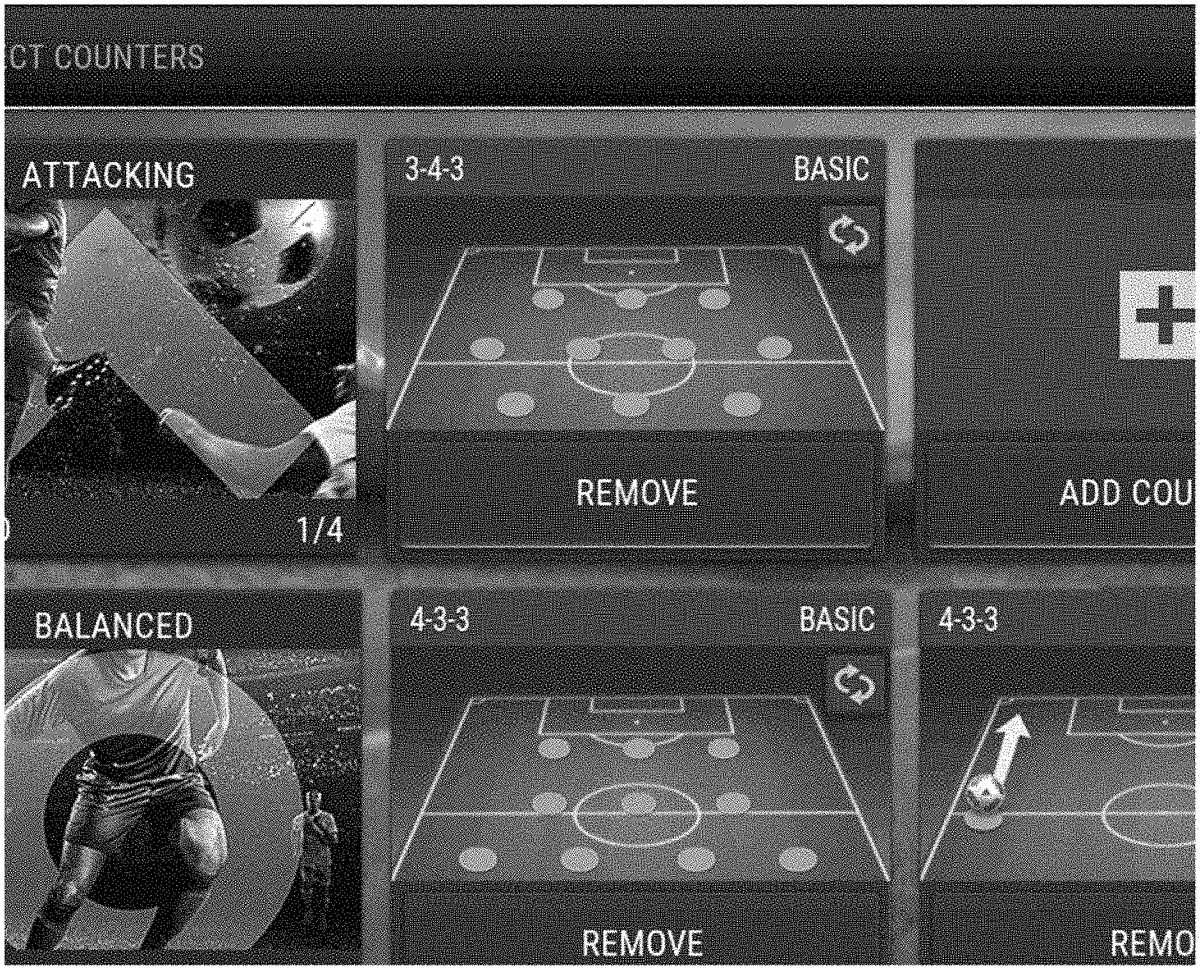
The process300next continues to step303, where the server also calculates scoring chances across each category of scoring chances. The process300next continues to step304, where the server may display the information related to the scoring chances on a GUI of the video game displayed on the smartphone, such as the GUI shown inFIG. 4B. As shown inFIG. 4B, the GUI displays the different categories of scoring chances, such as “Great,” “Good,” “Basic,” and “Counter Attack,” and for each category of scoring chances, the GUI inFIG. 4Bdisplays the probability of the scoring chance. The video game player can select one or more offensive tactics and counter tactics using one or more GUIs of the soccer video game shown on the smartphone of the video game player. An example screenshot of a GUI that allows the video game player to select one or more offensive tactics is shown inFIG. 4C. The video game player may cycle through various tactics, some of which are shown in the GUI inFIG. 4C, prior to selecting one or more tactics for the game. The tactic that the video game player selects to be utilized in a game may be displayed as an “Active” tactic, as shown inFIG. 4C. The GUI may also display an overall team rating for each tactic, as shown inFIG. 4C. For each tactic, the server may calculate an overall team rating and display the overall team rating for the tactic on the GUI, as shown inFIG. 4C. Similarly, the video game player may select counter tactics using one or more GUIs of the soccer video game shown on the smartphone of the video game player. An example screenshot of a GUI that allows the video game player to select one or more counter tactics is shown inFIG. 4D. The video game player may cycle through the different counter tactics prior to selecting one or more counter tactics.
The process300next continues to step305, where the server simulates the game between two soccer teams that exist within the soccer video game. The process300next continues to step306, where the server identifies a playable moment. An example of the playable moment is when an in-game soccer player on the team controlled by the video-game player is in a position on the soccer field of the soccer video game from where the likelihood of scoring a goal is extremely high. The process300next continues to step307, where the server displays the playable moment on the smartphone of the video game player. The process next continues to step308, where the server provides control to the video game player of an in-game player closest to the soccer ball. The process next continues to step309, where the server updates the game data, which may include the amount of time left in the game, the score of the game, and the like. The process next continues to step310, where the server determines if the game has ended. If the game has not ended for the video game player, the process continues to step305, where the server continues the simulation of the video game. If the game has ended for the video game player, the process next continues to step311, where the server displays a GUI that specifies that the game for the video game player has ended, and the process300ends.
Hardware Overview
FIG. 5is a block diagram illustrating an example computer system500with which a client110, such as client110a, client110b, client110c, or client110d, and a server130, such as server130a, and/or server130b, ofFIG. 2can be implemented. In certain aspects, the computer system500may be implemented using hardware or a combination of software and hardware, either in a dedicated server, or integrated into another entity, or distributed across multiple entities.
Computer system500(e.g., client110a, and server130) includes a bus508or other communication mechanism for communicating information, and a processor502(e.g., processor212,252,236) coupled with bus508for processing information. According to one aspect, the computer system500can be a cloud computing server of an IaaS that is able to support PaaS and SaaS services. According to one aspect, the computer system500is implemented as one or more special-purpose computing devices. The special-purpose computing device may be hard-wired to perform the disclosed techniques, or may include digital electronic devices such as one or more application-specific integrated circuits (ASICs) or field programmable gate arrays (FPGAs) that are persistently programmed to perform the techniques, or may include one or more general purpose hardware processors programmed to perform the techniques pursuant to program instructions in firmware, memory, other storage, or a combination. Such special-purpose computing devices may also combine custom hard-wired logic, ASICs, or FPGAs with custom programming to accomplish the techniques. The special-purpose computing devices may be desktop computer systems, portable computer systems, handheld devices, networking devices, or any other device that incorporates hard-wired and/or program logic to implement the techniques. By way of example, the computer system500may be implemented with one or more processors502. Processor502may be a general-purpose microprocessor, a microcontroller, a Digital Signal Processor (DSP), an ASIC, a FPGA, a Programmable Logic Device (PLD), a controller, a state machine, gated logic, discrete hardware components, or any other suitable entity that can perform calculations or other manipulations of information.
Computer system500can include, in addition to hardware, code that creates an execution environment for the computer program in question, e.g., code that constitutes processor firmware, a protocol stack, a database management system, an operating system, or a combination of one or more of them stored in an included memory504(e.g., memory220, and232), such as a Random Access Memory (RAM), a flash memory, a Read Only Memory (ROM), a Programmable Read-Only Memory (PROM), an Erasable PROM (EPROM), registers, a hard disk, a removable disk, a CD-ROM, a DVD, or any other suitable storage device, coupled to bus508for storing information and instructions to be executed by processor502. The processor502and the memory504can be supplemented by, or incorporated in, special purpose logic circuitry. Expansion memory may also be provided and connected to computer system500through input/output module510, which may include, for example, a SIMM (Single In Line Memory Module) card interface. Such expansion memory may provide extra storage space for computer system500, or may also store applications or other information for computer system500. Specifically, expansion memory may include instructions to carry out or supplement the processes described above, and may include secure information also. Thus, for example, expansion memory may be provided as a security module for computer system500, and may be programmed with instructions that permit secure use of computer system500. In addition, secure applications may be provided via the SIMM cards, along with additional information, such as placing identifying information on the SIMM card in a non-hackable manner.
The instructions may be stored in the memory504and implemented in one or more computer program products, e.g., one or more modules of computer program instructions encoded on a computer readable medium for execution by, or to control the operation of, the computer system500, and according to any method well known to those of skill in the art, including, but not limited to, computer languages such as data-oriented languages (e.g., SQL, dBase), system languages (e.g., C, Objective-C, C++, Assembly), architectural languages (e.g., Java, .NET), and application languages (e.g., PHP, Ruby, Perl, Python). Instructions may also be implemented in computer languages such as array languages, aspect-oriented languages, assembly languages, authoring languages, command line interface languages, compiled languages, concurrent languages, curly-bracket languages, dataflow languages, data-structured languages, declarative languages, esoteric languages, extension languages, fourth-generation languages, functional languages, interactive mode languages, interpreted languages, iterative languages, list-based languages, little languages, logic-based languages, machine languages, macro languages, metaprogramming languages, multiparadigm languages, numerical analysis, non-English-based languages, object-oriented class-based languages, object-oriented prototype-based languages, off-side rule languages, procedural languages, reflective languages, rule-based languages, scripting languages, stack-based languages, synchronous languages, syntax handling languages, visual languages, wirth languages, embeddable languages, and xml-based languages. Memory504may also be used for storing temporary variable or other intermediate information during execution of instructions to be executed by processor502.
A computer program as discussed herein does not necessarily correspond to a file in a file system. A program can be stored in a portion of a file that holds other programs or data (e.g., one or more scripts stored in a markup language document), in a single file dedicated to the program in question, or in multiple coordinated files (e.g., files that store one or more modules, subprograms, or portions of code). A computer program can be deployed to be executed on one computer or on multiple computers that are located at one site or distributed across multiple sites and interconnected by a communication network, such as in a cloud-computing environment. The processes and logic flows described in this specification can be performed by one or more programmable processors executing one or more computer programs to perform functions by operating on input data and generating output.
Computer system500further includes a data storage device506such as a magnetic disk or optical disk, coupled to bus508for storing information and instructions. Computer system500may be coupled via input/output module510to various devices (e.g., input device216, output device214). The input/output module510can be any input/output module. Example input/output modules510include data ports such as USB ports. In addition, input/output module510may be provided in communication with processor502, so as to enable near area communication of computer system500with other devices. The input/output module510may provide, for example, wired communication in some implementations, or wireless communication in other implementations, and multiple interfaces may also be used. The input/output module510is configured to connect to a communications module512. Example communications modules512(e.g., communications module218,258, and238) include networking interface cards, such as Ethernet cards and modems.
The components of the system can be interconnected by any form or medium of digital data communication (e.g., a communication network). The communication network (e.g., communication network150) can include, for example, any one or more of a personal area network (PAN), a local area network (LAN), a campus area network (CAN), a metropolitan area network (MAN), a wide area network (WAN), a broadband network (BBN), the Internet, and the like. Further, the communication network can include, but is not limited to, for example, any one or more of the following network topologies, including a bus network, a star network, a ring network, a mesh network, a star-bus network, tree or hierarchical network, or the like. The communications modules can be, for example, modems or Ethernet cards.
For example, in certain aspects, communications module512can provide a two-way data communication coupling to a network link that is connected to a local network. Wireless links and wireless communication may also be implemented. Wireless communication may be provided under various modes or protocols, such as GSM (Global System for Mobile Communications), Short Message Service (SMS), Enhanced Messaging Service (EMS), or Multimedia Messaging Service (MMS) messaging, CDMA (Code Division Multiple Access), Time division multiple access (TDMA), Personal Digital Cellular (PDC), Wideband CDMA, General Packet Radio Service (GPRS), or LTE (Long-Term Evolution), among others. Such communication may occur, for example, through a radio-frequency transceiver. In addition, short-range communication may occur, such as using a BLUETOOTH, WI-FI, or other such transceiver.
In any such implementation, communications module512sends and receives electrical, electromagnetic, or optical signals that carry digital data streams representing various types of information. The network link typically provides data communication through one or more networks to other data devices. For example, the network link of the communications module512may provide a connection through local network to a host computer or to data equipment operated by an Internet Service Provider (ISP). The ISP in turn provides data communication services through the world wide packet data communication network now commonly referred to as the “Internet.” The local network and Internet both use electrical, electromagnetic, or optical signals that carry digital data streams. The signals through the various networks and the signals on the network link and through communications module512, which carry the digital data to and from computer system500, are example forms of transmission media.
Computer system500can send messages and receive data, including program code, through the network(s), the network link, and communications module512. In the Internet example, a server might transmit a requested code for an application program through the Internet, the ISP, the local network, and communications module512. The received code may be executed by processor502as it is received, and/or stored in data storage506for later execution.
In certain aspects, the input/output module510is configured to connect to a plurality of devices, such as an input device514(e.g., input device216) and/or an output device516(e.g., output device214). Example input devices514include a keyboard and a pointing device, e.g., a mouse or a trackball, by which a user can provide input to the computer system500. Other kinds of input devices514can be used to provide for interaction with a user as well, such as a tactile input device, visual input device, audio input device, or brain-computer interface device. For example, feedback provided to the user can be any form of sensory feedback, e.g., visual feedback, auditory feedback, or tactile feedback, and input from the user can be received in any form, including acoustic, speech, tactile, or brain wave input. Example output devices516include display devices, such as an LED (light emitting diode), CRT (cathode ray tube), LCD (liquid crystal display) screen, a TFT LCD (Thin-Film-Transistor Liquid Crystal Display) or an OLED (Organic Light Emitting Diode) display, for displaying information to the user. The output device516may comprise appropriate circuitry for driving the output device516to present graphical and other information to a user.
According to one aspect of the present disclosure, the client110A can be implemented using a computer system500in response to processor502executing one or more sequences of one or more instructions contained in memory504. Such instructions may be read into memory504from another machine-readable medium, such as data storage device506. Execution of the sequences of instructions contained in main memory504causes processor502to perform the process steps described herein. One or more processors in a multi-processing arrangement may also be employed to execute the sequences of instructions contained in memory504. Processor502may process the executable instructions and/or data structures by remotely accessing the computer program product, for example by downloading the executable instructions and/or data structures from a remote server through communications module512(e.g., as in a cloud-computing environment). In alternative aspects, hard-wired circuitry may be used in place of or in combination with software instructions to implement various aspects of the present disclosure. Thus, aspects of the present disclosure are not limited to any specific combination of hardware circuitry and software.
Various aspects of the subject matter described in this specification can be implemented in a computing system that includes a back end component, e.g., as a data server, or that includes a middleware component, e.g., an application server, or that includes a front end component, e.g., a client computer having a graphical user interface or a Web browser through which a user can interact with an implementation of the subject matter described in this specification, or any combination of one or more such back end, middleware, or front end components. For example, some aspects of the subject matter described in this specification may be performed on a cloud-computing environment. Accordingly, in certain aspects, a user of systems and methods as disclosed herein may perform at least some of the steps by accessing a cloud server through a network connection. Further, data files, circuit diagrams, performance specifications, and the like resulting from the disclosure may be stored in a database server in the cloud-computing environment, or may be downloaded to a private storage device from the cloud-computing environment.
Computing system500can include clients and servers. A client and server are generally remote from each other and typically interact through a communication network. The relationship of client and server arises by virtue of computer programs running on the respective computers and having a client-server relationship to each other. Computer system500can be, for example, and without limitation, a desktop computer, laptop computer, or tablet computer. Computer system500can also be embedded in another device, for example, and without limitation, a mobile telephone, a personal digital assistant (PDA), a mobile audio player, a Global Positioning System (GPS) receiver, a video game console, and/or a television set top box.
The term “machine-readable storage medium” or “computer-readable medium” as used herein refers to any medium or media that participates in providing instructions or data to processor502for execution. The term “storage medium” as used herein refers to any non-transitory media that store data and/or instructions that cause a machine to operate in a specific fashion. Such a medium may take many forms, including, but not limited to, non-volatile media, volatile media, and transmission media. Non-volatile media include, for example, optical disks, magnetic disks, or flash memory, such as data storage device506. Volatile media include dynamic memory, such as memory504. Transmission media include coaxial cables, copper wire, and fiber optics, including the wires that comprise bus508. Common forms of machine-readable media include, for example, a floppy disk, a flexible disk, a hard disk, magnetic tape, any other magnetic medium, a CD-ROM, a DVD, any other optical medium, punch cards, paper tape, any other physical medium with patterns of holes, a RAM, a PROM, an EPROM, a FLASH EPROM, any other memory chip or cartridge, or any other medium from which a computer can read. The machine-readable storage medium can be a machine-readable storage device, a machine-readable storage substrate, a memory device, a composition of matter effecting a machine-readable propagated signal, or a combination of one or more of them.
As used in this specification of this application, the terms “computer-readable storage medium” and “computer-readable media” are entirely restricted to tangible, physical objects that store information in a form that is readable by a computer. These terms exclude any wireless signals, wired download signals, and any other ephemeral signals. Storage media is distinct from but may be used in conjunction with transmission media. Transmission media participates in transferring information between storage media. For example, transmission media includes coaxial cables, copper wire, and fiber optics, including the wires that comprise bus508. Transmission media can also take the form of acoustic or light waves, such as those generated during radio-wave and infra-red data communications. Furthermore, as used in this specification of this application, the terms “computer,” “server,” “processor,” and “memory” all refer to electronic or other technological devices. These terms exclude people or groups of people. For the purposes of the specification, the terms display or displaying means displaying on an electronic device.
In one aspect, a method may be an operation, an instruction, or a function and vice versa. In one aspect, a clause or a claim may be amended to include some or all of the words (e.g., instructions, operations, functions, or components) recited in other one or more clauses, one or more words, one or more sentences, one or more phrases, one or more paragraphs, and/or one or more claims.
To illustrate the interchangeability of hardware and software, items such as the various illustrative blocks, modules, components, methods, operations, instructions, and algorithms have been described generally in terms of their functionality. Whether such functionality is implemented as hardware, software, or a combination of hardware and software depends upon the particular application and design constraints imposed on the overall system. Skilled artisans may implement the described functionality in varying ways for each particular application.
The word “exemplary” is used herein to mean “serving as an example, instance, or illustration.” Any embodiment described herein as “exemplary” is not necessarily to be construed as preferred or advantageous over other embodiments. Phrases such as an aspect, the aspect, another aspect, some aspects, one or more aspects, an implementation, the implementation, another implementation, some implementations, one or more implementations, an embodiment, the embodiment, another embodiment, some embodiments, one or more embodiments, a configuration, the configuration, another configuration, some configurations, one or more configurations, the subject technology, the disclosure, the present disclosure, other variations thereof and alike are for convenience and do not imply that a disclosure relating to such phrase(s) is essential to the subject technology or that such disclosure applies to all configurations of the subject technology. A disclosure relating to such phrase(s) may apply to all configurations, or one or more configurations. A disclosure relating to such phrase(s) may provide one or more examples. A phrase such as an aspect or some aspects may refer to one or more aspects and vice versa, and this applies similarly to other foregoing phrases.
A reference to an element in the singular is not intended to mean “one and only one” unless specifically stated, but rather “one or more.” Pronouns in the masculine (e.g., his) include the feminine and neuter gender (e.g., her and its) and vice versa. The term “some” refers to one or more. Underlined and/or italicized headings and subheadings are used for convenience only, do not limit the subject technology, and are not referred to in connection with the interpretation of the description of the subject technology. Relational terms such as first, second, and the like may be used to distinguish one entity or action from another without necessarily requiring or implying any actual such relationship or order between such entities or actions. All structural and functional equivalents to the elements of the various configurations described throughout this disclosure that are known or later come to be known to those of ordinary skill in the art are expressly incorporated herein by reference and intended to be encompassed by the subject technology. Moreover, nothing disclosed herein is intended to be dedicated to the public, regardless of whether such disclosure is explicitly recited in the above description. No claim element is to be construed under the provisions of 35 U.S.C. § 112, sixth paragraph, unless the element is expressly recited using the phrase “means for” or, in the case of a method claim, the element is recited using the phrase “step for.”
While this specification contains many specifics, these should not be construed as limitations on the scope of what may be claimed, but rather as descriptions of particular implementations of the subject matter. Certain features that are described in this specification in the context of separate embodiments can also be implemented in combination in a single embodiment. Conversely, various features that are described in the context of a single embodiment can also be implemented in multiple embodiments separately, or in any suitable subcombination. Moreover, although features may be described above as acting in certain combinations and even initially claimed as such, one or more features from a claimed combination can in some cases be excised from the combination, and the claimed combination may be directed to a subcombination or variation of a subcombination.
The subject matter of this specification has been described in terms of particular aspects, but other aspects can be implemented and are within the scope of the following claims. For example, while operations are depicted in the drawings in a particular order, this should not be understood as requiring that such operations be performed in the particular order shown or in sequential order, or that all illustrated operations be performed, to achieve desirable results. The actions recited in the claims can be performed in a different order and still achieve desirable results. As one example, the processes depicted in the accompanying figures do not necessarily require the particular order shown, or sequential order, to achieve desirable results. In certain circumstances, multitasking and parallel processing may be advantageous. Moreover, the separation of various system components in the aspects described above should not be understood as requiring such separation in all aspects, and it should be understood that the described program components and systems can generally be integrated together in a single software product or packaged into multiple software products.
The title, background, brief description of the drawings, abstract, and drawings are hereby incorporated into the disclosure and are provided as illustrative examples of the disclosure, not as restrictive descriptions. It is submitted with the understanding that they will not be used to limit the scope or meaning of the claims. In addition, in the detailed description, it can be seen that the description provides illustrative examples and the various features are grouped together in various implementations for the purpose of streamlining the disclosure. The method of disclosure is not to be interpreted as reflecting an intention that the claimed subject matter requires more features than are expressly recited in each claim. Rather, as the claims reflect, inventive subject matter lies in less than all features of a single disclosed configuration or operation. The claims are hereby incorporated into the detailed description, with each claim standing on its own as a separately claimed subject matter.
The claims are not intended to be limited to the aspects described herein, but are to be accorded the full scope consistent with the language claims and to encompass all legal equivalents. Notwithstanding, none of the claims are intended to embrace subject matter that fails to satisfy the requirements of the applicable patent law, nor should they be interpreted in such a way.
Claims
- A computer-implemented method comprising: receiving, from a device of a user, a plurality of player selections for a first team in a game between the first team and a second team;calculating, based on the plurality of player selections for the first team, an overall team rating for the first team;calculating a number of scoring chances for the first team in the game, wherein each of the scoring chances is associated with a category of scoring chances, the category of scoring chances comprising at least one of a great scoring chance, a good scoring chance, a mediocre scoring chance, or a counter chance;assigning a probability value for each category of scoring chances;updating the number of scoring chances for each category of scoring chances based on the probability value assigned to each category of scoring chances;simulating, based on the number of scoring chances, a first portion of the game between the first team and the second team until a first predetermined type of interaction between the first team and the second team occurs, wherein the first predetermined type of interaction is a first playable moment in the game, the first playable moment comprising at least one of a first scoring chance or a first chance to defend against the second team by the user;displaying, on the device of the user, the first predetermined type of interaction in the game;providing control of the first team to the device of the user for the first predetermined type of interaction during the first playable moment in the game;simulating, based on the number of scoring chances, a second portion of the game between the first team and the second team until a second predetermined type of interaction between the first team and the second team occurs, wherein the second predetermined type of interaction is a second playable moment in the game, the second playable moment comprising at least one of a second scoring chance or a second chance to defend against the second team by the user;displaying, on the device of the user, the second predetermined type of interaction in the game;and providing control of the first team to the device of the user for the second predetermined type of interaction during the second playable moment in the game.
- The computer-implemented method of claim 1 , wherein calculating scoring chances for the first team is based on the overall team rating for the first team.
- The computer-implemented method of claim 1 , further comprising: updating the number of scoring chances for the first team by reducing the number of scoring chances for the first team by a threshold number.
- The computer-implemented method of claim 1 , further comprising: adjusting the probability values for each category of scoring chances based on a number of scoring chances generated for a category of scoring chances;and simulating the first portion of the game based on the adjusted probability values.
- The computer-implemented method of claim 1 , wherein providing control of the first team to the device of the user includes displaying, on the device of the user, a graphical icon configured to receive input.
- The computer-implemented method of claim 1 , wherein calculating the overall team rating for the first team is based on overall ratings of the players selected for the first team.
- The computer-implemented method of claim 1 , further comprising: displaying the number of scoring chances by categories of scoring chances.
- A system comprising: a memory storing sequences of instructions;and a processor configured to execute the sequences of instructions, which when executed, cause the processor to perform: receiving, from a device of a user, a plurality of player selections for a first team in a game between the first team and a second team;calculating, based on the plurality of player selections for the first team, an overall team rating for the first team;calculating, based on the overall team rating for the first team, a number of scoring chances for the first team in the game, wherein each of the scoring chances is associated with a category of scoring chances, the category of scoring chances comprising at least one of a great scoring chance, a good scoring chance, a mediocre scoring chance, or a counter chance;assigning a probability value for each category of scoring chances;updating the number of scoring chances for each category of scoring chances based on the probability value assigned to each category of scoring chances;simulating, based on the number of scoring chances, a first portion of the game between the first team and the second team until a first predetermined type of interaction between the first team and the second team occurs, wherein the first predetermined type of interaction is a first playable moment in the game, the first playable moment comprising at least one of a first scoring chance or a first chance to defend against the second team by the user;displaying, on the device of the user, the first predetermined type of interaction in the game;providing control of the first team to the device of the user for the first predetermined type of interaction during the first playable moment in the game;simulating, based on the number of scoring chances, a second portion of the game between the first team and the second team until a second predetermined type of interaction between the first team and the second team occurs, wherein the second predetermined type of interaction is a second playable moment in the game, the second playable moment comprising at least one of a second scoring chance or a second chance to defend against the second team by the user;displaying, on the device of the user, the second predetermined type of interaction in the game;and providing control of the first team to the device of the user for the second predetermined type of interaction during the second playable moment in the game.
- The system of claim 8 , further comprising stored sequences of instructions, which when executed by the processor, cause the processor to perform: updating the number of scoring chances for the first team by reducing the number of scoring chances for the first team by a threshold number.
- The system of claim 8 , further comprising stored sequences of instructions, which when executed by the processor, cause the processor to perform: adjusting the probability values for each category of scoring chances based on a number of scoring chances generated for a category of scoring chances;displaying the number of scoring chances by categories of scoring chances;and simulating the first portion of the game based on the adjusted probability values.
- The system of claim 8 , wherein providing control of the first team to the device of the user includes displaying, on the device of the user, a graphical icon configured to receive input.
- The system of claim 8 , wherein calculating the overall team rating for the first team is based on overall ratings of the players selected for the first team.
- The system of claim 8 , further comprising stored sequences of instructions, which when executed by the processor, cause the processor to perform: receiving, from a device of a second user, a plurality of player selections for the second team, wherein the user and the second user are different users;simulating the portion of the game between the first team and the second team based on the number of scoring chances for the first team and the number of scoring chances for the second team.
- A non-transitory machine-readable storage medium comprising machine-readable instructions, which when executed by a processor, cause the processor to perform a method comprising: receiving, from a device of a user, a plurality of player selections for a first team in a game between the first team and a second team;calculating, based on the plurality of player selections for the first team, an overall team rating for the first team;calculating, based on the overall team rating for the first team, a number of scoring chances for the first team in the game, wherein each of the scoring chances is associated with a category of scoring chances, the category of scoring chances comprising at least one of a great scoring chance, a good scoring chance, a mediocre scoring chance, or a counter chance;assigning, based on the overall team rating for the first team, a probability value for each of a plurality of category of scoring chances;updating, based on the probability value assigned to the category of scoring chances, the number of scoring chances for the first team in the game, wherein each of the scoring chances is associated with at least one category of the plurality of category of scoring chances;simulating, based on the number of scoring chances for the first team and the category of scoring chances, a first portion of the game between the first team and the second team until a first predetermined type of interaction between the first team and the second team occurs, wherein the first predetermined type of interaction is a first playable moment in the game, the first playable moment comprising at least one of a first scoring chance or a first chance to defend against the second team by the user;displaying, on the device of the user, the first predetermined type of interaction in the game;providing control of the first team to the device of the user for the predetermined type of interaction during the first playable moment in the game;simulating, based on the number of scoring chances, a second portion of the game between the first team and the second team until a second predetermined type of interaction between the first team and the second team occurs, wherein the second predetermined type of interaction is a second playable moment in the game, the second playable moment comprising at least one of a second scoring chance or a second chance to defend against the second team by the user;displaying, on the device of the user, the second predetermined type of interaction in the game;and providing control of the first team to the device of the user for the second predetermined type of interaction during the second playable moment in the game.
Disclaimer: Data collected from the USPTO and may be malformed, incomplete, and/or otherwise inaccurate.