U.S. Pat. No. 10,905,954
INFORMATION PROCESSING DEVICE AND GAME PROCESSING METHOD
AssigneeSega Corp
Issue DateMarch 28, 2018
Illustrative Figure
Abstract
An information processing device is disclosed including a processor that controls progress of a game in which a plurality of players can participate simultaneously based on operation inputs at a plurality of game terminals. The plurality of game terminals includes a leader terminal and a member terminal. The information processing device further includes memory connected to the processor and that manages one of the plurality of game terminals as a host terminal. The processor causes the memory to set the leader terminal as the host terminal. The processor inspects communication quality of the host terminal during execution of the game. When the leader terminal is the host terminal and the communication quality satisfies a predetermined condition, the processor causes the memory to set the member terminal as the host terminal, without changing the leader player.
Description
DETAILED DESCRIPTION Embodiments of the present invention will be described in detail below with reference to the drawings. In the following description of embodiments of the invention, numerous specific details are set forth in order to provide a more thorough understanding of the invention. However, it will be apparent to one of ordinary skill in the art that the invention may be practiced without these specific details. In other instances, well-known features have not been described in detail to avoid obscuring the invention. In a network game according to one or more embodiments (hereinafter referred to as “game G”), game groups (teams) are organized by a plurality of players. A leader player establishes a game group and recruits member players. The players band together to battle enemy characters. As will be described in detail below, the execution speed of the game G is adjusted according to the communication quality of the host terminal. In the following, the description will focus on the method for inspecting the communication quality and setting the host terminal. FIG. 1is a hardware configuration diagram of the game system100. In the game system100, a plurality of game terminals104a,104b,104c, . . . ,104n(hereinafter, when referred to as a group, or when discussed without being distinguished from one another, these will be collectively called the “game terminals104”) are connected to the game server102via the Internet106. The game terminals104in one or more embodiments are assumed to be smartphones. The game terminals104may be portable dedicated game machines, or may be general-purpose computers such as laptop PCs. The game terminals104and the Internet106are connected wirelessly, but may also be connected by wire. A unique ID called a player ID is assigned ahead of time to each player of the game. The game server102provides the game to each of the game terminals104. FIG. ...
DETAILED DESCRIPTION
Embodiments of the present invention will be described in detail below with reference to the drawings. In the following description of embodiments of the invention, numerous specific details are set forth in order to provide a more thorough understanding of the invention. However, it will be apparent to one of ordinary skill in the art that the invention may be practiced without these specific details. In other instances, well-known features have not been described in detail to avoid obscuring the invention.
In a network game according to one or more embodiments (hereinafter referred to as “game G”), game groups (teams) are organized by a plurality of players. A leader player establishes a game group and recruits member players. The players band together to battle enemy characters. As will be described in detail below, the execution speed of the game G is adjusted according to the communication quality of the host terminal.
In the following, the description will focus on the method for inspecting the communication quality and setting the host terminal.
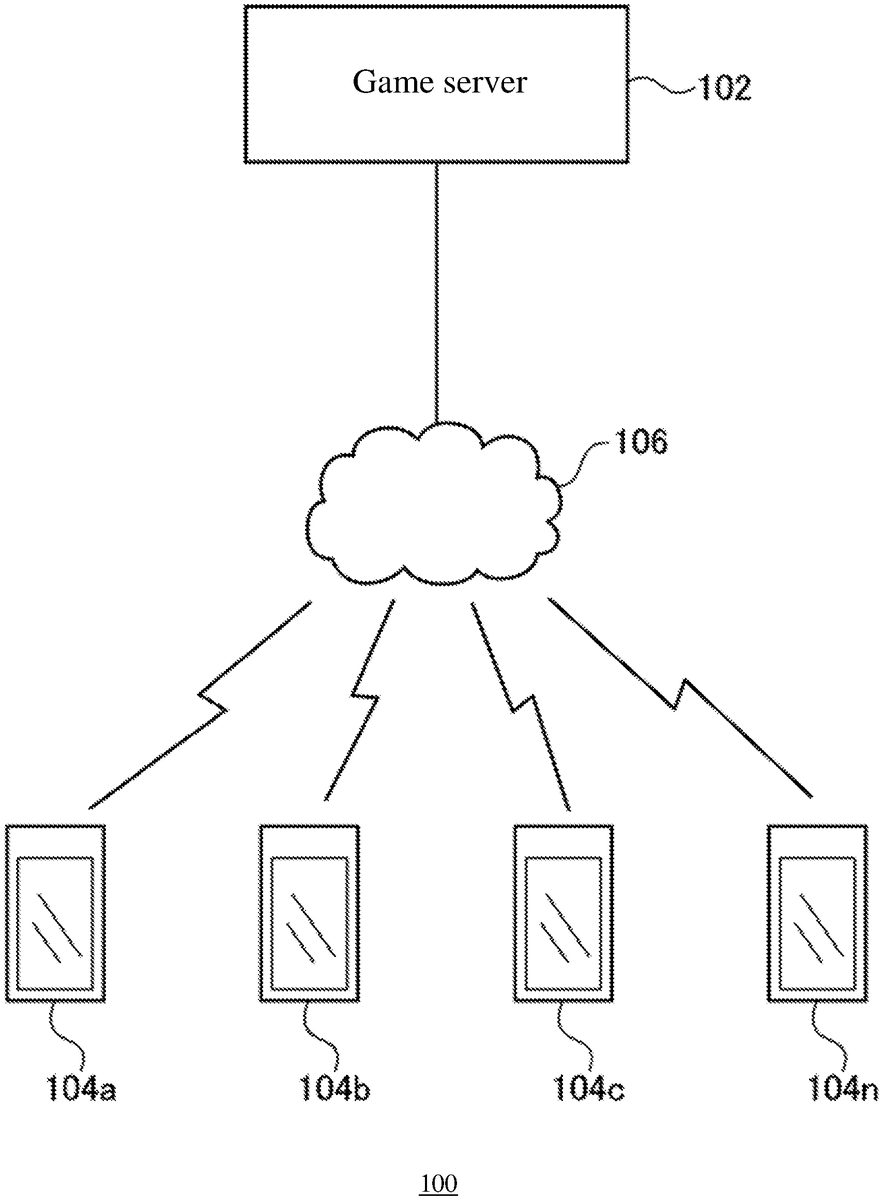
FIG. 1is a hardware configuration diagram of the game system100.
In the game system100, a plurality of game terminals104a,104b,104c, . . . ,104n(hereinafter, when referred to as a group, or when discussed without being distinguished from one another, these will be collectively called the “game terminals104”) are connected to the game server102via the Internet106. The game terminals104in one or more embodiments are assumed to be smartphones. The game terminals104may be portable dedicated game machines, or may be general-purpose computers such as laptop PCs. The game terminals104and the Internet106are connected wirelessly, but may also be connected by wire. A unique ID called a player ID is assigned ahead of time to each player of the game. The game server102provides the game to each of the game terminals104.
FIG. 2is a simplified diagram of the relation between a game group and the host terminal. InFIG. 2, two game groups G1and G2are formed. The player Pa of the game terminal104ais the leader player. The game group G1is formed by the leader player Pa and the member players Pb and Pc, who have been recruited by the leader player Pa. Similarly, member players Pe, Pf, and Pg participate in the game group G2, whose leader player is the player Pd of the game terminal104d. In both of the game groups, there is only one leader player, who is the one who proposed the game, and the others are member players.
Hereinafter, the game terminal104of the leader player shall be referred to as the “leader terminal,” and the game terminals104of the member players shall be referred to as “member terminals.” In one or more embodiments, the leader terminal is initially set as the host terminal by the group organizer of the game server102at the point when the game group is organized.
Players belonging to the same game group help each other fight against enemies that appear in the game G. In the game G, a player manipulates his own player character (not shown), and uses a sword and magic to fight the enemy. Because the enemies attack in real time, players are required to react quickly.
When a player manipulates his player character, the details of that operation are transmitted from the game terminal104to the game server102. The game server102receives the operation details, determines the action of the enemy, and transmits the resulting action of the enemy to the game terminals104. At the game terminals104, graphics change in accordance with the enemy's behavior.
In the game group G1, the leader terminal104aalso serves as the host terminal. The host terminal is the determining factor for the execution speed of the game G in the game group. Therefore, the responsiveness of the game server102to operation inputs at the member terminals104bis affected not only by the processing speed and communication quality of the member terminals104b(non-host terminals) themselves, but also by the processing speed and communication quality of the leader terminal104a(host terminal).
The communication quality will now be assumed to be synonymous with the communication speed. Also, in one or more embodiments, it is assumed that the execution speed of the game G is the number of operations that the game server102can accept (process) per unit of time.
The higher the communication speed of the game terminals104, the more frequently operation information can be transmitted to the game server102. The execution speed of the game G is greatly affected by the processing speeds of the game server102and the game terminals104, as well as by the communication speed of the game terminals104. The higher the communication speed and processing speed, the more times a player can input an operation per unit of time, which means the game will be more enjoyable. However, since there is a physical limit to a player's own operating speed, players can enjoy sufficiently fast play so long as the processing speed and the communication speed are at least at a certain level. In one or more embodiments, it is assumed that both the game server102and the game terminal104have sufficient processing speed.
If the communication speed of the host terminal is high and the communication speed of the non-host terminals is also high, there is no particular problem even if the execution speed of the game G is limited to the communication speed of the host terminal (case1). If the communication speed of the host terminal is high but the communication speed of the non-host terminals is low, then the players of the non-host terminals will be at a disadvantage compared to the player of the host terminal (case2). For example, during a period when the player of the host terminal makes three operations, it may be that only one operation can be made at a non-host terminal. However, such a disadvantage is attributable to the communication quality of the non-host terminal itself. If the communication speeds of the host terminal and the non-host terminals are both low, the execution speed of the game G will be slow overall (case3). The disadvantage in this case is also attributable to the communication quality of the game terminals104.
If the communication speed of the host terminal is low and the communication speed of the non-host terminals is high, even though the non-host terminals have sufficient communication speed, the non-host terminals will be restricted by the communication speed of the host terminal (case4). For example, even though the non-host terminals can perform five operations per second, if the host terminal can only be operated once per second, the game server102will accept only one operation per second. The players of the non-host terminals cannot enjoy operability above that of the player of the host terminal. The performance of the game group is restricted by the communication speed of the host terminal (leader terminal). The reason for deliberately imposing this restriction is to make it easier for the leader player to take leadership by giving preferential treatment to the leader player who presides over the game group over member players.
The game system100according to one or more embodiments includes a method for maintaining comfortable communication for the game group as a whole in case4. The details will be described below, but the leader terminal is set as the host terminal at the point when the game group is organized. However, if the communication speed of the leader terminal (host terminal) is particularly slow, the “host” is changed from the leader terminal to a member terminal. That is, using the leader terminal as the host terminal gives preferential treatment to the leader player, but if the leader terminal is not suitable as the host terminal, the leader player is stripped of the privilege of being “host,” thus preventing the overall performance of the game group from dropping off excessively.
In the game group G2, since the leader terminal104dis disqualified from being the host, the member terminal104ebecomes the host terminal.
In one or more embodiments, the game server102periodically transmits a ping to the game terminals104. This ping is a lightweight communication command based on ICMP (Internet Control Message Protocol), which is used to measure how long it takes for a destination to be able to communicate, that is, how long communication takes. Many network games can be played comfortably as long as the communication speed measured by ping (hereinafter referred to simply as the “ping value”) is less than 50 msec (milliseconds), and it is generally said that you can comfortably play any network game if the ping value is less than 10 msec.
In one or more embodiments, when the ping value of the host terminal is at or below a threshold T, that is, when the communication speed of the host terminal is sufficiently fast, the “host” is not changed, but when the ping value is over the threshold T, that is, when the communication speed of the host terminal is insufficient, a “disqualification condition” is met and the “host” is changed. The disqualification condition is an example of a predetermined condition. With this control method, if the communication speed of the host terminal is insufficient as in case4, the overall performance of the game group is prevented from decreasing. The threshold T can be set as desired, but in one or more embodiments, it is assumed that the threshold T is 50 msec.
FIG. 3is a functional block diagram of the game system100.
As described above, the game system100includes the game server102and the game terminals104. The constituent elements of the game terminals104and the game server102comprise hardware such as a CPU (central processing unit), a computing device such as various co-processors, a storage device such as a memory or storage, and a wired or wireless communication line connecting these, and software that is stored in the storage device and that supplies processing commands to the computing device. The computer program may be constituted by a device driver, an operating system, various application programs located in upper layers thereof, and a library that provides shared functions to these programs. The blocks described below are not configured in hardware units, but are functional unit blocks.
The game server102may have a configuration including a web server, or the game terminals104may include a portable communication terminal and a web browser installed therein.
Game Server102
The game server102includes a communication component108, a data processor110, and a data storage component112.
The communication component108handles processing for communication with the game terminals104via the Internet106. The data storage component112stores various kinds of data. The data processor110executes various kinds of processing based on the data acquired by the communication component108and the data stored in the data storage component112. The data processor110also functions as an interface for the communication component108and the data storage component112. The data storage component112stores various kinds of data.
The data storage component112includes a game data storage component124and a communication setting storage component128.
In addition to the game program, the game data storage component124stores information indicating the play status of the players. The play status may be, for example, information related to the rank of a player, the level and equipment of a player character, items that are owned, skills, and the like. The communication setting storage component128stores communication setting information for the game terminals104. The communication setting information will be discussed below with reference toFIG. 4.
The data processor110includes a player registration component126, a group organizer130, a host setting component134, a quality inspection component136, a game execution component game controller114, and a speed adjuster138.
The player registration component126receives player registrations from the game terminals104via the communication component108. When a player registration is requested, the player registration component126gives the player a player ID and registers it in the communication setting storage component128. Player registration is automatically requested when the game module of game G is installed on a game terminal104.
The group organizer130organizes game groups (teams). When the communication component108receives a group creation request from the player Pa, the group organizer130sets up the game group G1and discloses the establishment of the game group G1. The player Pa becomes the leader player of the game group G1. Next, when a group participation request specifying the game group G1is received from the player Pb, the group organizer130associates the game group G1with the player Pb. The player Pb becomes a member player of the game group G1. With this control method, the group organizer130sets up a game group and registers information related to the game group in the communication setting information (discussed below) of the communication setting storage component128.
The host setting component134sets a host terminal for each game group. The host setting component134initially sets the leader terminal to be the host terminal. When a disqualification condition (discussed below) is met, the host setting component134changes the host terminal. The quality inspection component136inspects the communication quality (communication speed). The quality inspection component136periodically distributes a ping command via the communication component108, and measures the ping value (communication speed) of each game terminal104. The game controller114controls the progress of the game in conjunction with the game execution component132of the game terminals104. The speed adjuster138sets the speed at which the game is executed by the game controller114according to the communication speed of the host terminal.
Game Terminals104
The game terminals104each include a user interface processor118, a communication component116, a data processor120, and a data storage component122.
In addition to accepting operations from players via a touch panel, the user interface processor118also handles processing related to the user interface, such as image display and audio output. The communication component116handles processing for communication with the game server102and other game terminals104via the Internet106. The data storage component122stores various kinds of data. The data processor120executes various kinds of processing based on the data acquired by the user interface processor118and the communication component116and the data stored in the data storage component122. The data processor120also functions as an interface for the user interface processor118, the communication component116, and the data storage component122.
The data processor120includes a game execution component132.
The game execution component132controls the progress of the game in conjunction with the game server102. The game execution component132of the game terminals104may be formed as a software module that is downloaded as part of the function of the game controller114from the game server102.
The communication component116acquires various kinds of game information from the game server102, and the data processor120displays a game screen on the user interface processor118. Also, the user interface processor118detects various inputs by the user, and the data processor120notifies the game server102of the inputted information via the communication component116. The game controller114of the game server102controls the progress of the game in conjunction with the game execution component132of the game terminals104according to this inputted information.
The user interface processor118includes an input component140for accepting input from the player and an output component142for outputting various kinds of information such as images and audio to the player. The input component140mainly detects a touch operation by a player on the screen as an input.
FIG. 4is a data structure diagram of communication setting information144.
The communication setting information144is stored in the communication setting storage component128of the game server102. The game group is identified by a group ID (hereinafter also referred to as “GID”). When the leader player transmits a group creation request, the group organizer130sets the group ID. The game terminals104are identified by a terminal ID (hereinafter also referred to as “TID”). A known ID such as an IP address may also be used as the terminal ID.
A game group with the group ID of G01(hereinafter referred to as “game group (G01)”) corresponds to the game group G1inFIG. 2. The game terminal104(T01), the game terminal104(T07), and the game terminal104(T14) are participating in the game group (G01). The game terminal104(T01) is the leader terminal, and the others are member terminals.
In the game group (G01), the leader terminal (T01) is the host terminal. Also, the ping value of the leader terminal (T01) is 10 msec, which is sufficiently fast. On the other hand, the member terminal (T07) has a ping value of 151 msec, which is an extremely low speed. In the game group (G01), the speed adjuster138sets the execution speed of the game G to match the fast leader terminal (T01) (host terminal). The member terminal (T07) (non-host terminal) cannot keep up with the operating speed of the leader player because the communication speed of the member terminal (T07) is far lower than that of the host terminal. On the other hand, the leader player can play the game G comfortably without being affected by the slow member terminal (T07).
In the game group (G02), the member terminal (T18) is set as the host terminal. Since the communication speed of the leader terminal (T15) is extremely low, the host setting component134changes the host terminal from the leader terminal (T15) to the member terminal (T18). The players in the game group (G02) can play the game G without being limited by the slow leader terminal104(T15).
FIG. 5is a flowchart showing the host change processing steps.
The quality inspection component136periodically transmits a ping command to the game terminals104.FIG. 5is executed every time the game server102receives a ping command response from the game terminal104. Shown here are the processing steps after a ping has been returned from the host terminal of a certain game group and the quality inspection component136has checked that ping value.
When the ping value of the host terminal is over the threshold value T, that is, when the host terminal is so slow as to be unacceptable (Yes in S10), the host setting component134changes the host terminal (S12). The host setting component134selects the next host terminal from among the other non-host terminals belonging to the same game group. The selection may be random, or the game terminal104having the smallest ping value may be selected as the host terminal. Alternatively, one of the game terminals104whose ping value is at or under the threshold value T may be selected as the next host. If the ping value of the host terminal is at or under the threshold value T (No in S10), the host terminal is not changed.
The speed adjuster138changes the execution speed of the game G based on the communication speed of the existing host terminal or the newly set host terminal (S14). For example, let us assume that the host terminal is capable of transmitting five operation inputs per second. In this case, the game controller114executes the game G at an execution speed that allows five operation inputs per second to be accepted. For the non-host terminal A, which can process only two operation inputs per second, the execution speed of the game G of 5 times per second is too fast to keep up with. Compared to the player of the non-host terminal A, the player of the host terminal has an advantage because he can increase the number of operations per unit of time. The player of the host terminal is not inconvenienced by the communication speed of the slow non-host terminal A.
On the other hand, for the non-host terminal B, which can process10operation inputs per second, the execution speed of the game G of 5 times per second is restrictive. There is no superiority or inferiority for the player of the non-host terminal B or the player of the host terminal with respect to communication speed. Compared to the player of the non-host terminal A, the player of the host terminal is not at a disadvantage. Also, if the game G can be sufficiently enjoyed as long as five operation inputs can be performed per second, then the player of the non-host terminal B will not be extremely inconvenienced despite being subjected to this restriction.
However, when the communication speed is so slow that the host terminal can only process one operation input per second, it is undesirable for the whole group to be limited by the slow host terminal. If the host terminal is so slow that the ping value exceeds the threshold value T, the host setting component134will change the host terminal.
The game system100was described above based on one or more embodiments.
The game server102in one or more embodiments sets the leader terminal to be the host terminal at the start of the game G, but changes the host terminal as needed if a disqualification condition is met during the game. The host terminal is not changed when the host terminal and the game server102are disconnected, but when the communication speed of the host terminal drops to an unacceptable level, so interruption of the game G by disconnection of the host terminal can be prevented from occurring. Also, changing the host terminal when the communication speed of the host terminal is unacceptably low makes it easy to maintain the overall performance of the game group.
The host setting component134sets the leader terminal as the host terminal at the start of the game G. Since the execution speed of the game G is set based on the communication speed of the leader terminal, the leader player does not assume any operational handicap versus the member players. With this control method, the leader player can clearly exhibit the leadership needed to lead the game group, and this also provides an incentive to become a leader player.
However, when the communication speed of the leader terminal has dropped excessively and a disqualification condition is met, the host setting component134sets a member player as the new host terminal. The players may or may not be informed of a change in the host terminal. With this control method, even though as a general rule the leader player is given preferential treatment, the overall performance of the game group can be maintained by changing the host terminal if the leader terminal cannot provide the communication quality required of a host terminal. In other words, it is possible to strike a balance between the overall performance of the game group and the design concept of leader player priority.
Also, the host terminal does not necessarily have to be replaced even if the communication quality of the host terminal is inferior to that of the non-host terminals. The host terminal is changed when the ping value of the host terminal exceeds the threshold T, or in other words, when the communication speed of the host terminal has dropped to an unacceptable level. Setting the threshold T makes it less likely that the host terminal will end up being changed too frequently during the game.
In one or more embodiments of the present invention is not limited to or by the above embodiments and modification examples, and can be embodied by modifying the constituent elements without departing from the gist of the invention. Various inventions may be formed by appropriately combining a plurality of the constituent elements disclosed in the above embodiments and modification examples. Also, some of the constituent elements given in the above embodiments and modification examples may be omitted.
The gaming system100was described as being configured by a plurality of game terminals104and one game server102, but some of the functions of the game terminals104may be realized by the game server102, and some of the functions of game server102may be allocated to the game terminals104. Also, a third device other than the game terminals104and the game server102may handle some of the functions.
The game system100, which is a collection of the functions of the game terminals104and the functions of the102as illustrated inFIG. 3, can also be thought of broadly as a single “information processing device.” How the functions required to realize one or more embodiments of the present invention are distributed to one or more pieces of hardware may be decided in consideration of the specifications required of the game system100and the processing capability of each piece of hardware.
The “communication quality” in one or more embodiments was described as being the communication speed, or more specifically the ping value. Communication quality may be ranked according to the communication carrier, the communication standard (such as Wi-Fi), or the like. Also, rather than determining whether the host terminal needs to be changed based on a single ping value, the need to change the host terminal may be determined based on a statistical value for a plurality of ping values. For example, a disqualification condition may be met when the average value for a plurality of the most recent ping values exceeds a threshold value T1, or a disqualification condition may be met when the percentage increase in a plurality of ping values (the percentage decrease in the communication speed) exceeds a threshold value T2. The disqualification condition may also be considered to be met when communicating in accordance with a low-speed communication standard.
In one or more embodiments, the leader terminal was initially set as the host terminal. In a modification example, any game terminal104may be initially set as the host terminal at the point when the game group is organized. The host setting component134may initially set as the host terminal the game terminal104with the highest communication speed out of all the game terminals104included in the game group, or a game terminal104that can execute communication processing in accordance with a certain communication standard (such as Wi-Fi) may be initially set as the host terminal.
With a server-client type of game system100, the game terminals104, rather than the game server102, may choose the host terminal. When the game group is formed, the game server102sends a list of the leader terminal and client terminals included in the game group to the game terminals104. The order of succession is set for the game terminals104registered in this list. For instance, let us assume that the game terminal104A is in first place on the list, and the game terminal104B is in second place.
The game terminals104periodically ping the game server102. The game terminal104A (host terminal) sends the non-host terminals a “host resignation” when the ping value exceeds the threshold T. The game terminal104corresponding to the next place on the host terminal list becomes the new host terminal, and a notice to this effect is transmitted to the game server102. In the above example, the game terminal104B in second place becomes the next host terminal. The speed adjuster138adjusts the execution speed of the game G according to the communication speed of the new host terminal (game terminal104B). This control method also allows a host change to be effected based on communication quality.
When a plurality of game terminals104are connected peer-to-peer, or in other words, when one host terminal becomes the server and a non-host terminal becomes a client by connecting with the host terminal, the above control method is also applicable. The host terminal (server) periodically pings some server for a time test, and notifies the non-host terminals (clients) of a host resignation when the ping value exceeds the threshold value T. The host terminal may designate the game terminal104that is to become the next host terminal by any method, including randomly. Then, the designated game terminal104may become the next host terminal. For peer-to-peer, even without speed adjustment, the entire game group is limited by the processing speed of the host terminal.
In one or more embodiments, a server-client type of network game was discussed, but as mentioned above, a host change can be similarly accomplished with a peer-to-peer type of network game. Also, as in Patent Literature 1, when a game server102that manages a peer-to-peer network game monitors the communication quality of the game terminals104and it is determined that the communication quality of the host terminal has decreased, a host change may be indicated with the game server102interposed in the peer-to-peer network game.
In one or more embodiments, a game played on smartphones was described, but the game system100may also be used on a home-use game machine, a personal computer, or the like. This may be an arcade game, or may be tied in with an arcade game.
The game controller114may not change the leader terminal when the host setting component134has changed the host terminal. This makes it possible to provide continued incentives to be a leader player who can lead a game group, to players who make a group creation request.
The configuration may be such that game controller114uses up action points (costs) necessary for game play for a player who has made a group creation request (leader player), and does not use up action points for players who make a group participation request (member players). The configuration may be such that when the host setting component134changes the host terminal and the game controller114does not change the leader terminal (leader maintained and host changed), action points are not used up for the player of the host terminal after the change (member player). Also, when the host setting component134changes the host terminal, the game controller114may also change the leader (leader changed, host changed). In this case, after the players have been notified to that effect, action points may be used up for the player of the host terminal after the change (new leader). The number of action points used up for the new leader may be smaller than that for the former leader. The configuration may be such that no action points are used up for the former leader (non-host terminal) thereafter. Also, the configuration may be such that instead of reducing the consumption of action points of the new leader, the former leader contributes action points equivalent to this reduced amount.
Although the disclosure has been described with respect to only a limited number of embodiments, those skilled in the art, having benefit of this disclosure, will appreciate that various other embodiments may be devised without departing from the scope of the present invention. Accordingly, the scope of the invention should be limited only by the attached claims.
REFERENCE SIGNS LIST
100game system,102game server,104game terminal,106Internet,108communication component,110data processor,112data storage component,114game controller,116communication component,118user interface processor,120data processor,122data storage component,124game data storage component,126player registration component,128communication setting storage component,130group organizer,132game execution component,134host setting component,136quality inspection component,138speed adjuster,140input component,142output component,144communication setting information
Claims
- An information processing device, comprising: a processor that controls progress of a game in which a plurality of players can participate simultaneously based on operation inputs at a plurality of game terminals, wherein the plurality of game terminals comprises a leader terminal and a member terminal, and a memory connected to the processor and that manages one of the plurality of game terminals as a host terminal, wherein the processor causes the memory to initially set the leader terminal as the host terminal, the processor measures a first communication speed of the leader terminal and a second communication speed of the member terminal during execution of the game terminal, when the leader terminal is the host terminal, if the second communication speed is higher than the first communication speed and the first communication speed is not higher than a predetermined speed, the processor causes the memory to set the member terminal as the host terminal, without changing a leader player so as to prevent interruption of the game by avoiding changes of the host terminal during game play based on consideration of the first communication speed and the second communication speed through the use of the predetermined speed, the processor causes the leader player that owns the leader terminal to incur cost associated with action in game play, and after the member terminal is set as the host terminal, the processor does not cause a member player that owns the member terminal to incur the cost.
- The information processing device according to claim 1 , wherein the processor causes the memory to set the member terminal as the host terminal in a state in which the game continues and does not notify the leader terminal that the member terminal has been set as the host terminal.
- The information processing device according to claim 1 , wherein the processor changes the host terminal when a statistical value of a plurality of measurements of a communication speed of the leader terminal is not higher than the predetermined speed.
- A game processing method that causes a computer to execute a game program, the method comprising: controlling, with a processor, progress of a game in which a plurality of players can participate simultaneously, based on operation inputs at a plurality of game terminals;wherein the plurality of game terminals comprises a leader terminal and a member terminal, managing, with a memory, one of the plurality of game terminals as a host terminal;causing, with the processor, the memory to initially set the leader terminal as the host terminal;measuring, with the processor, a first communication speed of the leader terminal and a second communication speed of the member terminal during execution of the game;when the leader terminal is the host terminal, if the second communication speed is higher than the first communication speed and the first communication speed is not higher than a predetermined speed, causing, with the processor, the memory to set the member terminal as the host terminal, without changing a leader player so as to prevent interruption of the game by avoiding changes of the host terminal during game play based on consideration of the first communication speed and the second communication speed through the use of the predetermined speed;causing, with the processor, the leader player that owns the leader terminal to incur cost associated with action in game play;and after the member terminal is set as the host terminal, not causing, with the processor, a member player that owns the member terminal to incur the cost.
Disclaimer: Data collected from the USPTO and may be malformed, incomplete, and/or otherwise inaccurate.