U.S. Pat. No. 10,898,807
SYSTEM AND METHOD FOR DYNAMIC GENERATION AND INTEGRATION OF INTERACTIVE TEXTUAL VIDEO GAME CONTENT
AssigneeMusic Powered Games, LLC
Issue DateOctober 7, 2019
Illustrative Figure
Abstract
A system and method relate to interleaved video game play associated with a web-based or device-resident program application selected via a client device. Upon execution of the program application, a game server is linked to the client, wherein a first set of executable iterations/portions of the original application are interleaved with a second set of iterations/portions comprising specified gameplay objects programmed to interact with dynamic text objects. At least for the second set, text strings are obtained in association with a first text source. The dynamically applied text objects are generated via a first set of rules associated at least with the selected application. Further based on the obtained text strings, the interleaved gameplay involves interacting with the gameplay objects via a second set of rules associated with the selected program application. The first text source may be an advertisement selected from campaigns associated with an ad server.
Description
DETAILED DESCRIPTION Referring generally toFIGS. 1-7, various exemplary embodiments of an invention may now be described in detail. Where the various figures may describe embodiments sharing various common elements and features with other embodiments, similar elements and features are given the same reference numerals and redundant description thereof may be omitted below. In one aspect as disclosed herein, embodiments of a hosted system or method may take the form of a video game server and application as delivered via a computer application, console application, mobile device application, website, or the like. A conventional embodiment of the systems and methods as disclosed herein may include a video game application executed on a user-based hardware device that is communicatively connected to a game server, the game server further connected to one or more databases of written works, the written works comprising at least text and optionally additional associated information (e.g. author, title, meter, rhythm, pitch, audio, video, images, metadata, copyright information, permissions, album cover, volume, publication information, and the like). A user may query, or in alternative embodiment enter, written works via the game application for inclusion. In an alternative embodiment, a third-party user may specify the written works to be included in accordance with user-associated advertising text. The system may then retrieve the text and associated information of a written work from the one or more communicatively connected databases, break down the text into one or more text strings, break down the text strings into associated string objects, and associate the one or more text strings and string objects with graphical elements or game objects of one or more video games associated with the game server and/or video game application. In various embodiments, the associated information may additionally be broken down by the system pursuant to the game logic, such that ...
DETAILED DESCRIPTION
Referring generally toFIGS. 1-7, various exemplary embodiments of an invention may now be described in detail. Where the various figures may describe embodiments sharing various common elements and features with other embodiments, similar elements and features are given the same reference numerals and redundant description thereof may be omitted below.
In one aspect as disclosed herein, embodiments of a hosted system or method may take the form of a video game server and application as delivered via a computer application, console application, mobile device application, website, or the like.
A conventional embodiment of the systems and methods as disclosed herein may include a video game application executed on a user-based hardware device that is communicatively connected to a game server, the game server further connected to one or more databases of written works, the written works comprising at least text and optionally additional associated information (e.g. author, title, meter, rhythm, pitch, audio, video, images, metadata, copyright information, permissions, album cover, volume, publication information, and the like). A user may query, or in alternative embodiment enter, written works via the game application for inclusion. In an alternative embodiment, a third-party user may specify the written works to be included in accordance with user-associated advertising text.
The system may then retrieve the text and associated information of a written work from the one or more communicatively connected databases, break down the text into one or more text strings, break down the text strings into associated string objects, and associate the one or more text strings and string objects with graphical elements or game objects of one or more video games associated with the game server and/or video game application. In various embodiments, the associated information may additionally be broken down by the system pursuant to the game logic, such that the presentation of string objects and text strings is in accordance with the associated information for each text string or string object element. For example, a text string comprising a portion of a song lyric may be associated and presented along with additional information such as name of the song, author, album cover, publication information, audio snippet, and the like, whereby the user is able to see and hear the associated audiovisual information upon presentation of the text string with the game and pursuant to the game rules and logic.
As previously noted, embodiments of the disclosed system may be implemented via a hosted software development kit (SDK) that enables the creation (by the hosted entity, third party developers, or otherwise) of video games or other executable program applications which include text-derived game content and gameplay. The platforms developed using the hosted SDK may be wholly novel in nature or may even be modified versions of an existing, previously known (“legacy”) video game or program application.
Also as previously noted, embodiments of the disclosed system are not limited to customized experiences associated with video games, but in certain embodiments may be applied for other executable program applications such as for example social media platforms or other web-based content delivery platforms. Gameplay portions or iterations as disclosed herein may be programmatically or selectively interleaved with legacy content portions or iterations of the selected platform.
In various embodiments, the system may further monitor user performance with respect to the one or more text strings via the video game and determine associative performance information therefrom. For example, the game server may determine that a user has completed a text string associated with an advertisement and, accordingly, prevent the display of that text string for a subsequent period of time. In a further embodiment, the game server may determine performance metrics in association with the one or more text strings that are of interest to advertisers, such as, for example, determining that users are more likely to interact with advertisement A as opposed to advertisement B, thereby permitting A/B testing in a video game environment.
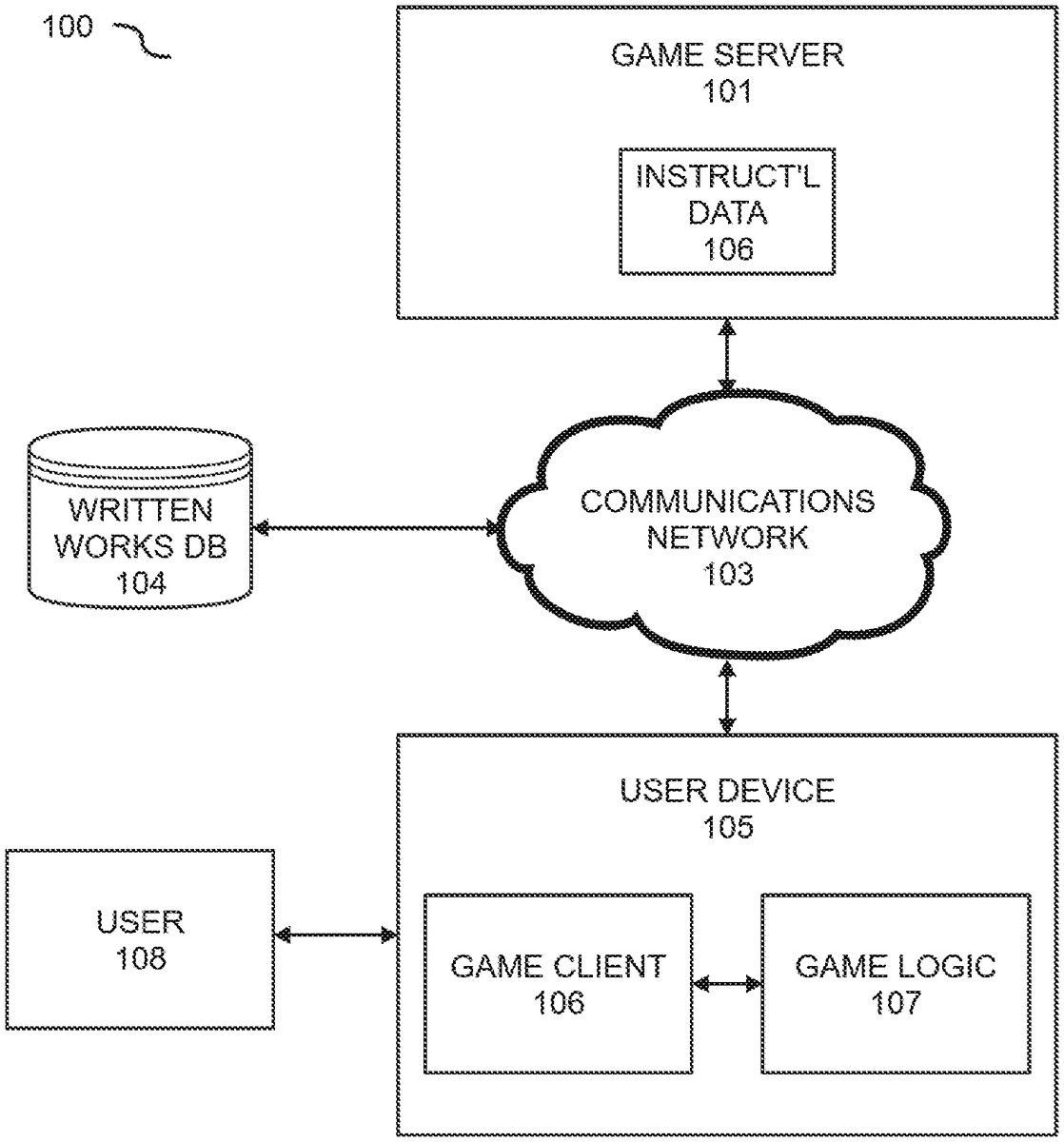
Referring first toFIG. 1, an exemplary embodiment of a system100for on-demand, dynamic generation and integration of interactive textual video game content as disclosed herein may include a game server101comprising instructional data102for the processing of written works into text strings, the one or more text strings comprising string objects, into one or more video game applications. The game server101may be operatively connected to a communications network103and, via the communications network103, communicatively connected to one or more written work databases104. The written work databases104may in various embodiments comprise a plurality of third-party databases such as lyrics websites, libraries, media servers, and the like. In an embodiment, the written work databases104may additionally include first-party databases, wherein the game server101, per the instructional data102, copies written works from non-first-party databases to the first party database.
The game server101is configured and informed via the instructional data102, as well as, in certain embodiments, user-provided information, to query the one or more written work databases104for written works, process the written works into one or more component text strings (e.g. phrases), further process the text strings into component text elements (e.g. words and/or letters), and configure such text strings and text elements into informational components for association with video game objects.
The game server101may further be communicatively connected to a user device105hosting one or more video game clients106, the video game client106further comprising video game logic107. The video game client106may be configured in accordance with the game logic107to receive text strings from the game server101as determined from the one or more written works in association with the written work servers104and to integrate said text strings and string objects with one or more objectives of a video game hosted upon the game client106. The game logic107may instruct the game client106to implement one or more of the received text strings into the ruleset of the associated game, whereby a user108is prompted via the game client106to provide interactive feedback using the user device105and associated inputs thereto. For example, the game client106may display upon a screen on the user device105a text string and text objects that are associated with game objects, such that the user must interact with the game objects and associated text objects pursuant to the rules of the game to solve the text string.
In one embodiment, the user108associated with the user device105may query the game server101via the game client106for one or more written works to be included in the respective video game the user is playing or intends to play upon the game client106.
Referring next toFIG. 2, an exemplary method200as disclosed herein for generating and integrating dynamic textual materials into video game content display and interaction therewith may be described in part or in whole as follows. The method200may begin at a first step S201wherein a user queries for the inclusion of a written work, or wherein the system itself queries for a written work upon user-initiated execution of a relevant program application. In an embodiment, a user may directly initiate a search via an application, such as a video game, for a certain written work. For example, a user may search for the title, artist, album, etc. of a piece of music; may search by speaking the text of the written work into a microphone upon a game client; may identify a written work via API instructions (e.g. by “sharing” the written work with the game client via a communicatively connected third-party system); etc.
In step S202, the system identifies the queried written work and retrieves the written work, including the text and associated information thereof, from one or more communicatively connected written work databases. In an embodiment, the system may retrieve written work information from multiple databases and aggregate the information. In another embodiment, where multiple iterations of the written work or information thereof exist, the system may query the user for additional information. For example, a user may request the written work,The Canterbury Tales, and the system identifies410iterations of 23 published copies. In said example, the system determines four iterations of the written work have the highest match, citation, and popularity rate, including two versions of the original text in Middle English and two different modern translations licensed for use; the system queries which version the user wants, and, upon user specification, identifies the associated iterations and aggregates the written work information from those iterative sources (e.g. text from Amazon, manuscript images from The British Library, information from Wikipedia, synopsis from Sparknotes, etc.).
In step S203, the system breaks down the written work text into one or more text strings, and the one or more text strings into one or more string elements. Continuing the example above, the system may break down the text ofThe Canterbury Talesinto chapters, stanzas, and lines (lines being text strings), each line comprising words and letters (each a string element): e.g., a text string “Whan that Aprille with his shoures sote” wherein each word and letter of each word is defined as an associated string element.
In step S204, the system integrates the text string and string elements into a video game in accordance with integration instructions and video game logic. In an embodiment, the system may associate the text string and string elements with variable components of the video game. For example, string elements may be associated with collectible coins for the user to collect in a video game, the collection of all of the coins thereby unlocking the text string and resulting in a desired video game outcome. In an embodiment, the video game ruleset may be modified in accordance with the text string and/or string elements, such as, for example, changing in-game objects in association with the text string and/or string elements. For example, a calendar-based puzzle within the video game may be modified to require the identification of the month of April in association with string elements obtained fromThe Canterbury Talestext, whereas the solution for the same in-game puzzle may be September for string elements derived from the text of the Earth, Wind, and Fire song, “September.”
In step S205, the system presents the video game to the user with the associated text strings and string elements for dynamic user interaction via the video game graphical user interface and/or user experience. For example, the user may be required to complete missing words or letters based upon the video game rules (e.g. collecting items, sliding tiles, entering letters, matching elements, etc.).
In an optional step S206, the system may further monitor user performance in association with the presentation of the text strings and/or string elements within the video game and provide analytics in association with said performance. For example, the system may monitor for popularity of certain text strings and associated written works, speed of completion, accuracy, retention, and the like. In an embodiment, such information may be viewable by the performing user or other users in a report. For example, such information may be deemed particularly useful for advertisers associated with written works pursuant to ad text, slogans, trademarks, and the like.
Referring next toFIG. 3an exemplary embodiment of a system300for integrating advertising text into the dynamic video game content as disclosed herein may be interpreted in accordance with the system and method ofFIGS. 1 and 2, respectively. The system300may include the game server101, user device105, and video game client106of system100, wherein the game server101, user device105, and video game client106are further communicatively connected to an ad server301. In an embodiment, the ad server301may be identified as a written work database104. The ad server301may further be associated with an ad client302, whereby the ad client302defines ad content and ad parameters as written works to be used by the system100. For example, the ad server301may comprise a plurality of ads including, per one ad client302, an advertisement for sports drinks with specified advertising parameters. The game server101and/or video game client106may factor in ad parameters when selecting written work content from the ad server301, such that advertisements are matched in accordance with advertising parameter instructions to preferable game users108. For example, the game server101may select the sports drink advertisement for display in a competitive shooter video game where the sports drink advertising parameters match with the competitive shooter video game. Matching may be determined in accordance with game-ad fit (e.g., matching written works with videographic content with videographic capable video game), demographic-ad fit (e.g., game popular among women ages 39-45, ad targeted to similar demographic) or user-ad fit (e.g., user specified as 24-year-old competitive male who has not seen the ad within past 30 days and ad targeted is towards same). In an embodiment, the ad server may respond to an ad request from the game server with respect to a given advertisement by returning ad content that is in the queue to be delivered next, based on various criteria such as user demographics, user location, and price for the ad. For example, an advertiser may designate one or more particular ads to be implemented in association with a particular location, wherein upon the user being identified in proximity with the particular location the system triggers the ad to be retrieved for implementation at that time or at a suitable later time when for example an appropriate game is executed.
The ad server301may further be configured to monitor ad performance, such as in accordance with step206of method200, for determining advertising viewership and interaction. In an embodiment, advertisers303associated with ad clients302may view the ad performance statistics determined in accordance with the ad client302for the specific advertising campaigns as well as to configure and manage the ad content and parameters via the ad client302.
Referring now toFIG. 4, an exemplary embodiment of a matching game in accordance with the present invention is now described. A traditional item matching game may be provided to a user for the matching of like items, such as by shifting and/or swapping game object to align, group, or otherwise associate like game objects401. In an embodiment of the game implementing the system and methods described herein, the traditional matching game ruleset may further be augmented with the inclusion of text string matching elements, such as like shapes or like colors. Specifically, a text string402determined in accordance with method200may be integrated into the user interface and partially censored or obfuscated, prompting the user to complete the censored or missing string objects403. In an embodiment, the string objects403may further be associated and displayed in accordance with one or more respective game objects401, whereby user input and solution of the game objects in accordance with the matching game ruleset results in the completion of the associated obfuscated string objects403. Accordingly, a user may complete a level upon successful completion of the text string402by solving all game objects401associated with a missing string object403. Other integrations into rulesets may apply, such that certain string object403solution or text string402completion results in, for example, a score multiplier or an achievement. In various embodiments, metagame rulesets may be applied such that completion of missing string objects403or text strings402across one or more games may result in a game action, such as a score multiplier or achievement. For example, in one such embodiment, a user may unlock an achievement for completing across multiple games one-hundred text strings402wherein the text strings402or string objects403or combinations thereof are associated with fruits (i.e. “apple of my eye,” “orange and purple,” “seedy-lookin' individual,” “go find your own tree,” etc.).
Referring now toFIG. 5, an exemplary embodiment of a bubble shooter game in accordance with the present invention is now described and may be referentially compared toFIG. 4with respect to the inclusion and relation of game objects401, text strings402, and string objects403. Traditional bubble shooter games generally involve a physics-based puzzle for launching a specific game object501in a manner wherein the specific game object501is ultimately placed physically proximate to like game objects401. In accordance with the present invention, the game may overlay or otherwise integrate string objects403in association with a text string402to be completed in accordance with the bubble shooter game ruleset. In this embodiment, the matching of the specific game object501to the associated like game objects401may result in the completion of the associated string object403to de-obfuscate the associated element in the text string402. For example, successfully matching the diamond shapes may result in the string object403“G” to be slotted into the associated sixth element of the text string402, forming the word “losing.” Other embodiments of bubble shooter-type text integration may be contemplated, such as including the string object403on the specific game object501as opposed to the targeted game objects401.
Referring now toFIG. 6, an exemplary embodiment of a word-find game in accordance with the present invention is now described and may be generally compared toFIGS. 4 and 5with respect to the inclusion and relation of game objects401, text strings402, and string objects403. Traditional word-find games may take various forms including word searches or, as is presently described, a sliding tile game whereby a user must create words from combinations of sliding tiles. In accordance with the present invention, words601may be generally contemplated as text strings402or, in certain embodiments, string objects403, wherein each tile is a game object401comprising a string object403in the form of a letter. The matching of related letters into an associated word601solves a text string402. Accordingly, in the present interface, matching a linear sequence of letters B-E-F-O-R-E creates one associated word601(a) “before,” solving text string602(a), and reconfiguring the linear sequence of letter to T-H-A-T-'-S creates another associated word “That's,” solving text string602(b). In an embodiment, a user may be scored on their successful completion of all or a portion of the presented text strings402. In another embodiment, a user may be prompted to match the solved word601with the associated text string402, such as matching601(a) to602(a),601(b) to602(b), and so forth.
Referring now toFIG. 7, an exemplary embodiment of a top-down shooter game in accordance with the present invention is now described and may be generally compared toFIGS. 4, 5, and 6with respect to the inclusion and relation of game objects401, text strings402, and string objects403. In the present embodiment, a user-controlled avatar701targets and shoots various game objects401, wherein certain game objects401are associated with string objects403. Upon successful targeting and shooting of a string object403, the game may complete, de-obfuscate, or otherwise progress the completed display of a text string402. In an embodiment, the user may be required to target and destroy the game objects401in order that the associated string objects403appear. In another embodiment, the user's destruction of a game object401may result in the creation of one or more subsequent game objects401, each associated with one or more string objects403. For example, a user may target and destroy an asteroid game object401associated with the string object403“STRAIGHT,” whereby the asteroid breaks into new game objects401associated with new string objects403: “STR”, “AIG,” and “HT;” similarly, the subsequent destruction of each of those game objects401may result in game and string objects for each letter, “S”, “T”, “R”, “A”, “I”, “G”, “H”, and “T”, and subsequent destruction of those elemental game objects completing the letters of the associated text string.
Still other game types may be contemplated in various alternative embodiments, such as card games, memory games, arcade games, platforming games, puzzle games, RPGs, and other such games comprising game objects with which string objects and text strings may be associated in manners where users may intentionally and selectively interact with game objects, thereby dynamically triggering actions (such as de-obfuscation) between associated string objects and one or more text strings.
Depending on the embodiment, certain acts, events, or functions of any of the algorithms described herein can be performed in a different sequence, can be added, merged, or left out altogether (e.g., not all described acts or events are necessary for the practice of the algorithm) Moreover, in certain embodiments, acts or events can be performed concurrently, e.g., through multi-threaded processing, interrupt processing, or multiple processors or processor cores or on other parallel architectures, rather than sequentially.
Various illustrative logical blocks, modules, and algorithm steps described in connection with the embodiments disclosed herein can be implemented as electronic hardware, computer software, or combinations of both. To clearly illustrate this interchangeability of hardware and software, various illustrative components, blocks, modules, and steps have been described above generally in terms of their functionality. Whether such functionality is implemented as hardware or software depends upon the particular application and design constraints imposed on the overall system. The described functionality can be implemented in varying ways for each particular application, but such implementation decisions should not be interpreted as causing a departure from the scope of the disclosure.
Various illustrative logical blocks and modules described in connection with the embodiments disclosed herein can be implemented or performed by a machine, such as a general purpose processor, a digital signal processor (DSP), an application specific integrated circuit (ASIC), a field programmable gate array (FPGA) or other programmable logic device, discrete gate or transistor logic, discrete hardware components, or any combination thereof designed to perform the functions described herein. A general-purpose processor can be a microprocessor, but in the alternative, the processor can be a controller, microcontroller, or state machine, combinations of the same, or the like. A processor can also be implemented as a combination of computing devices, e.g., a combination of a DSP and a microprocessor, a plurality of microprocessors, one or more microprocessors in conjunction with a DSP core, or any other such configuration.
Various steps of a method, process, or algorithm described in connection with the embodiments disclosed herein can be embodied directly in hardware, in a software module executed by a processor, or in a combination of the two. A software module can reside in RAM memory, flash memory, ROM memory, EPROM memory, EEPROM memory, registers, hard disk, a removable disk, a CD-ROM, or any other form of computer-readable medium known in the art. An exemplary computer-readable medium can be coupled to the processor such that the processor can read information from, and write information to, the memory/storage medium. In the alternative, the medium can be integral to the processor. The processor and the medium can reside in an ASIC. The ASIC can reside in a user terminal. In the alternative, the processor and the medium can reside as discrete components in a user terminal.
The term “user interface” as used herein may unless otherwise stated include any input-output module with respect to the hosted server including but not limited to video game interfaces; web portals, such as individual web pages or those collectively defining a hosted website; mobile applications; desktop applications; telephony interfaces such as interactive voice response (IVR); and the like. Such interfaces may in a broader sense include pop-ups or links to third party websites for the purpose of further accessing and/or integrating associated materials, data or program functions via the hosted system and in accordance with methods of the present invention.
The term “communications network” as used herein with respect to data communication between two or more parties or otherwise between communications network interfaces associated with two or more parties may refer to any one of, or a combination of any two or more of, telecommunications networks (whether wired, wireless, cellular or the like), a global network such as the Internet, local networks, network links, Internet Service Providers (ISP's), and intermediate communication interfaces.
Conditional language used herein, such as, among others, “can,” “might,” “may,” “e.g.,” and the like, unless specifically stated otherwise, or otherwise understood within the context as used, is generally intended to convey that certain embodiments include, while other embodiments do not include, certain features, elements and/or states. Thus, such conditional language is not generally intended to imply that features, elements and/or states are in any way required for one or more embodiments or that one or more embodiments necessarily include logic for deciding, with or without author input or prompting, whether these features, elements and/or states are included or are to be performed in any particular embodiment.
The previous detailed description has been provided for the purposes of illustration and description. Thus, although there have been described particular embodiments of a new and useful invention, it is not intended that such references be construed as limitations upon the scope of this invention except as set forth in the following claims.
Claims
- An adaptive video game system comprising: a game server operably linked via a communications network to a game client residing on a user computing device;said game client configured to execute a game program selected by a user from one or more original game programs, wherein a first set of one or more executable iterations or portions of the selected original game program are interleaved with a second set of one or more iterations or portions comprising specified gameplay objects programmed to interact with one or more dynamic text objects;wherein the game server is configured, at least for the second set of one or more iterations or portions, to obtain one or more text strings associated with at least a first text source, wherein the at least a first text source comprises a first advertisement selected from an ad campaign associated with an ad server;and wherein the game client is configured, at least for the second set of one or more iterations or portions, to dynamically apply one or more text objects as generated via a first set of rules associated at least with the selected game program and, based on the obtained one or more text strings, to interact with the specified gameplay objects via a second set of rules associated with the selected game program.
- The video game system of claim 1 , wherein the at least a first text source comprises a first text source comprising the first advertisement selected from an ad campaign associated with an ad server, and a second text source that is user-defined via the game client, wherein the game client enables the user to provide the user-defined second text source via one or more of an online search engine and a list of available text sources corresponding to an online database linked to the game server.
- The video game system of claim 1 , further comprising an ad client configured to enable selection by an associated user of one or more advertisements associated with the ad campaign, the ad campaign to be executed in association with at least one of the one or more game programs further in view of one or more game player profile parameters.
- The video game system of claim 3 , wherein one or more of the ad server, the game server and the game client are configured to determine the at least first advertisement from the ad campaign based on an identified location of the user computing device upon which the game client resides or one or more game player profile parameters associated with a profile of the game player user associated with the user computing device upon which the game client resides.
- The video game system of claim 1 , wherein the game client is configured to receive ambient sound data in real time from an audio receiver associated with the user computing device, said ambient sound data associated with a defined trigger for one or more advertisements of the ad campaign, and wherein the game client is configured to execute the at least second set of one or more iterations or portions of the selected game program to interact with one or more text objects generated from at least one or more text strings obtained from the at one or more advertisements associated with the received ambient sound data.
- The video game system of claim 1 , wherein the game client is configured to dynamically apply, via the second set of rules associated at least with the selected game program, audio elements associated with the text source in time relation with corresponding elements of the generated one or more text objects.
- The video game system of claim 1 , wherein each of the text objects are parsed into a plurality of sub-text objects, and the game client enables the user to interact with the plurality of sub-text objects to arrive at the corresponding text objects during a game.
- The video game system of claim 1 , wherein the at least a first text source is defined by sampling an audio recording and the game server is configured to: convert audio data received therefrom into the one or more text strings, or identify one or more text strings associated with the audio recording.
- A method of interleaved video game play, the method comprising: linking a game server via a communications network to a client device;executing a game program selected by a user from one or more original game programs, wherein a first set of one or more executable iterations or portions of the selected original game program are interleaved with a second set of one or more iterations or portions comprising specified gameplay objects programmed to interact with one or more dynamic text objects;and at least for the second set of one or more iterations or portions: obtaining one or more text strings associated with at least a first text source, wherein the at least a first text source comprises a first advertisement selected from an ad campaign associated with an ad server, dynamically applying one or more text objects as generated via a first set of rules associated at least with the selected game program, and based on the obtained one or more text strings, interacting with the specified gameplay objects via a second set of rules associated with the selected game program.
- The method of claim 9 , wherein the at least a first text source comprises a first text source comprising the first advertisement selected from an ad campaign associated with an ad server, and a second text source defined by the user via the client device, the method further comprising enabling the user to provide the user-defined second text source via one or more of an online search engine and a list of available text sources corresponding to an online database linked to the game server.
- The method of claim 9 , further comprising enabling, via an ad client linked to the game server, selection by an associated user of one or more advertisements associated with the ad campaign, the ad campaign to be executed in association with at least one of the one or more game programs further in view of one or more game player profile parameters.
- The method of claim 11 , further comprising determining the at least first advertisement from the ad campaign based on an identified location of the client device or one or more game player profile parameters associated with a profile of the game player user associated with the client device.
- The method of claim 9 , further comprising: receiving ambient sound data in real time from an audio receiver associated with the client device, said ambient sound data associated with a defined trigger for one or more advertisements of the ad campaign, and executing the at least second set of one or more iterations or portions of the selected game program to interact with one or more text objects generated from at least one or more text strings obtained from the at one or more advertisements associated with the received ambient sound data.
- The method of claim 9 , further comprising dynamically applying, via the second set of rules associated at least with the selected game program, audio elements associated with the text source in time relation with corresponding elements of the generated one or more text objects.
- The method of claim 9 , further comprising: defining the at least a first text source by sampling an audio recording;and converting audio data received therefrom into the one or more text strings, or identifying one or more text strings associated with the audio recording.
- A method of interleaved video game play, the method comprising: executing a web-based or device-resident program application selected by a user from one or more original program applications via a client device;linking a game server via a communications network to the client device in conjunction with execution of the program application, wherein a first set of one or more executable iterations or portions of the selected original program application are interleaved with a second set of one or more iterations or portions comprising specified gameplay objects programmed to interact with one or more dynamic text objects;and at least for the second set of one or more iterations or portions: obtaining one or more text strings associated with at least a first text source, wherein the at least a first text source comprises a first advertisement selected from an ad campaign associated with an ad server, dynamically applying one or more text objects as generated via a first set of rules associated at least with the selected program application, and based on the obtained one or more text strings, interacting with the specified gameplay objects via a second set of rules associated with the selected program application.
- The method of claim 16 , further comprising enabling, via an ad client linked to the game server, selection by an associated user of one or more advertisements associated with the ad campaign, the ad campaign to be executed in association with at least one of the one or more program applications further in view of one or more game player profile parameters.
- The method of claim 17 , further comprising determining the at least first advertisement from the ad campaign based on an identified location of the client device or one or more game player profile parameters associated with a profile of the user associated with the client device.
- The method of claim 16 , further comprising: receiving ambient sound data in real time from an audio receiver associated with the client device, said ambient sound data associated with a defined trigger for one or more advertisements of the ad campaign, and executing the at least second set of one or more iterations or portions of the selected program application to interact with one or more text objects generated from at least one or more text strings obtained from the at one or more advertisements associated with the received ambient sound data.
- The method of claim 16 , further comprising dynamically applying, via the second set of rules associated at least with the selected program application, audio elements associated with the text source in time relation with corresponding elements of the generated one or more text objects.
- The method of claim 16 , wherein each of the text objects are parsed into a plurality of sub-text objects, further comprising enabling the user to interact with the plurality of sub-text objects to arrive at the corresponding text objects.
Disclaimer: Data collected from the USPTO and may be malformed, incomplete, and/or otherwise inaccurate.