U.S. Patent No. 10,857,466: Audience adjusted gaming
Issued December 8, 2020, to eBay Inc.
Filed: November 20, 2018 (claiming priority to December 29, 2014)
Overview:
U.S. Patent No. 10,857,466 (the ‘466 patent) relates to adjusting video game mechanics based on the audience watching a stream of the game. The ‘466 patent details a system which receives requests to view a stream of a video game and provides potentially modifiable game mechanics (along with the stream) to devices requesting the stream. The system intakes requests for one or more modifications to the game mechanics and then at least one or more of the game mechanics is altered accordingly.
The game mechanics that can be altered in the ‘466 patent include: difficulty, map size, and game character attributes like movement speed or damage-per-second. It could be required that a viewer of stream has to pay to input game modifications, and the modification could vary based on the amount of money contributed. The amount of time that the modification lasts could also depend on amount of money contributed. The ‘466 patent could allow viewers of video game streams more interaction with the stream they are watching and encourage more donations from viewers by making donations more rewarding to donors.
Abstract:
A system and method includes a first device with one or more processors coupled to a memory that executes instructions from the memory to perform the steps of receiving a request to begin a videogame; streaming video of the videogame to an audience; determine a popularity of the streaming video; and changing the videogame mechanics based on the popularity of the streaming video.
Illustrative Claim:
- A system, comprising: one or more processors; and a memory coupled to the one or more processors and storing instructions that, when executed by the one or more processors, perform operations, comprising: receiving, from one or more computing devices, a request to receive streaming video of a video game; providing one or more game mechanics to the one or more computing devices; receiving, from the one or more computing devices, input that requests at least one of the one or more game mechanics be changed; and altering the at least one of the one or more game mechanics based, at least in part, on the received input.
Illustrative Figure
Abstract
A system and method includes a first device with one or more processors coupled to a memory that executes instructions from the memory to perform the steps of receiving a request to begin a videogame; streaming video of the videogame to an audience; determine a popularity of the streaming video; and changing the videogame mechanics based on the popularity of the streaming video.
Description
Embodiments of the present disclosure and their advantages are best understood by referring to the detailed description that follows. It should be appreciated that like reference numerals are used to identify like elements illustrated in one or more of the figures, wherein showings therein are for purposes of illustrating embodiments of the present disclosure and not for purposes of limiting the same. DETAILED DESCRIPTION In the following description, specific details are set forth describing some embodiments consistent with the present disclosure. It will be apparent, however, to one skilled in the art that some embodiments may be practiced without some or all of these specific details. The specific embodiments disclosed herein are meant to be illustrative but not limiting. One skilled in the art may realize other elements that, although not specifically described here, are within the scope and the spirit of this disclosure. In addition, to avoid unnecessary repetition, one or more features shown and described in association with one embodiment may be incorporated into other embodiments unless specifically described otherwise or if the one or more features would make an embodiment non-functional. In some embodiments, a system and method provide audience members of a video game the ability to affect the difficulty of a game. In some examples, the difficulty of the game increases incrementally when there is an increase in the number of viewers, number of monetary donors, points donors, votes, number of subscribers and/or the like. Gaming difficultly may be changed in a variety of ways including, but not limited to, changing character statistics, minion statistics, number of minions, item drops, map sizes, and/or the like. In some embodiments, a system and method are provided for changing game mechanics to affect the competitive advantage for one or more players in a player vs player (PvP) game. ...
Embodiments of the present disclosure and their advantages are best understood by referring to the detailed description that follows. It should be appreciated that like reference numerals are used to identify like elements illustrated in one or more of the figures, wherein showings therein are for purposes of illustrating embodiments of the present disclosure and not for purposes of limiting the same.
DETAILED DESCRIPTION
In the following description, specific details are set forth describing some embodiments consistent with the present disclosure. It will be apparent, however, to one skilled in the art that some embodiments may be practiced without some or all of these specific details. The specific embodiments disclosed herein are meant to be illustrative but not limiting. One skilled in the art may realize other elements that, although not specifically described here, are within the scope and the spirit of this disclosure. In addition, to avoid unnecessary repetition, one or more features shown and described in association with one embodiment may be incorporated into other embodiments unless specifically described otherwise or if the one or more features would make an embodiment non-functional.
In some embodiments, a system and method provide audience members of a video game the ability to affect the difficulty of a game. In some examples, the difficulty of the game increases incrementally when there is an increase in the number of viewers, number of monetary donors, points donors, votes, number of subscribers and/or the like. Gaming difficultly may be changed in a variety of ways including, but not limited to, changing character statistics, minion statistics, number of minions, item drops, map sizes, and/or the like.
In some embodiments, a system and method are provided for changing game mechanics to affect the competitive advantage for one or more players in a player vs player (PvP) game. For example, a player with more viewers, subscribers, fans, votes, and/or the like may receive attribute boosts (also referred to as stat boosts). Attributes such as health, defense, attack, and speed build speed, lives, stealth, and/or any other stat. In some examples, the audience may incrementally affect the game mechanics as more and more viewers watch, subscribe, vote, and/or otherwise support a player and/or teams of players. In this manner, players are incentivized to grow their fan base, which in turn may increase ad revenue and/or increase the popularity of a game. Furthermore, an interesting video game dynamic may occur where players who are not as skilled at the game may be able to gain an advantage by growing their channel popularity. A particularly charismatic player with a lot of fans may be supported sufficiently to play competitively against extremely skilled players with fewer fans. In some examples, the skill and popularity of a player may be used to calculate a ranking, and matching system may match the player with other players with similar rankings.
In some embodiments, a system and method are provided for analyzing video game viewership to identify gaming situations that are popular to the viewers. For example, certain maps, races, character combinations, and/or difficulty levels of a game may receive the most views. In some examples, the system and method may increase the odds of popular video game scenarios to reoccur.
In some embodiments, a media display system is provided, the media display system including a first device with one or more processors coupled to a memory. The processor may execute instructions from the memory to perform the steps of receiving a request to begin a video game, streaming video of the video game to an audience, determine a popularity of the streaming video, and changing one or more video game mechanics based on the popularity of the streaming video.
In some embodiments, a computer implemented method of broadcasting a video game is provided. The method may include, receiving a request to begin the video game from a player from a first device, streaming the video game to a second device being viewed by a viewer, receiving an indication from the second device to help the player, and providing help to the player in response to the indication.
In some embodiments, a media display system is provided. The media display system may include a first device with one or more processors coupled to a memory and executes instructions from the memory to perform the steps of identifying a plurality of viewers of a media stream, identifying a preferred game mechanic of the plurality of viewers, receiving a request to start a video game displayed in the media stream, and changing the video game based on the preferred game mechanic.
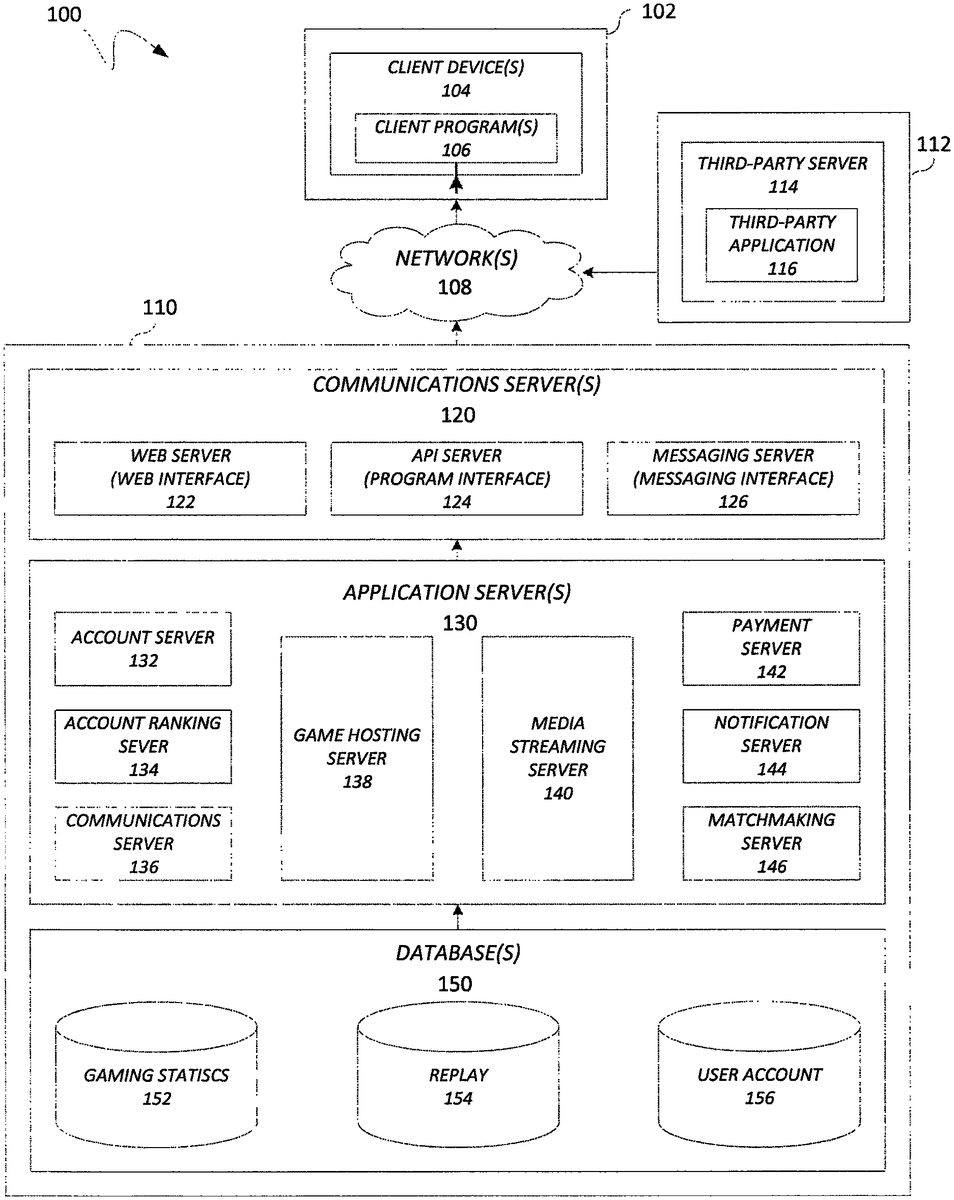
FIG. 1illustrates, in block diagram format, an exemplary embodiment of a computing system adapted for implementing a system and method for audience adjusted gaming. As shown, a computing system100may comprise or implement a plurality of servers and/or software components that operate to perform various methodologies in accordance with the described embodiments. Exemplary servers may include, for example, stand-alone and enterprise-class servers operating a server operating system (OS) such as a MICROSOFT® OS, a UNIX® OS, a LINUX® OS, or other suitable server-based OS. It may be appreciated that the servers illustrated inFIG. 1may be deployed in other ways and that the operations performed and/or the services provided by such servers may be combined, distributed, and/or separated for a given implementation and may be performed by a greater number or fewer number of servers. One or more servers may be operated and/or maintained by the same or different entities.
Computing system100may include, among various devices, servers, databases and other elements, one or more clients102that may comprise or employ one or more client devices104, such as a laptop, a mobile computing device, a tablet, a PC, a wearable device, and/or any other computing device having computing and/or communications capabilities in accordance with the described embodiments. Client devices104may include a cellular telephone, smart phone, or other similar mobile devices that a user may carry on or about his or her person and access readily.
Client devices104generally may provide one or more client programs106, such as system programs, gaming programs, and application programs to perform various computing and/or communications operations. Exemplary system programs may include, without limitation, an operating system (e.g., MICROSOFT® OS, UNIX® OS, LINUX® OS, Symbian OS™, Embedix OS, Binary Run-time Environment for Wireless (BREW) OS, JavaOS, a Wireless Application Protocol (WAP) OS, and others), device drivers, programming tools, utility programs, software libraries, application programming interfaces (APIs), and so forth. Exemplary application programs may include, without limitation, videogames, web browser applications, messaging applications (e.g., e-mail, IM, SMS, MMS, telephone, voicemail, VoIP, video messaging), contacts applications, calendar applications, electronic document applications, database applications, media applications (e.g., music, video, television), location-based services (LBS) applications (e.g., GPS, mapping, directions, positioning systems, geolocation, point-of-interest, locator), and so forth. One or more of client programs106may display various graphical user interfaces (GUIs) to present information to and/or receive information from one or more users of client devices104. In some embodiments, client programs106may include one or more applications configured to conduct some or all of the functionalities and/or processes discussed herein.
As shown, client devices104may be communicatively coupled via one or more networks108to a network-based system110. Network-based system110may be structured, arranged, and/or configured to allow client102to establish one or more communications sessions between network-based system110and various computing devices104and/or client programs106. Accordingly, a communications session between client devices104and network-based system110may involve the unidirectional and/or bidirectional exchange of information and may occur over one or more types of networks108depending on the mode of communication. While the embodiment ofFIG. 1illustrates a computing system100deployed in a client-server operating environment, it is to be understood that other suitable operating environments and/or architectures may be used in accordance with the described embodiments.
Data communications between client devices104and the network-based system110may be sent and received over one or more networks108such as the Internet, a WAN, a WWAN, a WLAN, a mobile telephone network, a landline telephone network, as well as other suitable networks. For example, client devices104may communicate with network-based system110over the Internet or other suitable WAN by sending and or receiving information via interaction with a web site, e-mail, IM session, video messaging session, and/or other communication applications. Any of a wide variety of suitable communication types between client devices104and system110may take place, as will be readily appreciated. In particular, wireless communications of any suitable form may take place between client device104and system110.
In various embodiments, computing system100may include, among other elements, a third party112, which may comprise or employ a third-party server114hosting a third-party application116and third-party devices118. In various implementations, third-party server114and/or third-party application116may host applications associated with or employed by a third party112. For example, third-party server114and/or third-party application116may enable network-based system110to provide client102with additional services and/or information, such as online videogame hosting, live video game streams, and/or the like, some of which are discussed herein. Third-party server114and/or third-party application116may also provide system110and/or client102with other information and/or services, such as email services and/or information, social networking services and/or information, user statistics and/or other online services and/or information.
In one embodiment, third-party server114may include a social networking server that hosts a user's social network account. In another embodiment, third party-server114may include an email server that hosts a user's email account. In yet another embodiment, third-party sever114may include one or more servers for aggregating user data and statistics.
Network-based system110may comprise one or more communications servers120to provide suitable interfaces that enable communication using various modes of communication and/or via one or more networks108. Communications servers120may include a web server122, an API server124, and/or a messaging server126to provide interfaces to one or more application servers130. Application servers130of network-based system110may be structured, arranged, and/or configured to provide various online services, account authentication, social networking, account management, and other services to users that access network-based system110. In various embodiments, client102may communicate with applications servers130of network-based system110using one or more client devices104via one or more of a web interface provided by web server122, a programmatic interface provided by API server124, and/or a messaging interface provided by messaging server126. It may be appreciated that web server122, API server124, and messaging server126may be structured, arranged, and/or configured to communicate with various types of client devices104and/or client programs106and may interoperate with each other in some implementations.
Web server122may be arranged to communicate with web clients and/or applications such as a web browser, web browser toolbar, desktop widget, mobile widget, web-based application, web-based interpreter, virtual machine, and so forth. API server124may be arranged to communicate with various client programs106and/or a third-party application116comprising an implementation of API for network-based system110. Messaging server126may be arranged to communicate with various messaging clients and/or applications such as e-mail, IM, SMS, MMS, telephone, VoIP, video messaging, and so forth, and messaging server126may provide a messaging interface to enable access by client102and/or third party112to the various services and functions provided by application servers130.
When configured to implement a system and method for audience adjusted gaming, application servers130of network-based system110may be a server that provides various gaming services. Application server130of network-based system110may provide services such as, game hosting, player matching, game streaming and/or recording, messaging, user data gathering, and/or other services. Application servers130may include an account server132, a game hosting server138, a media streaming server140, a payment server142, a notification server144, and/or a match making server146. Application servers130may further include an account ranking server134, and a communications server136. These servers, which may be in addition to other servers, may be structured and arranged to aid in hosting, displaying, and adjusting videogame play in addition to some or all of the other services as discussed above and in more detail below.
Application servers130, in turn, may be coupled to and capable of accessing one or more databases150including a gaming statistics database152, a replay database154, and/or user account database156. Databases150generally may store and maintain various types of information for use by application servers130and may comprise or be implemented by various types of computer storage devices (e.g., servers, memory) and/or database structures (e.g., relational, object-oriented, hierarchical, dimensional, network) in accordance with the described embodiments.
FIG. 2illustrates an exemplary computer system200in block diagram format suitable for implementing on one or more devices of the computing system inFIG. 1. In various implementations, a device that includes computer system200may comprise a personal computing device (e.g., a smart or mobile phone, a computing tablet, a personal computer, laptop, wearable device, PDA, Bluetooth device, key FOB, badge, etc.) that is capable of communicating with a network. A service provider and/or a payment provider may utilize a network computing device (e.g., a network server) capable of communicating with the network. It should be appreciated that each of the devices utilized by users, service providers, and payment providers may be implemented as computer system200in a manner as follows.
Computer system200may include a bus202or other communication mechanisms for communicating information data, signals, and information between various components of computer system200. Components include an input/output (I/O) component204that processes a user action, such as selecting keys from a keypad/keyboard, selecting one or more buttons, links, actuatable elements, etc., and sends a corresponding signal to bus202. I/O component204may also include an output component, such as a display211and a cursor control213(such as a keyboard, keypad, mouse, touch screen, etc.). An optional audio input/output component205may also be included to allow a user to use voice for inputting information by converting audio signals. Audio I/O component205may allow the user to hear audio. A transceiver or network interface206transmits and receives signals between computer system200and other devices, such as another user device, a merchant server, an email server, application service provider, web server, a social networking server, a payment provider server, and/or other servers via a network. In various embodiments, such as for many cellular telephone and other mobile device embodiments, this transmission may be wireless, although other transmission mediums and methods may also be suitable. A processor212, which may be a micro-controller, digital signal processor (DSP), or other processing component, processes these various signals, such as for display on computer system200or transmission to other devices over a network260via a communication link218. Again, communication link218may be a wireless communication in some embodiments. Processor212may also control transmission of information, such as cookies, IP addresses, and/or the like to other devices.
Components of computer system200also include a system memory component214(e.g., RAM), a static storage component216(e.g., ROM), and/or a disk drive217. Computer system200performs specific operations by processor212and other components by executing one or more sequences of instructions contained in system memory component214. Logic may be encoded in a computer readable medium, which may refer to any medium that participates in providing instructions to processor212for execution. Such a medium may take many forms, including but not limited to, non-volatile media, volatile media, and/or transmission media. In various implementations, non-volatile media includes optical or magnetic disks, volatile media includes dynamic memory, such as system memory component214, and transmission media includes coaxial cables, copper wire, and fiber optics, including wires that comprise bus202. In one embodiment, the logic is encoded in a non-transitory machine-readable medium. In one example, transmission media may take the form of acoustic or light waves, such as those generated during radio wave, optical, and infrared data communications.
Some common forms of computer readable media include, for example, floppy disk, flexible disk, hard disk, magnetic tape, any other magnetic medium, CD-ROM, any other optical medium, punch cards, paper tape, any other physical medium with patterns of holes, RAM, PROM, EPROM, FLASH-EPROM, any other memory chip or cartridge, or any other medium from which a computer is adapted to read.
In various embodiments of the present disclosure, execution of instruction sequences to practice the present disclosure may be performed by computer system200. In various other embodiments of the present disclosure, a plurality of computer systems200coupled by communication link218to the network (e.g., such as a LAN, WLAN, PTSN, and/or various other wired or wireless networks, including telecommunications, mobile, and cellular phone networks) may perform instruction sequences to practice the present disclosure in coordination with one another. Modules described herein may be embodied in one or more computer readable media or be in communication with one or more processors to execute or process the steps described herein.
A computer system may transmit and receive messages, data, information and instructions, including one or more programs (i.e., application code) through a communication link and a communication interface. Received program code may be executed by a processor as received and/or stored in a disk drive component or some other non-volatile storage component for execution.
Where applicable, various embodiments provided by the present disclosure may be implemented using hardware, software, or combinations of hardware and software. Also, where applicable, the various hardware components and/or software components set forth herein may be combined into composite components comprising software, hardware, and/or both without departing from the spirit of the present disclosure. Where applicable, the various hardware components and/or software components set forth herein may be separated into sub-components comprising software, hardware, or both without departing from the scope of the present disclosure. In addition, where applicable, it is contemplated that software components may be implemented as hardware components and vice-versa.
Software, in accordance with the present disclosure, such as program code and/or data, may be stored on one or more computer readable media. It is also contemplated that software identified herein may be implemented using one or more computers and/or computer systems, networked and/or otherwise. Such software may be stored and/or used at one or more locations along or throughout the system, at client102, network-based system110, or both. Where applicable, the ordering of various steps described herein may be changed, combined into composite steps, and/or separated into sub-steps to provide features described herein.
The foregoing networks, systems, devices, and numerous variations thereof may be used to implement one or more methods and/or services, such as the services discussed above and in more detail below.
FIG. 3illustrates a flow diagram of an exemplary method of audience adjusted game mechanics based on the popularity of the player and/or channel.
At301, a player and/or a user may request to begin a video game on a system such as network-based system110ofFIG. 1using one of the client devices of client devices104ofFIG. 1. The video game may be a single or multiplayer campaign style game wherein a storyline or a set of adventures in the video game is played out by the players with the purposes of reaching the end of the game. In some embodiments, the end of the story line is the end of the game. Many gamers will provide streams and/or replays of quick completions of games often referred to as “speedruns.” Speedruns refer to players that rush through the story line of a game to reach completion in the shortest amount of time. Many viewers are interested in speedruns because it allows the viewer to experience the story of the game without having to work through the game themselves.
In some examples, the game may be a PvP game, where the players are pitted against each other competitively. Examples of PvP games include, but are not limited to, real time strategy (RTS) games, first person shooters (FPS), and/or fighting games. PvP games also often have a campaign mode for players to play. Individuals usually watch PvP games for the same type of thrill people get from watching competitive sports matches. PvP games will often have similar dramatic and suspenseful situations are a professional sports match.
In some embodiments, the request to begin a video game may be a login event, such as submitting a username and password for an account to a server. In other embodiments, the request may be the actuation of a virtual button on a user interface used to initiate a game.
At302, the request received at301may trigger a stream and/or broadcast of the player's game. The stream may be a broadcast of a screen region capture, game capture, video camera capture, or a combination thereof. In some embodiments, the video steam may be handled by a third party application installed on the device of the user and sent to a broadcasting server such as media streaming server140ofFIG. 1for broadcasting. The broadcast of the game may be available to viewers through a web application, website, phone application, and/or the like.
At303, the system may determine the popularity of the stream. Determining the popularity of the stream may include determining the number of current viewers and/or subscribers to the channel of the user. In some example, the popularity may be determined by the total number of views. In some example, the system may determine popularity from monetary donations to the channel. As more money is donated to the player, the system may increase its popularity determination for the player.
At304, the system may change some of the game mechanics based on the popularity determination at303. In some embodiments, the difficulty of a campaign style game may be incrementally increased until a maximum difficulty is reached. The difficulty of the game can be changed in a number of ways, including, but not limited to, changing in-game character attributes, changing villain and/or minion attributes, changing the number of minions, changing map sizes, changing time limitations, changing the number of missions, change odds of health or helpful item drops in the game and/or the like. In-game characters, minions, villains, heroes, champions and individual army makeup are often referred to as “units”.
For example, a character that a user is playing may have a life attribute of 100. The player may lose a game when the life attribute is reduced to 0. To increase the difficulty of the game, the starting life attribute may be reduced in relation to the number of viewers, subscribers, and/or donors. In some instances, the life attribute may be reduced by 1 for every 100 viewers, with a maximum reduction of 50. In this case, the life attribute will reduce until there are 5000 viewers or more, where the maximum reduction is reached at 50.
In some examples the system may aid a player based on the popularity determination, at303. In a PvP game, fans may support a particular player/team by watching a streaming game from the channel of that player/team. As more fans view, subscribe, or donate to a channel for a user or team, character attributes and/or in-game items to help the team or individual may occur. In this manner, the audience support may affect the outcome of a competitive match. For example, a character that a user is playing may have a DPS attribute of 10. In some instances, the DPS attribute may be increased by 1 for every 100 viewers. Other attributes that may be affected include, but are not limited to, health, defense, movements speed, and/or the like.
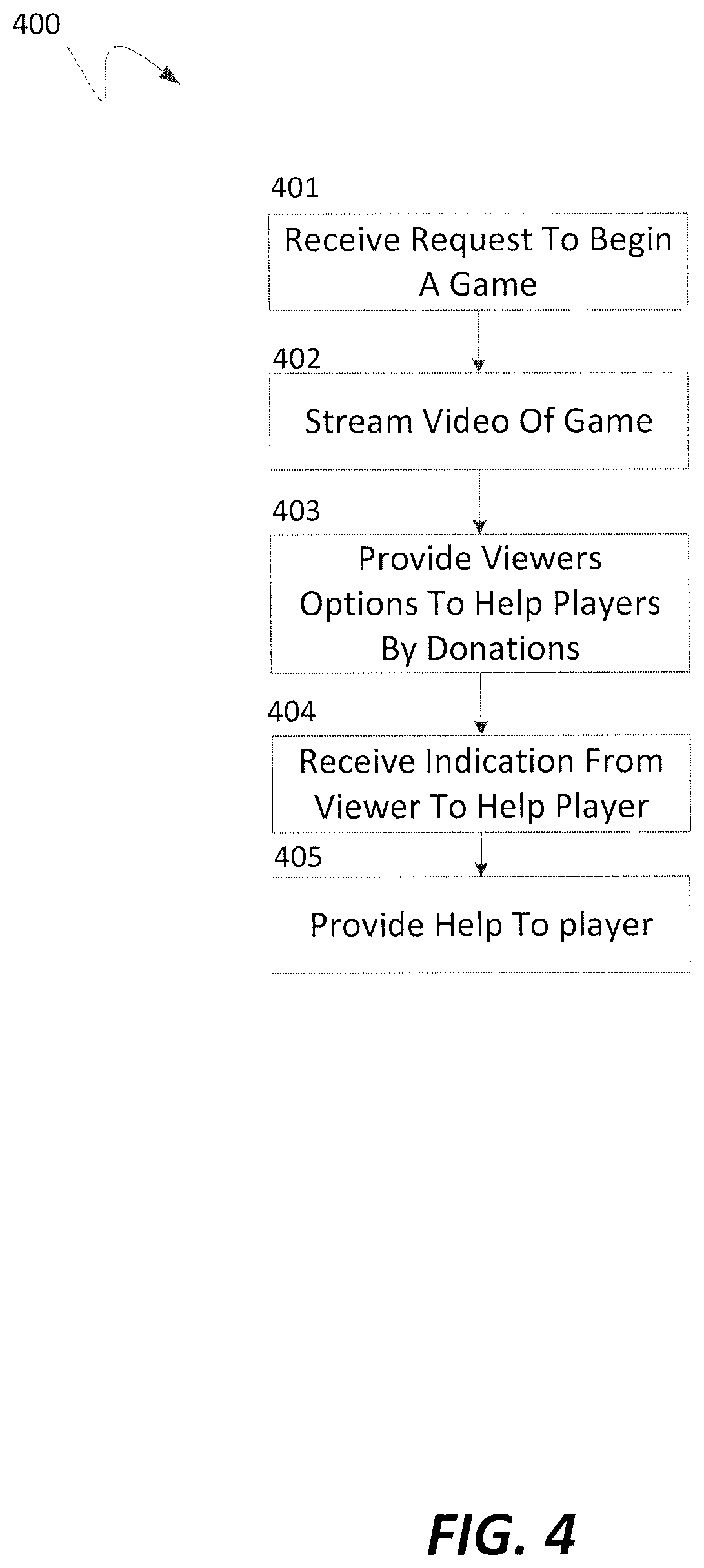
FIG. 4illustrates a flow diagram of an exemplary method400for audiences to aid players streaming a competitive video game according to an embodiment.
At401, a player and/or a user may request to begin a video game on a system such as network-based system110ofFIG. 1using one of the client devices of client devices104ofFIG. 1. The videogame may be a PvP game, where players and/or teams of players are pitted against each other competitively. The PvP games may have power up items normally available in the game. Power up items may include, but are not limited to, health potions, weapons, armor, virtual currency, magical items that provide special abilities, and/or the like.
The request may be a login event, such as submitting a username and password for an account to a server. In other embodiments, the request may be the actuation of a virtual button on a user interface used to initiate a game.
At402, the request received at401may trigger a stream and/or broadcast of the player's game. The stream may be a broadcast of a screen region capture, game capture, video camera capture, or a combination thereof. In some embodiments, the video steam may be handled by a third party application installed on the device of the user and sent to a broadcasting server such as media streaming server140ofFIG. 1for broadcasting. The broadcast of the game may be available to viewers through a web application, website, phone application, and/or the like.
At403, the system may provide viewers with the ability to aid and/or hinder a team in the PvP game through a graphical user interface. In some embodiments, the ability to aid and/or hinder a team in a PvP game may require a donation from the viewer. In some examples, the donation may determine how much a viewer can aid or hinder a team.
The ability to hinder and/or aid a player or team in a game may be the ability to change unit and/or character attributes (e.g. increase and/or decrease attack points, damage output, damage per second (DPS), defense points, etc.), change re-spawn times (e.g. increase/decrease re-spawn wait time after a character death by 30 seconds), change movement speeds, change the number of minions and/or the strength of minions, set booby-traps, heal units (e.g. heal units to full life points), damage units (e.g. remove life points), provide item drops (e.g. weapons, health potions, etc.), reveal a portion of the map, reveal enemy plans and/or the like. In some examples, the aid and/or hindrance may be temporary, such as for a short period of time (e.g. less than thirty seconds, a minute, five minutes, etc.), until the end of a match and/or round, until the death of a character or a certain number of deaths, and/or the like. The unit being affected by the aid and/or hindrance may be a unit controlled by a player in the game and/or an opponent to the player in the game. In some examples the opponent may be the system using artificial intelligence. In some examples, the opponent may be another human player.
In some examples, the amount donated may determine the effectiveness of the hindrance and/or aid. For example, a one dollar donation may increase the health of a unit by 100 points, where ten dollars may increase the health of a unit by 1000 points.
At404, the system may receive an indication from a viewer to help or hinder a player and/or team. The indication may be provided through the actuation of an actuatable element provided in a graphical user interface available to the viewer. For example, the GUI may provide a drop down menu of options for helping or hindering a player and/or team. The GUI may also provide an actuatable element to purchase the option. The purchase may be conducted through a payment provider or transfer funds from the user account using a payment server, such as payment server142ofFIG. 1. In some embodiments, the payment server may be handled by a third party, such as third-party server114ofFIG. 1. Some and/or all of the funds may be transferred to the team and/or player being helped and/or hindered.
At405, the system may provide the help and/or hindrance that were indicated by the viewer at404. In some embodiments, the system may allow the user to choose when help or hindrance is introduced into the game. In this manner, the viewer may provide help or hindrance at a critical moment in the game.
In some embodiments, method400may be applied in a campaign game that is not competitive. Audience members may enjoy disrupting a game by hindering a player or team of players from reaching an objective. This is sometimes referred to as “trolling,” with the main purpose of gaining a laugh at the expense of someone else (e.g. a player). In some embodiments, the system may allow users to troll players by adding difficult minions, adding lag, slowing player movement, adding blockades, and changing other game mechanics to generally annoy the players and/or disrupt a game. In some examples, viewers may have to donate to change the game mechanics in a similar manner as described at process403-404.
FIG. 5illustrates a flow diagram of an exemplary method500for automatically adjusting game mechanics based on audience preferences. Much like sports, viewers have opinions on how video games should be adjusted for optimal entertainment. Some viewers may be interested in short, action packed games with constant battling. Another group of viewers instead of action packed games may be more interested in slow, defensive, and technical games. A system implementing method500may tailor games based on the audience viewing the game.
At501, the system may determine which viewers are viewing a video game stream and/or media channel. In some embodiments, users may be required to log into an account to view a stream and the system may determine which accounts are accessing the stream.
At502, the system may access a database of recorded user history, such as user account database156ofFIG. 1, and determine which streams and/or replays of games the user accounts watched. The system may determine which streams and/or game replays are popular amongst the audience. In some embodiments, the system may also check viewing times and/or how much of a stream and/or replay was watched to determine which streams or replays of games were the most engaging. The system may determine that viewers enjoyed streams or replays of game plays that were watched for longer periods of time and/or viewed the entirety and/or majority of the game play. In some embodiments, users may be able to vote (e.g. thumbs up or thumbs down) on streams and replays that the audience liked or disliked. The system may track the history of the up and down votes of users to determine which games the viewers are most interested in. The system may track game mechanics of each game stream and or replay, such as maps, characters, game length, units, races played (in some games players are able to play different races such as orc, human, etc.), and/or the like. In some embodiments, users may also fill out a questionnaire regarding the viewing preferences and game mechanic preferences of the user. The questionnaire may ask questions such as, favorite character race, player, map, power-ups, weapons, and/or the like. The questionnaire may also be used in determining the viewing preferences of a viewing audience. In some embodiments, the questionnaire may be provided as part of a user profile when an account is initially created.
At503, the system may identify preferred game mechanics of the viewers. In some examples, preferred game mechanics are determined by common elements from the game statistics of the most popular streams and/or replays. For example, the system may determine that the most popular games used (or did not use) smaller maps, certain characters, and/or certain weapons. In some embodiments, the determination may be made by analyzing the historic votes, watching history, and/or questionnaires of the audience. For example, the replay and/or stream with the most up votes may be considered the most popular. In some examples the system may count up votes and down votes and subtract the down votes from the up votes to determine popularity.
In some embodiments, the system may count maps, characters, game times, and/or other game mechanics from well liked game plays. Well liked game plays may be game plays with above average up votes, game play watching time, and/or game plays commonly watched by most of the viewers.
At504, the system may receive a request to begin a game. The request may come from one or more players, and/or one or more moderators for a game. The game may have a randomizer that randomizes certain mechanics of the video game, such as which map is played, the races of the player, spawning areas, starting weapons, and/or the like.
At505, the system may set the game mechanics with the common elements determined at503. For example, the audience may have a preference of a larger map. The system at505may increase the odds of a larger map being used from a pool of maps, and/or use a map that is determined to be the most popular at503. Other game mechanics that may be changed by the system may be game speed. The system at503may determine that the users are interested in relatively short games and the system may, to shorten a game, increase movement speeds, attack speeds, and/or attack damage of units in the game.
FIG. 6illustrates an exemplary user interface600that may be used with a system and method of audience adjusted game mechanics, such as method400ofFIG. 4. In some embodiments, user interface600may be presented to one or more viewers of a streaming video game by a player. In some embodiments, user interface600may be an interface displayed within a web browser connected to a web server, such as web server122ofFIG. 1. In some embodiments, user interface600may be an interface displayed by an application, such as client program106ofFIG. 1, on a user device, such as one of client devices104ofFIG. 1.
User interface600may have a media player601for displaying a video game being played by one or more players and/or players of a video game. In some examples, media player601may have actuatable elements (not shown) which allow a user to pause, play, rewind, and/or fast forward the media. There may also be volume controls and/or video quality controls (e.g. ultra high definition, high definition, low quality, etc.).
In some embodiments, user interface600may have a chat window602where viewers and/or players may engage in a textual discussion in a public and/or private chat forum. In some examples, chat window602may be a private chat window where only people who are invited, such as friends, may view and join the chat session. The chat window may have moderator controls, such as the ability to kick out, ban, invite, and/or mute other users. In some embodiments, the moderator controls may be conducted through textual commands that are entered into the chat. In some examples, the moderator controls may be actuatable elements (not shown) that are a part of chat window602.
User interface600may display several actuatable elements603which, when actuated, allow a user to pick an aid or hindrance, such as the aids or hinderances discussed above in relation toFIG. 4, that can be applied to one or more players and/or teams playing the game being displayed in media player601. The actuatable elements may be virtual buttons on the user interface. In some embodiments aiding or hindering a player or team playing a game may require a donation of currency, game points, game coins, and/or the like. To facilitate the donations, there may be a donate button604which allows the user to donate and/or transfer money to a team and/or player. In some embodiments, actuating one or more actuatable elements603may enabled through a donation and/or money transfer. The donation button, when actuated, may request more information, such as the choice of a payment provider, payment account information, credit card numbers, and/or the like. In some examples, the donate button may retrieve funds that are already present in and/or related to a user account. The actuating donate button604may then be used to transfer funds from the user to one or more players playing the videogame displayed in media player601.
Where applicable, various embodiments provided by the present disclosure may be implemented using hardware, software, or combinations of hardware and software. Also, where applicable, the various hardware components and/or software components set forth herein may be combined into composite components comprising software, hardware, and/or both without departing from the scope of the present disclosure. Where applicable, the various hardware components and/or software components set forth herein may be separated into sub-components comprising software, hardware, or both without departing from the scope of the present disclosure. In addition, where applicable, it is contemplated that software components may be implemented as hardware components and vice-versa.
Software, in accordance with the present disclosure, such as program code and/or data, may be stored on one or more computer readable mediums. It is also contemplated that software identified herein may be implemented using one or more general purpose or specific purpose computers and/or computer systems, networked and/or otherwise. Where applicable, the ordering of various steps described herein may be changed, combined into composite steps, and/or separated into sub-steps to provide features described herein.
The foregoing disclosure is not intended to limit the present disclosure to the precise forms or particular fields of use disclosed. As such, it is contemplated that various alternate embodiments and/or modifications to the present disclosure, whether explicitly described or implied herein, are possible in light of the disclosure. Having thus described embodiments of the present disclosure, persons of ordinary skill in the art will recognize that changes may be made in form and detail without departing from the scope of the present disclosure. Thus, the present disclosure is limited only by the claims.
Claims
- A system, comprising: one or more processors;and a memory coupled to the one or more processors and storing instructions that, when executed by the one or more processors, perform operations, comprising: receiving, from one or more computing devices, a request to receive streaming video of a video game;providing one or more game mechanics to the one or more computing devices;receiving, from the one or more computing devices, input that requests at least one of the one or more game mechanics be changed;and altering the at least one of the one or more game mechanics based, at least in part, on the received input.
- The system of claim 1 , wherein the one or more game mechanics is a difficulty setting of the video game.
- The system of claim 1 , wherein the one or more game mechanics is a size of map associated with the video game.
- The system of claim 1 , wherein the one or more game mechanics is an attribute of a character of the video game.
- The system of claim 4 , wherein the attribute is a damage-per-second of the character.
- The system of claim 4 , wherein the attribute is a movement speed of the character.
- The system of claim 1 , further comprising receiving a monetary contribution from a user of the one or more computing devices prior to providing the one or more game mechanics to the one or more computing devices.
- The system of claim 1 , wherein the at least one of the one or more game mechanics is altered based, at least in part, on an amount of money contributed by a user associated with the one or more computing devices.
- The system of claim 1 , wherein the one or more game mechanics is altered for an amount of time.
- The system of claim 9 , wherein the amount of time is based, at least in part, on a monetary value contributed by a user associated with the one or more computing devices.
- A method, comprising: receiving, from one or more computing devices, a request to live stream a video game;providing one or more game mechanics of the video game to the one or more computing devices;receiving, from the one or more computing devices, input that requests a change to the one or more game mechanics;and altering the at least one of the one or more game mechanics based, at least in part, on the received input.
- The method of claim 11 , further comprising receiving a monetary contribution from a user of the one or more computing devices prior to providing the one or more game mechanics to the one or more computing devices.
- The method of claim 11 , wherein the at least one of the one or more game mechanics is altered based, at least in part, on an amount of money contributed by a user associated with the one or more computing devices.
- The method of claim 11 , wherein the one or more game mechanics is altered for an amount of time.
- The method of claim 14 , wherein the amount of time is based, at least in part, on a monetary value contributed by a user associated with the one or more computing devices.
- The method of claim 11 , wherein the one or more game mechanics is a difficulty setting of the video game.
- The method of claim 11 , wherein the one or more game mechanics is associated with a map of the video game.
- A method, comprising: receiving, from a remote computing device, a live stream of a video game;receiving, from the remote computing device, one or more game mechanics of the video game;providing input that requests a change to the one or more game mechanics during the live stream;and sending the request to the remote computing device.
- The method of claim 18 , further comprising receiving an indication that the one or more game mechanics has been altered.
- The method of claim 18 , wherein the one or more game mechanics is a difficulty level of the video game.
Disclaimer: Data collected from the USPTO and may be malformed, incomplete, and/or otherwise inaccurate.