U.S. Pat. No. 10,854,046
SYSTEMS AND METHODS FOR CASH PAYMENTS FOR ONLINE GAMING USING LOCATION
AssigneePayNearMe Inc
Issue DateDecember 26, 2018
Illustrative Figure
Abstract
Disclosed herein are systems and methods for facilitating cash payment for online gaming including receiving player information at a service provider system through an input element of a player input screen presented on a player system. Embodiments include presenting information regarding a point-of-service that is equipped to accept cash payments, generating a token that is optically readable for use by the point-of-service, determining if the point-of-service is located in a geographic region authorized to make payments to the game provider; and notifying the point-of-service to reject any payments from the player system if the point-of-service is not located in a geographic region authorized to make the payments from the player system to the game provider.
Description
DETAILED DESCRIPTION The present invention provides systems and methods to facilitate cash payments for online gaming that overcome many of the difficulties of the current system. For example, the systems and methods of the present invention may assist a player of an online game to make cash payments to a remote game provider and may help the player and game provider comply with state and federal gaming regulations. The following is a description of one or more embodiments of the present invention, with reference toFIGS. 1-5. The present invention is not limited to the particular embodiments described, and the terminology used herein is for the purpose of describing particular embodiments only. FIG. 1is a high-level flow illustration of one embodiment showing exemplary relationships between the parties involved in the presented systems and methods. In this embodiment, four parties are involved: (1) a service provider having a service provider system102; (2) a game provider104; (3) a point-of-service (“POS”)106; and (4) a game player108. The dashed lines inFIG. 1generally represent a flow of information, data, or process or interaction between respective parties. In practice, the dashed lines inFIG. 1may represent user interfaces and/or application program interfaces (APIs) for the transmission of information, data, instructions, funds, etc. The flow of information, data, or process between the respective parties may be direct or may flow through systems or parties not shown inFIG. 1. In a scenario consistent withFIG. 1, a player108wants to make a cash payment to a game provider104so that the player can use those funds to play an online game provided by the game provider104. Making a cash payment to the game provider104may be logistically difficult because the game provider104is remote from the player108, because the game provider104does not accept cash payments, or because state and federal laws and regulations may limit ...
DETAILED DESCRIPTION
The present invention provides systems and methods to facilitate cash payments for online gaming that overcome many of the difficulties of the current system. For example, the systems and methods of the present invention may assist a player of an online game to make cash payments to a remote game provider and may help the player and game provider comply with state and federal gaming regulations. The following is a description of one or more embodiments of the present invention, with reference toFIGS. 1-5. The present invention is not limited to the particular embodiments described, and the terminology used herein is for the purpose of describing particular embodiments only.
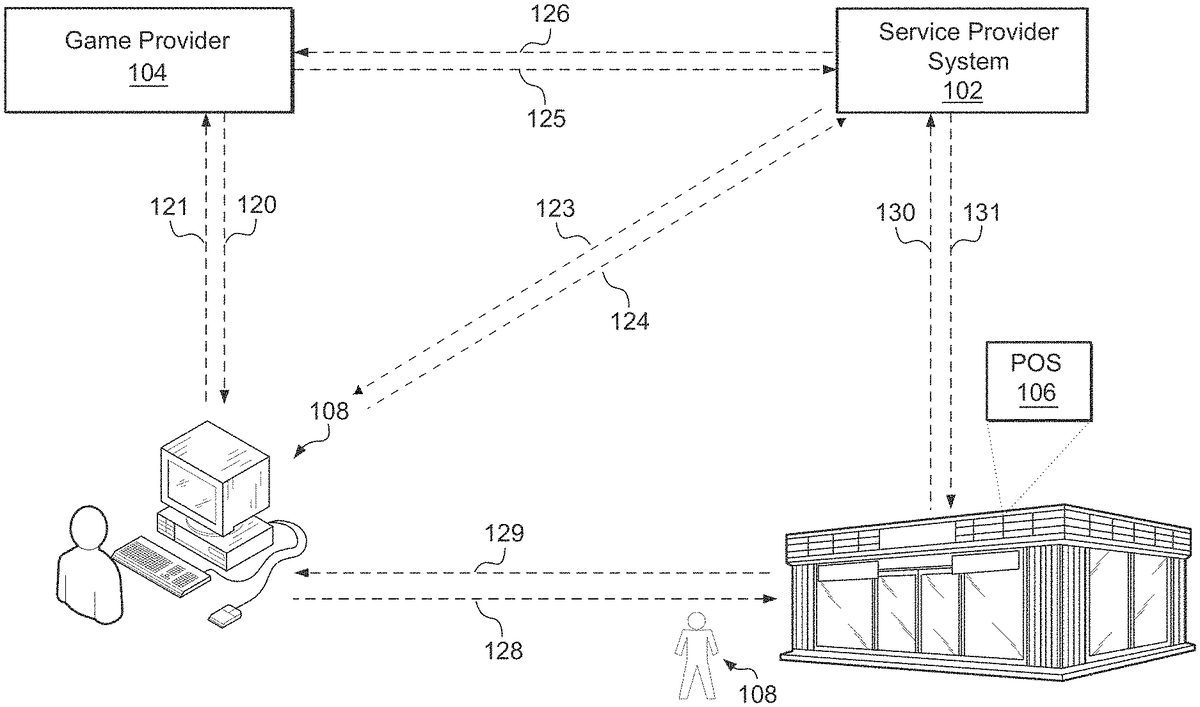
FIG. 1is a high-level flow illustration of one embodiment showing exemplary relationships between the parties involved in the presented systems and methods. In this embodiment, four parties are involved: (1) a service provider having a service provider system102; (2) a game provider104; (3) a point-of-service (“POS”)106; and (4) a game player108. The dashed lines inFIG. 1generally represent a flow of information, data, or process or interaction between respective parties. In practice, the dashed lines inFIG. 1may represent user interfaces and/or application program interfaces (APIs) for the transmission of information, data, instructions, funds, etc. The flow of information, data, or process between the respective parties may be direct or may flow through systems or parties not shown inFIG. 1. In a scenario consistent withFIG. 1, a player108wants to make a cash payment to a game provider104so that the player can use those funds to play an online game provided by the game provider104. Making a cash payment to the game provider104may be logistically difficult because the game provider104is remote from the player108, because the game provider104does not accept cash payments, or because state and federal laws and regulations may limit where payments to the game provider104can be made. The service provider system102exchanges information with the player108and/or the game provider104. These exchanges are represented by lines120-121and123-126. Based on these exchanges, the service provider system102provides a token to the player108directly or indirectly (e.g., through the game provider104). The player108presents the token and a payment at the point-of-service106, which is shown as line128. The point-of-service106communicates with the service provider system102to notify the service provider system102of the presentment of the token and payment and to transmit funds to the service provider system102. The interaction between the point-of-service106and the service provider system102are shown as lines130and131. The point-of-service106may interact with the player108including by providing information, merchandise, or a token to the player108. This interaction is shown as line129.
The service provider system102may comprise one or more computer systems capable of carrying out the functionality described herein. For example,FIG. 2is a schematic drawing of one embodiment of a service provider system200used to implement the methods presented herein. Service provider system200includes one or more processors, such as processor204. The processor204is connected to a communication infrastructure206(e.g., a communications bus, cross-over bar, or network). Computer system200can include a display interface202that forwards graphics, text, and other data from the communication infrastructure206(or from a frame buffer not shown) for display on a local or remote display unit230.
Service provider system200also includes a main memory208, such as random access memory (RAM), and may also include a secondary memory210. The secondary memory210may include, for example, a hard disk drive212and/or a removable storage drive214, representing a floppy disk drive, a magnetic tape drive, an optical disk drive, flash memory device, etc. The removable storage drive214reads from and/or writes to a removable storage unit218. Removable storage unit218represents a floppy disk, magnetic tape, optical disk, flash memory device, etc., which is read by and written to by removable storage drive214. The removable storage unit218includes a computer usable storage medium having stored therein computer software, instructions, and/or data.
In alternative embodiments, secondary memory210may include other similar devices for allowing computer programs or other instructions to be loaded into a service provider system200. Such devices may include, for example, a removable storage unit222and an interface220. Examples of such may include a program cartridge and cartridge interface (such as that found in video game devices), a removable memory chip (such as an erasable programmable read only memory (EPROM), or programmable read only memory (PROM)) and associated socket, and other removable storage units222and interfaces220, which allow computer software, instructions, and/or data to be transferred from the removable storage unit222to a service provider system200.
Service provider system200may also include a communications interface224. Communications interface224allows computer software, instructions, and/or data to be transferred between a service provider system200and external devices. Examples of communications interface224may include a modem, a network interface (such as an Ethernet card), a communications port, a Personal Computer Memory Card International Association (PCMCIA) slot and card, etc. Software and data transferred via communications interface224are in the form of signals228, which may be electronic, electromagnetic, optical, or other signals capable of being transmitted or received by communications interface224. These signals228are provided to and from the communications interface224via a communications path (e.g., channel)226. This channel226carries signals228and may be implemented using wire or cable, fiber optics, a telephone line, a cellular link, a radio frequency (RF) link, a wireless communication link, and other communications channels.
Computer programs (also referred to as computer control logic) are stored in main memory208and/or secondary memory210. Computer programs may also be received via communications interface224. Such computer programs, when executed, enable the service provider system200to perform the features of the present invention, as discussed herein. In particular, the computer programs, when executed, enable the processor204to perform the features of the presented methods. Accordingly, such computer programs represent controllers of the service provider system200. Where appropriate, the processor204, associated components, and equivalent systems and sub-systems thus serve as “means for” performing selected operations and functions. Such “means for” performing selected operations and functions also serve to transform a general purpose computer into a special purpose computer programmed to perform said selected operations and functions.
In an embodiment implemented using software, the software may be stored in a computer program product and loaded into a service provider system200using removable storage drive214, interface220, hard drive212, or communications interface224. The control logic (software), when executed by the processor204, causes the processor204to perform the functions and methods described herein.
In another embodiment, the methods are implemented primarily in hardware using, for example, hardware components such as application specific integrated circuits (ASICs). Implementation of the hardware state machine so as to perform the functions and methods described herein will be apparent to persons skilled in the relevant art(s). In yet another embodiment, the methods are implemented using a combination of both hardware and software.
Embodiments may also be implemented as instructions stored on a machine-readable medium, which may be read and executed by one or more processors. A machine-readable medium may include any mechanism for storing or transmitting information in a form readable by a machine (e.g., a computing device). For example, a machine-readable medium may include read only memory (ROM); random access memory (RAM); magnetic disk storage media; optical storage media; flash memory devices; electrical, optical, acoustical or other forms of propagated signals (e.g., carrier waves, infrared signals, digital signals, etc.), and others. Further, firmware, software, routines, instructions may be described herein as performing certain actions. However, it should be appreciated that such descriptions are merely for convenience and that such actions in fact result from computing devices, processors, controllers, or other devices executing firmware, software, routines, instructions, etc.
Referring again toFIG. 1, in one embodiment of the present invention, the service provider system102facilitates cash payments from a player108to a game provider104. First, the service provider system102generates a player input screen for the game provider104. Generation and transmission of the player input screen may be part of the two-way communication between the service provider system102and the game provider104shown as lines125and126. Additionally, generation and transmission of the player input screen may be part of the two-way communication between the service provider system102and the player108shown as lines123and124. The player input screen may appear to the player108on a website of the game provider104or may be an independent screen provided by the service provider system102. In one example, the service provider system102generates an inline frame element that can be nested or embedded another page such as a game provider's page.FIGS. 3aand 3billustrate one embodiment of an inline frame element,300and302, nested or embedded in the page,301and303, of a game provider.
Next, the service provider system102receives information about the player108via the player input screen. The information may come from directly from the player108or from the game provider104. This player information can include the player's name, address, phone number, or other information that can be used to identify the player. Also, the player information could include a player alias or player identification number. At some point in the interaction between the service provider system102and the player108, the service provider system may present one or more points-of-service106to the player108. The points-of-service106may include establishments local to the player108that are equipped to accept cash payments. The points-of-service106presented to the player108may include specific locations (e.g., individual stores) and may include general store information (e.g., a retail chain name) The points-of-service106may include retail establishments such as convenience stores, grocery stores, gas stations, and department stores. The points-of-service106may also include automated equipment such as automatic teller machines (“ATMs”). The presentation of the points-of-service106to the player108may be based on the player's information. For example, if the player's information includes an address, the service provider system may102may present an address for a point-of-service106close to the player's address.
After receiving the player's information, the service provider system102generates a token that is a reference to the information the player108provided in the player input screen. This token could be an optical machine-readable representation of data like a linear barcode or geometric or two-dimensional barcode. Also, the token could be a number generated by the service provider system102that provides a reference to the player information. The token provides sufficient information to correlate a payment made in association with the token to the player108that made the payment or for whom the payment was made.
The player108may receive the token, for example, on a computer or mobile device. When the player108wants to make a payment to the game provider104, the player108takes the token to point-of-service106and makes a payment. The point-of-service106at which the player108makes the payment may be a point-of-service presented to the player108by the service provider system102. The point-of-service106receives the token and payment and transmits token information and payment information to the service provider system102. The service provider system102receives the confirmation that the player presented the token and payment. Also, the service provider system102receives information about the amount of money the player108presented at the point-of-service106with the token. The service provider system102may send information to the point-of-service106in response to the information sent from the point-of-service106, including an authorization to accept payment from the player108.
The service provider system102also receives a portion of the payment amount received at the point-of-service104from the player108. The amount received by the service provider system102may depend on the agreements between the service provider, the game provider, and the point-of-service. For example, the amount received by the service provider system102may be less than the amount the player108presented to the point-of-service106if, for example, the point-of-service106retains some of the payment. Alternatively, the amount received by the service provider system102may be more than the amount the player108presented to the point-of-service106if, for example, the point-of-service106pays the service provider to increase traffic to the point-of-service.
The service provider, the game provider, and the point-of-service may use a convenience fee model in which a fee is typically visible to the player. In a convenience fee model, the player generally pays any extra costs for the convenience of conducting the transaction. The parties may also use a fixed or variable commission model in which the fee is typically not shown to the customer. In a fixed or variable commission model, costs are typically incurred by the game provider104. Variable commission can be established between one or more parties, and dependent on one or more factors. For example, a variable commission structure may call for percentages being paid by/to the game provider104and/or the point-of-service106.
The service provider system102also transmits a portion of the payment amount received and a portion of the player information to the game provider104. The game provider104uses the player information that the service provider system102transmits to correlate the payment it receives with the player108. The amount received by the game provider104may depend on the agreements between the service provider, the game provider, and the point-of-service.
FIG. 4is a high-level flowchart illustrating one embodiment of a method400for facilitating cash payments for gaming as described above. The method includes the service provider system102;401generating a player input screen for a game provider;402receiving system information for a player via the player input screen;403presenting one or more points-of-service to the player;404generating a token that is a reference to the player information;405providing the token to the player;406receiving a confirmation that the player presented the token and a payment having a payment amount at one of the points-of-service;407receiving a first portion of the payment amount received at the point-of-service; and408transmitting a second portion of the payment amount received at the point-of-service and a portion of the player information to the game provider.
In another embodiment, the service provider system102also receives location information for the point-of-service106at which the payment was received and transmits the location information to the game provider104. The service provider system102may receive location information for the point-of-service106at which the payment was received and determine if the point-of-service106is located in a geographic region authorized to make payments to the game provider104based on the location information received. Based on that determination, the service provider system102then notifies the point-of-sale106to reject the payment from the player if the point-of-service106is not located in a geographic region authorized to make payments to the game provider104. This feature of the present systems and methods is beneficial for assuring compliance with state and federal gaming regulations that may depend on the location at which payment is made or the player's state of residence.
The service provider system102may also receive a point-of-service selection from the player and provide a token to the player108that further comprises a reference to the point-of-service selection from the player. Also, service provider system102may receive a confirmation from the game provider104that the game provider received the transmitted second portion of the payment amount and the portion of the player information.
The described systems and methods may also be used to facilitate cash payments to lottery providers. In this case, the game provider104is a lottery provider, and the service provider system102may receive a selection of lottery numbers from the player108. Additionally, after receiving a selection of lottery numbers, the service provider system102may generate a token that further comprises a reference to the selection of lottery numbers from the player108. In this case, the token may serve as a receipt of purchase of an entry in a lottery or as a lottery ticket.
In the lottery example, the service provider system102may also receive a second confirmation that the player108presented the token and a second payment having a second payment amount at one of the points-of-service106; receive a first portion of the second payment amount received at the point-of-service106; and transmit a second portion of the second payment amount received at the point-of-service106and a portion of the player information. With this aspect of the present systems and methods, a player108may re-use the token, play multiple times with the same token, or add payments to an account.
In other embodiments, the service provider system102may receive a spending limit associated with the player108. The service provider system102may keep a record of a player's prior payment amounts and then determine if the player's prior payment amounts together with the amount most-recently received at a point-of-service106exceeds the spending limit. Also, the service provider system102may transmit a notification that the spending limit has been exceeded. The service provider system102may send the notification to the point-of-sale106and/or instruct the point-of-sale106to reject the payment from the player108if the service provider system determines that the payment amount together with the prior payment amounts exceed the spending limit.
The service provider system102may also receive a spending limit from the game provider104, from the player108, or from a government entity. In some embodiments, the spending limit may be temporal, that is, based on a specific time frame. For example, the spending limit may be set by week or by month. That way, the player108, the game provider104, or a government entity may set a spending limit for the player108for a specific amount of time.
The described systems and methods may also assist in the distribution of winnings to the player108. The service provider system102may receive winnings information from the game provider104associated with the player information. The service provider system102then distributes funds to the player108according to the winnings information and the player information. Further, the service provider system102may receive distribution instructions and distribute the funds to multiple accounts according to the distribution instructions.
The described systems and methods may also be used to facilitate cash payments from several players108for group gaming. In one embodiment, the service provider system102generates a player input screen for a game provider as discussed above. In this instance, the service provider system102receives information for a plurality of players108via the player input screen. The service provider system102may present one or more points-of-service106to one of the plurality of players108. The service provider system102further generates a token for each of the plurality of players108, wherein each token is a reference to the respective player's information. After generating the tokens, the service provider system102provides the respective token to each of the players108. That is, the token corresponding to the information for a player is provided to that player. After the players108receive the tokens, they may present the tokens and payment at a point-of-service106. The service provider system102then receives a confirmation from the point-of-service106that one or more of the players108presented his or her respective token and a payment at the point-of-service106.
The service provider system102also receives information about the payment amount for each player108received at the one or more points-of-service106. Therefore, the service provider system102receives information that indicates how much each player who presented his or her token at a point-of-service106paid in conjunction with presenting the token. The service provider system102then determines a total payment amount received at the one or more points-of-service106from the plurality of players108. The service provider system102also receives a portion of the total payment amount received at the point-of-service106and transmits a portion of the total payment amount and a portion of the information for the plurality of players received via the player input screen to the game provider104. The service provider system102transmits a portion of the players' information to allow the game provider104to link the payments to the players108.
After transmitting a portion of the player's information to the game provider104, the service provider system102may receive winnings information from the game provider associated with the information. The service provider system102then determines an allocation of the winnings among the plurality of players108according to the relative payments from each of the plurality of players and distributes funds to the plurality of players according to the allocation. The distribution may take place thorough a point-of-service106or thorough other funds distribution channels.
In other embodiments for facilitating cash payments for group gaming, the service provider system102generates a player input screen for a game provider104and receives information for a player108via the player input screen. The service provider system102may present one or more points-of-service106to the player. The service provider system generates a plurality of tokens that each comprise a reference to the player information and have a unique identifier distinct from the other tokens. The service provider system102then provides the plurality of tokens to the player108. The player may then distribute the tokens to members of a group who wish to participate in the game provider's game. The members of the group who participate in the game also become players108. In one embodiment, the player selects the game prior to receiving the tokens and the tokens are specific to the selected game. In this embodiment, the members of the group will all participate in the same game. The members who wish to play present the token they received and a payment at a point-of-service106. After providing the tokens to the player, the service provider system receives a confirmation that at least one of the tokens and a payment having a payment amount were presented at a point-of-service. The service provider system102also receives a portion of the payment amount received at the point-of-service106and transmits a portion of the payment amount received at the point-of-service and a portion of the player information to the game provider104.
After transmitting payment and player information to the game provider104, the service provider system102can receive winnings information from the game provider associated with the portion of the player information transmitted to the game provider and determine an allocation of the winnings among the plurality of tokens according to the relative payments made with each token.
In some embodiments, the service provider system102receives a request for authorization from a point-of-service106and also requests authorization from a game provider104before facilitating a cash payment to the game provider. For example, the service provider system102can receive an authorization call from a point-of-service106and transmit the authorization call to a game provider104. An authorization call is an electronic request for authorization to receive cash payment from a player108. After receiving the authorization call, the game provider104may provide authorization and additional information to the service provider system102including entry numbers associated with one of the game provider's game.
Thereafter, the service provider system102receives one or more game entry numbers from the game provider and generates a plurality of tokens that it provides to the player108. The service provider system102then receives a confirmation that at least one of the tokens and a payment having a payment amount were presented at one of the points-of-service106, receives a portion of the payment amount received at the point-of-service106, and transmits a portion of the payment amount received at the point-of-service and a portion of the player information to the game provider104.
In other examples, the service provider system102may facilitate cash payments for recurring gaming. In this example, the service provider system generates a player input screen for a game provider and receives information for a player108via the player input screen. The service provider system102also receives wager information for the player via the player input screen. Wager information may include the amount, timing, as well as the wagered outcome (e.g., winning team, score, and point spread, etc.). As with other embodiments, the service provider system102may present one or more points-of-service106to the player. The service provider system102generates a token that is a reference to the player information and provides the token to the player108. The player then takes the token to a point-of-service106and presents the token and payment. Thereupon, the service provider system102receives a confirmation that the player presented the token and payment. The service provider system further receives a portion of the payment amount received at the point-of-service, places a wager with the game provider104according to the wager information from the player, and transmits a portion of the payment amount received at the point-of-service and a portion of the player information to the game provider.
In this recurring gaming example, the service provider system102may also receive a notification of the outcome of the wager from the game provider104and transmit the notification of the outcome of the wager to the player108. The wager information in the recurring gaming example may comprise a set of numbers that the player108wishes to play in a game or the wager information may include a sports team on which the player wishes to wager.
In further embodiments, the service provider system102facilitates cash payments for more than one game that may go to more than one game provider. In these embodiments, the service provider system102generates a player input screen for a plurality of games of a plurality of game providers104and receives information and wager information for a player via the player input screen. The service provider system may present one or more points-of-service to the player108. The service provider system102generates a token that is a reference to the player information and provides the token to the player108. After the player presents the token and payment at a point-of-service106, the service provider system receives a confirmation that the player presented the token and a payment, receives a portion of the payment amount received at the point-of-service, places a wager with one or more of the game providers104according to the wager information from the player, and transmits a portion of the payment amount received at the point-of-service106and a portion of the player information to the one or more game providers104.
The service provider system102for facilitating cash payments for more than one game may also receive a notification of the outcome of the wager from one or more of the game providers104and transmit the notification of the outcome of the wager to the player108. The system102may be used to facilitate payments to a plurality lottery providers104. In this embodiment, the service provider system102determines the probability of wining each of the lotteries of the plurality of lottery providers104and allocates a portion of the payment amount according to the probability of wining each of the lotteries. Further, the service provider system102may determine the payoff amount for each of the lotteries of the plurality of lottery providers104and allocate a portion of the payment amount according to the payoff amount for each of the lotteries. In each of these examples, the player108may have the option to indicate which lotteries the service provider system will include in its determination and the player108may indicate the criteria (e.g., highest probability of wining or highest payoff amount) that the service provider system102will use to determine how to allocate the payment.
The service provider system102of the present invention may also be configured in other ways to facilitate cash payments for lottery and raffle type games. In one example, the service provider system102generates a game-provider input screen and receives information for a game provider104via the game-provider input screen. The information may include information about the identity of the game provider and information about a game of the game provider. The service provider system102may present one or more points-of-service106to the game provider. The service provider system102generates a primary token that comprises a first reference to the game provider information and provides the primary token to the game provider104. The game provider104may then distribute the primary token to people who wish to play a game associated with the token. The players108who have received the primary token may then present the primary token and payment at a point-of-service106. At this point, the service provider system102receives a confirmation that the primary token and a payment were presented at a point-of-service106and generates one or more secondary tokens based on the amount of the payment presented. Each secondary token also comprises a reference to the game provider information. The service provider system102then provides the secondary tokens to the point-of-service106at which the payment was presented, receives a portion of the payment amount received at the point-of-service, and transmits a portion of the payment amount received at the point-of-service to the game provider104. The point-of-service106provides the secondary tokens to the player108or players who presented the primary token and payment.
In this embodiment, the game provider104may be a lottery provider, and the service provider system102may also receive a selection of lottery numbers from the player108. In this example, the service provider system102may generate secondary tokens that comprise a reference to the selection of lottery numbers from the player108. The secondary tokens that comprise a reference to the selection of lottery numbers may serve as receipts of purchase of one or more entries in the lottery.
The service provider system embodiment that provides secondary tokens may also receive a game denomination amount from the game provider104and determine whether the payment amount received at the point-of-service106corresponds to a multiple of the game denomination amount. Based on that determination, the service provider system102transmits a notification to the point-of-service106. This embodiment is useful, for example, to a game provider104who wants to provide tickets for a game that have a set denomination (e.g. $5 per ticket). When a player108presents a cash payment that is a multiple of the set denomination (e.g., $10), the service provider system102may notify the point-of-service106to accept the payment and issue tickets (e.g., 2 tickets). If the player108presents a cash payment that is not a multiple of the set denomination (e.g., $4), the service provider system102may notify the point-of-service106to reject the payment and/or provide a message to the player108.
The service provider system102embodiment that provides secondary tokens may also receive a confirmation that one of the secondary tokens was presented at one of the points-of-service106, receive winnings information from the game provider104associated with the secondary token presented at the point-of-service106, and transmit the winnings information to the point-of-service106at which the secondary token was presented.
FIG. 5is a high-level flowchart illustrating one embodiment of a method500for facilitating cash payments for gaming using a service provider system that provides secondary tokens as described above. The method includes the service provider system:501generating a game-provider input screen;502receiving information for a game provider via the game-provider input screen;503presenting one or more points-of-service to the game provider;504generating a primary token that comprises a first reference to the game provider information;505providing the primary token to the game provider;506receiving a confirmation that the primary token and a payment having a payment amount were presented at one of the points-of-service;507generating one or more secondary tokens based on the payment amount that each comprise a second reference to the game provider information;508providing the one or more secondary tokens to the point-of-service at which the payment was presented;509receiving a first portion of the payment amount received at the point-of-service; and510transmitting a second portion of the payment amount received at the point-of-service to the game provider.
The figures included herein serve as embodiments of the presented systems and methods. Each individual process or sub-process performed within the embodiments described can be performed by one or more parties, as well as one or more computer systems. For example, in one embodiment, some or all of the communications and data transfers between game provider, service provider system, and point-of-service are performed via an automated computer-based system, such as an application program interface. As such, the embodiments presented in the figures are not intended to be limiting.
Claims
- A method to facilitate transactions with a game provider, the method comprising: generating an input element for a player input screen at a service provider system, the input element representing a proposed transaction to provide a game from the game provider to a player system;sending the input element to the game provider to be included in the player input screen that is sent to the player system by the game provider;receiving a player information about the player of the player system at the service provider system through the input element of the player input screen presented on the player system;presenting information regarding a point-of-service to the player system from the service provider system based on the player information, the point-of-service being equipped to accept cash payments;generating a token that is optically readable for use by the point-of-service, the token being linked to the player information;providing the token to the player system from the service provider system;determining if the point-of-service is located in a geographic region authorized to make game payments to the game provider;notifying the point-of-service to reject the game payments from the player system if the point-of-service is not located in the geographic region authorized to make the game payments from the player system to the game provider;receiving a token information, a payment information and a confirmation that the player presented the token and a transaction payment from the point-of-service at the service provider system if the point-of-service is located in the geographic region authorized to make the game payments from the player system to the game provider, the confirmation indicating that the player has provided the transaction payment to the point-of-service;and sending the player information and the payment information from the service provider system to the game provider in response to receiving the confirmation to indicate completing the proposed transaction to the game provider.
- The method of claim 1 , wherein the input element is configured to be nested in a frame of a game provider page having the player input screen.
- The method of claim 1 , wherein the game provider page is within a game provider website.
- The method of claim 1 , wherein receiving the player information includes receiving location information of the player, the method further comprising selecting the point-of-service from among a plurality of points-of-service that are local to the player, before presenting information regarding the point-of-service.
- The method of claim 4 , wherein determining if the point-of-service is located in the geographic region authorized to make the game payments to the game provider is performed based on the received location information.
- The method of claim 1 , wherein the token indicates a game selection from the player system and wherein the game selection is received at the service provider system from the player system before generating the token.
- The method of claim 1 , wherein the token comprises a reference to the point-of-service.
- The method of claim 1 , further comprising receiving a selection of the point-of service from the player system before presenting the information about the point-of-service.
- The method of claim 1 , further comprising, if the point-of-service is located in the geographic region authorized to make the game payments from the player system to the game provider, sending an authorization from the service provider system to the point-of-service to accept the transaction payment from the player for the token in response to receiving the token information and the payment information and before receiving the transaction payment from the player.
- The method of claim 9 , further comprising requesting and receiving the authorization from the game provider before sending the authorization to the point-of-sale.
- The method of claim 1 , further comprising: receiving a spending limit associated with the player at the service provider system;storing prior payment amounts associated with the player at the service provider system;storing a payment amount of the transaction payment received at the point-of-service at the service provider system;determining if the payment amount together with the prior payment amounts exceed the spending limit;and transmitting from the service provider system to the point-of-service a notification that the spending limit has been exceeded if the service provider system determines that the payment amount together with the prior payment amounts exceed the spending limit.
- The method of claim 11 , wherein receiving the spending limit comprises receiving the spending limit from the game provider.
- The method of claim 1 , further comprising;receiving a second payment from the point-of-service at the service provider system, the second payment being less than the transaction payment;and sending a third payment from the service provider system to the game provider, the third payment being less than the second payment.
- A non-transitory machine-readable medium comprising instructions stored thereon that, when operated on by a machine, cause the machine to perform operations to facilitate transactions with a game provider, the operations comprising: generating an input element for a player input screen at a service provider system, the input element representing a proposed transaction to provide a game from the game provider to a player system;sending the input element to the game provider to be included in the player input screen that is sent to the player system by the game provider;receiving a player information about the player of the player system at the service provider system through the input element of the player input screen presented on the player system;presenting information regarding a point-of-service to the player system from the service provider system based on the player information, the point-of-service being equipped to accept cash payments;generating a token that is optically readable for use by the point-of-service, the token being linked to the player information;providing the token to the player system from the service provider system;determining if the point-of-service is located in a geographic region authorized to make game payments to the game provider;notifying the point-of-service to reject the game payments from the player system if the point-of-service is not located in the geographic region authorized to make the game payments from the player system to the game provider;receiving a token information, a payment information and a confirmation that the player presented the token and a transaction payment from the point-of-service at the service provider system if the point-of-service is located in the geographic region authorized to make the game payments from the player system to the game provider, the confirmation indicating that the player has provided the transaction payment to the point-of-service;and sending the player information and the payment information from the service provider system to the game provider in response to receiving the confirmation to indicate completing the proposed transaction to the game provider.
- The medium of claim 14 , the operations further comprising: receiving multiple game entry number selections from the player system;requesting authorization from the game provider for the game entry number selections;receiving the requested authorization from the game provider, wherein generating the token comprises generating the token for each game entry number selection.
- The medium of claim 15 , the operations further comprising: receiving winnings information from the game provider associated with the player information;determining an allocation of winnings to the player based on past payments received from the player;and distributing funds to the player according to the determined allocation.
- A service provider system to facilitate transactions with a game provider, the service provider system comprising: a processor to generate an input element, the input element representing a proposed transaction to provide a game from a game provider to a player system;and a communications interface to send the input element to the game provider to be included in the player input screen that is sent to the player system by the game provider, to receive a player information about the player of the player system through the input element, to present information regarding a point-of-service to the player system based on the player information, the point-of-service being equipped to accept cash payments;the processor further to generate a token for use by the point-of-service, the token being linked to the player information and provided to the player system through the communications interface, to determine if the point-of-service is located in a geographic region authorized to make game payments to the game provider, and to notify the point-of-service to reject the game payments from the player system if the point-of-service is not located in the geographic region authorized to make the game payments from the player system to the game provider;the communications interface further to receive a token information, a payment information and a confirmation that the player presented the token and a transaction payment from the point-of-service at the service provider system, if the point-of-service is located in the geographic region authorized to make the game payments from the player system to the game provider, the confirmation indicating that the player has provided the transaction payment to the point-of-service, and to send the player information and the payment information to the game provider in response to receiving the confirmation to indicate completing the proposed transaction to the game provider.
- The service provider system of claim 17 , wherein the communications interface is further to receive a spending limit associated with the player and to transmit to the point-of-service a notification that the spending limit has been exceeded, the service provider system further comprising a secondary memory to store prior payment amounts associated with the player and to store a transaction payment amount received at the point-of-service, wherein the processor is further to determine if the transaction payment amount together with the prior payment amounts exceed the spending limit to cause transmitting the notification if the service provider system determines that the transaction payment amount together with the prior payment amounts exceeds the spending limit.
- The service provider system of claim 17 , wherein receiving the player information includes receiving location information of the player, and wherein the processor is further to select the point-of-service from among a plurality of points-of-service that are local to the player, before presenting information regarding the point-of-service.
- The service provider system of claim 19 , wherein determining if the point-of-service is located in the geographic region authorized to make the game payments to the game provider is performed based on the received location information.
Disclaimer: Data collected from the USPTO and may be malformed, incomplete, and/or otherwise inaccurate.