U.S. Pat. No. 10,848,805
CONTEXTUAL VIDEO RECOMMENDATIONS WITHIN A VIDEO GAME
AssigneeElectronic Arts Inc.
Issue DateMarch 28, 2018
Illustrative Figure
Abstract
Methods for providing contextual video recommendations within a video game are provided. In one aspect, a method includes executing an application that uses a rendering engine. The method also includes determining that a video recommendation threshold has been met. The method also includes providing a current contextual state of the application to a server such that the server selects a video from a plurality of videos based on the provided current contextual state and an index, wherein the index includes output from a vision model applied on the plurality of videos, and wherein the vision model is trained on footage generated by the rendering engine. The method also includes receiving a reference to the selected video from the server. The method also includes providing for display, via the reference, the selected video within a user interface of the application. Systems and machine-readable media are also provided.
Description
In one or more implementations, not all of the depicted components in each figure may be required, and one or more implementations may include additional components not shown in a figure. Variations in the arrangement and type of the components may be made without departing from the scope of the subject disclosure. Additional components, different components, or fewer components may be utilized within the scope of the subject disclosure. DETAILED DESCRIPTION The detailed description set forth below is intended as a description of various implementations and is not intended to represent the only implementations in which the subject technology may be practiced. As those skilled in the art would realize, the described implementations may be modified in various different ways, all without departing from the scope of the present disclosure. Accordingly, the drawings and description are to be regarded as illustrative in nature and not restrictive. General Overview As discussed above, video sharing and streaming services can provide a wide variety of helpful and entertaining content, but discovery of relevant content is often limited to interacting directly with the service itself. As a result, opportunities may be missed to view highly relevant, useful, and entertaining video content. Accordingly, a method of providing increased opportunities for discovering relevant video content is needed. The disclosed system provides contextual video recommendations within an application such as a video game. A rendering engine for the application may be used to generate training footage that is annotated with contextual state information. A vision model may be trained with the footage to recognize contextual state information from video content. The vision model may be used to index user generated video content from video sharing or streaming services. When a user runs the application, the application may present video suggestions at opportune times by searching the indexed ...
In one or more implementations, not all of the depicted components in each figure may be required, and one or more implementations may include additional components not shown in a figure. Variations in the arrangement and type of the components may be made without departing from the scope of the subject disclosure. Additional components, different components, or fewer components may be utilized within the scope of the subject disclosure.
DETAILED DESCRIPTION
The detailed description set forth below is intended as a description of various implementations and is not intended to represent the only implementations in which the subject technology may be practiced. As those skilled in the art would realize, the described implementations may be modified in various different ways, all without departing from the scope of the present disclosure. Accordingly, the drawings and description are to be regarded as illustrative in nature and not restrictive.
General Overview
As discussed above, video sharing and streaming services can provide a wide variety of helpful and entertaining content, but discovery of relevant content is often limited to interacting directly with the service itself. As a result, opportunities may be missed to view highly relevant, useful, and entertaining video content. Accordingly, a method of providing increased opportunities for discovering relevant video content is needed.
The disclosed system provides contextual video recommendations within an application such as a video game. A rendering engine for the application may be used to generate training footage that is annotated with contextual state information. A vision model may be trained with the footage to recognize contextual state information from video content. The vision model may be used to index user generated video content from video sharing or streaming services. When a user runs the application, the application may present video suggestions at opportune times by searching the indexed video content based on the current contextual state information of the application.
The disclosed system addresses a technical problem tied to computer technology and arising in the realm of computer networks, namely the technical problem of providing contextual video recommendations related to current application state. This is a technical problem related to networked content search, or more specifically related to analyzing and searching a large corpus of videos in an efficient manner to provide relevant contextual video recommendations. The disclosed system solves this technical problem with a technical solution, namely by generating context annotated training footage using a renderer from the application, training a vision model with the footage, and indexing videos from a video sharing or streaming service using the vision model. The indexed videos can then be readily searched against a current application state of the application to select a video recommendation. In this manner, contextual video recommendations can be provided that are highly relevant to the current application state while leveraging a rich library of user generated content already available on various video sharing services. The index may also be periodically updated to index new video uploads or to integrate updated training of the vision model. Further, by leveraging the preprocessed index, analysis of the video corpus can be avoided at search time, thereby reducing memory footprint, processor cycles, and network bandwidth usage. Accordingly, functioning of the computer itself is improved by using computational resources in an efficient manner.
Although certain examples provided herein may describe a user's account data being stored in memory, each user must grant explicit permission for such user information to be stored. The explicit permission may be granted using privacy controls integrated into the disclosed system. If requested user information includes demographic information, then the demographic information is aggregated on a group basis and not by individual user. Each user is provided notice that such user information will be stored with such explicit consent, and each user may at any time end having the user information stored, and may delete the stored user information. The stored user information may be encrypted to protect user security.
The user can at any time delete the user information from memory and/or opt out of having the user information stored in memory. Additionally, the user can, at any time, adjust appropriate privacy settings to selectively limit the types of user information stored in memory, or select the memory in which the user information is stored (e.g., locally on the user's device as opposed to remotely on a server). In many examples, the user information does not include and/or share the specific identification of the user (e.g., the user's name) unless otherwise specifically provided or directed by the user.
Example System Architecture
FIG. 1illustrates an example architecture100for contextual video recommendations within a video game. The architecture100includes clients110and servers130connected over a network150. Servers130may access various data stores including video content index160, annotated footage170, and user account database180, for example over a local intranet. In some aspects of the subject technology, servers130may instead access the data stores over network150. Users120may interact with respective clients110. Client110A may be part of live environment140, whereas client110B and110C may be part of simulation environment145. Additional clients and associated users may be included that are not specifically shown inFIG. 1. The clients110may each execute a separate instance of an application, such as a video game. The clients in simulation environment145may be real or virtualized clients, and may be under the control of a publisher or developer of the application. The clients in live environment140may correspond to clients associated with end users of the application, and may execute pre-release or release versions of the application.
Initially, a number of preprocessing steps may be executed to generate metadata for accelerated processing of contextual video searches. Each client in simulation environment145may be configured to execute a simulation run for an associated application instance. The simulation run may be fully automated without user intervention, semi-automated, or manually controlled. Renderer output for the application instance performing the simulation run may be video captured and annotated with contextual state from the application. The resulting training footage may then be stored in annotated footage170. A vision model may then be trained using annotated footage170, for example by using machine learning techniques. As a result, the vision model is configured to recognize application specific contextual states from arbitrary video footage. A video crawler may use the vision model to crawl through videos of video content providers152to generate video content index160.
As new content is added to the application or existing content is modified, the vision model may become out of date. Similarly, the videos available from video content providers152may change day to day as new videos are uploaded or existing videos are updated or removed. Accordingly, the preprocessing steps described above may be periodically repeated, incrementally or in full, to update one or more metadata resources such as video content index160, annotated footage170, and the vision model.
The application instances for each client in live environment140may include a video recommendation module that provides contextual video recommendations within a user interface of the application. By sending a current contextual state to a recommendation service hosted on servers130, the recommendation service can initiate a search on one or more video content providers152for a video recommendation based on the received current contextual state and video content index160. The recommendation service may also consider other data sources to merge into the current contextual state. For example, user account database180may be queried for a history of user interactions with the application and with other applications. Non-user specific data may also be considered, such as popularity, rating, and user engagement, which may be useful to provide initial recommendations while the user history is still relatively empty. Once a recommended video is selected, a reference to the selected video, for example a Uniform Resource Identifier (URI), may be provided back to the client. The client may then display, via the reference, the selected video within a user interface of the application.
The clients110can be any device having an appropriate processor, memory, and communications capability for executing the application. The clients110to which the servers130are connected over the network150can be, for example, desktop computers, mobile computers, tablet computers (e.g., including e-book readers), mobile devices (e.g., a smartphone or PDA), set top boxes (e.g., for a television), video game consoles, or any other devices having appropriate processor, memory, and communications capabilities.
One of the many servers130is configured to host a recommendation service along with supporting services such as a vision model, a content crawler, an indexer, and a search service. For the purposes of load balancing, multiple servers130can host the recommendation service and supporting services. In certain aspects, one or more of the servers130can be a cloud computing server of an infrastructure-as-a-service (IaaS), and be able to support a platform-as-a-service (PaaS) and software-as-a-service (SaaS) services.
The network150can include, for example, any one or more of a personal area network (PAN), a local area network (LAN), a campus area network (CAN), a metropolitan area network (MAN), a wide area network (WAN), a broadband network (BBN), the Internet, and the like. Further, the network150can include, but is not limited to, any one or more of the following network topologies, including a bus network, a star network, a ring network, a mesh network, a star-bus network, tree or hierarchical network, and the like.
Example System for Providing Contextual Video Recommendations within a Video Game
FIG. 2is a block diagram illustrating an example server130, client110A and client110B from the architecture ofFIG. 1according to certain aspects of the disclosure. The client110A, client110B, and server130are connected over the network150via respective communications modules218,258, and238. The communications modules218,258, and238are configured to interface with the network150and to receive information, such as data, requests, responses, and commands to other devices on the network, such as video content providers152, video content index160, annotated footage170, and user account database180. The communications modules218,258, and238can be, for example, modems or Ethernet cards.
An end user client, or client110A, is associated with user120A and includes processor212, communications module218, and memory220. The client110A also includes an input device216, such as a keyboard or mouse, and a display device214. The processor212of the client110A is configured to execute instructions, such as instructions physically coded into the processor212, instructions received from software in memory220, or a combination of both.
For example, the processor212of client110A may execute application instance222, corresponding to an instance of a video game application. Application instance222uses rendering engine224for rendering output for displaying on display device214. Application instance222also uses video recommendation module226to determine that a video recommendation threshold has been met, and to provide a current contextual state of application instance222to server130such that server130selects a video from video content providers152based on the provided current contextual state and video content index160, wherein video content index160includes output from vision model241applied on videos from video content providers152, and wherein vision model241is trained on annotated footage170generated by rendering engine224. Application instance222further uses video recommendation module226to receive a reference to the selected video from server130, and to provide for display, via the reference, the selected video within a user interface of application instance222.
In an aspect of the subject technology, the videos hosted on video content providers152include at least one of: content generated by rendering engine224, or real-world videos not generated by rendering engine224. For example, the user generated content hosted on video content providers152may include portions of gameplay footage generated by rendering engine224. However, some game genres such as sports games and open world games may have real life analogues to scenes, objects, characters, or other contextual state within the application. In this case, if the in-game models are rendered in a photorealistic fashion, the in-game models can be matched using vision model241to real footage of sporting matches, city landscapes, famous landmarks, or other real-world environments, persons, and events. For example, if a user performs an amazing in-game penalty kick with a player character based on a real world athlete, recommended videos may match to videos of similar penalty kicks actually performed by the real world athlete.
In an aspect of the subject technology, the current contextual state further identifies a user account in user account database180associated with application instance222. For example, the user account may include user history data such as a breakdown of time spent playing particular modes or stages, a composition of the user's game or application library or wish list, whether the user has played other games by the same developer or in similar genres, whether the user had difficulty with certain sections, whether the user has linked accounts to third party social networks or video sharing services, and other information.
In an aspect of the subject technology, the video recommendation threshold includes the current contextual state including at least one of: unlocking an achievement, obtaining a rare item, ranking in a multiplayer match, receiving a particular level layout, or failing a task for a preset number of times. Thus, when these notable contextual events occur, a video suggestion may be presented to the user. For example, when the user unlocks an achievement, live streams of other users unlocking the same achievement may be recommended to the user. When the user obtains a rare item, reaction videos from other users obtaining the same rare item might be recommended to the user. When the user ranks in a multiplayer match, a replay of a match with a similar team composition but a different ranking outcome might be recommended to the user. When the user receives a particular level layout, for example a difficult puzzle layout, walkthrough videos for similar puzzle layouts may be recommended to the user. When the user fails a task for a preset number of times, such as performing a tricky maneuver or action, using new equipment or items effectively, or getting past a difficult area, a tutorial video may be recommended to the user that covers the same maneuver, action, equipment, item, area, etc.
In an aspect of the subject technology, the video recommendation threshold includes the user interface showing at least one of: a title screen, a loading screen, a transition screen, a game over screen, or a navigation screen. In this manner, periods of natural downtime may be used as opportunities to present context relevant video recommendations. The video recommendation threshold may also be modified by previous user interactions with video recommendations. For example, if the user frequently dismisses video recommendations, then the video recommendation threshold may be raised higher to trigger less often.
In an aspect of the subject technology, the current contextual state includes at least one of a game mode, a game type, a location, a player action, a player statistic, or a hardware configuration. Of course, these data points are only examples of contextual state. Any game state data from application instance222may be extracted as the current contextual state.
A simulation client, or client110B, includes processor252, communications module258, and memory260. The processor252of the client110B is configured to execute instructions, such as instructions physically coded into the processor252, instructions received from software in memory260, or a combination of both. For example, the processor252of client110B may execute application instance262, corresponding to an instance of the video game application. As shown inFIG. 2, both application instance222and application instance262utilize the same rendering engine224for generating video output. Further, a number of support programs including simulator264, video capture266, and annotator268are provided to generate training footage for storing into annotated footage170.
Simulator264may simulate user inputs for a fully automated or semi-automated simulation run of the video game provided by application instance262. For example, levels of the video game may be traversed using prerecorded inputs, scripts, or artificial intelligence (AI). Alternatively, a quality assurance tester may manually simulate a run using an input device. In this case, the client110B may include an input device, such as a keyboard or mouse, and a display device. Alternatively, client110B may be accessed remotely by the quality assurance tester.
Video capture266may capture video output of application instance262. For example, a recording application program interface (API) of a discrete or integrated graphic processor unit (GPU) may be utilized to record video output of application instance262. Alternatively, a hardware based approach such as a video capture device may be utilized. In either case, video output of application instance262may be recorded to storage and optionally compressed in real-time or during post-processing. The video output may also include audio.
Annotator268may retrieve current contextual state from application instance262, for example by using a developer or debugger API exposed by application instance262. Annotator268may work in tandem with video capture266to annotate the recorded video according to a specified granularity, such as for every N frames at a particular framerate. The API may be disabled for end-user versions of the application, such as application instance222. Alternatively, application instance262may first verify client membership in simulation environment145before exposing the API. Note that in this manner, the same application codebase can be used for both live environment140and simulation environment145by implementing an environment check or by using different compilation flags or other build settings. This may help reduce development time as a separate “simulation version” of the application does not need to be developed, although that approach is still an option.
Although not specifically shown inFIG. 2, other users and associated clients may also be in communication with servers130over network150. The other clients may include components similar to those shown in client110A and client110B inFIG. 2.
Server130includes processor236, communications module238, and memory240, which includes vision model241, content crawler242, indexer244, search service246, and recommendation service248. The processor236of the server130is configured to execute instructions, such as instructions physically coded into the processor236, instructions received from software in memory240, or a combination of both.
For example, the processor236of the server130executes instructions in recommendation service248to receive a current contextual state of application instance222from client110A executing application instance222, wherein application instance222uses rendering engine224. For example, video recommendation module226may provide the current contextual state of application instance222to server130via network150.
Video content index160may be accessed. As discussed above, a number of preprocessing steps may be carried out to generate video content index160. Annotated footage170may be used to train vision model241to recognize application specific contextual states. Content crawler242may crawl through videos hosted on video content providers152. Indexer244may apply vision model241with videos retrieved by content crawler242to output video content index160.
A video may be selected from video content providers152by using search service246with the received current contextual state. Search service246may use video content index160and other data sources such as user account database180to select the video.
A reference, such as a URI, to the recommended video selected by search service246may be provided back to client110A. For example, the URI may point to a playback link for the selected video that is hosted on video content providers152.
The techniques described herein may be implemented as method(s) that are performed by physical computing device(s), as one or more non-transitory computer-readable storage media storing instructions which, when executed by computing device(s), cause performance of the method(s), or, as physical computing device(s) that are specially configured with a combination of hardware and software that causes performance of the method(s).
FIG. 3Aillustrates an example process300for providing contextual video recommendations within a video game using the example client110A ofFIG. 2. WhileFIG. 3Ais described with reference toFIG. 2, it should be noted that the process steps ofFIG. 3Amay be performed by other systems.
The process300begins by proceeding to step311, where processor212of client110A executes application instance222that uses a rendering engine224. As discussed above, the simulation client or client110B executes an application instance262that uses the same rendering engine224. The application instance222may correspond to a video game.
In step312, processor212determines that a video recommendation threshold has been met. For example, a calculated value may be compared to a threshold value to determine whether now is an opportune time to interrupt the user with a contextual video recommendation. A baseline default threshold value may be established for all users, which may be adjusted on a per user basis according to user interactions with the video recommendations. Further, certain contextual states or user interface states may affect the calculated value. As an example, user interface states that correspond to natural downtime during the application, such as game over, loading, or transition screens may increase the calculated value, whereas game states that require player concentration or involve a high risk/reward may decrease the calculated value.
In some aspects of the subject technology, the video recommendation threshold includes the current contextual state including at least one of: unlocking an achievement, obtaining a rare item, ranking in a multiplayer match, receiving a particular level layout, or failing a task for a preset number of times. As discussed above, these events may be good candidates for providing a contextual video recommendation.
In some aspects of the subject technology, the video recommendation threshold includes the user interface showing at least one of: a title screen, a loading screen, a transition screen, a game over screen, or a navigation screen. As discussed above, these user interface states may correspond to natural downtime during the application.
In some aspects of the subject technology, the video recommendation threshold is based on previous user interactions with video recommendations. For example, if the user frequently dismisses or closes video recommendations, then the video recommendation threshold may be adjusted upwards, whereas if the user engages with the video recommendations, then the video recommendation threshold may remain the same or be adjusted downwards.
In step313, processor212provides a current contextual state of application instance222to server130. In response, server130may select a video from video content providers152based on the provided current contextual state and video content index160, wherein video content index160includes output from vision model241applied on the videos from video content providers152, and wherein vision model241is trained on annotated footage170generated by rendering engine224. The steps carried out by server130are described in greater detail in conjunction withFIG. 3Bbelow.
As discussed above, preprocessing steps may be carried out to use simulation clients such as client110B to generate annotated footage170from rendering engine224. The vision model241is trained on the annotated footage170to recognize contextual state for application instance222. Content crawler242may crawl through videos hosted on video content providers152. Indexer244may apply vision model241with videos retrieved by content crawler242to output video content index160. Search service246of server130may use video content index160and the provided current contextual state of application instance222to execute search queries for recommended videos hosted by video content providers152.
In some aspects of the subject technology, the videos hosted on video content providers152may contain content rendered by rendering engine224. For example, a user may record video portions generated by rendering engine224, for example when the user is recording gameplay of an application instance. This gameplay footage may be processed with camera overlays and other effects and uploaded as a new video for video content providers152.
In some aspects of the subject technology, the videos hosted on video content providers152may contain real-world videos not generated by rendering engine224, wherein rendering engine224is photorealistic. For example, a camera or other device may be used to record footage of real world locations and events, which may be uploaded to video content providers152. Since rendering engine224is photorealistic, vision model241may be enabled to match to real-world videos hosted on video content providers152.
In some aspects of the subject technology, the current contextual state further identifies a user account associated with application instance222. For example, information concerning the user account may be retrieved from user account database180and merged into the current contextual state.
In some aspects of the subject technology, the current contextual state includes at least one of a game mode, a game type, a location, a player action, a player statistic, or a hardware configuration. As discussed above, these are only examples and any game or application state may be retrieved from application instance222.
In some aspects of the subject technology, vision model241may include an acoustic model for audio. For example, distinctive sounds, music, and spoken words may be recognized in audio tracks to provide additional contextual states.
In some aspects of the subject technology, vision model241may divide video frames into processing regions. For example, video frames may be divided into a grid of smaller elements such as 16 by 16 pixel boxes, or into relevance regions such as by Voronoi partitioning or other methods. These elements may then be individually analyzed using vision model241, for example by converting each element into a set of vectors using a fixed number of dimensions to represent the visual semantic data within each element. In this manner, image searching or matching can be performed in smaller, highly localized portions, providing robustness against partial image obstruction, image warping, and other artifacts that may hinder recognition. Further, vision model241may apply perspective correction and warping, which may further use known camera parameters and other context available from rendering engine224.
In some aspects of the subject technology, server130is accessed via network150, and the reference to the selected video refers to video content providers152that are separate from server130and accessible via network150, as shown inFIG. 2.
In step314, processor212receives a reference to a selected video from server130. For example, the reference may correspond to a URI pointing to a video hosted on video content providers152. Note that the reference does not necessarily need to point to the beginning of the video. For example, if the relevant portion of the video does not start until the 10 minute mark, the reference may specify an offset to start at the 10 minute mark. Similarly, a long video may be shortened by only specifying relevant video clips in the reference. Thus, the reference may include start and end offsets. Note that the video clips may be selected to start earlier than the matched relevant video, for example to include relevant background information or audio commentary.
In step315, processor212provides for display, via the reference, the selected video within a user interface of application instance222. For example, the user interface may be output for display on display device214, and a portion of the user interface may present the selected video as a recommended video by using the received reference. If the reference points to offsets or shorter clips within the video, user interface elements may be provided to allow the user to watch the entire video from the beginning, if desired by the user.
A number of example user interfaces for process300are illustrated inFIGS. 4A, 4B, 4C and 4D. For example, display device214A ofFIG. 4Aillustrates a user interface displaying a game over screen, wherein a video recommendation is provided for “Gamer Joe's Winning Strategy! How to beat the Black Knight.” For example, the current contextual state of application instance222may indicate that the user is on the third game over screen for the “Black Knight” boss character. As a result, the video recommendation is relevant for how to defeat the “Black Knight” boss character so that the user can progress in the game. Other criteria such as the popularity of “Gamer Joe” or the feedback or likes for the video may also be considered when selecting the video. WhileFIG. 4Aonly shows a single recommendation, multiple recommendation videos may also be displayed, for example by providing a scroll bar, by automatically switching or presenting a slideshow of different recommendation videos, or by providing other navigation elements.
When the user clicks on the video recommendation to initiate playback, the playback interface may vary depending on the particular application or video game. For example, in a massively multiplayer online (MMO) game or other game where the game cannot be paused and continues to operate in real-time, playback of the video may occur in a corner of the user interface or another unobtrusive location to avoid impacting gameplay. For a single player game where the player has more freedom to pause or step away from the game, playback may transition to full screen or occupy a significantly larger portion of the user interface.
FIG. 4Billustrates a display device214B, which may display the user interface shown in display device214A after the user clicks the “X” button in the corner to dismiss the video recommendations. As shown in display device214B, an acknowledgement may be provided for the dismissal, and the user may be informed that the video recommendations will appear less often, for example by increasing the video recommendation threshold. However, to incentivize users to engage with the video recommendations, a reward may be provided upon viewing a recommended video, for example by providing in-game currency, items, or other rewards. Further, users may be given the opportunity to rate or comment on recommended videos, which may also be incentivized with rewards to help provide better recommendations.
FIG. 4Cillustrates a display device214C, which may display a user interface displaying a rare item draw. As shown in display device214C, the user has pulled a rare “SSR Pelo card.” Since this item may be a very rare item, the user might be interested in other users that have pulled the same card. Thus, the recommended video corresponds to a reaction video of another user managing to pull the same “SSR Pelo card.”
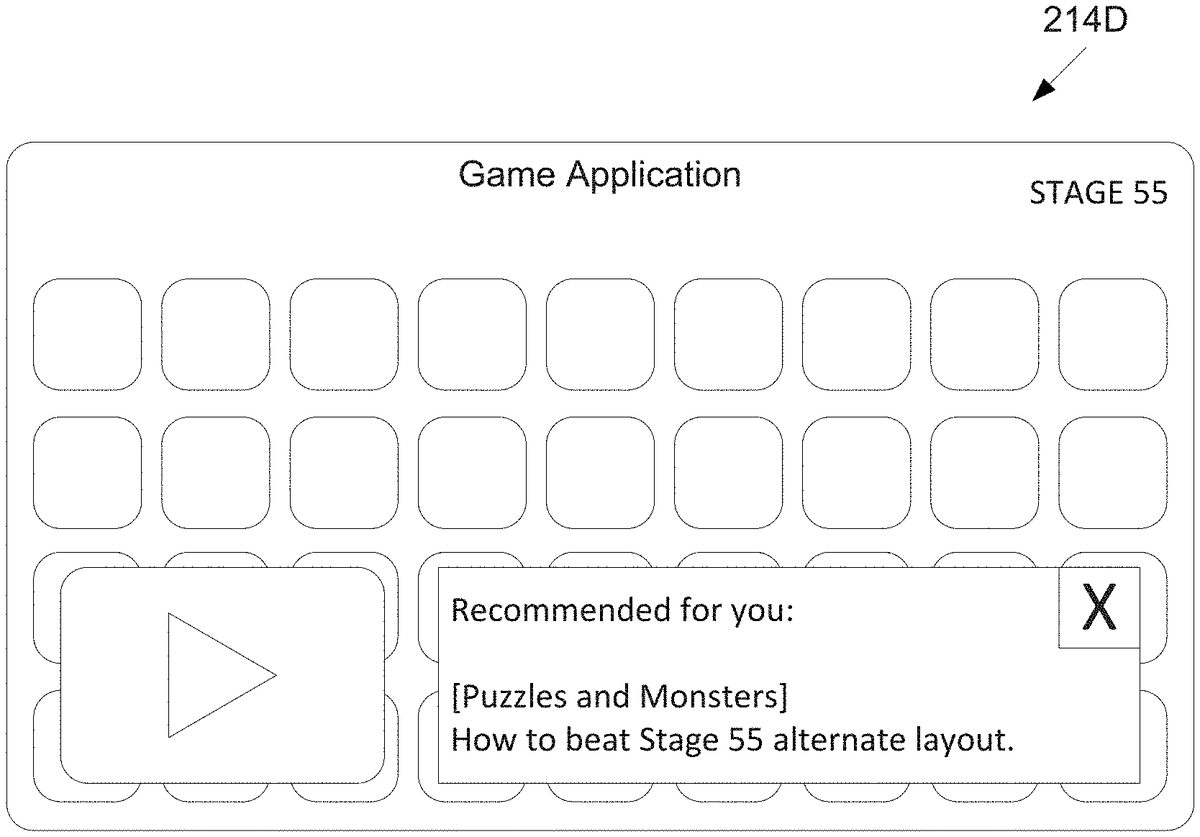
FIG. 4Dillustrates a display device214D, which may display a user interface displaying a stage in a particular configuration. As shown in display device214D, a puzzle game is currently on stage55with a particular layout, which may be partially randomized for each user. Since this particular layout may be harder than a typical layout, a recommended video may provide pointers and tips on how to successfully clear a puzzle layout similar to the layout shown in display device214D. Difficulty of the particular layout may be gauged, for example, by measuring successful completion rates from other users of the same application using a similar puzzle layout. Thus, recommended videos might only be presented when a particular puzzle layout is more challenging than usual. Of course, as discussed above, the user may also dismiss the recommended videos if the user prefers to solve the puzzles without outside help.
Besides video recommendations within a video game, the video content index160can also be used to support other applications such as diagnostics and feedback. For example, besides simulations of gameplay, simulation clients may also output all possible error messages and known or reproducible bugs, which can then be recognized using vision model241. Thus, a user might be able to receive recommendations for fixing a particular error message that is shown, or how to mitigate a known bug or issue. Additionally, as discussed above, vision model241may include an acoustic model that can perform voice or speech recognition. Thus, review videos or commentary videos might be analyzed for user sentiment and feedback concerning game features, difficulty, character balance, and other elements. This feedback may be provided to developers to continuously improve the application and integrate community feedback.
FIG. 3Billustrates an example process320for providing contextual video recommendations within a video game using the example server130ofFIG. 2. WhileFIG. 3Bis described with reference toFIG. 2, it should be noted that the process steps ofFIG. 3Bmay be performed by other systems.
The process320begins by proceeding to step331, where processor236of server130executes recommendation service248to receive a current contextual state of application instance222from client110A executing application instance222, wherein application instance222uses rendering engine224. For example, this may correspond to processor212of client110A performing step313to provide the current contextual state to server130, as described above.
In step332, processor236accesses video content index160that includes output from vision model241applied to videos hosted on video content providers152, wherein vision model241is trained on annotated footage170generated by rendering engine224. As discussed above, vision model241may be trained and video content index160and annotated footage170may be created using preprocessing steps with content crawler242and indexer244.
In step333, processor236selects a video from video content providers152based on the received current contextual state and video content index160. For example, processor236may execute search service246to execute a search query using the received current contextual state and video content index160.
In step334, processor236provides a reference to the selected video to client110A. For example, processor236may receive a result from search service246pointing to a particular video hosted on video content providers152. Processor236executing recommendation service248may then format the result from search service246as a reference, such as a URI, that provides a playback of the particular video hosted on video content providers152. Recommendation service248may provide the reference to client110A over network150.
Hardware Overview
FIG. 5is a block diagram illustrating an example computer system500with which the client110A, client110B, and server130ofFIG. 2can be implemented. In certain aspects, the computer system500may be implemented using hardware or a combination of software and hardware, either in a dedicated server, or integrated into another entity, or distributed across multiple entities.
Computer system500(e.g., client110A, client110B, and server130) includes a bus508or other communication mechanism for communicating information, and a processor502(e.g., processor212,252,236) coupled with bus508for processing information. According to one aspect, the computer system500can be a cloud computing server of an IaaS that is able to support PaaS and SaaS services. According to one aspect, the computer system500is implemented as one or more special-purpose computing devices. The special-purpose computing device may be hard-wired to perform the disclosed techniques, or may include digital electronic devices such as one or more application-specific integrated circuits (ASICs) or field programmable gate arrays (FPGAs) that are persistently programmed to perform the techniques, or may include one or more general purpose hardware processors programmed to perform the techniques pursuant to program instructions in firmware, memory, other storage, or a combination. Such special-purpose computing devices may also combine custom hard-wired logic, ASICs, or FPGAs with custom programming to accomplish the techniques. The special-purpose computing devices may be desktop computer systems, portable computer systems, handheld devices, networking devices, or any other device that incorporates hard-wired and/or program logic to implement the techniques. By way of example, the computer system500may be implemented with one or more processors502. Processor502may be a general-purpose microprocessor, a microcontroller, a Digital Signal Processor (DSP), an ASIC, a FPGA, a Programmable Logic Device (PLD), a controller, a state machine, gated logic, discrete hardware components, or any other suitable entity that can perform calculations or other manipulations of information.
Computer system500can include, in addition to hardware, code that creates an execution environment for the computer program in question, e.g., code that constitutes processor firmware, a protocol stack, a database management system, an operating system, or a combination of one or more of them stored in an included memory504(e.g., memory220,260, and240), such as a Random Access Memory (RAM), a flash memory, a Read Only Memory (ROM), a Programmable Read-Only Memory (PROM), an Erasable PROM (EPROM), registers, a hard disk, a removable disk, a CD-ROM, a DVD, or any other suitable storage device, coupled to bus508for storing information and instructions to be executed by processor502. The processor502and the memory504can be supplemented by, or incorporated in, special purpose logic circuitry. Expansion memory may also be provided and connected to computer system500through input/output module510, which may include, for example, a SIMM (Single In Line Memory Module) card interface. Such expansion memory may provide extra storage space for computer system500, or may also store applications or other information for computer system500. Specifically, expansion memory may include instructions to carry out or supplement the processes described above, and may include secure information also. Thus, for example, expansion memory may be provided as a security module for computer system500, and may be programmed with instructions that permit secure use of computer system500. In addition, secure applications may be provided via the SIMM cards, along with additional information, such as placing identifying information on the SIMM card in a non-hackable manner.
The instructions may be stored in the memory504and implemented in one or more computer program products, e.g., one or more modules of computer program instructions encoded on a computer readable medium for execution by, or to control the operation of, the computer system500, and according to any method well known to those of skill in the art, including, but not limited to, computer languages such as data-oriented languages (e.g., SQL, dBase), system languages (e.g., C, Objective-C, C++, Assembly), architectural languages (e.g., Java, .NET), and application languages (e.g., PHP, Ruby, Perl, Python). Instructions may also be implemented in computer languages such as array languages, aspect-oriented languages, assembly languages, authoring languages, command line interface languages, compiled languages, concurrent languages, curly-bracket languages, dataflow languages, data-structured languages, declarative languages, esoteric languages, extension languages, fourth-generation languages, functional languages, interactive mode languages, interpreted languages, iterative languages, list-based languages, little languages, logic-based languages, machine languages, macro languages, metaprogramming languages, multiparadigm languages, numerical analysis, non-English-based languages, object-oriented class-based languages, object-oriented prototype-based languages, off-side rule languages, procedural languages, reflective languages, rule-based languages, scripting languages, stack-based languages, synchronous languages, syntax handling languages, visual languages, wirth languages, embeddable languages, and xml-based languages. Memory504may also be used for storing temporary variable or other intermediate information during execution of instructions to be executed by processor502.
A computer program as discussed herein does not necessarily correspond to a file in a file system. A program can be stored in a portion of a file that holds other programs or data (e.g., one or more scripts stored in a markup language document), in a single file dedicated to the program in question, or in multiple coordinated files (e.g., files that store one or more modules, subprograms, or portions of code). A computer program can be deployed to be executed on one computer or on multiple computers that are located at one site or distributed across multiple sites and interconnected by a communication network, such as in a cloud-computing environment. The processes and logic flows described in this specification can be performed by one or more programmable processors executing one or more computer programs to perform functions by operating on input data and generating output.
Computer system500further includes a data storage device506such as a magnetic disk or optical disk, coupled to bus508for storing information and instructions. Computer system500may be coupled via input/output module510to various devices (e.g., input device216, display device214). The input/output module510can be any input/output module. Example input/output modules510include data ports such as USB ports. In addition, input/output module510may be provided in communication with processor502, so as to enable near area communication of computer system500with other devices. The input/output module510may provide, for example, wired communication in some implementations, or wireless communication in other implementations, and multiple interfaces may also be used. The input/output module510is configured to connect to a communications module512. Example communications modules512(e.g., communications module218,258, and238) include networking interface cards, such as Ethernet cards and modems.
The components of the system can be interconnected by any form or medium of digital data communication (e.g., a communication network). The communication network (e.g., communication network150) can include, for example, any one or more of a personal area network (PAN), a local area network (LAN), a campus area network (CAN), a metropolitan area network (MAN), a wide area network (WAN), a broadband network (BBN), the Internet, and the like. Further, the communication network can include, but is not limited to, for example, any one or more of the following network topologies, including a bus network, a star network, a ring network, a mesh network, a star-bus network, tree or hierarchical network, or the like. The communications modules can be, for example, modems or Ethernet cards.
For example, in certain aspects, communications module512can provide a two-way data communication coupling to a network link that is connected to a local network. Wireless links and wireless communication may also be implemented. Wireless communication may be provided under various modes or protocols, such as GSM (Global System for Mobile Communications), Short Message Service (SMS), Enhanced Messaging Service (EMS), or Multimedia Messaging Service (MMS) messaging, CDMA (Code Division Multiple Access), Time division multiple access (TDMA), Personal Digital Cellular (PDC), Wideband CDMA, General Packet Radio Service (GPRS), or LTE (Long-Term Evolution), among others. Such communication may occur, for example, through a radio-frequency transceiver. In addition, short-range communication may occur, such as using a BLUETOOTH, WI-FI, or other such transceiver.
In any such implementation, communications module512sends and receives electrical, electromagnetic, or optical signals that carry digital data streams representing various types of information. The network link typically provides data communication through one or more networks to other data devices. For example, the network link of the communications module512may provide a connection through local network to a host computer or to data equipment operated by an Internet Service Provider (ISP). The ISP in turn provides data communication services through the world wide packet data communication network now commonly referred to as the “Internet.” The local network and Internet both use electrical, electromagnetic, or optical signals that carry digital data streams. The signals through the various networks and the signals on the network link and through communications module512, which carry the digital data to and from computer system500, are example forms of transmission media.
Computer system500can send messages and receive data, including program code, through the network(s), the network link, and communications module512. In the Internet example, a server might transmit a requested code for an application program through the Internet, the ISP, the local network, and communications module512. The received code may be executed by processor502as it is received, and/or stored in data storage506for later execution.
In certain aspects, the input/output module510is configured to connect to a plurality of devices, such as an input device514(e.g., input device216) and/or an output device516(e.g., display device214). Example input devices514include a keyboard and a pointing device, e.g., a mouse or a trackball, by which a user can provide input to the computer system500. Other kinds of input devices514can be used to provide for interaction with a user as well, such as a tactile input device, visual input device, audio input device, or brain-computer interface device. For example, feedback provided to the user can be any form of sensory feedback, e.g., visual feedback, auditory feedback, or tactile feedback, and input from the user can be received in any form, including acoustic, speech, tactile, or brain wave input. Example output devices516include display devices, such as an LED (light emitting diode), CRT (cathode ray tube), LCD (liquid crystal display) screen, a TFT LCD (Thin-Film-Transistor Liquid Crystal Display) or an OLED (Organic Light Emitting Diode) display, for displaying information to the user. The output device516may comprise appropriate circuitry for driving the output device516to present graphical and other information to a user.
According to one aspect of the present disclosure, the client110A can be implemented using a computer system500in response to processor502executing one or more sequences of one or more instructions contained in memory504. Such instructions may be read into memory504from another machine-readable medium, such as data storage device506. Execution of the sequences of instructions contained in main memory504causes processor502to perform the process steps described herein. One or more processors in a multi-processing arrangement may also be employed to execute the sequences of instructions contained in memory504. Processor502may process the executable instructions and/or data structures by remotely accessing the computer program product, for example by downloading the executable instructions and/or data structures from a remote server through communications module512(e.g., as in a cloud-computing environment). In alternative aspects, hard-wired circuitry may be used in place of or in combination with software instructions to implement various aspects of the present disclosure. Thus, aspects of the present disclosure are not limited to any specific combination of hardware circuitry and software.
Various aspects of the subject matter described in this specification can be implemented in a computing system that includes a back end component, e.g., as a data server, or that includes a middleware component, e.g., an application server, or that includes a front end component, e.g., a client computer having a graphical user interface or a Web browser through which a user can interact with an implementation of the subject matter described in this specification, or any combination of one or more such back end, middleware, or front end components. For example, some aspects of the subject matter described in this specification may be performed on a cloud-computing environment. Accordingly, in certain aspects, a user of systems and methods as disclosed herein may perform at least some of the steps by accessing a cloud server through a network connection. Further, data files, circuit diagrams, performance specifications, and the like resulting from the disclosure may be stored in a database server in the cloud-computing environment, or may be downloaded to a private storage device from the cloud-computing environment.
Computing system500can include clients and servers. A client and server are generally remote from each other and typically interact through a communication network. The relationship of client and server arises by virtue of computer programs running on the respective computers and having a client-server relationship to each other. Computer system500can be, for example, and without limitation, a desktop computer, laptop computer, or tablet computer. Computer system500can also be embedded in another device, for example, and without limitation, a mobile telephone, a personal digital assistant (PDA), a mobile audio player, a Global Positioning System (GPS) receiver, a video game console, and/or a television set top box.
The term “machine-readable storage medium” or “computer-readable medium” as used herein refers to any medium or media that participates in providing instructions or data to processor502for execution. The term “storage medium” as used herein refers to any non-transitory media that store data and/or instructions that cause a machine to operate in a specific fashion. Such a medium may take many forms, including, but not limited to, non-volatile media, volatile media, and transmission media. Non-volatile media include, for example, optical disks, magnetic disks, or flash memory, such as data storage device506. Volatile media include dynamic memory, such as memory504. Transmission media include coaxial cables, copper wire, and fiber optics, including the wires that comprise bus508. Common forms of machine-readable media include, for example, a floppy disk, a flexible disk, a hard disk, magnetic tape, any other magnetic medium, a CD-ROM, a DVD, any other optical medium, punch cards, paper tape, any other physical medium with patterns of holes, a RAM, a PROM, an EPROM, a FLASH EPROM, any other memory chip or cartridge, or any other medium from which a computer can read. The machine-readable storage medium can be a machine-readable storage device, a machine-readable storage substrate, a memory device, a composition of matter effecting a machine-readable propagated signal, or a combination of one or more of them.
As used in this specification of this application, the terms “computer-readable storage medium” and “computer-readable media” are entirely restricted to tangible, physical objects that store information in a form that is readable by a computer. These terms exclude any wireless signals, wired download signals, and any other ephemeral signals. Storage media is distinct from but may be used in conjunction with transmission media. Transmission media participates in transferring information between storage media. For example, transmission media includes coaxial cables, copper wire, and fiber optics, including the wires that comprise bus508. Transmission media can also take the form of acoustic or light waves, such as those generated during radio-wave and infra-red data communications. Furthermore, as used in this specification of this application, the terms “computer,” “server,” “processor,” and “memory” all refer to electronic or other technological devices. These terms exclude people or groups of people. For the purposes of the specification, the terms display or displaying means displaying on an electronic device.
In one aspect, a method may be an operation, an instruction, or a function and vice versa. In one aspect, a clause or a claim may be amended to include some or all of the words (e.g., instructions, operations, functions, or components) recited in other one or more clauses, one or more words, one or more sentences, one or more phrases, one or more paragraphs, and/or one or more claims.
To illustrate the interchangeability of hardware and software, items such as the various illustrative blocks, modules, components, methods, operations, instructions, and algorithms have been described generally in terms of their functionality. Whether such functionality is implemented as hardware, software, or a combination of hardware and software depends upon the particular application and design constraints imposed on the overall system. Skilled artisans may implement the described functionality in varying ways for each particular application.
The word “exemplary” is used herein to mean “serving as an example, instance, or illustration.” Any embodiment described herein as “exemplary” is not necessarily to be construed as preferred or advantageous over other embodiments. Phrases such as an aspect, the aspect, another aspect, some aspects, one or more aspects, an implementation, the implementation, another implementation, some implementations, one or more implementations, an embodiment, the embodiment, another embodiment, some embodiments, one or more embodiments, a configuration, the configuration, another configuration, some configurations, one or more configurations, the subject technology, the disclosure, the present disclosure, other variations thereof and alike are for convenience and do not imply that a disclosure relating to such phrase(s) is essential to the subject technology or that such disclosure applies to all configurations of the subject technology. A disclosure relating to such phrase(s) may apply to all configurations, or one or more configurations. A disclosure relating to such phrase(s) may provide one or more examples. A phrase such as an aspect or some aspects may refer to one or more aspects and vice versa, and this applies similarly to other foregoing phrases.
A reference to an element in the singular is not intended to mean “one and only one” unless specifically stated, but rather “one or more.” Pronouns in the masculine (e.g., his) include the feminine and neuter gender (e.g., her and its) and vice versa. The term “some” refers to one or more. Underlined and/or italicized headings and subheadings are used for convenience only, do not limit the subject technology, and are not referred to in connection with the interpretation of the description of the subject technology. Relational terms such as first, second, and the like may be used to distinguish one entity or action from another without necessarily requiring or implying any actual such relationship or order between such entities or actions. All structural and functional equivalents to the elements of the various configurations described throughout this disclosure that are known or later come to be known to those of ordinary skill in the art are expressly incorporated herein by reference and intended to be encompassed by the subject technology. Moreover, nothing disclosed herein is intended to be dedicated to the public, regardless of whether such disclosure is explicitly recited in the above description. No claim element is to be construed under the provisions of 35 U.S.C. § 112, sixth paragraph, unless the element is expressly recited using the phrase “means for” or, in the case of a method claim, the element is recited using the phrase “step for.”
While this specification contains many specifics, these should not be construed as limitations on the scope of what may be claimed, but rather as descriptions of particular implementations of the subject matter. Certain features that are described in this specification in the context of separate embodiments can also be implemented in combination in a single embodiment. Conversely, various features that are described in the context of a single embodiment can also be implemented in multiple embodiments separately, or in any suitable subcombination. Moreover, although features may be described above as acting in certain combinations and even initially claimed as such, one or more features from a claimed combination can in some cases be excised from the combination, and the claimed combination may be directed to a subcombination or variation of a subcombination.
The subject matter of this specification has been described in terms of particular aspects, but other aspects can be implemented and are within the scope of the following claims. For example, while operations are depicted in the drawings in a particular order, this should not be understood as requiring that such operations be performed in the particular order shown or in sequential order, or that all illustrated operations be performed, to achieve desirable results. The actions recited in the claims can be performed in a different order and still achieve desirable results. As one example, the processes depicted in the accompanying figures do not necessarily require the particular order shown, or sequential order, to achieve desirable results. In certain circumstances, multitasking and parallel processing may be advantageous. Moreover, the separation of various system components in the aspects described above should not be understood as requiring such separation in all aspects, and it should be understood that the described program components and systems can generally be integrated together in a single software product or packaged into multiple software products.
The title, background, brief description of the drawings, abstract, and drawings are hereby incorporated into the disclosure and are provided as illustrative examples of the disclosure, not as restrictive descriptions. It is submitted with the understanding that they will not be used to limit the scope or meaning of the claims. In addition, in the detailed description, it can be seen that the description provides illustrative examples and the various features are grouped together in various implementations for the purpose of streamlining the disclosure. The method of disclosure is not to be interpreted as reflecting an intention that the claimed subject matter requires more features than are expressly recited in each claim. Rather, as the claims reflect, inventive subject matter lies in less than all features of a single disclosed configuration or operation. The claims are hereby incorporated into the detailed description, with each claim standing on its own as a separately claimed subject matter.
The claims are not intended to be limited to the aspects described herein, but are to be accorded the full scope consistent with the language claims and to encompass all legal equivalents. Notwithstanding, none of the claims are intended to embrace subject matter that fails to satisfy the requirements of the applicable patent law, nor should they be interpreted in such a way.
Claims
- A computer-implemented method for providing contextual video recommendations, the method comprising: executing an application that uses a rendering engine;determining that a video recommendation threshold has been met, the video recommendation threshold comprising a user interface showing at least one of: a title screen, a loading screen, a transition screen, or a navigation screen, the video recommendation threshold modified by previous user interactions with video recommendations;providing a current contextual state of the application to a server such that the server selects a video from a plurality of videos based on the provided current contextual state, a popularity of the selected video, and an index, wherein the index includes output from a vision model applied on the plurality of videos, wherein the contextual state identifies a user account associated with the application, the user account including user history data, and wherein the vision model is trained on footage generated by the rendering engine;and receiving a reference to the selected video from the server;and providing for display, via the reference, the selected video within the user interface of the application.
- The method of claim 1 , wherein the plurality of videos include content generated by the rendering engine.
- The method of claim 1 , wherein the rendering engine is photorealistic, and wherein the plurality of videos includes real-world videos not generated by the rendering engine.
- The method of claim 1 , wherein the vision model includes an acoustic model for audio.
- The method of claim 1 , wherein the current contextual state comprises at least one of a game mode, a game type, a location, a player action, a player statistic, or a hardware configuration.
- The method of claim 1 , wherein the video recommendation threshold comprises the current contextual state including at least one of: unlocking an achievement, obtaining a rare item, ranking in a multiplayer match, receiving a particular level layout, or failing a task for a preset number of times.
- The method of claim 1 , wherein the video recommendation threshold comprises the user interface showing a game over screen.
- The method of claim 1 , wherein the video recommendation threshold is based on previous user interactions with video recommendations.
- The method of claim 1 , wherein the vision model divides video frames into processing regions.
- The method of claim 1 , wherein the footage generated by the rendering engine is annotated with contextual states.
- The method of claim 1 , wherein the reference includes a start offset and an end offset for the selected video.
- The method of claim 1 , wherein the server is accessed via a network, and wherein the reference to the selected video refers to a video content provider that is separate from the server and accessible via the network.
- A system for providing contextual video recommendations, the system comprising: a memory;and a processor configured to execute instructions which, when executed, cause the processor to: execute an application that uses a rendering engine;determine that a video recommendation threshold has been met, the video recommendation threshold comprising a user interface showing at least one of: a title screen, a loading screen, a transition screen, or a navigation screen, the video recommendation threshold modified by previous user interactions with video recommendations;provide a current contextual state of the application to a server such that the server selects a video from a plurality of videos based on the provided current contextual state, a popularity of the selected video, and an index, wherein the index includes output from a vision model applied on the plurality of videos, wherein the contextual state identifies a user account associated with the application, the user account including user history data, and wherein the vision model is trained on footage generated by the rendering engine and annotated with contextual states;and receive a reference to the selected video from the server;and provide for display, via the reference, the selected video within the user interface of the application.
- The system of claim 13 , wherein the plurality of videos include at least one of: content generated by the rendering engine, or real-world videos not generated by the rendering engine.
- The system of claim 13 , wherein the video recommendation threshold comprises the current contextual state including at least one of: unlocking an achievement, obtaining a rare item, ranking in a multiplayer match, receiving a particular level layout, or failing a task for a preset number of times.
- The system of claim 13 , wherein the video recommendation threshold comprises the user interface showing a game over screen.
- The system of claim 13 , wherein the current contextual state comprises at least one of a game mode, a game type, a location, a player action, a player statistic, or a hardware configuration.
- A non-transitory machine-readable storage medium comprising machine-readable instructions for causing a processor to execute a method for providing contextual video recommendations, comprising: executing an application that uses a rendering engine, wherein the application is a video game;determining that a video recommendation threshold has been met, the video recommendation threshold comprising a user interface showing at least one of: a title screen, a loading screen, a transition screen, or a navigation screen, the video recommendation threshold modified by previous user interactions with video recommendations;providing a current contextual state of the application, including a user account associated with the application, to a server such that the server selects a video from a plurality of videos based on the provided current contextual state, a popularity of the selected video, and an index, wherein the index includes output from a vision model applied on the plurality of videos, wherein the contextual state identifies a user account associated with the application, the user account including user history data, and wherein the vision model is trained on footage generated by the rendering engine and annotated with contextual states;and receiving a reference to the selected video from the server;and providing for display, via the reference, the selected video within the user interface of the application.
Disclaimer: Data collected from the USPTO and may be malformed, incomplete, and/or otherwise inaccurate.