U.S. Pat. No. 10,827,943
MENTAL DISORDER TREATMENT UTILIZING VIDEO GAME TECHNOLOGY
Issue DateJune 25, 2019
Illustrative Figure
Abstract
Methods for mental treatments, such as treatments for mental disorders, are described. Such methods can include measuring user brainwaves while the user plays a video game, such as a video game where the user is exposed to a competitive environment. The user can be rewarded within the video game based upon brainwave measurements.
Description
DETAILED DESCRIPTION OF THE INVENTION The present invention relates to the use of video game technologies and scenarios, and specifically video game technologies utilizing user brain patterns, in the treatment of mental disorders such as ADHD and anxiety. In addition to or in place of traditional hand controls (e.g., “first-person shooter controls”), a user can gain an in-game benefit, or “power,” through controlling his or her brain waves. This power can then be used to accomplish different in-game goals, thus encouraging the user to control his or her brain waves to gain the benefit. It is understood that when an element is referred to as being “on” another element, it can be directly on the other element or intervening elements may also be present. Furthermore, relative terms such as “inner”, “outer”, “upper”, “top”, “above”, “lower”, “bottom”, “beneath”, “below”, and similar terms, may be used herein to describe a relationship of one element to another. Terms such as “higher”, “lower”, “wider”, “narrower”, and similar terms, may be used herein to describe relative relationships. It is understood that these terms are intended to encompass all relationships which could be reasonably conveyed by their use. Although the terms first, second, etc., may be used herein to describe various steps, elements, components, regions and/or sections, these steps, elements, components, regions, and/or sections should not be limited by these terms. These terms are only used to distinguish one step, element, component, region, or section from another. Thus, unless expressly stated otherwise, a first step, element, component, region, or section discussed below could be termed a second step, element, component, region, or section without departing from the teachings of the present invention. FIG. 1shows a user interface100, which can be used in embodiments of the present invention, with a cutout showing a user102. The user102can wear ...
DETAILED DESCRIPTION OF THE INVENTION
The present invention relates to the use of video game technologies and scenarios, and specifically video game technologies utilizing user brain patterns, in the treatment of mental disorders such as ADHD and anxiety. In addition to or in place of traditional hand controls (e.g., “first-person shooter controls”), a user can gain an in-game benefit, or “power,” through controlling his or her brain waves. This power can then be used to accomplish different in-game goals, thus encouraging the user to control his or her brain waves to gain the benefit.
It is understood that when an element is referred to as being “on” another element, it can be directly on the other element or intervening elements may also be present. Furthermore, relative terms such as “inner”, “outer”, “upper”, “top”, “above”, “lower”, “bottom”, “beneath”, “below”, and similar terms, may be used herein to describe a relationship of one element to another. Terms such as “higher”, “lower”, “wider”, “narrower”, and similar terms, may be used herein to describe relative relationships. It is understood that these terms are intended to encompass all relationships which could be reasonably conveyed by their use.
Although the terms first, second, etc., may be used herein to describe various steps, elements, components, regions and/or sections, these steps, elements, components, regions, and/or sections should not be limited by these terms. These terms are only used to distinguish one step, element, component, region, or section from another. Thus, unless expressly stated otherwise, a first step, element, component, region, or section discussed below could be termed a second step, element, component, region, or section without departing from the teachings of the present invention.
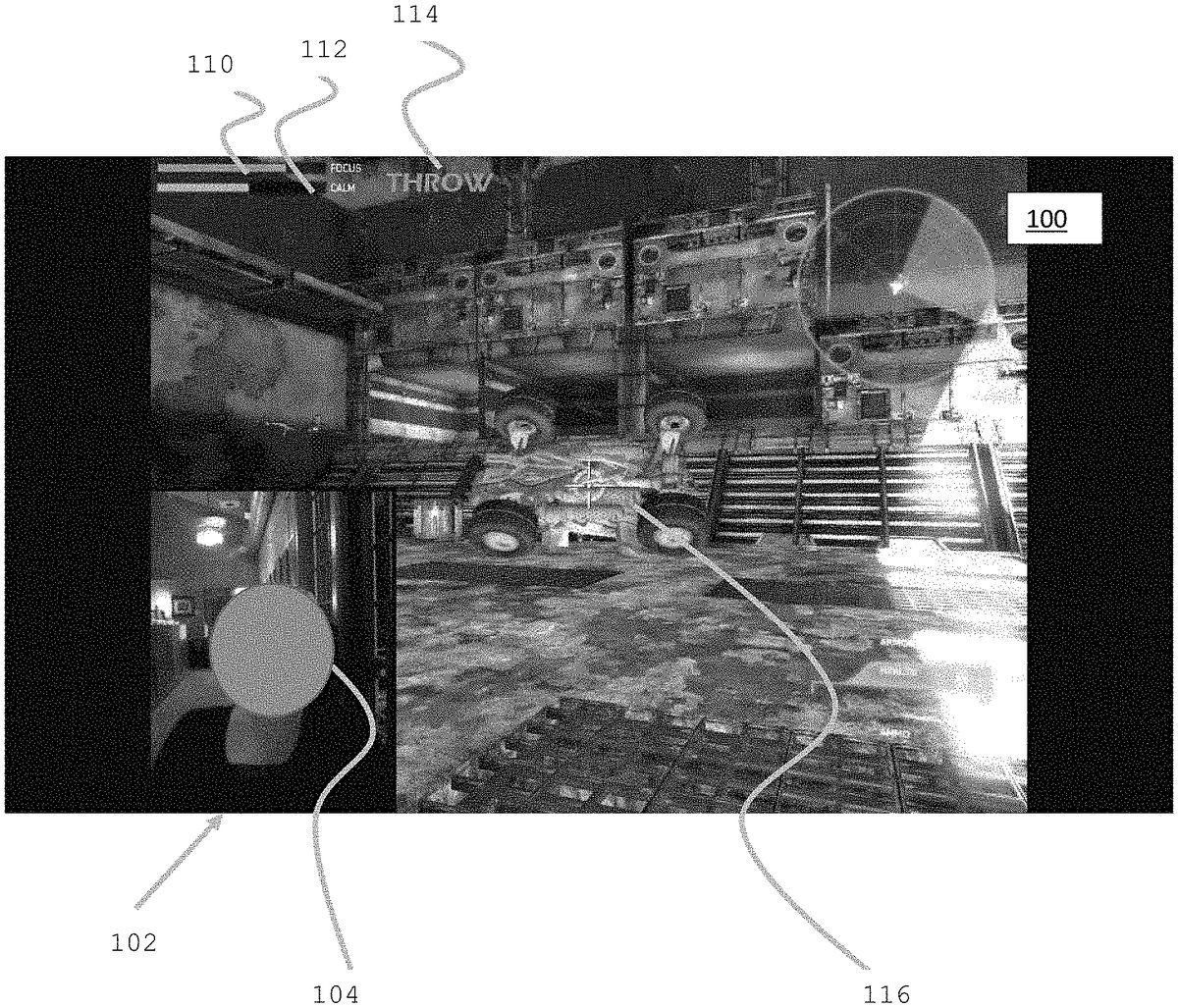
FIG. 1shows a user interface100, which can be used in embodiments of the present invention, with a cutout showing a user102. The user102can wear an EEG biosensor104for reading brain waves, such as the one shown inFIG. 2available from NeuroSky® of San Jose, Calif., USA. The software behind the interface100can be similar to that of various first-person shooter games in many respects, and can use a handheld controller with joystick(s) and/or buttons, or a keyboard/mouse combination, for example, to operate in various manners within the interface. Other embodiments may not use handheld or similar controllers, or may use other types of controllers in addition to or in place of those described above.
In addition to standard controls, the game can also be controlled via the biosensor104. While the below embodiments focus on control using traditional methods in combination with biosensor control, it is understood that biosensor control may be used by itself or with any combination of other control techniques. In the specific embodiment described, two in-game attributes, FOCUS110and CALM112, are controlled via brain waves read by the biosensor104and interpreted via the software. While this specific embodiment utilizes two brain-controllable attributes, it is understood that other embodiments can utilize fewer or more such attributes. Further, while the embodiments described herein focus upon attributes related to “focus” and “calmness”, it is understood that in-game attributes can be related to any number of different mental attributes.
Brain-controllable attributes such as FOCUS110and CALM112are awarded to a user in an amount that can be controlled in any number of manners using different measurements. For example, in one embodiment, the amount of CALM112a user is awarded is dependent upon the prevalence of alpha waves emitted by the user's brain. Because this attribute is designed specifically to promote calmness, and because a higher number of alpha waves corresponds to calmness, this attribute can simply reward the user on a scale of 0 to 100 based on the number or percentage of alpha waves, with no detrimental effect suffered due to an excess of such waves. In other embodiments, a user can be rewarded for having fewer of a certain type of wave. In other embodiments, the score of an attribute can be based upon emission of a type or types of brainwaves within a certain optimal range, where a higher score is achieved if the number of waves is within the optimal range, and a lower score is received if the number of waves is either lower than or higher than the optimal range. The above example regarding an increase in CALM score with an increase in alpha waves can be utilized, for example, in a game having a multiplayer competitive environment. Such a scoring system—with no detrimental effect due to an excess of waves—may be appropriate in such an environment because it is highly unlikely that a user in such an embodiment will be too calm, as a multiplayer competitive environment will naturally stimulate a user's brain into activity or overactivity.
Brainwaves emitted by the user102can be used by the software in any number of ways. In one embodiment, data from the biosensor104can be provided to the software, which can take a fast Fourier transform (FFT) of blocks of the data. For example, in one embodiment, the FFT of one-second blocks of the user's alpha waves can be taken, and a score can be calculated based on this FFT. This process can then result in the user102receiving a CALM112score based on, for example, the prevalence and/or pure number of alpha brainwaves.
Attributes can also be rewarded based on a ratio of brainwaves. For example, as recognized by Hillard et al., high theta/low-beta and theta/alpha ratios are often associated with ADHD and similar issues. The FOCUS110score of a user can be based on a ratio of brainwaves, such as the theta/beta ratio. By controlling his or her brain to focus upon the tasks at hand, the user will produce fewer theta brainwaves and more beta brainwaves, resulting in a lower theta/beta ratio. The software can then reward FOCUS110points to the user based on his or her theta/beta ratio. As previously described above, the software can award FOCUS110points based on minimizing or maximizing a value, such as theta/beta ratio, or can award points based on achieving an optimal range. In an embodiment utilizing a multiplayer competitive environment, points can be awarded based on the minimization of theta/beta ratio. In one embodiment, the FFT of the user's theta and beta waves can be taken, and a score can be calculated based on these FFTs. This process can then result in the user102receiving a FOCUS110score based on, for example, the ratio of theta/beta waves. In another embodiment, the FFT of theta and alpha waves (or other wave(s)) can be taken and compared to determine a baseline theta/alpha (or other) ratio for the calculation of an in-game attribute, such as FOCUS110.
A user can be rewarded by gaining FOCUS110or CALM112points accordingly. The user may then exchange an amount of the points earned for an in-game benefit such as a “power up.” In another embodiment, a user is given FOCUS110and CALM112scores according to the user's current, recent, or cumulative brainwave activity. Thus the scores may reflect the user's brainwaves in real time. A threshold score may be a pre-requisite to receive an in-game benefit, the degree of an in-game benefit may be reflective of the score, or a combination of the two. In any embodiment, the FOCUS110and CALM112scores may be displayed in various manners, such as numerically and/or graphically as shown inFIG. 1(e.g., as a pie or bar chart).
Attribute points can be used in any number of ways. In one embodiment, neurofeedback is used to award attribute points, while other tasks are performed by a user using traditional controls, such as a joystick/button configuration or a keyboard/mouse configuration. Attribute points can be used to perform a certain action and/or achieve a certain goal within the game. For example, inFIG. 1the user102is using FOCUS110and/or CALM112points to perform an in-game action114, in this case, throwing. The action performed using attribute points can be actuated using traditional controls, or in one embodiment can be activated using brainwaves. InFIG. 1, the user102is using attribute points gained via brainwaves to throw the truck116using traditional controls. In one embodiment, FOCUS110points can be used to perform offensive actions, while CALM112points can be used to perform defensive actions, such as bringing up a forcefield to protect a user's player or character. Different attribute points can be used for different types of player/character actions, and the types of player/character actions may also vary among the characters. For example, use of CALM112points for one character may result in a different defensive action than that of another character.
InFIG. 3, the user's character120is using FOCUS110and/or CALM112points to throw a tank216. Once the points are used, the corresponding amount of FOCUS and/or CALM112points are depleted on the screen. In another embodiment, points are not depleted upon use, but instead the user must have a certain threshold of points in order to perform different actions.
FIG. 4shows a multi-player mode. Here, the user's character120and an additional character122are teaming up to throw the same object, applying both of their attribute points. In multi-player mode, there may be additional one or more characters controlled by other users or the game.FIG. 5displays the character user120choosing an object118to interact with, such as to throw it or cause it to move in a number of ways.
In embodiments of the present invention, such as the embodiment utilizing the interface100fromFIG. 1, seemingly contradictory reward systems can be utilized in order to fine-tune the user's control of his or her brainwaves. For example, as described above, in one embodiment a user is rewarded for 1) a higher number of alpha waves, and 2) a lower theta/beta ratio. Alpha waves are typically associated with calmness; theta waves are often associated with daydreaming and sleep; and beta waves are associated with being active. Therefore, a higher number of alpha waves and a lower theta/beta ratio demonstrates calmness and focus, respectively, for which the user is rewarded by appropriate CALM112and FOCUS110scores. Thus, this embodiment rewards a user for keeping calm while also focusing. This embodiment and other embodiments like it can utilize two different reward systems which somewhat contradict each other in order to ultimately reward an optimal balance between the two, e.g., a calm, but focused and alert state of mind. Simpler embodiments, such as those for use with beginning users or those beginning treatment, may use a single attribute or attributes that are complementary to one another (e.g., low number of theta waves in combination with low theta/beta ratio). Further, while the embodiments above focus upon two-attribute systems, any number of attributes can be used.
In another embodiment, attribute points may only be rewarded when a combination of measurement thresholds are reached, in order to prevent a user from focusing upon gaining one type of attribute point and ignoring another. For example, in one embodiment utilizing FOCUS110based upon alpha wave prevalence and CALM112based upon theta/beta ratio, a user may not be awarded any points until both the number of alpha waves and the theta/beta ratio reach a predetermined threshold. The threshold may be set to a number of alpha waves lower than is required to receive CALM112points and a theta/beta ratio higher than is required to receive FOCUS110points, in which case the user could still be rewarded based upon the other attribute's score.
In one embodiment, the game may adapt to the user's FOCUS110and CALM112scores. If the scores are low for a predetermined amount of time, then the game may automatically decrease the degree of stimuli presented to the user, for example by reducing the amount or complexity of obstacles or altering background music (thus decreasing difficulty in achieving the desired neurological output). If the scores are high for a predetermined amount of time, then the game may automatically increase the degree of stimuli presented to the user (thus increasing difficulty in achieving the desired neurological output). In an additional embodiment, the game may adjust according to each individual score. For example, if the FOCUS110score is high for a predetermined time, then the game may adjust to present multiple stimuli simultaneously. If the CALM112score is high for a predetermined time, then the game may play more intense background music or add unexpected stimuli. The predetermined amount of time as well as threshold scores may be pre-set and/or adjustable by the user. The game's adaptability ensures that the user is continually challenged without being overly discouraged. Further, the amount of points awarded to a user can be adjusted based upon user capability (e.g., less points being rewarded to an experienced user for feedback that is the same as a less experienced user).
The in-game environment with which the user102interacts can be designed specifically to stress the user102in a way that is useful to the treatment of mental disorders. For example, it is well-known that a competitive video game environment can 1) cause anxiety, and/or 2) cause persons suffering from certain neurological disorders to struggle to concentrate. This can be especially true when the in-game environment is a multiplayer competitive environment, as stress levels in such environments can be increased even further. In addition to disorders such as ADHD, PTSD, and anxiety disorders, embodiments of the present invention can also be used to treat disorders such as autism spectrum disorder. Results from a non-scientific study showed that users with a history of neurofeedback therapy for attention and relaxation aspects of autistic spectrum disorder tend to excel in embodiments of the present invention utilizing a competitive video game environment, which may indicate a relationship between traditional neurofeedback techniques and those described above, and further may indicate the effectiveness of embodiments of the present invention in treating neurological disorders.
Additionally, the use of neurofeedback techniques in conjunction with traditional video game controls may achieve enhanced treatment results. This combination can force the user102to concentrate more than, and in a manner different from, neurofeedback-only techniques, which may utilize only brainwave measurements. Typically, anxiety would be raised with more things upon which to concentrate. Embodiments of the present invention can require both control of brainwaves and the mental processes involved in actuating traditional video game controls, thus further stressing the user.
It is further envisioned that embodiments of the present invention can be utilized in treatment of depression. Depression often manifests itself in negative thoughts spiraling out of control. A user suffering from such negative thoughts can see their FOCUS110and CALM112scores suffer, and recognize that it is negative thoughts that are causing this. The user can then learn to “block” these negative thoughts, or at the very least stop them from spiraling out of control and lessen their effect.
Regardless of any disorders or issues from which a user may suffer, poor FOCUS110and CALM112scores allow the user to recognize when an undesired response to the stimuli is occurring. Such recognition teaches the user to identify common triggers, understand the types of neurological responses caused by the triggers, and learn how to effectively counteract these responses.
Although the present invention has been described in detail with reference to certain preferred configurations thereof, other versions are possible. Therefore, the spirit and scope of the invention should not be limited to the versions described above.
Claims
- A method for treating mental disorders, comprising: exposing a user to a competitive video game environment such that said user controls a player within said video game;obtaining brainwave measurements from said user;and rewarding said player within said video game, the extent of said reward being based on said brainwave measurements;wherein said player is rewarded based on the ratio of a first type of brainwave emitted by said user to a second type of brainwave emitted by said user;wherein said first type of brainwave is theta;and wherein said user is rewarded more as said ratio lowers.
- The method of claim 1 , wherein said player is rewarded based on the number of alpha brainwaves emitted by said user.
- The method of claim 1 , wherein said second type of brainwave is beta.
- The method of claim 1 , wherein said rewarding comprises rewarding said user in at least a first category and a second category.
- The method of claim 4 , wherein said rewarding of said user in said first category comprises rewarding higher emission of brainwaves of higher than 8 Hz, and said rewarding of said second category comprises rewarding lower emission of brainwaves of lower than 8 Hz.
- The method of claim 1 , wherein said rewarding comprises rewarding said player points that can be used to perform actions within said video game environment.
- The method of claim 1 , wherein a Fourier transform is used for said measuring.
- A method for treating mental disorders, comprising: exposing a user to a competitive video game environment such that said user controls a player within said video game;obtaining brainwave measurements from said user;and rewarding said player within said video game, the extent of said reward being based on said brainwave measurements;wherein said player is rewarded based on the ratio of a first type of brainwave emitted by said user to a second type of brainwave emitted by said user;wherein said first type of brainwave is gamma;and wherein said user is rewarded more as said ratio lowers.
- The method of claim 8 , wherein said player is rewarded based on the number of alpha brainwaves emitted by said user.
- The method of claim 8 , wherein said second type of brainwave is beta.
- The method of claim 8 , wherein said rewarding comprises rewarding said user in at least a first category and a second category.
- The method of claim 11 , wherein said rewarding of said user in said first category comprises rewarding higher emission of brainwaves of higher than 8 Hz, and said rewarding of said second category comprises rewarding lower emission of brainwaves of lower than 8 Hz.
- The method of claim 8 , wherein said rewarding comprises rewarding said player points that can be used to perform actions within said video game environment.
- The method of claim 8 , wherein a Fourier transform is used for said measuring.
Disclaimer: Data collected from the USPTO and may be malformed, incomplete, and/or otherwise inaccurate.