U.S. Pat. No. 10,807,009
VIDEO GAME RIDE
AssigneeUniversal City Studios LLC
Issue DateNovember 9, 2018
Illustrative Figure
Abstract
A system in accordance with present embodiments includes a plurality of vehicles having vehicle interface circuitry and configured to accommodate one or more riders. In certain embodiments, a vehicle of the plurality of vehicles is configured to receive respective inputs from the one or more riders via the vehicle interface circuitry, and wherein the respective inputs are related to one or more game features of a game environment; and a game controller configured to receive information from the vehicle interface circuitry related to the respective inputs; and provide instructions to modify the game environment based on at least one of the respective inputs.
Description
DETAILED DESCRIPTION The present disclosure is directed to an interactive game ride that includes features of a ride that provide audio, visual, and physical effects that can be experienced by riders in a vehicle, as well as features of a game, including player interaction with the various game effects and dynamic experiences based on the interaction. The interactive game ride is in contrast to passive rides providing a static experience for each rider, e.g., a passive ride does not include variable routes or outcomes each time the ride is taken and/or does not permit dynamic rider interaction with or control of physical features of the ride. The present techniques facilitate a potentially different experience for each vehicle and/or game player each time the ride is taken. Further, the game players may actively control the outcome of their physical environments. Further still, the interactive game ride couples player-controlled actions of virtual effects with physical outcomes. For example, if a projected virtual player avatar jumps on a lever (either real or projected), the lever actuates and a physical drawbridge may be opened. In another example, a physical activation of an effect, such as a fan, may blow debris out of the way, showing a hidden pathway. In this example, the debris may include projected or virtual debris that changes on a display in a manner that is coordinated with the physical effect. In this manner, the interactive game ride provides continued interest over several park visits. The interactive game ride may allow storytelling with variable or unique narratives depending on the choices made by the game players. For example, such choices may include the selection of a particular game character to role-play or follow, the selection of objects within the game, speaking certain triggering phrases, etc. The interactive game ride may also ...
DETAILED DESCRIPTION
The present disclosure is directed to an interactive game ride that includes features of a ride that provide audio, visual, and physical effects that can be experienced by riders in a vehicle, as well as features of a game, including player interaction with the various game effects and dynamic experiences based on the interaction. The interactive game ride is in contrast to passive rides providing a static experience for each rider, e.g., a passive ride does not include variable routes or outcomes each time the ride is taken and/or does not permit dynamic rider interaction with or control of physical features of the ride. The present techniques facilitate a potentially different experience for each vehicle and/or game player each time the ride is taken. Further, the game players may actively control the outcome of their physical environments. Further still, the interactive game ride couples player-controlled actions of virtual effects with physical outcomes. For example, if a projected virtual player avatar jumps on a lever (either real or projected), the lever actuates and a physical drawbridge may be opened. In another example, a physical activation of an effect, such as a fan, may blow debris out of the way, showing a hidden pathway. In this example, the debris may include projected or virtual debris that changes on a display in a manner that is coordinated with the physical effect. In this manner, the interactive game ride provides continued interest over several park visits.
The interactive game ride may allow storytelling with variable or unique narratives depending on the choices made by the game players. For example, such choices may include the selection of a particular game character to role-play or follow, the selection of objects within the game, speaking certain triggering phrases, etc. The interactive game ride may also provide an immersive video game type experience that allows players to experience their favorite games in a large scale setting. The interactive game ride may accommodate gamer players of varying levels or abilities, and may include game player (including multi-player) interaction to affect the ride path and story, both individually (i.e., for individual players) and collectively (i.e., multi-player play outcomes may influence the vehicle path or story narrative for all of the players in the game). Further, the interactive game ride may serve as a platform for a variety of game types, including first person shooter games, racing games, sports games, logic games, problem-solving games, puzzles, embedded narratives, etc. To augment the game experience, the game ride may also permit the players in individual vehicles or individual players (e.g., vehicle riders) within each vehicle to identify with a particular game character and experience the game as that character, i.e., role-playing. For example, an interactive game ride may permit players to select a character from a character menu or may facilitate character assignment to the players. The character may then be associated with a particular skill level or particular game goals. In certain embodiments, the game ride may assess or assign a skill level to each player and adapt accordingly.
In one embodiment, the game system itself may assume the role of the lead or main character, and the game players may select supporting characters (i.e., characters other than the main character). For example, a game may permit selection of supporting characters that play the game with the goal of advancing/helping or hindering the goals of the main character, depending on the game narrative. The individual and/or collective play of the game players in turn influences the story narrative presented for the main character by the game system, including the path and choices that the main character takes. In this manner, the individual rider-players may control their individual supporting characters, but as a collective vehicle group they may together control the main character that is seemingly leading their vehicle or otherwise directing the narrative. In other embodiments, the game players may assume the role of one or more main characters and experience the game ride as that main character. In further embodiments, other players may assume the role of supporting characters within the game as well. The character may also take the form of a particular character avatar that is projected within the game environments or displayed on a video screen.
The interactive game ride may also provide the benefit of a dynamic narrative that changes in response to interest from the game players. For example, if a family with small children is participating in the ride, the game may receive input on the player ages to select appropriate game environments. Alternatively or additionally, the player interactions with the game may also influence the game to provide feedback. In one example, the game is a series of puzzle rooms, and the actions that the players take within each scene or puzzle change the environment and allow different paths to be activated or different physical effects to take place.
As the players travel through the game, they may interact with the game via one or more game input devices that may, in certain embodiments, be provided as part of the game vehicle or may be provided as portable wireless devices. Such devices may be familiar game playing accessories, such as joysticks, steering wheels, wands, markers (e.g., controllers configured as weapons), etc. In the example of a game joystick, when the player is within the game, the joystick may control an avatar on a video surface of the game environment (e.g., on a wall, ceiling, or floor) and, based on the player's own control of the avatar, the game may dynamically adjust the game experience to reflect what the player has selected or targeted or where a player has moved on the video surface. For example, the selection may indicate a target that has been shot or a door that has been opened. In addition, the game input device may be used to interact with video, projection, display or surfaces that are part of physical objects in the game (e.g., interactive objects, barriers), and the game controller may be configured to determine the nature of the interaction from input from the input device, sensors on the surface, and/or external sensors such as cameras within the game system. In another embodiment, movement or action of the players may be sensed by various sensors with the game and used as inputs to the game. For example, if a player says a certain phrase, sensors within the environment may provide the sensed audio as an input to the controller to trigger particular game actions, where the game player statement of “yes” has a different game outcome than the statement of “no.” Accordingly, the game may also include game player interaction with game characters, either animatronic characters or actors within the game. Such interactions may also provide dynamic inputs to the game to trigger changes within the environment depending on the outcome of the interaction.
The game controller, which may include one or more automation controllers, e.g., a programmable logic controller (PLC), is operatively connected to, communicates with, and/or controls operations of certain components of the system. For example, the game controller controls the display of images or videos on one or more game surfaces and, in certain embodiments, may also provide instructions to control certain aspects of a display within a game vehicle. In addition, the game controller is also configured to receive inputs from various game components, including game input devices, the game vehicles, the game environment features, sensors, etc., to control certain aspect of game play. In addition, in particular embodiments, the game controller may be configured to control individual vehicle motion for any vehicle in the game. For example, the interactive game ride system may be implemented with autonomous guided vehicles. In such embodiments, the vehicle path is determined via the game controller and the game player does not drive or steer the vehicle. However, game player interactions with the game may be provided as inputs to the game controller that influence not only the vehicle path, but may also trigger vehicle effects (e.g., noise effects, vehicle shaking or tilting, etc.). Further, in accordance with the present disclosure, the game controller may update or change a game configuration, either under game operator control or based on the skill or performance of the vehicle riders.
The disclosed interactive video game ride may be implemented with amusement park attractions including shows, rides, promotions, and so forth. By employing the interactive video game ride in conjunction with particular themes, such as traditional video games, guests are incentivized to visit the amusement park and are further enabled to enjoy the thematic experience provided by the amusement park. Further, because the interactive video game ride is configurable and dynamic, one game environment may be configured to host games having a number of different themes or narratives.
With the foregoing in mind,FIG. 1illustrates an embodiment of an interactive game ride system10in accordance with the present disclosure. The interactive game ride system10may include a game environment14for one or more game vehicles16. In the illustrated embodiment, multiple vehicles16are positioned within and configured to move in the game environment14. The game environment14may generally refer to the locations within an arena12or building in which the game is played. In certain embodiments, the game environment14may include different locations (e.g., environments14a-14f) that may be interconnected via passageways or doors. In other embodiments, the environments14a-fmay be separate sections of a larger arena12. The game system10may permit or facilitate movement of one or more vehicles16within all or only a subset of the environments14a-fdepending on the game play. Further, each vehicle16may move together with other vehicles16or independently within the arena12such that the vehicles16visit different game environments14a-f.
For example, in one example of game play, a first vehicle16may travel through environments14a,14c, and14ewhile a second vehicle16may travel through environments14c,14b,14d,14f, and14e. The game environments14may be configured for multiple vehicles16to play simultaneously or may be configured to hold only one or a few vehicles16. Accordingly, a game in operation may feature vehicles16that converge at a particular location within the arena12to play together and then separate to accomplish individual game goals. In this manner, the system10may also be configured to maximize usable operation time for high-interest game environments14that may otherwise form a bottleneck to game play, and distribution of the vehicles16within the arena may be in part determined via one or more rules-based algorithms that use as input the desired number of vehicles16in a particular game environment14, the desired length of vehicle time in the environment14, the game goals of an environment14, the recovery time for any physical effects, etc. Whichever vehicle path is assigned, for certain games, a linear story or narrative is presented that incorporates game player interactions, e.g., via selected game character avatars. The system10may store different narratives or outcomes that are activated based on the receipt of particular inputs. In certain embodiments, a game system10may have over 100 or over 1000 different possible narratives that may include variable vehicles paths, physical objects, physical effects, character interactions, etc. Each vehicle (or group of vehicles) experiences a particular linear narrative during the course of a single game. However, the narrative is dynamic and responds to input from the game players. Accordingly, the game narrative is not set at the beginning of the game such that the game players cannot predict how the game will unfold.
In certain embodiments, the system10may also determine the divergent vehicle paths based on the game play and inputs received from the players in the vehicles16. The vehicles16may be player-driven and controlled or may be provided as autonomous guided vehicles that are controlled via a game controller. In the embodiment using guided vehicles, the vehicle paths are determined by the game controller and the players move within the arena12and to and from various game environments14without controlling the movement of the vehicles16. The vehicle16may also include display functionality, and information about the vehicle path may be provided as part of a map display, which may also facilitate player driving of the vehicles16. Such a display may include various features of the game and may be part of the game narrative. That is, the vehicle16may display a map that includes depictions of the game environments14that are selected by the controller for game play.
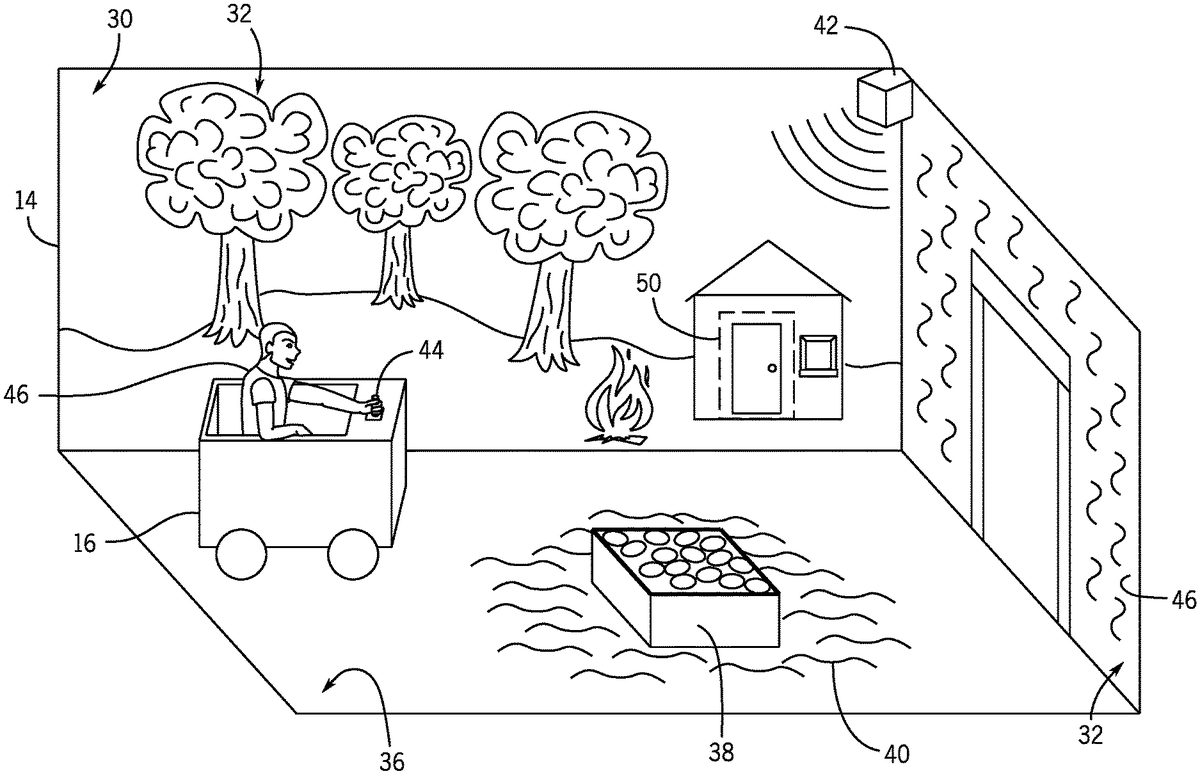
Individual game environments14may include one or more features that enhance the game experience and that are interactive. Player interaction with these features dynamically changes the course of the game. For example, in one embodiment, certain vehicles12may experience entirely different paths as well as game narratives and challenges relative to other vehicles in the game and/or relative to other times that the game is experienced. In this manner, each experience with the game is tailored to the player or group of players.FIG. 2is a perspective view of a game environment14that includes virtual game features such as those provided by a projection or video display30. The video display may include various selectable virtual displayed features32that are capable of being selected by a game player (e.g., player46). In certain embodiments, the display may be part of the walls, ceiling, and/or floor36, depending on the desired environment14of the game. The environment14may also include interactive physical objects38, e.g., surface features that can reflect projections in accordance with the environment, that form dynamic physical barriers, visual interest, or that may be activated upon accomplishment of a game goal. For example, a pot of gold may emerge from the floor under mechanical control if a certain game goal is accomplished. Alternatively, a barrier may be imposed or lifted based on game play. Such physical objects38may also include animatronic figures. In one embodiment, an animatronic figure may deliver different audio messages to game players46depending on their game play. In this manner, the animatronic figure may reward high skill players46or provide clues to lagging players46to help them catch up to other players in the game. The animatronic figure or other physical objects38may be configured to be controlled via the game controller, which provides instructions to indicate that a vehicle16is within a distance range to activate certain motion actions.
The game environment14may also be configured to activate certain special effects40, such as, for example, smoke or water effects. Other physical effects may include snow, fire, wind, ice, temperature effects, smells, etc. The special effects40may be augmented by video displays30. For example, a water wall effect may include some physical water that is backed by a video display such that the player46is under the impression that they are passing through a waterfall without uncomfortably soaking the players. The game environment14may also include various audio effects delivered via one or more speakers42. An operator interface44controls player interaction with the game environment14and may include, for example, one or more player input devices such as a steering wheel, brake and gas pedals, a joystick, a display screen, one or more buttons, a gun, etc. Selection box50on the video display30indicates the player selection via joystick or other input device. For example, selecting a door may trigger game controller activation of an adjacent game environment14that resembles the interior of a cottage and automatic guidance of the vehicle16into the appropriate environment14. Passing through the environment14without selecting the door maintains the game environments in exterior settings.
In certain embodiments, when multiple players46are present in a single vehicle16, the vehicle16may include multiple interfaces44, as shown inFIG. 3. Each interface44permits different inputs to the game. In one embodiment, the players46a-46dare associated with different game characters. Accordingly, each player46may have different game goals and/or different operator interfaces44a-44d. For example, in a wizard-themed game, each operator interface44may represent a different wand associated with each character. The wands may be the players' own wands, and, in such embodiments, the game system10may link to the wands before the game start to configure game play and to authorize individual wands to interact with the game environment14. Unauthorized wands would have no effect or ability to interact with features in the game system10.
Further, depending on the type of game configuration, the players46a-46dmay be competing on opposing teams or may be working together to accomplish a joint goal. For team-based play, the vehicles12may be scored individually as well as cumulatively. The various operator interface inputs may be pooled for a total vehicle score or may be arbitrated to the highest or lowest player ability to determine the vehicle path and/or game play or the influence an unfolding story. For example, depending on the game play, additional clues, plot points in the narrative, or avatar interactions may be revealed. In one embodiment, superior game play may reveal tie-in information to a game theme, such as movie release information or may reveal introduction of a particular character within the game theme In another embodiment, some game play may reveal clues or hints to let novice players catch up to more experienced players.
As illustrated inFIG. 4, the system10includes a game controller48that is communicatively coupled to the vehicle/s16and the game environment14. As shown inFIG. 4, which is a block diagram of the system10, the techniques disclosed herein may be used in conjunction with one or more components of the system10, including the vehicles16, the game environment14, and the game controller48. To provide movements of an individual vehicle16, the vehicle16includes a motor62and a brake64. The movements of the vehicle16may include running (e.g., acceleration, deceleration), turning, and stopping of the vehicle16. The motor62may be powered by any suitable power source58, including, but not limited to, a battery, a solar panel, an electrical generator, a gas engine, or any combination thereof. The operations of the motor62and the brake64may be controlled by the vehicle controller50. For example, the vehicle controller50may control the motor62to adjust its output power to accelerate or decelerate the vehicle16. The vehicle controller50may also control the brake64to decelerate or stop the vehicle16. Further, the vehicle controller50may operate under instructions from the player via the operator interface44(e.g., to steer the vehicle based on operator control of a steering wheel or joystick) and/or from the game controller48.
The vehicle16may include a position feedback system54for monitoring its position in the game environment14. In one embodiment, the position feedback system54interacts with one or more sensors or tags in the game environment14. In such an embodiment, the vehicle position feedback system54includes a reader that may sense the sensors or tags to provide the position information of the vehicle16. The reader then supplies the position information to the vehicle controller50, which in turn provides the information to the game controller48. The vehicle16may include a communication module56to facilitate communication with the game controller48and to facilitate transmitting information from the operator interface44related to game specific inputs (e.g., game environment interactions) and receiving information related to autonomous vehicle guidance and controlled vehicle paths. In this manner, the game controller48may control movement of the vehicles16in the system10. Based on feedback from the game controller48, the vehicle16may also display game information via a display module60coupled to a display screen. Game information may include a vehicle score as well as a team score, a representation of the game environment14(e.g., a2D dynamic graphical display including the current game configuration and vehicle positions in the game environment14as well as any available interactive displayed elements32).
The game controller48and the vehicle controller50may include various components that may allow for interaction of the players46with the vehicle16and the game environment14. Further, the game environment may include separate control circuitry for facilitating interactive and dynamic game elements, including display circuitry70for the video display30, tags or sensors72for tracking the vehicle16and/or the input device of the operator interface44, a sound module74, and a physical effects module76for controlling one or more physical effects (e.g., special effects40and/or physical objects38; seeFIG. 2). One or more disclosed features of the game environment14may alternatively be implemented in the vehicle12, e.g., the speakers may be part of the vehicle12but controlled via the game controller48and/or the vehicle controller50
While certain elements are discussed in the context of the game controller48, it should be understood that the vehicle controller50and the game environment14may include similar components. For example, the vehicle controller16may be any device employing a general purpose or an application-specific processor80. The vehicle controller16may also include a memory device82for storing instructions executable by the processor80to perform the methods and control actions described herein for the vehicle16. The processor80may include one or more processing devices, and the memory82may include one or more tangible, non-transitory, machine-readable media. By way of example, such machine-readable media can include RAM, ROM, EPROM, EEPROM, CD-ROM, or other optical disk storage, magnetic disk storage or other magnetic storage devices, or any other medium which can be used to carry or store desired program code in the form of machine-executable instructions or data structures and which can be accessed by the processor80or by any general purpose or special purpose computer or other machine with a processor. In addition, the game controller48may be configured to communicate over wired or wireless communication paths with the game environment14and the vehicle16. The game controller48may include a distributed control system (DCS) or any computer-based workstation including a display84and an input/output interface86that is fully or partially automated.
In one embodiment, data is transferred between the game controller48, the game environment14, and the vehicle controller50at least in part via a wireless network. The vehicle controller50may transfer data indicative of the status of the vehicle to the game controller48. Such data may include a vehicle identifier for an individual vehicle16and associated position, velocity, impact zone, traveling direction, motor output power, loading condition, or the like. Based on the received data from the vehicle controller50, the game controller48may send instructions to the vehicle controller50to control the movement of the vehicle16. In accordance with the present disclosure, the game controller48may control each of a plurality of ride vehicles16independently.
The system10may determine vehicle position and game player interaction via the position tracking system54that interacts with the tags or sensors72on or in the game environment14or other suitable techniques for determining vehicle position. For example, the system10may include an external sensor90, such as a camera, that tracks the positions of the vehicles16and provides data to the game controller48. In addition, the vehicle16may include transmitters, such as RFID transmitters, that provide signals to the game controller48and that may be used to determine position information. Further, while the disclosed embodiments have been described in the context of vehicles16, in other embodiments, the game players46may interact directly with the game environment14. In such an embodiment, game players may wear watches or other objects that can incorporate position indicating devices. Alternatively, player location may be determined via the external sensor90.
In operation, the game system (e.g., the game ride system10ofFIG. 4) starts the game and the vehicles16progress through the game environments14. Their movement within the larger arena12of the game and to and from the individual environments14may be determined dynamically based on game play. This is in contrast to passive rides in which all ride participants travel in a fixed path within an attraction. As provided herein, the interactive game ride permits and facilitates different paths within the game ride and/or different game experiences based on game play. Accordingly, the progress of the game is not fixed at the beginning, but is in response to the players themselves and their interaction with the game features.
The interactive game ride systemFIG. 5is a flow diagram of a method100of assigning vehicle paths to one or more vehicles16based on their vehicle paths during game play. The method100may be performed entirely or in part by a game controller48as provided herein using control logic or programming (e.g., via controller100). At block102, a controller48receives one or more signals or inputs from a vehicle16with interactive game input information. The information may be information from an operator interface44and/or a display screen30. For example, the information may be a position and/or angle of a joystick, a button actuation, a trigger pull, etc. The information may also include vehicle position information via the position feedback system54. In one embodiment, the controller48may receive information that a trigger has been pulled from a particular game environment position. Further, the controller48may also determine if a target has been hit based on an optical signal (e.g., an optical source in the gun barrel may shine onto a target, and a light sensor in the target may provide information that the light detection is consistent with a game target hit) or other signal. Player actions may be received via the operator interface and data related to the actions may be stored and/or transmitted to the controller48for further processing, such as score determination at block104. In certain embodiments, the score input may include input from external sensors90that capture player motion, such as wand motion, and provide the motion characteristics as input to a score determination algorithm. If the wand motion is associated with a particular spell that is an effective spell for the game, the player's score may be updated to indicate a successful “freezing spell” or other spell has been cast. Additional score input may also include information from video displays and sensors in the game environment14. For example, selection of particular objects in the video display30may be received by the game controller48and provided as score input. Based on the vehicle score, the method100may assign a vehicle path in the game at step106as well as modifying or updating the existing game environment at step108to reflect the actions of the players and the score or similar action tally. For example, if the player46selects a door, the game environment14may be updated via the controller48to display an opened door rather than a closed door. Once the path is assigned, the controller48communicates the path information to the vehicle16(e.g., to the vehicle controller50). The method100tracks the progress of the game and the scores of particular vehicles16and/or riders46by returning to step102to process new position information as the vehicles16progress in the game environment14during game play.
FIG. 6is an example of vehicle path assignment that may be implemented via the method100ofFIG. 5. For example, both vehicles16aand16bin the game start in the same environment14. The vehicles then interact (e.g., via the operator interface44) with the game environment14and information about the interaction is received by the game controller48. Based on the information, as well as additional information (e.g., selected characters, selected play difficulty), the game controller48provides path information to the vehicles16. For autonomous guided vehicles, the vehicle controller automatically controls the vehicle path16, including the speed of the vehicle16within the game as well as direction, speed and degrees of rotation of vehicle, vehicle starting stopping, backing up, etc. In one embodiment, vehicle16amay be associated with the Character A while vehicle16bis associated with Character B. Vehicle16amay select a pathway by maneuvering a selection within a control and clicking on a fork in the path illustrated on a display screen. Based on the selection, the vehicle16aprogresses to environments14a. Similarly, the vehicle16bmay select a different path, and the vehicle16bthen progresses through the environments14b. Depending on the game, the vehicles16aand16bmay come together in another game environment14before exiting the game. In some embodiments, the players in different vehicles12are competing with each other to proceed on a desired or winning path. In other embodiments, players in multi-player vehicles follow multiple characters, each player focused on providing input/control to his/her own character.
FIG. 7is another example of vehicle path assignment within an environment14that may be implemented via the method100ofFIG. 5. For example, the environment14may include a plurality of entrances120(e.g., entrances120aand120b) and exits122(e.g. exits122a-d). Based on predetermined factors, a vehicle entry into the game may be assigned to a particular entrance120. In one embodiment, a repeat player may be assigned to a new entrance120at each visit. In another embodiment, a repeat player may “unlock” access to new entrances via game skill or achievements. Other entrance assignment factors may include assessed skill level, age, or character assignment (e.g., a particular game character may be assigned a preset entrance while other characters use their own designated entrances) or cumulative “score” or performance level of all players in the same vehicle. For example, in one embodiment, repeat game players who have achieved a particular skill level may have certain hidden or special characters available as options upon reaching a cumulative score threshold over the course of many game plays. The environment14may include certain character training rooms that only vehicles associated with a particular character may enter. For example, a character training room may be located just within an assigned character entrance120.
Once within the environment, the game may progress as the player vehicles advance within the environment14, e.g., as the players enter a room and interact with the game environment14. Certain locations in the game may trigger path forks. For example, a vehicle on a path126may reach a path junction128where game play may determine if the player exits on a path130to the exit122bor on a path132to the exit122d. For example, if a game goal is achieved, the vehicle may be instructed to progress on path130to a higher-level location. Alternatively, if the game goal is not achieved, the vehicle may progress on the lower-level path132. Accordingly, the paths may represent paths through environments associated with different skill levels. The paths may also present different options depending on player interest. For example, the player/s in the vehicle may choose whether a path through a dungeon or a kitchen is more interesting, and may be permitted to choose any path regardless of skill level. In the depicted configuration, other paths may progress through other game locations. A path134may progress to a path junction136, which may then fork either towards the junction128or the junction137, which in turn may fork into the path138and the path139. These paths may represent other features. For example, in a castle game, the various paths may progress through throne room or bedroom game environments. It should be understood that the depicted paths are by way of example, and other environment configurations may be selected based on the desired game goals. Certain paths may be longer and more complex than others, and may be associated with longer game run times. Further, the game may be played such that different vehicles enter via various entrances at the same time and such that vehicles may converge within the game and then move apart, depending on their game play. In other examples, other vehicles may be playing the same game but may never encounter one another because their paths never converge.
In addition to controlling the progress of vehicles in the game via different game environments14, the system10may be reconfigured by changing the displayed images in a single environment.FIG. 8is an example of a game environment14that transitions from a first setting to a second setting. In some embodiments, the information from or associated with the vehicle16indicates that a certain game goal was accomplished (block140) and triggers an update to the second setting (block144). In this manner, the game system10may change the game in essentially real-time in response to game play. In one embodiment, such transitions may include screens that provide messages that indicate that different levels have been passed.
As provided herein, the game system10may incorporate player skill information in determining scores and/or environment updates.FIG. 9shows a method160that accounts for player skill within the game. For example, in a multi-vehicle team game, each vehicle16(vehicles16a-16c) may have associated players46with different skill levels, including high skill (block162), medium skill (block164) and low skill (block166) players. The skill levels may be determined via player self-evaluation or from previous game play information, e.g., if the game player is a repeat visitor, game scores from earlier park visits may be stored on a visitor card or pass. In certain embodiments, the skill levels may be determined in a testing environment or in an initial game environment14. Accordingly, the game system10may dynamically adapt to players with different skill levels. For a novice player, the low skill level may also include a default setting that allows such a player to experience the game ride as a ride without interacting with the game environment14. Based on the interactions with the game, the system10may weight the game scores (or the environmental updates) according to skill level to yield adjusted scores (e.g., scores174,176, and178). Further, the scores may be combined in a total team score180. In other embodiments, the game ride may not be score-focused (i.e., may not provide scores), but may instead be about accomplishing a mission that resolves a story goal. For example, the game may direct players to catch a villain, find a treasure, solve a mystery, etc.
FIG. 10shows an embodiment of a game environment14that includes interactive elements that are specific for certain game players. The elements32aare associated with the player46a, and the elements32bare associated with the player46b. Such distinctions may be based on the character and/or the skill levels of the players46. When the player46aattempts to interact with the elements32b, there is no response, e.g., the controller48does not receive any input from the attempted interaction. Alternatively, the game system10may be configured to indicate a penalty associated with such attempts.
In another embodiment, the game system10may track the game experience of the players. For example, an amusement park may track player progress over the course of park visits in various games, e.g., via a card or mobile device. When a player or group of players returns to a game, the game controller48may select a game display based on previously played games. In this manner, a single game location is capable of providing challenges for more experienced players as well as novice players. For example, a new game level and ride experience may be played and experienced on each return visit. Further, for games played with a mix of player skill levels, the game controller48may introduce additional challenges for more advanced players. The game system10may also track player performance on home or online game versions associated with the in-park ride game and respond and adjust accordingly.
While only certain features of the present embodiments have been illustrated and described herein, many modifications and changes will occur to those skilled in the art. It is, therefore, to be understood that the appended claims are intended to cover all such modifications and changes as fall within the true spirit of the present disclosure. Further, it should be understood that certain elements of the disclosed embodiments may be combined or exchanged with one another.
Claims
- A method comprising: receiving one or more inputs from a plurality of vehicles in a game environment;assigning scores or game narratives to each individual vehicle based on the one or more inputs;assigning a vehicle path within the game environment to each individual vehicle of the plurality of vehicles based on the score or assigned game narrative of the respective individual vehicle, wherein assigning the vehicle path to an individual vehicle comprises assigning a first vehicle path if any individual vehicle score of the plurality of vehicles is above a threshold and assigning a second vehicle path if the score of all individual vehicles scores are below a threshold;and transmitting information related to the respective vehicle path to the corresponding individual vehicles.
- The method of claim 1 , comprising updating the scores based on new inputs from the plurality of vehicles and assigning an updated vehicle path based on the updating.
- The method of claim 1 , wherein assigning the vehicle path to the individual vehicle comprises assigning the first vehicle path if the individual vehicle score is above the threshold and assigning the second vehicle path if the individual vehicle score is below the threshold.
- The method of claim 1 , comprising providing instructions to modify a game environment based on the scores or the game narratives, and wherein modifying the game environment comprises modifying a virtual or physical object within the game environment.
- The method of claim 1 , comprising activating a first setting of the game environment when the scores are above the threshold and a second setting of the game environment when the scores are below the threshold.
- The method of claim 5 , wherein the first setting comprises a first portion of a game story and the second setting comprises a second portion of a game story.
- The method of claim 6 , wherein the first setting comprises a first set of game environment features and the second setting comprises a second set of game environment features, wherein the first setting and the second setting are associated with the same location in the game environment.
- The method of claim 1 , wherein the vehicle path defines a path within the game environment associated with a subset of rooms in the game environment.
- A method comprising: receiving one or more inputs from one or more riders of a vehicle in a game environment;assigning scores to each rider of the one or more riders based on the one or more inputs;assigning a vehicle path within the game environment to the vehicle based on a vehicle score for the vehicle, wherein the vehicle score is based at least in part on the scores of the one or more riders;assigning a skill level to each rider of the one or more riders;determining weighted scores for each rider of the one or more riders based at least in part on the skill level of each rider of the one or more riders, wherein the vehicle score is based at least in part on the weighted scores of the one or more riders;and providing instructions to move the vehicle along the vehicle path.
- The method of claim 9 , wherein the vehicle score is based at least in part on a cumulative weighted score of each rider of the one or more riders.
- The method of claim 9 , wherein the vehicle score is based at least in part on a highest individual weighted score assigned to an individual rider of the one or more riders.
- The method of claim 9 , providing the respective inputs from the one or more riders based at least in part on external motion sensors disposed within the game environment.
- The method of claim 9 , wherein the skill level is assigned based at least in part on scores associated with the respective rider during previous ride experiences.
- The method of claim 9 , comprising assigning a game character to the vehicle based on a game character selection of the one or more riders, wherein the game character is selected from a plurality of game character options, and wherein the game character options are presented based on the skill level assigned to each rider of the one or more riders.
- The method of claim 14 , comprising providing instructions to modify the game environment based on the game character assigned to the vehicle, and wherein modifying the game environment comprises modifying a virtual or physical object within the game environment.
- A system comprising: a plurality of vehicles configured to accommodate one or more riders in a game environment, wherein each vehicle of the plurality of vehicles comprises vehicle interface circuitry responsive to inputs from the one or more riders;and a game controller configured to: receive one or more inputs from the plurality of vehicles;assign scores or game narratives to each individual vehicle based on the one or more inputs;assign a game character to each individual vehicle based on a game character selection of the one or more riders, wherein the game character is selected from a plurality of game character options, and wherein the game character options are presented based on a skill level of the one or more riders;assign a vehicle path within the game environment to each individual vehicle of the plurality of vehicles based on the score or assigned game narrative of the respective individual vehicle;and transmit information related to the respective assigned vehicle path to each individual vehicle.
- The system of claim 16 , wherein the information related to the respective assigned vehicle path causes each individual vehicle to travel along the respective assigned vehicle path.
Disclaimer: Data collected from the USPTO and may be malformed, incomplete, and/or otherwise inaccurate.