U.S. Pat. No. 10,803,702
CARD SELECTION SYSTEM FOR ONLINE GAME PLAY
Issue DateNovember 14, 2017
Illustrative Figure
Abstract
A card selection system, for use with an online gaming system, for allowing verifiable, physical selection of cards for players while playing a card game on the online gaming system. A plurality of card identifying balls are provided in a vessel, each ball representing one of the cards of a standard card deck. The balls are sequentially deployed from the vessel into a delivery tube, and are read by a sensor to provide identity data for each ball, so that a corresponding virtual card can be associated with the appropriate player. A video feed of the balls entering the delivery tube is recorded so that any dispute of the randomization of card selection can be verified by replaying the video feed.
Description
The present disclosure now will be described more fully hereinafter with reference to the accompanying drawings, which show various example embodiments. However, the present disclosure may be embodied in many different forms and should not be construed as limited to the example embodiments set forth herein. Rather, these example embodiments are provided so that the present disclosure is thorough, complete and fully conveys the scope of the present disclosure to those skilled in the art. DETAILED DESCRIPTION OF THE PREFERRED EMBODIMENTS FIG. 1illustrates a gaming system10, diagrammatically illustrated, including a controller12, and a game status representation14. The gaming system10is used for selecting card while playing a game, having a plurality of players, the game having rules regarding game play. The game status representation14ofFIG. 1may be considered to be an actual video display of a virtual gaming table, or it may be just a graphical representation of internal status of players and other card positions within the system, and any cards currently associated with such players and positions. The gaming system10may be configured to operate with a plurality of users, including various classes of users. Among the users are players, represented within the system by player locations20, each player location20may be empty or may be occupied by one or more virtual cards22. Each card is a representation of a playing card, which has a value that may be a numeric value between two and ten, or a jack, queen, king, or ace; and a suit such as clubs, heart, diamonds, or spades. The cards in each player location may be varied according to the rules of the particular game being played by the gaming system. For example one or more cards are emptied from the player location when cards are discarded or at the end of a round of play. The ...
The present disclosure now will be described more fully hereinafter with reference to the accompanying drawings, which show various example embodiments. However, the present disclosure may be embodied in many different forms and should not be construed as limited to the example embodiments set forth herein. Rather, these example embodiments are provided so that the present disclosure is thorough, complete and fully conveys the scope of the present disclosure to those skilled in the art.
DETAILED DESCRIPTION OF THE PREFERRED EMBODIMENTS
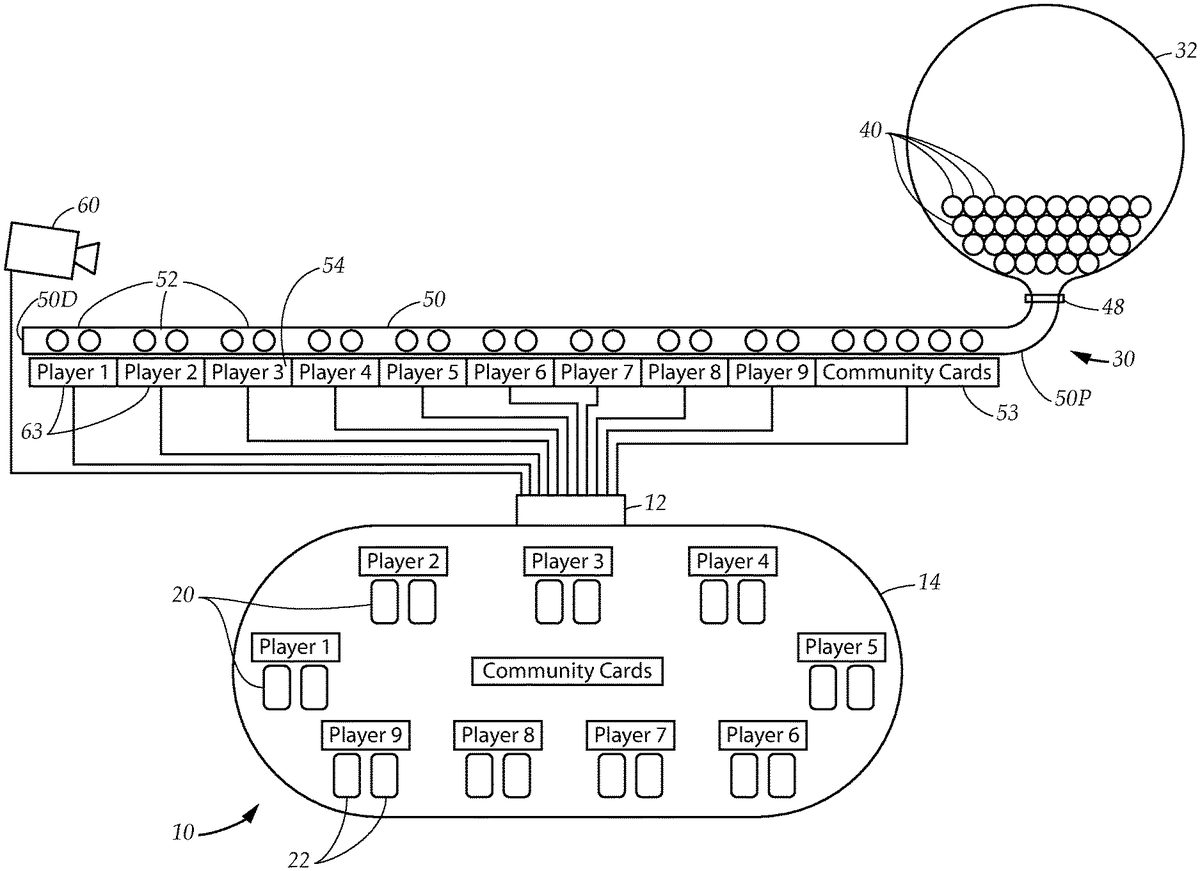
FIG. 1illustrates a gaming system10, diagrammatically illustrated, including a controller12, and a game status representation14. The gaming system10is used for selecting card while playing a game, having a plurality of players, the game having rules regarding game play. The game status representation14ofFIG. 1may be considered to be an actual video display of a virtual gaming table, or it may be just a graphical representation of internal status of players and other card positions within the system, and any cards currently associated with such players and positions.
The gaming system10may be configured to operate with a plurality of users, including various classes of users. Among the users are players, represented within the system by player locations20, each player location20may be empty or may be occupied by one or more virtual cards22. Each card is a representation of a playing card, which has a value that may be a numeric value between two and ten, or a jack, queen, king, or ace; and a suit such as clubs, heart, diamonds, or spades. The cards in each player location may be varied according to the rules of the particular game being played by the gaming system. For example one or more cards are emptied from the player location when cards are discarded or at the end of a round of play. The gaming system10may be configured to play a card game, such as poker, blackjack, or any other card game. Accordingly, each player location may be configured to contain a certain maximum number of cards, in accordance with the rules of the game being played. The game status representation14may also include a community cards location in the center for displaying additional cards selected that may be used during game play subsequent to cards being initially dealt to the players.
In accordance with the principles of the present disclosure, a card selection system30is provided for operation in conjunction with the gaming system10. The card selection system interfaces with the controller12to provide data about cards that are selected. Such data is provided as card identifying data which may be provided in direct relation to a specific player, or may be provided as a stream or sequence of card identifying data, such that the placement and assignment of the associated cards with respect to the players is made by the gaming system10, assigned in sequence according to the rules of the game and progression of the game in accordance with choices and ‘moves’ of the players—such as the decision to discard and replace cards, or the decision to take another card.
The card selection system30includes a vessel32that contains a plurality of card identifying balls40. The card identifying balls40, each have a unique identity that includes a value and suit. Preferably, fifty-two card identifying balls40are contained within the vessel, encompassing every card in a standard deck. Other variations may include more than one set of fifty-two balls, to simulate a multiple card deck deal. Referring toFIG. 2, the value and suit is visually displayed on the ball as card identifying indicia42, and also as a machine readable indicia44. The machine readable indicia44may be visually readable, such as a bar code, or may be readable using other means, such as an RFID tag or magnetic tag.
Referring again toFIG. 1, during game play, the balls40are released from the vessel32, one by one, into a delivery tube50. Controlling the release of the card identifying balls40into the delivery tube50may be accomplished by a release mechanism48at the junction of the vessel32and delivery tube50. When one of the card identifying balls40enters the delivery tube50, it represents that its associated card has been selected for game play, just as if a physical playing card were dealt by a dealer. Apparatus may be provided in conjunction with the vessel32to randomize the balls40, to increase the unpredictability of any given ball40being the next one selected. As an example, the vessel32and balls40may be configured like the number selection system commonly used for Keno or Bingo games. Accordingly, a blower may be provided in conjunction with the vessel to excite and thereby thoroughly randomize the positioning of the balls within the vessel.
The delivery tube50has a proximal end50P near the vessel32and has a distal end50D fully opposite therefrom. The delivery tube50may include a plurality of sequentially and linearly arranged positions52, which may be appropriately labeled with position indicia54. These positions52may be associated with specific players within the gaming system. A video camera60may be provided to monitor and record all or specific portions for the delivery tube50. Thus, the video camera60may be fixed and capture the entire delivery tube60, or may pan and zoom to capture specific parts of the delivery tube50during card selection.
As each card identifying ball40is released into the delivery tube50at the proximal end50P, it will roll down the delivery tube50toward the distal end50D. The delivery tube50can be configured so that the ball will stop when it actually reaches the previously deployed ball40. Alternatively, gates or related mechanisms within the delivery tube50may be employed to stall the ball and prevent it rolling further down the tube50. So, for example, if one of the positions52has space for more balls than cards are actually drawn by the player associated with that position, when a card is drawn by the next player, gating elements can prevent that next ball from rolling down the delivery tube50and entering the position of the previous player. Instead the ball will stop within the next position52, which is associated with said next player.
Referring toFIG. 3, the card identifying balls40are read by a ball identity sensor60. The ball identity sensor63is in communication with the controller12, and is capable of uniquely identifying the ball using the machine readable indicia44. As previously noted, the ball identity sensor63can use any suitable technology, both presently and prospectively available, to identify the card identifying ball40and generate identifying data. The identifying data is provided to the controller, which then will associate the value and suit of that card with the appropriate player within the game, as if it were drawn from a deck of cards. Note that the ball identity sensor63may be positioned near the proximal end50P of the delivery tube, such that it will provide identifying data as the ball40rolls down the tube. Alternatively, multiple ball identity sensors63may be provided along the delivery tube, at each of the player positions52shown inFIG. 1, such that the balls that presently occupy a player position can be determined at any time. Among the player positions52may be a community position53, which collects additional randomized cards that may be used to represent the dealer or as additional cards drawn during the round, as appropriate for the particular game being played. Virtual cards associated with card identifying balls40that land in the community position53may be displayed in the “community cards” location on the game status display.
After the round of game play has ended, the system may be configured so that the balls40exit the distal end50D and are stored as “used” balls until it is desired to return them to the vessel32, just as used cards in a casino are stored until the deck is reshuffled. Thus, in accordance with rules of the game, the vessel32may be exhausted to a predetermined point—just as cards in a casino shoe are played until the shuffle card is encountered—and then the “used” balls are returned to the vessel32. Alternatively, if desired, the used balls may be returned directly to the vessel32at the end of each round. If that is the case, the apparatus may also be configured so that the balls40are expelled from the delivery tube50back into the vessel32through the proximal end50P, using pneumatic pressure or any other suitable means.
As previously described, as the card identifying balls40are deployed, a video feed is recorded of the delivery tube50, for allowing the user to verify the identity of the cards drawn by the system on his or her behalf. Referring toFIG. 4, a game display70illustrates the player location20, and the virtual cards22drawn by the player. A video feed display72may be shown to the player, illustrating the corresponding card identifying balls40as they are drawn and roll into the player position52within the tube50. Note that typically, the video feed display72is not displayed to the player. But if, in accordance with the rules set forth by the system, the player wishes to contest or dispute the card randomization, the recording of the video feed will be replayed for that player and displayed in the video feed display72as indicated inFIG. 4. Referring to the flow diagram ofFIG. 5, generally the cards are dealt500to some or all players. If the player does not dispute the card randomization501, the hand will continue503. But if the player does dispute the card randomization501, the video feed is shown to the disputing player502, and then (when appropriate) the hand will continue503.
Note that while adhering to the various randomization principles described hereinabove, numerous variations are possible. For example, the cards for a given hand may be “drawn” before the hand commences, perhaps while the previous hand is being played, or may occur in real time, as the hand is played. In addition, the card selection system may be provided in card selection “farms” where multiple vessels and delivery tubes are located in a physical space where they can be used to serve multiple games that are being played simultaneously on the gaming system. Each card selection system has its own video feed that is recorded and can be monitored by system personnel or by players that dispute the randomization.
It is understood that when an element is referred hereinabove as being “on” another element, it can be directly on the other element or intervening elements may be present therebetween. In contrast, when an element is referred to as being “directly on” another element, there are no intervening elements present.
Moreover, any components or materials can be formed from a same, structurally continuous piece or separately fabricated and connected.
It is further understood that, although ordinal terms, such as, “first,” “second,” “third,” are used herein to describe various elements, components, regions, layers and/or sections, these elements, components, regions, layers and/or sections should not be limited by these terms. These terms are only used to distinguish one element, component, region, layer or section from another element, component, region, layer or section. Thus, “a first element,” “component,” “region,” “layer” or “section” discussed below could be termed a second element, component, region, layer or section without departing from the teachings herein.
Spatially relative terms, such as “beneath,” “below,” “lower,” “above,” “upper” and the like, are used herein for ease of description to describe one element or feature's relationship to another element(s) or feature(s) as illustrated in the figures. It is understood that the spatially relative terms are intended to encompass different orientations of the device in use or operation in addition to the orientation depicted in the figures. For example, if the device in the figures is turned over, elements described as “below” or “beneath” other elements or features would then be oriented “above” the other elements or features. Thus, the example term “below” can encompass both an orientation of above and below. The device can be otherwise oriented (rotated 90 degrees or at other orientations) and the spatially relative descriptors used herein interpreted accordingly.
Example embodiments are described herein with reference to cross section illustrations that are schematic illustrations of idealized embodiments. As such, variations from the shapes of the illustrations as a result, for example, of manufacturing techniques and/or tolerances, are to be expected. Thus, example embodiments described herein should not be construed as limited to the particular shapes of regions as illustrated herein, but are to include deviations in shapes that result, for example, from manufacturing. For example, a region illustrated or described as flat may, typically, have rough and/or nonlinear features. Moreover, sharp angles that are illustrated may be rounded. Thus, the regions illustrated in the figures are schematic in nature and their shapes are not intended to illustrate the precise shape of a region and are not intended to limit the scope of the present claims.
In conclusion, herein is presented a card selection system for allowing cards to be physically selected in an online gaming system. The disclosure is illustrated by example in the drawing figures, and throughout the written description. It should be understood that numerous variations are possible, while adhering to the inventive concept. Such variations are contemplated as being a part of the present disclosure.
Claims
- A card selection system, for use in conjunction with a game having a plurality of players, for selecting cards associated with the players during game play, comprising: a set of 52 card identifying balls, each of the card identifying balls have a value and a suit that represents one of the cards in a standard card deck, the card identifying balls together representing all of the cards in said standard card deck;a vessel for containing the card identifying balls;a delivery tube connected to the vessel;a release mechanism for providing one of the card identifying balls in the vessel to the delivery tube;a ball identifying sensor, for determining the value and suit of said one of the card identifying balls as it enters the delivery tube and assigning a virtual card having said value and suit to one of the players during game play;a video camera directed toward the delivery tube, for capturing images and video of the card identifying balls as they enter the delivery tube;and a video feed display for replaying video previously captured by the video camera to one of the players to evidence previous selection of virtual cards for said player;wherein each card identifying ball has card identifying indicia that visually displays the value and suit of said card identifying ball and also has machine readable indicia that encodes the value and suit of said card identifying ball such that it may be determined by the ball identifying sensor.
- The card selection system as recited in claim 1 , wherein the delivery tube has a plurality of positions that are arranged sequentially along said delivery tube, adjacent to each of said positions is printed indicia that indicates one of the players, so that each player can see the card identifying balls that represent the virtual cards associated with said player.
- The card selection system as recited in claim 2 , wherein the cards associated with the player represent cards dealt to the player, and wherein the delivery tube further comprises community positions, for associating at least one of the card identifying balls with a pool of selected virtual cards that may be used during game play after the virtual cards are initially dealt to the players.
- A card selection system, for use in conjunction with a game having a plurality of players, for selecting cards associated with the players during game play, comprising: a set of 52 card identifying balls, each of the card identifying balls have a value and a suit that represents one of the cards in a standard card deck, the card identifying balls together representing all of the cards in said standard card deck;a vessel for containing the card identifying balls;a delivery tube connected to the vessel, the delivery tube having a plurality of player positions, each player position associated with one of the players;a release mechanism for providing one of the card identifying balls in the vessel to the delivery tube;a ball identifying sensor, for determining the value and suit of said one of the card identifying balls as it enters the delivery tube and assigning a virtual card having said value and suit to one of the players during game play;a game status representation, having a player location associated with each of the players, each player location having a card display for displaying virtual cards that have been selected for said player;a video camera directed toward the delivery tube, for capturing images and video of the card identifying balls as they enter the delivery tube;and a video feed display for replaying video previously captured by the video camera to one of the players to evidence previous selection of virtual cards for said player.
- The card selection system as recited in claim 4 , wherein the set of 52 card identifying balls further comprises two sets of 52 card identifying balls, and wherein each card identifying ball has card identifying indicia that visually displays the value and suit of said card identifying ball and also has machine readable indicia that encodes the value and suit of said card identifying ball such that it may be determined by the ball identifying sensor.
- The card selection system as recited in claim 5 , wherein the delivery tube has a plurality of positions that are arranged sequentially along said delivery tube, adjacent to each of said positions is printed indicia that indicates one of the players, so that each player can see the card identifying balls that represent the virtual cards associated with said player that are displayed at the player location on the game status representation.
- The card selection system as recited in claim 6 , wherein the delivery tube further comprises community positions, for associating at least one of the card identifying balls with a pool of selected virtual cards that may be used during game play after the virtual cards are initially dealt to the players, and wherein the game status representation has a community cards location for displaying virtual cards associated with card identifying balls in the community positions.
- A card selection method, for facilitating play of a game by a plurality of players, the game having rules, comprising the steps of: (a) providing a vessel and a delivery tube, the vessel having a set of 52 card identifying balls, each card identifying ball having a value and suit representing one of the cards in a standard card deck, each card identifying ball having machine readable indicia representing the value and suit associated with said card identifying ball;(b) providing a ball identifying sensor adjacent to said delivery tube;(c) dispensing one of the card identifying balls into the delivery tube, while capturing video of said card identifying ball entering said delivery tube;(d) reading the value and suit of said card identifying ball as it enters said delivery tube by reading the machine readable indicia on said card identifying ball by said ball identifying sensor;(e) associating a virtual card having said value and suit with one of the players;(f) repeating steps (c), (d), and (e) until sufficient cards have been selected for each of the players in accordance with the rules of said game;and (g) verifying that the virtual cards associated with said player are correctly associated with said player by replaying the video of the card identifying balls associated with said player entering the delivery tube.
- The card selection method as recited in claim 8 , wherein the delivery tube has a plurality of player positions, each player position associated with one of the players;wherein the step of dispensing one of the card identifying balls into the delivery tube further comprises rolling said card identifying ball into one of the player positions;and wherein the step of capturing video of said card identifying ball as it enters the delivery tube further comprises associating said captured video with the player associated with the player position that said card identifying ball rolls into.
- The card selection method as recited in claim 9 , wherein after sufficient cards have been selected for each of the players in accordance with the rules of said game, the step is performed of selecting at least one community card by repeating steps (b), (c), and (d) at least once.
Disclaimer: Data collected from the USPTO and may be malformed, incomplete, and/or otherwise inaccurate.